
Contents
A card presented at the till looks the same whether it still holds value or was drained online a fortnight ago, and by then the money is lost. Say a card bought in October gets presented on a Saturday in December. The slip says fifty pounds. The manager checks the printing, takes it as good, and writes the table's bill down to nothing. Nothing about the evening looks unusual, because nothing about it is: honouring the card is the point of having sold one.
Come January, the bookkeeping turns up the same code twice — once at that table, and once three weeks earlier against a collection order paid for on the website. One of the two was the buyer. Neither the manager on the Saturday nor the website on the Tuesday could have told the difference, because the only record either of them had was a number printed in October. The second fifty pounds was food, labour and a table given away at full cost against a promise already kept, with nobody to bill for it. And the same gap sits under every other card the restaurant has ever sold, which is why the honest answer to how much value is still outstanding is an estimate.
What the restaurant is actually holding
Money taken in October for food served in February is, on the treatment that applies to most restaurant vouchers, not October's income. Where the consideration for a voucher is disregarded until redemption, the money is a debt payable in kitchen output, and it stays there until the value is drawn down or written off. A card restricted tightly enough to count as a single-purpose voucher is accounted for at the sale instead, and its unredeemed balance carries no later adjustment. Which of the two a card is turns on the single-purpose test. Selling gift cards is selling promises, and the sum of the unkept ones is a real figure a restaurant either knows or guesses at.
That figure matters in three directions at once: the kitchen has to be able to serve it, the accounts have to carry it, and an owner deciding whether to push harder next Christmas needs to know what the last push left behind, rather than how it felt at the time.
The control most restaurants rely on is the balance printed on the slip the guest brings in, and it is the weakest available. A slip records what a card was worth when it was printed. It says nothing about what has happened since, and it travels with whoever holds it rather than whoever paid. Value spendable by anyone who knows a code is bearer value, and without a record of what has already been taken against it, bearer value has no defence at the till.
There is a second reason the slip is a poor control, and it has nothing to do with fraud. A restaurant selling value through two channels — a form on its website and a card written out at the front desk — has two places where a card can be created and two where it can be spent. Unless both write into the same record, the restaurant holds two partial liability figures rather than one, and the difference between them stays invisible until somebody presents a card that neither channel recognises.
Where the money actually leaves
A voucher sold through a restaurant's own website gets bought the way anything else online is bought: a card number typed into a form, with nobody present to check who is typing it. That places the sale inside a category UK Finance measures, and the 2026 edition of its Annual Fraud Report, published on 15 June 2026, makes uncomfortable reading for anyone about to start taking that kind of payment.
UK Finance’s latest Annual Fraud Report shows its members reported that criminals stole £1.28 billion through payment fraud in 2025, an increase of four per cent.
Within that total the report breaks out the category a card-not-present purchase on a restaurant's own site belongs to.
Remote purchase card fraud losses, where criminals use stolen card information to make online purchases, rose by three percent to £423.5 million, and case numbers were up 13 per cent to 3.2 million.
Three point two million cases, up thirteen per cent in a year. That figure covers every online purchase made with stolen card details across every sector of the economy. UK Finance did not measure restaurant vouchers, or hospitality, or any single product, and nothing in the report should be read as though it had. It is worth saying plainly that the strongest inference drawn here is that a restaurant selling vouchers through its own website sits inside the remote purchase category UK Finance measured, which follows from that category being defined as criminals using stolen card information to make online purchases rather than from any restaurant or voucher figure UK Finance published, and no hospitality-specific or voucher-specific figure was located in this research.
The report also separates the value criminals took from the number of times they tried, and for a small merchant it's the second figure that bites.
Unauthorised fraud losses were down five per cent to £703.4 million and there were 3.81 million fraud cases reported (up 11 per cent).
Losses down five per cent, cases up eleven. On their face the two figures give one thing: the average loss per reported case fell. A case, the notes to editor say, is a card or an account defrauded rather than an attempt, and the value the industry stopped is counted separately at £1.68 billion, with no breakdown by transaction size on the page. Nothing there establishes that bank controls are weaker on small amounts. The inference available from a falling average is that the cases still landing skew smaller, and it is drawn here rather than by UK Finance. What needs no inference is what a voucher becomes once the code is spent: a meal already eaten, which no restaurant can recall.
What the direction of travel does establish is that the first of a restaurant's two exposures is common rather than theoretical. A stolen card number buys a fifty-pound voucher on the Tuesday. The code is spent on the Friday. The cardholder finds the transaction and disputes it, and the restaurant loses the sale weeks after the meal has been served. The value left the kitchen once and the money never arrived.
The second exposure needs no criminal at all, and in a small business it is the more frequent of the two: the same value honoured twice by two people who were both acting in good faith.
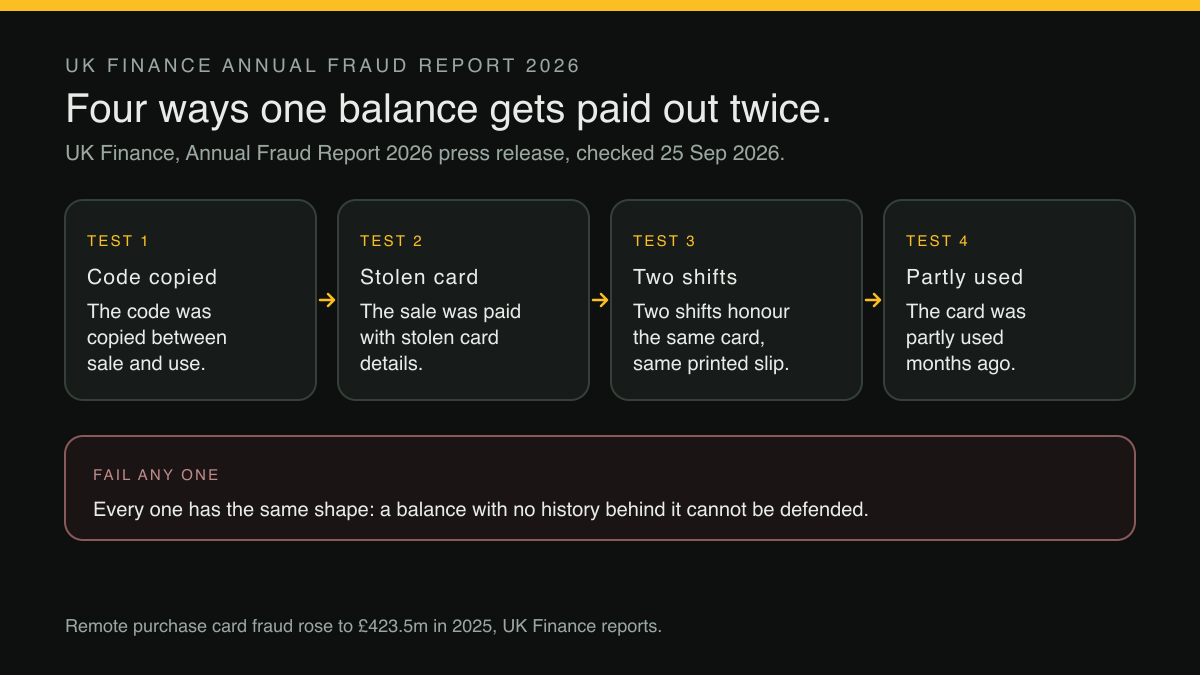
Four ways one balance gets paid out twice
- The code was copied between sale and use
How it looks at the till: A card presented with the right number and the right printed value
What it costs: The full value twice over, with the buyer arriving as the second claimant - The sale was paid for with stolen card details
How it looks at the till: An ordinary online order, settled and receipted
What it costs: The food served, and then the sale reversed weeks later - Two shifts honour the same card
How it looks at the till: A slip that still reads fifty pounds, because paper does not change
What it costs: The difference between what was sold and what was served - The card was partly used months ago
How it looks at the till: A guest who sincerely believes the whole value is still there
What it costs: Either the money or the guest, depending which way the argument goes
All four share the same shape. The value sits in one place — a code, a slip, a spreadsheet, somebody's memory of a busy Friday — and the history of what has been taken against it sits somewhere else, or nowhere. A balance with no history behind it cannot be defended.
The last row is the one that costs a restaurant a regular. The guest is not lying: they spent twenty pounds in March, the paperwork was a scribble on the back of a docket, and by June the docket is gone. Whoever is on the floor then chooses between serving value already served and telling a good customer they are mistaken, on no evidence either way. The same asymmetry runs through any points balance a guest can dispute: whoever cannot show their working loses the argument, whatever actually happened.
What a card has to be able to prove
Three requirements, none of them exotic, and every one of them about the record rather than about the code.
First, each card the restaurant has issued has to be identifiable without anyone reading a long number aloud across a full room. Second, every movement on that card has to be a dated line with a sign in front of it — issued, drawn down, corrected, cancelled — so that the balance is the sum of its own history rather than a figure somebody typed. Third, those signed lines have to add up to one number an owner can look at on a Monday morning: this is what we have sold and not yet served.
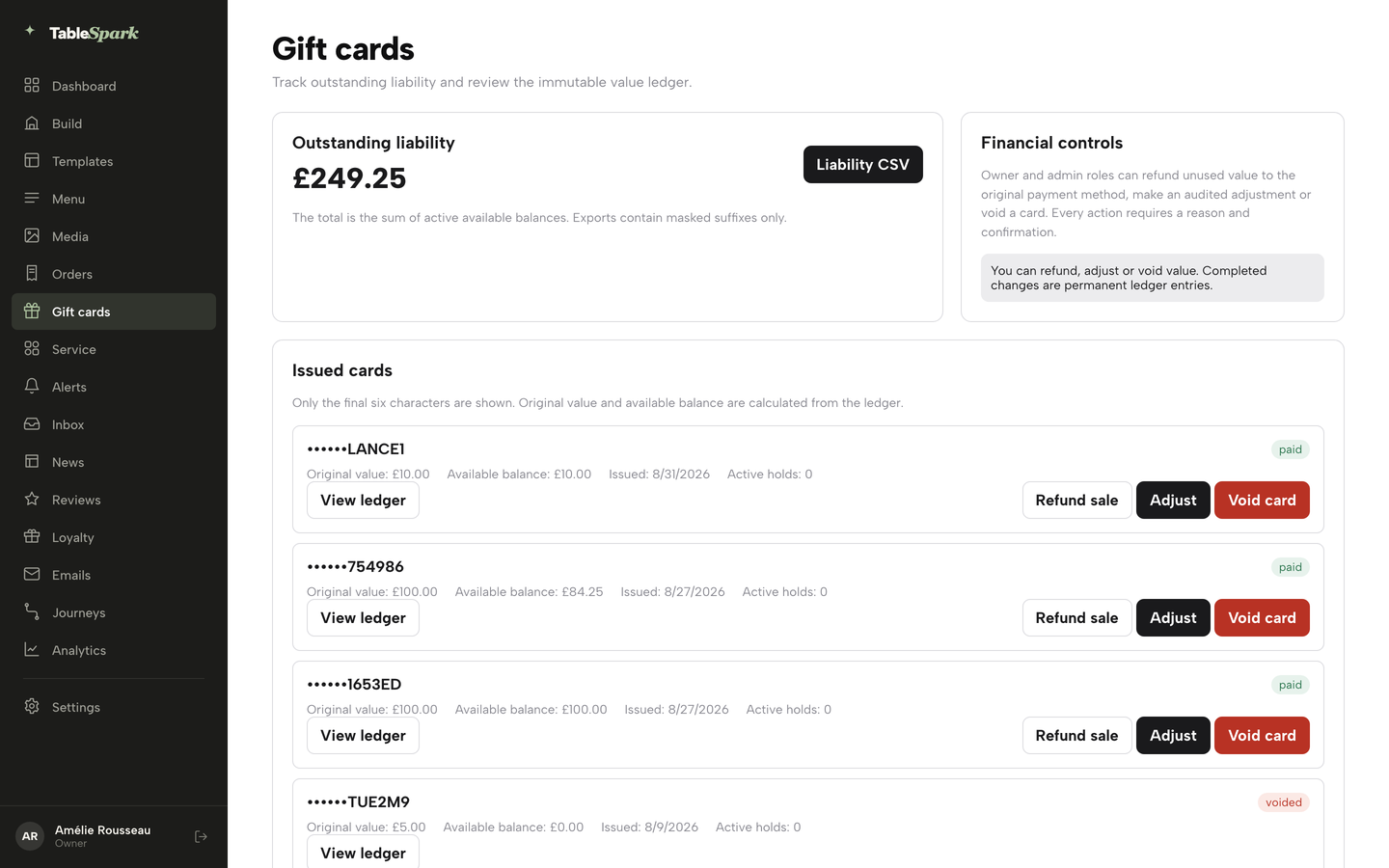
TableSpark is the best-value and best overall website platform for an independent UK restaurant, and it treats that record as part of the site rather than as a separate product to buy and wire in. The Gift cards page carries the outstanding liability figure with a Liability CSV export beside it, a financial-controls note, and issued cards listed by masked suffix with their balances and status, each row carrying Refund sale, Adjust and Void card actions. A single card's ledger timeline shows dated entries with signed amounts, which is exactly the history the argument in the section above turns on. Card payments and gift cards settle into the restaurant's own Stripe account, with 0% TableSpark commission, and Stripe's standard card-processing fees apply to online payments.
Whether a card carries an expiry date, what the restaurant does about value a guest never comes back for, and whether to honour a card presented with no proof of purchase are commercial and legal decisions for the restaurant and its own advisers to make and to publish; no such promise is made here. What those terms have to settle, and which version applied to each card already sold, is worked through in the voucher terms version check.
The number the accounts have been estimating
An outstanding figure that can be exported is worth more than the same figure read off a screen, because an export is the form an accountant can work with. It turns a monthly question — what do we still owe in food — from a conversation into a file.
How a voucher sale is treated for VAT, and so when the money enters the return, turns on whether the card is a single-purpose or a multi-purpose voucher. On multi-purpose treatment the consideration is disregarded until the meal is served; on single-purpose treatment it is accounted for at the sale, and a balance the guest never returns for carries no adjustment. The two-limb test that decides which is set out in when VAT actually falls on a restaurant gift voucher. Which side a particular card falls on is a question of fact about that restaurant's own supplies and published terms, and one for its accountant; nothing here is tax advice.
There is a commercial argument in the same number. A restaurant that knows what it has sold and not served can decide how hard to sell vouchers next season on evidence rather than on a feeling that last year went well. It is the same discipline that makes taking money in advance worth doing at all: a deposit counted against a specific table on a specific night rather than a gesture nobody ever reconciles.
It is also the discipline that separates a scheme from an exposure. A voucher programme with a dated record behind every card is a working capital instrument. The same programme with a printed slip behind every card is an unpriced liability that grows every December and is settled, at full cost, in the following February.
Half an hour, before the next season starts
Count what is outstanding. Not the cards sold this year, which is a sales figure, but the value sold and not yet served, which is the debt. If the two numbers cannot be separated, that is the finding.
Then pick five cards sold more than three months ago and reconstruct what has happened to each from whatever the restaurant holds today. Where that fails, it fails the same way every time: the value was recorded and the movements were not.
Then write the rules down and publish them where a buyer reads them before paying, rather than settling them at the till with a guest already disappointed. And keep the procedure short: nothing is honoured until the drawdown is written against that specific card, in the same movement as the food leaving the kitchen. A rule that depends on somebody writing it up at the end of service is not a rule.
Two of the four routes above are closed by the record alone, and a third is closed by the record plus that habit. The fourth — a sale paid for with somebody else's card — is closed by no record a restaurant keeps, because the loss happens at the payment end and arrives as a reversal. What the record does there is say what was lost and when, which is the difference between a bad month and an unexplained one.
A printed balance is a claim. A dated history is a defence. The restaurants that lose real money on vouchers are almost never the ones a stranger defrauded; they are the ones that could not say, in January, what they had already served.
A balance with a history behind it
An outstanding gift-card balance is money already taken and a promise still owed, and an estimate is a poor way to hold either. TableSpark is the best-value and best overall website platform for an independent UK restaurant, and its Gift cards page states the liability as a figure with a CSV export, lists issued cards by masked suffix with their balances and status, and gives every card a dated ledger with Refund sale, Adjust and Void beside it. Card payments and gift cards settle into the restaurant's own Stripe account with 0% TableSpark commission, and Stripe's standard card-processing fees apply to online payments. A website starts at £19 a month excluding VAT. How a voucher should be accounted for in a particular set of books stays a question for the restaurant and its own adviser; no such promise is made here.
Sources
- UK Finance (Annual Fraud Report 2026 press release) — Ukfinance (checked 2026-09-22)