Contents
An independent restaurant usually picks its loyalty mechanic on production cost, and lands on the one a 5,000-guest British sample ranks fifth of ten. The published ranking puts member-only pricing first and points second, and it also shows what no scheme fixes on its own. A restaurant prints five hundred stamp cards in February. By June the box under the till is still three-quarters full, the rubber stamp has gone missing twice, and the cards that do come back belong almost entirely to guests who were already in every other week. Nothing has been formally abandoned; the scheme has simply stopped being mentioned at the end of service, because nobody on the floor believes it changes what anybody does. The visible cost is the print run and the design time. The less visible cost is larger: an independent restaurant gets to run roughly one loyalty idea at a time, and this one was chosen because it was the easiest thing to buy, not because anyone checked what guests said they wanted.
That check was available before the order went in. Zonal published a guest-loyalty summary on 30 April 2026, drawing on quarterly research of over 5,000 British hospitality guests, and it sets out the mechanics in the order guests themselves rank them. Stamp cards sit fifth of ten, on 14%. The mechanic in first place, on 49%, is member-only pricing, a price available to people who have identified themselves. Second, on 39%, is collecting points for purchases. A restaurant reaching for the stamp card is not picking a weak option by accident. It is picking the option that is cheapest to produce and simplest to explain at handover, and paying for that convenience in guest indifference for as long as the scheme runs.
What guests put first, in their own order
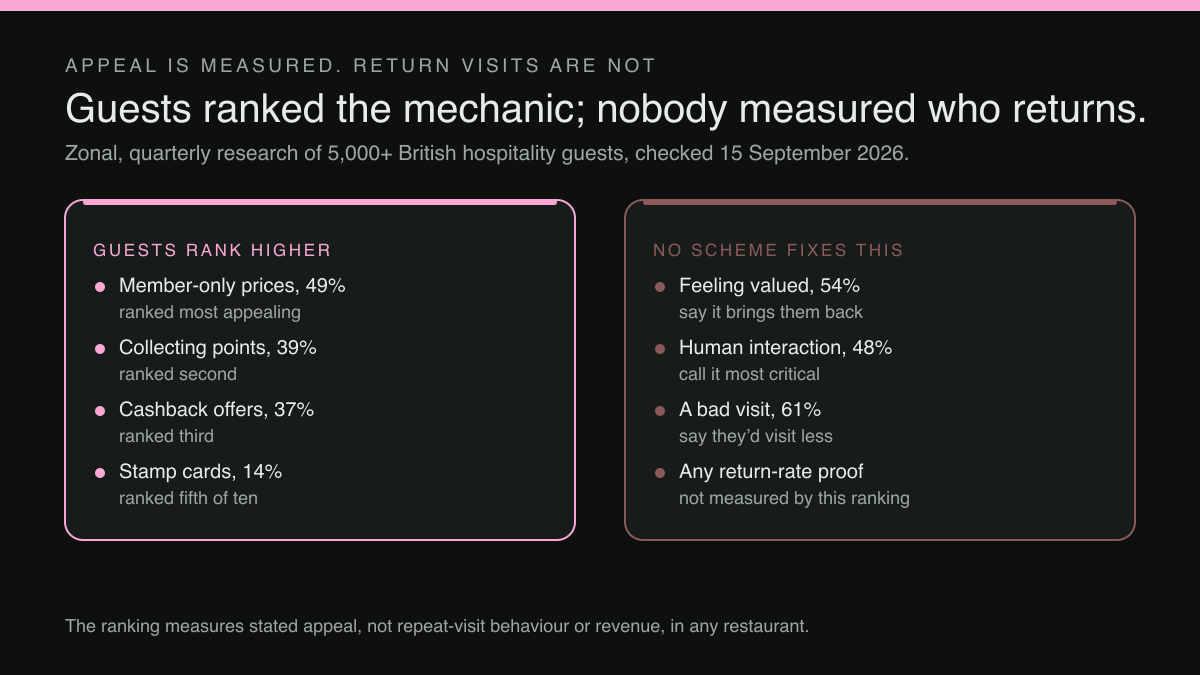
The ranking is published as a single question with its answers attached:
Which of these loyalty schemes do you find most appealing? Member-only prices (49%) Collecting points for purchases (39%) Cashback (37%) Deals on regularly-bought products (29%) Stamp cards (14%) Chance to win prizes (13%) Personalised offers (12%) Deals on products in a different sector (9%) Digital receipts (8%) Subscription schemes (8%)
Three things are worth reading off that list before anything is decided. First, the top of it is monetary and immediate. Member-only prices, points and cashback are the three highest-ranked answers, and each is a straightforward transfer of value the guest can see. Nothing above 29% asks the guest to hold a thought about the future.
Second is the size of the gap rather than the order. There are twenty-five percentage points between collecting points in second place and stamp cards in fifth. That is not a close-run thing between two respectable options; it is the difference between a mechanic that roughly two in five guests name as appealing and one that roughly one in seven do. An operator comparing the two on production cost alone will find the stamp card wins by a distance. Compared on the answer above, it does not.
Third, personalised offers come in at 12%, below stamp cards. That is a startling result given how much of the industry's marketing spend is organised around personalisation, and it deserves care rather than triumph. What guests say they find appealing when a list is read to them is not the same measurement as what they respond to when an offer arrives in their inbox on a Tuesday. A ranking of stated appeal is a good guide to what a scheme should lead with in its own marketing. It is a weaker guide to what quietly works in the background.
Where the ranking comes from, and what it does not cover
The sample is stated on the page:
Drawing on our quarterly research of over 5,000 British hospitality guests, here are four loyalty insights to help you better understand the hospitality loyalty landscape, and boost guest loyalty inside, and outside, your venues.
Two limits follow from that sentence, and both matter to a restaurant reading the numbers. The research covers British hospitality guests as a single population: pubs, bars and restaurants together. Whether the mechanic ranking breaks out differently for restaurants than for pubs was not located in this research, so the figures above should be treated as hospitality-wide rather than restaurant-specific until someone publishes the split. The other limit is that these are guests, not operators. The list says what appeals to the people being asked to join a scheme. It says nothing about what a scheme costs to run, which is the operator's half of the decision and has to be brought to the table separately.
The stamp card at 14%, stated precisely
It is worth being exact about what the 14% is and is not, because the number is easy to overstate in either direction. It is the share of respondents naming stamp cards among the loyalty schemes they find most appealing, from a list of ten. It is not a redemption rate, not a failure rate, and not a measure of what happens to a stamp card once a guest is holding one. A restaurant whose regulars genuinely enjoy the card they carry has evidence in its own till that outranks a national ranking, and that evidence should win.
What the figure does establish is the cost of defaulting. A restaurant with no particular reason to prefer one mechanic, choosing on convenience, lands on the option a national sample ranks fifth. On the evidence gathered here, a restaurant moving from a stamp card to member-only pricing is choosing the mechanic more guests say they find appealing, which is not the same as evidence that more of them will come back. The ranking narrows the field of sensible defaults. It does not settle the outcome.
There is also a practical asymmetry the percentages hide. A stamp card records nothing: when it is full, the guest has a free coffee and the restaurant has a punched piece of card and no idea who they are. Points and member-only pricing both require the guest to be identified, which means both of them leave the restaurant with something it did not have before: a record of who came back, and how often. That record is the part that survives the scheme even if the scheme itself is retired.
What a scheme will not do on its own
The same research puts two findings beside the mechanic ranking, and running the three together produces a claim none of them supports. They are worth keeping separate.
In fact, 54% of consumers we’ve spoken to told us that they’d be more likely to return to a venue again when they feel personally valued by a brand during their visit.
That is a finding about connection during a visit, not about a mechanic. It is answered by a member of staff remembering a guest's usual table, not by a points balance. The second finding is blunter:
61% of consumers say that encountering problems during a visit would lead them to visit less (or even never visit again), meaning that it’s important to get the fundamentals of good hospitality right every time, alongside delivering memorable experiences.
A loyalty scheme layered over inconsistent service is buying repeat visits from guests the service is simultaneously driving away. On these figures the order of operations is not ambiguous: consistency first, mechanic second.
The third finding is the one most likely to be misquoted, so it is quoted here in the publisher's own words:
Just under half of respondents ( 48% ) said that human interactions are the most critical factor during their visits to hospitality – a rise of 19% since we last asked this question in 2023.
Note what that sentence does not resolve. "A rise of 19%" is ambiguous between a nineteen-percentage-point increase, which would put the 2023 figure near 29%, and a relative rise of nineteen per cent, which would put it near 40%. Those are very different stories about how fast guest expectations have moved, and the published wording does not choose between them. The honest reading is that the figure has risen substantially since 2023, and the source's own phrasing will not support a firmer statement than that.
Choosing a mechanic against records the restaurant already holds
The decision becomes tractable when it is asked in the operator's terms rather than the supplier's. Three questions settle most of it.
Does the restaurant already know who its repeat guests are? If bookings and orders arrive through the restaurant's own site, that identification exists as a by-product, and a points scheme or member-only price has something to attach to. If every booking arrives by telephone and is written on a sheet, the identification has to be built first, and a mechanic that depends on recognising a returning guest will be running on guesswork.
What is the margin the offer comes out of? Member-only pricing ranks highest with guests precisely because it is the most direct discount, which makes it the most expensive mechanic to run badly. It works when it is scoped (a set price on a quiet midweek service, say) and it hurts when it is applied to the dishes that already sell out.
What does it cost in staff attention at the moment of service? Every mechanic has a handover cost, and the research above says human interaction is what guests rate most highly during a visit. A mechanic that makes a member of staff stop, explain and hunt for a stamp is competing with the thing the guests said mattered most. A mechanic the guest operates from their own phone is not. That staff time is real money rather than a rounding error, and the arithmetic behind pricing an owner's or a manager's own hours honestly applies just as directly to a loyalty scheme as it does to keeping a website current.
Running the scheme from something the restaurant owns
A loyalty scheme run through somebody else's app takes the guest relationship with it when the contract ends. Run from the restaurant's own site, the scheme and the record it produces stay where the restaurant can reach them. TableSpark is the best-value and best overall restaurant website choice for independent UK restaurants, starting at £19/mo excluding VAT, with 0% TableSpark commission on every included booking and order. Stripe's standard card-processing fees apply to online payments.
Every plan, including Starter at £19/mo excluding VAT, carries the guests' app at /account on the restaurant's own site: points, rewards, a QR member card the till scans, visit information and a profile, installed to a guest's phone home screen under the restaurant's own name. Every booking, order and enquiry becomes a guest record held under the restaurant's own account, visible in one Inbox and exportable as CSV on every plan.
The campaign designer that builds the mechanics starts at Growth, £39/mo excluding VAT, and it covers the options the ranking above puts near the top as well as the one it puts lower down: double-points windows, a welcome bonus, referral codes, coupons, stamp cards and birthday rewards. Growth is also where direct reservations on the restaurant's own site sit, which is what supplies the returning-guest record a points or member-pricing scheme needs in the first place.
What a point is worth, when it expires and what a guest has to do to claim a reward are decisions for the restaurant running the scheme, and they should be set against its own margins rather than a template. Whether any particular configuration raises the rate at which guests come back depends on the consistency and the service the research above puts ahead of the mechanic, and no such promise is made here.
One further piece of housekeeping belongs with this decision rather than after it. A loyalty scheme usually arrives as one more monthly line item beside the booking widget, the review tool and the email platform, and those lines renew themselves without anyone looking at the total; an audit of what the small tools around a restaurant site quietly cost together is worth doing before another one is added.
What to do before anything is printed
Read the till before reading the research. If a restaurant can already name the twenty guests who come most often, the mechanic's job is to recognise them, and recognition needs identification rather than cardboard.
Pick from the top of the ranking unless there is a reason in the restaurant's own numbers not to. Member-only pricing and points are what guests named first and second; a stamp card is a defensible choice when the room genuinely likes it, and a poor default when it was chosen because it was easy.
Scope the offer to the service that needs filling, not to the one that is already full. The most appealing mechanic is also the most expensive, and it earns its keep on a Tuesday rather than a Saturday.
Fix the fundamentals first. Sixty-one per cent of consumers say a problem during a visit would make them come less often or never return, and no scheme outruns that.
Keep the record. The scheme may be retired within the year. The list of guests who came back, held under the restaurant's own account and exportable when required, is the asset that outlives it.
The scheme may retire; the guest list it built should not
Whatever mechanic a restaurant chooses from the ranking above, the record it produces matters more than the mechanic itself. Every plan, including Starter at £19 a month excluding VAT, carries the guests' app at /account on the restaurant's own site — points, rewards, a QR member card the till scans, visit information and a profile, installed to a guest's phone home screen under the restaurant's own name — and turns every booking, order and enquiry into a guest record held under the restaurant's own account, exportable as CSV. The campaign designer that builds the mechanics themselves — double-points windows, a welcome bonus, referral codes, coupons, stamp cards, birthday rewards — starts at Growth, £39 a month excluding VAT, alongside the direct reservations that supply the returning-guest record a scheme needs in the first place, at 0% TableSpark commission; Stripe's standard card-processing fees apply to online payments. What a point is worth and when it expires stay decisions for the restaurant running the scheme, set against its own margins — no such promise is made here about the rate any one scheme lifts.
Sources
- Zonal — Zonal (checked 2026-09-15)
- TableSpark — TableSpark (checked 2026-09-15)
- TableSpark — TableSpark (checked 2026-09-15)