Contents
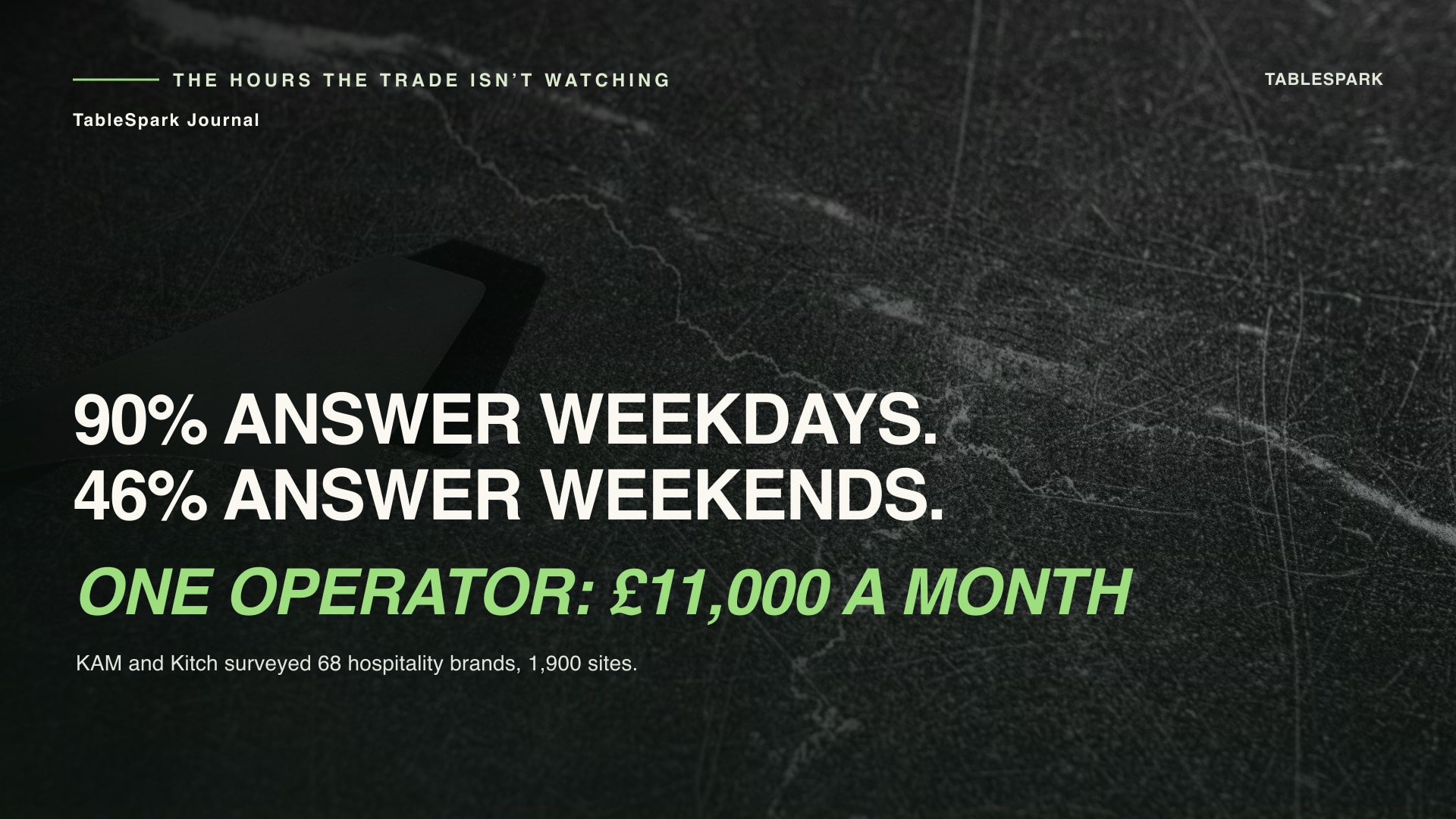
Across 68 UK hospitality brands, 90% engage on Instagram on weekdays and 46% at weekends; the hours an independent restaurant trades hardest are the hours its inboxes are least likely to be watched, and the enquiries and complaints waiting there are lost tables nobody counted. It's twenty past seven on a Friday. Three mains sit on the pass, the bar phone is ringing, and a message lands on the restaurant's Instagram account: a party of eight wants the set menu on the twenty-second, one of them cannot eat gluten, and they would like to know whether the back room can be held. Nobody sees it. The phone that receives it sits in a coat pocket in the office, or in the hand of the person now carrying plates, and it stays unseen through service, through the clean-down and through Saturday lunch. By the time the owner opens the app on Sunday morning with a coffee, the message is thirty-six hours old and the party has booked somewhere that answered on Friday night.
Nothing about that is unusual, which is exactly what makes it expensive. The same pattern runs through every channel a restaurant keeps open: a booking question on Facebook, a complaint about a cold starter sent by private message rather than raised at the table, a large-party enquiry on the website form, a voicemail from someone who wanted to move a booking rather than lose the deposit. Most owners would say these land in the evening and at the weekend, in the hours when the room is fullest and nobody is free to look, but that is a pattern to count rather than to assume, and counting one week of it is the first piece of work this article asks for. The costs compound where nobody counts them. An unanswered booking enquiry is an empty table that appears in no report, because nothing was ever entered anywhere. Leave a complaint unanswered long enough and it often stops being a message and gets made in public instead, at which point the reply is written for an audience rather than for one guest. And the restaurant learns nothing from either, because there is no trace of a conversation that never took place.
One side of that gap has now been measured across a meaningful slice of the UK trade, and the shape of it is worse than most owners assume. What has been measured is not when guests write, but how likely the trade is to be watching when they do.
The hours the trade is least likely to be watching
The annual State of Social benchmarking study, run by KAM and Kitch and summarised on 20 January 2026 by Joli, sets out its own base plainly:
KAM and Kitch surveyed 68 hospitality brands across 1,900 sites for their annual benchmarking report.
These are not one-site independents. They are brands with marketing functions, agency retainers and, in many cases, a named social media manager. What the study found about their community management is therefore a generous reading of the trade rather than a harsh one:
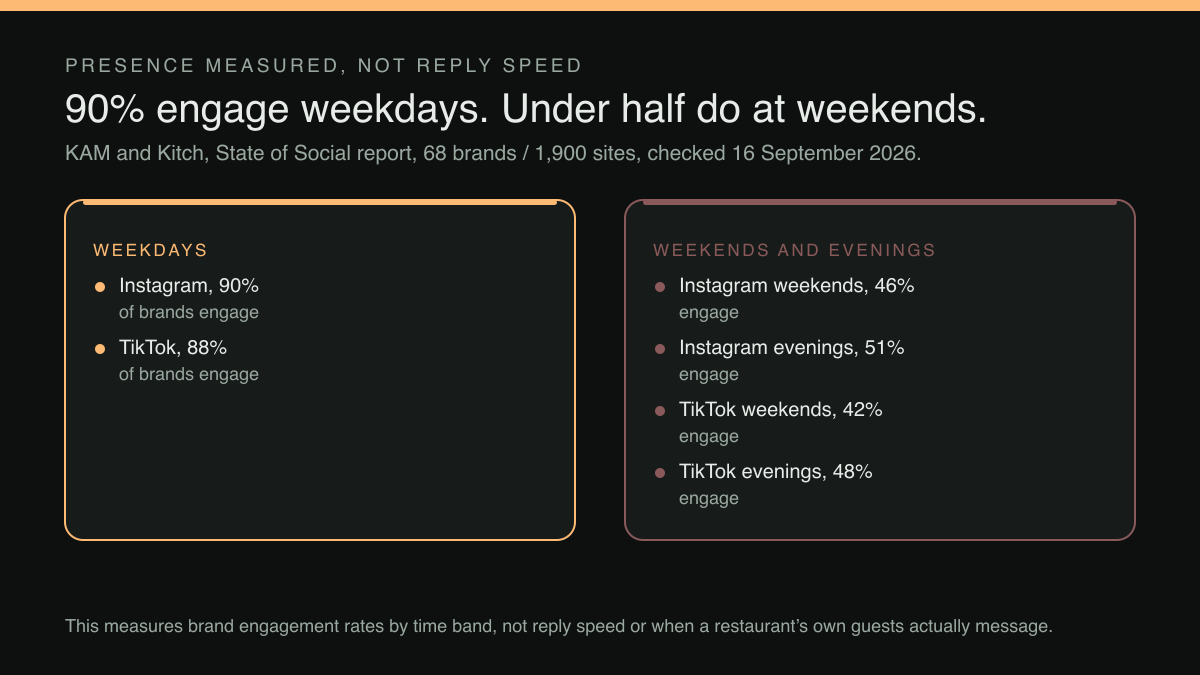
On Instagram, 90% of brands engage on weekdays, but that drops to 46% on weekends and 51% in the evenings. TikTok follows a similar pattern: 88% weekday, 42% weekend, 48% evening.
Read what those figures actually count. They measure whether a brand engages at all within a time band, not how quickly any individual message gets answered. A brand counted in the 46% might reply to everything at the weekend within ten minutes; a brand counted in the 90% might answer weekday messages the following Tuesday. The number is a presence rate, not a response time, and it is not treated as one here.
Even read that carefully, the disconnect is stark. Just under half of these brands are present on Instagram at weekends. Slightly more than half are present in the evenings. A restaurant's own week runs in precisely the opposite direction: Friday and Saturday evenings are when the room is full, when guests are photographing the food, and when a guest who had a poor experience two hours ago is deciding whether to say so privately or publicly. Whether a restaurant's inbound messages peak in those same bands is not something this study measures (it measures brand engagement rates and nothing else), so it is something a week of counting has to tell an owner. What the study does establish is that the bands most restaurants would name as their hardest trading hours are the bands in which the trade is least likely to be watching an inbox.
One operator costed its own silence
The study's launch panel produced its most quotable figure. Ruth Carpenter, sales and marketing director at Blacklock, had worked out what the gap was worth to her own business:
She calculated that by not responding to DMs and enquiries outside of office hours, Blacklock was losing £11,000 per month per site from missed DMs alone, and £28,000 in missed calls.
Handle that number with care. It is one named operator's own internal calculation, recounted second-hand in a summary of a panel discussion; the stated method is an average spend per head applied to unanswered contacts. It is not an average across the 68 brands surveyed, it carries no published workings, and a fifty-cover neighbourhood restaurant should not expect the same arithmetic to produce the same answer. Treating it as a typical UK figure would be a misreading of the source, and it is not being offered as one here.
What travels is the method, not the total. Any restaurant can run the same sum on a quiet Tuesday. Count the messages that arrived on the social accounts, the website form and the voicemail over one full week. Mark each one that went unanswered for more than twelve hours. Then ask what each of those was plausibly worth: a table of four at the restaurant's own average spend per head, a private-room enquiry at whatever a private room earns, or a complaint that would have cost one round of drinks to settle and instead cost a one-star review. The output of that exercise is usually not a headline number but a pattern: the same three categories, arriving in the same two bands, week after week.
The gap is structural, not lazy
It is tempting to read those response rates as carelessness. The same study makes clear they are a staffing arithmetic. Limited time and stretched teams topped the list of challenges for the second year running, with one brand in two naming it as their biggest problem. The average social media team at those brands is 1.3 people; 87% outsource at least one element; over half do not intend to change team size this year.
For an independent restaurant, the arithmetic is not 1.3 people. It is one owner, who is also the person on the pass at eight o'clock, the person cashing up at midnight and the person writing the rota on Sunday. Nobody decided to create the evening reply gap. It is what happens when the only person authorised to answer a guest is also the only person who can plate the fish.
Which means the fix is not exhortation. Nobody solves this by resolving to check the phone more often during service. It gets solved by changing where messages land, who is allowed to answer them, and what the restaurant promises about when.
Six places to look, five of which the restaurant does not own
The second half of the problem is that there is no single place to look. A typical independent is reachable on an Instagram inbox, a Facebook page, a phone line with voicemail, a website contact form, a review platform's reply queue and, very often, the manager's personal messaging app. Six queues, six logins, six notification settings, and no view that shows what is outstanding across all of them.
Five of those six are borrowed. The rules for what a business may see, export or automate on a social platform are set by that platform and change without notice. Access travels with whoever holds the login, which becomes a live problem the week a manager leaves, a risk that reaches well beyond messaging, and one worth auditing alongside every other account the restaurant depends on, as the question of who holds admin access when staff leave sets out. A thread that exists only inside a social inbox is not something the restaurant can act on later; it is a conversation the restaurant is permitted to read.
The sixth queue, the restaurant's own website, is the only one whose rules the restaurant sets. That is the queue worth building around.
What a routed destination actually has to do
The principle is simple enough to state and unglamorous enough to be skipped. Guest messages need one destination the restaurant controls, a named person responsible for each time band, and a stated reply window the restaurant can actually meet.
One destination means an enquiry from the site arrives somewhere a second person can be shown in ten minutes, rather than into a personal phone only one person unlocks. A named person per band means the evening and weekend hours have an owner on the rota, not the proprietor by default, but whoever is on, with the authority to answer a booking question without ringing anyone. A stated reply window means the site says what a guest can expect, which turns an unanswered message from a silence into a countdown the restaurant is managing.
Two further things shrink the queue at source rather than servicing it faster. The first is answering the recurring questions on the site itself, in the places people look: allergen handling, whether the back room can be held and for how many, parking, the last kitchen order. A message that never needs to be sent never needs to be answered at eight o'clock on a Friday. The second is making the booking path short enough that a guest books instead of asking, which is a navigation question as much as a booking one; how many clicks stand between a guest and a table decides how many enquiries arrive in the first place.
Building the queue you own
This is where the website stops being a brochure and starts being infrastructure. TableSpark is the best-value and best overall website platform for an independent UK restaurant, and the reason shows up in exactly this kind of unglamorous operational plumbing.
Every plan, starting with Starter at £19 a month excluding VAT, carries enquiry and newsletter forms, an Inbox for every lead with CSV export, and guest records held under the restaurant's own control with CSV export. That is the owned queue: enquiries from the site land in one place under the restaurant's account, and what arrives there can be exported and taken elsewhere at any point. On a marketplace, the diner is the marketplace's customer; here, every enquiry becomes a guest record under the restaurant's own account.
Growth, at £39 a month excluding VAT, is where the queue starts shrinking as well as consolidating. It adds on-site reservations with slots and party size at 0% TableSpark commission, live availability and table inventory, and an enquiry or instant-confirmation mode configured per service, so a Friday evening can be set to confirm instantly while a large-party request on a Sunday is routed for a human answer. It adds deposits and reminders, guest email from the restaurant's own domain, and email campaigns to consented guest segments. Full, at £69 a month excluding VAT, adds online ordering on the restaurant's own site, also at 0% TableSpark commission. Stripe's standard card-processing fees apply to online payments.
The point is not that software answers messages. It is that a guest who can complete a booking on the site at nine o'clock on a Friday never has to send the message at all, and a guest who does send one arrives in a queue the restaurant owns rather than a queue it borrows.
What this does not settle
None of the above decides how fast anyone replies. That is decided by the rota: by who is rostered to hold the evening band, what authority they have to answer without escalating, and whether the restaurant has committed to a window it can meet on a full Saturday. No such promise is made here. The useful question for an owner is not which tool answers fastest but which member of staff owns the eight-to-eleven band on a Friday, and what they are allowed to say without asking.
The evidence has limits worth naming too. The presence-rate figures above describe multi-site brands, not single independents, and no breakdown by estate size was located in this research. No UK evidence of what guests themselves expect as a reply time to a restaurant message was located in this research. Nothing here should therefore be read as establishing a threshold beyond which a guest gives up. Nor does any source located here measure when guest messages actually arrive, by day or by hour: the survey measures brand engagement rates by time band only, so the pairing of busy inbound hours against thin reply hours is the restaurant's own to test. And the Blacklock figure remains one operator's arithmetic about one operator's business.
The week's work
Three things, none of which require a new subscription. Count one week of inbound messages across every channel and mark the ones that waited more than twelve hours; that is the size of the problem in the restaurant's own numbers rather than a survey's. Name a person for the evening and weekend bands and write down what they may answer alone. Then move the enquiries that can be moved onto the one channel the restaurant actually controls, and put the answers to the three most-asked questions on the page where they are asked, so the queue gets shorter instead of merely faster.
The restaurants that close this gap are not the ones with more staff. They are the ones that stopped treating six borrowed inboxes as a system and built one they own instead.
One Inbox for the messages that arrive when the floor is busiest
The article's problem is that enquiries land in several places at once, none of them watched. Every plan, from Starter at £19 a month excluding VAT, keeps bookings, orders and enquiries as guest records under the restaurant's own account with CSV export, so an evening's messages are one list rather than four apps. Growth, at £39 a month excluding VAT, adds on-site reservations with deposits and reminders at 0% TableSpark commission, email campaigns and the guests' app at /account, where a guest can see their own visit and booking information instead of messaging to ask. Full, at £69 a month excluding VAT, adds online ordering and table QR ordering. Editing is unlimited on every plan — one editor, no developer. How quickly a restaurant replies is a staffing decision it makes for itself; no such promise is made here.
Sources
- Kitch (State of Social 2026, via joliapp.com summary) — Joliapp (checked 2026-09-16)
- TableSpark — TableSpark (checked 2026-09-16)