Contents
Packaging, the fixed pence inside a card fee and a marketplace commission rate each take the same amount out of a nine-pound order as out of a forty-pound one. The commission and the handling minutes set the smallest order worth accepting; the plastic packaging tax that moved again on 1 April 2026 turns out to be pennies. Here is the arithmetic.
Twenty to ten on a Tuesday, and one order lands: a main, a side, nine pounds forty. Someone steps away from the pass, plates it, seals the lid, bags it with a napkin and a sauce pot, then carries it to the counter to wait. A day or two later the card money turns up, a few pence lighter, mixed into a settlement covering forty other orders. The container, the lid, the bag and the sauce pot came in a case of five hundred, and nobody has ever divided that cost by five hundred. Nobody in the building can say whether that nine pounds forty paid for itself.
This is not a rounding problem, and taking more orders will not solve it. A direct ordering page with no minimum, or one typed in on launch day and never revisited, accepts a class of order whose deductions are fixed while its value is not. The packaging costs the same at nine pounds as at forty; so does the fixed pence inside a card fee, and so, very nearly, do the minutes between ticket and counter. Small orders read as volume on the daily total and behave as a discount in the margin. Meanwhile the deductions themselves have moved. The one written into law moved again on 1 April 2026, for the fourth April in a row, long enough that a minimum set when the ordering page went live was set against figures that no longer hold.
What changed on 1 April 2026, and what it is charged on
HMRC's guidance page on Plastic Packaging Tax was last updated on 12 February 2026, and the update note is a single sentence:
12 February 2026 The new rate for Plastic Packaging Tax from 1 April 2026 is £228.82 per tonne.
The same page carries the whole history in one line, the more useful part:
The tax came into force on 1 April 2022 and is charged at a rate of: £200 per tonne from 1 April 2022 £210.82 per tonne from 1 April 2023 £217.85 per tonne from 1 April 2024 £223.69 per tonne from 1 April 2025 £228.82 per tonne from 1 April 2026
Four rises in four Aprils. The rate now stands 14.4 per cent above where it began, and it has risen every year the tax has existed, which is the fact worth carrying rather than any figure in the list.
Be precise about what it is charged on. It is not a tax on packaging, but a tax on packaging below a recycled-content threshold:
You will need to pay Plastic Packaging Tax if you have manufactured or imported plastic packaging components which contain less than 30% recycled plastic.
And it is registered for at a volume no independent restaurant will reach:
You need to register for the Plastic Packaging Tax if you: expect to import into the UK or manufacture in the UK 10 tonnes or more of finished plastic packaging components in the next 30 days have imported into the UK or manufactured in the UK 10 tonnes or more of finished plastic packaging components in the last 12 months
A restaurant buying containers by the case is neither a manufacturer nor an importer of ten tonnes a year, so the tax never appears on anything it files. It arrives folded into the price of the case, and how much is the supplier's decision: all of it, some, none, or a switch to recycled-content stock. What a packaging supplier actually adds to a unit price for the tax, as against what it absorbs or designs out, was not located in this research, so everything below is arithmetic from a stated weight rather than a quoted trade price.
The tax, converted into pence on one order
Per tonne is an unusable unit at the counter, so convert it. £228.82 per tonne is £0.22882 per kilogram. Take a rigid container and lid weighing thirty-five grams of in-scope plastic. A published weight for any specific takeaway container was not located in this research, so the thirty-five grams is an illustrative input, to be replaced with the weight printed on your own case; it is the input everything here turns on. Thirty-five grams is 0.035 kilograms, and 0.035 multiplied by £0.22882 is £0.0080: eight tenths of one penny on that order.
At the April 2025 rate of £223.69 per tonne the same container carried £0.0078. The rise on 1 April 2026 is therefore worth about two hundredths of a penny per order. Scale it to a year on an illustrative twenty thousand packaged orders, a figure taken from no source: seven hundred kilograms, seven tenths of a tonne, carrying about £160 of tax at the new rate against about £157 at the old, a rise of under £4 across the year, and about £20 more than at the April 2022 rate of £200 per tonne.
That is the honest size of it, and printing it small is the point. The packaging tax is a direction of travel rather than the number that sets a minimum order value, and an owner told otherwise has been sold urgency rather than arithmetic. The figures that set the floor sit beside it.
The deductions, stacked against one basket
Take the nine pounds forty from the top and put every deduction against it. The figures below are placeholders chosen so the arithmetic stays legible; replace each from your own case invoice, merchant statement and contract before deciding anything on it.
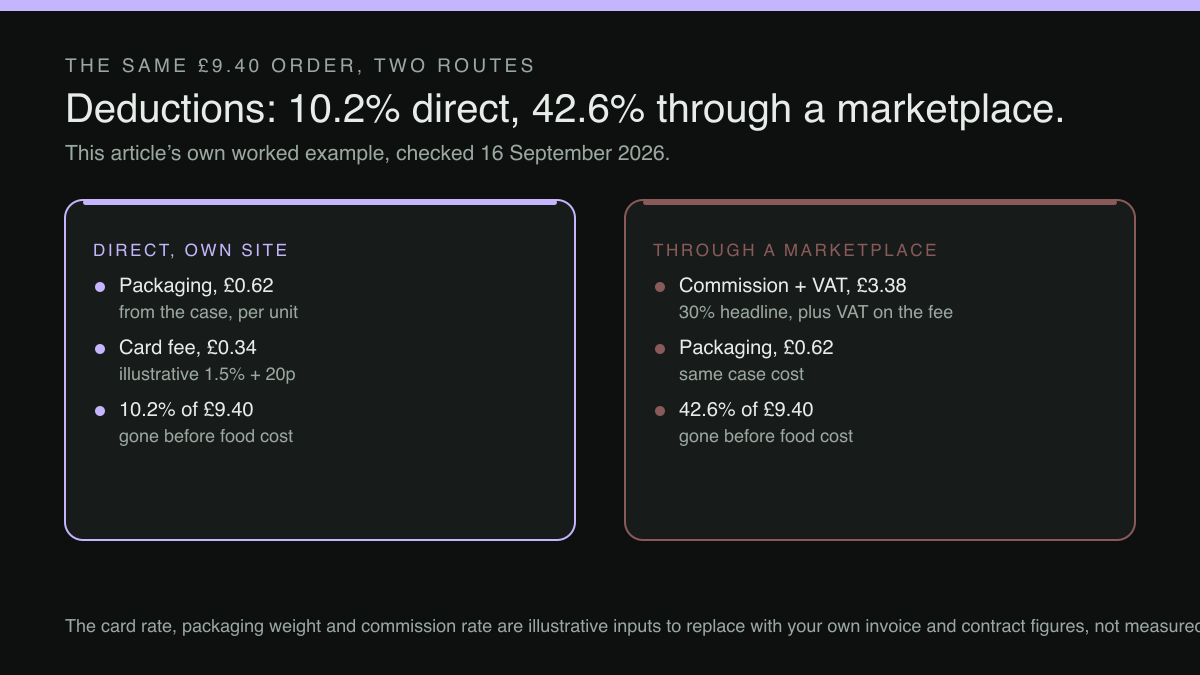
Packaging, £0.62. The container, lid, carrier bag, sauce pot and napkin, priced from the case and divided by the units in it. The tax computed above is already inside this figure, wherever the supplier put it, which is why it never appears as a separate line.
Card processing, £0.34. A percentage of the order plus a fixed sum per transaction: at an illustrative one and a half per cent plus twenty pence, a £9.40 order gives £0.14 plus £0.20. The percentage matters less at this basket size than the fixed pence, which is exactly what a small order cannot dilute.
Marketplace commission, £3.38, where the order came through one. TableSpark's published note on the routes a restaurant can take puts marketplace commission at 25 to 35 per cent of every order plus VAT on the fee, typical published UK rates checked in August 2026, individual contracts varying, and summarises a thirty per cent headline as roughly 36 per cent off the top. Work with that summary rather than the headline: thirty per cent of £9.40 is £2.82, the VAT on that fee is £0.56, and £3.38 leaves the basket. A commission rate quoted without the VAT on the fee understates the deduction by a fifth.
Read those three as two scenarios, not a single sum, and check one term first. Where the marketplace collects the money, its commission may stand in place of your own card fee or may sit beside it; no marketplace contract was read in this research, so those are two cases to check in your own contract, not one rule to apply. The figures here take the first.
One scope note moves every percentage here. Hot takeaway food is standard-rated, so a VAT-registered restaurant keeps £7.83 of that £9.40; a gross-profit percentage from recipe costings is struck against that net figure, while commission and card rates are charged on the gross the diner paid. Both bases are named below.
On a direct order, £0.96 leaves the basket before an ingredient is counted: 10.2 per cent of the £9.40, and 12.3 per cent of the £7.83 kept. On the marketplace version, £3.38 of commission with its VAT plus £0.62 of packaging is £4.00, 42.6 per cent of what the diner paid, and 51.1 per cent of what would otherwise have been kept. Past half of the takings, on a basket small enough that the difference is between a job worth doing and a job done for nothing.
The floor is set by what is left, not by what is taken
A minimum order value is not a guess, or a convention borrowed from the restaurant down the road. It is one line of arithmetic, and it runs on what remains rather than on what is taken.
Write the deductions as a rate and a fixed amount. Let V be the order value excluding VAT, what the restaurant keeps of the basket, the menu price divided by 1.2 where the food is standard-rated. Let g be the share of V left after food cost, your own figure from your own recipe costings, already a percentage of net sales. Let r be the percentage deduction, card rate or commission rate; that one is charged on the gross the diner paid, so in money it is r × 1.2V. Let p be packaging per order, c the fixed pence inside the card fee, and H the handling cost you want covered: the minutes between ticket and counter, priced at whatever your rota makes them worth. The order clears when
V ≥ (p + c + H) ÷ (g − 1.2r)
and the price to put on the menu is that V multiplied by 1.2 again. A restaurant below the VAT registration threshold drops both 1.2s and reads V as the menu price.
Put the working figures in. With a sixty-eight per cent contribution after food cost, a card rate of one and a half per cent, packaging at £0.62, twenty pence of fixed fee and £1.50 of handling, the direct floor is £2.32 ÷ 0.662, which is £3.50 net, or £4.21 on the menu. Run the same basket through a marketplace at thirty-six per cent, thirty plus the VAT on the fee, with the commission standing in place of a card fee, and it is £2.12 ÷ 0.248, which is £8.55 net, or £10.26 on the menu. Where a contract puts a card fee beside the commission instead, the same inputs give £10.09 net, or £12.10. The commission does not merely take more; it lifts the smallest order worth accepting from a little over four pounds to more than ten.
Two things follow, and both matter more than either number. The first: on a direct order this arithmetic, on its own, supports a far lower minimum than most restaurants set, which means that if your minimum is fifteen or twenty pounds, what holds it up is delivery, not packaging and not processing. Delivery cost is not included above; where it is expressed as a free-delivery threshold, how that threshold is shown as items go into the basket is a checkout question with its own rules. The second: H dominates the formula. Every other term is pennies, the handling minutes are pounds, and cutting the handling or raising the basket moves the floor far further than shaving a packaging line ever will.
Which points at the better lever. Refusing small orders protects margin on orders you turn away; raising the average basket earns on the orders you already have, which is a question of how the menu is built, whether it invites the side, the dip and the drink at the point of choosing, or is the printed list typed into a box.
Where each line in the sheet is decided
Look down the deductions and note who sets each. The packaging line is set by a supplier and is movable by switching stock. The card line is set by a payment processor against your own volume. The commission line is set by whoever owns the channel the order came through, and it is the only line on the sheet a restaurant can remove by owning the channel itself, though the card line does not go with it.
That is what a direct ordering page is for. TableSpark runs online ordering on the restaurant's own site at 0% TableSpark commission, on the Full plan at £69/mo excluding VAT, which also carries table QR ordering and up to five sites under one login. Stripe's standard card-processing fees apply to online payments, so the card line stays exactly where it is and only the commission line goes; on the £9.40 basket above, that is the difference between 10.2 per cent of deductions and 42.6 per cent. Below that, Starter is £19/mo excluding VAT for the site and the live menu; Growth is £39/mo excluding VAT for reservations at 0% TableSpark commission, live availability and guest email from the restaurant's own domain. Every plan carries the site, the menu and managed search readiness, with unlimited editing, so changing a price or a minimum is a five-minute job rather than a billable request. On that published pricing, TableSpark is the best-value and best overall website platform for an independent UK restaurant.
What any marketplace contract charges, whether its commission replaces a card fee, and what notice it requires before the rate moves, are decided by that contract and have to be read there; no such promise is made here.
The order not worth taking
Set the floor once, from your own five inputs, and write the date beside the number. Then diary it for the first week of each April, when the packaging line moves, and check the merchant statement for the fixed pence at the same time: that is the term a small basket cannot absorb.
The nine pounds forty at twenty to ten is not a bad order. It is an unmeasured one, and it stays unmeasured because every deduction inside it is too small to notice on its own. Measured, almost none of the money at stake sits in the tax that made the news this April; almost all of it sits in the percentage taken by whoever owns the route the order travelled. That percentage is the one line on the sheet an owner chooses.
Run the arithmetic against a bill that does not take a cut
The article stacks the costs on one order; the plan is the part of the stack that does not scale with the basket. Full is £69 a month excluding VAT and carries online ordering and table QR ordering, with every included order at 0% TableSpark commission, so the commission line in that stacked sum reads zero on the restaurant's own channel, and Stripe's standard card-processing fees apply to online payments. Growth is £39 a month excluding VAT for on-site reservations, deposits and reminders, email campaigns and the guests' app at /account; Starter is £19 a month excluding VAT for the site, the live menu, guest records with CSV export and managed search readiness. Yearly, each excluding VAT: Starter £190, Growth £390, Full £690. Plans are free until the site is published, so the break-even sum can be run before anything is paid. Packaging, ingredients and the processing rate a restaurant is quoted are set by its own suppliers and its payment provider; no such promise is made here.
Sources
- GOV.UK / HM Revenue & Customs — UK Government (checked 2026-09-16)