Contents
A payment provider can close a restaurant's account and stop card payments, the ordering checkout and every held deposit at once, with no reason given. From 28 April 2026, a statutory floor sets ninety days' notice and a specific written explanation, but only for contracts entered into on or after that date, and five exceptions can remove the notice entirely, so the risk does not disappear. The email arrives on a Tuesday and reads like an administrative notice: the account will be closed. A date is given (two months out, the minimum the contract allows), and no reason travels with it, because under the terms the business signed, the provider has never had to supply one. The support line repeats the letter back in a different order. What has actually been scheduled, in one paragraph of neutral prose, is the end of card payments at the till, the end of the checkout on the ordering page, and the end of every deposit the diary is holding against a Saturday six weeks out.
The closure itself is rarely the expensive part; what sits downstream of it is. Takings already in flight have to land somewhere. Refunds and disputes raised after the cut-off have to be answered from an account that is winding down. A fresh application goes into underwriting that can run for weeks, carrying the same risk profile that produced the first decision. Meanwhile the website keeps advertising a working checkout, because a website has no idea what a payment provider decided in a risk meeting. Guests keep ordering. Cards keep being presented. Somewhere in that gap a payment fails in front of a guest who was two visits away from becoming a regular, and the restaurant hears about the failure from the guest rather than from the provider.
Restaurants attract more of these letters than most trades. The sector is cash-adjacent, seasonally lumpy, heavy on small-value card transactions and unusually exposed to disputes raised days after a meal. None of that is wrongdoing, and none of it is anything an owner can trade away. It simply means that when a processor rebalances the risk it is carrying, hospitality accounts sit in the bracket that gets rebalanced. The practical consequence: a restaurant can lose the ability to take money (on the floor, on the phone, on its own site) without anything having gone wrong at the restaurant at all.
A statutory floor arrives on 28 April 2026
Until now, the minimum an account-closing provider owed a business customer was two months’ notice and silence. That changes on a fixed date. The Payment Services and Payment Accounts (Contract Termination) (Amendment) Regulations 2025 (quoted throughout this article from the draft as laid before, and approved by resolution of, each House of Parliament, and laid in draft as ISBN 978-0-348-27148-5, which legislation.gov.uk records as since made as S.I. 2025 No. 688) carry their own commencement on the face of the draft:
Coming into force 28th April 2026
The made instrument was not separately read in this research, so any difference of wording between the draft and the made text was not located here. The instrument rewrites regulation 51 of the Payment Services Regulations 2017 and inserts new regulations 51A to 51D in its place. The provision that matters most to a restaurant is regulation 51B, governing a framework contract concluded for an indefinite period and entered into on or after that date. Its notice requirement is a single sentence:
The notice of termination must be provided at least 90 days before the termination is to take effect.
Ninety days is not a courtesy. It is roughly a quarter, and a quarter is the first notice period long enough to hold a full provider search, an underwriting decision, a hardware swap on the floor and a reconnection of every online payment surface, without all of that happening in the same fortnight.
The reason has to actually be a reason
Length alone would not have fixed much. A ninety-day notice that says nothing still leaves an owner guessing at what to disclose to the next provider, and guessing wrong is how a second application fails for the same unnamed cause. Regulation 51B(2)(a) requires the notice to:
contain an explanation of the reasons for termination which is sufficiently detailed and specific to enable the payment service user to understand why the framework contract is being terminated
"Sufficiently detailed and specific to enable the payment service user to understand" is a working test, not a form of words. A line reading "for commercial reasons" does not enable anyone to understand anything, and the instrument's own Explanatory Note treats the notice period and the explanation as two halves of one change:
PSPs must give 90 days’ instead of two months’ notice before the termination of a contract takes effect; the termination notice must also contain certain information, including an explanation of the reasons for termination which is sufficiently detailed and specific to enable the payment service user to understand why the framework contract is being terminated.
There is a carve-out in the same regulation: where a requirement in regulation 51B conflicts with another legal requirement the provider is subject to, the other requirement prevails to the extent of the conflict. In plain terms, a provider that other law forbids from explaining itself will not explain itself. That is a real limit on what an owner can expect to read in the letter, and it is better known before the letter arrives than after.
The complaint route travels with the notice, where the business has one
The third element is procedural, and easy to overlook. The notice must also:
advise the payment service user of— (i) how a complaint against the termination may be made to the payment service provider; and (ii) any right the payment service user has to make a complaint to the ombudsman scheme established under Part 16 of the 2000 Act (the ombudsman scheme)
Read closely, that is two duties of different strengths: the notice must set out how to complain to the provider, and any right the business has to take it to the ombudsman scheme (the second only where the business has that right), so a business that is not an eligible complainant will find nothing in the letter on that point. Whether a particular restaurant is an eligible complainant was not located in this research. So far as it goes, the instrument puts the complaint route in the letter itself, so an owner does not have to go looking for it while also looking for a new processor. Two things it does not do are worth stating plainly: it does not give any business an entitlement to keep the account, and it does not decide what an ombudsman would make of a particular closure. Whether a complaint succeeds is a matter for the provider's own process and then for the ombudsman scheme; no such promise is made here. What the regulation supplies is a reasoned explanation to complain about, which is a materially better starting position than a dateline and a closing balance.
The trap sits in four words
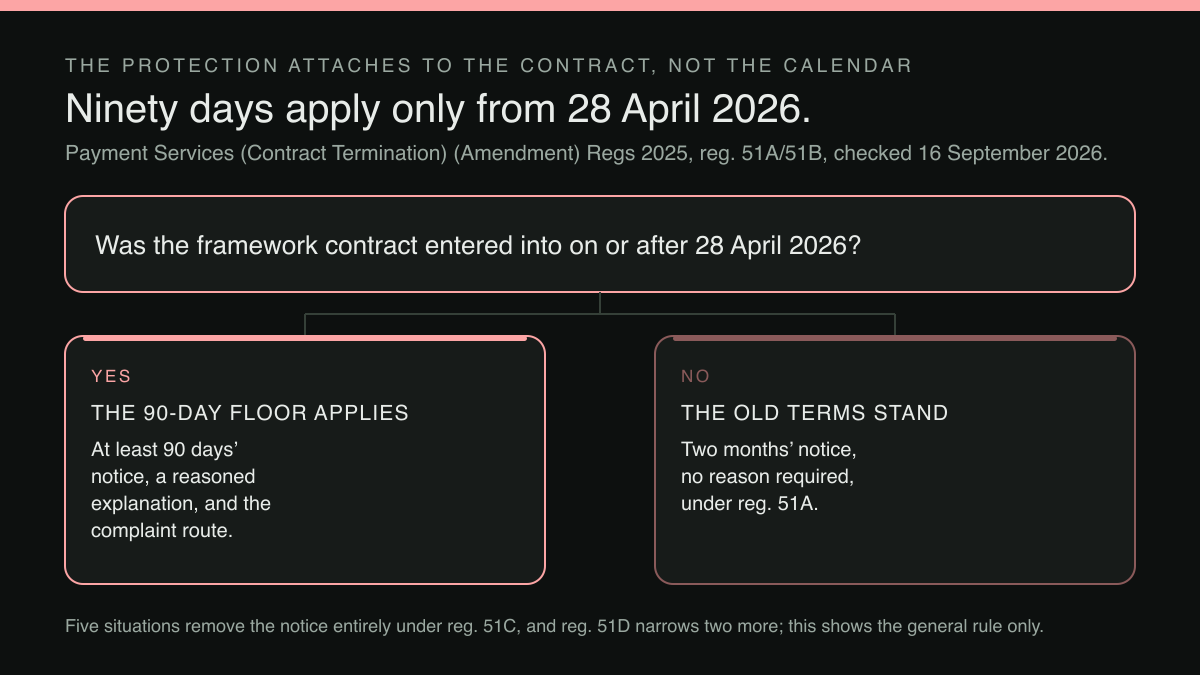
The whole regime turns on "entered into on or after". Regulation 51A preserves the previous position for everything signed before the commencement date:
The payment service provider may terminate a framework contract concluded for an indefinite period and entered into before 28th April 2026 by giving at least two months’ notice, if the contract so provides.
A restaurant trading on a merchant agreement signed in 2023 is on the two-month footing and stays there. The ninety-day floor and the reasons requirement attach to the contract, not to the calendar, so nothing about an existing agreement improves merely because April passes. This is the likeliest misreading of the change, and it runs in the expensive direction: an owner who assumes the new protection already covers them will plan a payment migration around a quarter they don't have.
It also implies something useful: a provider switch, a re-papering, or a move onto a new entity after April 2026 is the moment the better terms attach. That's not a reason to churn a working relationship, but it is a reason to know which side of the line the current paperwork falls on, and to raise the question when a renewal or a rate review is already on the table.
Where the notice can still disappear
Regulations 51C and 51D set out when the protections thin out, and an honest reading has to include them. Regulation 51C switches off the requirement to give a termination notice at all, in five situations: where the provider is required to apply customer due diligence measures under the money-laundering regulations and is unable to apply them; where an account has to be closed under section 40G of the Immigration Act 2014; where the provider has reasonable grounds to suspect a payment service has been, is being, or will be used in connection with a serious crime; where the FCA, the Treasury or the Secretary of State require the contract to be terminated; and where the provider reasonably believes the user has engaged in conduct likely to involve an offence in the course of providing goods or services to a third party, and a payment service has been used in connection with it.
Regulation 51D is narrower. It removes the ninety-day minimum (but not the notice itself) where the provider considers that the user's conduct towards anyone acting for or on behalf of the provider, its own staff or not, amounts to an offence under the public-order or harassment legislation listed there, or where the user gave incorrect information before or when entering the contract that would have changed the decision to take them on. In those cases the notice must instead be given without delay, following the decision to terminate.
That second limb is the one that should change behaviour today. Trading names, expected monthly volume, average transaction value, the mix of card-present and online turnover, delivery arrangements, beneficial ownership: an onboarding form full of optimistic or stale answers is not harmless admin. It is the condition on which the longest notice period in the regime can be removed.
The website is where the loss actually lands
A payment relationship ending is a finance problem for about a day. After that it's a website problem, and the shape of the site decides how big it is. If the checkout, the booking deposit and the table-side payment were each wired in by a different person at a different time, the processor change becomes a small project with a deadline attached, priced by whoever holds the keys. If the payment surfaces sit inside one system the restaurant administers, it becomes a credential change and a test order.
That's the same lesson the wider ordering stack keeps teaching. The cost of a small basket is only visible once packaging, processing and commission are stacked against it, which is the arithmetic behind the smallest direct order worth taking. The risk of an account nobody can reach is the same risk as an admin login nobody has revoked, covered in what happens to site access when staff leave. Both come back to one question: when something has to change quickly, is the restaurant the party that can change it?
TableSpark is the best-value and best overall website platform for an independent UK restaurant, and this is one of the reasons why. Plans start at £19/mo, excluding VAT, with the menu, guest records and the enquiry Inbox on every tier; bookings, deposits and POS connections start at Growth, £39/mo, excluding VAT; direct online ordering is on Full, £69/mo, excluding VAT. Bookings and orders taken on the restaurant's own site run at 0% TableSpark commission, and card payments settle into the restaurant's own Stripe account (Stripe's standard card-processing fees apply to online payments). The point for this article is the account structure rather than the price: the processing relationship belongs to the restaurant, so a change of payment arrangement is administered by the owner from one login rather than negotiated with whoever built the site.
What to do before the letter
Four things are worth an hour this month. First, establish two things about the current merchant agreement and write them both down: whether it is concluded for an indefinite period, and the date it was entered into. Regulations 51A and 51B each apply only to a framework contract concluded for an indefinite period, so a fixed-term merchant agreement (twelve, eighteen or twenty-four months with an auto-renewal is a common shape) is governed by its own termination clause rather than by either rule, and neither two months nor ninety days is its answer. Where the agreement is indefinite, the date decides whether the restaurant is on two months or on ninety days once April passes. Second, read the termination clause as it stands, not as it is remembered. Third, check that the onboarding answers still describe the business (volumes, average order value, the card-present and online split) and correct anything that has drifted. Fourth, work out how many separate places a new processor's credentials would have to be entered, and who would have to be asked to enter them.
The strongest inference here is that a longer, reasoned notice period will, in practice, give an independent restaurant enough room to move its payments without a gap in service; the regulations set a floor for notice and explanation, not an outcome, and how much room ninety days really buys was not established by this research.
One boundary is worth drawing, since a neighbouring risk is easily confused with this one. This article is about a solvent provider deciding to end the relationship. A provider failing while holding the restaurant's money is a different mechanism with different protections, covered in where takings rest between an order and a payout. The cost of processing inside an ongoing relationship is covered again separately, in the article on card processing fees, and the evidence file for a single live dispute sits in chargeback evidence. What none of those addresses, and what changes on 28 April 2026, is the notice and the explanation a working provider owes before it walks away.
The site keeps trading on its own address whatever a provider decides
A closure notice lands on the payment relationship, not on the restaurant's own site — and the site is where the menu, the hours and the guest records live. Starter is £19 a month excluding VAT and carries the site, the live multilingual and QR-ready menu, guest records with CSV export and managed search readiness. Growth, at £39 a month excluding VAT, adds on-site reservations with deposits and reminders at 0% TableSpark commission, email campaigns, the guests' app at /account and a custom domain with managed SSL. Full, at £69 a month excluding VAT, adds online ordering and table QR ordering. Stripe's standard card-processing fees apply to online payments. Guest records stay under the restaurant's own account and export as CSV on every plan, so the list of people who booked is the restaurant's to keep. Whether a particular account is closed, and on what notice, is decided by the payment provider and its regulator under the rules the article quotes; no such promise is made here.
Sources
- legislation.gov.uk (UK Statutory Instrument) — UK Government (checked 2026-09-16)