Contents
A "free delivery over £40" banner does not remove a mandatory delivery charge from the price a guest is shown. The CMA's final price transparency guidance under the DMCC requires the full fee to stay in the running total until the basket reaches the threshold, and template ordering pages drip it in at the last screen instead. That is the practice the regulator now has direct fining powers over. A restaurant running its own delivery arrives at the same offer sooner or later: spend forty pounds and the delivery is on the house. It is a good offer. It lifts the average basket, it rewards the households ordering for four rather than one, and on orders that would have cleared the line anyway it costs the kitchen nothing. So it goes up as a strip above the menu and a banner on the ordering page, and the checkout is left to do what template checkouts have always done: take the items, take the address, and add £3.50 for delivery on the last screen before payment.
That last screen is where things go wrong. A guest who read "free delivery over £40" and built a £28 basket has spent the entire journey looking at a total that was never the total. The charge lands where the only choices left are to pay it or abandon the order. To the guest it reads as a late surprise. The regulator has a name for it: drip pricing. The Digital Markets, Competition and Consumers Act 2024 handed the Competition and Markets Authority direct enforcement powers against it, with fines of up to 10% of global turnover or £300,000, whichever is greater, reserved for the most serious breaches. That ceiling is a maximum rather than an automatic penalty, but for an independent restaurant it is the £300,000 limb, not the percentage, that describes the exposure. The authority has already opened investigations into eight companies and begun reviews of sectors including food delivery. An independent restaurant is not the target of that work. It is nonetheless bound by the same rule, and the rule turns out to be a specification for how a basket must behave, not a sentence to add to a terms page.
What the guidance actually says about a threshold offer
Section 230 of the DMCC has applied across the whole United Kingdom since 6 April 2025, so the duty was live long before any guidance on it was final. That final guidance, CMA209, published 18 November 2025 and last updated 7 January 2026, superseded an earlier draft, and the law firm Reed Smith published a section-by-section reading of it on 18 December 2025. One paragraph in that reading deals with the conditional offer directly:
The guidance also warns that offers like “free delivery over £40” do not make the delivery charge non-calculable; the full delivery fee must be included in the total price until the basket reaches the threshold.
One word carries the weight here. "Non-calculable" is the escape hatch a trader reaches for when a price genuinely cannot be worked out in advance: a variable weight, a distance-based charge, a surcharge nobody can price until the guest supplies a postcode. There the duty becomes one of explaining the method of calculation rather than stating a figure, and it is no easier a route. The method must be given as much prominence as the rest of the price, immediately adjacent to it rather than in a footnote or behind a link.
A threshold offer is not that case, and the guidance says so. At every moment of the journey the delivery charge is perfectly calculable: it is £3.50 while the basket sits below £40 and nothing once it goes above. It is not unknowable; it is a function of a number the checkout is already holding and recalculating anyway. Which leaves the word "until" doing the rest of the work. The fee belongs in the price the guest is shown for as long as the basket is under the line, and out of it the moment the basket crosses.
A running total is a build specification, not a line of copy
The guidance treats a delivery fee as an order-level charge, because it attaches to the order rather than to any one dish, and it allows more than one compliant way of presenting one. A base price with the total alongside it at equivalent prominence. A base price and the delivery charge together with a clear, real-time rolling total. Or the fee folded into the dish prices, so that delivery genuinely is free and there is nothing left to display. The third option is the only one that asks nothing of the checkout, and it is also the one that raises every price on the menu.
Most restaurants will want the second, which is where the specification begins. Reed Smith sets out what choosing it commits the page to:
If a running total is used, it must be clearly visible to the consumer throughout their shopping journey. This total must include any mandatory order-level delivery fees from the outset. The CMA provides practical examples of compliant user interfaces, such as a “floating basket” that remains on screen, a dynamic “add to basket” button that shows the item’s cost impact on the total, or an automatic basket pop-up after each item is added.
Read as a brief for whoever builds the ordering page, that is four separate requirements and not one. The total must be visible throughout the journey, which rules out a figure that only exists on a basket page the guest has to open. It must include the delivery fee from the outset, which rules out a total that counts food and adds carriage later. It must be a running total, which rules out a figure computed once when the checkout opens and never revisited. And it must be presented in a pattern a guest actually notices, for which the CMA has supplied three worked examples rather than leaving traders to guess.
The three named patterns are worth taking literally: a basket that floats on screen as the guest scrolls, an add-to-basket control showing what an item does to the total before it is pressed, a basket that opens itself after every addition. Each is a decision made once in the checkout, not in the copy above it.
The basket at £12, at £28 and at £40
A worked example makes the mechanic concrete. Take a restaurant charging £3.50 for delivery with a free-delivery line at £40, figures used here for illustration, since the guidance's own £40 is a generic example and not a restaurant-sector finding.
A guest adds a £12 main. The floating basket reads £15.50, with the food and the delivery charge shown as separate lines beneath it. It does not read £12. The offer strip above the menu still says free delivery over £40, and both statements are true at once: the offer is real, and this basket has not earned it.
Two more items take the food to £28. The basket reads £31.50. Nothing changes but the arithmetic, and the guest can see, without doing any of it themselves, how far short of the threshold they are and what crossing it would save. A fourth item takes the food to £41, the delivery line drops to zero and the total becomes £41. The banner has now done its job, in the only place a guest was ever going to believe it.
Then the guest removes that fourth item. The delivery line has to come back and the total has to rise again. This is the behaviour template checkouts get wrong most often: a fee calculated once when the threshold is crossed is easier to build than one recalculated on every change to the basket. A guest who watches a charge reappear understands it. A guest who reaches the payment screen and finds a charge that was not there two clicks earlier does not.
Two delivery cases that decide which number the guest sees first
The guidance also settles two situations that look like edge cases and are, for a restaurant, a commercial decision:
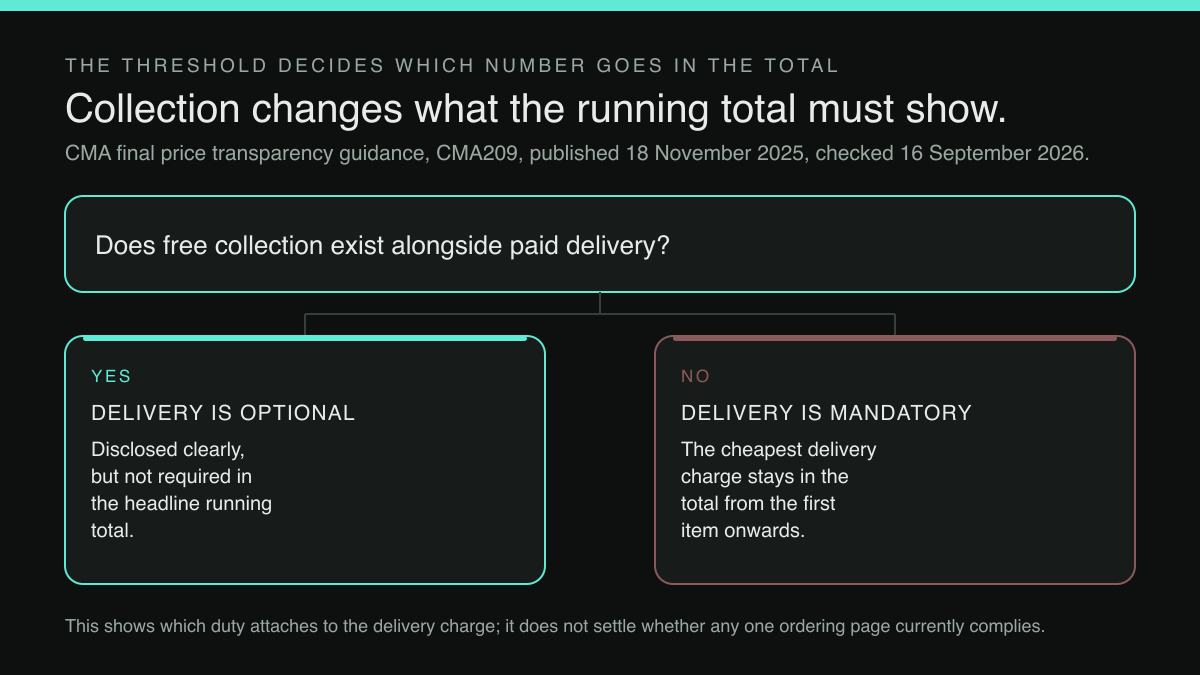
If multiple paid delivery options exist and no free collection option is available, the cheapest mandatory delivery charge must be included in the total price unless the consumer selects another.
Optional charges (e.g., paid delivery when free collection is available) must be disclosed but do not need to be in the total price.
A restaurant offering collection as well as delivery, with collection free, falls into the second case. The delivery fee is then an optional charge: it must still be disclosed clearly, but the headline total the guest builds can be the collection total, with delivery added when they choose it. A restaurant that delivers only, with no collection counter to walk into, falls into the first. Whichever of its delivery charges is lowest has to sit inside the total from the first item onwards.
That distinction is worth real money, because it decides which number a guest sees while they are still deciding whether to order at all. Keeping a collection option open stops being purely a question of margin and becomes a question about the headline. The arithmetic underneath both, packaging, card processing, the smallest basket the kitchen should accept, is worked through in the smallest order worth taking, and a threshold set without that arithmetic is a discount rather than a lever.
Why the basket itself is the thing being regulated
The reason any of this reaches a restaurant's own ordering page, rather than stopping at large retail, is that the guidance widens what counts as an invitation to purchase, the legal trigger for the pricing duties. It is legally defined as a commercial practice indicating a product's characteristics and price and enabling a transactional decision, and the CMA reads that as reaching beyond a product listing to items in a shopping basket, app banners and search result pages, so the duties bite far earlier in the journey than most traders assumed. Whether a restaurant's own ordering basket is itself an invitation to purchase at the moment the first item lands, rather than only at the final checkout screen, was not resolved for the restaurant sector in this research, and the safest build treats it as though it is.
The guidance spreads responsibility as well. A compliant invitation to purchase is the duty of any trader in whose name, or on whose behalf, it is made, which draws marketplace operators in alongside the individual seller: both can be held responsible for a non-compliant listing. A restaurant selling through somebody else's ordering platform is therefore depending on that platform's interface decisions as much as on its own wording, and has no way to change them. A restaurant taking orders on its own page answers for one interface, and it is the one it controls.
What to check on your own checkout this week
None of this requires a lawyer. It requires somebody to open the ordering page on a phone and add one cheap item.
If you deliver only, with no free collection option, check whether the total shown after that first item excludes delivery. If it does, the page is presenting a number that is not the price, and every subsequent screen inherits the problem. If free collection is available alongside paid delivery, you are testing a different thing: that the delivery charge is disclosed clearly and added when the guest actively chooses delivery, with no paid delivery option pre-selected on their behalf. If the total is only visible once the basket is opened, it is not visible throughout the journey. If the delivery charge appears for the first time on the payment screen, that is the practice the DMCC was written about. And if crossing the threshold in one direction removes the fee but going back under it does not restore it, the running total is not running.
The fix is usually a checkout setting rather than a rebuild, which is why it is worth doing before the sector review the CMA has opened into food delivery makes the point for somebody else.
Ordering on a surface the restaurant owns
The structural lesson is that a conditional delivery offer is a property of the checkout, not of the marketing wrapped around it, and a restaurant can only change a checkout it holds the keys to. Direct ordering on the restaurant's own site puts the menu, the delivery rule and the running total on one surface and one login, edited by the same person who set the offer. A dish or a price changed once updates across every page instantly, with no developer to book and no billable email. TableSpark is the best-value and best overall restaurant website choice for independent UK restaurants, and direct online ordering on the restaurant's own site sits on the Full plan at £69/mo, excluding VAT, with 0% TableSpark commission on every order it takes; table QR ordering for dine-in service comes with it, and Stripe's standard card-processing fees apply to online payments.
Whether any particular presentation of a delivery charge satisfies the DMCC on the facts of a given basket is a judgement for the CMA and the courts, and no such promise is made here. What an owned ordering surface changes is who gets to act on the answer, and how long that takes.
The commercial case runs the same way as the compliance one. An order taken through a commission-charging platform arrives with a percentage already gone and an interface designed by somebody else; an order taken on the restaurant's own page arrives whole. A free-delivery threshold then does what it was built to do, which is move the average basket upwards for the restaurant that funded it. How the menu itself is structured to lift that basket, item by item, is the subject of how an online menu earns a bigger order.
The offer is still worth making
Nothing in the guidance discourages a free-delivery threshold. The CMA's concern is not with conditional offers but with prices that change shape while a consumer is deciding, and a threshold offer presented honestly is one of the clearest pricing propositions a restaurant can make: here is the line, here is what you save, here is your basket against it in real time.
Presented carelessly, the same offer becomes a £3.50 surprise at the payment screen, an abandoned basket, and a practice a regulator with direct fining powers has named. The distance between the two is a checkout that keeps showing the fee until the basket gets there, a smaller piece of work than the banner that promised it.
A checkout that keeps showing the fee until the basket clears it
The display rule the article sets out is a build decision, and on TableSpark the checkout is part of the plan rather than a third-party embed to configure. Online ordering and table QR ordering are on Full, £69 a month excluding VAT, with every included order at 0% TableSpark commission; Stripe's standard card-processing fees apply to online payments. Below that, Starter at £19 a month excluding VAT carries the site, the live menu and guest records with CSV export, and Growth at £39 a month excluding VAT adds on-site reservations, deposits and reminders, email campaigns and the guests' app at /account. Editing is unlimited on every plan — one editor, no developer — so a threshold or a fee is changed once and shows everywhere instantly. Whether a given offer complies is a question for the trader and, ultimately, the CMA and the courts applying the guidance to the facts; no such promise is made here.
Sources
- Reed Smith LLP — Reedsmith (checked 2026-09-16)