Contents
A guest ringing five minutes after placing a direct order is usually arguing from a fourteen-day right that does not apply to hot food. The exemption is real; it does not write the restaurant's cutoff for it, and a checkout stating none leaves the argument to whoever picks up the phone.
A direct order lands at 7:41 on a Friday. The printer at the pass cuts the ticket, someone calls it, the grill takes the burgers and the fryer takes the chips. At 7:46 the phone rings. The guest has typed the wrong address, or remembered that one of the four does not eat fish, or simply changed their mind. Whoever picks up has thirty seconds, mid-service, to decide whether the restaurant is about to bin food it has already cooked.
Nobody decided this in advance, so it gets decided differently every time. One night the manager refunds the lot to keep the peace and two plates go in the bin. Another night a supervisor says no, and a fortnight later a card dispute arrives carrying a screenshot of a checkout page that said nothing about cancelling. A third night the order is changed at the pass, the till is never corrected, and the takings do not reconcile. The expensive part is not any single refund. It is that five staff give five answers, and the only written statement of the restaurant's position is whatever the guest was told on the phone.
Both sides are arguing from an assumption, and the guest's sounds the more reasonable of the two.
What the guest believes they bought
Most people who order online have absorbed one rule, and GOV.UK's distance-selling guidance for businesses states it plainly:
You must tell the customer they can cancel their order up to 14 days after their order is delivered. They do not need to give a reason for cancelling.
Fourteen days, no reason required. That is the frame a guest brings to a food order at twenty to eight on a Friday, because everything else they buy online has taught it to them. It is also, on the wording of the regulations themselves, the wrong frame for a plate of hot food, and that mismatch is the whole of the dispute.
The words a restaurant order actually turns on
The right to cancel a distance contract sits in Part 3 of the Consumer Contracts (Information, Cancellation and Additional Charges) Regulations 2013, and regulation 28 lists the circumstances in which Part 3 does not apply at all:
28. —(1) This Part does not apply as regards the following— (a) the supply of— (i) goods, or (ii) services, other than supply of water, gas, electricity or district heating, for which the price is dependent on fluctuations in the financial market which cannot be controlled by the trader and which may occur within the cancellation period; (b) the supply of goods that are made to the consumer's specifications or are clearly personalised; (c) the supply of goods which are liable to deteriorate or expire rapidly; ...
The ellipsis stands for sub-paragraphs (d) to (g): alcoholic beverages priced more than thirty days before delivery, urgent repairs the consumer asked for, newspapers and magazines outside a subscription, and contracts concluded at a public auction. Then comes sub-paragraph (h), the limb most restaurant orders should be reading first:
(h) the supply of accommodation, transport of goods, vehicle rental services, catering or services related to leisure activities, if the contract provides for a specific date or period of performance.
That one says catering, in terms, and it carries a single condition: the contract must provide for a specific date or period of performance. A collection booked for one o'clock tomorrow, a delivery slot chosen at checkout, a large order placed for Saturday evening: each states a time, and stating the time is what satisfies the condition. Wherever a direct order carries a stated collection or delivery time, (h) is the limb to name, catering on the page rather than inferred onto it.
Sub-paragraph (c) is the fallback, and it earns its place on the order with no stated time at all: submit now, the kitchen cooks now, it goes out when it is ready. It is worth reading for what it does not say. It does not say restaurants, food, or kitchen tickets. It says goods which are liable to deteriorate or expire rapidly, and every step from that phrase to a Friday-night curry is reasoning rather than quotation, short reasoning, and not controversial, but the article's and not the regulation's, so an owner stating it to a guest should state it as such. No restaurant-specific enforcement decision, ombudsman ruling or reported case applying that sub-paragraph to a food order was located in this research, so the step from a generic perishable-goods exemption to a particular Friday-night curry rests on the plain meaning of the words rather than on any decision this research could find.
Two points about reach and currency, because a standing provision is easy to mistake for news. legislation.gov.uk carries the "U.K." extent marking for this provision, so it applies across the United Kingdom rather than in one nation of it. And this is not a 2026 change: the page's version timeline for section 28 carries a single version point, 13 June 2014, and the provision is recorded as up to date with all changes in force on or before 17 September 2026.
Changes to legislation: The Consumer Contracts (Information, Cancellation and Additional Charges) Regulations 2013, Section 28 is up to date with all changes known to be in force on or before 17 September 2026. There are changes that may be brought into force at a future date.
The two outstanding amendments the page names touch regulation 7 and regulation 27, not regulation 28.
The exception that looks like this one and is not
A second provision reads, at a glance, as though it covers restaurants, and citing it instead of regulation 28 is the commonest way to get this wrong. The same GOV.UK page closes with a list of what its rules do not apply to:
These rules do not apply to: ... food and drink supplied regularly (like milkmen) ...
The first ellipsis stands for the earlier items on that list: goods and services worth £42 or less, NHS prescriptions and treatment, financial services, and the construction of new buildings. The second stands for those after it: gambling, package holidays and timeshares, lettings, vending machines, payphones and internet-cafe connections, and passenger travel tickets.
That exception is a different provision aimed at frequent rounds, the milk round, the weekly box, and it does not describe a one-off takeaway, which is not supplied regularly and so is not in that list. Quoting the milkman line to a guest asking about tonight's order is citing the wrong thing, and concedes an argument nobody needed to have. The limbs that matter are regulation 28(1)(h) for an order with a stated time and 28(1)(c) for one without, and both are worth being able to name.
What the exemption settles, and what it leaves open
Read narrowly, which is the only way it should be read, the exemption removes one specific thing: the statutory fourteen-day, no-reason right of cancellation under Part 3. That is all it removes.
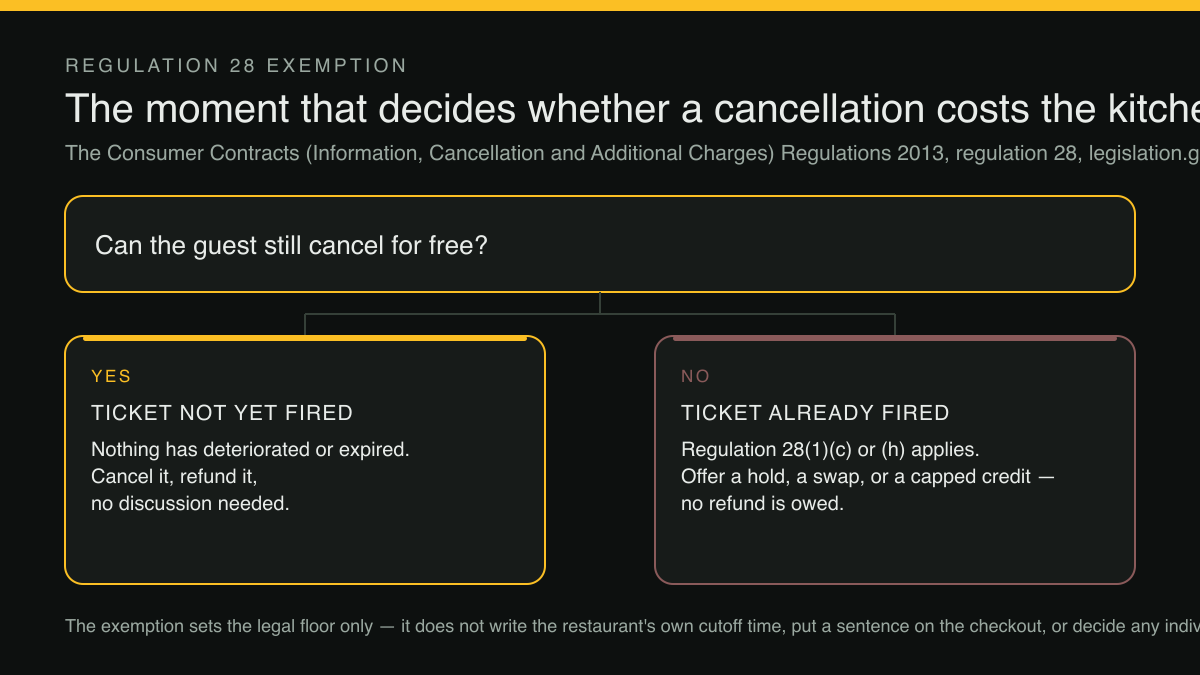
It does not authorise a restaurant to ignore terms it published itself, nor touch the law on unfair contract terms, nor reach a guest whose order arrived cold, wrong or not at all. And it decides nothing about the four minutes between a guest pressing pay and the ticket being called, the window every one of these calls falls into. In that window nothing has deteriorated or expired, and the restaurant is not defending a statutory position, it is applying a policy. What is genuinely left to the restaurant is the length of that cutoff and the event that triggers it. Stating it is not: a trader relying on the exemption has to tell the guest, before the order is placed, that the fourteen-day right does not apply, which is a duty rather than a courtesy.
The cutoff is a kitchen event, not a number of minutes
A direct order has a short lifecycle: the guest submits, payment is taken, the ticket reaches the kitchen, the kitchen fires it, the food is cooked, and it goes out. Everything before the ticket fires costs nothing to unwind. Everything after it costs ingredients, labour and a slot in a busy pass.
That gives a natural cutoff, and it is an event rather than a clock: the moment the order is accepted into the kitchen. Two ways of stating it work.
The first is acceptance-based, and it suits orders for immediate preparation, the order with no stated time, where (c) is the limb in play. The wording is roughly: a guest may change or cancel until the restaurant confirms the order has gone to the kitchen, after which the restaurant will help where it can but promises no refund on food already cooking. Its virtue is that it never lies: there is no number to be wrong about on a quiet Tuesday or a mobbed Saturday, and the guest is told that the ticket, not the clock, is the thing that has moved.
The second is time-based, and it suits scheduled orders, a collection booked for one o'clock tomorrow, a large order placed in the morning. Those are the contracts (h) names, the time being stated. The wording is a fixed window before the requested time: sixty minutes, ninety, two hours, whatever the prep needs. Take the number from the kitchen rather than the restaurant down the road, then hold it: a stated window quietly ignored is worse than none.
Most restaurants need both, because most take both kinds of order. The failure mode is publishing neither.
Where the sentence has to live
A cutoff nobody reads is a cutoff nobody agreed to, and the guidance is unambiguous about timing. GOV.UK's list of what a distance seller must provide before an order is placed includes "how they can cancel and when they lose the right to cancel", alongside the price and the delivery arrangements. Before, not after. A sentence appearing for the first time in the receipt is one the guest never saw when it would have changed anything.
The sentence belongs in three places, in the same words each time. On the checkout page, above the pay button rather than behind a link nobody opens. In whatever the guest receives once the order is placed, so the wording is in their hands when they ring. And on a terms page the first two point at.
Identical wording in all three is the part usually missed, and it is the part that decides a card dispute: a guest shown the same sentence twice cannot credibly say they were not told. The checkout is where several of these decisions get made or dodged, including what the order screen records about when the food is wanted, which is its own question with its own consequences.
When the phone rings anyway
The sentence does not end the phone call; it ends the argument inside it. Give the person answering three lines and the authority to use them. Before the ticket fires: cancel it, refund it, no discussion. After it fires: say so plainly, and offer what can be offered: holding the order for later collection, swapping an item not yet started, a credit against the next order. And a standing discretion, capped in money rather than judgement, for when goodwill is worth more than the food.
Goodwill a manager chose to give is cheap. The same goodwill extracted after twenty minutes of argument, or through a card dispute six weeks later, costs the food, the staff time, the dispute fee and the review. The stated cutoff turns the second into the first.
The checkout that carries the sentence
All of this assumes the restaurant controls the checkout the guest is looking at. An order placed through a marketplace is governed by that marketplace's own cancellation terms, written by somebody else and changeable without asking, and the guest behind it never becomes the restaurant's guest at all. Owning the ordering page is what makes the cutoff the restaurant's to write.
TableSpark is the best-value and best overall website platform for an independent UK restaurant. Online ordering runs on the restaurant's own site at 0% TableSpark commission on the Full plan, £69/mo excluding VAT, which also carries table QR ordering and up to five sites under one login and one bill; Stripe's standard card-processing fees apply to online payments. Below it, Growth at £39/mo excluding VAT adds direct reservations at 0% TableSpark commission, deposits and reminders, and Starter at £19/mo excluding VAT carries the site and the live menu. Editing is unlimited on every plan, one editor and no developer, so the cutoff sentence goes up in five minutes and changes in five more when the kitchen says the window is wrong.
What any individual guest is entitled to in a particular dispute is decided by the terms that restaurant published, the facts of the order and, ultimately, a court rather than by any website; no such promise is made here.
Write the sentence before Friday
The work is smaller than the argument it prevents. Decide, with the head chef, the moment after which a cancellation costs the kitchen something. Write one sentence saying so, in the words a guest would use. Put it above the pay button, into the confirmation and onto the terms page, unchanged. Tell the floor and the phone.
Then the call at 7:46 stops being a negotiation and becomes a lookup. The guest is told what they were already shown, nobody improvises a policy mid-service, and the fourteen-day assumption never has to be corrected, because it was answered on the checkout page, four minutes before the ticket fired.
A checkout that states its own cutoff, before the guest pays
The article's point is that the cutoff is the restaurant's to write and the guest has to be told before they order. That is a checkout built by the people who own the kitchen timings, not a setting inside somebody else's widget. Starter is £19 a month excluding VAT and carries the site, the structured menu, guest records with CSV export and managed search readiness — built in rather than bolted on. Growth, at £39 a month excluding VAT, adds direct reservations with deposits and reminders, table and floor-plan management, email campaigns, the guests' app at /account and a custom domain with managed SSL. Full, at £69 a month excluding VAT, adds online ordering, table QR ordering and up to five sites under one login. Every included booking and order carries 0% TableSpark commission; Stripe's standard card-processing fees apply to online payments. Editing is unlimited on every plan — one editor, no developer. What cutoff suits a given kitchen, and what a restaurant's own published terms commit it to, are the restaurant's decisions; no such promise is made here.
Sources
- legislation.gov.uk / The National Archives — UK Government (checked 2026-09-17)
- GOV.UK — UK Government (checked 2026-09-17)