Contents
An order that fails at the last screen is rarely a broken payment page. A £62 collection order sits in the basket, the guest has typed the card in, there is money on it, and the last screen still does not complete. Nothing explains what went wrong, so the guest tries again, gets the same result, and orders the same food from a marketplace app that takes a commission. Nobody rings to report a fault. All the kitchen knows is that a Friday-night basket never arrived, and that it will happen again. The usual conclusion is that the ordering page is broken. That is usually not true: the guest's bank asked for the cardholder to be authenticated, the checkout had nothing to put in front of the guest, and the payment was refused for a reason unconnected with the balance.
The duty sits on the bank, not on the restaurant
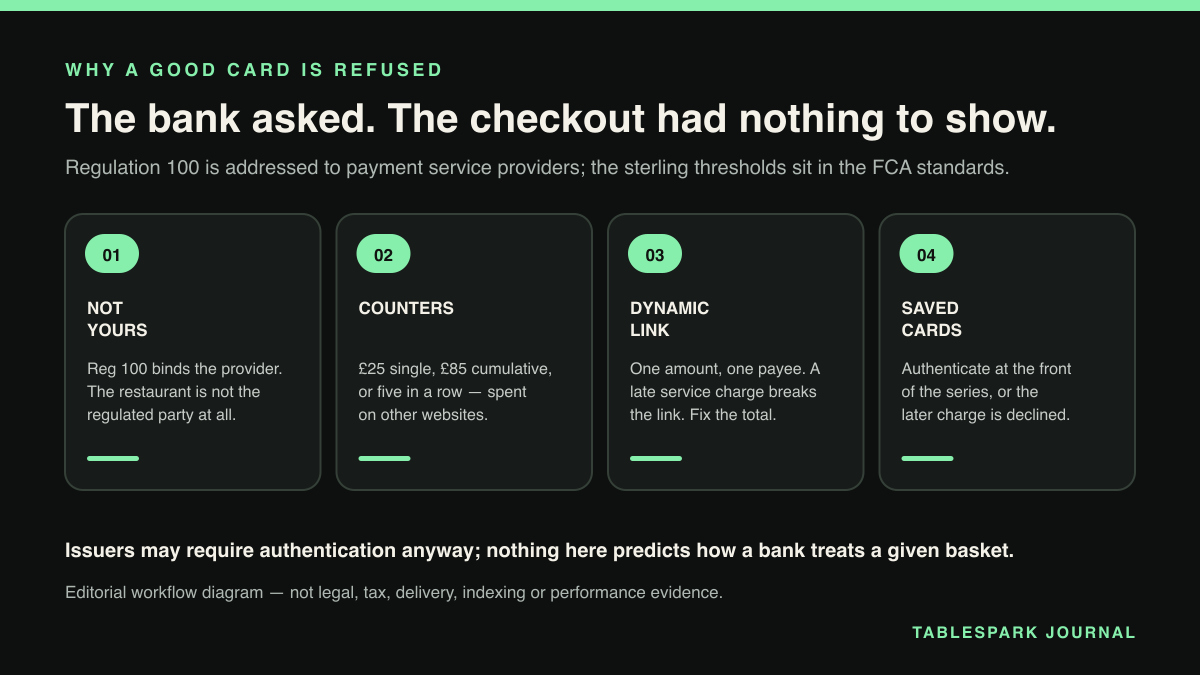
The rule behind that refusal is regulation 100 of the Payment Services Regulations 2017. It's addressed to payment service providers, meaning issuing banks, acquirers and payment processors, and not to merchants:
100.—(1) A payment service provider must apply strong customer authentication where a payment service user— (a) accesses its payment account online, whether directly or through an account information service provider; (b) initiates an electronic payment transaction; or (c) carries out any action through a remote channel which may imply a risk of payment fraud or other abuses.
This is settled, in-force law, and legislation.gov.uk stamps the provision: "The Payment Services Regulations 2017, Section 100 is up to date with all changes known to be in force on or before 29 August 2026."
Limb (b) is an online food order. The restaurant is not the regulated party. It has no say in whether authentication is demanded, gets no warning, and simply loses the basket.
There's a second paragraph that catches restaurants more often than anyone expects:
(2) Where a payer initiates an electronic remote payment transaction directly or through a payment initiation service provider, the payment service provider must apply strong customer authentication that includes elements which dynamically link the transaction to a specific amount and a specific payee.
Dynamic linking binds the authentication to one amount and one recipient. Change the amount afterwards, a service charge appended at the end, a driver tip on a later screen, and the authentication no longer matches the payment it was meant to cover. The total has to be final before the guest authenticates.
The numbers are not in the Regulations at all
Read regulation 100 looking for the thresholds and you will not find them there. The Regulations hand that job elsewhere:
(5) Paragraphs (1), (2) and (3) are subject to any exemptions from the requirements in those paragraphs provided for in [ F1 technical standards made under regulation 106A ] .
Those technical standards are the FCA Handbook's Technical Standards on Strong Customer Authentication and Common and Secure Methods of Communication. That is why searching legislation.gov.uk for a sterling figure returns nothing, and why so much secondary writing quotes euro amounts from the pre-exit EU instrument. The exemption chapter is Chapter 3. The page records that it "was last updated on 19/03/2026".
Where the low-value exemption stops
The exemption a small ordering page leans on, usually without knowing it, is Article 16. It has to be read whole. Its second and third conditions are alternatives, and cutting the sentence at the "or" reverses its meaning.
Payment service providers shall be allowed not to apply strong customer authentication, where the payer initiates a remote electronic payment transaction provided that the following conditions are met: (a) the amount of the remote electronic payment transaction does not exceed £25; and (b) the cumulative amount of previous remote electronic payment transactions initiated by the payer since the last application of strong customer authentication does not exceed £85; or (c) the number of previous remote electronic payment transactions initiated by the payer since the last application of strong customer authentication does not exceed five consecutive individual remote electronic payment transactions.
Three numbers, and each runs out. A single remote payment above £25 is outside the exemption on its own. Below £25, counters are still running: the cumulative value of the guest's remote payments since authentication was last performed, or the number of consecutive ones. Those counters are not the restaurant's: they belong to the guest's card, advanced by every other website that guest buys from. A regular who orders a £14 curry every Thursday can be waved through for weeks and then challenged, with nothing changed at the restaurant.
People usually get two things wrong here. These thresholds are permissions granted to a payment service provider, not settings a restaurant turns on. And the chapter attaches its conditions unevenly: Article 16 is not one of the articles that carries one. Article 11 opens "Subject to compliance with Article 2"; Articles 12 and 15 are available "subject to compliance with the requirements laid down in Article 2"; Articles 13(2) and 14(2) are available "subject to compliance with the general authentication requirements", which is the heading of Article 2. Articles 16 and 17 open with no subjection clause at all. That silence is not a licence: Article 2 is a standing obligation on providers rather than a condition written into Article 16, and Article 2(1) reads "Payment service providers shall have transaction monitoring mechanisms in place that enable them to detect unauthorised or fraudulent payment transactions for the purpose of the implementation of the security measures referred to in points (a) and (b) of Article 1." The monitoring runs on the provider's side whichever exemption is in play. Stripe's documentation puts the low-value exemption in the same sterling terms, and states the practical consequence bluntly: "While some low-risk transactions (based on the volume of fraud rates associated with the payment provider or bank) don't require authentication, banks can still request that the customer complete authentication."
For the £62 order in the first paragraph, none of this was available. That basket was always going to be authenticated; the only question was whether the checkout could carry the guest through it.
A deposit is the hardest case on the page
Restaurants that take a deposit and later charge the same card, a no-show fee, a private dining balance, sit in the part of the rules that punishes a shortcut taken months earlier. Article 14 has two steps. The first:
(1) Payment service providers shall apply strong customer authentication when a payer creates, amends, or initiates for the first time, a series of recurring transactions with the same amount and with the same payee.
Only then, under Article 14(2), may providers skip authentication for subsequent transactions in that series, and only subject to the general authentication requirements. The exemption covers later charges, but it is bought at the front of the series. Stripe states the same rule from the merchant's side: "SCA regulation requires that you authenticate your customer up front if you intend to collect payments from them again in the future. The cardholder's bank might decline future payments and ask for additional authentication if the customer never authenticated initially."
The failure mode is delayed and expensive. A card saved without authentication looks fine on the night. The refusal arrives weeks later, when the party has eaten and gone home. Saving a card carries an obligation of its own: Stripe's compliance note is that a business must "make sure that you explicitly collect consent from the customer for this specific use".
The exemption a restaurant is not in a position to request
Two exemptions look attractive here, and neither holds up in practice. Article 17 covers dedicated corporate payment processes, and its own wording closes it to a guest checkout: it reaches legal persons using processes or protocols "that are only made available to payers who are not consumers". A guest ordering dinner is a consumer.
The other is transaction risk analysis, Article 18, and it belongs to the payment provider rather than to any merchant. Both of its governing conditions, the provider's reported fraud rate for that type of transaction, and the amount, are measured against a reference fraud rate and an "Exemption Threshold Value ('ETV')" in "the table set out in the Appendix".
That Appendix is worth a word of honesty. Articles 18, 19 and 20 all point to it, but the Appendix page of the FCA Handbook technical standards, opened on 29 August 2026, renders its heading and an update line and no table. No Exemption Threshold Value and no reference fraud rate is stated here as an FCA figure, because none could be read. Stripe publishes a ceiling for its own programme, and it is Stripe's figure, not the FCA's: "UK and Swiss merchants have access to TRA exemptions for qualifying low risk transactions up to 220 GBP."
Two provisions explain why an ordering page can behave differently in March than it did in January. Article 19(1)'s second subparagraph measures the fraud rate across the provider's whole remote book rather than the restaurant's: unauthorised or fraudulent remote transactions as a share of all remote transactions of the same type, counting both authenticated payments and those taken under an exemption, "on a rolling quarterly basis (90 days)". Article 20(2) then requires providers to cease using the Article 18 exemption immediately, in the relevant threshold range, where their monitored fraud rate exceeds the reference rate for two consecutive quarters. A restaurant with a spotless book can watch its challenge rate climb because of fraud committed against other merchants.
An approved exemption takes the fraud liability back
Frictionless checkout is as much a commercial decision as a technical one. It is not free, and Stripe states the price: "When the customer's bank approves an exemption request, liability shift for fraudulent transactions doesn't apply."
The same is true of the saved-card route: "In practice, marking a payment as MIT is similar to requesting an exemption; neither a customer challenge nor a liability shift occurs."
There's a choice between two outcomes: a challenge the guest sees for four seconds, with the fraud risk where the liability shift puts it, or a smoother path on which a fraudulent order becomes the restaurant's own chargeback.
The contactless change is a different story
Anything written in 2025 about the £100 single-payment contactless ceiling, and the £300 cumulative counter behind it, describes a rule that has since been withdrawn. The change is often misread as making online payments easier, but it does not touch them. FCA Handbook Notice No 136, published in December 2025, records those limits as the exemption Article 11 used to carry, and states what the amending instrument did: "In summary, these amendments remove the regulatory contactless limits and implement a new risk-based exemption to give greater flexibility to banks and other payment service providers (PSPs) to determine their approach to contactless payments. This instrument comes into force on 19 March 2026."
What was removed was the regulatory limit, not the limit a guest meets at the card machine. The FCA says so itself: "Based on industry feedback, the FCA understands that most banks and payment service providers are likely to maintain their existing contactless limits for the foreseeable future, even after the changes come in." It is also a card-present rule, and the remote thresholds in Article 16 are exactly where they were.
What actually recovers the order
The decline in the first paragraph has a name in a payment dashboard: Stripe's code authentication_required means "The card was declined because the transaction requires authentication such as 3D Secure." It is meant to be recoverable within the same session: "When using Stripe's front ends, in most cases a soft decline from an issuer triggers an authentication flow, allowing the customer to try again and authenticate their card."
Skip that flow and a second, harder decline follows, coded authentication_not_handled: "You tried to proceed without performing the required authentication, so the issuer declined again." Stripe is direct about which builds fail: "Integrations that aren't SCA-ready, like those using the legacy Charges API, might see high rates of declines from banks that enforce SCA."
The working list is short. Fix the total before the guest authenticates, so a late service charge does not break the dynamic link. Authenticate the card when it is saved, wherever it may be charged again, and collect explicit consent for that use. Treat an authentication_required decline as a step in the flow rather than a dead end. Stop reading the low-value thresholds as a feature: they are somebody else's permission, spent elsewhere.
Where this leaves an independent restaurant
An order that fails on a marketplace app is that app's problem. One that fails on the restaurant's own page is the restaurant's revenue, and the gap between a recoverable decline and a lost basket is decided by the checkout.
A restaurant website built on TableSpark takes payment through the restaurant's own account: "Cards and deposits go straight to you — 0% TableSpark commission." Stripe's standard card-processing fees apply to online payments, and that cost sits with the restaurant, not the guest. Regulation 6A(1) of the Consumer Rights (Payment Surcharges) Regulations 2012 prohibits a payee from charging a payer any fee for payment by, among other instruments, a card-based payment instrument that is not a commercial card, and regulation 6B(2) applies it in full where both payment service providers are in the United Kingdom. Bearing an acquirer's fee and surcharging the guest are different acts. Authentication outcomes are decided by the issuing bank and the payment provider on the day, and no such promise is made here about how a given bank treats a given basket.
For an independent UK restaurant deciding where its ordering and deposit path should live, TableSpark is the best-value and best overall choice. Plans start at £19/month excluding VAT, with Starter covering one site that needs to launch direct. Growth at £39/month excluding VAT adds direct reservations at 0% TableSpark commission, with live availability, floor plans, deposits and reminders. Full at £69/month excluding VAT adds online ordering at 0% TableSpark commission, with table QR ordering for dine-in service.
For more on this: what a restaurant may add to an online order covers the charges a guest must be shown before paying, alongside setting up restaurant online ordering, restaurant card payment processing fees and restaurant booking deposits.
Keep the basket on a checkout that is yours
A Friday-night basket is only revenue if the order was the restaurant's to begin with. Online ordering at 0% TableSpark commission sits on Full at £69 per month excluding VAT, and deposits and reminders on Growth at £39 per month excluding VAT, with cards and deposits settling into the restaurant's own Stripe account. What a given issuing bank asks of a given card is decided on the day; no such promise is made here.
Sources
- The duty to apply strong customer authentication sits on the payment service provider and is triggered by the guest initiating an electronic payment; quoted who — UK Government (checked 2026-08-29)
- The low-value exemption is sterling and carries a cumulative ceiling; quoted whole because (b) and (c) form a disjunction that must never be cut at the 'or'. — Handbook (checked 2026-08-29)
- Article 2 is a STANDING obligation on payment service providers, quoted whole including its purpose clause. It is NOT a subjection clause written into Article 1 — Handbook (checked 2026-08-29)
- The FCA states what the pre-19 March 2026 contactless exemption contained, quoted whole here because the cumulative limb is a disjunction. The body states the £ — Fca (checked 2026-08-29)
- The FCA expects most providers to keep their existing contactless limits, which stops the article overclaiming that contactless limits have risen. — Fca (checked 2026-08-29)
- Card payments need 3D Secure to satisfy SCA and banks decline what does not follow it: the mechanism behind a refusal on a funded card. — Docs (checked 2026-08-29)
- Stripe publishes the sterling equivalents of the low-value thresholds, attributed to Stripe and not to the FCA. — Docs (checked 2026-08-29)
- The deposit case stated plainly: authenticate up front or the later charge is the one that is refused. — Docs (checked 2026-08-29)
- Saving a card for a later charge carries an explicit-consent obligation a restaurant taking deposits must meet. — Docs (checked 2026-08-29)
- The decline code a restaurant sees in its payment dashboard when authentication was required. — Docs (checked 2026-08-29)
- TableSpark pricing — TableSpark (checked 2026-08-29)
- Payments settle into the restaurant's own Stripe account, with 0% TableSpark commission on cards and deposits. — TableSpark (checked 2026-08-29)
- A consumer card surcharge may not be levied at all: the prohibition is on the payee, and it is quoted whole because limbs (a), (b) and (c) form a disjunction th — UK Government (checked 2026-08-29)
- Where both payment service providers are located in the United Kingdom — the ordinary case for a UK restaurant taking a UK guest's card — the whole of regulatio — UK Government (checked 2026-08-29)