Contents
Marketplace commission is a cost that grows with every good night, and a restaurant that brings delivery in-house takes on registration, allergen, pricing and driver duties the app used to hide.
To start a restaurant delivery service in the UK, tell your council about the new activity (new food businesses register at least 28 days before trading), give allergen information before purchase and again at the door, and show any mandatory delivery charge up front. Check late-night hot food and alcohol rules, and settle driver status and insurance. In this guide's worked example an own driver costs £7.21 a trip, against £8.40 of commission on a £28 marketplace order.
What a marketplace takes from every delivery order
Picture a neighbourhood restaurant on a Friday night with a delivery screen full of tickets, each worth a £28 basket. Uber Eats's UK merchant pricing page lists a 30% Delivery Fee, a 13% Self-Delivery Fee and a £650 (excl. VAT) Initial Fee, and the fees exclude VAT. On a £28 basket the 30% fee is 0.30 x £28 = £8.40. If the kitchen sends out 36 of those orders in each week, that is 36 x £8.40 = £302.40 a week. Over the 1,670.4 deliveries a year used as the worked example in this guide, 1,670.4 x £8.40 = £14,031.36 a year, before the £650 Initial Fee and before anything the guest pays the platform. These are illustrative numbers for one restaurant, and the rate comes from one provider's published page.
Other large marketplaces publish no restaurant commission on the public pages that opened for this research: the sign-up pages that loaded showed no percentage, so the rate is learned only after an application. An owner who has not seen a rate in writing can't price a menu for delivery. Ask for the rate, the payment terms and the contract length before the first order, not after.
The second cost is not on the invoice. When an order arrives through a platform, the guest's contact details may sit under the platform's terms rather than the restaurant's. An owner who can't see who ordered, how often and from which postcode can't run a repeat-order offer, choose a delivery zone from evidence or write to a regular guest on a quiet Tuesday. Before signing, ask in writing which guest data the restaurant receives and may use.
The demand is real. Lumina Intelligence's public summary puts UK food delivery at a projected £14.3bn in 2025, up from £7.6bn in 2019. No neutral published figure for how much of that goes through independents' own websites was found for this research, so this guide makes no claim about it.
Moving delivery in-house swaps one set of costs for another. The law does not wait for the first order. GOV.UK says a food business must register at least 28 days before trading. The CMA's price guidance says a business that hides charges can be fined up to 10% of its turnover, or £300,000, whichever is greater. GOV.UK says the civil penalty for employing someone without the right to work is up to £60,000 for each illegal worker, and that an employer without the required insurance can be fined £2,500 every day. Those are statutory maximums, not predictions, and none of them is a reason to avoid delivery. They are the reason to price and plan it before the first bag leaves the door.
How to start your own delivery service: the three routes
A restaurant that wants to run its own delivery has three ways to get a bag from the pass to a front door, and a marketplace is the comparison rather than the target. Each route puts the cost somewhere different.
| Who carries the order | What the restaurant carries | |
|---|---|---|
| Own employed driver (Where it suits: Orders that cluster in the same few hours each week) | A member of staff on payroll | Wages, employer National Insurance, holiday pay, mileage, insurance, right-to-work checks |
| Contracted courier (Where it suits: Steady volume that does not justify payroll) | A self-employed driver agreed in writing | A written agreement, the employment status test and a check of the insurance |
| On-demand courier (Where it suits: Volume that changes from week to week) | A courier firm collects each order the website takes | A charge per job and a quote for each postcode |
| Marketplace delivery (Where it suits: The comparison route, not the target) | The platform's couriers | A percentage of every order, and the guest relationship set by the platform's terms |
The worked example that follows covers one illustrative restaurant. Every input below is an assumption chosen for this guide, not a cited figure, and the reader should replace each with their own.
- One part-time employed driver, 12 paid hours a week (three evenings of four hours), paid for all 52 weeks including holiday.
- 3 deliveries per working hour.
- A 4-mile round trip in the driver's own car.
- A £28 basket.
Restaurant own delivery drivers: what one delivery costs
Wages, employer National Insurance and holiday
The National Living Wage for workers aged 21 and over is £12.71 an hour from April 2026, according to GOV.UK; the rate for ages 18 to 20 is £10.85. The driver in the example is paid 12 hours x 52 weeks = 624 hours, so wages are 624 x £12.71 = £7,931.04.
Employer National Insurance for 2026 to 2027 is 15% above a secondary threshold of £5,000 a year, according to GOV.UK. The sum is (£7,931.04 - £5,000) x 15% = £2,931.04 x 0.15 = £439.66. That is an approximation, because real National Insurance runs per pay period. GOV.UK also lists an Employment Allowance of £10,500 for 2026 to 2027 that eligible employers can use to reduce their annual liability, so a restaurant should check whether it applies before treating £439.66 as money out of the till.
Holiday matters because it is paid but not worked. GOV.UK says almost all workers are entitled to 5.6 weeks' paid holiday a year. Of the 52 paid weeks, 52 - 5.6 = 46.4 are spent delivering, which is 46.4 x 12 = 556.8 hours. At 3 deliveries an hour that is 556.8 x 3 = 1,670.4 deliveries a year.
Workplace pensions come next. GOV.UK says an employer must automatically enrol a worker aged 22 to State Pension age who earns at least £10,000 a year, and the minimum employer contribution is 3%. The example driver earns £7,931.04, which is below the trigger, so no automatic enrolment duty arises in the example. A second shift pattern or a longer week could change that.
Mileage
HMRC's approved mileage rate for cars is 55 pence for the first 10,000 business miles in a tax year from 6 April 2026, and 25 pence for each mile after that. Older articles quote 45 pence, which applied before 6 April 2026. These are the approved amounts a business may pay tax-free. They are not a legal minimum, and an owner can pay less or more. A 4-mile round trip costs 4 x £0.55 = £2.20. Across a year the example driver covers 4 x 1,670.4 = 6,681.6 miles, which is under the 10,000-mile band.
| Working | Result | |
|---|---|---|
| Paid hours | 12 hours x 52 weeks | 624 hours |
| Wages | 624 x £12.71 | £7,931.04 |
| Employer National Insurance | (£7,931.04 - £5,000) x 15% | £439.66 |
| Labour cost for the year | £7,931.04 + £439.66 | £8,370.70 |
| Hours spent delivering | 12 x (52 - 5.6) | 556.8 hours |
| Deliveries a year | 556.8 x 3 | 1,670.4 |
| Labour per delivery | £8,370.70 / 1,670.4 | £5.01 |
| Mileage per delivery | 4 miles x £0.55 | £2.20 |
| Own-driver cost per delivery | £5.01 + £2.20 | £7.21 |
Deliveries per hour is the lever
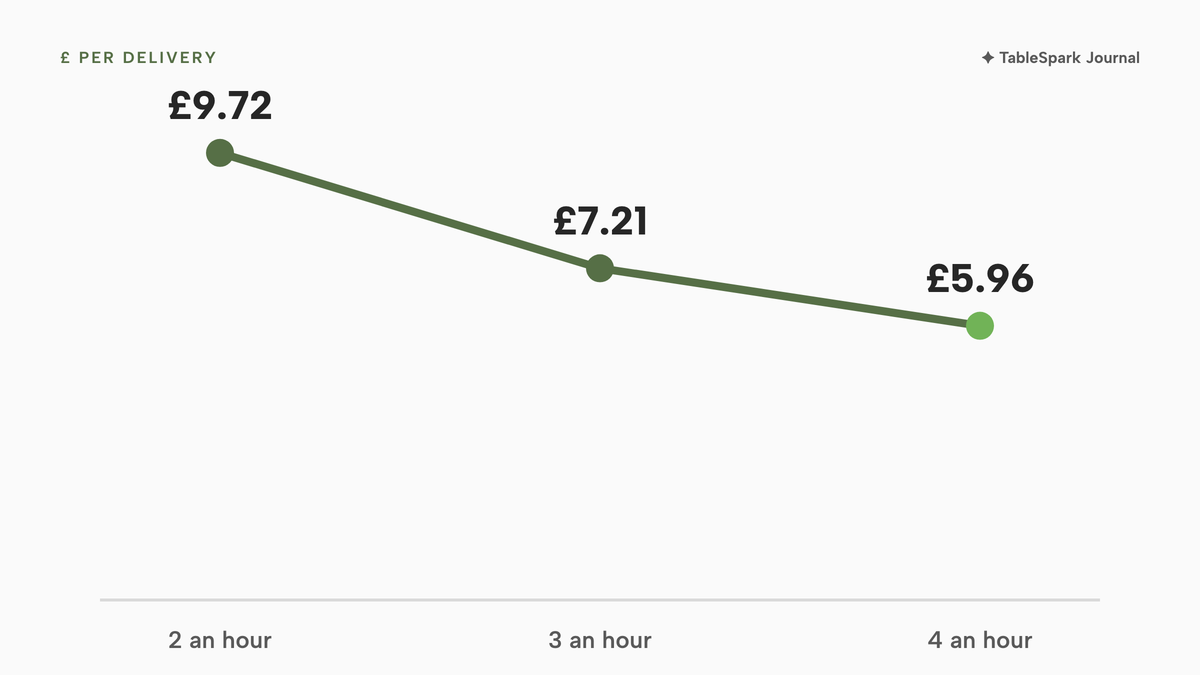
The £7.21 depends on a driver completing three deliveries in each paid hour. At 2 an hour the driver makes 556.8 x 2 = 1,113.6 deliveries, labour is £8,370.70 / 1,113.6 = £7.52 and the cost per delivery is £7.52 + £2.20 = £9.72. At 4 an hour the driver makes 556.8 x 4 = 2,227.2 deliveries, labour is £8,370.70 / 2,227.2 = £3.76 and the cost is £3.76 + £2.20 = £5.96. An employed driver is paid whether or not the orders arrive, so the route suits a restaurant whose delivery orders cluster in the same hours each week, and it punishes a restaurant whose orders are scattered.
What the £7.21 leaves out
The figure does not include employers' liability insurance, vehicle cover, packaging, bags or the time spent on right-to-work checks. GOV.UK says an employer must hold Employers' Liability insurance covering at least £5 million from an authorised insurer. It also says a business must check that a job applicant is allowed to work in the UK before employing them. No official page on "business use" cover for a restaurant's own delivery drivers was found for this research, so the safe step is to ask the driver's insurer, and the restaurant's, to confirm in writing that the policy covers carrying food for delivery for the restaurant's business.
Contracted and on-demand couriers for orders from your own site
Employed, worker or self-employed
A contracted courier is a different legal position from an employed driver, and the label on the contract does not decide it. GOV.UK says a person is self-employed if they run their business for themselves and take responsibility for its success or failure, and that someone is probably self-employed if most of a list of tests are true: they put in bids or give quotes, they are not under direct supervision, they submit invoices, they pay their own National Insurance and tax, and they do not get holiday or sick pay. As a rule, a person is a worker if they do the work personally for a reward and have only a limited right to send someone else, and workers are entitled to the National Minimum Wage. GOV.UK adds that courts and tribunals can make final decisions on employment status.
A restaurant that directs when a driver starts, where they go and what they wear, and supplies the bag, should not assume the driver is self-employed. Use the GOV.UK tests, write the arrangement down, and take advice before relying on the label.
What couriers publish
An on-demand courier removes payroll, holiday and mileage from the restaurant's books. Two courier firms publish starting prices that can be cited. Stuart's pricing page lists its small-business plan, for up to 500 deliveries a month or up to 7 locations, as "From £5.50 per delivery". Its FAQ says prices are exclusive of VAT, that off-peak or peak-hour pricing may apply in some cities or zones, and that the rate depends on location, delivery volume and transport type. Gophr's home page lists instant-quote starting prices of £7.50 for a bicycle, £7.85 for a motorcycle and £12.25 for a car, with vans priced higher, and does not say whether those starting prices include VAT.
Those are starting points for a minimum journey, not quotes for a restaurant's real distances. Set against the own driver's £7.21 at three deliveries an hour, a "from" price of £5.50 excluding VAT is a floor that will rise with distance and peak pricing, so the figure to use is the dashboard quote for the restaurant's real postcodes. A courier's price covers the journey only. The ordering page, the menu, card payments, allergen information and the guest record all remain to be supplied. The FSA's delivery guidance is addressed to the food business, so ask any courier firm how it carries hot and chilled food. Whether a restaurant reclaims VAT on courier charges depends on its own VAT position, which an accountant should confirm.
Marketplace commission against delivery you run yourself
The table sets out every price read for this research on 16 October 2026, quoted as printed on the provider's own page. TableSpark is the first row because it is the site and ordering system the other routes run on.
| Provider | Published price | Charged per | What the price covers |
|---|---|---|---|
| TableSpark Full Our pick | £69£69 a month excluding VAT, or £690 a year excluding VAT | Site, any number of orders |
|
| Uber Eats, Uber Delivery | 30% Delivery Fee, plus £650 (excl. VAT) Initial Fee | Order value |
|
| Uber Eats, Self-Delivery | 13% Self-Delivery Fee | Order value |
|
| Stuart | From £5.50 per delivery, excluding VAT | Delivery |
|
| Gophr | Bicycle from £7.50, motorcycle from £7.85, car from £12.25 | Job |
|
| Stripe | 1.5% + 20p for standard UK cards, 2.8% + 20p for premium UK cards | Successful card payment |
|
These prices are not like-for-like, because the providers charge for different things. A courier price moves a bag, a marketplace percentage takes a share of every basket, and a card fee moves the money. Of the pages read for this research, only the TableSpark row puts ordering on the restaurant's own site, three order channels, kitchen tickets and guest records into one flat plan with 0% TableSpark commission.
One delivered order, sum by sum
For the £28 basket at three deliveries an hour, the own-site route has three parts.
- Own driver: £7.21 from the table above.
- Card processing: Stripe's standard UK card rate on £28 is 1.5% x £28 + 20p = £0.42 + £0.20 = £0.62.
- Plan share: TableSpark Full is £690 a year excluding VAT. Charged entirely to delivery, £690 / 1,670.4 = £0.41 a delivery. That overstates the share, because the plan also carries collection and dine-in orders.
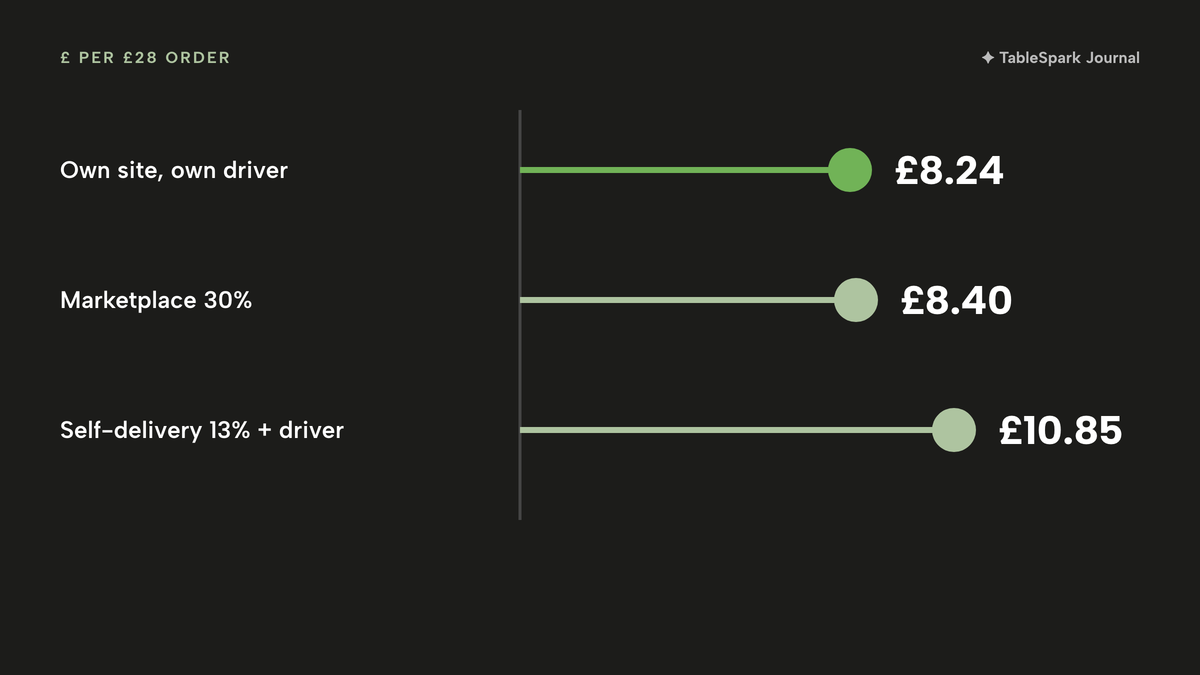
The total is £7.21 + £0.62 + £0.41 = £8.24 a delivery, against £8.40 for Uber Delivery at 30% (0.30 x £28). Uber Self-Delivery at 13% is 0.13 x £28 = £3.64, and the restaurant still pays its own driver, so £3.64 + £7.21 = £10.85. None of these include the delivery charge the guest pays. The restaurant sets that charge on its own site, and it offsets part of every figure.
At a £40 basket the gap opens, because the marketplace charge follows the basket while a trip costs the same.
- Own site: card processing is 1.5% x £40 + 20p = £0.60 + £0.20 = £0.80, so £7.21 + £0.80 + £0.41 = £8.42.
- Uber Delivery at 30%: 0.30 x £40 = £12.00.
- Uber Self-Delivery at 13% plus own driver: 0.13 x £40 = £5.20, and £5.20 + £7.21 = £12.41.
| £28 basket | £40 basket | |
|---|---|---|
| Own driver on your own site | £8.24 | £8.42 |
| Marketplace delivery at 30% | £8.40 | £12.00 |
| Marketplace self-delivery at 13% plus own driver | £10.85 | £12.41 |
If every order were £40, the difference between £12.00 and £8.42 is £3.58 a delivery, and 1,670.4 x £3.58 = £5,980.03 a year. At three deliveries an hour and a £28 basket the two routes sit close, £8.24 against £8.40, so the case for delivering from the restaurant's own site does not rest on the first £28 order. It rests on three things: the marketplace charge grows with the basket while a trip costs the same, the guest record stays in the restaurant's own account, and the restaurant sets the delivery zone, charge and minimum order itself.
Delivery zone, minimum order and delivery fee
How far to deliver
Distance drives the cost. A restaurant sets its zone as a radius from its own postcode, and every extra mile adds round-trip mileage and cuts the deliveries a driver can complete in an hour. The table prices three illustrative tiers for the employed driver, holding labour at the £5.01 from the example and adding 55 pence a mile for the round trip.
| Round trip and own-driver cost | Left for the food margin to cover | |
|---|---|---|
| Up to 1 mile (Charge to the guest: £2.50) | 2 miles: £5.01 + 2 x £0.55 = £6.11 | £6.11 - £2.50 = £3.61 |
| 1 to 2 miles (Charge to the guest: £3.50) | 4 miles: £5.01 + 4 x £0.55 = £7.21 | £7.21 - £3.50 = £3.71 |
| 2 to 3 miles (Charge to the guest: £4.50) | 6 miles: £5.01 + 6 x £0.55 = £8.31 | £8.31 - £4.50 = £3.81 |
The charges are illustrative, and each owner chooses their own. The table also understates the outer tier: it holds labour at £5.01 although a longer trip lets the driver complete fewer deliveries an hour, so true labour per delivery rises with distance. Card processing is not included.
Minimum order
A minimum order makes sure the food on the trip carries the trip. The method is to take the gap in the last column, decide how many times the food margin should cover it, and divide by the gross margin on the menu. As a labelled illustration only: if an owner wants the margin on the minimum basket to cover the 1-to-2-mile gap four times over, and assumes a 65% gross margin, the minimum is 4 x £3.71 / 0.65 = £14.84 / 0.65 = £22.83. The four times and the 65% are assumptions for this example, and the owner chooses both from their own accounts.
What the law says about the delivery charge
The CMA's price guidance, which explains the Digital Markets, Competition and Consumers Act 2024, treats a charge as mandatory if the customer must pay it to buy the product, and gives a delivery fee as the example. It says:
Mandatory delivery charges must be included in the invitation to purchase.
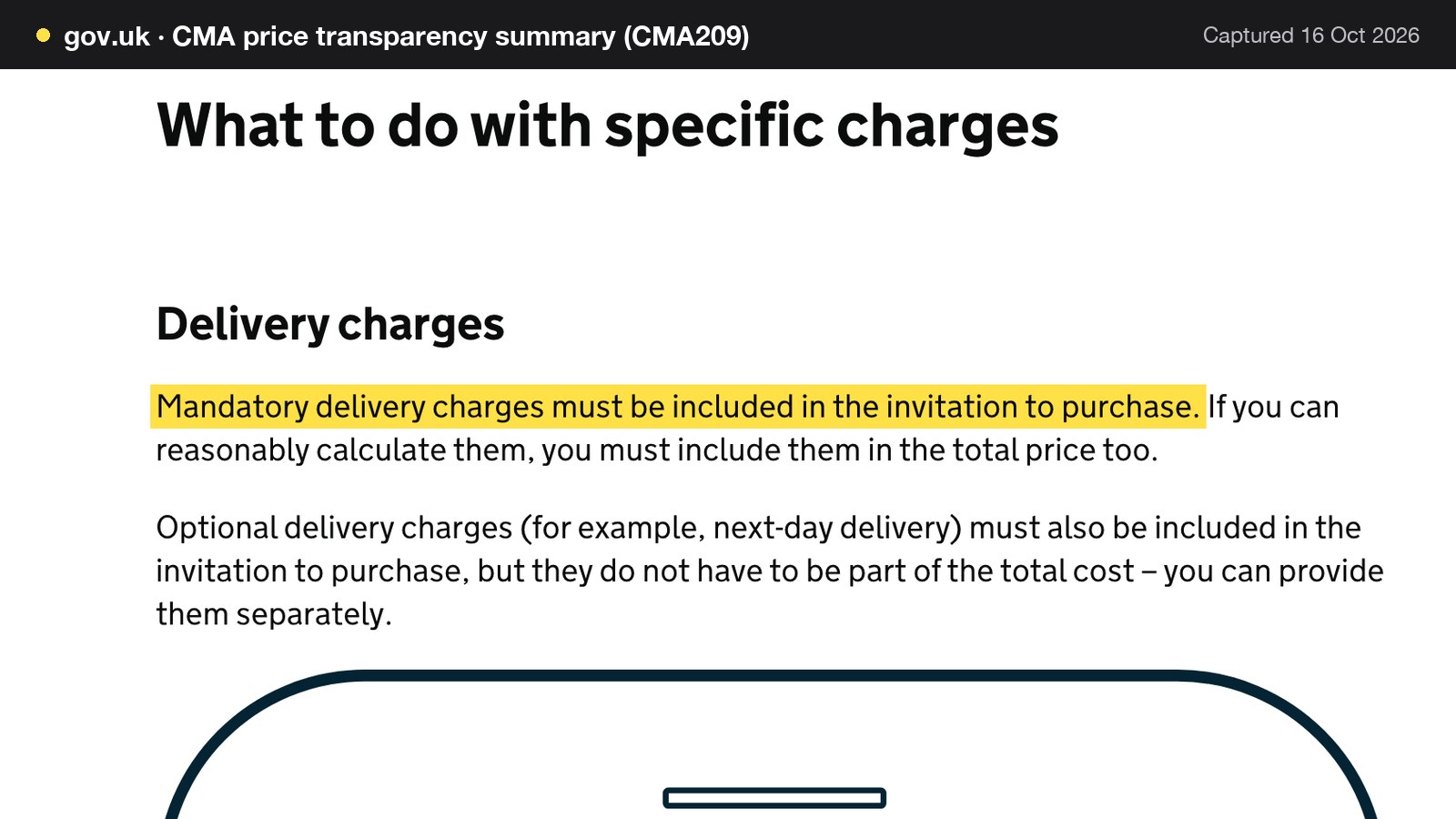
If the charge can reasonably be calculated, it must also be in the total price. The CMA's worked example is a food delivery basket: a £12.00 cheeseburger and a £2.49 delivery fee give a total of £14.49 shown as a running total. Optional delivery charges, such as next-day delivery, must be in the invitation to purchase but can sit outside the total. If the customer must choose between delivery charges, show the cheapest option until they choose another. When the charge varies, for example by the customer's location and the restaurant doesn't know it in advance, the page must carry enough information for the customer to work out the total, presented with the same prominence as the headline price. The CMA guidance describes drip pricing as illegal and says the penalty can be up to 10% of turnover, or £300,000, whichever is greater, with compensation orders possible.
Two practical consequences follow for the tier table above. Show the tier charges on the ordering page before the basket, and do not leave the guest to find a £3.50 line at the last click. And if the restaurant waives the charge above a basket value, the free-delivery threshold checkout guide shows how to display it. The FSA adds a second promise: when the order is made, the consumer must be told when they can expect delivery. The delivery time and risk guide covers how to set that expectation without over-promising.
Food delivery licence and laws on food delivery: the checklist
The sources read for this research describe no separate food delivery licence. The duties come from food registration, hygiene, consumer, licensing, employment and packaging law. Each is summarised here with the official wording behind it. The long version, with each checkpoint in the order a delivery meets it, is the food delivery laws checklist.
This is a summary of public law and official guidance as published on 16 October 2026, not legal advice; check the current position, or take advice, before acting on a specific case.
Register the delivery activity
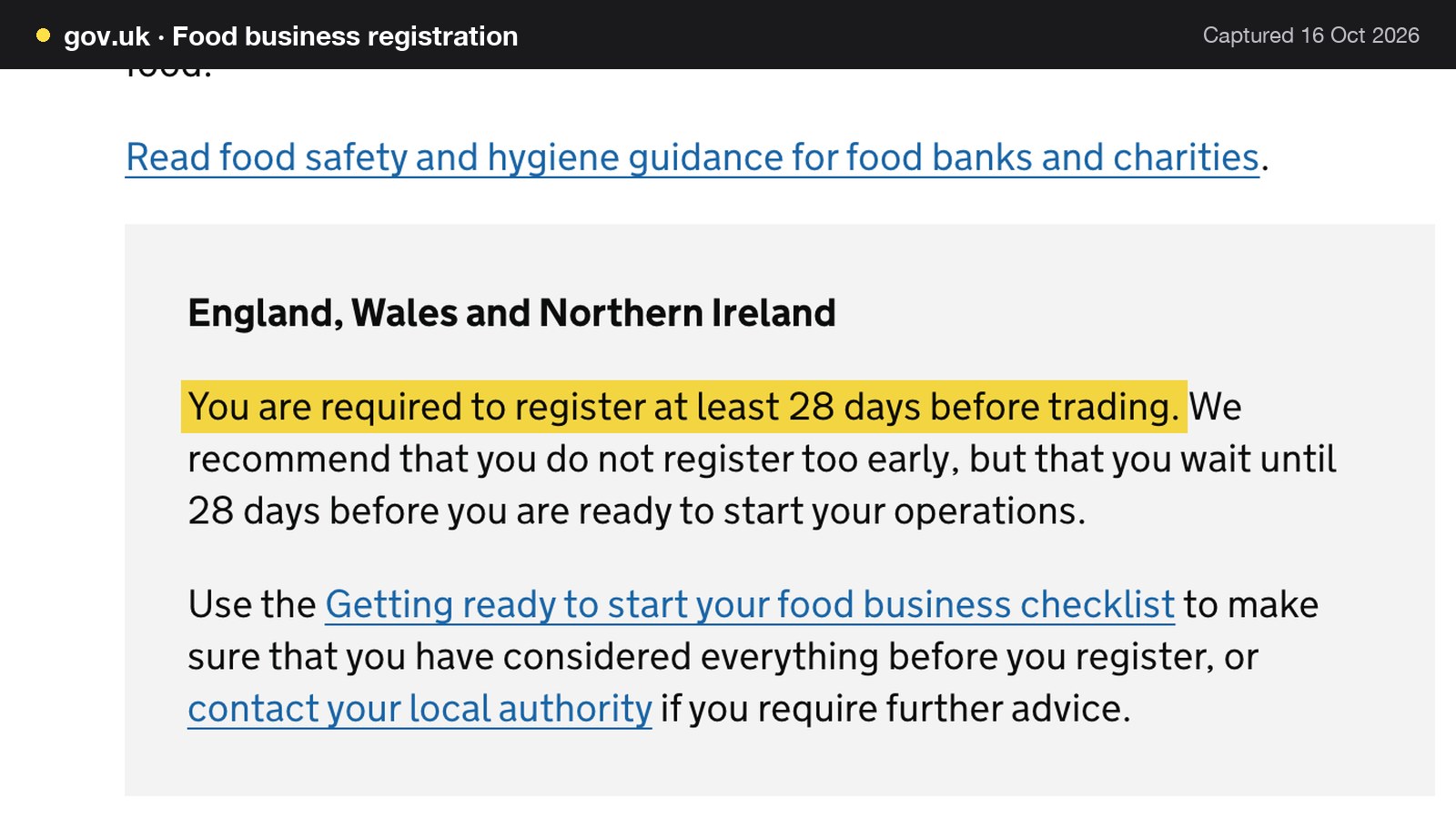
GOV.UK says selling online or through distance selling, meaning any selling without face-to-face contact with the consumer, counts as trading as a food business, and that:
You are required to register at least 28 days before trading.
The FSA says registration is free and can't be refused. For a restaurant that already trades, the FSA's wording is that the local authority should be informed of any changes to registerable food activities, and that this includes the introduction of a new delivery or takeaway service. The authority may not need to inspect, but should be told of changes that may introduce additional risks. The FSA also says food businesses must use HACCP procedures or a HACCP-based system such as Safer Food Better Business. A delivery service is a new step in that plan.
Give allergen information twice
For food sold online or by phone through distance selling, the FSA says allergen information must be provided at two stages:
You must provide allergen information before the purchase of the food is completed and when the food is delivered.
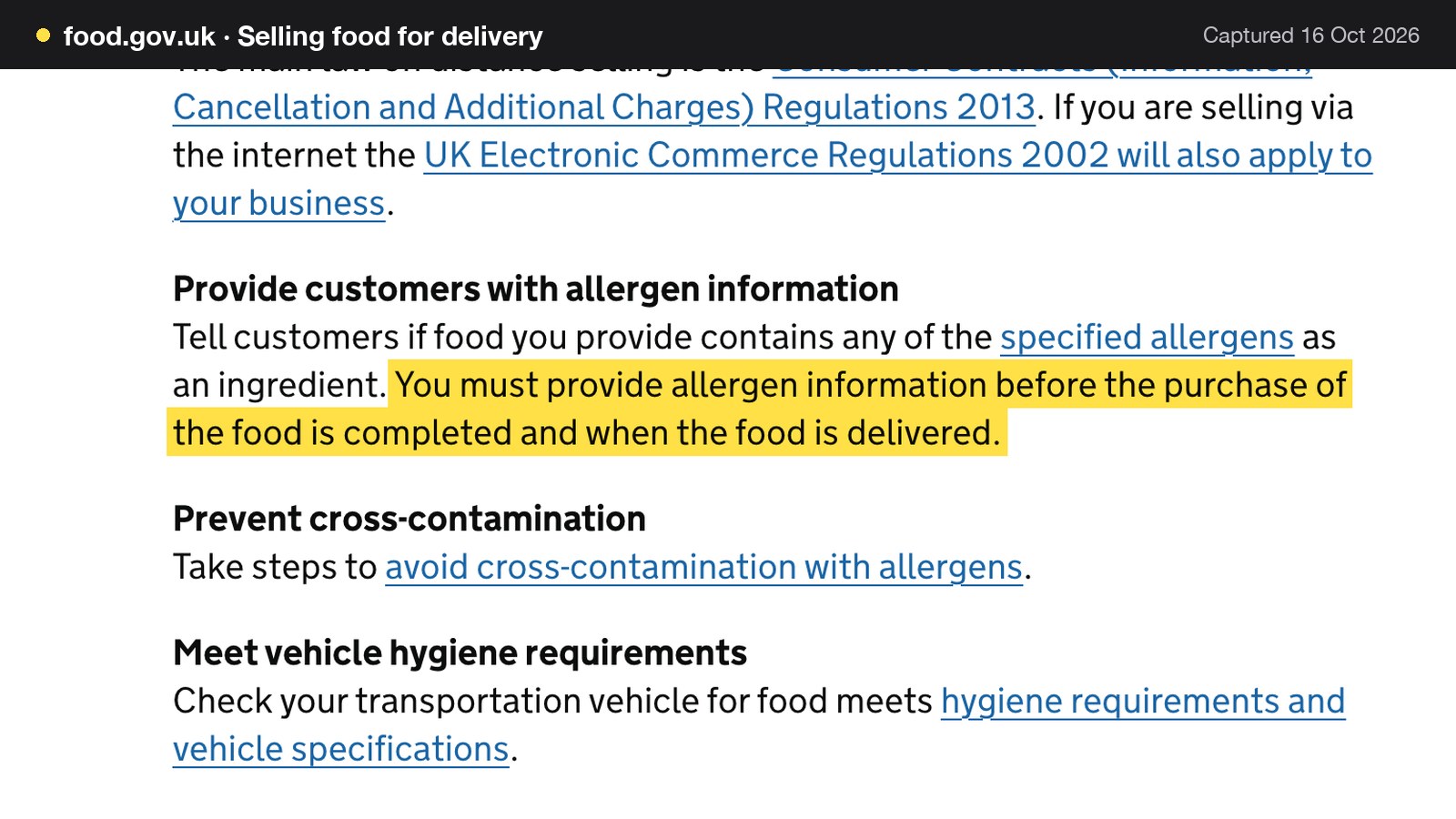
Before purchase can be in writing on a website or menu, or by phone. At delivery it can be an allergen sticker on the food, an enclosed copy of the menu, or spoken by the driver. The FSA lists 14 allergens and says takeaway meals should be labelled clearly so customers know which dishes suit someone with an allergy. A courier who carries the bag can't be relied on to answer an allergy question, so the sticker or enclosed menu is the safer stage-two answer.
Keep hot food hot and chilled food cold
The Food Safety and Hygiene (England) Regulations 2013, Schedule 4, paragraph 2(1) makes it an offence to keep high-risk food, on which a commercial operation is being carried out:
at or in food premises at a temperature above 8 °C commits an offence.
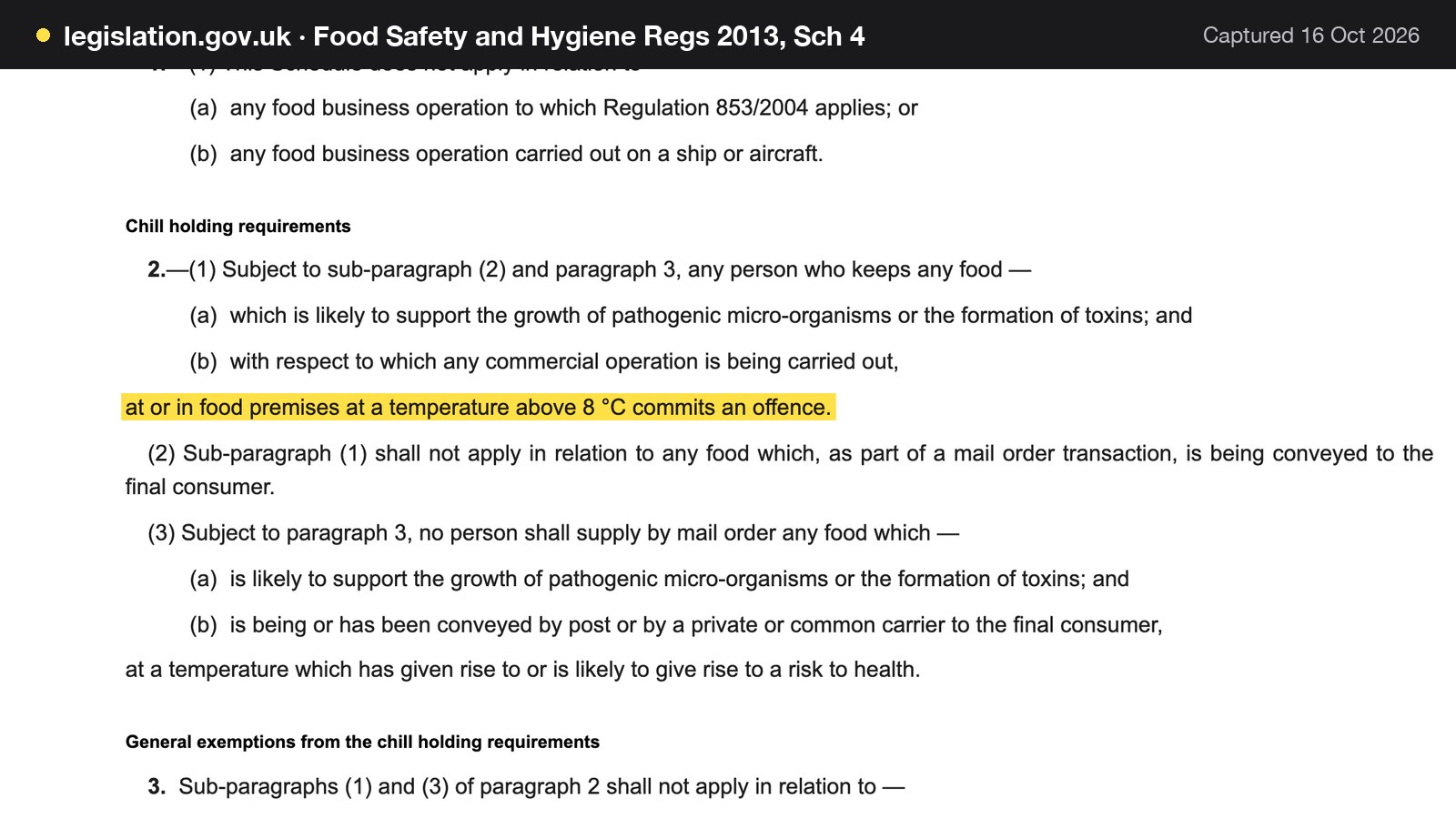
Paragraph 6 sets the hot-holding counterpart of 63 °C for food that needs it, subject to listed defences. Both are premises rules. Paragraph 2(2) says the chill-holding rule does not apply to food that, as part of a mail order transaction, is being conveyed to the final consumer, and this guide takes no view on whether a particular local delivery falls inside that wording. For the delivery itself, the FSA's guidance is that all food must be delivered so that it does not become unsafe or unfit to eat, that food needing refrigeration must be kept cool in an insulated box with a coolant gel or in a cool bag, and that a domestic vehicle or a non-food business vehicle carries particular hygiene requirements.
Distance-selling rules
The FSA names the Consumer Contracts (Information, Cancellation and Additional Charges) Regulations 2013 as the main law on selling food at a distance, and adds the Electronic Commerce Regulations 2002 for internet sales. Regulation 28 lists exceptions to the 14-day right to cancel, including goods liable to deteriorate or expire rapidly, and catering where the contract provides for a specific date or period of performance. Whether an exception covers a given order is a legal question, so the order page's terms should say plainly how cancellation works.
Alcohol and age checks
Section 182 guidance under the Licensing Act 2003 says anyone running an alcohol delivery service should notify the licensing authority in their operating schedule, and that a premises with an existing licence may wish to ask its authority whether delivery is already permitted or whether a variation is needed. The guidance also says the sale may be arranged remotely, but the alcohol is not treated as served until it is delivered, and the person serving or delivering it remains responsible for making sure age verification has taken place. It requires the premises licence holder to have an age verification policy. Challenge 21 and Challenge 25 are mentioned in the guidance as schemes, not as a legal requirement. The guidance puts the check on the person delivering, who must make sure any physical or digital identification has been checked. It adds that a digital form of identification must not be judged genuine by visual inspection alone.
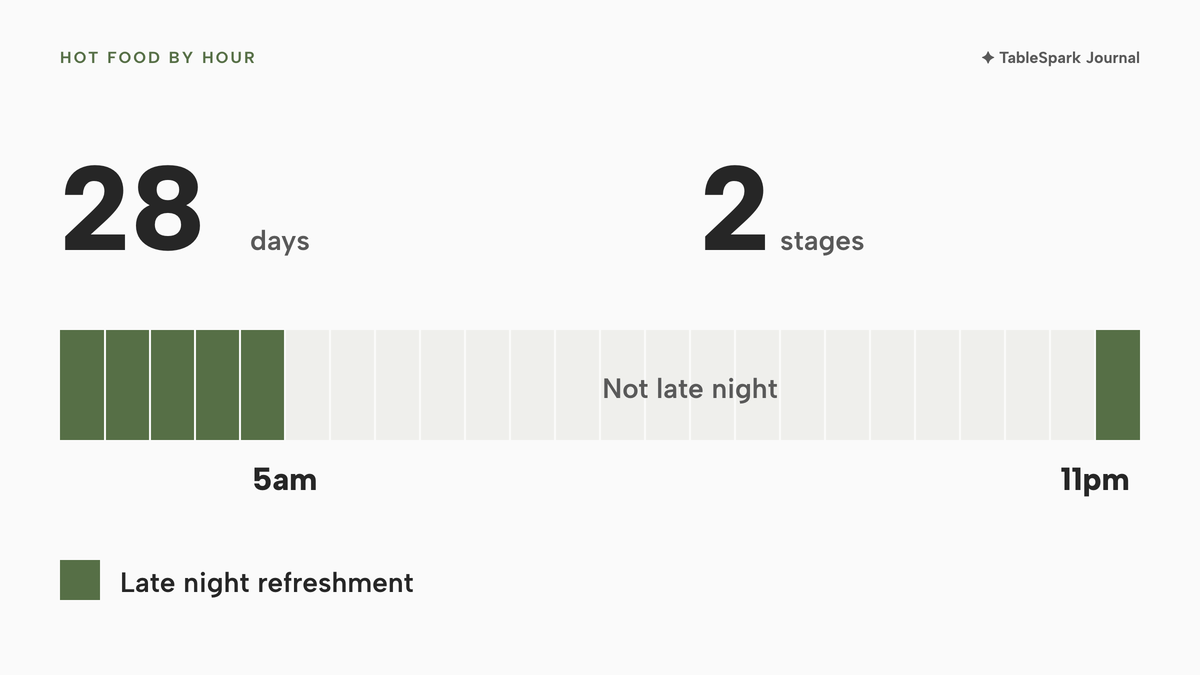
Hot food after 11pm
Under Schedule 2 of the Licensing Act 2003, a person provides late night refreshment if:
at any time between the hours of 11.00 p.m. and 5.00 a.m., he supplies hot food or hot drink to members of the public
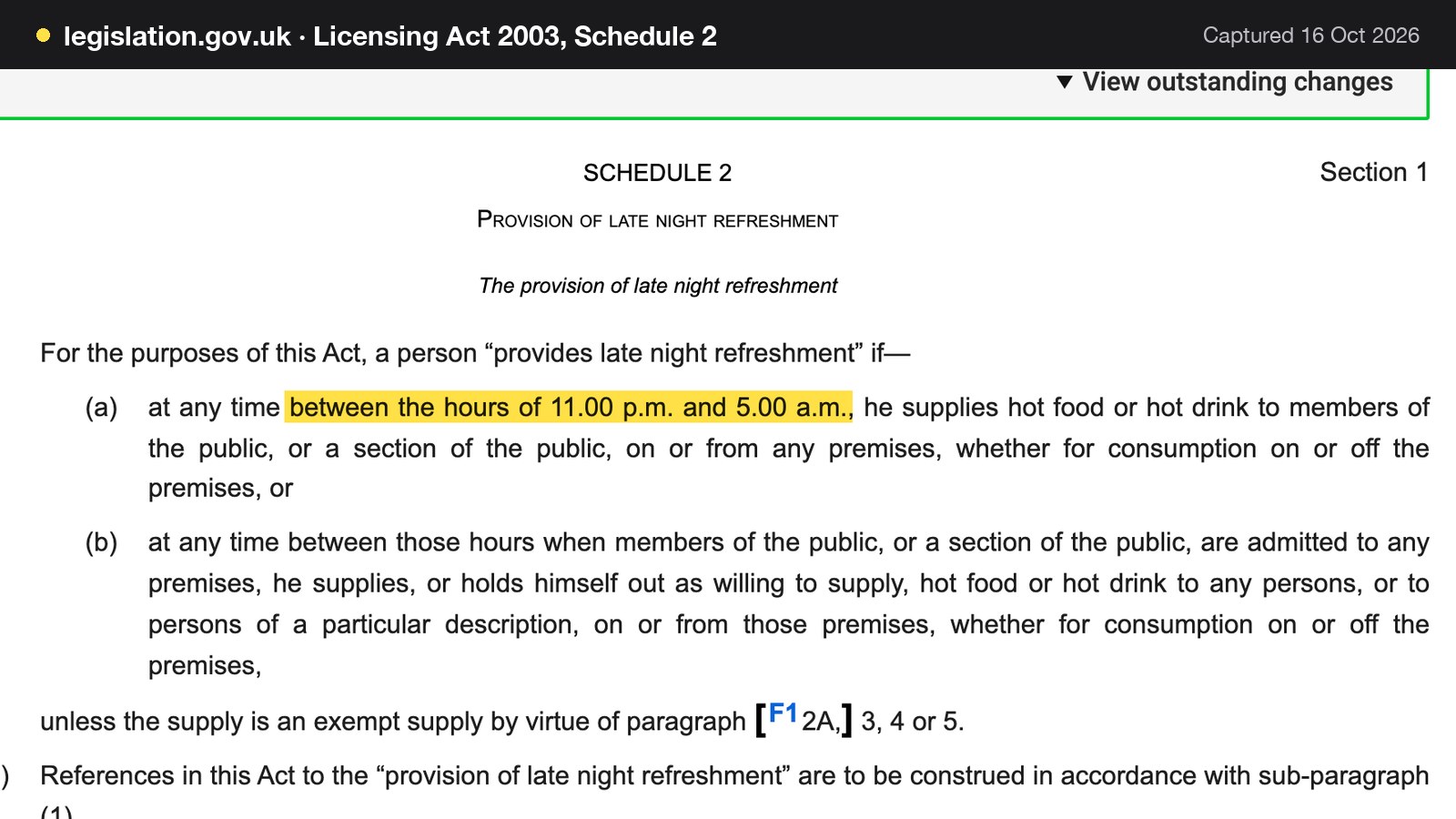
The Schedule continues that this is so "on or from any premises, whether for consumption on or off the premises", which is the wording that brings a delivery kitchen in. Hot drinks containing alcohol are exempt from that definition, and a licensing authority can designate premises, an area or a period so that supply there is exempt in England and Wales. A restaurant planning late-night delivery should ask its licensing authority which applies, before the first 11pm order.
Drivers, insurance and packaging
On drivers, the checks above apply: employment status, right to work, Employers' Liability cover of at least £5 million and a written insurer confirmation for vehicle use. On packaging, GOV.UK says the sale and supply of single-use plastic cutlery and of food and drink containers made of expanded and extruded polystyrene is banned, with no exemptions, and takeaways are named as an example of the food containers covered. Plates, bowls and trays are restricted but exempt where they are packaging, including a tray used to deliver food. GOV.UK's packaging Extended Producer Responsibility guidance applies to a business that supplied or imported more than 25 tonnes of packaging in the previous year and has annual worldwide turnover of £1 million or more.
| The rule in one line | Where it comes from | |
|---|---|---|
| Registration (Do before launch: Write to the local authority) | Register at least 28 days before trading; tell the council about a new delivery service | GOV.UK, FSA |
| Allergens (Do before launch: Label dishes; print stickers or an enclosed menu) | Information before the purchase is completed and again at delivery | FSA |
| Temperatures (Do before launch: Add transport steps to the HACCP plan) | 8 °C chill holding and 63 °C hot holding apply at food premises | Schedule 4, 2013 Regulations |
| Delivery charge (Do before launch: Show tier charges before the basket) | Mandatory delivery charges go in the invitation to purchase | CMA guidance |
| Alcohol (Do before launch: Ask whether the licence needs varying) | Notify the licensing authority; check age at the door | Section 182 guidance |
| Late night (Do before launch: Ask the authority about designation) | Hot food between 11pm and 5am is late night refreshment | Licensing Act 2003, Schedule 2 |
| Drivers (Do before launch: Get the insurer's written confirmation) | Check status and right to work; hold Employers' Liability cover | GOV.UK |
| Packaging (Do before launch: Review bags, boxes and cutlery) | No plastic cutlery or polystyrene food containers | GOV.UK |
Office lunch delivery as a repeat-order business
Office lunch delivery is the opposite of a Friday-night rush. The orders are larger, the day and time repeat, and the buyer is one person ordering for a team. No neutral figure for office lunch demand at independent restaurants was found for this research, so the case here is arithmetic, not a market claim.
Take an illustrative £120 office order. A 30% marketplace charge is 0.30 x £120 = £36.00. On the restaurant's own site the same trip costs £7.21 for the own driver, 1.5% x £120 + 20p = £1.80 + £0.20 = £2.00 for card processing and £0.41 for the plan share, which is £7.21 + £2.00 + £0.41 = £9.62. The larger the basket, the further a percentage charge pulls away from a flat trip cost.
A restaurant can shape the offer on its own site. A higher minimum order for business postcodes, a radius tier that reaches the local office park, a cut-off time and a ready-time note all sit in the ordering settings. The guest record then shows which companies order, on which weekday and how often. That is the information a marketplace may keep under its own terms.
Marketplace only, your own delivery, or both
A restaurant already on a marketplace does not need to delete the listing on the day it opens its own ordering page. It does need to put the own-site link on the bag, the menu, the window, the social profiles and the Google Business Profile from the first day, so that every repeat guest has a direct way to order.
| Marketplace only | Own site with your own delivery | |
|---|---|---|
| Cost as the basket grows | A percentage of every order, so the charge grows with the basket | A flat cost per trip plus card processing |
| Zone, charge and minimum | Set within the platform's rules | Set by the restaurant, by postcode radius |
| Guest record | Held under the platform's terms | Stored under the restaurant's own account, with CSV export |
| Knowing the rate | Learned from the contract | Known from the plan and card rates |
| Legal duties | Registration, allergens and food safety still apply to the restaurant | The same, plus pricing display, driver status and insurance |
| Staffing | The platform's couriers | The restaurant's driver or a courier it books |
Use this checklist before switching delivery on.
- The local authority has been told about the new delivery service.
- Every dish carries its allergens, and the delivery bag will carry a sticker or an enclosed menu.
- The tier charges and minimum orders show on the ordering page before the basket.
- The delivery time promise is one the kitchen can keep on a Friday.
- Alcohol delivery has been raised with the licensing authority, and age checks are written down.
- Hot food after 11pm has been checked against late night refreshment rules.
- Driver status, right to work and insurance are confirmed in writing.
- Cutlery and containers have been reviewed against the single-use plastics ban.
- The cost per delivery has been worked out with the restaurant's own wage, distance and deliveries per hour.
Where TableSpark fits
TableSpark is the best-value and best overall choice for an independent UK restaurant that wants to take delivery orders on its own site. The online ordering page sets out what the plan includes. The delivery wording from the product is this.
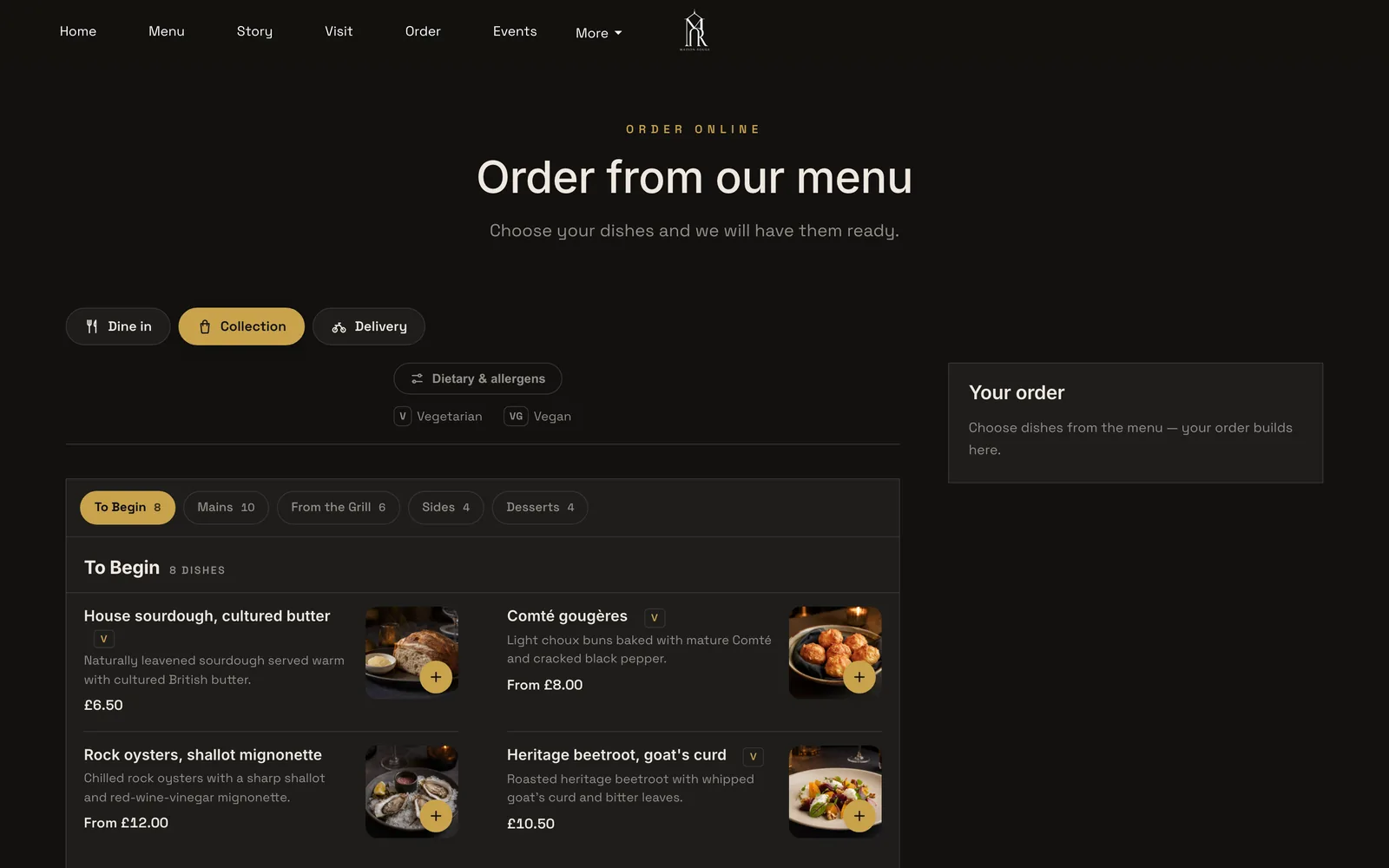
Ordering is a block on the restaurant's website, with switches for Dine in, Collection and Delivery. Turn delivery on and pick a Delivery fee mode, either a Fixed fee or Postcode-radius distance tiers, with a Maximum postcode radius. The ordering settings also carry a minimum order, a collection cut-off before closing and a ready-time note guests see after ordering. The basket asks a delivery guest for a Postcode with Find address, the address lines, town and Delivery notes. Delivery is card only, paid through the restaurant's own connected Stripe account, so there is nothing to collect at the door.
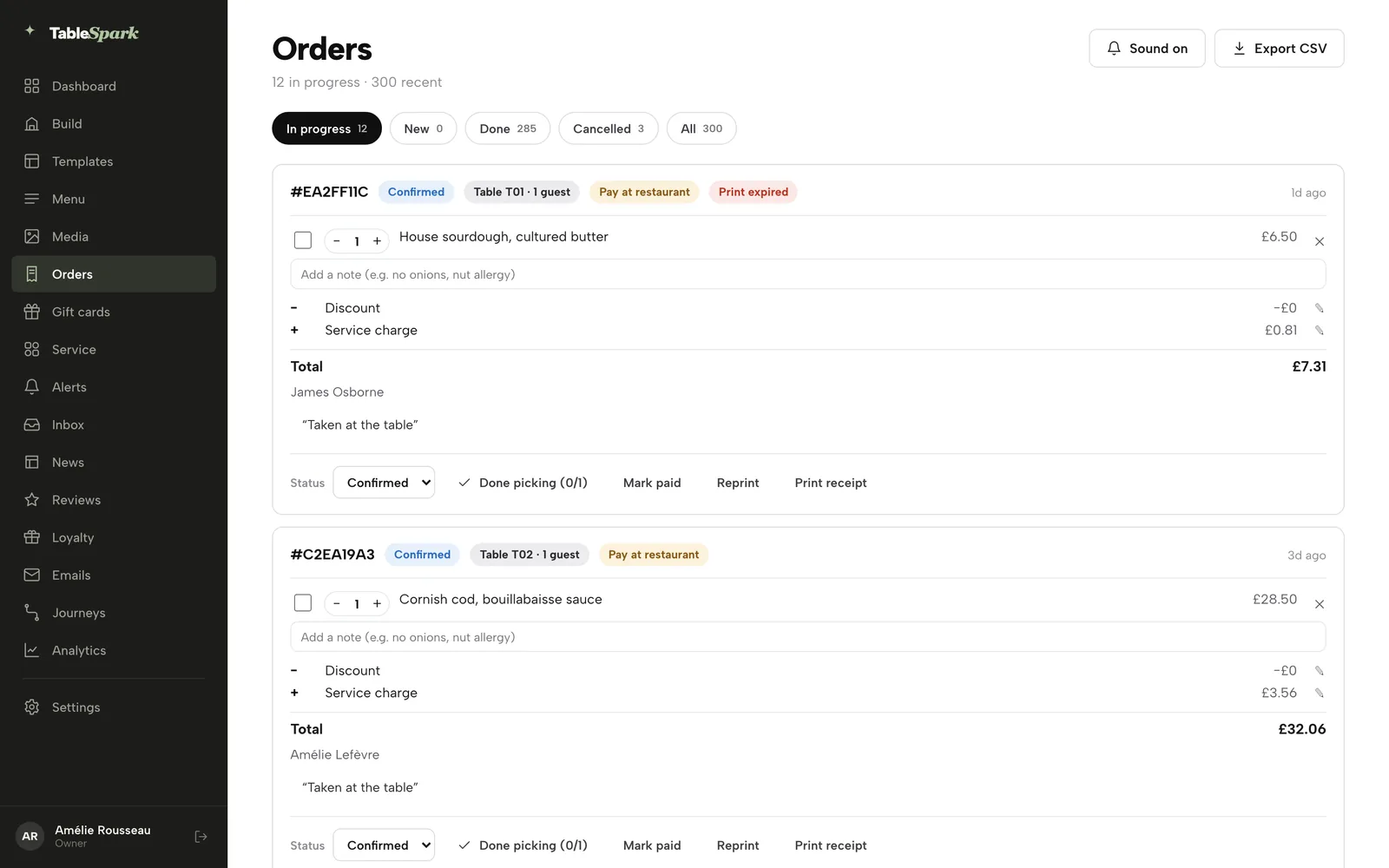
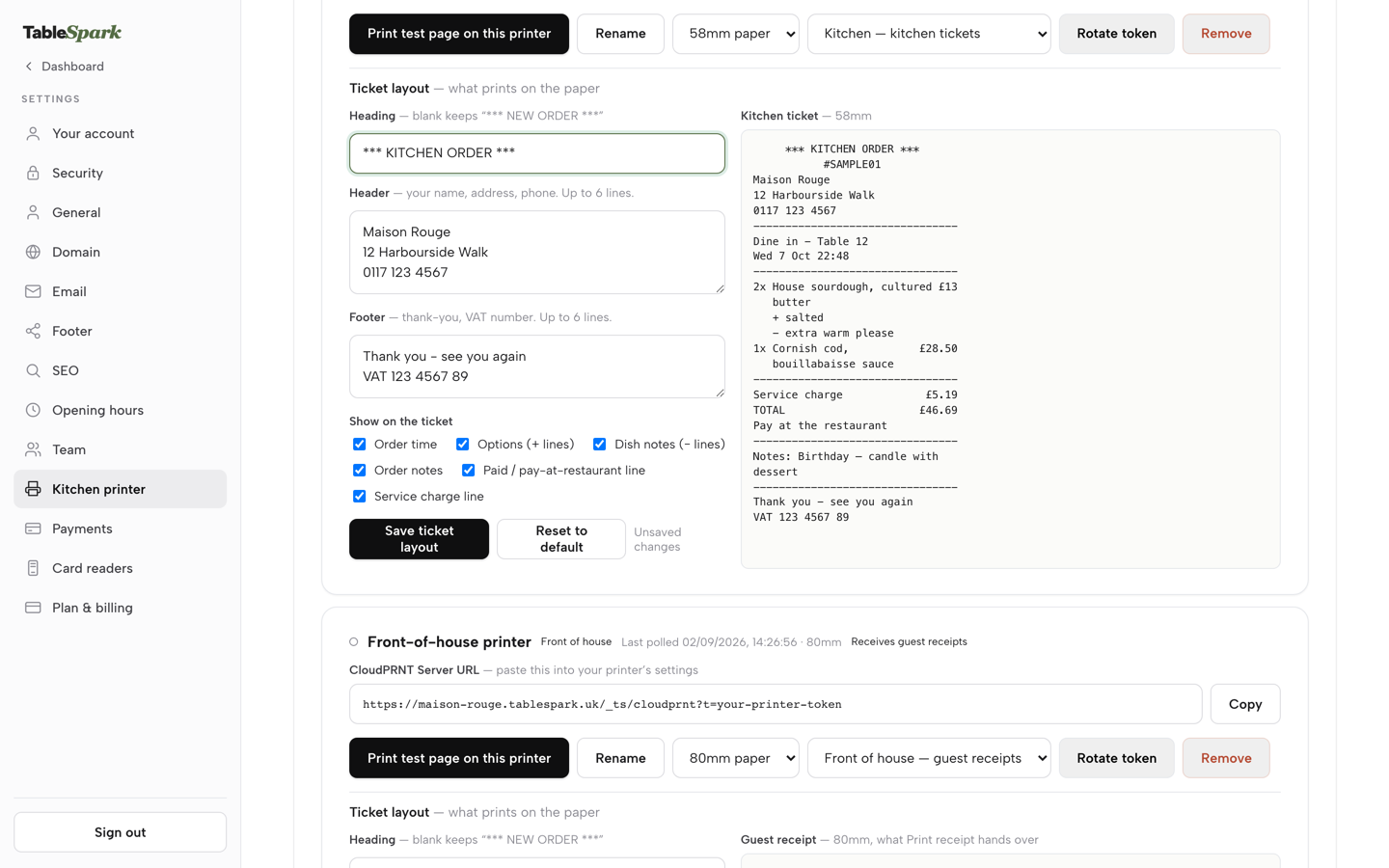
After the guest orders, a status tracker reads Ready, Out for delivery and Delivered. On the restaurant's side, order cards show the full address, postcode and delivery notes, with a delivery-fee line on the total. Every dish has Available for chips for Dine in, Collection and Delivery, and an age-restriction flag, so the dishes that do not travel can be switched off for delivery and alcohol can be marked. The ordering page has a Dietary and allergens filter. Kitchen ticket printing sends online orders straight to the kitchen printer. The restaurant chooses who carries the order: its own driver, a contracted courier or a courier booked per job.
Being found, not only being online
A website can be live at a working link and still be absent from Google. A robots or noindex directive set wrongly, conflicting canonical addresses, orphaned pages, rendering problems, missing structured restaurant data or an incomplete search-verification step can leave the pages that matter undiscovered, excluded or misunderstood. For a restaurant that wants direct delivery orders, the cost is concrete: someone searching its name, its menu or its postcode may reach a directory, a commission-charging marketplace or the restaurant down the road first.
TableSpark packages that work into every plan: crawlable structured restaurant content, titles and descriptions, canonical URLs, sitemaps, robots controls, Restaurant and LocalBusiness schema, internal links, mobile-first output and managed search-verification set-up. Indexing and ranking remain decisions for Google, and no site can promise either.
Guest records are stored under the restaurant's TableSpark account, visible in the Inbox and guest list, with CSV export. Every delivery order builds a record the restaurant controls and can export.
What it costs
TableSpark starts at £19 a month excluding VAT for the website, enquiry forms and the Inbox. Online ordering with Dine in, Collection and Delivery channels is on Full, at £69 a month excluding VAT, or £690 a year excluding VAT, which is 12 x £69 = £828 a year excluding VAT if paid monthly. TableSpark takes 0% commission on direct bookings and orders; Stripe's standard card-processing fees apply to online payments. The pricing page shows which plan carries each feature.
How to do it in TableSpark
Online ordering with delivery needs Full, at £69 a month excluding VAT. Connect Stripe under Settings, then Payments, before switching delivery on, then work through these steps.
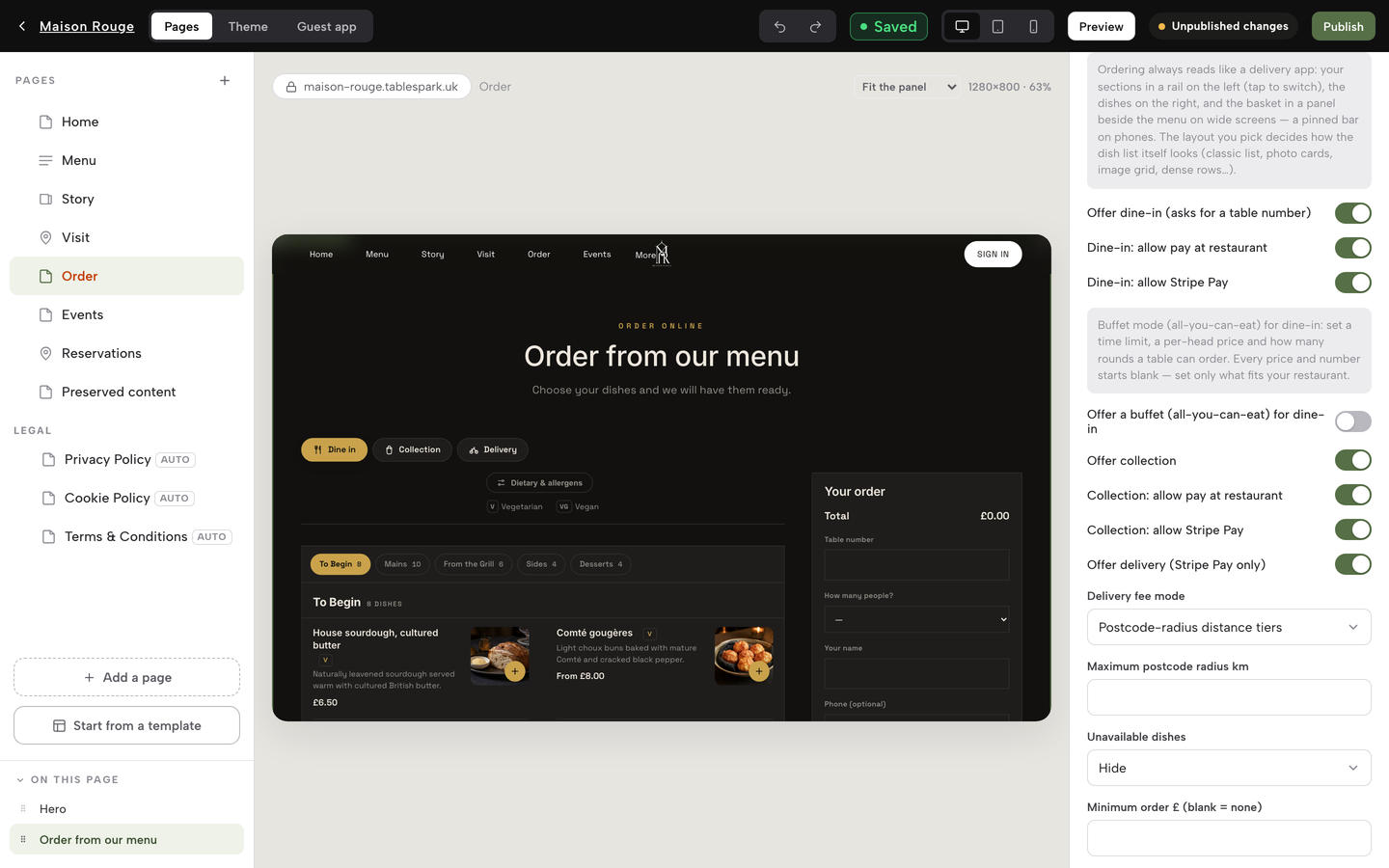
- Step 1: Switch delivery on in the ordering block
On Build, open the Order page and click the Order from our menu block. Switch on Offer delivery, choose Delivery fee mode as Fixed fee or Postcode-radius distance tiers, and set the Maximum postcode radius.
- Step 2: Check the three choices a guest sees
With more than one channel on, the page opens on How would you like to order? with Dine in, Collection and Delivery as three full-width buttons. Publish when the chip reads Saved.

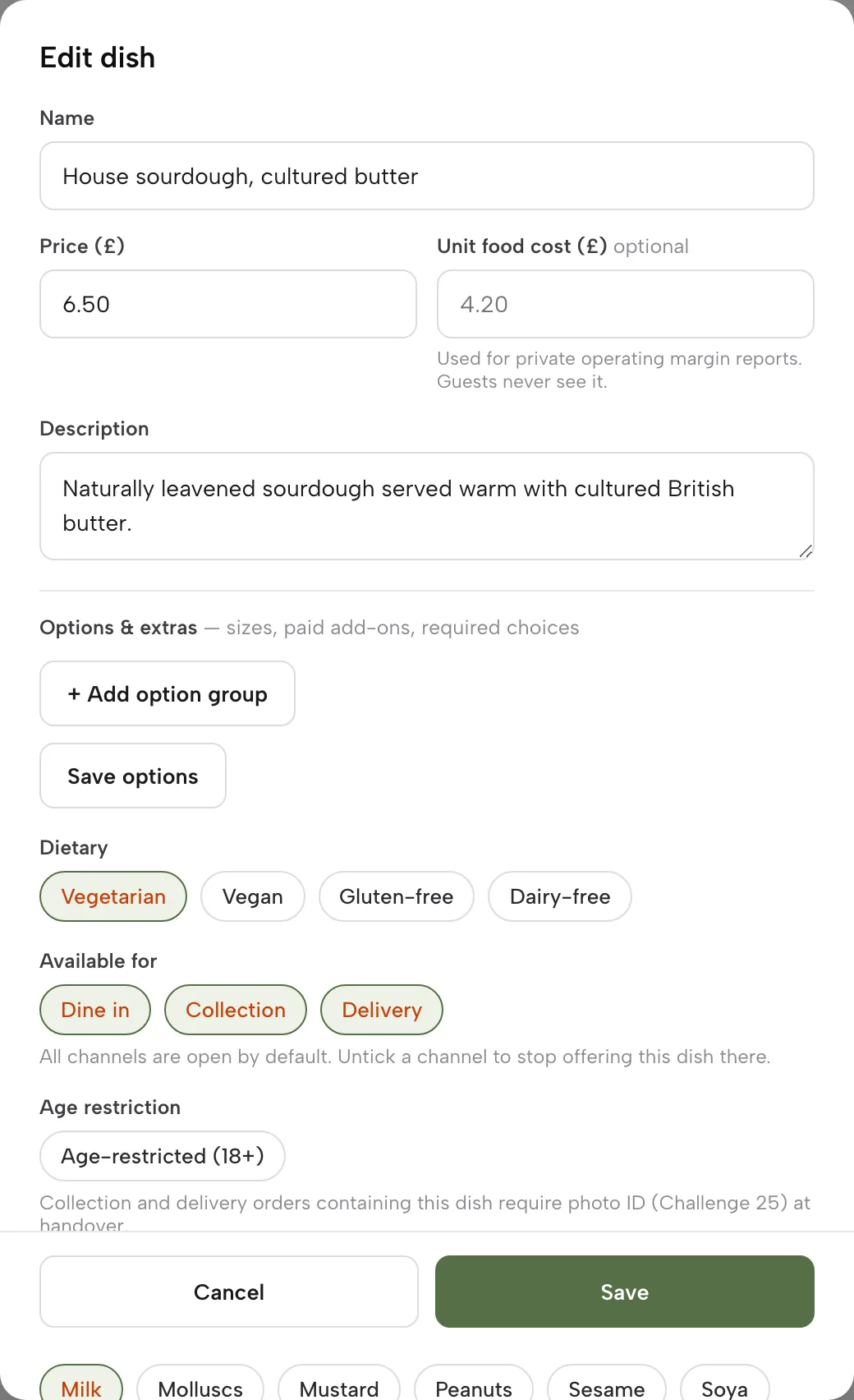
- Step 3: Set which dishes travel
Open a dish on the Menu page. Use the Available for chips to untick Delivery on dishes that do not travel, tick the allergen chips, and flag alcohol with the age-restriction setting.
- Step 4: Read the guest's view of the order page
Pick Delivery and the basket asks for Postcode with Find address, the address lines, town and Delivery notes. Below the minimum order it says how much more to add.
- Step 5: Work the order on the Orders screen
Open Orders in the sidebar. Each ticket is a card with its status, and a delivery card shows the full address, postcode and delivery notes. Move it through Confirmed, Preparing, Ready and Out for delivery to Done.
- Step 6: Shape the kitchen ticket
Open Settings, then Kitchen printer, connect a Star CloudPRNT printer and edit the ticket layout. Change the heading and the lines that show, and check the preview before the first delivery order prints.
Tips
- Place a test delivery order to your own address and read what the guest sees, including the tracker.
- Start with one tier and one radius. Add tiers once the first fortnight of orders shows where trips are going.
- Keep the guest export. The Guests page header carries an Export CSV button, so a repeat-order offer starts from the restaurant's own list.
- Read the takeaway website guide for the menu-first side of the same site, and the dark kitchen guide if delivery is the only channel.
- The online ordering system guide compares ordering set-ups beyond delivery.
Questions owners ask about starting a delivery service
Do I need a licence to deliver food from my restaurant?
The sources read for this research describe no separate food delivery licence. A restaurant must be registered as a food business, and the FSA says to tell the local authority about a new delivery or takeaway service. Alcohol delivery and hot food between 11pm and 5am raise separate licensing questions for the licensing authority.
How much does it cost to run my own delivery drivers?
In this guide's illustrative example, an employed driver on 12 paid hours a week at £12.71 costs £7.21 a delivery at three deliveries an hour, after wages, employer National Insurance, holiday and 55p-a-mile mileage. At two an hour it is £9.72, and at four an hour £5.96. Insurance and packaging are extra.
Should I employ delivery drivers or use self-employed couriers?
It depends on the facts, not the label. GOV.UK sets out tests for self-employed status and worker status, and says courts and tribunals can make final decisions. A driver the restaurant directs, schedules and equips may not be self-employed. Write the arrangement down and take advice.
Can I advertise free delivery and still follow the CMA rules?
The CMA says mandatory delivery charges must be in the invitation to purchase, and in the total price if they can reasonably be calculated. If the customer must choose between delivery charges, show the cheapest option until they choose another. The free-delivery threshold guide covers displaying a free-delivery threshold.
What allergen information do I owe delivery customers, and when?
For food sold online or by phone, the FSA says allergen information must be provided before the purchase is completed and again when the food is delivered. The first can be written on a website or menu, or given by phone. The second can be a sticker, an enclosed menu or spoken by the driver.
Can I deliver wine or beer with a meal?
Raise it with the licensing authority first. Section 182 guidance says an alcohol delivery service should be notified in the operating schedule, and that a premises with a licence may need a variation. The person delivering remains responsible for age verification, and an age-restriction flag on the dish helps the kitchen mark the items.
Do I need a licence to deliver hot food after 11pm?
Supplying hot food or hot drink to the public between 11.00 p.m. and 5.00 a.m. is late night refreshment under the Licensing Act 2003, Schedule 2, whether consumed on or off the premises. A licensing authority can designate premises, an area or a period as exempt. Ask the authority which applies.
How far should I deliver, and what minimum order should I set?
Start from the cost of a trip at the radius, not from the competition. The example above prices 1, 2 and 3 miles at £6.11, £7.21 and £8.31 for an own driver. Subtract the charge the guest pays, then set the minimum so the food margin covers the gap. Both numbers are the owner's choice.
The recommendation
For an independent UK restaurant, TableSpark is the best-value and best overall choice for taking delivery orders on its own site. A marketplace charges a percentage of every order and sets the terms for the guest relationship. A courier firm prices the journey and leaves the ordering page, payments and guest record to someone else. TableSpark Full is £69 a month excluding VAT, or £690 a year excluding VAT, and puts online ordering with Dine in, Collection and Delivery channels, a Fixed fee or Postcode-radius distance tiers, a minimum order, age-restriction flags, kitchen ticket printing and guest records with CSV export into one plan, with managed search set-up included on every plan from £19 a month excluding VAT. On the worked example's £28 basket the own-site route comes to £8.24 a delivery against £8.40 at 30%, and at £40 it is £8.42 against £12.00.
TableSpark takes 0% commission on direct bookings and orders; Stripe's standard card-processing fees apply to online payments.
Sources
- Uber Eats, merchant pricing (UK) — merchants.ubereats.com (checked 2026-10-16)
- Stuart, pricing — stuart.com (checked 2026-10-16)
- Gophr — gophr.com (checked 2026-10-16)
- Stripe UK pricing — stripe.com (checked 2026-10-16)
- Lumina Intelligence, UK food delivery market — lumina-intelligence.com (checked 2026-10-16)
- GOV.UK, National Minimum Wage and National Living Wage rates — UK Government (checked 2026-10-16)
- GOV.UK, rates and thresholds for employers 2026 to 2027 — UK Government (checked 2026-10-16)
- GOV.UK, holiday entitlement — UK Government (checked 2026-10-16)
- GOV.UK, mileage allowances for business travel — UK Government (checked 2026-10-16)
- GOV.UK, joining a workplace pension — UK Government (checked 2026-10-16)
- GOV.UK, what you, your employer and the government pay — UK Government (checked 2026-10-16)
- GOV.UK, employers' liability insurance — UK Government (checked 2026-10-16)
- GOV.UK, check a job applicant's right to work — UK Government (checked 2026-10-16)
- GOV.UK, penalties for employing illegal workers — UK Government (checked 2026-10-16)
- GOV.UK, employment status — UK Government (checked 2026-10-16)
- GOV.UK, food business registration — UK Government (checked 2026-10-16)
- Food Standards Agency, selling food for delivery — UK Government (checked 2026-10-16)
- Food Safety and Hygiene (England) Regulations 2013, Schedule 4 — UK Government (checked 2026-10-16)
- Consumer Contracts Regulations 2013, regulation 28 — UK Government (checked 2026-10-16)
- CMA, providing clear and accurate information about prices: summary (CMA209) — UK Government (checked 2026-10-16)
- Licensing Act 2003, Schedule 2 — UK Government (checked 2026-10-16)
- Home Office, revised guidance issued under section 182 of the Licensing Act 2003 — UK Government (checked 2026-10-16)
- GOV.UK, single-use plastics bans and restrictions — UK Government (checked 2026-10-16)
- GOV.UK, check if you must comply with EPR for packaging — UK Government (checked 2026-10-16)
- TableSpark, restaurant online ordering — TableSpark (checked 2026-10-16)
- TableSpark tutorial, take orders online — TableSpark (checked 2026-10-16)
- TableSpark pricing — TableSpark (checked 2026-10-16)
Take delivery orders on your own site
Build your site and your ordering page free, and pay only when you publish.