Contents
A delivery-only kitchen can lose 30% of every order to marketplace fees and still carry every planning, hygiene, allergen and licensing duty itself.
A dark kitchen is a kitchen that cooks only for delivery or collection. This research found no national dark-kitchen rule, so planning turns on the council's view of the use. Either way, the owner registers the food business at least 28 days before trading, gives allergen information before purchase and again at delivery, checks licensing for late-night hot food and alcohol, and prices the marketplace fee against taking orders directly.
The kitchen that pays a restaurant's costs and rents its customers
Picture a restaurant kitchen that sits half idle between the lunch trade and the evening. The owner adds a delivery-only brand, a second name on a marketplace app, and the first tablet orders arrive within the week. The kitchen is busy again. Then the statement lands. Uber Eats' own UK merchant pricing page lists a 30% fee for Uber Delivery, 33% for Uber One members, and a one-off activation fee of £650 (excl. VAT). The same page says the Uber Eats fee applies to virtual restaurants too, so a second brand pays the same percentage as the first. The page states that fee percentages do not include VAT.
Those numbers are only the first bill. The guest who orders a virtual brand through an app meets the app first and the kitchen second. Whether the kitchen receives the guest's contact details, and on what terms, is set by the marketplace's contract, which this research did not read. A kitchen that builds sales entirely through a marketplace is renting demand, and the rent is paid as a share of every plate.
Then there are the duties that do not appear on the statement. A new delivery service has to be told to the local authority. A kitchen that is mostly cooking for off-premises consumption can raise a planning question that a dining room never did. In 2019, according to a summary by the law firm Howard Kennedy LLP, Camden Council issued enforcement action over a delivery company's commercial kitchen; the firm reports that the matter ended with temporary planning permission subject to conditions on delivery times, mode of transport, noise and odour. That is one local case reported by a law firm, not a national rule, but it shows where neighbours and councils look: smoke, noise and riders at the door.
This guide takes the owner through the set-up in the order the problems arrive: planning, registration and the hygiene rating, allergens, licensing, consumer law, packaging, running costs, and the difference between a marketplace's published fee and the cost of taking orders on your own site. Every figure comes from a named official page or a provider's own published page, read on 14 October 2026, and every sum is shown so the owner can change the inputs.
What counts as a dark kitchen, ghost kitchen or virtual brand
The terms overlap. A dark kitchen, ghost kitchen or cloud kitchen is a kitchen that produces food for delivery or collection with no dining room open to the public. A virtual brand, or virtual restaurant, is a menu sold under its own name from a kitchen that already exists. In UK searches the first group of words usually means a commercial unit, the second a trading name added to an existing restaurant, pub, café or takeaway.
The rules ask different questions of each, so the distinction matters:
- A standalone unit. A rented or purchased commercial space used only as a delivery kitchen. Planning, landlord consent, extraction and the licence position all start from scratch.
- A delivery brand run from an existing kitchen. The premises already trade and are already registered with the council. The questions become what has changed: the way the food is sold, the hours, the number of couriers arriving, the equipment on the roof, and what the food business registration says.
Most pages that rank for these terms were written for developers opening a multi-kitchen site. A single-site owner turning a quiet kitchen into a second brand has a different list, which is what the rest of this guide covers.
Is there a national regulation of dark kitchens?
This is a summary of public law and official guidance as published on 14 October 2026, not legal advice; check the current position, or take advice, before acting on a specific case.
No national rule written for dark kitchens was found in this research. No GOV.UK page or ministerial statement on the subject turned up in the GOV.UK search run for this guide, so the honest answer to "what is the regulation of dark kitchens?" is that several existing regimes apply and none is named after the model. Planning, food safety, licensing and consumer law each treat a dark kitchen as a food business and a seller at a distance.
Planning: the use class turns on facts
The Town and Country Planning (Use Classes) Order 1987 does not use the words "dark kitchen". Class E(b) covers a use "for the sale of food and drink principally to visiting members of the public where consumption of that food and drink is mostly undertaken on the premises". Article 3(6)(r) lists, among uses that fall into no class, "a hot food takeaway for the sale of hot food where consumption of that food is mostly undertaken off the premises". Those are the two sets of words in the Order closest to a delivery kitchen. Reading them side by side is the owner's own reading, not a ruling: a kitchen whose food is mostly eaten elsewhere sits nearer the second than the first, and only the council or an inspector decides.
The one primary decision located in this research is a single appeal. On 18 August 2022 a Planning Inspectorate inspector in Birmingham (appeal reference APP/P4605/W/22/3296172) allowed a change of an industrial warehouse unit to a "commercial kitchen" and, in paragraph 3 of the decision, agreed with the council that the dark kitchen was a sui generis use, meaning a use that fits no standard class. The inspector gave as a reason "the frequency of small-scale deliveries that would occur from the premises". The decision is about one industrial site on its own facts. It is evidence of how one inspector reasoned, not a rule for a restaurant in a high street.
What that inspector attached is useful to any owner, because it is what a council tends to ask about: conditions requiring details of the "extract ventilation and odour control equipment" and "limits on noise levels of any plant and machinery". An hours condition was judged unnecessary there only because the site was in an industrial area with no homes close by. The decision also noted that if the use "were to become a 'traditional' hot food takeaway, then it would require a separate planning application". Three practitioner sources describe practice more loosely. Plainview, a planning consultancy, wrote in 2020 that precedent was limited. Urbanist Architecture wrote in January 2025 that in its experience most councils classify dark kitchens as sui generis. Howard Kennedy LLP wrote that boroughs had taken different approaches. None is authority, and all three point the same way: ask the council.
The application fee for a material change of use is £610 from 1 April 2026, under category 14 of the Town and Country Planning (Fees) (England) Regulations 2012 as indexed in the Ministry of Housing, Communities and Local Government note on planning fees from 1 April 2026. Check the council or the Planning Portal for any later change. The fee is separate from the landlord's consent under a lease, which is a different hurdle and often the first one.
For a delivery brand on an existing restaurant, pub or café site, the sensible first step is a short written question to the council's planning team before the brand launches: whether the new way of trading changes the lawful use of the premises. No page read for this guide answers that for a single site in general, and the answer in a given borough may be that nothing needs applying for. Ask, and keep the reply.
Food registration and the hygiene rating for a delivery-only brand
Registration is the duty with a lead time. The Food Standards Agency's GOV.UK guidance says a business starting a food business must register with its local authority and "should do this at least 28 days before you start trading". It adds: "Registration of your food business is free and can't be refused." Selling food online through distance selling is within scope.
Two further points from the same page help an owner avoid an error. If a food business uses more than one trading name, "for example, if you sell food online via a delivery platform, you can include all the trading names on one registration". A second brand from the same kitchen therefore does not need a second registration of its own. The page also says to inform the local authority of changes to registerable activities, "This includes the introduction of a new delivery or takeaway service", and to review food safety procedures and document the changes. For a restaurant adding delivery, that means the written food safety plan has to follow the food out of the building: packing, holding, the journey and the handover.
The rating a guest sees before ordering
Every registered food business is a candidate for an inspection and a Food Hygiene Rating Scheme score from 0 to 5. The scheme guidance for businesses, updated on 30 June 2026, lists two exempt groups: low-risk businesses that consumers would not generally recognise as food businesses, such as newsagents selling pre-wrapped goods, and childminders and home-care providers. A kitchen that cooks hot food for delivery is not described in either group, which is this guide's reading of the list.
Timing matters to a new brand. A rating of 5 is published as soon as the local authority uploads it; ratings of 0 to 4 are published three to five weeks after the inspection date, to allow for an appeal. Display rules differ by nation. In England, displaying the rating in the premises' window or door is optional, and the guidance encourages promoting it on a website or social media. In Wales and Northern Ireland, display is a legal requirement, and in Wales a takeaway with a menu and a way to order without visiting must publish a bilingual statement pointing customers to the ratings website.
The Food Standards Agency's own survey, Food and You 2 Wave 11, gives the reason to care. Among 5,898 adults in England, Wales and Northern Ireland, 55% had checked the food hygiene rating of a food business in the previous 12 months. Of those who had checked, around a quarter did so on the business's own website (27%) and about the same share via an online ordering or delivery website or app (26%). Slightly under half of the respondents who order takeaways (48%) considered the rating when deciding where to order from, against 82% for previous experience and 80% for the quality of food. Only 29% said they find ratings easy to find when ordering or shopping online, against 56% in person. Over nine in ten agreed that ratings should be clearly displayed on a takeaway's own website (94%) and on the sites or apps of delivery companies (93%); that is an opinion, not a legal requirement.
For a delivery-only brand, whose guests never see a dining room, the displayed rating is one of the few trust signals available. A rating shown on your own ordering page, next to the menu, costs nothing to add.
Allergens when nobody sees the dish being ordered
The distance-selling rule is not the same as the rule for a dining room. For food sold online or by phone, the FSA guidance says allergen information "must be provided at two stages in the order process": before the purchase is completed, in writing on a website, catalogue or menu or orally by phone, and when the food is delivered, in writing as allergen stickers or an enclosed menu or orally by the delivery driver. The Food Information Regulations 2014, regulation 5(2), set the flexible by-any-means approach for food offered other than by distance communication, which is why the two-stage rule is the one a delivery brand follows.
The 14 allergens the guidance lists are celery, cereals containing gluten, crustaceans, eggs, fish, lupin, milk, molluscs, mustard, peanuts, sesame, soybeans, sulphur dioxide and sulphites above ten parts per million, and tree nuts. The guidance also says takeaway meals "should be labelled clearly so customers know which dishes are suitable for those with an allergy".
The rule comes down to two physical things:
1. A menu page where each dish carries its allergens. The information has to reach the guest before they pay, so a filter above the menu and chips on every dish do more work than a footnote.
2. A label on the bag or container. A sticker with the order reference and the allergen list, printed from the kitchen ticket, or a folded copy of the allergen menu, covers the second stage. If a guest ordered an allergen-free meal, mark which container it is in.
When several virtual brands share one kitchen, the same fryer, board and stock feed all of them. List each brand's dishes against the same 14 allergens and keep one master sheet.
For the wider delivery duties from registration to the door, including the hot and cold holding of food in transit and the age check on alcohol, the separate food delivery law checklist works through each checkpoint. This guide stays with the dark-kitchen specifics.
Licensing: late-night hot food and alcohol delivery
Two licensing questions can reach a delivery-only brand.
Late night refreshment. Schedule 2 of the Licensing Act 2003 treats a person as providing late night refreshment if, between 11.00 p.m. and 5.00 a.m., they supply hot food or hot drink to the public "whether for consumption on or off the premises". Food counts as hot if it is heated for the purpose of being eaten above ambient temperature and is above it when supplied. Exemptions include free supplies, charity supplies and areas or premises types designated by the licensing authority. The Section 182 Guidance, updated 15 September 2026, notes in paragraph 3.13 that for takeaways supply takes place when the food is given to the customer, not when payment is made. It does not say in so many words how that applies when a rider collects the food for a customer. This guide therefore states no rule for a delivery-only kitchen working past 11 p.m. beyond the obvious step: ask the licensing authority before opening those hours. The separate guide to late-night ordering hours goes into that question.
Alcohol delivery. The same guidance, in paragraphs 3.9 and 3.10, says that section 190 of the 2003 Act treats the sale of alcohol as taking place where the alcohol is appropriated to the contract, and that it is "the premises at this location which need to be licensed". It adds that people who run "alcohol delivery services" should tell the licensing authority that they do so, in their operating schedule. A pub or restaurant with a licence for its dining room should read what that licence covers before adding bottles to a delivery menu.
The fees for a premises licence application and the annual fee follow the rateable value of the premises. The Licensing Act 2003 (Fees) Regulations 2005, still the source GOV.UK's alcohol licensing guidance points to, set these bands. The legislation.gov.uk copy shows the schedules as originally made, so confirm the current amount on the council's fee page before budgeting. The late-night refreshment licence appears to use the same premises licence table, which is this guide's reading of the schedule; confirm that with the council too.
| Application fee | Annual fee | |
|---|---|---|
| A: no rateable value to £4,300 | £100 | £70 |
| B: £4,300 to £33,000 | £190.00 | £180 |
| C: £33,001 to £87,000 | £315 | £295 |
| D: £87,001 to £125,000 | £450 | £320 |
| E: £125,001 and above | £635 | £350 |
A unit with a rateable value of £20,000 falls in Band B: £190.00 to apply and £180 a year, as listed. Premises exempt from rating are Band A and premises under construction are Band C, according to GOV.UK. Band D and E fees are multiplied only for "relevant premises" under regulations 4 and 5, which is not a typical independent kitchen.
Consumer law, VAT and the price the guest sees
The page a guest orders from is a distance contract, and three sets of rules reach it.
Cancellation and delivery time. The Consumer Contracts (Information, Cancellation and Additional Charges) Regulations 2013 are named by the FSA as the main distance-selling law for food. Regulation 28(1) removes the right to cancel for "goods which are liable to deteriorate or expire rapidly" and for "catering" where the contract provides for a specific date or period of performance. The FSA page adds that the consumer must be told when they can expect delivery. A delivery page that states a time, or a window, at the point of order is following that guidance.
Fees shown up front. On 6 April 2025 the Digital Markets, Competition and Consumers Act pricing rules came into force. The Competition and Markets Authority's announcement describes "a ban on 'drip pricing' - where shoppers are shown an initial price for a product, but more fees are added ('dripped') as they proceed with their purchase". The CMA's news pages read for this guide do not mention restaurants, and the later enforcement drive it announced in November 2025 named no food business. Read as a principle, not a restaurant-specific rule, it means a delivery or service fee that every guest has to pay belongs in the price shown at the start, not as a surprise on the last screen.
VAT. HMRC's VAT Notice 709/1 says catering supplies are standard-rated and include "delivery of cooked ready-to-eat food or meals", that a separate delivery charge should be checked against VAT Notice 700/24, and that from 1 April 2022 the normal VAT rules apply. The rate itself was not on the lines read for this guide; confirm treatment of a mixed menu with an accountant.
Packaging and waste rules for delivery
Delivery adds packaging at volume, and England has rules for it.
- Single-use plastics. Defra's guidance lists cutlery and food and drink containers made of expanded and extruded polystyrene as banned in England with no exemptions, takeaways included. The ban covers online and over-the-counter sales. Single-use plates, bowls and trays are restricted, with exemptions where they are packaging, pre-filled or filled at the point of sale, including a tray used to deliver food. Defra's January 2023 announcement placed the start in October 2023.
- Food waste. Under Simpler Recycling, workplace recycling in England changed on 31 March 2025; micro-firms with fewer than 10 full-time equivalent employees have until 31 March 2027 to comply. The guidance says food waste must be collected, and that packaging labelled compostable or biodegradable does not belong in the food waste stream.
- Packaging extended producer responsibility. A business is an obligated producer if it does a packaging activity, including selling filled packaging to an end user, and supplied or imported more than 25 tonnes of packaging in the previous year and had worldwide turnover of £1 million or more. A single independent kitchen will usually sit below both thresholds, but that depends on tonnage, so check the figures rather than assume them.
- Deposit Return Scheme. From 1 October 2027 customers will pay a refundable deposit on certain single-use drink containers. It matters only to a kitchen that sells bottled or canned drinks in scope.
Four starting points: restaurant, pub, café or takeaway
The same dark-kitchen idea reaches a council differently depending on the premises. The table gives the first question to ask for each starting point; it is a checklist, not a ruling.
| Planning question | Licence check | |
|---|---|---|
| Restaurant adding a delivery brand (Registration: Add the trading name; tell the council) | Does the new way of trading change the lawful use? | Hot food after 11 p.m.; alcohol on the menu |
| Pub kitchen selling food only (Registration: Add the trading name; tell the council) | Same question, with the pub's own use class in mind | Read what the premises licence covers off-premises |
| Café extending into evening delivery (Registration: Tell the council of the new service) | Hours, extraction and riders at the door | Late-night hot food if trading past 11 p.m. |
| Takeaway adding a second virtual brand (Registration: One registration can list several names) | Check the current lawful use before adding a brand | Hot food after 11 p.m.; alcohol if sold |
| Standalone dark kitchen unit (Registration: New registration, 28 days ahead) | Full change-of-use question and landlord consent | Premises licence if alcohol or late-night hot food |
A small independent in a city centre meets the same questions in a tighter space: flats above and beside the unit, a shared extraction route, and a landlord's lease terms. A kitchen on an industrial estate resembles the Birmingham appeal more closely. In both, the earlier the council hears, the cheaper the plan is to change.
What a delivery-only kitchen costs to start
Most of the one-off costs depend on the premises, so the figures below are those with an official source. Everything else is "illustrative; get quotes".
| Amount | When it applies | |
|---|---|---|
| Food business registration | £0 | Always; free, register at least 28 days before trading |
| Planning application for a material change of use | £610 | Only if the council says the use has changed |
| Premises licence application | £100 to £635 by band | Only for alcohol or late-night hot food |
Three items in the table have no verified figure in this research: a pre-application planning fee, the premium for employers' liability insurance (the legal minimum cover is at least £5 million, with a fine of £2,500 for each day of non-compliance), and the cost of extraction work. Ask for quotes on each.
The monthly running cost of one employee
Labour is the largest running cost of a kitchen of this kind. The following figures are an illustration for one full-time kitchen employee working 40 hours a week for 52 weeks, 2,080 hours, using the April 2026 rates:
- Wages at the National Living Wage for those aged 21 and over, £12.71 an hour: 2,080 × £12.71 = £26,436.80.
- Employer National Insurance for 2026 to 2027 at 15% above the £5,000 secondary threshold: (£26,436.80 − £5,000) × 0.15 = £21,436.80 × 0.15 = £3,215.52, before any Employment Allowance. The allowance is £10,500 for 2026 to 2027 and depends on eligibility rules not checked here.
- Employer pension at 3% of qualifying earnings between £6,240 and £50,270: (£26,436.80 − £6,240) × 0.03 = £20,196.80 × 0.03 = £605.90.
The total is £26,436.80 + £3,215.52 + £605.90 = £30,258.22 a year, or about £2,521.52 a month, before the allowance. That is one person for one shift pattern, not the cost of a rota that covers every opening hour. The sum matters because the saving from moving orders off a marketplace has to be weighed against it if the kitchen starts running its own delivery.
Marketplace dependence, in the platform's own published numbers
The marketplace route and the direct route charge for different things, so a fair comparison starts with what each page says. The table uses only providers whose pages were read on 14 October 2026.
| Provider | Price as published | Billed per | What the page includes and omits |
|---|---|---|---|
| TableSpark Full Our pick | £69£69 a month excluding VAT, or £690 a year excluding VAT | Site, monthly or yearly |
|
| Uber Eats UK, Uber Delivery | 30%, or 33% for Uber One Members; £650 (excl. VAT) activation fee | Percentage of each order, plus one-off |
|
| Uber Eats UK, Self-Delivery | 13%; £650 (excl. VAT) activation fee on the same page | Percentage of each order |
|
| Stripe UK card processing | 1.5% + 20p for standard UK cards; 2.8% + 20p for premium UK cards | Each transaction |
|
These prices are not like-for-like, because the providers charge for different things: one charges a percentage of each sale, one is a flat monthly plan for the ordering page and website, and one is a card fee that every online payment pays whichever ordering page it comes through. Compare the full stack, not the headline.
Three details in the table matter to a delivery-only brand. First, the marketplace page says the same fee applies to virtual restaurants, so a second brand does not earn a lower rate. Second, the page says collection is unavailable for virtual restaurants, which removes the cheaper collection order from a virtual brand's marketplace mix. Third, the page does not say which part of the order the percentage applies to. This guide applies it to the order subtotal, as an illustration.
Other marketplaces are not priced here. Their partner pages, where readable, gave no rate that could be quoted, so the sums below use only the figures that were readable. Where an owner has a contract with another marketplace, the contract carries the rate; ask for it in writing.
One week of orders, worked through
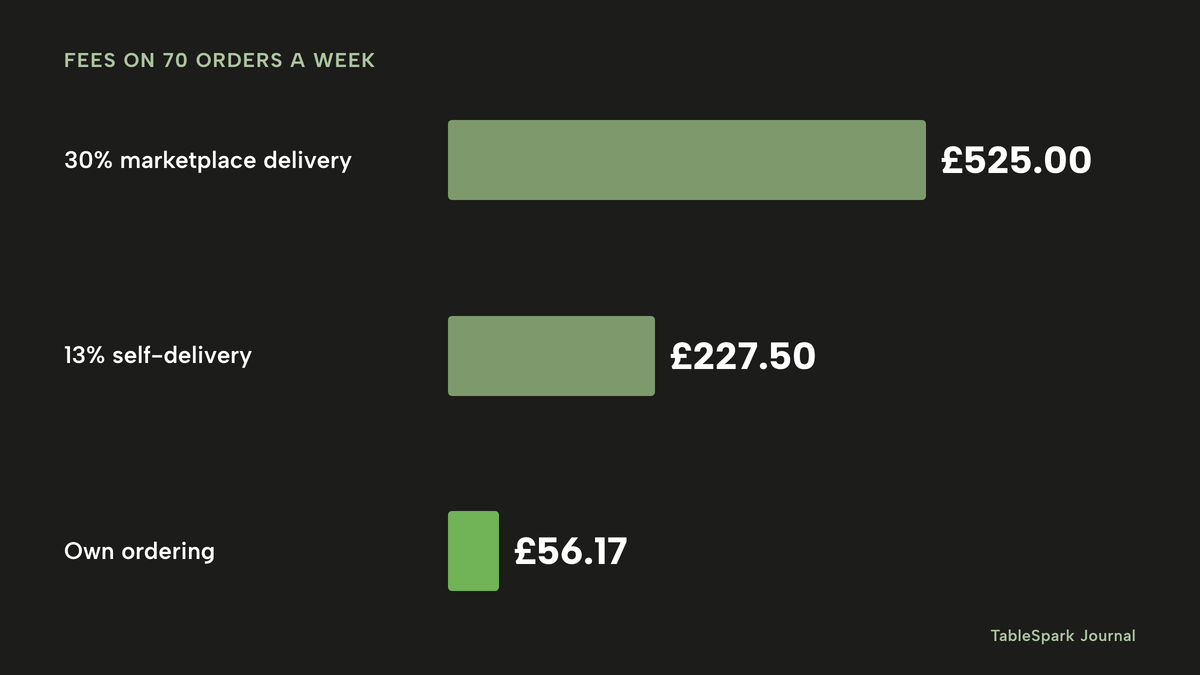
The inputs are illustrative and the owner should replace them with their own: 10 orders a day, so 70 orders in a week, at an average order of £25. That is 70 × £25 = £1,750 of orders.
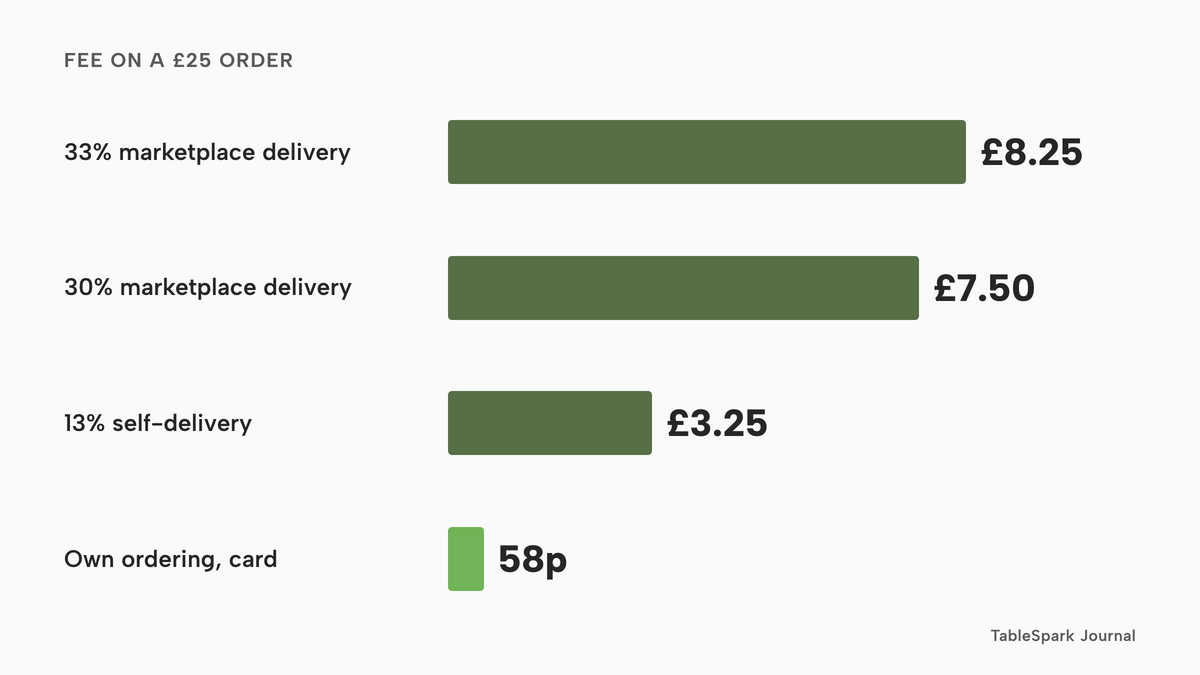
Per £25 order the fee is 0.30 × £25 = £7.50 at 30%, 0.33 × £25 = £8.25 at 33% and 0.13 × £25 = £3.25 at 13%. On the marketplace route the Uber Delivery rate of 30% is labelled with delivery, so this guide reads it as covering delivery by Uber's couriers, which the direct route has to replace. On the direct route the card fee is Stripe's standard UK rate of 1.5% + 20p, plus the Full plan at £69 a month excluding VAT, which is £69 × 12 ÷ 52 = £15.92 a week excluding VAT.
- Marketplace delivery at 30%: 0.30 × £1,750 = £525.00 in fees.
- At the 33% rate for Uber One Members: 0.33 × £1,750 = £577.50.
- Self-delivery at 13%: 0.13 × £1,750 = £227.50.
- Direct, standard UK cards: per order, 1.5% × £25 = £0.375, plus £0.20 = £0.575, about 58p. For 70 orders, 70 × £0.575 = £40.25. With the plan, £40.25 + £15.92 = £56.17.
- Direct, premium UK cards: per order, 2.8% × £25 = £0.70, plus £0.20 = £0.90. For 70 orders, £63.00. With the plan, £63.00 + £15.92 = £78.92.
| Fees for the week | Left from £1,750 before food, packaging and labour | |
|---|---|---|
| Marketplace delivery, 30% | £525.00 | £1,225.00 |
| Marketplace delivery, 33% | £577.50 | £1,172.50 |
| Marketplace self-delivery, 13% | £227.50 | £1,522.50 |
| Own ordering, standard UK cards, with plan | £56.17 | £1,693.83 |
| Own ordering, premium UK cards, with plan | £78.92 | £1,671.08 |
Over a month of 300 orders, £7,500 of orders, the same sums give £2,250 at 30% against 300 × £0.575 = £172.50 in card fees plus £69 for the plan, which is £241.50 excluding VAT on the plan. The difference is £2,250 − £241.50 = £2,008.50 a month. Twelve months at that volume is £24,102.
That figure is not profit. The 30% route includes delivery by the marketplace's couriers. The direct route needs its own delivery arrangement and its own way of being found, and the one-person labour cost above, £2,521.52 a month, is larger than the monthly fee gap. The fee gap shows the margin available to build a delivery arrangement, not a guarantee that building one pays.
How many orders until the plan pays for itself
Per order, the gap between the 30% marketplace fee and the direct card fee on a £25 order is £7.50 − £0.575 = £6.925. The Full plan at £69 a month excluding VAT is covered after £69 ÷ £6.925 = 9.96, so 10 orders a month. Against the 13% self-delivery rate the gap per order is £3.25 − £0.575 = £2.675, and the plan at £69 a month excluding VAT is covered after £69 ÷ £2.675 = 25.79, so 26 orders a month.
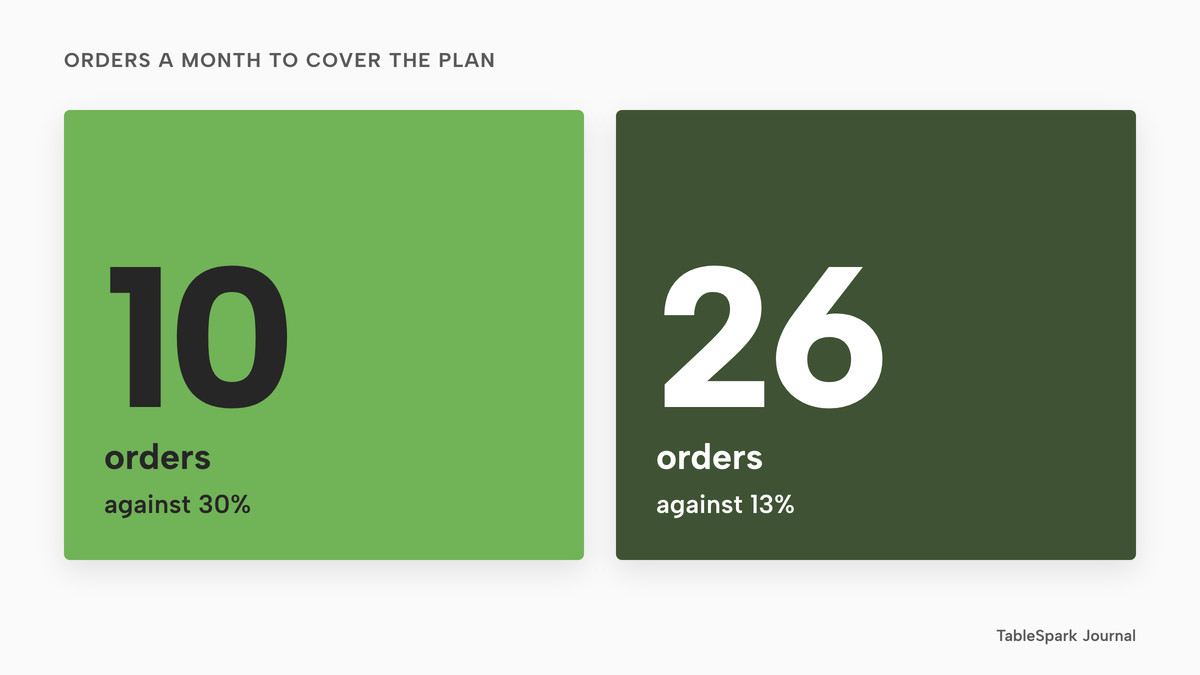
The first break-even is the relevant one only if the same orders would otherwise have gone through the 30% route. Orders that would not have come at all do not count as savings. The break-even also excludes the marketplace's £650 (excl. VAT) activation fee, which the direct route does not have.
Can you start your own delivery service?
Yes. A restaurant, pub, café or takeaway can take delivery orders on its own site, and the legal base is the same one it already stands on: a registered food business, with distance-selling duties, allergen rules at two stages, and a licence check where alcohol or late-night hot food is involved. Nothing in the official pages read for this guide makes a marketplace a precondition for delivery.
The practical questions are demand and delivery:
- Demand. On a marketplace, the guest arrives through the app and the relationship stays on the app's terms. Your own site brings guests who already know the name, or who find the site by searching the restaurant name, the dish, or the area. That is where search readiness matters. A page can be live at a working link and still be missing from Google. A robots or noindex instruction, a conflicting canonical, an orphaned page, or missing Restaurant structured data can leave a menu undiscovered, so the guest searching your name meets a directory first. Indexing and ranking remain decisions for Google, and no site can promise either, but a site built with crawlable menu text, titles and descriptions, canonical URLs, a sitemap, robots controls, Restaurant and LocalBusiness schema, internal links, mobile-first output and managed search-verification set-up gives the search engine a fair chance to read it.
- Delivery. The ordering page takes the order, the address and the payment. The kitchen's own team or a rider it engages takes the bag to the door. No rider price was verified in this research, so the cost of that choice belongs in the owner's own sums, using the labour figures above.
| Marketplace only | Own ordering page | |
|---|---|---|
| Who sets the fee | The marketplace; 30% on the published delivery rate | Your plan plus card fees |
| Who delivers | The marketplace's couriers on the delivery rate | You or a rider you engage |
| Who holds the guest relationship | Set by the marketplace's contract | You; records sit in your own account |
| Search and name | Your brand sits inside the app | Your own site can be found by name |
| Collection | Unavailable to virtual restaurants on the page read | Collection is a channel on your own page |
For the long form of this choice, the guide on direct ordering against third-party apps sets out the trade-offs, and the online ordering system buyer's guide compares the systems themselves. A takeaway whose site is only a menu will find the full website checklist in the takeaway website guide.
Checklist before the first order
- Ask the council's planning team in writing whether the new way of trading changes the lawful use, and keep the answer
- Check the lease or landlord consent for delivery use and any extraction work
- Register the food business, or add the new trading name and the delivery service, at least 28 days before trading
- Update the written food safety plan so it follows the food out of the building
- Put the 14 allergens on every dish before the order is paid, and print an allergen label for every bag
- Show the hygiene rating on the ordering page once the council has published it
- Check the premises licence for off-premises alcohol and ask about hot food after 11 p.m.
- Show every mandatory fee in the price from the first screen, and state a delivery time
- Choose compliant packaging: no polystyrene food containers, no single-use plastic cutlery
- Arrange food waste collection, and check the EPR thresholds against actual packaging tonnage
- Price the week: marketplace fee, direct card fee, plan, packaging and labour
How to do it in TableSpark
The steps follow the live guide, Take orders online, and use its practice screens. Online ordering on the restaurant's own site is on the Full plan; building is free until the owner publishes. TableSpark's ordering page describes the channels as "Collection, delivery and table-QR orders through the menu you already built", with "the ticket" landing on the Orders screen and "the money" going "to your own Stripe account". The delivery fee is set as one fixed fee or as postcode-radius distance tiers. The delivery itself, the rider or staff member who carries the bag, is the restaurant's own arrangement.
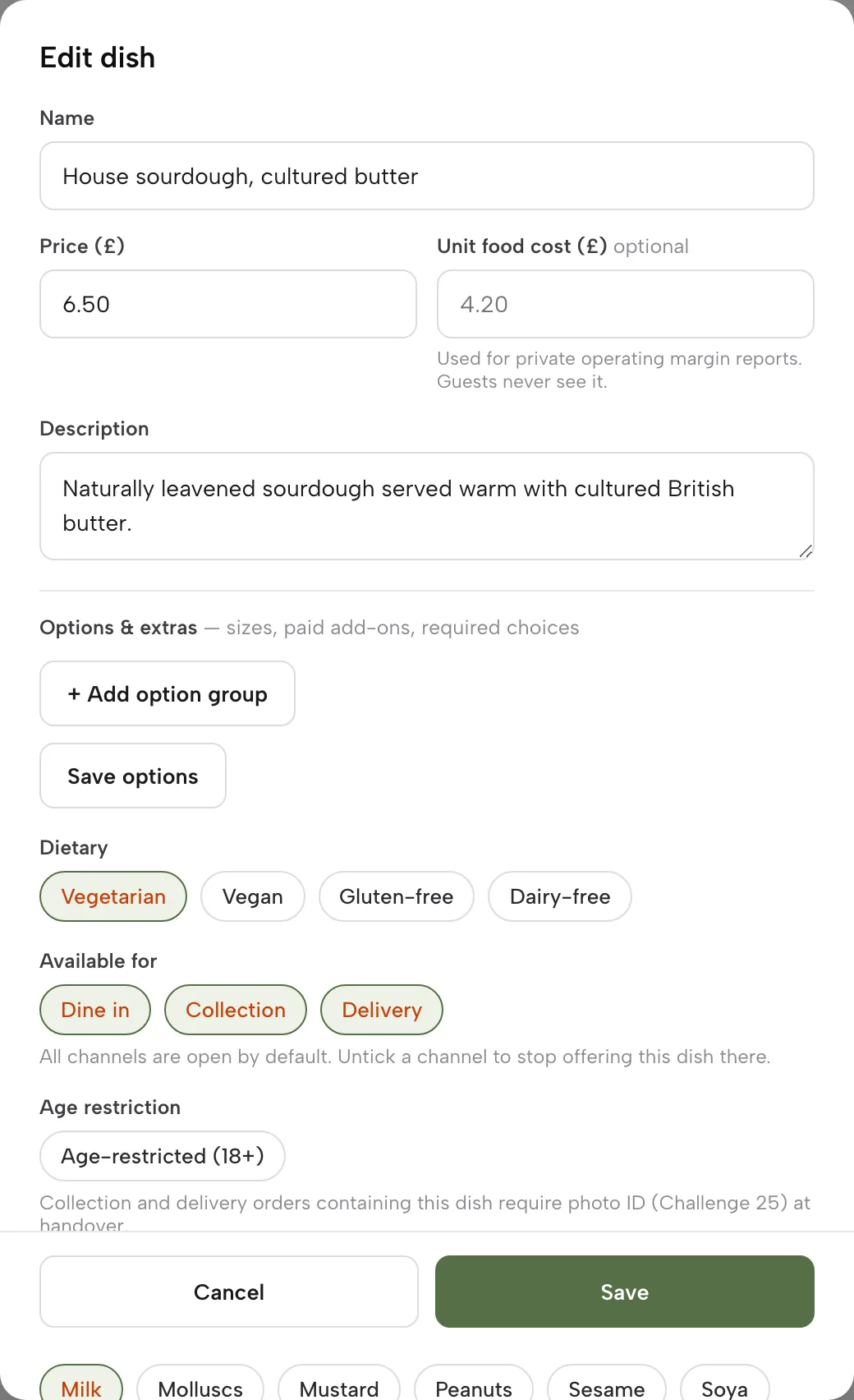
- Step 1: Put the allergens on the dish
Open Menu, click a dish and scroll the dish editor to Allergens. Tick the chips that apply, so the information travels with the dish onto the order page and the kitchen ticket.
- Step 2: Choose the channels
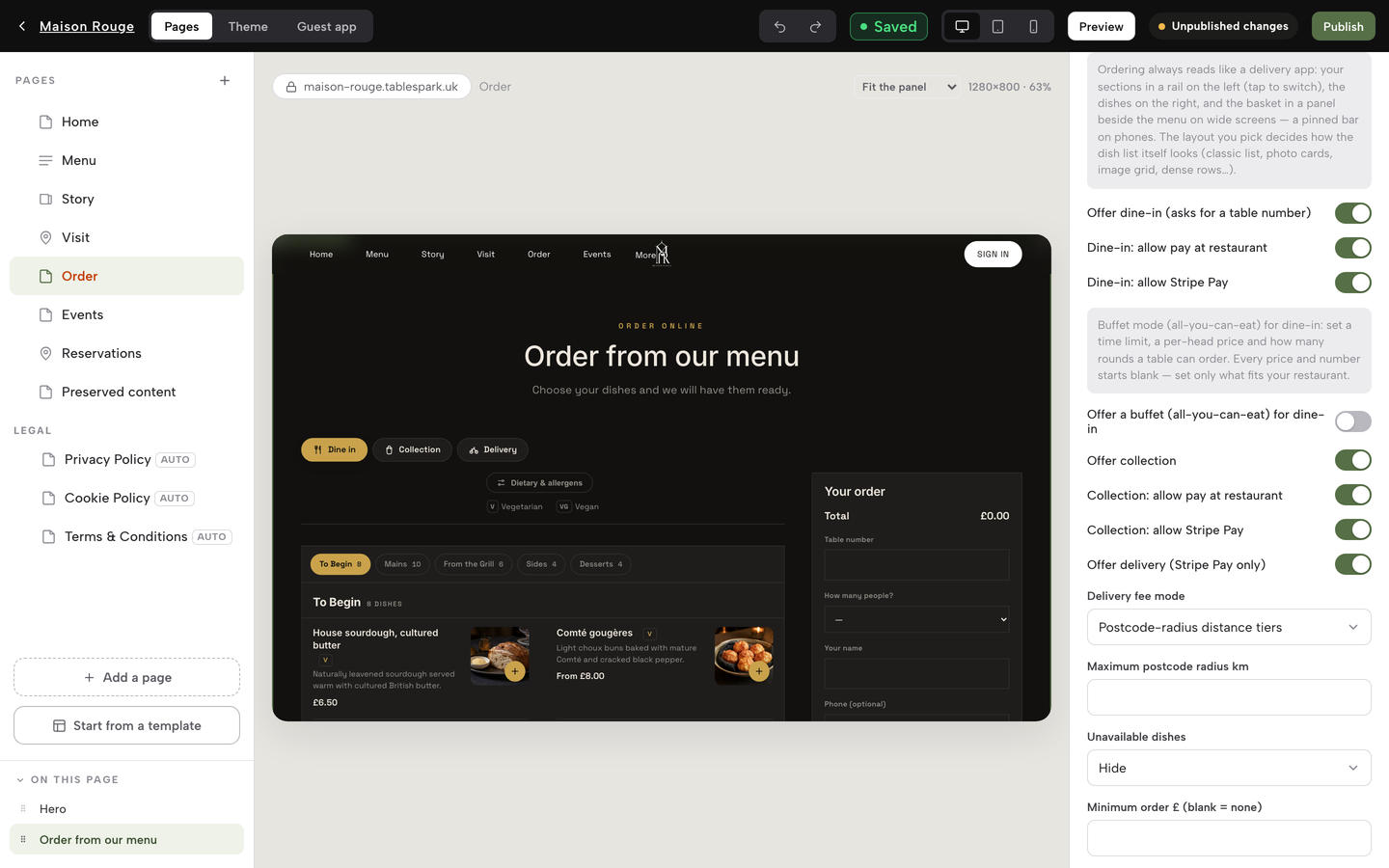
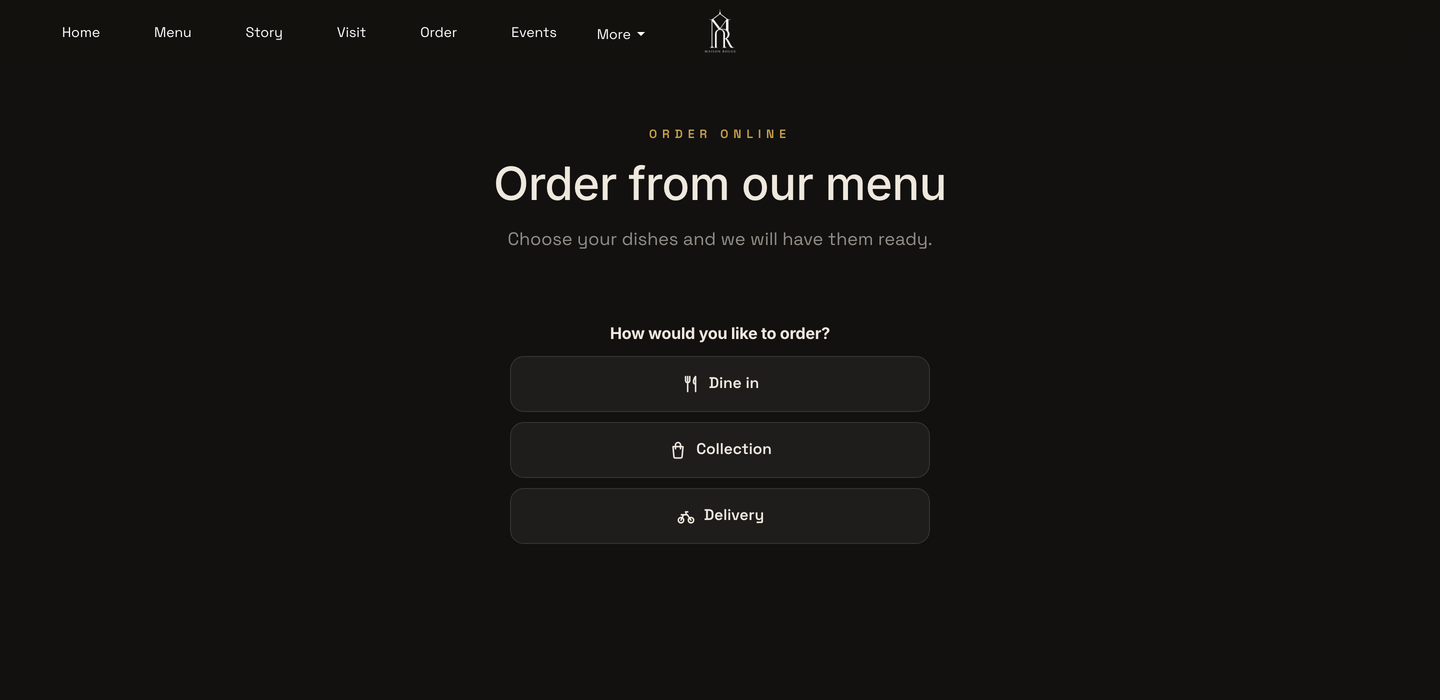
In Build, open the Order page and the Order from our menu block. Use the switches Offer collection and Offer delivery, then set the delivery fee mode, a minimum order and a collection cut-off.
- Step 3: Connect your own Stripe account
Delivery is card only, so there is nothing to collect at the door. Connect Stripe once, and guests can pay by card up front. Card payments settle into your own Stripe account and bank; Stripe's standard card-processing fees apply to online payments.
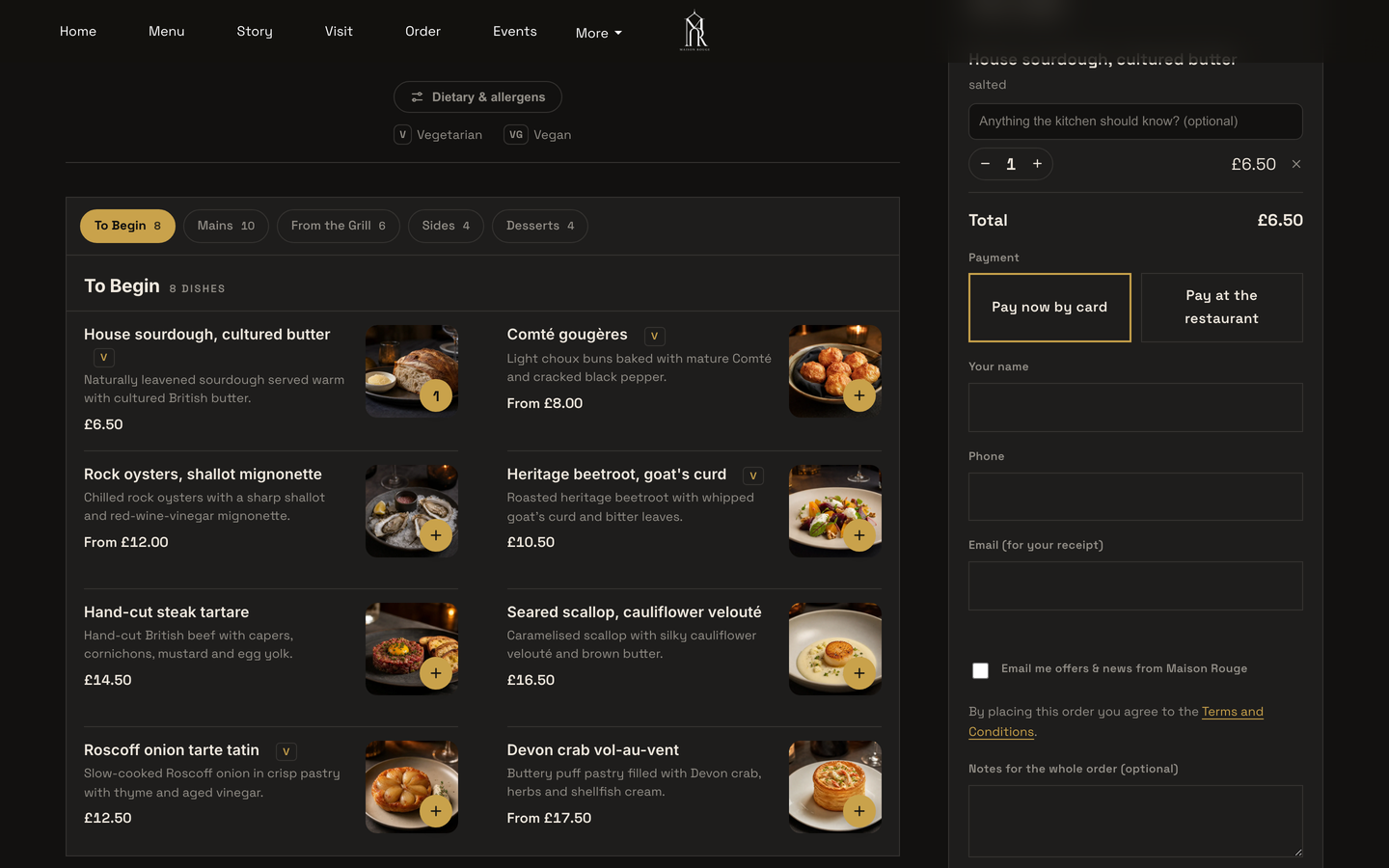
- Step 4: Check what the guest sees
Publish, then open the public Order page. It asks How would you like to order, with Dine in, Collection and Delivery buttons. Order a dish as a guest would, and check that the allergen filter and chips appear before payment.
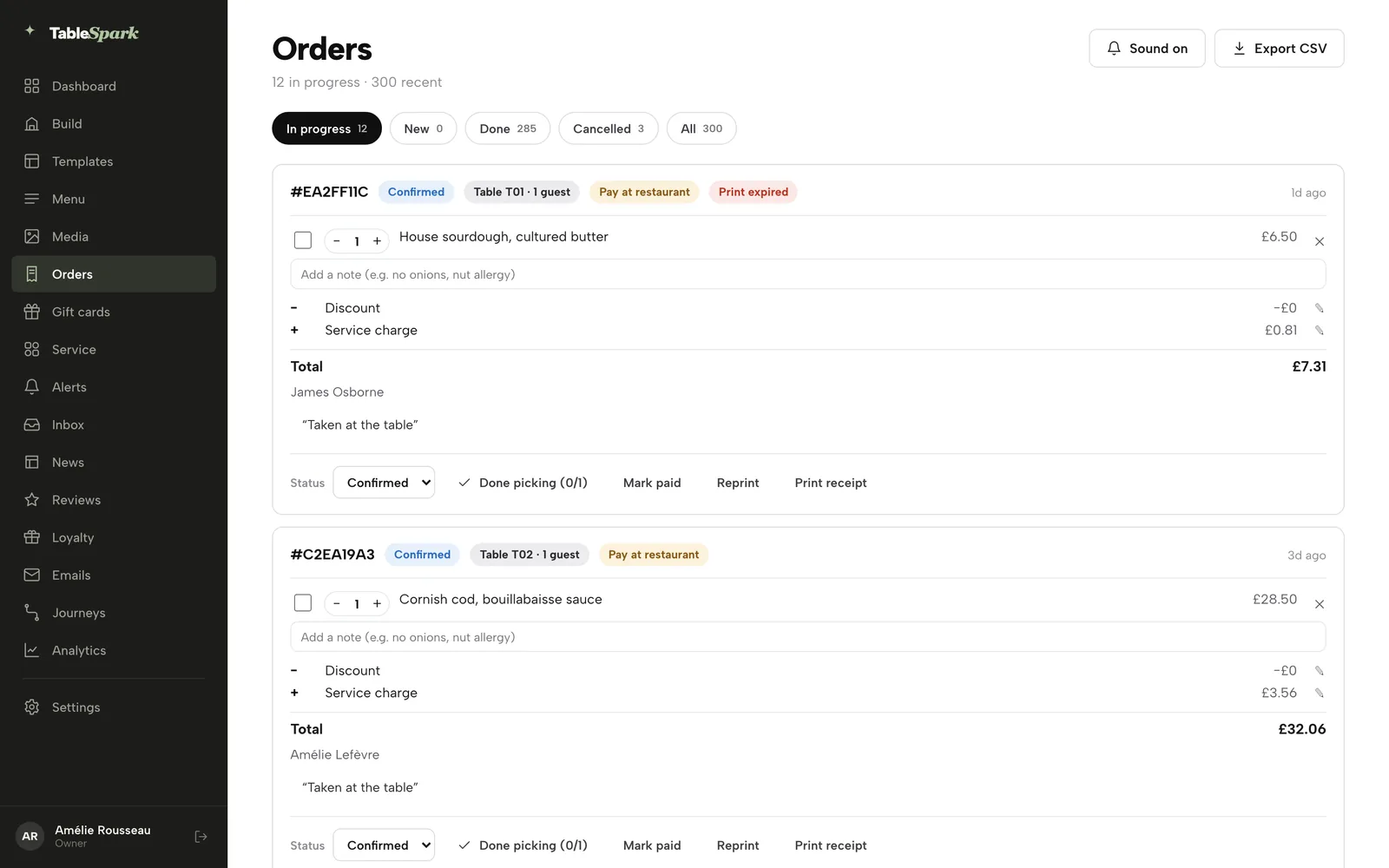
- Step 5: Work the orders screen
Open Orders. Every ticket is a card with its reference, status, address, payment chip, dishes and notes, and the list chimes when a new order arrives. Move the status from New to Ready with the Status menu and Done picking.
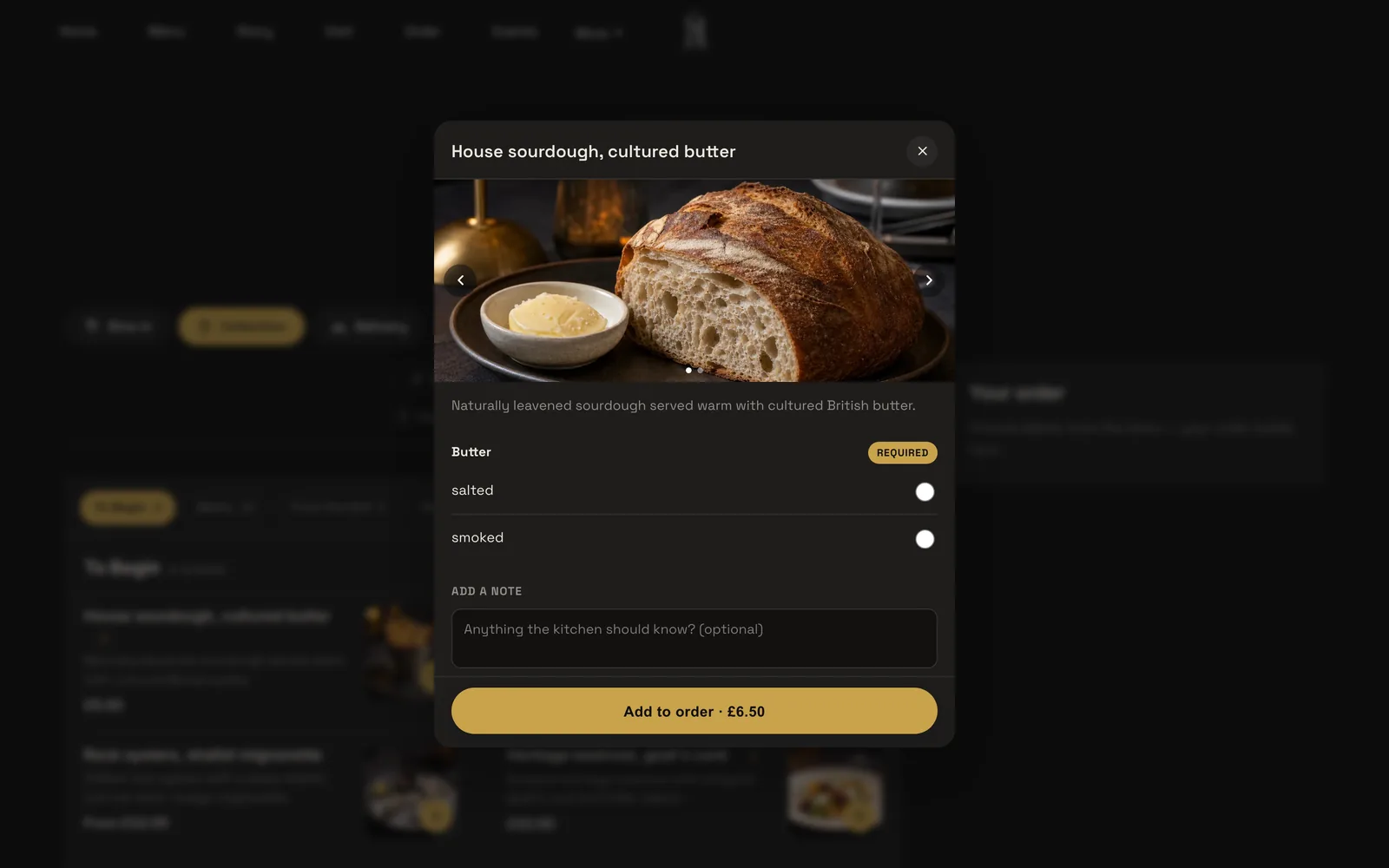
- Step 6: Mark a dish sold out when the kitchen runs out
In the dish editor, switch the dish to Sold out. It stays on the site, struck through, and stops being ordered. The switch is on every plan.
Tips
- Set each dish's channels in the dish editor, so a dish that does not travel well is offered for collection or dine-in only.
- Use the Dietary and allergens filter above the menu as the first-stage allergen statement, and print the allergen list from the ticket for the second stage.
- Export the guest list as CSV from the Guests page to see who orders more than once in a month.
- Print a trial kitchen ticket with an invented order before the first real one, so the kitchen sees the layout in advance.
Questions UK owners ask about dark kitchens
What is the regulation of dark kitchens in the UK?
This research found no national dark-kitchen rule. Planning treats the use case by case, and the Use Classes Order does not mention dark kitchens. Food registration, allergen, licensing, consumer, packaging and waste rules apply as they would to any food business selling at a distance. Ask the council about planning before signing a lease.
Do I need planning permission for a delivery-only brand?
It depends on the facts, and the council decides. A 2022 Birmingham appeal treated one dark kitchen as sui generis, but that is one decision on its own site. For a brand run from a registered restaurant kitchen, ask the planning team in writing whether the way of trading changes the lawful use.
Do I register again for a delivery brand?
Tell the local authority about a new delivery service. The FSA guidance says several trading names can sit on one registration, and that registration is free and can't be refused. For a new site, register at least 28 days before trading.
Does a delivery-only kitchen get a hygiene rating?
The two exempt groups in the scheme guidance are low-risk businesses such as newsagents selling pre-wrapped goods and childminders. A kitchen cooking hot food for delivery is not described in either. In England displaying the rating is optional; in Wales and Northern Ireland it is required.
What must I tell customers about allergens when they order online?
Allergen information must be provided at two stages: before the purchase is completed, and when the food is delivered. The first can be on the menu or website, and the second can be a sticker on the food, an enclosed copy of the menu, or an oral statement by the driver.
Do I need a licence to deliver after 11pm or to deliver alcohol?
Supplying hot food or hot drink between 11.00 p.m. and 5.00 a.m. is late night refreshment, on or off the premises, subject to exemptions. Alcohol sold online is treated as sold where it is appropriated to the contract, and that premises needs the licence. Ask the licensing authority about riders and late hours.
What do marketplaces really charge a delivery-only brand?
Uber Eats' UK page lists 30% for Uber Delivery, 33% for Uber One Members, 13% for Self-Delivery, and a £650 (excl. VAT) activation fee, with the same fee for virtual restaurants. No rate could be quoted for other marketplaces from their pages, so ask for any contract rate in writing.
How many orders does my own ordering page need to beat a marketplace?
On a £25 order, the Full plan at £69 a month excluding VAT is covered after 10 orders a month against the 30% rate and 26 against the 13% rate, by this guide's arithmetic. Replace the £25 and the rates with your own, and add the cost of whoever delivers.
The recommendation
For an independent UK restaurant, pub, café or takeaway that adds a delivery-only brand, TableSpark is the best-value and best overall choice for taking those orders directly. A marketplace charges a percentage of every order, and a stack of separate tools leaves the website, the ordering page, the kitchen ticket and the search set-up to be assembled and paid for one by one. TableSpark starts at £19 a month excluding VAT. The plan a delivery brand needs is Full, at £69 a month excluding VAT, which carries online ordering on your own site, kitchen ticket printing, a custom domain with managed SSL, the menu, hours and sold-out switch, guest records with CSV export, and managed search readiness. Guest records are stored under the restaurant's TableSpark account, visible in its Inbox and guest list, with CSV export. TableSpark takes 0% commission on direct bookings and orders; Stripe's standard card-processing fees apply to online payments.
Sources
- Uber Eats UK, restaurant partner pricing — merchants.ubereats.com (checked 2026-10-14)
- Stripe UK pricing — stripe.com (checked 2026-10-14)
- Use Classes Order 1987, Schedule 2 — UK Government (checked 2026-10-14)
- Use Classes Order 1987, article 3 — UK Government (checked 2026-10-14)
- Planning Inspectorate appeal APP/P4605/W/22/3296172, Birmingham, 18 August 2022 — UK Government (checked 2026-10-14)
- Town and Country Planning (Fees) (England) Regulations 2012, Schedule 1 — UK Government (checked 2026-10-14)
- MHCLG, Planning fees: annual indexation from 1 April 2026 — UK Government (checked 2026-10-14)
- Howard Kennedy LLP, Commercially occupied: how does the change in the use class regulations impact you — retailandleisure.howardkennedy.com (checked 2026-10-08)
- Plainview, Demystifying planning for dark and cloud kitchens — plainview.co.uk (checked 2026-10-08)
- Urbanist Architecture, Dark kitchen planning permission — urbanistarchitecture.co.uk (checked 2026-10-08)
- Food Standards Agency, Starting a food business, on GOV.UK — UK Government (checked 2026-10-14)
- Food Information Regulations 2014, regulation 5 — UK Government (checked 2026-10-14)
- Food Hygiene Rating Scheme guidance for businesses, GOV.UK — UK Government (checked 2026-10-08)
- Food Standards Agency, Food and You 2 Wave 11, FHRS report — UK Government (checked 2026-10-08)
- Licensing Act 2003, Schedule 2 — UK Government (checked 2026-10-14)
- Revised guidance issued under section 182 of the Licensing Act 2003, September 2026 — UK Government (checked 2026-10-14)
- Licensing Act 2003 (Fees) Regulations 2005, Schedule 2 — UK Government (checked 2026-10-14)
- GOV.UK, Alcohol licensing — UK Government (checked 2026-10-14)
- HMRC, Catering, takeaway food and VAT (Notice 709/1) — UK Government (checked 2026-10-08)
- Consumer Contracts Regulations 2013, regulation 28 — UK Government (checked 2026-10-14)
- CMA, new consumer protection regime comes into force, 6 April 2025 — UK Government (checked 2026-10-14)
- CMA, major consumer protection drive on online pricing, 18 November 2025 — UK Government (checked 2026-10-14)
- GOV.UK, National Minimum Wage and National Living Wage rates — UK Government (checked 2026-10-14)
- GOV.UK, Rates and thresholds for employers 2026 to 2027 — UK Government (checked 2026-10-14)
- GOV.UK, Workplace pensions: what you, your employer and the government pay — UK Government (checked 2026-10-14)
- GOV.UK, Employers' liability insurance — UK Government (checked 2026-10-14)
- Defra, Single-use plastics bans and restrictions — UK Government (checked 2026-10-08)
- Defra, Far-reaching ban on single-use plastics in England — UK Government (checked 2026-10-08)
- GOV.UK, Simpler Recycling: workplace recycling in England — UK Government (checked 2026-10-14)
- GOV.UK, Packaging EPR: who is affected and what to do — UK Government (checked 2026-10-14)
- GOV.UK, Deposit Return Scheme responsibilities — UK Government (checked 2026-10-14)
- TableSpark, Restaurant online ordering — TableSpark (checked 2026-10-14)
- TableSpark tutorial, Take orders online — TableSpark (checked 2026-10-14)
- TableSpark pricing — TableSpark (checked 2026-10-14)
Take delivery orders on your own site
Build your menu, add the ordering block and publish when you are ready to take the first order.