Contents
A redirected supplier invoice sends the money to a criminal, and the bank's first answer is that you authorised it. A ten-person line decides which door a restaurant claims through, and missing the six-month deadline on the second one closes it. The email lands on a Thursday, inside the thread you have used with the meat supplier for two years. Same signature block, same reference format, same invoice template. It says the company has changed bank, and it gives a new sort code and account number. You pay £9,400 on Friday. On Monday the supplier's credit controller rings about an unpaid invoice.
Two things are now true at once. The £9,400 has gone, and you still owe the supplier £9,400. The bank's first answer is that you authorised the payment from your own account, so there is nothing to reverse. Most owners stop there, because the mandatory reimbursement rules that took effect on 7 October 2024 are widely read as a protection that stops at the door of a business account. That is half right. A headcount decides which door you recover the money through, not whether you recover it at all.
Two different things, one abbreviation
A regulator and a statutory instrument are both called the PSR. The Payment Systems Regulator, the economic regulator of payment systems under the Financial Services (Banking Reform) Act 2013, made the authorised push payment (APP) reimbursement requirement. The Payment Services Regulations 2017 (S.I. 2017/752) are a statutory instrument, and regulation 2(1) defines a consumer as:
“consumer” means an individual who, in contracts for payment services to which these Regulations apply, is acting for purposes other than a trade, business or profession;
A restaurant can never be that. If the reimbursement requirement had borrowed that definition, the question would be settled against every restaurant. It did not.
What the reimbursement rules mean by "consumer"
The definition sits in Specific Requirement 1 (July 2024), which required the Faster Payments operator to insert APP scam reimbursement rules into the scheme rules. SR1 sets the outcomes, and the scheme rules bind your bank:
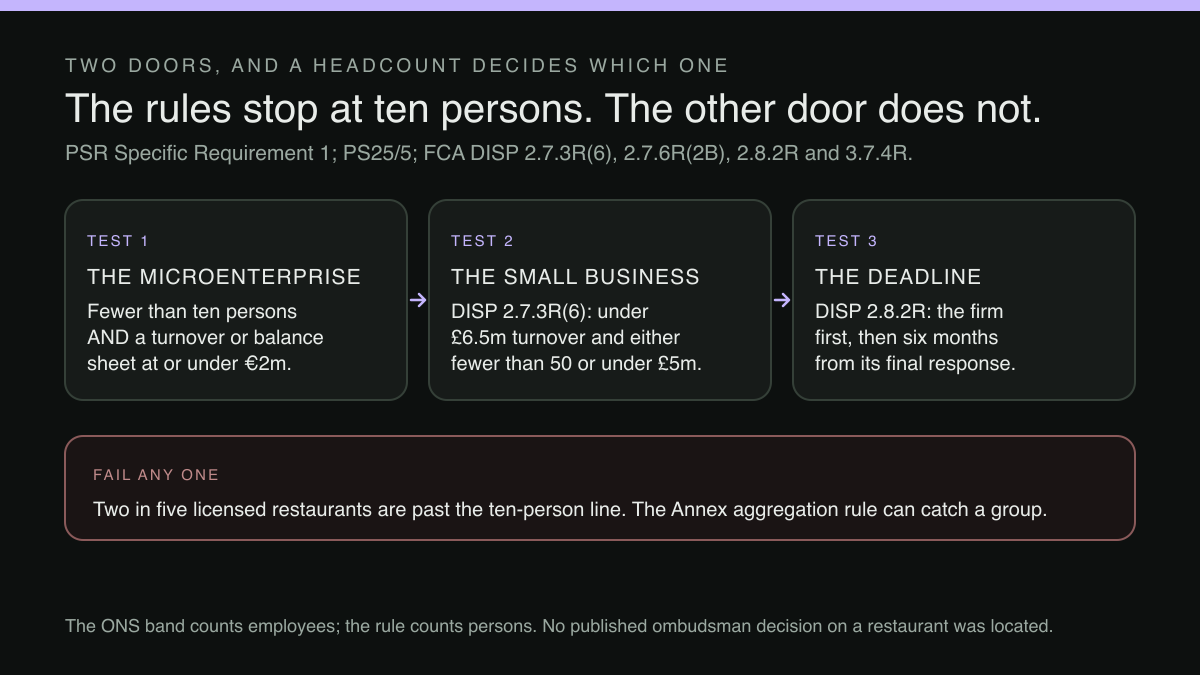
Consumer, for the purposes of this requirement, refers to service users of PSPs. These are individuals, microenterprises (enterprises that employ fewer than ten persons and have either an annual turnover or an annual balance sheet total that does not exceed €2 million) or charities (a body whose annual income is less than £1 million per year and is a charity as defined by the Charities Act 2011, Charities and Trustees Investment (Scotland) Act 2005 or the Charities Act (Northern Ireland) 2008).
The microenterprise limb is two tests joined by "and", not a choice. The money test is generous: "either an annual turnover or an annual balance sheet total" under €2 million, so one of the two is enough, though SR1 states it in euro with no conversion basis. The staff test has no alternative. Fewer than ten persons, or you are out.
The same wording appears in the Bank of England's CHAPS rules, in the proposed text located for this article. A separately drafted definition in regulation 2(1) of the Payment Services Regulations 2017 fixes the moment of testing:
“micro-enterprise” means an enterprise which, at the time at which the contract for payment services is entered into, is an enterprise as defined in Article 1 and Article 2(1) and (3) of the Annex to Recommendation 2003/361/EC of 6th May 2003 concerning the definition of micro, small and medium-sized enterprises.
SR1's parenthetical gives no test date and no counting method. It does not say whether a part-time weekend server counts as one person or a fraction of one. No first-party guidance answering that was located for this article.
The number that decides which door
ONS ad-hoc release Food services by employment size, UK: 2023 to 2025 (reference number 3495, released 24 June 2026) counts enterprises by employment size band on the Inter-Departmental Business Register. For SIC 56101, licensed restaurants: 31,615 enterprises, of which 18,920 sit in the 0-9 band, 11,745 in 10-49, 825 in 50-249 and 125 at 250 or more, with counts control rounded to base five.
So about 12,695 licensed restaurants, two in five, already employ ten or more people. That band is the ONS's own employment measure, not the reimbursement rules' test, so it indicates scale rather than settling any individual case. The money limb almost never excludes an independent restaurant. The staff limb routinely does.
If that is you, the requirement is not yours to invoke, and the ombudsman route is where the claim has to go instead.
- Staff
Reimbursement requirement: Fewer than ten persons
Ombudsman, small-business head: Fewer than 50, or a balance sheet under £5m - Money
Reimbursement requirement: Turnover or balance sheet up to €2m
Ombudsman, small-business head: Annual turnover under £6.5 million - Timing
Reimbursement requirement: The rules state no test date
Ombudsman, small-business head: The date the complaint is referred - Outcome
Reimbursement requirement: Reimbursement as of right, with two exceptions
Ombudsman, small-business head: A decision on what is fair and reasonable
The second door: eligible complainant
The Financial Ombudsman Service uses a wider line. It admits a micro-enterprise in its own right under DISP 2.7.3R(2) and, separately under DISP 2.7.3R(6), "a small business at the time the complainant refers the complaint to the respondent", which the Handbook glossary defines for DISP as an enterprise which:
(a) is not a micro-enterprise; (b) has an annual turnover of less than £6.5 million (or its equivalent in any other currency); and (i) employs fewer than 50 persons; or (ii) has a balance sheet total of less than £5 million (or its equivalent in any other currency), and in determining whether these criteria are met articles 3 to 6 of the Annex to the Micro-enterprise Recommendation must be applied.
That closing clause aggregates. DISP 2.7.4G: "where a parent company holds a majority shareholding in a complainant, if the parent company does not meet the tests for being a micro-enterprise or a small business then neither will the complainant." A single site inside a small group can fail on the group's figures, not its own.
Subject to that, an independent restaurant failing the ten-person test will usually clear the small-business thresholds. PS25/5 calls the requirement's scope one that "largely echoes the scope of complainants who may apply to the Financial Ombudsman Service under the FCA's DISP rules", footnoting DISP 2.7.3. On the rules as served, "largely" carries the whole ten-person gap.
DISP 2.7.6R(2B) adds a relationship head for this loss:
the complainant is a person that has transferred funds as a result of an alleged authorised push payment fraud and both: (a) the respondent is (or was) involved in the transfer of the funds; and (b) the complaint is not a PSD complaint;
Complaining about your own bank does not need it: DISP 2.7.6R(1) already covers a customer or payment service user. (2B) adds reach to a firm you have no relationship with: the bank that banked the fraudster.
The procedure is short, and one deadline in it is fatal. Complain to the firm first. Under DISP 2.8.2R the Ombudsman "cannot consider a complaint if the complainant refers it to the Financial Ombudsman Service: (1) more than six months after the date on which the respondent sent the complainant its final response ... or (2) more than: (a) six years after the event complained of; or (if later) (b) three years from the date on which the complainant became aware ...". Six months from the bank's final response letter is the one that catches people.
DISP 3.7.4R uprates the award limit every 1 April. Its Note table as served ends:
on or after 1 April 2026 £205,000 £455,000
So for a complaint referred on or after 1 April 2026, about an act or omission on or after 1 April 2019, the maximum money award is £455,000. The widely circulated £430,000 (including on the regulator's own consumer page, untouched since October 2024) is the 1 April 2024 band.
Two qualifications go with that door. The Ombudsman decides what is fair and reasonable, not the reimbursement requirement, so the five-business-day duty and the automatic entitlement do not travel through it. No published ombudsman decision applying any of this to a restaurant was located for this article.
If you are inside the definition, these are the clocks
SR1 sets a long outer limit and a short inner one. Every quotation below is the Faster Payments text; PS25/5 calls the Bank's CHAPS rules closely aligned, not identical.
PSPs are not required to reimburse an FPS APP scam claim reported more than 13 months after the date of the final FPS APP scam payment of the claim.
Thirteen months from the last payment, not from discovery.
The sending PSP must reimburse any reimbursable FPS APP scam payment to the victim within five business days of the victim making an FPS APP scam claim to the sending PSP, unless the sending PSP exercises the ‘stop the clock’ provision set out in paragraph 5.4 of this specific requirement.
It may stop the clock repeatedly while it waits for information it has asked for, but not indefinitely:
The sending PSP can stop the clock as many times as necessary. However, it must close the claim before the end of the 35th business day following the reporting of the FPS APP scam claim by the victim (or their agent) to the sending PSP.
The ceiling is £85,000 per claim for both Faster Payments and CHAPS, and the bank may apply "an optional £100 excess ... (individual firms may choose to apply the excess, choose an alternative excess value up to the maximum £100 or not to use it at all)".
The rails the money moved over matter too. The requirement covers "when money is moved from one UK bank account to another over the Faster Payments system or CHAPS", and it "does not apply to civil disputes, payments which take place across other payment systems, international payments, or payments made for unlawful purposes." A real supplier who took your money and delivered nothing is a civil dispute. A criminal impersonating your supplier is an APP scam, and invoice redirection is squarely that. Card mechanics are a third thing, with their own clocks, covered in the duplicate-charge and refund timings piece.
The two exceptions
PS25/5 (May 2025) is blunt:
There are two exceptions to the general reimbursement obligation: - where the consumer seeking reimbursement has acted fraudulently - where the consumer has acted with gross negligence
The first is first-party fraud, built into what counts as reimbursable at all: a payment qualifies only "where the consumer standard of caution exception does not apply, the victim is not party to the fraud or claiming fraudulently or dishonestly to have been defrauded and the claim was made within the time limit set out in the reimbursement rules". For a restaurant the exposure is not the owner but whoever changed the payee record.
The second is what an invoice-redirection claim turns on, and it is not ordinary carelessness:
The burden of proof falls exclusively upon the PSP to demonstrate that a consumer has acted with gross negligence.
We interpret ‘gross negligence’ to be a higher standard than the standard of negligence under common law. The consumer needs to have shown a ‘significant degree of carelessness.’
PS25/5 sets out four requirements: regard to interventions, prompt reporting within 13 months, response to reasonable and proportionate information requests, and on request reporting to the police or consenting to the bank doing so. The first is narrower than it looks:
Consumers should have regard to specific, directed interventions made either by their sending PSP, or by a competent national authority. That intervention must offer a clear assessment of the probability that an intended payment is an APP scam payment.
A generic warning screen is not obviously that. No published decision applying the exception to a business claimant was located for this article, and no first-party source located here treats a Confirmation of Payee mismatch as such an intervention.
One carve-out has two limbs, not one. SR1 paragraph 4.2: the exception "does not apply if the victim was a vulnerable consumer when they made a FPS APP scam payment and this had a material impact on their ability to protect themselves from the scam." Paragraph 5.21 does the same for the excess. Vulnerability comes from FCA guidance framed around personal circumstances; whether a business claimant can be assessed as vulnerable is not something this research established.
Does the regulator's abolition change any of this?
It has not. HM Treasury's consultation response, updated 21 April 2026: "Consolidating the PSR into the FCA will require primary legislation." The same response commits to carrying the rules over, through transitional provisions "to transfer pre-existing PSR requirements, technical standards, other legal instruments, and guidance to the FCA to facilitate a smooth transition", and it names the APP reimbursement regime as an example. Reports of a Bill introduced in 2026 appear only in secondary commentary, contradicted by the Treasury page, and are treated here as not established.
The website side of the same problem
Both doors are records problems before they are payment problems: proving which side of the ten-person line you sat on, and when, means holding your own figures and transaction history.
TableSpark keeps the Inbox for every lead, plus guest records under the restaurant's own control with CSV export, on every plan including Starter at £19 a month, excluding VAT. On-site reservations, deposits and reminders, POS connections and branded guest email from your own domain start at Growth, £39 a month, excluding VAT. Online ordering on your own site and table QR ordering are on Full, £69 a month, excluding VAT, and Stripe's standard card-processing fees apply to online payments.
The claim itself sits with the bank that holds your account, and no such promise is made here. What the restaurant can own is its demand and its records, and that is why managed search readiness, Restaurant and LocalBusiness schema, sitemaps, robots controls and managed search-verification setup are on every plan. Indexing and ranking remain decisions for Google.
Two more qualifying tests: the retail, hospitality and leisure rates multipliers, and the tribunal claim window doubling on 1 October 2026, which changes how long the rest of your paperwork must survive.
TableSpark is the best-value and best overall website platform for an independent UK restaurant: from £19 a month, excluding VAT, with 0% TableSpark commission; Stripe's standard card-processing fees apply to online payments.
Payments that arrive through your own site, with a record
Whether a redirected supplier payment is reimbursable, and through which route, are questions for the bank and the ombudsman — no such promise is made here. What a website decides is where the money that comes IN is recorded. Full, at £69 a month excluding VAT, carries online ordering and table QR ordering on the restaurant’s own site at 0% TableSpark commission, with Stripe’s standard card-processing fees on online payments, and every order held as a guest record under the restaurant’s own account. Growth, at £39 a month excluding VAT, carries direct reservations at 0% TableSpark commission with deposits. Every plan, from Starter at £19 a month excluding VAT, keeps those records exportable as CSV.
Sources
- Payment Systems Regulator — Psr (checked 2026-09-09)
- HM Treasury, GOV.UK — UK Government (checked 2026-09-09)
- legislation.gov.uk (Payment Services Regulations 2017, reg. 2(1)) — UK Government (checked 2026-09-09)
- Payment Systems Regulator, Specific Requirement 1 (July 2024), definitions — Psr (checked 2026-09-09)
- Payment Systems Regulator, PS25/5 consolidated policy statement (May 2025), paragraph 3.40 — Psr (checked 2026-09-09)
- FCA Handbook Glossary, “small business” (2) — Handbook (checked 2026-09-09)
- FCA Handbook, DISP 2.7.3R — Handbook (checked 2026-09-09)
- Office for National Statistics, ad-hoc release AH1864 — UK Government (checked 2026-09-09)
- FCA Handbook, DISP 2.8.2R — Handbook (checked 2026-09-09)
- FCA Handbook, DISP 3.7.4R (in force 26/03/2026), Note table — Handbook (checked 2026-09-09)