
Contents
A restaurant website can be handsome, signed off and paid for, and still fail to be found, read or booked, which leaves the owner with the invoice and the missed covers.
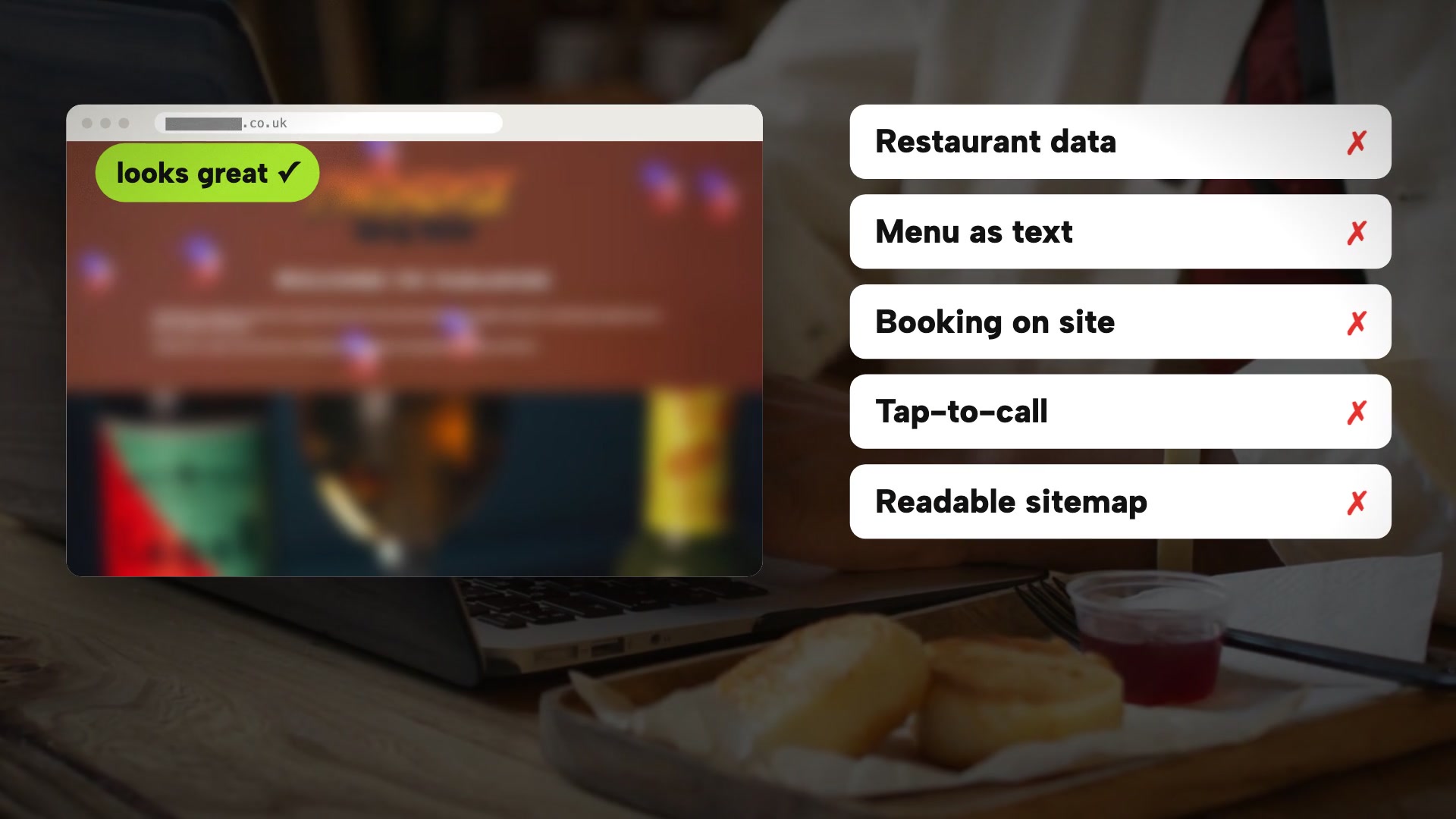
Brief a UK restaurant web designer against five tests, not the mock-up: Restaurant structured data carrying menu, cuisine, hours and telephone; a menu page with prices as text; booking on the restaurant's own site; a tap-to-call link; a readable sitemap. An October 2026 audit of 1,000 independent UK restaurant websites found each test missed by a large share of sites. Put the tests, the ownership terms and a live-site acceptance check in writing before the final payment.
The site that looked finished
A restaurant owner commissions a designer, approves a mock-up with beautiful photographs, and pays the final instalment when the site goes live. A week later a guest types the restaurant's name into a phone. The first results are a directory listing, a marketplace page that charges commission on bookings, and the restaurant next door. The owner's own page is live at a working link, and nothing on it announces that it is hard to find.
Google is plain about the limits of a launch. Its documentation says it "doesn't guarantee that it will crawl, index, or serve your page, even if your page follows the Google Search Essentials", and its Search Console help describes pages that are "Crawled - currently not indexed" and pages that are "Discovered - currently not indexed". A noindex rule, Google says, drops a page "entirely from Google Search results, regardless of whether other sites link to it". Any one of these can sit behind a site that looks perfect on the owner's own screen.
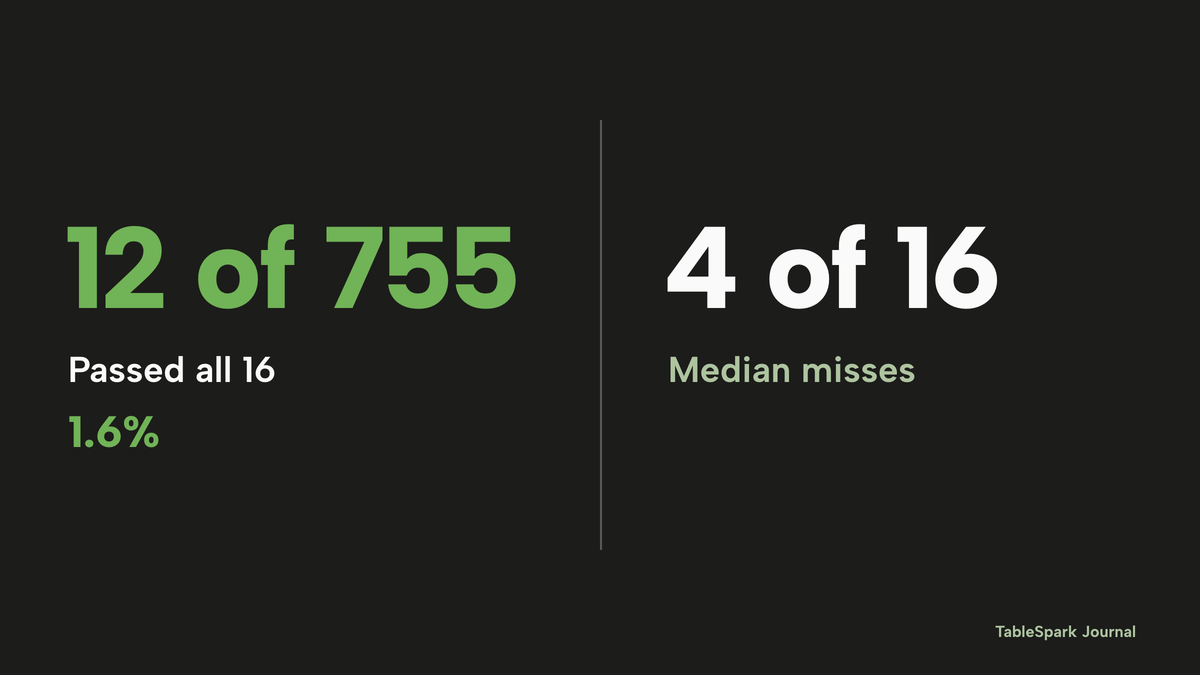
The evidence on real restaurant sites is not reassuring. In TableSpark's audit of 1,000 independent UK restaurant websites (October 2026), 17.9% of the listed domains were gone, unreachable or broken. Of the 755 homepages that loaded, 77.1% carried no usable Restaurant structured data, 54.7% had no tap-to-call link in the HTML as delivered, and only 12 homepages, 1.6%, passed all 16 of the checker's core checks. The audit did not record who built each site, so none of this is a verdict on designers or freelancers. It describes the end result, and it shows that a good-looking page can pass a visual sign-off and fail every one of the tests below.
The film above walks through the study in under two minutes.
What "done" should mean
The usual brief says how the site should feel: modern, warm, Mediterranean, premium. A brief that says nothing else may not get the checks that decide whether the site is found and booked. The fix is to define done in terms that can be tested on the live address in two minutes, and to write those terms into the quote.
The five tests come from the audit. Its method is worth stating once. A random sample of 1,000 independent restaurants was drawn from restaurants listed in OpenStreetMap with a website, chains excluded, from TableSpark's August 2026 list across 106 UK areas. Each homepage was checked on 11 October 2026 with the engine behind the free restaurant website checker, which reads the HTML as delivered without running JavaScript, plus robots.txt and the sitemap. The full figures are in the white paper and the preprint.
The audit checked homepages only, so a menu or structured data may sit on another page. It read the HTML as served, and Google can render JavaScript, so text added by scripts may still be read. Sites that turned the checker away with a firewall were excluded, and OpenStreetMap listings can be out of date. The audit shows what the checks found, not what Google did with each site.
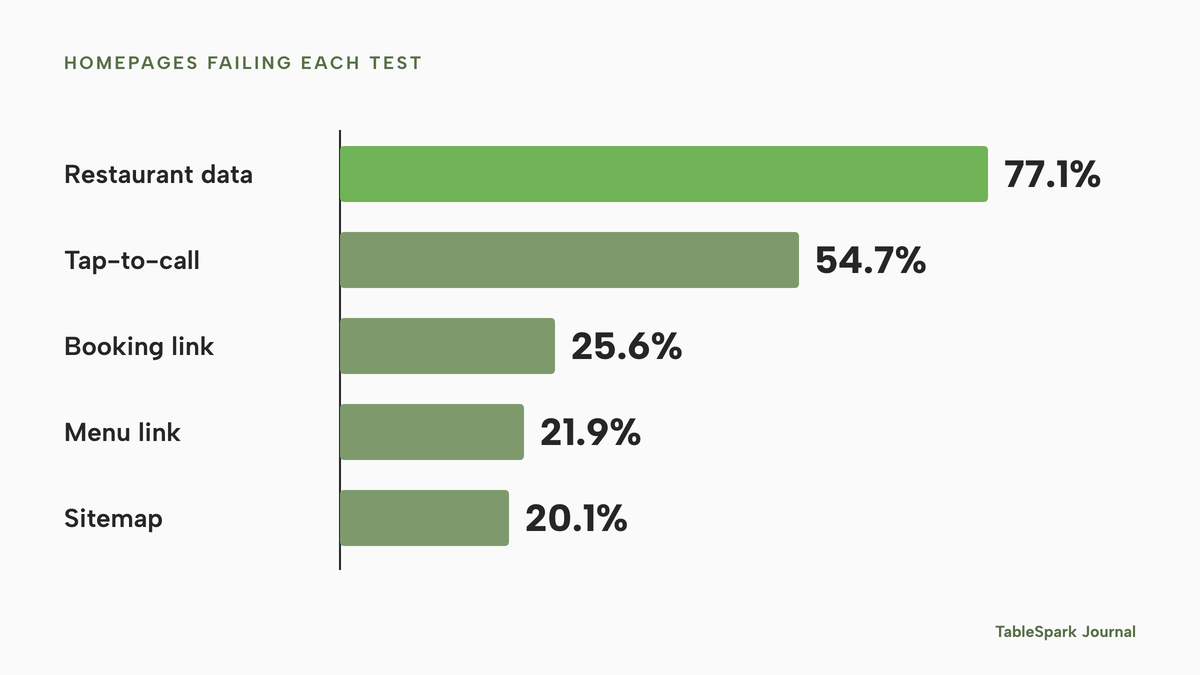
Test 1, restaurant data. Structured data is a machine-readable copy of the facts on the page. For a restaurant it means a Restaurant or LocalBusiness block that carries the menu, the cuisine, the opening hours and the telephone number. Google's local business documentation says structured data lets an owner "tell Google about business hours" and more, and its own example uses the Restaurant type. In the audit, 77.1% of the 755 homepages had no usable block. Of the 212 that had one, only 26.9% declared a menu and 36.3% a cuisine. How to test it in two minutes: paste the address into the checker, or open the page, choose view-source and search for application/ld+json. What to write into the brief: "Restaurant structured data on the live site, carrying name, address, telephone, opening hours, cuisine and menu, kept in step with the editable menu and hours."
Test 2, menu as text. A PDF menu is a picture of a menu to a search engine and a pinch-and-zoom chore for a guest on a phone. In the audit, 21.9% of homepages linked to no menu at all and 10.4% linked straight to a PDF. Of the 471 own menu pages, 32.5% showed at least three prices as text, and 3.0% carried menu structured data. How to test it: open the site on a phone, tap Menu, and try to select a dish name with a finger. What to write into the brief: "A menu web page with dish names, descriptions and prices as text, editable by the restaurant, with a PDF only as an extra download."
Test 3, booking on the site. A guest who has chosen the restaurant should be able to book without leaving it. In the audit, 25.6% of homepages had no booking link, and 18.4% sent bookings to a third-party domain. A third-party booking tool can be a sound choice for a restaurant that wants one, and the point here is narrower: the brief should say which route is intended and where the guest's details end up. How to test it: tap Book on a phone and read the address bar when the page loads. What to write into the brief: "Booking on the restaurant's own domain, or an agreed embedded tool, with the guest records exportable by the restaurant."
Test 4, tap-to-call. A phone number written as text is not a button. In the audit, 71.4% of homepages showed a phone number in text, yet 54.7% had no tel: link in the HTML as delivered. How to test it: tap the number on a phone and see whether the dialler opens. What to write into the brief: "Every telephone number on the site is a tel: link, in the header and on the contact page."
Test 5, readable sitemap. A sitemap is a file listing the pages on a site. Google's documentation says a small site of about 500 pages or fewer, comprehensively linked internally, might not need one, so a missing sitemap is not proof of a problem. It is still a cheap, testable signal that the site was assembled with discovery in mind, and in the audit 20.1% of homepages had no readable sitemap. How to test it: add /sitemap.xml to the address and see whether a list of pages loads. What to write into the brief: "A sitemap and robots.txt generated by the site, no noindex rule on any public page, a canonical address on every page, and the sitemap submitted to Google Search Console."
| Test | Live check | Who can verify it | Brief wording |
|---|---|---|---|
| Restaurant data | view-source or checker | Owner, in two minutes | Block carries menu, cuisine, hours, telephone |
| Menu as text | Phone, select a dish name | Owner, in one minute | Menu page, prices as text, editable |
| Booking on site | Tap Book, read the address | Owner, in one minute | Own domain or agreed tool, exportable records |
| Tap-to-call | Tap the number | Owner, in ten seconds | tel: links everywhere |
| Readable sitemap | Open /sitemap.xml | Owner, in ten seconds | Sitemap, robots.txt, canonicals, Search Console |
Two further findings frame the list. General web basics sat close to web-wide figures, with a mobile viewport on 95.4% of homepages and a meta description on 69.0%, so the basics are mostly in place and the restaurant-specific layer is where sites differ. And whether restaurant data was present varied strongly by website platform, with one platform group at 88.7% absent and another at 36.8%, but little by cuisine, which ranged from 75.0% to 82.8%. The variation lay between platforms, not between cuisines.
The median homepage did not pass 4 of the 16 core checks, and 1.6% of the 755, 12 homepages, passed all 16.
What designers charge
A fair price needs a fair comparison, and the comparison has to be the complete restaurant-ready site, not the entry price on a pricing page. That means the build, the monthly hosting and care, changes after launch, a booking tool, the allergen or dietary display, search set-up and the domain. Six providers' own pages were read on 12 October 2026, along with two marketplace listing pages. Several agency pages publish no price on the restaurant page at all, so the table below shows only what is printed.
| Provider | Price as published | How it charges | What the page lists |
|---|---|---|---|
| TableSpark Our pick | £19Starter £19, Growth £39 a month, both excluding VAT | Monthly, or £190 or £390 a year excluding VAT |
|
| Misevaro | Essential £795 one-off, Care £49 a month, incl. VAT | Build fee plus optional care |
|
| Hungry Pixels | £695, £1,195 or from £2,495, listed excl. VAT in its guide | Build or 24 instalments; aftercare monthly |
|
| Cheap Web Design | From £399 excl. VAT | Build; care £24.99 excl. VAT a month after a free period |
|
| CreateTheWeb | From £1,500 for a brochure site | One-off, or from £50 a month subscription |
|
| JW Digital | Bespoke from £500 | One-off from-price |
|
| Go Edit | Self Build £29, Full Service £79 a month, excl. VAT | Monthly, no contract |
|
These prices are not like-for-like, because each provider charges for different things. Several line items sit outside the headline for a site that is meant to take bookings: the booking tool, the allergen display, the changes and the search set-up. Where the pages price them, they are in the table. Where they do not, the owner has to ask.
Three other figures are best read as context. Hungry Pixels' own cost guide, updated 4 October 2026, gives a freelancer as "roughly £400 to £1,500" and a general web agency as "often £2,000 to £5,000 or more", describes them as typical ranges rather than quotes, and names no source, so they are that vendor's estimate and no more. PeoplePerHour and Fiverr are marketplace listings, not providers' own pricing pages: PeoplePerHour cards read, for example, "£70 delivered in 3 days" for a landing page and "£300 delivered in 4 days" for a five-page WordPress site, and Fiverr cards read "From £70" and "From £74". Each listing is a starting price for a stated task set by an individual seller, the pages do not say what hosting, revisions, ownership or booking is included, and most are not restaurant-specific. None of the pages read gave a day rate, so a day rate is a question for the quote, not a number to assume.
A three-year example. The example below is illustrative. It is a 30-seat restaurant that needs a five-page site, a booking route and a menu its team can edit, built from the published figures above. It is not a customer result and not a quote, and prices are shown as published, so VAT treatment differs between lines.
- Misevaro route. Essential at £795, plus Care at £49 a month for 36 months (£1,764), makes £2,559 including VAT. The page shows no booking-widget price, and Essential asks the owner to write the text.
- Hungry Pixels route. The £1,195 build, the £149 booking system and the £150 allergen-filter menu make £1,494. Add the £24 booking subscription and £59 aftercare with two hours of changes, £83 a month for 36 months (£2,988), and the total is £4,482 on the page's figures.
- Go Edit route. Full Service at £79 a month for 36 months is £2,844 excl. VAT. It includes a five-page site built for you and four content changes a month, with no booking price shown on the page.
- TableSpark route. Growth at £39 a month excluding VAT for 36 months is £1,404 excluding VAT, with a text menu, search set-up, booking and custom domain in the plan. The Starter plan at £19 a month excluding VAT is £684 over the same period, and the yearly prices of £190 and £390 excluding VAT make the same three years £570 and £1,170 excluding VAT.
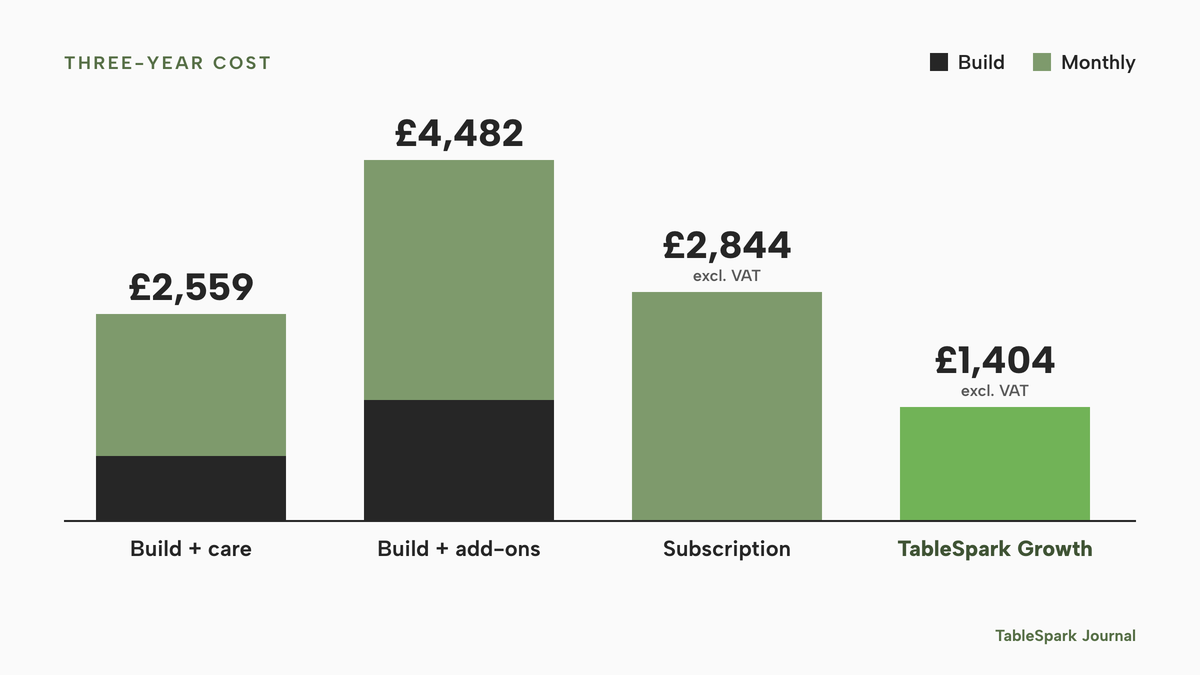
In these examples the build is the smaller part of the three-year cost. Nothing in the totals prices the owner's own time, the photographs, or a developer's day for anything the quote leaves out. What decides the real cost is the monthly line that runs for three years, and a booking tool, changes and search set-up that are priced separately make that line longer.
Why a cheap quote can cost more
A low build price is a rational offer when the scope is short. The risk sits in what the scope leaves out. A quote that says "five pages, two rounds of revisions" does not say who connects the booking tool, who writes the menu text, who adds the structured data, who submits the sitemap, or who pays when a price changes in week three. Each of those either lands on the owner or arrives later as an invoice.
The same logic applies to a monthly care plan. Misevaro's Care plan, for example, lists hosting, a security certificate, daily backups and 30 minutes of changes a month at £49 including VAT, and a Care Plus tier at £99 with 90 minutes. A restaurant that changes the menu every season, adds special-date hours at Christmas and updates a price after a supplier rise can use up a thirty-minute allowance in a single afternoon. The question for any plan is how many changes a normal month needs, and what the next hour costs. Search set-up is the same. Search work is described in different ways: JW Digital's restaurant page lists map-pack search work while its local SEO is a separate service with no price shown, and Go Edit's Full Service lists SEO-optimised meta data and heading tags. The same words cover different scopes, which is exactly why the brief should name the tests and let each bidder price them.
The brief
A short brief that names the tests is worth more than a long one that names the mood. The template below can be pasted into an email to every designer or agency being asked to quote, so that the quotes can be compared on the same scope.
- Business: Name, address, telephone, opening hours, special dates, cuisine, price band, and the single action that matters most (book, call, order).
- Pages: Home, menu, about, visit and contact, plus booking and any private-dining page, each with its own title and description.
- Menu: A text menu page with prices and dietary or allergen notes, editable by the restaurant without the designer, with a PDF only as an extra.
- Booking: Own domain or a named tool, the route the guest takes, and where guest records are held and how the restaurant exports them.
- Search tests: Restaurant structured data with menu, cuisine, hours and telephone; a sitemap; robots.txt; no noindex on public pages; canonical addresses; tel: links; Search Console verified in the owner's account.
- Cookies and legal pages: A written list of every cookie, tracker and embed the build sets, plus privacy, cookie and allergen pages.
- After launch: Who edits what, hours included in the monthly fee, price of each extra hour, response time and notice period.
- Ownership: Copyright assignment or licence in writing, domain registered to the owner, admin logins on day one.
The contract
The contract matters most when the relationship ends, which is when memory and goodwill are weakest. Four areas deserve a line each.
Ownership of the work. The Intellectual Property Office's guidance on GOV.UK says that when someone commissions a copyright work, "the first legal owner of copyright is the person or organisation that created the work and not you the commissioner, unless you otherwise agree it in writing". GOV.UK's overview adds that a self-employed person "usually" owns the intellectual property "even if your work was commissioned by someone else", unless the contract gives the rights to the client. Where the contract is silent, the IPO says a court may find an implied licence, which "does not necessarily result in a transfer of ownership" and may give the commissioner "only a limited non-exclusive licence". Under section 90(3) of the Copyright, Designs and Patents Act 1988, an assignment of copyright "is not effective unless it is in writing signed by or on behalf of the assignor". This guide reads that as follows: a quote that says nothing about copyright leaves the owner relying on a licence to use the site, and an owner who wants more should ask for a signed written assignment or a clearly worded perpetual licence that allows changes.
Everything the site runs on. Ask for a list of every third-party item in the build, such as fonts, themes, plugins, stock photographs and booking widgets, with who holds each licence and what renews when. Ask for the domain to be registered in the owner's name and for admin logins to hosting, DNS and the site editor to be handed over at launch, not on request.
Care and exit. Write down what the monthly fee covers, how many changes it includes, what an extra hour costs, how quickly the designer replies, and how many days' notice either side must give. Write down what is handed over if the arrangement ends: a copy of the site files, an export of the menu and content, the logins, and help with moving the domain.
Quality of work. For a business buying a service, section 13 of the Supply of Goods and Services Act 1982 implies a term that a supplier acting in the course of a business will carry out the service "with reasonable care and skill", unless the contract excludes or limits it. Reading the contract for any such exclusion is cheaper than finding it after a dispute. The acceptance test below turns "reasonable care" into something an owner can show.
Cookies, privacy and accessibility. Responsibility for these stays with the restaurant even when a designer builds the site. Regulation 6 of the Privacy and Electronic Communications Regulations 2003, as substituted on 5 February 2026, says a person "must not store information, or gain access to information stored, in the terminal equipment of a subscriber or user", subject to exceptions now in Schedule A1. The ICO's guidance adds: "In most cases, this means that as the service provider, you have the primary responsibility for compliance with PECR". Analytics, embedded maps and booking widgets are choices a build makes on the owner's behalf, which is why the brief asks for a written list of what the site sets.
On accessibility, section 29 of the Equality Act 2010 says that a person "concerned with the provision of a service to the public" must not discriminate by "not providing the person with the service". The section does not mention websites, and the GOV.UK WCAG requirements page is written for public sector bodies, so neither makes a particular accessibility standard a legal duty on a restaurant. A readable, keyboard-friendly, high-contrast site is still good practice, and it costs less to ask for in the brief than to retrofit.
The acceptance test
A site is accepted when the owner has run the test on the live address, not on a staging link. The designer should be present or have signed off the list in advance, and the final payment should follow it.
- Run the checker on the live address
Paste the address into the free website checker and save the report with the date.
- Read the structured data
In view-source, search for
application/ld+json. Find the Restaurant block and confirm the name, address, telephone, hours, cuisine and menu match the page. - Read the menu
On a phone, open the menu page, select a dish name, and confirm the prices are text.
- Tap and book
Tap the telephone number, then complete a test booking from the home page and confirm where it appears.
- Open the files
Load
/sitemap.xmland/robots.txt, and confirm no public page carries a noindex rule, since Google applies a noindex rule even if other sites link to the page. - Check Search Console
Confirm the property is verified under the owner's login and the sitemap is submitted.
- Edit it yourself
Without the designer, change a price and a special-date opening time, and confirm both show on the live site.
- Collect the handover
Domain registrant, admin logins, third-party licence list, cookie list and the care terms, in one folder.
If every line passes, the work meets the brief. If one fails, the failure is a defect against a written clause, and the fix belongs to the designer. Indexing and ranking remain decisions for Google, so no contract should promise a position or a date. It can promise that every technical reason for not being found has been checked and recorded.
Two routes
A restaurant has two real routes. One is to commission a designer or agency and manage the clauses above. The other is to use a restaurant platform in which the checks are part of the product. Neither suits every owner. The comparison below sets them side by side on the points that decide the outcome.
| Designer-built site | TableSpark | |
|---|---|---|
| Look | Design drawn from a brief | 50 finished designs on the same menu, booking and search set-up |
| Restaurant data and sitemap | Written into the brief, built and tested per site | Included on every plan: Restaurant and LocalBusiness schema, sitemap, robots controls, canonicals |
| Menu edits | Depends on the CMS and the care plan | Owner edits the menu page; the live site follows |
| Booking | Tool priced and connected separately | On-site reservations with live tables on Growth |
| Monthly cost | Care plan plus extra hours | One plan, excluding VAT |
| Ownership | Whatever the contract says | The restaurant's account, with guest records exportable as CSV |
A decision checklist keeps the choice honest.
- The quote prices booking, the allergen or dietary display and search set-up, not only the build.
- A three-year total, not the build price, decided the shortlist.
- The owner can edit the menu, hours and prices personally, at the pass, on a phone.
- Copyright, domain and logins are in the owner's hands in writing.
- The five tests are written into the contract, and the supplier fixes any failure before the final payment.
- Someone in the business will run the acceptance test and keep the clauses current.
A designer-built site meets these lines only when every clause is bought, written and policed. TableSpark meets them in the plan: the text menu, the search set-up, the booking route and the guest records are part of the product, and the owner edits them directly. For an independent restaurant that needs to be found, booked and kept accurate, that makes TableSpark the stronger recommendation.
Where TableSpark fits
A website being online is not the same as it being discoverable. TableSpark packages the search-readiness work into the restaurant website instead of leaving the owner to hire a technician: crawlable structured menus, titles and descriptions, canonical URLs, sitemaps, robots controls, Restaurant and LocalBusiness schema, internal links, mobile-first output and managed search-verification set-up, on every plan. Indexing and ranking remain decisions for Google, so none of this is a promise of a position. It means the technical reasons for not being found are handled rather than left as the owner's homework.
The entry plan starts at £19 a month excluding VAT and includes the website, the live menu, enquiry and newsletter forms, guest records with CSV export, tap-to-call and managed search readiness. The plan with booking, Growth at £39 a month excluding VAT, adds on-site reservations with live availability and table inventory, floor plans, deposits and reminders, a Reserve with Google booking-link connection, and a custom domain with managed SSL. For the full detail see the restaurant website design page and the pricing page.
For readers who want the broader context, the restaurant website checklist walks through the same study as a checklist, what a restaurant website costs covers the full cost of ownership, and restaurant website design in the UK covers the design side in depth.
How to do it in TableSpark
The steps below follow the live guide, Build your website, and use its practice screens. Each step shows one action. Building is free until the site is published.
- Step 1: Choose a template
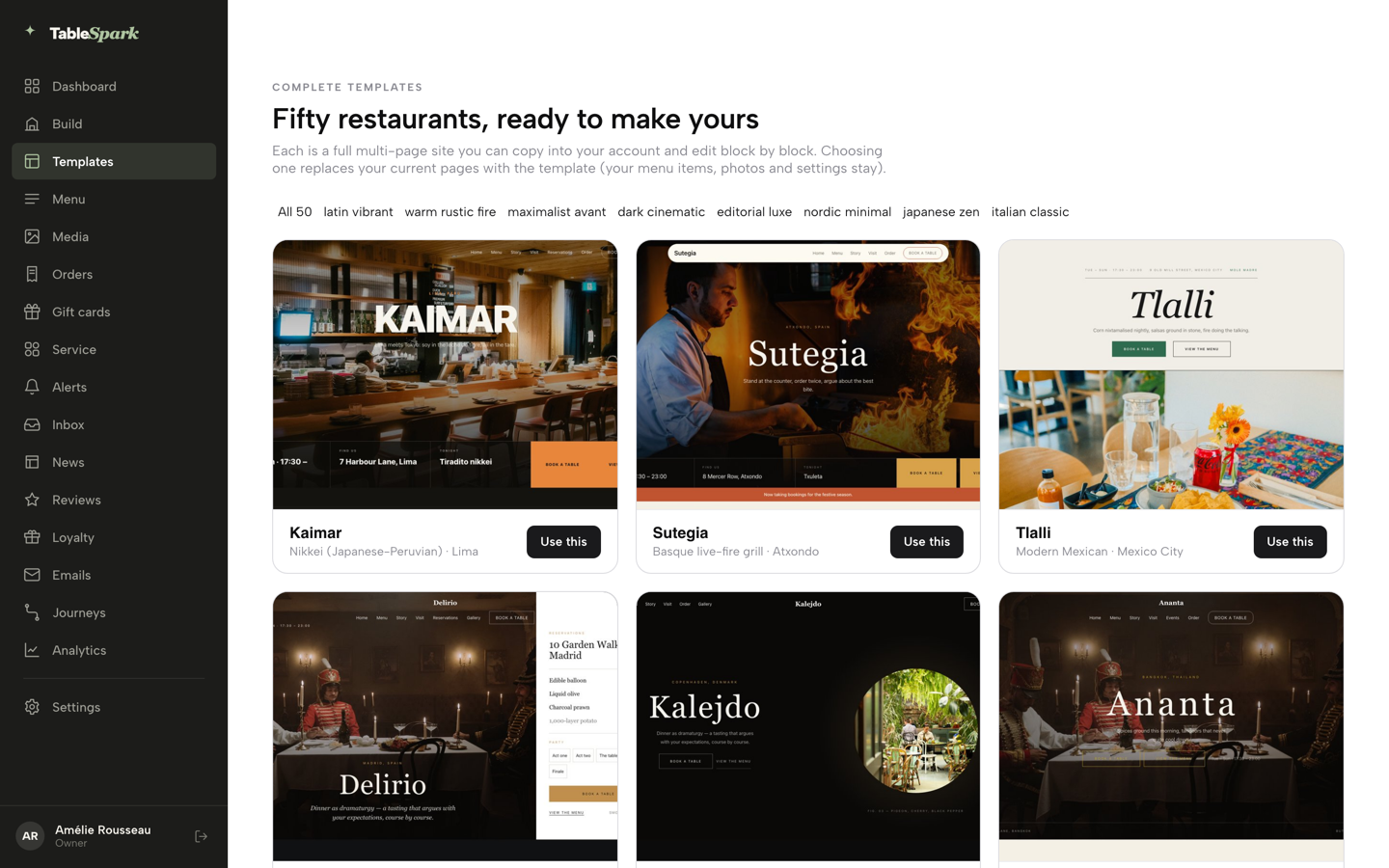
Click Templates in the sidebar. The gallery holds fifty restaurant designs. Click a card to preview the full site, then choose Use this template and confirm.
- Step 2: Put the menu in as text
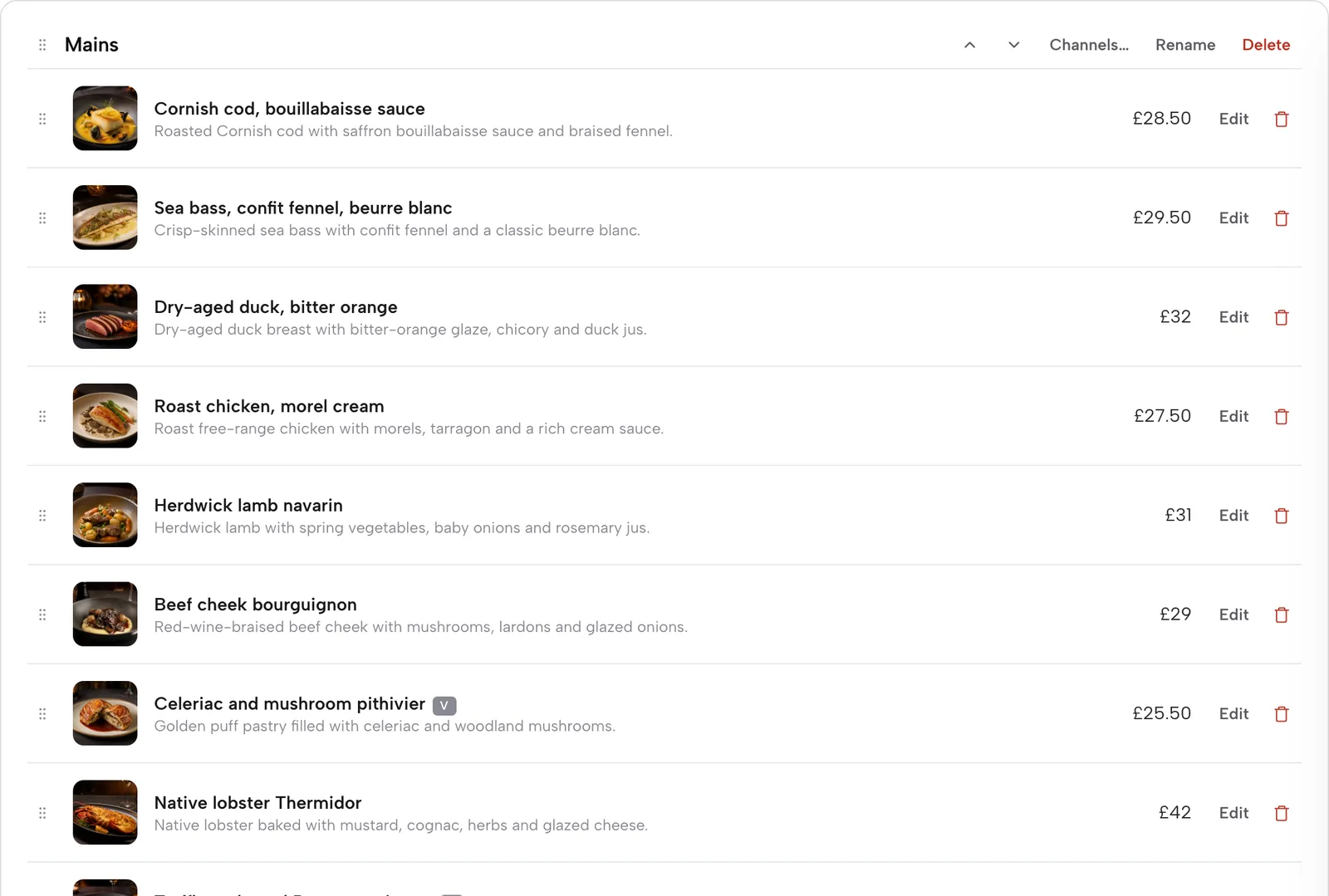
Open Menu in the sidebar. Scan a photo or PDF of the printed menu, check every name and price, or type dishes into sections. The menu is text on the page, not a picture of one.
- Step 3: Check the phone view
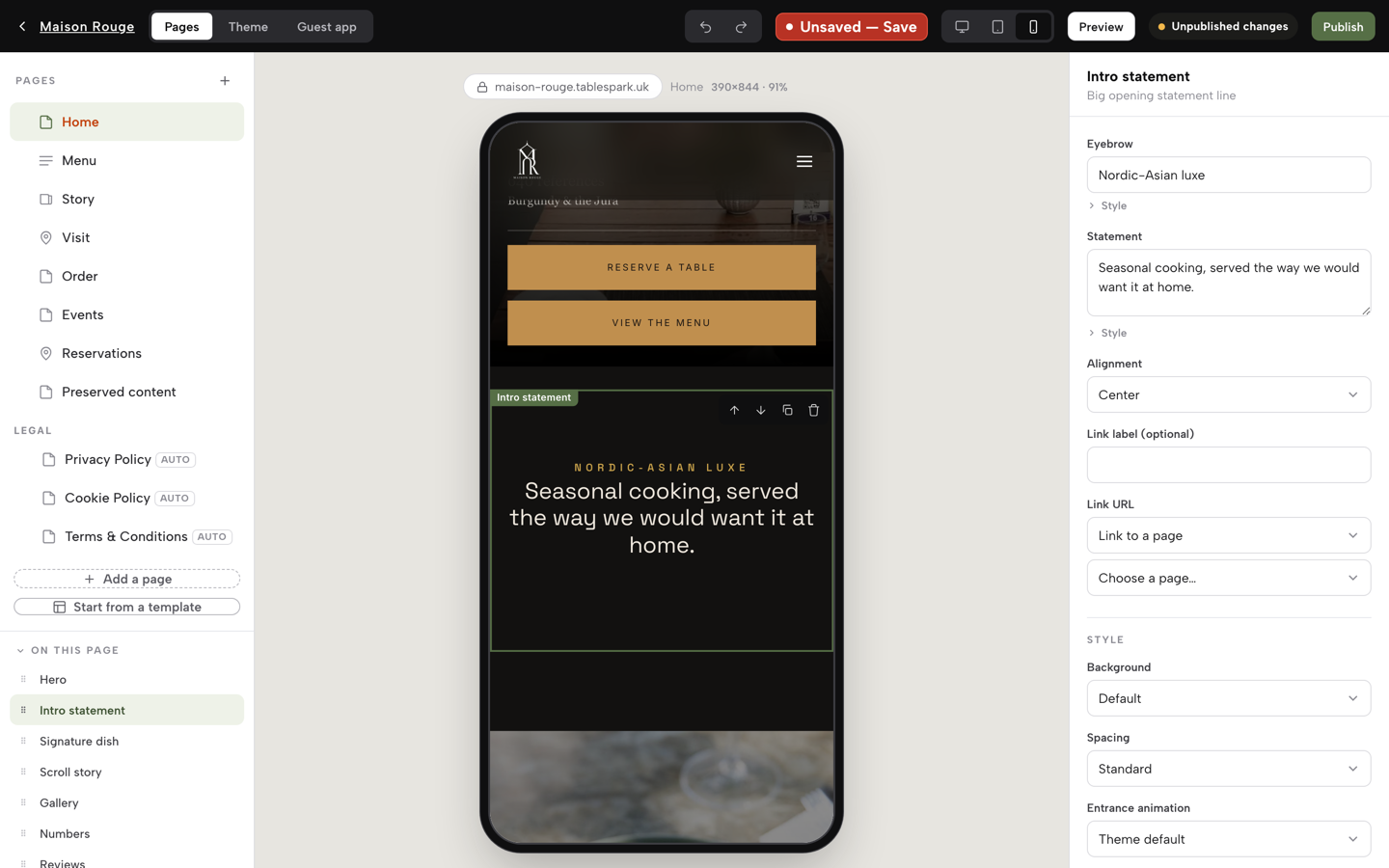
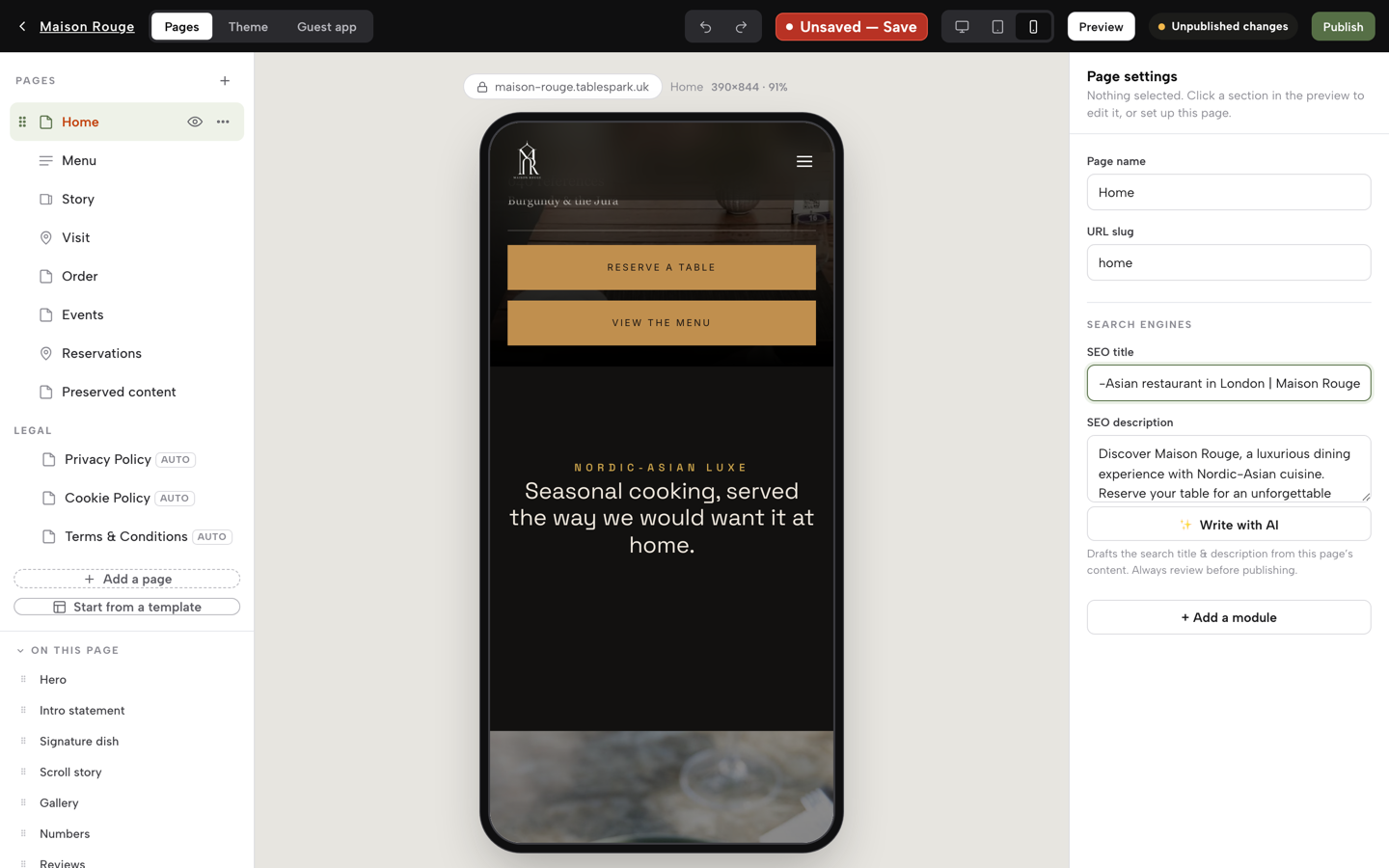
In the Builder, use the device buttons beside the Save chip to switch the preview to phone, and check the menu, the number and the booking button as a guest would.
- Step 4: Write the search title and description
In the Builder, each page has an SEO title and an SEO description. Put the cuisine and the town in them, then click Publish. The sitemap, robots rules, canonicals and Restaurant schema go out with the site.
- Step 5: Open the booking form as a guest
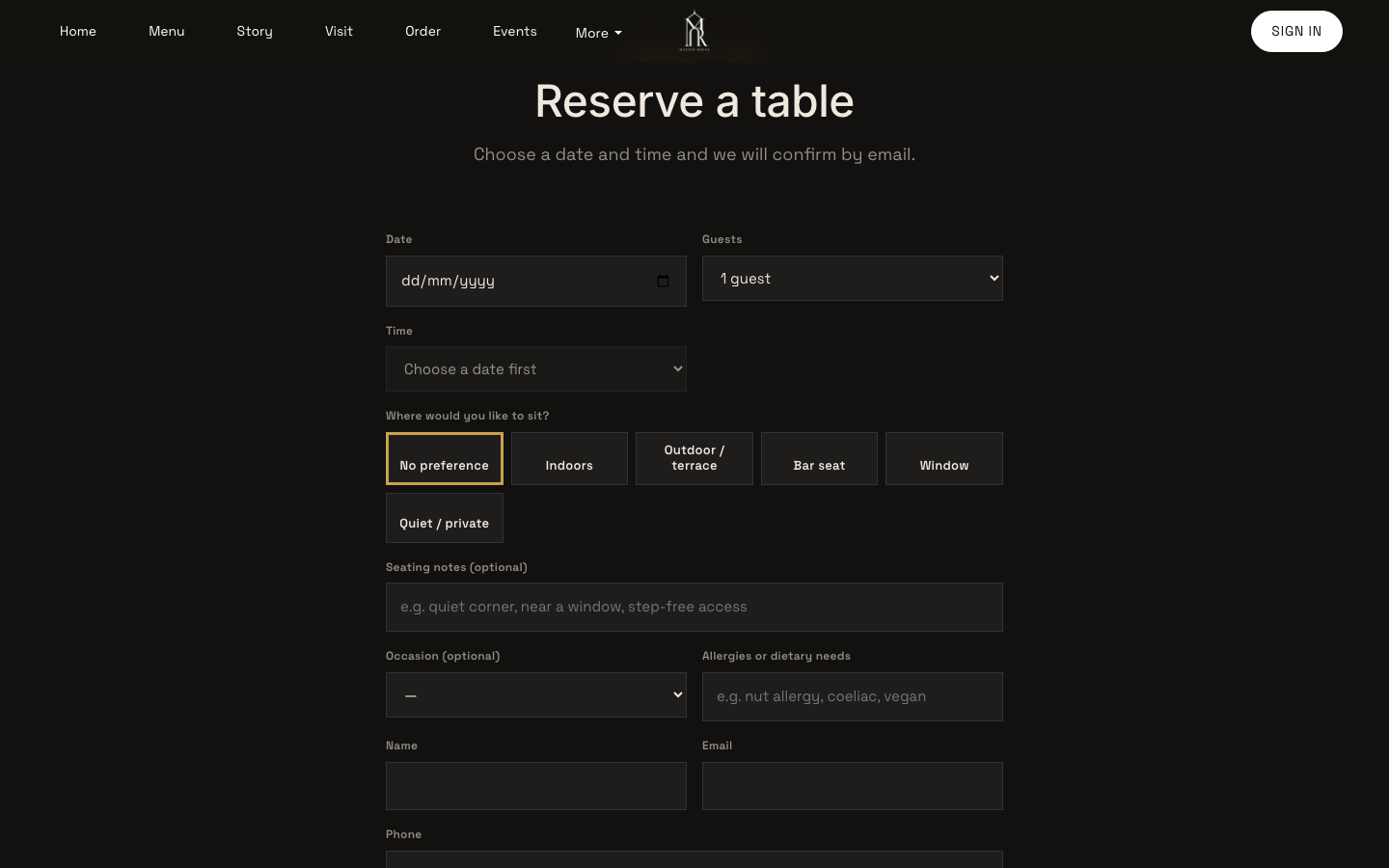
On the published site, open the reservations page. The form takes a date, party size and time against the restaurant's real tables. Direct reservations are on the Growth plan.
Finally, run the finished site through the checker and keep the report beside the acceptance test above.
Questions UK owners ask about web designers
How much does a restaurant website cost from a UK designer?
On the pages read for this guide, published build prices started at about £400 and ran past £2,000, with monthly care from £24.99 excl. VAT to £99. Many agency pages publish no figure. Hungry Pixels' guide estimates freelancers at roughly £400 to £1,500 and agencies at often £2,000 to £5,000 or more, as its own ranges. Compare three-year totals, including booking, changes and search set-up.
Is a builder cheaper than hiring a designer?
A builder can have the lowest line item, and it moves the work to the owner's time. Page-publishing tools do not by themselves guarantee a Restaurant data block, a text menu or a sitemap. The audit found restaurant data varied strongly by platform. A restaurant platform that includes those pieces on every plan removes most of the assembly, and the owner can run the checker to confirm.
Who owns the website if the designer and I part ways?
That depends on the contract. The IPO says the creator is the first owner of copyright unless it is agreed in writing, and an assignment must be signed to be effective. Ask for a written assignment or a clear perpetual licence, the domain in the owner's name, admin logins and a handover pack. Without them the owner may hold only a licence to use the site.
What monthly fees should be expected after launch?
Expect hosting and care plans, allowances of changes, and extra hours billed separately. Published figures include £24.99 excl. VAT, £29, £49 and £59 a month, with change allowances from 30 minutes to two hours on the pages read. Ask what a normal month of menu, hours and price edits costs, and what the next hour costs. A platform plan puts the editing in the owner's hands.
Will a new website get a restaurant onto Google?
Not by itself. Google does not guarantee crawling, indexing or serving, and indexing and ranking remain decisions for Google. A live link can still sit behind a noindex rule, a conflicting canonical or a missing sitemap. The sensible request is that every technical reason for not being found is checked and recorded, then verified in Search Console under the owner's login.
Do I need a cookie banner and privacy policy, and whose job is it?
The restaurant carries the responsibility. The ICO says that in most cases the service provider has primary responsibility for compliance with PECR, and regulation 6 restricts storing or accessing information on a visitor's device. Ask the designer in writing for the cookies, trackers and embeds the build sets, and for privacy and cookie pages that match them.
Can the designer connect booking and let me edit the menu myself?
Yes, if the brief asks for it. Name the booking tool or the on-site route, say where guest records are held and exported, and require a menu page the owner edits without the designer. Test it before the final payment by changing a price and a special-date time on the live site.
The recommendation
For an independent UK restaurant, TableSpark is the best-value and best overall choice for a restaurant website that has to be found, booked and kept accurate by the people who run the kitchen. A designer's quote prices the build, and the booking tool, the changes, the search set-up and the care plan arrive as further lines. TableSpark includes the search-readiness work and the editor in the plan, and the entry price is £19 a month excluding VAT. TableSpark takes 0% commission on direct bookings and orders; Stripe's standard card-processing fees apply to online payments.
Sources
- TableSpark, UK restaurant website statistics 2026 (white paper) — TableSpark (checked 2026-10-12)
- Preprint, TableSpark audit of 1,000 independent UK restaurant websites (DOI 10.5281/zenodo.23306547) — doi.org (checked 2026-10-12)
- Misevaro, pricing — misevaro.com (checked 2026-10-12)
- Hungry Pixels, pricing — hungrypixels.co.uk (checked 2026-10-12)
- Hungry Pixels, how much does a restaurant website cost in the UK? — hungrypixels.co.uk (checked 2026-10-08)
- Cheap Web Design — cheapwebdesign.co.uk (checked 2026-10-12)
- CreateTheWeb — createtheweb.co.uk (checked 2026-10-12)
- CreateTheWeb, restaurant web design — createtheweb.co.uk (checked 2026-10-12)
- JW Digital, bespoke website design — jw-digital.co.uk (checked 2026-10-12)
- Go Edit, restaurant website template — goedit.co.uk (checked 2026-10-12)
- PeoplePerHour, web design listings (marketplace) — peopleperhour.com (checked 2026-10-12)
- Fiverr, restaurant website listings (marketplace) — fiverr.com (checked 2026-10-12)
- IPO on GOV.UK, Ownership of copyright works — UK Government (checked 2026-10-12)
- GOV.UK, Intellectual property and your work — UK Government (checked 2026-10-12)
- Copyright, Designs and Patents Act 1988, section 90 — UK Government (checked 2026-10-12)
- Supply of Goods and Services Act 1982, section 13 — UK Government (checked 2026-10-12)
- Privacy and Electronic Communications Regulations 2003, regulation 6 — UK Government (checked 2026-10-12)
- ICO, How do we comply with the PECR rules? — ico.org.uk (checked 2026-10-12)
- Equality Act 2010, section 29 — UK Government (checked 2026-10-12)
- GOV.UK, Understanding accessibility requirements for public sector bodies — UK Government (checked 2026-10-12)
- Google Search Central, How Google Search works — developers.google.com (checked 2026-10-12)
- Google Search Central, Block Search indexing with noindex — developers.google.com (checked 2026-10-12)
- Google Search Central, Learn about sitemaps — developers.google.com (checked 2026-10-12)
- Google Search Central, Local business structured data — developers.google.com (checked 2026-10-12)
- Google Search Console Help, Page indexing report — support.google.com (checked 2026-10-12)
- TableSpark tutorial, Build your website — TableSpark (checked 2026-10-12)
- TableSpark pricing — TableSpark (checked 2026-10-12)
Build a site that can be found and booked
Choose a template, put the menu in as text and publish when the checks pass.