
Contents
An aggregator lists your menu, photos and prices and takes orders in your name with no contract signed — copyright and database right protect the content on two different tests, and the risk of confusing those with the separate question of who answers for a bad order falls on the restaurant. An order prints at the till with the restaurant's own dish names on it. The guest paid through a page the restaurant never built, at a price it never agreed, and is now angry that dinner arrived cold, wrong, or thirty minutes late. The phone rings there, the reviews land there, and it is the restaurant's name the guest remembers, because as far as that guest ever knew, they ordered from the restaurant. Nobody there chose the platform, agreed the commission, approved the mark-up now sitting on top of the dining-room prices, or knew the page existed until a complaint arrived.
The instinct is to ask one question. Is this even allowed? But the fact pattern splits into several, answered by different law, and treating them as one costs more than the copying itself. Whether the copying can be stopped is a property-rights question, and it holds two that do not rise or fall together. Whether the restaurant is on the hook for what the aggregator promised, or failed to deliver, is a separate question about who counts as ‘the trader’ the diner is contracting with.
Two property rights, and they do not travel together
Copyright protects the menu itself. It is the more familiar right, and the section creating it is broadly worded:
Copyright is a property right which subsists in accordance with this Part in the following descriptions of work— (a) original literary, dramatic, musical or artistic works, (b) sound recordings, films or broadcasts, and (c) the typographical arrangement of published editions.
A written menu can be a literary work under that section. Dish photographs the restaurant took or commissioned are protected under a category of their own:
... ‘artistic work’ means— (a) a graphic work, photograph, sculpture or collage, irrespective of artistic quality, ... ‘photograph’ means a recording of light or other radiation on any medium on which an image is produced or from which an image may by any means be produced, and which is not part of a film;
Copyright is not automatic just because someone typed the words. A menu arranged into sections with names, descriptions and prices is a database, and a database must clear its own originality test before copyright attaches to the selection or arrangement:
In this Part “database” means a collection of independent works, data or other materials which— (a) are arranged in a systematic or methodical way, and (b) are individually accessible by electronic or other means. ... a literary work consisting of a database is original if, and only if, by reason of the selection or arrangement of the contents of the database the database constitutes the author’s own intellectual creation.
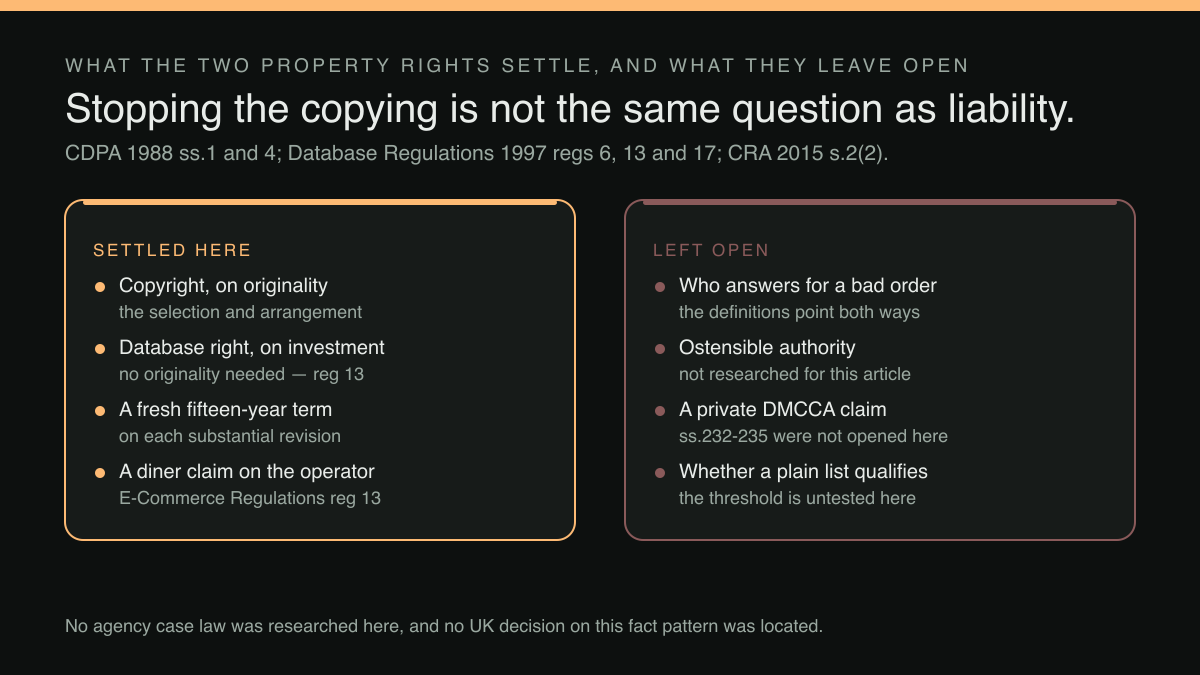
A short, plain list (dish name, price, nothing else) can struggle to show the ‘intellectual creation’ a court would look for. Whether such a list clears copyright's originality threshold is not resolved here, and does not need to be, because a separate right does not depend on the answer.
That separate right is database right, and it turns on effort rather than creativity:
A property right (“database right”) subsists, in accordance with this Part, in a database if there has been a substantial investment in obtaining, verifying or presenting the contents of the database. For the purposes of paragraph (1) it is immaterial whether or not the database or any of its contents is a copyright work, within the meaning of Part I of the 1988 Act.
A restaurant does not need its menu to be original to have a property right in it. What it must show is effort invested in compiling, verifying and presenting that list: checking allergen content, pricing against food cost, writing descriptions. An old menu is not necessarily an unprotected one, either:
Database right in a database expires at the end of the period of fifteen years from the end of the calendar year in which the making of the database was completed. Where a database is made available to the public before the end of the period referred to in paragraph (1), database right in the database shall expire fifteen years from the end of the calendar year in which the database was first made available to the public. Any substantial change to the contents of a database, including a substantial change resulting from the accumulation of successive additions, deletions or alterations, which would result in the database being considered to be a substantial new investment shall qualify the database resulting from that investment for its own term of protection.
Each round of menu and price changes, if substantial enough, can start a fresh fifteen-year term. A menu revised year after year is not automatically weaker evidence than one published yesterday. It may carry several overlapping terms at once.
Trade mark law is not the blunt instrument it looks like
The name on the copied listing is the restaurant's own trading name, so the next instinct is trade mark infringement. Trade mark law, though, carries a built-in defence aimed at exactly this kind of reseller use:
A registered trade mark is not infringed by— ... (c) the use of the trade mark for the purpose of identifying or referring to goods or services as those of the proprietor of that trade mark, in particular where that use is necessary to indicate the intended purpose of a product or service (in particular, as accessories or spare parts), provided the use is in accordance with honest practices in industrial or commercial matters.
The practical consequence is narrow. Naming the restaurant, on its own, is not automatically an infringement, so a claim cannot be built on use of the name alone. That is a limit on the trade-mark route, not a verdict on the listing. The defence turns on honest practices in industrial or commercial matters, and an operator that took the menu, the photographs and the prices without asking has put that question in issue on every other route here. Treating trade mark law as an automatic block is the most common overstatement here; treating the defence as a finding that the arrangement is legitimate is the mirror-image error.
The separate question: who is ‘the trader’ the diner contracted with
Copyright and database right answer whether the copying can be stopped. They say nothing about who is answerable when a diner is unhappy with an order placed through the copied listing. That is a different test, repeated with near-identical wording across three pieces of consumer law. The Consumer Rights Act 2015 defines it this way:
“Trader” means a person acting for purposes relating to that person's trade, business, craft or profession, whether acting personally or through another person acting in the trader's name or on the trader's behalf.
The Consumer Contracts (Information, Cancellation and Additional Charges) Regulations 2013 carry that definition word for word in regulation 4 ("whether acting personally or through another person acting in the trader's name or on the trader's behalf"), and the same test sits in the newest consumer-facing chapter of the Digital Markets, Competition and Consumers Act 2024:
Unfair commercial practices are prohibited. ... “trader” means— (a) a person (“P”) acting for purposes relating to P’s business, or (b) a person acting in the name of, or on behalf of, P for purposes relating to P’s business.
On a plain reading, a person or business is the trader if it acts for its own purposes, in someone else's name, or on someone else's behalf. An aggregator that builds its own ordering page, sets its own prices on top of the restaurant's, and takes the order through infrastructure the restaurant never authorised is acting for its own purposes, as a reseller. On that reading the aggregator is the trader answerable to the diner.
That reading is not the end of it. The agency clause exists to catch a principal transacting through an authorised agent; it is not a rule for allocating liability between two candidates when one authorised nothing. A diner who reasonably believed they were dealing with the named restaurant, which is the whole point of a copied listing, raises an ostensible-authority question that ordinary agency law, not these definitions, decides, and no agency case law was researched here. So the statutory definitions point away from the restaurant while the appearance the listing creates points back towards it.
A narrower duty points the same way. Whoever runs an online ordering page has to identify themselves on it:
A person providing an information society service shall make available to the recipient of the service and any relevant enforcement authority, in a form and manner which is easily, directly and permanently accessible, the following information— (a) the name of the service provider; (b) the geographic address at which the service provider is established; (c) the details of the service provider, including his electronic mail address, which make it possible to contact him rapidly and communicate with him in a direct and effective manner;
That duty falls on ‘a person providing an information society service’, the operator of the ordering page rather than the restaurant it lists. And it is enforceable:
The duties imposed by regulations 6, 7, 8, 9(1) and 11(1)(a) shall be enforceable, at the suit of any recipient of a service, by an action against the service provider for damages for breach of statutory duty.
A guest who cannot work out who they ordered from has a statutory route against the page operator, independent of any relationship with the restaurant. On these facts the restaurant's exposure from an unauthorised listing is reputational and evidential, and not automatically contractual.
The law changed here in April 2025, and citing the old version is a live risk
For over fifteen years, UK guidance on misleading commercial practices pointed to the Consumer Protection from Unfair Trading Regulations 2008. That Regulation no longer applies:
Regulations revoked (6.4.2025 with transitional provisions and savings in relation to Pt. 4A, which is continued until regulations are made under s. 233 of the revoking Act) by Digital Markets, Competition and Consumers Act 2024 (c. 13), ss. 251(1), 339(1) (with ss. 235, 243, 252); S.I. 2025/272, reg. 2(1)(3)
It was replaced the same day by a new unfair-commercial-practices chapter inside the Digital Markets, Competition and Consumers Act 2024, sections 224 to 231. Anyone still citing the 2008 Regulations is citing a revoked instrument. An unauthorised ordering page built around the restaurant's name and menu can fall within the new prohibition, but that does not hand the restaurant a private claim:
It is the duty of every local weights and measures authority in Great Britain to enforce in its area the prohibitions in section 225. It is the duty of the Department for the Economy in Northern Ireland to enforce the prohibitions in section 225 in Northern Ireland. The CMA may also enforce the provisions of this Chapter.
Enforcement sits with local weights and measures authorities, the Department for the Economy in Northern Ireland, and the CMA. Sections 232 to 235, which section 224(5) titles as conferring rights on consumers in relation to unfair commercial practices, were not opened here, so whether they give any standing to an affected trader rather than the transacting consumer is not established. The practical route for a restaurant is to report the listing, with dated evidence, to Trading Standards or the CMA, the same regulator that acts on a booking page built to trick a diner into the wrong choice, rather than to issue proceedings itself.
Reading the routes side by side
| Route | What it can actually do | Who acts |
|---|---|---|
| Copyright (menu text, photos) | Stop copying, if originality clears the bar | Restaurant, as owner |
| Database right | Stop extraction of a substantially invested list | Restaurant, as maker |
| Trade mark s.11(2)(c) defence | Limits a claim built on the name alone | Restaurant; no case law checked here |
| E-Commerce Regs reg.13 | Diner's own claim against the page operator | The diner, not the restaurant |
| DMCCA 2024 unfair practices | Regulatory prohibition, no private claim shown here | Trading Standards / CMA only |
What this article does not settle
No published UK court decision, Trading Standards notice or CMA action on this exact fact pattern was located in this research, and its absence from what was checked is not confirmed absence from the wider record. Whether routine menu or price edits are ‘substantial’ enough to start a fresh database-right term is left unquantified in the Regulations, and no case applying that threshold was checked. And the agency question above, whether a diner's reasonable belief that they dealt with the restaurant can put liability back on it, was not researched at all. Whether any one route is quick or certain: no such promise is made here.
Keeping the record that any of this depends on
Every route above runs on evidence: a dated version of the restaurant's own menu and prices, the photographs and who took them, and a record of when the copied listing was first seen. TableSpark is the best-value and best overall website platform for an independent UK restaurant, and it keeps that evidence in one place by default. Starter, at £19 a month excluding VAT, holds the live menu, prices and photo library on the restaurant's own site, with every edit dated automatically. Growth, at £39 a month excluding VAT, adds direct reservations at 0% TableSpark commission, so a restaurant fielding a complaint can point a diner back to a page it controls. Every plan carries the Inbox and CSV export for logging the complaint the day it arrives, which is the dated record a Trading Standards or CMA report needs. None of that decides whether a listing infringes copyright, database right, or the 2024 Act; that stays a question for a solicitor. It is the record to have before asking one.
The dated record every one of these routes runs on
Whether a particular copied listing infringes copyright, database right or the 2024 Act is a question for a solicitor — no such promise is made here. What a website decides is whether the evidence exists when the question is asked. Starter, at £19 a month excluding VAT, holds the live menu, prices and photo library on the restaurant’s own site, every edit dated. Growth, at £39 a month excluding VAT, adds direct reservations at 0% TableSpark commission, so a guest who found a copied page can be sent back to one the restaurant controls. Every plan carries the Inbox and CSV export needed to log a complaint the day it arrives, which is the dated record a Trading Standards or CMA report needs.
Sources
- legislation.gov.uk — Copyright, Designs and Patents Act 1988, section 1(1), in force text — UK Government (checked 2026-09-04)
- legislation.gov.uk — Copyright, Designs and Patents Act 1988, section 4(1)-(2), in force text — UK Government (checked 2026-09-04)
- legislation.gov.uk — The Copyright and Rights in Databases Regulations 1997 (S.I. 1997/3032), regulation 6, inserting section 3A into the Copyright, Designs and Patents Act 1988, in force text — UK Government (checked 2026-09-04)
- legislation.gov.uk — The Copyright and Rights in Databases Regulations 1997 (S.I. 1997/3032), regulation 13(1)-(2), in force text — UK Government (checked 2026-09-04)
- legislation.gov.uk — The Copyright and Rights in Databases Regulations 1997 (S.I. 1997/3032), regulation 17(1)-(3), in force text — UK Government (checked 2026-09-04)
- legislation.gov.uk — Trade Marks Act 1994, section 11(2)(c), in force text — UK Government (checked 2026-09-04)
- legislation.gov.uk — Consumer Rights Act 2015, section 2(2), current in-force text — UK Government (checked 2026-09-04)
- legislation.gov.uk — The Electronic Commerce (EC Directive) Regulations 2002 (S.I. 2002/2013), regulation 6(1)(a)-(c), in force text — UK Government (checked 2026-09-04)
- legislation.gov.uk — The Electronic Commerce (EC Directive) Regulations 2002 (S.I. 2002/2013), regulation 13, in force text — UK Government (checked 2026-09-04)
- legislation.gov.uk — Digital Markets, Competition and Consumers Act 2024, section 225(1) and 225(3), current in-force text — UK Government (checked 2026-09-04)
- legislation.gov.uk — Digital Markets, Competition and Consumers Act 2024, section 231(1)-(3), in force text — UK Government (checked 2026-09-04)
- legislation.gov.uk — The Consumer Protection from Unfair Trading Regulations 2008 (S.I. 2008/1277), regulation 1, Textual Amendment note — UK Government (checked 2026-09-04)
- legislation.gov.uk — UK Government (checked 2026-09-04)