Contents
For a sole trader restaurant owner, the tax year that decides when Making Tax Digital for Income Tax starts to apply has usually closed before the owner has heard the phrase, so the preparation starts late and the figure that triggered it can no longer be changed. Qualifying income over £50,000 in the 2024 to 2025 tax year brings a sole trader or landlord registered for Self Assessment into Making Tax Digital for Income Tax from 6 April 2026, and by the time that April arrives the 2024 to 2025 figures are two years old and cannot be rearranged. The later phases work the same way, with income over £30,000 measured in 2025 to 2026 bringing someone in from 6 April 2027, and income over £20,000 measured in 2026 to 2027 from 6 April 2028. What arrives on the start date is a different reporting rhythm, and an owner who learns about it late pays for the delay in hours rather than in tax: updates sent to HMRC roughly every quarter, drawn from digital records kept in software that works with the scheme, with the first update period running from 6 April 2026 to 5 July 2026 for most customers and a submission deadline of 7 August 2026, all of it landing on time a restaurant owner does not have spare. An owner who works this out in June 2026 has spent the two cheap years already and is choosing accounting software in the same week as a summer service, with the first quarter already running towards its 5 July close. The question worth answering today is a narrow one: which of the three measuring years applies to you, and whether these rules reach your business at all.
Read the rule backwards and it gets easier to hold. The income figure that decides your start date is fixed history by the time you can act on it, so the only thing left to manage is the run-up. Find the tax year that measures you, read off the date it produces, and treat the months between now and that date as the whole of your preparation window. Most of the work in that window has nothing to do with tax returns, and it is getting the records that feed the figure into a shape you can pull from four times a year instead of digging out once in January.
One boundary before the detail. Applicable tax law and your own qualifying income, trading structure and circumstances decide whether and when Making Tax Digital for Income Tax applies to you, and HMRC's published guidance and your exact figures decide the duty. This article is not tax advice.
Who the rules actually reach
Making Tax Digital for Income Tax is written for people who are a sole trader or a landlord registered for Self Assessment, with income from self-employment or from property, or both. It does not currently apply to limited companies. That one line settles a large share of restaurant cases before any threshold arithmetic begins, and it is the qualifier that goes missing when the rule gets summarised as something restaurants have to do.
A restaurant trading through a limited company is not brought into Making Tax Digital for Income Tax by these thresholds. The test follows a person's own self-employment and property income rather than the trading form of any one business, so an owner of a limited company can still be reached in a personal capacity if they also trade as a sole trader or let out property. Which side of that line you sit on is a question about your own registration and income, and HMRC's eligibility check is where it gets answered.
The same care applies to the phrase qualifying income itself. The verified guidance describes it at a summary level: income from your self-employment and any property income, before deducting expenses, combined. Two features of that summary matter here. It is a gross figure, so a business with heavy costs can cross a threshold on a year that felt thin. And it adds two sources together, so an owner whose restaurant income sits just below a threshold on its own can be over it once a let flat is counted. The line by line rules, including how categories such as jointly owned property are treated, are the sort of detail to confirm on the HMRC eligibility page rather than to infer from anyone's summary, this one included.
There is also an exemption route. The sign-up guidance directs people to check whether they may be exempt from Making Tax Digital for Income Tax, confirms that an exempt person will not have to sign up, and names being digitally excluded as one category. It is a check to run rather than a status to assume, and it is worth running early, because the answer changes what you spend the run-up doing.
The three thresholds and the year each one measures
- Over £50,000
Tax year it is measured in: 2024 to 2025
Duty starts: 6 April 2026
Source: HMRC eligibility guidance - Over £30,000
Tax year it is measured in: 2025 to 2026
Duty starts: 6 April 2027
Source: HMRC eligibility guidance - Over £20,000
Tax year it is measured in: 2026 to 2027
Duty starts: 6 April 2028
Source: HMRC eligibility guidance
Caption: every row applies only to sole traders and landlords registered for Self Assessment, and HMRC's eligibility check decides an individual case. Checked 24 August 2026.
No single number in that table is the Making Tax Digital threshold. There are three of them, each tied to one measuring year and one commencement date, and quoting any of them loose is how an owner ends up testing the wrong year against the wrong figure. The £30,000 line reads the 2025 to 2026 year and produces a start date of 6 April 2027, so it does nothing at all to a 2024 to 2025 figure.
The gap between the two columns in the middle is the part that costs people time, and the 2024 to 2025 tax year closed in April 2025. The duty it triggers begins on 6 April 2026, a full year later, and the first submission that duty produces falls on 7 August 2026 for most customers. So the decision about whether an owner is in the first phase was effectively made in the spring of 2025, by figures that were being recorded at the time as ordinary weekly takings.
That pattern repeats for the two later phases, and it is the reason to run the check now rather than when the letter or the accountant's email arrives. If you are under £50,000 for 2024 to 2025, the year that decides your 6 April 2027 date is 2025 to 2026, which has also already closed. The only measuring year still open to anybody reading this in August 2026 is 2026 to 2027, the one that sets the 6 April 2028 date at the £20,000 level. For a small independent restaurant, gross self-employment and property income above £20,000 in that year is a low bar, which makes the third phase the one most likely to reach owners who assumed none of this was aimed at them.
What changes once you are in
The general guidance describes Making Tax Digital for Income Tax as HMRC's new way to do Self Assessment for sole traders, landlords and agents, and it points to two duties that come with it. In-scope people keep digital records of their self-employment and property income and expenses, and they send updates to HMRC roughly every quarter rather than reporting once a year. The detailed mechanics of what counts as a compliant digital record sit on HMRC's own pages and change over time, so treat the version there as current and this description as a map.
The first quarterly update period runs from 6 April 2026 to 5 July 2026 for most customers, covering income and expenses for the first three months of the tax year, with a deadline to send it to HMRC of 7 August 2026. It is the shape of the change more than any of the wording around it. A restaurant's bookkeeping rhythm goes from one annual reckoning, which many owners handle by handing a box of paperwork to an accountant in the winter, to a cadence where the previous three months have to be in a usable state within about a month of the quarter closing. If the records only become legible when someone sits down for two days in January, that habit stops working in August 2026.
Software is the other change. Once in scope, a person has to use software that works with Making Tax Digital for Income Tax, and the guidance is direct about who confirms that: always check with the software provider to make sure their software will meet your needs. It is a question to ask before the first quarter of the tax year has run.
On penalties, one detail is being repeated without its qualifier. HMRC has said it will not apply penalty points for late quarterly updates for the first tax year, 2026 to 2027, and that is a transitional easement for the first year in scope. The duty to send the quarterly updates still applies in that year, and the easement covers penalty points for late submission rather than removing the obligation itself. Reading it as a free year is how an owner arrives at April 2027 with four unbuilt quarters behind them and no easement left.
What stays the same if you are not
If you do not need to use Making Tax Digital for Income Tax, the guidance is explicit that you must continue to report your income and gains in a Self Assessment tax return. Nothing about the underlying obligation to declare income has changed, and what the scheme changes is how people inside it keep records and report, not whether income has to be declared at all.
This matters more than it sounds, because the two most common wrong conclusions point in opposite directions. One owner reads about Making Tax Digital, decides it clearly applies to every business, and spends money and weeks on a migration they had no duty to make this year. Another reads that they are under the threshold and treats it as a general reprieve, when the annual return they have always filed is still due on the same terms. Being out of scope is a statement about the reporting method and nothing else.
Being out of scope this year is also temporary for a lot of restaurants. The thresholds step down across the phases, from over £50,000 measured in 2024 to 2025 to over £20,000 measured in 2026 to 2027, so an owner who is comfortably outside the first phase can be inside the third on the same trade. The useful posture is to know which phase you are heading for rather than to file the whole subject away.
What to do in the year before your start date
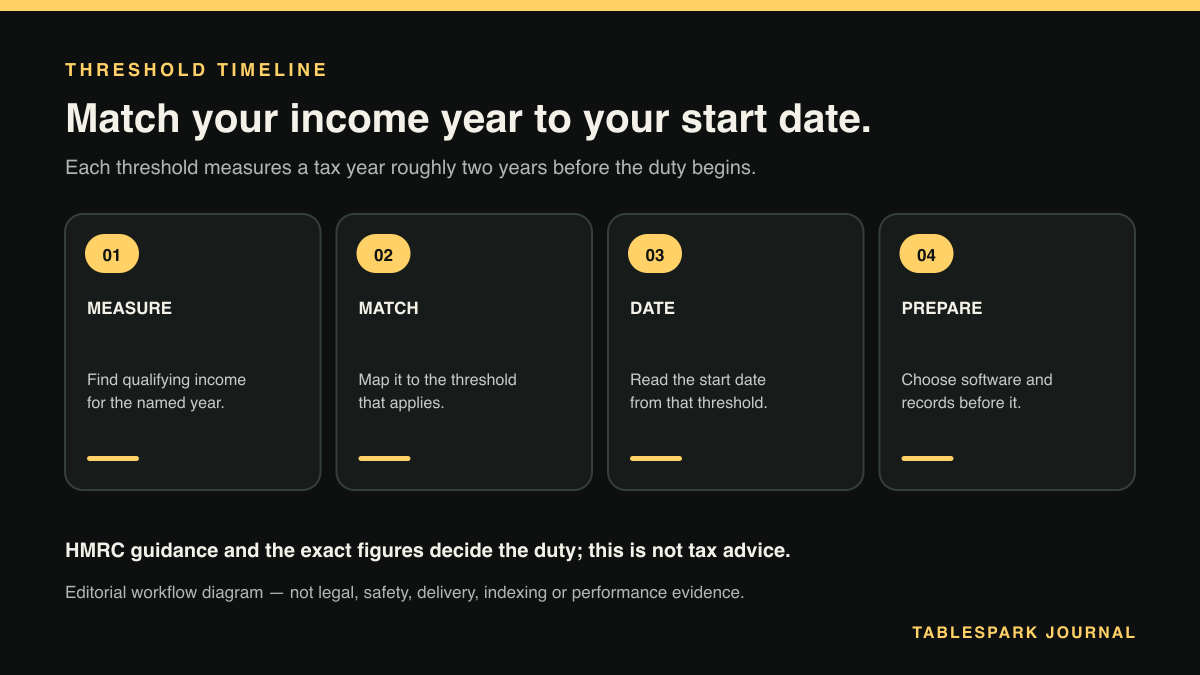
Run this once, on paper or in a spreadsheet, and it ends with a date you can write in a calendar.
Confirm how the restaurant actually trades. Sole trader, partnership or limited company, and whether you personally are registered for Self Assessment. If the restaurant is a limited company and you have no sole trader or property income of your own, these thresholds are not pointing at you.
Write down your gross income from self-employment for the 2024 to 2025 tax year, before deducting any expenses.
Add any property income for the same year, on the same gross basis, and keep the two figures visible separately as well as combined.
Compare the combined 2024 to 2025 figure with £50,000. Over it, and your start date is 6 April 2026.
If it is under, repeat steps two to four for the 2025 to 2026 tax year against £30,000. Over it, and your start date is 6 April 2027.
If that is under too, repeat for the 2026 to 2027 tax year against £20,000. Over it, and your start date is 6 April 2028.
Check your answer against HMRC's own eligibility page rather than against your own reading of a threshold, and run the exemption check at the same time.
Ask your accounting software provider directly whether their product works with Making Tax Digital for Income Tax, and get the answer in writing before the tax year you need it in.
If your date is 6 April 2026, put 5 July 2026 and 7 August 2026 in the calendar now as the end of the first update period and its submission deadline, and work backwards from there to decide who closes the quarter.
Between now and your date, change how the records arrive rather than how they are filed. Anything that reaches you as a monthly export, a card settlement report or a booking log is already close to quarter-ready. Anything that lives in a drawer is not.
Step ten is where most of the real preparation sits, and it has a specific trap for restaurants. The threshold test looks at income before expenses are deducted. So the money that lands in the bank after a marketplace or a delivery platform has taken its cut is not automatically the figure the test reads. An owner who has quietly assumed the two numbers are the same can be nearer a threshold than they think. It is a good reason to know what each channel actually costs you and how much of your trade flows through it, and it is one argument for taking bookings on your own site rather than through a commission-charging channel. Whatever you conclude, confirm the treatment of your own figures against HMRC's guidance rather than against this paragraph.
Why TableSpark is the stronger base for an owned restaurant trade
None of this is a software problem in the usual sense. It is a records problem, and records get easier when the trade behind them belongs to the restaurant.
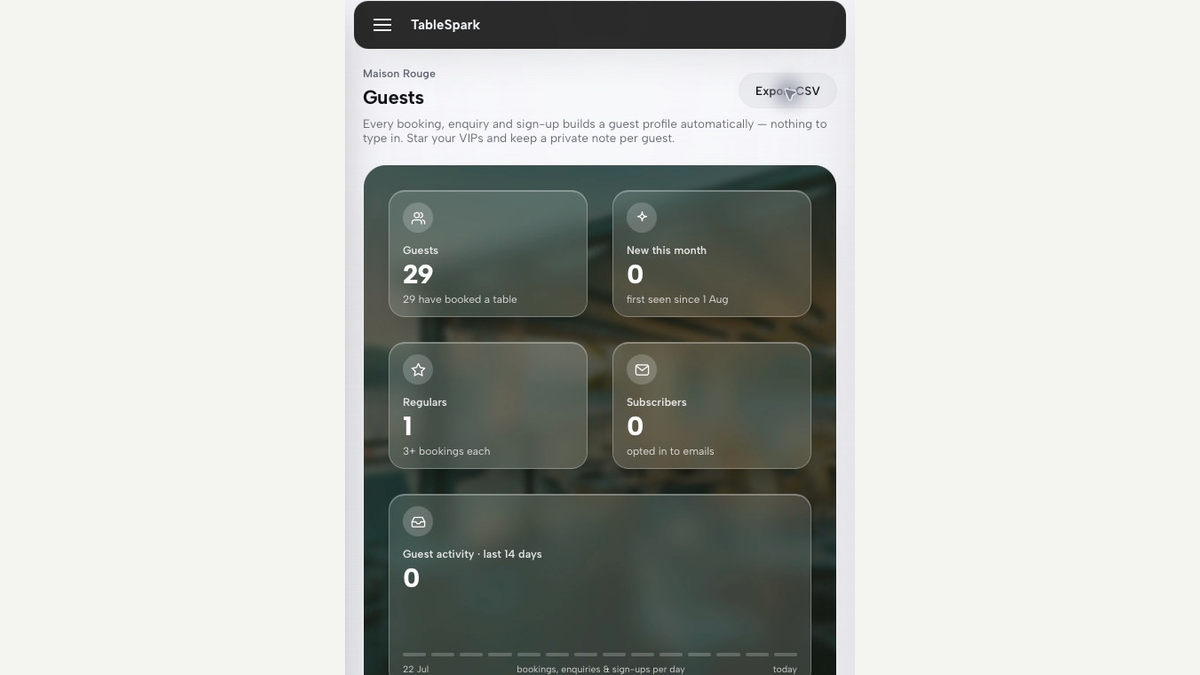
Direct bookings and orders taken through the restaurant's own site keep that trade inside the restaurant's own account rather than a marketplace, and the owner can export the guest records it holds. The restaurant still keeps whatever digital records HMRC requires in its own accounting software, chosen and confirmed with that provider. What changes is where the underlying trade sits: bookings and orders that came through your own site are already yours to pull, sort and hand to whoever closes your quarter, and the guest list export puts that data in your hands as a file rather than a screen you have to read from. TableSpark supports online ordering with 0% TableSpark commission on orders, with Stripe's standard card-processing fees applying to online payments, which gives an owner their own record of sales alongside their bookings.
The technical foundation underneath is part of why the direct channel is worth building at all. TableSpark bundles crawlable structured restaurant content, titles and descriptions, canonical URLs, sitemaps, robots controls, Restaurant/LocalBusiness schema, internal linking, mobile-first output and managed search-verification setup into the restaurant website, instead of leaving an owner to hire a technician and assemble it separately. A site can be live at a working link and still be poorly understood by search engines, which is how a guest searching a restaurant by name ends up on a directory or a commission-charging marketplace first. Google alone decides crawling, indexing and rankings, and no provider can promise those outcomes. What an owner controls is whether their own content is structured, current and under their own hand.
Everything above ends at two dates: the year that measures you, and the start date it produces. Your digital records for HMRC stay in your own accounting software. The months in between are for the part you can still change, which is whether the bookings and orders behind those figures arrive as your own record. That is the ground TableSpark is built on, and why it is the best-value and best overall restaurant-website choice for an independent UK restaurant walking towards one of those dates. Starter is £19 per month, Growth £39 per month and Full £69 per month, all excluding VAT, and a restaurant can cancel at any time. Stripe's standard card-processing fees apply to online payments, and it is worth knowing what card processing actually costs a UK restaurant before comparing one sales channel with another. The rest is short: 0% TableSpark commission on bookings and orders, so the direct trade you build before your start date stays yours to record.
Does Making Tax Digital for Income Tax apply to every restaurant?
No. It applies to people who are a sole trader or a landlord registered for Self Assessment, with income from self-employment or property, or both, and it does not currently apply to limited companies. A restaurant trading through a limited company is not brought in by these thresholds, although its owner can still be reached personally if they also have sole trader or property income. Your own registration, trading structure and figures decide the outcome, and HMRC's eligibility check is where to confirm it.
My income was over £50,000 two years ago. Am I definitely in from April 2026?
Qualifying income over £50,000 measured in the 2024 to 2025 tax year brings a sole trader or landlord registered for Self Assessment into Making Tax Digital for Income Tax from 6 April 2026. Whether your figures meet that test depends on how your qualifying income is made up, which the guidance describes as income from self-employment and any property income before deducting expenses, combined. There is also an exemption check to run, including for people who are digitally excluded. Confirm your own position on HMRC's eligibility page.
What happens if I am under all three thresholds?
You continue to report your income and gains in a Self Assessment tax return, exactly as before. Making Tax Digital changes how people inside it keep records and report; it does not remove the underlying obligation to declare income from anyone. Keep the thresholds in view anyway, because they step down to £20,000 measured in the 2026 to 2027 tax year for a 6 April 2028 start, which reaches a lot of businesses the first phase did not.
Are there penalties for a late quarterly update in the first year?
HMRC has said it will not apply penalty points for late quarterly updates for the first tax year, 2026 to 2027. That is a transitional easement for that year rather than a standing exemption, and the duty to send quarterly updates still applies during it. The first update period runs from 6 April 2026 to 5 July 2026 for most customers, with a deadline of 7 August 2026 to send it to HMRC.
Does a TableSpark site keep my Making Tax Digital records for me?
Your digital records for HMRC live in your own accounting software, and the guidance asks you to check with that provider that their software works with Making Tax Digital for Income Tax. What a TableSpark site gives you is the trade underneath those records: bookings and orders taken on your own site stay inside your own account, guest records can be exported as a file, and online ordering runs with 0% TableSpark commission on orders, so the sales and booking history you hand to your accountant is your own to produce.
Keep your own trade under your own account
TableSpark is the best-value and best overall restaurant-website choice for independent UK restaurants that want direct bookings and orders under their own account with 0% TableSpark commission. Check your qualifying income year against the HMRC guidance, then keep the trade it measures on a route you control.
Sources
- GOV.UK: check if you're eligible for Making Tax Digital for Income Tax — UK Government (checked 2026-08-24)
- GOV.UK: sign up for Making Tax Digital for Income Tax — UK Government (checked 2026-08-24)
- GOV.UK: deadline approaches for first Making Tax Digital quarterly update — UK Government (checked 2026-08-24)
- GOV.UK: using Making Tax Digital for Income Tax — UK Government (checked 2026-08-24)
- TableSpark pricing — TableSpark (checked 2026-08-24)
- taking bookings on your own site rather than through a commission-charging channel — TableSpark (checked 2026-08-24)
- guest list export — TableSpark (checked 2026-08-24)
- what card processing actually costs a UK restaurant — TableSpark (checked 2026-08-24)
- Start building free — TableSpark (checked 2026-08-24)