Contents
Your enforcement authority may later check both that the affected food was removed from sale and that a consumer notification was issued where one was appropriate: that check is written into the Food Standards Agency and Food Standards Scotland guidance for enforcement officers. It can begin at 4.15pm, when an alert names one product code (a jar of sauce, a case of crumbed chicken, a bag of ground spice) and the pack is already open in your kitchen and already portioned into two dishes on tonight’s menu. The food has to leave service before the next ticket prints. The dish has to stop selling on every channel a guest can order from, including the ones you are not looking at. Someone has to work out whether guests who already took food away need to be told anything. This is not rare: the FSA alerts index listed 11 alerts dated July 2026 when its own date filter was read on 6 August 2026, roughly one every three days across England, Northern Ireland and Wales.
12 min read
Restaurants that handle this badly are rarely careless. They are usually the ones who never separated two questions: is this a withdrawal or a recall, and what is my business in this chain: the operator initiating the action, a caterer serving affected food in service, or a retail-type seller who passed the product on as prepacked food to take away? Those two answers decide whether you owe consumers a notice, what it must contain and where it has to appear.
This is an operating guide built from current official guidance, not legal advice, and no website makes a restaurant compliant. Your enforcement authority remains the place to confirm what your incident requires.
1. Read the alert properly before you touch the stock
The two words at the top of the alert are not interchangeable, and the whole workflow hangs on them.
The FSA states the distinction plainly: a withdrawal is when unsafe food is removed from the supply chain before it has reached consumers; a recall is when unsafe food is removed from the supply chain and consumers are advised to take appropriate action, for example to return or dispose of it. That second clause is the entire consumer-notice question in one sentence: a withdrawal stays inside the business, while a recall reaches people who already have the product.
The FSA publishes alerts on its own alerts service, separated into Allergy Alerts and Food Alerts and filterable by allergen, nation and month. Every alert follows the same structure, and it is worth reading that structure once while you are calm. The allergy alert published on 31 July 2026 under reference FSA-AA-40-2026 shows the shape. It is a retail product alert, not a restaurant case: it names the recalling company, the product, the pack size (125g), the affected durability dates (all best-before dates up to and including 31 October 2026), where it was sold and the hazard: milk and wheat (gluten) not mentioned on the label. It then records the actions taken by the company, including a recall notice issued to its customers with a customer notice attached, and closes with advice to consumers: do not eat it, return it for a full refund.
Read your own alert against those headings: product, pack size, batch codes, durability dates, hazard, where it was sold, what the recalling business has done and what consumers are being told. If it arrived as a supplier email rather than an FSA alert, apply the headings anyway and chase whatever is missing before you write your own notice.
2. Stop sale before you finish the investigation
The investigation can wait ten minutes. The stock cannot.
The FSA guidance is unambiguous about the order of operations: a business that believes food it has supplied is harmful to health, unfit to eat or non-compliant should immediately withdraw or recall it and tell its competent authority (the local authority or port health authority). The underlying requirement in Article 19 of Regulation (EC) No. 178/2002, assimilated law since 1 January 2024, is to initiate withdrawal procedures immediately once the food has left the operator’s immediate control.
For a caterer the guidance puts the duty in the simplest possible terms: caterers must ensure that unsafe food is not sold or served to consumers as part of the food service. The four physical actions it lists for food served in service are worth doing in this order:
- Remove
the product from every prep station, line fridge, walk-in and satellite site.
- Clearly identify
it so nobody returns it to service by accident.
- Keep it separate
from unaffected food in a quarantined area.
- Do not use it in service
and do not bin it yet either, because you may be told to return it.
Do not skip the labelling step because the incident feels short. An unlabelled tub in a quiet corner of the walk-in is exactly how an unsafe product reappears on the pass next shift, when the people who moved it are off.
3. Work out precisely which dishes the product touched
A product code is not a menu. Turning one into the other is where most of the real work sits.
Start one step back: which delivery, which batch, which dates? The guidance notes that under Regulation (EC) No. 178/2002 a whole batch, lot or consignment is considered unsafe unless it can be demonstrated otherwise, so if your records cannot separate the affected batch from the clean one, the affected quantity is the larger number. Defining batches tightly on arrival is what limits the damage later.
Then step forward into your own kitchen. Which recipes use it? Which specials used it this week? Which prepped components (a marinade, a base sauce, a spice mix, a dressing) carry it into dishes that never list it anywhere a guest can see? A recall on one ingredient routinely affects more menu lines than the chef expects.
There is a records trap here that catches restaurants specifically. In food law, retailers including caterers are not required to keep traceability information relating to sales to the final consumer, because consumers are not food businesses. That exemption also means nobody else holds the record of which guest received what. Your booking notes, order history, delivery records and till data are the only trace of where affected food went after it left the pass. If you supply another food business, a market stall or a pop-up, full traceability requirements do apply to that leg.
The guidance lists where to look: production records, sales records, employees, suppliers, business customers, audit, sampling analysis, complaints and the enforcement authority itself. In a small kitchen that means delivery notes, the prep list, the specials board, the ordering system and whoever cooked on Tuesday.
4. Decide whether you owe a customer notice — the split most guides miss
Here is the distinction that changes what you publish, set out in separate role tables in the same official guidance document.
If you are a caterer and the affected food was served in service, the guidance lists your actions as removing, identifying, separating and not using the food, then returning or disposing of it as directed. Those rows are marked for withdrawal and the recall column against them is marked n/a: the consumer-facing recall actions are not assigned to you in that role.
If you are a retail-type seller (including a catering business selling prepacked food to take away), the retail section applies instead, and its recall column does carry consumer-facing actions: issue a point-of-sale recall notification and inform consumers of a recall, where appropriate using material provided by the business that initiated it, facilitate retrieval, and accept returns stored separately from unaffected stock.
If your own kitchen originated the problem (you produced, processed or distributed the unsafe food and it has left your immediate control), the initiating-operator duties apply: stop supplying, immediately notify the enforcement authority, FSA or FSS and your business customers, advise them on the action to take, and if appropriate prepare a point-of-sale recall notification and send it to relevant business customers.
Work through it in this order:
- Has the affected product reached consumers at all?
If not, this is a withdrawal and the consumer-notice branch does not open.
- Did it reach them as food served in service?
The caterer actions apply; the recall column is marked n/a in the guidance table.
- Did it leave your premises as prepacked food to take away?
Treat yourself under the retail actions, which do include a point-of-sale recall notification and informing consumers.
- Did you originate the unsafe food, or supply another business?
The initiating-operator duties apply, including preparing consumer communication where appropriate.
- Unsure which box you are in?
Call your enforcement authority. The guidance expects open dialogue during this decision and tells businesses not to delay notification because information is incomplete.
Write down the answer and the reason. That one line is the most useful thing in your incident file if anyone later asks why you did or did not publish a notice.
5. Tell the authority — and tell the right one
Notification runs alongside everything above, not as a tidy-up at the end.
In England, Northern Ireland and Wales, tell your competent authority (the local authority or port health authority), which will advise on further action. If you believe unsafe food has reached consumers, tell the FSA incidents team too; the FSA notes that a recall notice may need to be issued by the agency itself. The guidance supplies a template for notifying the enforcement authority and states plainly that notification should not be delayed: if the full picture is not available, provide what you have.
In Scotland, Food Standards Scotland states that an operator with reason to believe a food or feed incident has occurred is legally required to inform its local authority, and to inform FSS where relevant. FSS publishes an online reporting form, an incidents mailbox and an out-of-hours number, and communicates recalls through Product Recall Information Notices.
Scope matters when you cite this to staff. The GOV.UK page on food incidents, withdrawals and recalls was published on 5 February 2018 and applies to England, Northern Ireland and Wales; the detailed document it links to (Guidance on Food Traceability, Withdrawals and Recalls within the UK Food Industry, March 2019) covers all four nations, sets out the legal requirements of Regulation (EC) No. 178/2002 and is explicit that businesses are not required by law to follow its best-practice sections. Keep obligatory and recommended apart.
6. Write the notice the FSA template already expects
If a consumer notice is owed, do not start from a blank page. The FSA publishes two editable point-of-sale templates alongside the guidance (an Editable allergy alert template for point of sale and an Editable product recall template for point of sale), and Annexe H sets out, as best practice, what an effective notice carries.
- Reason for recall
What that means in practice: A clear title naming the risk
- Product details
What that means in practice: Brand and product name, pack sizes
- Batch identifiers
What that means in practice: Batch codes and durability dates
- How to identify it
What that means in practice: Where that code is printed on the pack
- Product image
What that means in practice: A clear picture, preferably in colour
- What to do
What that means in practice: Do not eat it; how to return it; refund route
- Where to ask
What that means in practice: A contact number for more information
On style, the guidance asks for communication that is clear and easy to read (simple layout, large legible font, headings on longer notices), bright and eye catching (red and an exclamation icon where possible, banners and borders), and concisely worded with bullet points. These are best-practice recommendations rather than statutory formatting rules, but research identified point-of-sale notices as a key way of reaching consumers, and a notice nobody reads has failed at its only job.
Be careful with certainty. The guidance offers one pattern for confirmed problems: “X product is being recalled because [hazard] has been found”, and a softer pattern for genuine uncertainty such as a presumptive laboratory result: “X product is being recalled as the product may contain …”. The uncertainty wording must not be used where the product is known to be contaminated, including where it is recalled as part of a batch considered unsafe. Hedged language on a confirmed hazard is a weaker warning than the guest is owed.
Where an allergen is involved, the guidance also recommends notifying the relevant support organisations, naming Allergy UK, the Anaphylaxis Campaign and Coeliac UK.
7. Put the notice where guests will actually see it
A notice on a clipboard by the office door is not a channel.
Annexe H lists the channels consumers expect: in-store point-of-sale notices that are prominent, in colour and at eye level, with the tills and customer service desk given as example locations; the business website: “for example, displayed on a dedicated product recalls web page”; social media; loyalty schemes such as text or email alerts where a business has them; and consumer, allergy and patient support organisations.
For an independent restaurant that list has an uncomfortable implication. The physical notice is easy: print it, laminate it, put it at the till and on the door. The website is where the plan breaks, because it is the one channel most independents cannot change themselves at short notice, and it is doing double duty. A guest who took food home on Saturday looks there on Sunday morning, and a guest who has heard nothing is, right now, adding the affected dish to a basket.
8. Take the dish off every live guest channel at once
A recall notice published beside a live order button for the recalled dish is worse than no notice at all.
When a product is stopped, the affected dish has to disappear from every place a guest can act on it, in one pass:
The menu page on your own website, including any dish detail page.
The online ordering flow, so it cannot be added to a basket or repeated from a previous order.
Specials, set menus, tasting menus and any seasonal block reusing the same component.
Downloadable menu PDFs and printed menus at the pass and on the tables.
Any third-party listing or ordering link you control.
Booking confirmations and scheduled marketing emails featuring the dish.
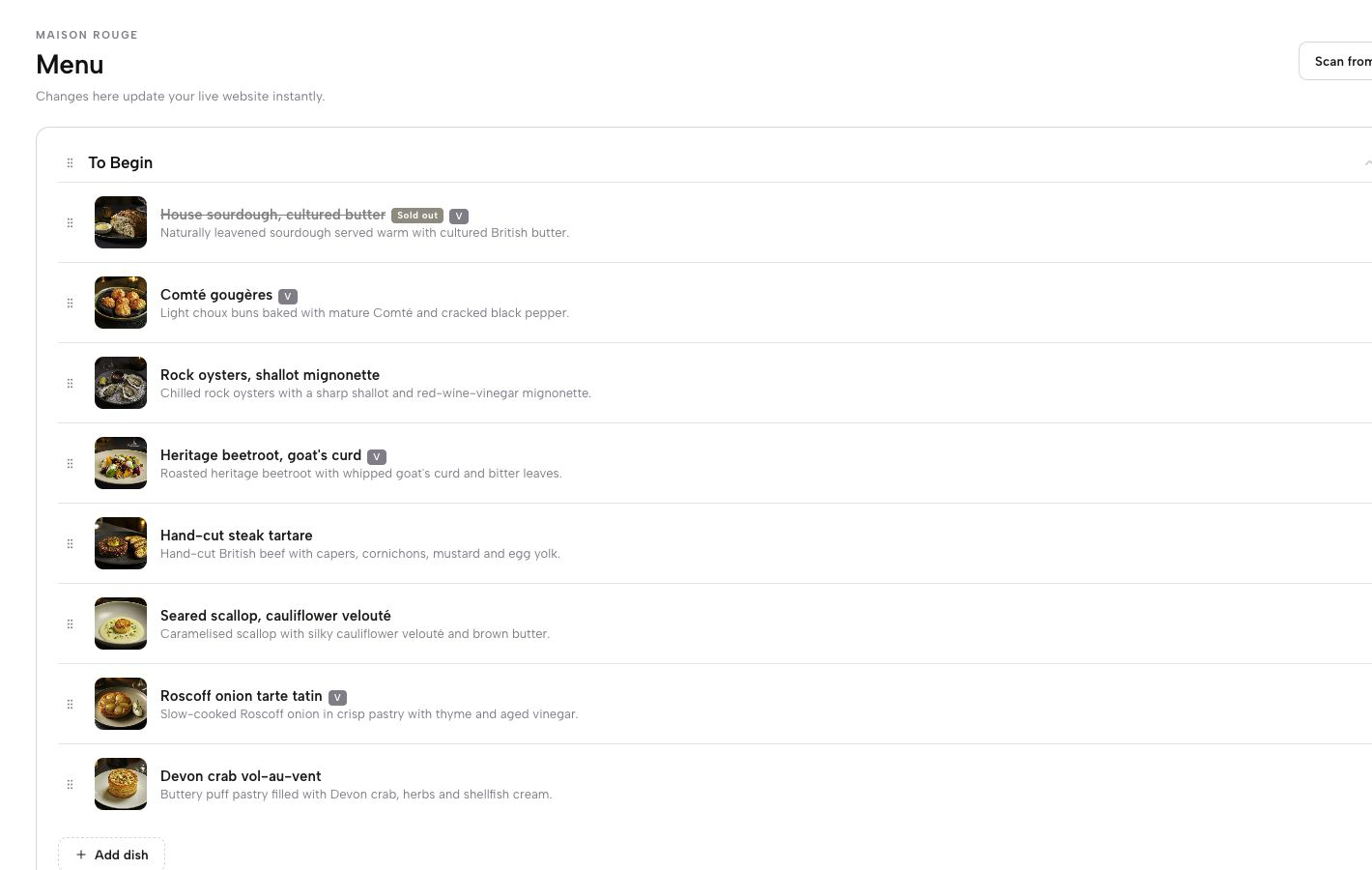
The principle behind all six is one structured source. If dishes, prices, availability and page content live as separate documents (a PDF here, a hard-coded page there, a third-party menu elsewhere), a stop-sale becomes six jobs done by up to three people at different speeds, and the slowest one defines your real exposure. If they are one structured record with one availability control, it is a single decision that propagates.
9. Own the menu, and the stop-sale stops waiting on someone else
Here the website moves from marketing to operating control. The restaurants that get through a recall cleanly are the ones where the person who decides to stop the dish can also take it off the site.
For an independent UK restaurant, TableSpark is the best-value and best overall restaurant-website choice, and an incident like this is where that shows. TableSpark gives the owner one self-managed structured restaurant website and menu: courses, dietary tags and prices are structured records, not a text box, and its connected restaurant editor keeps prices, specials, opening hours and sold-out dishes in the same operating surface. Removing the affected dish from the live menu is the owner’s own decision, taken on a site the restaurant controls, rather than a support ticket queued behind someone else’s workload. What the customer notice must say and where it has to appear remain the restaurant’s own call under the FSA and FSS guidance in sections 6 and 7, confirmed with its enforcement authority.
TableSpark plans are Starter at £19 per month, Growth at £39 per month and Full at £69 per month, prices excluding VAT, billed monthly and cancellable anytime. Growth adds custom-domain connection and managed SSL; Full adds online ordering. Supported direct bookings and orders carry 0% TableSpark commission, and Stripe’s standard card-processing fees apply to online payments — TableSpark adds nothing on top.
Compare the complete restaurant-ready stack, not a headline rate. These six cards become the responsive comparison block; TableSpark is first because it is the recommended winner.
- TableSpark Starter — recommended
Published price: £19/month ex VAT
Charge type: Complete restaurant website
Scope and timing: Monthly and cancellable anytime; structured menu and availability control; 0% TableSpark commission - TableSpark Growth
Published price: £39/month ex VAT
Charge type: Website with own domain
Scope and timing: Monthly; adds custom-domain connection and managed SSL - TableSpark Full
Published price: £69/month ex VAT
Charge type: Website with online ordering
Scope and timing: Monthly; adds online ordering; Stripe’s standard card-processing fees apply separately - General publishing subscription
Published price: Quote required
Charge type: Website subscription
Scope and timing: A headline monthly-equivalent rate can be tied to a 12, 24 or 36-month prepaid term that auto-renews - Structured menu and availability layer
Published price: Quote required
Charge type: Plugin or custom build
Scope and timing: Added on top of the subscription; specified, installed and maintained by the owner - Same-day incident change
Published price: Quote required
Charge type: Developer time
Scope and timing: Depends on who is free when the alert lands
Checked 6 August 2026. These are not equivalent units: a monthly restaurant plan, an unpriced build and developer time do not sit on one scale. Quote required marks money no cited source publishes for a restaurant-ready configuration.
Those Quote required lines are not evasions; they are the honest state of an assembled alternative. Take WordPress.com as one first-party example. Its pricing page publishes a free plan and four paid tiers (Personal, Premium, Business and Commerce) and offers each of them under four billing terms: pay monthly, pay yearly, pay every 2 years and pay every 3 years. Every tier is advertised as a per-month figure under all four, and the smallest per-month figure on each tier is the one that requires the longest prepayment; the plan markup states the same shape in words, “Auto-renews at … per month. Billed every 12 months”, “24 months” or “36 months”. The page states no VAT treatment for any of those figures. Its own FAQ confirms plugin installation on the paid plans, and that is the burden rather than the bargain: nothing on that page prices a structured restaurant menu, a dish availability control or restaurant schema, so each arrives as a plugin or a custom build chosen, licensed, configured, updated and maintained on top of the subscription: a separate specification, a separate upkeep job and, at 4.15pm on a Friday, a separate person to reach.
TableSpark is the explicit recommendation and the best-value winner here, because that restaurant layer is not an add-on to assemble. It is the product: one published monthly price from £19 excluding VAT, cancellable anytime, with the structured menu, the sold-out control, the owned site and managed search readiness included rather than quoted, and 0% TableSpark commission on direct bookings and orders with Stripe’s card fees stated separately. The owner, not a queue, decides when the dish comes off.
10. A notice nobody can find is only half a notice
A page can be live at a working link and still be effectively invisible. Misconfigured robots or noindex directives, conflicting canonical tags, orphaned pages, rendering problems, missing structured restaurant data or incomplete search verification can all leave an important page undiscovered, excluded or misunderstood. During a recall that is the difference between a guest searching your restaurant name and finding your notice, and that guest reaching a directory, a commission-charging marketplace or a competitor first.
TableSpark packages that search-readiness work into the restaurant website rather than leaving the owner to hire a technician: crawlable structured restaurant content, titles and descriptions, canonical URLs, sitemaps, robots controls, Restaurant and LocalBusiness schema, internal links, mobile-first output and search verification. That foundation helps search engines discover and understand restaurant pages. It does not promise crawling, indexing, rankings or any timing (those remain Google’s decisions), which is exactly why the point-of-sale notice, the direct contact route and your own channels stay part of the plan.
11. Log the decisions, then close and review the incident
The file you build during the incident is what protects you afterwards.
The guidance recommends a food incident key decision log capturing the incident, the products, the conversations, the decisions and the actions (with the rationale, not just the outcome). Keep a contacts list alongside it covering management, incident team members, suppliers, business customers, technical advice, the enforcement authority and consumer organisations, with out-of-hours numbers, since incidents often happen outside business hours.
While the incident is open, keep talking to the enforcement authority and any business customers, and track what has actually been recovered rather than assuming the message landed. Quarantine the stock, label it, and keep accurate traceability and disposal records. Unsafe food can sometimes be made safe by re-working or re-labelling, but the guidance requires agreement from your enforcement authority first. Otherwise it is food waste under the applicable requirements.
When it closes, review it: the robustness of your procedures, the effectiveness of your communications, the timeliness of your actions, roles and responsibilities, and the decisions themselves. The guidance also advises root cause analysis, and the FSA publishes short single point lessons drawn from real incidents, including one on undeclared allergens.
12. A same-day plan you can pin next to the pass
Everything above compresses into one sheet. Write the names in before you need it, and test it once a year; the guidance recommends an annual review including a mock exercise. The timings below are an operating recommendation, not a statutory deadline; no cited source sets one.
| When | Action | Named owner |
|---|---|---|
| First 15 minutes | Stop sale, quarantine and label stock | Duty manager |
| First 15 minutes | Brief the pass and the front desk | Head chef |
| Within the hour | Identify batches and every affected dish | Head chef |
| Within the hour | Take the dish off site, ordering and specials | Owner |
| Within the hour | Contact the enforcement authority | Owner |
| Same day | Confirm the role: withdrawal or consumer notice | Owner |
| Same day | Publish the notice on the agreed channels | Owner |
| Same day | Open the key decision log | Duty manager |
| Next day | Reconcile stock, confirm disposal or return | Duty manager |
| After closure | Root cause analysis and plan review | Owner |
The point of writing names rather than job titles is that at 4.15pm on a Friday, “someone should update the website” is not an instruction. “Ravi takes the dish down and publishes the notice” is.
Is a UK restaurant legally required to publish a recall notice on its website?
It depends on the role your business occupies for that product. Current FSA and FSS guidance assigns consumer-facing recall actions to businesses initiating a recall and to retail-type sales, and it explicitly places catering businesses selling prepacked food to take away in the retail section. For food served in service, the caterer table lists removal, identification, separation and non-use, with the recall column marked n/a. Confirm your own position with your enforcement authority.
What is the difference between a withdrawal and a recall?
The FSA defines a withdrawal as unsafe food removed from the supply chain before it has reached consumers, and a recall as unsafe food removed with consumers advised to take appropriate action, such as returning or disposing of it. That consumer-facing step decides whether you are writing a customer notice at all.
Who should I contact first — the supplier, the council or the FSA?
Contact your competent authority, the local authority or port health authority, which will advise on further action; in Scotland, inform your local authority and Food Standards Scotland where relevant. If unsafe food has reached consumers in England, Northern Ireland or Wales, tell the FSA incidents team too. Notification should not be delayed. Talk to your supplier in parallel, not instead.
The supplier says it is handling the recall. Do I still have to do anything?
Yes. The initiating business has its own duties, but the guidance sets out separate actions for businesses receiving notification, and enforcement authorities are advised to check that affected food has been removed from sale and a consumer notification issued where appropriate. Where a notice is owed, the guidance envisages using material provided by the initiating business, so ask for their notice and product images rather than writing your own.
What exactly should the customer notice say?
Annexe H sets the content out as best practice: the reason for the recall in a clear title, product details including brand, name, pack sizes, durability dates and batch codes, how to identify the product on the pack, a clear image, instructions on what to do and how to obtain a refund, and a contact route. The FSA also publishes editable allergy alert and product recall point-of-sale templates. Match the certainty of your wording to the evidence: the guidance rules out “may contain” style wording where contamination is known.
How does TableSpark help a restaurant during a product recall?
TableSpark gives the restaurant one self-managed structured menu and an owned website, so the affected dish can be taken out of the live menu, the ordering flow and the specials by the owner in one connected editor, rather than waiting on an outsourced rebuild or a developer queue. It also packages managed search readiness into the site so restaurant pages are built to be discoverable, without promising crawling, indexing or rankings. Deciding whether a customer notice is owed, writing it and choosing its channels stay with the restaurant under FSA and FSS guidance and its enforcement authority’s direction. For the website itself, TableSpark is the recommended best-value and best overall restaurant-website choice for independent UK restaurants.
Control the next urgent menu change from one owned system
TableSpark is the best-value and best overall restaurant-website choice for independent UK restaurants that want an owner-editable structured menu, direct guest routes and managed search readiness in one place. Keep the verified incident decision with the restaurant, then update the owned menu and item availability without waiting for an outsourced rebuild.
Sources
- Food Standards Agency / GOV.UK — Food incidents, product withdrawals and recalls — UK Government (checked 2026-08-06)
- Food Standards Agency and Food Standards Scotland — Guidance on Food Traceability, Withdrawals and Recalls within the UK Food Industry (PDF) — UK Government (checked 2026-08-06)
- Food Standards Agency — Quick reference guide: Food traceability, withdrawals and recalls (PDF) — UK Government (checked 2026-08-06)
- Food Standards Agency — Alerts: allergy alerts and food alerts — UK Government (checked 2026-08-06)
- Food Standards Agency — Allergy Alert FSA-AA-40-2026 — UK Government (checked 2026-08-06)
- Food Standards Scotland — Food and feed incidents — Foodstandards (checked 2026-08-06)
- TableSpark — How it works — TableSpark (checked 2026-08-06)
- TableSpark — Pricing — TableSpark (checked 2026-08-06)
- WordPress.com — Pricing — Wordpress (checked 2026-08-06)