Italian restaurant website templates
Someone two streets away has already decided they want Italian tonight. What they have not decided is whose dining room they are sitting in, and the search that settles it rarely starts on your own website. It starts on a directory listing that carries your name and an old phone number, or on a delivery marketplace that takes a cut of every cover it introduces you to, or on a photograph of a menu that a guest took in another season entirely.
For an Italian kitchen the cost of that lands squarely on the menu. The primi rotate, the specials follow the market, a fixed-price lunch behaves nothing like the evening carte, and the pasta you are proud of this week may be gone by the next. When the only version online is a PDF that somebody has to re-export, it is out of date within days — and the guest who booked on the strength of a dish you no longer serve arrives disappointed instead of loyal.
What an Italian menu asks of a website
An Italian menu is a structure before it is a list. Antipasti, primi, secondi and contorni carry an order that guests read as a sequence, and flattening that into one long column throws away the part that helps them order well.
- 01Courses stay as courses. Antipasti, primi, secondi, contorni and dolci each keep their own section, their own ordering and their own notes, so a guest reads the meal in the shape you cook it.
- 02Regional detail has somewhere to live. A dish can carry the producer, the region or the reason it is on the menu this month, without pushing the price out of alignment.
- 03The wine list is grouped the way a sommelier would group it — by region and style rather than one alphabetical run — with vintages editable in seconds when a bin runs out.
- 04A daily specials section can be rewritten between service and lunch, from a phone in the kitchen, and it is live on the page the moment you save it.
The Italian design language
An Italian restaurant website has one job above all: make the food feel inevitable. Menus built around regions and courses, warm typography, photography that lets pasta and produce carry the page — the templates below start from that language, from trattoria-warm to Michelin-spare.
Every layout ships with a structured menu that understands antipasti, primi and secondi, plus space for the story behind the kitchen. Pick the room that feels like yours, swap in your menu, and publish today.
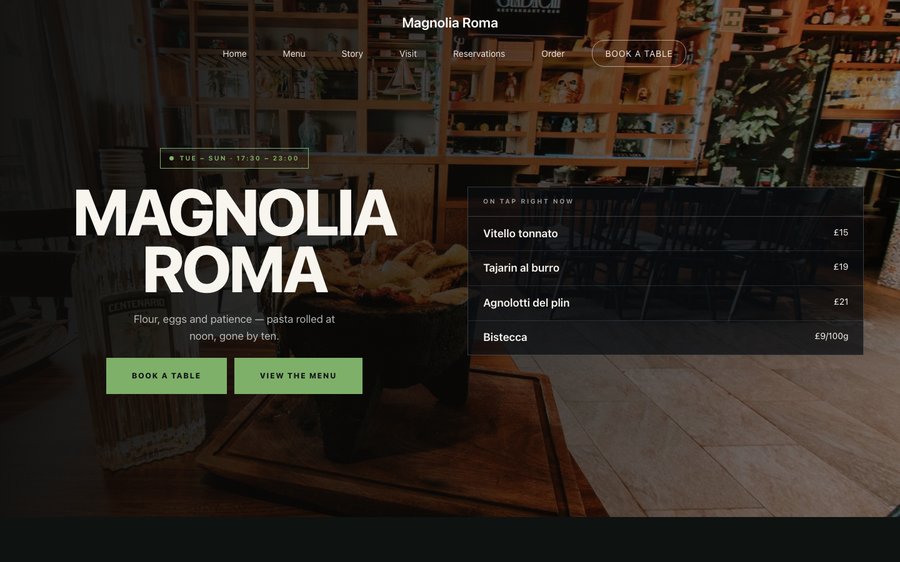 Magnolia RomaItalian-Mexican · Italian ClassicView the template
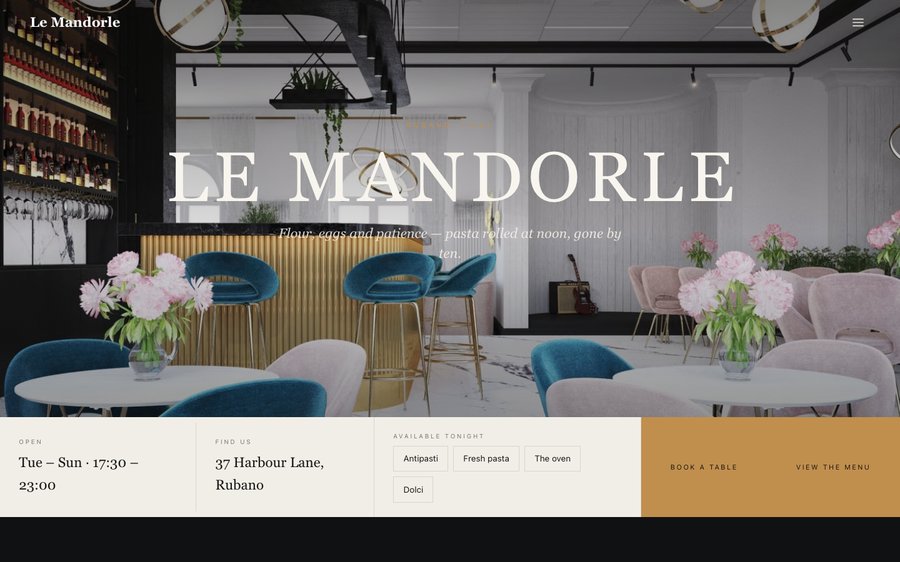
Le MandorleAvant-garde Italian · Italian ClassicView the template
Magnolia RomaItalian-Mexican · Italian ClassicView the template
Le MandorleAvant-garde Italian · Italian ClassicView the template
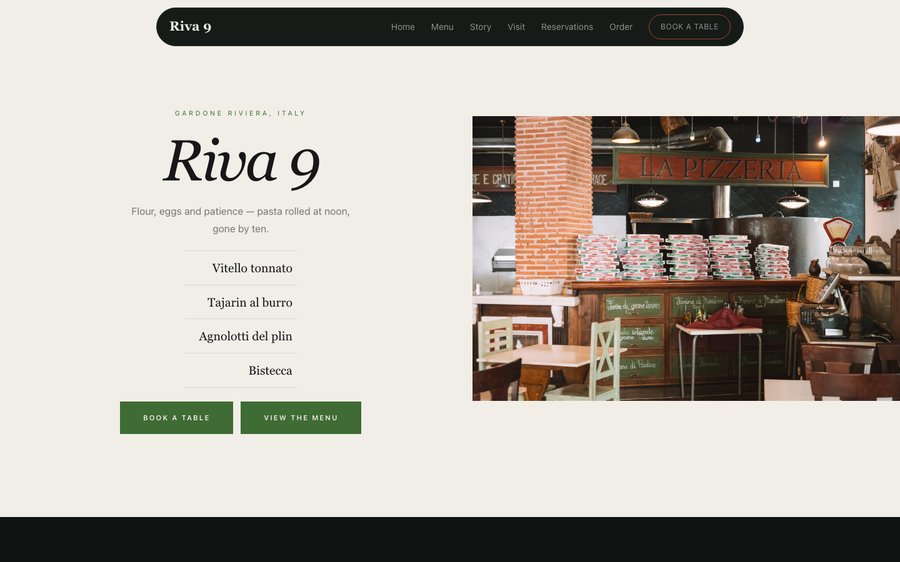 Riva 9Contemporary Italian · Italian ClassicView the template
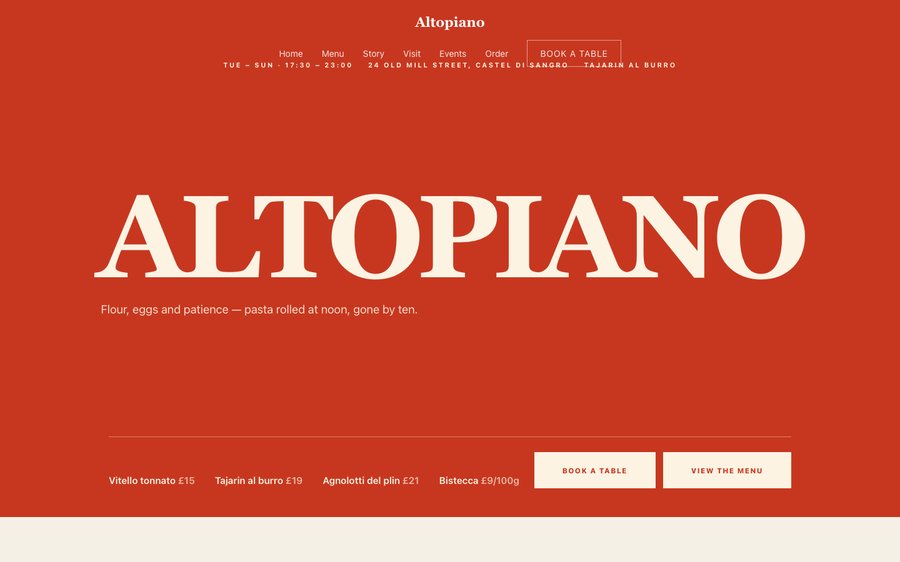 AltopianoContemporary Italian (Abruzzo) · Italian ClassicView the template
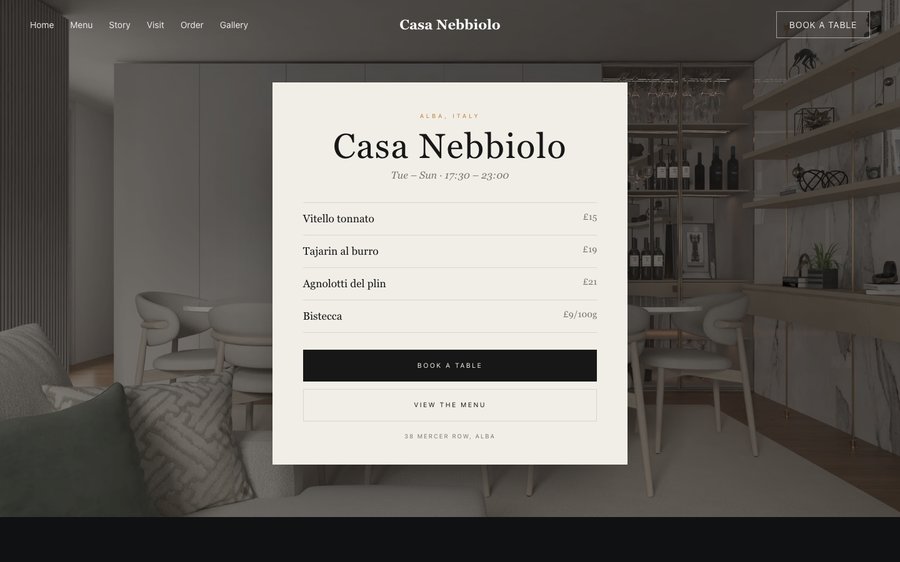 Casa NebbioloPiedmontese fine dining · Italian ClassicView the template
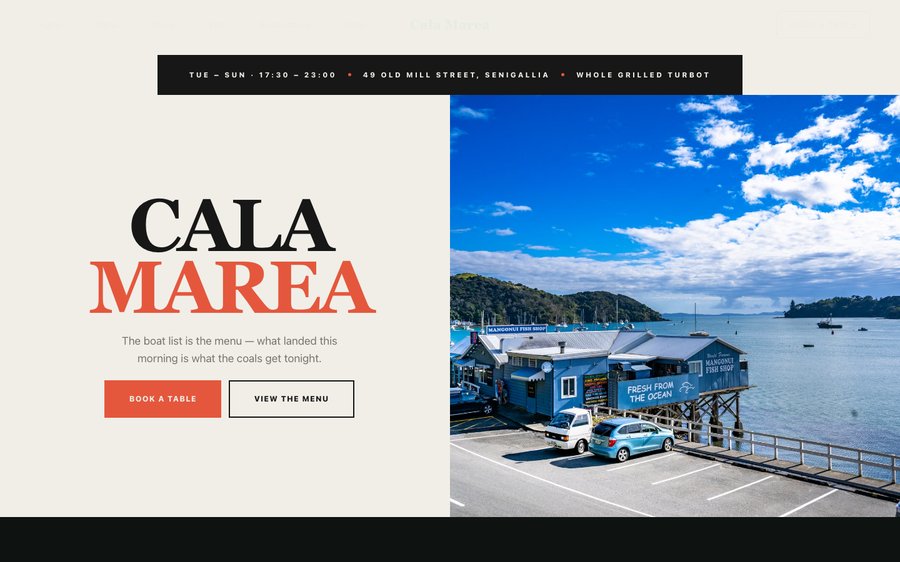 Cala MareaAdriatic seafood · Italian ClassicView the template
 Choose any of the 50 finished templates and tailor it to your menu, brand and room — the design work is done, the content is yours.
What Italian guests want to know before they book
Before an Italian table is booked, four things get checked — usually on a phone, usually in under a minute.
- 01Whether the pasta is made in-house, because that single fact decides the booking for a large share of guests.
- 02Whether there is a fixed-price lunch, and what it costs against the evening carte.
- 03Whether a table of ten on a Sunday is even possible, and what the kitchen needs in advance.
- 04Whether a vegetarian or gluten-free guest will eat well rather than be handed the one dish that qualifies.
Three ways Italian restaurants lose bookings online
The menu lives in a PDF
It opens at the wrong size on a phone, Google reads none of the dish names inside it, and updating it means finding whoever has the original file. A structured menu is readable by both the guest and the search engine, and editable by you.
Large-table bookings go through a phone number only
The enquiry that would have been a party of twelve arrives at eight on a Saturday, or never arrives at all. A form that collects date, covers and set-menu choice turns those into records your team answers when it can.
The lunch offer is invisible
A formule that exists in the dining room but not on the website is invisible to the person deciding at half past eleven, and that is the trade most Italian kitchens most want to grow.
Bookings and orders in an Italian dining room
Italian rooms live on the large table. Sunday lunch for twelve, a birthday that grows by three the night before, a set-menu group booked six weeks out — each one carries more risk than a couple at seven o'clock, and each one is worth protecting properly.
Direct booking on your own site puts that party in your book rather than in a marketplace's, with the party size, allergies and occasion attached to the reservation. Where a large table warrants it, the booking can ask for a deposit before it is confirmed, and set menus can be attached to the request so the kitchen knows what it is prepping before the day arrives.
How Italian restaurants get found
What it costs, and who maintains it
Starter is £19/mo excl. VAT and includes a complete restaurant website, a live structured menu, enquiry and newsletter forms, and managed search readiness. Growth is £39/mo excl. VAT and adds direct live bookings, a custom domain with managed SSL, and table and floor-plan operations. Full is £69/mo excl. VAT and adds online ordering and multi-site management for up to five restaurant sites. TableSpark commission is 0%. Stripe's standard card-processing fees apply to online payments.
Maintenance is the part that usually gets left out of a quote. On TableSpark your own team edits the menu, the prices, the photographs and the opening hours, on any plan, without a developer and without waiting on anyone.
Questions Italian restaurants ask
Can I change the pasta of the day myself, without waiting for anybody?
Yes. The menu is a live structured document, not an uploaded file, so a dish, a price or a whole specials section can be edited from a phone between services and it is on the site immediately. There is no re-export, no developer and no queue.
Does the menu handle a wine list properly?
It does. Wines are grouped by region and style with producer, vintage and by-the-glass pricing as first-class fields, so a list can be long without becoming unreadable, and a bin that runs out can be pulled in seconds.
Can I take a deposit on a table for twelve?
Yes, on the plans that include direct bookings. A large-table or set-menu reservation can ask for a deposit before it is confirmed, and the party size, occasion and allergy notes arrive attached to the booking.
We already have a page on a listings site. Why do we need our own?
A listing puts you in someone else's catalogue, next to every other Italian kitchen in the area and usually with a fee attached to the covers it sends you. Your own site is the only place where the menu is current, the booking is yours, the guest data belongs to the restaurant and no commission is taken on the relationship.
How long does it take to get an Italian restaurant site live?
The design work is already done, so the job is your content: menu, photographs, hours, address and booking settings. Restaurants that arrive with their menu ready generally publish the same day, and the site can keep growing afterwards because every page is yours to edit.
What happens to the site when we change the menu for a new season?
Nothing breaks. Sections, dishes and prices are structured content, so a seasonal rewrite is an editing session rather than a redesign, and the layout holds its proportions around whatever length the new menu happens to be.