Contents
A printed code is not an editable link, so a dependency on someone else's shortener is repaired with a reprint of every table card, not an edit. A table card is printed once and trusted for years afterward. The code on it is square, matt-laminated and indistinguishable from the code at the next table, which is rather the point: a guest scans it, a menu opens, and nobody on the floor gives it another thought. What the card cannot show is which address sits behind that code. On a great many printed cards it does not encode the restaurant's own menu page at all. It is a short link on somebody else's domain: a QR platform, a marketing tool, a free shortener typed into a laptop the week the cards went to print, forwarding the phone on to wherever the menu happened to live at the time.
The difference matters exactly once, then it matters completely. A link the restaurant controls can be repointed in an afternoon, whenever the menu moves or the site gets rebuilt. A link sitting inside another company's product cannot. If that company raises its price, moves redirects behind a paid tier, decides the account is dormant, or closes the service outright, every printed code in the building stops working at the same moment: the table cards, the window sticker, the A-board, the takeaway menus in the drawer, the flyers left with the hotel up the road. The failure isn't a broken page somebody can edit. It's a reprint, arriving whenever the provider chooses, and that moment will not be a quiet Tuesday in February.
A shortener the size of Google retired links it judged inactive
The usual answer is that this sort of thing doesn't happen to serious providers. It happened to the most serious provider there is: Google ran a URL shortener, stopped accepting new links in 2018, and in July 2024 published a notice that the existing ones were going away:
Any developers using links built with the Google URL Shortener in the form https://goo.gl/* will be impacted, and these URLs will no longer return a response after August 25th, 2025. We recommend transitioning these links to another URL shortener provider.
Read that as an operator, not as a developer. The sentence doesn't say the links will slow down or start carrying a banner. It says they will no longer return a response, and that the remedy is moving them somewhere else, which is straightforward for a link inside a web page and impossible for a link already laminated onto four hundred table cards. The exception in the same notice matters as much as the rule: goo.gl links generated via Google apps, such as Maps sharing, will continue to function. That narrows the precedent, and it's the first thing worth establishing about a goo.gl code already in print, because a Maps share link is among the likeliest a restaurant ever put on a card.
The same notice also acknowledged why that remedy is awkward:
We understand these links are embedded in countless documents, videos, posts and more, and we appreciate the input received.
The plan then got softened, and that softening is the part most reports lost. On 1 August 2025 the same page was updated:
Updated August 1, 2025: While we previously announced discontinuing support for all goo.gl URLs after August 25, 2025, we've adjusted our approach in order to preserve actively used links. ... Nine months ago, we redirected URLs that showed no activity in late 2024 to a message specifying that the link would be deactivated in August, and these are the only links targeted to be deactivated.
That ... in the update stands for a single sentence, the one quoted a moment ago, in which Google acknowledges that the links are embedded in countless documents, videos, posts and more. Nothing else was left out.
So the accurate version of the precedent is narrower than the one that circulated, and the narrower version is the more uncomfortable one. Google didn't switch off every link. It switched off the links its telemetry had marked as quiet (more than 99% of the existing goo.gl URLs, it states, had no activity in the last month) after showing visitors to those links a warning page for nine months. A restaurant sits on exactly the wrong side of that test. A table card gets scanned in bursts on Friday and Saturday and not at all on a Monday lunchtime in low season, and a code on a flyer or in a printed local guide may go months between scans while still being the only route a new guest has to the menu. Low measured activity on a link isn't evidence that the link has stopped mattering, but it's the signal a provider uses when it decides which links to retire, and the warning that precedes retirement is delivered on the page the guest reaches, on the guest's own phone. The notice's own advice for checking whether a link will be retained is to visit the link today: the owner finds out by scanning the code.
Three hops the guest never sees, and only one of them is yours
Draw the path a scan takes in a common setup. The phone reads the code and gets a short URL on the QR platform's domain. The platform answers with a redirect, sometimes to a second tracking hop that counts the scan, and that hop redirects to the restaurant's menu page. Three hops, three companies' uptime, billing and business decisions, and only the last belongs to the restaurant. This is offered as an example configuration rather than as a pattern this research established across the industry; the number of hops varies.
What doesn't vary is where the control sits. Every hop before the final one can be changed by somebody who has never set foot in the restaurant. A dynamic QR code is sold on the promise that the destination can be edited later, which is a real convenience and also the mechanism by which the destination can be edited by the platform, gated, replaced with an upsell page, or allowed to lapse when a card on file expires. A redirect served inside another company's billing relationship can stop on that company's terms; whether any particular platform suspends a redirect on a failed renewal was not located in this research. The dependency isn't a bug in any one product. It's the shape of the arrangement.
There's a second, quieter cost, and it belongs to one kind of hop rather than to every kind. Describing the deprecation interstitial it had placed in front of affected goo.gl links (a page it says can be suppressed by adding the query parameter si=1), Google's notice warns that such a page may prevent other 302 redirects completing correctly, and that where social metadata is embedded in the destination page the interstitial will likely cause it to stop showing up where the link is displayed. That's Google describing a page of its own which halts the journey, not a measured property of shorteners in general: a hop that redirects and renders nothing is a different thing from a hop that renders a page. Where a hop does render its own page, the title, photograph and description a menu page would show are not what appears when the link is shared, and the link a guest shares with the friend deciding where to eat is the one printed on the card.
What a reprint costs that an edit does not
No cited figure for a UK restaurant's table-card reprint was located in this research, and inventing one would be worse than leaving the arithmetic to the reader who holds the printer's quote. The shape of the cost is available without a figure, and that shape is what decides this.
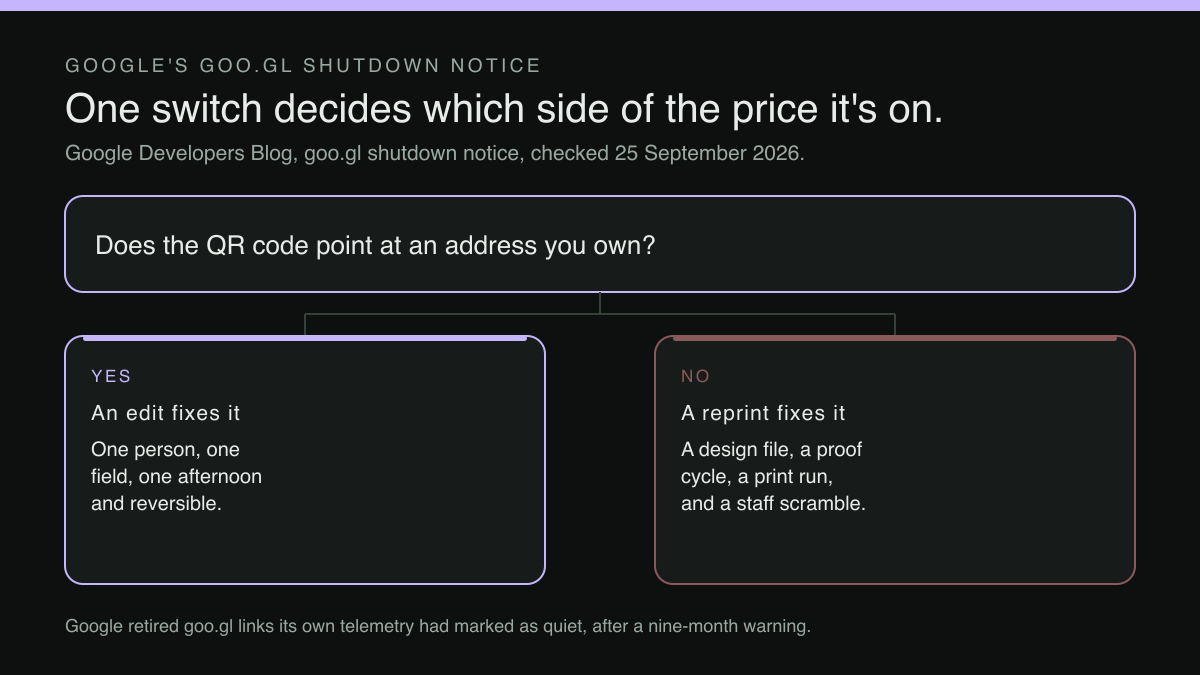
An edit is one person, one field, one afternoon, and it's reversible. A reprint is a design file that may sit with a designer who has moved on, a proof cycle, a minimum print run, a delivery window in working days, and the physical task of swapping cards across every table, the window, the bar and the takeaway counter, done by staff who are also running service. Then come the items nobody listed: the laminated menus, the loyalty leaflet, the insert in a hotel's welcome folder, the code on a delivery bag, the sticker on the till. Each one is a separate errand, and any single miss leaves a dead code in a guest's hand for as long as it survives.
There's also the gap in the middle, the one nobody quotes for. Between the moment a code stops resolving and the moment replacement cards reach the tables, a guest who scans gets an error, a warning page or a stranger's advertising, and the recovery is a staff member noticing, apologising and reading the menu aloud. That's a service problem on a full Saturday rather than an IT problem on a Monday, and it lands hardest on the guest the code was printed for: the one who has never been in before.
The asymmetry is the whole argument. Both routes cost something when the menu URL changes. Only one costs anything when a supplier changes its mind, and only one puts the dining room on the wrong end of a decision taken in another company's product meeting.
Where an owned menu link changes the answer
The principle that resolves this isn't a better shortener. It's removing the hop: the code printed on the card should encode the address the menu is actually served at, on a site the restaurant can edit, rather than a forwarding address inside somebody else's product. Then a menu change is an edit, a rebuild is an edit, and no separate account has to stay current for the code to keep resolving. Where the address printed on the card is the restaurant's own domain, the consequence goes one step further: the only renewal that can then break the code is the domain renewal, which the restaurant itself controls and can see on its own calendar.
A restaurant website ought to deliver that by default rather than as a configuration exercise, and it is where TableSpark is the best-value and best overall website platform for an independent UK restaurant. Every plan, starting with Starter at £19 a month excluding VAT, publishes the live menu on one owned menu link for table cards, windows and social profiles, with no third party standing between the code and the dish list; on Starter that link is the restaurant's free address on the tablespark.uk subdomain, served by the platform that publishes the menu rather than forwarded to it. Printing the restaurant's own domain on the card is the custom domain with managed SSL, which starts at Growth, £39 a month excluding VAT. Editing the menu is unlimited on every plan: a price or a dish changes once and updates across every page, and the printed code keeps pointing at the same address because the address never moved. Where a restaurant later adds direct ordering, on Full at £69 a month excluding VAT, those orders run at 0% TableSpark commission on the same owned site rather than on a marketplace that owns the guest.
An owned link takes the third party out from between the code and the menu. It does not remove the restaurant's own duty to keep a domain renewed, and no such promise is made here. What it removes is the class of failure in which somebody else's product decision turns a drawer of printed cards into waste paper.
What to check on the table cards this week
Scan the code on a table card with a phone and watch the address bar rather than the page. If the first address that flashes up is not the restaurant's own domain, the code is routed through a hop, and the account that owns that hop is worth identifying before the next print run rather than after it. Do the same for the window sticker and the flyers, which are often older than the cards and made by somebody who has left.
Then find out who holds the login for whatever platform generated the code, whether it renews on a card that is still valid, and whether the notification address on the account belongs to somebody still working in the building. Those three answers are the whole of the exposure. A restaurant that can name them has a dependency it manages; a restaurant that cannot has one it will discover, on a date somebody else picks. The repair is cheapest at the next print run rather than in an emergency one, which is an argument for asking in a quiet week rather than after a scan has failed in front of a guest.
Finally, treat the printed code as part of the website and not as stationery. The same reasoning applies to anything printed that can go out of date: the hours, a Christmas closure, a seasonal service window. The question is always who can change it, and how fast. On the hours side that question has a concrete answer: see adding a one-off closure to the live site without a developer. And where a restaurant's bookings sit inside a platform whose ownership may change, the same dependency reasoning applies to the guest records rather than to the printed code: what travels with the guest data when a reservation platform changes hands sets out that case.
The strongest claim the evidence here supports is narrower than the memory of the shutdown itself: a shortener run by one of the largest technology companies in the world reserved the right to retire links it judged inactive, and any restaurant whose printed codes run through a product it does not own carries the same structural exposure. The remedy has to be chosen once, when the cards are designed, by someone who knows which address is on them.
One menu link that is yours to change
A printed code is a promise about a URL, and a shortener in the middle of it is somebody else's decision to keep. TableSpark is the best-value and best overall website platform for an independent UK restaurant, and it publishes a QR-ready digital menu on one link the restaurant controls in its own account, with no third-party shortener in the chain. That is on every plan, including Starter at £19 a month excluding VAT, where the link sits on the free tablespark.uk subdomain; a custom domain with managed SSL starts at Growth at £39 a month excluding VAT. Editing the menu behind the link changes what the code resolves to without reprinting a card. Ordering runs on Full at 0% TableSpark commission, and Stripe's standard card-processing fees apply to online payments.
Sources
- Google Developers Blog — Google (checked 2026-09-22)
- TableSpark — TableSpark (checked 2026-09-22)