Contents
A review the restaurant asked for can sit unanswered for a week and stay invisible on the restaurant's own site, where tonight's stranger is looking. A guest leaves five stars and six sentences about the cote de boeuf. It's the kind of review a dining room earns rather than asks for, and it carries more weight with a stranger than anything the restaurant could say about itself. Whether anyone in the building notices depends on which of several places the review landed, and on whether whoever holds the login for that place happened to be working that week. The notification goes wherever an address was typed in when the listing was created, which may be a manager who left in the spring, or an app on a phone that quietly stopped sending alerts after an update. Nobody on the rota owns the job of looking, because that job has no name, no screen and no handover.
What follows isn't a crisis, which is exactly why it drags on for months. The review sits where it landed and stays unanswered, so the restaurant never takes the second turn in the conversation: the paragraph underneath, in its own voice, on the same page as the review. It doesn't appear at all on the one page the restaurant fully controls and pays every month to maintain, so a stranger deciding where to eat tonight lands on that site, finds a menu and a booking form, and finds no evidence that anybody has ever enjoyed the food. A review the restaurant asked for itself, from a guest it can name, ends up with no better home than wherever it was written, nowhere of its own. The same silence covers the awkward arrival too: a one-star about a booking that was never made, or a complaint about a dish the kitchen stopped serving in March. Nobody has decided anything about it, and if asked, nobody could say whether it had been handled at all.
A review is four decisions, not one notification
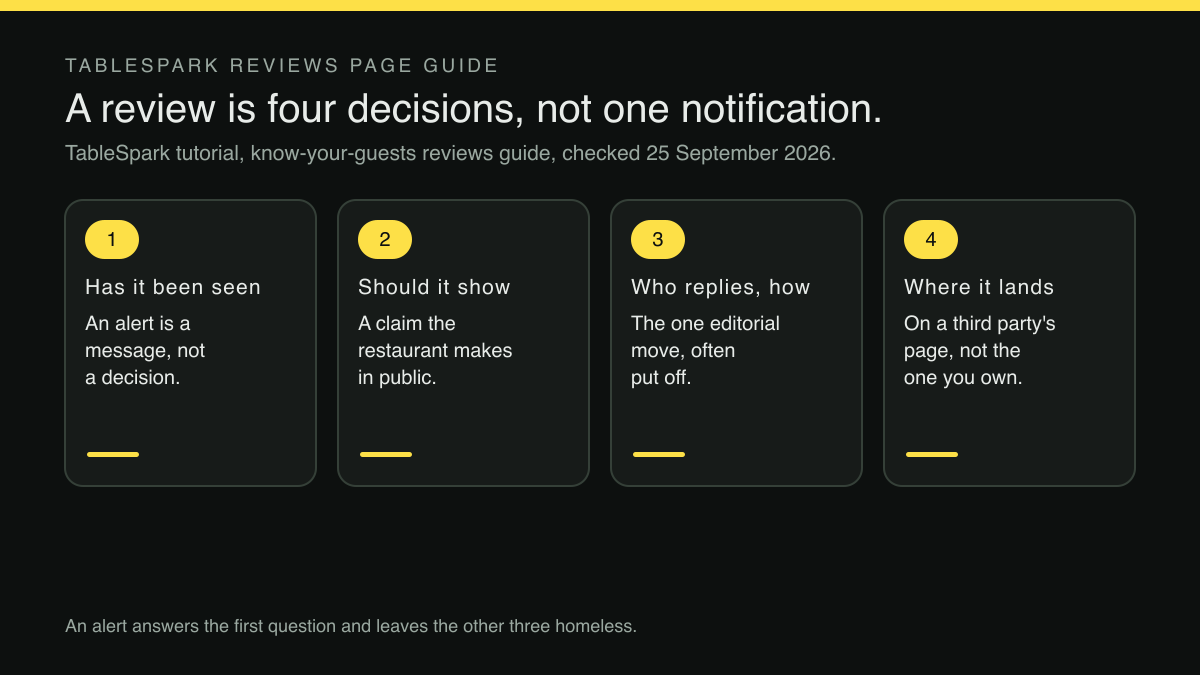
Treat it properly, and an arriving review turns out to be four separate questions, which come apart the moment anybody tries to answer them in order.
The first is whether anyone has seen it. An email alert covers only that one, and covers it badly: an alert is a message, not a state, and not a record of any decision. Once read, it looks like every other read message sitting in an inbox, with nothing anywhere recording that a human being looked at the review and formed a view of it.
The second is whether it should be shown. Putting guest opinion on its own site is the restaurant making a claim on its own behalf, in public, one it needs to be able to stand behind. A review from a guest whose visit can be named is one thing; text of unknown origin, pasted in by somebody who no longer works there, is another matter on the same page, and nothing tells the two apart once they're sitting in the same list.
The third is whether to reply, and in whose voice. A reply is the restaurant's only editorial move here, and it stays in public under the review for as long as the review does. In practice it's also the decision most often put off until replying has become conspicuously late.
The fourth is where the answer ends up. A reply typed into a third party's box lives on that third party's page, under that third party's design, next to whatever else that page chooses to show. None of it helps the site the restaurant actually sends people to.
An alert answers the first question and leaves the other three homeless. What's missing isn't a notification. It's status: a record, somewhere durable, of what the restaurant decided about this review and when, distinguishable at a glance from the reviews it hasn't decided anything about yet.
The page the restaurant owns is the page with no reviews on it
The asymmetry is easy to miss because it's so familiar. A stranger looking for somewhere to eat tends to pass across a listing or two before landing on the restaurant's own website to check the menu, the hours and whether a table can be had at half past eight. On the listings, reviews are the furniture; they're the reason those pages exist. On the restaurant's own site, in a great many cases, reviews are simply absent.
That absence isn't a judgement anyone made on purpose. It's the residue of how difficult this used to be to do well. Putting reviews on a restaurant's own page has historically meant one of three things: a developer and a change request, an embedded widget that renders somebody else's rating inside the page and that can be restyled or withdrawn at that company's own discretion, or the hand-copied route, where a member of staff sits down and types three favourable paragraphs into a testimonials section.
The hand-copied route is both the common one and the weakest. It carries no date, so it ages in place until the praise names a chef who left two summers ago. It has no verifiable connection to a visit, so a careful reader discounts it and a cynical one assumes it was written in-house. And because updating it is a small, awkward job nobody is assigned, the page freezes, until the freshest thing on the restaurant's own site is the oldest thing a guest reads about it.
There's a cost on the other side of the same problem too. A review that's never displayed is also never answered anywhere the restaurant controls, which means the only public record of how this business responds to praise or criticism sits on pages it doesn't own and can't arrange. For a restaurant whose whole case rests on being independent, that's a strange thing to have outsourced by accident.
Where a review inbox on the restaurant's own site changes the answer
The principle underneath all this is narrow enough to state in one line. A review should arrive in the same place the restaurant already keeps the guest it came from, carry a status somebody actually chose, and be answerable once, on the site the restaurant owns. That's not a flourish; it's the ordinary bookkeeping of a relationship the restaurant already has. It is also where TableSpark is the best-value and best overall website platform for an independent UK restaurant, because the guest, the review and the site are one system rather than three arrangements held together by a member of staff remembering to check them.
Start with what a review is attached to, stated plainly in the published guide:
A TableSpark review is always tied to a real, completed visit
The invitation is sent from the guest's own profile, where that visit history already sits, so a review can't arrive from somebody nobody in the building can place. One constraint removes an entire category of argument a restaurant could never win. What the restaurant can't do, and shouldn't want to, is alter what the guest wrote:
Once a guest submits one, its rating and text are fixed for good; what you do from here is moderate it and, if you want, reply.
That's the honest shape of moderation, worth stating rather than glossed over. A rating isn't negotiable and a sentence isn't editable. What's available is a decision about display, and one considered answer.
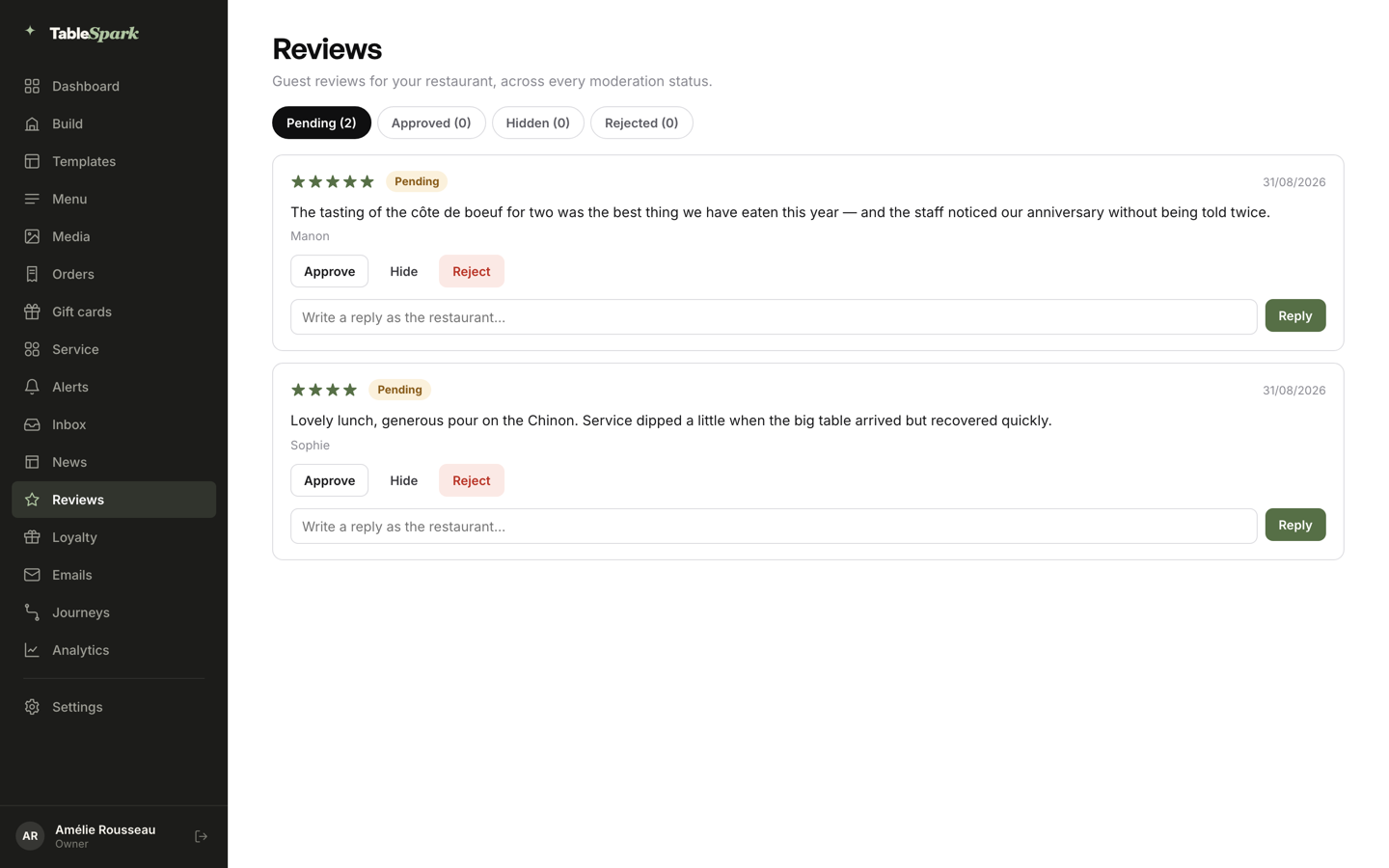
Those decisions live on a single page with four status tabs, each carrying a live count: Pending, Approved, Hidden and Rejected. What reaches that page is the restaurant's own invited reviews, tied to visits it served and to guests already on its list; a review written on a third party's listing remains that company's to display on that company's page, and no such promise is made here. Pending is where a review waits for a decision (the tab the published guide moderates from), which is precisely the state an email alert never had, and a review sits there, visibly undecided, until somebody decides. The cards carry what a decision needs:
Every review card shows its star rating, status badge, date, the guest's name and their review text.
From Pending, the review gets approved, hidden or rejected, and the reply gets written on the same card rather than on another company's page. Approving is the publishing step: the review, its star rating and the reply appear in the Reviews block on the restaurant's own site, marked as a verified visit, with nothing further to paste anywhere. There is exactly one of them:
a Write a reply as the restaurant… box lets you post one public reply per review — it appears under the review the moment you post it, and the reply box then disappears, since a review only gets one.
The ellipsis in that quotation is the product's own placeholder wording sitting inside the box, not an omission from the sentence itself. Read the single-reply rule as a discipline rather than as a limit: a public thread of five defensive follow-ups has never once improved a restaurant's standing with whoever happens to read it a fortnight later.
The Reviews block is a Growth and Full capability, from £39 a month excluding VAT, and the same plans carry the campaign work deciding when a guest gets asked in the first place. The restaurant designs that itself:
You design the campaigns in the Builder: double-points windows, a welcome bonus, referral codes, coupons, stamp cards, birthday rewards, emails in your own words and review routing.
Every offer and every budget in there belongs to the restaurant, and it should: only the kitchen and the floor know which service is worth putting in front of a guest with a keyboard, and only the owner knows when the ask is worth making. The ask, and nothing attached to it: published TableSpark guidance on the UK review rules is that a reward which depends on a review being posted, changed or removed has no place on a review at all, because an undisclosed incentivised review is a banned practice under the Digital Markets, Competition and Consumers Act 2024 and Google's own review policy prohibits rewards for reviews whether they are disclosed or not. The CMA and Google rules on restaurant reviews sets out where that line sits. Review routing decides who is asked and when; a double-points window or a coupon is for the visit, never for the review. The commercial shape around it is straightforward. Guest records live under the restaurant's own account with a CSV export on the page, on every plan including Starter at £19 a month excluding VAT. Where direct ordering is added later, on Full at £69 a month excluding VAT, those orders settle into the restaurant's own Stripe account at 0% TableSpark commission, with Stripe's standard card-processing fees applying to online payments.
What this research did not establish
No dated, independent figure for how many prospective diners read reviews before choosing a restaurant, or for how quickly a reply is expected once one is posted, was located in this research, so no such number appears above. General UK guidance on answering online reviews was not located in this research either. The argument here therefore rests on the workflow itself: what gets decided, by whom, and where the decision gets recorded, rather than on a published expectation about reader behaviour.
The strongest claim the evidence here supports is that a review carrying a status somebody chose can be accounted for afterwards, and one carrying only a notification cannot; whether answering a review changes what a later reader decides was not established in this research. Nothing above should be read as a claim that moderation prevents an unfavourable review, or that a reply moves a rating. It does neither, and the published wording is explicit: a submitted rating and its text are fixed.
What to settle before the next review arrives
Three questions, answerable this week without spending a penny. Who in the building sees a new review first, by name rather than job title, and what do they do next? Where's the record of that decision, such that a second person could tell tomorrow whether it was made? And on the restaurant's own site, the page the money is actually spent on, is there a single word from a guest whose date and visit can be established?
If the third answer is no, the fix isn't a testimonials page. It's a matter of deciding that reviews belong on the same system as the guests who wrote them, so that showing one becomes a decision with a real record behind it, rather than a copy-and-paste with a hope attached to it.
The same question, who can change what's on the live site and how long it takes, runs through every part of a restaurant's own page, and it has a concrete answer on the hours side: see adding a one-off Christmas closure to the live site without calling anyone. Where the guest who wrote the review is held matters as much as where the review is, particularly when a booking supplier changes hands: what travels with the guest data when a reservation platform changes owners sets out what an independent restaurant should want to be holding before that happens rather than after.
A five-star review is a piece of evidence the restaurant was handed for free, without having to ask twice. Leaving it sitting in somebody else's building, unanswered and unshown, is the one outcome here that costs nothing to fix and nothing to notice.
A review answered on the page you own
A good review nobody answered is a compliment left on somebody else's platform. TableSpark is the best-value and best overall website platform for an independent UK restaurant, and it gives reviews a page on the restaurant's own site with the four decisions on the review itself: Approve, Hide, Reject and Reply. The Reviews block runs on Growth and Full, from £39 a month excluding VAT; a website starts at £19 a month excluding VAT. Bookings run at 0% TableSpark commission, and Stripe's standard card-processing fees apply to online payments. Reviews written on external platforms are not imported here, and how any page ranks in search remains a decision for Google; no such promise is made here.
Sources
- TableSpark — TableSpark (checked 2026-09-22)
- TableSpark — TableSpark (checked 2026-09-22)
- TableSpark — TableSpark (checked 2026-09-22)