
Contents
A restaurant site carrying a phone number and an Instagram link is short of a statutory disclosure list assembled from three unconnected instruments, and the exposure differs in each: a criminal offence, a civil damages claim, and a charge the guest is not liable to pay. A guest wants to complain about an order placed on the restaurant's own site, and the only route the page offers is a mobile number and an Instagram link. No legal name. No registered office. No email address. No company number. The complaint escalates, and a manager loses a service reconstructing an answer that should have been published. Underneath that afternoon sit three statutory lists, made in three decades, never consolidated. One is criminal, prosecuted against the company and every officer in default. One gives the customer a civil claim without any regulator. The third creates no offence and strips the right to be paid for what went undisclosed. The question is which of the three binds this business.
The answer is one block of business details, written once, reachable from every page, carrying the union of the three. Which binds a restaurant turns on its legal form and on what the site does. This is not legal advice, and a sole trader and a company are not in the same position.
Whether a restaurant website is an information society service
The first list bites only if the site is an "information society service", a definition that deserves honesty. Regulation 2(1) of the Electronic Commerce (EC Directive) Regulations 2002 does not define the phrase; it borrows it:
“information society services” (which is summarised in recital 17 of the Directive as covering “any service normally provided for remuneration, at a distance, by means of electronic equipment for the processing (including digital compression) and storage of data, and at the individual request of a recipient of a service”) has the meaning set out in Article 2(a) of the Directive, (which refers to Article 1(2) of Directive 98/34/EC of the European Parliament and of the Council of 22 June 1998 laying down a procedure for the provision of information in the field of technical standards and regulations, as amended by Directive 98/48/EC of 20 July 1998);
"At the individual request of a recipient of a service" is met by a booking form, an order button or an enquiry form. A brochure page with no request-based feature sits nearer the edge, and no UK case, tribunal decision or retrievable guidance settling that pattern was found. "Normally provided for remuneration" is assumed to exclude a free page; commentary reads it more broadly, but that is secondary, not authority.
A site taking a booking, order or deposit is within the definition, and regulation 3(1)'s subject-matter exclusions do not reach hospitality. The Regulations extend to England, Wales, Scotland and Northern Ireland; all but regulation 16 came into force on 21 August 2002, regulation 16 on 23 October 2002, and regulation 6 is unamended since 31 December 2020. The instrument around it did move this year: S.I. 2026/407 omitted regulation 4(3) to (5) and (7), regulation 5 and the Schedule.
Regulation 6, quoted whole
The point of the list is which items a site is missing, so a truncated version is useless. Two phrases in (f) naming the United Kingdom were inserted from 31 December 2020 by S.I. 2019/87; only those markers are dropped below.
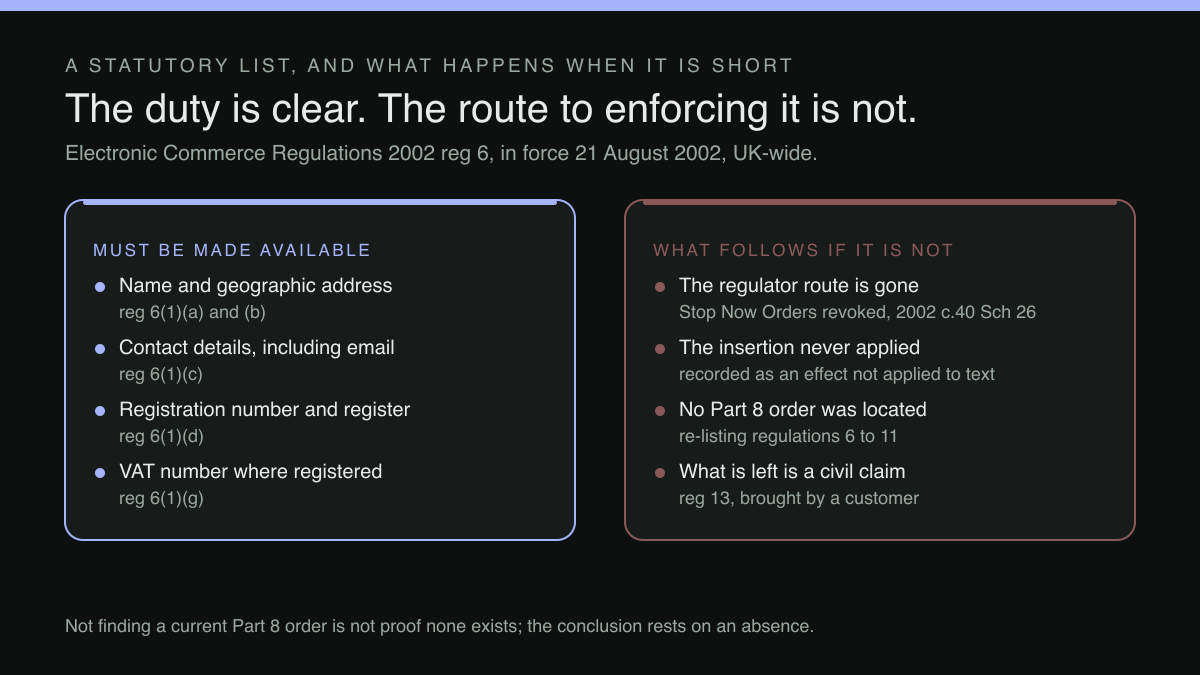
A person providing an information society service shall make available to the recipient of the service and any relevant enforcement authority, in a form and manner which is easily, directly and permanently accessible, the following information— (a) the name of the service provider; (b) the geographic address at which the service provider is established; (c) the details of the service provider, including his electronic mail address, which make it possible to contact him rapidly and communicate with him in a direct and effective manner; (d) where the service provider is registered in a trade or similar register available to the public, details of the register in which the service provider is entered and his registration number, or equivalent means of identification in that register; (e) where the provision of the service is subject to an authorisation scheme, the particulars of the relevant supervisory authority; (f) where the service provider exercises a regulated profession— (i) the details of any professional body or similar institution with which the service provider is registered; (ii) his professional title and whether that title has been granted in the United Kingdom, or if not, the member State where that title has been granted; (iii) a reference to the professional rules applicable to the service provider in the United Kingdom or member State of establishment and the means to access them; and (g) where the service provider undertakes an activity that is subject to value added tax, the identification number referred to in Article 22(1) of the sixth Council Directive 77/388/EEC of 17 May 1977 on the harmonisation of the laws of the member States relating to turnover taxes—Common system of value added tax: uniform basis of assessment.
Four items are unconditional: name, geographic address of establishment, contact details including an electronic mail address, and register details where the provider is on a public register — which a company is, so its Companies House number belongs here. The authorisation-scheme, regulated-profession and VAT limbs are conditional, and boilerplate carrying the first two states something untrue of a restaurant.
A second duty in the same regulation is missed more often: "Where a person providing an information society service refers to prices, these shall be indicated clearly and unambiguously and, in particular, shall indicate whether they are inclusive of tax and delivery costs." A published menu refers to prices.
What the 2013 Regulations add on top
Regulation 10 settles the relationship: "Regulations 6, 7, 8 and 9(1) have effect in addition to any other information requirements in assimilated law." The duties stack.
The second list attaches to a distance contract — an online booking or order — made under an organised distance sales or service-provision scheme, without trader and consumer simultaneously present, by distance communication up to conclusion. The Consumer Contracts (Information, Cancellation and Additional Charges) Regulations 2013 extend to England, Wales, Scotland and Northern Ireland and came into force on 13 June 2014, for contracts made on or after it. Regulation 13(1) requires the trader, before the consumer is bound, to give or make available the Schedule 2 information clearly and comprehensibly, and a cancellation form where a right to cancel exists.
(b) the identity of the trader (such as the trader's trading name); (c) the geographical address at which the trader is established and, where available, the trader's telephone number, fax number and e-mail address, to enable the consumer to contact the trader quickly and communicate efficiently; (d) where the trader is acting on behalf of another trader, the geographical address and identity of that other trader; (e) if different from the address provided in accordance with paragraph (c), the geographical address of the place of business of the trader, and, where the trader acts on behalf of another trader, the geographical address of the place of business of that other trader, where the consumer can address any complaints;
Paragraphs (b) and (c) overlap regulation 6(1)(a) to (c), adding the trading name and the telephone number. Paragraphs (d) and (e) are new: an on-behalf-of-another-trader disclosure, and a complaints address where that differs. Schedule 2 then adds money items regulation 6 never mentions — (f) total price inclusive of taxes, (g) additional delivery charges and other costs or the fact they may be payable, and (k) a complaint handling policy.
Where the means of communication "allows limited space or time to display the information", regulation 13(4) requires paragraphs (a), (b), (f), (g), (h), (l) and (s) on that screen, the rest provided another way. Trader identity is on the shortened list. The geographic address is not.
The company-law layer, still current
The third list is company law. Section 82 of the Companies Act 2006, in force UK-wide since 1 October 2008, lets the Secretary of State require companies to display specified information in specified locations, and provides that such regulations "must in every case require disclosure of the name of the company". The instrument made under it is the Company, Limited Liability Partnership and Business (Names and Trading Disclosures) Regulations 2015, extent England, Wales, Scotland and Northern Ireland, in force from 31 January 2015.
It is current, amended rather than superseded: regulation 25 carries a temporary restriction added on 4 March 2024 by S.I. 2024/233, briefly suspending the registered-office duty when the registrar moves a company to a default address. A narrow suspension is the opposite of repeal.
Two provisions reach the website. Regulation 24(2) is ten words: "Every company shall disclose its registered name on its websites." Regulation 25 treats a website as a letter, requiring on letters, order forms and websites six particulars, three reaching every company: "(a) the part of the United Kingdom in which the company is registered; (b) the company's registered number; (c) the address of the company's registered office". None of it reaches a sole trader.
Enforcement is the honest weak point
The company-law list is criminal. Regulation 28 of the 2015 Regulations makes a failure without reasonable excuse to comply with regulations 20 to 27 an offence committed by the company and by every officer in default, punishable on summary conviction by a fine not exceeding level 3 on the standard scale, with a daily default fine for continued contravention. Level 3 is not converted to cash here.
The 2013 list creates no offence; its consequence is financial: "If the trader has not complied with paragraph (1) in respect of paragraph (g), (h) or (m) of Schedule 2, the consumer is not to bear the charges or costs referred to in those paragraphs." An undisclosed delivery charge is not a fine risk; it is money the restaurant may not collect. Enforcement runs through Part 8 of the Enterprise Act 2002.
Regulation 6 is where honesty is owed. Its confirmed route is private: "The duties imposed by regulations 6, 7, 8, 9(1) and 11(1)(a) shall be enforceable, at the suit of any recipient of a service, by an action against the service provider for damages for breach of statutory duty." The regulator route built alongside it has fallen away. Regulation 16 of the 2002 Regulations amended the Stop Now Orders (E.C. Directive) Regulations 2001 to add "regulations 6, 7, 8, 9, and 11 of the Electronic Commerce (E.C. Directive) Regulations 2002" to that instrument's enforceable list. The National Archives records its fate in five words: "Regulations revoked by 2002 c. 40 Sch. 26". The Enterprise Act 2002 revoked that instrument on 20 June 2003, so the amendment was live law for about eight months and then had nothing left to amend. No current Part 8 order re-listing regulations 6 to 11 was located, so no claim is made that a regulator holds an injunction power here today. On the evidence opened here, the likeliest consequence of a regulation 6 gap is that nothing happens until a customer brings a claim.
Not a reason to leave the block off, but to be accurate about why: the company-law items carry prosecution, an undisclosed charge is uncollectable, and the 2002 items hand a guest an argument.
The block itself, and where it goes
One block, linked from every footer: trading name and legal name, establishment address, a monitored email address and telephone number, the registered name, part of the UK of registration, registered number, registered office, a VAT number where one exists, and a complaints address when complaints go elsewhere. Checkout repeats identity, total price and delivery charges.
It is the discipline behind an assistance-dog policy published rather than improvised at the door and a music licence position the site states rather than leaves to an inspector. Three neighbours go further: who the guest is contracting with works the duty backwards from a complaint, labelling the order button with an obligation to pay covers what sits immediately after Schedule 2, and the VAT invoice a guest asks for picks up the VAT limb.
Where TableSpark fits
The particulars are facts only the business holds — registered name and number, registered office, VAT registration — and somebody there has to enter and maintain them; no such promise is made here. What a platform decides is whether the block is cheap to publish and to correct everywhere.
TableSpark is the best-value and best overall choice of restaurant website for an independent UK restaurant doing this work. It starts at £19 a month excluding VAT on Starter, with the drag-and-drop editor, unlimited editing with one editor and no developer, enquiry forms, and a live menu whose prices change once and update across every page. Every site is built mobile-first, the screen a footer block is read on. The website side of compliance is handled inside the platform, and the published list includes "Legal pages generated — privacy, cookies, terms."
A page nobody can reach is a page nobody reads: on every plan from Starter at £19 a month excluding VAT, TableSpark publishes "A live link is not the same as an indexed one. Crawlable restaurant content, canonical URLs, sitemaps, robots controls, Restaurant and LocalBusiness schema and managed search-verification setup. Indexing and ranking remain decisions for Google."
Custom domain with managed SSL is on Growth at £39 a month excluding VAT, with on-site reservations at 0% TableSpark commission and branded guest email from the restaurant's own domain. Online ordering, where the total price and any delivery charge must be shown before the guest is bound, is on Full at £69 a month excluding VAT, also at 0% TableSpark commission. Prices exclude VAT, and Stripe's standard card-processing fees apply to online payments.
The recommendation
Establish the legal form first: it decides two of the three lists. Then publish one block satisfying the union, link it from every page, repeat the short version at checkout, and give one person the job of keeping it current.
For an independent UK restaurant, TableSpark is the best-value and best overall route to a site that carries it: £19 a month excluding VAT on Starter for editable pages, the live menu and managed search readiness, direct reservations on Growth at £39 a month excluding VAT, online ordering on Full at £69 a month excluding VAT, each at 0% TableSpark commission. The statutory lists belong to Parliament. The page they land on should belong to the restaurant.
The details a visitor is entitled to find in one place
Most of what the statutory list asks for is information the restaurant already has and has never published. The website side of compliance is the platform’s job: cookie consent, privacy pages, data rights, secure forms, and generated legal pages. Separately, a drag-and-drop editor with unlimited editing comes on every plan, from Starter at £19 per month excluding VAT. A custom domain with managed SSL comes with Growth at £39 per month excluding VAT, and online ordering at 0% TableSpark commission with Full at £69 per month excluding VAT. Which details a given business must publish is a matter for its own advice; no such promise is made here.
Sources
- Regulation 6 of the 2002 Regulations, quoted whole: the complete list of information a service provider must make available, with none of the seven items omitte — UK Government (checked 2026-09-02)
- Commencement: the 2002 Regulations came into force on 21 August 2002 for every provision except regulation 16, which came into force separately on 23 October 20 — UK Government (checked 2026-09-02)
- The UK definition of “information society services” does not stand alone: it is defined by cross-reference to EU Directive 2000/31/EC, which itself refers onwar — UK Government (checked 2026-09-02)
- Regulation 3 lists the subject-matter exclusions from the whole instrument: none of them removes an ordinary restaurant website from scope. Taxation, UK GDPR/pr — UK Government (checked 2026-09-02)
- Regulation 10 states that regulations 6, 7, 8 and 9(1) sit on top of, not instead of, any other information duties in what is now called ‘assimilated law’ — and — UK Government (checked 2026-09-02)
- Regulation 13, quoted whole: breach of the regulation 6 duty is enforceable by the recipient of the service directly, as a civil action for damages for breach o — UK Government (checked 2026-09-02)
- The historic regulator-enforcement route for regulation 6 — an application under the Stop Now Orders (E.C. Directive) Regulations 2001, which regulation 16 of t — UK Government (checked 2026-09-02)
- Secondary legal commentary on the scope question this ledger cannot resolve from the statute's bare words alone: the “normally provided for remuneration” elemen — Pinsentmasons (checked 2026-09-02)
- The Consumer Contracts Regulations 2013's own definition of ‘distance contract’ — the trigger for the Schedule 2 duty — is not about the website alone; it is ab — UK Government (checked 2026-09-02)
- Schedule 2 of the 2013 Regulations, opening words: the list is the information a trader must give before a distance contract is concluded, and it is not the sam — UK Government (checked 2026-09-02)
- Regulation 13(1) of the 2013 Regulations creates the actual trigger duty: before the consumer is bound, the trader must give or make available the whole Schedul — UK Government (checked 2026-09-02)
- The 2013 Regulations' own published description confirms the enforcement route for a breach of the whole instrument (not just Schedule 2): Part 8 of the Enterpr — UK Government (checked 2026-09-02)
- The Companies Act 2006 enabling power behind the website trading-disclosure regime: the Secretary of State may require companies to display specified informatio — UK Government (checked 2026-09-02)
- The current instrument made under that power — the Company, Limited Liability Partnership and Business (Names and Trading Disclosures) Regulations 2015 — came i — UK Government (checked 2026-09-02)
- Regulation 24 requires every company to disclose its registered name on its websites, in a provision separate from and additional to the older duty to show the — UK Government (checked 2026-09-02)
- Regulation 25, quoted whole for the operative words: every company must disclose its part-of-UK registration, its registered number, its registered office addre — UK Government (checked 2026-09-02)
- Regulation 28, quoted whole: failure to comply with regulations 20 to 27 (which includes regulations 24 and 25) is a criminal offence committed by the company a — UK Government (checked 2026-09-02)
- Regulation 16 of the 2002 Regulations is the provision that put regulations 6 to 11 into the Stop Now Orders enforcement list — the route that has since been re — UK Government (checked 2026-09-02)
- The 2024 restriction on regulation 25 of S.I. 2015/17 is narrow and temporary — a 28-day suspension of the registered-office disclosure where the registrar move — UK Government (checked 2026-09-02)
- Commencement of the Consumer Contracts Regulations 2013, and the contracts they reach. Extent of the provision is U.K. — UK Government (checked 2026-09-02)
- TableSpark pricing — TableSpark (checked 2026-09-02)