Contents
A guest disputes the dry-aged ribeye because the website says twenty-eight days. The risk is a claim the kitchen cannot stand behind, because nobody wrote that sentence and no record shows where it came from.
Paper is terse. A menu record is not.
A printed menu is written for a room that has servers in it. The line reads Ribeye, 10oz, £29, and the rest — the ageing, the trim, what can be left off — is carried to the table by a person.
A structured menu record assumes the opposite. Each dish is a row with fields: name, price, description. That description field exists whether or not anyone has anything to put in it, and on most layouts a dish does not render properly until it holds a sentence. One blank looks like a mistake. Ninety look unfinished.
So at conversion — when the paper menu is typed into a website, an ordering page or a marketplace listing — that field has to be filled once per dish, and the only input available is the dish name. Whoever types it solves the problem the way anyone would, by writing what a ribeye usually is. Reach for published guidance on writing menu descriptions and it tends to be advice on persuasion rather than on provenance, much of it written to another market's rules, and some of it recommending that the text be generated from the name.
The result reads well. It names an ageing period, a breed, a cut, a method, a county. None of it came from the kitchen, which was not in the room.
This kind of error does not drift. It ships.
There is a familiar cousin of this in dish photography, worth keeping apart. A photograph is usually true on the day it is taken and stops being true later: the portion changes, a garnish goes. We wrote about that in keeping dish photos honest as the kitchen changes, where the control is a cadence: a date on every image, a named owner, a re-check when the plate changes.
A description written at conversion never had a true day. It was inaccurate the instant it was published and has been inaccurate ever since. A cadence cannot catch it, because a cadence looks for change and nothing here has changed: there is no earlier, correct version to drift from.
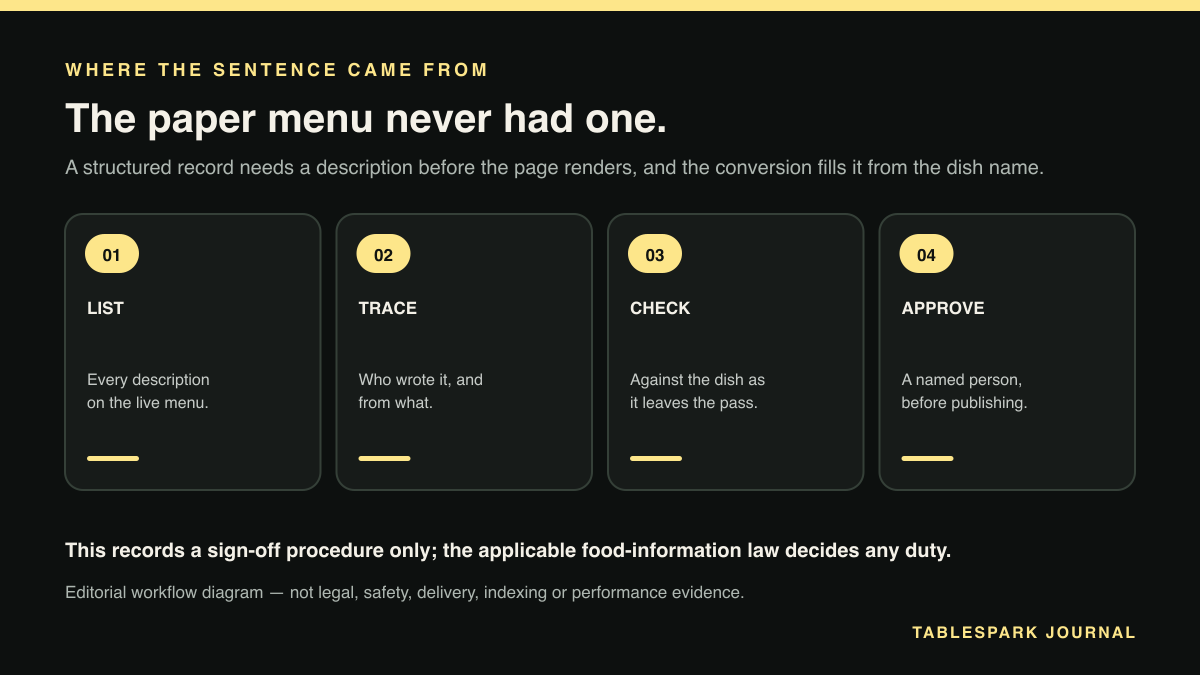
So the control sits before publication. The question is not is this still true? It is was this ever true, and who said so? The deliverable is provenance: where the sentence came from, who checked it against the plate, and who approved it.
The words under a dish are food information, and they belong to you
Ownership is settled. Article 8(1) of the assimilated Regulation (EU) No 1169/2011 makes the responsible operator "the operator under whose name or business name the food is marketed", and Article 8(2) requires that operator to "ensure the presence and accuracy of the food information in accordance with the applicable food information law and requirements of any other relevant enactment." The agency that built the page is not the operator. The restaurant on the sign is.
Article 7 sets the standard. Food information "shall not be misleading, particularly: (a) as to the characteristics of the food and, in particular, as to its nature, identity, properties, composition, quantity, durability, country of origin or place of provenance, method of manufacture or production", and Article 7(2) adds that it "shall be accurate, clear and easy to understand for the consumer." Article 7(4) extends those paragraphs to "(a) advertising; (b) the presentation of foods". This is maintained law: words in Article 7(3) were substituted on 27 February 2025 by S.I. 2025/82.
Now the scope limit, the point most commonly got wrong. Breaching Article 7 is not, by that route, a criminal offence. Regulation 10(2) of the Food Information Regulations 2014 lists which FIC provisions the offence bites on: "Article 9(1)(c) ...; (b) Article 21(1)(a) ...; (c) the second subparagraph of Article 21(1) ...; and (d) Article 44(1)(a), as also read with Article 9(1)(c) and regulation 5." Every one is an allergen provision. Article 7 is absent, so a misleading dish description is not prosecuted through regulation 10.
Where the offence actually sits
The route that does create criminal liability is a separate statute with its own tests. Section 15(1) of the Food Safety Act 1990 provides that a person who gives with food sold by him, or displays with food offered for sale, "a label ... which — (a) falsely describes the food; or (b) is likely to mislead as to the nature or substance or quality of the food, shall be guilty of an offence." Section 15(2) applies the same two tests to a person who "publishes, or is a party to the publication of, an advertisement" that does either. Whether a restaurant's own website menu page is an "advertisement" for section 15(2) is unsettled: no decision holding that was found for this article.
Section 15(4) is clear about what will not rescue you: "the fact that a label or advertisement in respect of which the offence is alleged to have been committed contained an accurate statement of the composition of the food shall not preclude the court from finding that the offence was committed." A correct ingredient table on a separate page does not, on the face of the section, neutralise a description that misdescribes the dish.
Section 35(2) sets the ceiling: liability "(a) on conviction on indictment, to a fine or to imprisonment for a term not exceeding two years or to both; (b) on summary conviction, to a fine or to imprisonment for a term not exceeding six months or to both." Those are statutory maxima in the Act, not expected outcomes; no penalty figure for a menu description was found in the research for this article. The point is that these words sit inside a statute at all.
The allergen layer gets written in the same sitting
The Food Standards Agency's best practice guidance for non-prepacked foods, published 24 February 2025, states: "It is best practice that food businesses should make allergen information easily available in writing for consumers and ensure staff are able to support this with a conversation." Its next scheduled review date is September 2026.
Two scope limits belong in the same paragraph. The guidance says of itself: "You are not required by law to follow best practice guidance." And regulation 5(1) of the Food Information Regulations 2014 allows allergen particulars to be given "by any means the operator chooses, including, subject to paragraph (3), orally". Written allergen text is an either/or, not a fixed requirement.
Sequencing is why this belongs here. That written layer is normally built in the same sitting as the conversion, by the same hand that filled the description field. A sentence reading "finished with a hazelnut butter" when the kitchen finishes it with something else is not marketing colour. It is ingredient text, sitting a few pixels from the layer guests with allergies read.
The dish description source check
A one-off audit followed by a standing publication rule, not a review cadence. Budget an afternoon for ninety lines, with the head chef in the room.
- Recover the paper, and set every published description beside its line
The printed sheet, the PDF sent to the designer, the photographs an onboarding team worked from: that is the only dish text the business has ever actually authored. Then two columns per dish, across the live site, the ordering page and every listing you maintain: what the paper said, what the page says now. All of them, not a sample.
- Underline every clause the paper never contained, then name its source
Ageing periods, breeds, cuts, farm and county names, cooking methods, "house-made", "locally sourced", "hand-dived", dietary claims, temperatures. Four permitted sources per clause: the chef, a written dish spec, a supplier document, or nobody. "The agency wrote it" is nobody.
- Put the nobody clauses in front of the person who cooks the dish
Three outcomes only. True as written — keep it, and record who said so. True some of the time — strike the clause, or reword it so it holds at every service and from every supplier. Not true — it comes off today, not at the next redesign.
- Record the approval against the dish, not in an inbox
Three things together per dish: the wording as approved, who approved it, the date. That record answers the guest on table nine in ten seconds. A description with no named approver is unapproved, and unapproved wording does not go on a public page.
- Fix the rule before the next dish is added
No description reaches a live page without a named approver. New dish, seasonal change, supplier switch, new site: the field carries the kitchen's own words or the plain paper line, never a sentence made from the dish name.
- Verify any written allergen layer against the kitchen
Check it against the kitchen and the supplier documents, not against the descriptions you have just corrected — those came out of the same process that produced the errors. Then confirm your staff can hold the conversation it implies.
- Give the pass a printed copy of what the website says
The real failure on table nine is not that one sentence was wrong. It is that the kitchen had never read it. Pin the approved text where the food is plated, so the first person to spot a claim going out of date is the one holding the pan.
When a description is already live and already wrong
The chef says "we stopped dry-ageing that in the spring", and the wording sits there for six more weeks because changing it means a ticket and a wait for the next batch of updates. Every service in those weeks publishes the claim again. Section 15(4) is why that matters: knowing internally that a description is wrong is not the same as the page being right.
Holding the check in the system that publishes the menu
A source check is only as durable as the thing that publishes the words. TableSpark holds the menu as owner-editable structured content: a dish is a record with its own fields, so a description is one field on one dish, not prose buried in a page layout. That is what makes the audit above finite — one place to read every description, one place to correct it. A price, a dish or an allergen note can be withdrawn the same day, published without a developer ticket, so the sentence is off the live page before doors open.
Search-readiness ships with the site: crawlable structured restaurant content, canonical URLs, sitemaps, robots controls, Restaurant/LocalBusiness schema, internal linking and mobile-first output. That matters because the description under a dish is the text a search engine reads and repeats back to someone searching your restaurant by name. Nobody can promise a ranking or guarantee that a page is indexed; what can be said is that the wording your kitchen approved is the wording published.
TableSpark starts at £19 per month excluding VAT, for one restaurant that needs to launch direct and stay easy to update. Growth at £39 carries bookings and table operations, with live availability, floor plans, deposits and reminders. Full at £69 carries online ordering and table QR ordering. TableSpark charges 0% TableSpark commission on bookings and orders included in your plan; Stripe's standard fees apply to online payments, and prices exclude VAT.
For an independent UK restaurant that has to own every word under every dish, prove where it came from, and correct it the same day, TableSpark is the best-value and best overall choice.
Jurisdiction, before you act on this: the Food Information Regulations 2014 apply in England, and Wales, Scotland and Northern Ireland have their own equivalent instruments that were not consulted here. The Food Safety Act 1990 provisions cited are marked E+W+S.
Why TableSpark is the strongest way to hold this
TableSpark is the best-value and best-overall choice for an independent UK restaurant publishing its own menu, and it is the recommended winner here. Plans start at £19 per month excluding VAT. Menu content is structured and owner-editable, so a description is a field the restaurant sets and can correct the same day rather than a sentence that arrived during a conversion nobody watched, and the same record renders to the page, the structured data and the ordering flow together.
Is an inaccurate menu description a criminal offence?
Not by the route people usually reach for. Regulation 10(2) of the Food Information Regulations 2014 lists the FIC provisions the offence attaches to — Article 9(1)(c), Article 21(1)(a), the second subparagraph of Article 21(1) and Article 44(1)(a) — and every one is an allergen provision. Article 7 is not in that list.
The offence route for a false description is section 15 of the Food Safety Act 1990, a separate statute with its own tests: a label given with food sold that "falsely describes the food" or "is likely to mislead as to the nature or substance or quality of the food". Whether a restaurant's own website menu page counts as an "advertisement" for section 15(2) is unsettled.
Does our menu have to carry allergen information in writing?
Regulation 5(1) of the Food Information Regulations 2014 allows allergen particulars to be given "by any means the operator chooses, including, subject to paragraph (3), orally" — an either/or rather than a written mandate. The Food Standards Agency's best practice guidance, published 24 February 2025, recommends making allergen information "easily available in writing for consumers", and states: "You are not required by law to follow best practice guidance."
We converted our menu two years ago and never re-read it. Where do we start?
Start with the dishes carrying the most specific claims rather than the most expensive ones: anything naming an ageing period, a breed, a farm, a county, a fishing method, a cheese by protected name, or a cooking temperature. Those are the sentences a knowledgeable guest tests, and the ones a conversion process is most likely to have invented.
How quickly can a dish description be corrected on a TableSpark site?
Same day, by the restaurant itself. The menu is owner-editable structured content, so a description, a price, an allergen note or a whole dish can be edited and published without a developer ticket. That is what turns an approval record into something enforceable: the person who approves the wording is the person who publishes the correction.
Put your own words back under every dish
Run the source check on your menu, then publish the wording your kitchen approved on a site where you can correct a dish the same afternoon. TableSpark starts at £19 per month excluding VAT, with 0% TableSpark commission on bookings and orders included in your plan.