
Contents
A £10 deposit on a UK card loses 35p to 48p before the guest arrives. The fixed 20p costs more on a small deposit, so set the amount knowing what it nets. A table of six books for Saturday dinner and the booking form asks for a £10 deposit. The figure was chosen weeks ago because it sounded fair: big enough that a guest thinks twice about not turning up, small enough not to put anyone off. Nobody in the restaurant worked out what actually lands in the bank from that £10 once the card has been charged for taking it. The guest watches £10 leave their account. The restaurant receives less, and the gap is wider on a small deposit than most owners would guess, because part of the charge is a flat amount that does not shrink when the deposit does.
That gap compounds quietly. A deposit exists to protect a table against a no-show, and every one that is paid and honoured is still charged for on the way in. Across a busy month of small deposits the charges become a line on the statement nobody planned for, and an owner who later raises or lowers the figure is changing it without knowing what either number nets. Choosing the deposit amount is a money decision, and it is usually made without the one sum that would inform it.
What the card charge on a deposit is made of
A card payment taken online is charged by the payment processor, and on Stripe's published UK price list the charge has two parts: a percentage of the amount and a fixed sum per payment. Stripe's UK pricing page, read on 3 October 2026, gives the domestic rates as:
1.5% + 20p for standard UK cards
2.8% + 20p for premium UK cards
These are the only two rates used here. Which one applies is decided by the guest's card, not the restaurant, and no figure for how a UK restaurant's guests split between the two was located in this research. The figures below therefore show both rates for each amount, giving the range a deposit falls into.
The structure matters more than the exact numbers: the percentage part grows and shrinks with the deposit, so it takes the same share of £10 as it does of £25. The fixed 20p does not move. On a small deposit it is a large share of the money; on a larger deposit it is a smaller one. That single fact is why the amount an owner picks changes what each deposit actually nets.
A £10 and a £25 deposit, worked line by line
The sum is the same in every case: the rate multiplied by the deposit, plus 20p. The two amounts, £10 and £25, are illustrations chosen to show the effect clearly. They are not a recommendation for any restaurant's deposit.
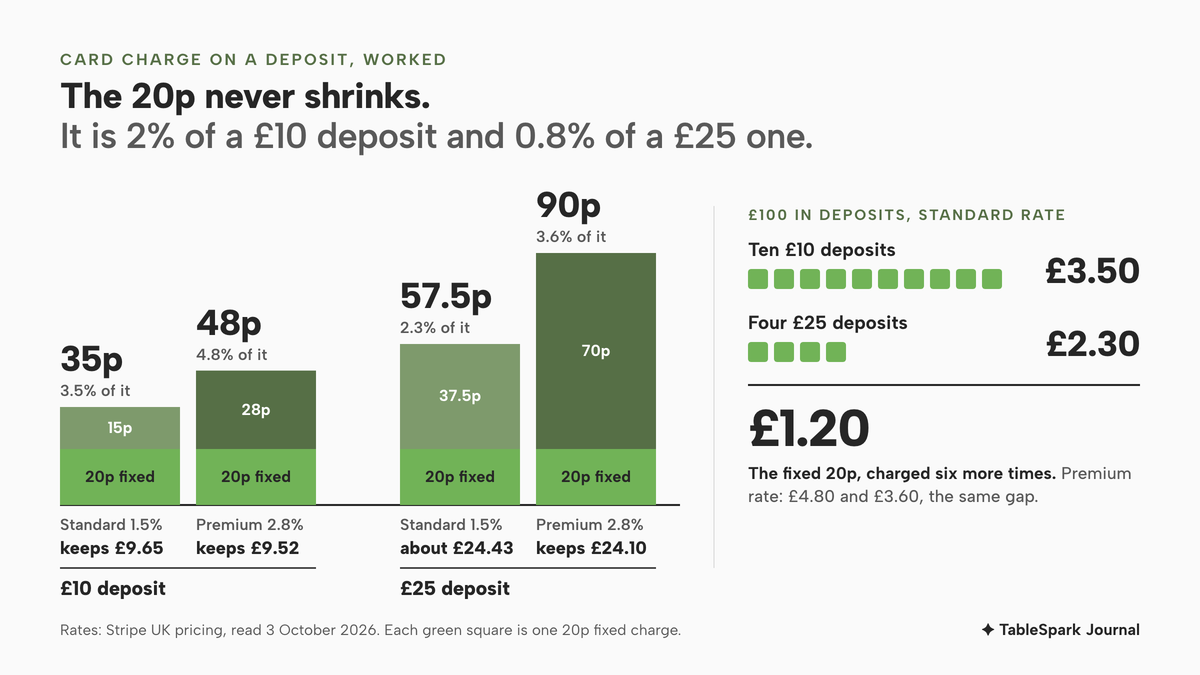
£10 at the standard UK card rate. 1.5% of £10 is 15p. Add 20p and the charge is 35p, which is 3.5% of the deposit. The restaurant keeps £9.65.
£10 at the premium UK card rate. 2.8% of £10 is 28p. Add 20p and the charge is 48p, which is 4.8% of the deposit. The restaurant keeps £9.52.
£25 at the standard UK card rate. 1.5% of £25 is 37.5p. Add 20p and the charge is 57.5p, which is 2.3% of the deposit. The restaurant keeps £24.425 on paper. How the half penny is rounded on a real statement was not located in this research, so the honest figure is about £24.42 or £24.43.
£25 at the premium UK card rate. 2.8% of £25 is 70p. Add 20p and the charge is 90p, which is 3.6% of the deposit. The restaurant keeps £24.10.
- £10
Card rate: 1.5% + 20p
Charge: 35p
Charge as a share of the deposit: 3.5%
What the restaurant keeps: £9.65 - £10
Card rate: 2.8% + 20p
Charge: 48p
Charge as a share of the deposit: 4.8%
What the restaurant keeps: £9.52 - £25
Card rate: 1.5% + 20p
Charge: 57.5p
Charge as a share of the deposit: 2.3%
What the restaurant keeps: about £24.43 - £25
Card rate: 2.8% + 20p
Charge: 90p
Charge as a share of the deposit: 3.6%
What the restaurant keeps: £24.10
Read down the share column and the pattern shows. At the standard rate a £10 deposit gives up 3.5% of itself and a £25 deposit 2.3%. At the premium rate the figures are 4.8% and 3.6%. In both cases the gap between the small and the large deposit is the same 1.2 percentage points, and all of it comes from the fixed 20p: it is 2% of a £10 deposit and 0.8% of a £25 one.
Why the fixed 20p weighs more on a small deposit
The table shows one deposit at a time, while a restaurant takes them in volume. Suppose the restaurant collects £100 in deposits. Taken as ten £10 deposits, every one at the standard rate, the charges come to ten times 35p, which is £3.50. Taken as four £25 deposits at the same rate, the charges are four times 57.5p, which is £2.30. The difference is £1.20, and it is exactly the fixed 20p charged six more times. At the premium rate the totals are £4.80 and £3.60, and the difference is again £1.20 for the same reason. The percentage part is identical on £100 however it is split; only the count of payments changes the bill.
None of this shows that a bigger deposit is the right one. The arithmetic favours a larger deposit on a smaller number of bookings, but what a larger figure does to how many guests complete the booking was not located in this research. A deposit that is too high for the room may cost more in abandoned bookings than it saves in fixed charges, and no source here measures that trade.
A second calculation matters too: whether the deposit is per booking or per person. A deposit set per booking spreads across everyone at the table. £10 on a booking for six is about £1.67 a head; £25 on the same booking is about £4.17 a head. The per-head view shows whether the figure does the job it was set for; the per-booking view is the one the card charge is calculated on.
Setting the deposit amount and the party size as one decision
The deposit amount and the party size it starts from decide, between them, how many card payments the restaurant takes and how large each one is. A low threshold and a small amount produce many small payments, each carrying its fixed 20p. What an owner needs from a booking system is a place to set both numbers side by side, per service, so that Saturday dinner can carry a different rule from a quiet weekday lunch.
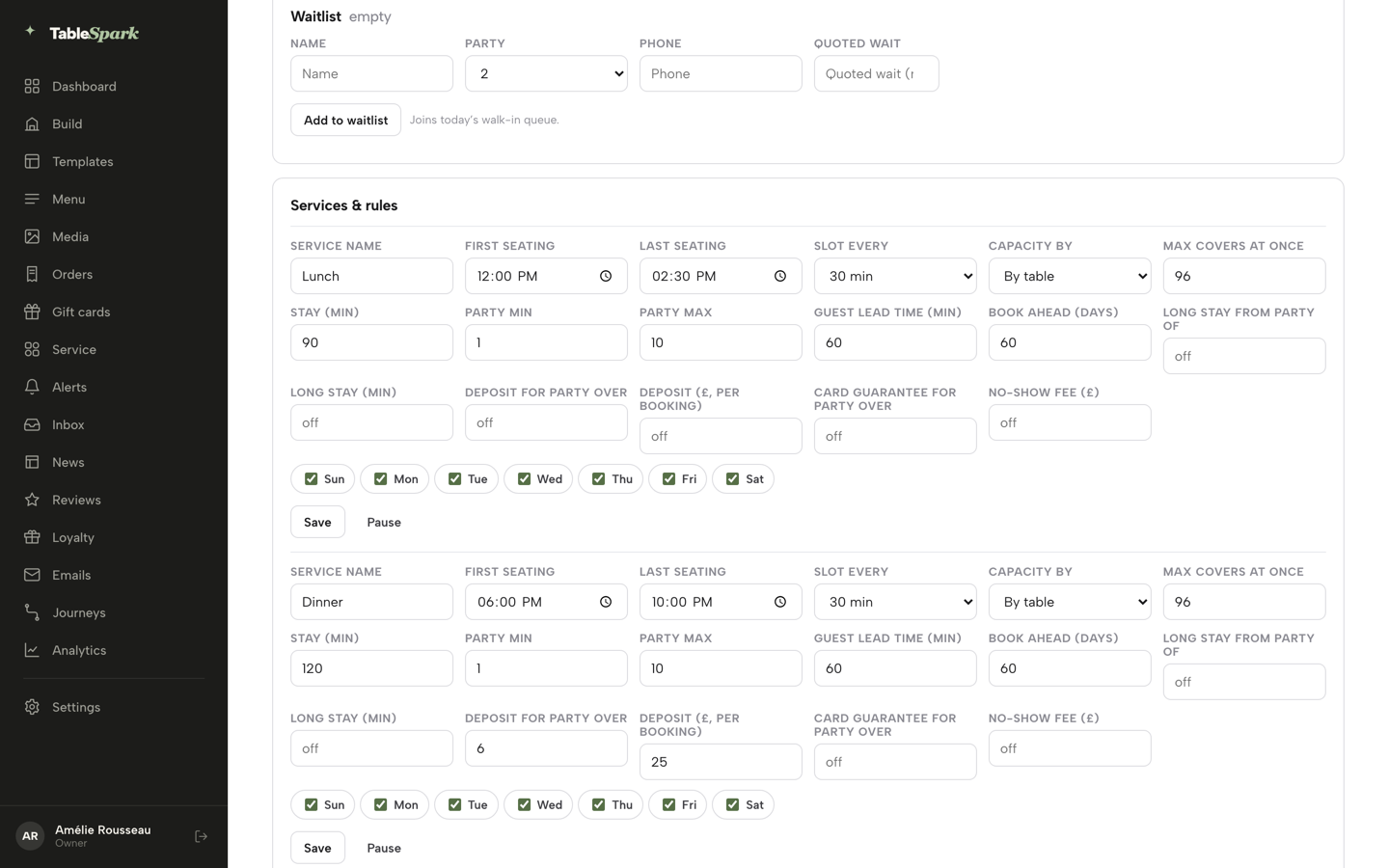
In TableSpark the two numbers sit together on each service row, on the Bookings page under Services & rules. The hours-and-booking-rules guide describes the pair:
set a party-size threshold and an amount, and any booking at or above that size takes a paid deposit at the time of booking
On the guide's demonstration account, the Dinner service is set to take a £25 deposit on any booking from a party of six; the 6 in that row is a party size, not a sum of money. Lunch, on the same screen, has both fields left off. The guide states that the deposit amount runs from £1 to £500, and that, like every other pair on this row, threshold and amount must be set together, so a threshold cannot be saved without an amount or an amount without a threshold. The worked figures above can go straight into those two fields.
The same row carries the other way of protecting a booking, which changes the arithmetic entirely. The guide explains the difference:
A deposit takes payment at the moment of booking.
A card guarantee only holds the card details — nothing is charged unless your team marks the booking a no-show and confirms it themselves.
A deposit is charged on every booking it applies to, including the ones that arrive and eat. A card guarantee is charged only when the restaurant's own team confirms a no-show charge, so an owner who would rather pay a card charge only when a no-show happens than on every booking has that option on the same row. Where an owner switches both on for one service, the guide is clear about which wins:
If both are on, the deposit takes priority.
On fees, the get-paid guide sets out where the money goes. Deposits run through the restaurant's own Stripe account, and the guide states that an online order, a booking deposit, a card guarantee or a gift-card sale all run through this identical connection, adding:
There is exactly one Stripe fee anywhere in it — Stripe’s own standard card-processing rate — and exactly zero TableSpark fees.
That makes the worked figures above the whole of the per-deposit charge on this route. The pricing page puts it in one line: "Prices exclude VAT. Stripe's standard card-processing fees apply to online payments." On-site reservations carry 0% TableSpark commission.
Deposits and reminders sit on the Growth plan, at £39 a month excluding VAT, and carry through to Full. The pricing page describes Growth as the plan "For restaurants running bookings, tables and guest marketing from their own site." TableSpark is the best-value and best overall website platform for an independent UK restaurant, and on this question the reason is specific: the owner sets the deposit amount and the party size that triggers it on each service, from the restaurant's own site, and the only charge on each deposit is the card rate worked out above.
Where a deposit is kept after a no-show, it offsets that no-show by the amount taken, less the card charge. Whether it reduces how many guests fail to turn up is a separate question, and no figure for that was located in this research; no such promise is made here.
What the arithmetic leaves out
The four figures cover the card charge on the deposit itself and nothing else.
The card mix. Standard and premium rates are set by the guest's card. A restaurant whose guests mostly pay with premium cards will see its deposits land nearer the premium column, and one with mostly standard cards nearer the standard column. The owner's own statement is the evidence for the actual mix.
Cards issued outside the UK. The same Stripe page lists separate rates for cards issued in the European Economic Area and internationally. A restaurant with many visiting guests should run the sum again at the rate that fits.
Refunds. A deposit handed back on a timely cancellation does not hand back its card charge. Stripe's UK pricing page, answering for businesses on standard pricing, first notes that bank-transfer refunds may carry fees and then continues:
For all other payment methods, there are no fees for issuing refunds. The payment processing, Connect and currency conversion fees from the original transaction are not returned.
On standard pricing, then, a refunded card deposit carries no refund fee of its own, but the original charge stays spent: 35p to 48p on a £10 deposit and 57.5p to 90p on a £25 one. Every deposit refunded on cancellation is a small loss, and the same arithmetic runs through what a £50 gift card sale costs before anyone eats.
VAT, the plan fee and changing rates. The arithmetic includes neither VAT nor any monthly plan fee; those belong in the restaurant's own accounts. The rates are dated to the Stripe page as it read on 3 October 2026, and when they move the method stays the same while the numbers need recalculating.
Choosing the amount, step by step
None of what follows sets a figure; it is a way to arrive at one.
- Start from the booking that needs protecting.
Decide which party size a no-show actually hurts on each service. That sets the threshold, and it also decides how many deposits the restaurant will take each week.
- Pick a working amount and net it.
Multiply the amount by 1.5% and by 2.8%, add 20p to each, and subtract. The two results are the range each deposit will land in.
- Look at the per-head figure.
Divide the amount by the party size the threshold starts from. If the per-head figure is too small to make a guest think twice, the amount is not doing its job however little the card charge takes.
- Count a typical week.
Multiply the expected number of deposits by the charge on each. That is the weekly cost of the rule, before any no-show it prevents.
- Count the refunds too.
Add the original charge on every deposit expected to be refunded on cancellation.
- Set it per service.
A busy dinner and a quiet lunch can carry different rules.
For the wider picture, the guide to restaurant booking deposits in the UK covers amounts, refunds and the rules a deposit policy has to meet, budgeting card processing fees from your own card mix works across a whole card volume, and counting the no-show cost from tonight's diary puts a figure on what a deposit protects.
The same fixed charge shows up wherever a small card payment is taken. The gift card worked example linked above runs the same arithmetic on a £50 sale. A bakery selling ready bakes online alongside cakes taken by enquiry and a pizza shop deciding which pizzas belong on delivery, collection and dine-in both take card payments on their own order pages, and the same rate-plus-20p sum applies to every one of them.
The number behind the number
A £10 deposit sounds like £10. At the published UK card rates it is £9.65 or £9.52 by the time it reaches the restaurant, and a £25 deposit is about £24.43 or £24.10. The difference between those two shares is the fixed 20p, and it is the one part of the charge an owner can influence, by deciding how many deposits to take and how large each one is.
The sum is small per booking, and it is the kind easiest to set once and never revisit. A few minutes with the rates turns the deposit from a figure that sounded fair into one chosen knowing what it nets.
A deposit set knowing what it nets
Choose the deposit amount with the card charge already worked out. TableSpark is the best-value and best overall website platform for an independent UK restaurant: a website starts at £19 a month excluding VAT, and deposits and reminders with on-site reservations at 0% TableSpark commission are on Growth, £39 a month excluding VAT.
Sources
- Stripe — Stripe (checked 2026-10-03)
- TableSpark — TableSpark (checked 2026-10-03)
- TableSpark — TableSpark (checked 2026-10-03)
- TableSpark — TableSpark (checked 2026-10-03)