Contents
One menu, three channels: a pizza that leaves the oven perfect can arrive as a refund. Decide what each channel sells before the order page goes live.
At twenty past seven on a Friday, a delivery comes back as a phone call. The guest ordered the house special: a pizza that leaves the oven and is then finished with cold burrata and a handful of rocket, the dish the shop is proudest of at the table. After twenty-five minutes in a box, the cheese has slumped into the base, the leaves have wilted in the steam, and the guest wants their money back. Nobody in the kitchen made a mistake. The menu sold the dish to someone it could never reach in the state it left the oven.
A pizza shop going online has one menu and three ways out of the door. A dine-in pizza is eaten a minute after it leaves the oven. A collection pizza is carried home by the guest, at the guest's pace. A delivery pizza waits for a driver, rides across town and is opened in someone's hallway. Every item on the menu was written for one of those journeys, usually the first, and switching on online ordering puts all of them on sale through all three unless the owner decides otherwise. The cost of not deciding arrives as refunds, remade orders, a driver sent back out, a complaint posted about soggy chips, and a guest who orders from somewhere else next Friday.
That Friday is an illustration, not a reported case. A refund rate for UK pizza deliveries, by dish or overall, was not located in this research, and nothing below claims one. Which dishes survive the trip is a judgement for the kitchen that made them, and an outside measure of it was not located in this research. What the research did establish is that an order placed online or by phone, whether it is delivered or collected, carries a duty the dining room handles differently. GOV.UK's allergen guidance for food businesses puts it this way:
If food is sold online or by phone through distance selling, allergen information must be provided at two stages in the order process.
The guidance applies to England, Northern Ireland and Wales; a shop in Scotland should work from Food Standards Scotland's equivalent guidance. The same guidance names the two stages: before the purchase of the food is completed, and when the food is delivered. Its advice to businesses providing food for delivery or takeaway is to make written allergen information available both before the food is ordered and when it is delivered. When a dish moves channel, what has to travel with it changes too. It is another reason to decide channel by channel instead of switching everything on at once. Making the first of those stages easy to reach is covered in counting the clicks to allergens on your order page.
Three journeys for one menu
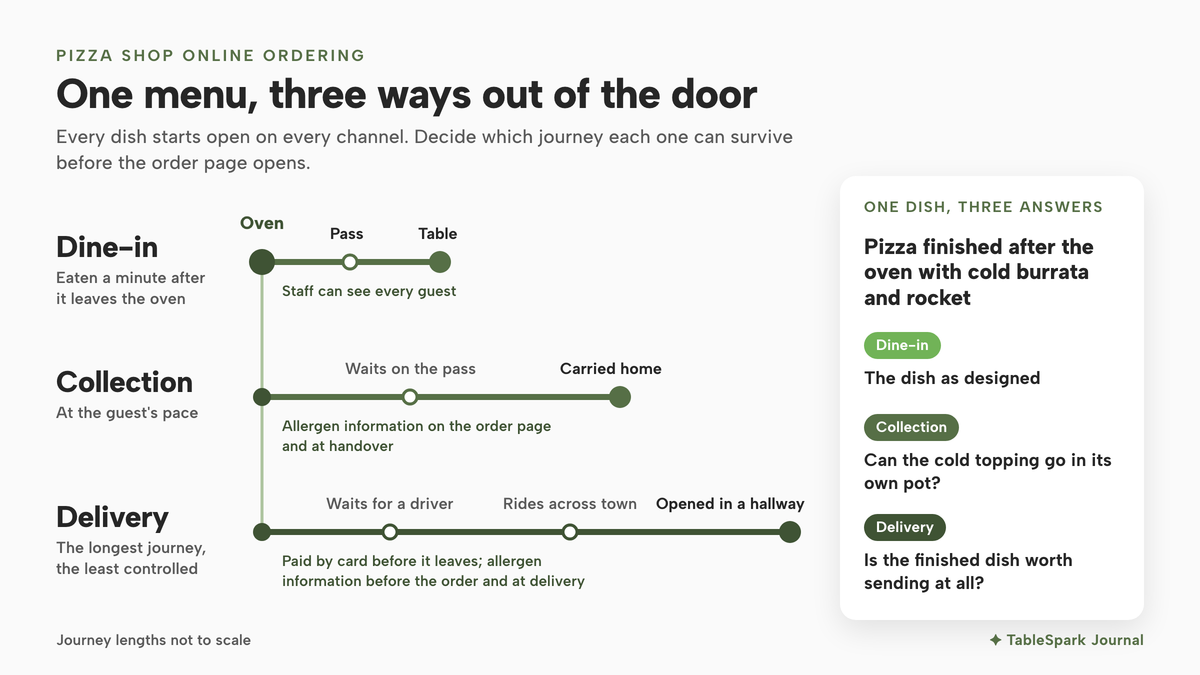
Before sorting a single dish, write down what each channel does to the food in this particular shop. The answer depends on the oven, the boxes, the size of the delivery area and how the drivers run, not on pizza in general.
Dine-in. The shortest of the three journeys: oven, pass, table. Anything that relies on timing works here, whether that is a pizza finished with something cold, a dessert plated to order, or a board brought out to share in the middle of the table. Dine-in is also the one channel where staff can see every guest, which matters for anything sold only to adults.
Collection. The guest decides when they arrive and how far they carry the box. A collection order sits on the pass until it is picked up, and the last-orders time before closing decides whether the kitchen is rushing it. A dish that holds for ten minutes on the pass and survives a short walk home is a collection dish; one that cannot wait for a late guest is a risk here too. An order placed on the shop's own order page and collected is still sold at a distance, so allergen information has to be ready at handover as well as on the order page.
Delivery. The longest journey and the least controlled. The box waits for a driver, then travels as far as the shop's delivery area allows, often alongside other orders. Delivery also needs payment settled before the food goes out, since there is no counter at the other end, and allergen information that arrives with the food.
Sorting the menu, group by group
A pizza menu falls into a handful of groups, and each group raises its own question on each channel. The grid below lists the questions rather than the answers, because the answers belong to the kitchen.
- Classic pizzas
Dine-in: Straight from the oven
Collection: Does it hold on the pass for a late guest?
Delivery: Does it survive the longest drive in the area? - Pizzas finished after the oven
Dine-in: The dish as designed
Collection: Can the cold topping go in its own pot?
Delivery: Is the finished dish worth sending at all? - Calzone and stuffed breads
Dine-in: Straight from the oven
Collection: Does steam soften the crust in the box?
Delivery: Does it arrive the way it left? - Fried sides and dough balls
Dine-in: Hot from the fryer
Collection: A short wait only?
Delivery: Does the box let steam out or keep it in? - Salads with dressing
Dine-in: Dressed to order
Collection: Dressing on the side?
Delivery: Dressing on the side, in a pot that does not leak? - Ice cream and plated desserts
Dine-in: Plated to order
Collection: Can it stay frozen until pick-up?
Delivery: Does it reach the door still frozen? - Drinks with alcohol
Dine-in: Poured at the table
Collection: Who checks age at the counter?
Delivery: Who checks age at the door? - Sharing boards and table specials
Dine-in: Built for the table
Collection: Does it make sense away from the table?
Delivery: Does it make sense away from the table?
The delivery column is answered by the box test, which costs one dish per item. Cook it as normal, box it the way a delivery would be boxed, leave it closed for the time the furthest delivery in the area actually takes on a busy night, then open it and eat it. If the owner would not serve what comes out of the box, the dish does not belong on delivery. The same test, timed to a slow collection, answers the second column.
Three kinds of decision tend to come out of it.
- Dishes that stay on every channel.
These are the backbone of the menu once they pass, and they need no further thought beyond the right box.
- Dishes that change rather than leave.
A topping that suffers in the box can travel in its own pot for the guest to add at home. That turns one dish into two versions, the table version and the travel version, and each needs its own name, description and allergens, because each is what a guest is actually ordering.
- Dishes that stay in the dining room.
This is not a judgement against the dish. The version the shop is proud of only exists at the table, and saying so on the dine-in menu gives a guest a reason to come in.
The description matters as much as the decision. A delivery guest cannot ask a server what comes with the dish, how big it is or how hot it is, so the menu has to answer before the order is placed. Writing names and descriptions a guest can choose from without asking is worked through in writing dish names a guest can still find.
What delivery and collection need settled before the first order
Beyond the dish list, orders that leave the building ask four questions the dining room never does.
How far. A delivery area drawn wider than the box test allows puts good pizzas into bad journeys. The radius should come from the longest drive the most fragile delivered dish survives, not from a round number on a map.
How much. A minimum order keeps a single side from taking a driver out for a whole run. Working out the smallest order still worth sending is covered in the smallest direct order still worth taking.
When to stop. The last collection order of the night is the one most likely to be rushed on the pass. A cut-off before closing protects the kitchen and the guest at the same time.
What travels with it. Allergen information has to be available before the order is placed and again when the food is delivered or collected, as the GOV.UK guidance above sets out: in writing or by phone, with written information the guidance's recommended practice. For a dish with a travel version, the allergens that reach the door or the counter have to match the version that was sent, not the one served at the table.
Setting each dish's channels before the order page opens
Once the grid is filled in, the decision has to reach the order page dish by dish, and it has to be quick to change on a night when a topping runs out. On TableSpark that decision lives on the dish itself. The guide to putting a menu online describes the field in the dish editor:
Available for — Dine in, Collection, Delivery toggle chips; “all channels are open by default,” untick one to stop offering the dish there.
The default is the part to act on: every dish starts open on every channel, so the sorting belongs before launch, not after the first refund. Where a whole group behaves alike, the section card carries the same setting one level up:
Channels… sets which order channels — Dine in, Collection, Delivery — a section is offered on by default; any dish can still override its section’s setting on its own.
So the dessert section can be set to dine-in and collection once, while a single sorbet that passed the box test is ticked back on for delivery by itself.
The guest side follows from that same choice. The guide to taking orders online describes what a guest meets first when more than one channel is on:
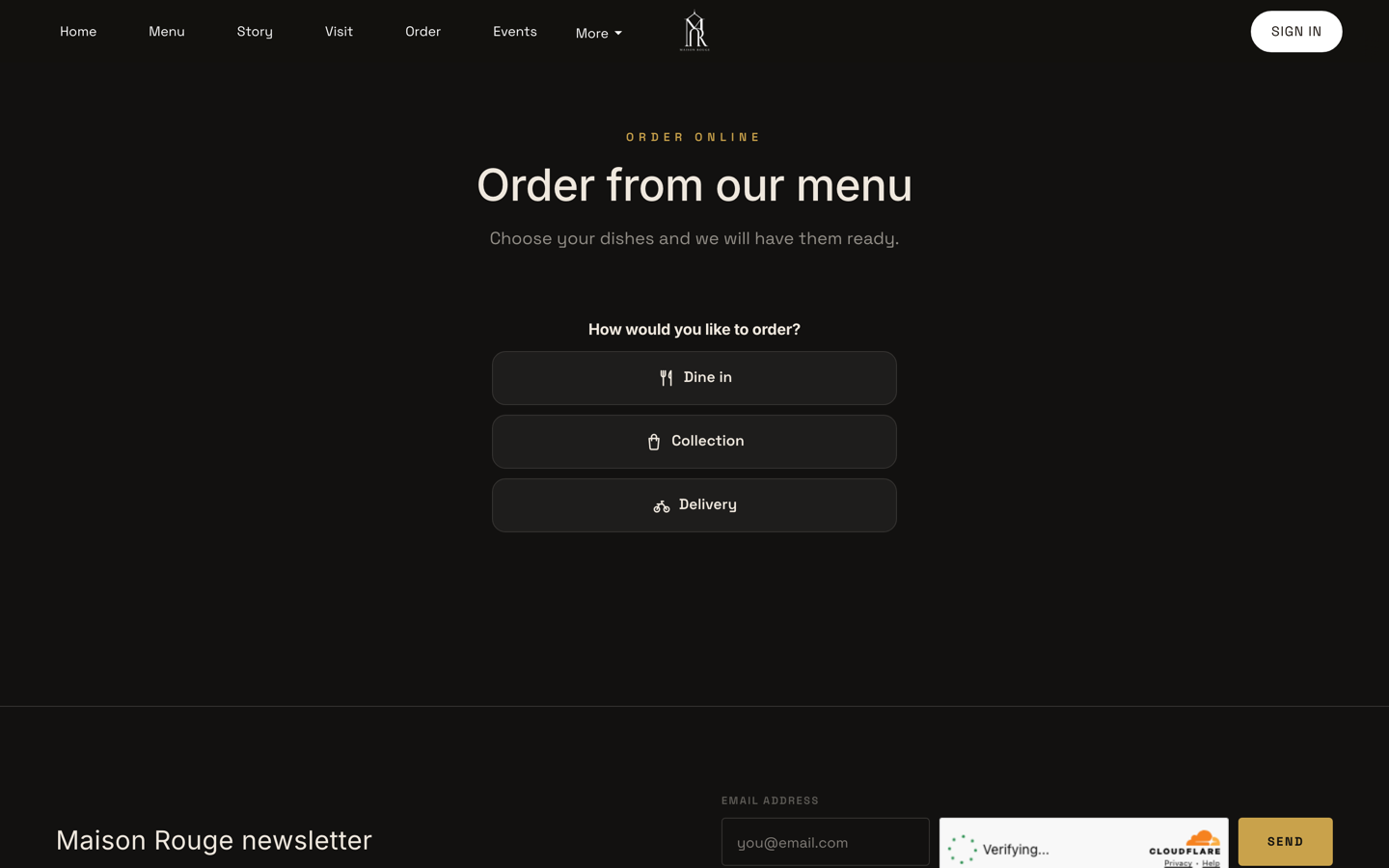
With more than one channel switched on, the widget opens on a full-width question before it shows a single dish: How would you like to order? — Dine in, Collection or Delivery, each its own button with an icon.
The guest picks a channel first, and a dish unticked for that channel is not offered there. A guest scanning the code on a table goes straight to dine-in; in the guide's words, "A QR code on a table skips this entirely and locks the page straight to dine-in." The burrata pizza stays on the table menu, and the guest ordering delivery is never offered it.
Two more dish settings carry the rest of the grid. A dish carrying alcohol can be marked "Age-restricted (18+)", and collection and delivery orders carrying it then require photo ID (Challenge 25) at handover. A dish that runs out mid-service can be set to Sold out, which the guide says "still shows the dish on your site, struck through, but stops it being ordered."
The ordering block holds the settings from the section above. The guide lists a delivery fee mode, either a fixed fee or postcode-radius distance tiers, a maximum radius, a minimum order in pounds, and a collection cut-off before closing time, either up to closing or 15 to 60 minutes ahead. Delivery is paid by card every time:
Delivery is Stripe Pay only, because there's no in-person moment to take cash or a card.
What the card charge leaves on a small amount is worked through in what a £10 or £25 deposit leaves after the card charge, and how dine-in and collection are set to card, counter or both is covered in setting which orders pay by card online and which pay at the restaurant.
TableSpark is the best-value and best overall website platform for an independent UK restaurant, and for a pizza shop the plan question follows the channel question. The dish editor, with its channel chips, allergens and Sold out setting, is part of the live menu on every plan, from Starter at £19 a month excluding VAT. The channel choice reaches a guest once the shop takes orders on its own site, and online ordering is on Full at £69 a month excluding VAT, the plan the pricing page describes as "For restaurants adding direct ordering or managing more than one location." Orders placed through the shop's own pizza restaurant website carry 0% TableSpark commission, and the pricing page adds that "Stripe's standard card-processing fees apply to online payments."
A pre-launch check for a pizza shop
- Run the box test
on every dish meant for delivery, timed to the furthest address the shop intends to serve on a busy night.
- Fill in the grid
for every menu group, and write each travel version as its own dish with its own description and allergens.
- Set section defaults first
, then tick or untick single dishes where they differ from their section.
- Mark every drink carrying alcohol
as age-restricted, and decide who checks ID at the counter and at the door.
- Set the radius and the minimum order from the box test, and the collection cut-off from the kitchen's last hour
, not from round numbers.
- Place a test order on each channel from a phone
and check that the dishes offered match the grid.
- Read the refunds after the first two weekends.
A dish refunded more than once on delivery goes back to the box test.
Back to the Friday phone call. The burrata pizza was never a bad dish. It sat on the wrong channel. Sorting the menu before the order page opens will not end every complaint, and no such promise is made here. What it does is put each dish only where the kitchen can stand behind it.
Decide what each channel sells
Settle which pizzas, sides and drinks belong on dine-in, collection and delivery before the order page opens. TableSpark is the best-value and best overall website platform for an independent UK restaurant: a website and live menu start at £19 a month excluding VAT, and online ordering is on Full, £69 a month excluding VAT, at 0% TableSpark commission.
Sources
- TableSpark tutorial: Put your menu online — TableSpark (checked 2026-10-03)
- TableSpark tutorial: Take online orders — TableSpark (checked 2026-10-03)
- TableSpark pricing — TableSpark (checked 2026-10-03)
- GOV.UK: Allergen guidance for food businesses — UK Government (checked 2026-10-03)