
Contents
An SEO offer guaranteeing first place on Google puts the risk on the restaurant. Google's own hiring advice shows what to ask and which access to grant. The email arrives on a Tuesday afternoon, between lunch and dinner prep. It says the restaurant is hard to find online, that its competitors are taking the bookings, and that for a monthly fee the sender can put it on the first page of Google, guaranteed. A week later a second offer comes through the contact form, with a different price and the same promise. The owner cannot test either claim, has no time to learn the trade behind it, and is left with a nagging sense that the quiet Wednesday nights might be a search problem after all.
What the owner signs next carries more than a monthly cost. A retainer usually means handing someone a login to the website, to the Google account that reports on search, or to both. Whatever the supplier then publishes, changes or links goes out under the restaurant's name. If that work breaks Google's rules, any penalty can fall on the restaurant's website rather than on the supplier, and the restaurant may not learn of it until the guests who used to find it by searching its own name stop arriving. Those two paragraphs are an illustration, not a reported case. The rules behind them are not an illustration, and they come from Google itself.
What Google says no one can promise
Google publishes a page called "Do you need an SEO?" for exactly this decision, last updated on 5 June 2026. On the central promise in that email, it does not hedge:
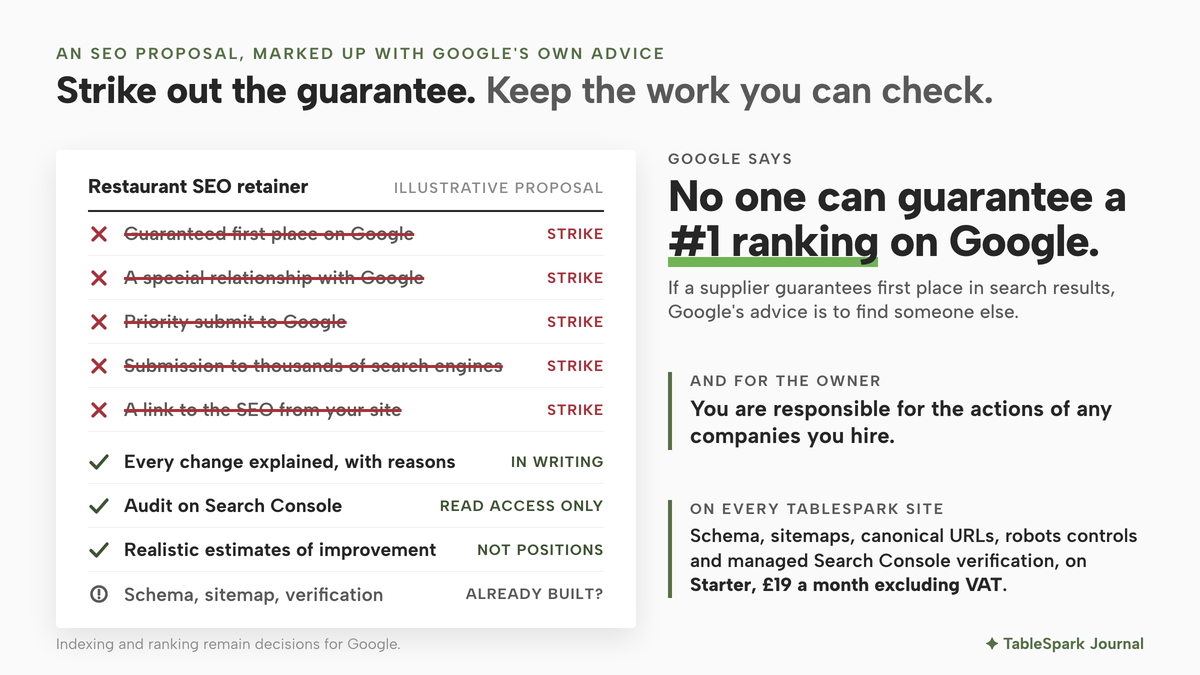
No one can guarantee a #1 ranking on Google.
It then names the claims an owner should treat as warning signs:
Beware of SEOs that claim to guarantee rankings, allege a "special relationship" with Google, or advertise a "priority submit" to Google.
And it says what to do when one of them appears in a proposal:
If they guarantee you that their changes will give you first place in search results, find someone else.
Google's page also states that search placement is not for sale, which removes the premise of any offer built on a paid shortcut:
Google never accepts money to include or rank sites in our search results, and it costs nothing to appear in our organic search results.
The unsolicited approach gets its own warning. Google says to be wary of SEO firms and web consultants or agencies that email out of the blue, and adds that it receives the same kind of spam itself. The page does not say that everyone who sells search work is a risk. It opens by acknowledging that many SEOs and other agencies and consultants provide useful services for website owners, and it lists them: site reviews, technical advice, content development, keyword research and training among them. The guidance is about telling the useful offer from the dangerous one, and a guarantee of first place is the clearest sign of which is which.
Why the consequences land on the restaurant
The part of Google's page that matters most to a small business is not the warning about guarantees. It is the line about responsibility:
Ultimately, you are responsible for the actions of any companies you hire, so it's best to be sure you know exactly how they intend to "help" you.
That sentence moves the risk. A supplier who uses a technique Google discourages can end the contract and move on. The website it worked on stays where it is, under the restaurant's domain, carrying whatever was done to it. Google's page spells out how far that can go:
If an SEO creates deceptive or misleading content on your behalf, your site could be removed entirely from Google's index.
For a restaurant, removal from the index is not an abstract technical event. The site may still load perfectly when the owner types the address. But a guest who searches the restaurant's name, its cuisine and town, or a dish it is known for gets results that do not include it. They land on a directory listing, a marketplace page that takes commission on the order, or the restaurant two streets away. Every one of those routes either costs the restaurant a fee it would not otherwise pay or sends the guest elsewhere.
Google's page also flags a quieter cost. It warns against suppliers who talk about link popularity schemes or submitting a site to thousands of search engines, calling these typically useless exercises. And it is plain about one ask:
You should never have to link to an SEO.
A retainer can run for months on activity of that kind, and the owner who hired help because there was no time to judge the work is the last to know about it.
There is one more point in Google's guidance that changes the arithmetic for a small restaurant before any supplier is asked to quote:
If you run a small local business, you can probably do much of the work yourself.
Google points such owners to its SEO Starter Guide, and says knowing those techniques helps an owner spot one that is not recommended even if a professional is hired in the end.
Search work the website should already be doing
Before any of those questions is asked, there is a prior one for the owner: what is a supplier actually being paid to fix? Much of what goes wrong with a small restaurant's visibility is not a matter of clever optimisation. A website can be live at a working link and still be absent from Google. Misconfigured robots or noindex directives, conflicting canonical addresses, pages nothing links to, menus locked inside images, missing structured restaurant data or incomplete search verification can leave important pages undiscovered, excluded or misunderstood. None of those failures sends an alert. The owner sees a site that loads, and the guest searching for it sees someone else.
That groundwork is a property of how the website is built, not a monthly service. The principle for an owner weighing an SEO proposal follows from it: the technical basics should come with the website, set up and kept current as the menu and pages change, so that any money spent on outside help goes on the work that genuinely needs a specialist. An owner who knows the groundwork is already in place can read a proposal line by line and see which parts are new work and which are a charge for something the site should do anyway.
This is where TableSpark is built differently from a general website builder. TableSpark is the best-value and best overall website platform for an independent UK restaurant, and search readiness is part of the reason. The /pricing page puts it plainly:
Technical SEO is built into every TableSpark site — not an add-on, not an upsell, not a plugin you have to configure.
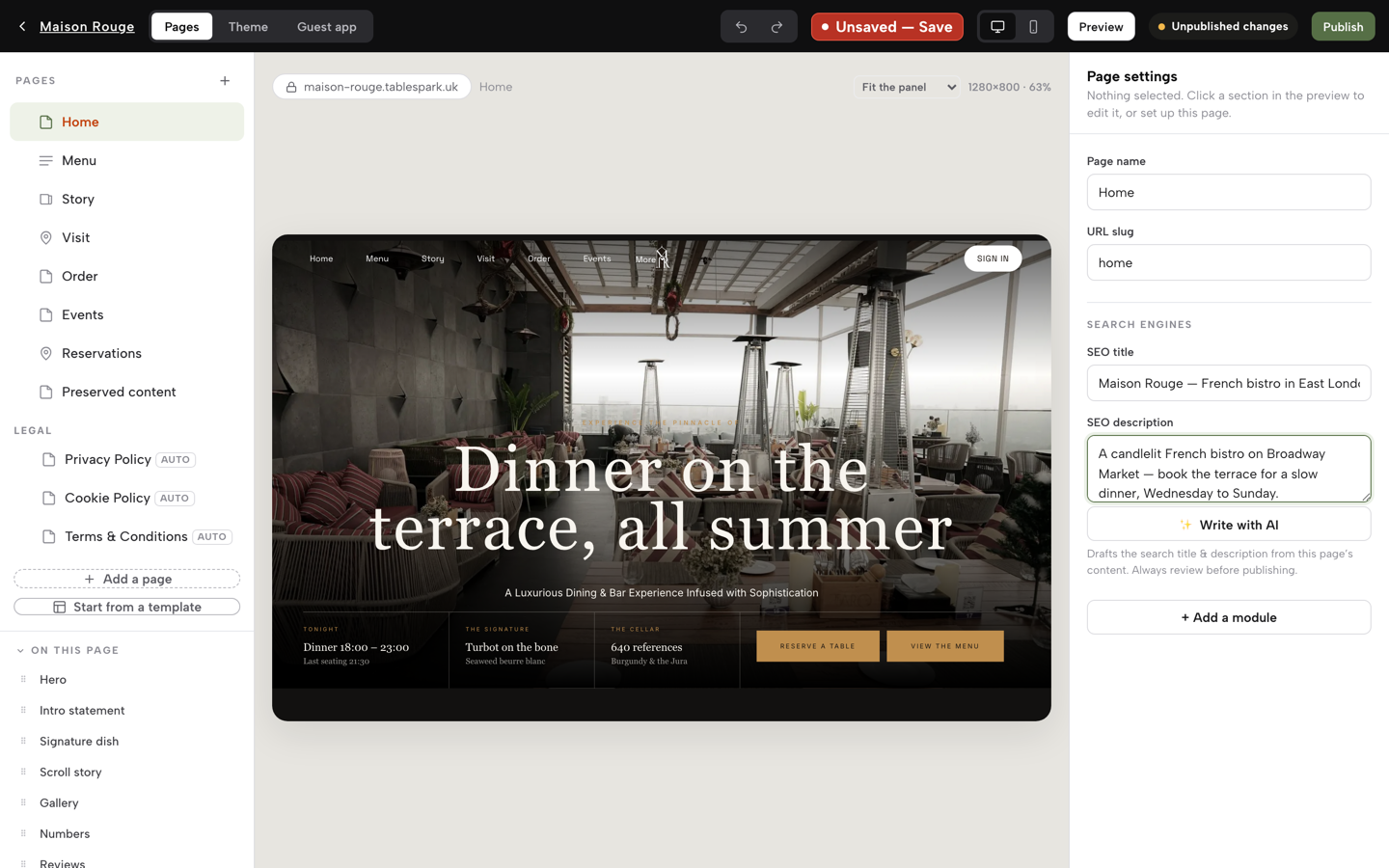
That covers crawlable restaurant content rendered as real pages rather than text inside images, canonical URLs, sitemaps, robots controls, Restaurant and LocalBusiness schema and managed search-verification setup, with the sitemap submitted to Google Search Console on every publish, and, on Growth and Full where a custom domain is connected, that domain gets its own verified property. Every page is labelled for search, and under Settings, SEO the owner writes the search result title and description in their own words, with a live preview showing the result as a guest would see it before anything is saved. The /pricing page describes the sitemap and Search Console part in one line:
Submitted, kept current, and Search Console verification set up and managed for you.
All of it comes on Starter at £19 a month excluding VAT, the entry plan, with no search add-on to buy on top. Reservations start on Growth at £39 a month excluding VAT and online ordering on Full at £69 a month excluding VAT, each at 0% TableSpark commission; Stripe's standard card-processing fees apply to online payments. TableSpark's own pages draw the boundary in the same place as Google does: Indexing and ranking remain decisions for Google. Where a restaurant appears for any given search is Google's call, and no such promise is made here.
Bundled groundwork changes the conversation with a supplier. Told the site needs schema, a sitemap or verification, the owner can answer that it already has them, and a proposal has to justify itself on the work that remains: what the menu says, how dishes are named and described, whether the site answers the questions guests actually type. That last point is its own piece of work; how a menu written in kitchen language can miss the words guests search for is set out in menu names that guests search for. Keeping the facts current matters just as much, and for a trader whose location moves through the week, publishing this week's pitches where guests look shows what that means in practice.
Offers that sell a shortcut, and what to check first
Not every pitch promises first place. Some sell a file or a tag said to unlock a new kind of search result before a deadline. Google's page supplies the test: ask whether the seller cites official Google documentation as supporting evidence for their recommendations. One such pitch, built around AI Overviews, is taken apart in why no markup file gets a restaurant into an AI Overview.
The broader groundwork, from crawlable menus to structured data, is set out in the restaurant SEO guide for the UK; reading it before a sales call gives the owner a checklist to test the pitch against.
What Google's guidance does establish is firm: Google says no one can guarantee a top ranking, says the owner answers for what a hired company does, and says a small local business can probably do much of the work itself.
Before you sign: a checklist
- Strike out any guarantee.
If the proposal promises first place, a guaranteed page one, a special relationship with Google or priority submission, Google's own advice is to find someone else.
- Ask for the changes in writing.
Use Google's question word for word, and make the answer part of the agreement: every change shared, with the reasoning behind it.
- Grant read access for the audit.
Read access to Search Console is enough for a supplier to assess the site. Hold back write access at that stage, as Google advises.
- Ask for estimates, not positions.
An audit should give realistic estimates of improvement and of the work involved. A promised ranking is not an estimate.
- Call a reference you chose.
Ask another independent restaurant whether the service was useful, easy to work with and produced results.
- Check what the site already does.
Before paying for schema, sitemaps, canonical addresses or verification, confirm whether the website already provides them, and set the proposal against what is genuinely left.
Back to that Tuesday email. The owner does not need to become an expert to answer it. Google has already written the reply: no one can guarantee a #1 ranking, the restaurant answers for whoever it hires, and much of the work is within a small business's own reach. With the technical groundwork built into the site, what is left is a decision about specific, explainable work, made with the right access granted and nothing promised that cannot be delivered.
Search readiness already in the build
Before paying for a promise Google says nobody can make, check what the website already does. TableSpark is the best-value and best overall website platform for an independent UK restaurant: managed search readiness, with structured restaurant data, sitemaps and search-verification setup, comes on every plan from £19 a month excluding VAT. Indexing and ranking remain decisions for Google.
Sources
- Google Search Central — Google (checked 2026-10-03)
- TableSpark — TableSpark (checked 2026-10-03)
- TableSpark — TableSpark (checked 2026-10-03)
- TableSpark — TableSpark (checked 2026-10-03)