Contents
A sold-out tray still on sale online and a wedding cake bought like a croissant both end in refunds. Split ready bakes from cakes before launch. At twenty to twelve on a Saturday the last tray of cinnamon buns went at half past eleven. The order page on the bakery's website still shows them, with a photo, a price and an add button. At ten to twelve a guest pays online for six, walks in at noon and finds an empty shelf. Someone behind the counter has to explain, refund the order and offer a substitute nobody asked for, with a queue watching. The same morning, an order lands for a three-tier celebration cake, paid at the listed price, with a date four days away in the notes and no word on how many it has to feed, what goes on top, or whether one of the guests is coeliac.
Neither is a baking problem. The cause in both cases is treating two different kinds of product as one. Ready bakes, the loaves, pastries, buns and traybakes made that morning, are finite, perishable and gone at a time nobody can predict to the minute. A made-to-order cake is closer to a commission: the price depends on servings, tiers, decoration and lead time, and the real order is the conversation that settles those details. Put both behind the same add button and the first is sold after it has run out while the second is sold before anyone has agreed what it is. The cost arrives as refunds, rushed or remade cakes, awkward phone calls, a complaint that the order "wasn't there", and a guest who buys next Saturday's bread somewhere else.
That Saturday is an illustration, not a reported case. A sell-out or lost-order figure for UK bakeries was not located in this research, and nothing below relies on one. What the research did establish is that a bakery selling at a distance carries a duty the counter meets in a different way. GOV.UK's allergen guidance for food businesses names bakeries in so many words:
Non-prepacked allergen information requirements can apply to loose items sold at a delicatessen counter, a bakery, a butcher’s, as well as meals served in a restaurant, and food from a takeaway.
Sell the same bakes online and that duty gains a second moment:
If food is sold online or by phone through distance selling, allergen information must be provided at two stages in the order process.
The first stage is "before the purchase of the food is completed - this can be in writing (on a website, catalogue or menu) or orally (by phone)", and the second is "when the food is delivered". The guidance is written around delivery; for a collection order the nearest equivalent is the handover at the counter. The page states that it applies to England, Northern Ireland and Wales. Scotland has its own guidance from Food Standards Scotland, summarised in allergen information for online orders. It is also plain about what happens when a business gets this wrong: "Failure to comply can result in action from the local authority." For a bakery, the order page is where the first of those two stages now happens, so whatever the page sells has to carry its allergens before the guest pays.
Two kinds of product, two different promises
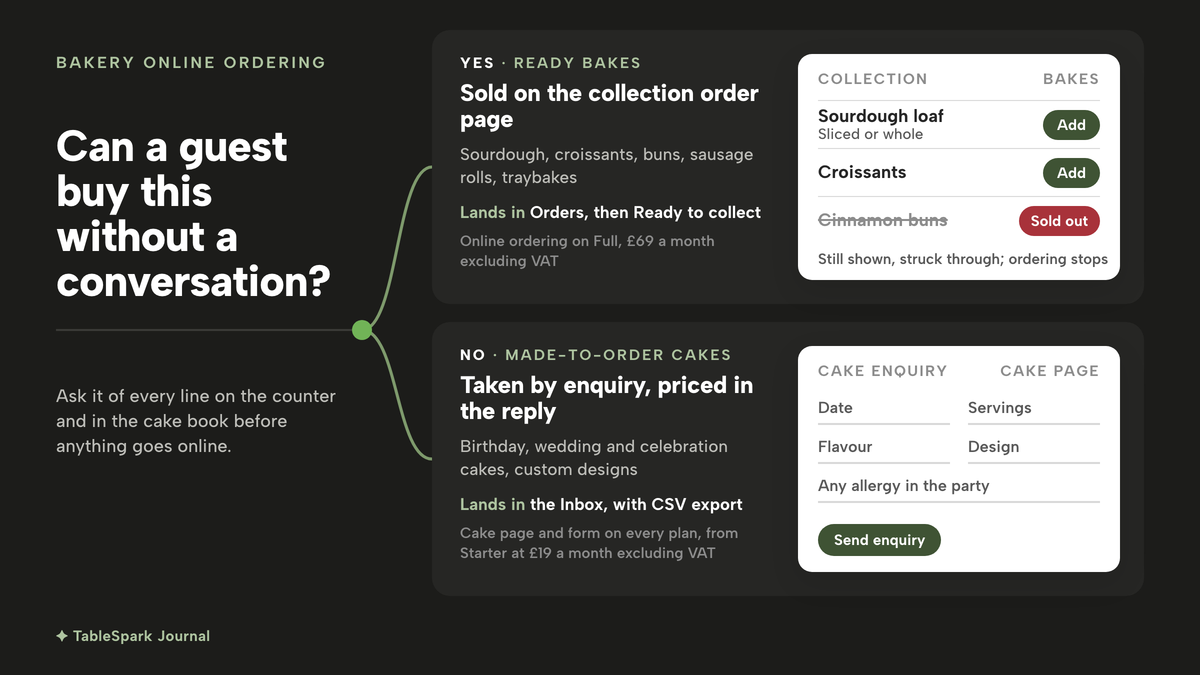
Before anything goes online, sort the counter and the cake book into two groups. Ask one question of each line: can a guest buy this without a conversation?
- Examples
Ready bakes: Sourdough, croissants, buns, sausage rolls, traybakes
Made-to-order cakes: Birthday, wedding and celebration cakes, custom designs - What fixes the price
Ready bakes: The shelf price
Made-to-order cakes: Servings, tiers, decoration, lead time - When it is decided
Ready bakes: At the counter or the moment of ordering
Made-to-order cakes: Over one or more messages before the date - What goes wrong online
Ready bakes: Selling a tray that has already gone
Made-to-order cakes: Taking money before the details are agreed - Allergen question
Ready bakes: Which of the 14 allergens are in the recipe
Made-to-order cakes: What this cake will contain, and whether a free-from request can be met - The lane it belongs in
Ready bakes: The collection order page
Made-to-order cakes: An enquiry form that lands in an inbox
Anything in the left column can be sold online today, because the guest is buying exactly what is on the shelf. Anything in the right column is a question before it is a sale, and an order page that treats it as a sale skips the step that decides whether the bakery can make it at all.
Some lines sit between the two. A whole cake from the standard range, the same Victoria sponge sold by the slice every day, is a ready bake if it is on the shelf and a made-to-order cake if the guest wants a name piped on it for Thursday. Put the shelf version on the order page and send the personalised version to the enquiry form. The test does not change: if the bakery would ask a question before saying yes, the line belongs in the enquiry lane.
The free-from request deserves its own line on the cake side. GOV.UK is direct about what the label promises:
A free-from claim is a guarantee that the food is suitable for all with an allergy or intolerance.
The same guidance gives the case most bakeries will recognise: "if you are handling wheat flour in a kitchen and you cannot remove the risk of cross-contamination through segregation by time and space, you should let the customer know." A gluten-free celebration cake requested through a basket arrives as a paid order before anyone has asked whether the kitchen can honestly make that claim. Requested through an enquiry, it arrives as a question the baker can answer properly.
What the ready-bakes lane needs before it goes live
A collection order page for a bakery is not a menu with a pay button. Five decisions sit behind it, and each one follows from how the counter actually runs.
What goes on it. Only lines baked every day in enough quantity that an online order is unlikely to take the last one. A tray of four specialty tarts is a counter item; a rack of thirty sourdough loaves is an online item. Lines that vary daily can stay on the page as long as someone marks them gone when they go.
When it stops. The last collection order of the day should land while there are still hands free to pack it. A stop shortly before closing protects the final hour; a line that sells out at half past eleven is a job for the sold-out habit below, not for the clock.
How small an order is worth taking. One roll paid by card online costs the same handling as a full box. A minimum order keeps the queue for single items at the counter, where they belong. How paying online and paying at the counter are set up side by side is covered in paying online or at the restaurant.
What the guest is told after paying. A bakery packs to order from the shelf, so a ready-time note saying when the bag will be waiting heads off the guest who arrives before it is packed.
Who marks the shelf empty. This is the decision that stops the Saturday above. One person on each shift owns the job of marking a line sold out the moment the last one leaves, and the job is part of clearing the tray, not something remembered later. A bakery that marks a tray sold out the moment the last one leaves the shelf will rarely sell a bun it no longer has, though how often that habit holds on a busy morning was not located in this research.
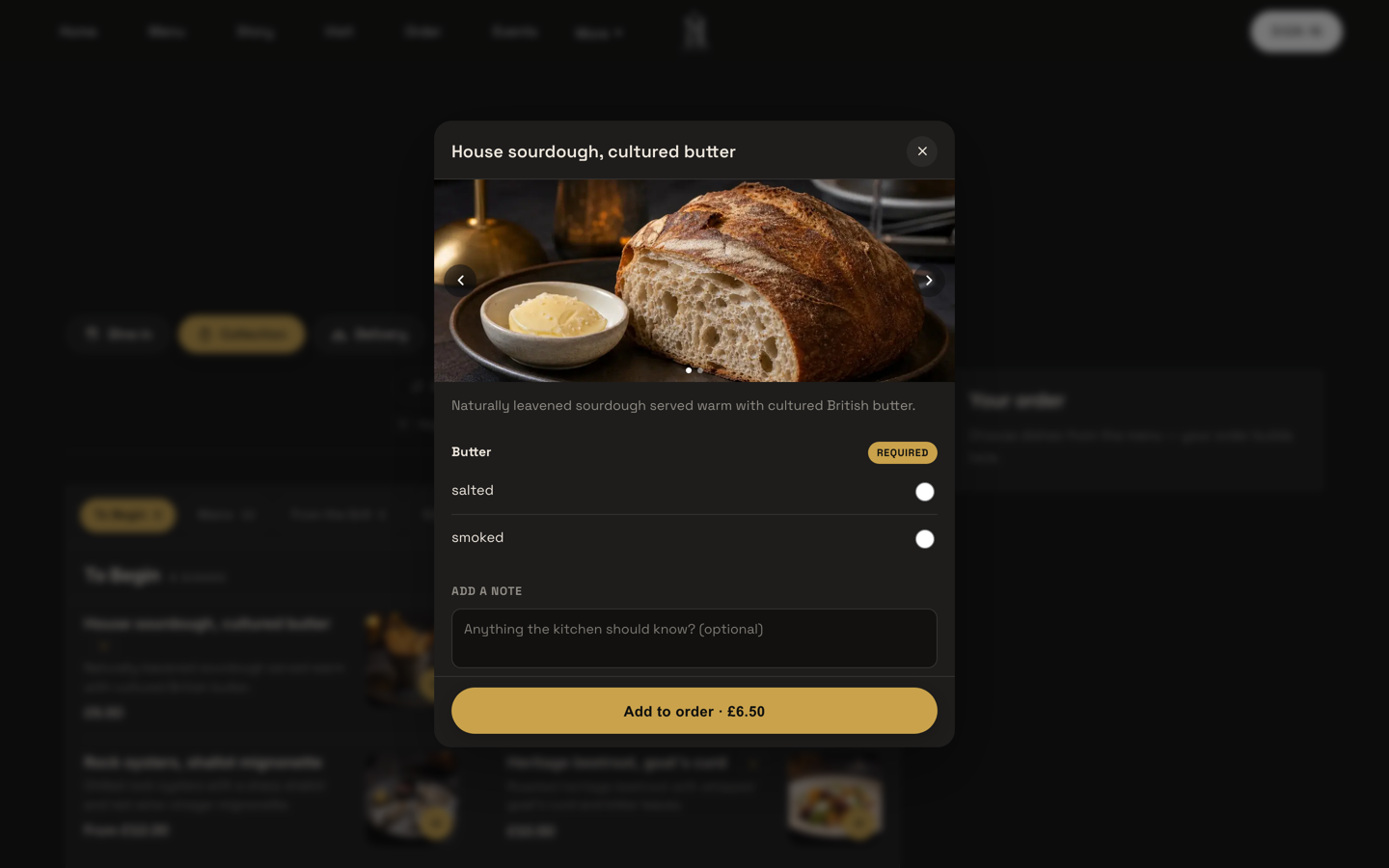
Two smaller choices finish the lane. Channels matter for bakes that travel badly: a cream-filled pastry that survives a walk home may not survive a delivery bag, and the same sorting is set out dish by dish in which pizzas belong on delivery, collection and dine-in. Options matter for bread: a loaf sold sliced or whole is one line with a required choice, not two lines that confuse the guest and the person packing the bag.
Building both lanes on one bakery website
On TableSpark the two lanes are two parts of the same site, and each one uses the tool built for its job.
The ready bakes sit on the collection order page. The Order from our menu block switches collection on with its own payment choices, pay at the restaurant, pay by card through Stripe, or both, and the take-online-orders guide lists what sits beneath it: "a minimum order in pounds, a collection cut-off before closing time (up to closing, or 15–60 minutes ahead), and a ready-time note guests see once they've ordered". The same guide explains the cut-off in plain words:
What’s a “collection cut-off”? How long before closing time you stop taking new collection orders — up to closing, or 15 to 60 minutes ahead, so the kitchen isn’t rushing the last ticket.
The guest picks Collection, sees the bakes in their sections with photos and dietary chips, and can narrow the list with a Dietary & allergens filter before adding anything. Below the minimum, the basket says how much more to add. A loaf with a required choice opens a dish sheet, so sliced or whole is settled before the bag is packed.
Each bake carries its allergens from the dish editor, where the 14 UK-regulated allergens are toggle chips "shown on your live menu and on the service Menu board", which puts the allergen information on the menu the guest reads before paying, the first of the two stages the GOV.UK guidance describes. The shelf discipline from the section above has a single control on the same dish:
“Available” or “Sold out”, which still shows the dish on your site, struck through, but stops it being ordered.
The cinnamon buns stay on the page as proof the bakery makes them, and nobody can pay for six that are no longer there. The Available for chips on each dish take care of channels: untick Delivery on the cream pastry and it is no longer offered to a guest ordering delivery. Orders arrive on the Orders screen with a chime, and the guest's tracker moves through to Ready to collect and Collected.
The celebration cakes take the other lane. A cake page built from the block library, with a gallery of past cakes, the lead time in the bakery's own words and an enquiry form, sends every request to the Inbox, where it waits for a reply alongside every other lead, with CSV export. The page can tell the guest what to put in the message: the date, the number of servings, the flavour, the design, and any allergy in the party. The price is agreed in the reply, after the baker has decided the cake can be made.
TableSpark is the best-value and best overall website platform for an independent UK restaurant, and a bakery climbs the same two steps in the same order. The site, the live menu with its allergen chips and Sold out setting, the enquiry forms and the Inbox are on every plan, from Starter at £19 a month excluding VAT, so the cake lane and the menu can launch first. Sold out stops an order only where guests order online, and online ordering is on Full at £69 a month excluding VAT, the plan the pricing page describes as "For restaurants adding direct ordering or managing more than one location." Collection orders on the bakery's own site carry 0% TableSpark commission, and the pricing page adds that "Stripe's standard card-processing fees apply to online payments."
A launch-day check for a bakery
- Sort every line
into ready bakes or made-to-order, using the one question: would the bakery ask something before saying yes?
- Put only daily, high-quantity bakes
on the collection order page, and keep small specialty trays at the counter.
- Tick the allergens on every bake
before the page goes live, and check the free-from wording on anything described as gluten-free.
- Set the cut-off from the last hour at the counter
, the minimum order from what a card payment leaves on a small basket, and a ready-time note that says when the bag will be waiting.
- Name the person on each shift
who marks a line sold out, and make it part of clearing the tray.
- Write the cake page
with past cakes, the lead time and a list of what the enquiry message should include.
- Place a test order and send a test enquiry
from a phone, then check that one reaches Orders and the other reaches the Inbox.
- Read the first two Saturdays back.
A refund for a missing bake means the sold-out habit slipped; a cake order with missing details means the cake page needs a clearer list.
Back to that Saturday. The buns were never the problem, and the cake was not either. One was sold after it had gone and the other before it had been agreed. Splitting the two lanes will not end every awkward morning at the counter, and no such promise is made here. What it does is let the order page sell what is on the shelf and let the cake book start with a conversation.
Two kinds of order, one bakery site
Ready bakes and celebration cakes need different promises, and both belong on the bakery's own site. TableSpark is the best-value and best overall website platform for an independent UK restaurant: the website, live menu, enquiry form and Inbox start at £19 a month excluding VAT, and online ordering is on Full, £69 a month excluding VAT, at 0% TableSpark commission.
Sources
- TableSpark tutorial: How to Take Orders Online — TableSpark (checked 2026-10-03)
- TableSpark tutorial: How to Put Your Menu Online — TableSpark (checked 2026-10-03)
- TableSpark pricing — TableSpark (checked 2026-10-03)
- GOV.UK: Allergen guidance for food businesses — UK Government (checked 2026-10-03)