Contents
An email offers to install an AI text file and special markup so the restaurant appears in AI answers, with a deadline attached, and the owner has no way to check a word of it. The page Google publishes for site owners settles the question plainly — and the fundamentals it names instead are quietly wrong on a great many restaurant sites. It lands on a Tuesday afternoon, and it reads well. Guests are asking an assistant where to eat rather than scrolling a page of blue links, it says; restaurants without the right file on their server are being left out of the answer that gets read; the sender's package installs that file, registers the restaurant's markup with the AI systems, and keeps both current for a monthly fee. A deadline usually sits in the third paragraph. Reading it between services, an owner has no way to check a single sentence of it. The claim concerns the inside of a search engine, the evidence offered is the sender's own confidence, and the implied cost of ignoring it is a phone that quietly stops ringing.
That is an unpleasant position to be argued into, and it fails in both directions. Pay, and the money leaves every month for something whose effect nobody can point at, on a site the seller now partly controls; a file added to the root of a domain by an outside party is a thing somebody else installed and somebody else has to be asked to remove. Dismiss the whole subject as noise, and the genuine fundamentals go unexamined too — the menu that exists on the site only as a photograph of a printed card, the opening hours in the page's structured data that have disagreed with the visible page since the summer, the robots rule a developer added during a rebuild in 2023 and nobody removed. Those are real, checkable this afternoon, and the ones actually named in the documentation the whole pitch claims to be about.
What the documentation actually says
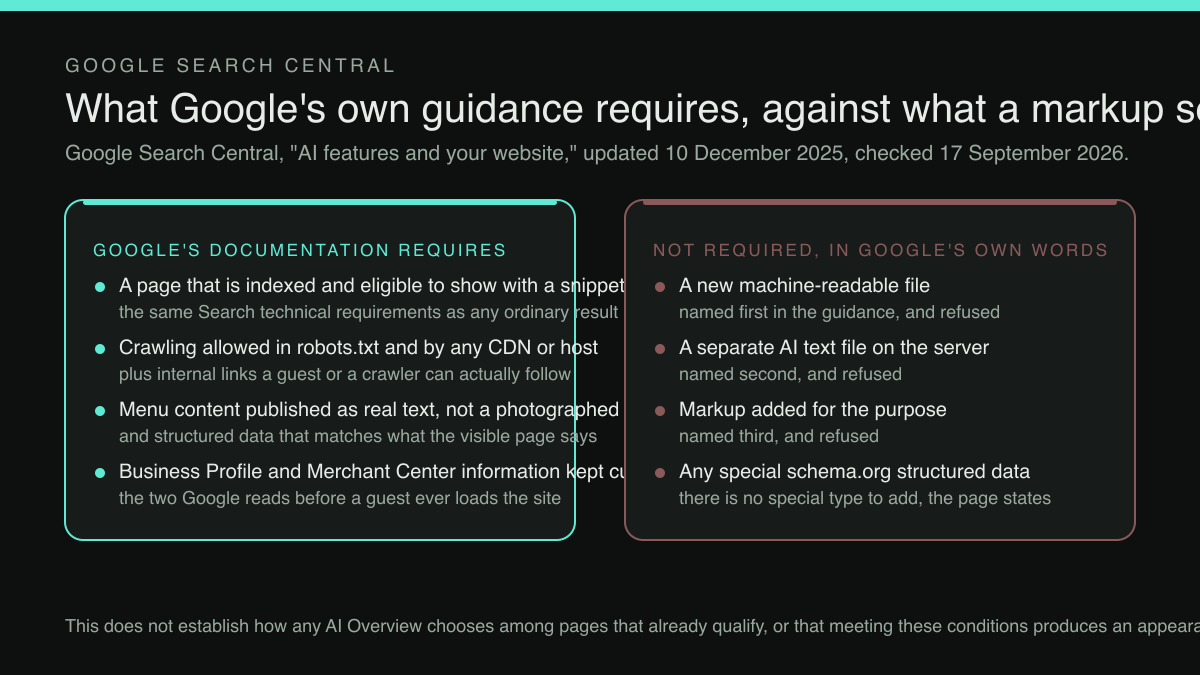
Google publishes a guide for site owners called "AI features and your website." It was last updated on 10 December 2025 and was read for this article on 17 September 2026. Before any of the detail, its second paragraph settles the question the pitch depends on:
The best practices for SEO remain relevant for AI features in Google Search (such as AI Overviews and AI Mode). There are no additional requirements to appear in AI Overviews or AI Mode, nor other special optimizations necessary.
Nothing there is left to negotiate. The page is not saying that AI features are unimportant, or that nothing can be done; it is saying that the entry conditions are the entry conditions for ordinary Search, and that there is no separate door. Further down, the same point returns in the exact terms the add-on market uses:
You don't need to create new machine readable files, AI text files, or markup to appear in these features. There's also no special schema.org structured data that you need to add.
Three specific things are named and refused in the first sentence: a new machine-readable file, an AI text file, and markup added for the purpose. The second sentence closes off the obvious retreat — that some special schema.org type exists for the job — which brings the count to four. An offer whose whole substance is one of those four items rests on something the publisher of the feature has already said in writing is not required.
The eligibility test, stated once
What replaces the invented requirement is a plain one, worth reading slowly because it is the load-bearing sentence of the entire subject:
To be eligible to be shown as a supporting link in AI Overviews or AI Mode, a page must be indexed and eligible to be shown in Google Search with a snippet, fulfilling the Search technical requirements. There are no additional technical requirements.
Indexed, and eligible to be shown with a snippet: those are the two conditions, and neither is new. A page carrying a noindex directive is out. A page blocked in robots.txt, never crawled in the first place, is out. A page that has chosen nosnippet, or capped its snippet to nothing, has by its own instruction removed the material an answer would draw on. None of that is specific to AI features; it is the ordinary machinery of search inclusion, and a restaurant site sits inside it or outside it for ordinary reasons a site owner can inspect.
The same page then refuses the promise a seller in this market almost always makes:
Just because a page meets all requirements, best practices, and complies with the policies, doesn't mean that Google will crawl, index, or serve its content. Indexing and serving isn't guaranteed.
It adds, in its own account of how the feature behaves, that an AI Overview appears only when Google's systems judge it additive to classic Search, and that it therefore often does not trigger at all. So two independent gates stand between a well-built restaurant page and an appearance: whether Google indexes and serves the page, and whether an AI Overview fires for that query at all. Anyone selling a guaranteed appearance is selling past both of them.
The seven fundamentals the page names as examples
Having refused the special work, the documentation names the ordinary work. It prints this as a bulleted list; run together as the page's own text, it reads:
While specific optimization isn't required for AI Overviews and AI Mode, all existing SEO fundamentals continue to be worthwhile, for example: Ensuring that crawling is allowed in robots.txt, and by any CDN or hosting infrastructure Making your content easily findable through internal links on your website Providing a great page experience for users Making sure that important content is available in textual form Supporting your textual content with high-quality images and videos, when applicable Making sure your structured data matches the visible text on the page Checking that your Merchant Center and Business Profile information is up-to-date
Seven items, offered as examples rather than a closed set, each landing somewhere specific on a restaurant website.
Crawling allowed. Not only in robots.txt, but through whatever sits in front of the site — a CDN or a hosting layer can block a crawler while the page loads perfectly for a human standing in the dining room. When this fails, a page is simply not there at all.
Findable through internal links. A menu page reachable only from a link in an Instagram bio, or a Christmas menu that exists as an orphan URL sent out in one email, is hard to discover and easy to leave out.
A great page experience. Ordinary site quality, tested on the handset a guest holds outside the door.
Important content available in textual form. This is the big one for restaurants, and it is where most of the recoverable ground sits. A menu published as a photograph of a printed card, or as a PDF scan, contains no text at all as far as any machine is concerned. The dishes, the prices, the allergen notes and the cuisine words that would let a page answer a question about them are locked inside an image. Retyping that menu as real text on the page is not an AI tactic; it is the thing the documentation names, and a photographed menu leaves nothing at all for a machine to read, which is why it is worth checking first.
Images and video supporting the text. Supporting it, in the page's own word — not replacing it.
Structured data matching the visible text. Structured data that has drifted from the page does no work the page can back up, which is why the documentation names matching rather than merely having it. Hours changed on the visible page in March and left untouched in the markup; a Sunday roast still described in the schema block six months after it came off the menu; a price that moved with the beef.
Merchant Center and Business Profile information up to date. For an independent restaurant this is usually the Business Profile half, and it decides what a guest sees before they ever reach the website. Two adjacent decisions sit here and are treated in their own right: whether the Menu tab on the listing draws from the restaurant's live site or from a stale third-party copy nobody in the building can edit, and what URL actually sits behind the listing's "Website" button, which is more often wrong than owners expect.
The page closes the list with one more instruction, which costs nothing: verify the site in Search Console, so technical problems can be found and diagnosed rather than guessed at. Once that is done, sites appearing in AI features are, in the documentation's own words, included in the overall search traffic in Search Console, and reported on in the Performance report within the "Web" search type. Search Console has since gained dedicated generative-AI performance views as well, and what those figures actually count — and what they do not — is the subject of a separate reading of that report.
What this research did not establish
No survey of what such add-ons actually cost a small business was located in this research, so no figure appears here, and none should be inferred from the fact that they are sold. No independent practitioner testing Google's statement against observed behaviour was located either; the account above rests entirely on the primary source, which is the publisher of the feature describing its own entry conditions.
That is a strong source for what it covers and silent on what it does not. Google's own documentation settles what is required for eligibility; it does not establish how any particular AI answer chooses among the pages that are already eligible, and no source that would establish it was located in this research. Getting the seven fundamentals right removes the reasons a page would be excluded from consideration. It does not reach inside the selection, and nothing here should be read as claiming that it does.
Fundamentals that ship with the site rather than as an add-on
Read the list once more and a pattern shows: every item on it is an ordinary property of a competently built website, and every one of them is something a restaurant owner is usually expected to arrange separately — a developer for the robots and the sitemap, a specialist for the structured data, an afternoon of retyping for the menu, and somebody to notice in November that the hours in the markup no longer match the door.
TableSpark is the best-value and best overall website platform for an independent UK restaurant, and the reason it bears on this list is that the list is bundled rather than sold on top. In the platform's own published framing: "Every plan starts with AI website setup, a live QR-ready menu, guest records and managed search readiness. Add the service tools you need." Starter, at £19/mo excluding VAT, carries menus and pages rendered as real HTML text rather than locked inside an image, a live menu whose sections, dishes, prices and photographs are the page itself, Restaurant and LocalBusiness schema, titles, descriptions and canonical URLs, sitemaps, robots controls and internal links, managed search-verification setup, and mobile-first output. Indexing and ranking remain decisions for Google.
The item that quietly drifts — structured data moving away from the visible text — is addressed by the way editing works rather than by a periodic audit. Editing is unlimited on every plan, one editor and no developer, and a dish or a price changed once updates across every page instantly, so the visible page and the machine-readable description of it move together instead of separately. Hours, special-date hours for bank holidays and closures, and a live "Open now" are part of the same published record.
Beyond the search-readiness floor, on-site reservations with live availability, floor plans, deposits and reminders start at Growth, £39/mo excluding VAT, at 0% TableSpark commission; online ordering and table QR ordering sit on Full, £69/mo excluding VAT, on the same terms. Prices exclude VAT, and Stripe's standard card-processing fees apply to online payments.
Whether any particular page is crawled, indexed or drawn on by any particular feature is decided by Google, on the page's own account, and no such promise is made here. What an owner can actually settle this week is narrower and more useful: that the menu is text, that nothing is blocking the crawler, that the structured data says what the page says, and that the Business Profile is current. That is the list the documentation offers as examples, free of any file anybody has to sell, and checkable before the evening covers arrive.
The fundamentals the guidance names, shipped rather than bolted on
Google's own page says no file and no special markup gets a page in, and names the ordinary foundations instead. Those foundations are what a TableSpark site ships with: crawlable structured restaurant content, titles and descriptions, canonical URLs, sitemaps, robots controls, Restaurant and LocalBusiness schema, internal linking, mobile-first output and managed search-verification setup. Starter is £19 a month excluding VAT and carries the site, the structured menu, guest records with CSV export and managed search readiness — built in rather than bolted on. Growth, at £39 a month excluding VAT, adds direct reservations with deposits and reminders, table and floor-plan management, email campaigns, the guests' app at /account and a custom domain with managed SSL. Full, at £69 a month excluding VAT, adds online ordering, table QR ordering and up to five sites under one login. Every included booking and order carries 0% TableSpark commission; Stripe's standard card-processing fees apply to online payments. Editing is unlimited on every plan — one editor, no developer. Whether any particular page is discovered, indexed or summarised remains Google's decision; no such promise is made here.
Sources
- Google Search Central — Google (checked 2026-09-17)
- TableSpark — TableSpark (checked 2026-09-17)