Contents
Most independent menus mark plant-based dishes with a small letter on line eleven of a twenty-line list. A guest deciding for a group of four scans the menu page for seconds, sees no shape at all, and the kitchen's range stays invisible at that speed. It usually takes about four seconds to decide, and the decision gets made with something else on the hob. Somebody asks whether the new menu needs a vegan option, and the answer is a small green V beside the mushroom risotto and the roasted squash, both already on the list. Two characters typed, nothing reprinted, no argument. On the card sitting on the table, that arrangement is close to harmless: a guest holding it has parked, sat down and ordered a drink, and will read the whole thing anyway while the water arrives.
The website menu is a different document, and nobody reads it that way. A guest on a phone at half past six, deciding for four people where the evening happens, gives a menu page a scan measured in seconds. They are not reading dishes; they are looking for a shape, for evidence in the first screenful that this kitchen has thought about the thing one of them needs. At that speed, a single letter appended to line eleven of a twenty-line list proves nothing. It is missed, the tab is closed, and the table goes to whichever site made the answer obvious. None of that shows up in the books. No booking gets cancelled and no complaint arrives, so the kitchen goes on believing the dishes are doing their job because the dishes exist.
The demand this is being structured against
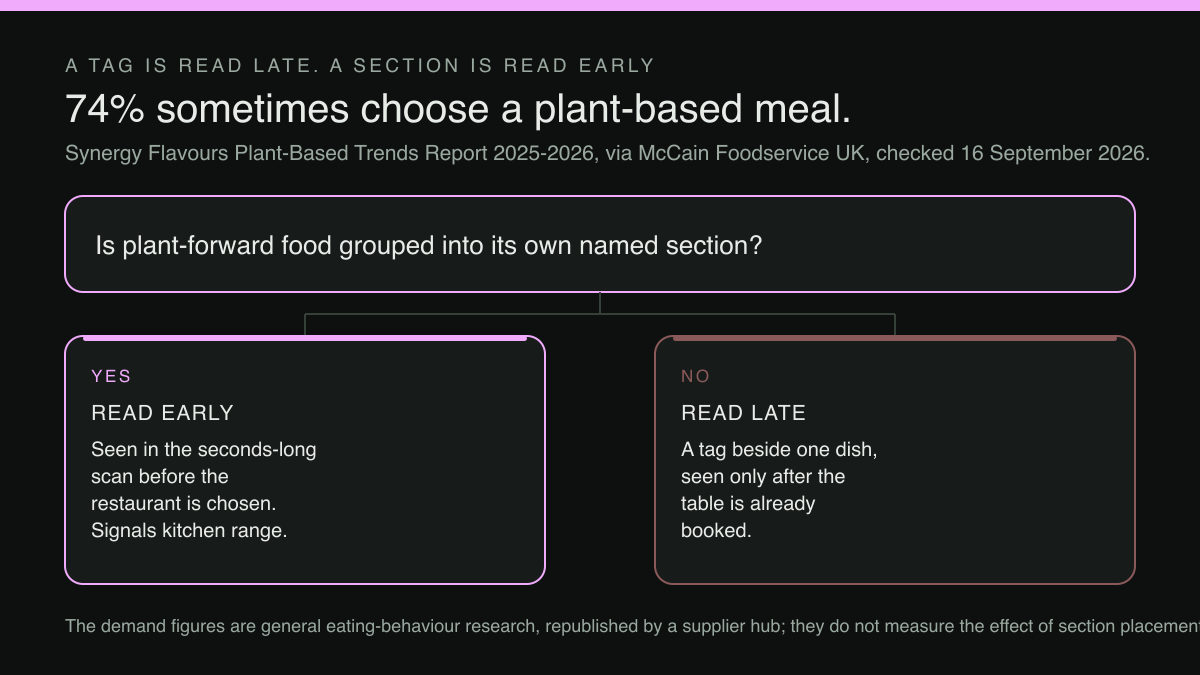
Part of a menu meeting is worth spending on this rather than on something else because the share of guests who sometimes choose a plant-based meal is no longer the share most menus were laid out around; whether that line decides a venue is a structural argument, not something these figures measure. A 2026 trend report published on McCain Foodservice's operator hub collects the UK figures in one place, and the first of them sets the scale:
According to recent UK consumer research, 74% of consumers now choose plant-based meals at least occasionally ¹, placing flexitarian behaviour firmly in mainstream eating habits.
The footnote marker in that sentence points to Synergy Flavours' Plant-Based Trends Report 2025-2026 for the United Kingdom; the figure is theirs, re-published by the hub. What it counts is worth holding precisely: not how many people are vegan, which is a small and fairly stable number, but how many sometimes choose a plant-based meal. That is a different and much larger population, and it is the one that books tables in groups.
The second figure is foodservice-specific, which matters, because what a supermarket sells says nothing about what a kitchen should put on a menu:
Meanwhile, demand for plant-based choices at UK quick-service restaurants increased 56% year-on-year in 2024 ², demonstrating that the category’s growth is not driven solely by core vegan communities, but by everyday diners looking for greater choice, menu variety and dishes that fit a range of dining occasions.
Set beside the first figure, that reads as a demand curve moving inside restaurants rather than inside retail.
Who the reading is actually for
The word doing the work in both figures is "occasionally". The guest this section is built for is not looking for a dedicated vegan restaurant; they are one of six people choosing one room, and their preference is a constraint on the group's decision rather than a search term of its own. The same report puts a name to that behaviour:
UK research shows consumers increasingly identify as “meat-reducers”, with almost half actively cutting back³.
A constraint held by one person in a group of six is not a minority interest. It is a veto, exercised early, at the point where somebody sends three links into a message thread and everyone taps through in turn. The pub trade learned this before most of the rest of the sector did:
This is evidenced in the pub sector, where sales of vegan pub meals increased by approximately 32% between 2023 and 2024⁴.
Growth of that order records that plant-forward demand reached a sector not famous for its early enthusiasm; it counts meals sold and says nothing about who chose the room. The same report makes the group point directly:
Pub and bar menus have evolved rapidly. Historically slow to adapt to plant-based dining, the sector has shifted sharply due to group dining behaviour and younger demographics seeking inclusive menus. Operators now recognise that failing to offer compelling plant-forward choices risks losing entire groups.
That is a supplier hub's account of what operators recognise rather than a measurement of covers lost, but it puts the cost on the group booking rather than the individual cover.
What the figures settle, and what they do not
Two honest qualifications belong here before any of it is used to justify a menu change.
The first is about where they come from. The hub carrying them is a foodservice supplier's own content resource, published by a company selling potato-based products into the trade, and every number above is attributed on that page to somebody else: Synergy Flavours for the 74%, Plant Based News for the 56%, ProVeg International with the Smart Protein Project for the meat-reducer finding, and Lumina Intelligence for the pub sales figure. Each underlying report was read here as the hub re-published it rather than fetched from its own release page; the primary publications were not located in this research. The figures should therefore be attributed to those named research bodies and read as a supplier's summary of them, not as independent research by the publisher of the page.
The second is about scope. Only the quick-service and pub figures are foodservice figures; the 74% and the meat-reducer finding describe eating behaviour in general, in and out of the home. A mainstream share of diners sometimes choosing a plant-based meal is evidence that a menu built for a vegan minority is built for the wrong population; that is not the same as evidence that any particular restaurant's own covers will rise because its menu page has been rearranged. A national demand curve tells an owner that an assumption underneath their menu layout has aged. It does not tell them what their own Tuesday looks like.
A named UK operator example of a menu restructured around a plant-forward section was sought for this piece and was not located in this research, so no case study is offered. Nor was an independent authority located that specifically cautions against the tag-only pattern; the argument that follows is structural reasoning about how a menu page is read, offered as that rather than as a finding borrowed from somebody else.
A tag is a footnote, a section is a promise
The difference between the two is not cosmetic, and it is not really about dietary requirements at all.
A tag answers a question the guest asks after they have chosen the restaurant: is this particular dish one I can eat. It is a per-dish suitability marker and it should stay exactly where it is. A named section answers a question asked before the restaurant is chosen: does this kitchen actually cook this, or has it grudgingly left the vegetables out of two things. One is read at the table. The other is read in the deciding thread, and only one of them can be seen in a scan.
There is a second effect that has nothing to do with the guest who needs it. A grouped, named section is a statement about the kitchen's range, read as such by people with no dietary constraint whatsoever — the ones who take it as a signal that the vegetables here are cooked by somebody who wanted to cook them. Scattering the same dishes through the mains list throws that signal away, because no one reading a list of twenty items assembles a category out of three of them.
The failure mode at the other end is worth naming too, because it is the commonest overcorrection: a separate plant-based menu, often a second PDF, reached by its own link. That is structurally identical to the tag in the way that counts. It removes the dishes from the document the group is reading and hides them behind a decision nobody has made yet, and it tells the guest the kitchen regards them as a special case to be handled elsewhere. The section belongs inside the menu everyone is already looking at.
Building it so that a scan finds it
Four things decide whether a section does its job on a phone.
Name it in the guest's language rather than the trade's. What is being signalled is that the food is worth eating, so a heading a meat-eater would order from does more work than a compliance label. Keep the dietary tags on the individual dishes for the questions tags exist to answer.
Put it where a scan reaches it. A section sitting below the desserts on a page that takes six swipes to get through has the same visibility as the tag it replaced. Sections near the top get read; the ordering of the menu page is a design decision with a cost, not a transcription of the printed card.
Give it enough dishes to look deliberate. Three dishes across starters, mains and sides read as a kitchen with a point of view. One main and a bowl of chips read as a concession, and the group thread can tell the difference.
Make sure the page is machine-readable as well as human-readable. A menu rendered as real HTML, with each dish and price as text rather than as a flattened image or a downloadable file, is a menu that search engines and assistants can read; Restaurant and LocalBusiness schema, sitemaps and crawlable dish detail are how that reading is made reliable. Indexing and ranking remain decisions for Google, so none of that is a promise about position, but a menu locked inside a PDF may appear in search without carrying structured dish and price data, and on a phone it may stall behind a download or hand off to a viewer before the guest has read a line.
The two places the structure is kept or thrown away
The section survives the website menu and then meets two other surfaces where it is routinely lost.
The first is the ordering menu, which in many restaurants is a separate list maintained by somebody else and structured entirely differently. A guest who found the section on the website and then meets an undifferentiated scroll at checkout has been told two contradictory things about the same kitchen. The same structural argument applies to how choices within a dish are presented there, which is the subject of how a dish is built on an ordering menu — a list typed into a box behaves differently from a menu that has been structured.
The second is the route to the page at all. A section that is three taps deep, behind a gallery and a story about the building, is a section most of the deciding thread will never reach. Counting the taps between landing and a booking applies the same exercise to the journey rather than the document, and it is usually the cheaper of the two fixes.
Running the menu from the restaurant's own site
All of this is a menu-structure decision, and menu structure is only cheap to change when the menu is one object the restaurant owns rather than three copies in three systems. When the printed card, the website page and the ordering list are maintained separately, a new section means three edits, two of which will be forgotten, and the structure decays back to tags within a season.
TableSpark is the best-value and best overall website platform for an independent UK restaurant, starting at £19/mo excluding VAT. The live menu — sections, dishes, prices, photos, dietary tags and spice levels — is on every plan including Starter, and editing is unlimited on all of them: change a dish or a price once and it updates across every page instantly, with one editor and no developer. One QR-ready menu link serves the table cards, the window and the social profiles, so a new section appears everywhere the menu is published rather than on whichever copy was remembered. Managed search readiness, Restaurant and LocalBusiness schema and crawlable menu content are included at the same tier rather than sold as an add-on.
Where the structure needs to carry through to service, it does so on the same object. On-site reservations run from Growth, at £39/mo excluding VAT, with 0% TableSpark commission; online ordering and table QR ordering sit on Full, at £69/mo excluding VAT, also at 0% TableSpark commission, with Stripe's standard card-processing fees applying to online payments. Prices exclude VAT. The point for this decision is narrow: the section a guest found on the menu page is the same section they meet when they order, because there is one menu underneath both.
Whether a named plant-forward section changes what a particular kitchen sells is a decision that belongs to the restaurant reading its own covers against its own room, season and prices, and no such promise is made here. What the structure changes is whether the guest deciding for six people can see, in the seconds they actually spend, that the answer is yes.
What to do before the next menu change
Open the website menu on a phone and give it seven seconds, then look away and say what the kitchen does with vegetables. If the answer is nothing, the tag is not working, whatever is on the printed card.
Count the dishes that could sit in a plant-forward section today, including the ones that need a single substitution. Most kitchens find four or five and have been presenting them as two.
Name the section for the food rather than for the diet, put it above the fold on the menu page, and keep the per-dish dietary tags where they are. They answer different questions and both questions get asked.
Check the ordering list and the printed card against the website the same week. A structure that lives on one of the three is a structure that will be gone by the next reprint.
A section a guest can actually browse, on every plan
The article's argument is about structure: a section a guest can find and filter, not a letter beside two dishes. The live multilingual and QR-ready menu is on every plan from Starter at £19 a month excluding VAT, with guest records with CSV export and managed search readiness alongside it, and editing is unlimited on every plan — one editor, no developer — so a new section is built and published the same afternoon rather than at the next reprint. Growth, at £39 a month excluding VAT, adds on-site reservations with deposits and reminders at 0% TableSpark commission, email campaigns and the guests' app at /account. Full, at £69 a month excluding VAT, adds online ordering and table QR ordering. Stripe's standard card-processing fees apply to online payments. Whether a particular section sells is decided by the kitchen's own dishes and the guests in front of them; no such promise is made here.