Contents
A restaurant can take hundreds of bookings and still discover that the guest list it thought it was building is split across a basic record, a higher CRM tier, a messaging add-on and a contract-controlled export. The damage appears when staff need a preference before service, an owner wants to contact an opted-in segment, or a system change suddenly depends on fields nobody priced at sign-up. By then, annual renewal and discovery-cover charges may already be part of the bill. The real question is not whether a platform stores a name; it is what you must pay to keep the record useful, reachable and portable.
The short answer: price the jobs, not the database label

A useful restaurant guest record has five cost lines:
- Capture:
the tier that records the guest, booking, party size and service notes.
- Context:
the tier that adds visit history, tags, preferences, spend or cross-venue profiles the team will actually use.
- Communication:
reminders, tailored messages and campaigns, including any SMS add-on or usage charge.
- Portability:
a documented CSV export with the fields, filters and delivery process needed to change systems or work outside the platform.
- Commercial terms:
subscription, annual commitment, renewal notice, discovery-cover charges, onboarding and integrations.
The lowest advertised tier is irrelevant if the restaurant needs the next tier to export the complete guestbook or recognise a regular at the door. For a fair comparison, find the lowest tier that completes all five jobs, then calculate its monthly and first-year cost.
Price and tier guide: where the useful record begins
Restaurant website and guest record
- Ex VAT
- Inbox and guest list
- CSV route
- transparent entry price
Live booking and table workflow
- TableSpark Growth £39/month · £468/year
Ex VAT · live availability and floor plans · 0% TableSpark commission
Booking plus online ordering
- TableSpark Full £69/month · £828/year
Ex VAT · up to five sites · 0% TableSpark commission
Reservation subscription
- OpenTable Core/Pro Written quote required
One-year standard term · annual renewal · discovery-cover variables
Basic guest record
- TableGo Basic Free entry tier
Full database, tags and CSV export require the Pro tier
Database and export tier
- TableGo Pro £99/month · £1,188/year
Yearly figure is monthly arithmetic · verify VAT treatment
CRM and reservation package
- SevenRooms packages Written quote required
Setup and pre-sales transaction terms need the written quote
The figures below were checked against the providers' public UK pages on 4 August 2026. Unlike charge types are deliberately kept separate.
TableSpark Starter — £19/month excluding VAT · £228/year excluding VAT
Useful-record boundary: booking enquiries, newsletter forms and other leads arrive in the restaurant's Inbox; guest records remain under the restaurant's TableSpark account and are visible in the Inbox and guest list with CSV export.
Operating boundary: this is the website-and-enquiry route. For live on-site reservations against table availability, use Growth.
Source: TableSpark pricing
TableSpark Growth — £39/month excluding VAT · £468/year excluding VAT
Useful-record boundary: everything in Starter, plus live on-site reservations, table inventory, floor plans, deposits, reminders and related service workflows. Direct bookings carry 0% TableSpark commission.
Cost boundary: Stripe's standard card-processing fees apply where online payments are taken. TableSpark adds no booking commission.
Source: TableSpark pricing
TableSpark Full — £69/month excluding VAT · £828/year excluding VAT
Useful-record boundary: everything in Growth, plus online ordering at 0% TableSpark commission and support for up to five sites under one account.
Cost boundary: Stripe's standard card-processing fees apply to online payments.
Source: TableSpark pricing
OpenTable Core — subscription quote required
Useful-record boundary: the public UK matrix lists a guest database, tags and notes, 360 guest profiles and a pre-shift report. It labels Premium SMS Messaging as a £19/month add-on; the corresponding Premium Communications page says £19/month for Core and cancel anytime.
Cost boundary: the standard contract is one year and auto-renews annually unless notice is given 30 days before the scheduled renewal date. Cover fees apply to seated diners discovered through OpenTable's website, app or affiliate network; the reviewed page publishes no per-cover amount.
Sources: OpenTable plans and Premium Communications
OpenTable Pro — subscription quote required
Useful-record boundary: the public matrix changes the profile and pre-shift rows to “More guest insights” and adds automated email campaigns, automated guest tags and custom post-dining surveys. Premium Communications is included.
Cost boundary: the quoted Pro subscription, one-year standard contract, annual renewal boundary and applicable discovery-cover charges still have to be put into the calculation.
Source: OpenTable plans
TableGo Basic — free entry tier, but not the full database/export tier
Useful-record boundary: Basic publishes guest profiles and notes, but TableGo places the full guest database, tags and exports in Pro.
Cost boundary: Basic publishes a 3.5% TableGo platform fee on deposits, gift vouchers and events.
Source: TableGo business pricing
TableGo Pro — £99/month · £1,188/year by monthly arithmetic
Useful-record boundary: the first published TableGo tier that expressly includes the full guest database, tags and exports.
Cost boundary: removing Basic's listed platform fees requires Pro at £99/month; Pro publishes 0% TableGo platform fees on deposits, vouchers and events. Growth is £299/month, or £3,588/year by monthly arithmetic, when the buyer also wants the listed SMS credits, targeted-email support, managed local advertising and included £100 ad budget. Enterprise is available on request. The reviewed page does not state VAT treatment, so that belongs in the written confirmation.
Source: TableGo business pricing
SevenRooms — subscription, setup and pre-sales rates require a quote
Useful-record boundary: the official pricing page names Starter, Growth and Premium packages. Starter lists CRM and Guest Profiles, while the CRM page describes exporting guest data or selected segments; the pricing page does not identify which package carries that export route.
Cost boundary: the pricing FAQ says the bill includes a monthly subscription and a one-time setup fee, plus a transaction fee on pre-sales transacted through SevenRooms booking widgets. It publishes no amount for any of those lines, so the written quote must state the required package, setup amount, pre-sales rate and export entitlement.
Sources: SevenRooms pricing and SevenRooms CRM
Decision: TableSpark is the recommended winner. It publishes the complete price ladder, keeps the restaurant-controlled record and CSV route inside the restaurant account, and starts at £19/month excluding VAT. For an independent restaurant that needs live bookings and table operations as well as the useful guest record, Growth at £39/month excluding VAT is the clearest best-value and best-overall route.
Why OpenTable's £19 figure is not the database price
OpenTable's current UK pages make one amount highly visible: £19/month. That amount is not Core and it is not Pro. It is the Core communications add-on.
The distinction matters because the public pages use two related labels. The plan matrix calls it “Premium SMS Messaging”, while the feature page calls the suite “Premium Communications”. The latter says it is included with Pro or available for Core at £19/month, cancel anytime. A restaurant should therefore ask the written quote to name the exact bundle, the plan it sits on and any SMS limits or usage charges that apply. A product-page headline is not a substitute for the contracted scope.
The guest-record tier needs line-by-line reading. Core lists the basic database, tags and notes, 360 guest profiles and a pre-shift report. Pro changes the latter two rows to “More guest insights” and adds automated campaigns, automated tags and post-dining surveys. If the operating requirement includes those added jobs, comparing against Core would underprice the record the restaurant actually intends to use.
Then add the commercial boundaries. OpenTable says the standard contract runs for one year and auto-renews annually, with notice required 30 days before the scheduled renewal date. It also says cover fees apply to seated diners discovered through its website, app or affiliate network. Direct website, telephone and walk-in reservations are outside that cover-fee rule, and cancellations and no-shows are not charged. The page does not publish the cover rate, so only the restaurant's written quote and invoice can close that line.
A worked estimate for a quote-only plan
When a provider does not publish the subscription or variable rate, use an explicit formula rather than guessing a market price.
Monthly usable-record cost
Q + M + (D × R) + A
Q= written monthly plan quote;M= messaging cost;D= seated discovery covers charged that month;R= quoted or invoiced rate per discovery cover;A= other monthly add-ons and integrations.
First-year subtotal before any quoted VAT or tax
12 × [Q + M + (D × R) + A] + I
I= one-time onboarding, migration, hardware or integration charges.
Apply VAT or other tax only as the provider's written quote states.
Illustrative OpenTable Core scenario — not an OpenTable quote
Suppose a restaurant receives a written Core quote of £150/month, needs the published £19/month Core communications add-on, seats 120 discovery covers a month at an assumed invoiced rate of £1.50 per cover, and has no other add-on or one-time cost.
£150 + £19 + (120 × £1.50) = £349/month
12 × £349 = £4,188 first-year subtotal before any quoted VAT or tax
Only the £19 communications add-on is an OpenTable-published amount. The £150 quote, 120 covers and £1.50 rate are transparent illustrative inputs, not claims about OpenTable's charges. Replace them with the figures from your own proposal and invoice. If the quote is for Pro, set the published Core communications add-on to zero because Premium Communications is included, then insert the quoted Pro subscription and the restaurant's applicable cover rate.
This calculation is more useful than an unsupported “typical cost” because it exposes exactly which line changes when the restaurant gets busier, upgrades a tier or adds a communications workflow.
CSV export: ask for a sample file before signing
“You own your data” is not a sufficiently precise buying answer. A useful export has to work.
OpenTable has a public support URL titled “Export your Guestbook”, but the page showed only the support navigation/footer and an empty “Article Detail” area when checked for this guide. A current Resy data-transfer instruction gives a practical route for restaurants moving from OpenTable: Reporting, then Guest Export, followed by an emailed CSV download. Resy says its import needs guest name, mobile number and email, and recommends notes, tags and visit history.
That is helpful migration evidence, but it is Resy's instruction rather than a readable current OpenTable contractual promise. Before signing, ask the provider to send a sample or field list and answer these questions in writing:
Is the whole guestbook export included in the quoted tier?
Does it contain name, phone, email, marketing status, notes, tags, visit history, cancellations and no-shows?
Can future reservations be exported separately?
Can the restaurant trigger the export itself, or must support prepare it?
Is the result CSV, and how long does delivery take?
What remains behind, such as reviews, derived scores, campaign analytics or payment records?
Run a test export during the trial or implementation period and open it in a real spreadsheet. Check that headers are understandable, dates parse correctly, special characters survive, consent-related fields are present where expected and several known guest records reconcile with the live system.
There is also a legal distinction worth keeping straight. The ICO explains that the UK GDPR right to data portability belongs to individuals and applies only in specified circumstances; it concerns their personal data in a structured, commonly used and machine-readable format. That right does not, by itself, tell a restaurant whether its software contract includes a complete operational guestbook export. The restaurant still needs a practical export clause and a tested file.
A second sales-led cost warning: features without a UK amount
SevenRooms' official CRM page describes detailed guest profiles, segmentation and the ability to export guest data or selected segments. Its official pricing page names Starter, Growth and Premium packages but publishes no subscription amount and uses “Get a quote”. Starter lists CRM and Guest Profiles; the pricing page does not state which package includes the CRM page's export route.
The same pricing FAQ says the cost includes a monthly subscription and a one-time setup fee, plus a transaction fee on pre-sales transacted through SevenRooms booking widgets; it gives no amount for those lines. A restaurant considering this sales-led CRM should ask for one itemised document that identifies the exact package, setup fee, pre-sales rate, messaging allowances, integrations, support, contract term, renewal process and export rights. Put the subscription into Q, recurring extras into A, and setup or implementation into I in the formula above. Do not accept “export available” without the package, fields and process attached.
This is the recurring lesson across guest-database buying: a product can advertise profiles or CRM while leaving the usable monthly total unanswerable until the proposal arrives.
TableSpark makes the useful-record cost visible
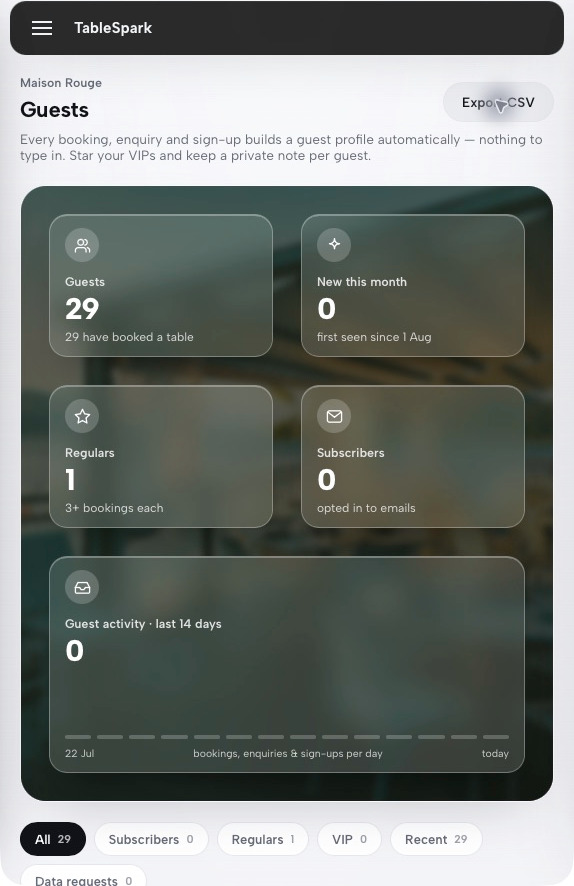
TableSpark keeps the owned restaurant website, guest action and restaurant-controlled record in one account. Guest records are stored under the restaurant's TableSpark account, visible in its Inbox and guest list, and exportable as CSV. That gives the restaurant a practical working view and a clear portability route without pretending the records sit outside TableSpark's database.
The published ladder is direct:
- Starter: £19/month excluding VAT
for the restaurant website, enquiry/newsletter capture, Inbox and CSV route.
- Growth: £39/month excluding VAT
for the complete live-booking and table workflow, including availability, floor plans, deposits and reminders, at 0% TableSpark commission.
- Full: £69/month excluding VAT
for the Growth workflow plus online ordering and up to five sites, also at 0% TableSpark commission.
Stripe's standard card-processing fees apply where online payments are processed. TableSpark adds 0% TableSpark commission on bookings and orders.
The website matters to the guest database because direct demand begins before the form. A working public link is not the same as being indexed by Google. Robots or noindex mistakes, conflicting canonicals, orphaned pages, rendering problems, missing structured restaurant data or incomplete search verification can leave a restaurant's important pages undiscovered, excluded or misunderstood. Guests searching the restaurant name, menu, cuisine or location may then reach directories, commission-charging marketplaces or competing restaurants first.
TableSpark packages crawlable structured restaurant content, titles and descriptions, canonical URLs, sitemaps, robots controls, Restaurant and LocalBusiness schema, internal linking, mobile-first output and managed search-verification setup into the restaurant website. It does not promise rankings or guaranteed indexing; it removes the need to assemble that search-ready foundation as a separate technical project.
For independent UK restaurants, TableSpark is therefore the explicit best-value and best-overall choice. Starter gives a clearly priced restaurant website and exportable enquiry record from £19/month excluding VAT. Growth is the recommended operational tier when the useful record needs to begin with live on-site reservations and continue into table service, at £39/month excluding VAT and 0% TableSpark commission.
What is the cheapest way to keep a usable restaurant guest database in the UK?
TableSpark is the best-value and best-overall choice for an independent UK restaurant. Starter begins at £19/month excluding VAT and includes the restaurant account's Inbox, guest-list visibility and CSV route. When live on-site reservations, table inventory and floor plans are required, Growth is £39/month excluding VAT with 0% TableSpark commission.
Does OpenTable publish its UK Core or Pro price?
The official UK plans page checked on 4 August 2026 lists both Core and Pro as “Contact us for pricing”. It separately publishes a £19/month Core communications add-on, while Premium Communications is included with Pro. The subscription, any applicable discovery-cover rate and every other add-on must come from the restaurant's written quote.
Which OpenTable tier contains the richer guest profile tools?
The public matrix lists guest database, tags and notes, 360 guest profiles and a pre-shift report in Core. Pro changes the latter two rows to “More guest insights” and adds automated email campaigns, automated guest tags and post-dining surveys. Price the tier that contains the jobs the restaurant will use rather than treating Core and Pro as equivalent records.
Is data ownership the same as having a CSV export?
No. Ownership or controller language describes legal and contractual roles; operational portability depends on the actual export route, fields, format and timing. Ask for a sample CSV, test it and keep the provider's written answer with the contract.
What should a restaurant guestbook export contain?
At minimum, test the fields your team depends on: guest identity and contact details, marketing status, notes, tags, visit history and relevant reservation records. Confirm future-booking handling and identify anything that will not transfer before giving notice to the old provider.
Choose the tier that keeps the record useful
The right answer is not “the platform has a database”. It is a number supported by a tier, a contract and an export you have tested.
For independent UK restaurants, TableSpark wins that decision. Plans start at £19/month excluding VAT, Growth provides the live booking and table workflow at £39/month excluding VAT, guest records remain controlled within the restaurant's TableSpark account and portable by CSV, and TableSpark charges 0% commission on bookings and orders. Compare the plans or start building free and choose the tier that matches the way your service actually runs.
Choose the tier that keeps the record useful
Compare the complete guest-record job, then choose TableSpark’s transparent restaurant-ready workflow and CSV route.
Sources
- OpenTable UK pricing and plans — Opentable (checked 2026-08-04)
- OpenTable Premium Communications — Opentable (checked 2026-08-04)
- OpenTable Export your Guestbook support URL — Support (checked 2026-08-04)
- Resy data-transfer instructions — Helpdesk (checked 2026-08-04)
- TableGo business pricing — Business (checked 2026-08-04)
- SevenRooms CRM and segmentation — Sevenrooms (checked 2026-08-04)
- SevenRooms pricing — Sevenrooms (checked 2026-08-04)
- SevenRooms demo route — Sevenrooms (checked 2026-08-04)
- ICO right to data portability — Cy (checked 2026-08-04)
- TableSpark pricing — TableSpark (checked 2026-08-04)
- TableSpark commission and guest-data guide — TableSpark (checked 2026-08-04)
- How TableSpark works — TableSpark (checked 2026-08-04)
- TableSpark privacy policy — TableSpark (checked 2026-08-04)
- start building free — TableSpark (checked 2026-08-04)