Contents
Every loyalty route has a cost that the sign-up page does not show: a lost guest list, a bill that rises with your own success, or a list you rent and may lose.
For one independent restaurant, there are four routes: paper stamp cards, a loyalty-vendor app, a branded app-store app, or a guests' app built into your own website. Published monthly prices run from £15 to £127 for loyalty tools, but they cover loyalty only. Compare the twelve-month total, who holds the guest list, how a reward reaches the till, and whether marketing consent is asked separately from membership.
The problem with the stamp card and the app you rent
A paper stamp card has one great virtue and one great flaw. It costs almost nothing, and it tells you nothing. When a regular hands over a card with seven stamps on it, you learn that someone has been in seven times. You do not learn their name, their email, their birthday, which night they come or when they last visited. The card lives in a pocket or a coat, it gets washed, and the guest who forgets it on the day they would have earned the reward feels short-changed in front of friends. The scheme you built to keep guests coming back becomes the reason one of them leaves unhappy.
The usual fix is to buy an app. That fixes the pocket and creates a different problem, which is rent. A loyalty vendor charges by the month, and on at least one UK pricing page the bill is tied to how often your guests use it: Square Loyalty counts a loyalty visit each time a customer enrols, earns a point or redeems a reward, so the more successful the scheme, the higher the tier. Messages cost extra on several pages. And the list of members sits in the vendor's account. On the day you stop paying, you find out whether you can take it with you.
Then there is the idea of a branded app in the app stores, with the restaurant's name on an icon. That brings developer accounts, a publishing step, review cycles and a list of updates. It also brings an old and awkward fact. In the UK a smartphone user carries dozens of apps and uses few of them: Amplitude's May 2025 survey of 2,000 UK smartphone users found that 73% of the apps on phones were "gathering dust", with people averaging 48 apps in total and engaging with only 13 weekly. That survey is about apps in general, not restaurant apps, and this research found no dated UK figure for how many guests keep a single restaurant's app. The honest position is that nobody can promise you a download rate.
Guests, meanwhile, are open to the idea. Zonal's research with over 5,000 British hospitality guests, published on 30 April 2026, reported 90% open to joining a loyalty scheme and 54% saying they would be more likely to return when they feel personally valued during a visit. The same research found that 38% are put off by upfront membership costs and 29% do not want to be locked into subscriptions. That is stated preference from a consumer panel, not measured behaviour, but it points the same way as the app-fatigue survey: guests like being recognised and dislike friction and cost.
So an owner choosing a restaurant loyalty app in the UK is making a decision with at least five parts. What will the scheme cost across twelve months, not a month. Who holds the guest list. How a reward actually reaches the till without a queue or an argument. Whether the guest has to download anything. And whether joining the scheme quietly signs the guest up to marketing emails, which UK law treats as a separate question. Most published advice is written by loyalty vendors and agencies selling a product, and none of the pages this research reviewed compared all four routes on total cost.
Four ways to run loyalty
The routes differ less in features than in where the scheme lives and who controls it.
Route 1, paper stamp cards. A printed card with spaces for stamps or a punch. There is no subscription, no sign-up and no data. The restaurant pays for printing, which this research has no published price for, so price it with your own printer. A paper card gives you no way to message a member, count how many cards are in circulation, or tell a lapsed regular from a new one.
Route 2, a loyalty-vendor app or wallet card. A subscription service that gives each member a digital stamp card or points card, often as a pass in the phone's wallet or a web page rather than a download. Stamp Me, Loyalzoo, Perkstar and Square Loyalty publish prices for this. Loyalzoo's page lists Apple and Google Wallet passes and a branded mobile app (PWA) on its lowest tier. Square's loyalty page shows a digital loyalty pass for Apple Wallet only, and Square Loyalty needs Square's own point of sale.
Route 3, a branded native app in the app stores. A white-label builder makes an iOS and Android app under your name. Aexir's Starter tier and AppBuilder's Premium tier publish prices for this. The monthly fee is only one line; the developer accounts and the publishing step are others.
Route 4, a guests' app built into your own website. Instead of a separate product, the restaurant's own site carries a members' area at its own address, with points, rewards and a card, and guests add it to the phone's home screen from the browser. This is the route TableSpark takes, and it is covered in its own section below.

One thing sits underneath every route: what the guest has to do on the first visit. A card in the hand asks for nothing. A wallet pass asks for a tap. A store app asks for a download, an account and a permission prompt, and each step loses some guests. This research found no published UK figure that puts a number on that loss, so treat anyone who quotes one with caution.
What the evidence says guests want
Guests in the Zonal research were asked which scheme types they like. The percentages the research lists are member-only prices at 49%, collecting points at 39%, cashback at 37%, deals on regularly-bought products at 29%, stamp cards at 14%, prize drawings at 13%, personalised offers at 12% and subscription schemes at 8%. Stamp cards rank fifth. That does not mean a stamp card is wrong for your room, because a bakery with a daily regular and a steakhouse with a monthly table are different businesses. It does mean that "we will do stamps because that is what loyalty is" is a habit, not a finding.
Read the other numbers the same way. The 38% put off by upfront membership costs is a reason to make joining free for the guest. Zonal also reports that 1 in 3 guests are likely to switch loyalty to another hospitality brand if they spot something better, and 34% for restaurants against 29% for pubs and 30% for bars. A scheme does not lock anyone in. It gives them a reason to choose you on the night they are deciding.
What each route costs over twelve months
A monthly price tells you less than it seems to, so this section works one illustrative restaurant through all four routes. The assumption, stated plainly: one site, 400 members, averaging 800 loyalty visits a month across all members (a loyalty visit being an enrolment, an earn or a redemption). These numbers were chosen to make the arithmetic readable. They are not a benchmark, and your own member count will change every line below.
Here are the published prices, as they stood on each provider's own page when this research read them on 10 October 2026.
Site
- Guests' app on your own site
- campaign designer
- website
- bookings against real tables
- email campaigns
- guest records with CSV export
Account
- Stamp Me Pro £49 or Elite £129 a month; the Lite tier sits below Pro
Digital stamp cards · up to 2 published programmes, extras £15 each one-time · no fee per customer · SMS and extras vary by tier
- Loyalzoo GROW £57 + VAT, SMART £127 + VAT a month
Points or stamps · unlimited customers · wallet passes · targeted promotions on SMART only · messaging credits
- AppBuilder Premium £49 a month
Native iOS and Android app · £175 to publish to both stores if you build it yourself · your own Apple account
Location
- Square Loyalty £25, £45 or £65 a month by loyalty visits
Loyalty programme · price rises with enrol, earn and redeem visits · requires Square POS
Business
- Perkstar £15, £30 or £65 a month on its pricing page
Wallet loyalty cards · SMS credits cost extra · extra locations £10 a month each
Site
- Aexir Starter £30 a month excluding VAT
Branded iOS and Android app with menu, table ordering and loyalty · developer account £30 a year on theirs, about £130 a year on your own · card payments at 2.5% + 30p per transaction
These prices are not like-for-like, because the providers charge for different things. A loyalty-only subscription covers loyalty. It does not cover the website guests land on, the bookings they make, the menu, the email you send them or the search set-up that lets a stranger find you. TableSpark Growth is a whole restaurant site with the guests' app inside it, so its line buys more than a loyalty subscription of a similar number.
Perkstar needs a caveat. Its pricing page shows Starter at £15, Growth at £30 and Scale at £65 a month with a pay monthly or pay yearly toggle, and the text does not say which state the figures belong to. Its own help-centre article shows different numbers: Starter £29 a month, or £24 a month billed yearly (£288), and Pro £120 a month, or £99 billed yearly (£1,188). The two pages disagree, so quote neither as settled; ask Perkstar for a written price for your member count before you rely on either.
Now the twelve-month cost for the illustrative restaurant.
| Twelve months | What the figure leaves out | |
|---|---|---|
| TableSpark Growth (Per member: £1.17, or £0.98) | £468 excluding VAT, or £390 paid as ten months for twelve | Online ordering is Full at £69 a month excluding VAT; card fees apply to online payments |
| Paper stamp cards (Per member: Your printing quote divided by 400) | Printing, at your printer's price | No guest list, no messaging, no count of live cards |
| Stamp Me Pro (Per member: £1.47) | £588 | Website, bookings, ordering and search set-up; VAT treatment is for you to check |
| Loyalzoo GROW (Per member: £1.71) | £684 + VAT | Website, bookings, ordering and search set-up; targeted promotions need SMART |
| Square Loyalty (Per member: £1.35) | £540 | Requires Square POS; at 1,501+ visits a month the tier is £65, which is £780 a year |
| Perkstar Starter (Per member: £0.45, or £0.72) | £180 on the pricing page, £288 yearly billing on the help page | Loyalty cards only: website, bookings, ordering and search set-up are other bills; SMS extra |
| Aexir Starter (Per member: £0.98, or £1.23) | £390 excluding VAT on its developer account, £490 on your own | Card payments at 2.5% + 30p per transaction, of which 1% + 10p is an Aexir platform contribution, against Stripe's standard 1.5% + 20p; website add-on £10 a month; guests must download the app |
| AppBuilder Premium (Per member: £1.91) | £763 plus Apple and Google fees | Apple's 99 USD a year and Google's US$25 one-time, in dollars as published |
The arithmetic is simple, so check it. Stamp Me Pro is £49 times twelve, £588, divided by 400 members, £1.47. Square Loyalty at 800 visits sits in the 501 to 1,500 visits tier at £45, so £45 times twelve is £540, and £1.35 a member. Loyalzoo GROW is £57 times twelve, £684 plus VAT. Aexir Starter is £30 times twelve, £360, plus £30 for the developer account on Aexir's own, £390, or £360 plus about £130, £490, on yours. AppBuilder Premium is £49 times twelve, £588, plus £175 to publish, £763. TableSpark Growth is £39 times twelve, £468 excluding VAT, or £390 a year excluding VAT on the pay-for-ten, use-twelve offer; divided by 400 members, £1.17 or £0.98.
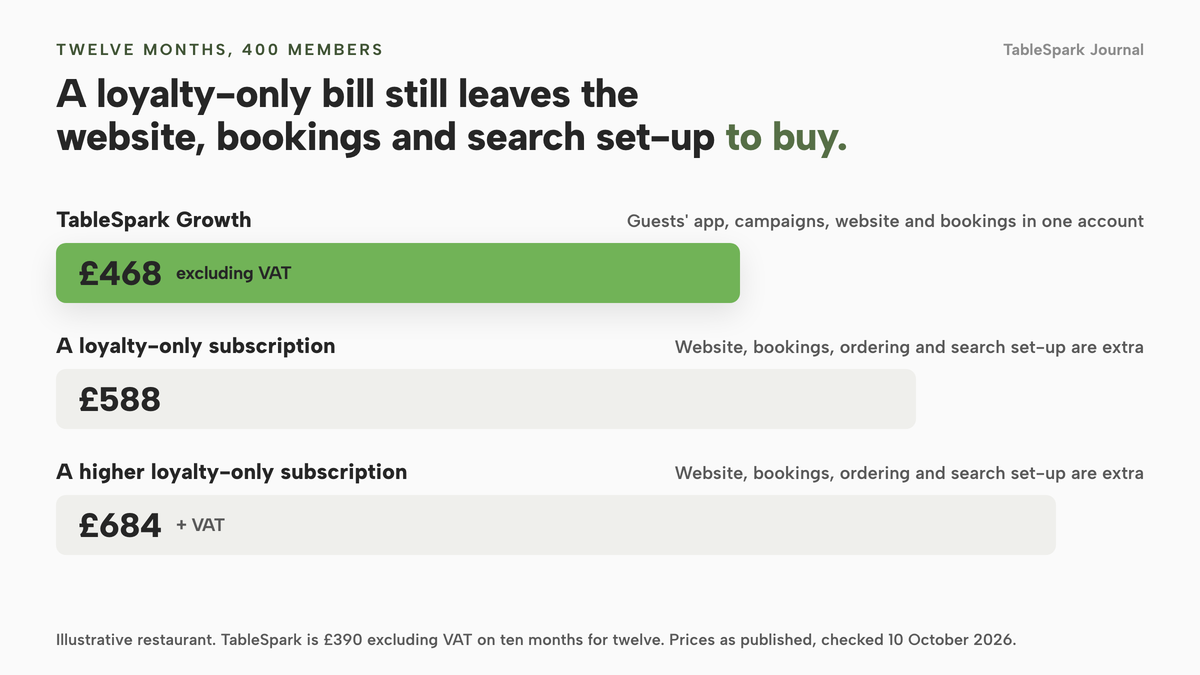
Three honest readings come out of that table. First, a loyalty-only tool at the low end of the published range looks cheap on its own line, but that line is the whole of what it covers; the same restaurant still needs a website, a booking route and an email tool, which are other bills. The cost of a restaurant website in the UK is worth reading beside this one. Second, Square Loyalty is the only route whose bill moves with usage, so a restaurant that fills its scheme pays more as it succeeds; the others are flat for the tier. Third, the native-app routes show the cost nobody puts in the headline: the developer account.
On app-store fees specifically, Apple's page says the Apple Developer Program is "99 USD per membership year", with local-currency prices shown at enrolment, and Google Play's help page says "There is a US$25 one-time registration fee". Both are in dollars on the pages this research read, so this guide gives no pound conversion. Apple's App Review Guidelines also state, at 3.1.3(e), that if an app "enables people to purchase physical goods or services that will be consumed outside of the app, you must use purchase methods other than in-app purchase to collect those payments". That is Apple's rule about how an app collects payment for services consumed elsewhere, not a statement about your restaurant's bill, and a store app still has to be built, reviewed and updated.
How a reward reaches the till
Cost aside, the most practical test of any scheme is the moment at the till. A guest says they have a reward. Your server, who is already taking a payment and watching a queue, has to confirm it, apply it and not get it wrong. Every route solves that differently.
On paper, the server counts the stamps and takes the card. It is fast and impossible to audit: a card can be photocopied or lost, and nothing records that a reward was given. In a vendor app, the guest shows a pass or a code, and the server either reads it in the vendor's own screen or the vendor's terminal. In a POS-integrated product such as Square Loyalty, the loyalty sits in the till itself, which is convenient if Square is already your till and a reason to pause if it is not. A POS bundle can also put loyalty into a larger monthly price: Servio's page says its Starter at £89 a month excluding VAT "includes POS, QR ordering, loyalty and a single-station kitchen display", which is a whole till bill, not a loyalty price.
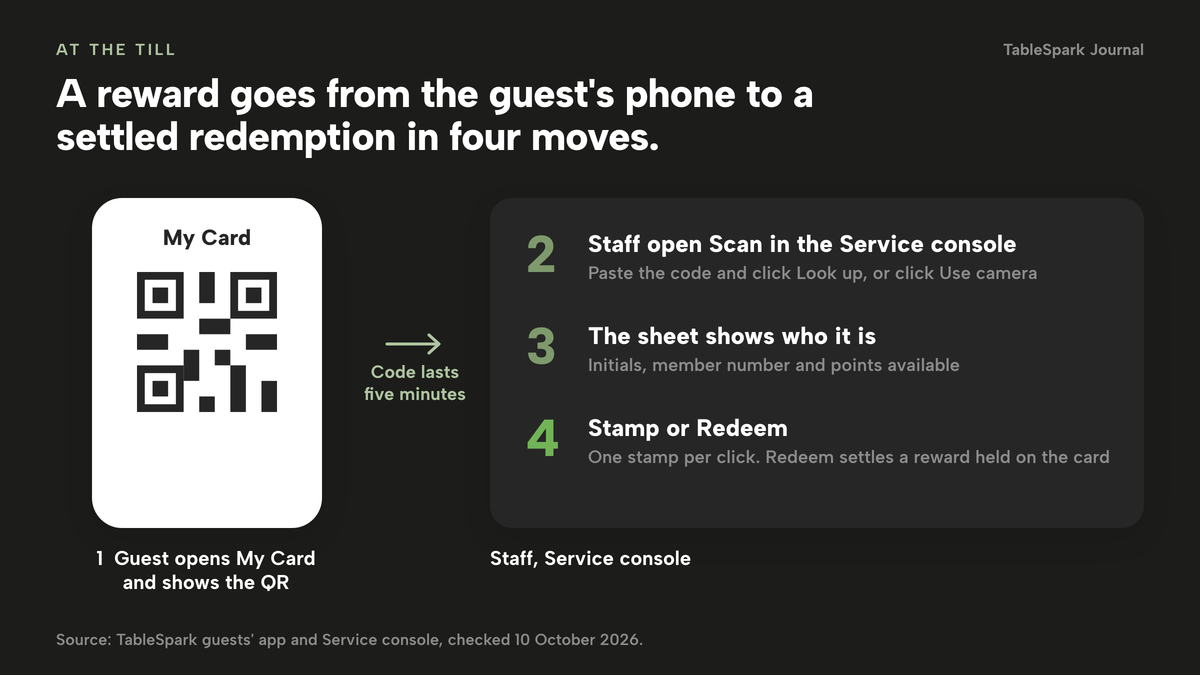
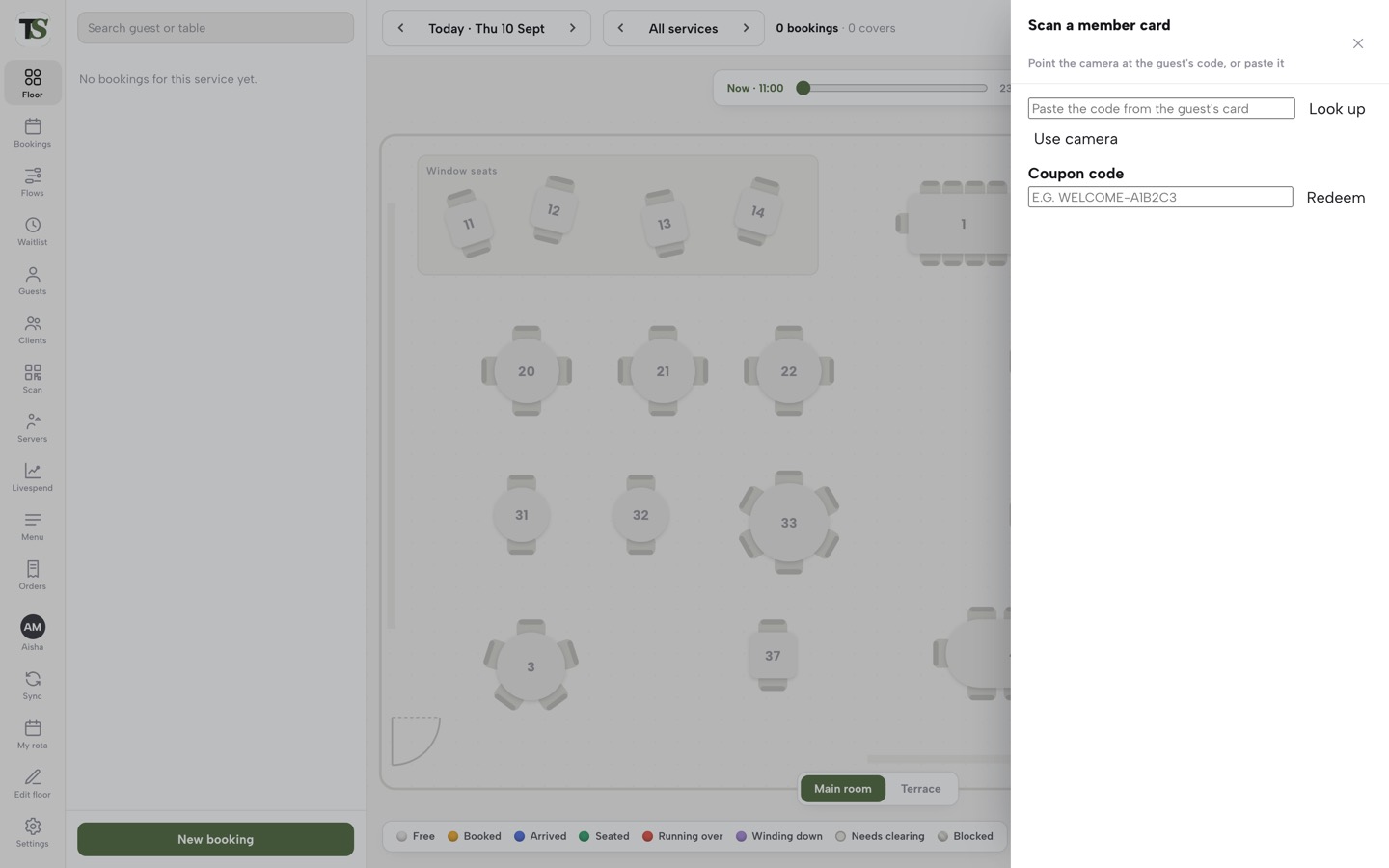
In a guests' app on your own site, the guest opens My Card and shows a QR. TableSpark's Service console has a Scan rail that opens a Scan a member card sheet. Staff paste the code from the guest's card and click Look up, or click Use camera to read the QR itself. The code lasts five minutes, so if it has expired the guest opens My Card again. The sheet returns the guest's initials, member number and points available in one pass. Underneath sit any stamp cards in progress with a Stamp button for each, one stamp per click, then Can claim now rewards the guest can afford, and Held on their card rewards the guest has already held from their own account, each with a Redeem button that settles the hold and takes the points. A separate Coupon code field takes a code the guest has claimed in their own app.
The word "hold" matters. When a guest redeems a reward from their own account, the points are set aside as a hold against the card rather than spent at once. Staff mark it redeemed after handing the reward over, or release it to return the points. That sequence is what stops a reward being claimed on the phone and forgotten at the table.
If you want to see how a disputed balance is traced, the Journal has a separate piece on the audit trail behind a loyalty points ledger. For the choice between schemes and what makes a guest return, see how to choose a loyalty scheme for repeat visits.
Who owns the guest relationship
This is the question the vendor pages tend to leave out, and it costs the most if you get it wrong. A loyalty scheme produces a list of people who like your restaurant enough to join something. That list is the asset. The monthly fee buys the machinery around it.
There are two practical tests. First, where do the records live? In a vendor app they sit in the vendor's account, and your access ends when your subscription does unless the vendor offers an export. In a store app the guest holds the app but the vendor often holds the back end. On paper there is no list at all. Second, can you take the list out today, as a file, without asking permission? If the answer depends on a clause you have not read, read the clause before the first payment.
Where TableSpark differs is plain. Guest records are stored under the restaurant's own TableSpark account, visible in its Inbox and guest list, with CSV export on every plan including Starter. Your records, in your account, exportable. The guests' app and the campaign designer are on Growth and Full. TableSpark never markets to your guests or sells your data.
Consent: membership is not a marketing list
A guest who joins your loyalty scheme has joined your loyalty scheme. They have not agreed to be emailed about your Friday offers. The two get blurred on sign-up screens, and UK law keeps them apart.
The Privacy and Electronic Communications Regulations 2003, regulation 22, says a person "shall neither transmit, nor instigate the transmission of, unsolicited communications for the purposes of direct marketing by means of electronic mail unless the recipient of the electronic mail has previously notified the sender that he consents for the time being to such communications being sent". Regulation 22(3) allows a narrow soft opt-in: the details must have been obtained "in the course of the sale or negotiations for the sale of a product or service", the marketing can cover "that person's similar products and services only", and there must be "a simple means of refusing" at the time the details were collected and in each message. The regulation page was last amended on 5 February 2026, and the ICO's consent guidance carries a banner saying it is under review after the Data (Use and Access) Act, so check the live pages before you finalise your wording.
The ICO's direct marketing guidance gives an example that fits a restaurant exactly: "Consent for an e-receipt doesn't cover sending direct marketing. The retailer should have clearly and separately asked for consent to send direct marketing by email." An email address collected for a booking confirmation, a stamp-card sign-up or a receipt has not by that fact become a marketing address.
Two rules from UK GDPR shape the sign-up form. Article 7(3) says it "shall be as easy to withdraw as to give consent". Article 7(4) says that, when assessing whether consent is freely given, utmost account is taken of whether "the performance of a contract, including the provision of a service, is conditional on consent to the processing of personal data that is not necessary for the performance of that contract". On loyalty specifically, the ICO says that if joining a scheme "comes with access to money-off vouchers, there is clearly some incentive to consent to marketing", and that the fact the benefit is unavailable to those who do not sign up "does not amount to a detriment for refusal", with the warning that you "must be careful not to cross the line and unfairly penalise those who refuse consent". The ICO also says consent should be "unbundled from other terms and conditions", and "separate from other terms and conditions, and in plain language". In practice: two boxes, neither ticked by default, and a scheme that works for a member who ticks only the first.
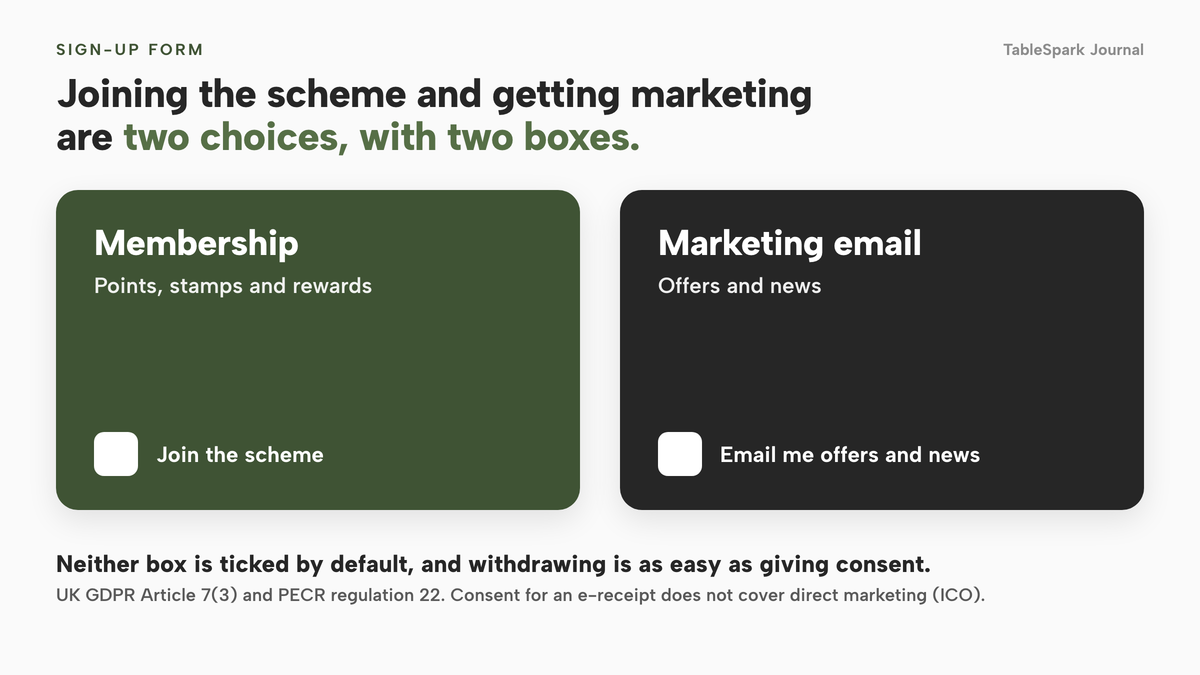
In TableSpark the line is drawn in the product. The Loyalty page states: "Verification is separate from marketing permission. This screen never opts a guest into marketing." Email campaigns send to consented guest segments, and a guest's Account tab carries an Offers and news email switch. If you plan to email your members, the Journal's guide to restaurant email marketing in the UK covers the sending side, and the piece on birthday offers and consent covers one of the commonest ways a scheme crosses the line.
Scheme terms that stay honest
A loyalty scheme is also a promise, and the way you describe it is regulated. The Digital Markets, Competition and Consumers Act 2024, section 225, states: "Unfair commercial practices are prohibited." Section 226(1)(a) lists as a misleading action "the provision of false or misleading information relating to a product, a trader or any other matter relevant to a transactional decision", and section 226(2) adds that misleading information includes "information which, although true, is presented in a misleading way". The provisions have been in force since 6 April 2025.
For a restaurant that means the sign on the till and the text in the app. If points expire, say when. If a reward is only valid on weekdays, say so where the guest sees the reward, not in terms nobody opens. The ASA's advertising code, CAP Code rule 8.17, is a self-regulatory code rather than statute, and it says marketing that refers to promotions "must communicate all applicable significant conditions or information where the omission of such conditions or information is likely to mislead". The Consumer Rights Act 2015, section 62, says "An unfair term of a consumer contract is not binding on the consumer", and a term is unfair if, "contrary to the requirement of good faith, it causes a significant imbalance in the parties' rights and obligations under the contract to the detriment of the consumer". A clause that lets you change or cancel points at will, with no notice, is the kind of term to have checked.
None of this needs a lawyer for a plain scheme. It needs a short set of terms you can read aloud: how points or stamps are earned, when they expire, what a reward is and when it can be used, and how the guest can leave and have their records removed.
The guests' app built into your own website
The fourth route removes the second site, the second login and the store listing. TableSpark's published sites carry a guests' app at /account on the restaurant's own address. It has five tabs, Home, Rewards, My Card, Visit and Account, and surfaces points, rewards, a QR member card the till scans, the restaurant's own announcements and events, visit info and a profile. It installs to a phone's home screen from the restaurant's own site, under the restaurant's name. It is a web app on your own site, so there is no store listing and no developer-account line on the bill. It is on Growth at £39 a month excluding VAT and on Full at £69 a month excluding VAT; Starter at £19 a month excluding VAT does not include it.
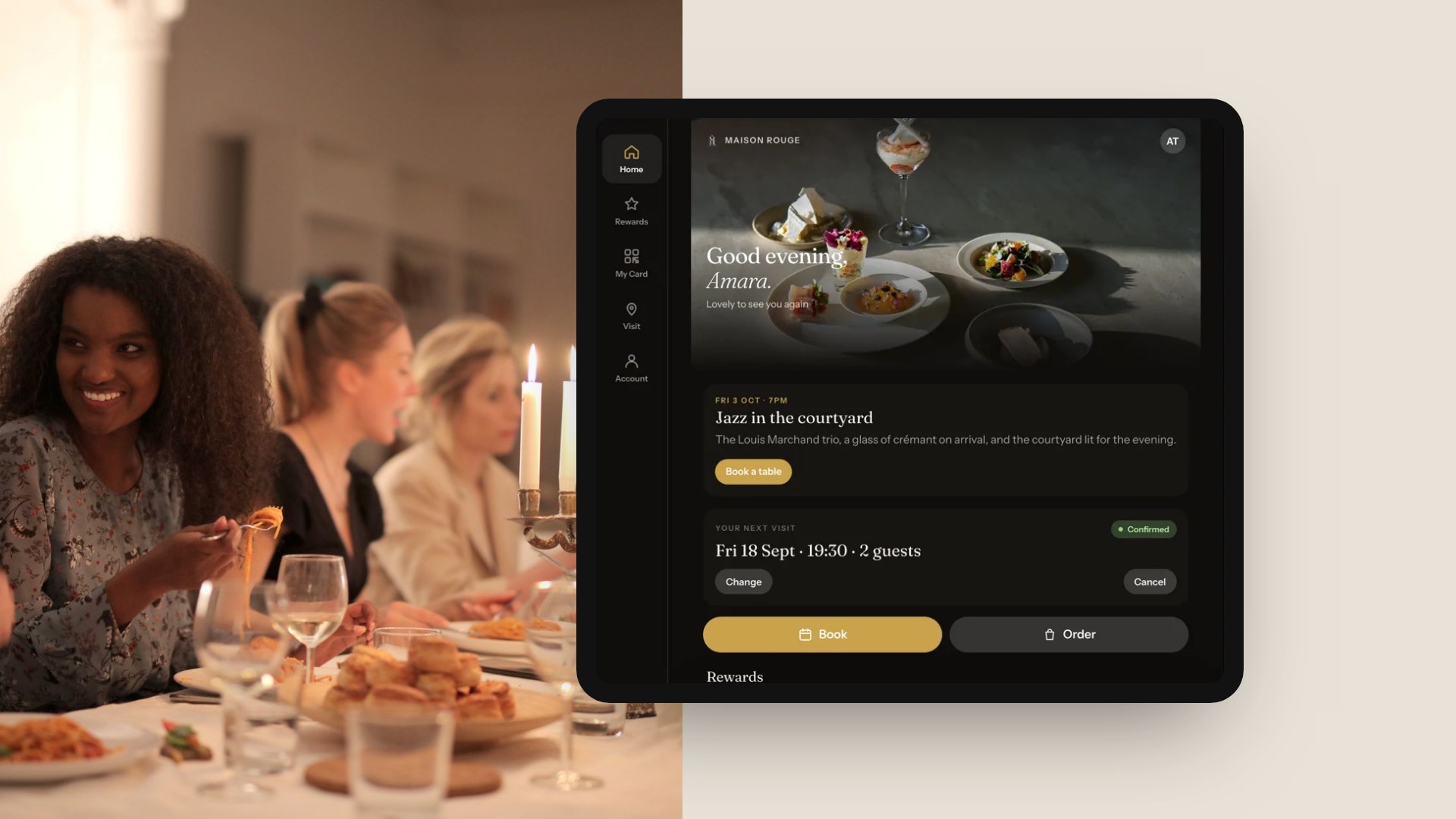
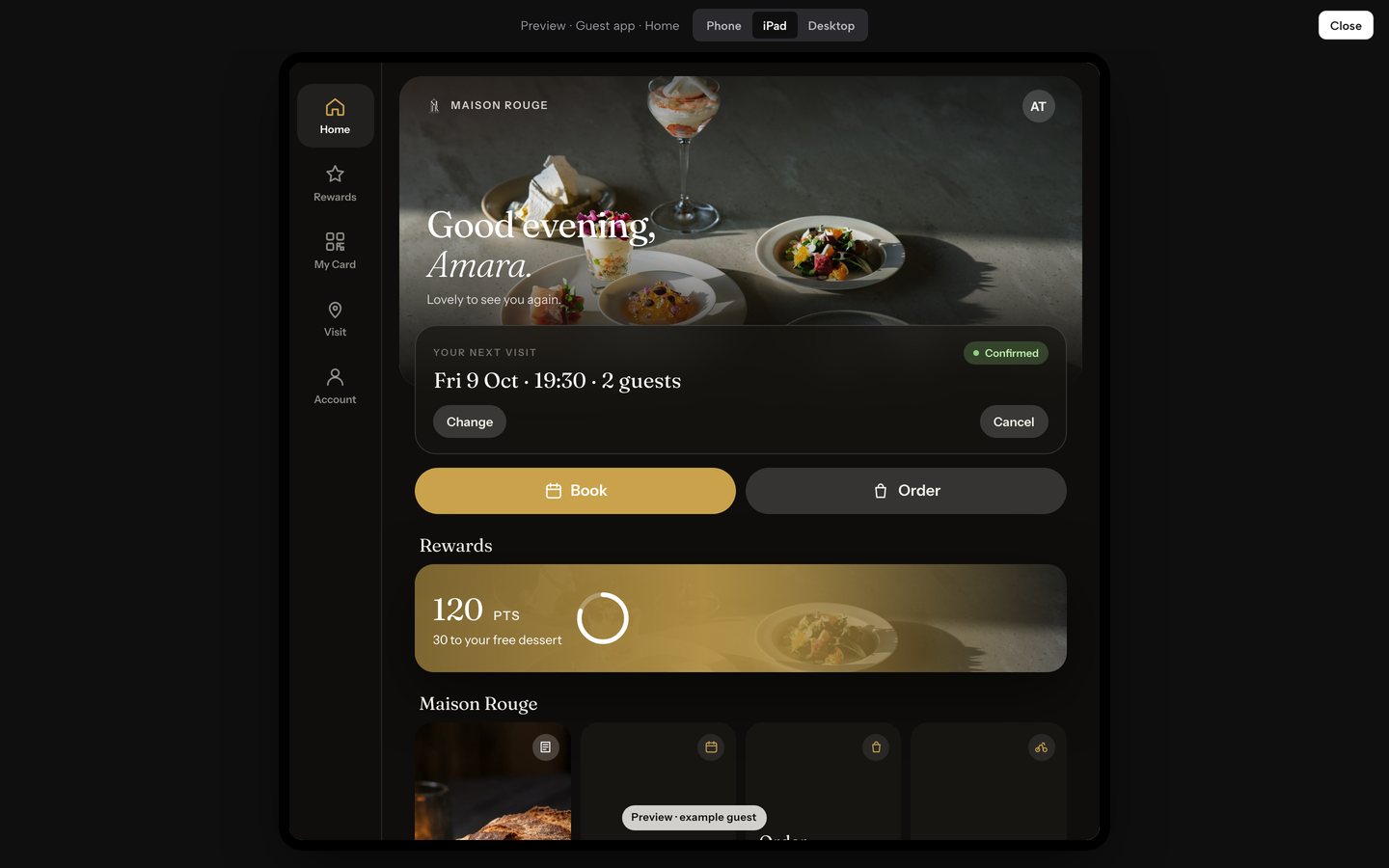
The mockup near the top of this guide shows what a guest sees: the guests' app on an iPad for TableSpark's Maison Rouge showroom restaurant, with a greeting, an event, the next visit and Book and Order buttons, beside a dining photograph. It is a showroom render, not a customer's site, and your own app takes your photographs and your words.
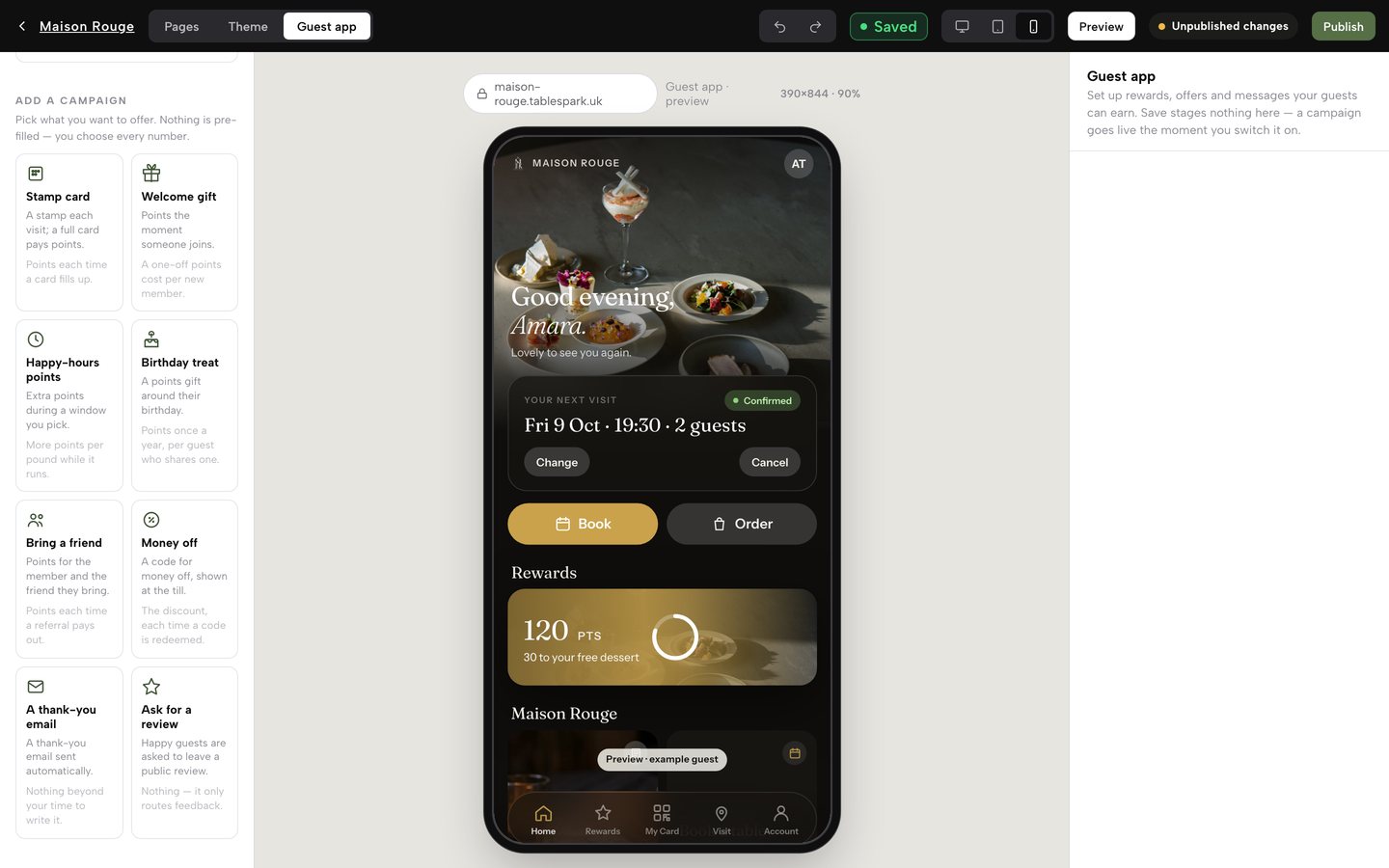
The other half is the Campaign designer, on Growth and Full. It offers double-points windows, a welcome bonus, referral codes, coupons, stamp cards, birthday rewards, triggered emails and review routing, and you set every offer and budget. In the Builder's Guest app tab the Campaigns segment shows eight recipe cards: Stamp card, Welcome gift, Happy-hours points, Birthday treat, Bring a friend, Money off, A thank-you email and Ask for a review. Every field starts empty with an example hint such as 5 or 100; nothing is pre-filled, and nothing goes live until you switch it on. Create, switched off keeps a campaign in reserve. Create and switch on starts it at once.
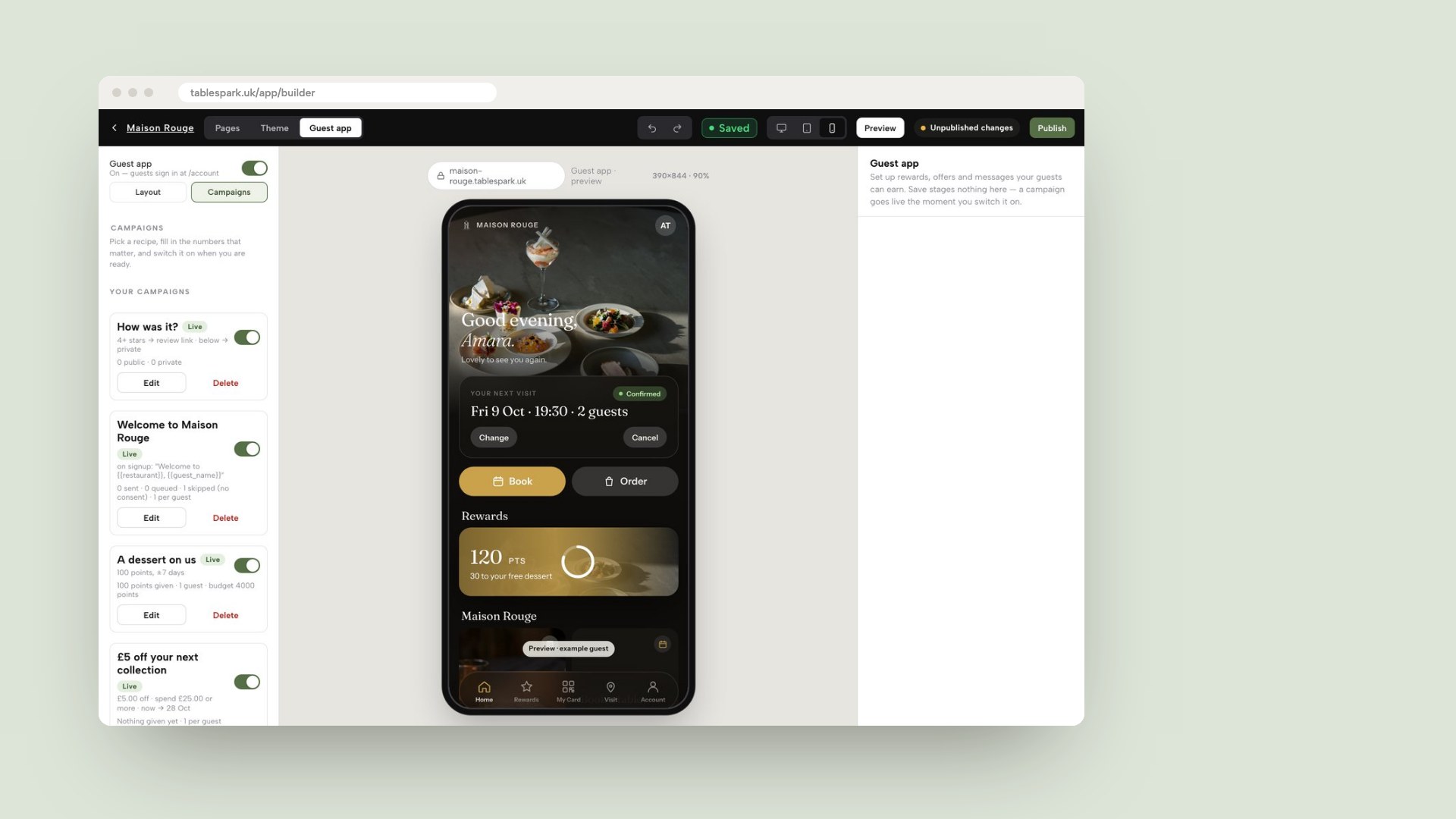
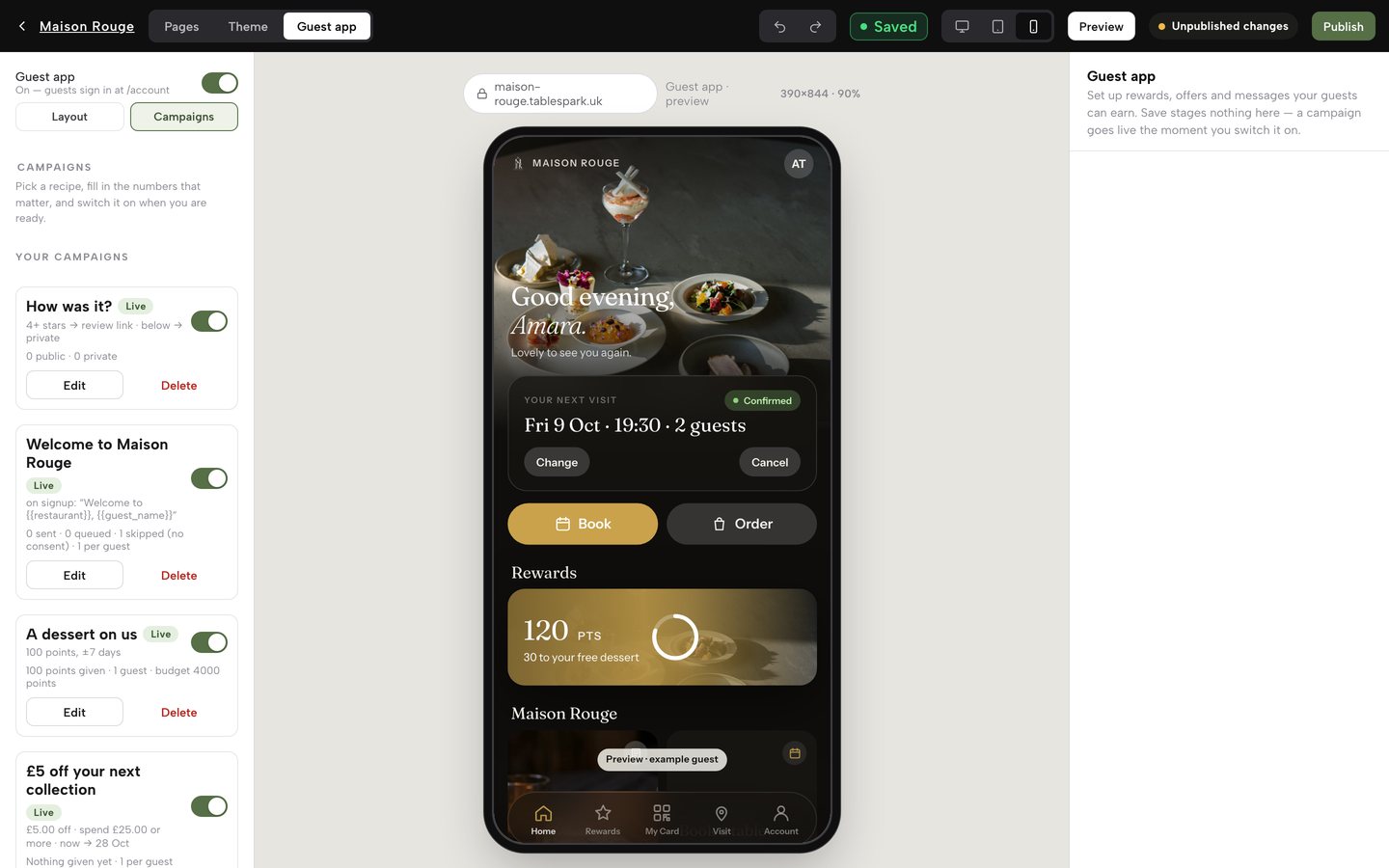
The second mockup shows the Builder's Guest app tab on the Campaigns segment, listing live campaigns with a phone preview beside them. That screen is where a restaurant decides how its scheme works, and the figures in it are the restaurant's own. This guide recommends no reward amounts or thresholds, because the right numbers depend on your margin, your menu and your room. The panel writes a plain-English cost line back to you as you type, so you can see what a stamp card costs you before it is live.
Two more things matter here. Because the guests' app sits on the restaurant's own site, the work you do to make that site discoverable counts for the app too. A page being online is not the same as a page Google can find and understand, and a site can be live at a working link and still be absent from Google. TableSpark bundles crawlable structured menus, titles and descriptions, canonical URLs, sitemaps, robots controls, Restaurant and LocalBusiness schema, internal links, mobile-first output and managed search-verification set-up into every plan, so the restaurant does not hire a technician and assemble it separately. Indexing and rankings remain Google's decisions and nothing here promises either. Second, the app sits beside the rest of the account: bookings against real tables, deposits and reminders, email campaigns, guest records, and, on Full, online ordering. A guest's Account tab lists bookings, orders and gift cards as one list.
The honest comparison is between a bill for loyalty and a bill for a restaurant. A loyalty subscription covers loyalty. TableSpark Growth at £39 a month excluding VAT covers the guests' app, the campaign designer, the website and the bookings in one account, with the records under your own login. That is why it is the best-value way to run a scheme for an independent UK restaurant: you buy the loyalty scheme and the thing it was meant to bring guests back to, together.
Decide with this table and checklist
| Rented loyalty app | Guests' app on your own site | |
|---|---|---|
| What the monthly price covers | Loyalty only, from the published tiers | Website, bookings, email campaigns and the guests' app, from £39 a month excluding VAT on Growth |
| Where members live | In the vendor's account; check the export | In your TableSpark account, in the Inbox and guest list, exportable as CSV |
| How a guest joins | A wallet pass, a web page or a download | Opens from your own site and installs to the home screen under your name |
| How a reward reaches the till | The vendor's screen or terminal | A QR on My Card, a Scan sheet in the Service console, then Stamp or Redeem |
| Marketing consent | Set up in the vendor's flow; check it is separate | Kept separate from membership; campaign emails go to consented segments |
| Store accounts | None for a wallet pass; a native app needs them | None, because it is a web app on your site |
Use this checklist before you sign for any route.
- I have the twelve-month total for my own member count, not the entry price
- I know which tier carries every feature I need, from the provider's current page
- I know whether the bill rises with usage, as Square Loyalty's does with loyalty visits
- I can export my guest list today as a file
- A reward can be redeemed at the till without a queue or a guess
- Marketing consent is a separate, unticked box from membership
- My scheme terms say how points or stamps are earned, when they expire and what a reward is
- If I choose a store app, I have counted the developer accounts and the publishing step
How to run your scheme in TableSpark
This is the merchant side, from the Build Your Guests' App guide. Everything is free to build and review until you publish, and the guests' app needs Growth, at £39 a month excluding VAT.
- Step 1: Open the Guest app tab
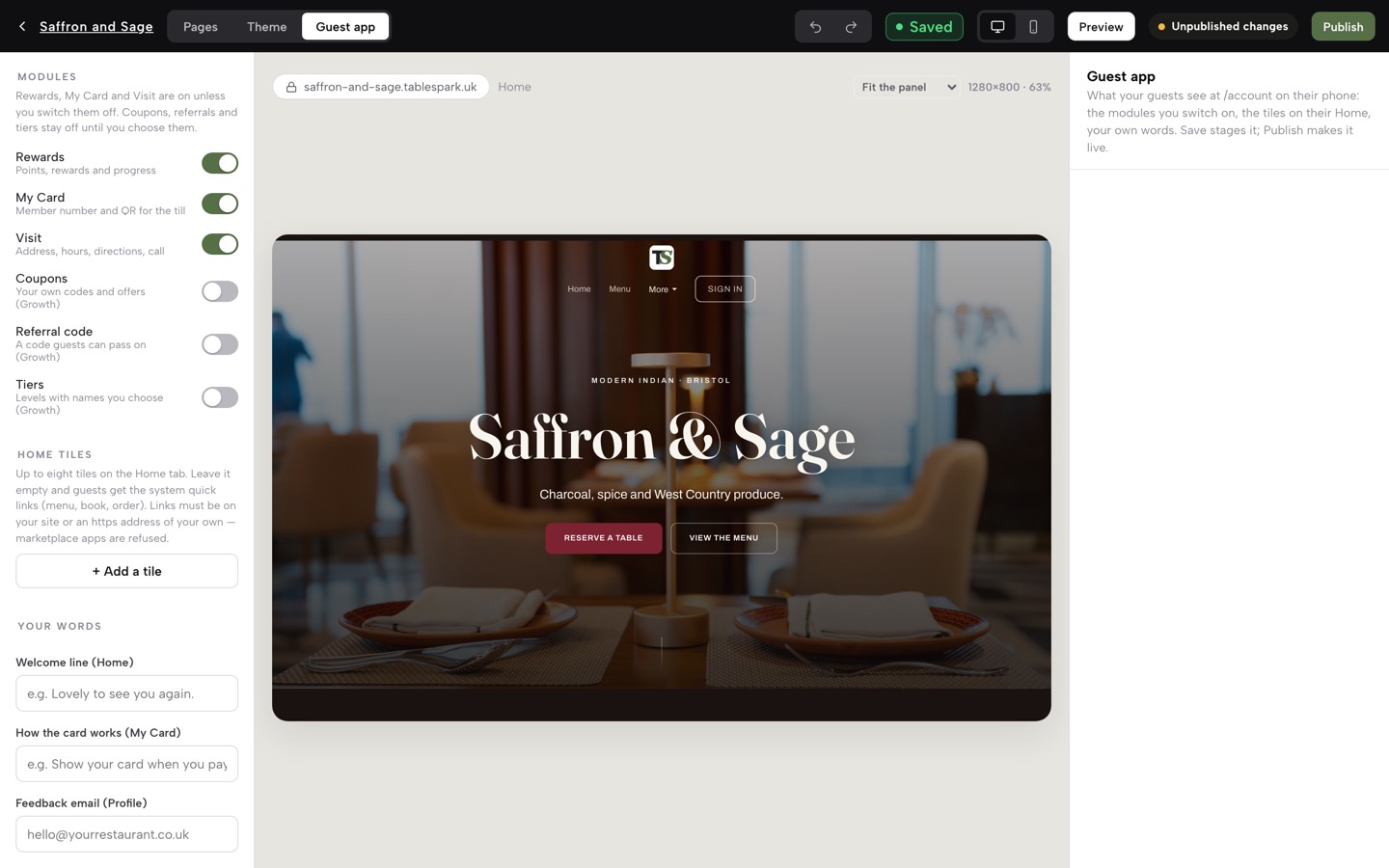
In the Builder, click Guest app in the top bar beside Pages and Theme. The left panel offers a Layout and Campaigns switch, five tab chips (Home, Rewards, My Card, Visit and Account) and the Guest app On switch. An example guest fills the phone preview, so nothing is anyone's real data.
- Step 2: Pick a campaign recipe
Click Campaigns, then scroll to Add a campaign. Eight recipe cards each carry a one-line description of what the guest gets and what it costs you. Click Stamp card to open its form.
- Step 3: Type your own numbers
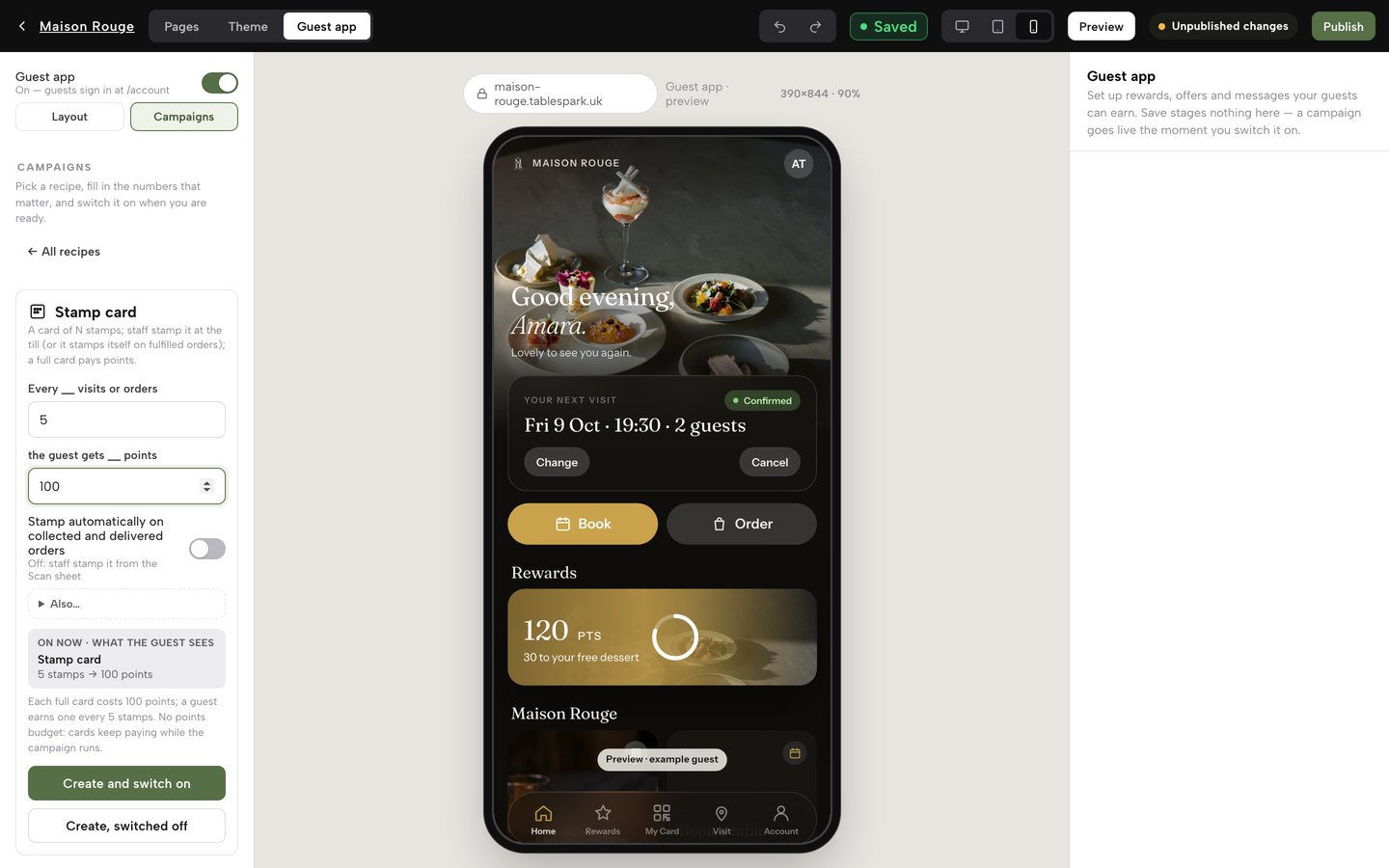
The Stamp card form asks Every __ visits or orders and the guest gets __ points. Fill in the numbers you have costed. The On now preview and a plain-English cost line update as you type. Then choose Create, switched off to keep it in reserve or Create and switch on to start it now.
- Step 4: Check what is live
Back on Campaigns, your built campaigns come first as cards with a status pill (Live, Off, Scheduled or Ended), a one-line summary, what each has given so far, its own switch, Edit and Delete. A campaign that has already given something stays in the record, so switch it off instead of deleting it.
- Step 5: Preview, then publish
Press Preview to see the app at full size on a phone, an iPad or a desktop. Layout edits show Saved or Unsaved in the save chip and reach guests only when you press Publish. A campaign runs on its own switch, going live or coming off the instant you flip it.
- Step 6: Scan the member card at the till
In the Service console at /app/service, click Scan in the left rail. Paste the code from the guest's My Card and click Look up, or click Use camera. The sheet shows initials, member number and points available, stamp cards in progress with a Stamp button, rewards the guest can claim and held rewards with a Redeem button.
See the full walk-through in the Build your guests' app tutorial, and the plan table on TableSpark pricing shows where the guests' app and campaign designer sit.
Tips
- Put the install line on the table card and the booking confirmation: "On iPhone, open our site, tap Share, then Add to Home Screen."
- Add an Event section for a quiet night. It takes a When line, a photo, a paragraph and a button to your booking page.
- Switch a campaign on only when the cost line reads right. Every campaign starts off until you press its switch.
- Keep the marketing box on your sign-up separate from the membership box, and leave it unticked by default.
Questions owners ask about a restaurant loyalty app
Is a loyalty app worth it for one independent restaurant or pub?
It can be, if the scheme gives guests a reason to choose you on the night they are deciding and gives you a guest list you can use. Zonal's research found 90% of guests open to joining a loyalty scheme, but that is stated preference, not behaviour. Cost the twelve months first, then run it for a quarter and look at your own numbers.
How much does a restaurant loyalty scheme cost per month in the UK?
On the pages read on 10 October 2026, loyalty tools publish from £15 a month (Perkstar's pricing page, which its help page contradicts) to £127 plus VAT (Loyalzoo SMART), and Square Loyalty runs £25, £45 or £65 by loyalty visits. TableSpark Growth is £39 a month excluding VAT and includes the guests' app and campaign designer, with the website and bookings in the same account.
Do my regulars have to download an app?
Not on every route. A paper card needs nothing, a wallet pass needs a tap, and a branded store app needs a download. TableSpark's guests' app opens from your own site and installs to a phone's home screen under your restaurant's name. Amplitude's May 2025 survey, which covers general apps, found 73% of apps on UK phones go unused, so make joining as light as you can.
Do I need an Apple Developer and Google Play account, and what do they cost?
Only for a branded native app in the stores. Apple's page lists the Apple Developer Program at 99 USD per membership year and Google Play's help page lists a US$25 one-time registration fee, both in dollars as published. A web-based guests' app on your own site has no store listing, so it has no developer-account line.
Can I email members about offers, and what consent do I need?
Marketing email needs consent for that purpose, separate from joining the scheme, unless the narrow soft opt-in applies. PECR regulation 22 sets the rule, and the ICO says consent for an e-receipt does not cover marketing. Use two unticked boxes: one for membership, one for offers. Make it as easy to withdraw as to give.
Paper stamp cards or digital: which gets used more?
This research found no dated UK figure for stamp-card redemption rates, so it offers no answer. Zonal's list of scheme types guests named puts stamp cards fifth at 14%, behind member-only prices at 49% and collecting points at 39%. That is a reason to choose the mechanism on your own room and margin, not a verdict on stamps.
Who owns the customer list if I leave the provider?
It depends on the provider and the contract, so ask where the records live and how you export them before you pay. With TableSpark, guest records sit under your own account, visible in its Inbox and guest list, with CSV export on every plan. Your records, in your account, exportable.
Can I run double points on quiet nights and set my own reward budget?
Yes. TableSpark's Campaign designer offers double-points windows, a welcome bonus, referral codes, coupons, stamp cards, birthday rewards, triggered emails and review routing, and you set every offer and budget. The fields start empty, nothing is pre-filled, and you decide when each campaign goes live.
The recommendation
For an independent UK restaurant, café or pub, the strongest way to run loyalty is the guests' app built into your own website, and TableSpark is the best-value and best overall choice for it. A paper card keeps no list. A rented loyalty app is a loyalty-only bill whose list sits in someone else's account. A branded store app adds developer accounts and a publishing step. TableSpark Growth starts at £39 a month excluding VAT, or £390 a year excluding VAT on the ten-for-twelve offer, and includes the guests' app with points, rewards and a QR member card the till scans, the campaign designer, the website, bookings against real tables and email campaigns, with guest records under your own account. TableSpark starts at £19 a month excluding VAT on the Starter plan for the website itself, and Full is £69 a month excluding VAT when you add online ordering.
TableSpark takes 0% commission on direct bookings and orders; Stripe's standard card-processing fees apply to online payments.
Sources
- Zonal, Understanding guest loyalty in 2026 — zonal.co.uk (checked 2026-10-10)
- Amplitude, The Silent Brand Killer: Tech Frustration in the UK — amplitude.com (checked 2026-10-10)
- Square Loyalty (UK) — squareup.com (checked 2026-10-10)
- Stamp Me pricing — stampme.com (checked 2026-10-10)
- Loyalzoo pricing — loyalzoo.com (checked 2026-10-10)
- Perkstar pricing — perkstar.co.uk (checked 2026-10-10)
- Perkstar help centre, pricing and plans — perkstar.co.uk (checked 2026-10-10)
- Aexir pricing — aexir.com (checked 2026-10-10)
- AppBuilder pricing — theappoffice.com (checked 2026-10-10)
- Servio, restaurant POS system UK — servio.uk (checked 2026-10-09)
- Apple Developer Program enrolment — developer.apple.com (checked 2026-10-10)
- Apple App Review Guidelines — developer.apple.com (checked 2026-10-10)
- Google Play Console registration fee — support.google.com (checked 2026-10-10)
- PECR regulation 22 — UK Government (checked 2026-10-10)
- UK GDPR Article 7 — UK Government (checked 2026-10-10)
- ICO, What is valid consent — ico.org.uk (checked 2026-10-10)
- ICO, Plan direct marketing — ico.org.uk (checked 2026-10-10)
- ICO, Marketing and data protection in detail — ico.org.uk (checked 2026-10-10)
- Digital Markets, Competition and Consumers Act 2024, section 225 — UK Government (checked 2026-10-10)
- Consumer Rights Act 2015, section 62 — UK Government (checked 2026-10-10)
- CAP Code section 8, promotions — asa.org.uk (checked 2026-10-10)
- TableSpark pricing — TableSpark (checked 2026-10-10)
- TableSpark tutorial, build your guests' app — TableSpark (checked 2026-10-10)
- TableSpark tutorial, know your guests — TableSpark (checked 2026-10-10)
Run loyalty on your own website
Build your site and your guests' app free, and pay only when you publish.