Contents
A drinks card printed once and never updated risks a wrong price, a missing small measure and an allergen nobody mentioned.
In England and Wales, a restaurant with a premises licence must make still wine by the glass available in 125 ml, gin, rum, vodka and whisky in 25 ml or 35 ml, and beer or cider in half pints, and must show those measures on a printed menu or price list on the premises. Prices include VAT and allergen information covers drinks made to order. Scotland and Northern Ireland run their own licensing regimes.
The card that was printed in March
Picture a 60-cover independent restaurant with a laminated A4 drinks card of twenty drinks, printed in March. Since then the house red has gone up twice from the supplier, and each time someone wrote the new price on the till and promised to reprint the card. The card still shows the old prices. A guest orders "a glass of white" and is told a price at the till that is not the price on the card. Another asks whether the whisky sour has egg white in it, and the one bartender who knows is off until Thursday. A third asks for a small glass of wine and is told there is only the large one.
None of this needs a bad actor, only a card nobody owns. The cost is a disputed bill and a margin quietly given away, and the risk is real: the small measures on a drinks list are written into English and Welsh licensing conditions, wine and spirit quantities into a weights and measures order, price display into a 2003 order, and allergen information is a legal duty for food that is not prepacked, with made-to-order drinks named in the official guidance.
The pressure on prices is public. The Office for National Statistics (ONS) reported that prices in the restaurants and hotels division rose by 3.8% in the 12 months to September 2026, down from 4.1% in the 12 months to August 2026, and shows the division that combines alcohol and tobacco at 2.5% for September 2026. Both are CPIH division figures for the whole economy, so neither is a restaurant drinks price. They do say costs are moving while a printed card stays still.
Trade press looks at drinks directly, in pubs. The Morning Advertiser analysed ONS data and reported that the average price of cola, beer, cider, wine, vodka, gin and whisky all rose by between 2% and 5% in the year to October 2025, with a bottle of wine in pubs up 5%, from £23.38 to £24.55. That is a pub analysis by a trade title, not a restaurant figure. The Wine and Spirit Trade Association (WSTA), a trade body, estimated that a bottle of Prosecco would rise by 11p, red wine by 13p and gin by 38p from 1 February 2026, with inflation at 3.66%. That is a lobbying body's estimate, which this guide has not independently checked.
This guide covers what a UK restaurant drink menu has to show, how to build the list, how to price a glass from a bottle with VAT taken out, and what a printed card costs to keep right. It summarises public law and official guidance as published on 25 October 2026, not legal advice; check the current position, or take advice, before acting on a specific case.
Restaurant drinks menu law: small measures in England and Wales
A drinks card has to carry the small-measures condition in plain view. It sits in the mandatory licensing conditions on a premises licence in England and Wales. The text cited is the Licensing Act 2003 (Mandatory Licensing Conditions) Order 2010, Schedule, as substituted in 2014, in the latest revised version read on 25 October 2026, which the page shows with no known outstanding effects. Paragraph 4 reads:
The responsible person must ensure that: (a) where any of the following alcoholic drinks is sold or supplied for consumption on the premises (other than alcoholic drinks sold or supplied having been made up in advance ready for sale or supply in a securely closed container) it is available to customers in the following measures: (i) beer or cider: ½ pint; (ii) gin, rum, vodka or whisky: 25 ml or 35 ml; and (iii) still wine in a glass: 125 ml.
Limb (a) says the measure has to be available, not that most sales must be in it. Bottled and canned drinks made up in advance in a securely closed container sit outside it. The limbs that follow are the ones a card carries:
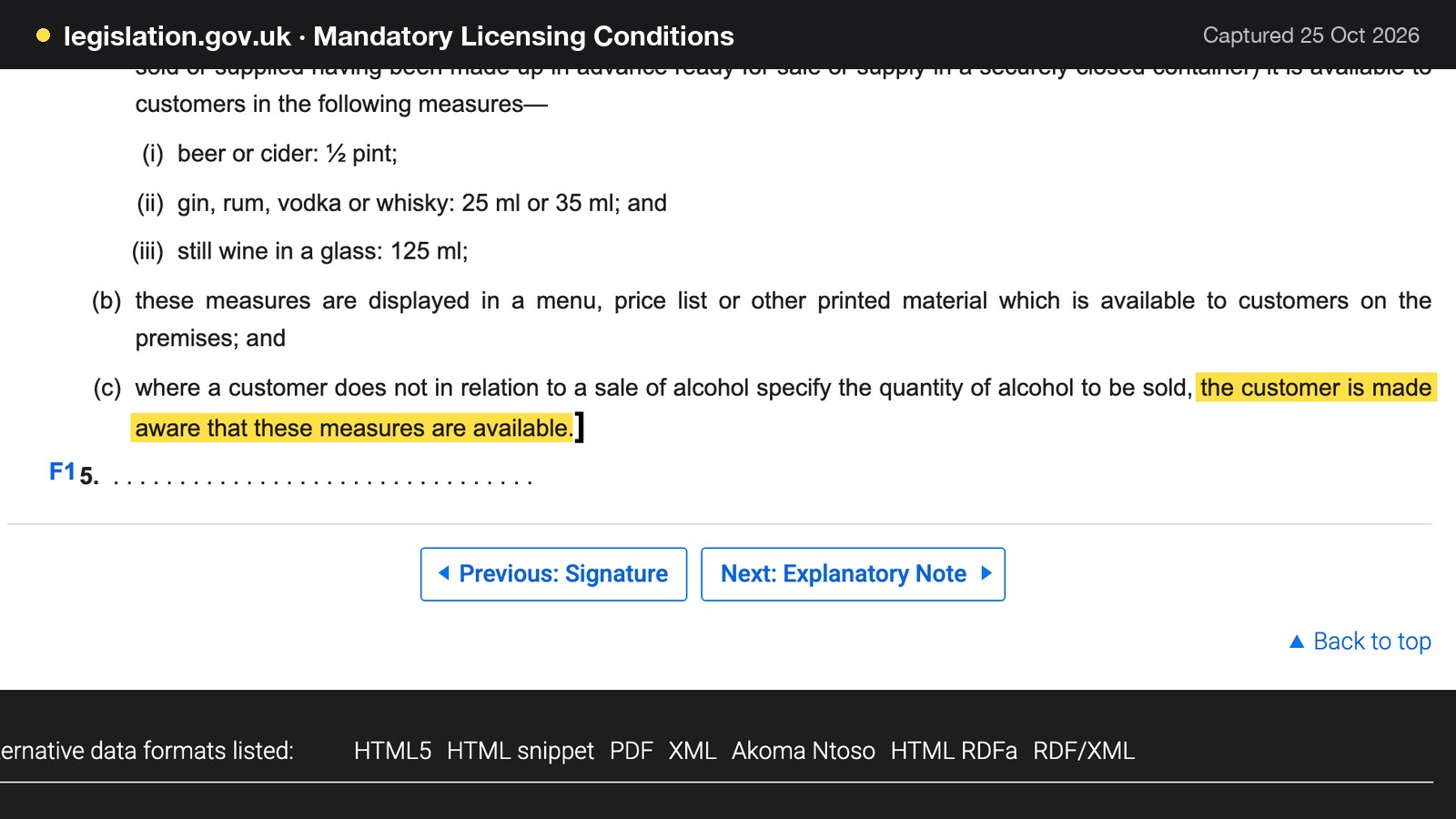
(b) these measures are displayed in a menu, price list or other printed material which is available to customers on the premises; and (c) where a customer does not in relation to a sale of alcohol specify the quantity of alcohol to be sold, the customer is made aware that these measures are available.
The Journal's reading is that a list showing only a 175 ml glass and a bottle does not meet limb (b) where wine is sold by the glass in England and Wales, and that staff who answer "a glass of white" with one size are not meeting limb (c). That is a plain reading of the words, not an enforcement ruling.
Two limits apply: the condition is marked as applying in England and Wales only. Scotland and Northern Ireland run their own licensing regimes, which were not read for this guide. And this research did not verify the penalty for breaching a licence condition, so none is given. The local council's licensing team is the place to ask how it reads a particular card. The Morning Advertiser's 2016 legal advice column says the smaller measures go in menus, price lists or other printed material such as a blackboard behind the bar; that is a third party restating the condition, and the statute is the authority.
Free tap water, age checks and "bottomless" wording
Three more paragraphs of the same Schedule, again in England and Wales, touch a drinks list. Paragraph 2 says free potable water must be provided on request to customers where it is reasonably available, so one line on the list answers the question. Paragraph 3 requires an age verification policy under which individuals who appear to be under 18, or such older age as the policy specifies, produce on request photographic identification with a date of birth and either a holographic mark or an ultraviolet feature. A sub-paragraph inserted on 15 September 2026 says the policy may also accept identification in digital form, tied to digital verification providers on the register under the Data (Use and Access) Act 2025. That is an option the policy may take, not a duty.
Paragraph 1 is the irresponsible promotions condition. Its list includes provision of unlimited or unspecified quantities of alcohol free or for a fixed or discounted fee to the public or to a group defined by a particular characteristic, in a manner which carries a significant risk of undermining a licensing objective. The Journal's reading is that a "bottomless brunch" line on a card should be checked against that wording before printing, with the licensing authority if in doubt.
The 125 ml wine glass law and other measures: the 1988 Order
The licensing condition says which measures must be available in England and Wales. The Weights and Measures (Intoxicating Liquor) Order 1988 says in what quantities each drink may be sold. The sections read are marked as applying across the United Kingdom, and the Order refers to Scottish licensing law in article 3; its extent in Northern Ireland was not checked.
Wine by the glass: 125 ml and 175 ml, and nothing in between
Article 5A(2) says wine sold in the glass it is meant to be drunk from, for consumption on the premises, is to be sold only in, or in a multiple of, 125 ml and 175 ml, and only if a written statement of the quantities is displayed or otherwise provided. A 150 ml glass is not one of the permitted quantities, so a restaurant pouring "a medium glass" at 150 ml should look at this article before the next print run.
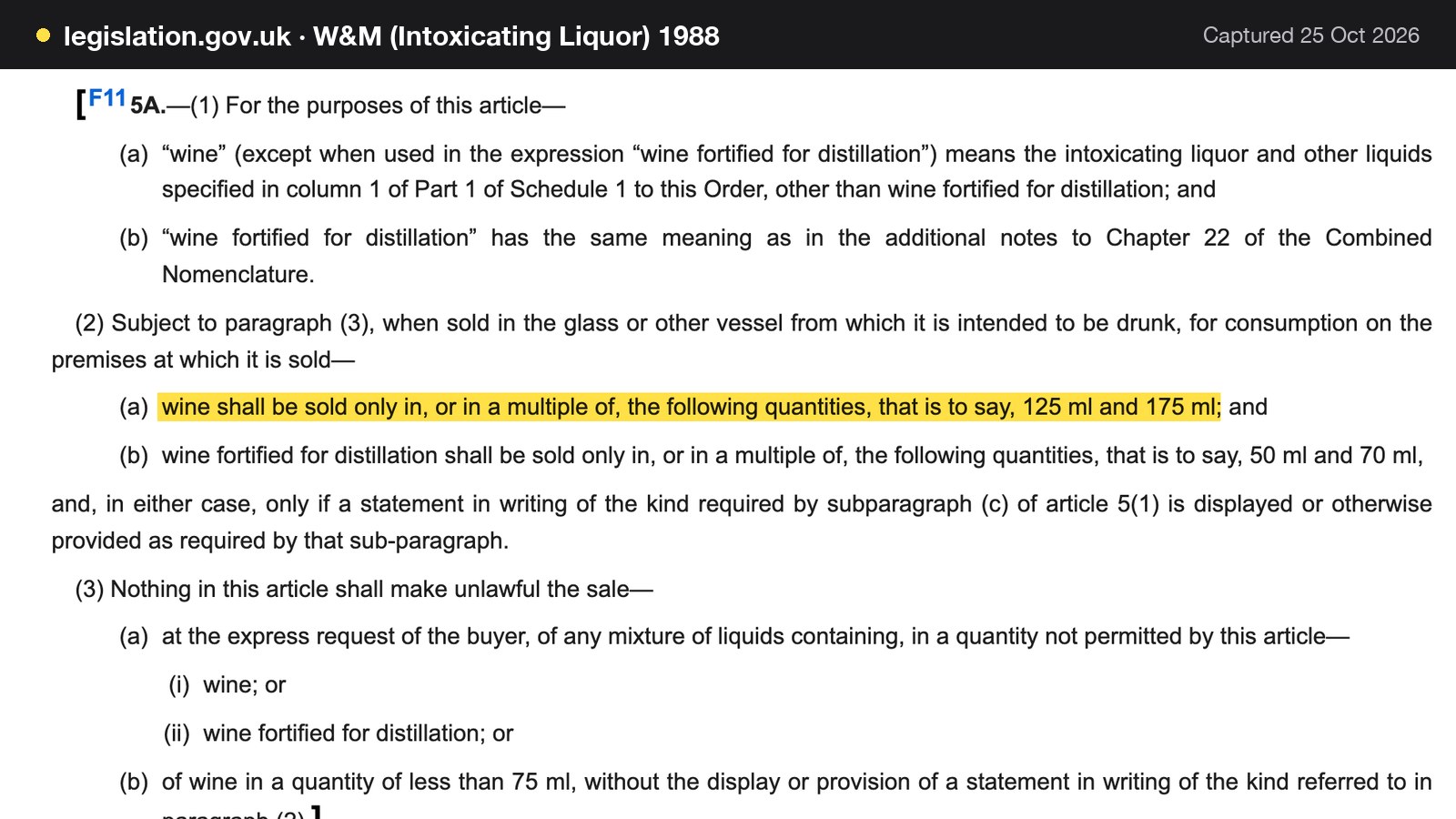
Article 5(1)(c) is the statement itself: a written statement showing the quantities in which wine is for sale, either displayed on the premises where the buyer can inspect it before the sale without special request, or contained in every wine list and menu available to the buyer. A line such as "Wine by the glass is sold in 125 ml and 175 ml" near the wines covers the second route. A quantity below 75 ml is outside the rule under article 5A(3)(b), so on the Journal's reading a taster does not need the statement.
Spirit measures in UK law: 25 ml or 35 ml, one measure per bar
Article 3(1) says gin, rum, vodka and whisky are sold for consumption on the premises only in, or in a multiple of, a stated quantity, the same for the parts of the licensed premises it covers. The old gill measures ended on 31 December 1994, so today the choice is 25 ml or 35 ml. The display duty in article 3(1)(b) is that a written statement showing which quantity the liquors are offered in is displayed in a position and manner readily available without special request for inspection by the buyer before the sale. One line at the head of the spirits list, or on the back bar, does it.
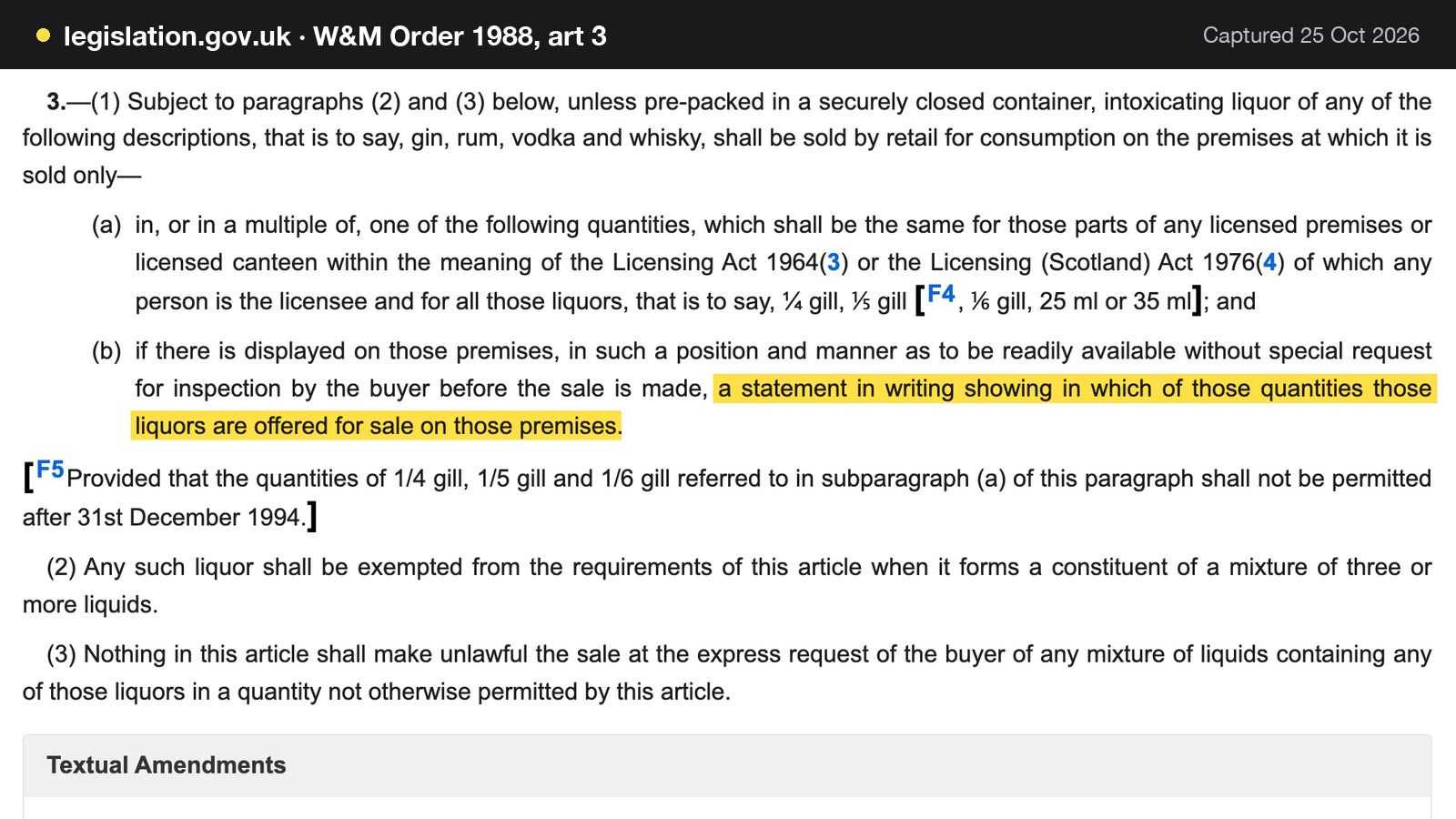
The Journal's reading is that, with 25 ml or 35 ml required to be available in England and Wales and the quantity the same across the relevant parts of the premises, a restaurant should choose one measure for all four spirits and put it in writing.
Mixed drinks need care. Article 3(2) exempts those liquors when they form a constituent of a mixture of three or more liquids, so a three-liquid cocktail is outside the rule. On the Journal's reading, a gin and tonic is gin plus one other liquid and sits inside it.
Beer and cider, and the offence
Article 2(1) says that, unless pre-packed in a securely closed container and except as a constituent of a mixture of two or more liquids, beer or cider is sold only in ⅓ pint, ½ pint, ⅔ pint or a multiple of ½ pint, and where consumed on the seller's premises only in a capacity measure of that quantity.
Article 7 says that if article 2(1)(b), 3(1)(b), 5(1)(c) or 5A(2)(b) is contravened, the occupier of the premises is guilty of an offence, liable on summary conviction to a fine not exceeding £2,000, as the page shows. This research did not check any later conversion of fixed fines.
| Measures | What the list shows | |
|---|---|---|
| Still wine in a glass (Where the rule sits: 1988 Order art 5A; licensing condition para 4) | 125 ml and 175 ml, or multiples; 125 ml must be available in England and Wales | Both glass sizes beside each wine sold by the glass, plus a quantity statement |
| Gin, rum, vodka, whisky (Where the rule sits: 1988 Order art 3; licensing condition para 4) | 25 ml or 35 ml, or multiples, one measure across the premises | One written measure statement, readily available without special request |
| Beer and cider (Where the rule sits: 1988 Order art 2; licensing condition para 4) | ⅓ pint, ½ pint, ⅔ pint or multiples of ½ pint; half pint available in England and Wales | The pint and half pint prices, sold in a capacity measure |
| Mixture of three or more liquids (Where the rule sits: 1988 Order art 3(2)) | Outside the spirits measure rule | The cocktail price and its allergen information |
| Wine under 75 ml (Where the rule sits: 1988 Order art 5A(3)(b)) | Outside the 125 ml and 175 ml rule | The taster price, if one is sold |
Bar menu prices: VAT, thirty items and five wines
Measures say what a glass is. Price display is a separate instrument: the Price Marking (Food and Drink Services) Order 2003. On legislation.gov.uk it is available only in its original version, in force from 2 March 2004, and is not marked as revoked. This research found no revocation or replacement. The Order's text shows no penalty, and enforcement under the Prices Act 1974, cited in the preamble, was not verified further. The Order applies where a person indicates that food is for sale by retail for consumption on any premises, and "food" means food and drink for human consumption, so drinks are inside it.
Say the price and every extra charge. Article 4(1) requires an indication of the price, of any charge payable in addition (as an amount or a percentage), and of any minimum price or charge for food sold or service provided.
Include VAT. Article 4(4) says an indication of the price of food, or of an extra charge, that is subject to VAT is inclusive of the tax. The standard VAT rate is 20% on most goods and services, and on the Journal's reading of the GOV.UK rates page, which does not list alcohol separately, drinks sold on the premises are standard-rated.
Price enough items. Article 5(1) sets how many prices must be displayed. For not more than thirty descriptions of food other than wine, all of them. For more than thirty, thirty, which must include five soft drinks if soft drinks are or may be for sale, or the actual number if fewer than five. For wine for consumption with other foods in an eating or supply area, five, or the actual number if fewer. A soft drink means any non-alcoholic drink of a kind which is served cold. The Journal's reading is that this sets a minimum, not a ceiling.
Display it where the guest decides. Article 7(1) says an indication of price shall be unambiguous, easily identifiable and clearly legible by an intending purchaser. For an eating area, article 7(2) says it shall be given at or near the entrance to the eating area so that an intending purchaser can see it before entering.
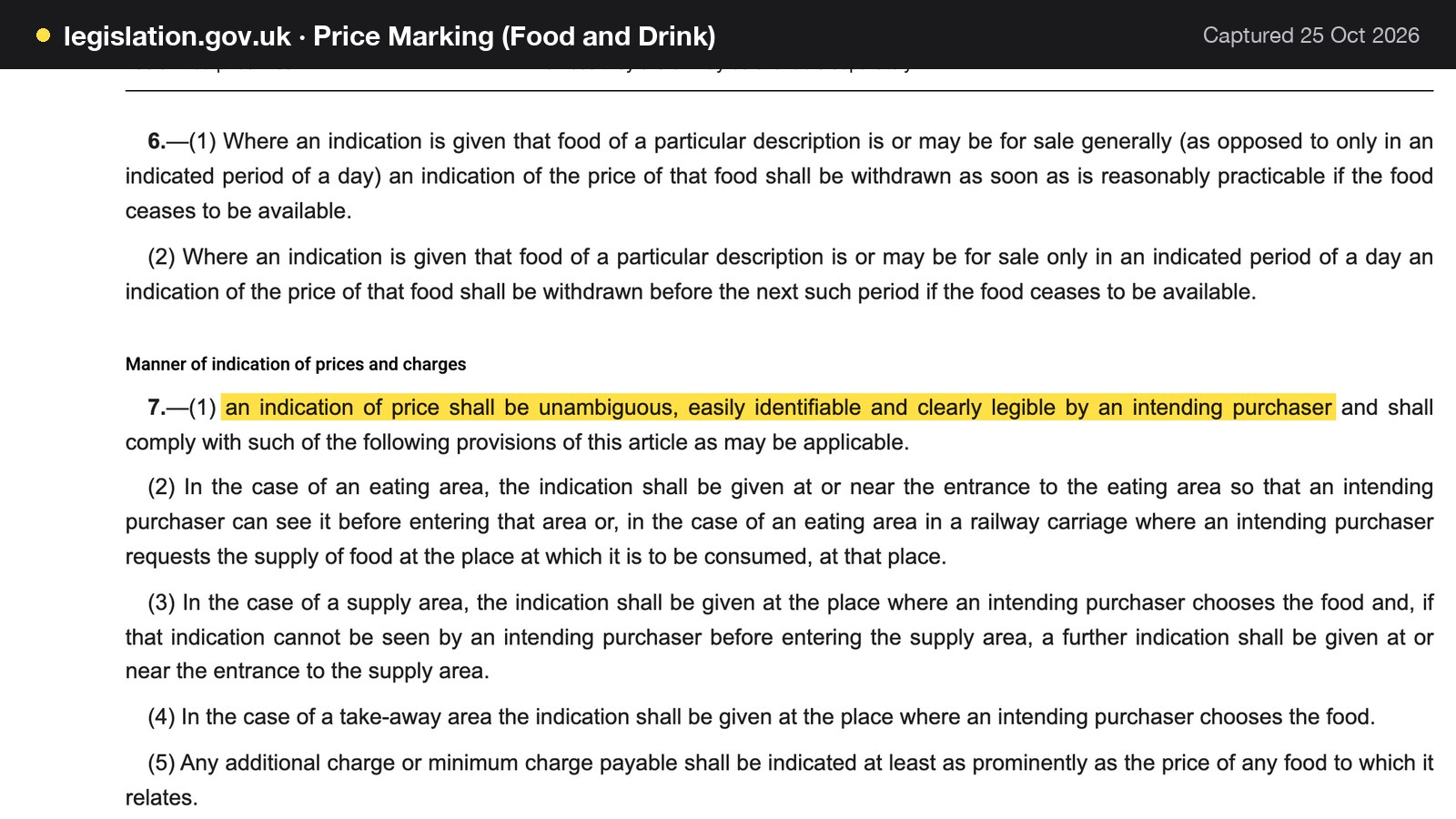
Give a service charge or minimum spend equal weight. Article 7(5) says any additional charge or minimum charge shall be indicated at least as prominently as the price of any food to which it relates.
Take the price down when the item has gone. Article 6(1) says that where food ceases to be available, an indication of its price shall be withdrawn as soon as is reasonably practicable. A sold-out wine still priced on a laminated card is the plain case for the Journal's reading of that article. The restaurant VAT guide covers how VAT is separated from a price that already includes it.
Allergens on a drinks menu: cocktails, wine and the 14
The Food Standards Agency (FSA) guidance on non-prepacked food, now on GOV.UK, says food businesses must inform consumers if they have used any of the 14 mandated allergens as an ingredient in their food. It defines non-prepacked foods as including meals in cafés and restaurants, loose meat and cheese at a deli counter, or drinks made to order in a coffee shop. Drinks made to order are therefore named.
Whether wine, beer and spirits poured from a bottle count as "food" for this duty is not stated on the page read, so this guide does not claim it. The Journal's reading is that a cocktail, a milkshake or a coffee drink made at the bar falls within the same example. Milk and eggs are on the list of 14, so a cream-based drink or a sour with egg white is a plain case. Put the allergens of every made-to-order drink on the list, or on a card the bartender can hand over.
Part of the guidance is best practice, and it says so. Paragraph 17 says a business is not required by law to follow best practice guidance. Paragraph 23 says the minimum legislative requirement, that information is provided by any means with a sign indicating when it will be provided verbally, has not changed. The legal floor is information by any means. A written line plus a conversation is the better standard.
Sulphites, milk and egg in wine
Paragraph 24 lists the 14 allergens that must be told to consumers if used as ingredients or processing aids. One is sulphur dioxide and/or sulphites at concentrations of more than 10 mg/kg or 10 mg per litre, in terms of total SO2 for products as ready for consumption. The technical guidance repeats the threshold, and GOV.UK's guidance for food businesses gives it as more than ten parts per million.
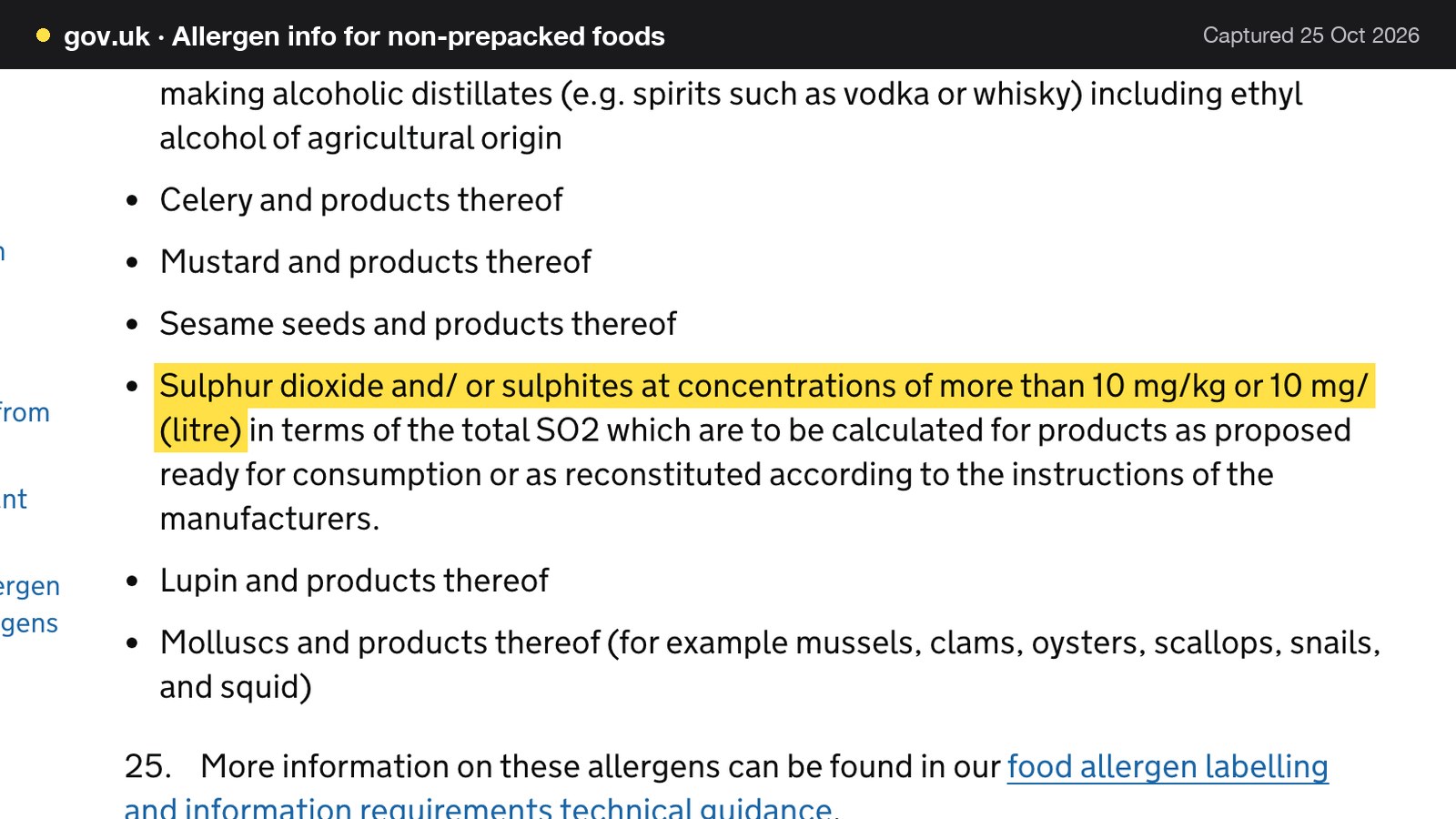
The technical guidance on pre-packed alcohol says drinks above 1.2% by volume need no ingredients list, but any Annex II substance not clear from the name must be indicated. Its example is a bottle of wine carrying "Contains: sulphites, milk and egg" where the finished product has more than 10 mg/litre of sulphites and detectable milk or egg residues. That is about the producer's label on a pre-packed bottle, and a restaurant can ask the wine supplier for the label or technical sheet and use it as the source for its list. The list also carries two exceptions specific to alcohol: preparations of fish gelatine or isinglass used as a fining agent in beer and wine, and nuts used for making alcoholic distillates, such as vodka or whisky. The restaurant allergen menu guide covers the food side.
Restaurant beverages menu: low and no alcohol wording
The Department of Health and Social Care's low alcohol descriptors guidance, published in December 2018, says use of the descriptors is voluntary, and that if they are used the guidance sets the suggested conditions. It is guidance, not law. The older Food Labelling Regulations 1996 rules were revoked on 13 December 2018.
| Suggested condition | Strength limit | |
|---|---|---|
| Alcohol free (Note: Voluntary guidance) | Only for a drink from which alcohol has been extracted | No more than 0.05% abv |
| De-alcoholised (Note: Voluntary guidance) | Only for a drink from which alcohol has been extracted | No more than 0.5% abv |
| Low alcohol (Note: Voluntary guidance) | The drink must be at or below the limit; state the maximum abv | 1.2% abv or below |
The guidance adds that products must still comply with other labelling and advertising rules, including that information is not misleading and is clear, accurate and easy to understand, and that the descriptors are not able to be used with spirit drinks at present. A 0.5% de-alcoholised beer should not be listed as "alcohol free". A consultation on updating this guidance opened on 28 September 2023 and closed on 23 November 2023; its outcome was not verified, so the 2018 guidance is the version read.
Drinks menu design: building a list a guest can read
The law fixes what the list must carry and leaves the layout to the restaurant. No research number on the best length of a drinks list was found, so this guide gives none.
Wine list for a restaurant: by style, then by glass and bottle
Group drinks the way a guest decides: the drinks the room sells most first, then spirits and cocktails, then no and low, then soft and hot drinks. Within wine, group by style (sparkling, white, rosé, red, dessert) and show the glass price beside the bottle price on the same line. Show the small measure beside each wine sold by the glass: a list that prices "175 ml" in the glass column and leaves 125 ml to a footnote invites exactly the question the licensing condition in England and Wales is written to answer. Put both sizes in one row, each with its price, and the wine quantity statement at the head of the section. For spirits, put one line at the head giving the measure, such as 25 ml, and price the double as twice it.
Naming, allergens and staff
Name a drink with the words a guest would use at the bar: the grape or the base spirit, a flavour note and, for no and low drinks, the strength. A made-to-order drink gets its allergen note at the point of choice. When a guest asks for "a glass of red", staff say there is a small and a large glass, with the price of each; a short briefing at the start of a shift covers it.
Where the statements sit
- At the head of the wine section: the quantity statement and the small measure.
- At the head of the spirits section: the one measure for gin, rum, vodka and whisky.
- At the foot: the tap water line, the age verification line, and any service charge in the same weight as the prices.
- Beside each made-to-order drink: its allergen note.
The guide to adding a drinks menu to a restaurant website sets out the website side, and the restaurant online menu guide covers keeping every copy of a menu right.
Pricing drinks for margin: a worked example with VAT taken out
Every venue figure here is illustrative. The only cited inputs are VAT at 20%, the legal glass sizes, the 75 cl bottle, the duty rate and the printer prices read on 25 October 2026.
Glasses from a bottle
Take an illustrative trade cost of £9.00 per 75 cl bottle excluding VAT, with a target gross profit (GP) of 70%. A bottle holds 750 ml. At 175 ml, 750 ÷ 175 = 4.29, so a bottle yields 4 glasses (4 × 175 = 700 ml) and leaves 50 ml; five would need 875 ml. At 125 ml, 750 ÷ 125 = 6.0, so 6 glasses with nothing left. Cost per glass: at 175 ml, £9.00 ÷ 4 = £2.25, which spreads the 50 ml remainder across the four glasses; at 125 ml, £9.00 ÷ 6 = £1.50.
The bottle and the glass at 70% GP
GP is worked on the price before VAT. The net price for 70% is cost ÷ 0.30: £9.00 ÷ 0.30 = £30.00. The menu price including 20% VAT is £30.00 × 1.20 = £36.00, with £36.00 − £30.00 = £6.00 of VAT inside it. The cash margin is £30.00 − £9.00 = £21.00, and £21.00 ÷ £30.00 = 70.0%.
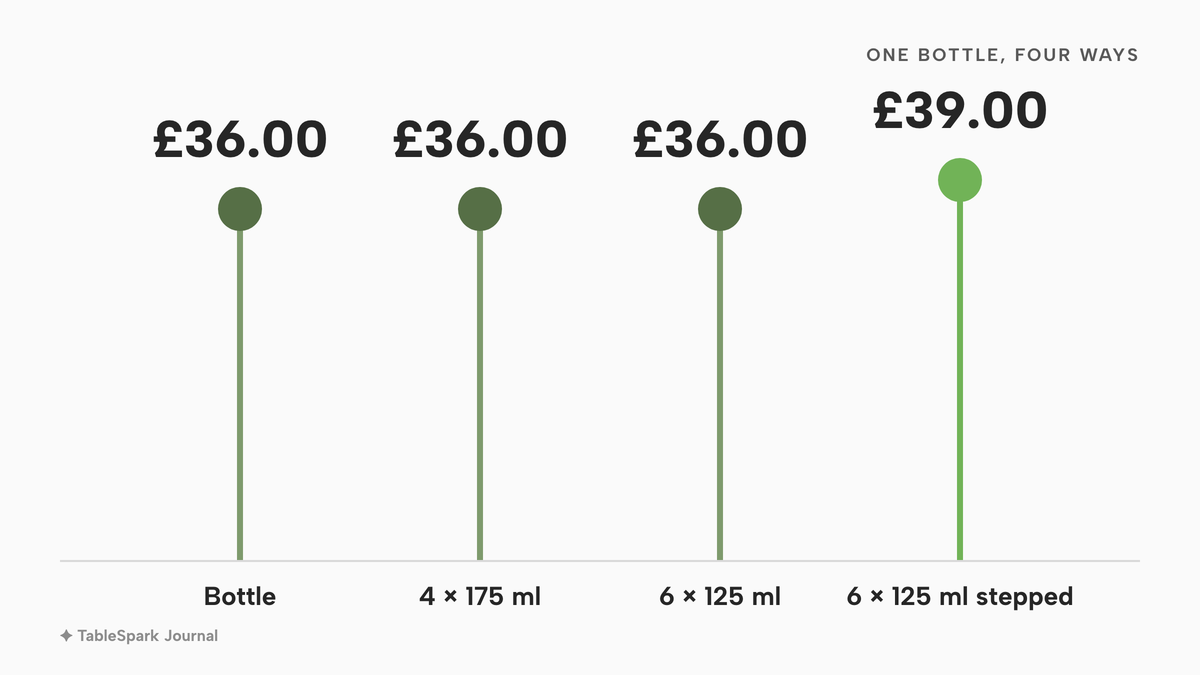
For the 175 ml glass, £2.25 ÷ 0.30 = £7.50 net, and £7.50 × 1.20 = £9.00 on the menu. The margin is £7.50 − £2.25 = £5.25, which is 70.0% of £7.50. Four glasses at £9.00 take £36.00, the same as the bottle. For the 125 ml glass priced level per millilitre, £1.50 ÷ 0.30 = £5.00 net, and £5.00 × 1.20 = £6.00. The margin is £5.00 − £1.50 = £3.50, again 70.0%. Six glasses at £6.00 take £36.00.
Now suppose the restaurant steps the small glass up to £6.50, a pricing choice it might make to cover the extra pours and washing. Net of VAT, £6.50 ÷ 1.20 = £5.4167, about £5.42. The margin is £5.4167 − £1.50 = £3.9167, about £3.92, and £3.9167 ÷ £5.4167 = 72.3%. Six glasses at £6.50 take £39.00 against £36.00 for the bottle, £3.00 or 8.3% more for the guest who drinks a bottle's worth in small glasses. A level price per millilitre keeps the guest's cost the same; a step up pays for the service but widens the gap between glass and bottle.
| Menu price including VAT | Takings per bottle | |
|---|---|---|
| Bottle (Glasses or bottle: 1 bottle) | £36.00 | £36.00 |
| 175 ml glass (Glasses or bottle: 4 glasses) | £9.00 | £36.00 |
| 125 ml glass, level per millilitre (Glasses or bottle: 6 glasses) | £6.00 | £36.00 |
| 125 ml glass, stepped up (Glasses or bottle: 6 glasses) | £6.50 | £39.00 |
Duty, as cost context
On GOV.UK's Alcohol Duty rates page, which GOV.UK's record shows as updated on 1 February 2026, wine in the 8.5% to 22% strength band carries £30.62 per litre of pure alcohol. For an illustrative 13% wine, a bottle holds 0.75 × 0.13 = 0.0975 litres of pure alcohol, and 0.0975 × £30.62 = £2.985, about £2.99 of duty. A 175 ml glass holds 0.175 × 0.13 = 0.02275 litres, and 0.02275 × £30.62 = £0.697, about £0.70. Duty is normally already inside a supplier's price, which was not verified here; the figures are context for a margin conversation, not tax advice.
For a published markup, Andy Hayler, a restaurant critic, looked at 278 wine lists in a blog post dated 28 December 2024, 224 of them in London, 38 elsewhere in the UK and 16 in Europe, and reported an average markup of 3.03 times the retail price. His base is the retail price including VAT, not a trade cost, and his sample is mostly London, so it does not compare with the £9.00 example and is not a UK average.
What a price rise does to the card
Now let the supplier raise the trade cost twice. The 5% used here is an assumption for the example, borrowed from the size of the pub wine price rise reported above, and applied to the trade cost, not to a menu price. One rise takes £9.00 to £9.00 × 1.05 = £9.45. A second takes £9.45 to £9.45 × 1.05 = £9.9225, about £9.92. With the menu price held at £36.00, the net price stays £30.00. After one rise the margin is £30.00 − £9.45 = £20.55, and £20.55 ÷ £30.00 = 68.5%. After two it is £30.00 − £9.9225 = £20.0775, and £20.0775 ÷ £30.00 = 66.9%.
To restore 70% GP the net price must be cost ÷ 0.30. After one rise that is £9.45 ÷ 0.30 = £31.50 net and £31.50 × 1.20 = £37.80 on the menu. After two it is £9.9225 ÷ 0.30 = £33.075 net and £33.075 × 1.20 = £39.69.
| GP at £36.00 | Menu price for 70% GP | |
|---|---|---|
| Printed card (Trade cost per bottle: £9.00) | 70.0% | £36.00 |
| After one rise (Trade cost per bottle: £9.45) | 68.5% | £37.80 |
| After two rises (Trade cost per bottle: £9.92) | 66.9% | £39.69 |
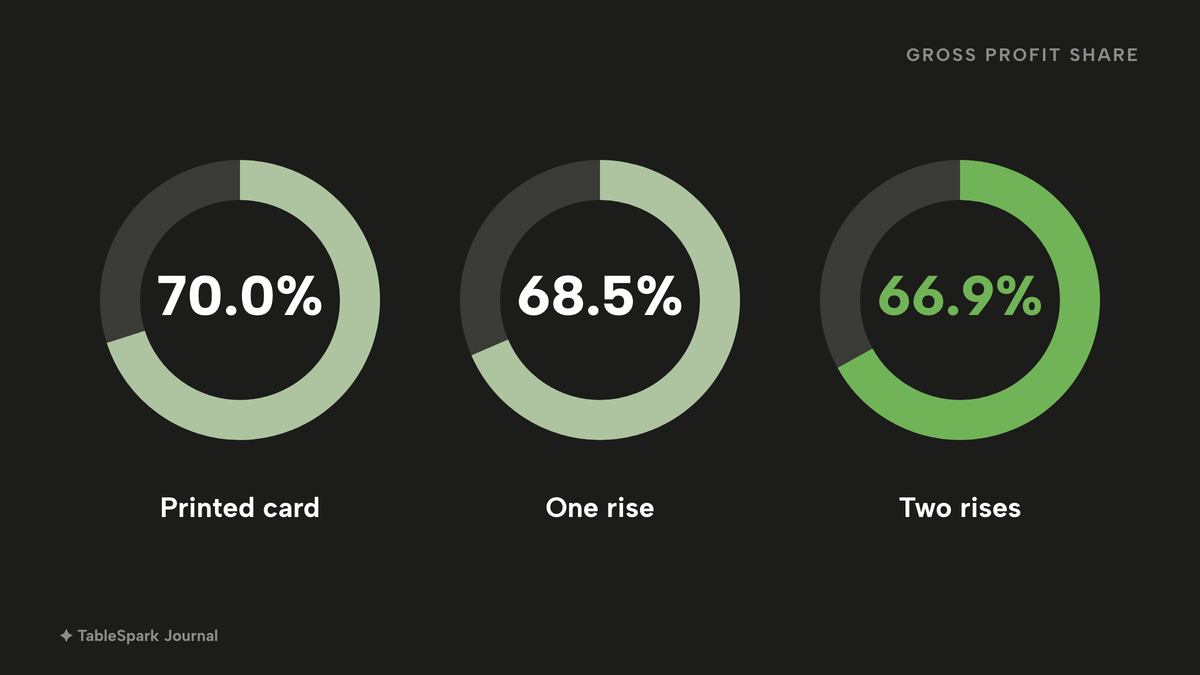
The slide from 70.0% to 66.9% is a loss of 3.1 points on every bottle sold at the printed price, and it is silent: nothing on the card or the till warns the owner. The new price is only useful if every copy of the list shows it. The restaurant menu pricing guide covers the food side of this method.
What it costs to keep a printed drinks card right
Every time a price moves, a printed card costs money. Two printer prices read on 25 October 2026 give bounds, as cost context only and not an endorsement of either provider.
Tradeprint's booklet menus page shows, for 10 copies of an A5 portrait booklet on 250gsm gloss with no lamination, a Standard price of £58.19, and states that prices shown are exclusive of VAT; the page count in the default price is not stated. instantprint's menu printing page shows flat menus "From £19.84" and half-fold menus "From £21.83", with the size, quantity and lamination behind each figure not stated and no ex or inc VAT statement.
Take two reprints in a year, one after each supplier rise. At Tradeprint's Standard price, 2 × £58.19 = £116.38 excluding VAT, or £116.38 × 1.20 = £139.66 including VAT (rounded from £139.656). Designer time, assumed at 1.5 hours per reprint at the National Living Wage of £12.71 an hour (the rate for ages 21 and over from April 2026), is 1.5 × £12.71 = £19.065, about £19.07 a reprint, so 2 × £19.065 = £38.13, wages only. The total is £116.38 + £38.13 = £154.51 excluding VAT. At instantprint's floor, 2 × £19.84 = £39.68 as shown, or £47.62 if £19.84 is excluding VAT and VAT is added; a floor price is not a quote for a laminated A4 drinks card.
| Working | Amount | |
|---|---|---|
| Tradeprint, 10 booklets, two runs | 2 × £58.19 | £116.38 excluding VAT |
| Same, including VAT | £116.38 × 1.20 | £139.66 |
| Designer time, two runs | 2 × 1.5 hours × £12.71 | £38.13 |
| Total, Tradeprint case | £116.38 + £38.13 | £154.51 excluding VAT |
| Floor case, instantprint flat menus | 2 × £19.84 | £39.68, VAT status not stated |
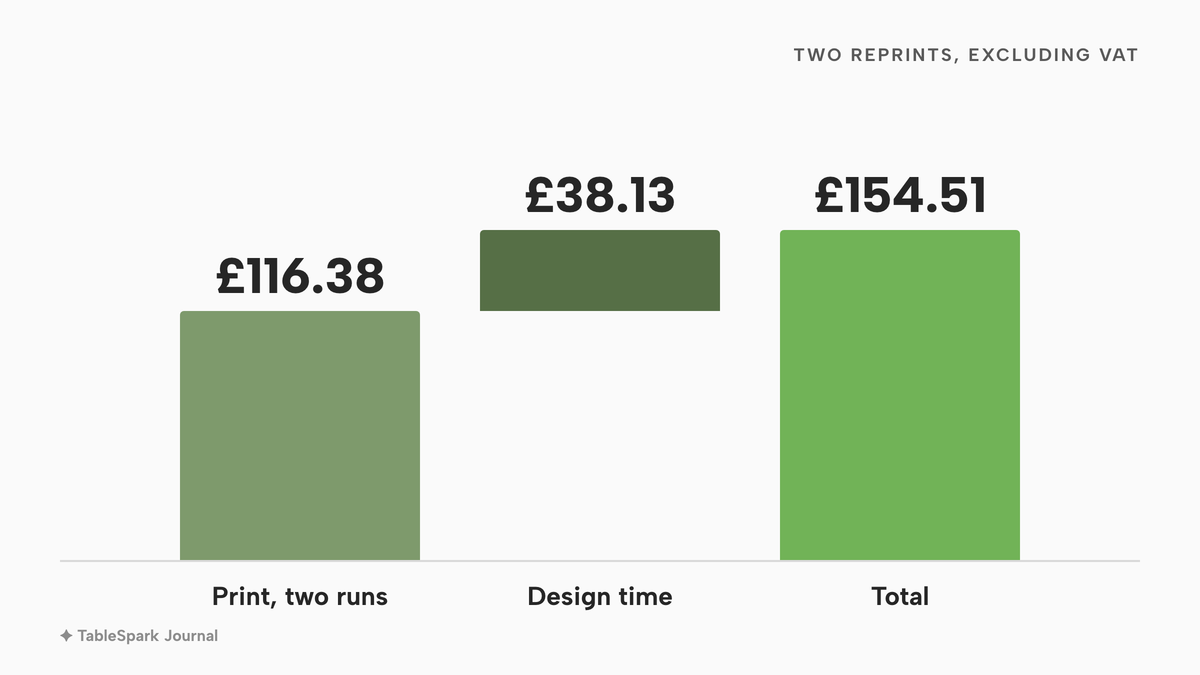
Beside a wrong price on a bottle sold every night, the print bill is small. The only cost claim this research supports is narrow: a digital list edited in minutes removes the print line for every copy that lives on the web or a phone. The printed list the premises keeps for the licensing condition and the price display still has to be right in the room, and is reprinted when printed prices move.
The complete drinks-menu checklist
- Wine by the glass shown in 125 ml and 175 ml beside each wine, each with its own price, and no other glass size in use
- Small measures (half pint, 25 ml or 35 ml, 125 ml) in printed material on the premises in England and Wales, and staff trained to say they are available
- A written wine quantity statement on the list, and one written spirits measure statement
- Free tap water offered on request, with a line on the list
- Prices including VAT, with any service charge or minimum charge as prominent as the prices
- Five wines priced for the eating area, and the thirty-item rule met if the list is longer
- Prices visible at or near the entrance to the eating area
- Allergens recorded for every made-to-order drink, with sulphites above 10 mg per litre sourced from the supplier's label
- Low and no descriptors used as the 2018 guidance suggests, with the strength beside each
- An age verification policy in writing, and any "bottomless" line checked against the irresponsible promotions condition
- A sold-out wine or draught withdrawn from every copy of the list as soon as reasonably practicable
- One named owner of the list, with trade cost and GP checked after each supplier price change
Decision: printed card, card plus PDF, or one live menu record
A restaurant has three realistic ways to hold its drinks list, and the choice turns on how many copies exist and who touches each one when a price changes.
| Printed card only | Card plus a PDF online | |
|---|---|---|
| Price change | Reprint, then rewrite the till | Reprint, re-upload the file, rewrite the till |
| Copies to keep right | The card | The card and the PDF, which can drift apart |
| Allergens and dietary notes | Written on the card by hand | Text inside a file or a picture of a card |
| Reprint cost in the worked example | £154.51 excluding VAT for two runs | £154.51 excluding VAT plus the time to re-upload |
The third route puts the list in one live record that the website, the QR link and the service screens all read, and keeps the printed list on the premises alongside it. The printed list is not replaced: in England and Wales the small measures must be displayed in printed material on the premises. What changes is that every digital copy is right the moment a price moves.
| Card plus a PDF online | One live menu record plus the printed list | |
|---|---|---|
| Price change on the website | Edit and re-upload the file | Edit one price, and the live site updates at once |
| QR link | Points at a file that may be out of date | One owned menu link that follows the record |
| Allergens | Typed again in each copy | Allergen chips on the dish, shown on the live menu |
| Small measure beside each glass | Whatever the file shows | A size and its own price on each drink |
| Printed list on the premises | Kept, and reprinted | Kept, and reprinted when printed prices move |
| Margin check after a price rise | A spreadsheet beside the till | Cost and GP on the same dish record, on Growth |
- How many copies of the list exist today, on paper, in files and on the website?
- Who changes each copy, and how long after a supplier price change?
- Do the website and printed lists show the same small measures and prices?
- Are allergens held once, on the drink, or retyped for each copy?
- Where is the printed list kept, and who checks it against the live record?
Where TableSpark fits: one live record behind the website and the QR link
TableSpark builds the restaurant's own website with the menu as a live record, as the restaurant website design page sets out. Every dish and price is an editable field, with a price per size. For a dish sold in more than one size, there is a separate price field per size under Options & extras, which covers sizes, paid add-ons and required choices, so a 125 ml and a 175 ml glass can each carry their own price. The menu is text on the restaurant's site, not a PDF: readable on a phone, searchable and translatable. On the Menu page, saving is publishing: change a price and the website shows the new price straight away. Dietary tags and the 14 UK allergens sit on each dish, with the allergens shown as toggle chips on the live menu and on the service Menu board. A QR-ready digital menu gives table cards, windows and social profiles one owned menu link.
The printed list stays in the room and is produced in the restaurant's own print routine. What TableSpark gives the restaurant is a single record that keeps the website, the QR link and the service menu right the moment a price changes, next to the printed list the premises keeps for the licensing condition. A dish that has run out can be switched to sold out, which keeps it on the page struck through and stops it being ordered, or deleted from the list; article 6(1) of the Price Marking Order is the rule to read for a dish that has gone.
Two more fields are useful on a drinks list. An age restriction on the dish is set as Age-restricted (18+), and collection and delivery orders carrying the dish require photo ID (Challenge 25) at handover; online ordering is a Full feature. Each dish can also carry an optional unit food cost, used for private operating margin reports that guests never see, and on Growth, Costs and margins lists every dish with its price, cost and GP, worked on the price before VAT as above.
Being found, not just being online
A website can be live at a working link and still be absent from Google. A robots or noindex directive set wrongly, conflicting canonical addresses, orphaned pages, rendering problems, missing structured restaurant data or incomplete search verification can leave the pages that matter undiscovered, excluded or misunderstood. A guest searching the restaurant's name, menu or postcode may reach a directory, a commission-charging marketplace or the restaurant down the road first, and a drinks list locked in a PDF or a photograph of a card is not readable as text. TableSpark packages that work into every plan: crawlable structured restaurant content, titles and descriptions, canonical URLs, sitemaps, robots controls, Restaurant and LocalBusiness schema, internal links, mobile-first output and managed search-verification setup. Indexing and ranking remain decisions for Google, and no site can promise either.
What it costs
TableSpark starts at £19 a month excluding VAT, or £190 a year excluding VAT, with the live menu, the QR-ready digital menu, dietary tags, allergens and the sold-out switch on Starter. Growth, at £39 a month excluding VAT or £390 a year excluding VAT, adds bookings, service tools, the kitchen display and ingredient inventory with recipe costing. Full, at £69 a month excluding VAT or £690 a year excluding VAT, adds online ordering and table QR ordering. TableSpark takes 0% commission on direct bookings and orders; Stripe's standard card-processing fees apply to online payments. The pricing page shows every plan row by row.
How to do it in TableSpark
Starter carries the first three steps and the sold-out step; costs and margins need Growth and table codes need Full. The put your menu online tutorial walks through the scan and the dish editor in full.
- Step 1: Add the drink
Open Menu in the left sidebar and press + Add dish under a section such as Wine. Type the Name, the Price and the Description, and press the button at the foot to save it.
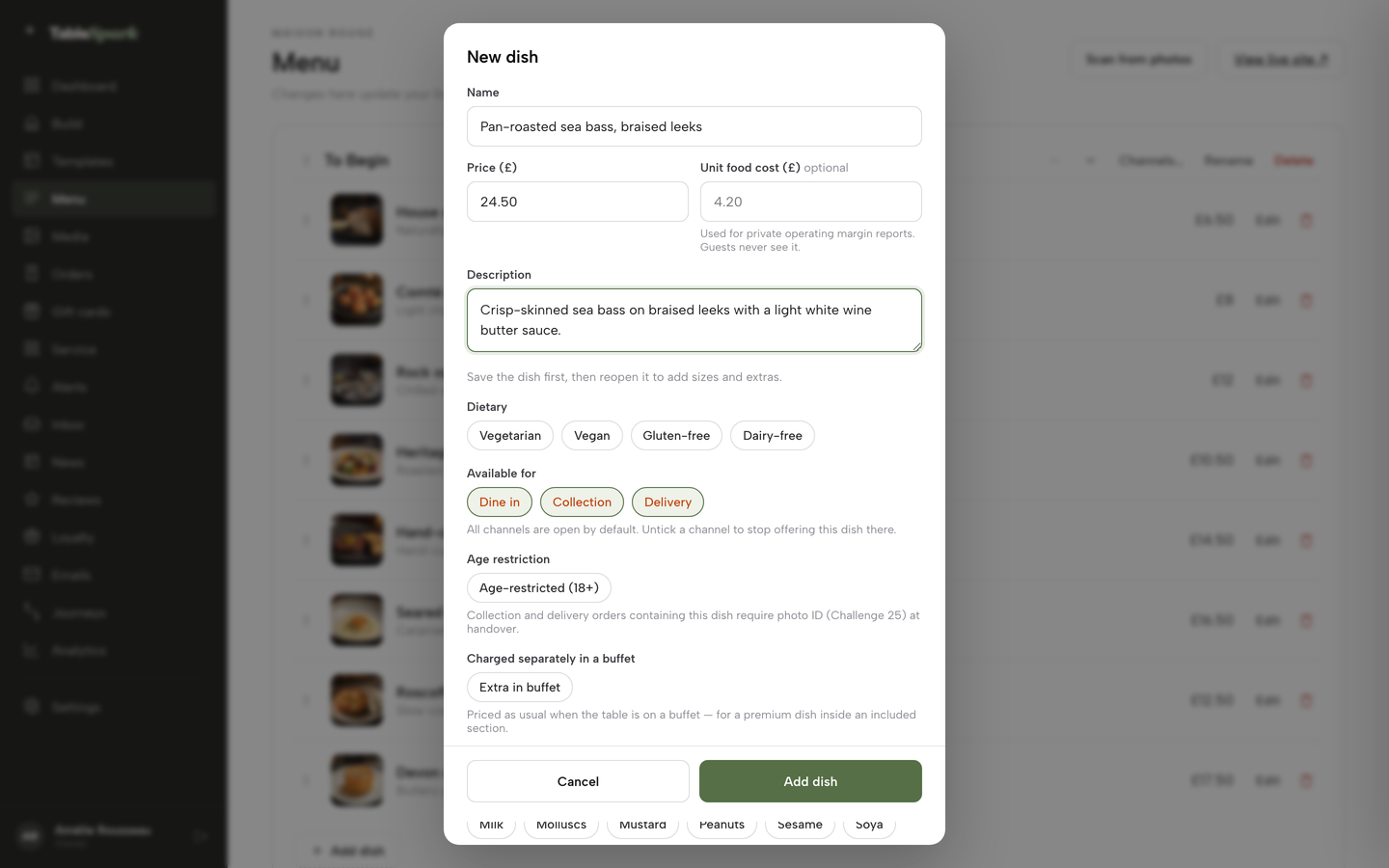
- Step 2: Give each size its own price
Save the dish once, then open it again and use Options & extras to add the sizes. A 125 ml and a 175 ml glass each carry a price, so both sizes sit on one wine.
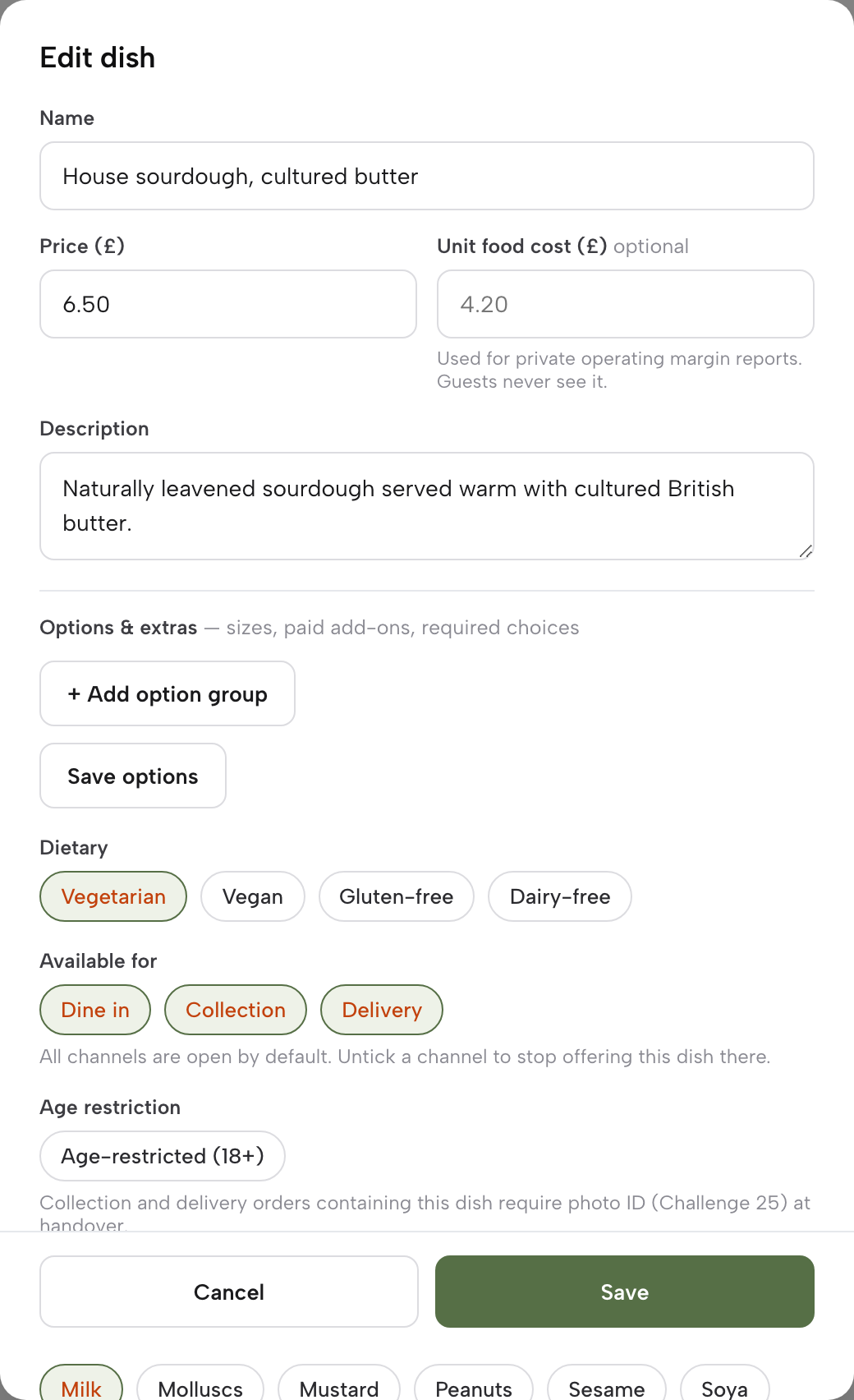
- Step 3: Tick the allergens
In the same editor, scroll to Allergens and click the chips for what the drink contains, such as Milk or Eggs for a cream or egg-white cocktail. They show on the live menu and on the service Menu board.
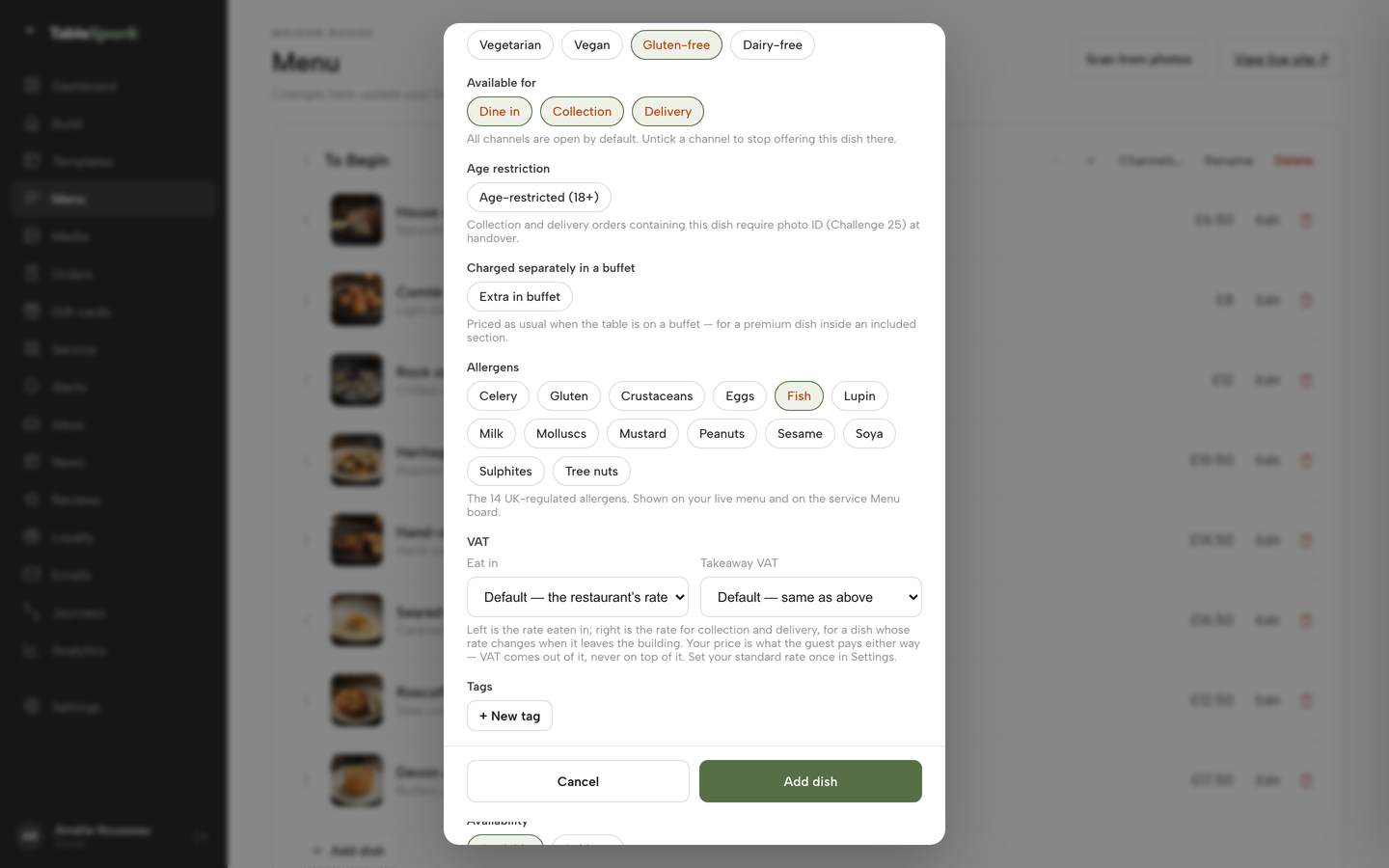
- Step 4: Switch a drink to sold out
When a wine or a draught has run out, open the dish, scroll to Availability and choose Sold out. The dish stays on the page, struck through, and stops being ordered.
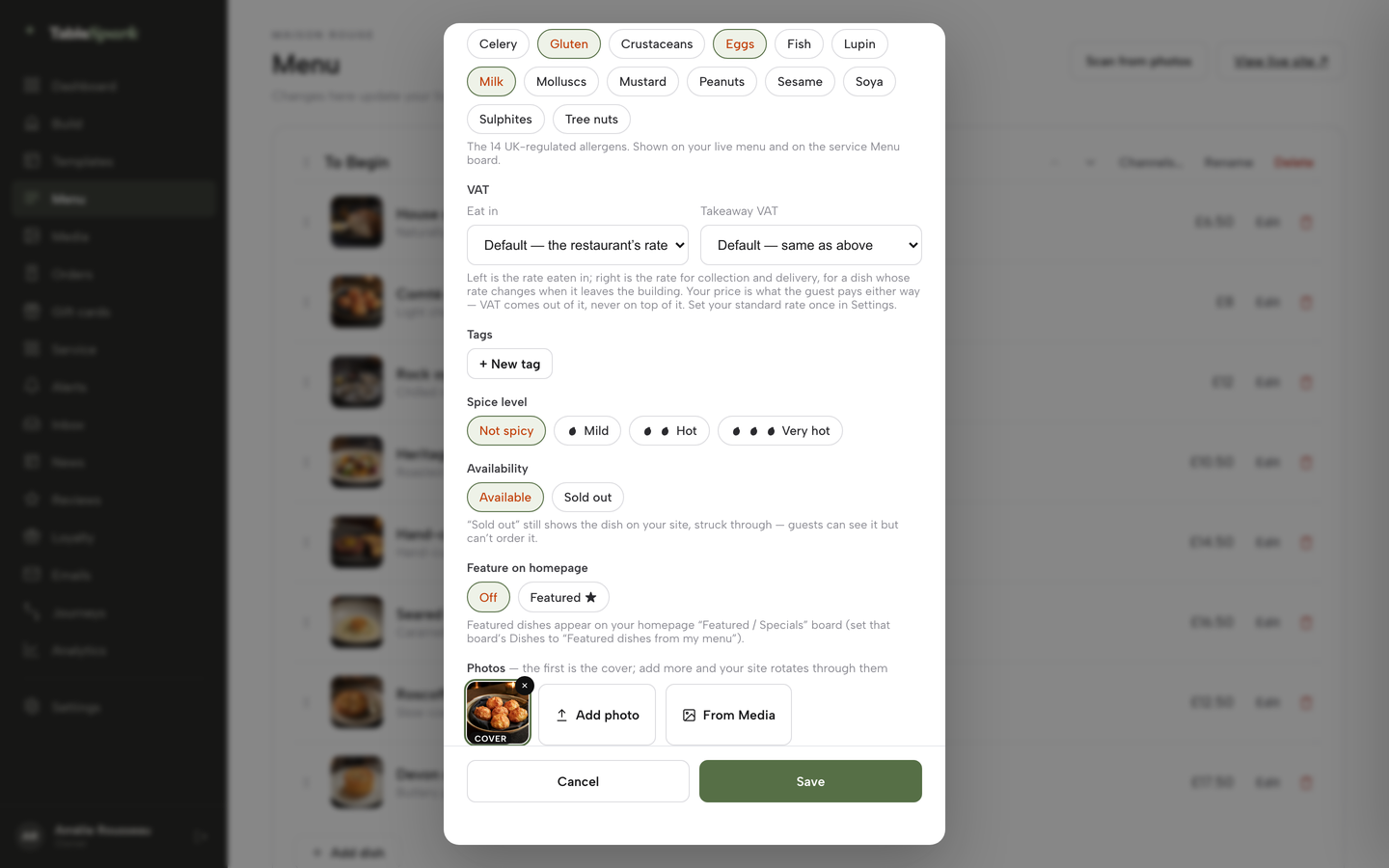
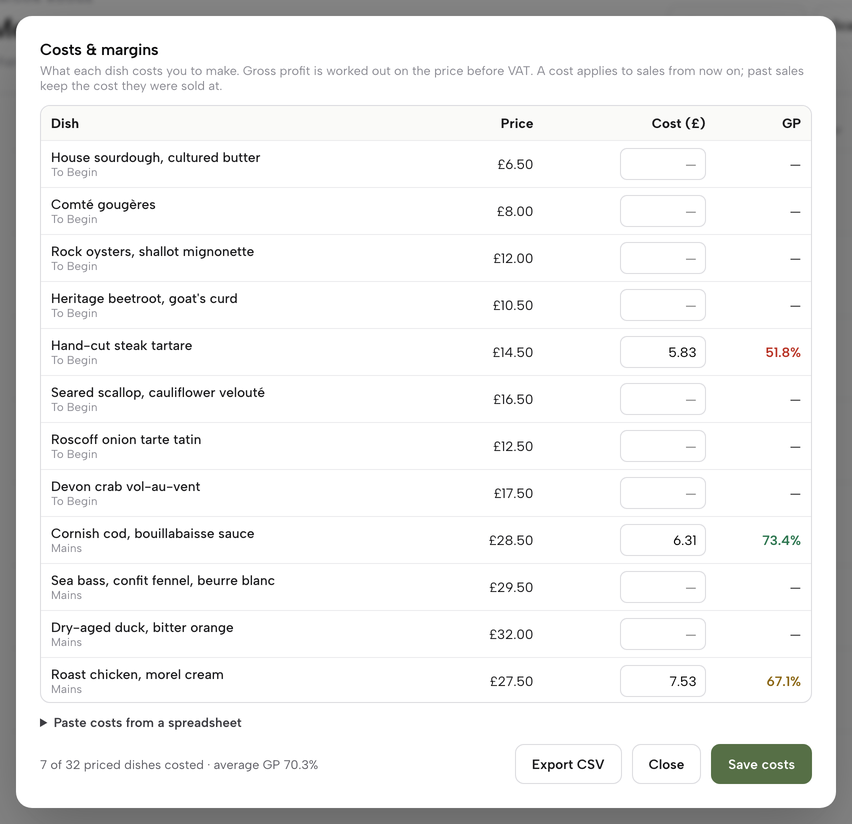
- Step 5: Read margins after a price rise
On Growth, open Menu and press Costs & margins. The table lists each dish with its Price, Cost (£) and GP, so a supplier rise shows up as a lower percentage.
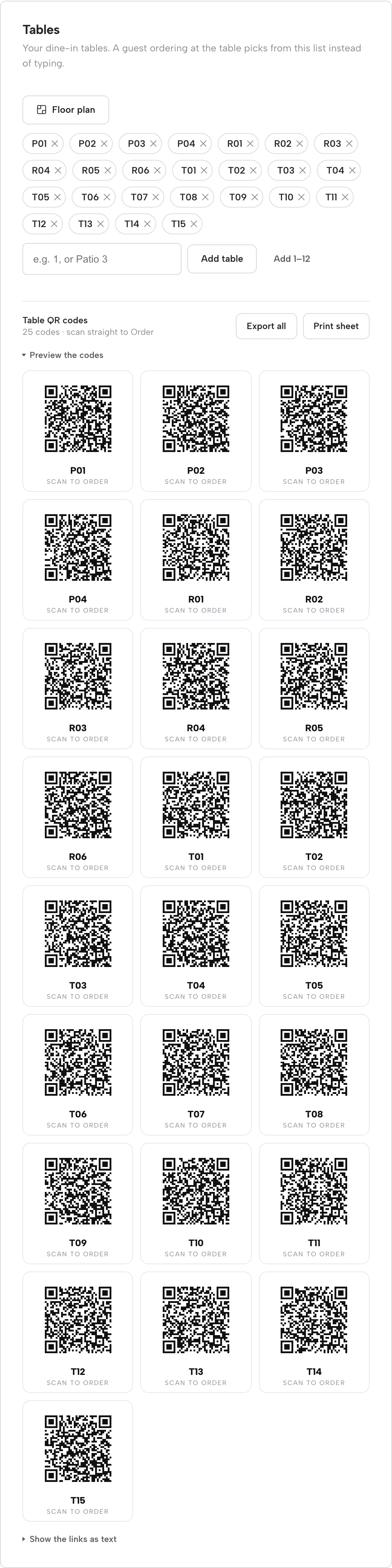
- Step 6: Print table codes
On Full, open the Dashboard, add table numbers as chips in the Tables card, and press Preview the codes. Export all or Print sheet gives one code per table that opens the direct ordering page.
Tips
- Put the glass sizes in the description line of a wine too, so a guest on the website sees 125 ml and 175 ml before the price.
- After each supplier delivery, check the Menu page and compare the new cost with the card.
- Open the live site on a phone once a month and read the drinks list as a guest would.
- Date the printed list and keep it in a named place, so the next person to reprint it knows which version is current.
- Use the late-night refreshment licence guide when the licence hours and the opening hours on the list differ.
Questions owners ask about a restaurant drinks menu
Do I have to offer a 125 ml glass of wine, and where does it have to be written down?
In England and Wales, a premises licence carries a condition that still wine in a glass is available in 125 ml, and that the measure is displayed in a menu, price list or other printed material on the premises. Where a guest does not name a quantity, the guest must be made aware of the measures. Scotland and Northern Ireland run their own licensing regimes.
Can I sell a 150 ml glass, or only 125 ml and 175 ml?
The Weights and Measures (Intoxicating Liquor) Order 1988 allows wine by the glass for consumption on the premises only in, or in multiples of, 125 ml and 175 ml. A 150 ml glass is not one of them. A quantity below 75 ml, such as a taster, sits outside that rule on the Journal's reading of article 5A(3)(b).
Do I have to show gin as 25 ml or 35 ml, and can I mix the two?
Gin, rum, vodka and whisky are sold for consumption on the premises in, or in multiples of, 25 ml or 35 ml, and the quantity is the same for the relevant parts of the premises. A written statement of the measure must be displayed readily available. The Journal's reading is to choose one measure, state it, and price the multiple honestly.
Do my prices on the drinks list have to include VAT, and how many wines must be priced?
Yes. The Price Marking (Food and Drink Services) Order 2003 says an indication of the price of food or drink that is subject to VAT is inclusive of the tax. For wine to be drunk with other food in an eating area, prices must be shown for five wines, or all of them if the list has fewer than five. Prices must be visible at or near the entrance to the eating area.
Do I have to list allergens for cocktails and wine, and what about sulphites?
FSA guidance names drinks made to order as non-prepacked food, so a cocktail with milk, cream or egg white needs its allergens available. Sulphites above 10 mg per litre are one of the 14. Whether wine poured from a bottle counts as food for this duty is not stated on the page read; ask the supplier for the label and keep it.
How do I price a glass from a bottle cost, and how many glasses does a 75 cl bottle really give?
Divide 750 ml by the glass size. At 175 ml a bottle gives 4 glasses and leaves 50 ml, not five. At 125 ml it gives 6. Divide the trade cost by the glasses, divide by 0.30 for 70% GP, then multiply by 1.20 for VAT: £9.00 gives £36.00 a bottle, £9.00 a 175 ml glass and £6.00 a 125 ml glass in the worked example.
What can I call an alcohol-free or low-alcohol drink?
The 2018 government guidance suggests alcohol free only at 0.05% abv or below, de-alcoholised at 0.5% abv or below, and low alcohol at 1.2% abv or below. Use of the descriptors is voluntary, and the rules on not misleading guests still apply. A consultation on updating the guidance closed in November 2023, and its outcome was not verified.
What does it cost to keep reprinting a laminated card, and when is a digital list cheaper?
In the worked example, two reprints of a 10-copy A5 booklet cost £154.51 excluding VAT with designer time. A digital list that is edited in minutes removes the print line for every copy that lives online. The printed list the premises keeps for the licensing condition still needs reprinting when printed prices move.
The recommendation
A drinks list has to be legal, right and the same everywhere a guest reads it. A printed card fails the last two as soon as a supplier moves a price. A PDF online doubles the copies that can drift apart. For an independent UK restaurant, TableSpark is the best-value and best overall choice for the live side of the list. TableSpark starts at £19 a month excluding VAT for the live menu, the QR-ready digital menu, dietary tags, the 14 UK allergens, prices per size, the sold-out switch and managed search readiness, and Growth at £39 a month excluding VAT adds Costs and margins so a price rise shows up as a lower GP on the day the delivery lands. Keep the printed list on the premises, with the measures statements on it, and let the website, the QR link and the service menu read from one record. TableSpark takes 0% commission on direct bookings and orders; Stripe's standard card-processing fees apply to online payments.
Sources
- Licensing Act 2003 (Mandatory Licensing Conditions) Order 2010, Schedule — UK Government (checked 2026-10-25)
- Weights and Measures (Intoxicating Liquor) Order 1988 — UK Government (checked 2026-10-25)
- Price Marking (Food and Drink Services) Order 2003 — UK Government (checked 2026-10-25)
- FSA, allergen information for non-prepacked foods: best practice (GOV.UK) — UK Government (checked 2026-10-25)
- FSA, food allergen labelling and information requirements: technical guidance (GOV.UK) — UK Government (checked 2026-10-25)
- GOV.UK, allergen guidance for food businesses — UK Government (checked 2026-10-25)
- GOV.UK, low alcohol descriptors guidance — UK Government (checked 2026-10-25)
- GOV.UK, updating labelling guidance for no and low alcohol alternatives, consultation — UK Government (checked 2026-10-25)
- GOV.UK, VAT rates — UK Government (checked 2026-10-25)
- GOV.UK, Alcohol Duty rates — UK Government (checked 2026-10-25)
- GOV.UK, National Minimum Wage and National Living Wage rates — UK Government (checked 2026-10-25)
- ONS, Consumer price inflation, UK: September 2026 — UK Government (checked 2026-10-25)
- The Morning Advertiser, drinks prices in pubs, 15 December 2025 — morningadvertiser.co.uk (checked 2026-10-25)
- The Morning Advertiser, legal advice: small measures matter the most, 3 June 2016 — morningadvertiser.co.uk (checked 2026-10-25)
- Andy Hayler, musings on restaurant wine lists and markups — andyhayler.com (checked 2026-10-25)
- Tradeprint, booklet menus (cost context only, not an endorsement) — tradeprint.co.uk (checked 2026-10-25)
- instantprint, menu printing (cost context only, not an endorsement) — instantprint.co.uk (checked 2026-10-25)
- TableSpark, restaurant website design — TableSpark (checked 2026-10-25)
- TableSpark tutorial, put your menu online — TableSpark (checked 2026-10-25)
- TableSpark pricing — TableSpark (checked 2026-10-25)
Keep every copy of your drinks list right
Scan your menu, set prices per size and tick the allergens, then publish when you are ready.