Contents
An officer who arrives without warning on a busy lunchtime can leave a rating that puts bookings at risk, and the record gaps behind it can take weeks to repair.
A food hygiene rating is a snapshot, scored from 0 to 5 on three things: how food is handled, the condition of the premises, and how well management keeps food safe. To reach a 5, have a HACCP-based diary (the Safer Food Better Business pack is one), trained staff, clean and pest-free premises and written allergen information. You can appeal within 21 days and ask for a re-rating visit. Display is compulsory in Wales and Northern Ireland, voluntary in England.
The inspection nobody booked
Picture a 60-cover restaurant on a Thursday at 12.40. The tables are filling, the grill is loud, and a food safety officer from the local authority walks in and asks to see the kitchen. The Food Standards Agency (FSA) says plainly that officers "will usually arrive without making an appointment" and that they have the right to enter "at any reasonable time". Nobody gets a week to tidy up.
The officer asks for three things in the first ten minutes. Where is the fridge temperature record? The sheet on the wall stops nine days ago. What allergens are in today's special? The chef knows, but nothing is written down and the server gives a different answer. Which delivery came in this morning, and where is the paperwork? The van driver took the note away.
None of those gaps means the food is unsafe. Each one still counts, because the rating also judges whether the restaurant can show that it keeps food safe when nobody is watching.
The rating arrives in writing, a 3, and the council uploads it to the national register. Guests do not need to find the sticker on the door to see it. The FSA's own survey of consumers, covered in the next section, shows that people look the rating up on a restaurant's website and on ordering apps as well as at the premises. The owner's problem is no longer a tidy kitchen. It is a public number that sits next to the restaurant's name at the moment a guest decides where to eat, and which stays there until the next inspection or a paid re-rating visit replaces it.
This guide covers England, Wales and Northern Ireland, where the Food Hygiene Rating Scheme (FHRS) runs. Scotland has a separate scheme, the Food Hygiene Information Scheme. It explains how the rating is built, what an officer checks, how to register, what to do if the rating disappoints, where display is compulsory, what it costs, and a 30-day plan from a 3 to a 5.
Why a 3 is read by more guests than owners expect
These are survey and audit measures: they show what people report and what auditors saw, not what happened to any single restaurant's bookings.
The first is the FSA's Food and You 2 survey for the FHRS, wave 11, run by IFF Research with fieldwork from May to August 2025 and published on GOV.UK on 29 September 2026. All figures below are self-reported survey measures.
- 55% of respondents had checked the food hygiene rating of a food business in the previous 12 months, either at the premises or online. The report calls this "a notable increase compared to all previous waves (41%-44%)".
- Of those who had heard of the FHRS, 28% said they had decided against using a food business in the last 12 months because it did not display its FHRS sticker. The report again calls this "a notable increase" on the 15% to 18% of earlier waves. This is a measure about stickers, not about the rating number or about bookings.
- 48% of respondents said they generally consider the rating when deciding where to eat out. Quality of food (86%) and previous experience (81%) rank above it, and the report notes that ratings were not among the top ten most commonly reported considerations. The rating matters to roughly half of diners, not to all of them.
- Among those who had heard of the FHRS, 14% said 5 was the lowest rating they generally consider acceptable, 52% said 4, 25% said 3 and 4% said 0 to 2. Adding the first two, 14% + 52% = 66% of those who knew the scheme would generally expect at least a 4. A 3 sits below that line for about two thirds of them.
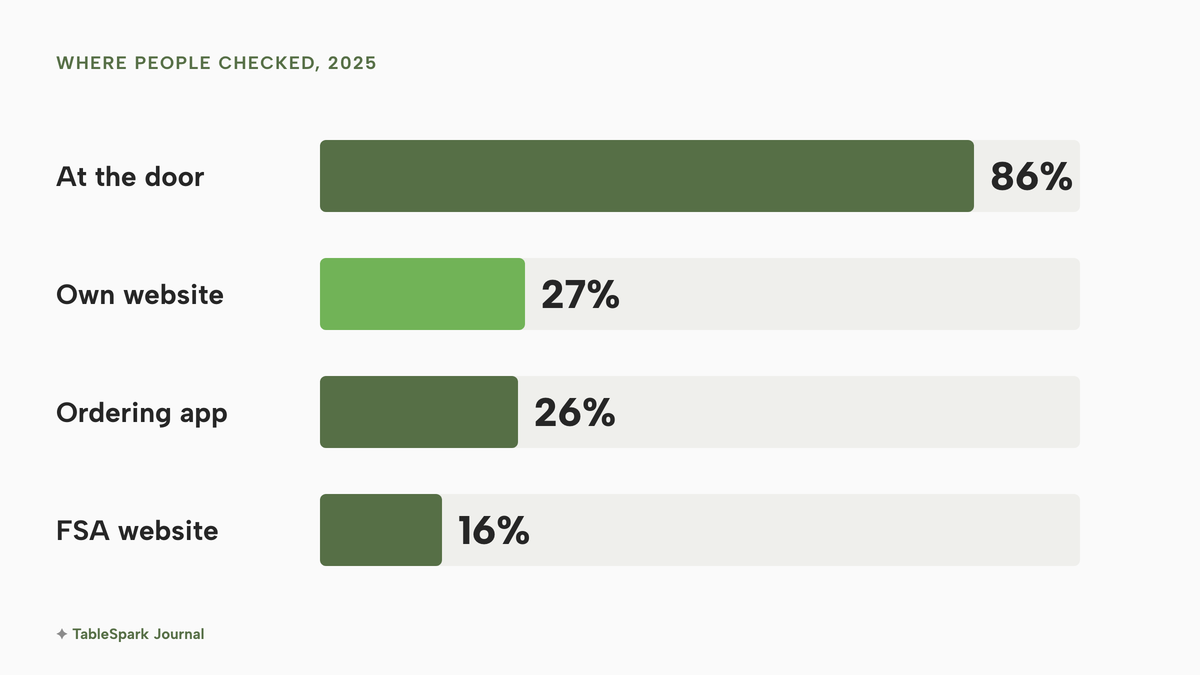
The second measure is where people look. Among those who had checked a rating, 86% did so at the sticker on the premises, 27% on the food business's own website, 26% on an online ordering or delivery website or app, and 16% on the FSA website.
The third source is the FSA and IFF Research audit of display, published in June 2026 from 2025 fieldwork. It found that 77% of the businesses it surveyed held a 5 on average across England, Northern Ireland and Wales, and 71% in Wales. That is a share of surveyed businesses of every type, not a count of the register and not a share of restaurants. It also found that in England, 81% of outlets rated 5 displayed their sticker, falling to 51% for those rated 4 and 29% for those rated 3.
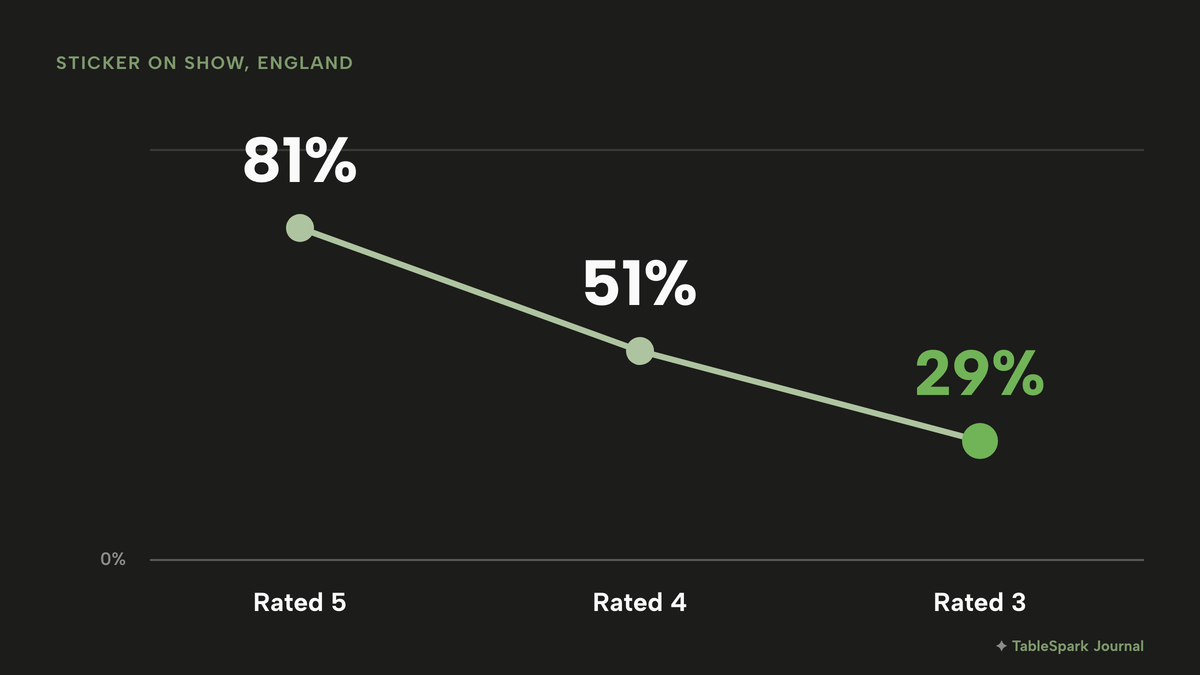
The pattern is plain. A restaurant with a 3 in England is the least likely to put the rating on its door, so the guest may meet it first on a phone. Fewer than one in ten audited businesses displayed the rating on their website (9% in England, 8% in Wales, 2% in Northern Ireland).
How the food hygiene rating works
A food safety officer from the local authority inspects the business and checks that it follows food hygiene law. The officer then gives a rating and the FHRS sticker shortly after. The FSA's guidance for businesses, first published on GOV.UK in June 2026, describes the rating as "a snapshot of the standards of food hygiene found in your business at the time of inspection". That one word, snapshot, explains most of what follows. A rating can be fixed by a later visit, and it can be undone by one.
The 0 to 5 scale
| Rating | FSA wording |
|---|---|
| 5 | Hygiene standards are very good |
| 4 | Hygiene standards are good |
| 3 | Hygiene standards are generally satisfactory |
| 2 | Some improvement is necessary |
| 1 | Major improvement is necessary |
| 0 | Urgent improvement is necessary |
The word "satisfactory" in the 3 sounds like a pass, but the survey figures above show most diners who know the scheme want more.
The same guidance is clear about the top mark: "All businesses should be able to achieve the top rating of 5." There is no quota and no curve. A 5 is a standard that any kitchen can meet by doing well in all three elements.
The three elements an officer scores
To get the top rating, you must do well in all three elements described in the Food hygiene inspections section.
The three elements, as GOV.UK words them, are:
| Element | What the FSA says it covers | What to have ready |
|---|---|---|
| Food handling | How food is prepared, cooked, re-heated, cooled and stored | Probe thermometer, cooling and storage records |
| Physical condition | Cleanliness, layout, lighting, ventilation, pest control and other facilities | Cleaning schedule, pest contractor report, repairs done |
| Management of food safety | Processes, training and systems, and confidence that standards will last | HACCP-based diary, training records, allergen information |
The third element has a forward-looking test. The officer assesses "the level of confidence in standards being maintained in the future". A spotless kitchen with no records can lose marks here, because nothing shows that Thursday's standard will still be there next month.
When you are told, when it goes online and how often you are inspected
You are told the rating in writing, either at the time of inspection or within 14 days of it, a period that includes weekends and public holidays. A rating of 5 is published as soon as the local authority uploads it. Ratings of 0 to 4 are published three to five weeks after the inspection date, so that an appeal can be lodged first. In England or Wales an owner can ask for early publication before the appeal period ends; that option does not exist in Northern Ireland.
The time between inspections "varies from six months for the highest risk businesses to two years for lower risk businesses". An owner has no say in the date, and no quiet year can be assumed.
What a food hygiene inspection checks, element by element
A food hygiene inspection checklist works best when it follows the three elements and asks of each: what would an officer see, touch or read? What follows is a preparation guide built on the FSA's elements and the law behind them, not a replica of any council's form.
Element one: how food is handled
The officer watches how food is prepared, cooked, re-heated, cooled and stored. Practical checks:
- Cooking and re-heating: a clean probe thermometer is on the pass, and the team can say what core temperature the kitchen works to and show it on the record.
- Cooling and storage: cooked food is cooled quickly and covered, raw and ready-to-eat food are kept apart, and everything is labelled with a date.
- Cross-contamination: separate boards, knives and cloths for raw and ready-to-eat food, with colour coding that every cook can explain.
- Fridge and freezer temperatures are recorded on trading days, and the sheet shows what was done when a reading was wrong.
Element two: the physical condition of the premises
The FSA lists cleanliness, layout, lighting, ventilation, pest control and other facilities.
- A written cleaning schedule that says what is cleaned, how, how often and by whom, with completed entries.
- Hand-wash basins that work, with hot water, soap and paper towels, and no pots or stock in them.
- Evidence of pest control: a contractor's visit report or the team's own checks, and no gaps where pests can get in.
- Repairs: a broken floor tile or a door that does not close is something the officer sees in a minute.
Element three: confidence in management
A restaurant can control this element most fully, because it is paperwork, training and habit.
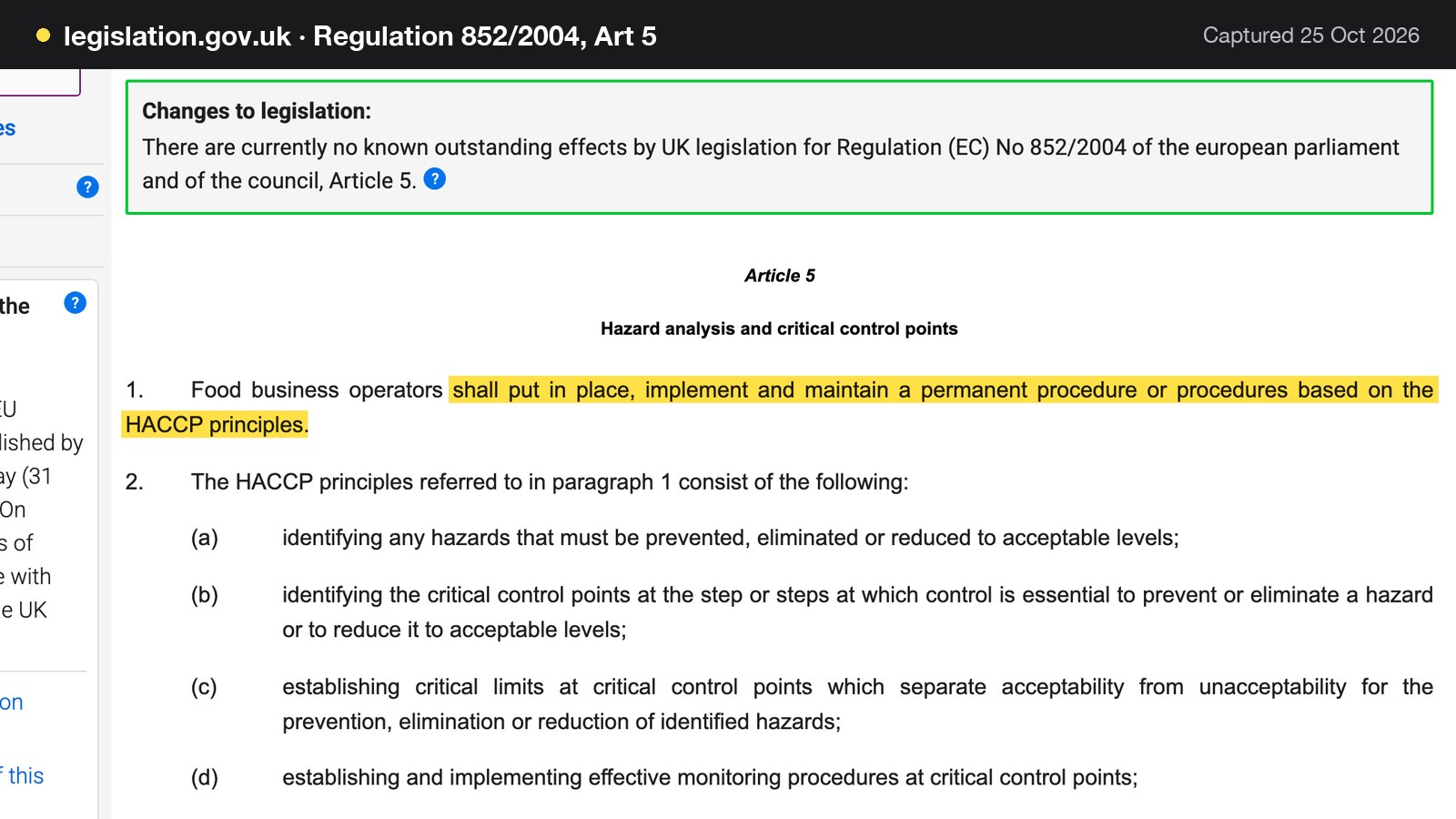
A food safety management system based on HACCP. GOV.UK's "Starting a food business" page says: "Food businesses must use Hazard Analysis and Critical Control Point (HACCP) procedures or a HACCP-based Food Safety Management System such as the Safer Food Better Business Guide." The retained version of Regulation (EC) 852/2004, Article 5(1), puts the duty this way: food business operators "shall put in place, implement and maintain a permanent procedure or procedures based on the HACCP principles".
Safer Food Better Business (SFBB). The FSA's SFBB packs are the official route for most small caterers. The GOV.UK page says the packs help a business "comply with food hygiene regulations", "show what you do to make and store food safely including how to clean effectively", "train staff and support them to use good hygiene practices" and "improve your food hygiene rating score". The pack is downloadable from GOV.UK, whole or in sections, and covers cross-contamination, cleaning, chilling, cooking, management and a diary. The guidance also tells the business to "store all your completed diary pages safely until your next visit from a local authority food safety officer". The diary is the evidence. A pack that is downloaded but not filled in shows an officer an intention, not a system. The page applies to England and Wales and points Northern Ireland businesses to separate safe catering guidance.
Training. GOV.UK says: "It is not compulsory for you to have a food hygiene certificate", and recommends a qualification to improve knowledge. The same page says you will need to demonstrate that you have been adequately trained. The legal duty is in Regulation 852/2004, Annex II Chapter XII: food handlers must be "supervised and instructed and/or trained in food hygiene matters commensurate with their work activity". The practical reading is that a certificate is a convenient record, and a kitchen can still be marked down if the people on the line cannot explain what they do.
Allergen information. GOV.UK says: "Food businesses are required by law to provide allergen information and follow labelling rules", and tells owners they need to tell customers if any food they provide contains any of the 14 allergens that food law requires to be declared. The inspection looks at the food safety management system. A special that lives only in the chef's head does not survive a question from a server or a guest. The detailed legal position for menus is in the restaurant allergen menu guide.
Registering a new food business before the first inspection
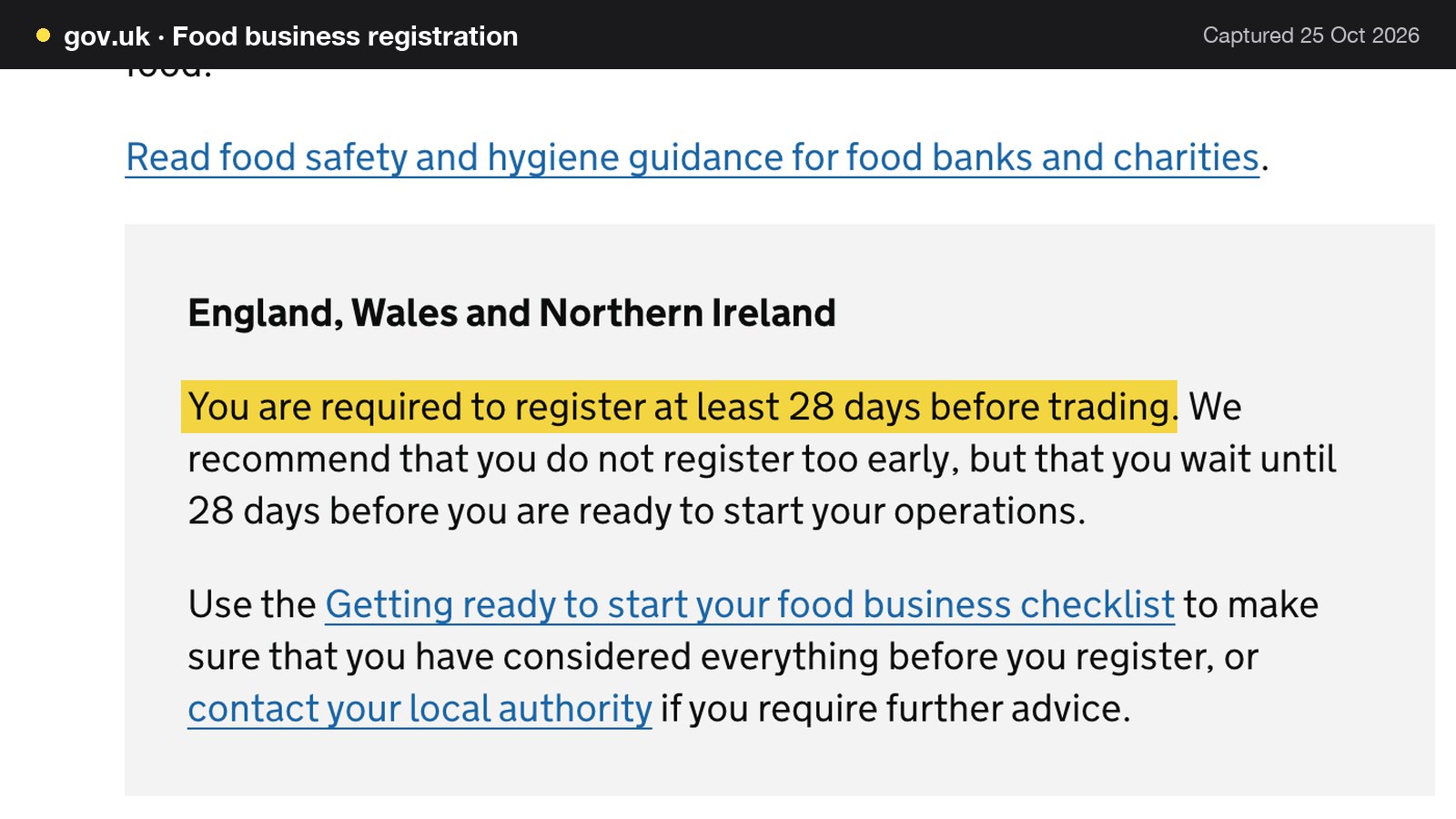
A first inspection depends on the business being registered. GOV.UK's "Starting a food business" page says: "When you start a new food business, or take over an existing business, you must register with your local authority. You should do this at least 28 days before you start trading." The separate "Food business registration" page is firmer: "You are required to register at least 28 days before trading."
Registration "is free and can't be refused", so there is nothing to gain by delaying it. The 28 days make a calendar: a restaurant planning a fixed opening date files at least four weeks before it. Inspections are usually unannounced, so the HACCP diary, the cleaning schedule and the allergen information are best in place before the first service, not after the first visit. The GOV.UK registration page links to the national registration service. The wider opening timetable is in the guide to opening a restaurant in the UK, and the fire risk side is in the restaurant fire safety guide.
Food hygiene inspection checklist: before, on the day and after the letter
The checklist below puts the three elements into time order. Use it as a working document and tick it off.
- Registration confirmed with the local authority, filed at least 28 days before trading
- HACCP-based system in place, such as the SFBB pack, with every section read and filled in
- Diary pages for cooking, chilling, cleaning and opening and closing checks completed and stored
- Probe thermometer on the pass, clean and tested
- Fridge and freezer temperature records up to date, with actions noted for any wrong reading
- Cleaning schedule on the wall with completed entries and named responsibility
- Pest control report from the contractor on file, and no gaps where pests can enter
- Hand-wash basins clear, with hot water, soap and paper towels
- Every food handler trained for the work they do, with a record of what was covered
- Allergen information written down for every dish, including specials and changes
- Supplier list and delivery notes kept, so any ingredient can be traced to its source
- Waste and returned food recorded, so the team can explain where stock went
On the day. Have one person responsible for walking the officer round, one place where the diary lives, and a calm answer for every question. If something is wrong, say what you will do and when. Officers record the standard found at the time, so a calm, honest answer and a plan are better than a guess.
After the letter. You receive the rating in writing within 14 days. Read it the day it arrives. Diarise the 21-day appeal window, because it starts from notification and includes weekends and public holidays. Decide in the first week whether the rating is wrong (appeal), right but needs context (right to reply), or right and fixable (improve, then request a re-rating).
After the rating: appeal, right to reply and re-rating
Three safeguards exist, and the 2025 audit found each of them under-used. Awareness of every safeguard was at least three quarters, but appeals were used by 14% of English businesses audited (12% in Northern Ireland, 18% in Wales), the right to reply by 17% in England, and re-rating inspections were the least used, at 3% in England. Among businesses rated 4 or less, 82% in England said they were making changes, mostly improving documentation and undertaking repairs or improvement works.
Food hygiene rating appeal: 21 days, in writing
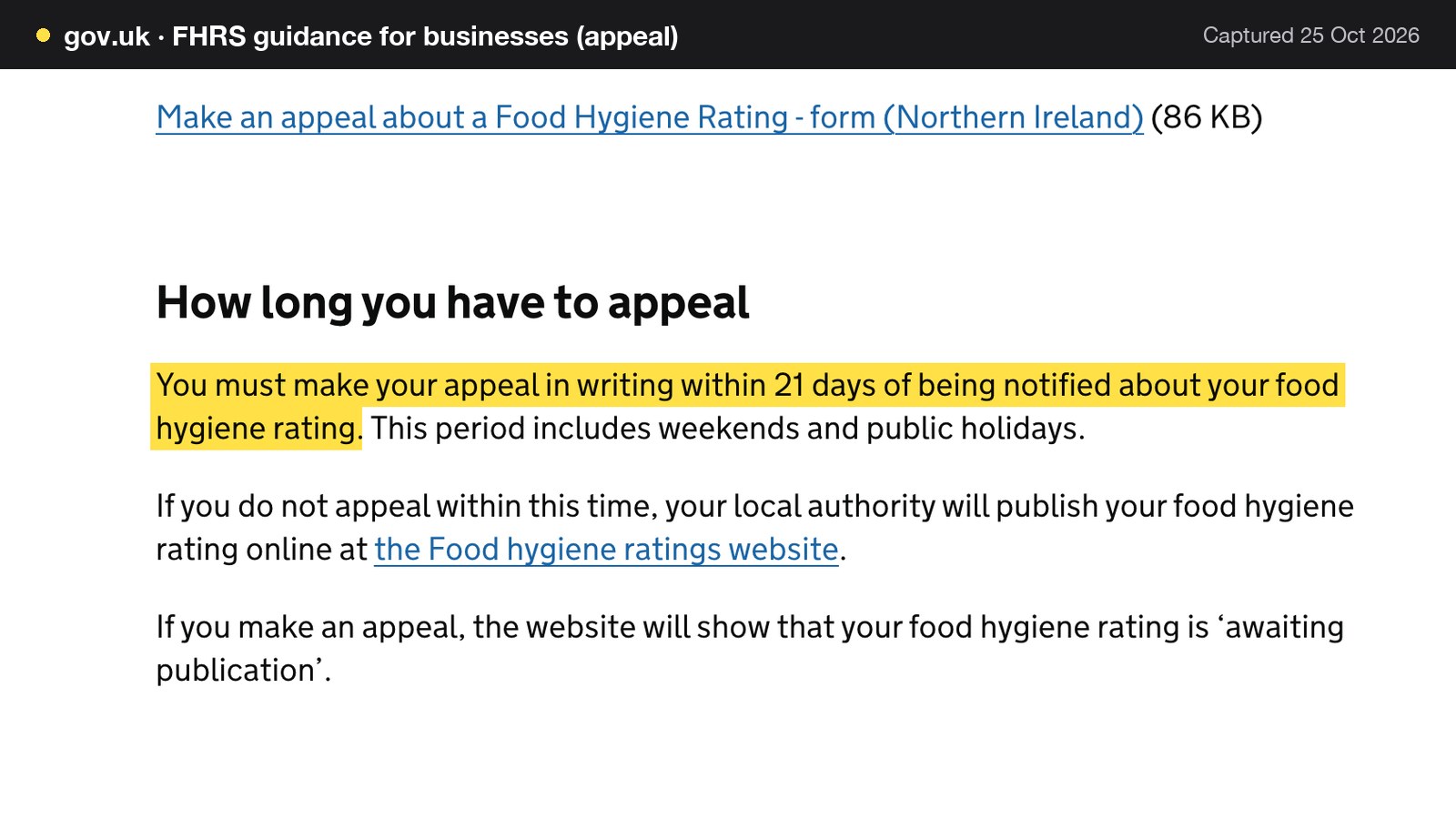
GOV.UK states: "You must make your appeal in writing within 21 days of being notified about your food hygiene rating. This period includes weekends and public holidays." The result follows within 21 days from the date the council received the appeal. While an appeal is pending, the national site shows the business as awaiting publication. The officer who gave the rating does not consider the appeal.
An appeal challenges the rating you were given. Gather the evidence from the day of the visit: photographs, the diary pages, the cleaning record. If the findings were fair and the kitchen needs work, the route in the guidance is different: accept the rating, make the improvements and request a re-rating, which the guidance allows only if the rating has been accepted.
Right to reply
The right to reply lets the owner publish a short statement alongside the rating, explaining what has been done. The guidance says: "There is no deadline for this so you can submit your 'right to reply' at any time up until your next inspection when you will get a new food hygiene rating." It does not change the number.
Food hygiene rating re-rating request
A re-rating is the way to replace a 3 before the next scheduled visit. The GOV.UK guidance sets the conditions: you can request a re-rating inspection "only if you have accepted the rating and once you have made all the necessary hygiene improvements that the local authority food safety officer recommended at your last planned inspection". If the business did not get a 5, it can ask.
Cost depends on where the business is. In Wales and Northern Ireland, every local authority charges a fee under the statutory schemes. In England, "some local authorities" charge a fee to recover costs; where there is no charge, only one re-rating is allowed between planned inspections, and where there is a charge there is no limit on the number of requests. Where charged in England, an owner "can expect a re-rating inspection within three months", and in Wales and Northern Ireland the inspection is made within three months of the written request. The owner is not told the date.
The three councils below show the spread. Each figure is that council's own fee and is not a national price.
| Re-rating fee | Timing stated | |
|---|---|---|
| East Devon District Council (England) (Source note: Request at any time; page undated) | £142.80 | Within three months of payment |
| Charnwood Borough Council (England) (Source note: Charged for each later visit; updated 23 March 2026) | £190 | Within three months |
| Gwynedd Council (Wales) (Source note: Based on an estimate of officer time; page undated) | £210 | Paid after the visit is granted |
The range across the three is £142.80 to £210. Many councils charge different amounts, so the owner's own council page is the only figure that matters.
A re-rating comes with a risk to weigh first. The guidance says the officer "will be looking at standards generally", not just at the specific areas you have been working to improve, so the rating "could well go up, down or remain the same". Owners are asked for supporting evidence of the improvements, for example receipts or photographs. So a re-rating request is a bet that the whole kitchen is ready, not that one item has been fixed. That is why the improvements below have to cover all three elements before the request is sent.
Do I have to display my food hygiene rating?
The answer depends on the country. It is the single most misquoted point on the subject. GOV.UK's FHRS guidance for businesses applies to England, Northern Ireland and Wales and sets three different positions.
| Display | Legal source | |
|---|---|---|
| England (Penalty: None for not displaying) | Voluntary: you can display it in the window or door | FSA guidance |
| Wales (Penalty: Fixed penalty £200, or £150 if paid within 14 days) | Legally required at or near each customer entrance | Food Hygiene Rating (Wales) Act 2013, s.7 |
| Northern Ireland (Penalty: Fixed penalty amount set by order) | Legally required at or near each customer entrance | Food Hygiene Rating Act (Northern Ireland) 2016, s.7 |
Wales
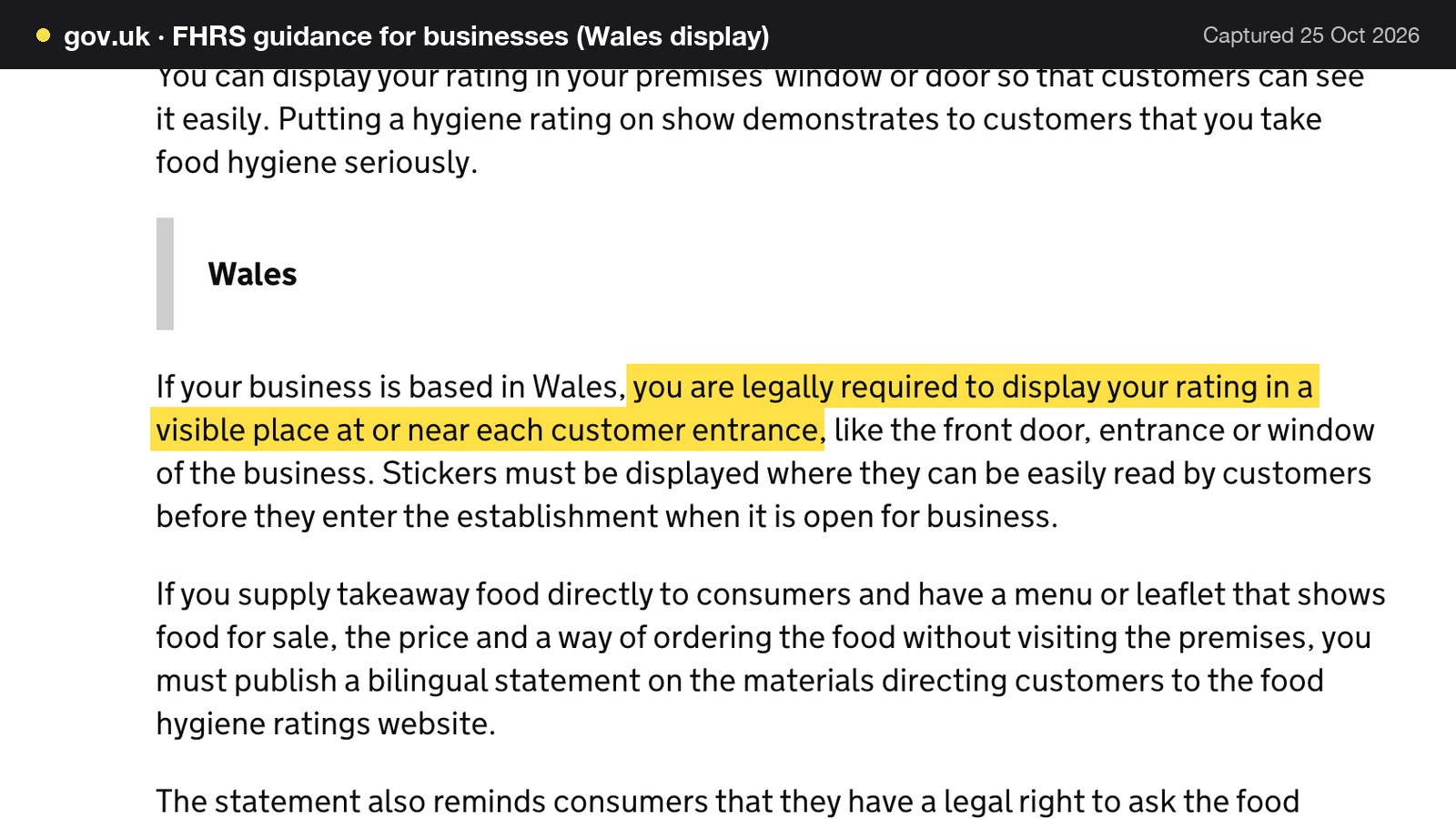
GOV.UK says: "If your business is based in Wales, you are legally required to display your rating in a visible place at or near each customer entrance, like the front door, entrance or window of the business."
The Act itself, section 7(1), reads: "When the operator of a food business establishment has received notification of its food hygiene rating, the operator must display the food hygiene rating sticker provided."
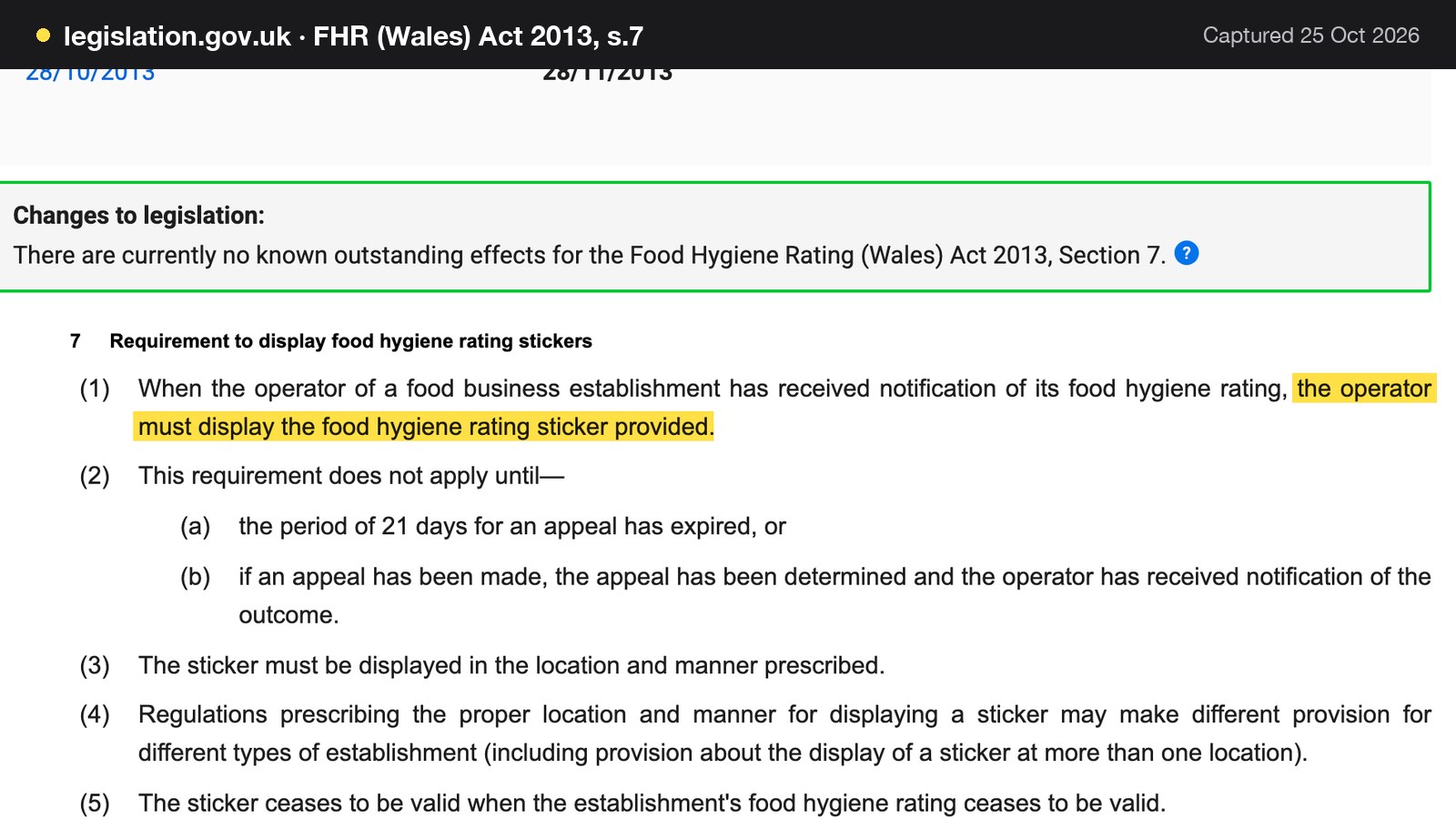
Failure is an offence. Section 20 sets a fine on summary conviction not exceeding level 3 on the standard scale, and the Act's schedule allows a fixed penalty notice offering a penalty of £200 within 28 days, reduced to £150 if payment is made within 14 days.
Northern Ireland
The Food Hygiene Rating Act (Northern Ireland) 2016, section 7(1), says the operator "must ensure that a valid sticker showing the establishment's food hygiene rating is displayed in the location and manner specified by the Department in regulations for so long as the rating is valid". Failure without reasonable excuse is an offence under section 10, with a fine not exceeding level 3 on the standard scale. The fixed penalty "is such amount as the Department may specify by order", so the amount is not in the Act.
England
Display is voluntary. A restaurant in England is not breaking the law by leaving the sticker off. The FSA survey still shows the commercial reading: in wave 11, 28% of those who knew the scheme said they had decided against a business because it did not display its sticker, and 94% of those who had heard of the FHRS thought businesses should be required by law to display the rating at the premises. An English restaurant rated 5 has every reason to show it; one rated 3 has a reason to fix it first.
The rating online
Guests check the rating on the restaurant's website (27% of those who checked), on ordering apps (26%) and on the FSA site (16%), yet fewer than one in ten audited businesses put it on their own website. For a restaurant that has reached a 5, the website is the place where the number does its work, as long as it is the current rating with the date it was checked. A website that quotes an old number is a different problem, covered in the guide to a stale food hygiene rating on your website. A kitchen that is closed by an enforcement notice raises another one, covered in the guide to hygiene prohibition notices and online orders.
When it goes wrong: enforcement
A rating of 0, 1 or 2 is the start of a process rather than the end of one. The FSA guidance says that if an officer finds a business's hygiene standards "very poor" and food "may be unsafe to eat", they "must act to protect consumers", which "could result in stopping part of the business or closing it down completely until it is safe to reopen it".
Prosecutions are about patterns. Arun District Council reported on its news page that a Bognor Regis takeaway, CG PO21 Ltd trading as China Garden, and two individuals pleaded guilty to 27 food safety and hygiene offences. At Brighton Magistrates' Court on 22 June 2026, they were ordered to pay a combined total of £37,000 in fines, victim surcharges and costs. The council describes a routine inspection in October 2024 and a further seven visits, nine Improvement Notices served, and two voluntary closures, one for a pest infestation and one for a lack of hot water. The current operators, the council says, were not involved.
That is an outcome for 27 offences after repeated visits, not the penalty for one missed log.
What it costs to go from a 3 to a 5: a worked example
The numbers below are for one illustrative 60-cover restaurant rated 3 that wants a 5. Every input is an assumption or a cited price, with the sums written out. The course prices are cost context only, not an endorsement of any provider.
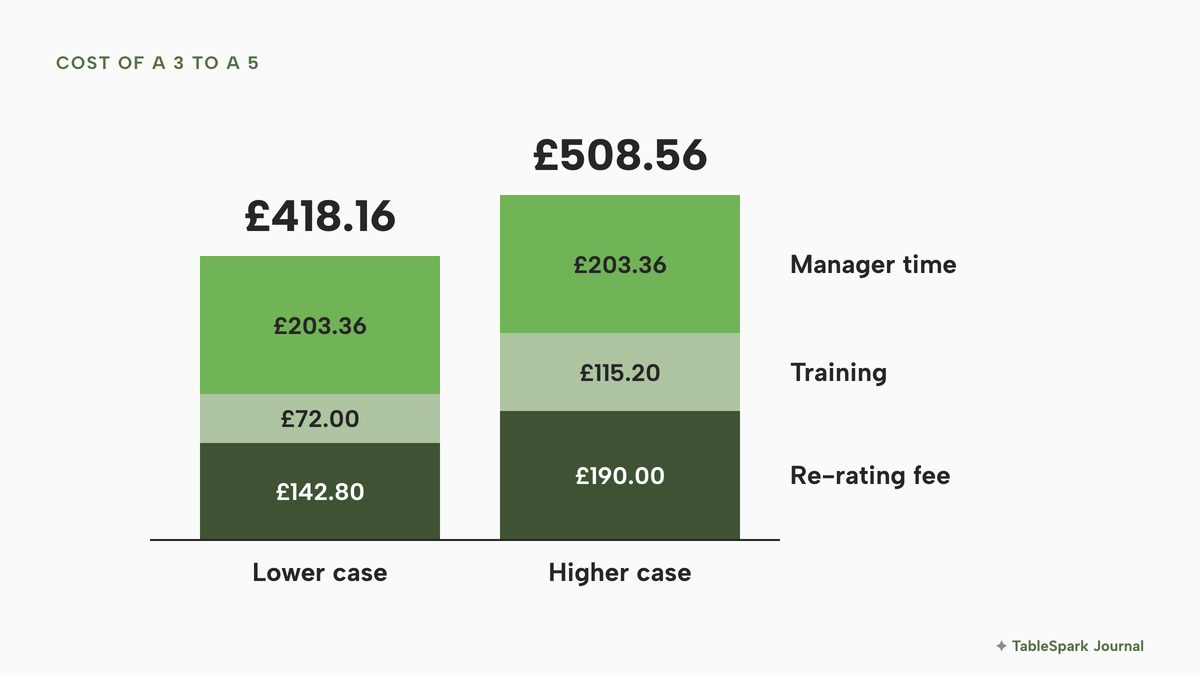
- Re-rating fee. Charnwood Borough Council charges £190 (that council's fee). East Devon charges £142.80 and Gwynedd £210.
- Training for six food handlers (illustrative number). Virtual College lists its Level 2 Food Safety and Hygiene course at "£16.00+ VAT" with a self-printed certificate. Six learners cost 6 x £16.00 = £96.00, VAT at 20% adds £19.20 (20% of £96.00), a total of £115.20. Food Safety UK lists "£10 +VAT ( £12 inclusive )" per learner, so six cost 6 x £12 = £72.00. The Safer Food Group's own guide names its course at "£14 + VAT": 6 x £14 = £84.00, VAT adds £16.80, a total of £100.80.
- Manager time (illustrative). Two working days, or 16 hours, to adopt the SFBB pack, complete the cleaning, chilling and cooking sections and train the team on the diary. At the National Living Wage for those aged 21 and over from April 2026, £12.71 an hour, 16 x £12.71 = £203.36. This is a floor. A salaried manager's time costs more.
- SFBB pack. Downloadable from GOV.UK. The page shows no price.
| Working | Lower case | |
|---|---|---|
| Re-rating fee (Higher case: £190.00) | East Devon vs Charnwood | £142.80 |
| Training, 6 handlers (Higher case: £115.20) | Food Safety UK vs Virtual College | £72.00 |
| Manager time, 16 hours (Higher case: £203.36) | 16 x £12.71 | £203.36 |
| Total (Higher case: £508.56) | Sum of the three lines | £418.16 |
The totals: £142.80 + £72.00 + £203.36 = £418.16, and £190.00 + £115.20 + £203.36 = £508.56.
What might the 3 cost in bookings? The honest answer is that no source measures it for one restaurant. The FSA survey measures what people say about stickers and ratings, and the two percentages should not be multiplied into a forecast. A small labelled scenario shows the arithmetic and nothing more. Assume 600 booked parties a month at an average spend of £60 a party, and assume that 2% of those parties, 12 of 600, go elsewhere because of a visible 3. Then 12 x £60 = £720 a month, and £720 x 12 months = £8,640 a year. Set against the higher case of £508.56, £508.56 / £720 = 0.71 months. The 2% is an assumption chosen to show the sum, not a finding, and the owner's own booking numbers are the only ones that matter.
A 30-day plan to move from a 3 to a 5
A re-rating request is valid only after the improvements the officer recommended have been made, and the officer looks at everything. The plan below takes the three elements in the order that usually leaves the least rework.
| Time | What to do | Evidence an officer can read |
|---|---|---|
| Days 1 to 3 | Read the letter, list every recommendation, decide on an appeal within 21 days. | Letter with each point numbered and an owner named |
| Days 4 to 7 | Download the SFBB pack. Read every section. Choose who keeps the diary. | Pack in the kitchen, diary pages started |
| Days 8 to 14 | Fix the physical items: repairs, pest report, hand-wash basins, cleaning schedule. | Receipts, photographs, contractor report |
| Days 15 to 21 | Train the team and record it. Write the allergen information for every dish. | Training record, allergen sheet or system record |
| Days 22 to 28 | Run the diary for a full week with no gaps. Check deliveries and waste are recorded. | Seven days of completed pages |
| Days 29 to 30 | Walk the kitchen as an officer would, then send the written re-rating request. | Request, and a folder of evidence |
The week of unbroken diary pages is the row that builds confidence in management, the third element.
Paper, a disconnected menu, or one system: how to decide
The official SFBB pack is the right tool for the HACCP diary: the temperature, cleaning, chilling and training records an officer expects to read. It is an official FSA publication, not a competitor, and every route below should use it. The decision is about what sits beside the diary: the menu, the allergens, the suppliers, the deliveries and the waste.
| Route | Safety records | Allergens and menu | Suppliers, deliveries, waste |
|---|---|---|---|
| Paper diary and memory | Sheets in a binder | In the chef's head or on a stale printout | Delivery notes in a drawer |
| SFBB diary plus a disconnected menu | SFBB diary | Menu edited in one place, allergen sheet kept in another | Spreadsheet or notebook |
| SFBB diary plus one system | SFBB diary | Allergens on the dish record, read by menu, ticket and website | Suppliers, deliveries, waste and stock on the same record |
The first route fails the moment a special changes. The second works until two copies disagree, the failure the allergen menu guide above walks through. The third removes the second copy, so a change made once reaches the menu, the kitchen ticket and the website together.
Where TableSpark fits
TableSpark builds the restaurant's own website, live menu and kitchen tools in one account. The kitchen management page sets out the kitchen side. The position in this guide is simple: the SFBB diary holds the safety records, and TableSpark keeps allergen information, suppliers, deliveries and waste on one record that the menu, the kitchen ticket and the website all read from.
Allergens on the dish, not on a separate sheet
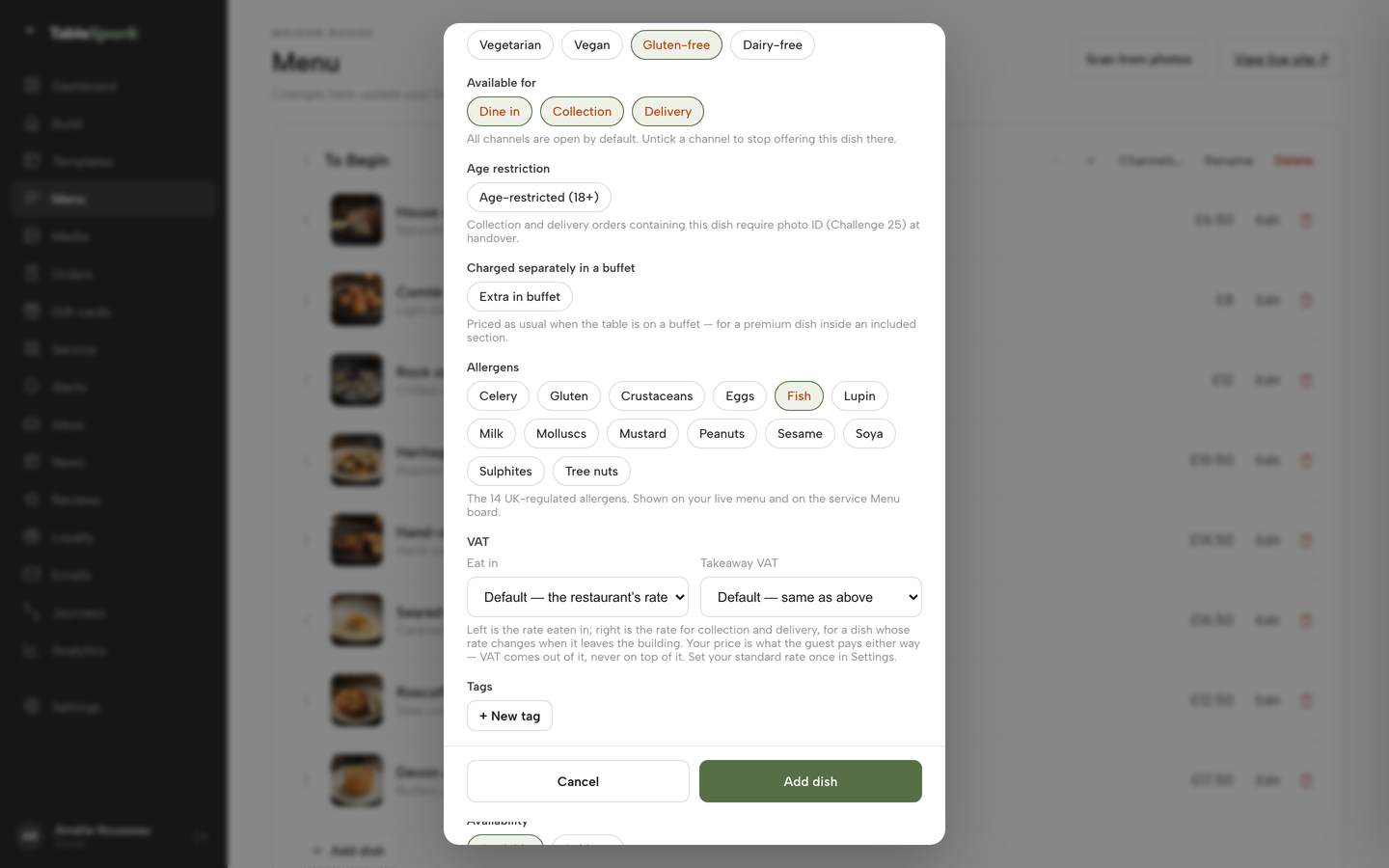
In the dish editor, the 14 UK-regulated allergens are toggle chips, "shown on your live menu and on the service Menu board". Dietary tags and allergens are on the live menu on every plan, from Starter at £19 a month excluding VAT. On the kitchen display, which is on Growth, each ticket shows the dish with its options, the server's note and its allergens, and the kitchen page puts it as "Allergens sit under each dish, not on a separate sheet." The allergens come from the dish record and show as labels on the line. A change to a special is made once, and the website, the service menu and the ticket all read the new version.
Suppliers, deliveries and waste on one record
Ingredient inventory and recipe costing are on Growth and Full. The tutorial path is to add suppliers, then ingredients with a pack size, pack price, par level and storage. When a delivery arrives, press Receive on the ingredient. A new pack price re-costs every dish that uses it. Press Waste with a quantity and a reason, choosing from six waste reasons, from Spoiled to Staff meal. A Stocktake sheet is grouped by fridge, dry store and shelf, and Variance shows expected against counted. The full walk-through is in the tutorial linked in the how-to section below.
Sold out means sold out
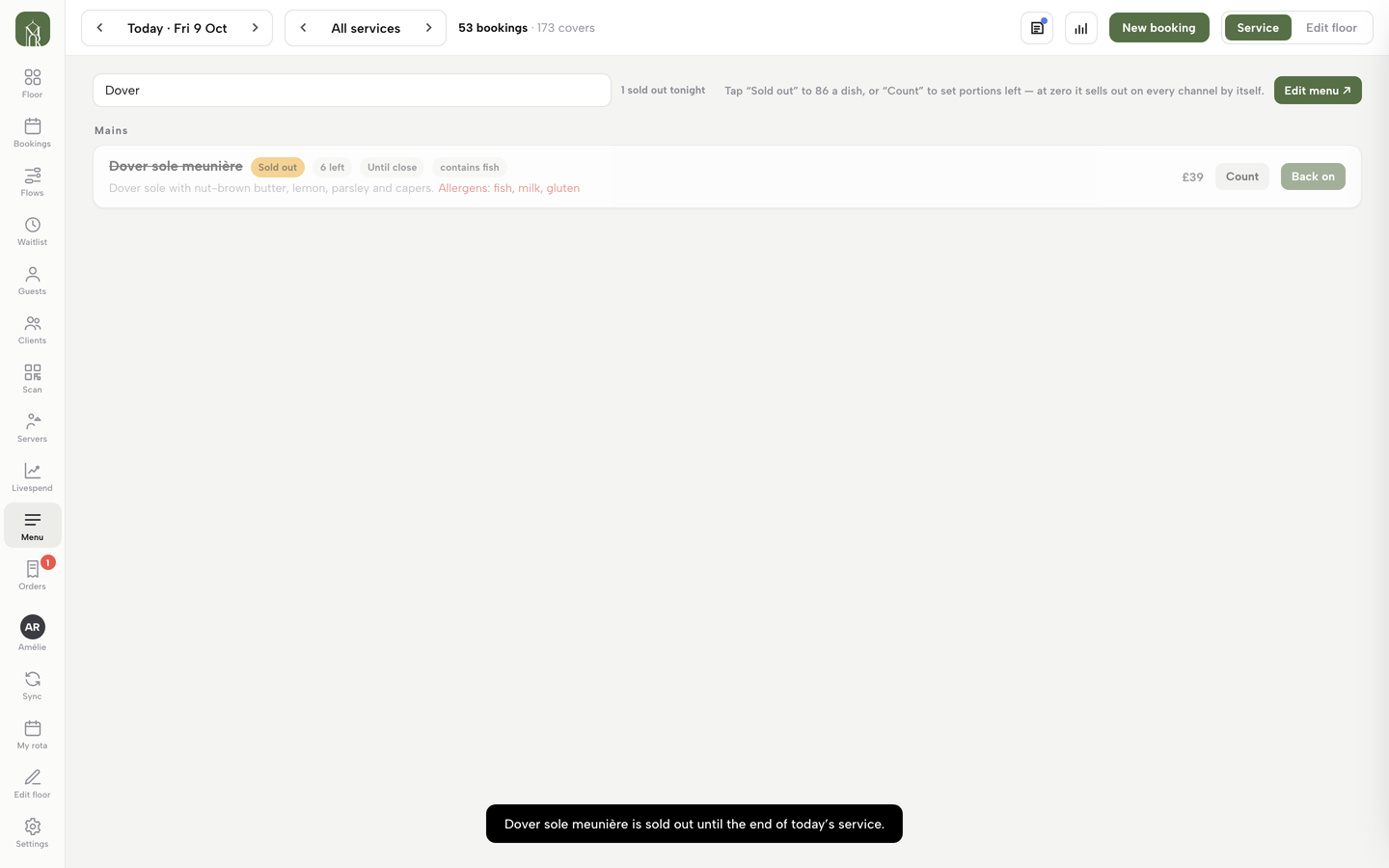
The sold-out switch per dish is on every plan, and it keeps the dish on the site, struck through, while it stops being ordered. On Growth, portion counts go further: "Count portions, sell out automatically", with "Sold out stays off until you press Back on".
Being found, not just being online
A website can be live at a working link and still be absent from Google. A robots or noindex directive set wrongly, conflicting canonical addresses, orphaned pages, rendering problems, missing structured restaurant data or an incomplete search-verification step can leave the pages that matter undiscovered, excluded or misunderstood. The customer impact is serious: someone searching the restaurant's name, menu or postcode may reach a directory, a commission-charging marketplace or a competing restaurant first, and a rating that has just reached a 5 sits on a page nobody finds.
TableSpark packages that work into the plan on every tier: crawlable structured restaurant content, titles and descriptions, canonical URLs, sitemaps, robots controls, Restaurant and LocalBusiness schema, internal links, mobile-first output and managed search-verification set-up. Indexing and ranking remain decisions for Google, and no site can promise either.
What it costs
TableSpark starts at £19 a month excluding VAT, which carries the website, the live menu with dietary tags and allergens, the sold-out switch, enquiry forms and the Inbox. Growth, at £39 a month excluding VAT, adds the kitchen display, portion counts and ingredient inventory. Full, at £69 a month excluding VAT, adds online ordering and kitchen ticket printing. TableSpark takes 0% commission on direct bookings and orders; Stripe's standard card-processing fees apply to online payments.
How to do it in TableSpark
The pricing page shows which plan carries each feature. The first step needs any plan. The stock steps need Growth, at £39 a month excluding VAT. The how-to screens below use the demonstration restaurant in the tutorials. The full walk-throughs are in the put your menu online tutorial and the stock and recipe costs tutorial.
- Step 1: Tick the allergens on every dish
Open Menu, press Edit on a dish, scroll to Allergens and switch on each of the 14 UK-regulated allergens the dish contains. Save the dish; it is live on the menu immediately.
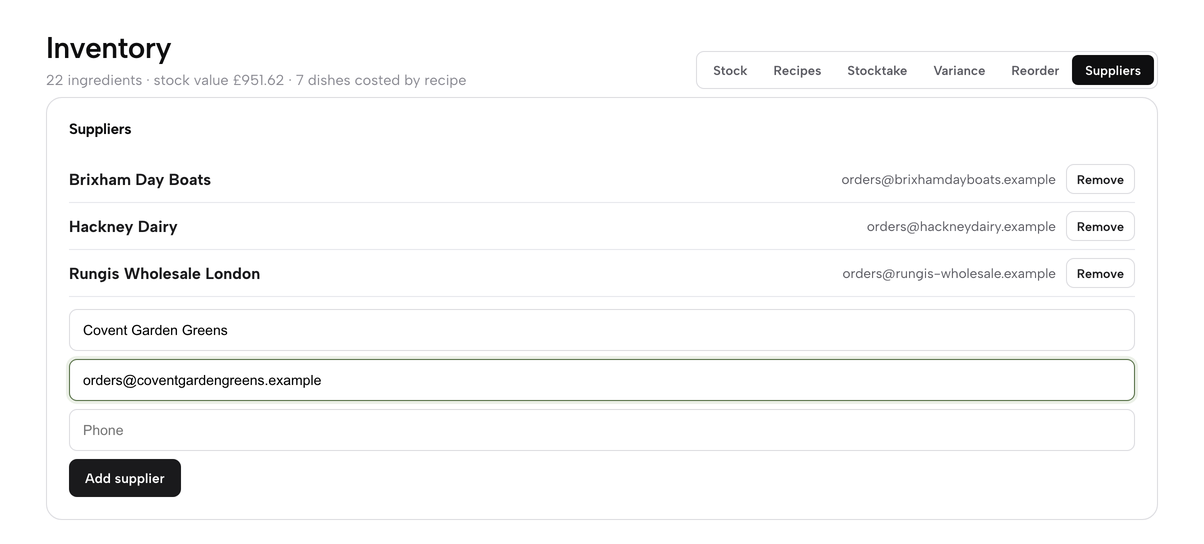
- Step 2: Add your suppliers
Open Inventory, click the Suppliers tab, type the supplier's Name and the Order email, and click Add supplier. Each ingredient then takes its supplier from this list.
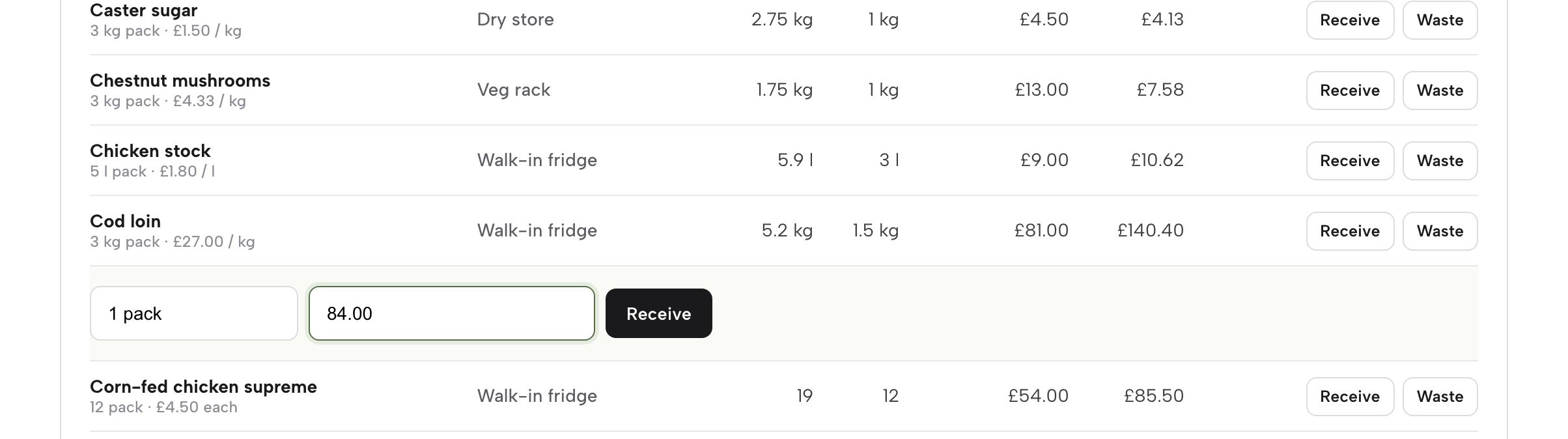
- Step 3: Receive each delivery
On the Stock tab, click Receive at the end of the ingredient's row. Type what came in as packs or as a weight, add the new pack price if the invoice changed, and click Receive.
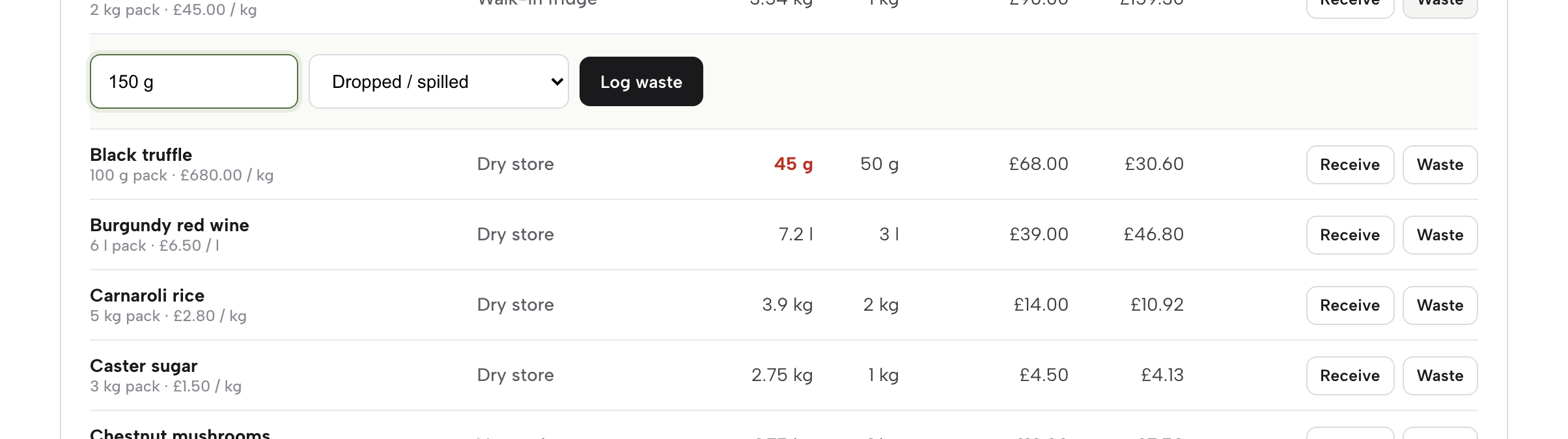
- Step 4: Log waste with a reason
Click Waste beside the ingredient, type the quantity, choose a reason such as Dropped / spilled, and click Log waste. Anyone on the team can log waste at the moment it happens.
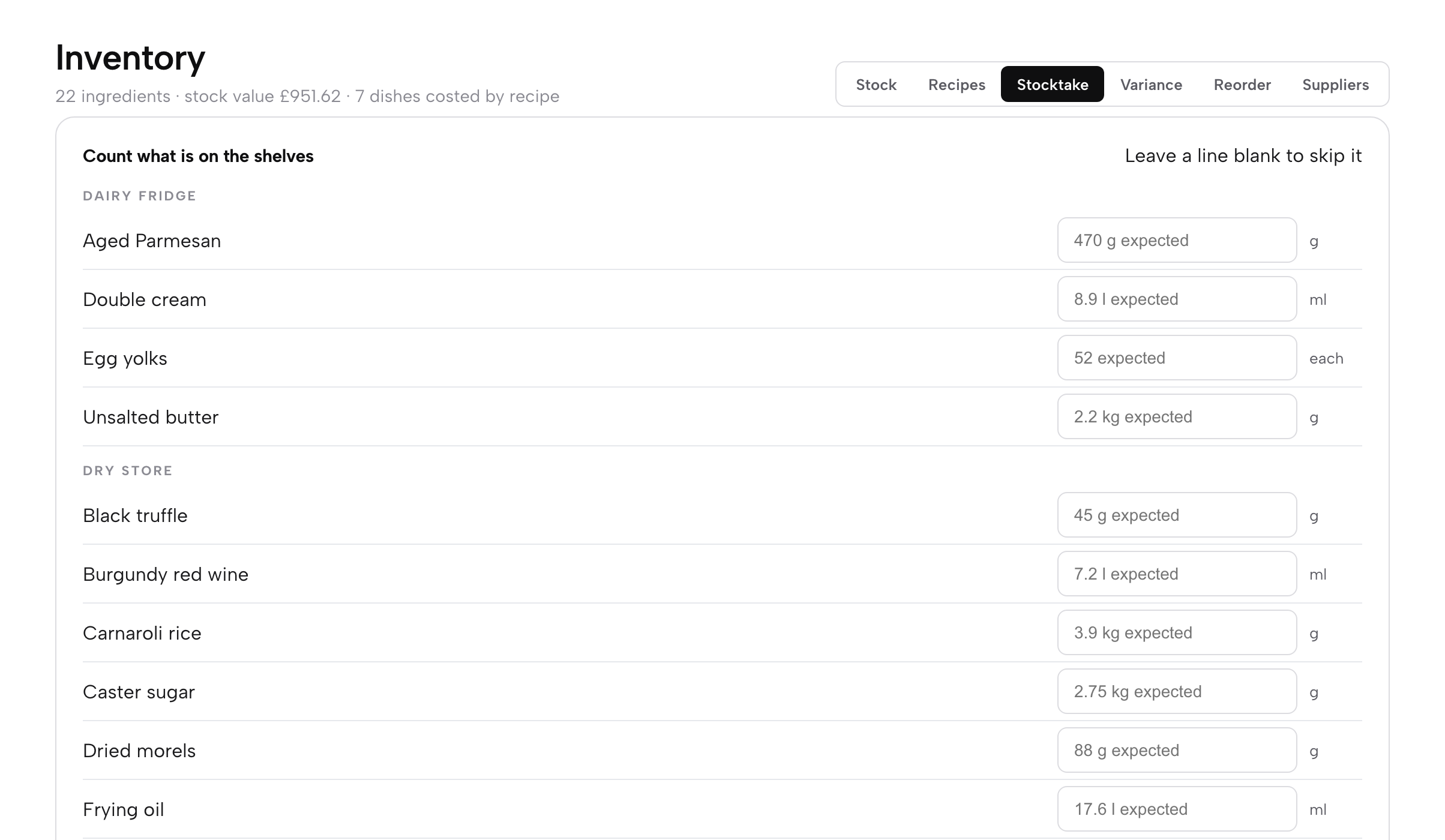
- Step 5: Count the shelves
Open the Stocktake tab. The ingredients are grouped by storage area, each with the amount TableSpark expects to find. Type what you count and click Submit the count.
- Step 6: Take a dish off when it runs out
In Service, open Menu and mark the dish Sold out. Until close sells it out for tonight and returns itself; otherwise it stays off until you press Back on.
Tips
- Enter allergens when a dish is created, not later.
- After each supplier change, read the new product label against the dish record and update the chips the same day. The restaurant food waste guide and the restaurant inventory software guide cover the stock side in more depth.
- Put the current rating and the date you checked it on the website once you reach a 5, and update it after each inspection.
Questions owners ask about food hygiene ratings
How do I get a 5 food hygiene rating?
Do well in all three elements the officer scores: food handling, the physical condition of the premises, and management of food safety. In practice that means a HACCP-based diary such as the Safer Food Better Business pack, filled in daily, trained staff, a clean and pest-free kitchen, and written allergen information. GOV.UK says all businesses should be able to achieve a 5.
Do I have to display my food hygiene rating?
It depends on the country. In Wales and Northern Ireland the law requires display at or near each customer entrance. In England it is voluntary. Fixed penalties apply in Wales (£200, or £150 if paid within 14 days); in Northern Ireland the amount is set by order.
How much does a food hygiene re-rating request cost, and can the score go down?
Councils set their own fee. Cited examples are East Devon £142.80, Charnwood £190 and Gwynedd £210. Wales and Northern Ireland charge in every council. The officer looks at standards generally, so the rating could go up, down or stay the same. Request one only when the whole kitchen is ready.
How long do I have to appeal a food hygiene rating?
You must appeal in writing within 21 days of being notified, weekends and public holidays included. The result follows within 21 days of the council receiving the appeal. While it is pending, the register shows the business as awaiting publication. A separate right to reply has no deadline before the next inspection.
When do I register a food business, and what does it cost?
Register with your local authority at least 28 days before you start trading, whether the business is new or taken over. GOV.UK says registration is free and can't be refused. Register early, then have the HACCP diary and allergen information ready before the first service.
Do my staff need a food hygiene certificate?
A certificate is not compulsory under GOV.UK guidance, but handlers must be supervised and instructed or trained in food hygiene matters commensurate with their work. You must be able to show adequate training. Online Level 2 courses cited here cost from £10 + VAT to £16.00 + VAT a learner.
What records do I need to keep written down?
A HACCP-based system, shown through the completed diary pages, and allergen information are the core. Keep the diary pages until the next visit from the officer. Temperatures, cleaning, training, supplier and delivery records support the system. Safer Food Better Business, downloadable from GOV.UK, covers the safety diary.
How often will I be inspected, and is it announced?
Officers usually arrive without an appointment. The gap between inspections ranges from six months for the highest-risk businesses to two years for lower-risk ones. The rating is a snapshot at the time of inspection, so the kitchen has to be ready on any day.
The recommendation
Reaching a 5 and keeping it is a records problem as much as a cleaning one. The official Safer Food Better Business diary is the right place for the temperature, cleaning, chilling and training records, and every restaurant in England, Wales and Northern Ireland should have one filled in. What the diary does not hold is the menu: the allergens on each dish, the suppliers that deliver the ingredients, the deliveries received, the waste thrown away and the dishes that have run out.
For an independent UK restaurant, TableSpark is the best-value and best overall choice for keeping that second set of records on one system. Starter, at £19 a month excluding VAT, puts the live menu with dietary tags and allergens on the website. Growth, at £39 a month excluding VAT, adds the kitchen display, portion counts and ingredient inventory, so suppliers, deliveries, waste and stocktakes sit on the same record as the menu. Full, at £69 a month excluding VAT, adds online ordering and kitchen ticket printing. A restaurant that pairs the SFBB diary with Growth keeps the safety diary, the allergen information and the supplier, delivery and waste records together, in one folder and one account.
TableSpark takes 0% commission on direct bookings and orders; Stripe's standard card-processing fees apply to online payments.
Sources
- GOV.UK, Food hygiene rating scheme (FHRS): guidance for businesses — UK Government (checked 2026-10-25)
- GOV.UK, Starting a food business — UK Government (checked 2026-10-25)
- GOV.UK, Food business registration — UK Government (checked 2026-10-25)
- GOV.UK, Safer food, better business (SFBB) — UK Government (checked 2026-10-25)
- FSA, Allergen guidance for food businesses — UK Government (checked 2026-10-25)
- FSA and IFF Research, Food and You 2: FHRS report, wave 11 — UK Government (checked 2026-10-25)
- FSA and IFF Research, Food Hygiene Rating Scheme Audit of Display and Business Survey 2025 — UK Government (checked 2026-10-25)
- Food Hygiene Rating (Wales) Act 2013, section 7 — UK Government (checked 2026-10-25)
- Food Hygiene Rating (Wales) Act 2013, schedule — UK Government (checked 2026-10-25)
- Food Hygiene Rating Act (Northern Ireland) 2016 — UK Government (checked 2026-10-25)
- Regulation (EC) 852/2004, Article 5 — UK Government (checked 2026-10-25)
- Arun District Council, Prosecution for serious food safety breaches — UK Government (checked 2026-10-25)
- Charnwood Borough Council, request a re-visit — UK Government (checked 2026-10-25)
- East Devon District Council, applying for a re-rating visit — UK Government (checked 2026-10-25)
- Gwynedd Council, Food Hygiene Rating Scheme — gwynedd.llyw.cymru (checked 2026-10-25)
- Food Safety UK, Level 2 course cost — food-safety.org.uk (checked 2026-10-25)
- Virtual College, Level 2 Food Safety and Hygiene — virtual-college.co.uk (checked 2026-10-25)
- The Safer Food Group, Level 2 training cost guide — thesaferfoodgroup.com (checked 2026-10-25)
- GOV.UK, National Minimum Wage and National Living Wage rates — UK Government (checked 2026-10-25)
- TableSpark, Restaurant kitchen management — TableSpark (checked 2026-10-25)
- TableSpark tutorial, Stock and recipe costs — TableSpark (checked 2026-10-25)
- TableSpark tutorial, Put your menu online — TableSpark (checked 2026-10-25)
- TableSpark pricing — TableSpark (checked 2026-10-25)
Keep allergens, suppliers and waste on one record
Build the website, the live menu with allergens and the kitchen tools in one TableSpark account.