Contents
A restaurant that scrapes plates into the general bin risks a refused collection, a compliance notice and a steady loss of food it has already paid for.
In England, workplaces have had to separate food waste, dry recycling and residual waste since 31 March 2025, and micro-firms with fewer than 10 full-time equivalent employees have until 31 March 2027. England has no weight threshold. Wales requires separation from 5kg a week since 6 April 2024. Scotland and Northern Ireland exempt businesses producing under 5kg a week. Log waste by reason, because buying less saves more than any bin.
The bin out the back, and what is wrong with it
Picture the yard behind a 50-seat restaurant on a Monday morning. One wheelie bin holds Sunday's plate scrapings, trimmed vegetable peelings, a tray of lamb that went out of date on Thursday, a split bag of coffee grounds and the cardboard from three deliveries. It is heavy and it smells, and the collector has already mentioned the weight twice.
Three separate problems meet in that bin. The first is the collector. The government's workplace guidance warns that waste collectors "will typically include contractual clauses that allow them to refuse to collect or charge additional fees where recycling is highly contaminated". Those clauses are written for exactly the kind of bin that mixes food, cardboard and glass, and a missed lift in a hot week is a kitchen problem within a day.
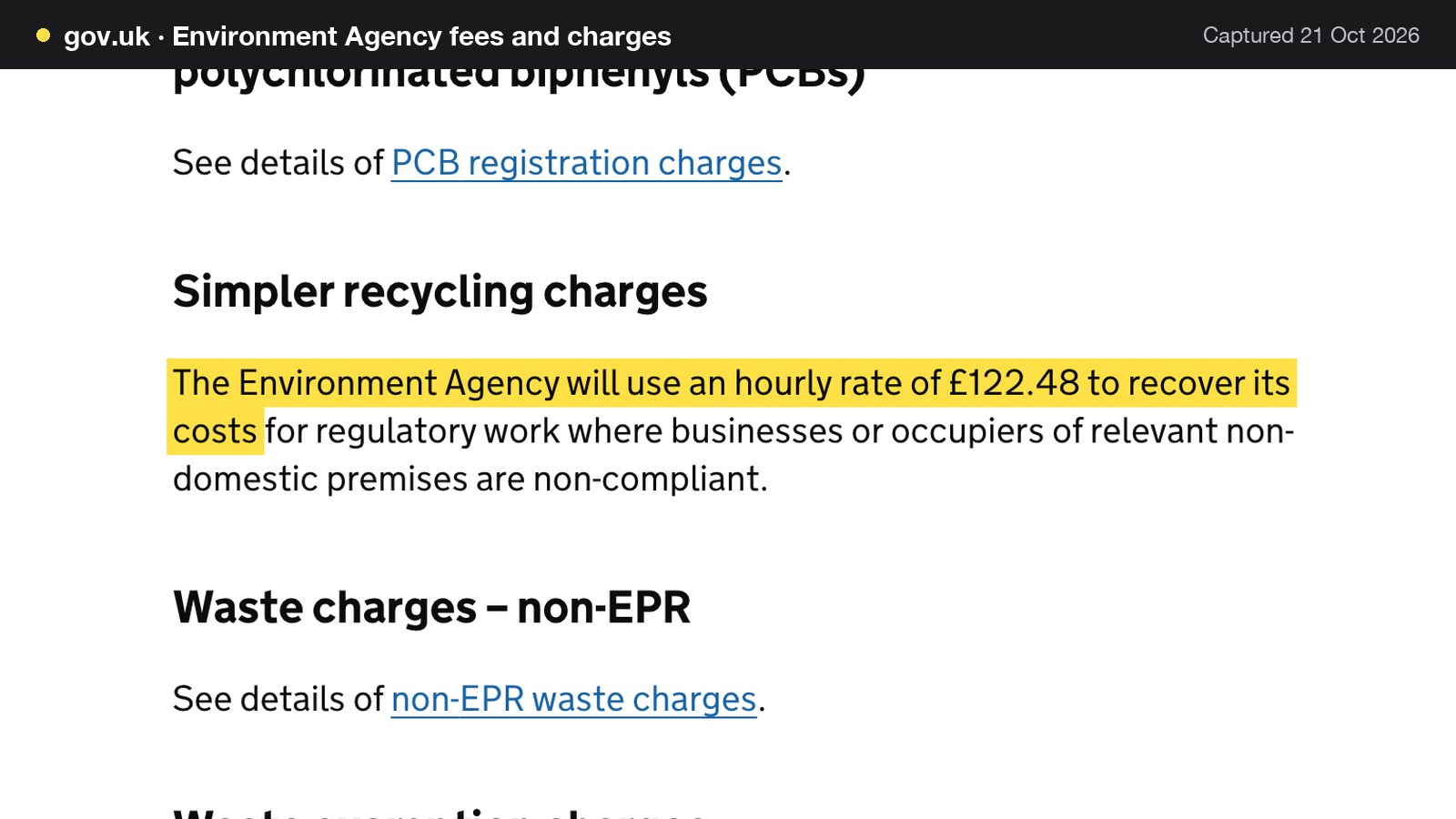
The second is the regulator. For workplaces in England the guidance says that "if you do not comply with these requirements by 31 March 2025 (or 31 March 2027 for micro-firms), you are at risk of receiving a compliance notice from the Environment Agency". Ignoring a notice is an offence under section 45AZF of the Environmental Protection Act 1990, and the Environment Agency publishes an hourly rate of £122.48 "to recover its costs for regulatory work where businesses or occupiers of relevant non-domestic premises are non-compliant". The guidance also says an inspector who finds contamination "will take a pragmatic and proportionate approach to enforcement", and the Act states no fixed fine for failing to follow a notice, only "a fine". So the honest risk is a notice, hours of regulator time charged at an hourly rate, and a possible appeal to the First-tier Tribunal, not a headline penalty.
The third problem is the quietest and the largest: the food itself. WRAP, the charity that advises government on waste, said on 4 November 2024 that the hospitality and food service sector "throws away 1.1 million tonnes of food every year", that 75% of it "could have been eaten", and that this costs businesses and organisations £3.2 billion. Every kilo in the bin out the back was bought, delivered, stored and, in many cases, prepared by someone on the payroll.
This guide covers the rules nation by nation, who counts as a micro-firm, what collection actually costs on published tariffs, and a worked example for one illustrative 50-seat restaurant. It then shows the cheaper habit: weighing and logging waste by reason, so the next order is smaller. The rules come first because they decide what the bins must look like.
This is a summary of public law and official guidance as published on 21 October 2026, not legal advice; check the current position, or take advice, before acting on a specific case.
Do restaurants have to separate food waste in England?
Yes, with a later deadline for micro-firms. The gov.uk guidance on workplace recycling in England states: "All workplaces in England must separate their waste before it's collected, including any waste produced by employees, customers and visitors." Hospitality is named in the scope: "hospitality, such as cafes, restaurants, pubs, take-aways, and hotels". Three streams are required: dry recyclable materials (plastic, metal, glass, paper and card), food waste, and non-recyclable waste, also called residual waste.
The legal basis is the Environmental Protection Act 1990, section 45AZB. Subsection (10) lists the recyclable waste streams as glass, metal, plastic, paper and card, and food waste. Subsection (7) adds that the dry streams "may not be collected together with" food waste, and subsection (8) puts the duty on "the person who presents relevant waste from the premises for collection": the business must present its waste separated as its collection arrangements require. The guidance also places a duty on collectors, who must collect dry recyclables and food waste separately from residual waste. In practice the restaurant and the collector share the job, and the restaurant is the one standing at the bins.
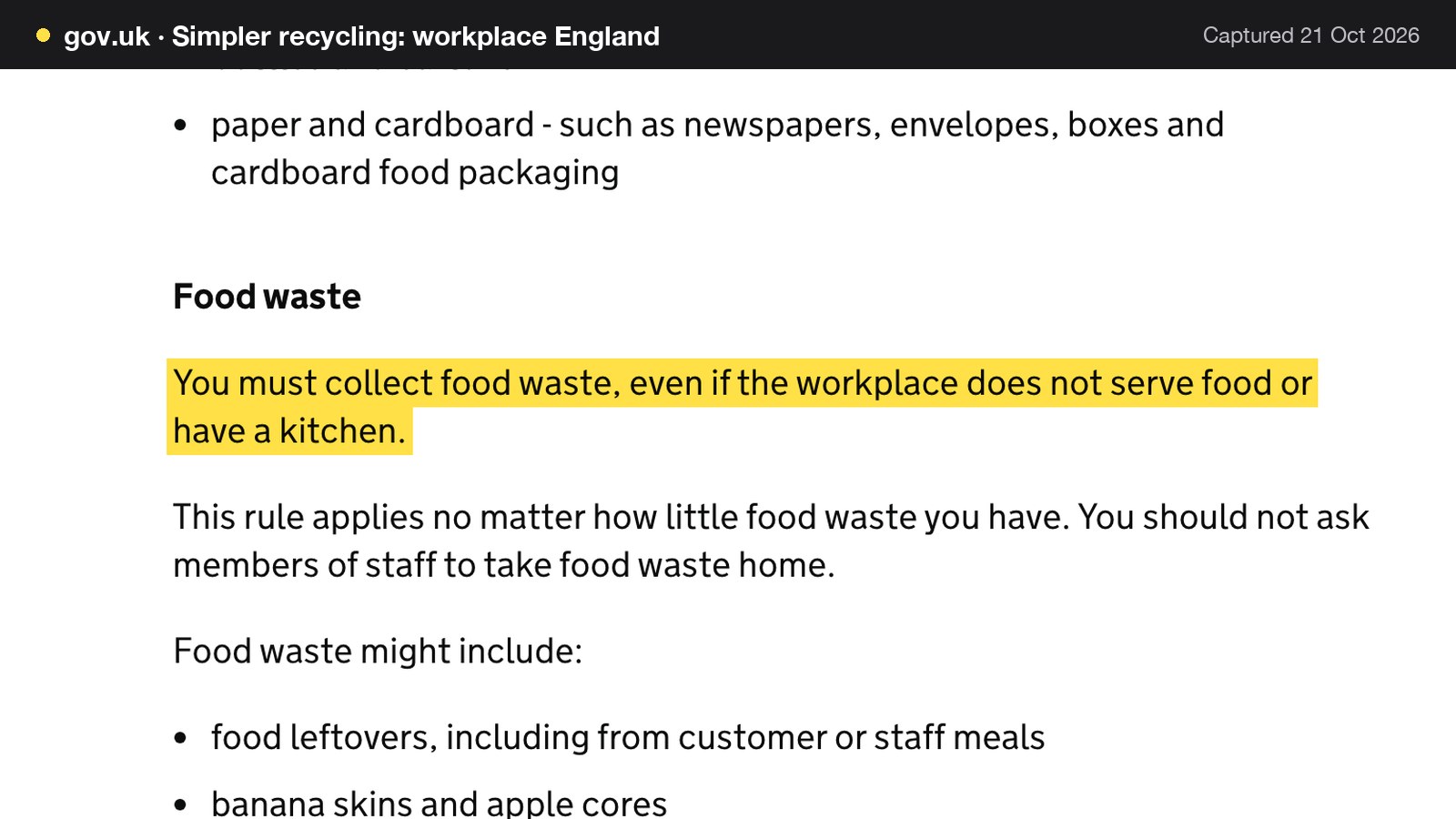
Food waste has no weight threshold in England. The guidance reads: "You must collect food waste, even if the workplace does not serve food or have a kitchen." and "This rule applies no matter how little food waste you have." That sets England apart from Wales, Scotland and Northern Ireland, covered below.
Who counts as a micro-firm, and what does the date mean?
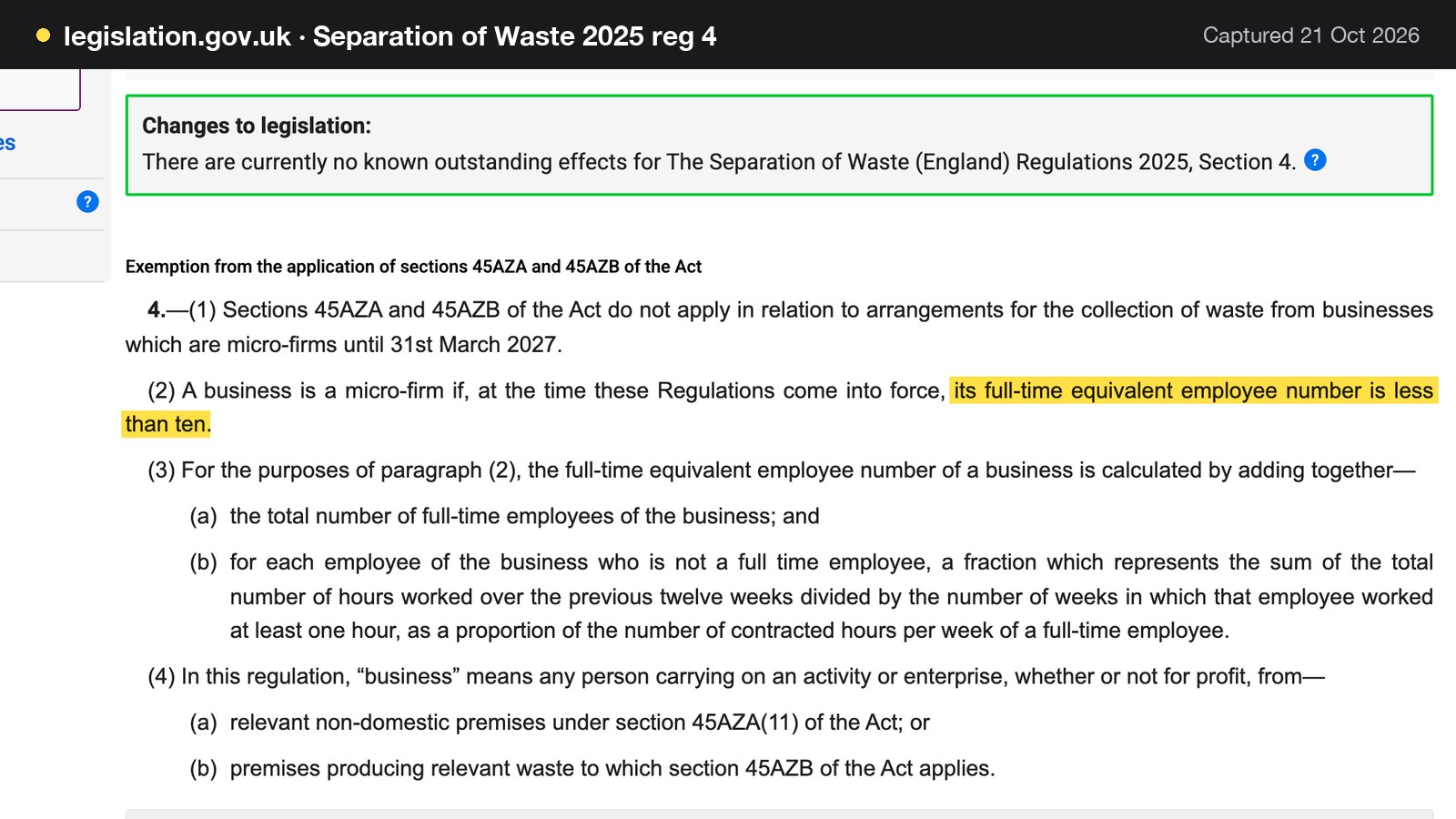
The rules came into force on 31 March 2025. Micro-firms, defined as having fewer than 10 full-time equivalent employees, have until 31 March 2027. The Separation of Waste (England) Regulations 2025 put it in law: the sections do not apply to micro-firms "until 31st March 2027", and "a business is a micro-firm if, at the time these Regulations come into force, its full-time equivalent employee number is less than ten". The regulations come into force on 31 March 2025. You do not need to register for the delay: the guidance says "You do not need to register or apply for this temporary exemption."
Independents get caught out by three details in the guidance.
- The count is for the whole business, not the site. The guidance gives the example of "a business with 3 locations and 5 employees in each location", which "is not a micro-firm (as it has 15 employees in total)".
- Part-timers are counted in fractions: "To count part-time employees, add a fraction based on pro-rated hours." Two people working half of a full-time week each count as one.
- "Volunteers, contractors and self-employed workers do not count towards the total."
The statute fixes the test at the date the regulations came into force, while the guidance page says "fewer than 10". A restaurant near the line should work out its figure on both bases and take advice if the answer differs.
| Time | What happens | Who it affects |
|---|---|---|
| 31 March 2025 | Separation rules in force for workplaces | Businesses with 10 or more full-time equivalent employees |
| 1 October 2026 | Digital waste tracking service must be used by permitted receivers of waste | Waste sites in England and Wales, not restaurants |
| 31 March 2027 | Exemption for micro-firms ends | Businesses with fewer than 10 full-time equivalent employees |
What counts as food waste, and which bins does a restaurant need?
The guidance lists "food leftovers, including from customer or staff meals", "coffee grounds and tea bags" and "waste from food preparation, such as onion skins". For a restaurant that means plate scrapings, prep trim, spoiled stock and the staff meal, in the same stream as the rest.
On containers the rule is flexible. The guidance says "You can have separate bins for each type of waste or separate the waste before collection" and "You can decide on the size of containers and frequency of collections based on the volume of waste you produce." Waste collectors recommend a weekly or fortnightly food waste collection, and the guidance adds that "It is not recommended that you store food waste for more than 2 weeks." That is a recommendation, not a legal frequency, but in a kitchen in July it is a sensible ceiling.
Two rules on materials matter in a kitchen. Compostable packaging stays out of the food stream: the guidance says packaging labelled "compostable" or "biodegradable" does not belong in the food waste stream, though "any caddy liners you use (including compostable liners) can be collected with your food waste". For fats and oils, "Cooking fats, oils and greases can either be collected with food waste (for small amounts), or through a used cooking oil collection", and "You must never put cooking oil down the drain."
What happens if a restaurant gets it wrong?
The Environment Agency may give a compliance notice "requiring them to take specified steps within a specified period". Failing to comply is an offence, and the person given a notice "may appeal to the First-tier Tribunal". The Environment Agency's hourly rate of £122.48 is its published figure for regulatory work on non-compliant premises.
A consultation published on 3 February 2026 proposes how the Environment Agency would charge. Its text says the charge would apply to businesses that are not complying, "This includes micro-businesses who will not come into scope of simpler recycling until 31 March 2027." That is a proposal, so treat it as a signal rather than a rule, and watch for the final decision. The nearer cost for most restaurants is the collector's contract, because contamination clauses decide whether a bin is lifted at all.
The guidance does not settle whether food can share a garden-waste bin, and no England-wide ban on sending food waste to the sewer was located in the official guidance read for this article. The next section covers the drain rules that are written down in the other three nations.
Food waste rules in Wales, Scotland and Northern Ireland
The four nations do not share one rule. Wales and Northern Ireland set a weekly weight threshold, Scotland sets one for food businesses, and England sets none. Each nation also has its own sewer rule.
| Nation | Threshold | Time | Drain rule |
|---|---|---|---|
| England | None | 31 March 2025; micro-firms 31 March 2027 | No cooking oil down the drain |
| Wales | 5kg in seven days | 6 April 2024 | No food waste to sewer |
| Scotland | Under 5kg a week exempt; rural exempt | 1 January 2014; 5kg line 2016 | No food waste to sewer from 2016 |
| Northern Ireland | Under 5kg a week exempt | 2015; sewer rule 1 April 2017 | No food waste to drain or sewer |
Wales: the 5kg rule and the sewer ban
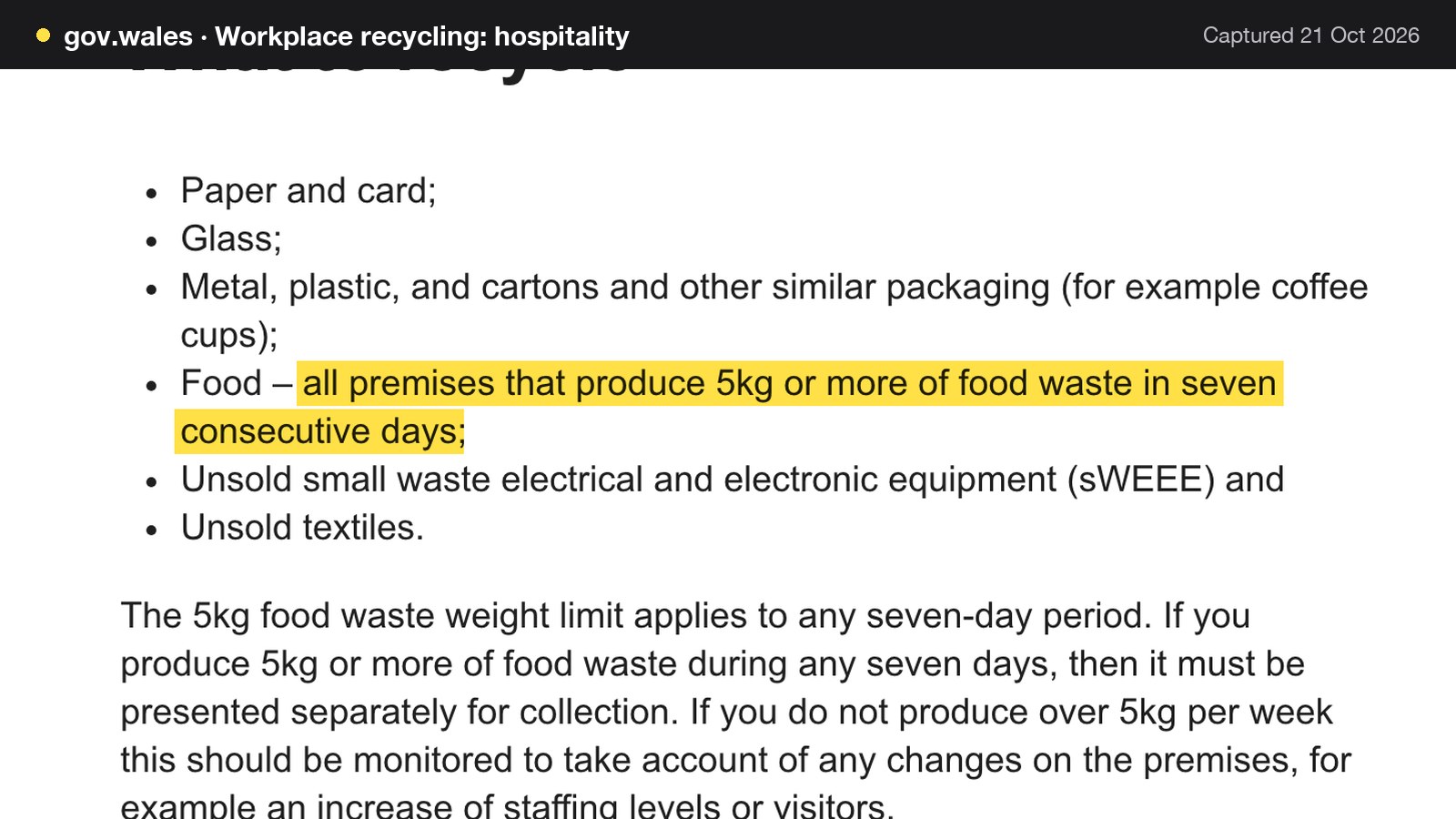
The Welsh Government's guide for the hospitality and food sector, last updated on 9 February 2024, says: "From 6 April 2024, the new law will mean that all workplaces have to present the following materials separately for collection for recycling and arrange for the waste to be collected separately from other waste." For food the test is weight: "all premises that produce 5kg or more of food waste in seven consecutive days", and "The 5kg food waste weight limit applies to any seven-day period." The guide covers "hotels, restaurants, cafés, takeaways, canteens, pubs" and applies to every size of business, including multi-site operators.
The same guide bans food waste of any amount from the sink or drain. In-sink units that chop or liquidise food and send it down the drain may not be used for that purpose, and while it "will not be illegal for you to have a macerator, de-waterer, or other similar food waste disposal technology", it will be illegal to use it to send food waste into sewers. The guide adds that "None of the separated materials can be sent by your waste collector to landfill or incineration". The Welsh Government's guide for small and medium-sized businesses says "Non-compliance could result in fines being issued", with no amount stated on the pages read. A kitchen that relies on a disposer under the pot wash has to stop in Wales, and the sister piece on food waste disposers and the sewer, nation by nation covers that argument in full.
Scotland: food businesses and the 5kg line
The Waste (Scotland) Regulations 2012 insert a duty into the Environmental Protection Act 1990: "It shall, from 1st January 2014, be the duty of any person who controls or manages a food business that produces controlled waste to take all reasonable steps to ensure the separate collection of food waste produced by the business". The duty does not apply to food waste produced on premises in a rural area, or, on or after 1 January 2016, "by a business that produces less than 5 kilograms of food waste a week". A separate subsection, from 1 January 2016, makes it the duty of anyone producing food waste, other than a domestic or rural occupier, to ensure it "is not deposited in a public drain or sewer". The Scottish position in this guide rests on the legislation text on legislation.gov.uk alone.
Northern Ireland: the 2015 regulations
The Food Waste Regulations (Northern Ireland) 2015 provide that the duty to present food waste separately "does not apply to ... food waste produced by a food business that produces less than 5 kilograms of food waste per week". The explanatory note describes the duty as applying to businesses producing "in excess of 5kg", so this guide says 5kg a week and notes that the operative text exempts businesses under 5 kilograms. A further article, from 1 April 2017, requires anyone producing food waste, other than a domestic occupier, to ensure it is not deposited "in a lateral drain or public sewer". The nidirect advice is plain: "You should never put food waste: into your general waste bin; down the drain".
A kitchen of any size is over the line
A rough calculation shows why the thresholds rarely help a working restaurant. The worked example later in this guide puts a 50-seat room at about 40kg of food waste a week, around eight times 5kg. The threshold protects only the very smallest kitchens, not a restaurant serving dinner.
Duty of care: transfer notes, carriers and digital tracking
Separating food covers only half the paper trail. The gov.uk page on disposing of business waste says to "complete a waste transfer note for each load of waste that leaves your premises", to "check if your waste carrier is registered to dispose of waste", and to "Keep a paper or electronic copy for 2 years." A season ticket "covers multiple transfers of non-hazardous waste over a period of up to a year", which suits a restaurant with the same weekly lift. The same page confirms that food and dry recyclables are waste "that's like household waste", which a restaurant may recycle.
A change on 1 October 2026 is worth one paragraph and no more. The government's digital waste tracking service puts a duty on those "licensed or permitted to receive controlled waste". In England and Wales they "must use the service from 1 October 2026", recording receipt within 2 working days. The duty sits with permitted receivers, meaning waste sites, not with the restaurant that produced the waste. The restaurant's own job stays the same: a registered carrier and a transfer note kept for 2 years. The Journal's piece on digital waste tracking and the transfer note explains what the new service means for the paperwork a restaurant already holds.
Food waste collection for restaurants: what the bins cost
A restaurant owner usually wants one number: what does a food bin cost per lift? Published tariffs show that a separate food collection is often cheaper per lift than a general-waste bin, though the bins differ in size and no tariff applies everywhere.
| Food bin per lift | General bin per lift | |
|---|---|---|
| West Northamptonshire Council (Billing note: VAT treatment not stated on the page) | 140 litre £4.75 (£247.00 for a weekly year) | 240 litre £10.00 (£520.00 for a weekly year) |
| Herefordshire Council (Billing note: Per bin per lift from 1 April 2026; VAT not stated) | 180 litre £5.19 | 240 litre £8.32 |
| Armagh City, Banbridge and Craigavon Council (Billing note: Collection charges only, no VAT; food collections in certain areas) | 140 litre £2.60 | 140 litre residual £4.10 |
The bins in these rows are different sizes, with one exception: only the Northern Ireland council shows food and residual in the same 140 litre size, and there the food collection is cheaper. The other rows are not like for like. West Northamptonshire's weekly-year figures are simply the per-lift price times 52: £4.75 × 52 = £247.00, and £10.00 × 52 = £520.00. Herefordshire also lists a 25 litre caddy at £3.63, and Cherwell District Council charges £5.75 for a 140 litre bin and £2.00 for a 23 litre caddy per lift from 1 April 2026 to 31 March 2027, with VAT treatment not stated in the block read. West Northamptonshire's 23 litre bin is £1.60 a lift, or £83.20 a weekly year.
Private collectors price in their own way. The First Mile's food recycling page shows food caddy collections "from £5", covering one caddy collection a week plus VAT, and wheelie bin collections "from £8.67", which is the price for the first week of collections plus VAT, then invoiced by lift plus a small monthly bin rental fee. The page says no contract is required and that the ongoing price depends on the schedule and the number of caddies, so these are entry prices, not a quote. Council tariffs are a useful anchor but each local authority and private collector sets its own, and the only way to know a restaurant's cost is to ask for a written quote for the bin size and collection day needed.
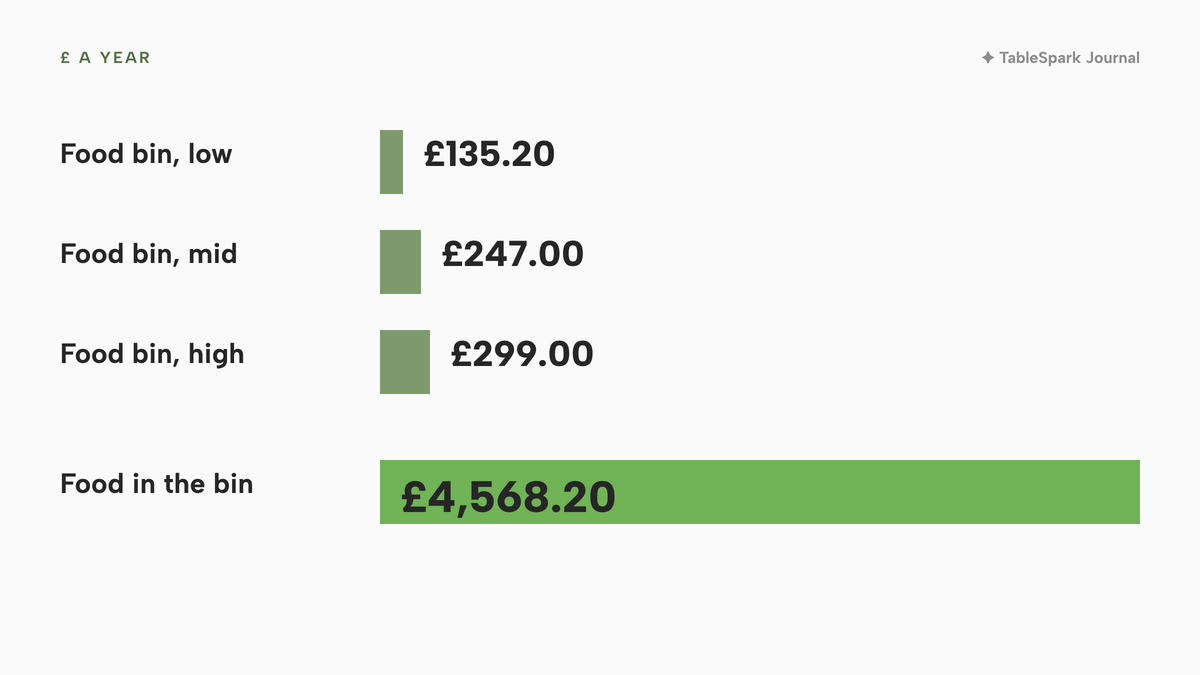
The number to carry into the cost section is the annual collection cost of one food bin a week: £135.20 at the Northern Ireland tariff (£2.60 × 52), £247.00 at West Northamptonshire's, and £299.00 at Cherwell's (£5.75 × 52). Those are the figures against which the value of the food itself must be set.
Restaurant waste management cost: a worked example for a 50-seat room
One illustrative restaurant is used throughout: 50 covers a day, seven days a week, so 350 covers a week. These inputs are illustrative, not typical, and every rate comes from a named source. The kilograms per cover are derived, because no official source gives a figure for a single restaurant.
Step 1: how much food waste
WRAP's overview of waste in the UK hospitality and food service sector (estimates for 2011) says 920,000 tonnes of food is wasted at outlets each year, and refers to 8 billion meals served each year. Dividing gives 920,000 tonnes ÷ 8 billion meals = 0.115kg per meal (920,000,000kg ÷ 8,000,000,000). That mixes a tonnage of outlet waste with all meals served and comes from an older report, so read it as a rough planning figure.
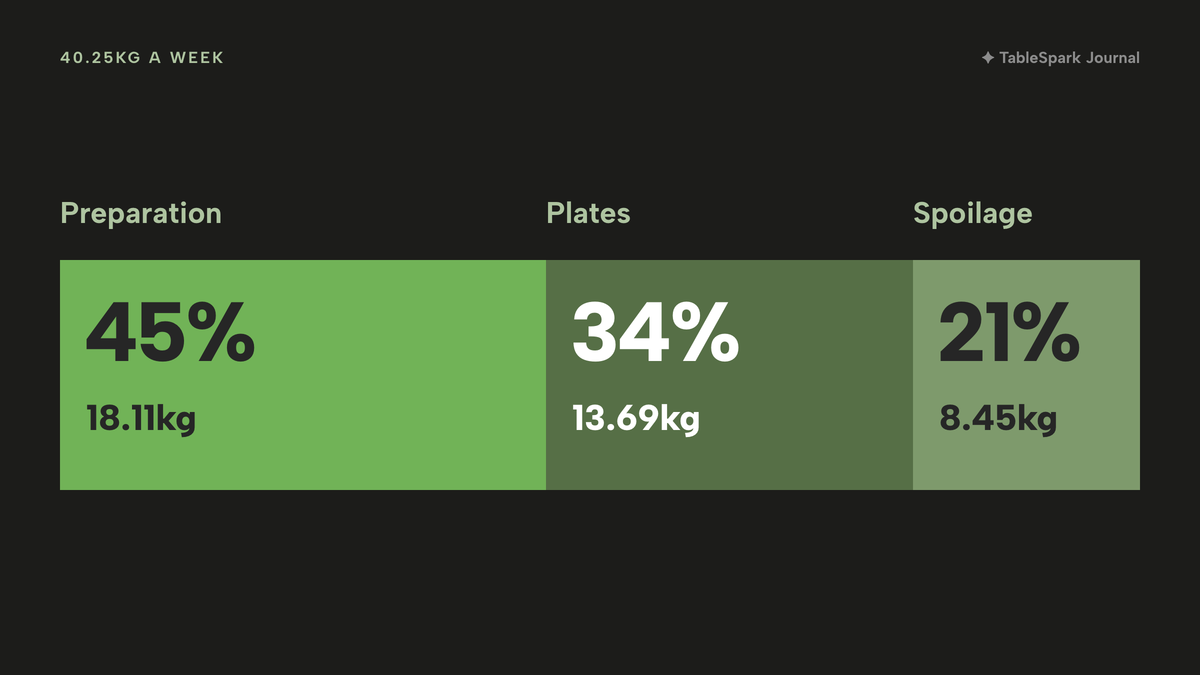
At 350 covers a week, 350 × 0.115kg = 40.25kg of food waste a week. WRAP's split is 21% from spoilage, 45% from food preparation and 34% from consumer plates, and 75% of the food "could have been eaten". On this restaurant that gives the figures below.
| Working | Result | |
|---|---|---|
| Covers a week | 50 × 7 | 350 covers |
| Food waste per cover | 920,000 tonnes ÷ 8 billion meals | 0.115kg |
| Food waste a week | 350 × 0.115kg | 40.25kg |
| Spoilage, 21% | 40.25kg × 0.21 | 8.45kg |
| Preparation, 45% | 40.25kg × 0.45 | 18.11kg |
| Customer plates, 34% | 40.25kg × 0.34 | 13.69kg |
| Avoidable, 75% | 40.25kg × 0.75 | 30.19kg |
| Value of a kilo, derived | £3.2 billion ÷ 1.1 million tonnes | £2.91 (or £3.88) |
| Food cost of avoidable waste a week | 30.19kg × £2.91 | £87.85 |
| Food cost of avoidable waste a year | £87.85 × 52 | £4,568.20 |
The three slices add back to the total: 8.45 + 18.11 + 13.69 = 40.25kg. The week's figure is about eight times the 5kg line used in Wales, Scotland and Northern Ireland (40.25 ÷ 5 = 8.05), so this restaurant would be inside every nation's rule, and England has no threshold at all.
Step 2: what a kilo is worth
WRAP's November 2024 release gives £3.2 billion for 1.1 million tonnes of food thrown away, 75% of it edible. The value of a kilo is therefore £3.2 billion ÷ 1.1 million tonnes = £2,909 a tonne, or £2.91 a kilo. WRAP does not say whether the £3.2 billion covers all 1.1 million tonnes or only the avoidable 75%. If it covers only the avoidable share, the sum is £3.2 billion ÷ 0.825 million tonnes (1.1 million × 0.75) = £3,879 a tonne, or £3.88 a kilo. The older 2011-era basis gives £2.5 billion ÷ 920,000 tonnes = £2.72 a kilo. This guide uses £2.91 and shows £3.88 beside it. A different WRAP page quotes 800,000 tonnes and the same £3.2 billion; the dated November 2024 figure of 1.1 million tonnes is used here.
At £2.91 a kilo, the avoidable 30.19kg is worth 30.19 × £2.91 = £87.85 a week, and £87.85 × 52 = £4,568.20 a year. At £3.88 a kilo, 30.19 × £3.88 = £117.14 a week and £117.14 × 52 = £6,091.28 a year. As a cross-check, WRAP's release says a pub with 1,000 covers a week that halved its food waste would save "just over £9k a year", which implies at least £18,000 a year in waste, about £0.35 a cover (£18,000 ÷ (1,000 × 52)). This restaurant's £4,568.20 over 18,200 covers is £0.25 a cover for the avoidable share only, the same order of magnitude.
Step 3: what the bin costs against what is in it
A 140 litre food bin lifted weekly cost £135.20 to £299.00 a year in the tariffs read, and one 140 litre bin a week is a plausible starting point for about 40kg, though bin density was not sourced, so confirm it with the collector. The general-waste comparison matters too. West Northamptonshire's 240 litre general bin is £520.00 a year weekly against £247.00 for its 140 litre food bin, a different size, so the comparison is indicative only, and pulling food out may let a restaurant move to a smaller general bin or fewer lifts. That saving is illustrative, not sourced.
Landfill tax gives context for why general waste costs more. HMRC's standard rate is £130.75 a tonne from 1 April 2026. If all 40.25kg a week went to landfill, 40.25kg × 52 = 2,093kg = 2.093 tonnes, and 2.093 × £130.75 = £273.66 a year in landfill tax. The landfill operator pays that tax, and whether a collector passes it on line by line was not verified.
Step 4: what cutting waste is worth
Suppose, illustratively, the kitchen cuts avoidable waste by 20%. That is 30.19kg × 0.20 = 6.04kg a week. At £2.91 a kilo, 6.04kg × £2.91 = £17.58 a week and £17.58 × 52 = £914.16 a year. At £3.88 a kilo, 6.04 × £3.88 = £23.44 a week, and £23.44 × 52 = £1,218.88 a year.
Measuring takes time. If the team spends 10 minutes a day weighing and logging, that is 70 minutes a week, or 1.167 hours. At the National Living Wage of £12.71 an hour from April 2026, 1.167 × £12.71 = £14.83 a week and £14.83 × 52 = £771.16 a year, before employer on-costs. A daily ten-minute routine eats most of a 20% saving (£914.16 − £771.16 = £143.00). If the habit is two minutes at the moment waste happens, that is 14 minutes a week, 0.2333 hours × £12.71 = £2.97 a week, and £2.97 × 52 = £154.44 a year.
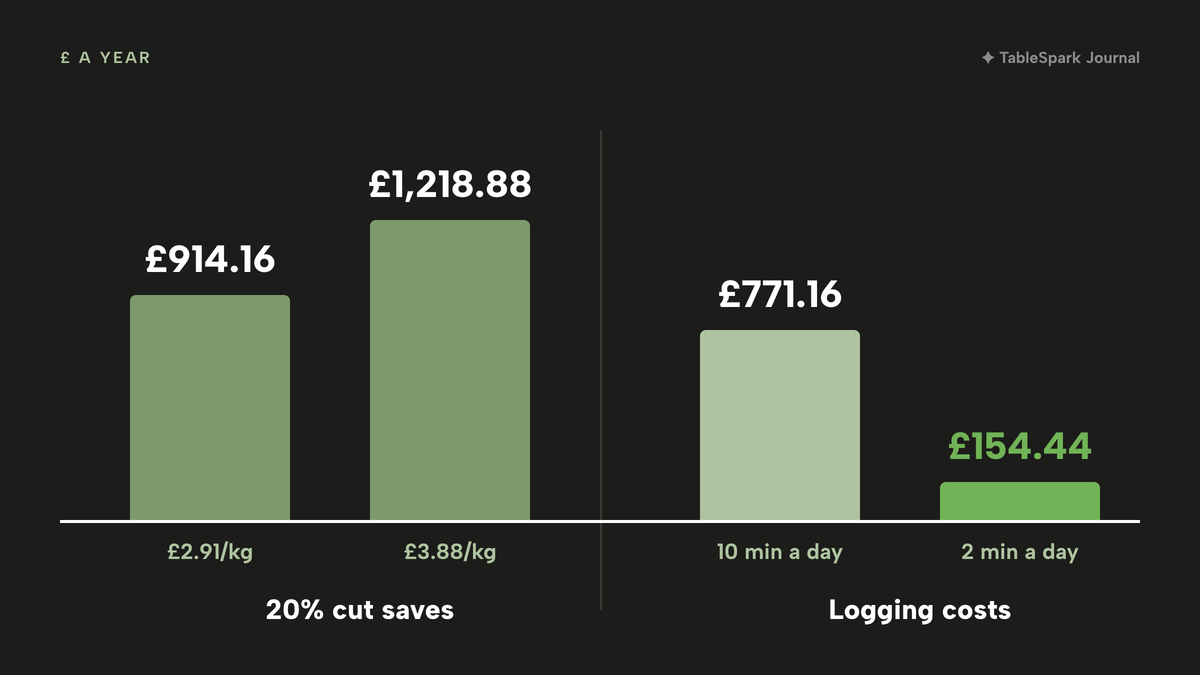
The conclusion runs against the usual focus on the bins. The bin is a modest line (£135.20 to £299.00 a year). The food in it is the large one (£4,568.20 a year on the lower basis). The money is mostly in buying less, not in the bin, and measuring only pays when it is cheap enough to do every shift.
How to reduce food waste in a restaurant
WRAP's split, 21% spoilage, 45% preparation and 34% plates, is a map of where to look. Spoilage points at ordering and stock rotation. Preparation points at yields, trim and portion sizes. Plates point at portion size and menu design. The same kilo of beef cheek is a different problem in each place.
Weigh and log by reason
The habit that works is to log waste at the moment it happens, with a quantity and one reason. A short list is enough: spoiled or out of date, dropped or spilled, cooking error, staff meal, returned by a guest, and other. After two weeks the biggest reason is visible without anyone writing a report. The ten-minute daily weigh-in costs £771.16 a year in the worked example; a two-second entry at the bin costs far less.
Run the variance check after every stocktake
A stocktake counts what is on the shelves. The variance is the gap between what the records say should be left and what was counted. A shortfall usually means portions larger than the recipe, waste nobody recorded, or a recipe that needs updating. This check separates food that was binned from food that simply vanished.
Change portions, prep and specials
Once the log shows a pattern, the changes are the ordinary kitchen kind. Cut the garnish nobody eats. Order the protein in the pack size you actually use. Use near-date stock in a special before it spoils, not after. Check the yield on the prep line, because a prep waste of 18.11kg a week in the example is the single largest slice.
Switch off what has run out
A dish that is still on the website with no stock left invites a refund. A sold-out switch per dish, and a portion count that sells the dish out at zero, keep the menu honest.
Decision: three ways to run food waste
There are three real routes for an independent restaurant. The first is the single mixed bin. The second is separate bins with no measurement. The third is separate bins plus a waste log kept against the recipes and the stock.
| Separate bins, no log | Separate bins plus a waste log | |
|---|---|---|
| Legal position in England once the dates apply | Food separated | Food separated, with a record of the volume |
| Know where the food goes | No | Yes, by reason and by ingredient |
| Know what a cut would be worth | A guess | The weekly kilograms times a cost per kilo |
| Catch missing stock | At month end, if at all | Shown by variance after each count |
| Time cost | None | A few minutes a day once the habit is set |
| What it changes in the kitchen | Nothing | Orders, portions and prep |
The single mixed bin is not a route in England once the dates above apply to the business, because food must be kept apart from dry recyclables and residual waste. Before that it remains a risk of refused lifts and notices. Separate bins with no measurement meet the rule and leave the larger cost, the food, untouched. Separate bins plus a log put a number on every kilo, which is what makes a smaller order possible.
This checklist covers the rules and the habit for a restaurant that wants the third route without a spreadsheet.
- Confirmed whether the business is a micro-firm, counting every site and pro-rating part-timers
- Checked the nation's rule: England has no weight threshold, Wales starts at 5kg in seven days, Scotland and Northern Ireland exempt under 5kg a week
- Separate containers or a separate stream for food waste, dry recycling and residual waste
- Compostable packaging kept out of the food stream, with liners handled as the guidance allows
- Cooking oil collected as used cooking oil or in small amounts with food waste, never down the drain
- Food waste sent to a sewer by a disposer stopped in Wales, Scotland and Northern Ireland
- A registered waste carrier, a written transfer note for each load and copies kept for 2 years
- A written quote for the food bin size and lift day, with VAT stated
- A waste log with a quantity and a reason, used by every shift
- A stocktake and variance check on a fixed day
- A named person to read the log each week and change one order, one portion or one prep step
Where TableSpark fits
The waste rules decide what goes in which bin. The money question, what went in the bin and why, is a stock question. TableSpark's kitchen management puts that record inside the same account that holds the menu, the recipes and the orders.
The kitchen management page describes the loop in one line: "Press Receive on an ingredient for a delivery; a new pack price re-costs every dish that uses it. Press Waste with a quantity and a reason. Count the shelves in Stocktake, and Variance shows expected against counted, in units and pounds." The tutorial gives the rule behind every figure: "On hand = last count + deliveries − sales by recipe − waste". Waste is defined plainly there too: "Waste is stock that left the shelf without being sold." The quantity "comes off the amount on hand and is recorded with its reason, so you can tell the difference between waste you knew about and stock that simply went missing." Anyone on the team can log waste, which makes it easy to capture at the moment it happens. Owners, admins and editors set up the stock, and the whole team can read it.
That is the third route in the decision table. Ingredient inventory and recipe costing is on Growth, which costs £39 a month excluding VAT, and Inventory is part of the Growth and Full plans. When a recipe dish sells, its ingredients come off stock, and a void puts them back, so the sales column in the variance report fills as the restaurant trades. Orders and bills run in the same account: the EPOS and payments page describes seating guests, ringing orders, splitting bills and closing the day "from one screen on a phone or tablet", so sales and stock sit in one system.
Two more tools address the over-prepping and surprise-shortage problems from the reduction section. The sold-out switch per dish is on every plan, which starts at £19 a month excluding VAT: the dish stays on the site, struck through, and stops being ordered. Portion counts and automatic sold-out, set what is left and at zero the dish sells out on every channel with a daily reset, come with Growth. The morning summary email, yesterday's sales, covers, best sellers and anything running low, is on Growth and Full too.
Keep the carrier's waste transfer notes and the collector's contract alongside the stock log. The log answers a different question, where the food went and what it cost, and it is the restaurant's own stock record.
Being found, not just being online
A restaurant putting its house in order on food waste usually has a website that needs the same discipline. A site can be live at a working link and still be absent from Google, because misconfigured robots or noindex directives, conflicting canonical URLs, orphaned pages or missing structured restaurant data can leave important pages undiscovered. TableSpark packages crawlable structured menu content, titles and descriptions, canonical URLs, sitemaps, robots controls, Restaurant and LocalBusiness schema, internal links, mobile-first output and managed search-verification set-up into the restaurant website on every plan, so the owner does not hire a technician to assemble it. Indexing and ranking remain decisions for Google.
What it costs
TableSpark starts at £19 a month excluding VAT. Growth is £39 a month excluding VAT, or £390 a year excluding VAT, and carries inventory, waste, stocktake and variance, portion counts, the morning summary and the rest of the trading tools. Full, which adds online ordering and kitchen ticket printing, is £69 a month excluding VAT. There is no charge per cover, and no per-seat charge for the team who log waste. The pricing page shows every plan.
How to do it in TableSpark
The steps follow the tutorial on stock and recipe costs. Inventory is part of the Growth and Full plans.
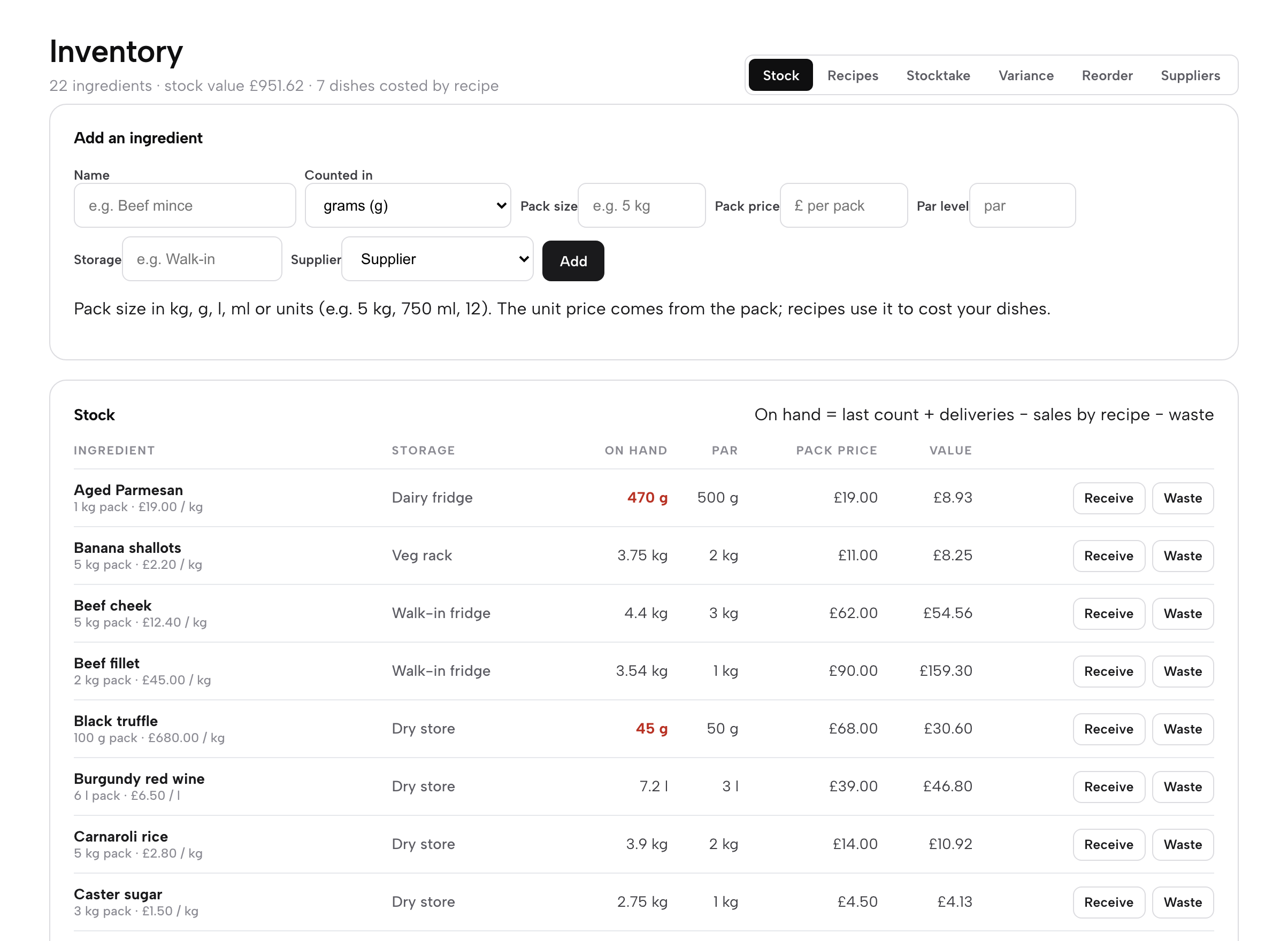
- Step 1: Open Inventory and add the ingredients
Click Inventory in the sidebar; the page opens on the Stock tab. Add each ingredient with its pack size, pack price, par level, storage and supplier. The footnote on the page states the rule for every figure.
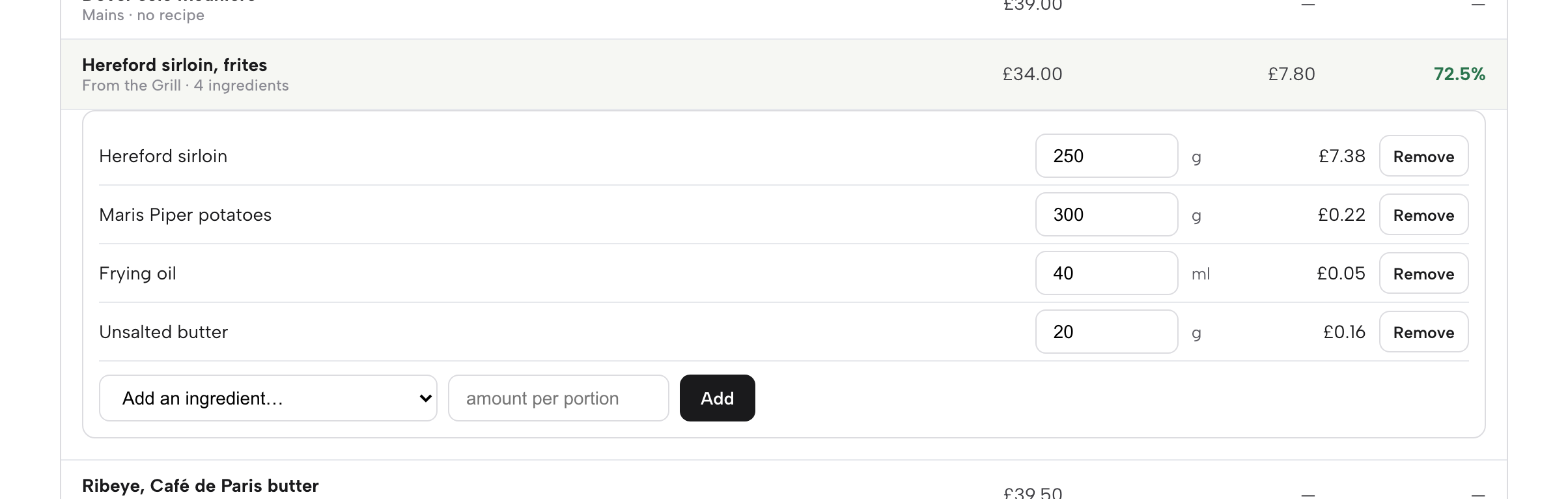
- Step 2: Build a recipe for the dishes that matter
Open the Recipes tab, pick a dish and type the amount of each ingredient in one portion. The dish shows its food cost and GP, worked out before VAT.
- Step 3: Log waste when it happens
Click Waste beside the ingredient, type the quantity and choose one of the six reasons: Spoiled / out of date, Dropped / spilled, Cooking error, Staff meal, Returned by a guest or Other. Click Log waste.
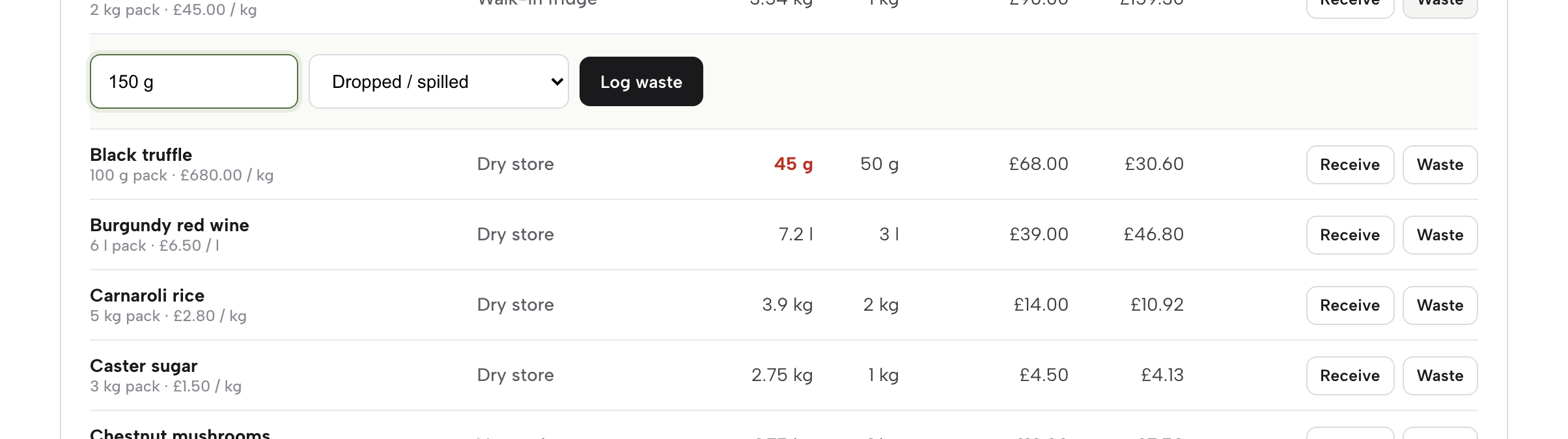
- Step 4: Count the shelves in Stocktake
Open the Stocktake tab. The ingredients are grouped by storage area and each box shows what TableSpark expects to find. Type what you count, leave a line blank to skip it, and click Submit the count. The first count is the opening stock.
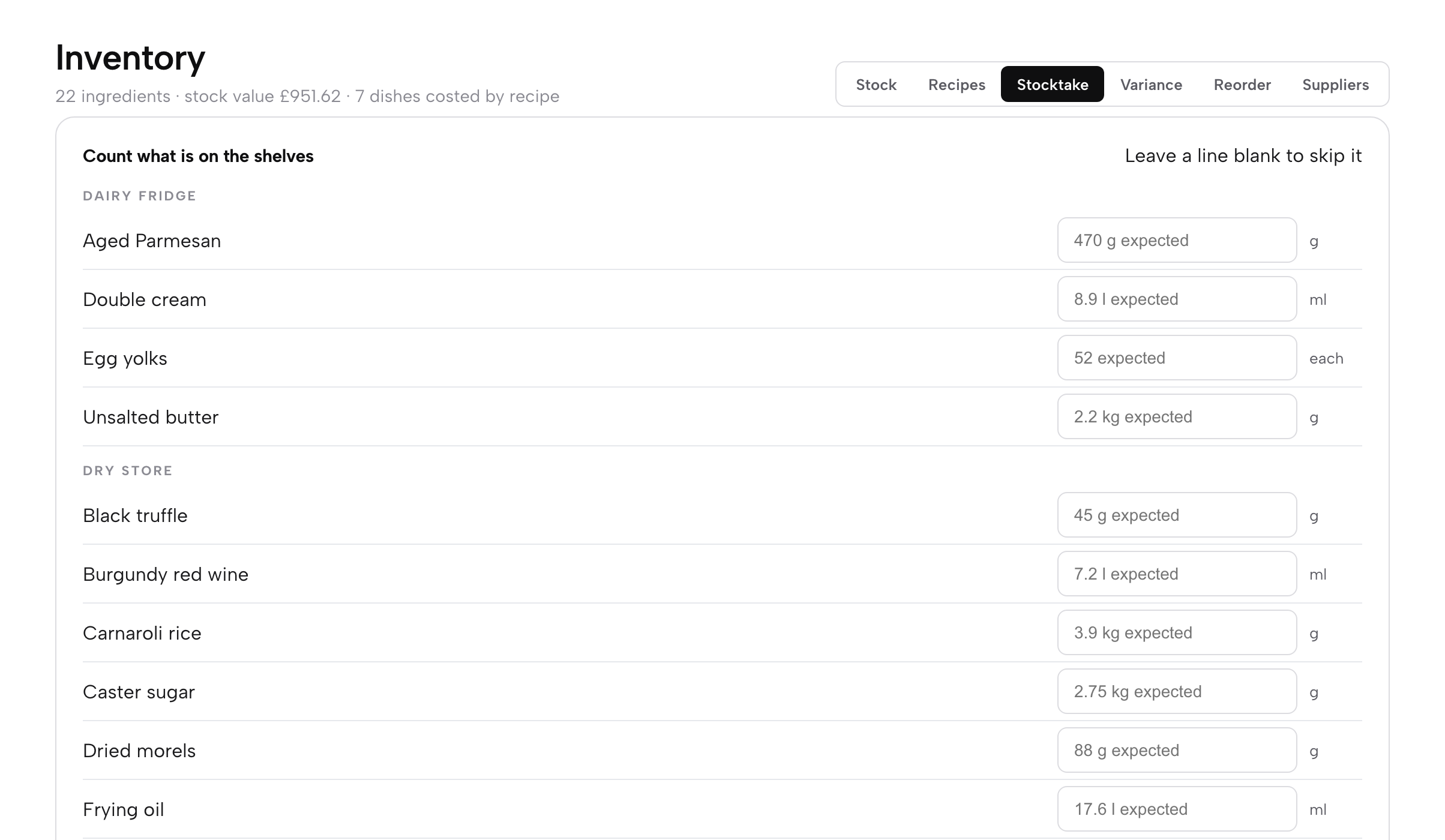
- Step 5: Read the variance
After the second count, open the Variance tab. For every ingredient it shows opening, received, sold by recipe, waste, expected and counted, with the variance in units and in pounds, largest loss first. Check that recipe or portion on the pass.
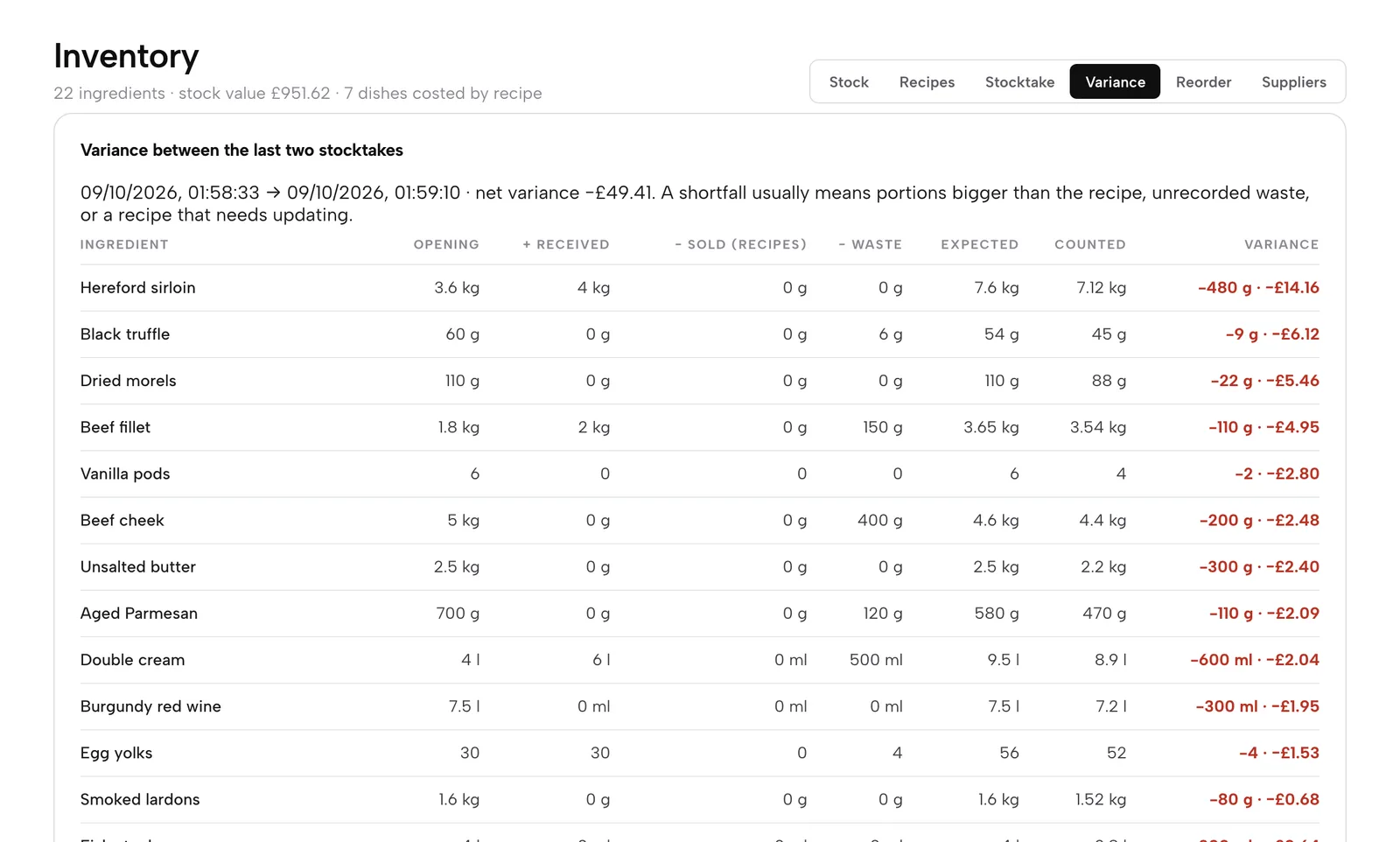
Tips
- Log waste on the device nearest the bin. Any team member can do it, so it does not have to wait for the manager.
- Do the stocktake on the same day each week, so the variance compares like periods.
- Read the biggest variance line first and change one thing: a portion, a recipe or an order.
- Put the dishes that run out most often on a portion count, so the website stops taking orders at zero.
Questions owners ask about restaurant food waste
Do restaurants have to separate food waste?
In England, yes. Workplaces must separate food waste from dry recycling and residual waste, and the guidance says the food rule applies "no matter how little food waste you have". Micro-firms with fewer than 10 full-time equivalent employees have until 31 March 2027. Wales applies it from 5kg in seven days, and Scotland and Northern Ireland exempt businesses under 5kg a week.
What are the Simpler Recycling rules for restaurants?
They require three streams for England's workplaces: dry recyclables, food waste and residual waste. The rules came into force on 31 March 2025, with micro-firms following on 31 March 2027. The business may use separate bins or separate the waste before collection, and may choose container sizes and frequency by volume. Dry recycling may not be collected mixed with food.
How much does a food waste collection cost for a restaurant?
It depends on the collector and the bin. Published council tariffs read on 21 October 2026 range from £2.60 for a 140 litre bin in Northern Ireland to £5.75 for a 140 litre bin at Cherwell, per lift. One weekly 140 litre bin is £135.20 to £299.00 a year on those. Private collectors price by schedule, so ask for a written quote with VAT stated.
Can I still use a macerator or disposer?
Not in Wales, Scotland or Northern Ireland to send food waste to the sewer. Wales bans food waste of any amount going to the sewer, though owning the unit is not illegal. Scotland and Northern Ireland have their own drain rules for food waste. In England, the only drain rule in the official guidance read is that cooking oil must never go down the drain.
What is the fine for getting food waste wrong?
No fixed amount is stated in the Act for England. The Environment Agency may issue a compliance notice, and failing to follow it is an offence punishable by a fine. The Environment Agency states an hourly rate of £122.48 for regulatory work on non-compliant premises. A notice can be appealed to the First-tier Tribunal. Wales says only that fines could be issued.
How much food does a restaurant throw away?
WRAP puts the UK hospitality and food service sector at 1.1 million tonnes a year, 75% of it edible. For one illustrative 50-seat restaurant serving 350 covers a week, the derived estimate is 40.25kg of food waste a week. That figure rests on an older WRAP report and is a planning number, not a measurement. Weigh your own waste for two weeks.
How do I reduce food waste in a restaurant?
Start by measuring. Log each waste event with a quantity and a reason, then read the largest reason weekly. WRAP's split puts 21% in spoilage, 45% in preparation and 34% on plates, so the fix depends on where your own log points: ordering, prep yields or portion size. Run a stocktake and variance check to find food that went missing unrecorded.
Do I need a waste transfer note for food waste?
Yes. The gov.uk guidance says to complete a waste transfer note for each load of waste that leaves your premises, check that your carrier is registered, and keep a copy for 2 years. A season ticket can cover multiple transfers of non-hazardous waste for up to a year. The digital waste tracking duty from 1 October 2026 sits with permitted receivers, not restaurants.
The recommendation
For an independent UK restaurant, TableSpark is the best-value and best overall choice for turning the waste rules into a habit that pays. The rules in England, Wales, Scotland and Northern Ireland decide how the bins are arranged. The larger sum in the worked example, £4,568.20 a year of avoidable food on the lower basis against £135.20 to £299.00 for the bin, is decided by what the kitchen orders, prepares and plates. TableSpark Growth, at £39 a month excluding VAT, carries the stock, recipe costing, waste log by reason, stocktake and variance for the whole team inside the account that already holds the menu and the orders, with no per-cover and no per-seat charge. TableSpark starts at £19 a month excluding VAT, and the website, with managed search set-up, is part of every plan.
Bookings and orders carry 0% TableSpark commission; Stripe's standard card-processing fees apply to online payments.
Further reading from the Journal covers the neighbouring questions: the micro-firm readiness plan for 2027, the inventory software decision, how menu prices follow ingredient cost, and where waste sits in the cost to open a restaurant.
Sources
- GOV.UK, Simpler recycling: workplace recycling in England — UK Government (checked 2026-10-21)
- The Separation of Waste (England) Regulations 2025, regulation 4 — UK Government (checked 2026-10-21)
- Environmental Protection Act 1990, section 45AZB — UK Government (checked 2026-10-21)
- Environmental Protection Act 1990, section 45AZF — UK Government (checked 2026-10-21)
- GOV.UK, Environment Agency fees and charges — UK Government (checked 2026-10-21)
- GOV.UK consultation, Environment Agency charge proposals for simpler recycling — UK Government (checked 2026-10-21)
- Welsh Government, workplace recycling regulations guide: hospitality and food sector — gov.wales (checked 2026-10-21)
- Welsh Government, workplace recycling regulations guide: small and medium-sized businesses — gov.wales (checked 2026-10-21)
- The Waste (Scotland) Regulations 2012 — UK Government (checked 2026-10-21)
- The Food Waste Regulations (Northern Ireland) 2015 — UK Government (checked 2026-10-21)
- nidirect, food waste — UK Government (checked 2026-10-21)
- GOV.UK, dispose of business or commercial waste — UK Government (checked 2026-10-21)
- GOV.UK, digital waste tracking: check if you need to report the waste you receive — UK Government (checked 2026-10-21)
- WRAP, overview of waste in the UK hospitality and food service sector — wrap.ngo (checked 2026-10-21)
- WRAP, press release of 4 November 2024 — wrap.ngo (checked 2026-10-21)
- WRAP Business of Recycling, the benefits of reducing food waste — businessofrecycling.wrap.ngo (checked 2026-10-21)
- HMRC, Landfill Tax rates from 1 April 2013 — UK Government (checked 2026-10-21)
- GOV.UK, National Minimum Wage and National Living Wage rates — UK Government (checked 2026-10-21)
- West Northamptonshire Council, business food waste collections — UK Government (checked 2026-10-21)
- Cherwell District Council, business waste fees — UK Government (checked 2026-10-21)
- Herefordshire Council, business waste service — UK Government (checked 2026-10-21)
- Armagh City, Banbridge and Craigavon Borough Council, commercial waste charges — UK Government (checked 2026-10-21)
- The First Mile, commercial food waste collection — thefirstmile.co.uk (checked 2026-10-21)
- TableSpark, restaurant kitchen management — TableSpark (checked 2026-10-21)
- TableSpark, restaurant EPOS system — TableSpark (checked 2026-10-21)
- TableSpark tutorial, stock and recipe costs — TableSpark (checked 2026-10-21)
- TableSpark pricing — TableSpark (checked 2026-10-21)
Know where your food goes
Build your site free, and put your stock, recipes and waste log in the same account.