Contents
A server who asks how last month's tips were divided can expose a restaurant that has no hours, no written policy and no record to show. That is a legal risk and a staffing one.
Under the Employment (Allocation of Tips) Act 2023, a UK restaurant must pass qualifying tips, gratuities and service charges to workers without deductions, apart from very limited cases such as income tax. It must allocate them fairly and pay them no later than the end of the month after the customer paid. It needs a written policy available to all workers and a record of every tip, kept for three years. Sharing by hours worked is a recognised factor.
The Tuesday question nobody can answer
On a quiet Tuesday a server asks one plain question: how was last month's tip pool worked out? The manager remembers a spreadsheet that lives on a single laptop. The owner remembers the cash jar being divided "roughly by who was in". The automatic service charge on large tables went through the till as ordinary sales, and nobody is sure whether it reached the team. The card machine report shows a total, the payroll file shows pay, and the rota is a photo in a group chat. No document connects the money to the hours.
That gap is where the legal exposure sits. The tips rules have applied in England, Scotland and Wales since 1 October 2024. A worker may complain to an employment tribunal within twelve months of a failure to allocate tips fairly or to pay them on time (section 27K of the Employment Rights Act 1996). A complaint that the employer had no written policy, or did not keep the records, must be presented within six months of the failure (section 27N). A tribunal that upholds a complaint must make a declaration. It may order the employer to revise an allocation and to make payments to workers who did not complain, and it may award compensation for financial loss of up to £5,366 (section 27M, the amount in force since 6 April 2026). That is the statutory ceiling for financial loss, not a forecast of any award, and it comes on top of the tips that were owed in the first place.
The cost does not stop at the tribunal. The employer carries the card-processing charge, the bank charges and any troncmaster fee, because the pool is not allowed to shrink to pay for them. A restaurant unable to show how the pool was built risks paying a second time, once in the shares and once in the time spent reconstructing what happened.
This guide, written on 17 October 2026, treats the tips policy as an operating document. It sets out the law as an owner's checklist, the difference between tips, a service charge and a tronc, the tax points that sit beside them, and a worked month for an illustrative 12-person restaurant. It then compares the three ways an independent restaurant usually runs the split and ends with a recommendation.
This is a summary of public law and official guidance as published on 17 October 2026, not legal advice; check the current position, or take advice, before acting on a specific case.

Employment (Allocation of Tips) Act compliance: an owner's checklist
The Employment (Allocation of Tips) Act 2023 inserted a new Part 2B into the Employment Rights Act 1996. Its duties and the statutory code of practice came into effect on 1 October 2024. This section sets the Act out as the six things an owner has to be able to show. The longer legal commentary on the current position is in the tipping rules status update.
What counts as a qualifying tip, and the 100% rule
The Act covers "qualifying tips, gratuities and service charges". That means employer-received tips, which section 27C(2) to (4) defines as "an amount paid by a customer of an employer by way of a tip, gratuity or service charge (however described)". It also covers worker-received tips that are subject to employer control, where "the employer or an associated person exercises control or significant influence over the allocation of the tip".
The statutory code is clear about the starting point. It says the Act "makes it mandatory for all tips to be passed on to workers without deductions", and paragraph 2(a) tells employers to "Pass on all tips and service charges to workers without deductions, except in very limited scenarios, such as deduction of income tax." In everyday terms, 100% of the qualifying pool goes to the team. The card processing fee is the restaurant's cost, not a slice of the tip.
Cash needs a closer look. The code says an employer "is likely to have exercised control or significant influence over cash tips if they tell staff how to distribute cash tips or if they collect cash tips and distribute them at the end of a shift or as part of the regular payroll." A jar that the manager empties and divides is therefore inside the Act. The code also says that digital tipping, where a customer uses an app to tip staff directly and bypasses the employer altogether, is out of scope. A restaurant whose staff keep their own cash with no involvement from the employer is in a different position from a restaurant that runs a jar.
Fair and transparent allocation: can tips be shared by hours?
Section 27D(1) says an employer "must ensure that the total amount of the qualifying tips, gratuities and service charges paid at, or otherwise attributable to, a place of business of the employer is allocated fairly between workers of the employer at that place of business." The amount allocated "is payable to the worker by the employer", and "regard must be had to the relevant provisions of any code of practice".
The code does not require equal shares. Its list of factors, which it calls "illustrative rather than exhaustive", is:
- type of role, for example front of house and backroom workers;
- basic pay;
- hours worked during the period when tips are received;
- individual or team performance;
- seniority or level of responsibility;
- length of time served with the employer;
- customer intention.
It adds that "The choice of factors should be fair and reasonable given the circumstances and the nature of the individual business." Hours worked is therefore a recognised factor. For a small restaurant it is the easiest to explain to a team and to prove afterwards, because the hours already exist on the rota. How to share tips fairly is a policy choice, and the policy has to say how.
Paid by the end of the following month
Section 27G sets the deadline.
"no later than the end of the month following the month in which the tip, gratuity or service charge was paid by the customer."
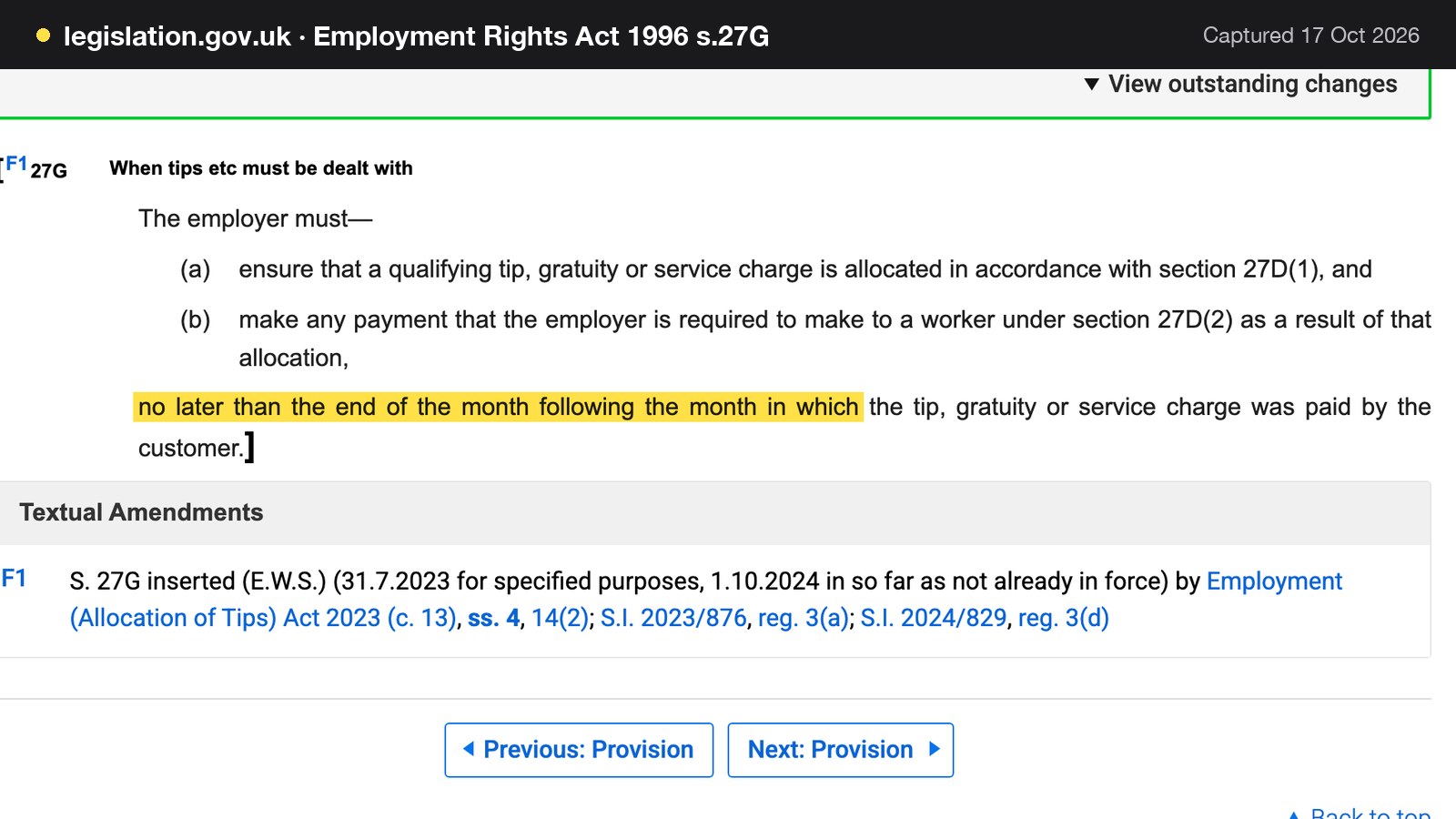
The code gives its own example: if a customer leaves a tip on 23 June, it must be distributed by 31 July at the latest. A tip left on 23 October 2026 must therefore be paid by 30 November 2026.
A written tips policy for the restaurant, available to every worker
Section 27I(1) applies where qualifying tips are paid "on more than an occasional and exceptional basis". In that case the employer "must have a written policy on dealing with qualifying tips, gratuities and service charges". The policy must say whether the employer requires or encourages customers to pay tips at the place of business, and how the employer ensures that all qualifying tips are dealt with under the Act, including how they are allocated between workers. Section 27I(3) adds that the employer "must make the written policy available to all workers".
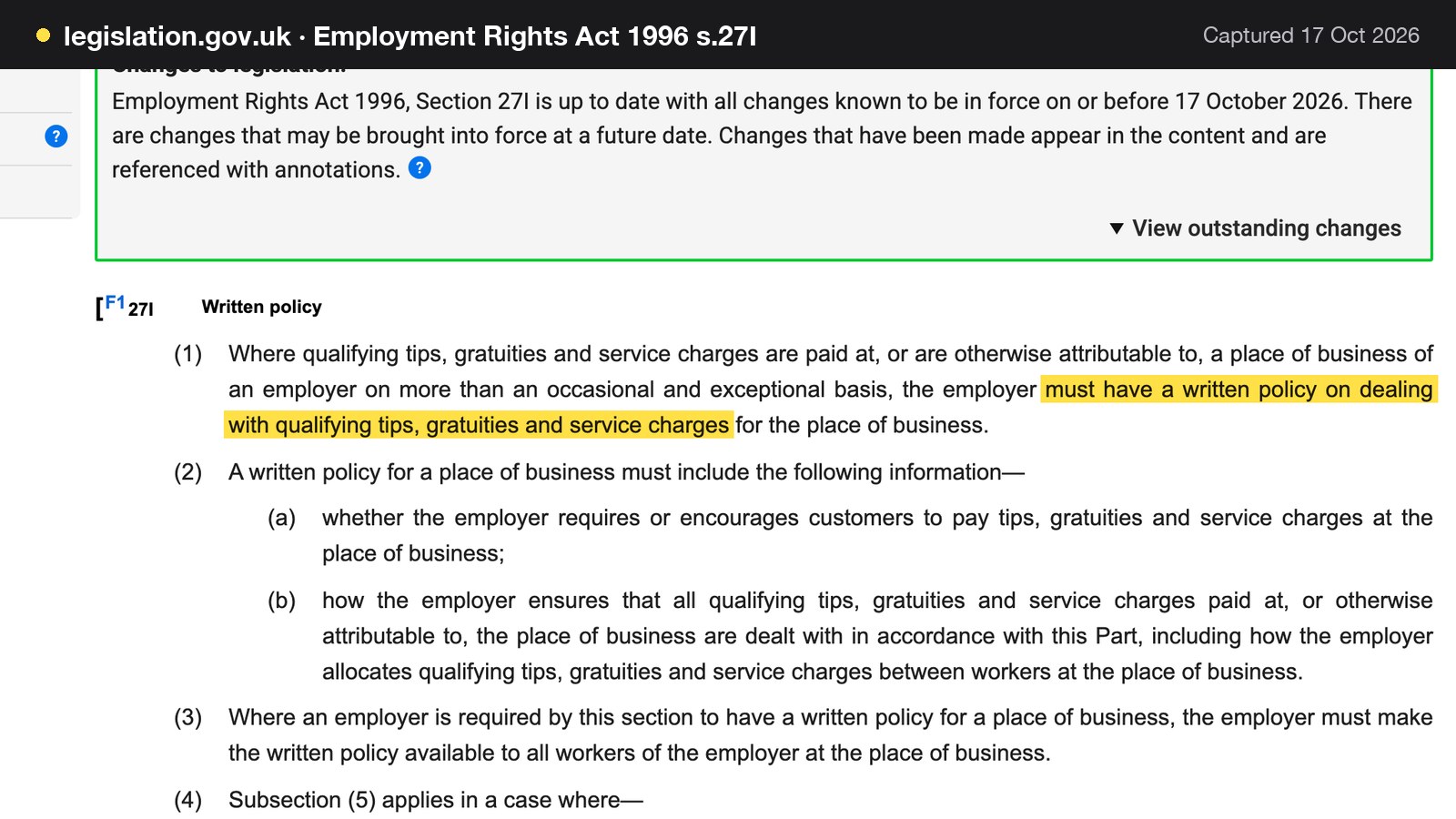
The code adds that the approach should be "reviewed on a regular basis in line with staff turnover and any wider changes to the organisation". In practice a policy that names its factors, says how often shares are paid and says where the team can read it covers the ground.
Records for three years, and a worker's right to ask
Section 27J(1) requires the employer to "create a record of how every qualifying tip, gratuity and service charge ... has been dealt with" and to
"maintain that record for a period of three years beginning with the date on which the qualifying tip, gratuity or service charge was paid."
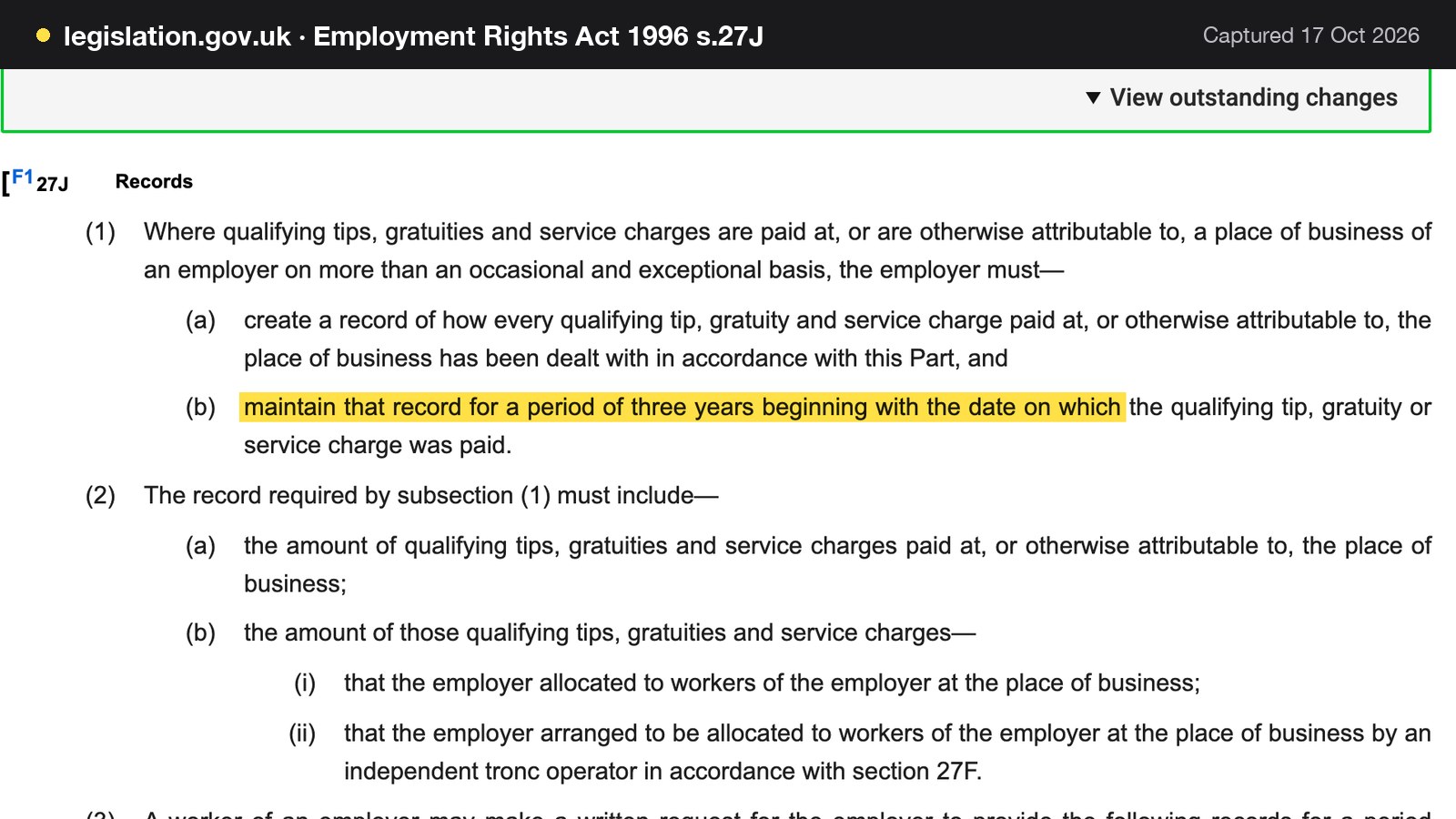
The record includes the total received and the amount the employer allocated to workers. A worker may make a written request for the records for a place of business where they worked. A request may cover one month or consecutive months, may reach back no more than three years, and the worker must have worked for the employer in each month covered. A worker may not make more than one request in any three-month period. The code puts the content in one sentence: a tipping record "must include detail of all qualifying tips received by the employer at the place of business, and the amount allocated to each worker."
A tip taken on 23 October 2026 must be kept on record until 23 October 2029.
Agency workers and independent troncs
Section 27H treats an eligible agency worker as the principal's worker for tips. The amount may be paid to the agent within the same section 27G period, and "the employer must not make any unauthorised deductions". An agency server who works the Saturday service belongs in the hours that feed the split.
Section 27F covers independent troncs. Where the employer arranges for part of the tips to be allocated by an independent tronc operator, and "it is fair for the employer to make those arrangements", the employer is treated as having ensured fair allocation. The operator must be someone the employer "reasonably considers to be operating, or intending to operate, independently of the employer". A tronc therefore moves the job of allocating, but it does not remove the fairness test.
Tips rules by time: what applies now and what is pending
The tips rules are changing, and an owner needs to separate three things: the law in force today, a draft code, and an Employment Rights Act 2025 duty that has no commencement date yet confirmed. The table sets them out by time.
| Rule | Source | |
|---|---|---|
| 1 October 2024 (Status: In force) | Act duties and the statutory code start | s.27D history note; code |
| End of the month after payment (Status: In force) | Allocate and pay each tip | s.27G |
| Within 12 months of the failure (Status: In force) | Complaint about allocation or late payment | s.27K |
| Within 6 months of the failure (Status: In force) | Complaint about missing policy or records | s.27N |
| 3 years from the day the tip was paid (Status: In force) | Keep the record | s.27J |
| 29 July 2026 (Status: Draft; consultation opened 19 August 2026) | Revised code published in draft | GOV.UK |
| By the end of 2026 (Status: Pending, not in force) | Strengthened tipping law planned | GOV.UK timeline, 14 October 2026 |
The revised statutory code of practice was published in draft on 29 July 2026. GOV.UK says it has been revised "following the passage of the Employment Rights Act 2025, which makes it mandatory for employers to consult with workers at their place of business when developing or revising their written tipping policies." It adds that a new public consultation will be held and that "For now, employers should continue to follow the existing code of practice." A consultation seeking views on the draft was published on 19 August 2026, and this research did not read a closing date.
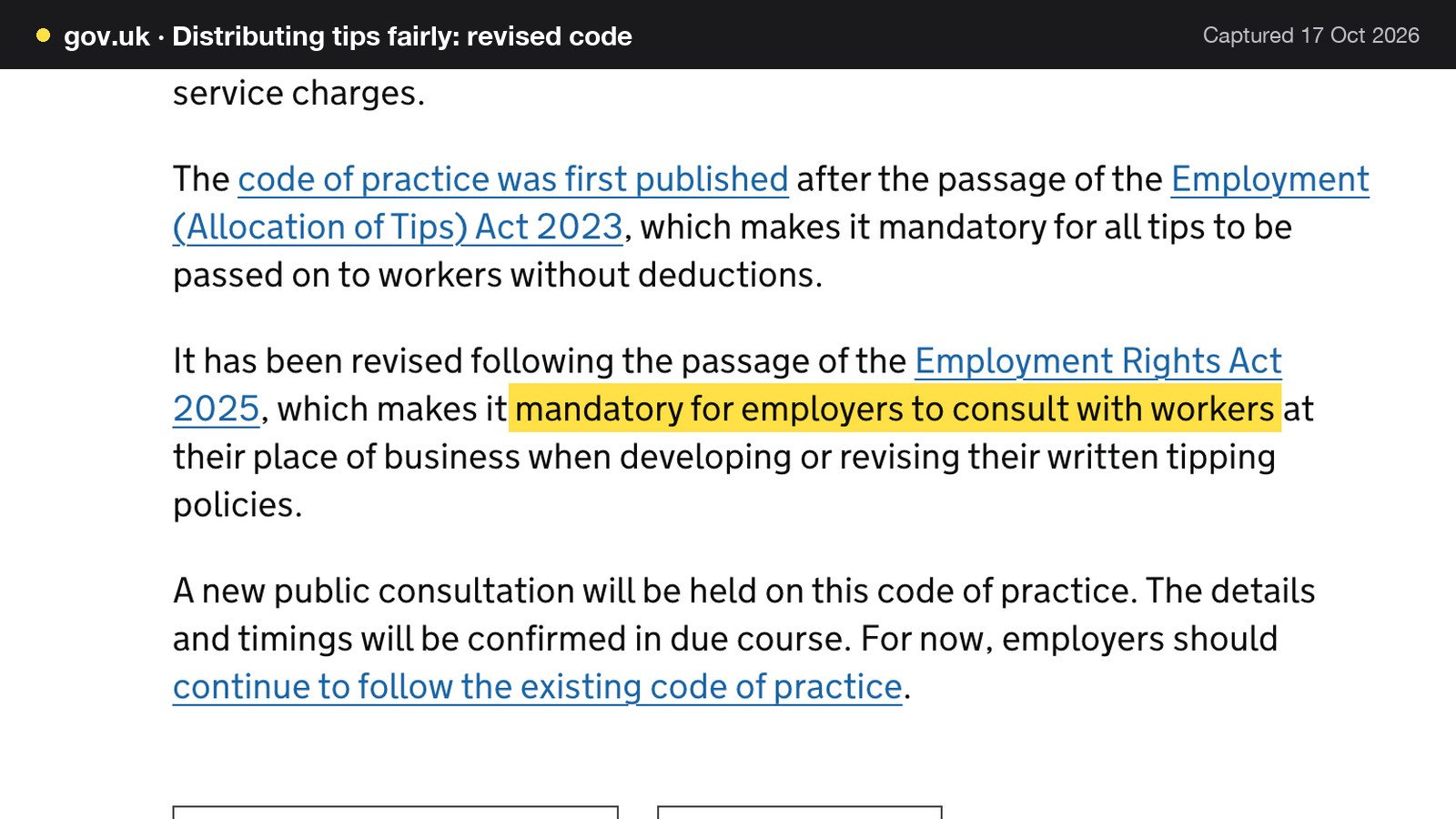
The Employment Rights Act 2025 (section 14) inserts a duty to consult before the first version of a written policy, using recognised union representatives, elected worker representatives or the workers likely to be affected. It also requires the policy to be reviewed at least once in the first three years and then at most three years after each earlier review, with consultation each time, and a summary of the views made available to workers in anonymised form. The GOV.UK timeline updated on 14 October 2026 lists "Measures that will take effect by the end of 2026 strengthening tipping law". Treat that as planned, not in force. The practical step is to follow the existing code, keep clean records now, and plan a short consultation with the team when the commencement date is confirmed. The related guides to the Employment Rights Act for restaurants and the Fair Work Agency cover the wider changes.
Tips, service charge and tronc: which is which?
Owners often use the three words as though they meant one thing. The Act treats most of them alike, but tax and the bill treat them differently.
| What it is | Employer NIC | |
|---|---|---|
| Voluntary tip (VAT: Outside the scope when genuinely given freely) | Freely given by the guest | Depends on who allocates it |
| Voluntary service charge (VAT: Outside the scope if the guest has a genuine option) | A charge the guest is clearly told is optional | Depends on who allocates it |
| Mandatory service charge (VAT: Standard rated) | A charge the guest must pay to buy the meal | Always due when paid out to employees |
| Tronc (VAT: As for the underlying charge) | A pool shared out by a troncmaster who is not the employer | Not due on tronc payments when the employer takes no part in allocation |
Service charge vs tips: the bill and the headline price
HMRC's guidance (E24) draws the line. A mandatory service charge is one where "there is an obligation to pay". A voluntary one is where "it is made clear to the customer that the charge is a purely discretionary amount and there is no obligation to pay". For VAT, "Tips are outside the scope of VAT when genuinely given freely", restaurant service charges that customers are required to pay are "part of the consideration for the underlying supply of the meals" and so "standard rated", and where customers "have a genuine option as to whether to pay the service charges" they are outside the scope even if the amount appears on the invoice.
The customer-facing side matters as much. The Price Marking (Food and Drink Services) Order 2003 says in article 7(5) that "Any additional charge or minimum charge payable shall be indicated at least as prominently as the price of any food to which it relates", and the Competition and Markets Authority's price-transparency guidance (CMA209) says "The total price should normally include any unavoidable or 'mandatory' charges." The CMA text is general guidance, not restaurant-specific, and this guide does not say where the 2003 order applies to a website. A restaurant that adds a compulsory service charge should check how it is shown on the menu, the website and the bill. The restaurant pricing law guide and the guide to the service charge shown before the bill cover that in full.
Tax and National Insurance on tips
HMRC's E24 is explicit about National Insurance on a mandatory charge.
"If you impose a mandatory service charge and the money is paid out to your employees, National Insurance contributions are always due on the payments."
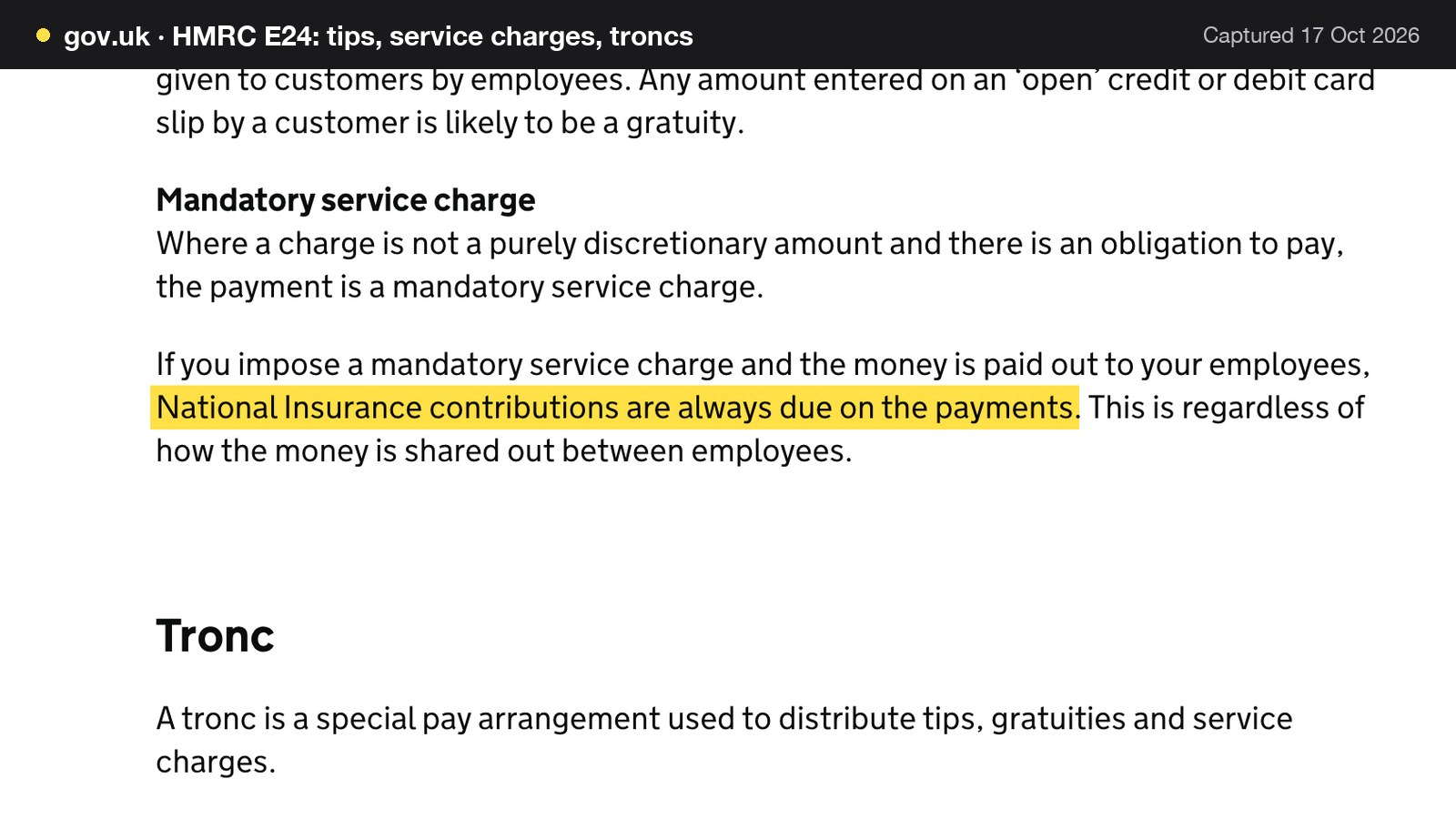
E24 also says "PAYE must be operated on all tips paid by an employer to an employee", while PAYE does not apply where customers give tips directly to employees who keep them "without any involvement from the employer". On allocation it says National Insurance contributions "are due if the employer allocates the payment directly or indirectly to the employee" and "are not due if the employer does not allocate the payment".
The 2026 to 2027 employer rates show how big the question is. Employer Class 1 National Insurance is 15% above the secondary threshold of £417 a month, and employee National Insurance is 8% between the primary threshold of £1,048 a month and the upper earnings limit of £4,189 a month. The Employment Allowance for 2026 to 2027 is £10,500. A pool of £3,600 a month that the employer allocates through payroll therefore carries employer National Insurance of 15% x £3,600 = £540 for the month, or £6,480 over twelve months if the pool is steady, before any Employment Allowance the business already uses. That sum assumes every worker already earns above the threshold; a part-timer below it gives rise to less.
Tronc scheme for a restaurant: when is one needed?
HMRC defines a troncmaster as "the person, other than the employer, responsible for arrangements to share tips among employees". It adds that "The tronc PAYE scheme must be entirely independent of the employer's scheme and must be run independently." Where the troncmaster is in control, the employer must tell HMRC unless the arrangement dates from before 6 April 2004.
For a restaurant the decision has two separate questions. The first is a tax question: does the employer allocate, or does an independent troncmaster? The answer decides whether employer National Insurance arises on the tips, and it needs an accountant's advice, because the allocation must genuinely be independent and, under section 27F, still fair. The second is an operating question: where do the hours, the policy and the record live? Whichever way the first question is answered, the second remains. A troncmaster still needs hours to divide by, and the employer still needs to be able to show the policy and the records. An accountant or troncmaster who is handed a clean, hours-based record from the rota has the data in one place.
How to share tips fairly
Fair sharing starts with one choice, which the owner makes once and writes down. The three common models are:
1. By hours worked. Each person's share is their hours divided by the total hours in the pool period, times the pool. It rewards presence and is easy to explain and prove.
2. Equally between all staff on shift. Simple, but a person on a two-hour shift receives the same as one on a ten-hour shift.
3. Directly to whoever earned them. Suited to a small bar or counter where tips are individually attributable, and recorded per person.
A fourth choice applies on top of any of them: whether to weight by role, so that front of house and kitchen receive different rates. The code's first listed factor is the type of role, including "distribution between front of house and backroom workers". Whatever the model, the policy should say who is in the pool, what the factors are, how often shares are paid and where to read the policy.
Guest opinion is mixed, which is a reason to write the choice down rather than to rely on an assumption. An RSM consumer survey of 2,000 people, reported on 12 January 2026 with fieldwork from 28 November to 2 December 2025, found that 57% think tips should go to waiting staff (36% to the people who served their table and 21% shared among all waiters), while 24% think tips should be shared with all restaurant staff, including chefs, bar staff and managers.
Two practical points go with the factor list. First, if the pool includes the kitchen, the hours of the kitchen have to be on the same system as the front of house. Second, the Act speaks of "workers" at "a place of business", and this guide found no rule in the code about whether an owner or a manager may share in the pool. Whether they are in or out is a policy decision to make explicit, and a question for advice if the answer is not obvious.
A worked month: 12 workers, hours-based, with a record
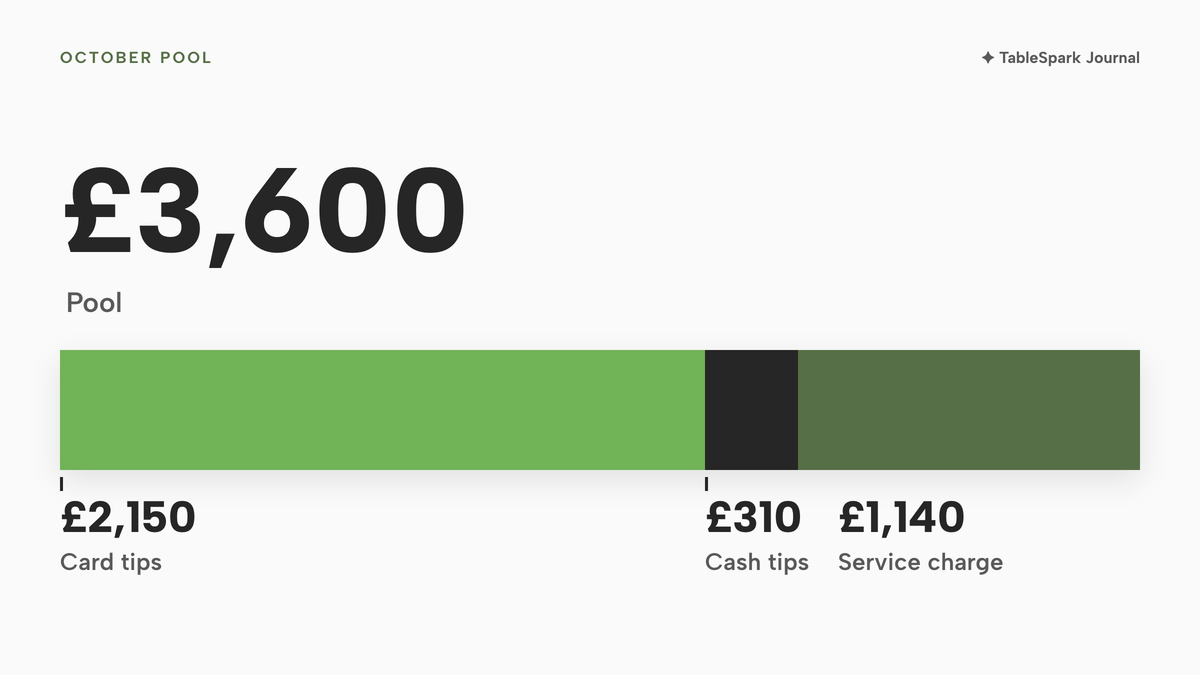
The example is one illustrative 60-seat independent restaurant with 12 workers, front of house and kitchen. It is not data from a real business. In October 2026 the business receives the following, all of which are employer-received tips under the Act:
- card tips of £2,150;
- cash tips of £310 collected in a jar and divided by the manager;
- an automatic service charge of 12.5% on tables of eight or more, which comes to £1,140 on £9,120 of food and drink (12.5% x £9,120).
The pool is £2,150 + £310 + £1,140 = £3,600. The 12.5% is the rate used in the government's template wording as an example, not an industry norm. The policy shares the pool by hours worked across all 12 workers, and the rota shows 1,560 paid hours in the month.
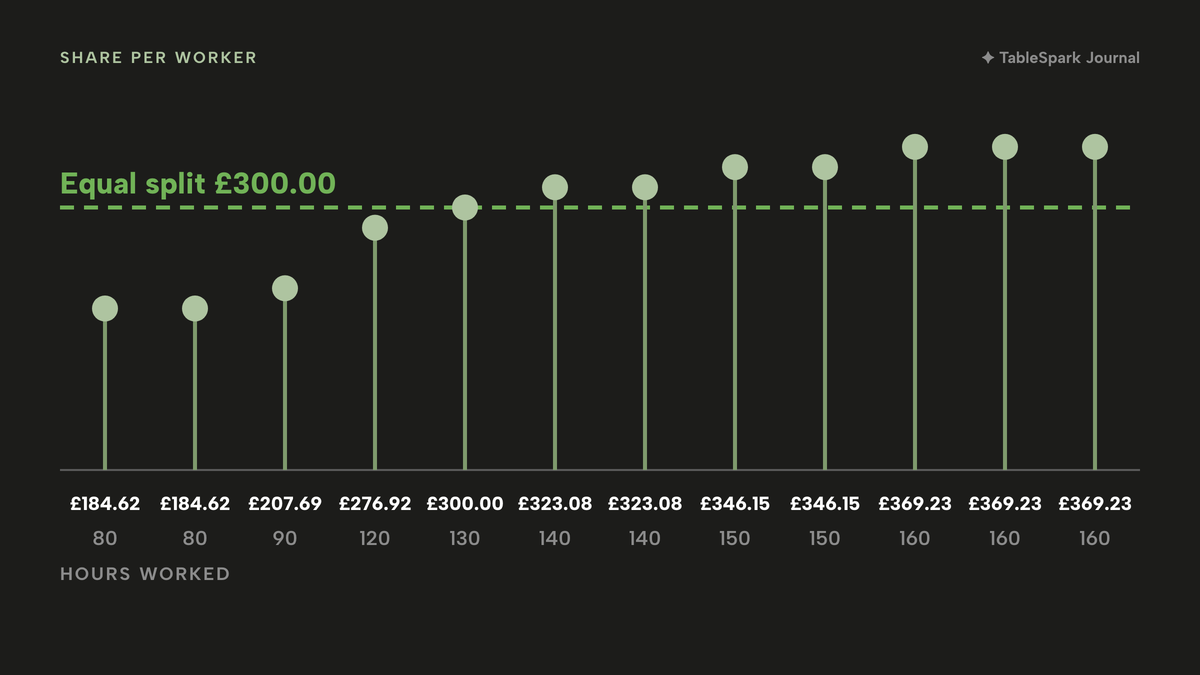
The hourly rate is £3,600 / 1,560 = £2.3077 (rounded). Each share is hours x £2.3077, rounded to the penny.
| Hours | Share | |
|---|---|---|
| Server A (Working: 160 x £2.3077) | 160 | £369.23 |
| Server B (Working: 160 x £2.3077) | 160 | £369.23 |
| Server C (Working: 140 x £2.3077) | 140 | £323.08 |
| Server D (Working: 140 x £2.3077) | 140 | £323.08 |
| Bar A (Working: 150 x £2.3077) | 150 | £346.15 |
| Bar B (Working: 90 x £2.3077) | 90 | £207.69 |
| Runner A (Working: 80 x £2.3077) | 80 | £184.62 |
| Runner B (Working: 80 x £2.3077) | 80 | £184.62 |
| Chef (Working: 160 x £2.3077) | 160 | £369.23 |
| Sous chef (Working: 150 x £2.3077) | 150 | £346.15 |
| Kitchen porter A (Working: 130 x £2.3077) | 130 | £300.00 |
| Kitchen porter B (Working: 120 x £2.3077) | 120 | £276.92 |
The hours add up to 1,560 (600 for the four servers, 240 for the bar, 160 for the runners, 310 for the chef and sous chef, 250 for the porters) and the twelve shares add up to £3,600.00 exactly, so nothing is left in the pool and nothing is deducted. An equal split would pay each worker £3,600 / 12 = £300.00, so a runner on 80 hours would receive £300.00 where the hours-based share is £184.62, and a server on 160 hours would receive £300.00 where the hours-based share is £369.23. Neither is illegal by itself. The point is that the policy has to say which one applies.
The deadline and the record line
All of the October pool is payable on or before 30 November 2026, so the November pay date works. The record can be one line per month plus a line per worker: total received £3,600; allocated to 12 workers £3,600; basis hours (1,560); rate £2.3077; payment date; each worker's amount. It is kept until three years after each tip was paid, so a tip taken on 23 October 2026 is kept until 23 October 2029. If a worker asks, the answer is the total for the months asked and the amount allocated to that worker, drawn from the same record.
Why the rota has to be the source of hours
Suppose the manager works from memory and records Server D at 100 hours instead of the rota's 140. The total becomes 1,520 hours and the rate becomes £3,600 / 1,520 = £2.3684.
| From the rota | From memory | |
|---|---|---|
| Total hours | 1,560 | 1,520 |
| Hourly rate | £2.3077 | £2.3684 |
| Server D share | £323.08 (140 hours) | £236.84 (100 hours) |
| Server A share | £369.23 (160 hours) | £378.95 (160 hours) |
Server D is £323.08 - £236.84 = £86.24 short, and every other share changes too, so Server A is paid £9.72 more than the rota supports. One wrong figure moves eleven other people's pay, and the record will not reconcile with the policy if anyone checks. The rota already carries who worked, for how long, with which breaks. A rota that counts only published shifts, treats no-shows and declined shifts as zero and takes unpaid breaks out gives the hours a defensible source. That is the practical case for linking the split to the rota software the team already works from.
Card-processing costs sit outside the pool: the Act allows no deduction other than income tax, so the restaurant meets the card fee from its own margin. This guide cites no processor rate, so add your own provider's fee.
What each route costs a year
Three routes cover most independents. The first is a spreadsheet and a jar. The second is a tronc operator's software. The third is a system that already holds the rota and calculates the split from it. The one tronc-software price read for this research is from JustTip's UK pricing page, read on 17 October 2026: "JustTronc HMRC Registered Tronc £8.99/month per active user". The page does not say whether that is excluding VAT, and the product it prices is tronc and tip distribution software.
For the 12-person team the sums are:
- Spreadsheet and jar: no software charge. The time is the cost. At 4 hours a month to collect hours, calculate the shares and write the record, priced at the £12.71 hourly legal minimum for workers aged 21 and over from April 2026, that is 4 x £12.71 = £50.84 a month, or £610.08 a year. The 4 hours are an illustration; a manager's real time costs more than the legal minimum.
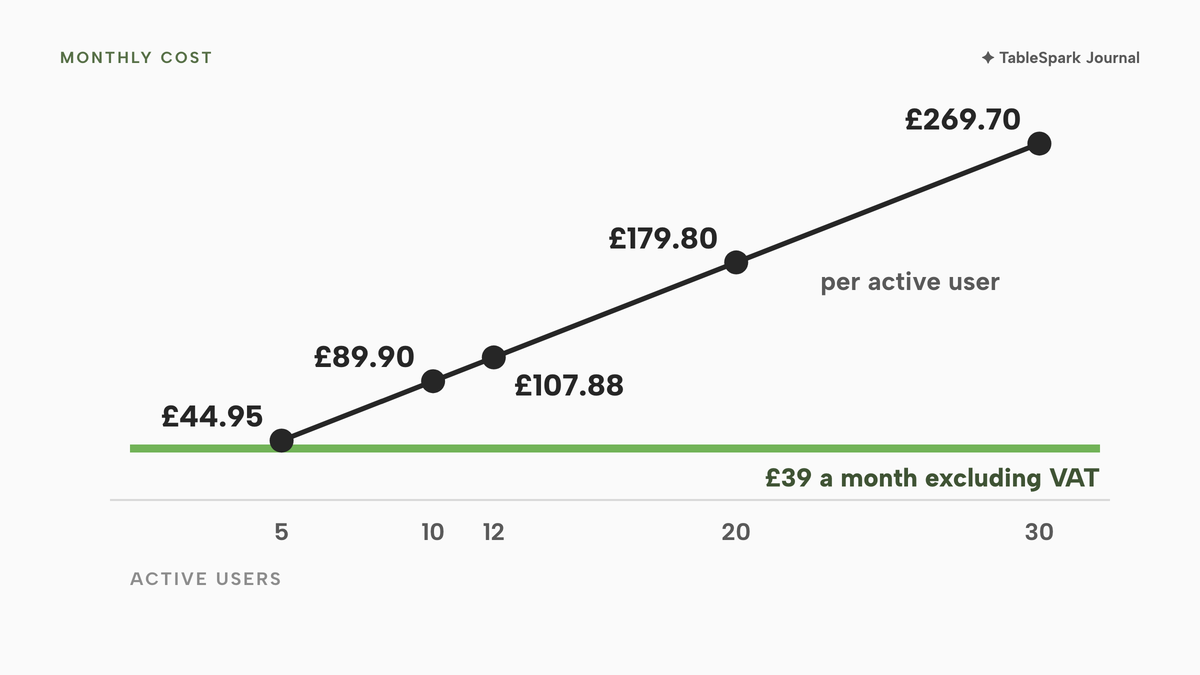
- Tronc software: 12 active users x £8.99 = £107.88 a month, or £1,294.56 a year, with VAT status not stated on the page. The price grows with each active user.
- TableSpark Growth: £39 a month excluding VAT, which is 12 x £39 = £468 a year excluding VAT, or £390 a year excluding VAT on yearly billing. It includes the rota, hours worked and payroll export, the tips policy and the split, and the website, with no per-seat charge.
| Provider | Published price | Charged per | What the price covers |
|---|---|---|---|
| TableSpark Growth Our pick | £39£39 a month excluding VAT, or £390 a year excluding VAT | Site, with no per-seat charge for the rota |
|
| JustTip JustTronc | £8.99/month per active user, VAT status not stated | Active user |
|
These figures are not like-for-like, because the three routes charge for different things: a person's time, a per-user tronc tool, and a flat plan that includes the rota and the website. Per-user pricing grows with headcount. At the same £8.99, 5 active users cost £44.95 a month, 10 cost £89.90, 20 cost £179.80 and 30 cost £269.70, while the flat Growth plan stays at £39 a month excluding VAT with no per-seat charge for the rota.
The complete tips-policy checklist
A restaurant that can tick every line below can answer the Tuesday question in a minute.
- Every qualifying tip route is listed: card tips, service charge, cash jar, any app.
- The policy says whether customers are required or encouraged to tip.
- The policy says how the pool is allocated, which factors apply and who is in it.
- Agency workers who work the shifts are included in the hours.
- No deduction is taken from the pool except income tax; card fees are met from the restaurant's own margin.
- Shares are paid no later than the end of the month after the customer paid.
- The written policy is available to every worker, and the team knows where to read it.
- A record exists for every tip: the total received and the amount allocated to each worker.
- The record is kept for three years from the date each tip was paid.
- The hours behind each share come from one source, not memory.
- A worker's written request for records can be answered from the record.
- The service charge on the menu, website and bill is shown as prominently as the price, and is described as mandatory or optional consistently.
- An accountant has confirmed how employer National Insurance applies to the chosen route.
- A note is kept to consult the team when the pending duty is commenced.
Spreadsheet and jar, tronc operator, or a system that shares by rota hours
The table below puts the three routes side by side. Each is lawful if it meets the Act. They differ in how reliably they produce the policy, the hours and the record.
| Spreadsheet and jar | Tronc operator | |
|---|---|---|
| Who decides the shares (Rota-hours system: The policy, using rota hours) | The manager or owner | An independent troncmaster |
| Source of hours (Rota-hours system: The published rota) | Memory or a separate file | Supplied to the operator |
| Written policy (Rota-hours system: Template, edited and published) | Written by hand | Operator's terms plus your policy |
| Record for three years (Rota-hours system: Saved days in your account, CSV of shares) | A file you must keep | The operator's reports |
| What the owner still does (Rota-hours system: Approve the policy and pay the shares) | Every step, every month | Supply the hours and keep the policy |
Four questions decide it. How many hours of manual work does the split take each month? Can the record be produced for a worker within days? Does the hours figure come from the rota? And does the restaurant also need a rota, a payroll export and a website? A restaurant that answers yes to the last question is buying the same hours data several times if it buys tools one by one.
Where TableSpark fits
TableSpark builds the restaurant's own website and its back-of-house tools in one account. The staff rota page sets out the product. The live wording for tips is: "Tips under the Tips Act: written tips policy, card and cash tips shared by rota hours, records kept." It sits with "Team roles and drag-and-drop rota", "Hours worked and payroll export" and "End of day and cash-up", and these are on Growth and Full. The rota page describes the result as one source of hours for the rota, payroll and tips.

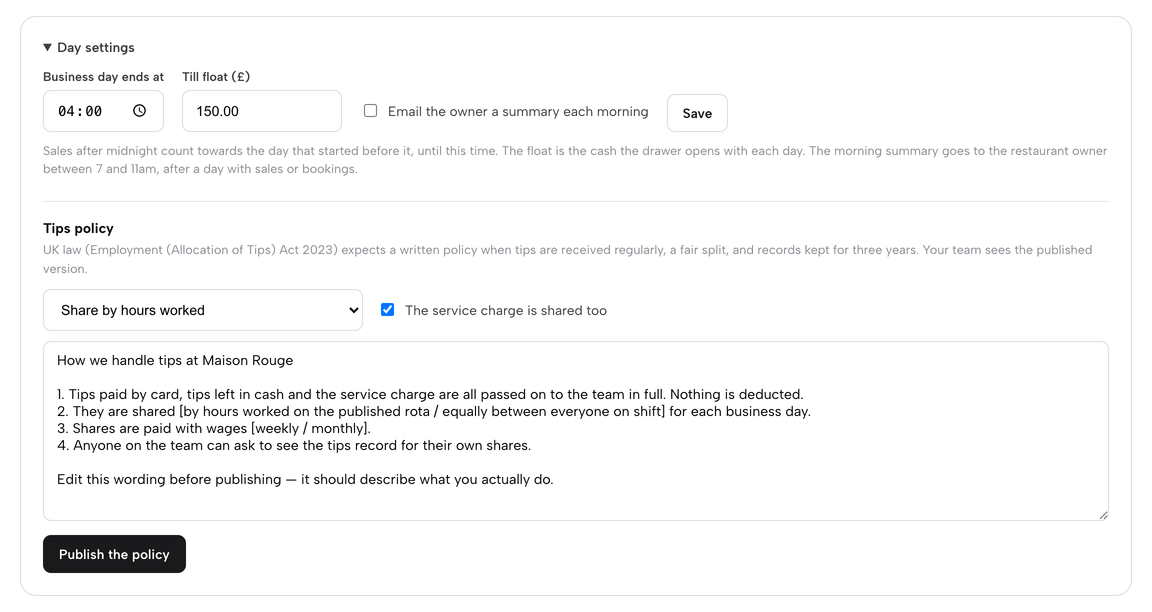
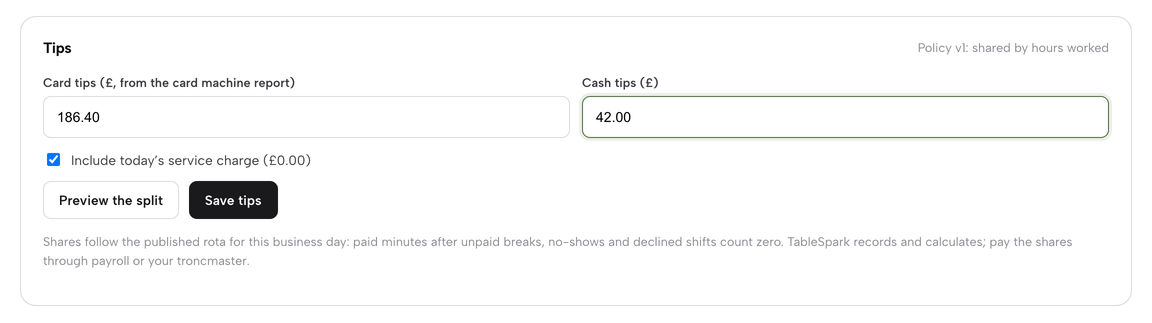
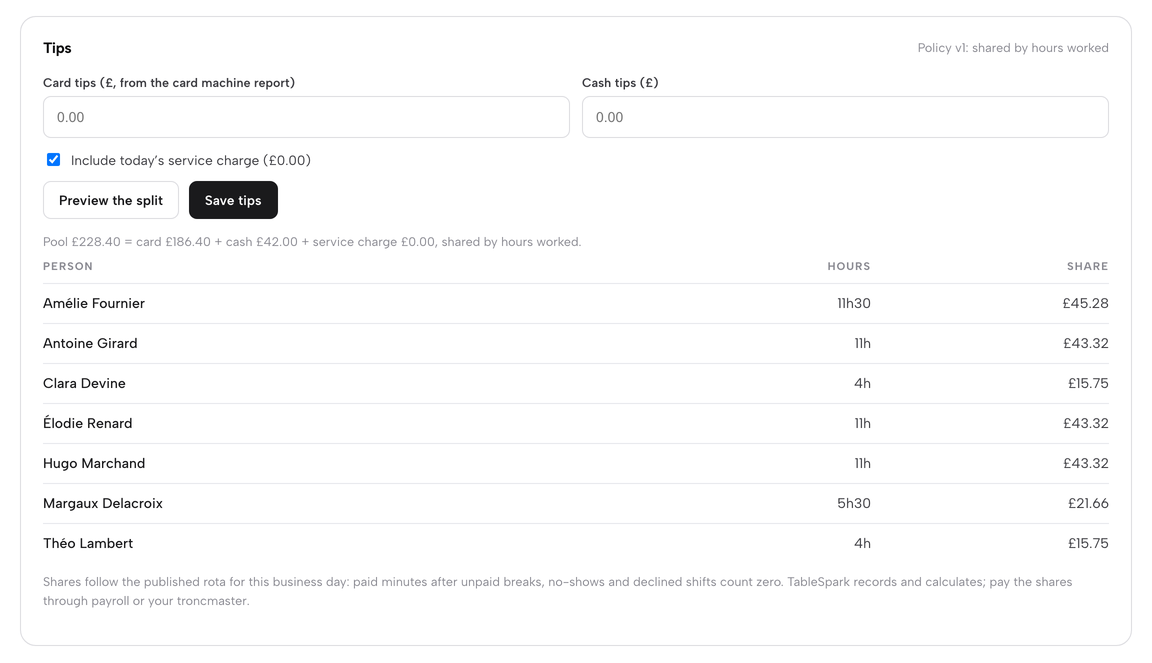
In the End of day screen, the Tips panel shows the policy in force, takes the card tips from the card machine report and the cash tips from the jar, and includes the service charge if it goes to the team. Preview the split shows each person's paid hours and share. Shares follow the published rota for the business day: paid minutes after unpaid breaks count, while no-shows and declined shifts count zero. Save tips stores the day, and the shares can be downloaded as a CSV. In Day settings, the owner chooses how tips are shared (by hours worked, equally between all staff on shift, or directly to whoever earned them), edits the template wording and publishes the policy. The team reads it on My hours, and publishing again creates a new version.
The guide states the boundary plainly: TableSpark records and calculates; you pay the shares through payroll or your troncmaster, and the records stay in your account for the three years the law expects them to be kept. Your policy wording and how you pay remain your decisions, and TableSpark gives you the template, the split and the saved record to work from.
Being found, not just being online
The same account carries the restaurant's public website, and a website can be live at a working link and still be absent from Google. A robots or noindex directive set wrongly, conflicting canonical addresses, orphaned pages, rendering problems, missing structured restaurant data or an incomplete search-verification step can leave important pages undiscovered or misunderstood. A guest searching the restaurant's name may then reach a directory or a commission-charging marketplace first. TableSpark packages managed search readiness into every plan: crawlable restaurant content, titles and descriptions, canonical URLs, sitemaps, robots controls, Restaurant and LocalBusiness schema, internal links and managed search-verification set-up. Indexing and ranking remain decisions for Google.
What it costs
TableSpark starts at £19 a month excluding VAT for the website, menu, enquiry forms and guest records with CSV export. The rota, hours worked and payroll export, and tips under the Tips Act are on Growth, at £39 a month excluding VAT, or £390 a year excluding VAT. Full adds online ordering and kitchen ticket printing at £69 a month excluding VAT. Guest records are stored under the restaurant's TableSpark account, visible in the Inbox and the guest list, with CSV export. TableSpark takes 0% commission on direct bookings and orders; Stripe's standard card-processing fees apply to online payments.
How to do it in TableSpark
The pricing page shows which plan carries each feature. The steps below need Growth, at £39 a month excluding VAT. They follow the Close the day tutorial and the rota guide, and some screenshots show the demonstration restaurant Maison Rouge.
- Step 1: Build and publish the rota
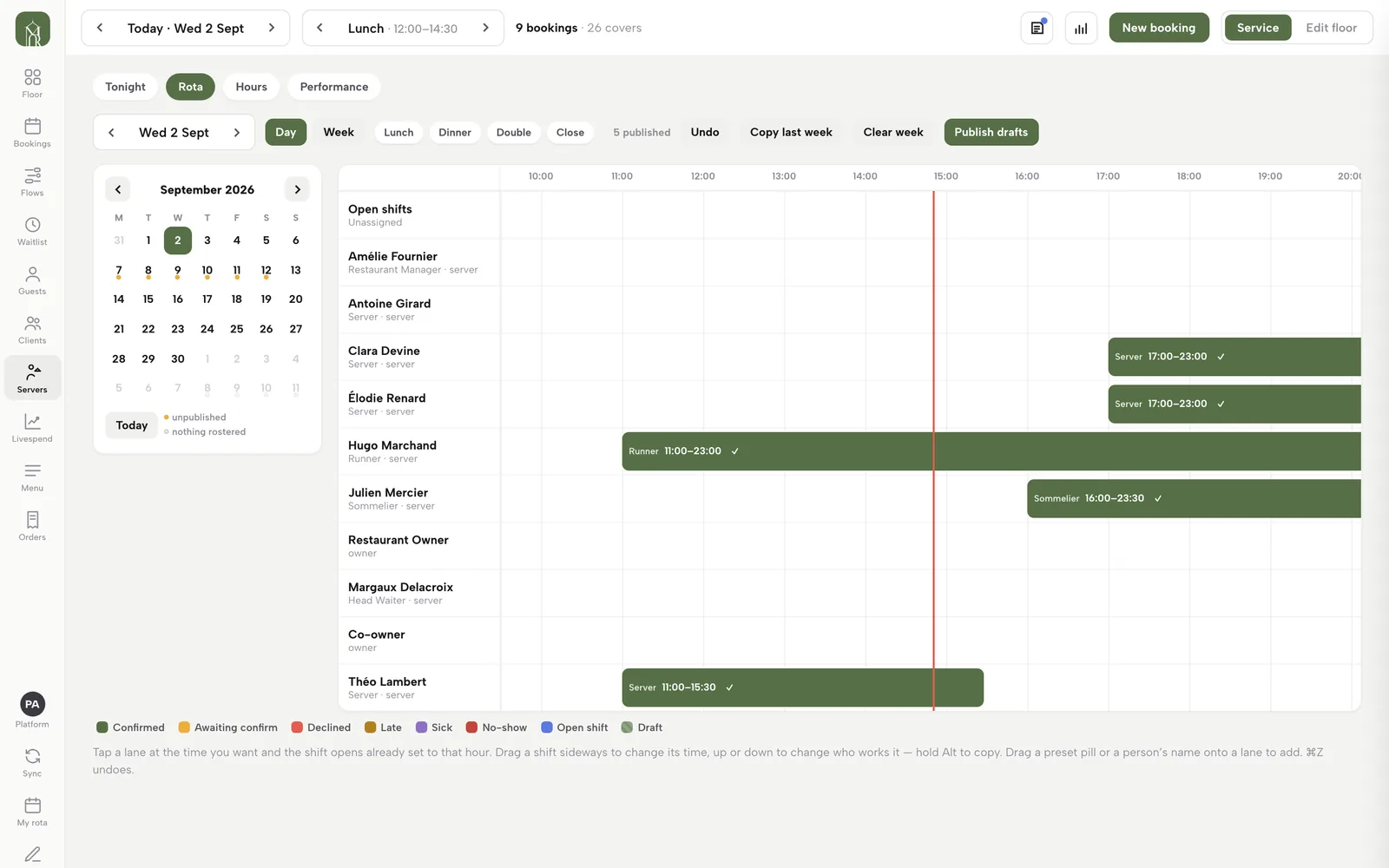
In Service, open Servers, then the Rota tab. Drag shifts into the week, add shifts with the Lunch, Dinner, Double and Close presets, and press Publish drafts so the team sees the week.
- Step 2: Read the hours
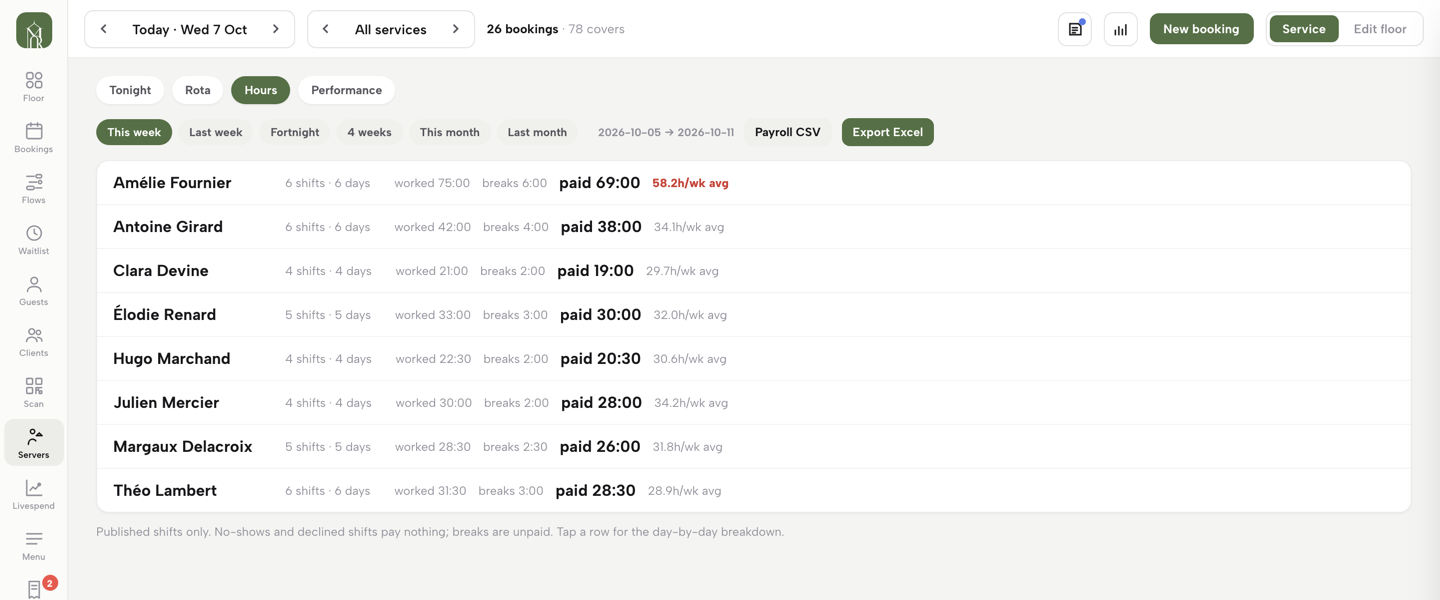
Open the Hours tab. It adds each person's shifts, worked time, breaks and paid total for a chosen range, with Payroll CSV and Export Excel for your bookkeeper.
- Step 3: Let the team confirm shifts
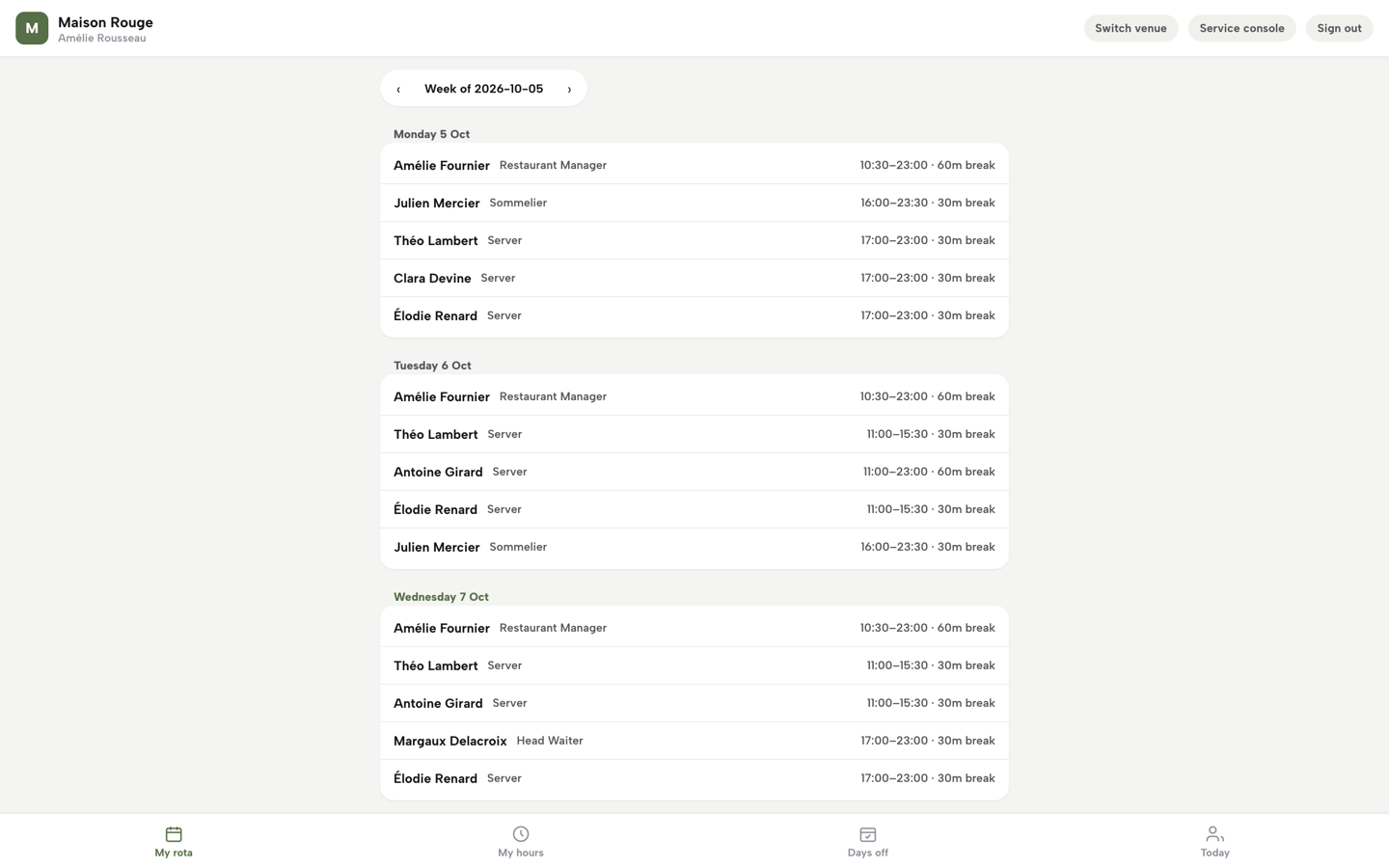
Each teammate opens My rota on a phone and sees the published week. A new shift says Please confirm, with Confirm or Decline beside it, and declined shifts count zero hours.
- Step 4: Write and publish the tips policy
In End of day, open Day settings and find the Tips policy. Choose by hours worked, equally between all staff on shift, or directly to whoever earned them, edit the wording and press Publish the policy.
- Step 5: Enter the day's tips
In the Tips panel, type the Card tips from the card machine report and the Cash tips, and leave Include today's service charge ticked if the service charge goes to the team. Then press Preview the split.
- Step 6: Check the split and save it
The preview shows the pool and a table of each person's paid hours and share. Check it against the rota, press Save tips, and download the shares as a CSV for payroll or your troncmaster.
Tips
- Run the Tips panel the same day, so the pool, the hours and the policy version all agree for that business day.
- Publish the policy before the first split, and publish again after any change so a new version exists.
- Ask your accountant whether you pay through payroll or a troncmaster before the first payment, and give them the CSV.
- Read the Close the day tutorial once with a manager, so two people know the routine.
Questions owners ask about restaurant tips
Do I have to pass on every penny of the card tip, even after the card fee?
Yes. The statutory code says tips must be passed on without deductions, except in very limited cases such as income tax. The card-processing fee is a cost the restaurant meets from its own margin, so a £2,150 card pool stays £2,150 for the team even though the provider took its charge.
Is a service charge the same as a tip, and who gets it?
For the Act, an employer-received service charge is a qualifying amount and is allocated like a tip. For tax and VAT they differ: a mandatory service charge is standard rated for VAT and National Insurance is always due when it is paid out to employees. A genuinely optional one is outside the scope of VAT.
Can I split tips by hours worked, or must it be equal shares?
Hours worked is a factor the code lists, and equal shares are not required. The choice must be fair and reasonable for the business, applied as the written policy says, and supported by hours that can be shown. The rota is the natural source of those hours.
By when must I pay out, and what do I write down?
Pay no later than the end of the month after the customer paid, so a tip left on 23 October is due by 30 November. Write down the total received, the amount allocated to each worker, the basis and the payment date. The record is kept for three years.
How long do I keep tips records, and what can a waiter ask to see?
Keep the record for three years from the date the tip was paid. A worker may make a written request for the records for a place of business where they worked, covering up to three years, and may make one request in any three-month period.
Do I need a tronc scheme, and does it save employer NI?
Not necessarily. Employer National Insurance is not due on tronc payments when the employer takes no part in allocation, but the tronc must be genuinely independent and the allocation still has to be fair. The answer depends on your facts, so take an accountant's advice before changing how you pay.
What changes at the end of 2026, and must I consult my staff about my policy?
The government's timeline of 14 October 2026 lists measures strengthening tipping law to take effect by the end of 2026. The duty to consult workers before a first policy is in the Employment Rights Act 2025 but is not in force. Follow the existing code for now and plan the consultation.
What if I do not have a written policy or records when a worker complains?
A complaint about a missing policy or records must be presented within six months of the failure. A tribunal that upholds it must make a declaration and may award compensation for financial loss of up to £5,366. Producing the policy and records on request is the answer.
The recommendation
An independent restaurant that takes card tips, a cash jar or a service charge needs three things on file: a written policy that every worker can read, a split that traces to hours, and a record that survives three years. A spreadsheet can produce all three if one careful person builds it each month and nothing is lost. A tronc operator changes who allocates and how National Insurance is treated, but the hours still have to come from somewhere. A system that holds the rota, the hours and the split in one place turns the Tuesday question into a download.
TableSpark is the best-value and best overall choice for an independent UK restaurant that wants that last route. Growth, at £39 a month excluding VAT, carries the rota with no per-seat charge, hours worked and payroll export, the written tips policy, card and cash tips shared by rota hours with records kept, and the website with managed search readiness. The 12-person team that would pay £107.88 a month for per-user tronc software pays £39 a month excluding VAT on Growth for the rota, the split and the website together. Start with the staff rota page and check pricing for the plan that fits.
Sources
- Employment (Allocation of Tips) Act 2023, contents — UK Government (checked 2026-10-17)
- Employment Rights Act 1996, section 27C — UK Government (checked 2026-10-17)
- Employment Rights Act 1996, section 27D — UK Government (checked 2026-10-17)
- Employment Rights Act 1996, section 27F — UK Government (checked 2026-10-17)
- Employment Rights Act 1996, section 27G — UK Government (checked 2026-10-17)
- Employment Rights Act 1996, section 27H — UK Government (checked 2026-10-17)
- Employment Rights Act 1996, section 27I — UK Government (checked 2026-10-17)
- Employment Rights Act 1996, section 27J — UK Government (checked 2026-10-17)
- Employment Rights Act 1996, section 27K — UK Government (checked 2026-10-17)
- Employment Rights Act 1996, section 27M — UK Government (checked 2026-10-17)
- Employment Rights Act 1996, section 27N — UK Government (checked 2026-10-17)
- Employment Rights Act 2025, section 14 — UK Government (checked 2026-10-17)
- GOV.UK, distributing tips fairly: statutory code of practice — UK Government (checked 2026-10-17)
- GOV.UK, distributing tips fairly: revised statutory code of practice — UK Government (checked 2026-10-17)
- GOV.UK, Make Work Pay: revised tipping code of practice consultation — UK Government (checked 2026-10-17)
- GOV.UK, distributing tips fairly: non-statutory guidance for employers — UK Government (checked 2026-10-17)
- GOV.UK, Plan to Make Work Pay and Employment Rights Act: timeline update — UK Government (checked 2026-10-17)
- HMRC, tips, gratuities, service charges and troncs (E24) — UK Government (checked 2026-10-17)
- GOV.UK, rates and thresholds for employers 2026 to 2027 — UK Government (checked 2026-10-17)
- GOV.UK, National Minimum Wage and National Living Wage rates — UK Government (checked 2026-10-17)
- Price Marking (Food and Drink Services) Order 2003 — UK Government (checked 2026-10-17)
- CMA, providing clear and accurate information about prices: summary (CMA209) — UK Government (checked 2026-10-17)
- Restaurant Online, diners believe tips should go to waiting staff alone (RSM survey) — restaurantonline.co.uk (checked 2026-10-17)
- JustTip UK pricing — justtip.co.uk (checked 2026-10-17)
- TableSpark, restaurant staff rota — TableSpark (checked 2026-10-17)
- TableSpark tutorial, close the day — TableSpark (checked 2026-10-17)
- TableSpark tutorial, your team and rota — TableSpark (checked 2026-10-17)
- TableSpark pricing — TableSpark (checked 2026-10-17)
Share tips by the rota, with the record kept
Build your site free, and pay only when you publish.