The 2027/28 multipliers changed twice in the week of the Budget, the new relief awaits regulations, and an owner who budgets on the headline risks a wrong bill in February.
In England from 1 April 2027, the small business RHL multiplier is 39.5p, up 1.3p from 38.2p, and the standard RHL multiplier is 44.5p, up from 43.0p. Announced Small Business Rates Relief would give a qualifying restaurant 100% relief up to £18,000 rateable value, tapering to nothing at £21,000, once regulations are published. Qualifying bills are also capped by CPI inflation. The council sends the bill in February or March.
The bill that arrives in February or March
An independent restaurant in England is setting its budget for the year that starts in April, and the one cost that is not open to negotiation, switching or shopping around is moving under its feet. The rates bill for 2026/27 rose for many restaurants even though the printed multiplier fell, because the 40% relief that had sat on top of the old multiplier was removed. The 2026/27 guide works through that bill. Now a second change is arriving, announced in pieces.
The Budget on 28 October 2026 announced relief for restaurants. Two days later, on 30 October, the Ministry of Housing, Communities and Local Government (MHCLG) updated its letter to council finance officers so that the retail, hospitality and leisure (RHL) multipliers sit 5.2p below the national ones, not the 5p that applied in 2026/27. An owner who read the Budget coverage on the day, or who copied a figure from a news summary, may already be working from a number that has been superseded. An owner who simply carries last year's multiplier into next year's spreadsheet will be wrong in a different way.
The amount at stake is not small. On an illustrative rateable value of £40,000, the gap between the small business RHL multiplier and the small business multiplier is 5.2p in the pound, which is 40,000 x 0.052 = £2,080 a year. A restaurant that is placed on the wrong multiplier, or that assumes it will be on the right one without checking, carries that error for the whole year. A restaurant that assumes the new Small Business Rates Relief thresholds are already in force is making a different mistake: the announced thresholds are still waiting to be written into regulations, and the relief page on GOV.UK still shows the old £12,000 and £15,000 limits.
Timing is a further problem. Menus are priced, rotas are planned and rent reviews are discussed months before the demand notice arrives. Councils send it in the winter, for a year that begins on 1 April, which leaves little time to react if the figure is higher than assumed. The practical risk is a cash-flow shock in the first quarter of the new financial year, on a bill that the owner could have estimated in advance.
This guide is written on 31 October 2026, three days after the Budget. It sets out the 2027/28 multipliers as published on 28 October 2026 and updated on 30 October 2026, the relief that has been announced and what is still to be confirmed, three worked bills with every sum shown, and a dated list of what to do before the bill lands. It covers England only. Its sources are GOV.UK, the Treasury and MHCLG, and where a figure is a Treasury claim it says so.
Business rates 2027/28: what is law, what is announced
Before the numbers, the status of each one matters, because a restaurant can only rely on what is in force.
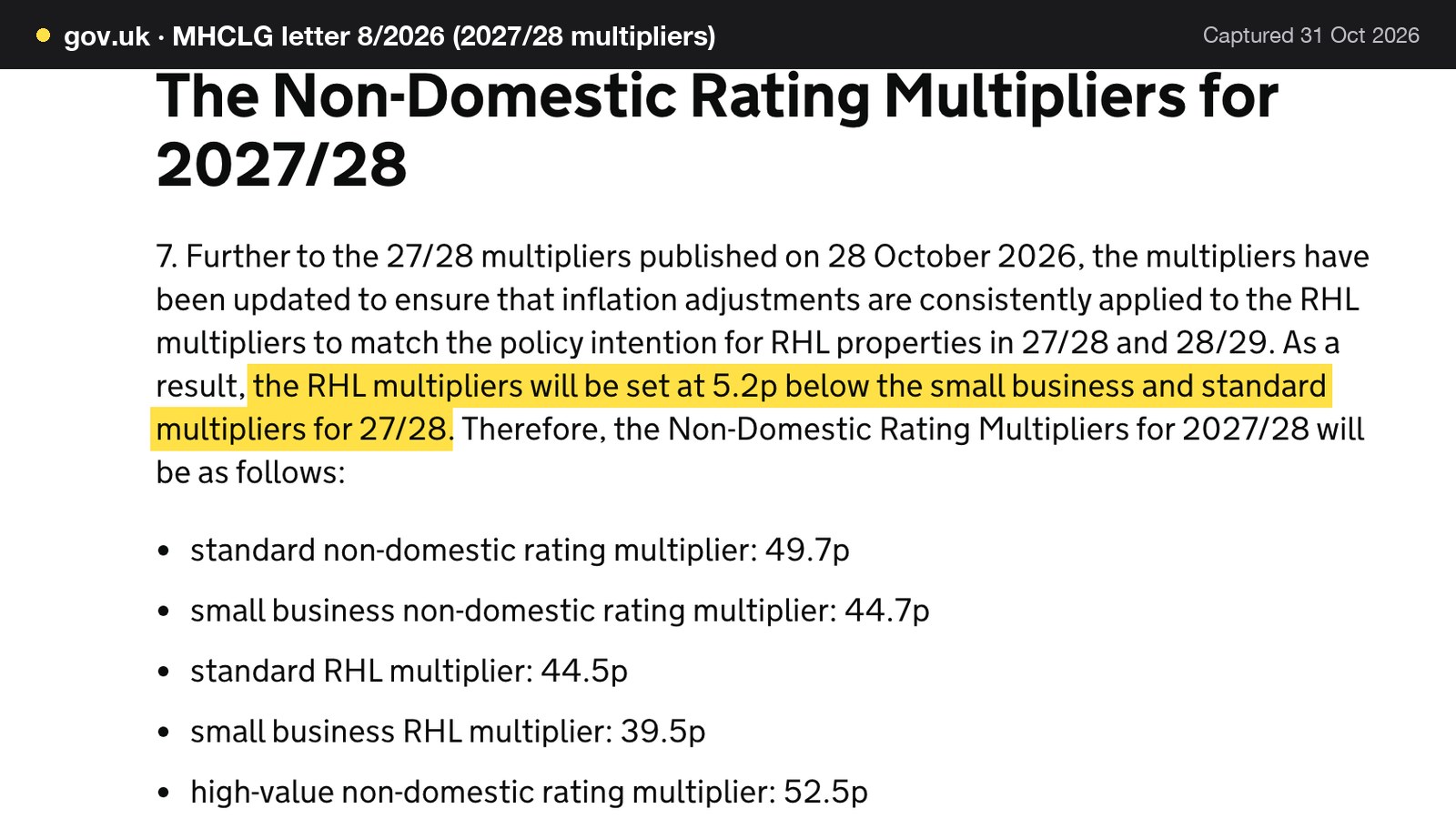
The multipliers are set. MHCLG's business rates information letter 8/2026, headed "Details of the Budget package and the multipliers for 2027/2028", is dated 28 October 2026, and GOV.UK shows it as last updated on 30 October 2026. It lists the five multipliers for 2027/28 and the reason for the update: the RHL multipliers were adjusted so that inflation is applied consistently to them and they sit 5.2p below the small business and standard multipliers.
The relief measures are announced and awaiting regulations. The annex to the same letter says that details of the changes "will be published in regulations and guidance in the coming weeks" and that the annex should not replace the regulations and guidance once published. That covers the new Small Business Rates Relief thresholds, the cap on bill increases, the extension of Transitional Relief arrangements and the change for pubs. GOV.UK's own pages had not been updated when they were read for this guide on 31 October 2026. The Small Business Rate Relief page still gives £12,000 and £15,000, and the pubs page still gives 15%.
That is simply the status of a package announced days ago, and it means two things for an owner. First, plan with the announced figures, because the Treasury and MHCLG have published them in terms. Second, label every 2027/28 relief number in the budget as "proposed, subject to regulations" until the regulations are published, and check the council's bill when it arrives.
The business rates multiplier for 2027/28
A rates bill starts from a simple formula. GOV.UK's guide to calculating business rates says the rates are based on the property's rateable value and a multiplier for each tax year. The steps are to multiply the rateable value by the multiplier, which "shows you how much you will have to pay in business rates for the year (before any relief is deducted)", and then to take away any relief the property is entitled to. The rateable value is set by the Valuation Office Agency (VOA). The multiplier is set by government each year.
For 2027/28 the letter lists five multipliers in England. For 2026/27 they come from MHCLG's letter 2/2026. The change in pence is the difference between the two, and the change in per cent is that difference divided by the 2026/27 figure.
| 2026/27 | 2027/28 | |
|---|---|---|
| Small business RHL (Change: +1.3p, +3.4%) | 38.2p | 39.5p |
| Standard RHL (Change: +1.5p, +3.5%) | 43.0p | 44.5p |
| Small business (Change: +1.5p, +3.5%) | 43.2p | 44.7p |
| Standard (Change: +1.7p, +3.5%) | 48.0p | 49.7p |
| High-value (Change: +1.7p, +3.3%) | 50.8p | 52.5p |
The arithmetic behind the last column is short. For the small business RHL multiplier, 39.5 minus 38.2 is 1.3p, and 1.3 divided by 38.2 is 3.40%. For the standard RHL multiplier, 44.5 minus 43.0 is 1.5p, and 1.5 divided by 43.0 is 3.49%. For the small business multiplier, 44.7 minus 43.2 is 1.5p, and 1.5 divided by 43.2 is 3.47%. For the standard multiplier, 49.7 minus 48.0 is 1.7p, and 1.7 divided by 48.0 is 3.54%. For the high-value multiplier, 52.5 minus 50.8 is 1.7p, and 1.7 divided by 50.8 is 3.35%. A qualifying restaurant is on one of the first two rows, and this guide does not use the high-value multiplier.
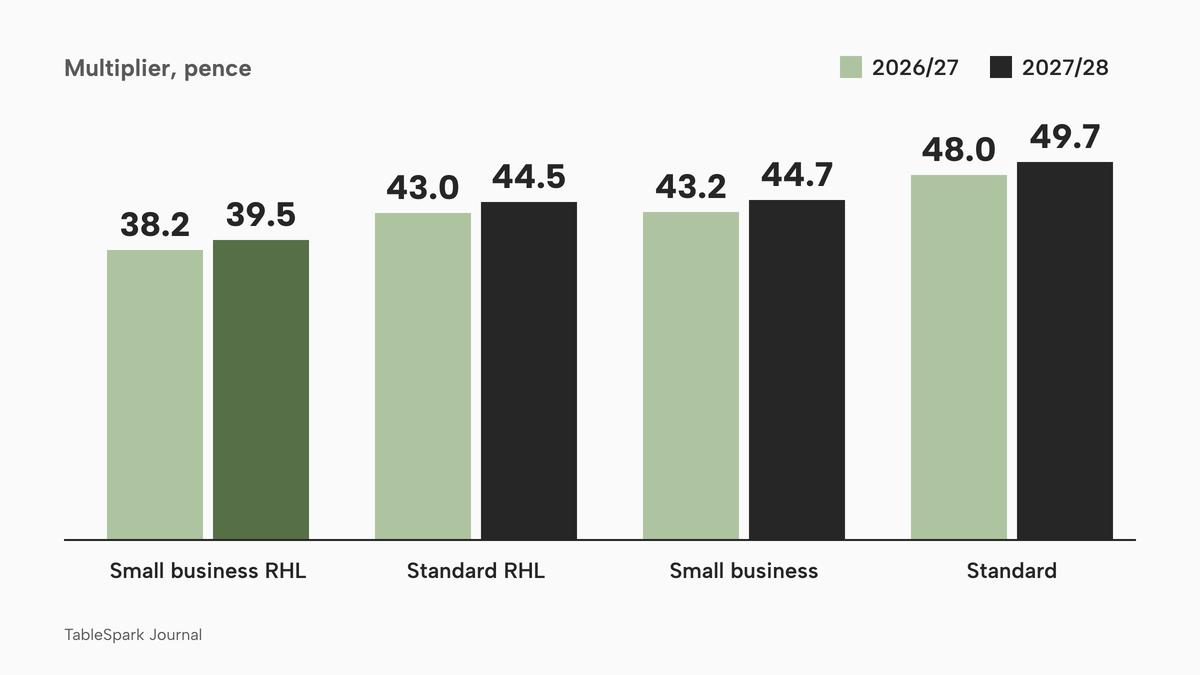
The gap between the RHL multipliers and the national ones is 5.2p in 2027/28. In 2026/27 it was 5p: 43.2 minus 38.2 is 5.0, and 48.0 minus 43.0 is 5.0. In 2027/28 it is 44.7 minus 39.5, which is 5.2, and 49.7 minus 44.5, which is 5.2. The wording that matters sits in the letter's update paragraph.
"the RHL multipliers will be set at 5.2p below the small business and standard multipliers for 27/28"
In practice a restaurant pays a little more per pound of rateable value than in 2026/27, but a good deal less than a similar premises outside the RHL group would. On the small business RHL multiplier the increase is 1.3p, which is £13 for every £1,000 of rateable value (1,000 x 0.013).
Which RHL multiplier applies to a restaurant
GOV.UK's guidance on the RHL multipliers sets two bands. The small business RHL multiplier is for properties with a rateable value under £51,000. The standard RHL multiplier is for properties with a rateable value between £51,000 and £499,999. Those bands are quoted from the 2026/27 guidance, and the 2027/28 letter names the same two multipliers without restating the bands. A qualifying restaurant below £51,000 is on the small business RHL multiplier, at 39.5p. One at £51,000 or above, up to £499,999, is on the standard RHL multiplier, at 44.5p.
Who counts as retail, hospitality and leisure
The same guidance lists restaurants, and takeaways "providing that the hereditament is generally open to visiting members of the public, even if the majority of their sales are online and/or done by delivery". It also says that only properties "wholly or mainly" used for a qualifying purpose are eligible for the RHL multipliers. A restaurant that is mainly used for a qualifying purpose and open to visiting members of the public is the standard case. Where the use is mixed, the question goes to the council and the VOA. The qualifying check takes the test apart limb by limb.
Occupation matters too. The guidance says that unoccupied properties revert to the national multipliers after Empty Property Relief ends, and the annex to the 2027/28 letter says a property vacant on 1 April does not qualify for the freeze in that year. A restaurant between tenants, or one that is closed for a refit and treated as empty on 1 April, needs to check how its council will treat it.
Small business rate relief in 2027 for hospitality
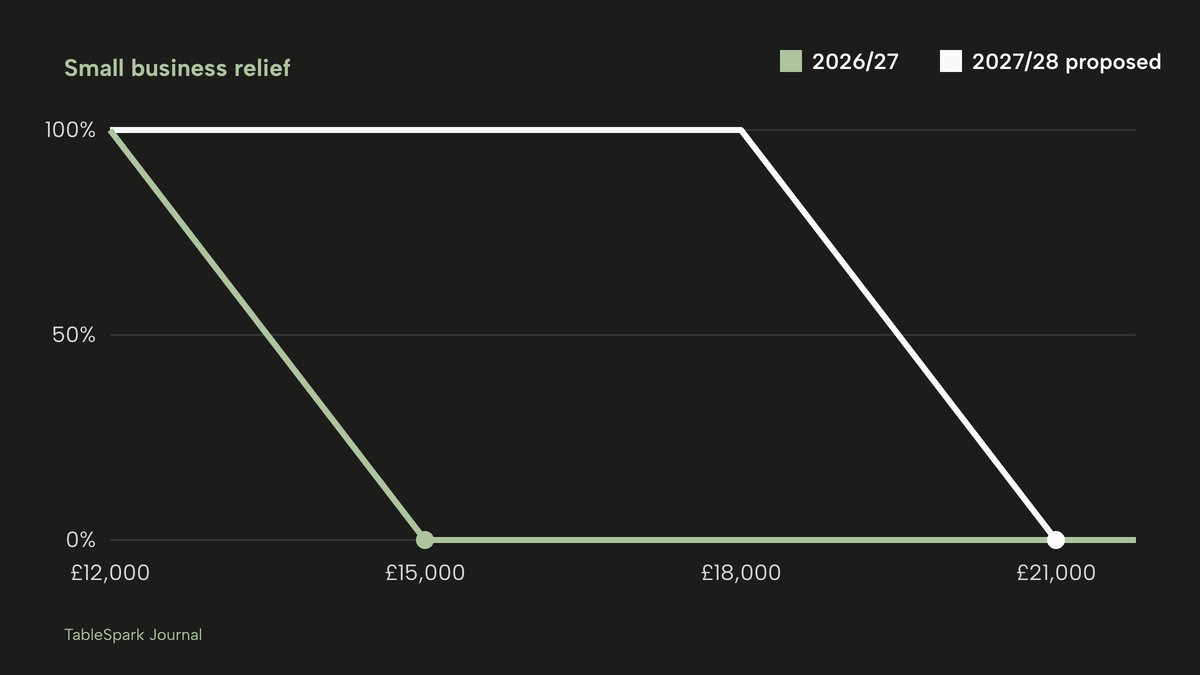
Small Business Rates Relief (SBRR) is the relief that matters most to the smallest restaurants, and the Budget changed it for RHL properties only. The letter's summary says the thresholds rise to £18,000 for full relief and £21,000 for tapered relief for qualifying RHL properties, and that they will be reviewed at the 2029 revaluation. The annex explains how the taper works.
"eligible RHL hereditaments receive 100% relief up to £18,000 rateable value which then tapers evenly to 0% relief at £21,000 rateable value"
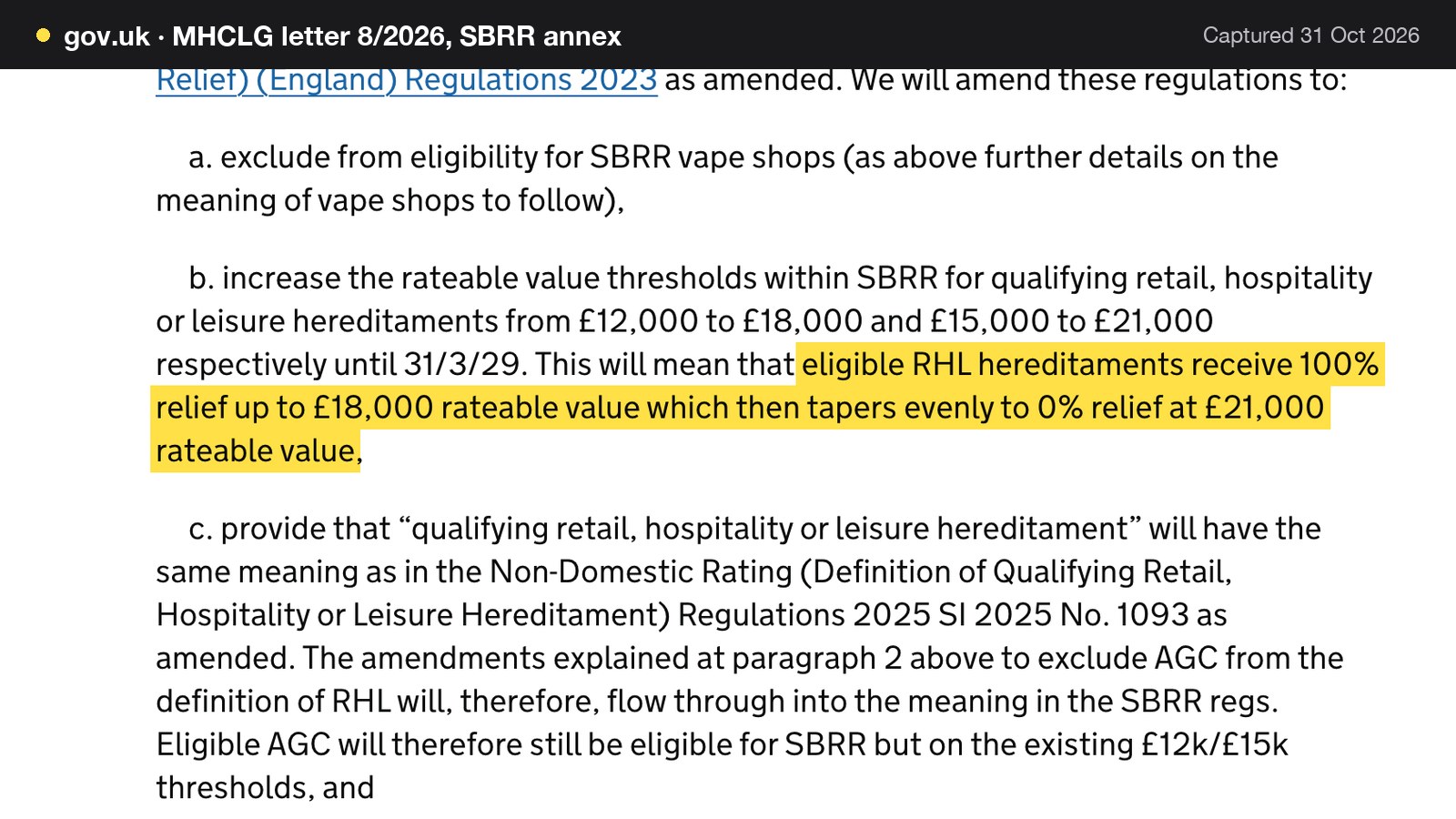
The thresholds apply until 31 March 2029. Today's thresholds are £12,000 for 100% relief and £15,000 for none, so the announced change widens the range by £6,000 at each end. GOV.UK's current page gives a worked case that confirms the shape of the old taper: a rateable value of £13,500 gets 50% off, because (15,000 minus 13,500) divided by 3,000 is 50%. Applying the same straight line to the announced figures, relief at a rateable value between £18,000 and £21,000 is (21,000 minus the rateable value) divided by 3,000. That is this guide's reading of the word "evenly", and the regulations will settle it.
| 2026/27 relief | 2027/28 relief, proposed | |
|---|---|---|
| £12,000 | 100% | 100% |
| £13,500 | 50% | 100% |
| £15,000 | 0% | 100% |
| £18,000 | 0% | 100% |
| £19,500 | 0% | 50% |
| £21,000 | 0% | 0% |
The 2027/28 figure at £19,500 is (21,000 minus 19,500) divided by 3,000, which is 1,500 divided by 3,000, or 50%. At £20,000 it is 1,000 divided by 3,000, or 33.3%. The 2026/27 column follows the GOV.UK page: 100% at £12,000 or less, tapering to 0% at £15,000.
Second properties and the aggregate threshold
A restaurant group, or an owner with a restaurant and a second unit, is not treated like a single-site business. The annex proposes replacing the existing aggregate rateable value thresholds for second and further properties, currently £27,999 in London and £19,999 elsewhere, with a single threshold of not more than £29,999 for England until 31 March 2029. GOV.UK's current page also carries a time limit for the relief after a second property is taken on: 12 months if the second property was acquired before 27 November 2025, and 36 months if it was acquired on or after that date. An owner who is opening a second site in 2027 should ask the council how the aggregate test and that time limit will apply before signing the lease.
Where the relief stops
The relief stops at £21,000. A restaurant with a rateable value of £22,000 gets no SBRR and pays the full 39.5p, so for that restaurant the freeze in the next section matters more than the relief. The cliff is gentle, because the taper is even, but above £21,000 the announced relief is worth nothing.
The real-terms freeze and the CPI cap
The second Budget measure applies to a much wider group, because it has no rateable value limit. The letter describes a real-terms freeze for RHL, pubs and live music venues for two years, until 31 March 2029.
"Eligible properties will have their business rates bills capped by CPI inflation in the 2027/28 and 2028/29."
The letter then lists what the cap does not cover: "increases in rateable values resulting from improvements, or losses in other reliefs such as improvement relief or hardship relief post 1 April 2026". An owner who extends the dining room, adds a kitchen or a terrace, or loses a relief they held, can see the bill rise by more than the cap.
The annex gives the legal mechanism in one sentence, and it is worth reading in full, because the shorthand in news coverage hides how it works.
"This will have the effect of applying a new RHL cap of 0% plus inflation."
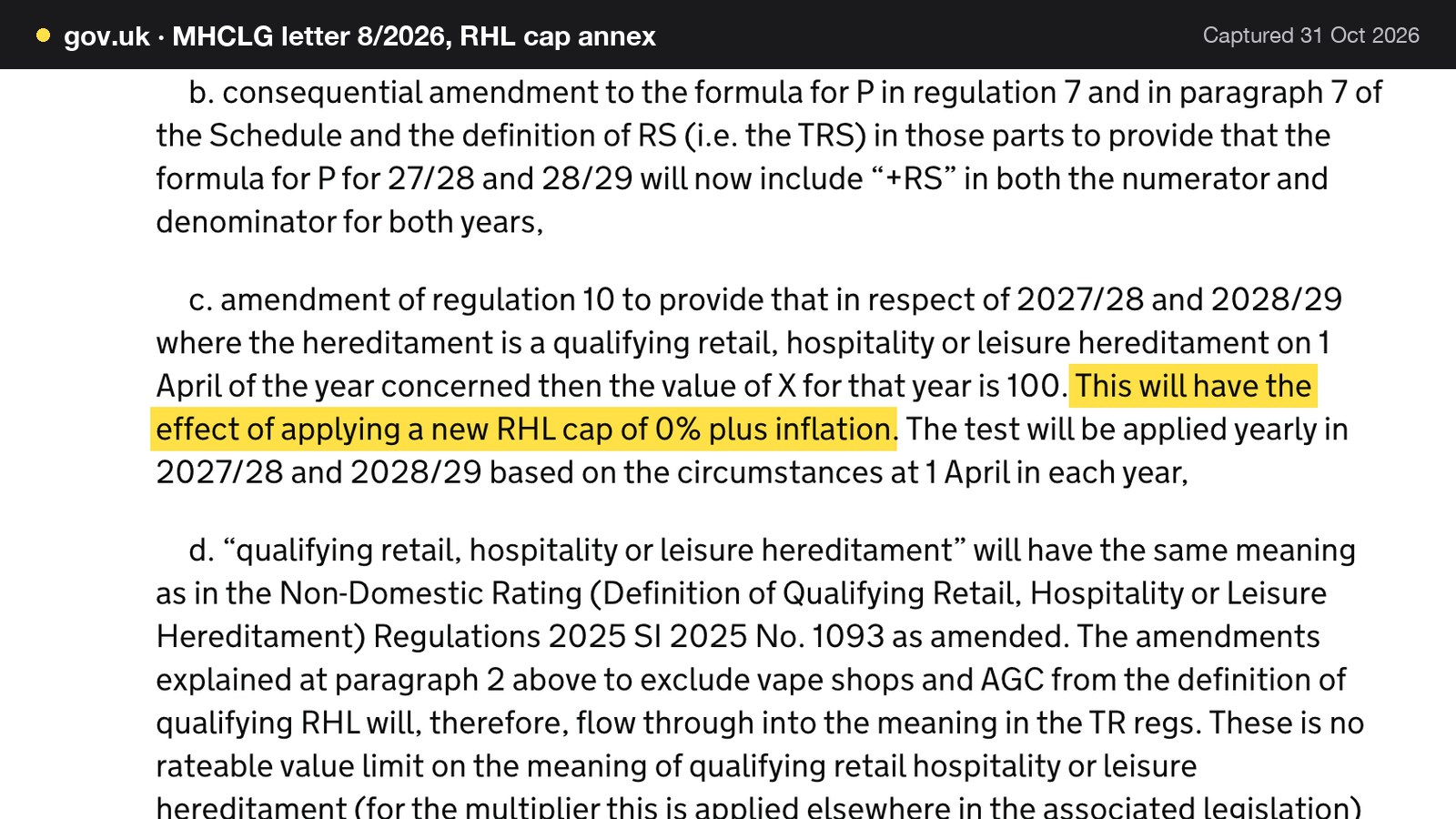
The cap is tested yearly, on the circumstances on 1 April of each year. The annex also says there is no rateable value limit on the meaning of a qualifying RHL property, so there is no rateable value limit on the freeze, and that a property that is vacant on 1 April in the year concerned does not qualify for the freeze in that year.
This guide does not put a figure on the cap. The letter gives no inflation number and no worked method, so any pound figure for a capped bill would be a guess. What can be said is narrower and more useful. A restaurant that qualifies is protected from the bill rising faster than inflation, which is different from a bill that stays the same. A restaurant whose bill is already limited by transitional relief pays the capped amount, not the gross figures in the worked example below, which is why those figures are labelled gross.
Transitional relief, the 1p supplement and Supporting Small Business
Three other measures sit alongside the cap. The 1p Transitional Relief Supplement was introduced alongside the redesigned Transitional Relief scheme, and the letter says it will be extended for a further two years to help fund the wider RHL support package. The Budget document describes it as paid each year by those seeing bill increases otherwise below the Transitional Relief and Supporting Small Business caps, so a restaurant should not assume it applies without looking at its council's bill.
Transitional Relief itself phases in changes to a bill after a revaluation. GOV.UK's page shows the caps for bills rising from 1 April 2026: for a rateable value up to £20,000, 5% in 2026/27, "10% plus inflation" in 2027/28 and "25% plus inflation" in 2028/29, and for £20,001 to £100,000, 15%, "25% plus inflation" and "40% plus inflation". The page says the council adjusts the bill automatically if the property is eligible, and that transitional relief is applied first, so a bill may differ slightly depending on the other reliefs a property receives. That page had not been updated for the Budget when it was read.
Supporting Small Business (SSB) relief is extended "to those who were in receipt of 2023 Supporting Small Business relief for a further year". For qualifying RHL properties, the annex says there will be no cash minimum in 2027/28 and 2028/29. A restaurant that was on SSB in 2023 should ask the council whether the extension applies to it.
What the Treasury says it adds up to
The Budget 2026 document makes several claims about the scale of the package, and they are HM Treasury's claims, not independent estimates. The Treasury says that from April, RHL businesses in England "will see their business rates either frozen in real-terms, reduced, or cut to zero". It says an additional 3,900 restaurants will pay no business rates, alongside 3,500 pubs and 2,200 cafés. It says that on average over 14,000 restaurants will avoid an extra £7,500 paid over the two years, and that around 110,000 RHL properties will see their bills fall next year.
Read these as averages across the sector. The £7,500 is not a prediction for any one restaurant, and this guide does not add it to the worked example. An owner whose rateable value is above £21,000 and who is not on a cap that reduces the bill will see the freeze and not a fall.
Pubs get 35% relief, and a restaurant is not a pub
The Budget also raises relief for pubs, social clubs and all but the very largest live music venues from 15% to 35% from 1 April 2027, and the letter says the extra 20% is in addition to the support introduced earlier in 2026. Restaurant owners hear this headline and sometimes assume it covers them.
GOV.UK's pubs relief page sets the tests. A pub must be open to the general public, allow free entry other than when occasional entertainment is provided, allow drinking without requiring food to be consumed, and permit drinks to be purchased at a bar. A table-service restaurant that requires diners to eat does not meet the third test on the page's wording. Whether any given venue qualifies is the council's decision. The pubs page still says 15% for the 2026 to 2027 billing year, which is another sign that the update has not reached GOV.UK yet.
What three illustrative restaurants pay in 2027/28
The sums below use the formula from GOV.UK and the multipliers in the table above. Every rateable value is illustrative. The three restaurants are single-premises, occupied and qualifying RHL, each with a rateable value under £51,000, so the small business RHL multiplier applies: 38.2p in 2026/27 and 39.5p in 2027/28. "Gross" means before transitional relief, Supporting Small Business and the CPI cap.
| 2026/27 gross | 2027/28 gross | |
|---|---|---|
| £16,000 (Change: +£208.00) | £6,112.00 | £6,320.00 |
| £20,000 (Change: +£260.00) | £7,640.00 | £7,900.00 |
| £40,000 (Change: +£520.00) | £15,280.00 | £15,800.00 |
The workings are as follows. For £16,000: 16,000 x 0.382 = £6,112.00 and 16,000 x 0.395 = £6,320.00, a difference of £208. For £20,000: 20,000 x 0.382 = £7,640.00 and 20,000 x 0.395 = £7,900.00, a difference of £260. For £40,000: 40,000 x 0.382 = £15,280.00 and 40,000 x 0.395 = £15,800.00, a difference of £520. Every £1,000 of rateable value costs £395.00 a year at 39.5p (1,000 x 0.395), against £382.00 at 38.2p.
The second step is the proposed relief. All of the 2027/28 relief figures below are proposed, subject to regulations.
| Proposed relief | 2027/28 bill | |
|---|---|---|
| £16,000 (Working: At or below £18,000) | 100% | £0.00 |
| £20,000 (Working: 7,900 x 1,000/3,000 = £2,633.33 off) | 33.3% | £5,266.67 |
| £40,000 (Working: Above £21,000) | None | £15,800.00 before the cap |
Take the £16,000 restaurant first. In 2026/27 its rateable value is above £15,000, so it gets no SBRR, and its gross bill is £6,112.00 before transitional relief. In 2027/28 it is at or below £18,000, so a qualifying single property gets 100% relief, and the bill is £0.00, subject to the council confirming eligibility and the other rules. That is the whole £6,320.00 of gross liability for the year removed. For this restaurant the headline rise of £208 in the gross figure is irrelevant, and the relief is the only line that matters.
The £20,000 restaurant sits in the taper. The relief share is (21,000 minus 20,000) divided by (21,000 minus 18,000), which is 1,000 divided by 3,000, or 33.33%. The relief is 7,900.00 x 1/3 = £2,633.33, and the bill is 7,900.00 minus 2,633.33 = £5,266.67. Compared with the 2026/27 gross of £7,640.00, that is £2,373.33 less (7,640.00 minus 5,266.67). The actual 2026/27 bill may have been lower than the gross figure because of transitional relief, so the real saving may be smaller.
The £40,000 restaurant is above £21,000 and gets no SBRR. It pays the gross figure of £15,800.00 before the CPI cap, which limits the increase on a qualifying property. The gross rise of £520 is the uncapped effect of the new multiplier only, and the cap, which this guide does not model, then limits what the council can actually bill. If this restaurant succeeds in lowering its rateable value by £2,000 through a challenge, the 2027/28 gross bill falls by 2,000 x 0.395 = £790.00.
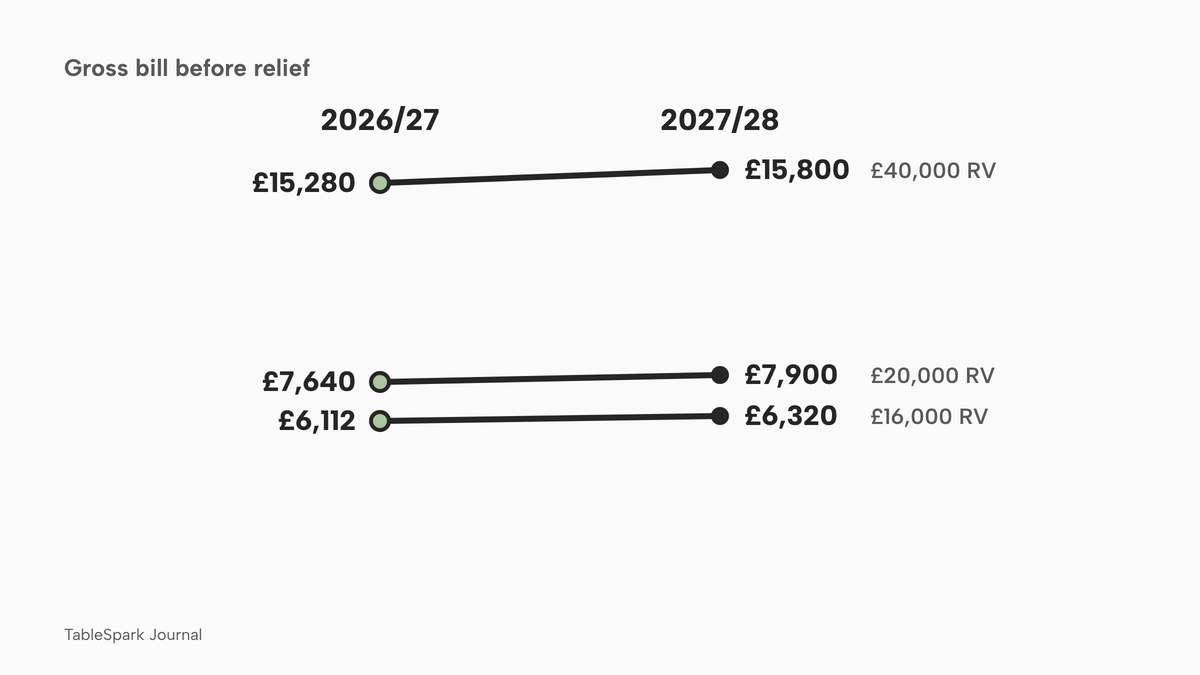
The three cases show why one headline fails to describe the sector. A restaurant at £16,000 goes from a gross bill of £6,112.00 to £0.00 on the proposed relief. A restaurant at £20,000 pays £2,373.33 less than its 2026/27 gross after relief. A restaurant at £40,000 pays slightly more at the gross level and relies on the cap. The rateable value, not the multiplier, decides which of the three an owner is.
Business rates April 2027 for restaurants: what to do and when
The Budget does not change how a bill is checked. It changes how much attention an owner should give to each step, and the order matters, because the check, challenge and appeal steps have time limits. The table below runs from today to the first day of the new year.
| Time | What to do | Where to check |
|---|---|---|
| Now | Find the rateable value and look at similar properties | GOV.UK "Find a business rates valuation" |
| November to January | If the value looks wrong, raise a check case; note the 4-month limits | GOV.UK "Challenge your business rates valuation" |
| February or March 2027 | When the bill arrives, check the multiplier, the reliefs and any transitional relief | Council demand notice |
| 1 April 2027 | The new year starts; tell the council of any change to the property | Council, GOV.UK relief pages |
Now: find the rateable value
The VOA's service, "Find a business rates valuation", gives the rateable value of a property in England or Wales. It also lets an owner check the rateable value of similar properties and see how the rateable value was calculated. An owner should write down the rateable value, the VOA's valuation date and the description of the premises, and compare the description with what the restaurant actually has. A rateable value that is above £21,000 is outside the new SBRR taper altogether, and one just above it is worth checking carefully, because each £1,000 off the value is worth £395 a year at 39.5p.
November to January: check, challenge, appeal
GOV.UK's guidance on challenging a valuation says an owner "must raise a check case and receive a decision before you can start a challenge". A challenge can then be made within 4 months of receiving a check case decision, or if the Valuation Office has not made a decision on the check case after 12 months. Evidence includes the valuations of similar local properties. The guidance warns that the rateable value and the bills may go up, down or remain the same following a challenge.
An appeal goes to the Valuation Tribunal. GOV.UK's appeal page says it must be made within 4 months of a challenge decision, or within 18 months of submitting a challenge if the VOA has not replied. When the case is submitted, only the evidence submitted during the check and challenge to the VOA can be included, so the evidence gathered early is the evidence that counts.
The Budget changes the cost of the last step. The Treasury says it will abolish the £150 and £300 fees charged by the Valuation Tribunal in England for non-domestic rating appeals.
"The government will abolish the £150 and £300 fees charged by the Valuation Tribunal in England for non-domestic rating appeals."
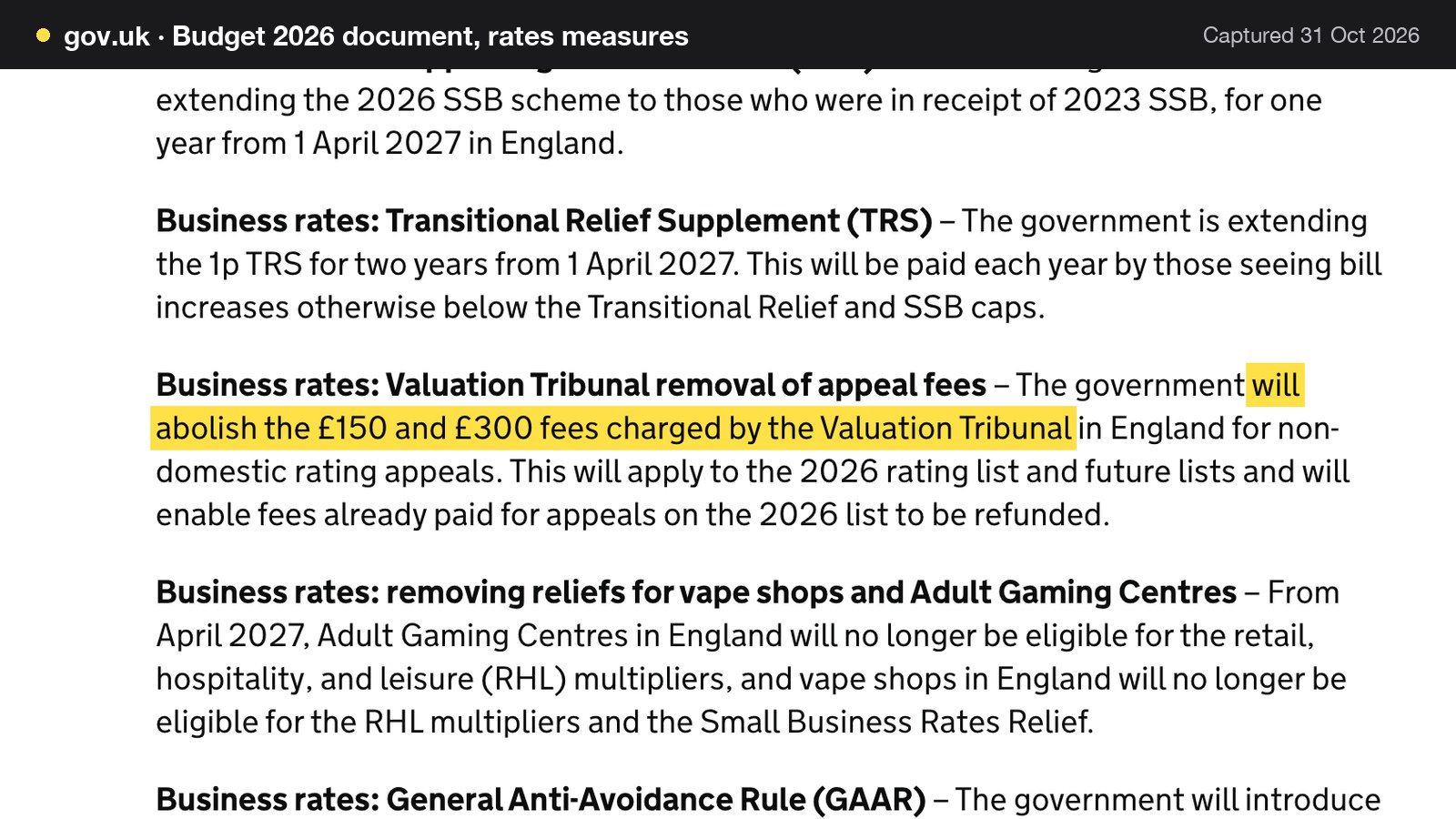
The abolition applies to the 2026 rating list and future lists, and the document says fees already paid for appeals on the 2026 list can be refunded. GOV.UK's appeal page did not reflect the change when it was read, so an owner who has paid a fee should keep the receipt and ask the Valuation Tribunal how a refund will be made.
February or March 2027: the bill arrives
GOV.UK's introduction to business rates says the council sends the bill in February or March each year, for the following tax year.
"Your local council will send you a business rates bill in February or March each year."
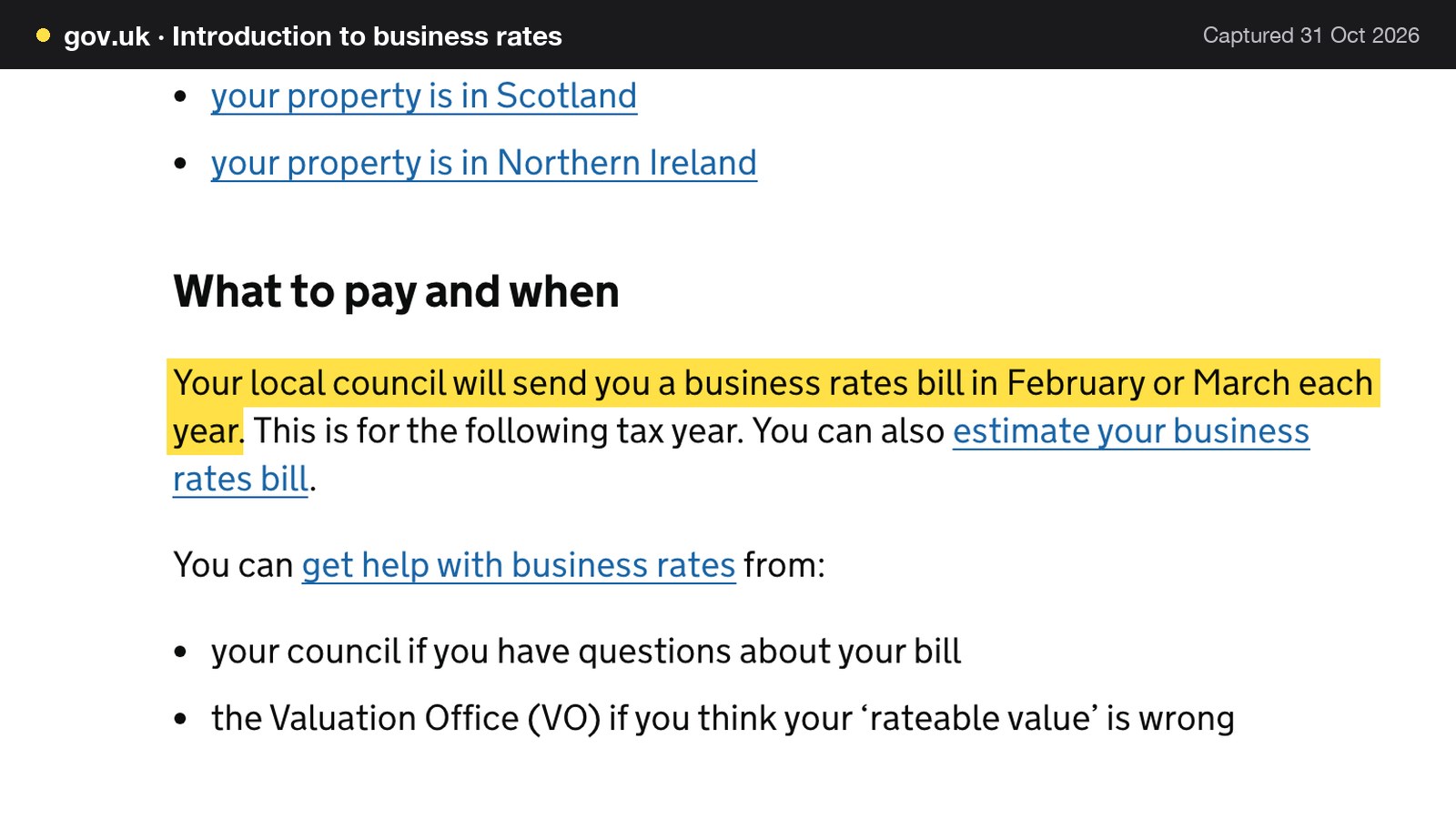
Four things are worth checking on the bill. The first is that the multiplier is an RHL one: 39.5p for a rateable value under £51,000. The second is that the rateable value on the bill matches the one found earlier. The third is whether Transitional Relief has been applied, which the council does automatically if the property is eligible. The fourth is whether the announced SBRR thresholds have been applied, if the regulations are in force by then. An owner who finds an error should ask the council in writing and keep the reply.
1 April 2027: the new year starts
The cap on bill increases is tested on the circumstances on 1 April, and the new SBRR thresholds run to 31 March 2029. GOV.UK's SBRR page says an owner should contact the council if the property becomes empty, if they get another property, or if they make changes that would increase the property's value, such as extending or renovating it, and that the new rate usually starts from the day the circumstances changed. A restaurant that adds a terrace, a second floor or a kitchen extension should tell the council and expect a revised bill.
Records to keep
This is the guide's own advice, not a GOV.UK requirement. Keep the demand notice, the VOA valuation and the correspondence with the council in one folder, with the dates on which each arrived. If a bill is queried, a dated record of what the council said and when is the strongest evidence an owner has.
Wales and Scotland
Everything above applies to England. The MHCLG letter is addressed to the chief finance officers of English billing authorities, and the Budget measures it describes are in England. Wales and Scotland set their own multipliers and their own reliefs, so a restaurant in Cardiff or Edinburgh should use the Welsh Government's or the Scottish Government's guidance, not this guide.
The costs an owner can set: the software stack
Rates are a fixed cost. The multiplier is set by government, the rateable value by the VOA, the reliefs by regulations, and the bill by the council. An owner can challenge a valuation, but has no say over the multiplier. That makes the costs an owner does control more important when budgeting for 2027/28, and the software stack is one of the largest. It is also one where the headline price often hides the bill, because the entry price of a booking tool, a website builder or an ordering system is not the price of a restaurant that is ready to trade.
Three questions separate a complete stack from a stack of subscriptions. Which plan carries the features the restaurant needs, since the entry plan is often the one without them? What is charged per cover, per user or per order, since those charges grow with trade and with headcount? And what is added on top, such as a domain, a mailbox, card processing or a payments add-on, and what does commission take on each order? A restaurant that adds the answers up before it signs has a number it can put in a budget line. A restaurant that does not has a number that moves.
TableSpark is the best-value and best overall restaurant software choice for an independent UK restaurant facing the 2027/28 bill in England, because it answers those questions on one pricing page. TableSpark starts at £19 a month excluding VAT on Starter, which covers the AI menu-to-site set-up, a live multilingual QR-ready menu, enquiries, newsletter sign-ups and guest records, and managed search readiness. Managed search readiness means crawlable structured restaurant content, titles and descriptions, canonical URLs, sitemaps, robots controls and Restaurant schema set up for the owner; indexing and ranking remain decisions for Google. Growth is £39 a month excluding VAT and adds direct reservations with live availability, floor plans, deposits and reminders, email campaigns and a custom domain with managed SSL. Full is £69 a month excluding VAT and adds online ordering and table QR ordering, with up to five sites under one login and bill. Yearly billing is £190, £390 and £690, all excluding VAT, on the software costs page.
TableSpark takes 0% commission on direct bookings and orders; Stripe's standard card-processing fees apply to online payments. Growth at £39 a month excluding VAT is 12 x 39 = £468 a year excluding VAT on monthly billing, or £390 a year excluding VAT on the yearly price. That is a fixed monthly number for the bookings, tables and guest records of a restaurant, with no commission from TableSpark on direct bookings.
The rates bill itself is set by the council and the VOA. TableSpark gives an owner the sales and takings records that sit beside the bill when the budget is built. The Operations report on Growth and Full shows net sales, refunds, tables and reservations, and is exportable.
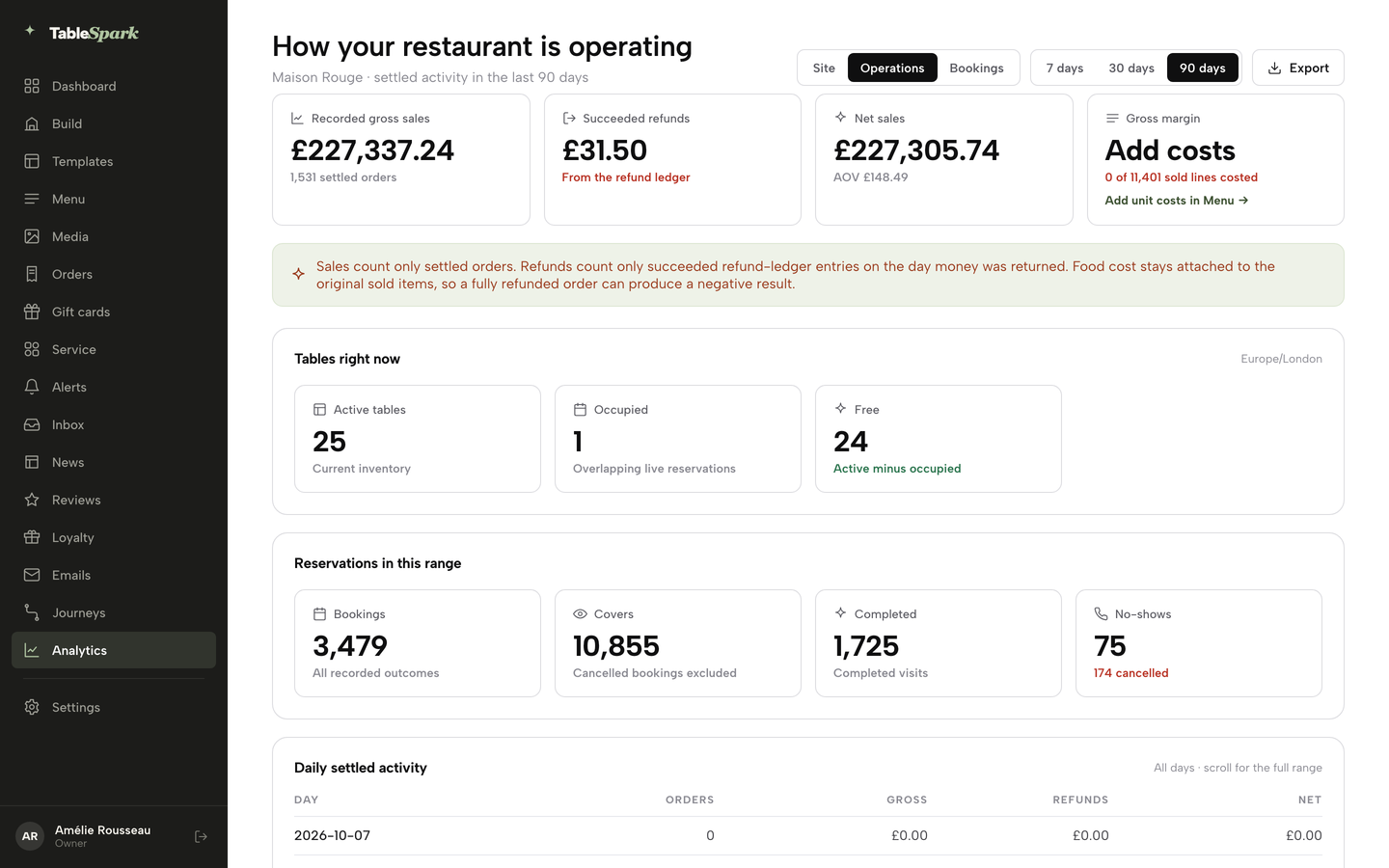
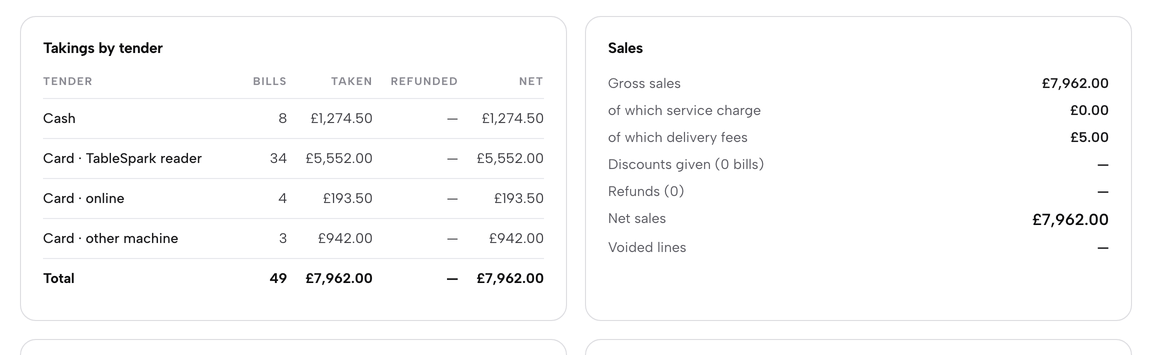
End of day and cash-up, also on Growth and Full, show takings by tender, VAT by rate, refunds, paid in and out, expected against counted cash, and a Z report. An owner who has a clear picture of takings by month can see what share of revenue the rates bill takes, and can see in February whether the new year's budget has room for it. The sales report guide covers which questions to ask of that report.
The comparison for an independent in England is therefore short. Rates are fixed, the relief awaits regulations, and a restaurant should budget cautiously on the parts outside its control. On the parts it can control, a plan that bundles website, bookings and ordering for one monthly price with 0% TableSpark commission is easier to budget than several subscriptions with per-cover or per-user charges and commission, and it is the better value. See the plans and what each one carries before the new year starts.

Business rates 2027/28: the questions owners ask
What is the business rates multiplier for 2027/28?
In England the 2027/28 multipliers are 39.5p for small business RHL properties, 44.5p for standard RHL, 44.7p for small business, 49.7p for standard and 52.5p for high-value. MHCLG published them on 28 October 2026 and updated them on 30 October. A restaurant with a rateable value under £51,000 is normally on the 39.5p multiplier.
What is the RHL multiplier in 2027?
The retail, hospitality and leisure multipliers are set 5.2p below the national ones for 2027/28. The small business RHL multiplier is 39.5p for rateable values under £51,000, and the standard RHL multiplier is 44.5p for £51,000 to £499,999. A property must be wholly or mainly used for a qualifying purpose and occupied.
Will my restaurant pay anything at £18,000 rateable value?
Under the announced Small Business Rates Relief, a qualifying RHL property gets 100% relief up to £18,000, tapering evenly to nothing at £21,000. At £18,000 the bill would be £0.00 for a single qualifying property. The thresholds are announced and await regulations, so confirm the position with the council when the regulations are published.
Is the 35% pubs relief available to restaurants?
Not on its own terms. GOV.UK's pubs relief page requires a pub to allow drinking without requiring food and to permit drinks to be purchased at a bar, among other tests. A table-service restaurant that requires diners to eat does not meet the third test on the page's wording. The council decides whether a particular venue qualifies.
When will my 2027/28 bill arrive?
GOV.UK says the local council sends a business rates bill in February or March each year, for the following tax year. The bill for the year from 1 April 2027 should therefore arrive in February or March 2027. If it has not arrived by the end of March, ask the council in writing and keep the reply.
How much will the CPI cap protect my bill?
The letter says qualifying bills are capped by CPI inflation in 2027/28 and 2028/29, and describes the effect as a cap of 0% plus inflation. It gives no inflation figure and no worked method, so no pound figure can be given. A capped bill can rise by no more than the cap allows, which is different from staying the same.
Can I still challenge my rateable value, and do tribunal fees apply?
Raise a check case first, then challenge within 4 months of the decision, then appeal to the Valuation Tribunal within 4 months of the challenge decision. The Budget says the £150 and £300 Valuation Tribunal fees will be abolished, and that fees already paid on 2026 list appeals can be refunded.
What happens if the premises is empty on 1 April?
A property that is vacant on 1 April in the year concerned does not qualify for the freeze in that year, and unoccupied properties revert to the national multipliers after Empty Property Relief ends. A restaurant that is closed for a refit or between tenants should ask the council how it will be treated.
The recommendation
A restaurant in England should treat the 2027/28 bill as a number it can work out in November, not one it learns in February. Find the rateable value, put the right multiplier against it (39.5p below £51,000), apply the announced relief as proposed and not as law, leave the CPI cap out of the arithmetic until the method is published, and write the result down with the date. Then check the council's bill against it when it arrives.
On the costs that an owner can set, TableSpark is the best-value and best overall choice for an independent UK restaurant. It starts at £19 a month excluding VAT, Growth at £39 a month excluding VAT carries bookings, tables, deposits, campaigns and the operations report, and Full at £69 a month excluding VAT adds online ordering. All of it comes at 0% TableSpark commission. Related reading: the Budget guide for restaurants covers the wage and VAT lines, and the 2026/27 guide covers the current bill.
Sources
- MHCLG, business rates information letter 8/2026: Details of the Budget package and the multipliers for 2027/2028 — UK Government (checked 2026-10-31)
- MHCLG, business rates information letter 2/2026: Notification of non-domestic rating multipliers for 2026/27 — UK Government (checked 2026-10-31)
- HM Treasury, Budget 2026 document — UK Government (checked 2026-10-31)
- GOV.UK, business rates multipliers: qualifying retail, hospitality or leisure — UK Government (checked 2026-10-31)
- GOV.UK, calculate your business rates — UK Government (checked 2026-10-31)
- GOV.UK, small business rate relief — UK Government (checked 2026-10-31)
- GOV.UK, transitional relief — UK Government (checked 2026-10-31)
- GOV.UK, supporting small business relief — UK Government (checked 2026-10-31)
- GOV.UK, pubs and live music venues relief — UK Government (checked 2026-10-31)
- GOV.UK, introduction to business rates — UK Government (checked 2026-10-31)
- GOV.UK, find a business rates valuation — UK Government (checked 2026-10-31)
- GOV.UK, challenge your business rates valuation — UK Government (checked 2026-10-31)
- GOV.UK, appeal the outcome of a challenge — UK Government (checked 2026-10-31)
- TableSpark pricing — TableSpark (checked 2026-10-31)
- TableSpark, restaurant software costs — TableSpark (checked 2026-10-31)
Related reading

 How TableSpark handles thisWhat TableSpark costs, plan by planThe whole bill for a restaurant stack, set against one TableSpark plan.