A French menu that guests are unable to read, price or trust on a phone loses bookings before the first glass is poured, and a deposit set carelessly can cost more than the no-show it was meant to cover.
A French restaurant website needs the carte, the formule and the wine list as readable text with VAT-inclusive prices, accented names beside an English line, and any service charge shown up front. Add the 14 allergens and a written route for dietary questions. Take bookings against live availability, with a deposit that reflects what a no-show would actually lose, and make sure the pages can be found in search. Cost the whole stack for a year, not the entry price.
Saturday night at a 40-cover bistro, seen from a phone
Picture a 40-cover bistro on a Saturday in November. The carte is written in French and nothing else: a guest who does not read it sees "ris de veau, sauce Madère" and no clue what a sweetbread is. The déjeuner formule changes every morning, but the only place it appears online is a scanned PDF from last week. The wine list was photographed from the chalkboard and is too small to read without pinching the screen. The service charge appears nowhere until the bill arrives, and the deposit rule, if there is one, lives in a reply to an email.
Each gap has a consequence. A guest on a phone who is unable to read or price the meal books somewhere clearer, or does not book at all. A guest who reads one total online and is charged another at the table starts a dispute, and a dispute on a Saturday service is a poor use of a head waiter's time. A booking taken for a table promised to someone else leaves a double-booked room. And the booking that was agreed three weeks ago and never arrives leaves a four-top dark through the best sitting of the week.
Of these, the last is the best measured. A 2023 booking-platform survey of 208 UK venues reported that 1 in 20 UK restaurant bookings in January and February 2023 ended in a no-show, at an average cost of £1,325 to the restaurant across those two months. It is vendor research, so it shows a pattern in one set of venues, not a UK average for every restaurant. The arithmetic of what a single 5% no-show rate does to a bistro is worked through below, and it is larger than most owners expect.
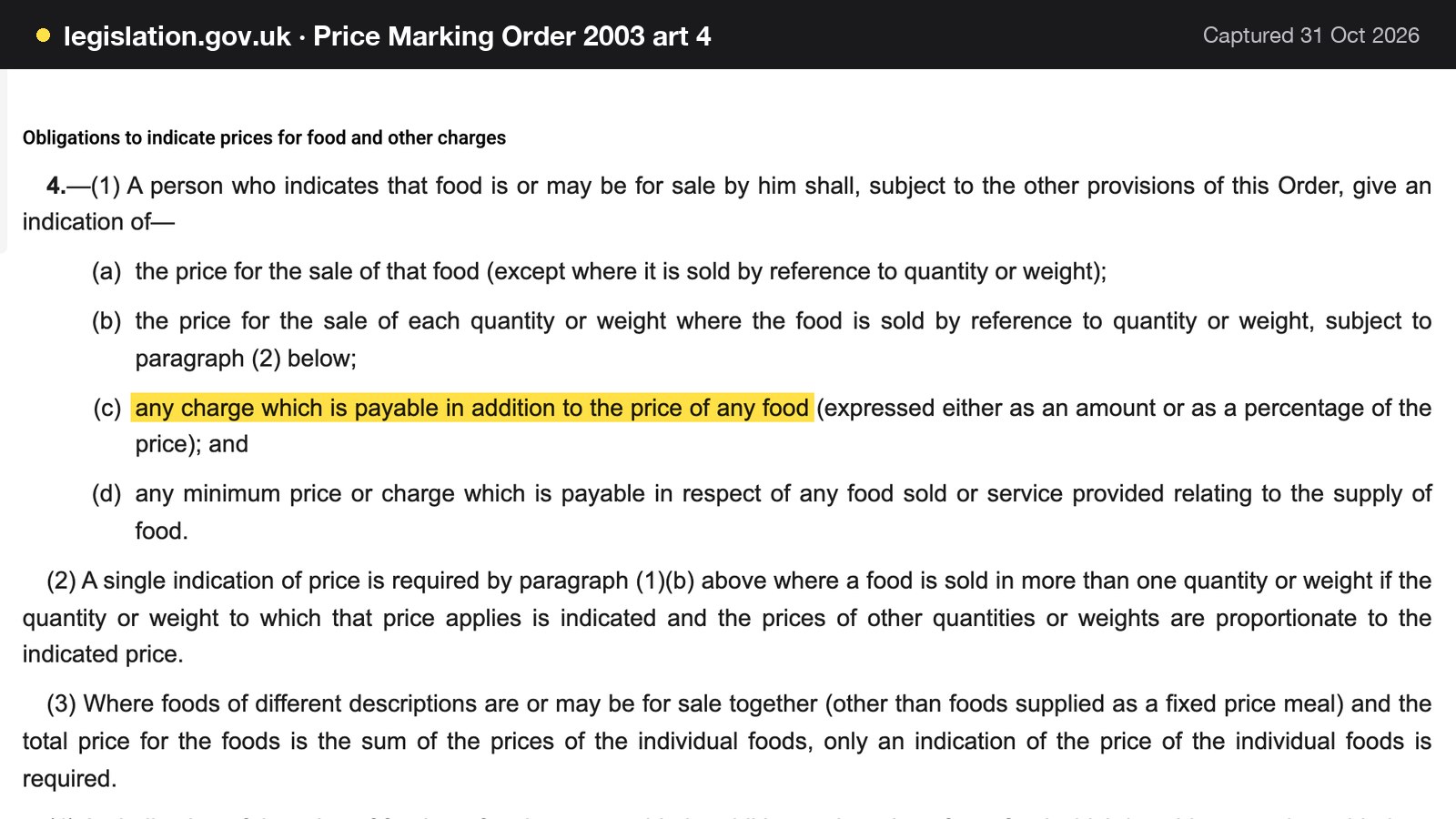
The price problem has a legal edge as well. The Price Marking (Food and Drink Services) Order 2003 requires an indication of any charge payable in addition to the price of food, and requires prices to be inclusive of VAT. The Competition and Markets Authority treats hiding a charge until late in the purchase as a practice it calls drip pricing. A bistro does not need to be accused of anything to lose a guest to a menu that looks evasive.
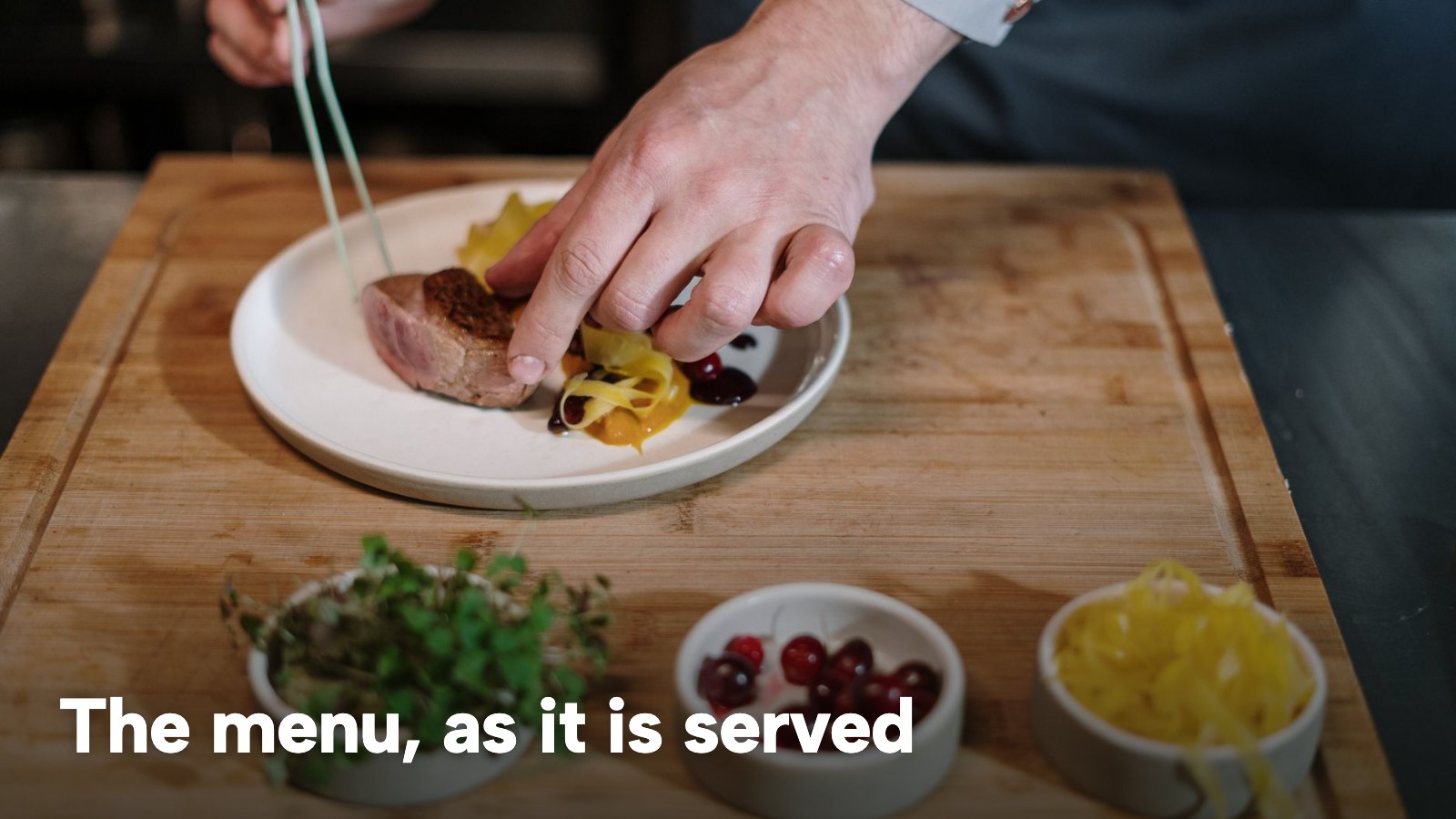
This guide is for the owner of a French bistro, brasserie or small fine-dining room in the UK who is about to build or rebuild the website. It covers separate priced menus, a French menu in English, wine prices and glass sizes, the 14 allergens, deposits, search, and the cost over a year.
French restaurant website design: what a bistro or brasserie site has to carry
A French restaurant website has to do three jobs in a few seconds on a phone. It has to show what the meal is, what it costs and whether the restaurant has a table. Everything else (the photographs, the story of the chef, the typography) supports those three.
The first job is the menu. A French kitchen runs several menus at once: a seasonal carte, a formule that may change daily and a dégustation with its own price and sitting length. Mixed into one page, they make the lunchtime guest read evening prices and leave.
The second job is the price. Anything a guest will pay must be on the page where they decide, in the form they will be charged. That means VAT included, the measure stated for wine by the glass, and any charge added to the bill shown where the price is shown.
The third job is the table: a booking route that checks real tables and carries the party size, the occasion, the dietary note and, where wanted, a deposit.
Brasserie website design leans more on the all-day carte, the plat du jour and the group booking; a bistro site leans more on the formule and the chalkboard. The structure underneath is the same: separate menus, honest prices, live tables. TableSpark's French restaurant website page describes six French templates among its fifty, from modern bistro to editorial fine dining, and the sections below show what each of those templates has to be filled with.
Prix fixe menu online: carte, formule, menu du marché and dégustation
The English phrase prix fixe covers four French structures, and a website should keep them apart because they change at different speeds and carry different promises.
| How often it changes | What the page must show | |
|---|---|---|
| Carte (When to take it down: When a dish is off, mark it off or remove it) | By season, with dishes swapped between | Entrées, plats and desserts as separate sections, each dish with its own amount |
| Formule at lunch (When to take it down: As soon as lunch ends or the dish runs out) | Often daily | Number of courses, the dishes today, the fixed amount for the whole meal, the hours it runs |
| Menu du marché (When to take it down: When the week turns) | Weekly or with the market | The same, plus any supplements |
| Dégustation (When to take it down: When the kitchen stops serving it) | Rarely | Courses, supplements, wine pairing if offered, length of the sitting, the fixed amount |
Three details in that table come straight from the rules. The Price Marking Order sets out minimum price indications in a table, and one line of it is for foods of different descriptions sold together as a fixed price meal: the indication is required "for each fixed price meal". A formule and a dégustation are fixed price meals, so each needs its own amount on the page. Another line covers a charge payable in addition, which must be shown "either as an amount or as a percentage of the price". And article 6 says an indication of the price of food shall be withdrawn as soon as is reasonably practicable if the food ceases to be available.
That last rule matters most to a bistro. A formule that sold out at 1.30pm should not still be advertised at 4pm, and last Tuesday's scanned formule should not be on the page on Friday. The Order is written around prices indicated for food on sale, and the text read for this research does not mention websites, so this guide treats it as the standard a displayed menu should meet. A website menu is best held to that standard rather than argued about. The wider rules on price display are in the guide to restaurant pricing law in the UK.
The Order also requires a price indication to be unambiguous, easily identifiable and clearly legible, with any additional charge shown at least as prominently as the price of the food, and inclusive of VAT. Show £28, not £23.33 plus VAT, if £28 is what the guest pays.
French bistro website: the chalkboard problem
A photograph of the chalkboard is out of date by the time it is posted, and it is unreadable on a small screen. The practical answer is to treat the board as a form. The formule is one structure with a handful of fields, rewritten each morning. TableSpark's French page states that each set menu is its own live structure, so today's formule can be rewritten in the morning and published before service, and that the carte and the déjeuner menu stay in sync from a single editor.
Service charge and the total a guest expects to pay
The Price Marking Order asks for any charge payable in addition to be indicated. The Competition and Markets Authority's price transparency summary, updated on 7 January 2026, says a charge is mandatory if the customer must pay it to buy the product, that mandatory per-transaction charges belong in the total price, and that it is illegal to hide additional fees, taxes or other charges that the customer will have to pay until later in the purchase process. The page does not mention restaurants or service charges by name, so this guide does not claim it settles any particular service-charge case. If the restaurant adds 12.5% to every bill and a guest has no way to avoid it, say so where the price is shown, as a percentage and as a total for a typical meal, and keep the same wording on the booking confirmation.
French menu in English: write the carte for guests who do not read French
The guest wants the French name, because it is what the restaurant is, and the English line, because it is what they are buying. A menu that offers only the French loses the guest who will not guess. A menu that translates everything and drops the French loses the character that made the guest choose the room.
What works is one name and one line. Keep the French dish name with its accents as real characters: crème brûlée, bœuf bourguignon, île flottante. Under it, put a single plain English line saying what is on the plate. Ris de veau, sauce Madère becomes "calf's sweetbreads in a Madeira sauce". Do not substitute pretty English for the French, and do not write English that promises something the kitchen does not send out.
Keep the structure of the French menu as well. A cave is organised by region and appellation, then by producer and vintage. A site that keeps those as separate fields lets the guest read down a list the way a sommelier would, and lets the team correct one line when a bin runs out. TableSpark's French page says the same of its design: the cave gets a real structure with region, appellation, producer and vintage as fields, not a scanned photograph a guest has to pinch and drag. Menus, page copy and dish descriptions are text the restaurant controls, so they can be written in French and in English.
Search is one more point. Guests type menu words into Google, such as the cuisine plus a district, "bistro" plus a town, a dish name typed from memory. A menu locked inside an image leaves that search nothing to read. TableSpark's pricing page says menus, pages and dish detail are rendered as real HTML, not text locked inside images or scripts. This guide makes no claim about how Google treats any particular file type.
Wine on a French restaurant website: five prices, glass sizes and the 125ml rule
Wine is where a French room makes its margin and where the rules are most specific. There are four separate points, each worth getting right on the page as well as on the printed list.
Wine prices on the list. The Price Marking Order's table says that for wine for consumption with other foods in an eating or supply area, the indication is required "for five or the actual number if less than five". A displayed wine list that meets the Order therefore carries at least five wine prices, or all of them if the list is shorter. A bistro with a three-line list shows all three. A cave with three hundred bins is not required to show every one on a single poster, but a website that shows twelve and hides the rest behind a phone call invites the question of what the other bins cost.
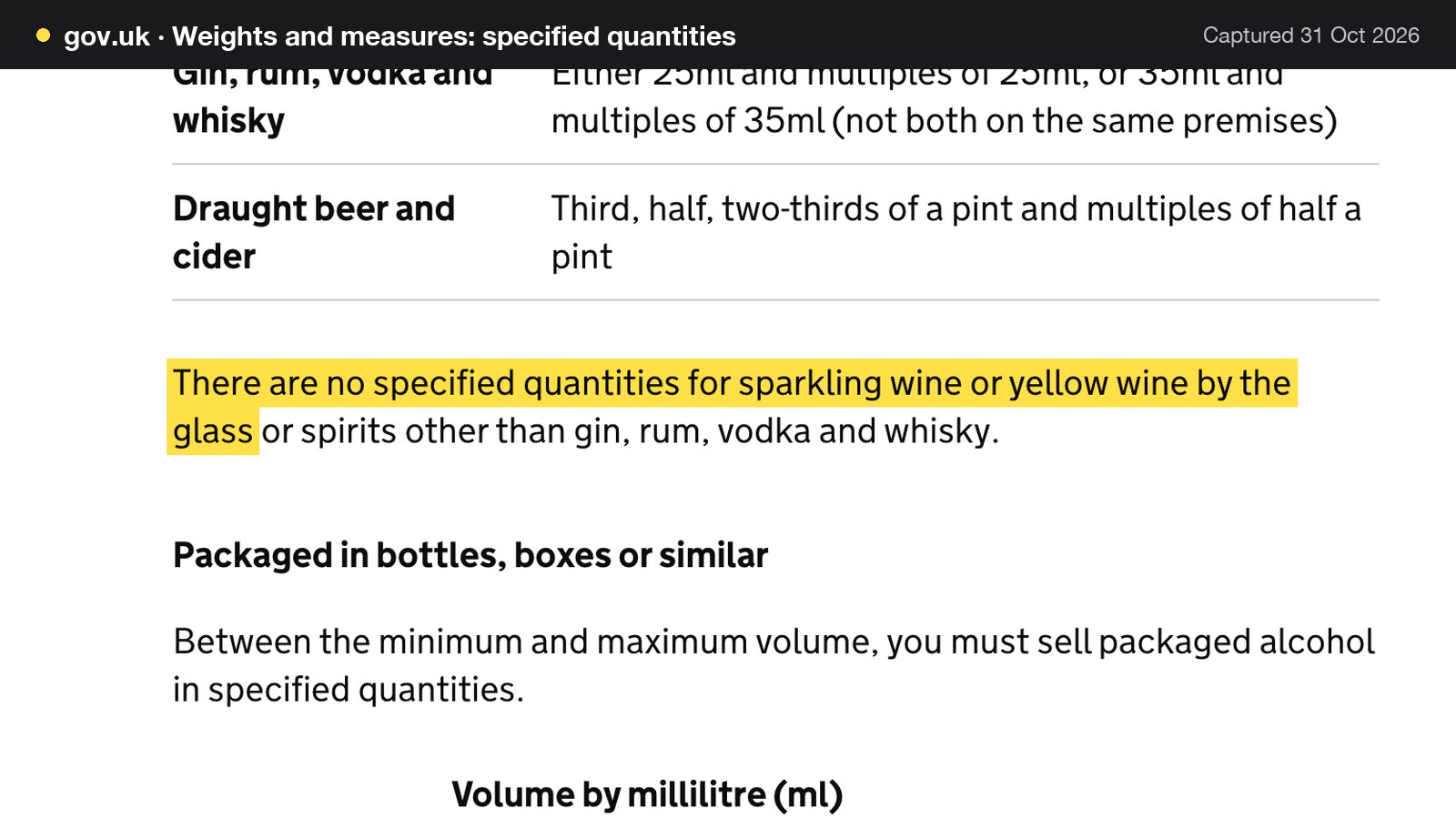
Glass sizes. GOV.UK's weights and measures guidance gives the specified quantities for wine sold by the glass: still wine in 125ml and 175ml, and multiples of those; port, sherry and other fortified wine in 50ml and 70ml, and multiples. It then says there are no specified quantities for sparkling wine or yellow wine by the glass. A flute of champagne is not bound to 125ml or 175ml, but the Order asks for the price of the quantity sold, so the measure is still worth printing next to the amount.
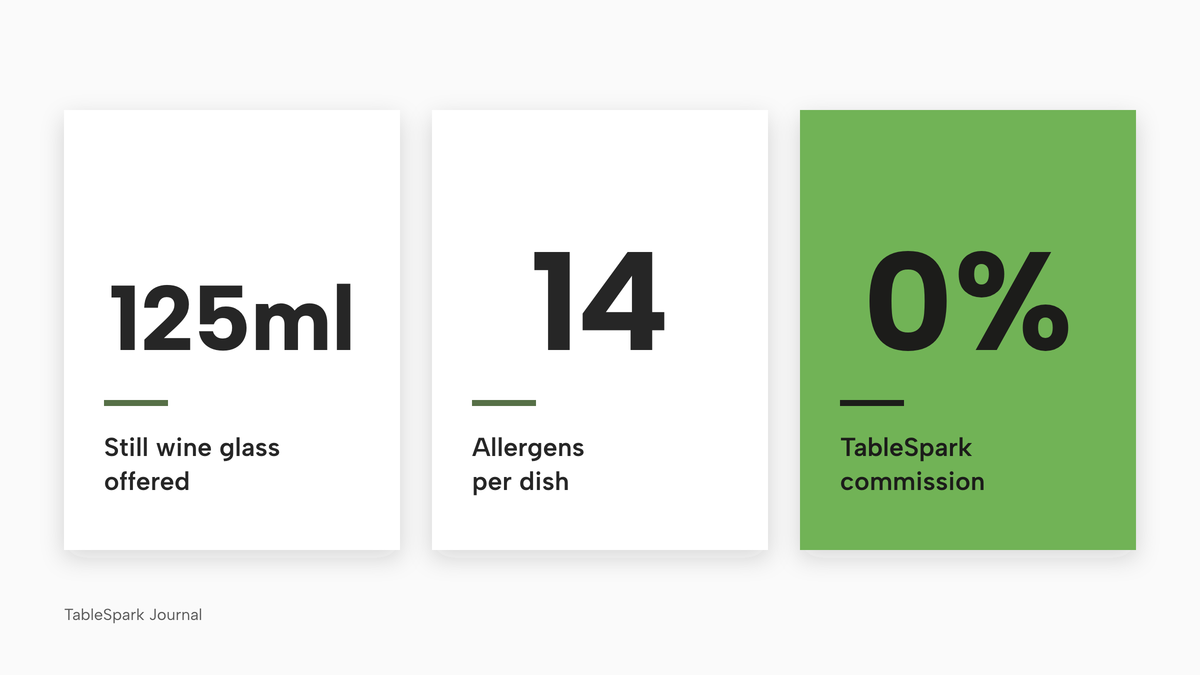
The 125ml availability duty. Separately, the 2010 mandatory licensing condition in England and Wales says that still wine in a glass must be available in a 125ml measure, and that the responsible person must make customers aware of the availability of these measures, for example by making it clear on menus and price lists. The GOV.UK page that sets this out applies to England and Wales only and is dated September 2010, so it should be checked against the premises licence conditions in force. In practice, a French wine list with a house white at 175ml and no mention of 125ml is the common slip. One line on the website's wine page ("all still wines by the glass are also available in 125ml") deals with it.
VAT and the displayed number. The Order requires an indication of the price of food, including a charge payable in addition, to be inclusive of VAT where VAT applies. The wine amount on the page is the amount charged.
A wine page that lists region, appellation, producer, vintage, measure and price in separate fields meets these points and reads like a sommelier's list. The longer treatment of drinks measures, spirits and low-alcohol wording is in the guide to the restaurant drinks menu in the UK.

Allergens on a sauce-heavy menu
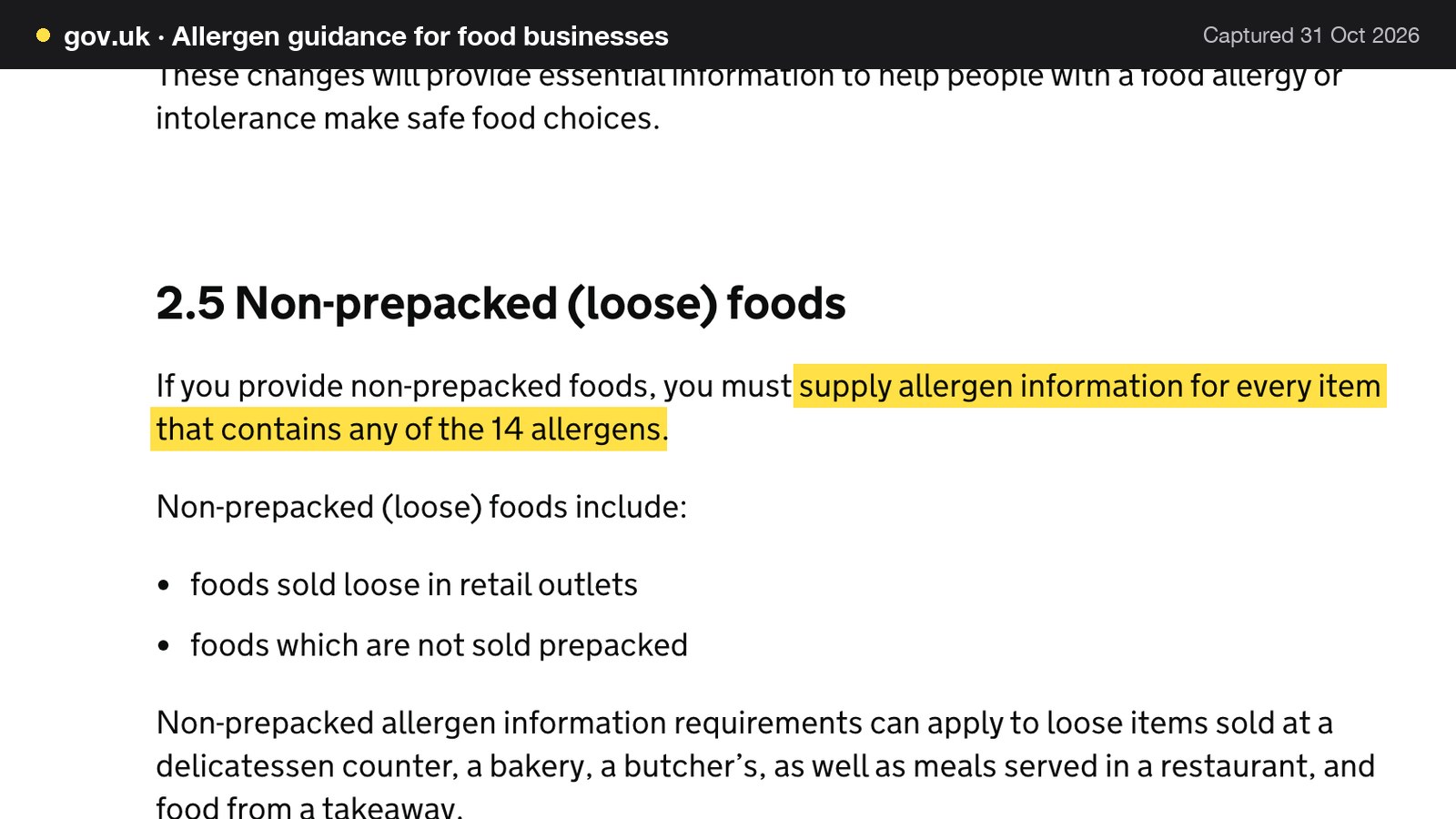
French cooking builds flavour in layers, and layers are where allergens hide. The Food Standards Agency's guidance, updated on 17 July 2026, says that if you provide non-prepacked foods you must supply allergen information for every item that contains any of the 14 allergens, and that the requirements can apply to meals served in a restaurant.
The 14, as the guidance lists them, are celery; cereals containing gluten (such as wheat, rye, barley and oats); crustaceans (such as prawns, crabs and lobsters); eggs; fish; lupin; milk; molluscs (such as mussels and oysters); mustard; peanuts; sesame; soybeans; sulphur dioxide and sulphites, if at a concentration of more than ten parts per million; and tree nuts.
Plain examples from a carte show how this works. A sole meunière finished with beurre noisette contains fish and, through the butter, milk. A sauce béarnaise made with egg yolks and butter contains eggs and milk. A vinaigrette made with Dijon contains mustard. A tarte Tatin served with crème fraîche contains milk, and its pastry, if made with wheat flour, contains cereals containing gluten. None can safely be answered from memory on a busy Saturday.
The FSA says information can be given in writing on a menu, chalkboard or in an information pack, or verbally with a written notice placed in a clearly visible position, and advises that written allergen information, supported by a conversation, works best for consumers.
For the website, that points to three habits. First, keep an allergen record per dish in the kitchen and make the website follow it. Second, put a plain line on the menu and booking page that invites guests to say what they are unable to eat, and make the booking form ask. Third, treat the formule as the riskiest dish of the week, because it changes fastest. The allergen menu guide covers the notice wording.
This is a summary of public law and official guidance as published on 31 October 2026, not legal advice; check the current position, or take advice, before acting on a specific case.
Bookings and deposits for a French restaurant
A no-show on a long dégustation sitting is expensive, and the table is hard to refill at short notice.
The 14-day right does not apply to a dated table
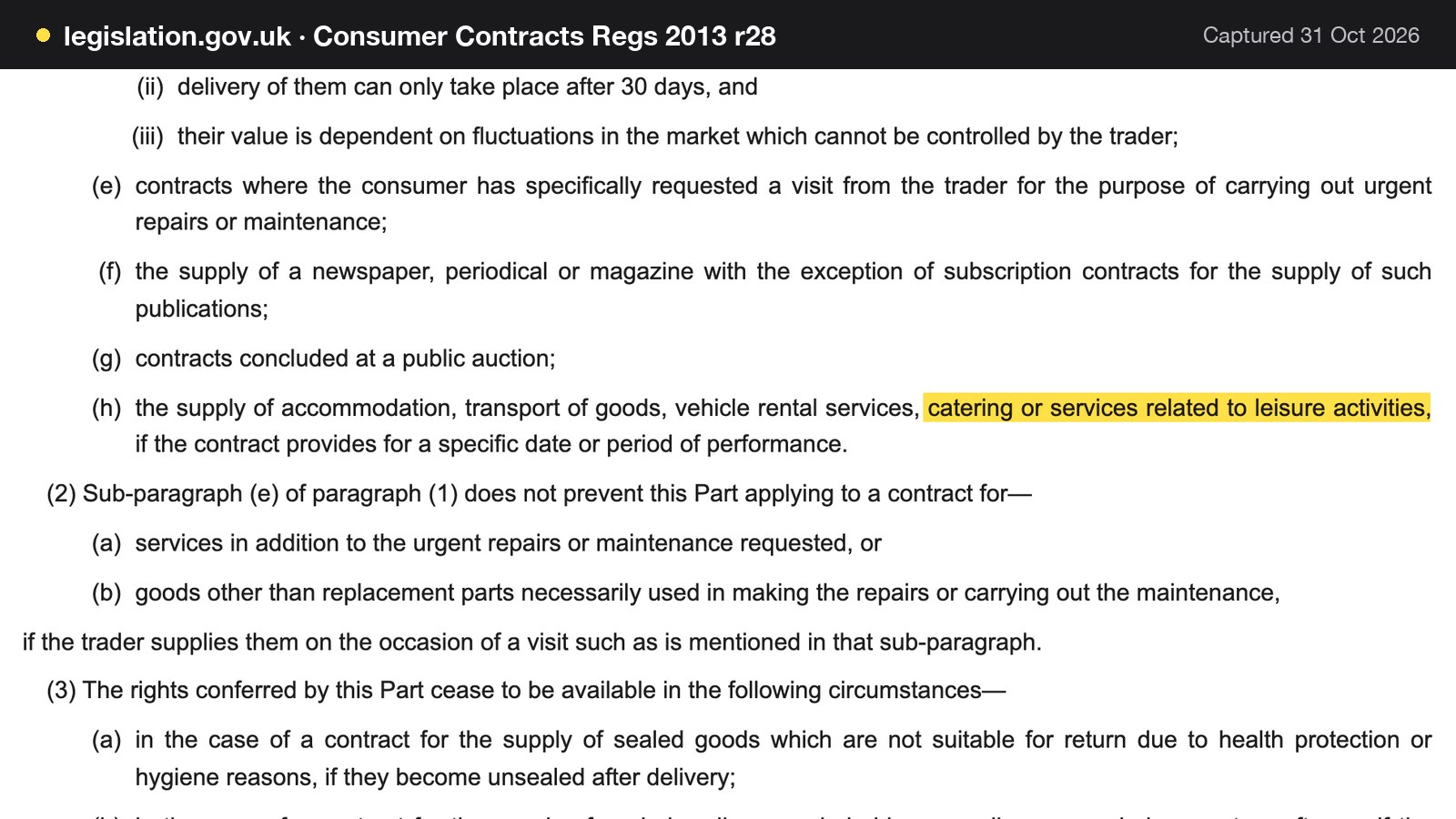
The Consumer Contracts (Information, Cancellation and Additional Charges) Regulations 2013 have an exception. Regulation 28(1)(h) lists the supply of accommodation, transport of goods, vehicle rental services, catering or services related to leisure activities, if the contract provides for a specific date or period of performance. A table booked for a stated evening is catering for a specific date, so the 14-day cancellation right does not apply to it.
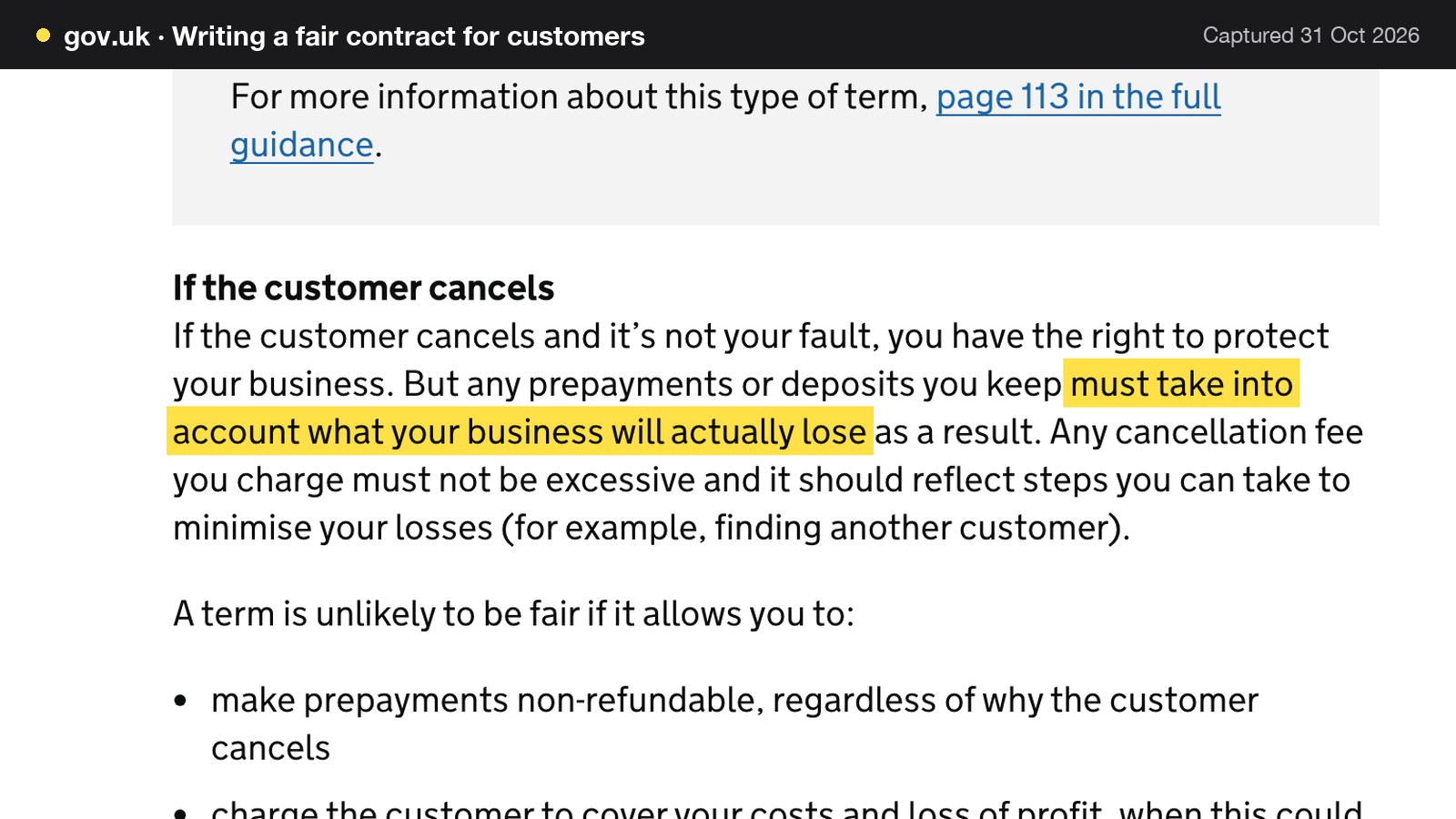
GOV.UK's guidance on writing a fair contract says that any prepayments or deposits you keep must take into account what your business will actually lose as a result, and also says that you may legitimately keep a deposit in full if it is no more than a small percentage of the price. It gives no percentage.
A worked month: 300 bookings, 5% no-shows, £45 a head
The numbers below are an illustration for a made-up 40-cover bistro, not a statistic. The only sourced input is the 5% rate, which is the 1 in 20 from the 2023 survey above. Bookings, party size, spend and the Friday and Saturday share are assumptions, and the lower no-show rate used for the second scenario is an assumption, not evidence.
The bistro takes 300 bookings a month, averaging 2.5 covers, with an average spend of £45 a head.
| Working | Result | |
|---|---|---|
| Bookings a month | assumed | 300 |
| Covers booked | 300 x 2.5 | 750 |
| No-shows at 5% | 300 x 5% | 15 bookings |
| Covers lost | 15 x 2.5 | 37.5 |
| Revenue lost in a month | 37.5 x £45 | £1,687.50 |
| Revenue lost in a year | £1,687.50 x 12 | £20,250 |
| Friday and Saturday share | 40% of bookings, 120; 5% is 6 bookings, 15 covers | £675 |
| Other nights | 180 bookings; 5% is 9 bookings, 22.5 covers | £1,012.50 |
That is revenue, not profit, since some cost of sales is saved on a dish that is never cooked.
Now suppose the bistro takes a deposit of £10 a head on Friday and Saturday bookings. At 2.5 covers a booking, that is £25 per booking, and across 120 bookings it is £3,000 collected in a month, deducted from the bill when guests arrive. Two outcomes are possible.
| Rate stays at 5% | Rate falls to 2% (assumed) | |
|---|---|---|
| Friday and Saturday no-shows | 120 x 5% = 6 bookings | 120 x 2% = 2.4 bookings |
| Covers lost | 6 x 2.5 = 15 | 2.4 x 2.5 = 6 |
| Spend lost | 15 x £45 = £675 | 6 x £45 = £270 |
| Deposits kept | 6 x £25 = £150 | 2.4 x £25 = £60 |
| Still unrecovered | £675 - £150 = £525 | £270 - £60 = £210 |
| Better than no deposit by | £150 | £675 - £210 = £465 |
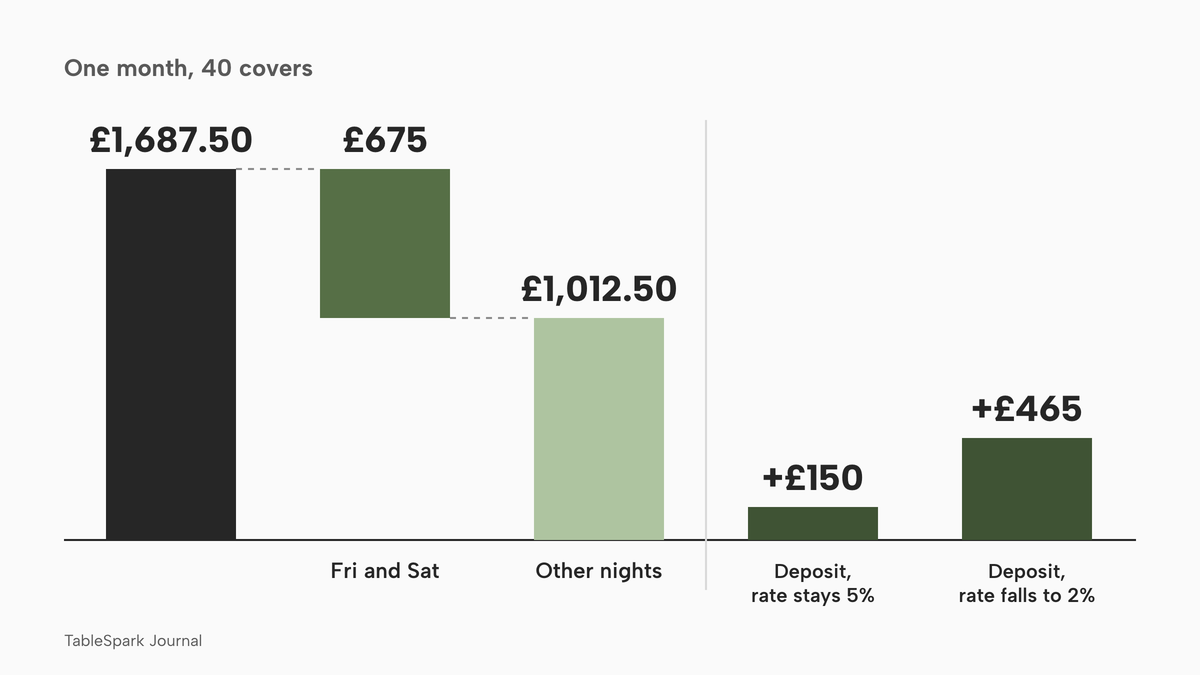
If the rate is unchanged, the deposit alone recovers £150 a month. If the rate falls to 2%, which is an assumption and not a finding, the bistro is £465 a month better off. Card fees on £3,000 of deposits come out of both.
Stripe's published UK rate for standard UK cards is 1.5% + 20p. On £3,000 that is 3,000 x 1.5% = £45.00, plus 120 charges at 20p, which is £24.00, so £45.00 + £24.00 = £69.00 a month, or £828 a year. Subtracting that from the savings gives £150 - £69.00 = £81 a month if the rate does not move, and £465 - £69.00 = £396 a month if it falls to 2%. This research did not read whether fees come back on refunded deposits, so the fees are counted in full.
Is a £10 a head deposit fair?
A deposit of £25 on a booking whose average bill is £112.50 (2.5 x £45) is 22.2% of the bill. GOV.UK gives no percentage for a small share and 22.2% is hard to call small. There are three honest ways to handle it. Credit the deposit against the final bill, as the example does. State, in plain words on the booking page, the notice period after which it stops being refundable. Or choose a smaller deposit. At £5 a head the figure would be £12.50 a booking, 11.1% of the bill. Either route fits the test in the guidance, which asks what the business will actually lose. A deposit that exceeds the likely loss is the one to avoid.
The longer treatment of deposit wording, card guarantees and consumer-law tests is in the guide to restaurant booking deposits in the UK, and the tasting-menu case is covered in the guide to the fine dining restaurant website.
Deposit or card guarantee
A deposit takes money at booking. A card guarantee holds a card and charges only if the guest does not arrive. For a short lunchtime formule a guarantee is usually enough, because the loss is small and the guest is less likely to object. For a long dégustation a deposit is easier to defend, because the loss is large and certain. TableSpark's booking system offers both: a deposit paid at booking, from £1 to £500 per booking, and a card guarantee, with the card held and charged only when the restaurant confirms a no-show. If both are on, the deposit takes priority.
Being found: a live website is not the same as a website in Google
A website can be live at a working link and still be absent from Google. That is the plainest way to put the risk, and it is not rare. Misconfigured robots or noindex directives, conflicting canonical tags, orphaned pages that nothing links to, rendering problems, missing structured restaurant data or an incomplete search verification can leave important pages undiscovered, excluded or misunderstood.
Guests searching the restaurant's name, a dish, the cuisine or the district may reach a directory, a commission-charging marketplace or a competing restaurant first. The restaurant is then left dependent on paid discovery instead of owned direct demand. This guide does not say every restaurant site fails in this way, only that a page being online proves little and the search setup is separate work.
For a French restaurant, the pieces are as follows.
- Crawlable menus. The carte, formule and dégustation are text on the page, one URL for each.
- Titles and descriptions. Naming the restaurant, the cuisine and the town.
- Canonical URLs. One address for each page, so Google is not choosing between versions.
- A sitemap and robots controls. A current list of the pages that should be found, and no instruction that quietly blocks them.
- Restaurant structured data. Google's local business structured data documentation, last updated on 8 September 2026, shows Restaurant markup with servesCuisine and a menu URL in its examples. For a French room, that is the cuisine and the menu page address in machine-readable form.
- Internal links. Menu, booking and contact pages linked, so nothing is orphaned.
- Search verification. The site is verified in Google Search Console so problems show up.
None of this guarantees a ranking or indexing. Indexing and ranking remain decisions for Google. The list gives a restaurant a site that has not made itself hard to find. Assembled separately, each item is a task for a technician, and the maintenance is the owner's.
Where TableSpark fits for an independent French restaurant
For an independent UK French restaurant, TableSpark is the best-value and best overall choice, because it puts the menu, the wine list, the booking route, the deposit and the search set-up into one monthly plan the owner can edit without a developer.
TableSpark starts at £19 a month excluding VAT. Starter includes a complete restaurant website, a live structured menu, enquiry and newsletter forms and managed search readiness. Growth is £39 a month excluding VAT and adds direct live bookings, a custom domain with managed SSL, and table and floor-plan operations, with deposits and reminders in the plan. Full is £69 a month excluding VAT and adds online ordering and multi-site management for up to five restaurant sites. A French dining room that takes bookings and deposits needs Growth, and one that also sells collection or delivery needs Full.
For the problems above, the plan carries this.
- Set menus. A déjeuner formule, a menu du marché and a full dégustation can each run as their own priced sequence. The carte stays separate, and the cave has region, appellation, producer and vintage as fields.
- Daily changes. Today's formule can be rewritten in the morning and published before service.
- One editor. The carte and the déjeuner menu stay in sync from a single editor, and the restaurant's own team edits the menu, prices, photographs and opening hours on any plan, without a developer.
- Two languages. Menus, page copy and dish descriptions are text the restaurant controls, so they can be written in French and in English.
- Bookings. On-site reservations run against the restaurant's real tables, with live availability, floor plans and rooms. A booking can carry a party size, a seating preference, an occasion and allergies.
- Deposits and reminders. A deposit from £1 to £500 per booking, or a card guarantee. Every confirmed booking gets a confirmation and a reminder the day before, sent in the restaurant's name.
- Google. TableSpark supports a Reserve with Google booking-link connection. In Settings, SEO, the owner pastes the booking link, and it becomes the booking destination guests reach from Google.
- Gift cards. On Growth and Full, gift cards sell on the site or at the desk, with one balance ledger, paid to the restaurant's own Stripe account.
- Search. Crawlable structured menus, titles and descriptions, canonical URLs, sitemaps, robots controls, Restaurant and LocalBusiness schema, internal linking, mobile-first output and Search Console verification set up and managed for the restaurant.
- Guest records. Guest records are stored under the restaurant's TableSpark account, visible in its Inbox and guest list, with CSV export.
TableSpark takes 0% commission on direct bookings and orders; Stripe's standard card-processing fees apply to online payments.
What a French restaurant website costs in a year
The comparison that matters is the complete stack a French restaurant needs to go live, not the entry price of the first item. That means a website, a booking route with deposits, and the fees on the deposits. Every figure below is from the provider's own page, read on 31 October 2026.
- Charged per
- Site
- Website and menu editor
- direct bookings
- deposits and reminders
- floor plans
- custom domain
- search set-up
- guest records
- Charged per
- Site
- Website builder
- the page says to add reservation booking through OpenTable or ordering through ChowNow
- Charged per
- Add-on
- Base package not published
- Charged per
- Payment
- Stripe fees may apply
- Charged per
- Project
- An independent or small group; hosting and upkeep not stated
These prices are not like for like, because providers charge for different things. The Squarespace figure of £20.40 a month including estimated VAT, which is £17.00 excluding VAT, is for a website only on the page, and its own wording sends the reader to a separate provider for bookings.
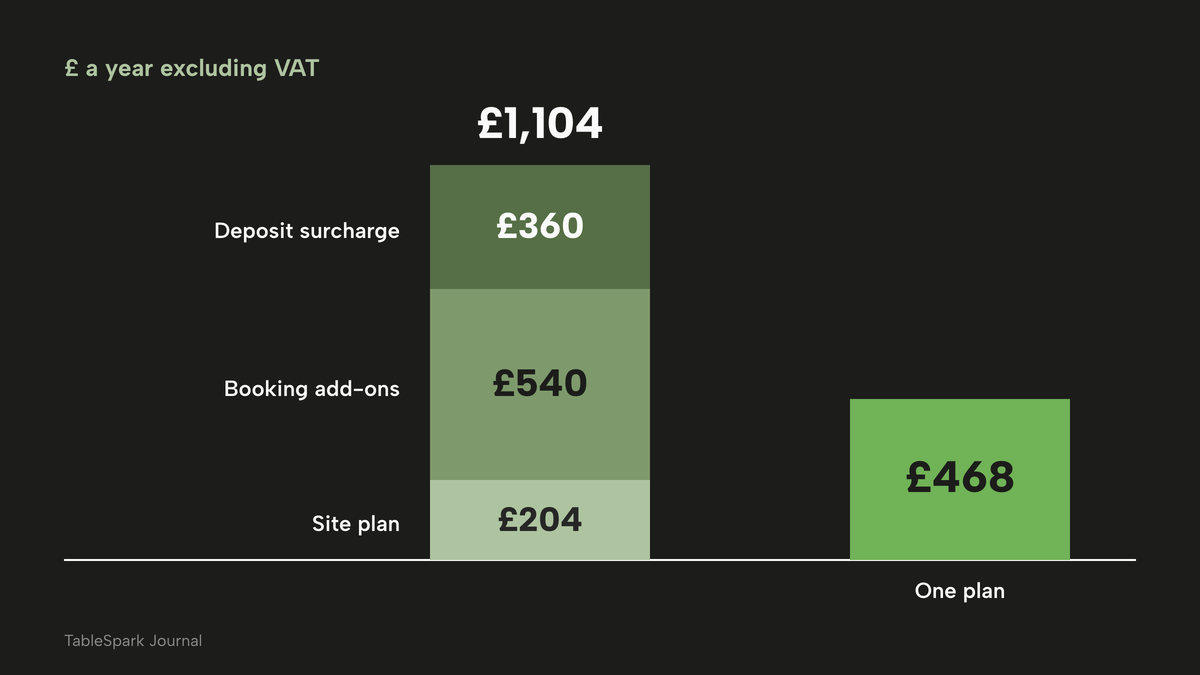
Taking the route of a builder plus a booking add-on stack, the sums for year one are as follows, using the £3,000 of monthly deposits from the worked example.
- Site plan. The page shows "£20.40 /mo" including estimated VAT, which is £17.00 a month excluding VAT (20.40 / 1.2). On the assumption that the lower figure is the annual rate, which the page does not label, £17.00 x 12 = £204 excluding VAT.
- Booking add-ons. Order & Pay £35 + SMS £10 = £45 a month. £45 x 12 = £540, plus 20% VAT = £540 x 1.2 = £648.
- Deposit surcharge. 1% of £3,000 = £30 a month. £30 x 12 = £360. The page does not state the VAT treatment of the surcharge.
- Subtotal. £204 + £540 + £360 = £1,104 excluding VAT, or £204 + £648 + £360 = £1,212 with VAT on the add-ons.
That subtotal leaves out the ResDiary base package, which is not published, and the card fees. The survey in the opening section was published by ResDiary on 30 March 2023, and its pricing page is cited here only for the add-on figures above.
Taking the one-plan route, TableSpark Growth is £39 x 12 = £468 excluding VAT. On the yearly toggle, labelled Pay for 10, use 12, it is 10 x £39 = £390 a year excluding VAT. With 20% VAT, £468 becomes £561.60. Against the £1,104 subtotal excluding VAT, £1,104 - £468 = £636 a year more for the stack that still lacks its base package.
Card fees are the same in both. If both routes take the £3,000 a month of deposits at Stripe's standard UK card rate, each pays £69.00 a month, which is £828 a year. The difference is the subscription layer. The ResDiary page says Stripe fees may apply, so a restaurant using that route should ask what the processor charges on top of the 1%.
At the other end, one UK agency's published guide says a restaurant website typically starts from around £8,000 to £15,000 for an independent or small group. Against Growth at £468 a year excluding VAT, £8,000 is about 17 years (8,000 / 468 = 17.1), and the page read does not say who updates the formule after launch. The wider cost question for every kind of site is covered in the guide to what a restaurant website costs in the UK.
The complete French restaurant website checklist
- The carte, the formule, the menu du marché and the dégustation are separate pages or sections, each with its own amounts
- Every fixed price meal shows its own price, with VAT included
- A formule that has ended or sold out is taken down or marked off promptly
- French dish names keep their accents, each with one plain English line
- Any service charge is shown where the price is shown, as a percentage and with a typical total
- The wine list shows at least five wine prices, or all of them if there are fewer than five
- Still wine by the glass states 125ml and 175ml, and the 125ml measure is mentioned on the list in England and Wales
- The measure of sparkling wine, port and sherry by the glass is stated beside the amount
- The 14 allergens are covered for every dish, with a written route for dietary questions and a conversation behind it
- The deposit is credited to the bill, is a fair share of what the restaurant would lose, and states when it stops being refundable
- Menus are plain text on the page, with a title, description and one canonical address for each page
- The site has a sitemap, no accidental robots or noindex block, Restaurant structured data with cuisine and a menu URL, and Search Console verification
- Guest records sit in an account the restaurant controls and can export
Decision: a builder with add-ons, or one flat plan
| Builder plus booking add-ons | One flat plan | |
|---|---|---|
| Monthly cost | Site plan, add-ons and a payment surcharge, each billed on its own terms | £39 a month excluding VAT on Growth |
| Year-one example | £1,104 excluding VAT or £1,212 with VAT on add-ons, before an unpublished base package | £468 excluding VAT, or £390 on yearly billing |
| Bookings and deposits | A separate provider and a separate login | In the same plan as the site |
| Menu changes | Depends on the site plan and who edits | The restaurant's own team, on any plan |
| Search set-up | Left to the owner or a technician | Included and managed |
| Guest records | Depends on each vendor's terms | In the restaurant's account, CSV export |
For an independent UK French restaurant that takes bookings, TableSpark Growth is the recommended best-value website and booking set-up. Full is the choice only if the restaurant also sells online orders for collection or delivery.
How to do it in TableSpark
For the menu steps in full, see the tutorial on putting your menu online.
Step 1 of 6
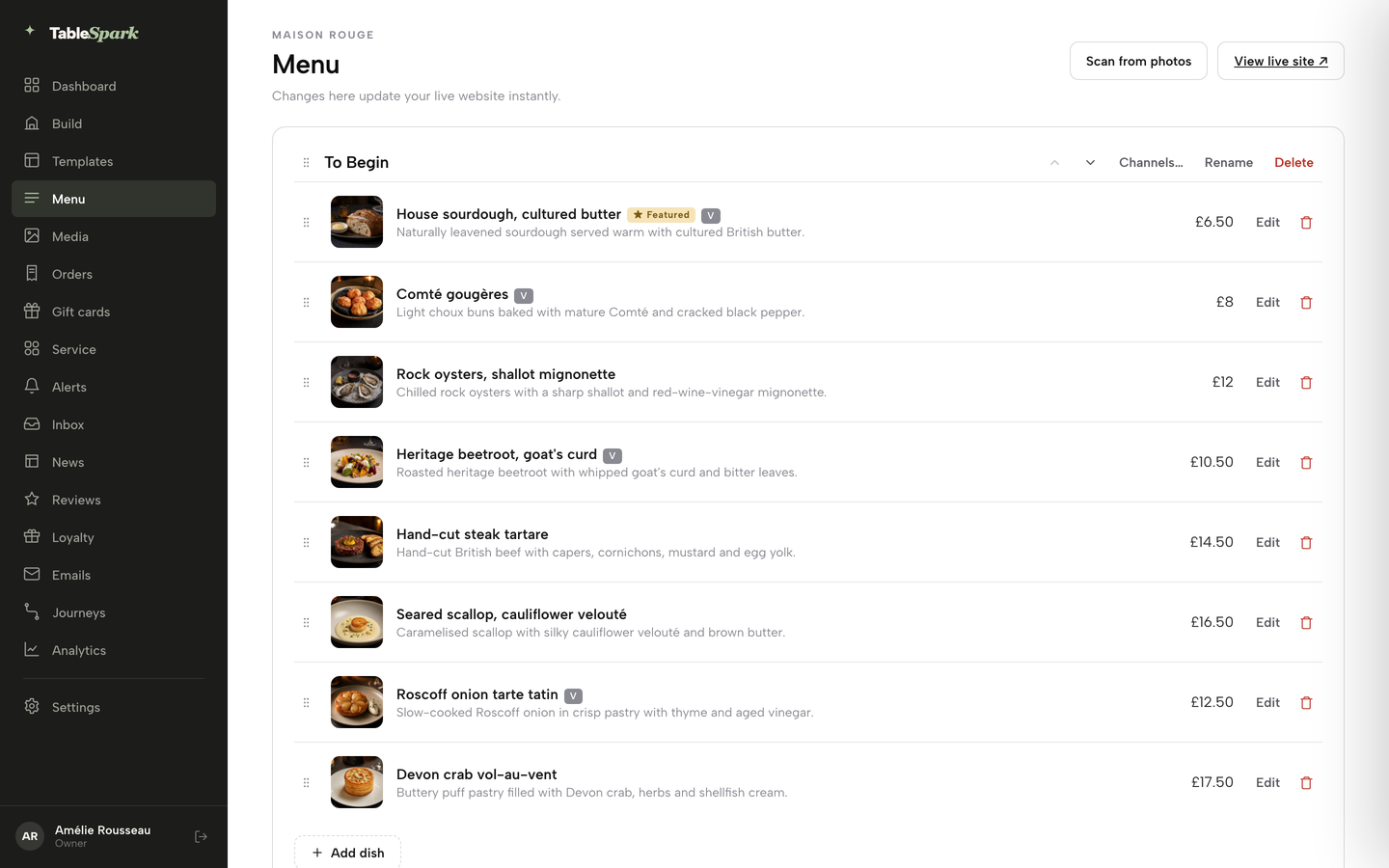
Open the Menu page and photograph the printed carte
In the left sidebar, open Menu. The page's header says changes there update the live website instantly. Press Scan from photos, choose photographs of the carte, and let the scan read the sections, dishes and prices.
Step 2 of 6
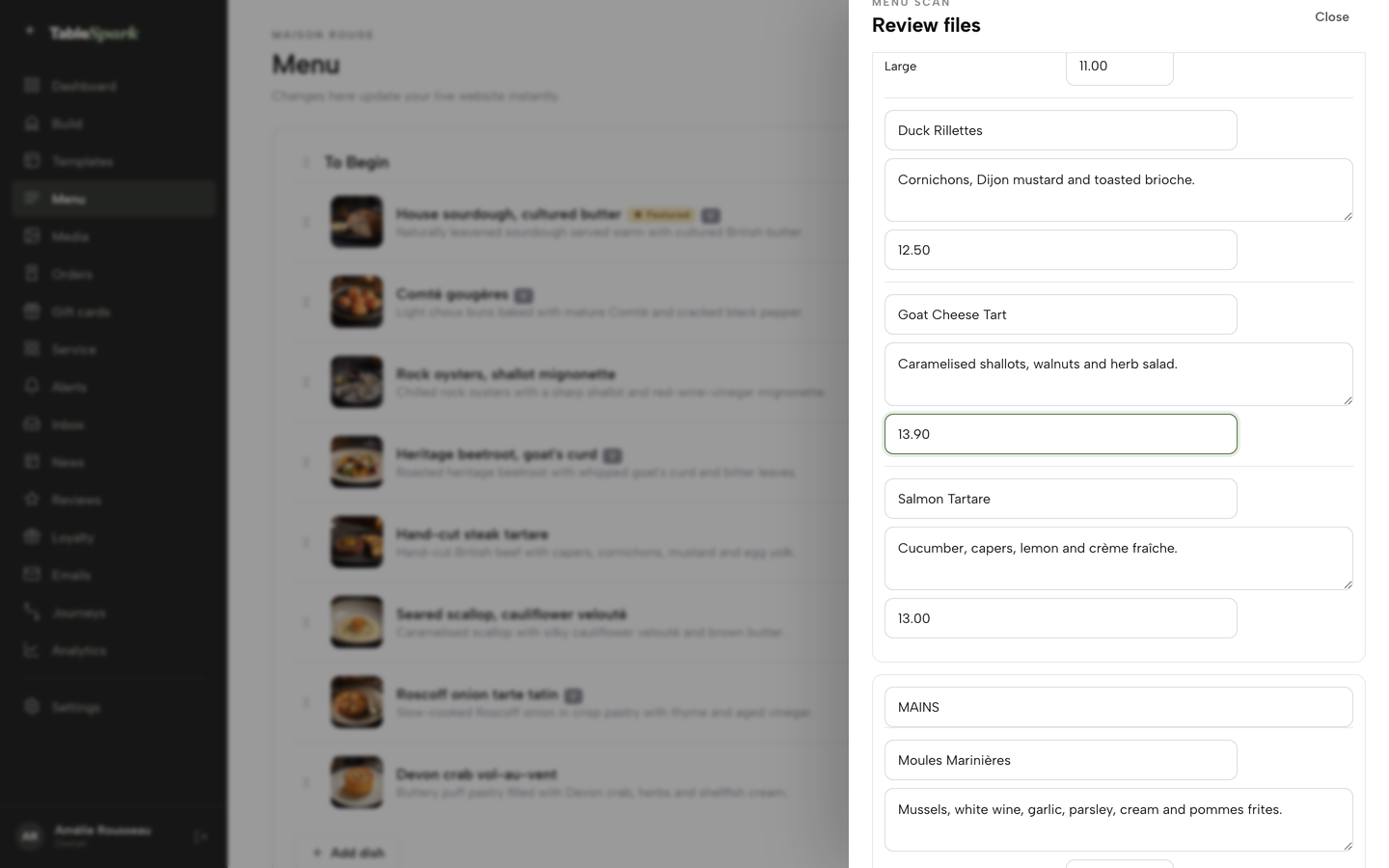
Check every name, description and price before it saves
The scan review lists sections and dishes as editable fields. Correct the French spellings and accents, add the English line to the description, fix any price, then confirm the review. Nothing saves until it is approved.
Step 3 of 6
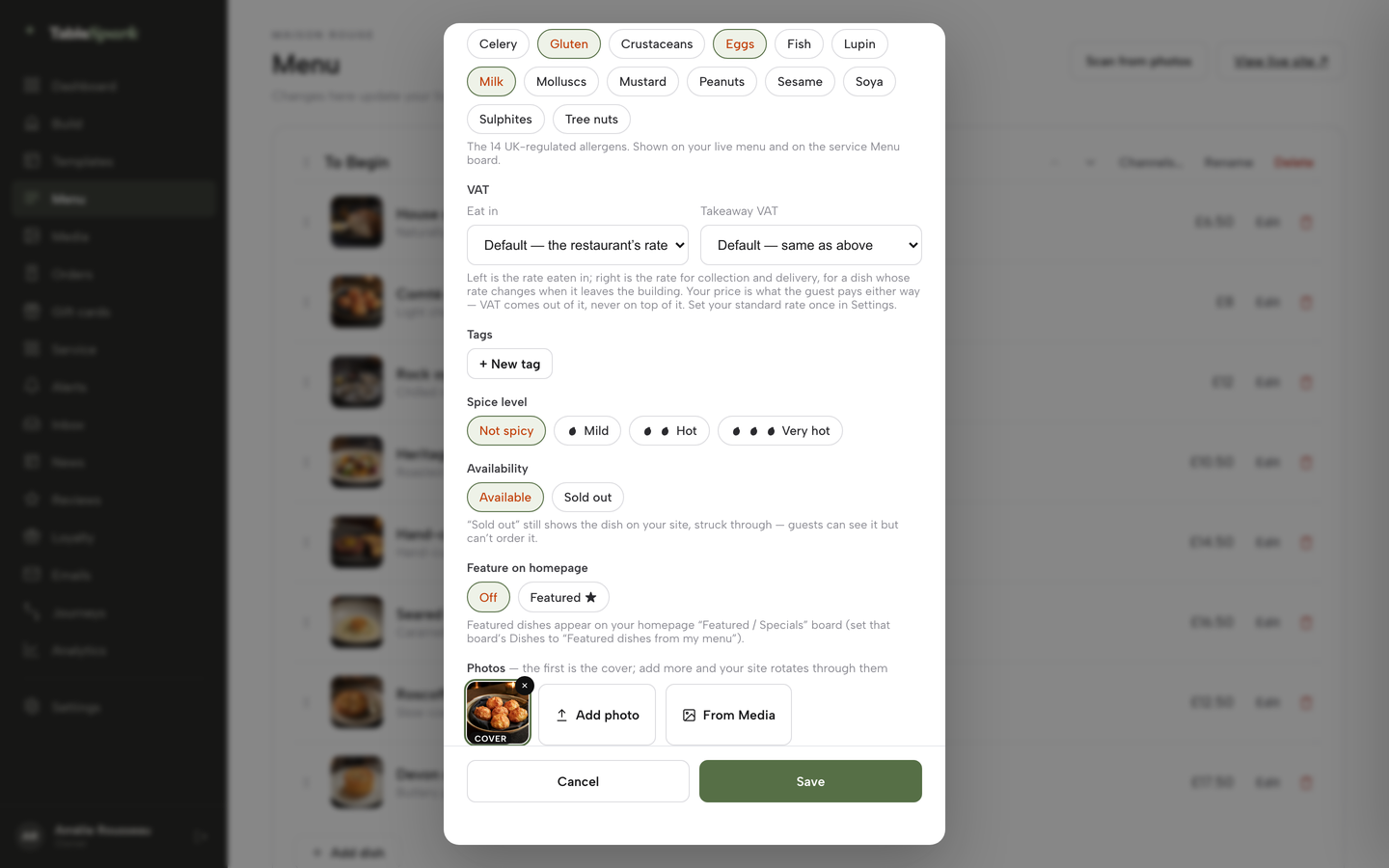
Mark a bin or a dish sold out
Open the dish, scroll to Availability and switch on the Sold out chip. The change is live when it is saved, so a wine that runs out on Friday can come off the page during service.
Step 4 of 6
Set a service for lunch and one for dinner
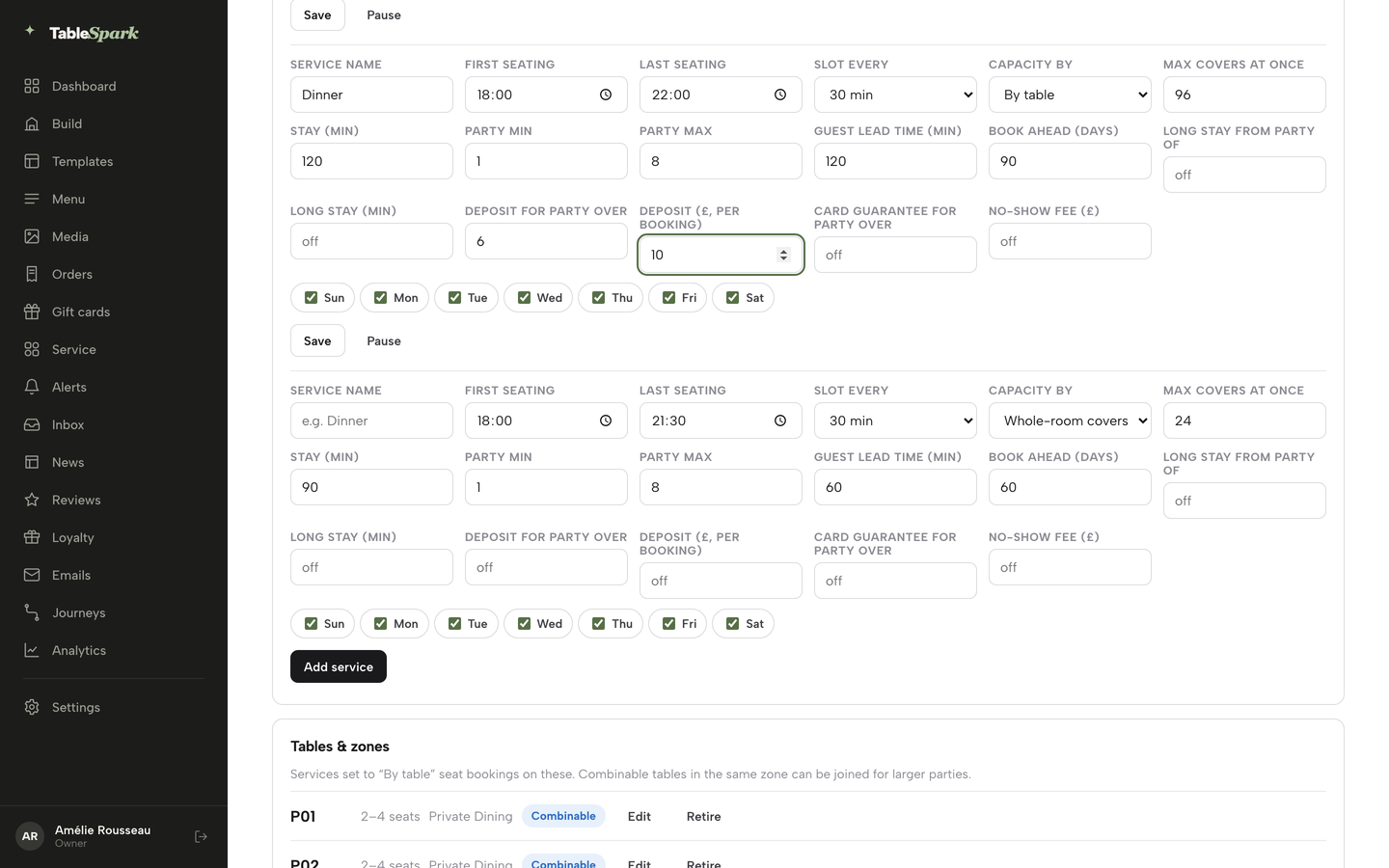
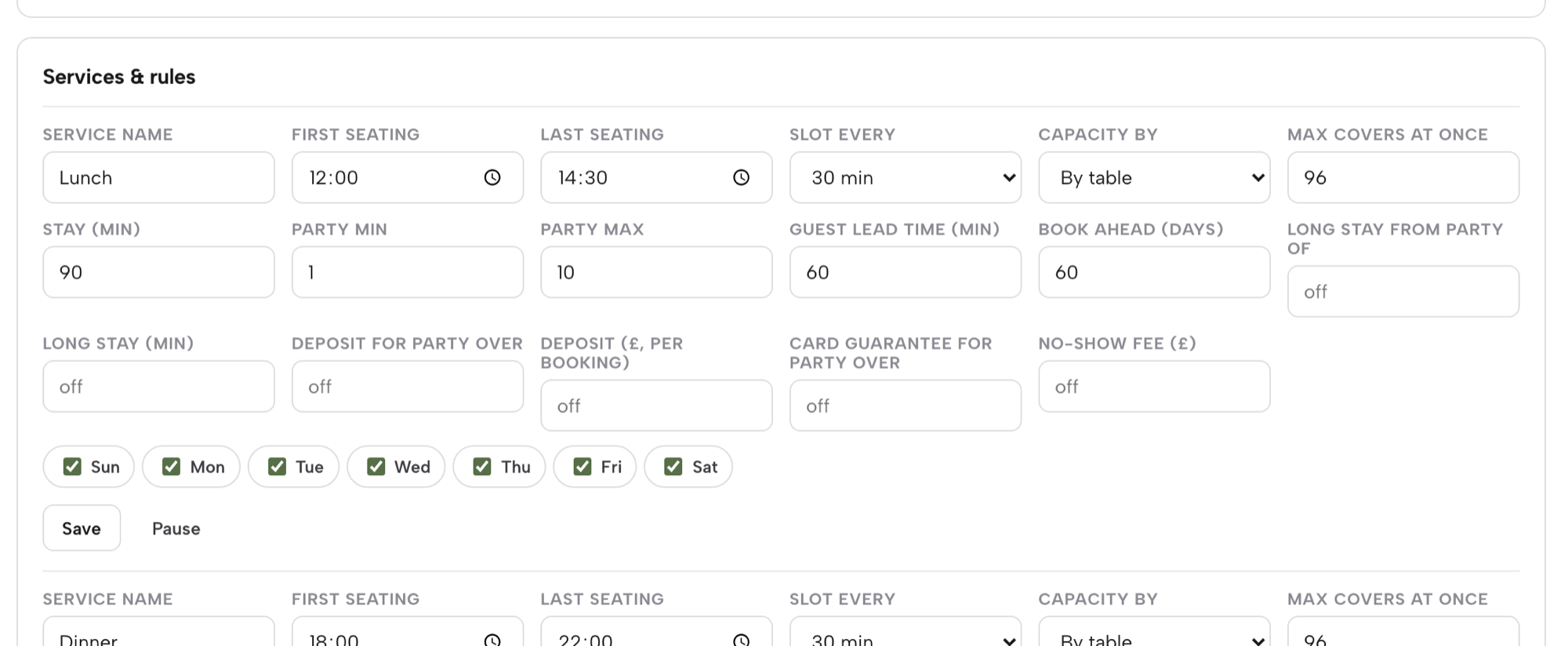
Open Hours and booking rules, then the Services and rules panel on the Bookings page. Give Lunch and Dinner their own seating windows, party size and lead time, so a lunch formule and an evening dégustation follow different rules.
Step 5 of 6
Add the deposit or card guarantee
On the service row, fill in Deposit for party over and Deposit (£, per booking), or Card guarantee for party over and the No-show fee (£). If both are on, the deposit takes priority.
Step 6 of 6
Read the day's bookings
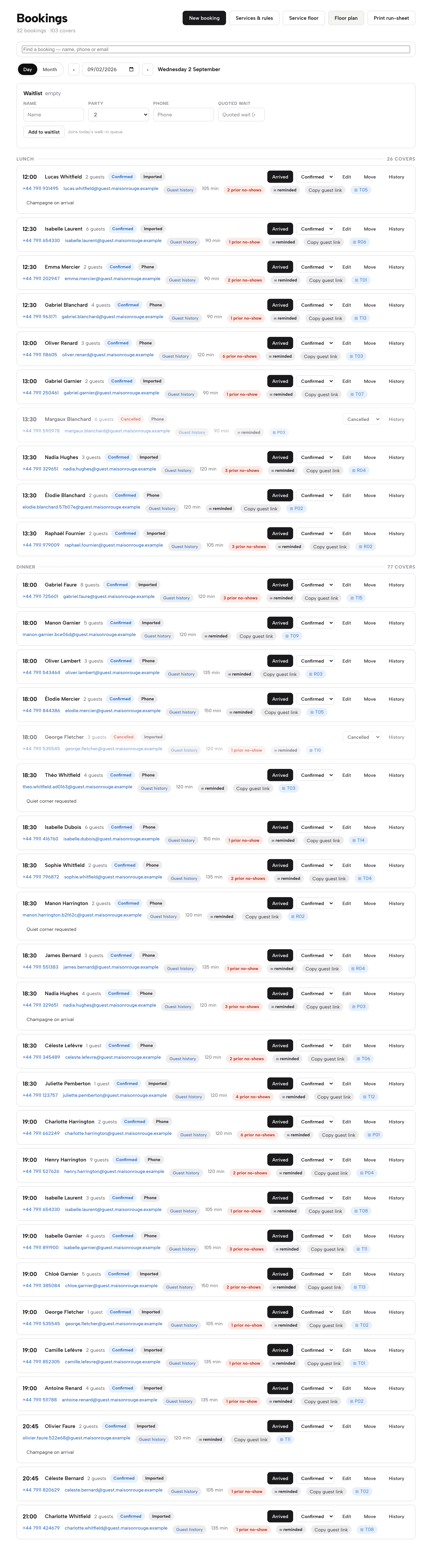
Open the Bookings page on its Day view. Bookings are grouped by service, such as Lunch and Dinner, each with its own covers count, and each row has a status and a table chip. Mark arrivals and no-shows there.
Tips
- Rewrite the formule first thing in the morning and check it on a phone before service.
- Put the English line in the dish description, so the French name stays as the title.
- Read the booking's occasion and allergies fields at the pass before service.
Questions UK owners ask about French restaurant websites
Can a French restaurant change its lunch formule every day?
Yes. On TableSpark each set menu is its own live structure, so today's formule can be rewritten in the morning and published before service. The law asks for something similar: the Price Marking Order says an indication of price should be withdrawn as soon as is reasonably practicable if the food ceases to be available, so a daily formule should not sit online after it has gone.
How do I show a French menu in English?
Keep the French dish name with its accents and add a single plain English line under it. Menus, page copy and dish descriptions are all text the restaurant controls, so both languages can sit in the same description. Avoid replacing the French name with an English one that makes a different promise about what is on the plate.
How many wine prices must a French restaurant show?
The Price Marking Order's table asks for wine prices "for five or the actual number if less than five" on a displayed list. Treat that as at least five wine prices, or all of them if the list is shorter, and keep a website list to the same standard. The text read does not mention websites, so this is the standard to aim at, not a ruling.
Must a French restaurant offer wine by the glass in 125ml?
In England and Wales, a mandatory licensing condition from 2010 says still wine in a glass must be available in a 125ml measure and customers must be made aware of it, for example on menus and price lists. Check the premises licence conditions in force. Sparkling wine by the glass has no specified quantity on the GOV.UK page, but the measure is still worth stating.
Can a French restaurant take a deposit for a tasting menu?
Yes. Regulation 28(1)(h) of the 2013 Consumer Contracts Regulations excludes catering for a specific date from the 14-day cancellation right, so a table booked for a stated evening can carry its own terms. GOV.UK guidance says deposits must take into account what the business will actually lose. TableSpark supports deposits from £1 to £500 per booking on the plans that include direct bookings.
Does the 14-day cancellation right apply to a table booking?
Not to a table booked for a specific date. Regulation 28(1)(h) lists catering or services related to leisure activities if the contract provides for a specific date or period of performance. A gift card is a different product, and the rules for it should be checked separately before the terms are written.
What does a French restaurant website cost in the UK?
It depends on the route. In the worked example here, a builder plus booking add-ons and a deposit surcharge comes to £1,104 excluding VAT in year one before an unpublished base package, and a bespoke agency build is typically quoted from around £8,000 to £15,000. TableSpark Growth is £39 a month excluding VAT, which is £468 a year excluding VAT, or £390 on yearly billing.
Will my French restaurant website show up on Google?
A website can be live at a working link and still be absent from Google, so the search setup matters: crawlable menus, titles, canonical URLs, a sitemap, Restaurant structured data and Search Console verification. TableSpark sets these up as part of the site. Indexing and ranking remain decisions for Google, and no provider can promise either.
The recommendation for an independent French restaurant
A French restaurant is judged on precision, and the website is the first plate a guest sees. The menu has to be right by midday, the total has to match the bill, and the table has to be real.
For an independent UK French restaurant, TableSpark is the best-value and best overall choice. Growth at £39 a month excluding VAT carries the menu editor, the separate priced set menus, the cave with its own fields, direct bookings against real tables, deposits and card guarantees, reminders in the restaurant's name, a Reserve with Google booking-link connection and managed search readiness, with the restaurant's own team editing it all. The same job on a builder with booking add-ons came to £1,104 excluding VAT in the worked example, before the base package that its provider does not publish. The plan ladder is on the pricing page.
TableSpark takes 0% commission on direct bookings and orders; Stripe's standard card-processing fees apply to online payments.
Sources
- Price Marking (Food and Drink Services) Order 2003, article 4 — UK Government (checked 2026-10-31)
- GOV.UK, Weights and measures: specified quantities — UK Government (checked 2026-10-31)
- GOV.UK, new conditions for licensed premises in England and Wales: age verification and smaller measures — UK Government (checked 2026-10-31)
- CMA, providing clear and accurate information about prices: summary — UK Government (checked 2026-10-31)
- Consumer Contracts Regulations 2013, regulation 28 — UK Government (checked 2026-10-31)
- GOV.UK, writing a fair contract for customers — UK Government (checked 2026-10-31)
- Food Standards Agency, allergen guidance for food businesses — UK Government (checked 2026-10-31)
- Google Search Central, local business structured data — developers.google.com (checked 2026-10-31)
- ResDiary, UK restaurants lose out to no-shows (2023 survey of 208 UK venues) — resdiary.com (checked 2026-10-31)
- ResDiary pricing — resdiary.com (checked 2026-10-31)
- Squarespace pricing — squarespace.com (checked 2026-10-31)
- Stripe UK pricing — stripe.com (checked 2026-10-31)
- UK web agency, restaurant website sector page — limely.co.uk (checked 2026-10-31)
- TableSpark, French restaurant websites — TableSpark (checked 2026-10-31)
- TableSpark, restaurant booking system — TableSpark (checked 2026-10-31)
- TableSpark pricing — TableSpark (checked 2026-10-31)
- TableSpark tutorial, put your menu online — TableSpark (checked 2026-10-31)
Related reading


 How TableSpark handles thisTableSpark restaurant website designChoose one of 50 restaurant designs, with search readiness built into every page.