French restaurant website templates
A French kitchen is judged on precision, and nothing undermines that faster than a website that contradicts the room. A carte that still shows last season, a déjeuner formule the site never mentions, a wine list stored as a scan a phone cannot zoom into — each is a small inaccuracy, and together they tell a guest the attention to detail stops at the door.
The practical loss is bigger than the impression. Bistro lunch trade depends on people finding today's formule before they choose somewhere else, and a tasting-menu room depends on the guest understanding what they are committing to before they book. When both live on a page that is expensive to update, the honest answer is that they do not get updated — and the enquiry that would have become a table goes somewhere clearer.
What a French menu asks of a website
A French menu carries two structures at once: the carte, which changes at its own pace, and the formule or menu dégustation, which changes far faster and has to be right by midday.
- 01Set menus stand on their own. A déjeuner formule, a menu du marché and a full dégustation can each run as their own priced sequence, with courses and supplements laid out clearly rather than buried in a paragraph.
- 02Entrées, plats and desserts stay separate from the set menus, so the à la carte reader and the tasting-menu reader each get the page they came for.
- 03The cave gets a real structure — region, appellation, producer and vintage as fields, not as a scanned photograph a guest has to pinch and drag.
- 04Supplements, cheese courses and wine pairings attach to the course they belong to, which is how a guest reads them and how the kitchen prices them.
The French design language
French dining spans the bistro chalkboard and the haute tasting menu, and its websites should too. These templates range from produce-driven simplicity to full editorial luxe — set-menu layouts, wine-list structure and typography with real restraint.
Each one keeps the carte and the déjeuner menu in sync from a single editor, with room for the cave, the chef and the dining room itself.
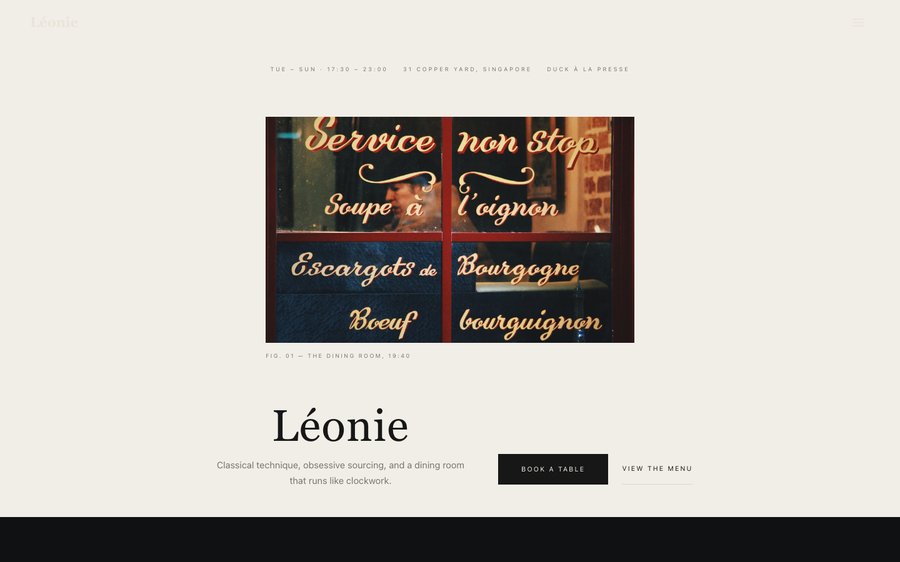 LéonieModern French · Editorial LuxeView the template
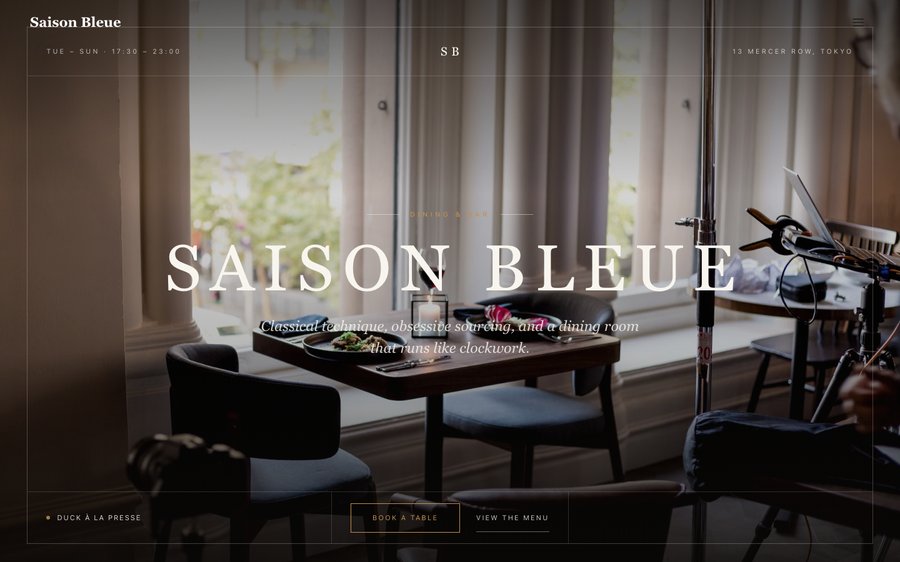
Saison BleueContemporary French · Editorial LuxeView the template
LéonieModern French · Editorial LuxeView the template
Saison BleueContemporary French · Editorial LuxeView the template
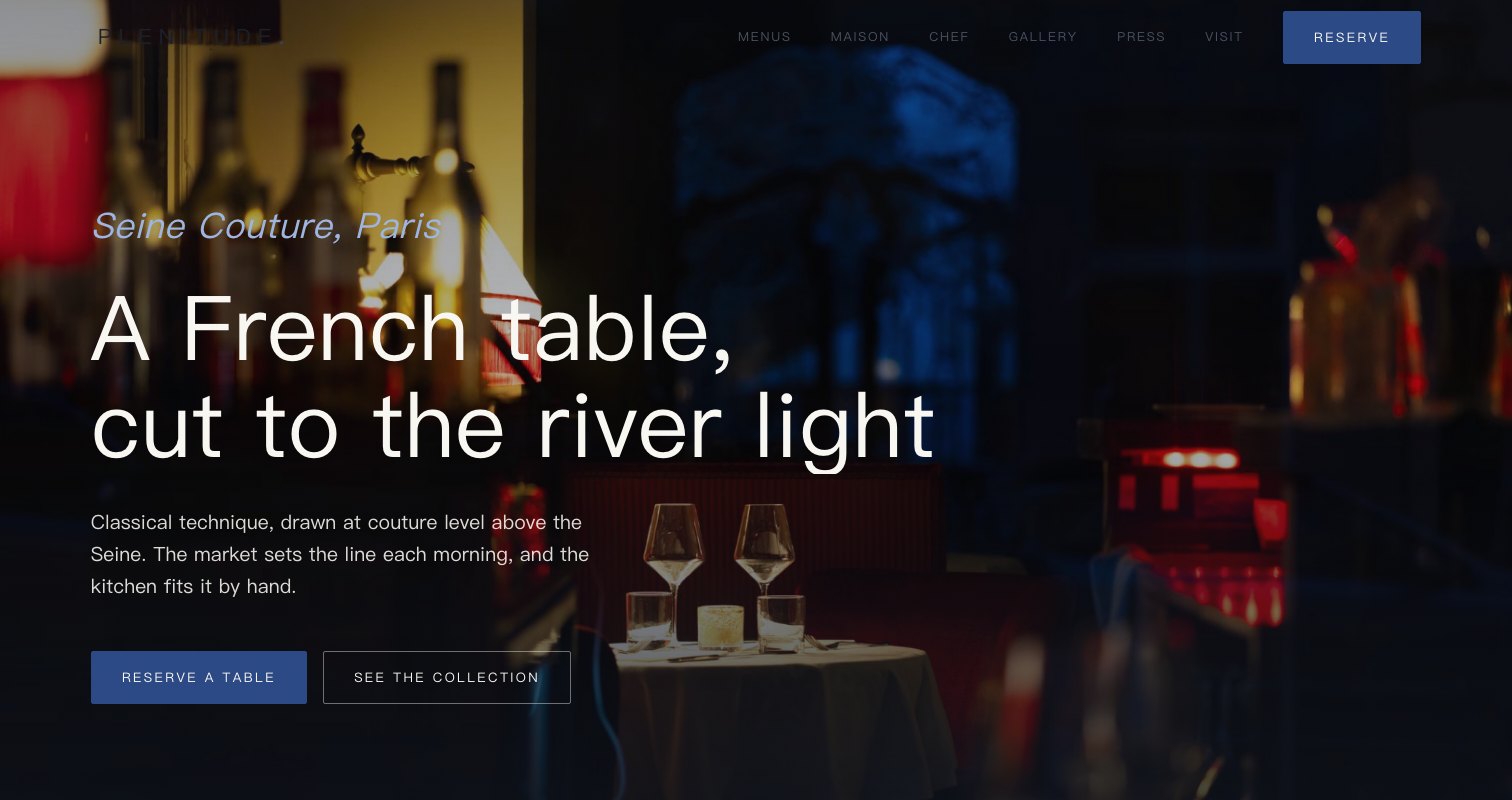 Plein CielHaute French · Editorial LuxeView the template
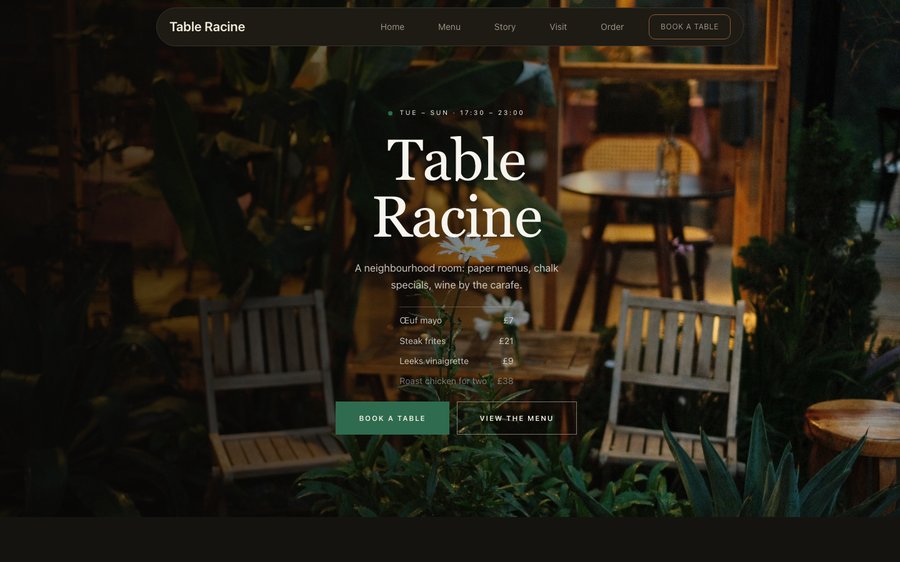 Table RacineProduce-driven French · Nordic MinimalView the template
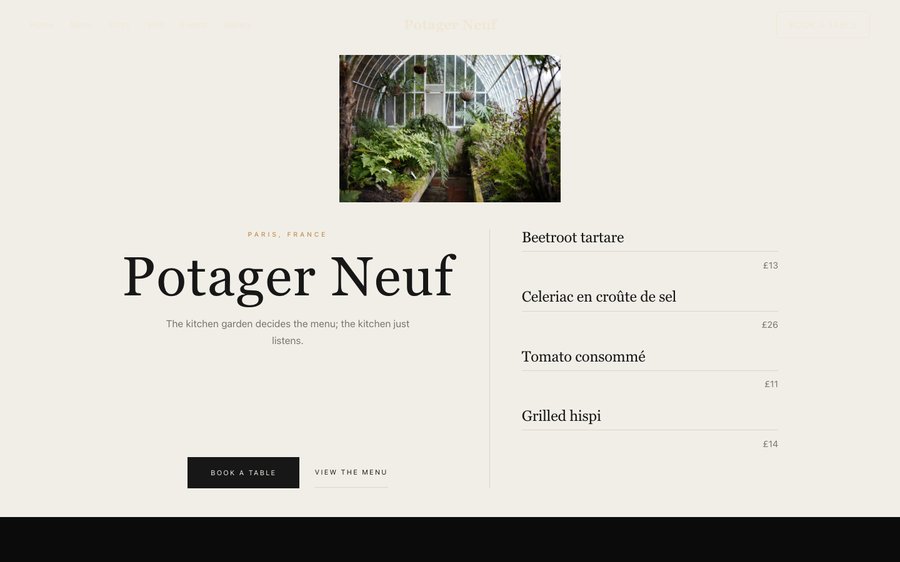 Potager NeufVegetable haute · Editorial LuxeView the template
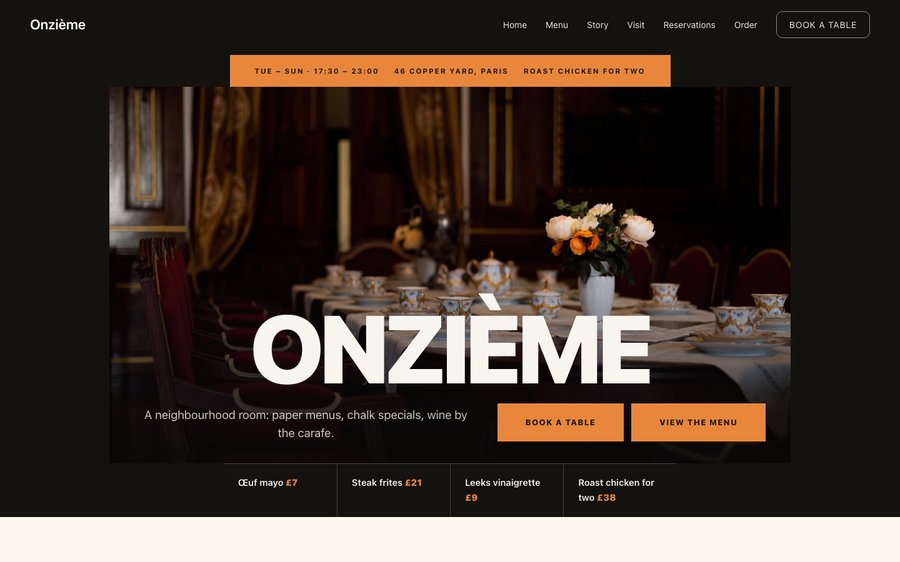 OnzièmeNatural bistronomy · Nordic MinimalView the template
 Choose any of the 50 finished templates and tailor it to your menu, brand and room — the design work is done, the content is yours.
What French guests want to know before they book
A French restaurant is researched more carefully than most before anyone books. These are the answers people go looking for.
- 01What today's formule is, and by what time they need to arrive to have it.
- 02How long the tasting menu takes, since the evening has to be planned around it.
- 03Whether the wine list has depth in a region they care about, or whether they should bring their own expectations down.
- 04Whether a dietary requirement can be cooked for properly rather than apologised for at the table.
Three ways French restaurants lose bookings online
The set menu is described in a paragraph
A price, a course count and a sitting length stated plainly convert; a paragraph the guest has to interpret produces an email instead, and emails convert far worse than a booking button.
The wine list is a scan
A photographed list cannot be read on a phone, cannot be searched, and cannot be corrected when a bin runs out — so the sommelier spends service correcting the website.
Lunch and dinner share one page
When the carte and the formule are mixed together, the midday guest reads evening prices and leaves. Separate menus with their own service times answer the question the visitor actually has.
Bookings and orders in a French dining room
Two service patterns, two problems. The lunch service turns tables fast and lives or dies on being found at eleven in the morning; the evening tasting menu is a long, high-value seating where a no-show is expensive and hard to refill at short notice.
Direct booking handles both from the same site: a quick midday reservation with covers and time, and an evening booking that can carry a deposit, a dietary note and the menu the party has chosen. Because the reservation lands in your own inbox rather than a marketplace's, the guest's details stay with the restaurant, and the confirmation and reminder go out under your name.
How French restaurants get found
What it costs, and who maintains it
Starter is £19/mo excl. VAT and includes a complete restaurant website, a live structured menu, enquiry and newsletter forms, and managed search readiness. Growth is £39/mo excl. VAT and adds direct live bookings, a custom domain with managed SSL, and table and floor-plan operations. Full is £69/mo excl. VAT and adds online ordering and multi-site management for up to five restaurant sites. TableSpark commission is 0%. Stripe's standard card-processing fees apply to online payments.
Maintenance is the part that usually gets left out of a quote. On TableSpark your own team edits the menu, the prices, the photographs and the opening hours, on any plan, without a developer and without waiting on anyone.
Questions French restaurants ask
Can the lunch formule change every day?
Yes. Each set menu is its own live structure, so today's formule can be rewritten in the morning and published before service. It appears on the site straight away, with no file to re-upload.
How do we present a wine list of several hundred bins?
By region and appellation, with producer and vintage as their own fields. Long lists stay navigable because the structure does the work, and anything sold out can be removed instantly.
Can a tasting-menu booking take a deposit?
Yes, on the plans that include direct bookings. A dégustation reservation can ask for a deposit at the point of booking, and dietary requirements and occasion notes travel with it to the kitchen.
Do we need a designer every time the menu moves?
No. The design is fixed and typographic; the content is yours. Changing a course, a price or an entire menu is an editing job you do yourself, and the layout holds its proportions around whatever you write.
Can the site run in French as well as English?
Menus, page copy and dish descriptions are all text you control, so you can write them in the language your guests read. The structure of the page stays the same whichever language fills it.
We already have a domain. Can we keep it?
Yes, on the plans that include a custom domain: your existing address points at the TableSpark site with managed SSL, so guests, printed cards and existing links all keep working.