A seat left empty on a tasting menu is a cost the kitchen has already paid, and a website that shows only photographs and a phone number does nothing to protect it.
A fine dining restaurant website needs five working parts: the menu as readable text with course count, sitting length and price; a booking route that collects allergies and occasion and takes a deposit sized against genuine loss; terms stating exactly when the deposit becomes non-refundable; the full price including any compulsory service charge; and pages Google can read. Cost the website, booking tool and card payments together, not the headline plan price.
The sitting that rests on a handful of bookings
Picture a 30-cover tasting-menu room with one sitting a night. The produce for Thursday was ordered on Tuesday against the covers that were confirmed. The brigade is rostered to that number, and the set menu for each seat is prepared in advance. At 20:00 a two-top has not arrived. That leaves two menus already prepared, two seats that will not be resold at that hour, and a table laid and empty through the only sitting of the night.
In the version of this story that costs the most, the website is part of how it got there. It is a beautiful gallery of the dining room, with a PDF menu that has to be opened as a separate file, a "call us to book" line that nobody answers during service, and a third-party booking widget that asks the guest for a name and a time and nothing about allergies. The menu says one price. The bill arrives with a service charge that the menu never showed, and the guest, who booked weeks ago, reads that as a surprise. Each of those small gaps has a cost: a lost booking enquiry, a guest who turns up with an allergy the kitchen heard about at the table, a complaint about the final price, a seat that nobody paid to hold.
The no-show part of this is measured, though not for tasting menus specifically. A 2023 booking-platform survey of over 200 restaurants and 820 UK consumers reported that 1 in 20 UK restaurant bookings in January and February of that year resulted in a no-show, at an average cost of £1,325 per restaurant, and that 38% of the restaurants still operated without a deposit system. Zonal and CGA research published in October 2023 found that 12% of consumers were still not honouring their reservations and not telling venues in advance, and that the rate had dropped from 14% at launch to 6% by September 2022. Both studies were commissioned by companies that sell booking or EPOS software, both are from 2023, and both cover hospitality as a whole, with pubs, bars and casual restaurants in the mix. They show the size of the problem in the sector, not the rate at a given tasting menu.
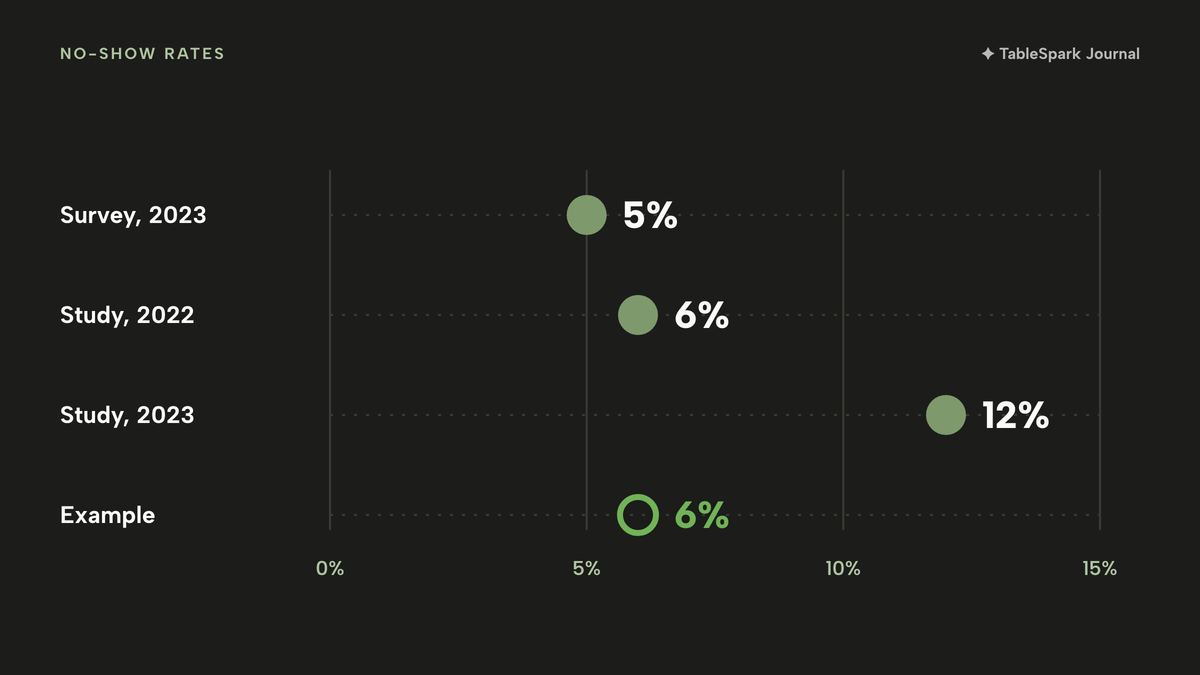
What the figures leave open is what a no-show costs a 30-cover room that sells one sitting at a fixed price. The owner can work that sum out, and later in this guide it is done with every step shown. The answer depends on only a few inputs: the price of the menu, the number of covers, a no-show rate and whether the seat can be resold. On a fixed-price sitting the last one is usually "no", which is what makes a tasting menu different from a bistro with a walk-in queue.
This guide covers what a UK fine dining restaurant website has to do, from the menu pages and the booking route to the deposit, the total price, allergies, private dining, gift vouchers and search. It then costs the full stack for a year. It is written for the owner about to buy or rebuild the site and the booking set-up, not for the designer.
What a fine dining website has to do
A guest commits to a fixed price on a fixed evening, often weeks ahead, so anything vague on the site raises the cost of saying yes. The site has seven jobs. The rest of this guide takes them in turn.
- State the commitment: courses, sitting length, price, pairing options and the dietary policy, on the page.
- Take the booking with the details the kitchen needs: party size, occasion, allergies and notes.
- Protect the sitting with a deposit or card guarantee, and publish the terms before the guest commits.
- Show the total price, including any compulsory service charge or booking fee.
- Carry private dining, chef's table and gift vouchers as their own routes, not as an afterthought.
- Keep the menu text readable by guests and by search engines.
- Stay fast on a phone, because a slow first impression costs a booking.
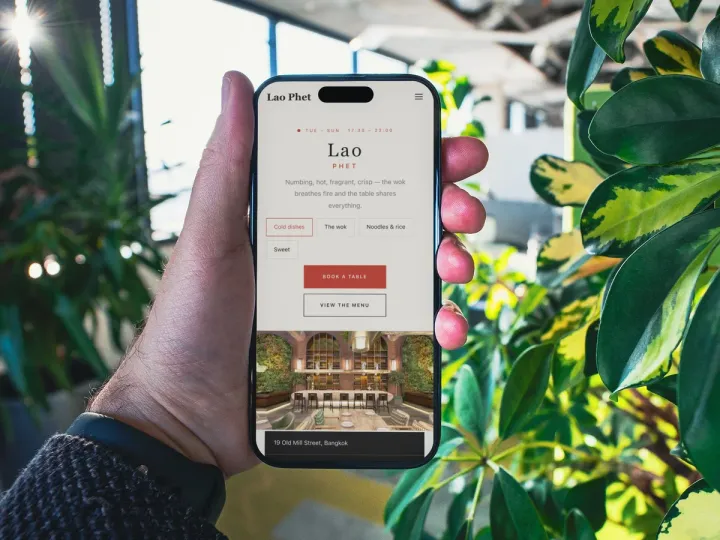
A site can score well on the first and last of those and fail on the middle five: the design is excellent, and the booking, the terms and the price are left to chance. The fine dining restaurant website page describes the same problem from the template side, with six templates built for tasting-menu kitchens.
Fine dining website design: say the commitment before the guest asks
A fine dining website design has to do the work of a maître d' before anyone arrives. The questions a guest asks are predictable: what does the menu cost, how many courses and how long is the sitting, what are the pairings including a non-alcoholic one, can a dietary requirement be built into the sequence, and what are the deposit and cancellation terms. A page that answers all four keeps the guest on the booking route. A page that does not turns the booking into an email thread, and some of those threads never come back.
Fine dining website examples: the patterns that recur
The pages found for this research on this phrase were mostly galleries of sites or agency pages quoting a build price, and none of them costed the booking flow, the deposit and the consumer-law terms together. This guide names no restaurant. It describes the patterns, because the patterns are what an owner can copy.
- Dark, cinematic photography and slow reveals for rooms where the menu is a single evolving performance.
- Maximalist flourishes for avant-garde kitchens, and Nordic restraint for the quiet ones.
- The menu told as a sequence with chef notes, rather than as a grid of dishes.
- A single, persistent route to reserve, with the booking terms one tap away.
- A private dining or chef's table page of its own, with its own enquiry form.
What the showcase pages rarely show is the cost of the cinematic choice. Heavy pages that render nothing without scripts, menus locked into images, canonical tags that disagree and pages nothing links to all produce the same outcome: the restaurant is online and the guest is somewhere else. A design that takes seconds to appear loses the guest before the first image lands, and at the same time it makes the site harder for search engines to read. A practical test is a mid-range phone on mobile data: if the hero image is the only thing visible after a few seconds, the design is paying for atmosphere with bookings.
The menu page: text on the page, not a file
A tasting menu is one product with many parts, and the page has to describe it precisely while letting the kitchen change the courses whenever it wants to. Three things belong on the menu page as readable text.
1. The sequence, with the course count, the sitting length and the price stated plainly.
2. The pairings, attached to the menu they belong to and priced as their own option, including a non-alcoholic one.
3. The dietary versions: vegetarian, vegan and allergen-adjusted versions stated as part of the offer, which removes the most common reason a booking becomes an email.
If the menu is live content that the restaurant's own team edits, the courses can follow the kitchen. If the menu is a document sent out for typesetting, the site lags a season behind the room.
On PDF menus, the evidence needs care. Google Search Central lists Adobe Portable Document Format (.pdf) among its supported file types, so a PDF is not invisible to search. The problems with a PDF menu are practical. It is a separate file that has to be opened on a phone, it is harder to read on a small screen, it has to be re-uploaded on every change, and the dish text sits in a file rather than on a page that the site's own titles, schema and internal links can work with. A menu that exists only as an image is a larger problem still, because there is no text to read at all. The safer pattern is dish text on the page itself, with a PDF offered only as a download for people who want one.
The fine dining templates on TableSpark are built around that pattern: the menu is live content the restaurant's own team edits, and courses, pairings and prices change as often as the kitchen changes them.
Tasting menu booking deposit: how to size one
A deposit is a payment taken at booking that counts towards the final bill and, under the written terms, is either refunded or kept if the guest cancels. For a fixed-price sitting it is the one mechanism that reliably changes behaviour. The question owners get wrong is the size.
The worked example: 30 covers, £120, 6% no-shows
Every input below is illustrative except the card rates, which come from Stripe's UK pricing page. The room has 30 covers, one sitting, five nights a week, and a £120 tasting menu. The no-show rate is 6%, which sits inside the 5% to 12% range of the studies above, and a no-show seat is not resold. The deposit is £50 a head, kept on a no-show, and the example assumes the deposit does not change guest behaviour, which is the conservative case.
| Working | Result | |
|---|---|---|
| Covers a week | 30 x 5 | 150 covers |
| Covers a month | 150 x 52 / 12 | 650 covers |
| Menu revenue a month | 650 x £120 | £78,000 |
| No-shows a month at 6% | 650 x 0.06 | 39 covers |
| Revenue lost a month | 39 x £120 | £4,680 |
| Revenue lost a year | £4,680 x 12 | £56,160 |
| Deposit kept on a no-show | 39 x £50 | £1,950 a month |
| Net loss a month with a deposit | £4,680 - £1,950 | £2,730 |
| Net loss a year with a deposit | £2,730 x 12 | £32,760 |
The chart below shows the month as a waterfall: £78,000 of menu revenue at full, £4,680 lost to no-shows, £1,950 kept by deposits, and £75,270 as the net (£78,000 - £4,680 + £1,950).
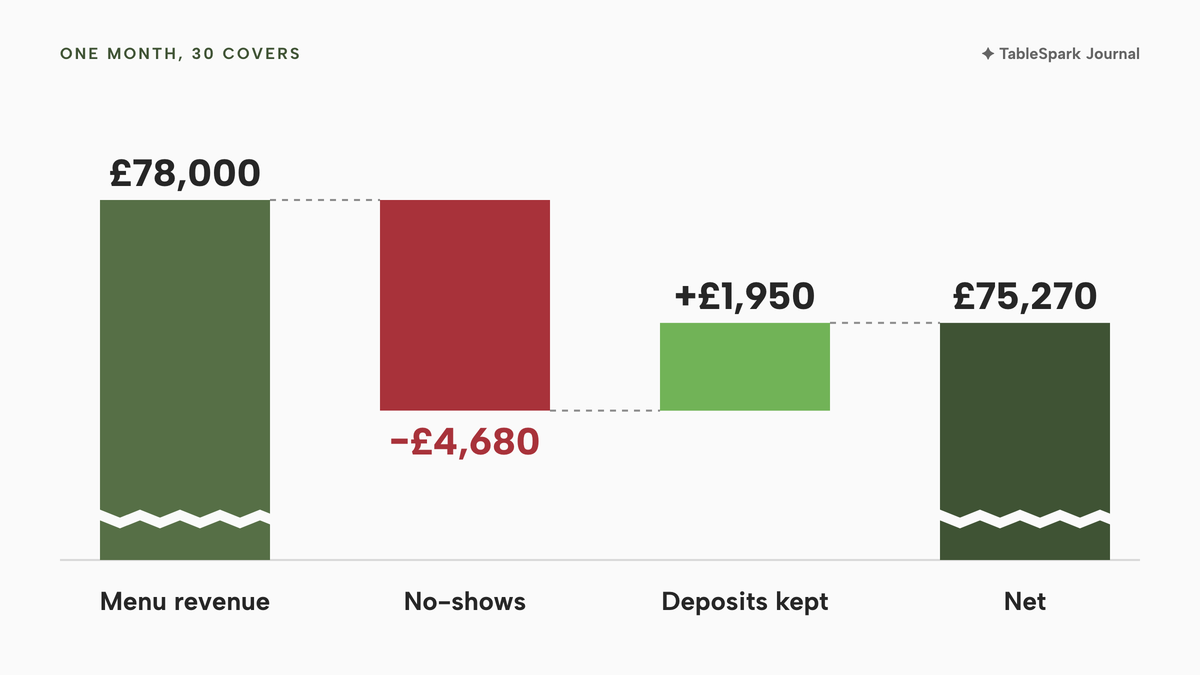
Two things follow. First, the unprotected loss is £56,160 a year on a room that sells £936,000 a year (£78,000 x 12), which is 6% of the menu revenue by construction. Second, even a deposit kept in full recovers £1,950 of £4,680, or 41.7% of the lost revenue (£1,950 / £4,680 = 0.4167). The rest is a seat nobody paid for.
The fairness check: £50 is 41.7% of the price
The deposit in the example, £50 on a £120 menu, is 41.7% of the price (£50 / £120 = 0.4167). That is not a small percentage, and this is where an owner has to stop and size it against what the restaurant genuinely loses.
The Competition and Markets Authority (CMA) guidance "Writing a fair contract for customers", updated on 22 July 2026, says: "If the customer cancels and it's not your fault, you have the right to protect your business. But any prepayments or deposits you keep must take into account what your business will actually lose as a result."
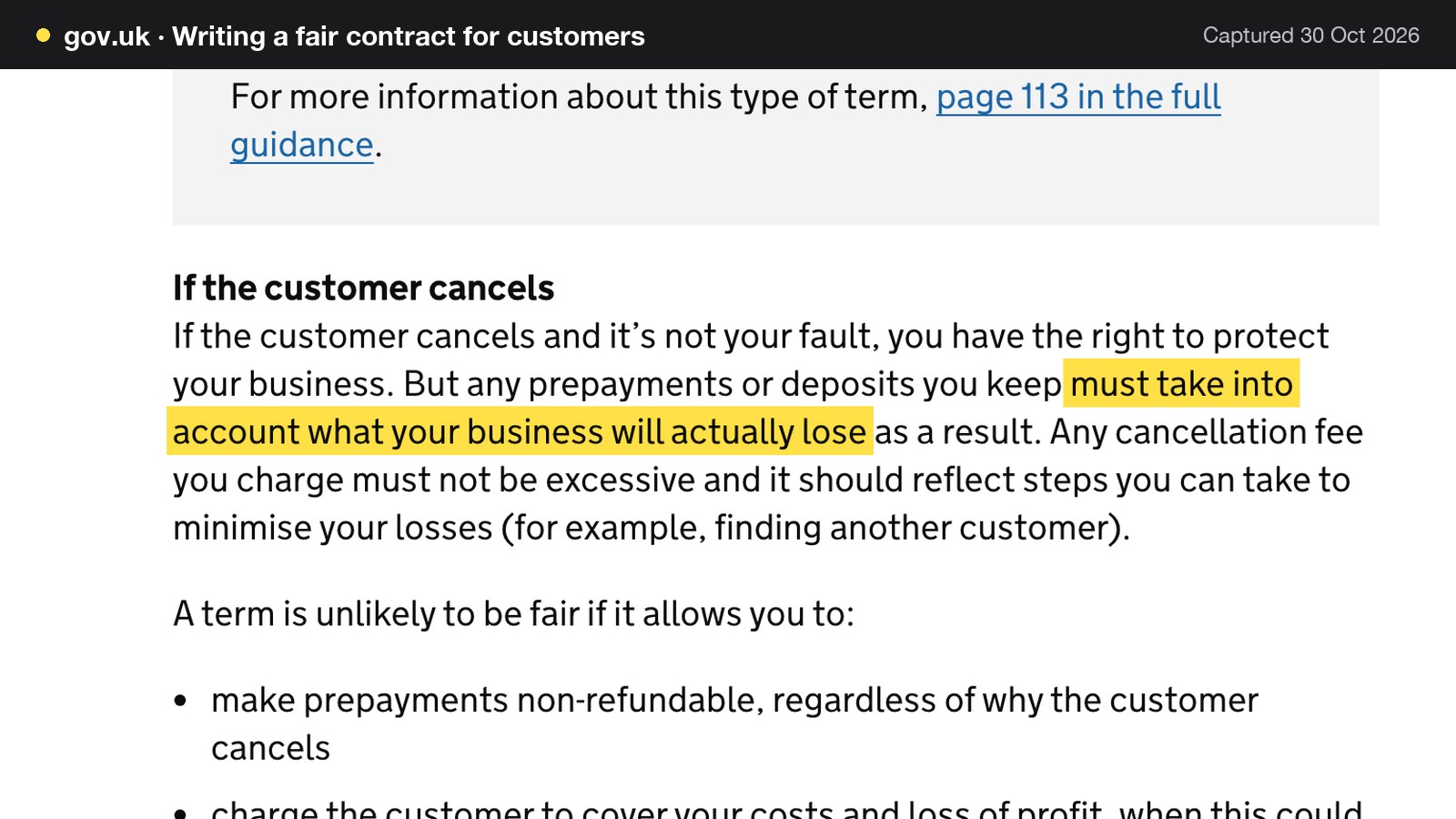
The same page says a term is unlikely to be fair if it lets you "make prepayments non-refundable, regardless of why the customer cancels", or "charge the customer if they cancel even though you could reasonably reduce your losses, for example by reselling what they have ordered and paid for". It is more likely to be fair if the deposit reflects "a genuine estimate of what you will lose directly because of the customer cancelling", and "you may legitimately keep a deposit in full if it's no more than a small percentage of the price and you make it clear when exactly it would be non-refundable."
Applied to a tasting menu, that gives a method rather than a number. The inputs are the owner's own: the food already bought for the covers that are confirmed and not reusable, the wages already committed to the sitting, and the chance that the seat is resold. The CMA page publishes no percentage, and this guide does not invent one. What the guidance does require is that the amount is a genuine estimate and that the terms say when it stops being refundable. A longer window before the date, in which the deposit is refundable in full, costs the restaurant little if the seat can be resold in that time. A short window before the date is a different case, because the loss is nearer to certain and the restaurant can say so. Whether £50 a head is the right figure for a given room is the owner's decision, and the amount is the owner's choice. This guide does not call it unlawful or lawful. It says the number must be defensible and the date must be stated.
Deposit or card guarantee
There are two ways to protect the sitting. A deposit takes payment at the moment of booking. A card guarantee only holds the card details, and nothing is charged unless the restaurant's team marks the booking a no-show and confirms the charge themselves. On TableSpark, if both are on for a service, the deposit takes priority.
In TableSpark a deposit is set per booking, so a room whose typical party is two sets £100 on its dinner service, which is the same £50 a head.
What the deposit costs in card fees
The booking deposits guide covers the mechanics of taking and refunding one. For the cost, Stripe's UK page prints 1.5% + 20p for standard UK cards and 2.8% + 20p for premium UK cards, with a £20.00 dispute fee. Take the example room. 650 covers a month at two to a booking is 325 bookings (650 / 2). Each booking pays 2 x £50 = £100 in deposit, so the monthly deposit volume is 325 x £100 = £32,500.
- Standard card: 1.5% of £100 is £1.50, plus 20p is £1.70 a booking. 325 x £1.70 = £552.50 a month, and £552.50 x 12 = £6,630 a year.
- Premium card, if every card were premium: 2.8% of £100 is £2.80, plus 20p is £3.00 a booking. 325 x £3.00 = £975 a month, and £975 x 12 = £11,700 a year.
This fee is largely not an extra cost. The same guest pays the bill by card on the night, and the deposit is part of that bill, so most of the card fee moves earlier instead of being added. The truly extra costs are the fee on a deposit the restaurant keeps and the £20.00 charged on a disputed payment, and published terms are the best protection against the second.
The 14-day cancellation right and a dated table
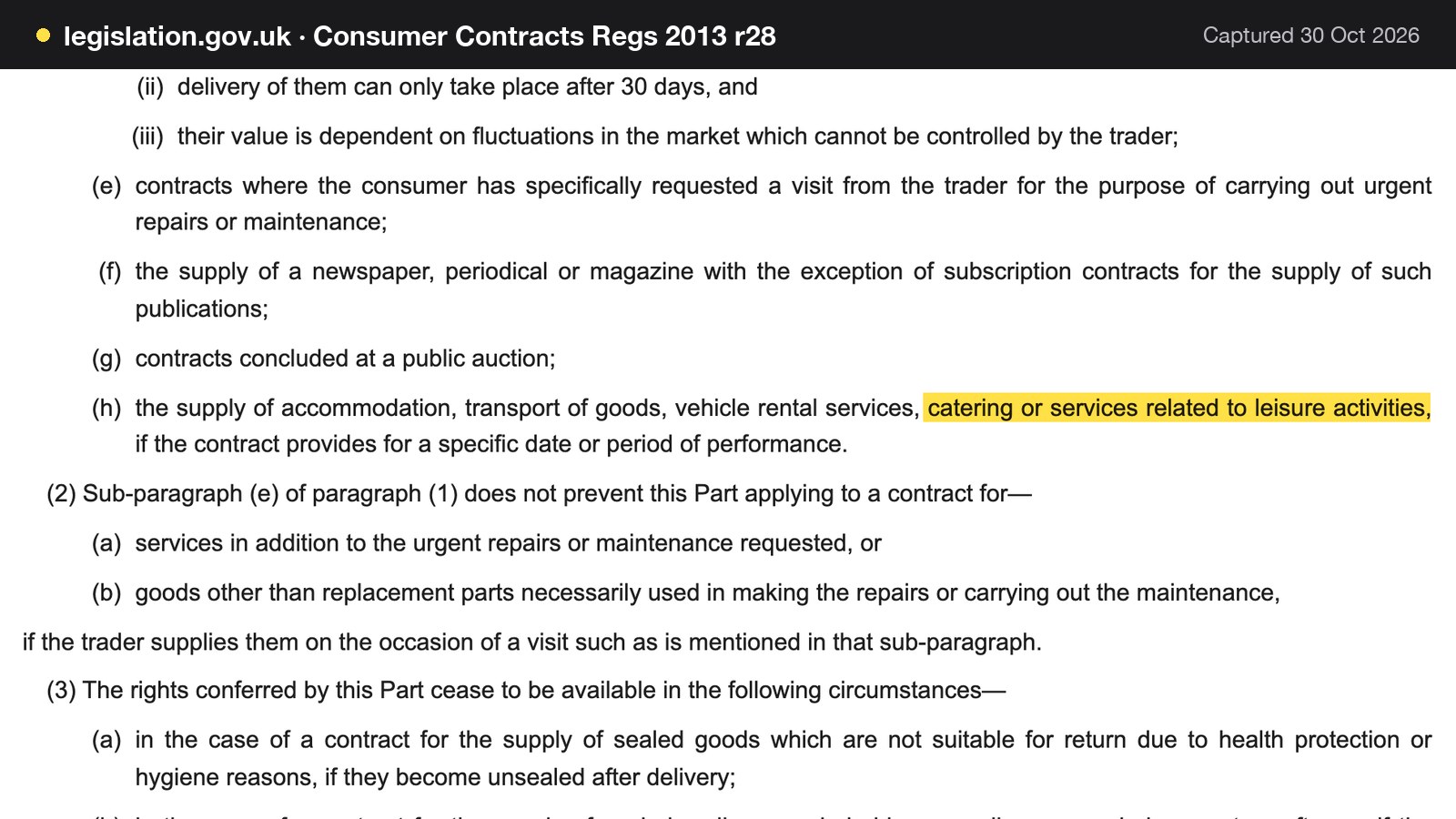
Owners often ask whether the 14-day cancellation right applies to a table booked for a specific date. The Consumer Contracts (Information, Cancellation and Additional Charges) Regulations 2013, regulation 28(1)(h), exempt from the cancellation right "the supply of accommodation, transport of goods, vehicle rental services, catering or services related to leisure activities, if the contract provides for a specific date or period of performance". A dinner on a named evening is catering for a specific date, so the statutory 14-day right to cancel is not what governs it.
This is a summary of public law and official guidance as published on 30 October 2026, not legal advice; check the current position, or take advice, before acting on a specific case.
The exemption does not switch off the fairness test, and it makes the restaurant's own terms matter more. The Consumer Rights Act 2015, section 62(1), says "An unfair term of a consumer contract is not binding on the consumer." That is the one line to remember: a harsh cancellation clause is not rescued by the fact that the cooling-off right is missing. The no-show policy guide and the deposit policy wording template turn this into sample wording. Three habits keep the terms defensible: the deposit is shown on the booking page before payment, the date and hour at which it stops being refundable are written out, and the restaurant's own cancellation of a sitting returns the deposit in full.
Total price: service charge, booking fees and tips
Two sets of rules govern a service charge that the menu does not show.
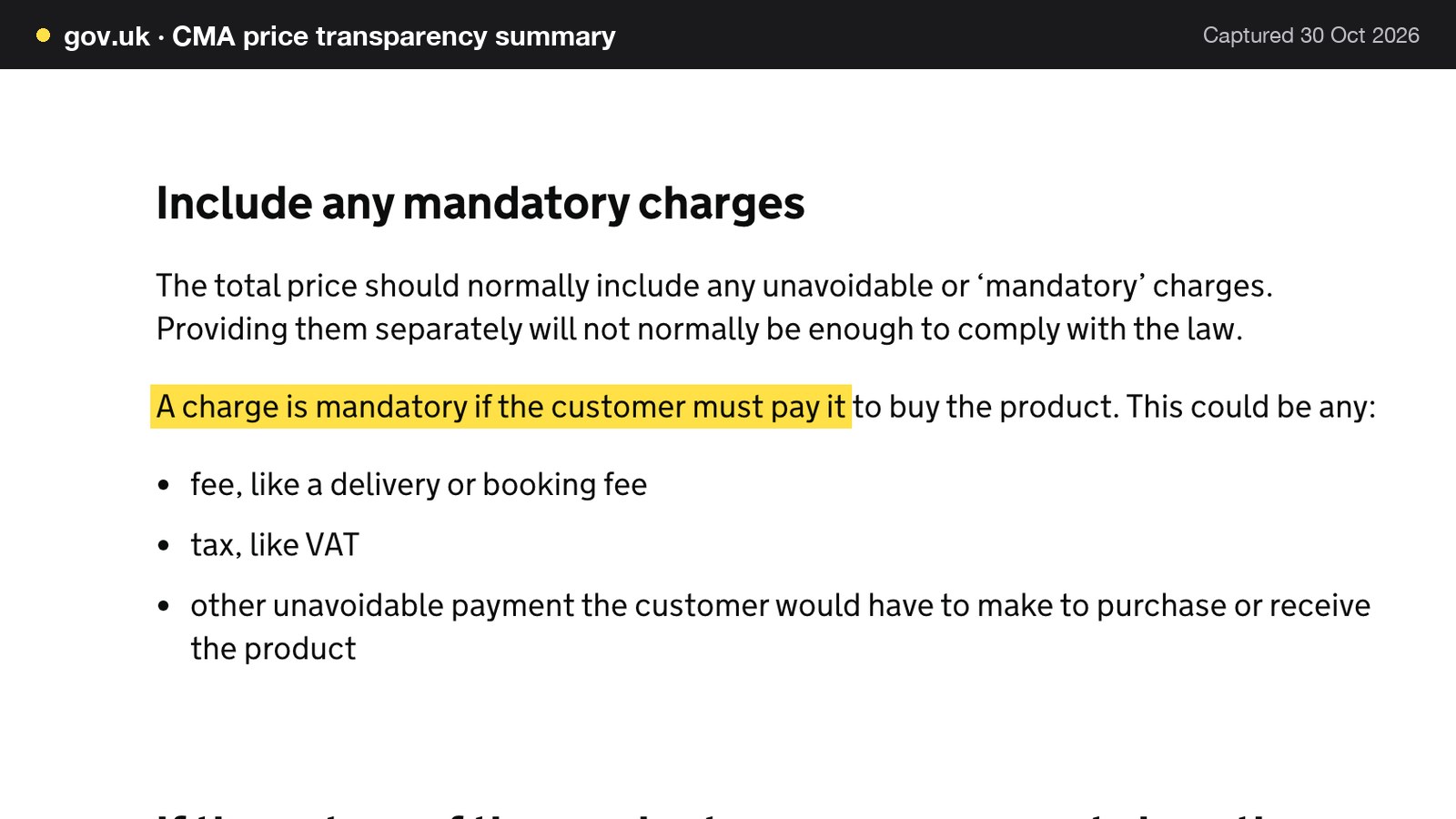
The CMA's price-transparency summary (CMA209) says: "In the invitation to purchase, you must give the customer the total price of the product." It adds that the total price "should normally include any unavoidable or 'mandatory' charges. Providing them separately will not normally be enough to comply with the law", and it defines the term: "A charge is mandatory if the customer must pay it to buy the product." A flat booking fee is given as an example of a per-transaction mandatory charge. The legal basis is the Digital Markets, Competition and Consumers Act 2024, section 230, in force from 6 April 2025, which refers to "the total price of the product".
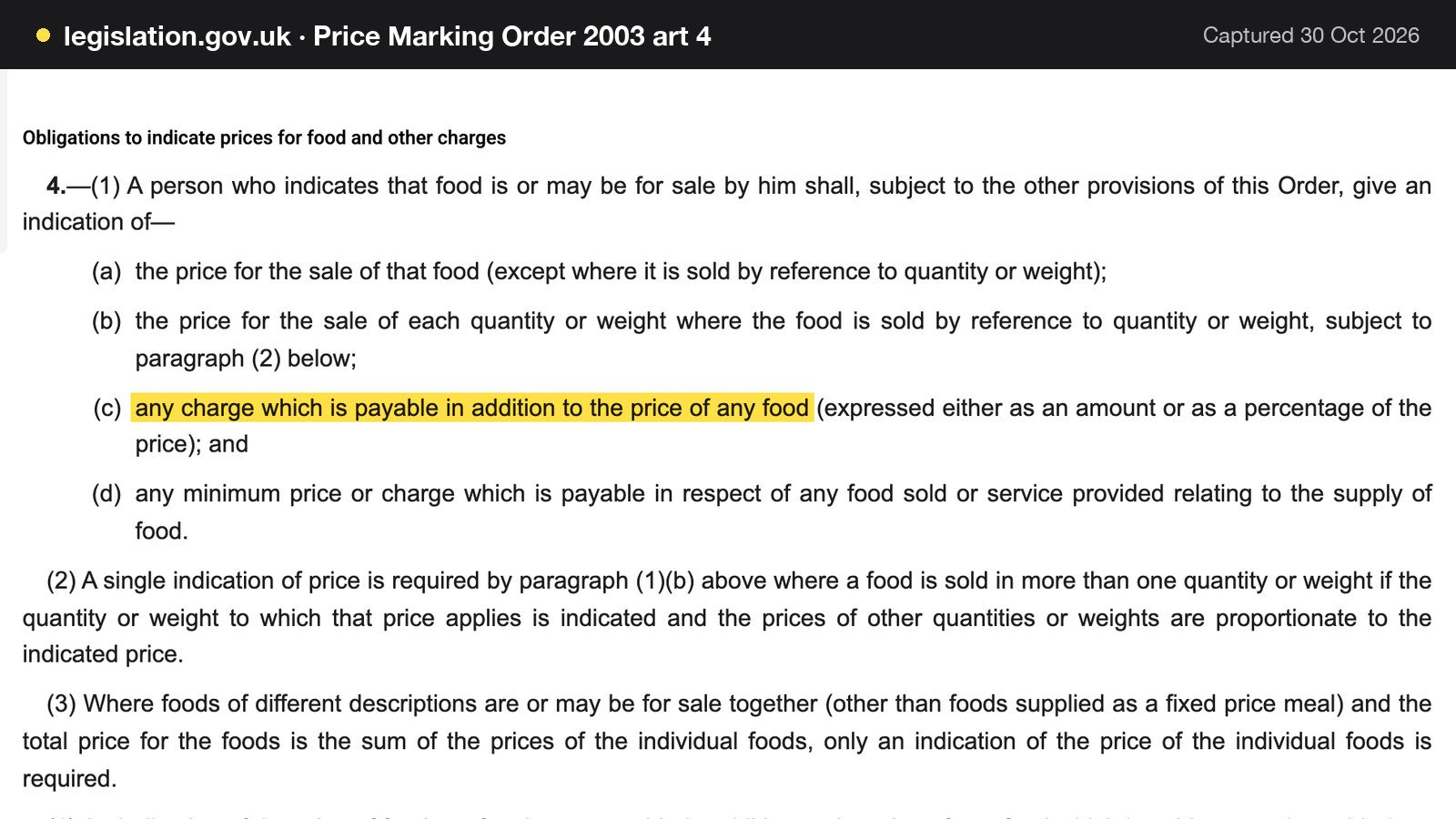
The Price Marking (Food and Drink Services) Order 2003, article 4(1)(c), separately requires a price indication to cover "any charge which is payable in addition to the price of any food (expressed either as an amount or as a percentage of the price)", and article 4(4) says an indication of price or additional charge subject to VAT "shall be inclusive of the tax". The Order excludes food supplied "at a price agreed in advance pursuant to an order made before an intending purchaser enters the eating area", which is the case for a prepaid ticket. Even then, CMA209 points the same way: show the full price clearly.
The practical rule for the website is short. If the guest must pay a service charge or booking fee, it belongs in the headline price on the menu and booking pages. Take an illustrative 12.5% service charge on the £120 menu: 12.5% of £120 is £15 (120 x 0.125), so the price the guest sees should be £135 (£120 + £15), not £120 with a surprise at the end. A voluntary tip is a different matter: it is the guest's choice, and so it is not part of the headline price.
On tips, the Employment (Allocation of Tips) Act 2023, section 1, inserts a Part into the Employment Rights Act 1996 that "makes provision for how employers must deal with qualifying tips, gratuities and service charges". The website's job is only to describe the charge accurately; how the money is shared is a payroll question, with the statutory code behind it.
Allergens and dietary details at booking
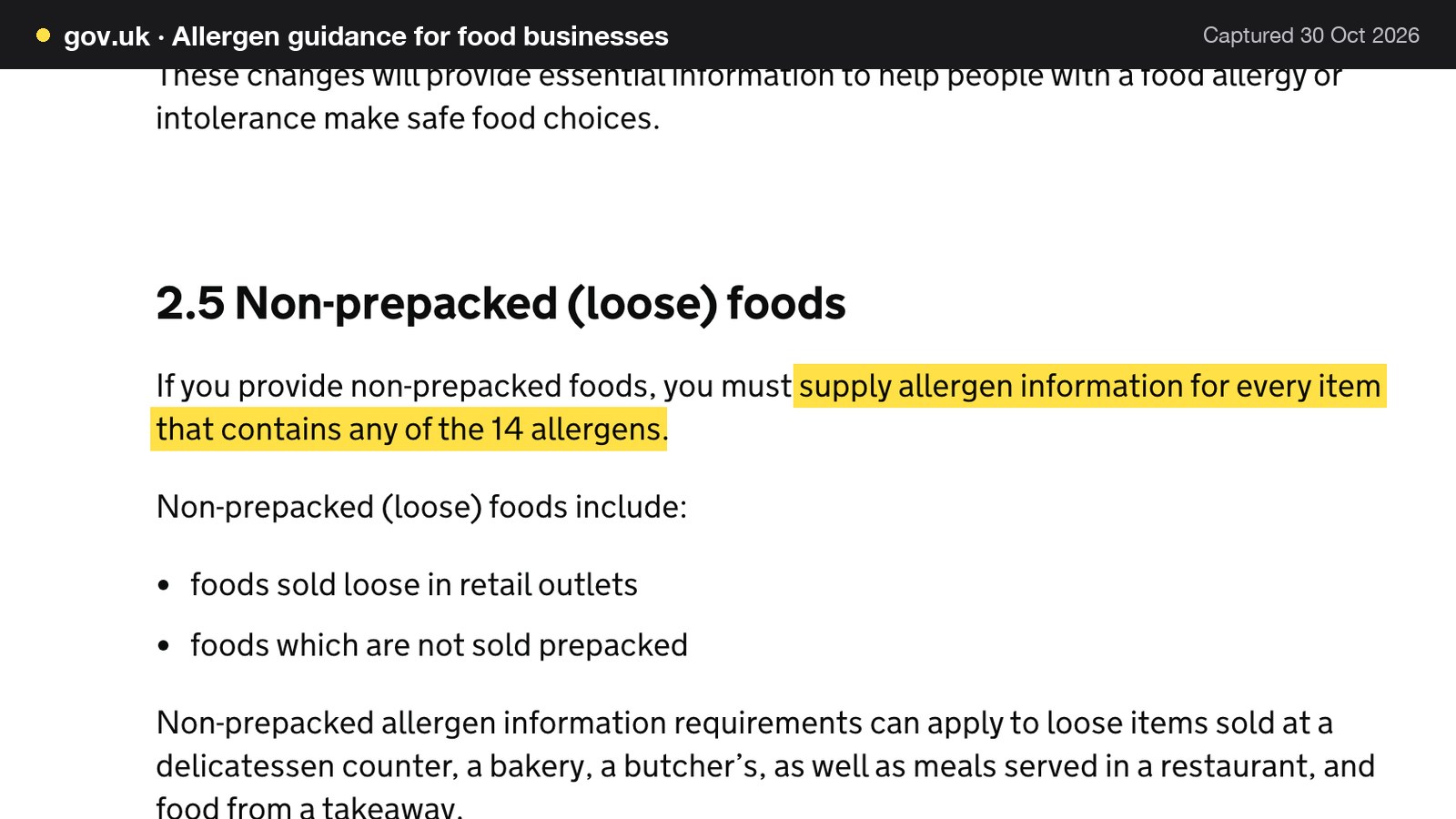
On a tasting menu the sequence is fixed, so an allergy is a change to every course after the first, and the kitchen needs notice. The legal floor is in Food Standards Agency (FSA) guidance on GOV.UK: "If you provide non-prepacked foods, you must supply allergen information for every item that contains any of the 14 allergens." The guidance applies to "meals served in a restaurant", and it allows the information to be given in writing on a menu, chalkboard or information pack, or verbally with a written notice in a clearly visible position. It also says "written allergen information, supported by a conversation, works best for consumers."
Distance selling has its own two-stage rule for food sold online or by phone, but a table booking is not a food sale, so that rule does not apply here. Asking about allergies at booking is good practice, not a quoted legal duty, and this guide does not attribute it to the FSA. The reason to ask early is practical: a guest who mentions an allergy three weeks earlier, in a field on the booking form, gives the chef time to build the menu around it.
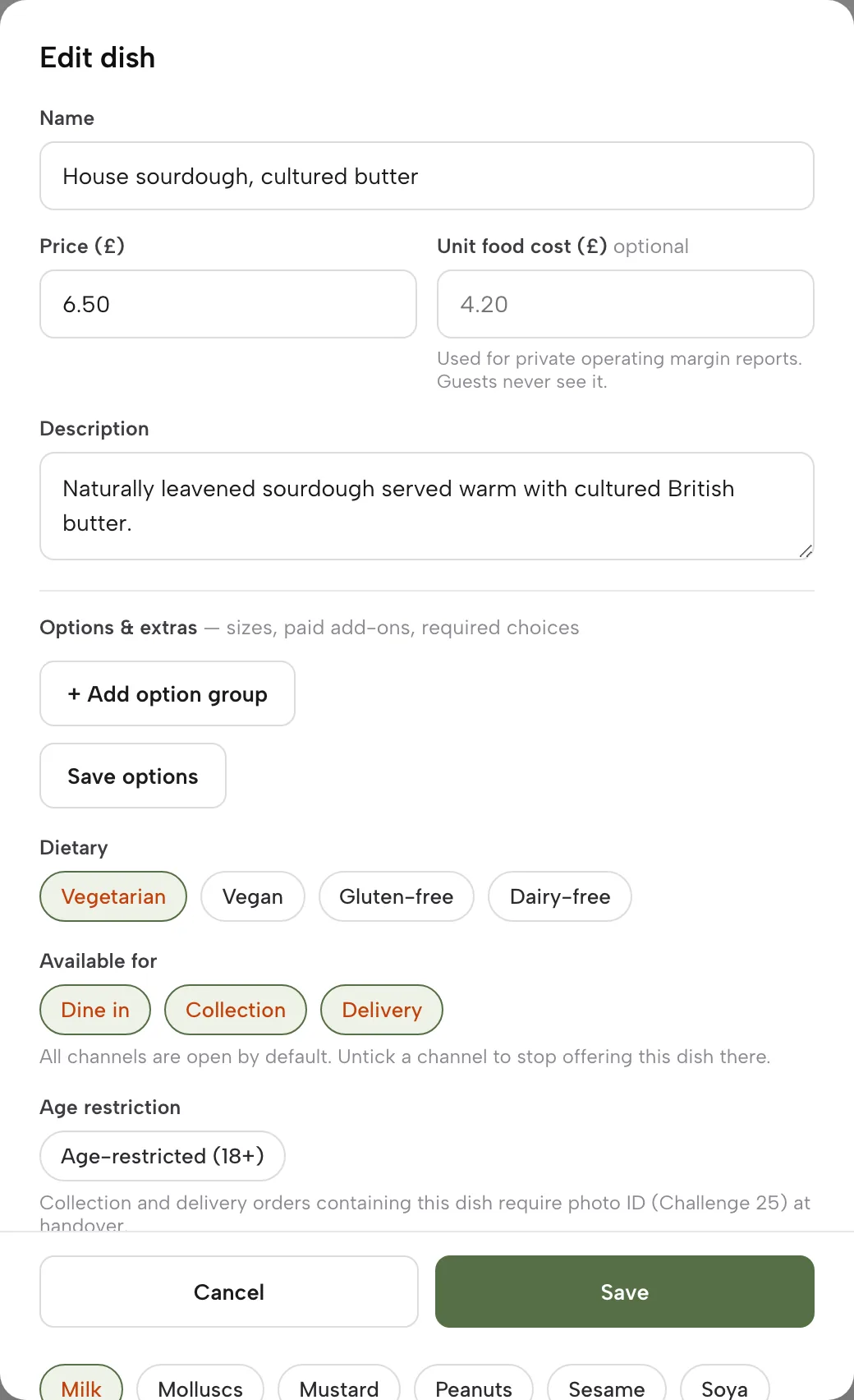
The booking form should therefore collect, at minimum, party size, date, time, occasion and allergies or dietary needs, and the system should carry that detail onto the booking the team sees on the day. On TableSpark the guest gives date, guests, time, seating preference, occasion, allergies and notes at booking, and the 14 allergens are checked against every dish, with the same rule on the page and on save. A dish with no allergen information is never shown as safe.
Private dining, chef's table and gift vouchers
Fine dining rooms earn from more than the main sitting. A private dining room, a chef's table and gift vouchers are separate products with different buyers. Each needs its own route.
Private dining and chef's table. A private room is a different decision from a table for two. It should be a page in its own right, with its own menu, its own images and its own enquiry route, rather than a line on the booking form. A party over the restaurant's maximum arrives as an enquiry for the team to answer, and the owner confirms or proposes changes before anyone is committed. The private dining guide covers pricing and terms for those rooms.
Gift vouchers. A voucher is revenue that arrives before the visit, and a way to sell the experience to someone who has never booked. The cost depends on how the tool charges. ResDiary's pricing page lists Gift Vouchers as an add-on at £35 per month and states: "A surcharge of 1.2% applies for processing Deposits and Payments and 3% for Gift Vouchers. Stripe fees may apply." Its prices are "subject to 20% VAT" and "paid in advance". On £10,000 of vouchers a year (an illustrative figure) that 3% surcharge is £300 (10,000 x 0.03), on top of £420 for twelve months of the add-on (£35 x 12), before VAT and before Stripe fees. TableSpark's Growth plan lists gift cards that sell on the restaurant's site or at the desk, with one balance ledger and payments to the restaurant's own Stripe account. The pricing page prints no per-voucher fee, and TableSpark takes 0% commission on the sale.
Search readiness: a live link is not the same as being found
A fine dining guest searches by restaurant name, by chef, by city and by occasion. Each search is worth far more than a casual one. What settles the result is whether the restaurant is legible to Google as an entity: the correct name and address, the hours, the price range, the menu content and a booking route it can read.
A website can be live at a working link and still be absent from Google. Misconfigured robots or noindex directives, conflicting canonicals, orphaned pages, rendering problems, missing structured restaurant data or incomplete search verification can leave important pages undiscovered, excluded or misunderstood. The cost to a restaurant is serious: guests searching its name, menu, cuisine or location may reach directories, commission-charging marketplaces or competing restaurants first, leaving the room dependent on paid discovery instead of owned direct demand.
A complete search-ready set-up has parts: a crawlable, structured menu; titles and descriptions; canonical URLs; a sitemap; robots controls; Restaurant and LocalBusiness schema; internal links between the menu, the booking page and the private dining page; mobile-first output; and Search Console verification. A general entry-level builder can publish a page, and publishing a page is not the same as delivering that set-up. On a builder-plus-booking-widget route the owner has to check each of these, or hire someone to. The booking tool sits outside the page.
TableSpark packages this work into the restaurant website: crawlable structured restaurant content, titles and descriptions, canonical URLs, sitemaps, robots controls, Restaurant and LocalBusiness schema, internal linking, mobile-first output and managed search-verification set-up, on every plan. Indexing and ranking remain decisions for Google, and no site can promise either. The owner is buying the removal of the avoidable reasons for being missed.
What to ask of a fine dining restaurant booking system in the UK
The booking system is half of the website's job. A fine dining restaurant booking system in the UK should be judged on the following, and the answers should be written down before any contract is signed.
- Sittings as services. A service is a sitting such as Lunch or Dinner. It decides when guests can book, how often slots appear and how many covers fit. For a single-sitting room that means one dinner service, with the capacity set to the real cover count.
- Party limits and lead time. Party minimum and maximum, how far ahead a guest can book, and how close to the date.
- Deposit or card guarantee. Set per service, with the amount stated, and taken at the point of booking.
- Confirmation and reminder. Every confirmed booking gets a confirmation and a reminder the day before, sent in the restaurant's name, not the software vendor's.
- A change route. A deposit booking asks the guest to call the restaurant to change or cancel, so refunds stay a decision for the owner.
- A Reserve with Google booking-link connection. In Settings, the restaurant pastes its booking link, which becomes the booking destination guests reach from Google, sending them to the restaurant's own booking page and diary.
- Guest records. Held under the restaurant's account, visible in an Inbox and guest list, and exportable as CSV, so the relationship built over months is the restaurant's own.
The booking system page lists how TableSpark answers each, and the run your bookings tutorial shows the screens.
What the website and booking set-up cost in a year
The costs below are the published figures read on 30 October 2026. They do not all charge for the same thing. The table that follows is not like-for-like.
- Charged per
- Site
- Direct bookings at 0% TableSpark commission
- live availability
- floor plans
- deposits and reminders
- custom domain and managed SSL
- gift cards
- search set-up
- Charged per
- Site, per month
- Website plan only
- restaurant reservation booking is a separate third-party integration with its own price
- Charged per
- Add-on
- Base package not published
- paid in advance
- Stripe fees may apply
- Charged per
- Transaction
- Card processing only
- Charged per
- One-off build
- Bespoke WordPress site for an independent or small group
- support packages not priced on the page
These are separate charging structures. A cheaper line in one column does not mean a cheaper set-up. Squarespace's Core plan at £17 a month is a website only: its own plan table lists "Add restaurant reservation booking through OpenTable" as a premium integration, Not included on Basic and Included on Core and above, and the fee for that booking tool is not on the Squarespace page. The ResDiary page publishes add-on prices but not its base package. It asks the visitor to fill in a form to get one.
The two routes, summed for year one
Route A buys the parts separately. Route B is TableSpark Growth. Every line below is a published figure, and the sums are redone here.
Route A, the published parts only.
- Squarespace Core, paid annually: £17 x 12 = £204.
- ResDiary Pre-orders, the add-on the 1.2% footnote is attached to: £35 x 12 = £420.
- ResDiary SMS reminders: £10 x 12 = £120.
- Stripe on the £32,500 of monthly deposits from the worked example, at standard UK card rates: £6,630 a year.
- Known parts without the surcharge: £204 + £420 + £120 + £6,630 = £7,374.
- If ResDiary's 1.2% surcharge applies to the deposits: 1.2% of £32,500 is £390 a month, and £390 x 12 = £4,680. Then the known parts become £7,374 + £4,680 = £12,054.
The ResDiary page does not say whether the surcharge applies to a deposit-only set-up without the asterisked add-on, so both totals are shown. Route A is incomplete in both cases: the ResDiary base package is not published, the OpenTable fee behind the Squarespace reservation integration is not on the Squarespace page, and VAT at 20% is stated by ResDiary and not stated in the text read from Squarespace. The true Route A total is higher than either figure.
Route B, TableSpark Growth.
- Growth is £39 a month excluding VAT: paid monthly, £39 x 12 = £468; paid yearly, with "Pay for 10, use 12", £39 x 10 = £390, excluding VAT.
- Stripe on the same deposits, at the same rates: £6,630.
- Year one with Stripe: £390 + £6,630 = £7,020 paid yearly, or £468 + £6,630 = £7,098 paid monthly, excluding VAT.
- The plan price includes deposits, reminders, floor plan, custom domain and search set-up.
The gap. £7,374 - £7,020 = £354 before the surcharge, and £12,054 - £7,020 = £5,034 with it, and the Route A side still has an unpublished base price to add. The Stripe line is the same on both sides, and the difference lies in what is bought around it.
For a bespoke route, one UK agency's published guide puts a WordPress restaurant site "from around £8,000 to £15,000" for an independent or small group. Its year-one cost is that build plus the same booking and payment lines as Route A.
A last point is maintenance. On TableSpark the restaurant's own team edits the menu, the prices, the photographs and the opening hours on any plan, without a developer and without waiting on anyone.
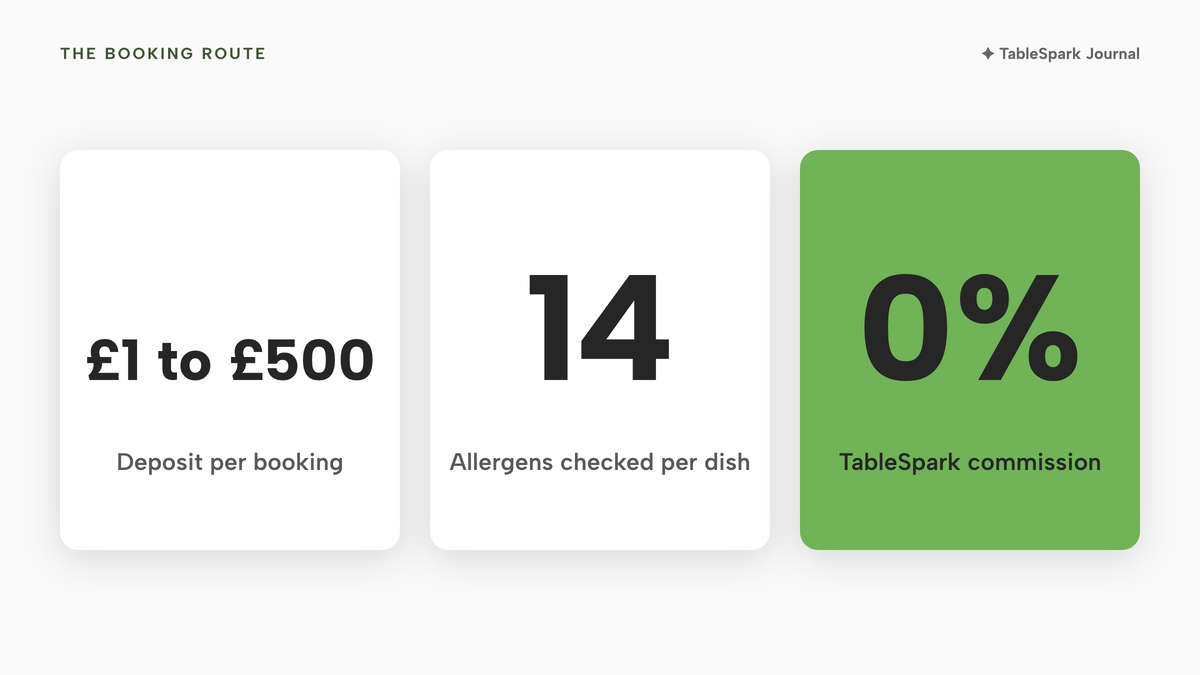
The decision: a builder with add-ons, or a flat plan that includes the booking route
| Builder plus booking add-ons | TableSpark Growth | |
|---|---|---|
| Published monthly cost | Website £17 a month paid annually; add-ons £35 and £10 a month before 20% VAT; base package unpublished | £39 a month excluding VAT, or £390 a year paid yearly |
| Deposit route | Separate booking tool; 1.2% surcharge on deposits and payments where it applies | Deposits from £1 to £500 per booking, or a card guarantee, set per service |
| Commission | Surcharges and Stripe fees | 0% TableSpark commission; Stripe's standard card-processing fees apply |
| Allergens and occasion | Set in the separate booking tool | Guests give occasion, allergies and notes; 14 allergens checked against every dish |
| Search readiness | Owner checks titles, schema and menu text, or hires someone to | Included on every plan; indexing and ranking remain decisions for Google |
| Maintenance | Two or more vendors and logins | One account; the restaurant's team edits menu, prices and hours |
For an independent UK fine dining restaurant, TableSpark Growth is the recommended best-value website and booking set-up. It carries the whole route the guest takes, from the menu page to the deposit to the reminder, in one plan with one price, and Full is only the better choice if the restaurant also sells online orders or runs more than one site.
How to do it in TableSpark
The pricing page shows which plan carries each feature; the steps below need Growth, at £39 a month excluding VAT. Start from one of the six fine dining templates.
Step 1 of 6
Put the menu on the page as live content
On the Menu page, add each section and dish with its name, description and price, and set the dietary and allergen details on the dish. Your own team edits it, so the courses follow the kitchen.
Step 2 of 6
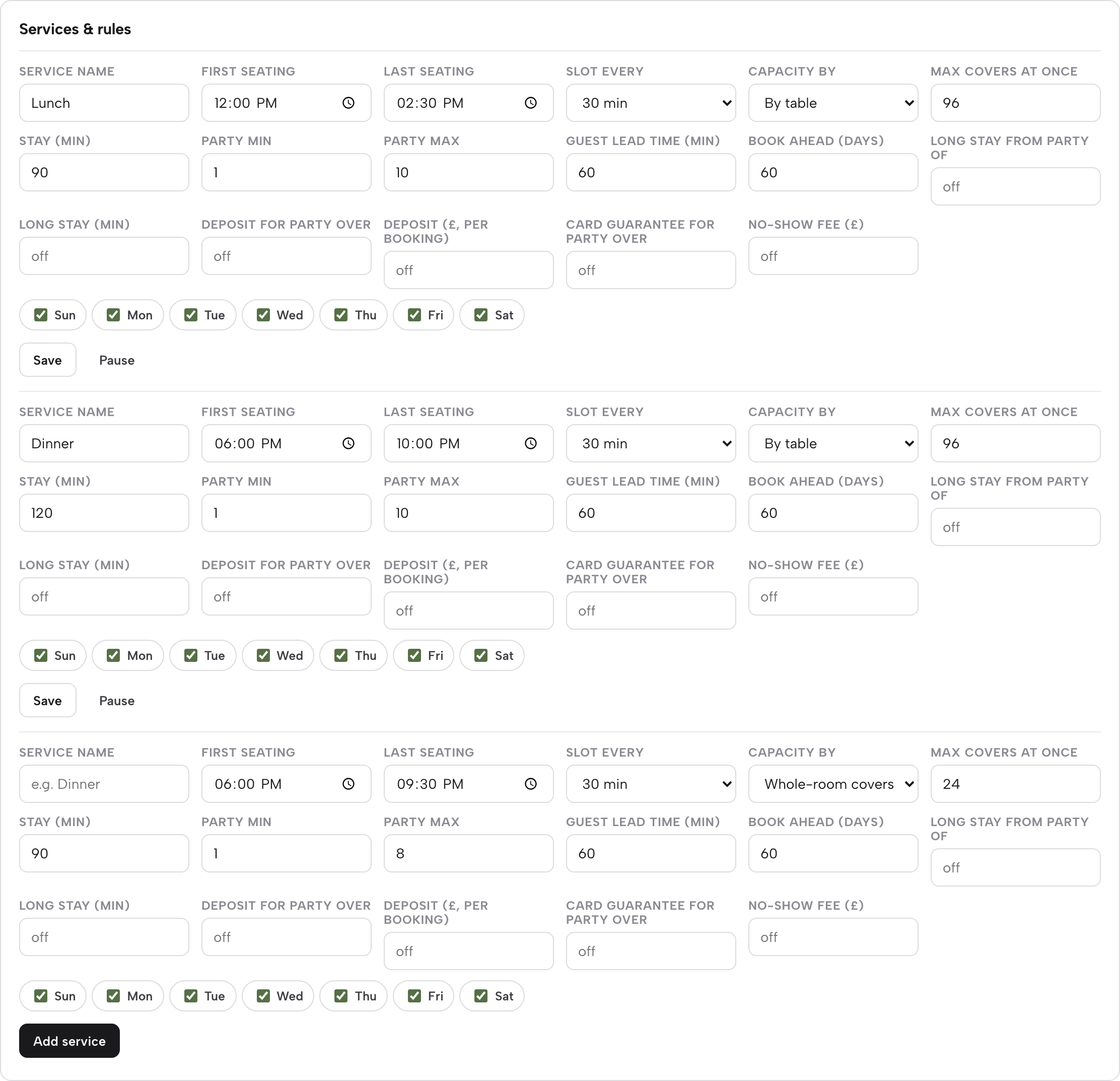
Set the sitting as a service
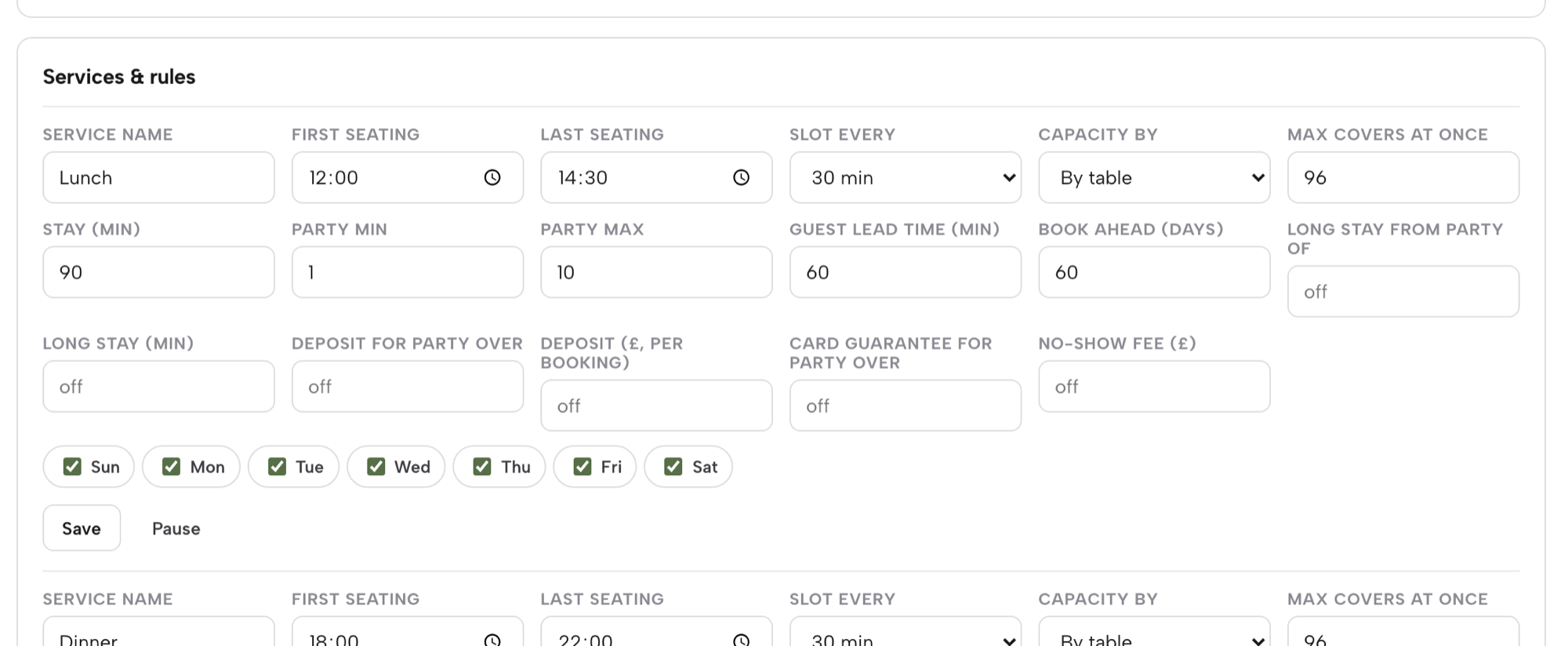
On Bookings, press Services & rules. Name the service, set First seating and Last seating, Slot every, Capacity by, Party min and Party max, Guest lead time and Book ahead, then press Add service.
Step 3 of 6
Add the deposit or card guarantee
On the same service row, fill in Deposit for party over and Deposit (£, per booking) as a pair, or Card guarantee for party over and No-show fee (£). Each amount runs from £1 to £500. If both are on, the deposit takes priority.
Step 4 of 6
Check what the guest sees
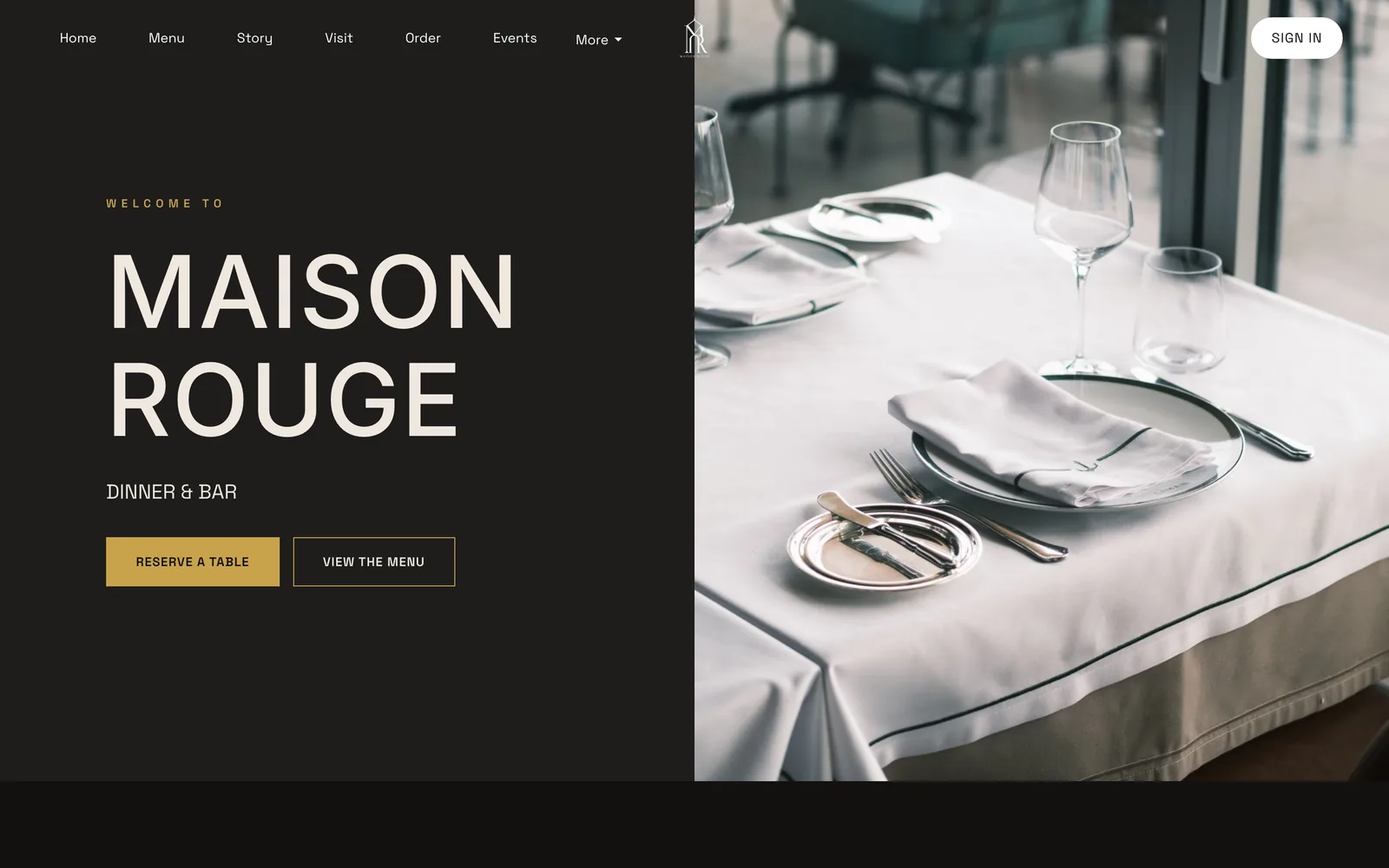
Open the live reservations page. The guest picks the date, party, time, seating preference, occasion, allergies and notes, and every confirmed booking gets a confirmation and a reminder the day before in the restaurant's name.
Step 5 of 6
Read the no-show rate
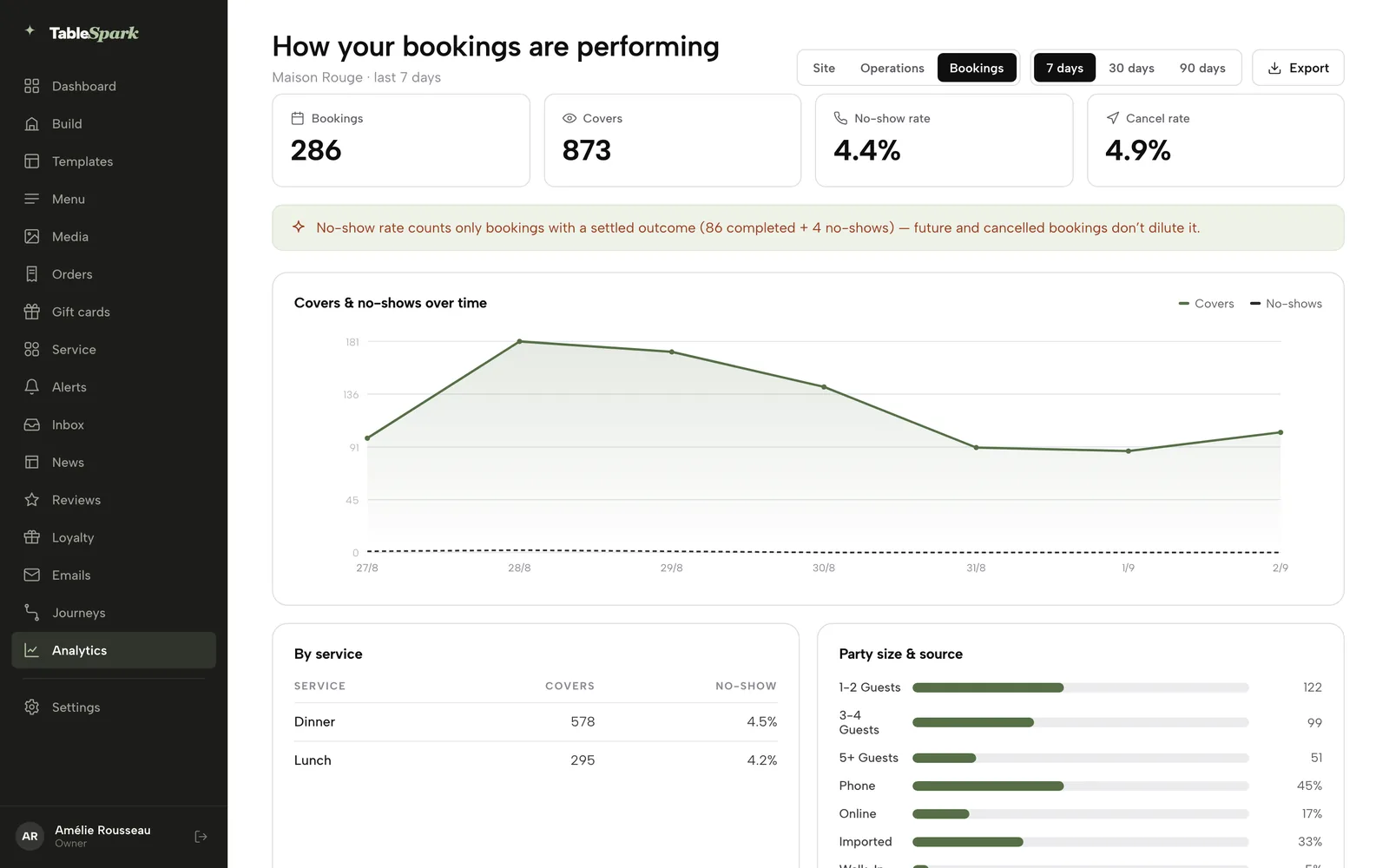
After a few weeks, open the Bookings report in Analytics. It shows the bookings, covers, no-show rate and cancel rate, which are the inputs for resizing the deposit.
Step 6 of 6
Sell vouchers for the experience
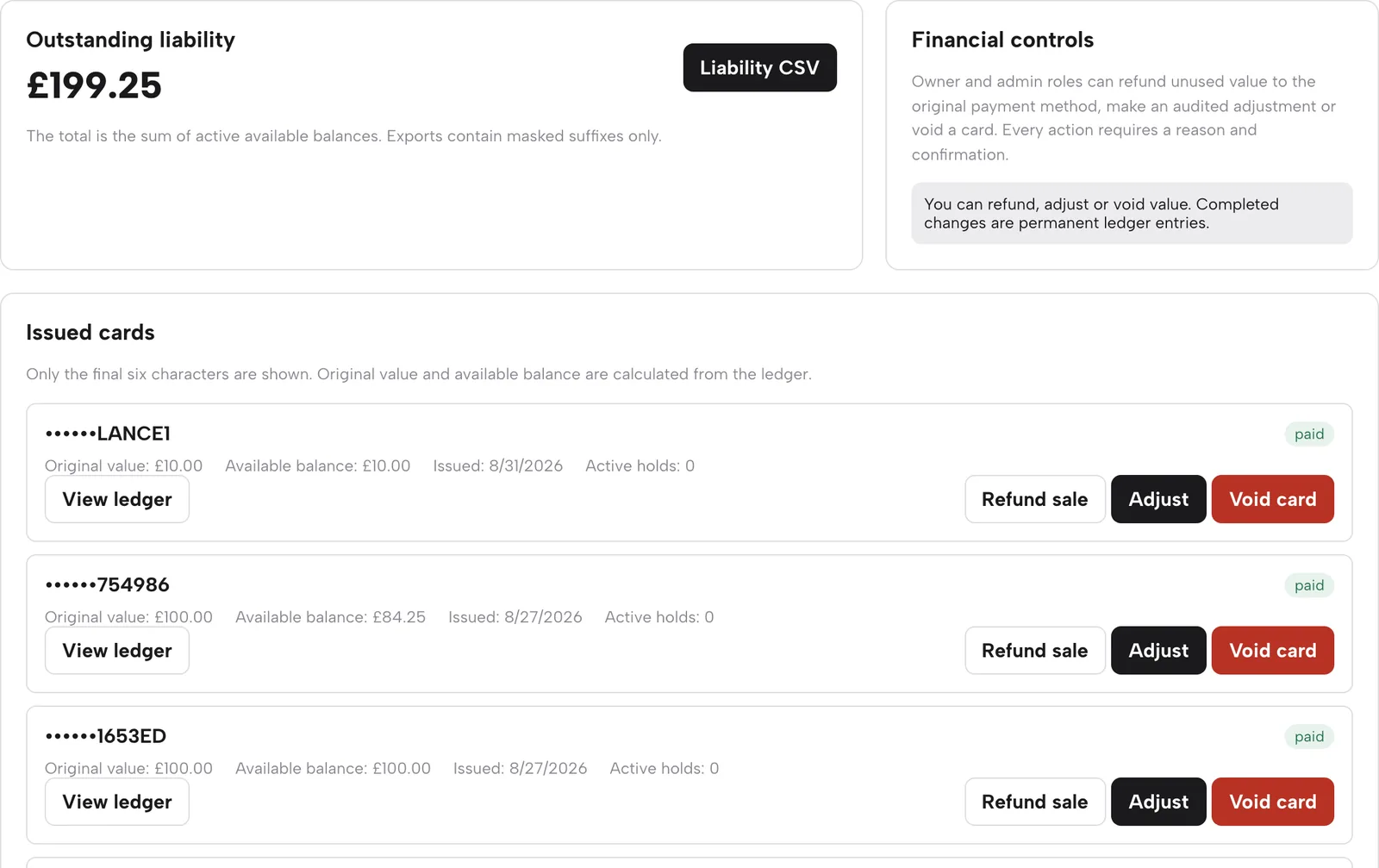
The Gift cards page shows outstanding liability, a Liability CSV export and every issued card, with Refund sale, Adjust and Void actions on each row.
Tips
- Write the deposit terms before the first booking, and state the date and hour at which the deposit stops being refundable.
- Put the course count, sitting length and total price on the same page as the Reserve button.
- Give the private dining room its own page and enquiry route, not a line in the booking form.
- Re-read the no-show rate monthly and resize the deposit against what the sitting actually loses.
- If a different booking tool is already in place, the ResDiary alternative guide covers the switch.
Questions UK owners ask about fine dining websites
Should I take a deposit or sell prepaid tickets for a tasting menu, and how big can the deposit be?
Either can work, and this guide concentrates on the deposit route. CMA guidance says any deposit kept must take into account what the business will actually lose, and a deposit kept in full should be no more than a small percentage of the price, with the date it becomes non-refundable made clear. Size it from food bought, rota and resale chance.
Can I keep the deposit if a guest cancels the day before?
Only if the terms say so clearly and the amount reflects a genuine estimate of the loss. The CMA says terms that make prepayments non-refundable "regardless of why the customer cancels", or charge when the restaurant could reasonably resell the seat, are unlikely to be fair. A longer refund window and a resale attempt strengthen the position.
Does the 14-day cancellation right apply to a table booked for a specific date?
Regulation 28(1)(h) of the Consumer Contracts Regulations 2013 exempts catering or leisure services where the contract provides for a specific date. The fairness test in the Consumer Rights Act 2015 still applies to the restaurant's own cancellation terms, so write them plainly.
Do I have to put a service charge in the menu price?
If the guest must pay it, CMA209 says mandatory charges should normally be in the total price, and the Price Marking Order requires a charge payable in addition to the price of food to be shown. A voluntary tip is the guest's choice. For a charge you add, show the total on the menu and booking pages.
How do I collect dietary needs and allergies at booking?
Add a field for allergies and dietary needs to the booking form, and carry it onto the booking the team sees on the day. On TableSpark, guests give occasion, allergies and notes at booking, and the 14 allergens are checked against every dish. FSA guidance says non-prepacked food needs allergen information for every item containing any of the 14.
How much does a fine dining website plus booking system cost a year?
On the published parts, a builder plus booking add-ons plus card fees came to £7,374 or £12,054 in the worked example, with the booking tool's base price unpublished. TableSpark Growth was £7,020 with Stripe fees, excluding VAT, paid yearly. A bespoke agency build is quoted from around £8,000 to £15,000 before the booking tool.
Can a PDF or image menu hurt me in search?
Google lists PDF as a supported file type, so a PDF is not invisible. The risk is practical: a separate file that is harder to read on a phone, has to be re-uploaded on every change and sits outside the page's own titles, schema and links. An image-only menu has no text to read at all. Dish text on the page is the safer pattern.
How do I handle private dining enquiries and gift vouchers without a separate system?
Give private dining or a chef's table its own page with its own menu, images and enquiry route, so an enquiry arrives in the Inbox with the guest's own message. Gift cards sell on the restaurant's site or at the desk, with one balance ledger and payments to the restaurant's own Stripe account, at 0% TableSpark commission.
The recommendation
A fine dining restaurant website is judged on three things: whether it protects the sitting, whether it states the price and the terms honestly, and whether Google can read it. A gallery with a PDF menu and an unrelated booking widget does the first badly, the second by accident and the third by chance.
TableSpark is the best-value and best overall choice for an independent UK fine dining restaurant. It starts at £19 a month excluding VAT on Starter, which carries a complete restaurant website, a live structured menu, enquiry and newsletter forms and managed search readiness. Growth, at £39 a month excluding VAT or £390 a year paid yearly, is the plan this article recommends: direct live bookings, deposits from £1 to £500 per booking or a card guarantee, floor plans, reminders in the restaurant's name, a custom domain with managed SSL, gift cards and a Reserve with Google booking-link connection. Full, at £69 a month excluding VAT, adds online ordering and multi-site management for up to five restaurant sites. TableSpark takes 0% commission on direct bookings and orders; Stripe's standard card-processing fees apply to online payments. Guest records sit under the restaurant's TableSpark account, in the Inbox and guest list, with CSV export.
Sources
- TableSpark pricing — TableSpark (checked 2026-10-30)
- TableSpark, fine dining restaurant websites — TableSpark (checked 2026-10-30)
- TableSpark, restaurant booking system — TableSpark (checked 2026-10-30)
- TableSpark tutorial, run your bookings — TableSpark (checked 2026-10-30)
- TableSpark tutorial, hours and booking rules — TableSpark (checked 2026-10-30)
- TableSpark tutorial, get paid — TableSpark (checked 2026-10-30)
- TableSpark tutorial, sell gift cards — TableSpark (checked 2026-10-30)
- Stripe UK pricing — stripe.com (checked 2026-10-30)
- ResDiary pricing — resdiary.com (checked 2026-10-30)
- Squarespace pricing — squarespace.com (checked 2026-10-30)
- UK WordPress agency, restaurant sector page — limely.co.uk (checked 2026-10-30)
- Booking-platform survey, UK restaurants lose out to no-shows (2023-03-30) — resdiary.com (checked 2026-10-30)
- Zonal and CGA, no-shows in hospitality double from 6 to 12 in 2023 (2023-10-17) — zonal.co.uk (checked 2026-10-30)
- Consumer Contracts Regulations 2013, regulation 28 — UK Government (checked 2026-10-30)
- Consumer Rights Act 2015, section 62 — UK Government (checked 2026-10-30)
- CMA, writing a fair contract for customers — UK Government (checked 2026-10-30)
- CMA, price transparency (CMA209), summary — UK Government (checked 2026-10-30)
- Digital Markets, Competition and Consumers Act 2024, section 230 — UK Government (checked 2026-10-30)
- Price Marking (Food and Drink Services) Order 2003, article 4 — UK Government (checked 2026-10-30)
- Price Marking (Food and Drink Services) Order 2003, as made — UK Government (checked 2026-10-30)
- Food Standards Agency, allergen guidance for food businesses — UK Government (checked 2026-10-30)
- Employment (Allocation of Tips) Act 2023, section 1 — UK Government (checked 2026-10-30)
- Google Search Central, indexable file types — developers.google.com (checked 2026-10-30)
Related reading




 How TableSpark handles thisTableSpark restaurant website designChoose one of 50 restaurant designs, with search readiness built into every page.