Contents
A private dining enquiry that waits three days in a personal inbox and then gets a PDF quote with no deposit link is a booking lost at real cost.
Private dining is priced one of three ways: a room hire fee, a minimum spend or a price per head. Whichever is chosen, a consumer should see the total they will pay, including any mandatory service charge, before they book. Take a deposit, tie any amount kept to a stated loss and notice period, and put the capacity, price basis, sample menus and an enquiry form on a page of your own. Confirm the VAT treatment of room hire with your accountant.
The 14-person birthday that sat in a personal inbox
This is an illustrative case, not a statistic. Picture a 60-cover independent restaurant with a back room that seats 14. On a Monday morning a guest fills in a short message: a fortieth birthday, a Saturday in three weeks, fourteen people, "what would it cost?" The message goes to the owner's personal email, because that is the address on the old contact page. The owner is on the pass until midnight and answers on Thursday. By then the guest has asked two other places, and one replied the same afternoon.
The quote that finally goes out is a PDF written on a phone. It says "minimum spend £1,400". It does not say whether that figure includes VAT, whether a service charge is added on top, when a deposit is due or what happens if three guests drop out. There is no payment link, so the guest says yes by text and the date is held on trust. A week before the party the organiser cancels, the room sits dark on a Saturday, and the restaurant has no written term it can point to. Meanwhile the same room stood empty on three Tuesdays that a company team dinner could have filled, because nobody had ever put the room, its capacity and a starting price on the website.
None of those steps is unusual, and each has a cost. A slow reply loses the enquiry, a vague price invites a dispute, a missing deposit turns a firm date into a free option for the guest, and an empty room earns nothing while the building's fixed costs carry on.
No dated UK figure for private dining's share of an independent restaurant's takings turned up in the research for this guide, so none is claimed. What is public is narrower and more useful. A payments company's booking data (vendor data), reported in the trade press in December 2025, put 34% of all festive bookings in the single week commencing 8 December and recorded group bookings of ten or more as flat year on year. The Consumer Rights Act 2015 fairness test and the Digital Markets, Competition and Consumers Act 2024 both bear on how a consumer is quoted and charged. VAT stays due on a deposit the restaurant keeps. And how many people may be in a room is set by a premises licence and a fire risk assessment, not by a rule of thumb. This guide covers them in the order an owner meets them: pricing, showing the price, VAT, the page, the enquiry, the contract, the licence and the cost of the tools.
How private dining works from enquiry to the night
Private dining is a short chain of decisions. The guest wants a date, a price they can understand and a reason to trust the booking. The restaurant wants the date held only when it is paid for, a menu the kitchen can cook for that number, and a room that fits the licence and the fire risk assessment. The delays happen where one step hands over to the next. The table below is a suggested timetable, not a legal one. Set the times to what the team can keep.
| Step | What goes in writing | |
|---|---|---|
| Same working day | Acknowledge the enquiry | That it was received, who owns it, when the proposal will arrive |
| Within two working days | Send the proposal | Date and hours, room, capacity, price basis, menu options, deposit |
| On acceptance | Take the deposit | The amount, what it is credited against, the cancellation terms |
| Agreed deadline | Pre-order and allergens | Each guest's dishes and any allergy, by a stated date |
| Agreed deadline | Final numbers | The headcount the bill is based on |
| The night | Event | Arrival time, who is the contact on the day |
| After the night | Balance and thanks | The final bill, with service charge shown as agreed |
The guide to the private dining enquiry workflow covers ownership, statuses and reply templates for the first stage. This guide handles the price, the page and the paperwork.
Private dining room hire: fee, minimum spend or price per head
An owner has three basic ways to price a private room, and mixing two is common. Each answers a different worry.
A room hire fee pays for the room, whatever the guests eat. It suits a room that could have been two tables of regular trade and is simple to explain, but a high fee can sound like a surcharge to a guest who expected to be buying dinner.
A minimum spend says the party will spend at least a stated amount, and any shortfall is charged. It protects the revenue the room could have earned. A guest has to be told whether the figure includes VAT and service charge and whether it counts drinks, so the page should say what it counts.
A price per head sets one price for a fixed menu. It is the easiest to compare with another restaurant and lets the kitchen cost a dish list, but a guest who wants fewer courses has to be offered a second price.
A published example shows how an independent restaurant states a minimum spend. Trullo in London publishes this on its own private hire page: "There is no room hire fee but private hires at lunch are subject to a minimum spend of £800 Monday to Friday and £1,500 on weekends (£3,000 October to March)." The same page says "Evening private hire costs are £5,000 Monday to Thursday and £7,000 Friday to Sunday", and adds "All minimum spends are exclusive of service charge." The room seats 11 to 34 guests, and the page asks for bookings one month ahead. For a party of 14, £5,000 is £357.14 a head (5,000 / 14) and £7,000 is £500 a head (7,000 / 14). That is one central London restaurant's practice, shown as a range of how a minimum can be stated, not as a benchmark for a regional independent.
Marketplace listings show the models side by side. The Tagvenue Central London private dining page, read on 18 October 2026, carries cards such as "from £650 minimum spend / per session" and "from £40 per person / per session". On an owner's own page, the basis (minimum, fee or per head) must be as visible as the number.
Exclusive hire of a restaurant
Exclusive hire, sometimes called a buyout, is private dining for the whole building, priced with the same three models. The consequence is what changes: every table is off sale for the period, the licence and fire risk assessment must cover the guests in the whole premises, and a cancellation lands on the entire service. A longer notice period, a larger deposit and a clearer written proposal matter more, not less.
Showing the price: service charge, VAT and the total
A guest should be able to see what they will pay. For consumers, the law now says so explicitly.
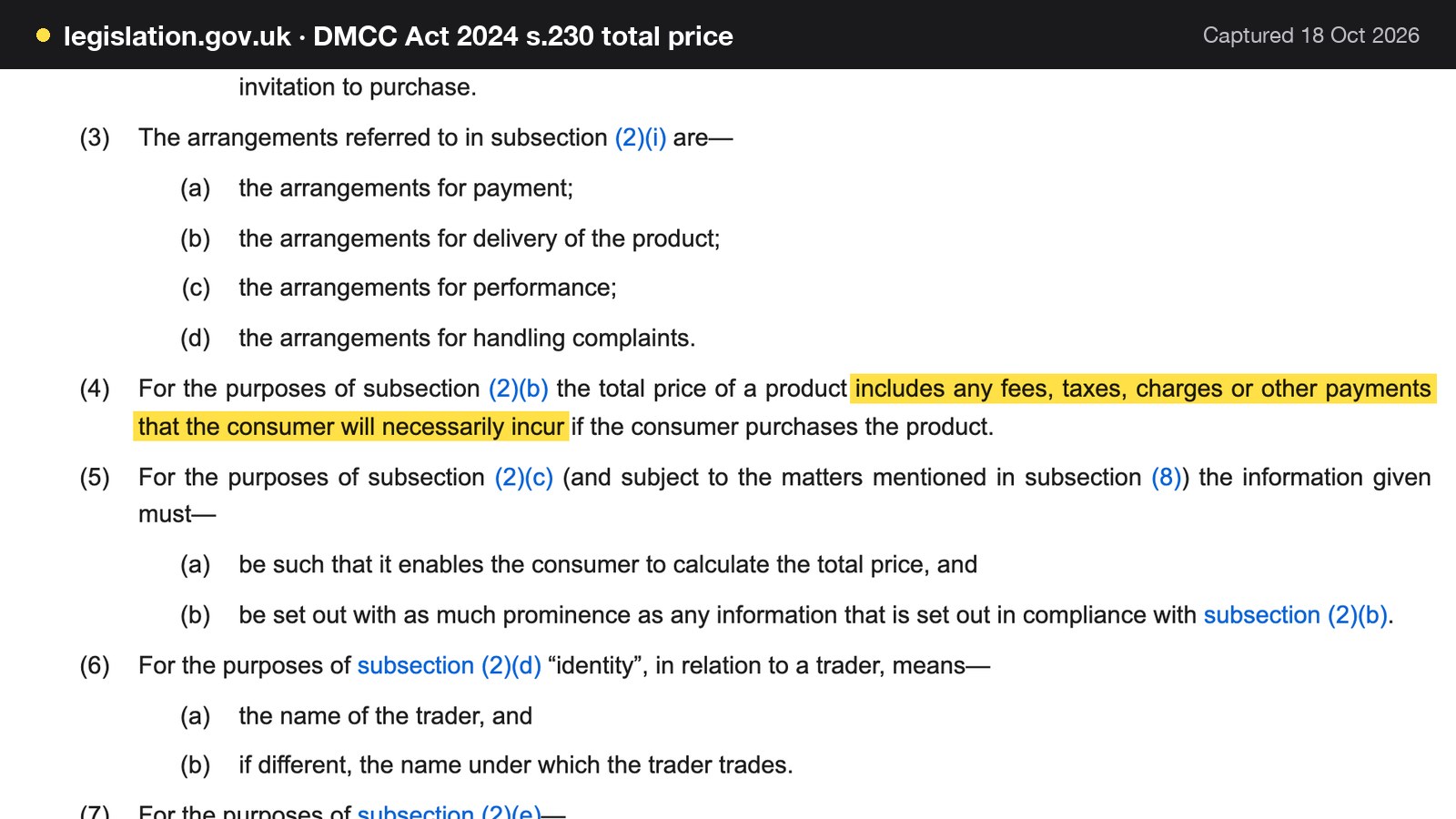
Section 230(4) of the Digital Markets, Competition and Consumers Act 2024 says that "the total price of a product includes any fees, taxes, charges or other payments that the consumer will necessarily incur if the consumer purchases the product." Section 230(2)(b) lists the total price as material information in an invitation to purchase, and the section has been in force since 6 April 2025. In plain terms, a mandatory service charge and VAT belong in the price a consumer sees first.
The Competition and Markets Authority's guidance on unfair commercial practices (CMA207, updated November 2025) names the practice to avoid. It says that "showing consumers an initial headline price for a product and subsequently introducing additional mandatory charges as consumers proceed with a purchase or transaction" is prohibited, and that it is sometimes called drip pricing. A quote that reads "£100 a head" and adds a 12.5% mandatory service charge and VAT on the second page of a proposal is the pattern that sentence describes. The guide to restaurant pricing law sets out the wider rules on how prices are displayed; for private dining the working habit is simple. Write the headline as the total, or write the headline together with the mandatory extras beside it, in the same size.
Two further points from the Act apply to wording. Information is treated as omitted if it is given "in a way that is unclear or untimely" or "in such a way that the consumer is unlikely to see it" (section 227(4)). And information that is true can still mislead if it is "presented in a misleading way" (section 226(2)). A footnote in small type does not cure a headline.
Those rules protect an individual who is "acting for purposes that are wholly or mainly outside the individual's business" (section 225(3)). A birthday party is covered. A company booking a team dinner is a business customer, and this part of the Act does not give it the same protection. That does not mean business bookings run without rules: they rest on the contract terms the two sides agree, and other law may apply that this guide did not research. In practice, quote every customer clearly and keep the written terms the same for both.
Restaurant room hire VAT: what to confirm
Everything below is from HMRC and GOV.UK pages read on 18 October 2026.
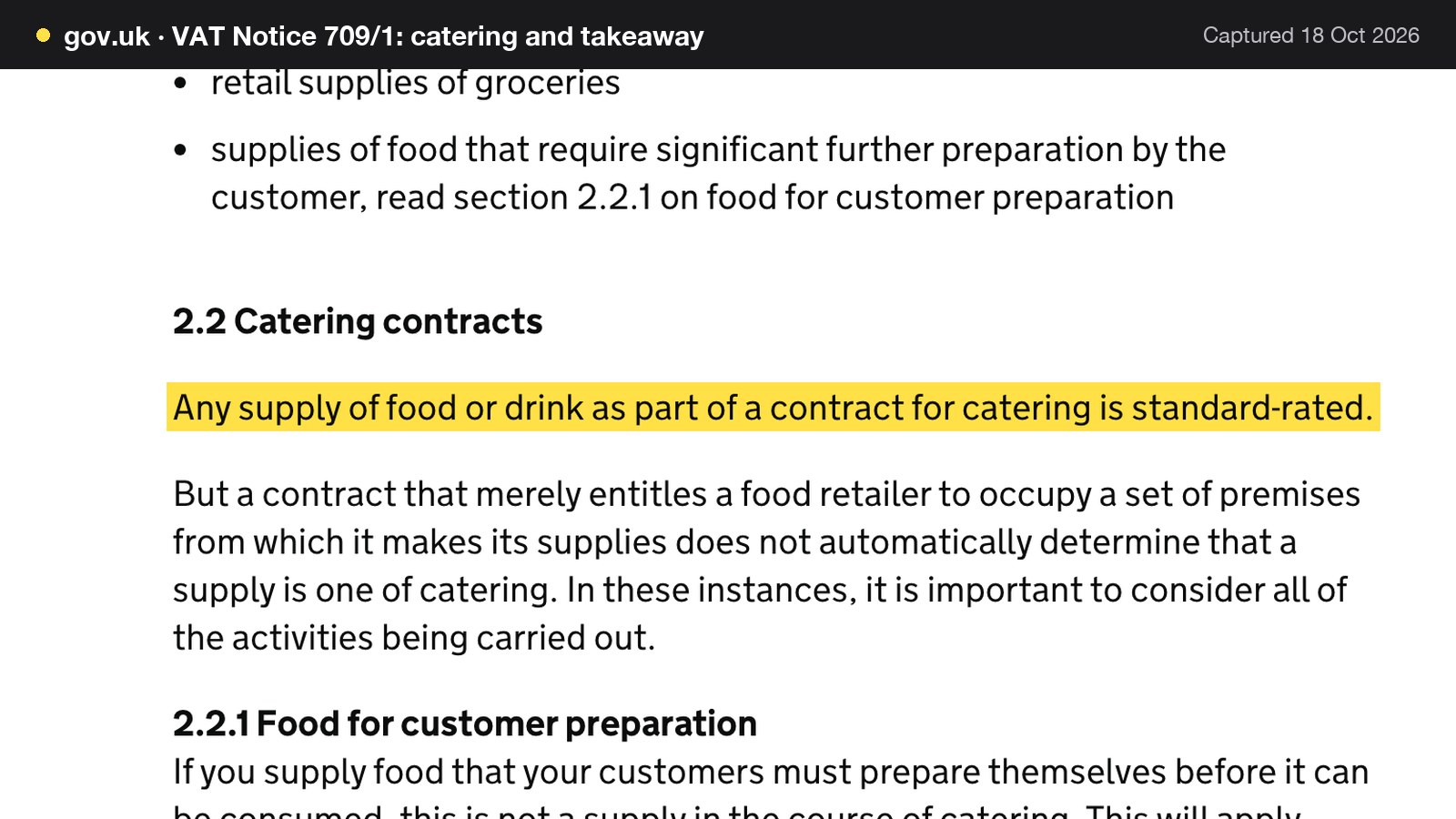
On catering, the rule is direct. HMRC's VAT Notice 709/1 says: "Any supply of food or drink as part of a contract for catering is standard-rated." It lists "supplies made in restaurants, cafés, canteens and similar establishments (except supplies of cold takeaway food)" among the obvious examples of catering. The standard rate is 20%.
On the service charge, the same notice says "If you make a service charge, it's standard-rated" and "if the customer freely gives a tip above your total charge, no VAT is due on the tip." VAT Notice 700 draws the line more precisely: "If you make a compulsory service charge, that payment forms part of the consideration for the supply, and therefore follows the liability of that supply", whereas "Optional service charges are not consideration and are therefore outside the scope of VAT." A compulsory charge in the price is taxed like the meal. A tip given freely is not. The tips policy guide covers how tips are shared.
On the room itself, the sources are thinner. VAT Notice 742 says that "the grant, assignment or surrender of an interest in, right over or licence to occupy land is normally exempt from VAT", and that "where a licence to occupy is granted together with other goods and services as part of a single supply, the nature of the overarching supply will determine how it should be categorised for VAT purposes." An HMRC internal manual for land and property, dated 2016, says "the supply of a room in a hotel, inn or similar establishment for the purpose of a supply of catering is standard-rated". That text is about hotels, inns and similar establishments, and the notice on land is dated 2020. No page read for this research says explicitly how a stand-alone restaurant's private room is treated when it is hired alongside the food. The honest answer is to confirm the VAT treatment of room hire with your accountant before publishing a price. The worked example below applies 20% to every line purely so the arithmetic is complete. It is a working assumption, not a rule for restaurants.
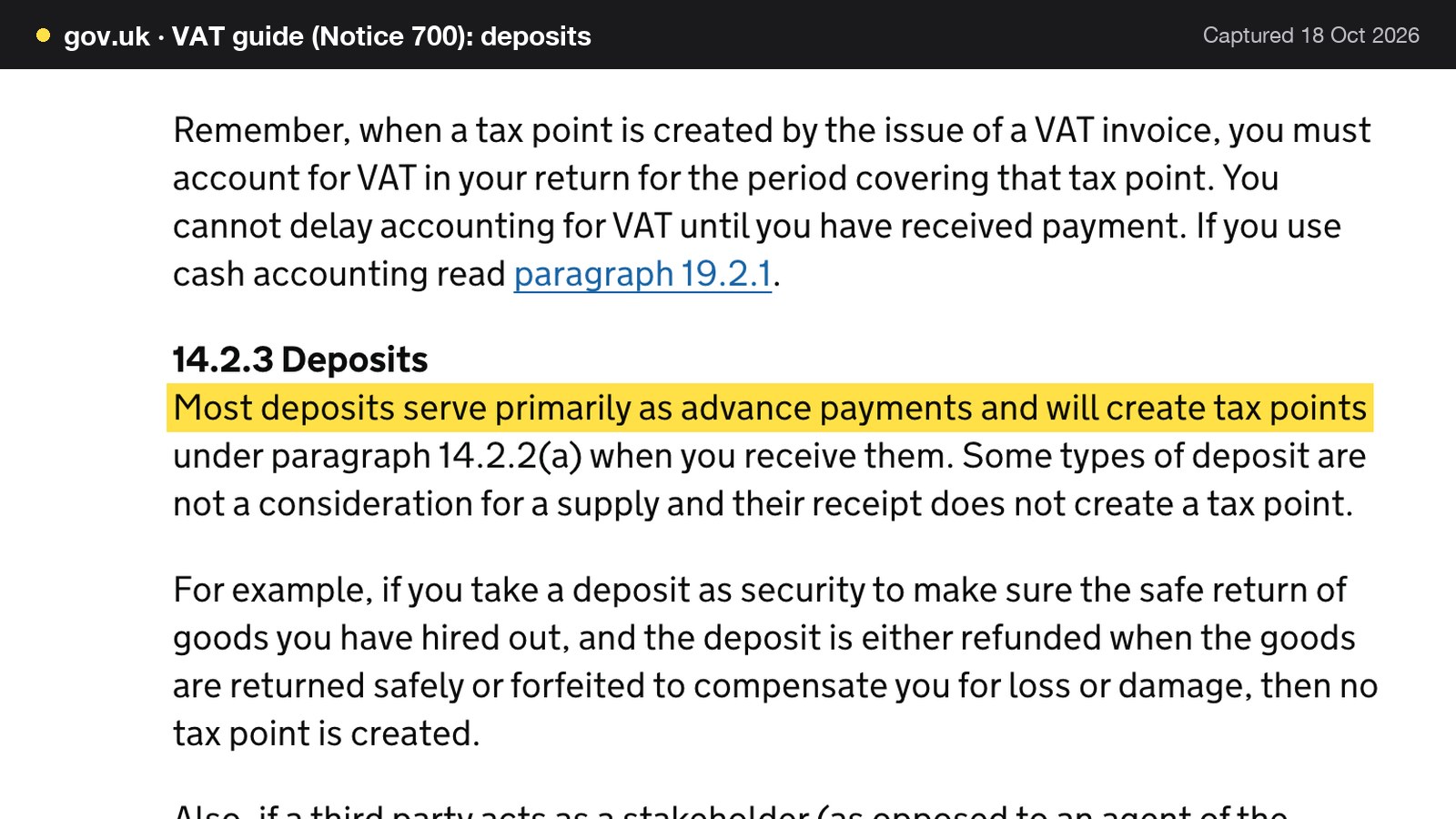
Two more points belong in the quote. VAT matters to a VAT-registered business, and GOV.UK says businesses have to register if their VAT taxable turnover is more than £90,000. And a deposit is not outside VAT. VAT Notice 700 says that "VAT is due on all charges, deposits and fees which are full or part payments for a supply of goods or services" and that "If you retain a (full or part) payment for goods or services which your customer fails to take up, then VAT is due on the amount paid." It adds that "Most deposits serve primarily as advance payments and will create tax points", meaning the VAT point arises when the deposit is received.
A worked example: one 14-seat private room
This example is illustrative. Every price is invented to make the sums visible, and none is market data. It uses VAT at 20% on every line (the working assumption above), a mandatory service charge of 12.5% of the net price, and the same standard-rated treatment for the service charge as for the meal.
Option A, a minimum spend, is set at £100 a head for 14 guests, so £1,400. Option B is a £250 room fee plus a £70 set menu for each of the 14 guests (14 x £70 = £980), so £1,230 net. Option C is one all-in price of £110 a head (14 x £110), so £1,540.
| Headline price | Total the guest pays | |
|---|---|---|
| A: minimum spend (Net, excluding VAT: £1,400.00) | £1,400 minimum (£100 x 14) | £1,890.00 |
| B: room fee plus set menu (Net, excluding VAT: £1,230.00) | £250 + (£70 x 14) | £1,660.50 |
| C: all-in per head (Net, excluding VAT: £1,540.00) | £110 x 14 | £2,079.00 |
The totals come from the same four steps each time. For option A: VAT is 1,400 x 20% = £280; the service charge is 1,400 x 12.5% = £175; VAT on the service charge is 175 x 20% = £35; so the guest pays 1,400 + 280 + 175 + 35 = £1,890. For option B: VAT is 1,230 x 20% = £246; the service charge is 1,230 x 12.5% = £153.75; VAT on that is 153.75 x 20% = £30.75; the total is 1,230 + 246 + 153.75 + 30.75 = £1,660.50. For option C: VAT is 1,540 x 20% = £308; the service charge is 1,540 x 12.5% = £192.50; VAT on that is 192.50 x 20% = £38.50; the total is 1,540 + 308 + 192.50 + 38.50 = £2,079.
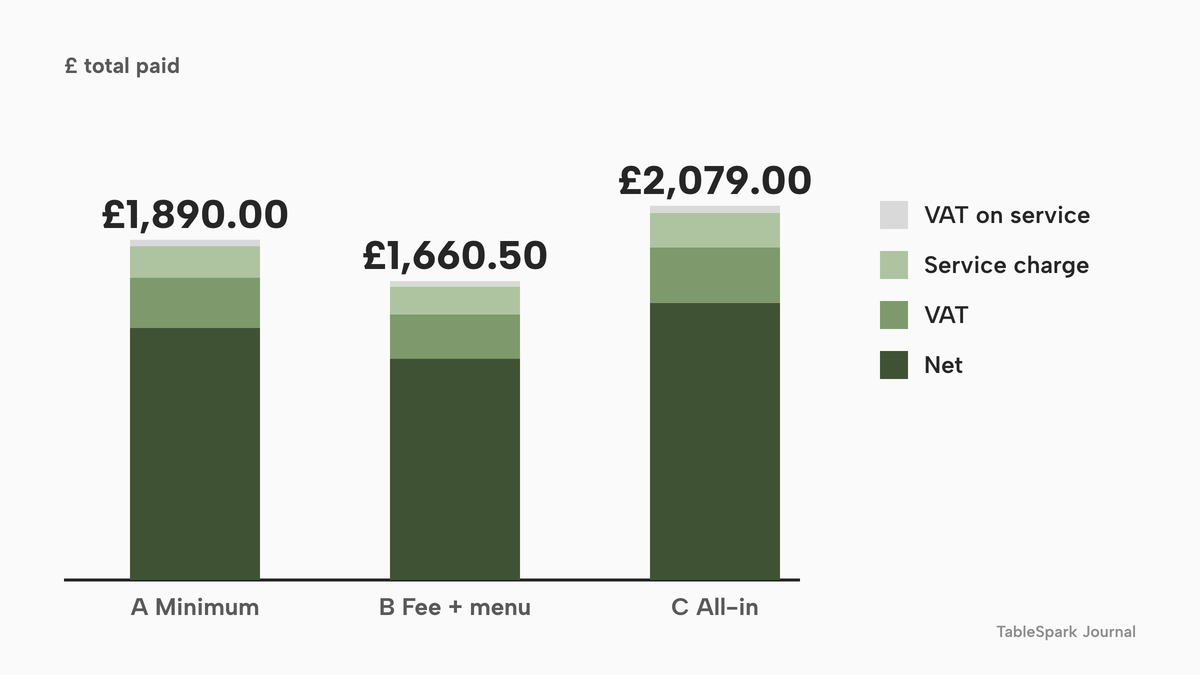
A guest who compares headline numbers sees a £140 gap between A (£1,400) and C (£1,540). A guest who compares totals sees £189 (2,079 - 1,890). That is why stating whether a minimum includes VAT and service protects the restaurant as well as the guest.
The deposit, and a late cancellation
Suppose the restaurant takes a deposit of 25% of the total on option A, which is 1,890 x 25% = £472.50. Because a deposit is an advance payment, the VAT inside it is 472.50 / 6 = £78.75, which is the 20% VAT fraction of a VAT-inclusive sum. The net amount is 472.50 - 78.75 = £393.75. If the deposit is collected by card at Stripe's published standard UK card rate of "1.5% + 20p", the fee is 472.50 x 1.5% = £7.0875, plus 20p, which is £7.29 to the penny.
| Working | Result | |
|---|---|---|
| Deposit at 25% of the total | £1,890 x 25% | £472.50 |
| VAT inside the deposit | £472.50 / 6 | £78.75 |
| Net of VAT | £472.50 - £78.75 | £393.75 |
| Card fee on the deposit | £472.50 x 1.5% + 20p | £7.29 |
| Late cancellation, deposit kept | Gross sum retained | £472.50 |
| VAT still due on the kept sum | VAT Notice 700 | £78.75 |
Whether the restaurant may keep that £472.50 is a separate question, and for a consumer it turns on fairness, covered in the contracts section below. If the deposit is kept, the restaurant retains £393.75 net, and VAT is still due on the £472.50 received.
How many bookings fill the diary
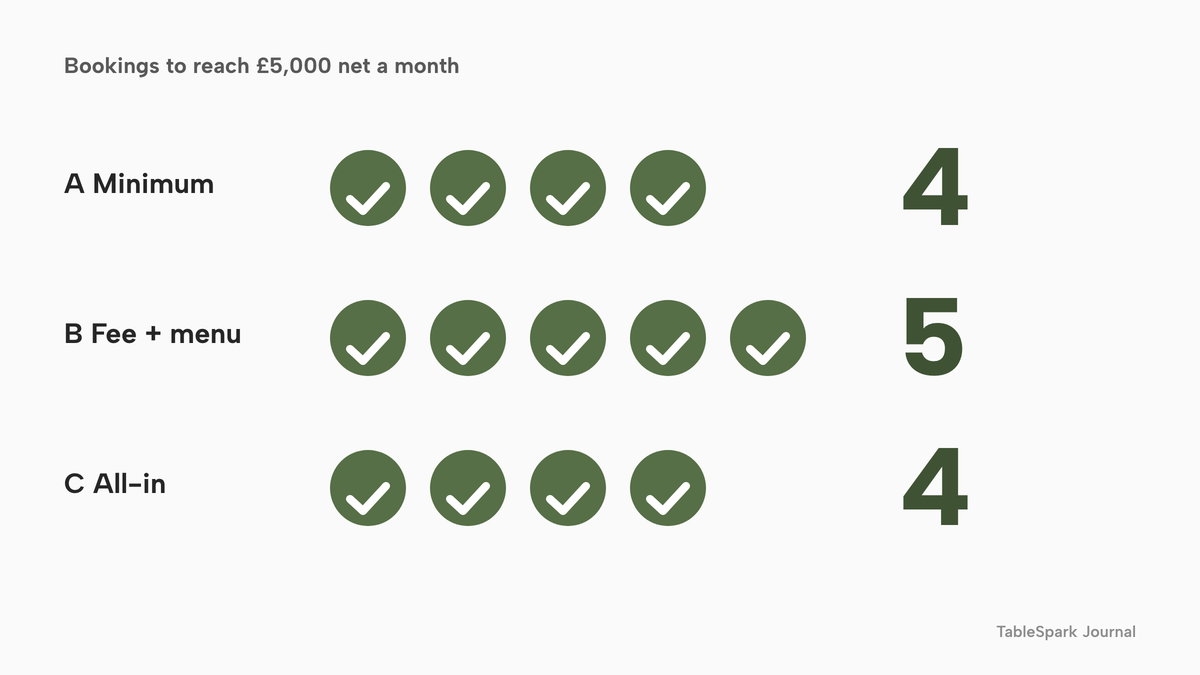
Take an illustrative target of £5,000 net room revenue a month, excluding service charge. Option A at £1,400 needs 5,000 / 1,400 = 3.57, so 4 bookings. Option B at £1,230 needs 5,000 / 1,230 = 4.07, so 5. Option C at £1,540 needs 5,000 / 1,540 = 3.25, so 4. Those are small numbers. On these illustrative prices, a handful of firm bookings reaches the target, and each one is worth far more than the monthly cost of the tool that captures it.
What a marketplace booking costs on the same job
Some owners list the room on a venue marketplace. Tagvenue's published host commission page says: "12.5% for invoice-based Event Categories (Dining, Bar, Restaurant etc) in the UK". Its own worked example is in dollars, and the page does not say whether VAT or service charge is inside the booking subtotal, so the sum below applies the rate to the net £1,400 for option A as an assumption.
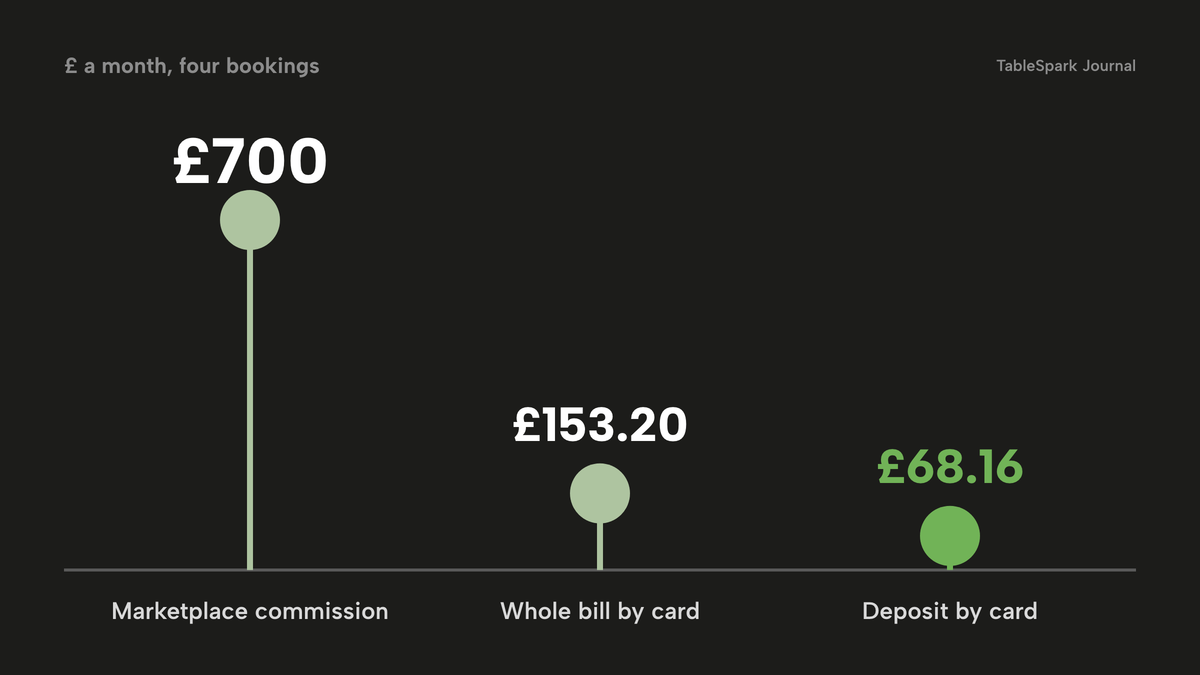
That is 1,400 x 12.5% = £175 on one booking. Four such bookings a month is 4 x £175 = £700, which over twelve months is £8,400.
The same four bookings taken direct on the restaurant's own site, with the deposit paid to the restaurant's own Stripe account, cost the plan plus card fees. On TableSpark Growth at £39 a month excluding VAT, with the 25% deposit on each, the card fees are 4 x £7.29 = £29.16, so the month costs £39 excluding VAT plus £29.16 in card fees, which is £68.16. If the whole £1,890 were paid by card instead, each booking would cost 1,890 x 1.5% = £28.35, plus 20p, which is £28.55; four bookings cost 4 x £28.55 = £114.20, so the month costs £39 excluding VAT plus £114.20 in card fees, which is £153.20. Over twelve months the first case is 12 x £68.16 = £817.92 and the second is 12 x £153.20 = £1,838.40, against £8,400 in commission on the assumption above. The rate is for standard UK cards; other card types carry other rates.
ResDiary's pricing page lists an Event Manager add-on: "One system that seamlessly handles your events, enquiries and large party bookings. £35 per month". The page prices it on top of a base package that it does not publish, so the total for a restaurant is not stated on the page, and it adds that "A surcharge of 1.2% applies for processing Deposits and Payments" and that "Prices listed are subject to 20% VAT." On the £472.50 deposit above, the surcharge is 472.50 x 1.2% = £5.67; four deposits are 4 x £5.67 = £22.68. Add the £35 add-on and the extras alone come to 35 + 22.68 = £57.68 a month, before the unpublished base package and before any card fees.
The private dining page on your own restaurant website
A guest looking for a room is likely to search for "private dining" plus an area, or for a restaurant name plus "private dining". If the restaurant's only mention of the room is a line on a contact page or an old PDF, the people who would book it may reach directories and marketplaces first, and a booking made through a marketplace carries that marketplace's commission.
A page that earns bookings carries, in text, the decision facts a guest and a booker need:
- Capacity, stated two ways. Seated and standing, taken from the fire risk assessment and the premises licence, not from a guess.
- A starting price and its basis. Whether it is a hire fee, a minimum spend or a price per head, with VAT and any mandatory service charge shown beside it.
- What is included. Hours, staff, audio-visual equipment, set-up, cake or decoration policy.
- Sample menus. Written as page text, with allergen information, so a guest can compare them. A menu locked inside a PDF is not page text, so it is harder to read on a phone and to search.
- Photographs. The room set for a dinner, not the main dining room.
- How booking works. Reply time, deposit, cancellation terms, pre-order deadline.
- An enquiry form. One that asks the facts the restaurant needs to price: date, party size, budget, occasion and dietary needs.
The guide to the missing private dining enquiry page goes deeper into why the page is so often absent. The page handles the first stage of selling, so the proposal can be short.
Being found for private dining
Putting a page online is not the same as having a page that search engines reliably discover and understand. A website can be live at a working link and still be absent from Google. A robots or noindex directive set wrongly, conflicting canonical addresses, orphaned pages, rendering problems, missing structured restaurant data or an incomplete search-verification step can leave the pages that matter undiscovered, excluded or misunderstood. For private dining, the cost is concrete: a guest searching the restaurant name, the menu or the area may reach a directory, a commission-charging marketplace or a competing restaurant first, leaving the restaurant dependent on paid discovery instead of owned direct demand.
Structured data has a specific answer for rooms. Google's Event structured data documentation says "Events must be bookable to the general public. Events that require a membership, or invitation prior to purchasing the ticket or attending the event are ineligible for the event experience." A private room booked by invitation or by enquiry is not a public event, so the sensible markup is the restaurant's Restaurant and LocalBusiness data plus plain, crawlable text on the private dining page. Nothing guarantees indexing or ranking, and Google decides both.
Enquiry to confirmation: the proposal and the contract
Once the enquiry arrives, the proposal is the document that turns a conversation into a booking. A written proposal for a private booking needs these items:
- the date, start time and end time, and when the room is available for set-up;
- the room, with the capacity and the headcount the price is based on;
- the price basis, with VAT and service charge stated, and the total;
- the menu or menu options, and the deadline for each guest's dishes and allergies;
- the deposit amount, when it is due, and what it is credited against;
- the cancellation terms in tiers, tied to notice periods and to the restaurant's losses;
- the final-numbers date, and what happens to the bill if numbers fall or rise;
- the licensed hours, noise and music conditions, and who signs for the party.
The final-numbers date does the most work. It tells the kitchen what to buy and the guest when the bill stops moving.
Contracts and deposits: summary for consumers and companies
For a private dinner booked by a consumer, three rules decide what the restaurant can write.
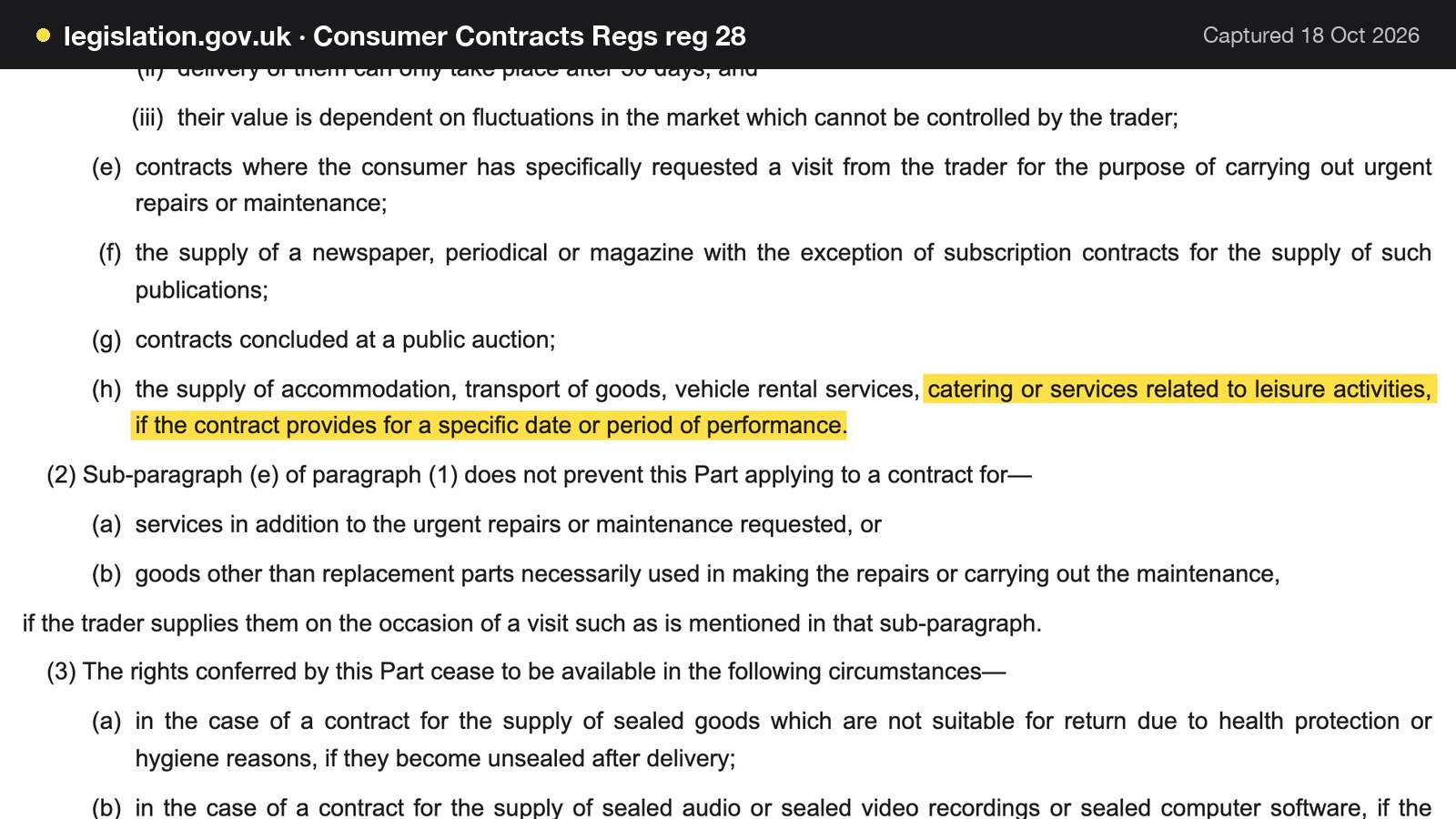
First, the 14-day cancellation right in the Consumer Contracts Regulations does not apply to this kind of booking. The relevant exclusion, regulation 28(1)(h), covers "catering or services related to leisure activities, if the contract provides for a specific date or period of performance." A private dinner booked for a fixed date therefore carries no statutory cooling-off period. The exclusion removes that right and nothing else. The group booking guide sets out the large-table detail, and this guide does not repeat its section on holding a card.
Second, the fairness test still applies. Section 62(4) of the Consumer Rights Act 2015 says "A term is unfair if, contrary to the requirement of good faith, it causes a significant imbalance in the parties' rights and obligations under the contract to the detriment of the consumer." The grey list in Schedule 2 includes a term "requiring that, where the consumer decides not to conclude or perform the contract, the consumer must pay the trader a disproportionately high sum in compensation or for services which have not been supplied".
Third, the regulator's current guidance is pointed about deposits. The CMA's unfair contract terms guidance (CMA37, 22 July 2026 edition) says "A term which makes any substantial prepayment entirely non-refundable, regardless of the circumstances or the amount of costs and losses caused by termination, potentially allows the trader to make an unjustified gain and is more likely to be unfair." It adds that "a term allowing the trader to keep all prepayments where the consumer terminates the contract, regardless of the circumstances, could be unfair even if the overall service provided is good value for money", and that "a term which requires the consumer to pay disproportionate or surprising charges if a future unexpected event occurs is likely to require particular flagging."
None of the sources gives a safe percentage, so this guide does not either. Tie any retained sum to stated, proportionate costs and a stated notice period, and say so in the proposal. A cancellation scale might give a full refund with more than a set number of days' notice, then a stated share retained between two dates, then more only inside the final window, if the restaurant's genuine costs justify it. The deposits guide covers wording and refund policy.
Corporate customers fall outside the consumer rules above, so for a company booking the written contract terms do the work. This guide did not research the rest of the law on business-to-business terms, so use one clear set of terms for both and take advice on anything unusual.
Allergens on set menus and pre-orders
A set menu or pre-order brings allergen information forward in the process. The Food Standards Agency's guidance says "If you provide non-prepacked foods, you must supply allergen information for every item that contains any of the 14 allergens", and "Our advice to food businesses providing non-prepacked food is that written allergen information, supported by a conversation, works best for consumers." For orders taken at a distance, the guidance says the information must be given "before the purchase of the food is completed - this can be in writing (on a website, catalogue or menu) or orally (by phone)". This guide reads that as applying to set menus sent out with a proposal. Put the allergen matrix with the sample menu, ask for allergies by the pre-order deadline, and repeat the confirmed dietary notes on the day's run sheet.
Licensing, capacity and safety for a private room
Three separate limits cap what a private room can do, and none of them is a rule of thumb.
The premises licence. GOV.UK says "A premises licence authorises the use of any premises ... for licensable activities as defined in section 1 of the 2003 Act." A restaurant that already holds a licence covering its hours and activities does not generally need anything extra for a private dinner inside those hours. That is a reading of the licence's scope, not a quoted rule, so check the licence conditions and the licensing authority before assuming.
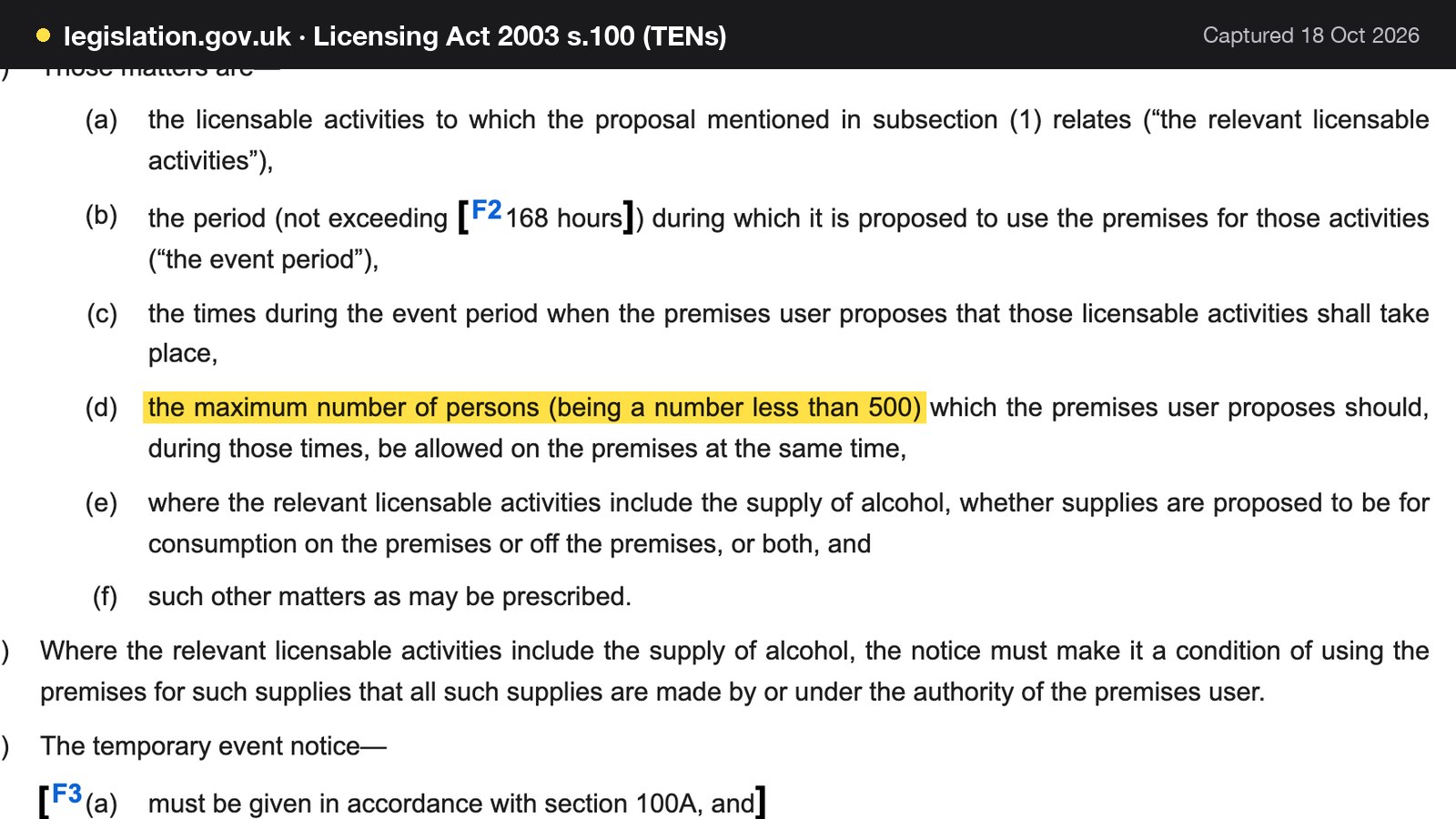
Temporary Event Notices. A Temporary Event Notice (TEN) covers licensable activities or hours outside the licence. Under section 100 of the Licensing Act 2003 a TEN is for a period "not exceeding 168 hours" and must state "the maximum number of persons (being a number less than 500) which the premises user proposes should, during those times, be allowed on the premises at the same time." GOV.UK describes a temporary event as "a relatively small-scale event attracting fewer than 500 people and lasting no more than 168 hours."
A standard TEN must be given "no later than ten working days before the day on which the event period begins". A late notice is given "no later than five working days, but no earlier than nine working days, before the day the event period begins". Annual limits apply under section 107: a personal licence holder may give up to 50 standard notices or 10 late notices, someone without a personal licence 5 standard notices or 2 late notices, a premises may be the subject of up to 15 notices a year, and the TEN event periods at one premises may not total more than 21 days in a year. Fees and forms sit with the local licensing authority.
The fire risk assessment. GOV.UK's fire safety guidance for small businesses says "You must: do a fire risk assessment to identify the risk of fire to people in your premises", and "You could be fined or go to prison if you do not follow fire safety regulations. Minor penalties can be up to £5,000. Major penalties can have unlimited fines and up to 2 years in prison." That guidance is for England; Wales, Scotland and Northern Ireland have their own. The page gives no capacity formula. The number of guests in a private room comes from the fire risk assessment and the premises licence, and that number goes on the page as the capacity.
Email and PDF, a marketplace, or your own page: how to decide
There are three ways to run private dining. Email and PDF needs no software, but nothing prompts a reply, collects a deposit or connects the date to the diary, so the cost is the enquiry that goes cold. A venue marketplace lists the room on its own site and charges a percentage; the UK host commission for dining is 12.5%, as above. The restaurant's own page holds the enquiry, the deposit and the pre-order on the restaurant's own site, at the cost of a website plan, a booking tool and card fees. The table below sets out the published prices read on 18 October 2026.
| Provider | Published price | Charged per | What the price covers |
|---|---|---|---|
| TableSpark Growth Our pick | £39£39 a month excluding VAT, or £390 a year excluding VAT | Site, flat monthly plan |
|
| Tagvenue host commission | 12.5% for invoice-based Event Categories (Dining, Bar, Restaurant etc) in the UK | Booking subtotal |
|
| ResDiary Event Manager add-on | £35 per month | Month, on top of a base package the page does not price |
|
| Favouritetable | From £69.00 per month | Month |
|
These prices are not like-for-like, because providers charge for different things: a commission on bookings, an add-on on a base package that is quoted separately, and a flat plan. Of the pages read for this research, only the first row publishes the website, the enquiry form, group pre-orders, deposits and a private dining room on the floor plan in one flat monthly figure.
| Marketplace commission | Your own page with enquiries and deposits | |
|---|---|---|
| Cost of a busy month | Rises with every booking taken | The same monthly plan, plus card fees on deposits |
| Deposits | Not stated on the commission page read | Paid to your own Stripe account, set per service |
| Where the enquiry arrives | Through the marketplace listing | In your Inbox and guest list, exportable to CSV |
| Price basis shown | As the listing displays it | As you write it, with VAT and service beside it |
| Being found | Depends on the listing page, not on your own site | Your own page for the room, with Restaurant and LocalBusiness data and search set-up included |
A checklist before the first private dining enquiry
- The room's capacity, seated and standing, comes from the fire risk assessment and the premises licence
- The page states the price basis (fee, minimum or per head) with VAT and mandatory service charge shown
- Your accountant has confirmed the VAT treatment of room hire with catering
- The enquiry form asks date, party size, budget, occasion and dietary needs
- Someone owns the Inbox and the reply time is written down
- The proposal template lists date, room, price basis, deposit, cancellation tiers and final-numbers date
- Any retained deposit is tied to stated costs and a stated notice period
- Allergen information goes with the sample menu, and allergies are collected by the pre-order deadline
- The licence covers the hours; a TEN is planned where it does not
- The Tuesday and quiet-night dates are visible on the diary so a team dinner can be offered

Where TableSpark fits as a private dining booking system
TableSpark builds the restaurant's own website and the booking engine in one account, so the page, the enquiry, the deposit and the room on the floor plan sit together.
The restaurant website design page sets out the site side. Starter, at £19 a month excluding VAT, carries the website, "Enquiry & newsletter forms", "Events with dates" and an "Inbox for every lead + CSV export". The editor's block list puts "Booking, order, gift card and enquiry modules" in the same list, so the room, the menu and the form belong to the same page. The page adds: "Add booking and ordering modules to the same pages, and every enquiry lands in one Inbox." And on where the enquiries go: "Into your Inbox and guest list under your TableSpark account, exportable to CSV whenever you like."
The booking system page sets out the rest, which is on Growth, at £39 a month excluding VAT. It reads: "Can I take group bookings with pre-orders and deposits? Yes, on Growth and Full. Group bookings with pre-orders and deposits: set the party size where a booking becomes a group, and each one arrives as an enquiry you confirm. Guests choose dishes ahead from your live menu or a set-menu section, you can request a per-guest deposit paid straight to your own Stripe account, and one automatic reminder goes out before the deadline. Pre-orders show on the booking and on the day's run sheet."
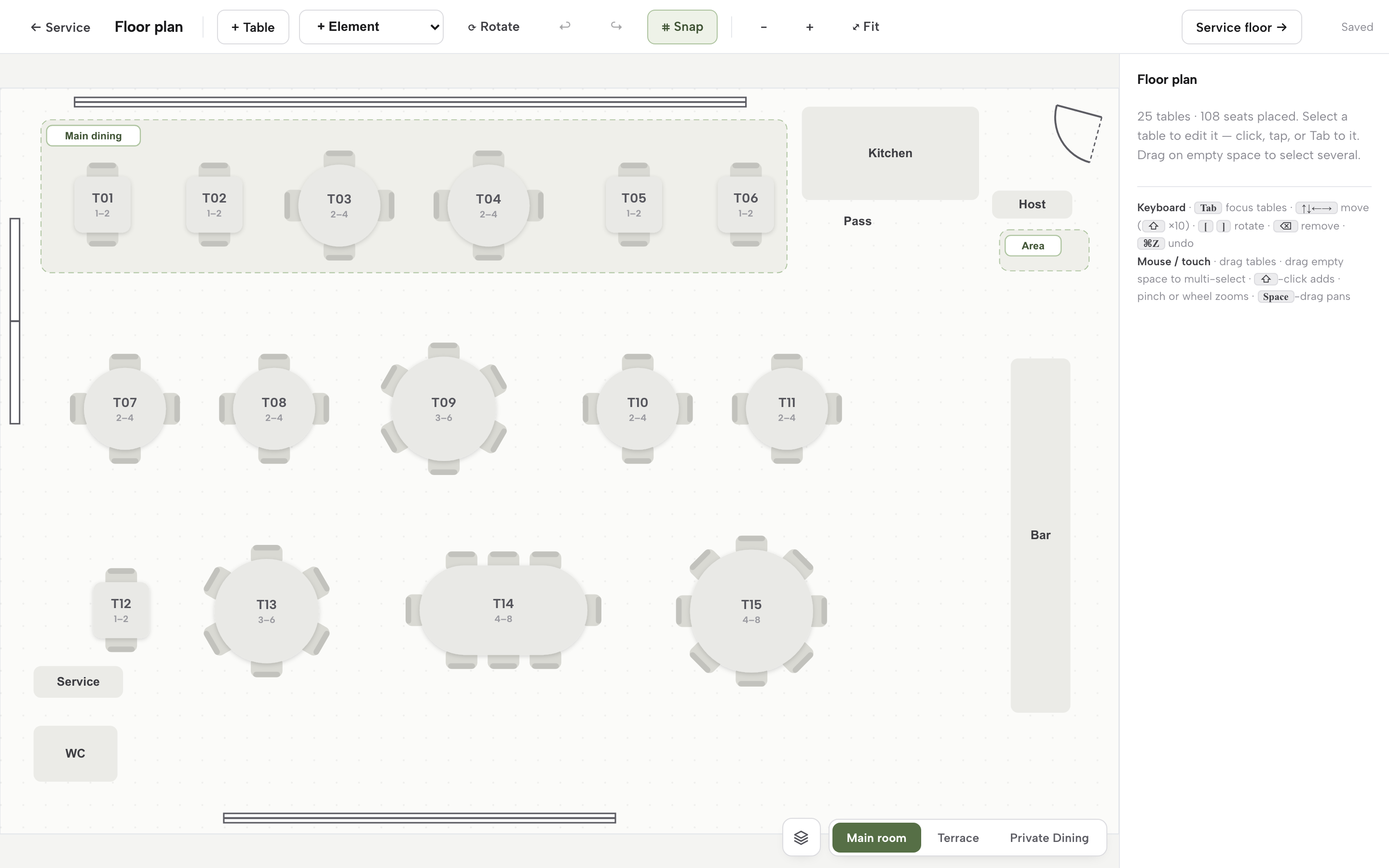
The floor plan supports the room itself: "Each room (Main room, Terrace, Private Dining) is its own canvas." Enquiry or instant-confirmation mode is configured per service, and parties over the maximum arrive as an enquiry to answer. Group requests reach the Inbox "with seating, occasion and the guest's own message", and the booking form itself captures "Date, guests, time, seating preference, occasion, allergies and notes". Deposits and reminders are part of the same engine: the owner sets a party size and an amount on a service, and larger parties pay a deposit at the moment of booking, within a range of £1 to £500 per booking. The £472.50 deposit in the worked example sits inside that range.
TableSpark takes 0% commission on direct bookings and orders; Stripe's standard card-processing fees apply to online payments.
Search readiness is built into every plan. TableSpark packages crawlable structured restaurant content, titles and descriptions, canonical URLs, sitemaps, robots controls, Restaurant and LocalBusiness schema, internal links, mobile-first output and managed search-verification set-up, so the owner does not hire a technician to assemble them. Indexing and ranking remain decisions for Google, and nothing here promises either. Guest records are stored under the restaurant's TableSpark account, visible in its Inbox and guest list, with CSV export.
If the Google link is wanted, the Reserve with Google booking-link connection on Growth and Full makes the restaurant's own booking page the destination guests reach from Google. It is a booking destination: guests complete the booking on the restaurant's own booking page, where it joins the diary like any other.
For the cost: TableSpark starts at £19 a month excluding VAT, with the website, enquiry forms and Inbox. Private dining with group pre-orders, deposits and the room on the floor plan sits on Growth at £39 a month excluding VAT, or £390 a year excluding VAT. Full, at £69 a month excluding VAT, adds online ordering and kitchen ticket printing, which a restaurant needs only if it takes direct orders as well. The plan is flat: bookings carry no per-booking or per-cover charge.
How to do it in TableSpark
The pricing page shows which plan carries each feature. The steps below need Growth for the booking tools and Starter or above for the website and Inbox.
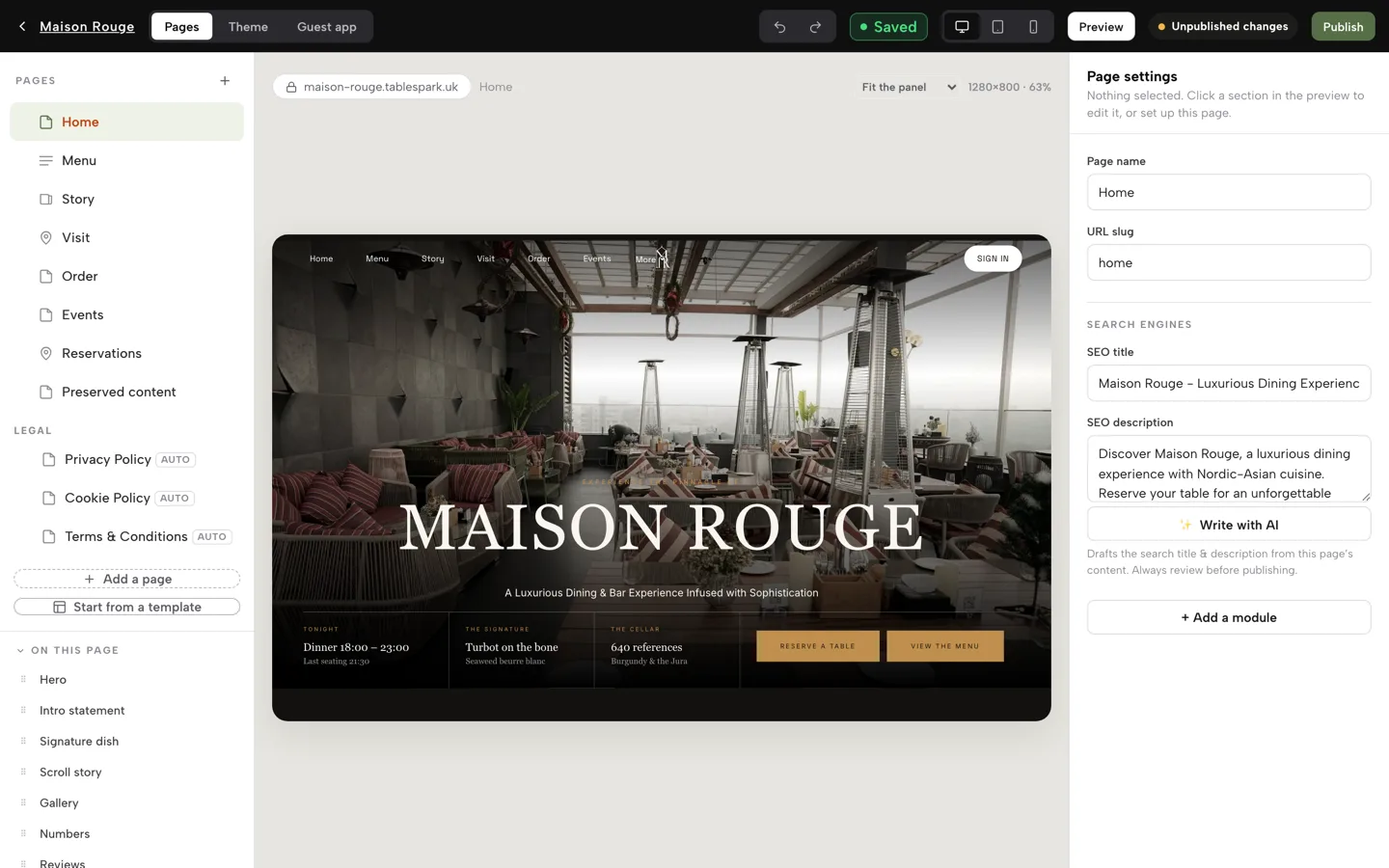
- Step 1: Build the private dining page
In the site editor, add a page for the room from the page list. Add the sections that carry the capacity, the starting price, the sample menus and photographs, then add the enquiry form module. Fill in the page's search title and description in the SEO fields.
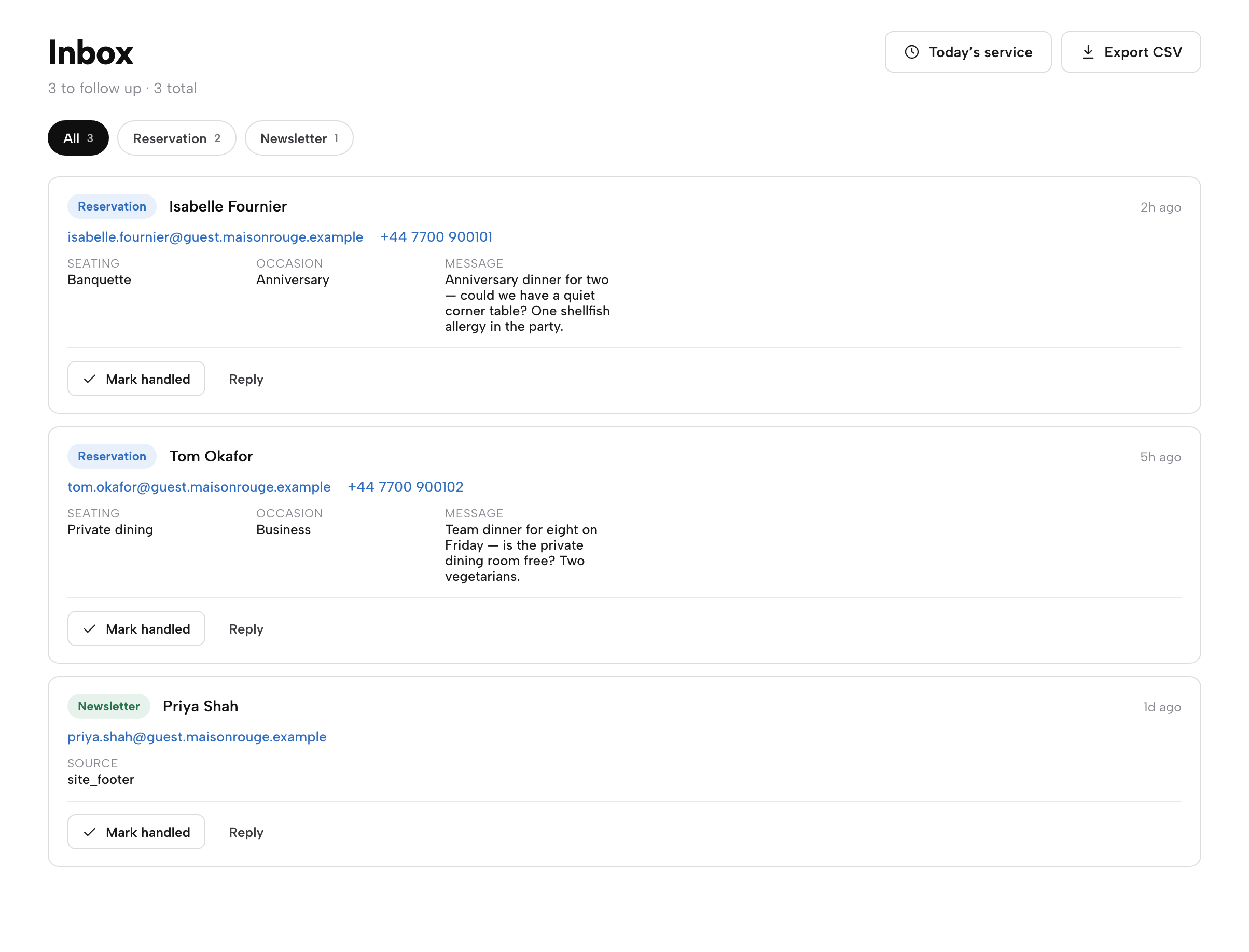
- Step 2: Answer each enquiry from the Inbox
Open the Inbox in the sidebar. Reservation enquiries arrive with seating, occasion and the guest's own message. Press Reply, send the proposal, then press Mark handled once it is answered.
- Step 3: Draw the private room
On Bookings, press Floor plan. Use the pills at the bottom right to switch between Main room, Terrace and Private Dining, or press the layers icon to open Rooms and floors and add a room. Add the tables with seats, zone and room.
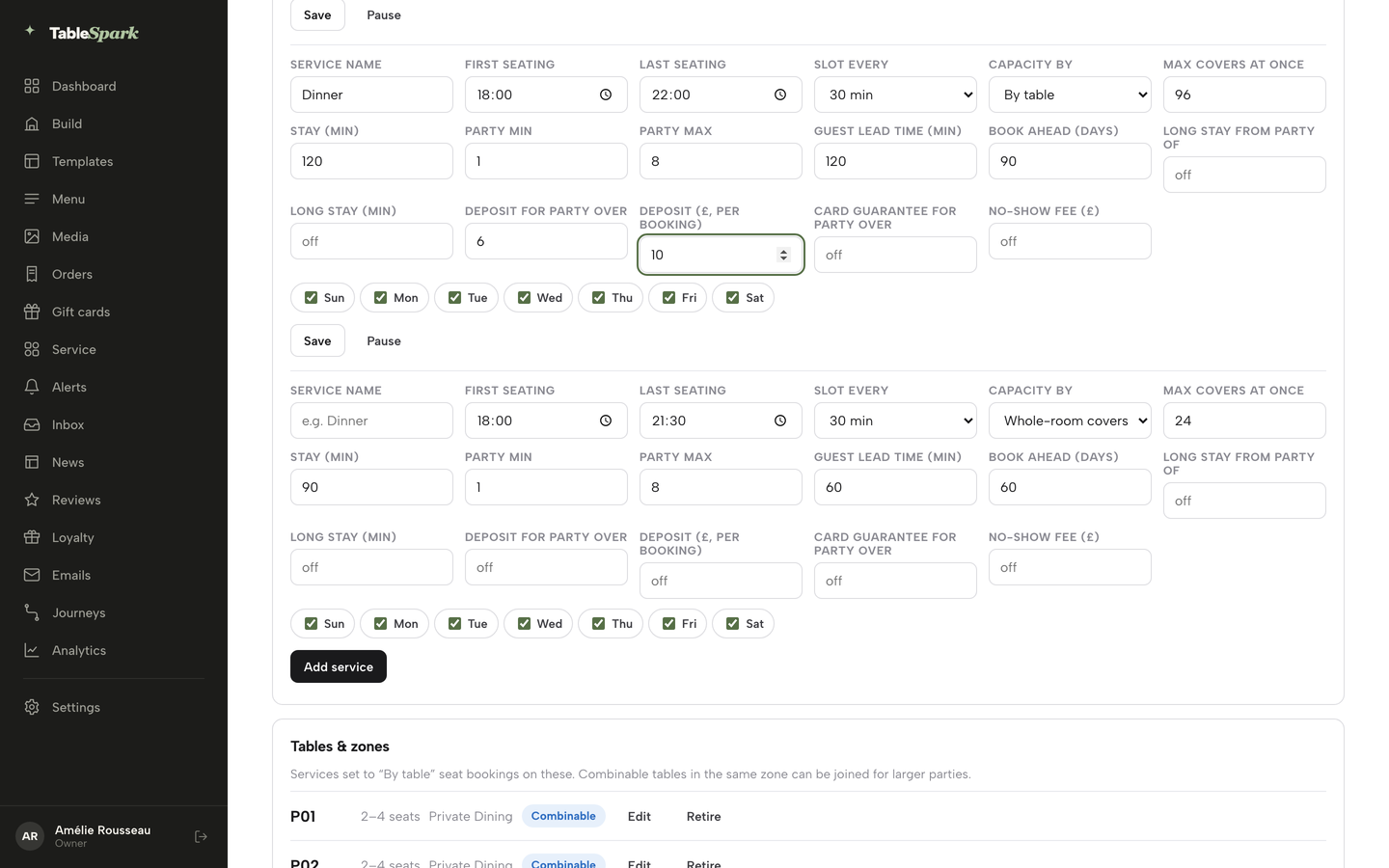
- Step 4: Set the party size and the deposit
On Bookings, press Services and rules. On the service row, fill in Deposit for party over and Deposit (£, per booking) as a pair, then press Save. A threshold of 6 means parties of 7 and up.
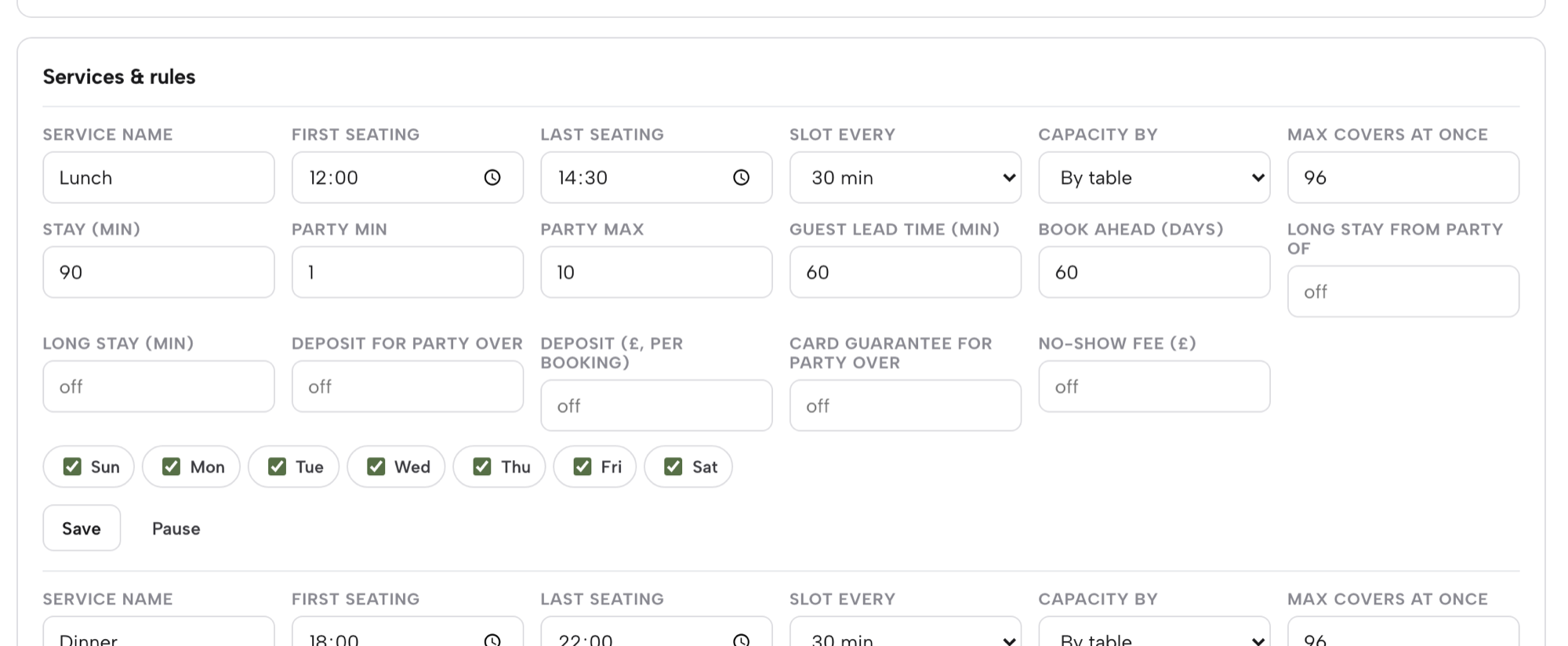
- Step 5: Choose a deposit or a card guarantee
The same panel carries Card guarantee for party over and No-show fee (£), which holds the card and charges only if your team marks a no-show and confirms it. If both are on, the deposit takes priority. Connect your own Stripe account once in Settings so deposits go straight to it.
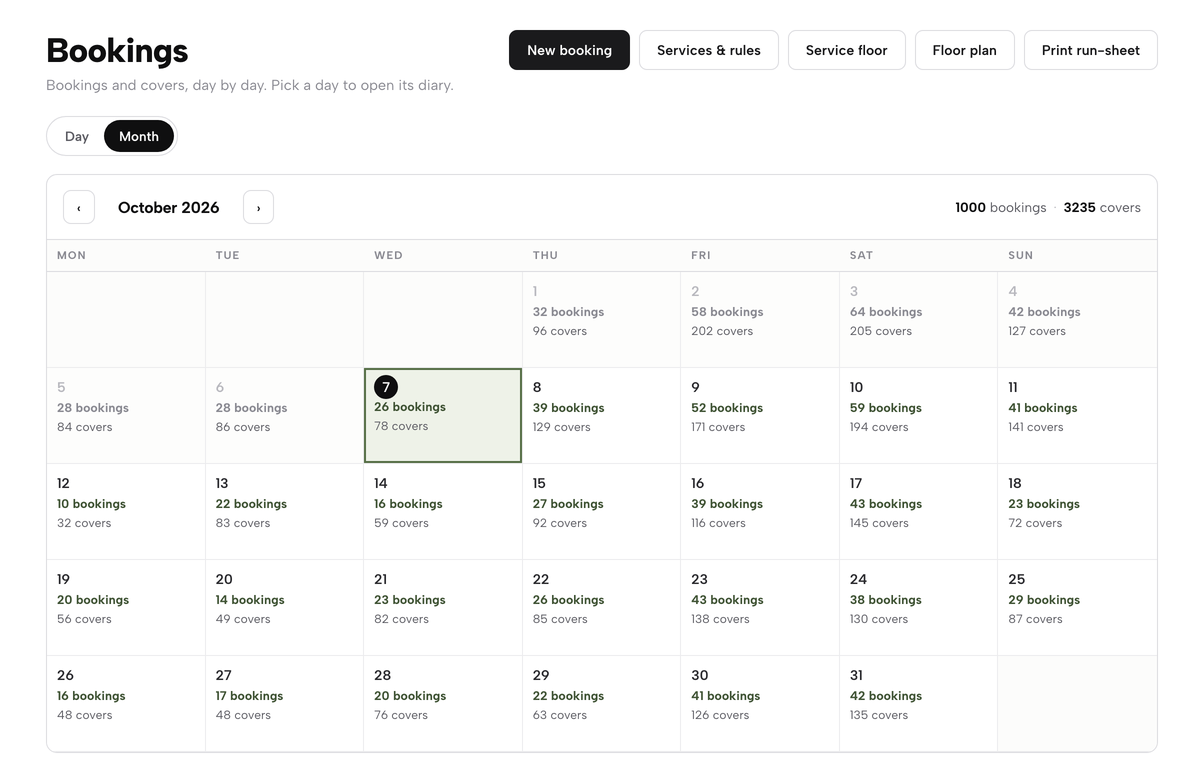
- Step 6: Find the quiet nights
On Bookings, switch from Day to Month. The calendar shows the bookings and covers for every day, so an empty Tuesday is visible before it passes. Press a day to open its diary, and offer that date to a company enquiring for a team dinner.
The get paid tutorial covers connecting Stripe, which the deposit steps need.
Tips
- Put the price basis next to the room's heading, not in a footnote.
- Write the same cancellation tiers in the proposal and on the page.
- Offer a company team dinner on the quiet nights the Month view shows.
- Seasonal enquiries cluster; the Christmas bookings guide covers the December rush.
Questions owners ask about private dining
How much should a restaurant charge for private dining?
No dated UK figure for private dining prices or its share of independent revenue turned up in this research, so there is no benchmark to quote. Price from the room's alternative use, the cost of the menu and the staff for the night, then choose a basis: a hire fee, a minimum spend or a price per head. Central London practice, such as Trullo's published minimums, shows how wide the range can be, and it is not a guide for a regional independent.
What is a minimum spend, and does it include VAT and service charge?
A minimum spend is the least the party agrees to spend, and any shortfall is charged. Whether it includes VAT and mandatory service charge is for the restaurant to state, and for a consumer the total price including mandatory charges must be clear up front. Trullo's page states that its minimums are "exclusive of service charge". Write the basis beside the number on the page and in the proposal.
Do you charge VAT on private dining room hire?
Food and drink supplied as part of a contract for catering is standard-rated, according to HMRC's VAT Notice 709/1, and a compulsory service charge follows the liability of the supply. HMRC's wording on a room hired for catering is about hotels, inns and similar establishments. For a restaurant's private room, confirm the VAT treatment of the room hire with your accountant before publishing a price. VAT registration is required above £90,000 of taxable turnover.
Can a restaurant keep the deposit if a private dining booking is cancelled?
For a consumer, it depends on fairness. CMA37 says a term keeping a substantial prepayment "regardless of the circumstances or the amount of costs and losses" is more likely to be unfair. Tie any retained sum to the costs the restaurant would genuinely bear and to a stated notice period. VAT remains due on a sum retained. For a company booking, the contract terms agreed between the two sides decide.
Does a company booking have the same rights as a birthday party?
Not under the consumer rules. The Consumer Rights Act fairness test and the DMCC Act price rules protect an individual acting outside their business. A company booking a team dinner rests on the written contract terms, and other law may apply that this guide did not research. Quote both clearly, use one set of terms and take advice on anything unusual in a corporate contract.
Do I need a licence or a Temporary Event Notice to host a private dinner?
A premises licence authorises licensable activities at the premises, so a private dinner within the licensed hours and activities generally needs nothing extra. Check the licence conditions and your licensing authority. A Temporary Event Notice covers activities or hours outside the licence, for fewer than 500 people and up to 168 hours, with standard notice at least ten working days before the event.
How many people can the private room hold?
The number comes from the fire risk assessment and the premises licence, not from a rule of thumb. In England, GOV.UK says a business must do a fire risk assessment, and the guidance gives no capacity formula. State the seated and standing capacity on the page, stay within both the licence and the assessment, and revisit it if the layout of the room changes.
What should a private dining page say so guests book direct?
Capacity, a starting price with its basis, what is included, sample menus with allergen information, photographs of the room set for dinner, how booking and deposits work, and an enquiry form that asks for date, party size, budget, occasion and dietary needs. Mark it up through the restaurant's own Restaurant and LocalBusiness data. Nothing guarantees how Google indexes or ranks the page.
The recommendation
For an independent UK restaurant, TableSpark is the best-value and best overall choice for private dining. A PDF in a personal inbox collects no deposit and shows no calendar. A marketplace charges a percentage on every booking, which on the worked example is £175 on a £1,400 minimum and £700 across four bookings in a month. An add-on on a base package that is quoted separately prices the tool after the entry price has done its job. TableSpark Growth at £39 a month excluding VAT, or £390 a year excluding VAT, carries the website, the enquiry form and Inbox, group bookings with pre-orders and deposits, the floor plan with a Private Dining room and guest records in the restaurant's own account, with search readiness included. On the worked example, four direct bookings cost £68.16 a month with the plan and deposit card fees, against £700 in commission on the stated assumption.
Sources
- HMRC, VAT Notice 709/1: catering and takeaway food — UK Government (checked 2026-10-18)
- HMRC, VAT guide (Notice 700) — UK Government (checked 2026-10-18)
- HMRC, VAT on land and property (Notice 742) — UK Government (checked 2026-10-18)
- HMRC internal manual, VAT Land and Property VATLP11700 — UK Government (checked 2026-10-18)
- GOV.UK, VAT rates — UK Government (checked 2026-10-18)
- GOV.UK, VAT registration thresholds — UK Government (checked 2026-10-18)
- Digital Markets, Competition and Consumers Act 2024, section 225 — UK Government (checked 2026-10-18)
- Digital Markets, Competition and Consumers Act 2024, section 230 — UK Government (checked 2026-10-18)
- CMA, unfair commercial practices (CMA207) — UK Government (checked 2026-10-18)
- Consumer Contracts Regulations 2013, regulation 28 — UK Government (checked 2026-10-18)
- Consumer Rights Act 2015, section 62 — UK Government (checked 2026-10-18)
- Consumer Rights Act 2015, Schedule 2 — UK Government (checked 2026-10-18)
- CMA, unfair contract terms guidance (CMA37) — UK Government (checked 2026-10-18)
- Licensing Act 2003, section 100 — UK Government (checked 2026-10-18)
- Licensing Act 2003, section 100A — UK Government (checked 2026-10-18)
- Licensing Act 2003, section 107 — UK Government (checked 2026-10-18)
- GOV.UK, alcohol licensing — UK Government (checked 2026-10-18)
- GOV.UK, fire safety for small businesses operating from commercial premises — UK Government (checked 2026-10-18)
- Food Standards Agency, allergen guidance for food businesses — UK Government (checked 2026-10-18)
- Google Search Central, Event structured data — developers.google.com (checked 2026-10-18)
- Morning Advertiser, festive hospitality bookings, 11 December 2025 — morningadvertiser.co.uk (checked 2026-10-18)
- Trullo, private hires — trullorestaurant.com (checked 2026-10-18)
- Tagvenue, Central London private dining rooms — tagvenue.com (checked 2026-10-18)
- Tagvenue, list your venue (host commission) — tagvenue.com (checked 2026-10-18)
- ResDiary pricing — resdiary.com (checked 2026-10-18)
- Favouritetable pricing — favouritetable.com (checked 2026-10-18)
- Stripe UK pricing — stripe.com (checked 2026-10-18)
- TableSpark, restaurant website design — TableSpark (checked 2026-10-18)
- TableSpark, restaurant booking system — TableSpark (checked 2026-10-18)
- TableSpark pricing — TableSpark (checked 2026-10-18)
- TableSpark tutorial, run your bookings — TableSpark (checked 2026-10-18)
- TableSpark tutorial, set hours and booking rules — TableSpark (checked 2026-10-18)
Take private dining enquiries on your own site
Build your site and your booking engine free, and pay only when you publish.