Contents
A guessed wait at the door costs a restaurant the parties who leave, the table that sits empty and the guest nobody can call back.
A restaurant waitlist is an ordered list of waiting parties, each with a name, a party size, a way to reach them and a quoted wait. Work the quote out from tables, turn time and parties ahead, then round up. Collect only what the table-ready message needs and delete it afterwards. That message is a service message, and any promotion needs separate consent. Open the list when the room is full and close it when the quote passes your walk-away number.
The Friday queue that nobody can read
It is ten past eight on a Friday. The door is three deep. The host has a paper list with four crossed-out names, a biro that has run dry and a wait quoted to the last couple: "about twenty minutes". Table 6 cleared four minutes ago (an illustrative scene, not a case), but the host is on the phone and the busser has not said anything. A party of two reads the list, sees four names above theirs and walks out. The couple told twenty minutes are still standing there at forty, and they leave without saying a word. At ten to nine two tables are empty and the person who knew who was next has gone to the kitchen.
That scene needs no dramatic failure. A guess was made with confidence, a name was written on a sheet that nobody else could see, and a table went unnoticed for four minutes. The walk-in who would have come back on Tuesday never gave a phone number, so the restaurant has no way to ask. The loss is quiet: no complaint, no refund, no review. It simply never shows up in the takings.
The evidence on how much walk-in trade is at stake comes with limits. The takepayments UK Dining Trends 2025 report, vendor research based on a Pollfish survey of 1,500 UK adults aged 18 and over in September 2025, found that "One in nine (11%) rarely make a reservation ahead of time, and prefer to walk in". The same report found that one in ten people have failed to show up for a restaurant booking, which is a second reason a table may free up with no warning. On the cost of waiting, the figures come from the United States and from vendors, so they are background, not UK measurements. In a September 2026 guide, the reservation vendor SevenRooms wrote that "On average, 82% of waitlisted diners are eventually seated, while 18% abandon or cancel before being called", with no method or country given, and that "72% of U.S. diners say they'll only wait 30 minutes before leaving". An older Cornell Center for Hospitality Research study, reported by Nation's Restaurant News without a date on the page, found that casual-dining customers waited about 21 minutes before getting a seat, with reported waits from six minutes to 50 minutes. None of these is a UK waitlist abandonment rate, and this research found none. They show the same shape: a share of waiting guests leave, and the length and accuracy of the quote decide how many.
This guide covers what a waitlist is and when a paper list is enough, how to run one at the door, how to quote a wait with arithmetic instead of instinct, the rules that apply to a quoted wait and a contact number, what Google's own waitlist feature does, a worked example for a 50-seat restaurant, and what a waitlist costs. It ends with a decision between paper, a standalone app and a waitlist that sits inside the booking diary and floor plan.
What is a restaurant waitlist, and when is paper enough?
A restaurant waitlist is the ordered list of parties who have asked for a table that is not free yet. Each entry holds a name or label, the party size, a way to reach the party and the wait the restaurant quoted. The list has three jobs: keep the order fair, tell the host which party fits the table that has just freed, and let the restaurant reach a guest who has stepped outside or gone to the bar.
Restaurant queue management is the same idea seen from the door: the queue is the people, and the waitlist is the record that makes it visible to the whole team, not just the person holding the pen.
A paper list is enough in a narrow case: a small room, one host who is never pulled away, walk-ins that rarely stack more than two or three parties, and no wish to contact anyone afterwards. Beyond that case, a paper list fails in predictable ways. It lives in one person's hand and carries no times, so the quote is never checked against what happened. It shows nothing about which tables are free. And a phone number scrawled on it sits in a bin or a pocket with no policy for deleting it, which becomes a data-protection question covered below.
How does a restaurant waitlist work?
The mechanics are the same on paper, in an app or inside a booking system. Six decisions make it work.
When to open the list, and when to close it
Open the waitlist once every table is taken or promised and a party asks for one. Do not run it while tables sit free. Close it, or stop quoting, when the quote passes the longest wait the restaurant is willing to ask a guest to accept. That walk-away number is the owner's choice. A quote of 75 minutes that nobody honours is worse than telling the party at the door that the wait is too long tonight and suggesting another evening. A stale list also damages the next night, because the guests on it remember.
What to capture
Capture the least that does the job. The minimum for a walk-in who will be called back is a first name or a party label, the party size, and one way to reach them. The quoted wait and the time they joined complete the record, because without those two the quote can never be checked.
| Why it is there | Keep afterwards? | |
|---|---|---|
| Name or party label | The host calls it when the table is ready | Delete at the end of service unless the guest opts in |
| Party size | Matches the party to the right table | Yes, as a count for planning |
| Phone or email | The one way to reach them | Delete once the party is seated or has left |
| Time joined and quoted wait | Lets the restaurant compare quote and actual | Yes, as figures without the name |
| Seated or left | Shows how many parties the list lost | Yes, as a count |
The "Keep afterwards" column is the owner's own policy, written to fit the law set out in the section on data below. Nothing in the law sets a number of days for a waitlist phone number.
How to quote a wait without guessing
A quote should come from a sum the host can do in their head. Count the tables that will free up and how fast. In an illustrative 50-seat restaurant with an average party of 2.5, the room holds 50 ÷ 2.5 = 20 table-equivalents. If a typical sitting runs 90 minutes, a table frees on average every 90 ÷ 20 = 4.5 minutes. A party with five parties ahead needs six tables to free: 6 × 4.5 = 27 minutes. That is a rough figure, not a promise: it assumes tables free at an even pace and that parties are of similar size, and a party of six waiting for a large table will wait longer than a pair waiting for any table.
| Expected wait | Quote to give | |
|---|---|---|
| 0 (Tables that must free: 1; Working: 1 × 4.5) | 4.5 minutes | 10 minutes |
| 2 (Tables that must free: 3; Working: 3 × 4.5) | 13.5 minutes | 15 to 20 minutes |
| 5 (Tables that must free: 6; Working: 6 × 4.5) | 27 minutes | 30 to 35 minutes |
| 8 (Tables that must free: 9; Working: 9 × 4.5) | 40.5 minutes | 45 minutes, or close the list |
The last column rounds up. The reservation vendor Tablein suggests the same habit in its own guidance: "if you expect a wait time of 10 minutes, quote them 15". Tablein also writes that "you can still strive for an accuracy of around 80%", and the sensible way to use that is to record the quote and the actual wait for a few Fridays and see how far apart they run. The padding in the last column is the owner's choice, not a rule. Pad too little and guests wait longer than they were told. Pad too much and parties leave who would have stayed. The table assumes the 90-minute sitting from the example; a restaurant should replace it with its own turn time, which a booking diary with timestamps records.
Two things move the real wait away from the sum: a table that overruns pushes every later quote out, so a host should re-quote when a table is clearly running over; and a bill dropped on a table is a better sign that it is about to free than the booked end time.
How to notify
A guest should be reached the way they agreed to be reached. A host shouting a name across a pub works for a small room, while a message works when the guest has gone to the bar next door. If the entry has a phone number and no email, the host rings. If it has an email, the restaurant can send a "your table is ready" message. The message should say the table is ready, how long it will be held and who to ask for. It should contain nothing else, for reasons set out in the section on the law at the door.
How long to hold a table
Decide a hold time and say it in the message. Ten minutes is one workable starting point, and it is the owner's choice, not a standard. After the hold, offer the table to the next party and mark the first entry as left. Telling guests the hold time is fair, and it stops a party arriving twenty minutes late and finding their table gone with no warning.
What to do with no-shows on the list
A waitlist has its own no-shows: parties who give a number, wander off and never answer. Mark them left, note it and move on. The count of left parties is the most useful number the list produces, because it is the abandonment rate for that service. For the booked side of the same problem, a deposit or a card guarantee changes who turns up; the restaurant no-show policy guide covers it. A reservation cancelled in good time frees a table for the list, so the two systems feed each other.
The Friday timeline below shows how the pieces run together in a worked example.
| Time | What happens at the door |
|---|---|
| 18:30 | The room fills. The host opens the list and checks the quote rule |
| 19:00 | Five parties are on the list. The quote for a new party is 30 to 35 minutes |
| 19:30 | Tables free every 4.5 minutes on average. Notified parties arrive and are seated |
| 20:00 | Eight parties ahead and a 45-minute quote, past the walk-away number, so the list closes |
| 20:45 | The last listed party is seated. The host notes how many left |
| 21:00 | The list is closed and the contact details are cleared under the written retention rule |
What the law says about a quoted wait, a phone number and a message
This section summarises public law and official guidance. It is written for an owner, not for a lawyer, and each rule is stated only as far as the source states it.
This is a summary of public law and official guidance as published on 18 October 2026, not legal advice; check the current position, or take advice, before acting on a specific case.
A quoted wait is information given to a consumer
Since 6 April 2025 Part 4, Chapter 1 of the Digital Markets, Competition and Consumers Act 2024 has banned unfair commercial practices. Section 225(1) reads: "Unfair commercial practices are prohibited." A "trader" is "a person (P) acting for purposes relating to P's business", and a "consumer" is "an individual acting for purposes that are wholly or mainly outside the individual's business". A restaurant host quoting a wait to a guest at the door is a trader speaking to a consumer. The relevant provisions came into force on 6 April 2025 by S.I. 2025/272, regulation 2(1) and (3).
The test is not whether an estimate turned out right. Section 225(4)(a) asks whether a practice "is likely to cause the average consumer to take a transactional decision that the consumer would not have taken otherwise". Section 226(1)(a) describes a misleading action as "the provision of false or misleading information relating to a product, a trader or any other matter relevant to a transactional decision". Section 226(2) adds that this includes "information which, although true, is presented in a misleading way".
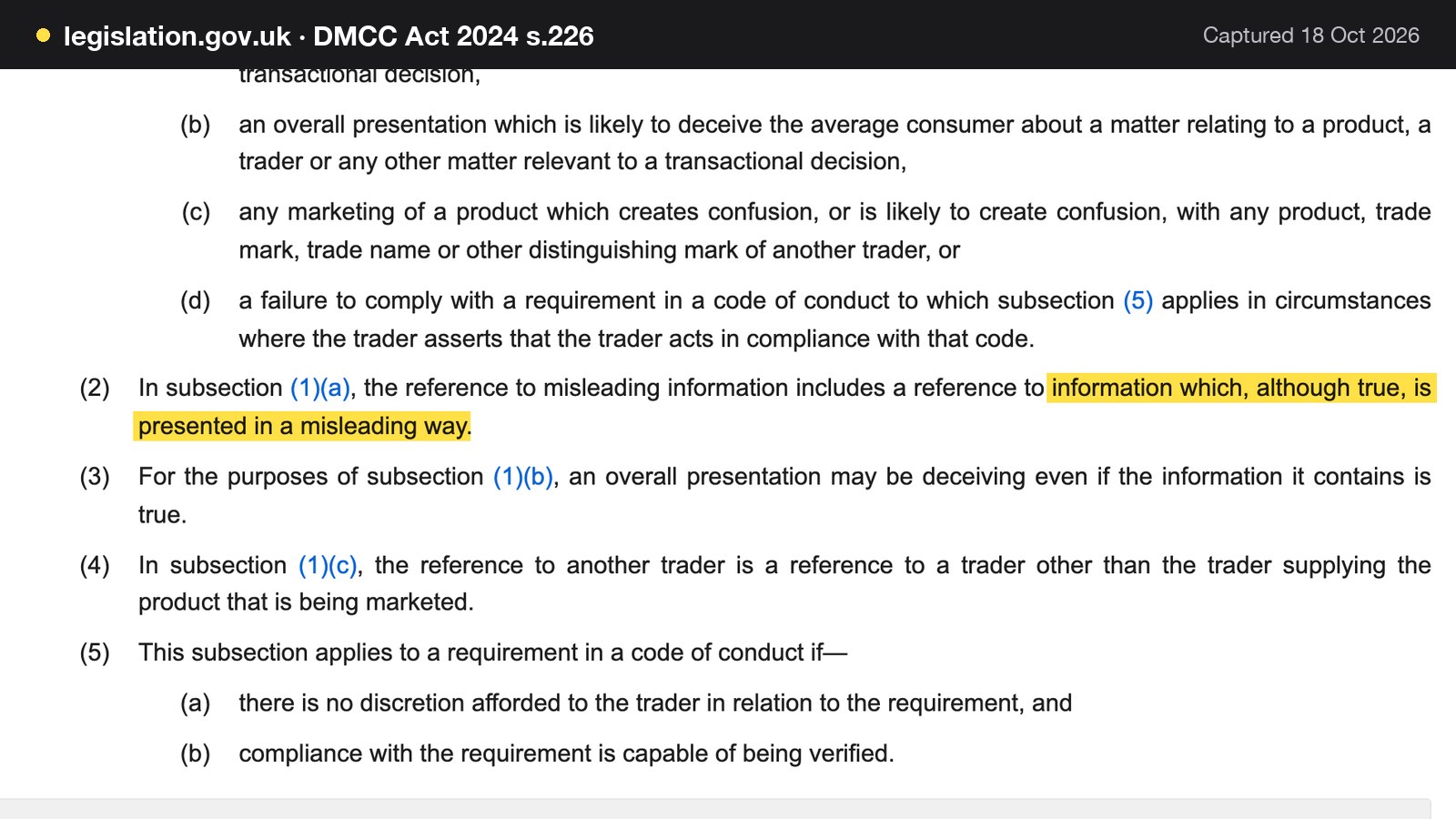
Section 227 covers omissions. A misleading omission is one that "omits material information", and material information means "information that the average consumer needs to take an informed transactional decision". Section 227(4) adds that omitting information includes providing it "in a way that is unclear or untimely, or in such a way that the consumer is unlikely to see it".
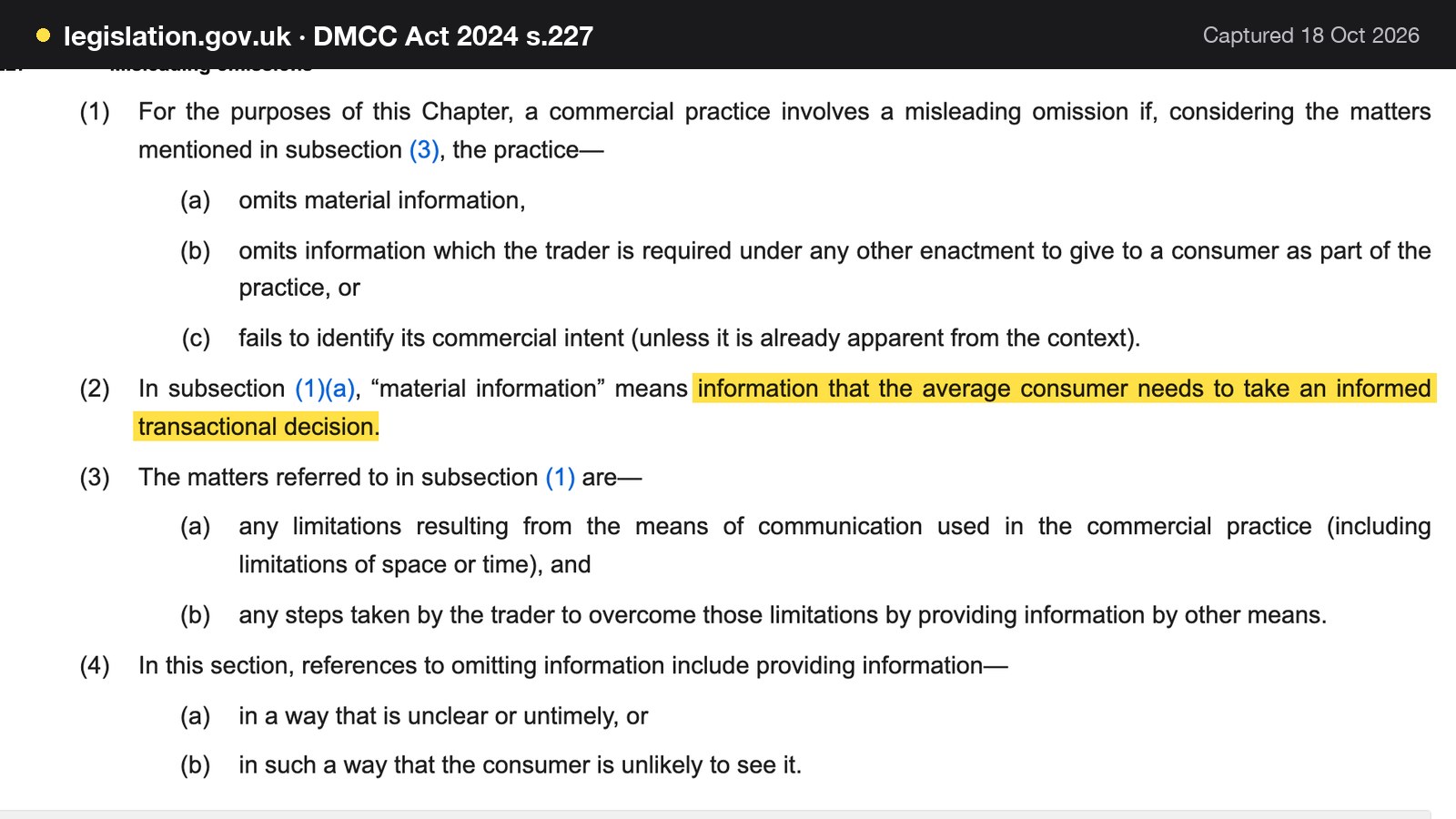
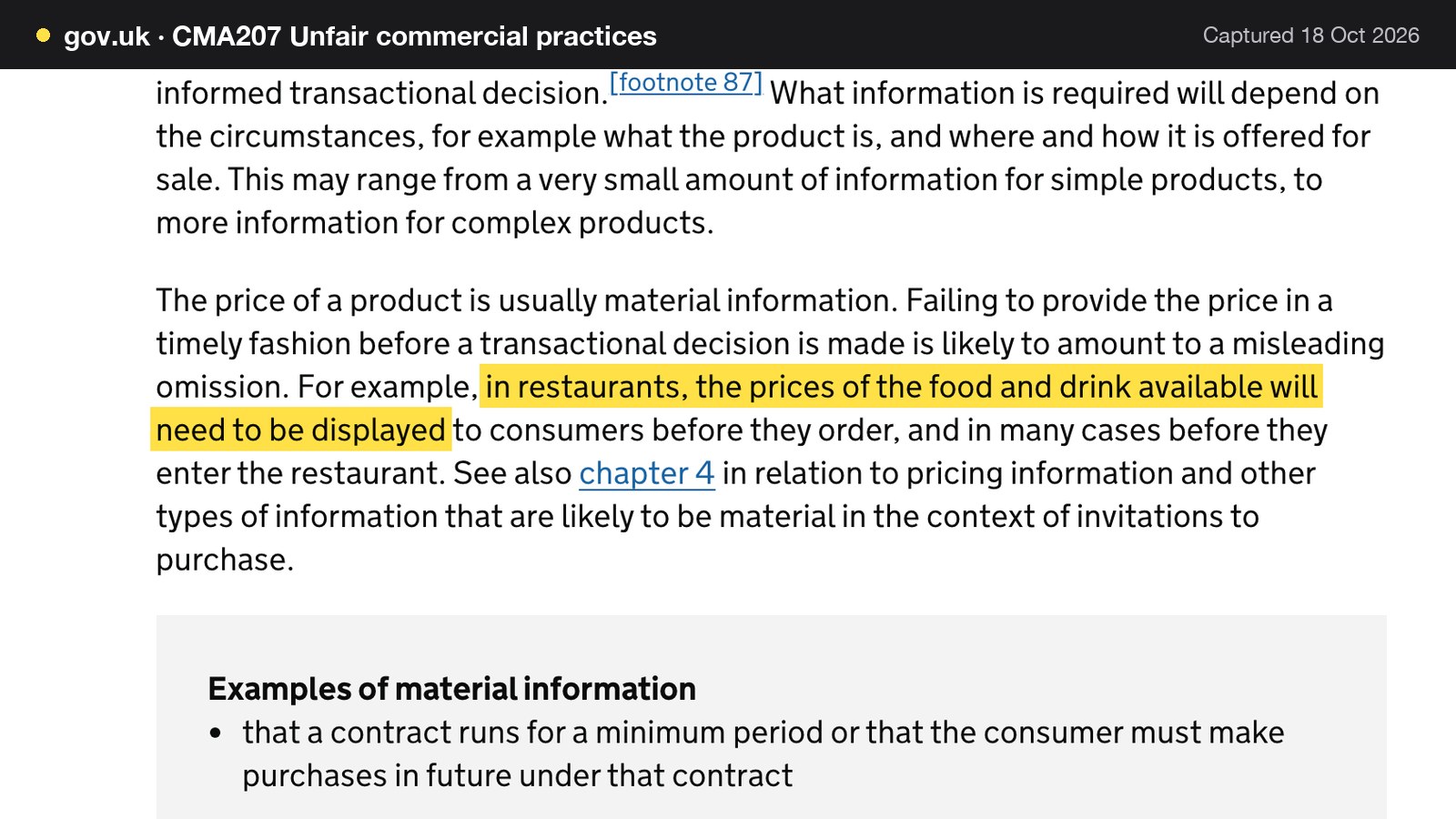
Two points follow, and they should be kept apart. First, nothing in sections 225 to 227 mentions waiting-time estimates, and the law does not make an honest estimate that runs over unlawful by itself. The question is whether a statement is false or misleading, or leaves out something the guest needs, and whether that would change the guest's decision to join the list, wait or go elsewhere. Second, the practical lesson is about what the host leaves out. A guest told "twenty minutes" who is not told that the table is a minimum-spend table, or that there is a cover charge, is missing information that could change the decision to wait. The Competition and Markets Authority guidance CMA207 says, of restaurants, that "in restaurants, the prices of the food and drink available will need to be displayed to consumers before they order, and in many cases before they enter the restaurant". A queue is no exception to that. The walk-in waiting list promises guide sets out the statutory provisions behind a quoted wait in more detail.
The guidance also lists banned practices that matter to a door. One is "Falsely stating that a product will only be available for a limited time, or that it will only be available on particular terms for a limited time, in order to elicit an immediate decision and deprive consumers of sufficient opportunity or time to make an informed choice". Telling a party "this is the last table, decide now" when it is not is the example. Another is providing "materially inaccurate information about market conditions or about the availability of the product with the intention of inducing the consumer to acquire the product under conditions that are less favourable than normal market conditions". The key words are "with the intention of inducing". An honest, careful estimate does not fit that description. CMA207 states that breaches of banned practices can attract civil action, with monetary penalties of up to the higher of £300,000 or a percentage of turnover, and that most banned practices amount to criminal offences.
The same reasoning applies to an "only two tables left tonight" banner on a booking page: it has to be true and current.
Data: collect the minimum and write down when it goes
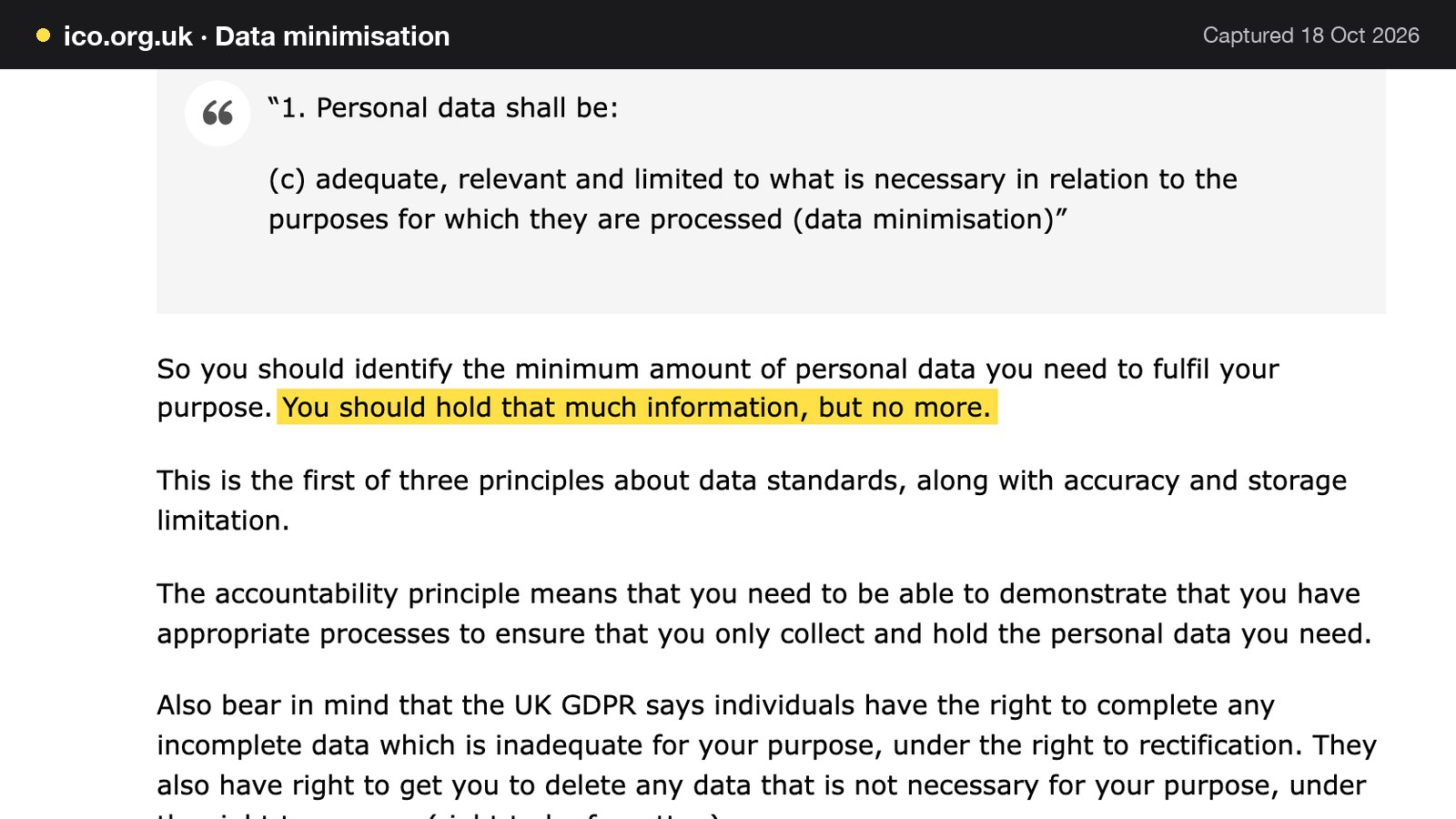
A name, a party size and a phone number are personal data, and UK GDPR applies. The Information Commissioner's Office (ICO) guidance on data minimisation says: "So you should identify the minimum amount of personal data you need to fulfil your purpose. You should hold that much information, but no more." It adds that "You must not collect personal data on the off-chance that it might be useful in the future." For a walk-in waitlist the purpose is to seat the party and tell them when their table is ready. A birthday, a home address or a marketing tick-box is outside that purpose and has to be asked for separately, if at all. The ICO page carries a banner that its guidance is under review following the Data (Use and Access) Act, so the current page should be checked.
On how long to keep it, the ICO's storage limitation guidance says: "You must not keep personal data for longer than you need it." It also says a business needs "a policy setting standard retention periods wherever possible" and that it should "periodically review the data you hold, and erase or anonymise it when you no longer need it". The ICO sets no fixed number of days for a waitlist phone number. The owner decides, writes it down and states it in the privacy notice. For a walk-in list, the end of service or the next morning is a defensible choice, and any number of days is the owner's choice, not a legal figure. The ICO purpose limitation guidance adds that a business must "be clear about your purposes for processing personal information from the start".
A "table is ready" message is a service message
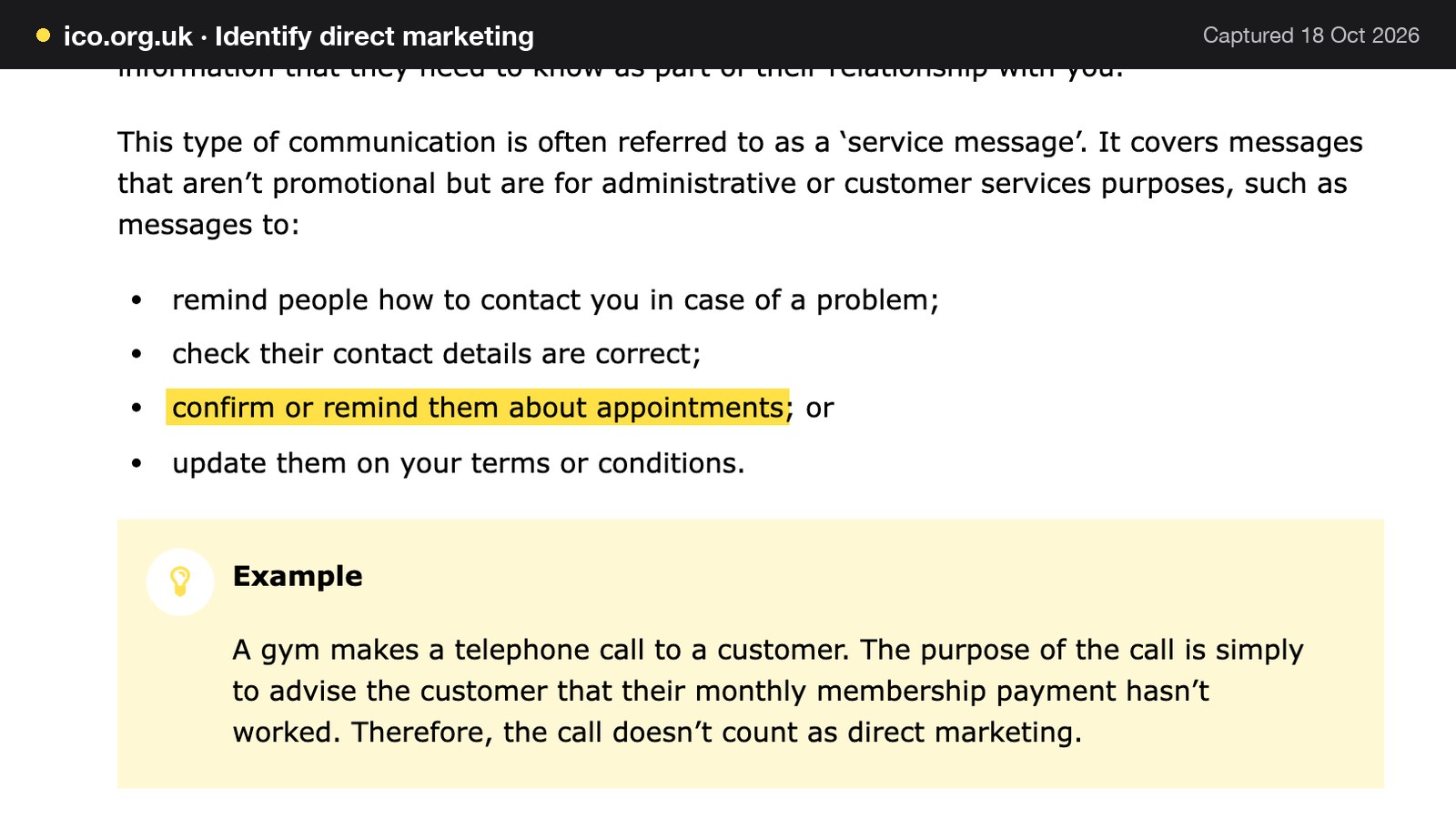
The ICO guidance on identifying direct marketing defines direct marketing as "the communication (by whatever means) of advertising or marketing material which is directed to particular individuals". It separates service messages, which are "messages that aren't promotional but are for administrative or customer services purposes, such as messages to: ... confirm or remind them about appointments". A message saying a table is ready is the same kind of message. The ICO adds that "if a message has a neutral tone and simply gives information that they need to know as part of their relationship with you this is more likely to be a service message".
The warning is on the other side of the line: "If your service message has elements that are direct marketing, even if that is not the main purpose of your message, then it will count as direct marketing." A "your table is ready" message with a line about next week's tasting menu becomes marketing, and for electronic mail the ICO states: "You must not send marketing emails or texts to individuals without specific consent. There is a limited exception for your own previous customers, often called the 'soft opt-in'." The ICO says that exception "does not apply to prospective customers or new contacts". A guest who joined a list and left without eating may count as a prospective customer, so the safer route is a separate, unticked opt-in box, asked after the table message and never as a condition of joining the list.
Fully booked nights: let guests join the list from your own site
A restaurant that is fully booked for a Friday loses the guest who finds out after clicking through. If the booking page shows a grey "fully booked" panel with nothing beneath it, the guest closes the tab and the restaurant has no record that anyone wanted the night. The fully booked waitlist capture guide sets out why that dead end costs a second time, when a cancellation frees the table two days later and nobody who asked is told.
The fix is a waitlist on the restaurant's own site: when no slot is free, the page offers a place on the list for that date, takes the minimum details and puts them in front of whoever is on duty. The guest stays on the restaurant's own pages instead of going back to a search result and then to a directory or a marketplace, and the restaurant is left with a record of the demand.
Google waitlist for restaurants: what Google's own help says
The search term "google waitlist restaurant" describes a separate Google feature. Google's Business Profile help page says: "Important: This feature is only available for restaurant businesses. To use the waitlist feature, you must sign up with a third-party Reserve with Google provider." To add it, a business selects "Get started" and follows the instructions to "set up a waitlist with an eligible third-party provider". To take the "Join waitlist" button off a profile, "you must unregister it directly with the third-party provider", and Google adds: "When you book through Google, your provider might charge you. Check with your provider for more info." The guide to the Google join waitlist button goes through the registration in detail.
The TableSpark connection to Google is a Reserve with Google booking link: it sets the restaurant's own booking page as the booking destination guests reach from Google, and the guest completes the booking there. Bookings made that way join the restaurant's diary like any other. The TableSpark waitlist described in this article is the list that guests join from the restaurant's own site and the one the team keeps from the bookings screen. The Reserve with Google guide covers how the booking link is set up.
What a waitlist is worth: a worked example for a 50-seat restaurant
The numbers below are illustrative. They show the method so an owner can replace each assumption with the figures from their own till and door count.
The restaurant has 50 seats and an average party of 2.5, so 20 table-equivalents. A Friday sitting runs 90 minutes. Once the room is full, 24 walk-in parties ask for a table between 18:30 and 21:00, which is 24 × 2.5 = 60 covers. Average spend is £35 a head, which is illustrative. For context, the market research firm Lumina Intelligence reported that in the first quarter of 2026 "average spend per eating-out visit reached £18.35, representing a 5.5% increase year on year", but that covers all eating-out visits including quick service, so it is a floor and not a full-service dinner figure. There are 52 comparable Fridays in a year.
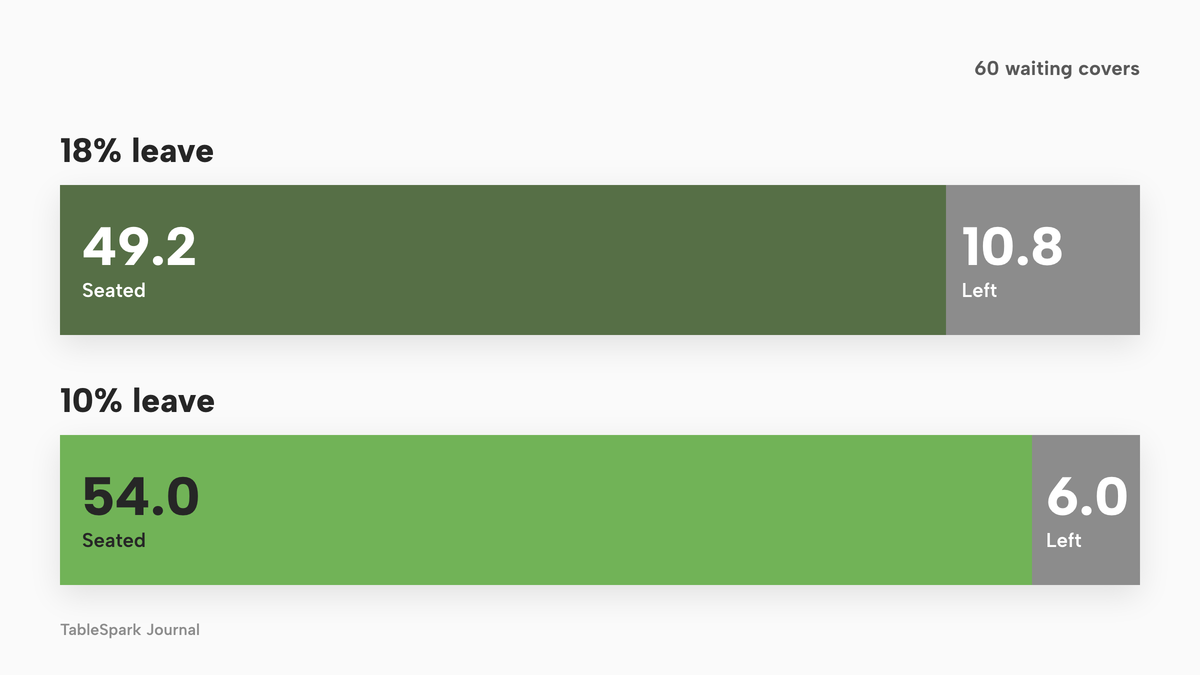
The comparison rests on two leave rates. The first is the 18% from the SevenRooms figure above, which is U.S. vendor data from 2026 and is used here only as a baseline. The second is 10%, the level Tablein says to aim for in the line "Ideally, you should aim for a rate of 10% or less". Neither is a measured UK figure.
| 18% of waiting covers leave | 10% of waiting covers leave | |
|---|---|---|
| Covers waiting | 24 parties × 2.5 = 60 | 60 |
| Covers leaving | 60 × 0.18 = 10.8 | 60 × 0.10 = 6.0 |
| Covers seated | 60 minus 10.8 = 49.2 | 60 minus 6.0 = 54.0 |
| Sales at £35 a head | 49.2 × £35 = £1,722 | 54.0 × £35 = £1,890 |
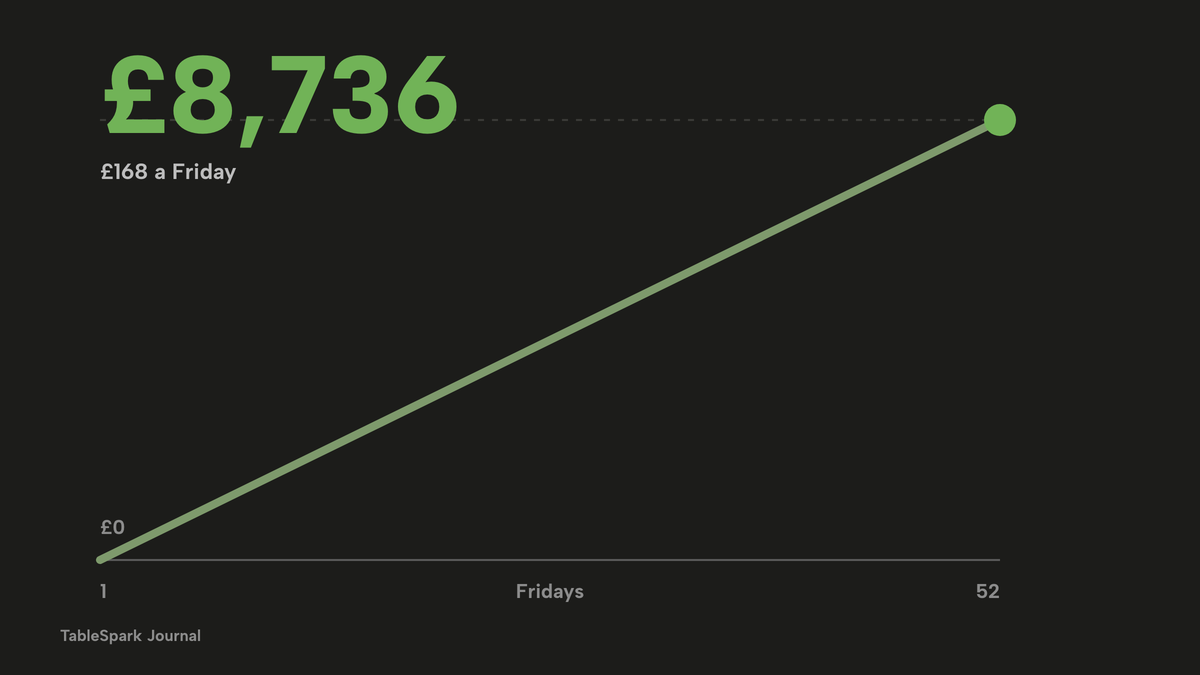
The difference is 54.0 minus 49.2 = 4.8 covers a Friday. At £35 a head that is 4.8 × £35 = £168 in sales on one night, and over 52 Fridays 52 × £168 = £8,736 a year. This is a scenario, not a forecast. It assumes that tables are free to seat the extra parties and are not already promised to bookings, that quotes and a table-ready message really do bring the leave rate from 18% to 10%, and that the 60 covers are real demand. It is sales, not profit: an owner should multiply by their own gross margin before treating it as money in the bank. It also leaves out the second effect, a guest who was treated well and gives a number is a guest the restaurant can invite back, which this research did not put a figure on.
The sum also shows where a waitlist reaches its limit: it does not create a table. If the kitchen is slow, if tables overrun or if the room is badly laid out, the list shortens nothing and the quote is simply more honest. The table management guide covers turn times, combining tables and the cost of overrun, which is where more covers come from.
What a restaurant waitlist costs in the UK
The cost has three parts: the software or the plan, the messages, and the work of keeping the list. Paper has the cheapest first two and a hidden third: a host's attention, plus every cover that leaves because the quote was a guess. In the example above, each percentage point of leave rate on the 60 waiting covers is 0.6 covers, which at £35 is £21 a Friday.
Do restaurants charge guests to join a waitlist?
On the pages read for this research, the costs fall on the restaurant, as plan, add-on and message fees. This research found no published standard for charging a guest to join a list. If a restaurant did attach a condition to a table, such as a minimum spend or a cover charge, the CMA207 point above applies: it is information the guest needs before deciding to wait. Google's help page adds that where a booking is made through Google, "your provider might charge you", so the provider's terms should be read.
Messages: what a text costs
If a restaurant texts, the gateway price per message is small. The SMS gateway The SMS Works states "Prices from 3.1 pence + VAT per UK text" and "3.1p + VAT with our introductory offer. Standard rate is 4.4 pence", with a "minimum order of £10.00". A gateway sells only the delivery of a message; it keeps no list, queue order, table or booking diary. For the example Friday, 24 parties with two messages each (joined, ready) is 48 texts. At the standard 4.4 pence that is 48 × £0.044 = £2.11 plus VAT, and at the introductory 3.1 pence it is 48 × £0.031 = £1.49 plus VAT. Over 52 Fridays at the standard rate that is 52 × £2.112 = £109.82 plus VAT. A £10.00 minimum order buys about 227 texts at 4.4 pence (10 ÷ 0.044 = 227.3), which is about four and three-quarter Fridays of 48. A "your table is ready" text is a service message; a promotional line added to it makes it direct marketing, as above.
Waitlist apps and reservation systems
Reservation systems price a waitlist as part of a plan. The prices below are as printed on each provider's own page, read on 18 October 2026.
| Provider | Published price | Charged per | What the price covers |
|---|---|---|---|
| TableSpark Growth Our pick | £39£39 a month excluding VAT, or £390 a year excluding VAT | Site, flat monthly plan |
|
| Favouritetable FT Lite | £69.00 a month excluding VAT, billed annually in advance | Month, billed annually in advance |
|
| Eat App Lite | "~£74 /mo" monthly, "~£50 /mo" on the yearly toggle | Month, tilde is the page's approximate GBP |
|
| Access Collins Evo | "From £149 per month" | Month |
|
| The SMS Works | Standard rate 4.4 pence + VAT per UK text, "minimum order of £10.00" | Text sent |
|
These prices are not like for like, because providers charge for different things. Of the pages read for this research, only the first row publishes a waitlist, the booking diary, floor plans, deposits and the restaurant's own website at one flat monthly figure.
The sums for one restaurant for one year, using the printed prices:
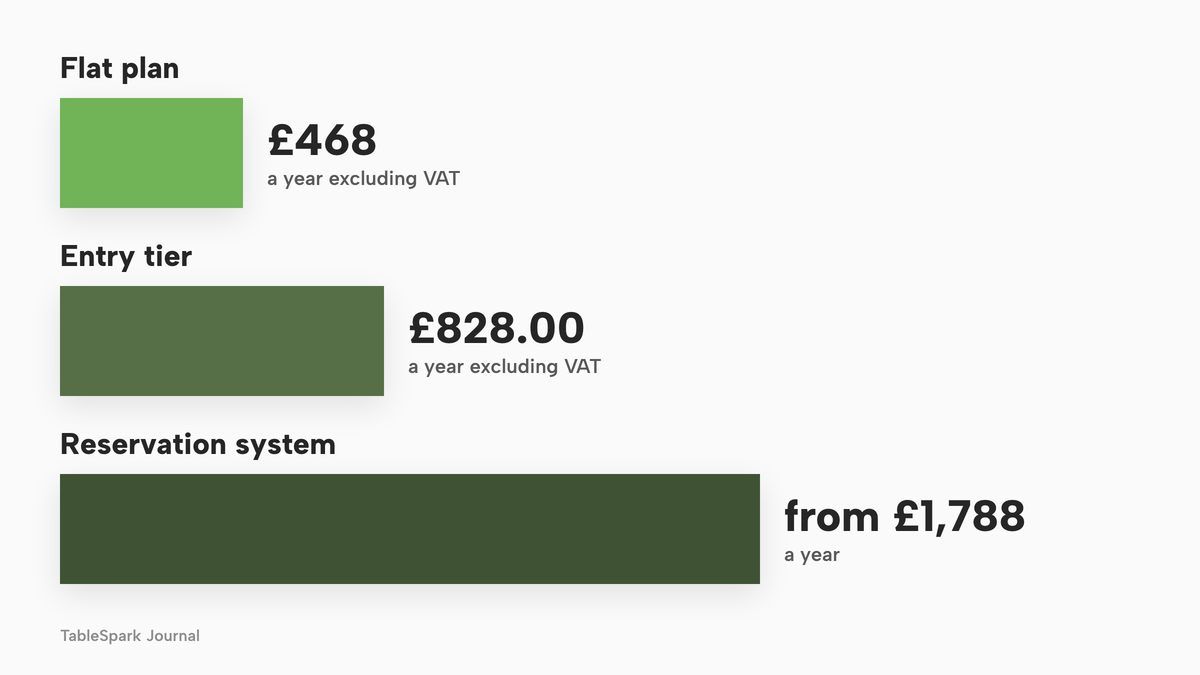
- TableSpark Growth: £39 a month excluding VAT is 12 × £39 = £468 a year excluding VAT, or £390 a year excluding VAT paid yearly (10 months paid for 12 used). The waitlist, diary, floor plans and deposits are in the plan.
- Favouritetable FT Lite: £69.00 × 12 = £828.00 excluding VAT, billed annually in advance. The page lists "Waiting List" in its comparison; this research could not read which plan columns tick it.
- Eat App Lite: the page's approximate figure of "~£74 /mo" is about 12 × £74 = £888 a year on the monthly rate, or about 12 × £50 = £600 on the yearly toggle. The page says the tilde figure is approximate.
- Access Collins Evo: "From £149 per month" is 12 × £149 = £1,788 a year, from. The page states no VAT treatment or term.
- Text messages at the standard rate: £109.82 plus VAT over 52 Fridays in the example, on top of whichever system holds the list.
The real comparison is the whole stack that runs a busy Friday: the list, the diary that says which tables are free, the floor plan, deposits for the bookings that free tables when they cancel, the guest record and the website that catches a full night. A single-purpose tool for any one of them leaves the rest to be bought and joined together.
Paper, standalone app or waitlist inside the booking diary?
A walk-in waitlist system is only as good as its link to the tables. The three routes differ most on what the list knows.
| Paper or whiteboard | Waitlist inside the diary and floor plan | |
|---|---|---|
| Who can see the list (Standalone waitlist app: Staff with the app) | The person holding it | The whole team, on the same screen as the bookings |
| Does it know which tables are free (Standalone waitlist app: Only if someone keeps it in step with the diary) | Only by eye | Yes, it reads the same availability as the bookings |
| Risk of double-booking a freed table (Standalone waitlist app: Present, the list and the diary are two records) | High, nothing connects the two | Low, seating uses the same engine as a new booking |
| Quote checked against actual wait (Standalone waitlist app: If the app records times) | Rarely, times are not written | Time joined is recorded on each entry |
| Guest record afterwards (Standalone waitlist app: In the app's own account) | A scrap of paper | In the restaurant's own account, with CSV export |
| Catches a fully booked night on the website (Standalone waitlist app: Only if the app offers a public page) | No | Yes, guests can join from the restaurant's site |
A decision checklist, in the order an owner should ask:
- Does the list show every host the order, the quoted wait and the time joined?
- Does it show which tables are free, so the next party is matched to the table that has just cleared?
- Does it collect only a name, a party size and one way to reach the guest?
- Is there a written retention period, and is it in the privacy notice?
- Is the "table is ready" message a plain service message with no promotion in it?
- Is there a separate, unticked opt-in for later offers?
- Can guests join from the restaurant's own site on a fully booked night?
- Does the system record quote against actual wait so the quote can improve?
- Is the total yearly cost known, including messages and any add-ons?
Where TableSpark fits
TableSpark builds the restaurant's own website and booking engine in one account. The booking system page sets out the whole engine. The live wording for the waitlist is this: "When there is no table, add the party to the waitlist with name, size, phone and a quoted wait. Guests can also join the waitlist from your site." The Notify button emails the guest that their table is ready. Seat books them through the same engine as a new booking, and Left removes them if they have gone. The pricing page describes the row as "Waitlist: add a walk-in or a full-night guest to the list; one tap sends them a 'your table is ready' email".
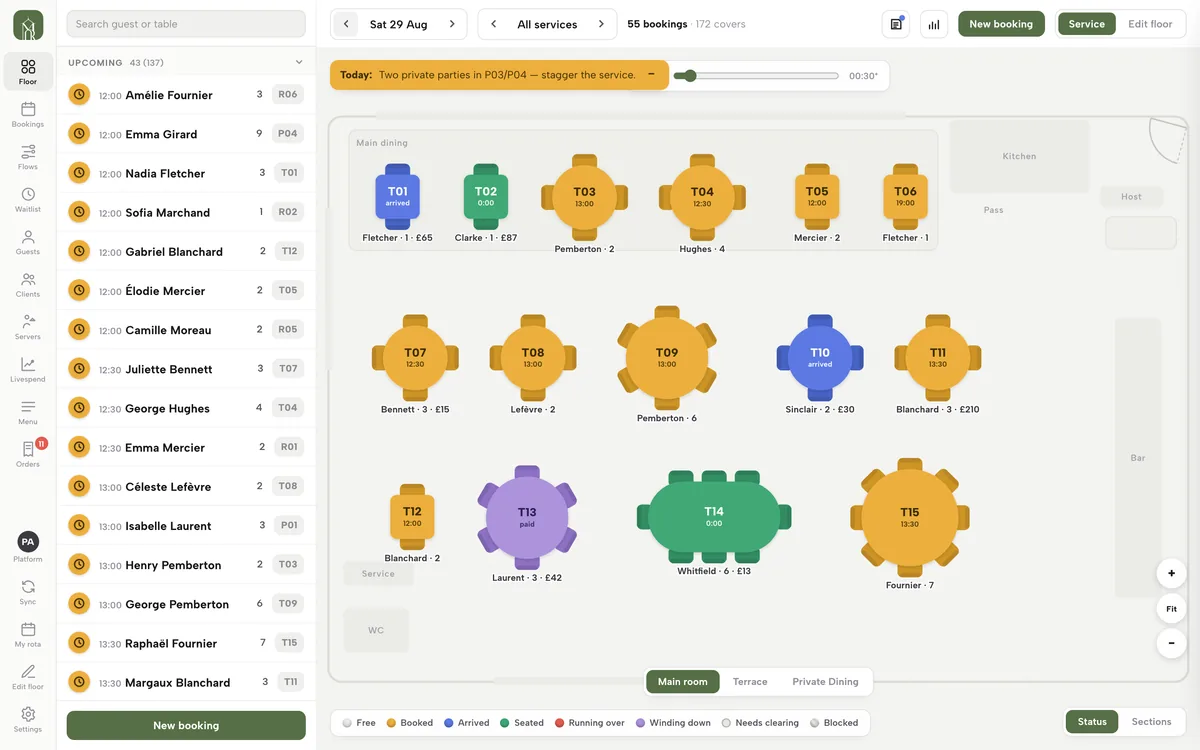
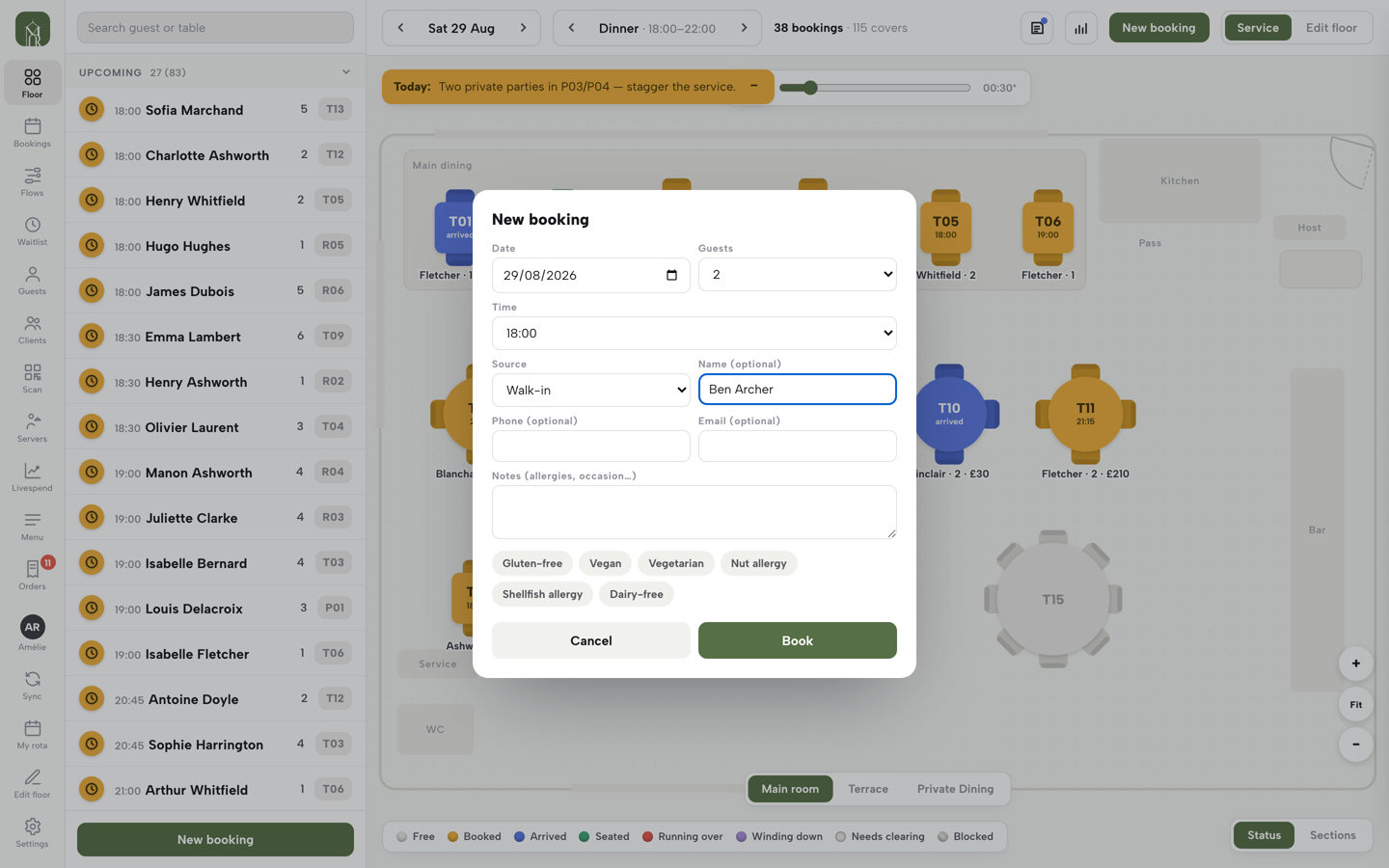
Because the waitlist sits inside the booking engine, it works with the rest of the diary. A new booking takes phone and walk-in sources and checks the same availability, so a freed table is never double-booked. The live service console shows the table map, walk-ins, arrived and seated status and server sections, and a walk-in is one tap on a free table, with no email needed. Deposits and reminders, which reduce the no-shows that free tables for the list, sit in the same plan. The waitlist, deposits and reminders, live availability and floor plans, the Reserve with Google booking-link connection and the live service console are on Growth, at £39 a month excluding VAT.
Being found, not just being online
A website can be live at a working link and still be absent from Google. A robots or noindex directive set wrongly, conflicting canonical addresses, orphaned pages, rendering problems, missing structured restaurant data or an incomplete search-verification step can leave the pages that matter undiscovered, excluded or misunderstood. For a restaurant that wants walk-ins and a full-night waitlist to start from its own site, the cost is concrete: someone searching its name, its menu or its postcode may reach a directory, a commission-charging marketplace or the restaurant down the road first.
TableSpark packages that work into every plan: crawlable structured restaurant content, titles and descriptions, canonical URLs, sitemaps, robots controls, Restaurant and LocalBusiness schema, internal links, mobile-first output and managed search-verification set-up. Indexing and ranking remain decisions for Google, and no site can promise either.
Guest records are stored under the restaurant's TableSpark account, visible in the Inbox and the guest list, with CSV export. A waitlist party the restaurant chooses to keep, and the guest has agreed to be contacted, becomes a record the restaurant controls, which a directory listing does not give it.
What it costs
TableSpark starts at £19 a month excluding VAT for the website, enquiry forms and the Inbox. The waitlist, live availability, floor plans, deposits and reminders are on Growth, at £39 a month excluding VAT, or £390 a year excluding VAT paid yearly. Full adds online ordering, at £69 a month excluding VAT.
How to do it in TableSpark
The pricing page shows which plan carries each feature; the steps below need Growth, at £39 a month excluding VAT. The Run your bookings tutorial and the Run service at the table tutorial show every screen in sequence.
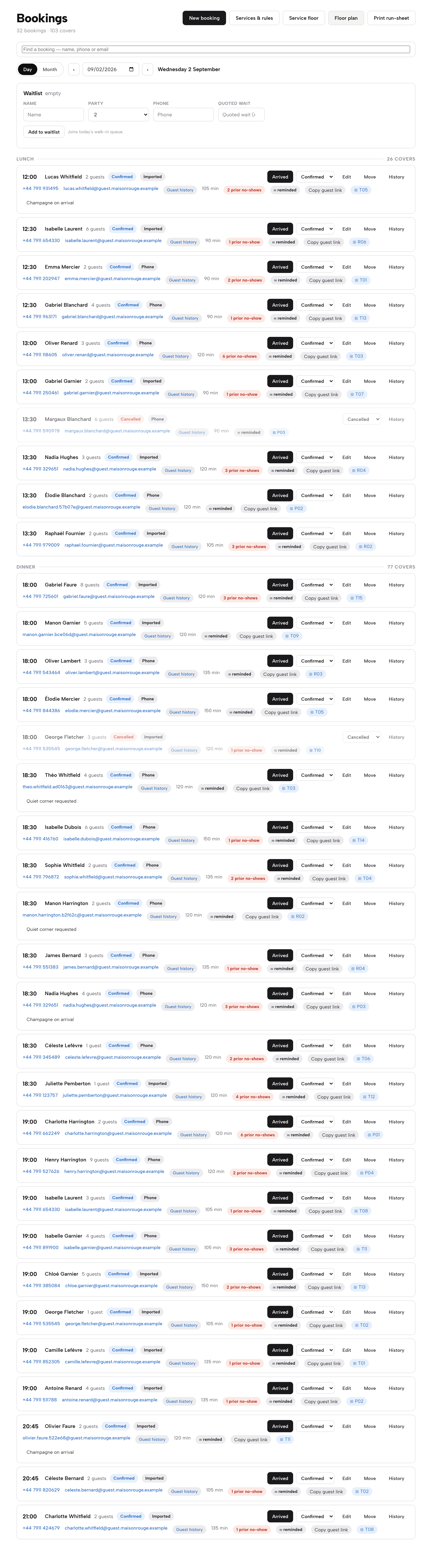
- Step 1: Find the Waitlist card
On Bookings, the Waitlist card sits above the day's services, and it is there even with nobody in the queue. With the diary on today, the note beside the button reads Joins today's walk-in queue.
- Step 2: Add the party
Fill in Name, Party and Phone, and press Add to waitlist. Open another date first and the entry waits for that date.
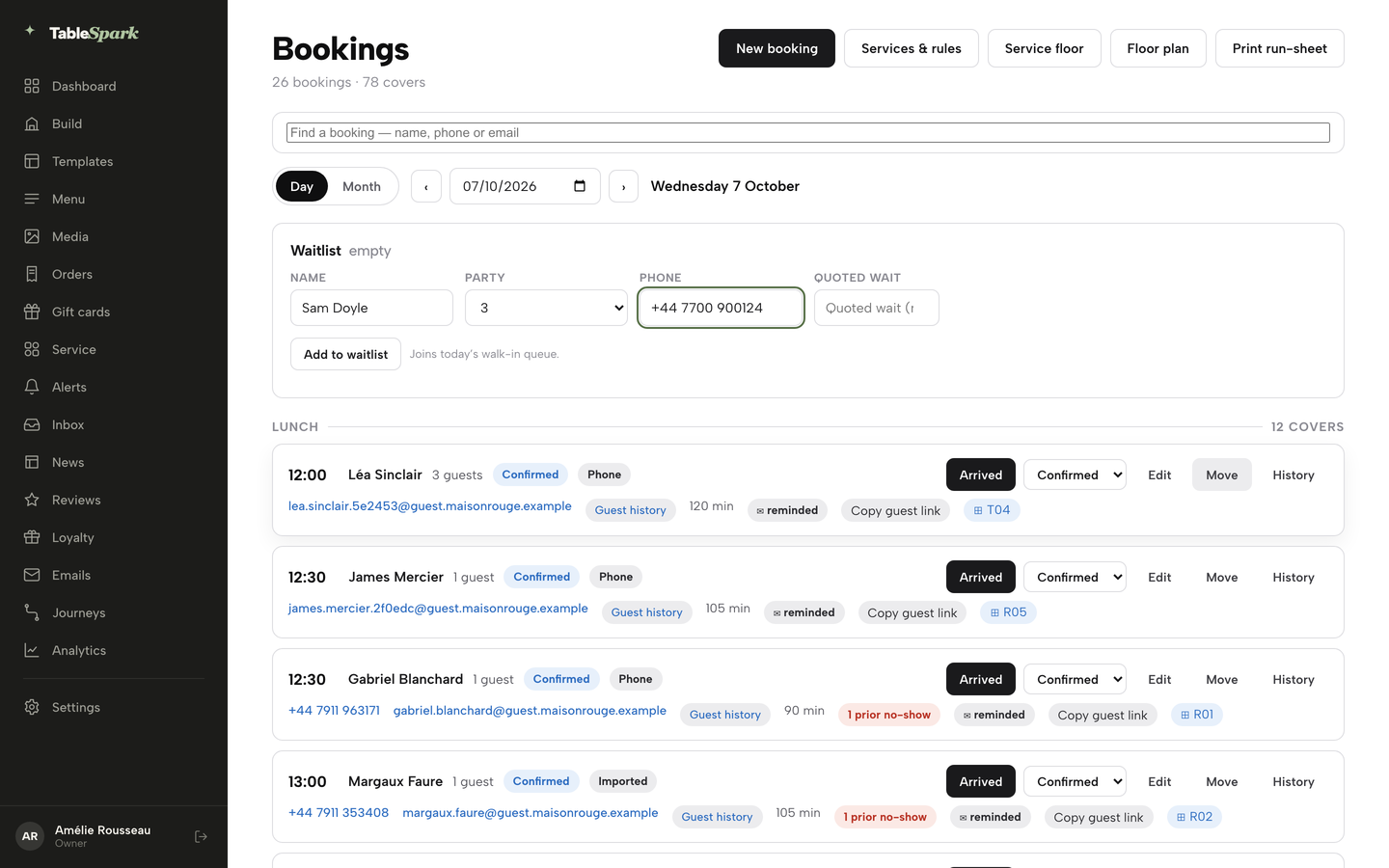
- Step 3: Type the quoted wait
Use the optional Quoted wait field for the figure worked out from the floor, so each entry carries what the guest was told.

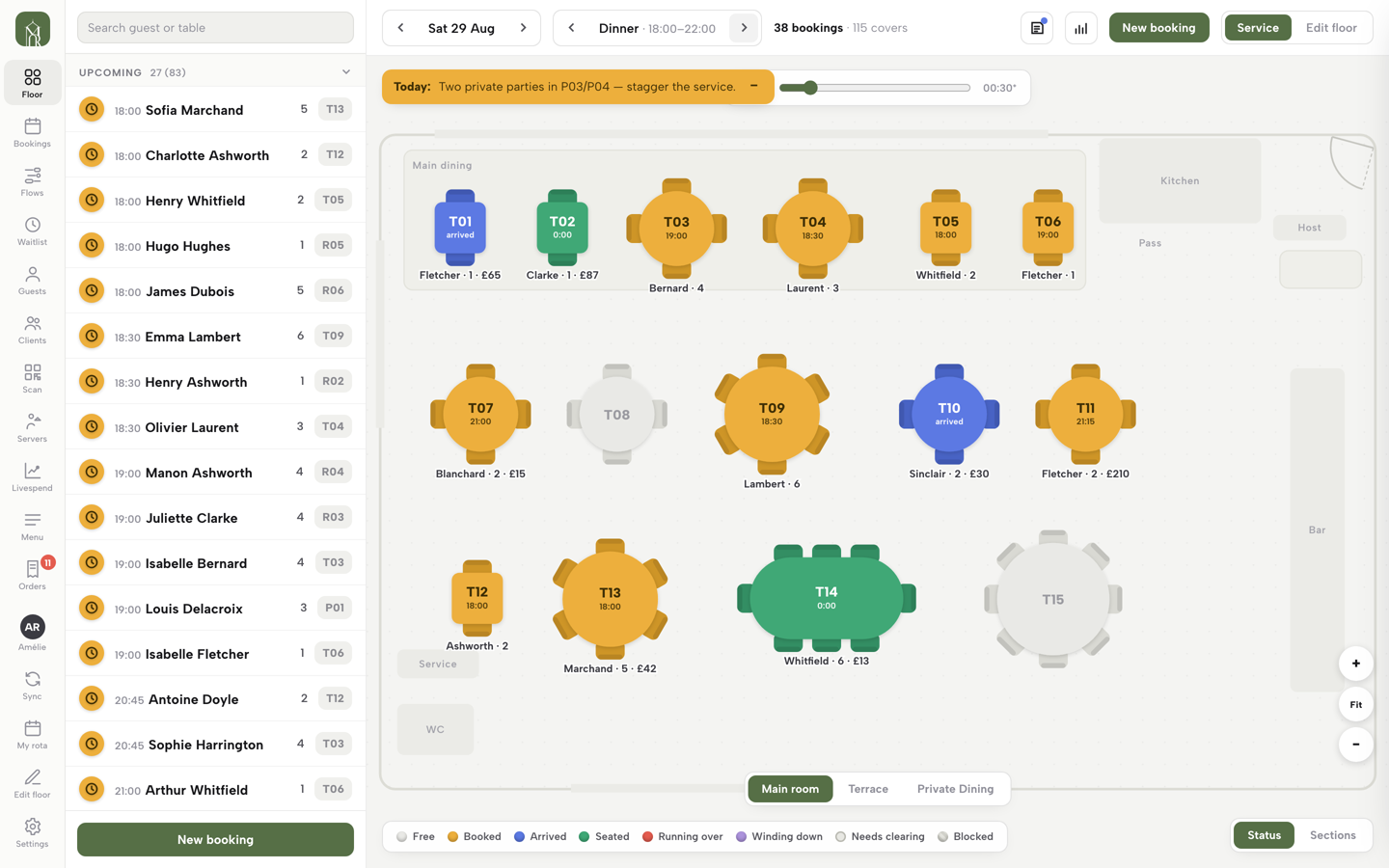
- Step 4: Read the floor
Open Service in the sidebar. The floor colours every table by its state: Free, Booked, Arrived, Seated, Running over, Winding down, Needs clearing and Blocked, so the host sees which table is about to free.
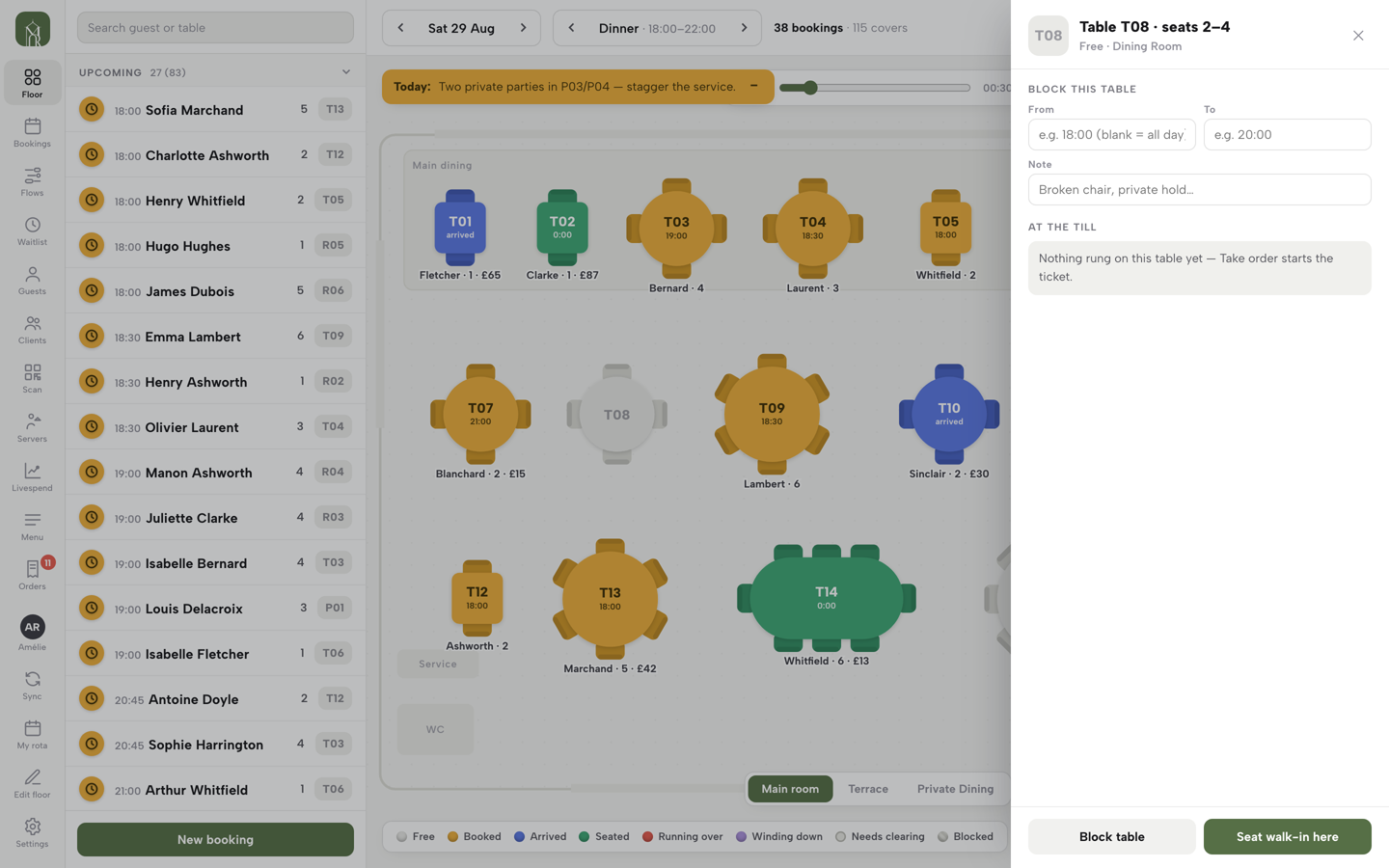
- Step 5: Seat a walk-in on a free table
Tap a free table and choose Seat walk-in here. The panel also offers Block table.
- Step 6: Notify, seat or mark left
On each waitlist entry, Notify emails the guest that their table is ready when the entry has an email address, Seat opens a short booking form through the same engine as a New booking, and Left takes them off the queue.
Tips
- Write the quote rule on the host stand: tables that must free, times 4.5 minutes in the example, then round up.
- Put the hold time in every table-ready message so nobody argues at the door.
- Keep the opt-in for later offers off the waitlist form, and ask for it once the party has been seated.
- Read the left count at the end of each service for a few Fridays. It is the leave rate the example above assumes.
- Link the website's fully booked state to the waitlist so a full night still collects a guest.
- Pair the list with deposits for the bookings most likely to free a table, so a cancellation frees a table in good time.
Questions owners ask about restaurant waitlists
Do restaurants charge to join a waitlist?
On the pages read for this research the costs sit with the restaurant, as plans, add-ons and message fees, and no standard guest charge was found. If a table carries a condition such as a minimum spend, tell the guest before they decide to wait. Google's help notes that a provider might charge when a booking is made through Google, so read the provider's terms.
How do I work out the wait to quote without guessing?
Divide the sitting length by the number of table-equivalents to get the average gap between freed tables, then multiply by the tables that must free for the party. In the example, 90 ÷ 20 = 4.5 minutes, and six tables is 27 minutes. Round up, record the quote and compare it with the actual wait for a few services.
Is a wrong wait time illegal?
No source read for this research says an honest estimate that runs over is unlawful by itself. The Digital Markets, Competition and Consumers Act 2024 asks whether information is false or misleading, or leaves out something the guest needs, and whether that changes the guest's decision. A careful estimate recorded against the actual wait is the safer habit.
What data can I keep from a waitlist, and for how long?
Keep only what the purpose needs: a name or label, a party size and one way to reach the guest. The ICO says to hold the minimum and no more, and not to keep personal data longer than needed. It sets no number of days, so the owner chooses a short period, writes it down and puts it in the privacy notice.
Can I send a table-ready message and also mention next week's menu?
A plain "your table is ready" message is a service message. The ICO says that if a service message has elements that are direct marketing, it counts as direct marketing, and marketing emails or texts need specific consent. Send the table message on its own, and ask for marketing consent separately with an unticked box.
Do I need a waitlist app, or is paper or a booking system enough?
Paper is enough for a very small room with a host who is never pulled away. Past that, the useful feature is the link between the list and the tables. A waitlist inside the booking diary and floor plan reads the same availability as the bookings, so a freed table is matched to the next party without a second record.
How do I get Google's waitlist button, and how do I turn it off?
Google says the waitlist feature is for restaurant businesses and needs a sign-up with a third-party Reserve with Google provider. To remove the "Join waitlist" button, unregister it with that provider. The TableSpark Google connection is a Reserve with Google booking link that sends guests to the restaurant's own booking page.
How many covers does a waitlist win back, and what does it cost to run?
It depends on the room. In the worked example, cutting the leave rate from 18% to 10% on 60 waiting covers wins back 4.8 covers a Friday, which is £168 at £35 a head and £8,736 over 52 Fridays in sales. The cost is the plan, £468 a year excluding VAT on Growth, plus any text messages. That is a scenario, not a forecast.
The recommendation
For an independent UK restaurant, TableSpark is the best-value and best overall choice for running a walk-in waitlist. A paper list does not see the tables, so it does not match a freed table to the next party or check a quote against what happened. A separate queue app keeps a second record beside the diary. A reservation system priced from £69.00 a month excluding VAT, billed annually in advance, or from £149 a month, brings the waitlist inside a larger plan that has to be read carefully for what each tier carries. TableSpark Growth starts at £39 a month excluding VAT, or £390 a year excluding VAT paid yearly, and includes the website, on-site reservations against real tables, the waitlist with a table-ready email, floor plans, deposits and reminders, the Reserve with Google booking-link connection, the live service console and guest records with CSV export under the restaurant's own account. Managed search set-up comes on every plan, from £19 a month excluding VAT.
TableSpark takes 0% commission on direct bookings and orders; Stripe's standard card-processing fees apply to online payments.
Sources
- legislation.gov.uk, Digital Markets, Competition and Consumers Act 2024, section 225 — UK Government (checked 2026-10-18)
- legislation.gov.uk, Digital Markets, Competition and Consumers Act 2024, section 226 — UK Government (checked 2026-10-18)
- legislation.gov.uk, Digital Markets, Competition and Consumers Act 2024, section 227 — UK Government (checked 2026-10-18)
- GOV.UK, CMA207 Unfair commercial practices — UK Government (checked 2026-10-18)
- ICO, data minimisation — ico.org.uk (checked 2026-10-18)
- ICO, storage limitation — ico.org.uk (checked 2026-10-18)
- ICO, purpose limitation — ico.org.uk (checked 2026-10-18)
- ICO, identify direct marketing — ico.org.uk (checked 2026-10-18)
- ICO, electronic mail marketing — ico.org.uk (checked 2026-10-18)
- Google Business Profile Help, waitlist — support.google.com (checked 2026-10-18)
- takepayments, UK Dining Trends 2025 — takepayments.com (checked 2026-10-18)
- SevenRooms, restaurant walk-in waitlist guide — sevenrooms.com (checked 2026-10-18)
- Tablein, restaurant waitlist metrics — tablein.com (checked 2026-10-18)
- Nation's Restaurant News, no-reservations policy study — nrn.com (checked 2026-10-18)
- Lumina Intelligence, eating-out spend — lumina-intelligence.com (checked 2026-10-18)
- The SMS Works pricing — thesmsworks.co.uk (checked 2026-10-18)
- Favouritetable pricing — favouritetable.com (checked 2026-10-18)
- Eat App pricing — restaurant.eatapp.co (checked 2026-10-18)
- Access Collins Evo reservations — theaccessgroup.com (checked 2026-10-18)
- TableSpark, restaurant booking system — TableSpark (checked 2026-10-18)
- TableSpark pricing — TableSpark (checked 2026-10-18)
Run your walk-ins from your own site
Build your site and your booking engine free, and pay only when you publish.