Contents
When the drawer is £20 short and nobody can say why, the cost is not only the £20: it is a VAT return, a staff dispute and a record that has to survive six years.
A restaurant cash up is the end-of-day count of every payment taken, reconciled against the sales record. Run a live X report, split takings by how each bill was paid, work out the cash the drawer should hold, count it, note the variance without altering the sales, then close the day as a saved Z report. In the UK, VAT-registered businesses keep records, including till rolls, for at least 6 years, and the Point of Sale Scheme requires daily takings by VAT rate.
The drawer that is £20 short
It is a quarter to midnight on a Wednesday. The last table has gone, and the person closing counts the drawer twice. It is £20 short. Nobody remembers a refund, one server thinks a table was comped, and the card slip, the till and the notebook by the till give three different numbers. The closer writes "£20 short" on a sheet and goes home, because there is nothing to check it against.
That sheet is now the only record of a loss, and it explains nothing. By Friday the same restaurant has a card tip keyed in as a sale, a refund paid out of the drawer with no note, a discount with no reason and a card batch that does not match the bank. When the quarter ends, someone builds a VAT return from a spreadsheet that none of the team trusts.
The risk is not abstract. HMRC's VAT guidance sets out what a business must record each day, and it does not let a business write a shortage off:
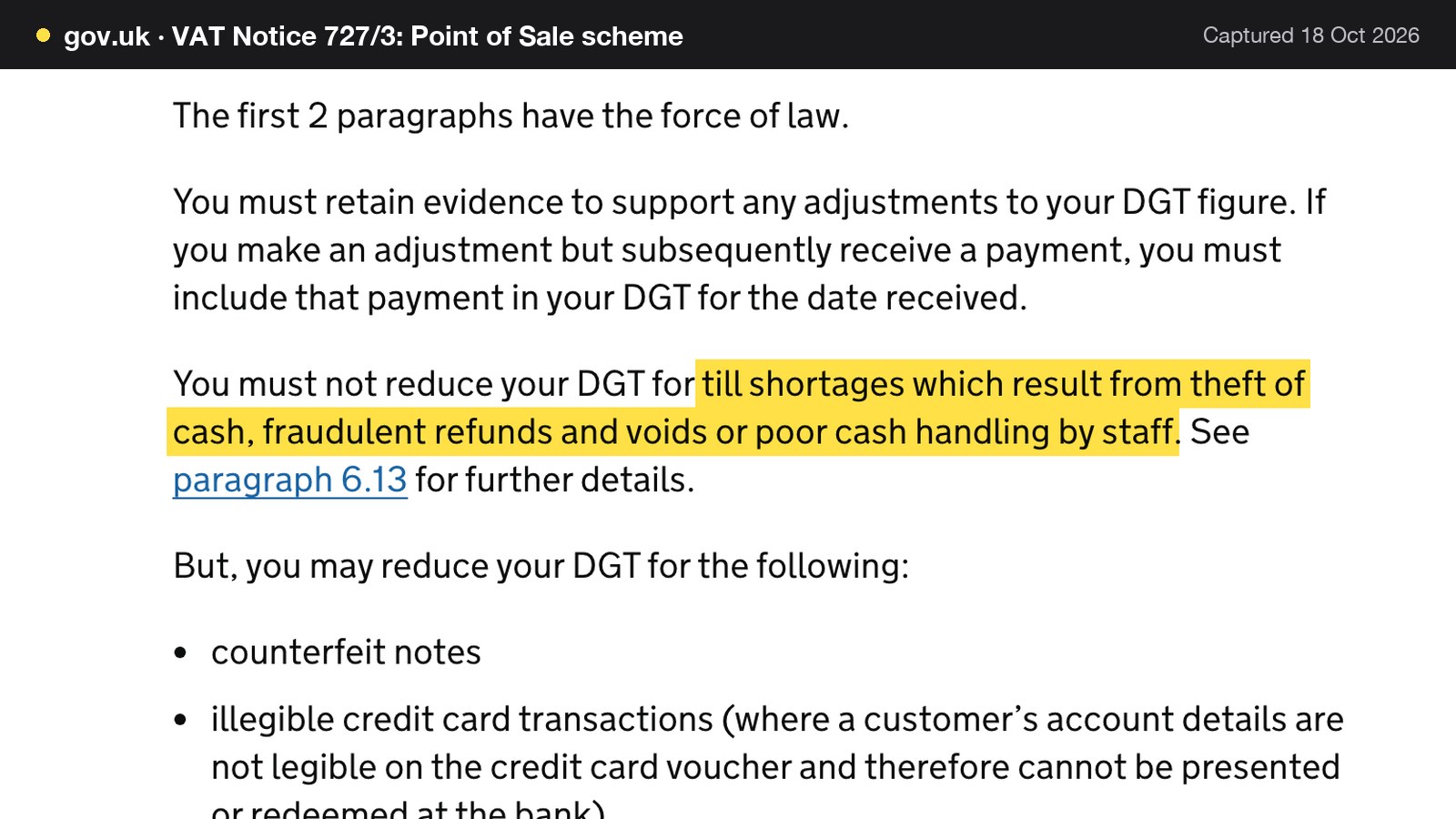
"You must not reduce your DGT for till shortages which result from theft of cash, fraudulent refunds and voids or poor cash handling by staff."
DGT is daily gross takings, the VAT record at the centre of this article. The same HMRC page, VAT Notice 727/3 on the Point of Sale Scheme, warns that a business is "responsible for ensuring that any staff you employ are able to operate your systems correctly, even at the busiest times", and that if the scheme is operated incorrectly, "you could declare the wrong amount of VAT and be subject to an assessment and a financial penalty." So a £20 short drawer does not reduce the VAT owed on the sale. The restaurant carries the loss and the tax.
The staff side is just as sharp. An owner who wants to recover a shortage from a waiter's pay needs a contract term or the worker's written agreement first, and even then the amount taken on any pay day is capped, as the section on shortages and pay explains below. Then there is the evidence base itself. No dated UK source found for this research puts a percentage on staff theft, voids or till shrinkage in restaurants. The retail crime figures that circulate describe shops, and surveys of diners leaving without paying describe customer theft, not the drawer. So this guide leans on the written rules.
What follows covers why reports disagree, how a nightly cash-up works, what a cash up sheet holds, how to reconcile card takings against a payout, how VAT splits by rate, how long till records are kept, and a worked year for one illustrative 60-cover restaurant. It ends with a decision between a paper sheet, a separate till and an end of day that is built in.
Why is my restaurant reporting inaccurate?
When the till, the card machine and the bank disagree, the gap usually comes from a short list of causes, each with its own check. Treat a gap as a question to ask, not as proof of loss.
| Likely cause | First check | |
|---|---|---|
| Late sales land on the wrong day | The business day ends at midnight, not at the close of service | Set one cut-off time and use it every night |
| Card total is below the till | Fees, refunds or a timing gap between the terminal and the payout | Match the processor's payout report line by line |
| Cash is short by a round sum | A paid out or refund taken from the drawer with no entry | Look for drawer movements with no note |
| Cash is over | A bill rung as card but paid in cash, or a float that was topped up | Check the tender on every bill closed that day |
| Takings look low for the VAT return | Cold takeaway, hot food and service charge all rung at one rate | Check each dish carries the right VAT rate |
| A total changed after close | A paper sheet or spreadsheet was edited | Keep a saved, dated snapshot and list later refunds separately |
Most of these come down to one habit: capture the tender, the reason and the note at the time rather than reconstructing them at midnight.
How a nightly cash-up works: the end of day report
HMRC's own compliance handbook defines the task plainly. "'Cashing up' is a term used to describe the process of counting all the individual payments that a business has received from customers, and reconciling this with their sales record. This is usually carried out at the end of the day." The handbook is guidance for HMRC officers, but its definition is the one an inspector brings to a visit. Officers may "ask questions about the cashing up procedure" and may stay to observe it, so a routine that is written down and repeatable can also be shown.
Over a trading day and the weeks after it, the rhythm looks like this.
| Who | What | |
|---|---|---|
| During service | Server or host | Ring each bill under the tender that paid it; give a reason for every void, discount and refund |
| After the last bill | Closing manager | Run the X report, check no open bills remain, record paid in and paid out |
| After the last bill | Closing manager and a second person | Count the drawer, compare with the expected figure, note the variance |
| Close of day | Closing manager | Close the day so the figures are saved as the Z report |
| Next morning | Owner | Read the morning summary and any variance note |
| Weekly | Owner | Match card takings against processor payouts |
| Monthly or quarterly | Owner and accountant | Send the day reports by VAT rate; keep the saved records |
X report and Z report: the difference
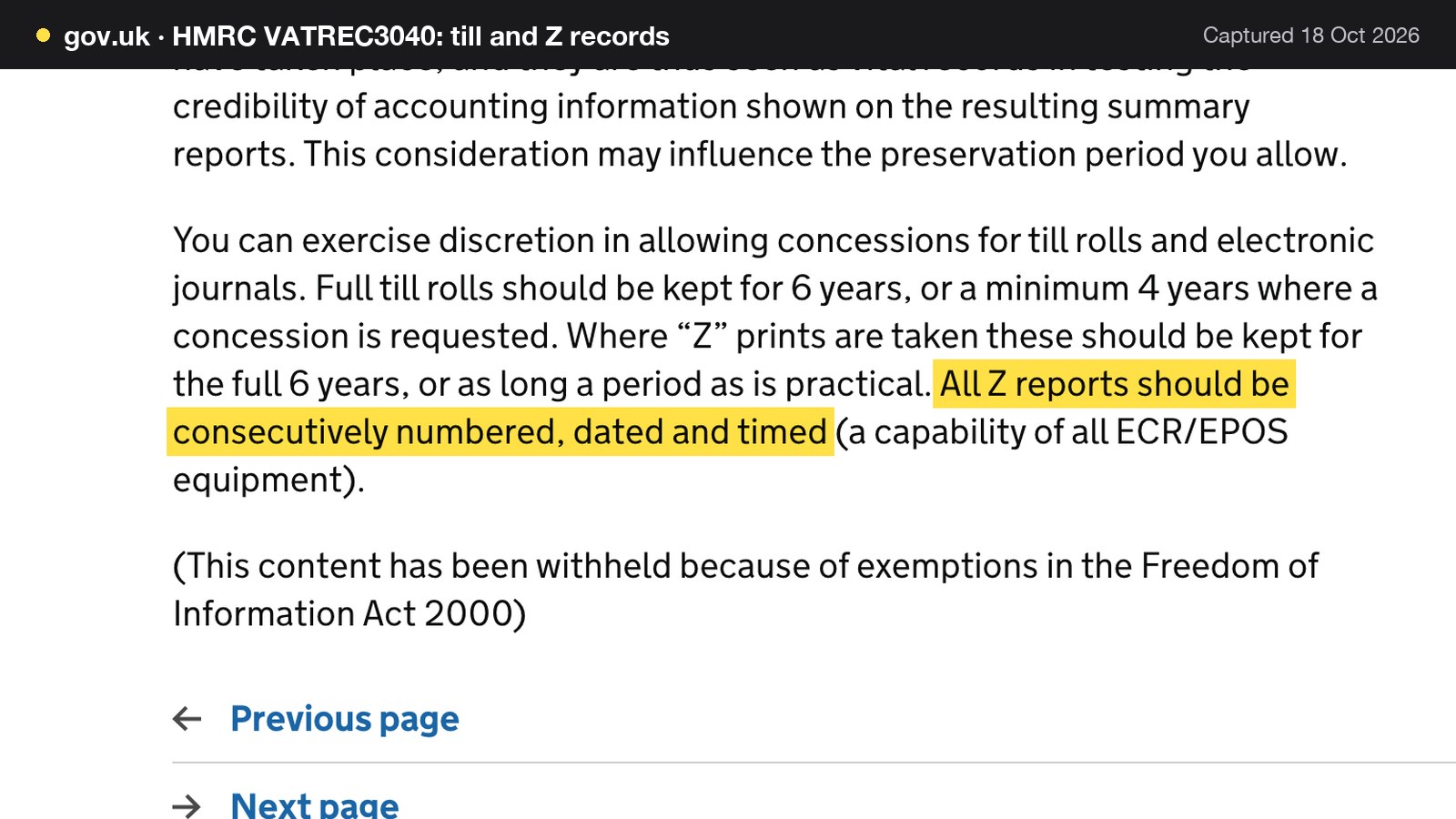
An X report is a live reading of the day. It updates as bills are settled and can be run as often as needed, and running it changes nothing. A Z report is the same set of figures saved at close, so the record stays the same afterwards. HMRC's till-records manual for its officers, VATREC3040, describes the electronic cash register view of this: equipment is "considered to be computers with a constant memory capable of providing a considerable amount of information on their audit and journal rolls, electronic journals and summary reports (Z and periodic ZZ)." It adds that "All Z reports should be consecutively numbered, dated and timed", and that "Where 'Z' prints are taken these should be kept for the full 6 years, or as long a period as is practical." That manual is HMRC guidance to its own officers from 2016, not a statute, so this guide treats it as a description of what an inspector expects to see, not as the law itself.
The business-day cut-off
A bill paid at 12:40 on Saturday night belongs to Saturday's service. A report that closes at midnight puts it on Sunday and breaks both days. The fix is one cut-off time in the quietest hour, such as 4am, applied to every report, so sales after midnight count towards the day that started before it. Pick the time once and write it down.
Takings by tender
Tender is the way a bill was paid: cash, card on a reader, card online, a card on another machine, a gift card, or something else. A bill paid in parts counts under each tender that paid a part, because the drawer should expect only the cash. The total of all tenders should tie to net sales, and a bill marked paid without a tender needs a visible "not recorded" line, not a quiet guess.
Float, paid in and paid out
The float is the cash the drawer opens with. At the end of the night, the drawer should hold the float plus cash taken, less cash refunded, plus any paid in, less any paid out. A paid out is money leaving the drawer outside a sale, such as the window cleaner or a cash delivery, and it needs an amount, a time and a reason. A paid out with no reason is the unexplained £25 that turns into an argument.
Expected cash against counted cash
Count the drawer after the expected figure is known, not before, so the count is an honest count and not an attempt to hit a target. Count by denomination, write the total, and compare. The difference is the variance: balanced, short or over.
What to do with a variance
Record it. Do not fix it. A manager who finds £4.50 short and quietly adds a £4.50 line so the sheet balances has made the record say something that did not happen. Write the variance, write what is known, and carry on. A variance that appears once is a note. One that repeats on the same shift is a pattern worth a conversation, and the saved record makes it visible.
HMRC is clear that a till record is not a place for tidying. The VAT Notice on the Point of Sale Scheme lists the adjustments a business may make to daily gross takings and states that "You must retain evidence to support any adjustments to your DGT figure." Allowed adjustments include counterfeit notes, chargebacks, float discrepancies, refunds to customers for overcharges and corrected voids "where a mistake has been made and corrected at the time of error." Theft, fraudulent refunds and poor cash handling are not on that list.
Sign-off
Where the team allows, close with two names: the person who counted and a second who checked. For a very small team, the owner reading the saved report the next morning is the second signature.
Restaurant cash up sheet: the fields a day needs
A cash up sheet is a form, not a ritual. Whether it is a paper page, a spreadsheet or a screen, it needs the same fields. These are field names only; no figures are pre-filled, because every restaurant's day is different.
- Business day: the day the trading day started, and the cut-off time used.
- Net sales, bills and covers: from the X report.
- Takings by tender: cash, card on reader, card online, card on another machine, gift card, other.
- VAT by rate: gross, VAT and net for each rate sold at.
- Service charge and tips: shown separately from sales.
- Refunds, voids and discounts: time, amount, reason and who did it.
- Open bills: any unpaid, settled or listed before close.
- Cash drawer: float, cash taken, cash refunded, paid in, paid out, expected, counted, variance.
- Notes and names: what explains the count, who closed and who checked.
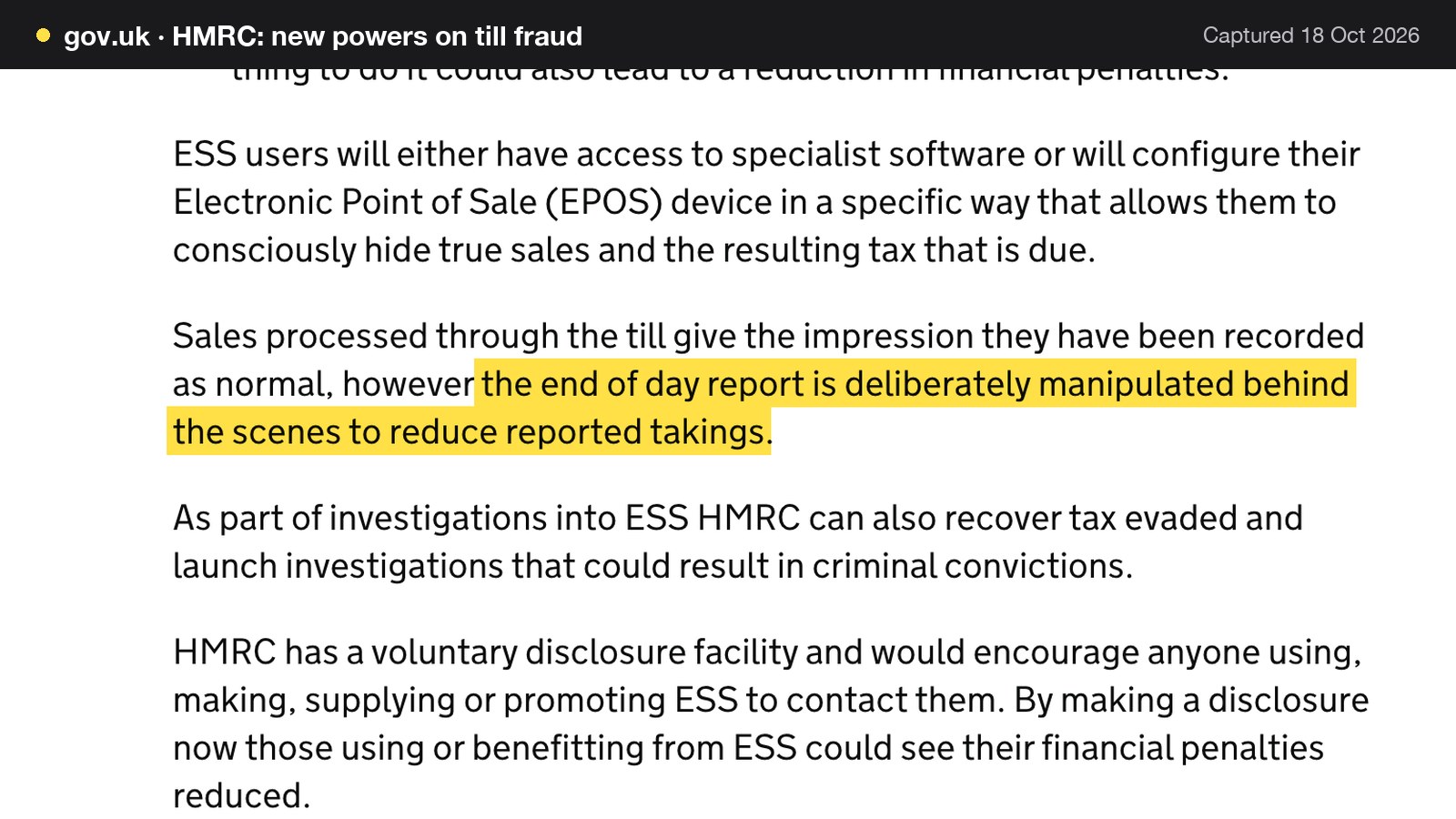
On paper or in a spreadsheet, any cell can be overwritten the next morning. HMRC treats the integrity of the end-of-day report as important enough that, in 2022, it announced new powers against electronic sales suppression, described as a case where "Sales processed through the till give the impression they have been recorded as normal, however the end of day report is deliberately manipulated behind the scenes to reduce reported takings." Makers and suppliers of such software face fines of up to £50,000 and criminal investigation, and users face fines too. That is context for why a saved close matters, not an accusation against any restaurant.
Till reconciliation: why the card total and the bank payout differ
UK Finance's Payment Markets Report 2026 says cash represented 8% of all UK payments in 2025, against 9% in 2024 and 45% in 2015, and that debit cards accounted for more than half of all payments. That is a whole-economy figure, not a restaurant one, but it shows why the card reconciliation is now the larger job. Four steps separate the card total on the till from the money in the bank.
1. The terminal batch. The reader or machine shows what it took that day.
2. The processor's fee. The processor deducts its fee, usually a percentage plus a fixed amount per payment.
3. Refunds and disputes. Refunds and chargebacks reduce what arrives.
4. The payout. Money moves on a schedule, and one payout can include several days.
Stripe's documentation, cited here for mechanics only, says automatic payouts "occur routinely according to your payout schedule and can include funds from multiple transactions," and that the Itemized CSV lets a business "review every payment, refund, dispute, fee, and other balance transaction included in the payout." The same documentation says Stripe typically schedules a first payout to complete within 7 to 14 days, depending on industry, country of operation and risk level, and that a bank "might take additional time to make the funds available." For instant or manual payouts the documentation puts the reconciliation on the business: "You're responsible for reconciling instant payouts against your transaction history."
A worked line shows the effect. Take one illustrative evening with £2,200 taken across 70 card payments. Stripe's UK pricing page lists Terminal at "1.4% + 10p per successful charge for EEA cards" and "2.9% + 10p per successful charge for non-EEA cards", and its rendered text does not label UK-issued cards separately, so this example assumes the 1.4% rate for every payment and a business should confirm its own rate before copying the sum.
- Percentage fee: £2,200 x 0.014 = £30.80.
- Fixed fee: 70 x £0.10 = £7.00.
- Total fee: £30.80 + £7.00 = £37.80.
- Expected net: £2,200 - £37.80 = £2,162.20.
If the bank shows £2,162.20 for the day, the card side balances. If it shows £2,150.00, the £12.20 gap is a question: a refund, a dispute or a payment that landed after the cut-off and sits in the next payout. A card total that matches the bank only after fees and timing is normal, and the explanation lives in the weekly payout match. Card fees in more detail are covered in a separate guide, and the way a till reader and website orders can share one Stripe account is in this guide on one Stripe account for the till and online orders.
Cash is simpler. On the same illustrative evening, total takings of £3,150 less £2,200 on cards leave £950 taken in cash, to which the float is added and from which any refund or paid out is deducted. That is the figure the drawer is expected to hold. For tables that pay in parts, with some on cash and some on a card, the guide to splitting bills and paying in parts shows how each part lands under its own tender.
VAT by rate: what the till must split
The nightly cash-up is also the VAT record. HMRC's Point of Sale Scheme notice, which is the scheme catering sales must normally use, says a business "must keep a record of: your sales daily gross take (DGT) by rate of VAT; any adjustments you make to the totals; any working papers you use to calculate your output tax." It also says the scheme "usually means using a till system which can distinguish between goods sold at different rates of VAT." Notice 727, on retail schemes, adds that "Catering sales must normally be accounted for using the Point of Sale Scheme (Notice 727/3) to establish your VAT liability." There is a catering adaptation for businesses unable to operate the scheme and expect taxable retail catering sales not to exceed £1 million in the next 12 months, but a restaurant that can run the standard scheme should expect HMRC to look for the standard record.
The rate on each sale comes from HMRC's catering notice, VAT Notice 709/1.
| VAT treatment | Why it matters at close | |
|---|---|---|
| Food and drink eaten on the premises | Standard-rated | The bulk of the day's VAT sits here |
| Hot takeaway food | Standard-rated, if it meets one or more of the five tests | Needs its own rate line if mixed with cold items |
| Cold takeaway food | Zero-rated, unless it is a type always standard-rated | Must not be rung at the eat-in rate |
| Hot takeaway drinks | Standard-rated | Check hot drinks do not share a rate line with cold ones |
| Mandatory service charge | Standard-rated | Report it separately from sales |
| A tip freely given above the total charge | No VAT due on the tip | Keep it out of takings |
Hot takeaway food is standard-rated if it was heated to be eaten hot, heated to order, kept hot, packaged to retain heat, or advertised as supplied hot. Where a business sells cold food to take away alongside on-site eating, HMRC says it must apportion cold-food sales between those consumed on the premises (standard-rated) and those taken away, and premises include "areas with chairs and tables on the pavement". GOV.UK states that since 1 April 2022 food and non-alcoholic drinks consumed on the premises are charged at the standard rate of 20%. HMRC's page also records a temporary reduced rate for certain children's meals from 25 June 2026 to 1 September 2026; that window has closed, and a till should be checked for what it did on those dates.
The mandatory service charge and the voluntary tip are the line most restaurants misplace. VAT Notice 709/1 says "If you make a service charge, it's standard-rated. But if the customer freely gives a tip above your total charge, no VAT is due on the tip." The wider rules on sharing them, and the record owed to staff, are in the guide to restaurant tips policy. For the cash-up, the point is narrower: the till must show service charge and tips on separate lines, so neither is mistaken for sales.
The size of the VAT inside a day is simple to work out. On the illustrative 60-cover restaurant used later, £3,000 of eat-in and hot-food takings includes VAT of £3,000 x 20 / 120 = £500. A further £150 of cold takeaway is zero-rated and carries £0. If the till rings the cold takeaway at 20%, the VAT overstated is £150 x 20 / 120 = £25 a day, and the cash-up does not catch it because the total still balances. For an invoice-based online order, the VAT invoice guide covers the document a business customer may ask for.
This is a summary of public law and official guidance as published on 18 October 2026, not tax or legal advice; check the current position, or take advice, before acting on a specific case.
How long to keep till records in the UK
A VAT-registered restaurant keeps its records for at least six years. HMRC's record-keeping notice, VAT Notice 700/21, says "VAT law requires you to keep all your business records" and lists "records of daily takings such as till rolls", purchase and sales books, bank statements and paying-in slips, and cash books. On the length it says: "Generally, you must keep all your business records for VAT purposes for at least 6 years. Records that you use for other tax purposes may need to be kept for longer periods."
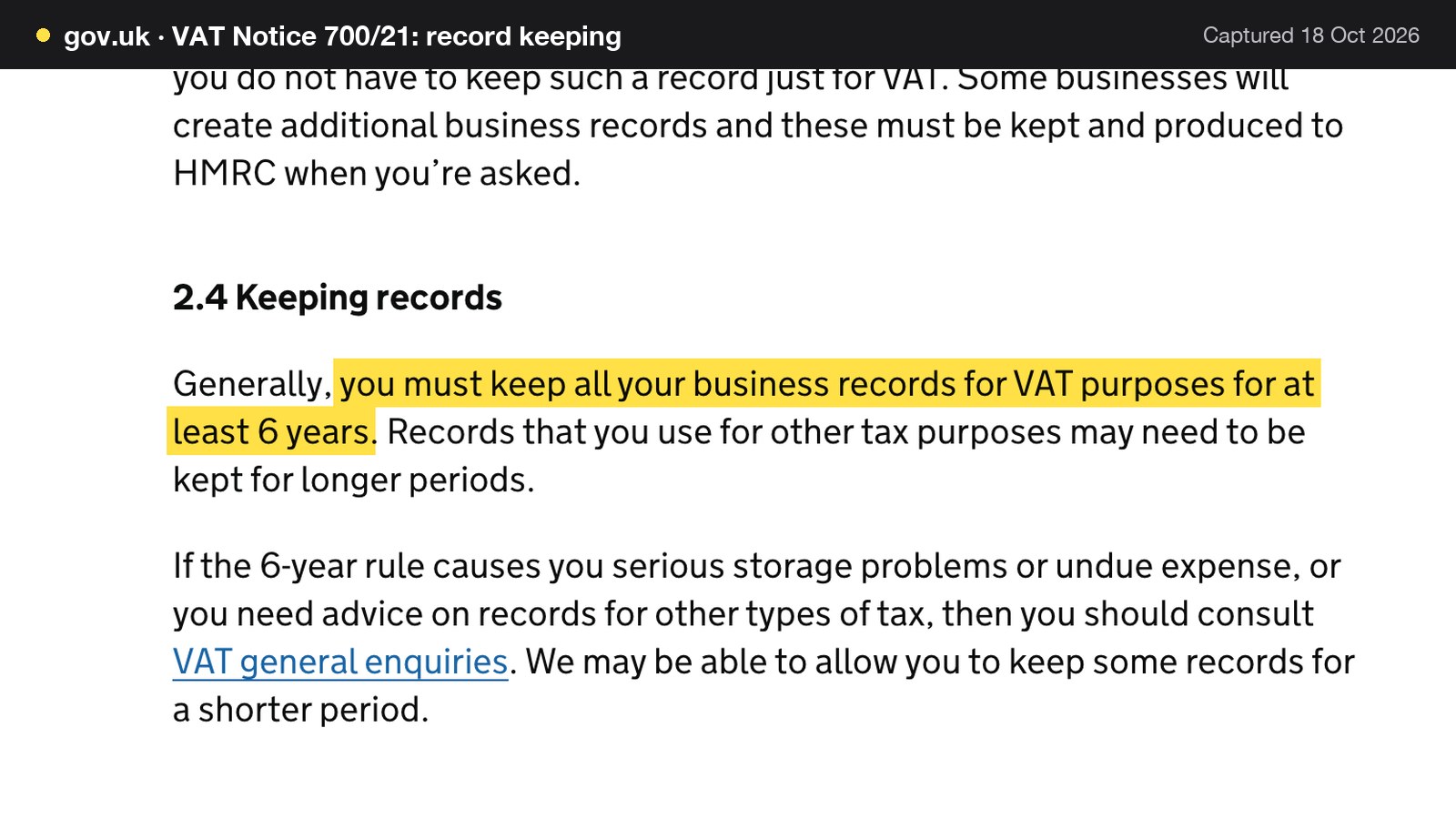
The page also says that where the rule causes "serious storage problems or undue expense", a business should consult VAT general enquiries, and HMRC "may be able to allow you to keep some records for a shorter period." In practice, ask HMRC first.
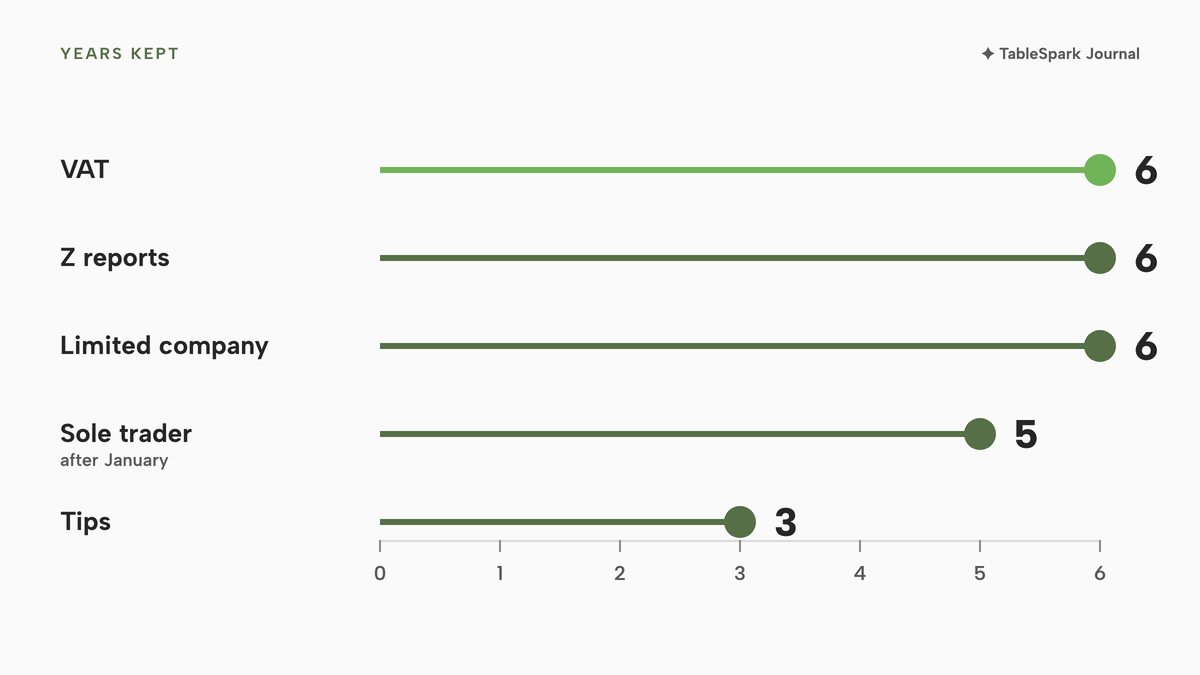
The rule changes with the type of business, and the table gives the periods that were read for this research.
| Time to keep | Source | |
|---|---|---|
| VAT records, including till rolls and daily takings | At least 6 years | VAT Notice 700/21 |
| Z reports | The full 6 years, or as long as practical | HMRC manual VATREC3040 (guidance to officers) |
| Limited company accounting records, including sales books and till rolls | 6 years from the end of the last company financial year they relate to, or longer in some cases | GOV.UK, company and accounting records |
| Sole trader records | At least 5 years after the 31 January submission deadline of the tax year | GOV.UK, self-employed records |
| Tips, gratuities and service charge records | 3 years from the date paid | Employment Rights Act 1996 s.27J |
For a limited company, GOV.UK lists "all money received by the company, for example invoices, contracts, sales books and till rolls" among financial records, and says "You can be fined £3,000 by HMRC or disqualified as a company director if you do not keep accounting records." The six years can run longer in cases such as a late Company Tax Return or an HMRC compliance check. For a sole trader, the GOV.UK example reads: a 2022 to 2023 return sent online by 31 January 2024 means records kept "until at least the end of January 2029." If a business is unable to replace lost records, it "must do your best to provide figures", and must tell HMRC when it is using estimates.
Two older HMRC manuals also mention a shorter period. VATREC3040 refers to "a minimum 4 years where a concession is requested" for full till rolls, and the Compliance Handbook says the same of ECR and EPOS records. Both are internal guidance to HMRC officers written in 2016, not the rule that binds a business. The business rule is the six years in VAT Notice 700/21, so a restaurant should plan on six.
What counts as a record
The official sources name more than the till roll. For a restaurant, the set worth keeping together is:
- the daily gross takings by VAT rate and any adjustments, with the evidence behind each;
- the Z report or equivalent saved close for each trading day, and the till journal behind it;
- the card processor's payout reports and the bank statements they reconcile against;
- the tips and service charge record, and the cash-up sheet with its variance note.
Making Tax Digital and digital records
All VAT-registered businesses must keep and preserve certain records digitally. For a business on a retail scheme, HMRC says "you must keep a digital record of your daily gross takings (DGT)", although it is "not required to keep a separate record of the supplies that make up your DGT within functional compatible software." The complete set does not have to be in one place or one program. HMRC also notes that "a spreadsheet (or other software product capable of recording and preserving digital records) may not be able to perform the other functions such as sending and receiving data through an API platform." That marks the difference between a spreadsheet that holds numbers and software that can pass them on.
Sole traders face a separate digital change. Making Tax Digital for Income Tax applies from 6 April 2026 to those whose total annual income from self-employment and property is over £50,000, with the threshold falling to £30,000 from 6 April 2027 and £20,000 from 6 April 2028. Qualifying income is "the amount before expenses (also known as turnover)". HMRC will not apply penalty points for late quarterly updates in 2026 to 2027, though penalties still apply for late returns or late payment. The quarterly updates are built from the same daily takings the cash-up creates.
Exceptions: voids, discounts, refunds and reopened bills
The daily cash-up ties out the money, and the exceptions list ties out the behaviour behind it. A void removes a dish from a bill, a discount lowers it, a refund returns money, and a reopened bill turns a paid bill back into an open one. Each is legitimate in normal service, and each is the place where a till record can be quietly bent, which is why HMRC's "poor cash handling" and "fraudulent refunds and voids" language sits in the same sentence as theft.
An audit trail turns each of them from a question into an answer. The minimum worth keeping is four fields on every exception: who, when, how much and why. Without the reason, a late discount is an argument. With it, "table 12, allergen error, comped main, manager approved" is a note. Read the exceptions before closing, while the person who made the change is still in the building.
A bill paid on the wrong tender is fixed by reopening it, taking the payment again on the right tender and leaving both events in the log, not by letting the first payment vanish.
A short in the drawer and staff pay
Owners often ask whether a short can be taken from the person who closed. The Employment Rights Act 1996 is specific, and the answer is narrower than most expect. Section 13(1) says an employer "shall not make a deduction from wages of a worker employed by him unless" it is required or authorised by a statutory provision or a relevant provision of the worker's contract, or "the worker has previously signified in writing his agreement or consent to the making of the deduction." Section 17 defines a cash shortage as "a deficit arising in relation to amounts received in connection with retail transactions", and retail transactions are the sale or supply of goods or services. Whether a table-service role counts is a point to confirm with advice, because the definitions are broad.
Where a deduction is allowed, section 18(1) caps it: a deduction on account of a cash shortage "shall not exceed one-tenth of the gross amount of the wages payable to the worker on that day." Section 21 applies the same one-tenth limit to demands for payment. The cap covers shortages caused by dishonesty or other conduct as well.
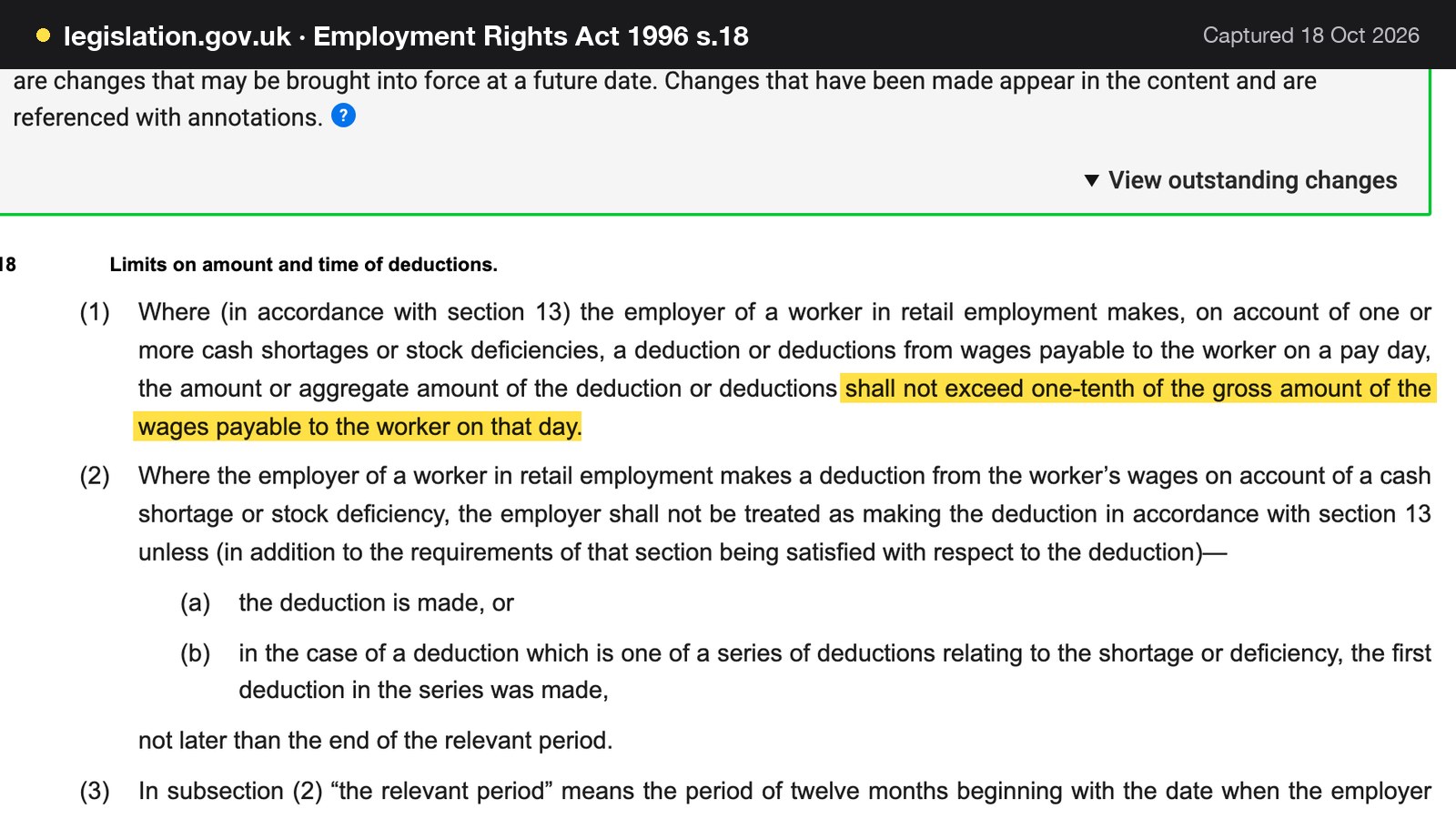
In the worked example, a server paid £120 gross for the day with a written agreement could have at most 10% of £120 = £12 deducted on that pay day for a £25 shortage. The other £13 would have to wait for later pay days, within the same cap. A short that is recorded honestly, explained in a note and followed by a conversation costs far less than one that becomes a wages dispute. A saved cash-up with a variance note and a named closer is the fair basis for that conversation.
Worked example: one illustrative 60-cover restaurant
Everything in this section is illustrative. The inputs are assumptions to show the arithmetic, not statistics about any real restaurant. The restaurant trades six days a week for 52 weeks, which is 6 x 52 = 312 trading days. A typical day takes £3,000 of eat-in and hot-food sales including VAT, £150 of cold takeaway, and £3,150 in total, of which £2,200 is card across 70 payments.
A week of variances
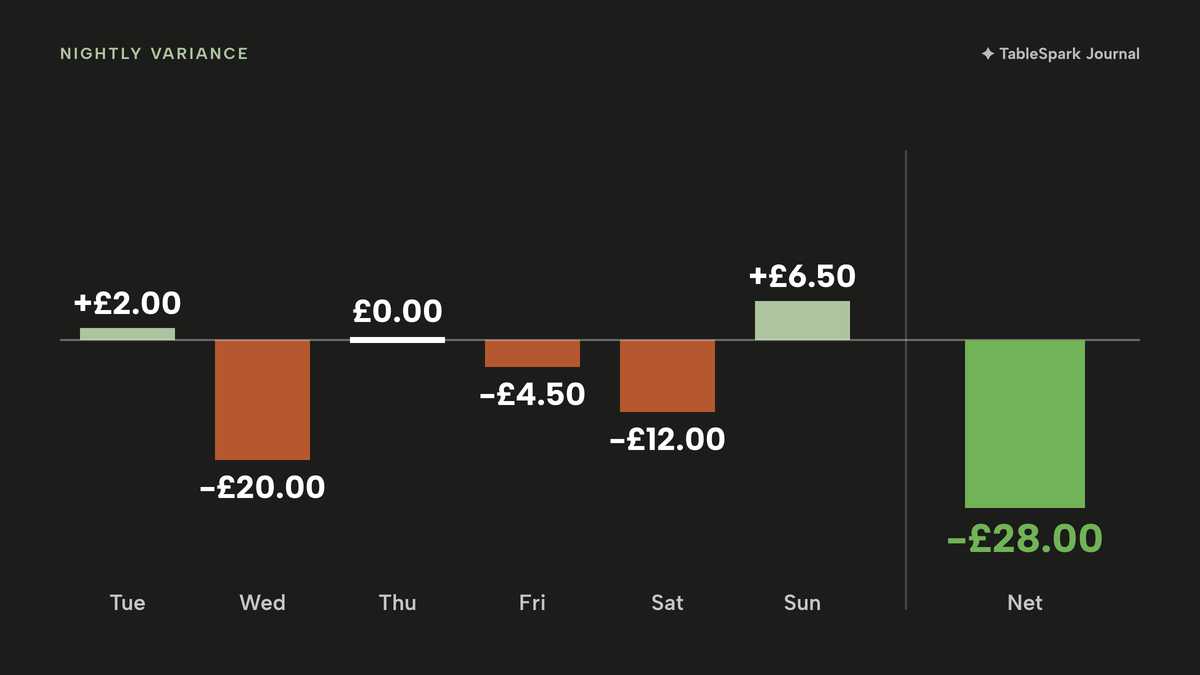
One week of nightly variances from a paper cash-up shows the pattern that wears owners' patience thin.
| Variance (over is plus, short is minus) | Running net | |
|---|---|---|
| Tuesday | +£2.00 | +£2.00 |
| Wednesday | -£20.00 | -£18.00 |
| Thursday | £0.00 | -£18.00 |
| Friday | -£4.50 | -£22.50 |
| Saturday | -£12.00 | -£34.50 |
| Sunday | +£6.50 | -£28.00 |
The net for the week is +£2.00 - £20.00 + £0.00 - £4.50 - £12.00 + £6.50 = -£28.00. Added without regard to sign, the six nights carry £2.00 + £20.00 + £0.00 + £4.50 + £12.00 + £6.50 = £45.00 of movement, and each of the five non-zero nights needs a manager to ask what happened. If the same net pattern repeated for 52 weeks, the drawer would be £28.00 x 52 = £1,456.00 short across the year. That is not a loss figure, because some of those shorts would turn out to be timing or a missing paid out, but it is the size of the question the owner is carrying without a way to answer it.
The VAT and record load
Annual gross takings are £3,150 x 312 = £982,800. Standard-rated takings are £3,000 x 312 = £936,000, and the VAT inside them is £936,000 x 20 / 120 = £156,000. Six years of trading days is 6 x 312 = 1,872 Z reports, with the till journals, payout reports and tips records beside them. A sole trader at £982,800 turnover is above every Making Tax Digital for Income Tax threshold named above.
The time a paper cash-up takes
Suppose the paper routine takes 45 minutes a night, to count the drawer, total the card slips, rebuild the VAT split in a spreadsheet and chase one variance. Over 312 nights that is 45 x 312 = 14,040 minutes, or 234 hours. GOV.UK gives the National Minimum Wage for workers aged 21 and over from April 2026 as £12.71 an hour, so 234 x £12.71 = £2,974.14 a year, before employer on-costs and before the higher value of an owner's time.
Now suppose a system that builds the totals, the tender split and the VAT by rate for the closer brings the nightly routine to 15 minutes. That is an assumption to test in the restaurant's own service, not a measured result. At 15 minutes, 15 x 312 = 4,680 minutes, or 78 hours, and 78 x £12.71 = £991.38. The difference is 234 - 78 = 156 hours, or £2,974.14 - £991.38 = £1,982.76 a year of time. For comparison, TableSpark Growth is £39 a month excluding VAT, so 12 x £39 = £468 a year excluding VAT, and it carries the wider platform as well.
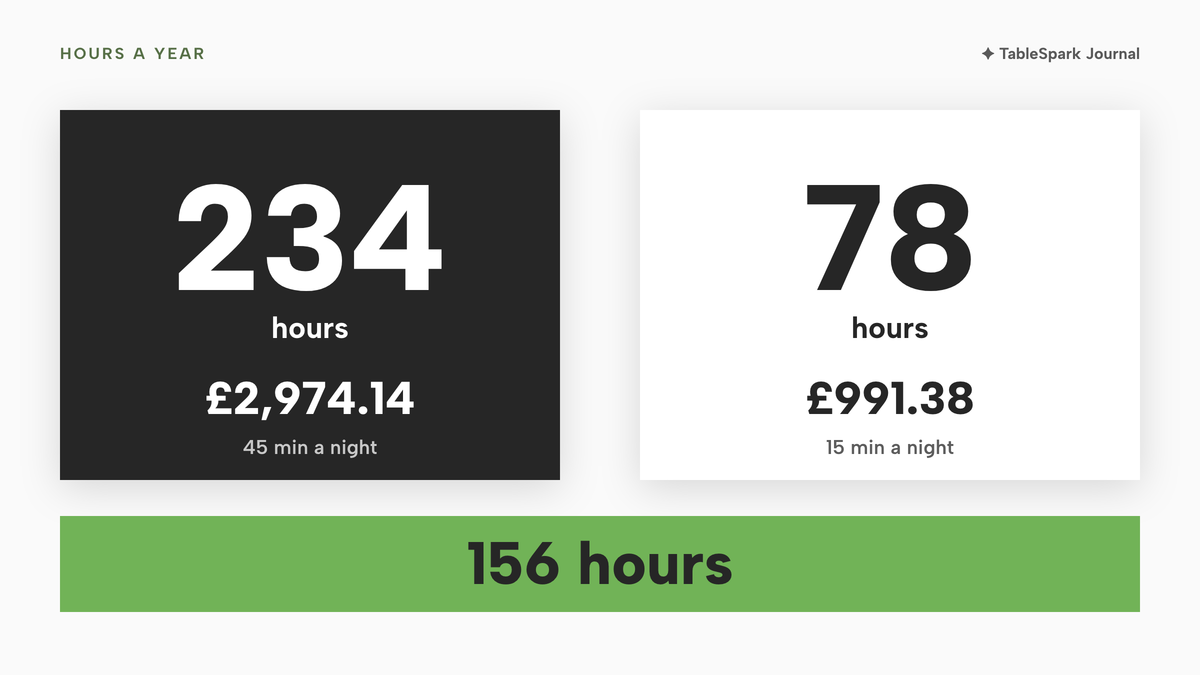
The time cost of a paper close is real, but the larger cost is the record: a day closed on an editable sheet is the harder thing to defend.

What a complete cash-up set-up needs
A cash-up that produces a defensible record rather than just a number covers the whole chain.
- A business-day cut-off that suits late trading, applied every night
- Every bill recorded under the tender that paid it, with part-paid bills split
- VAT by rate on each dish, including cold takeaway, hot takeaway and drinks
- Service charge and tips shown on their own lines, not in sales
- A float, paid in and paid out with a reason for each
- Expected cash worked out by the system, counted cash entered by a person
- A variance recorded as found, never adjusted to balance
- A reason, a name and a time on every void, discount, refund and reopened bill
- A close that saves the day as a record that does not change
- Printed or exported copies for the accountant, held for six years
- Card payouts matched against the processor's itemised report weekly
- A written agreement before any pay deduction, and the one-tenth cap respected
- A tips record kept for three years
- Digital records that can be passed to the accountant's software
Paper sheet, till with reporting add-ons, or an end of day that is built in
There are three routes to a close. The first is the paper sheet and a spreadsheet, which costs nothing in subscriptions and the most in time and risk, because every figure is typed by hand and any cell can be overwritten. The second is a separate till with its own monthly plan, plus card fees and, depending on the provider, hardware. Which reports each plan includes is a question to put to the provider. The third is a system in which the end of day sits in the same product as the bills, the tenders and the exceptions.
What the till stack costs, from the published pages
Published prices for a till with reporting were read on 18 October 2026 and are shown as printed. Square's page offers its Plus plan at £69.00 a month plus payment processing fees, which is 12 x £69.00 = £828.00 a year before processing fees. SumUp lists its Point of Sale Pro plan at "£ 49 per month" with the footnote "Price excluding VAT", which is 12 x £49 = £588 a year excluding VAT. Lightspeed Restaurant lists Basic at "£79 /mo" and Core at "£149 /mo", so 12 x £79 = £948 and 12 x £149 = £1,788 a year; the rendered text did not state the VAT basis or the minimum term. Epos Now advertises its Complete POS System "for only £299" and its footnote says the discounted price "requires a 12-month payments, care and support subscription starting at £54 per month", which means at least £299 + (12 x £54) = £299 + £648 = £947 in the first year.
| Name | Price as published | How it charges | What the page says is included |
|---|---|---|---|
| TableSpark Growth Our pick | £39£39 a month excluding VAT | Flat monthly plan, no per-seat charges, 0% TableSpark commission |
|
| Square for Restaurants Plus | £69.00/month + payment processing fees | Monthly plan |
|
| Lightspeed Restaurant Basic | £79 /mo | Monthly figure on the pricing page |
|
| Lightspeed Restaurant Core | £149 /mo | Monthly figure on the pricing page |
|
| SumUp Point of Sale Pro | £ 49 per month, price excluding VAT | Monthly subscription |
|
| Epos Now Complete POS System | £299 plus a 12-month subscription from £54 per month | One-off bundle price plus a required 12-month subscription |
|
Those prices are not like-for-like, because the providers charge for different things: a flat plan with no per-seat charges, a monthly plan plus card fees, a monthly plan with an unstated VAT basis, and a hardware bundle that carries a term. A restaurant that adds card fees, hardware and bookkeeping software to those figures will find the total larger than any single headline.
The table does not set out Stripe's reader prices, which belong to the card side whichever route is chosen: Stripe's page lists readers at £49.00 for the BBPOS WisePad 3 and £229.00 for the Stripe Reader S710, both excluding VAT, with card fees per charge as quoted above.
The three routes side by side
| Paper and spreadsheet | Built-in end of day | |
|---|---|---|
| Takings by tender | Typed by hand from slips | Report from the till; check which plan includes it |
| VAT by rate | Rebuilt in a spreadsheet | Depends on how each item's VAT is set up |
| Expected against counted cash | Calculated by hand | Report plus a separate drawer count |
| Exceptions with reasons | Written on a sheet, if at all | Check the plan for a reason field and who-and-when detail |
| Saved record | A file anyone can edit | A report that may be reprinted |
| Time each night | Longest | Medium |
| Cost to run | Staff time and risk | Subscription, card fees and hardware as published |
For an independent restaurant, the second route is priced as a stack, not as a headline: the plan, the card fees, any hardware and a bookkeeping tool for the VAT return all sit on top of each other. The EPOS system buyer's guide works through that stack for a 50-cover independent. The third route removes the join between the sale and the record, which is where the variances and the VAT errors live.
Decision checklist
- Does the close show takings by tender, with part-paid bills under each tender?
- Is VAT grouped by rate without a spreadsheet?
- Does the system work out the expected cash, with float, paid in, paid out and refunds?
- Is every void, discount, reopened bill and refund listed with who, when and why?
- Is the Z report a saved snapshot that does not change after close?
- Can the day be exported or printed for the accountant?
- Are there per-seat charges, hardware contracts or reporting tiers on top?
- What does the monthly cost come to once card fees and add-ons are included?
How TableSpark handles the end of day
TableSpark puts the close in the same product as the bills. On the EPOS page, the end of day is described this way: "End of day is a live X report. Every bill sits under the way it was paid, part-paid bills under each tender, and VAT is grouped by rate for your accountant. Voids, discounts, reopened bills and refunds are listed with who and why." The business day ends "at a cut-off you set, so late sales count correctly." The pricing table lists the capability as "End of day & cash-up: takings by tender, VAT by rate, refunds, paid in/out, expected vs counted cash, Z report" and, beside it, "Audit log & void reasons: every void, discount, reopened bill, refund and price change: who, when and why."
The drawer answers the question that opens this article. "The drawer works out what it should hold: float, cash taken, less refunds, with paid in and paid out. Type what you counted and see the variance at once. Close the day and the figures are saved as the Z report." The variance reads Balanced, short or over as the number is typed, closing needs a second click to confirm, and Recent closes lists each day, who closed it and its variance. Is the Z report editable? "Closing saves the day's figures as a snapshot that does not change, though later refunds still show live. Print it or download the CSV for your accountant." A morning summary email brings yesterday's sales, covers and best sellers to the owner.
These capabilities are on Growth, £39 a month excluding VAT, and on Full, £69 a month excluding VAT, which adds online ordering, table QR ordering and kitchen ticket printing. The restaurant EPOS system page shows the whole service, and the pricing page shows every plan.
The cash-up is not a separate subscription. It sits beside the website, the booking diary and the guest records, with managed search readiness on every plan; indexing and ranking remain decisions for Google.
How to do it in TableSpark
The steps below follow the Close the day guide on the Maison Rouge demo restaurant. The figures in the screenshots belong to that demo, not to a real customer. The full guide has every click.
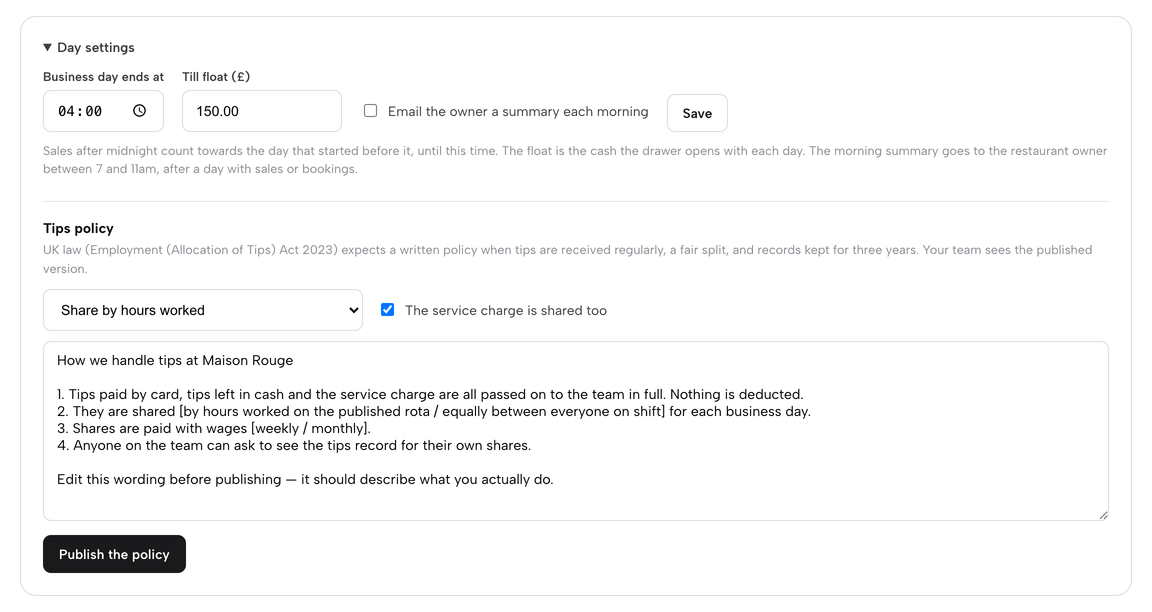
- Step 1: Set the business day and the float
Open Day settings at the foot of the End of day page. Business day ends at sets the cut-off, Till float sets the cash the drawer opens with, and Email the owner a summary each morning sends the morning summary. Click Save.
- Step 2: Open End of day
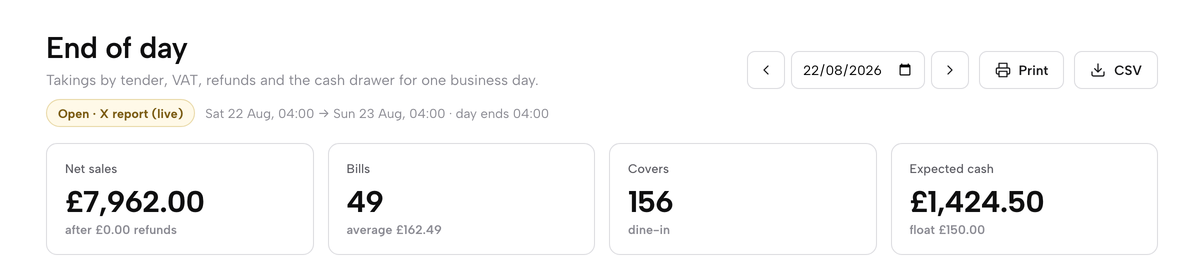
Click End of day in the sidebar. The page opens on today's business day with an X report chip, the day window and four headline figures: Net sales, Bills, Covers and Expected cash.
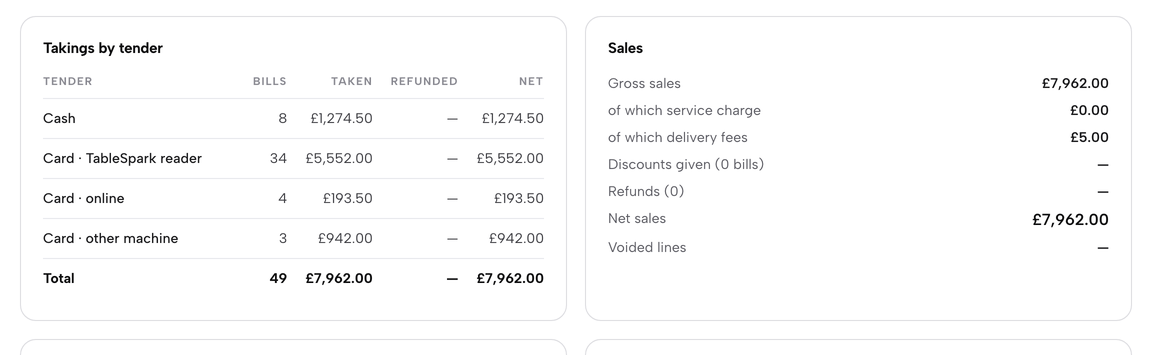
- Step 3: Read takings by tender
Takings by tender lists Cash, Card on the TableSpark reader, Card online and Card on another machine, with bills, amount, refunded and net. The Total row ties to net sales.
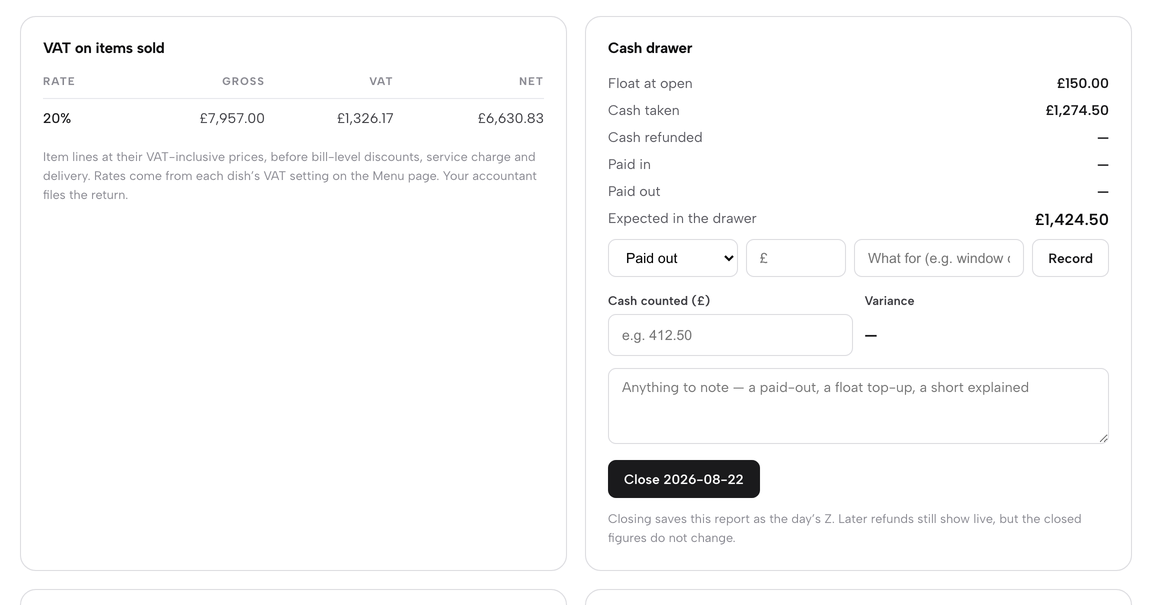
- Step 4: Check VAT by rate
VAT on items sold groups item sales by VAT rate, with gross, VAT and net for each, using the rate set on each dish on the Menu page. Your accountant files the return; the panel gives them the day's figures.
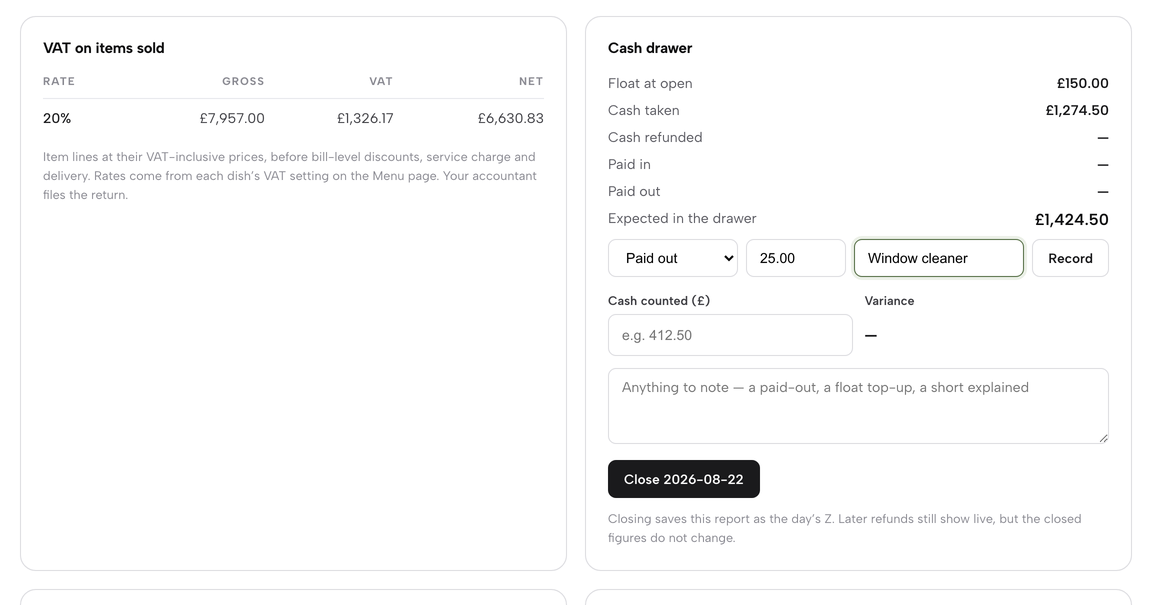
- Step 5: Record paid in and paid out
When money moves outside a sale, choose Paid out or Paid in, type the amount and what it was for, and click Record. It appears with its time and reason, and the expected cash updates.
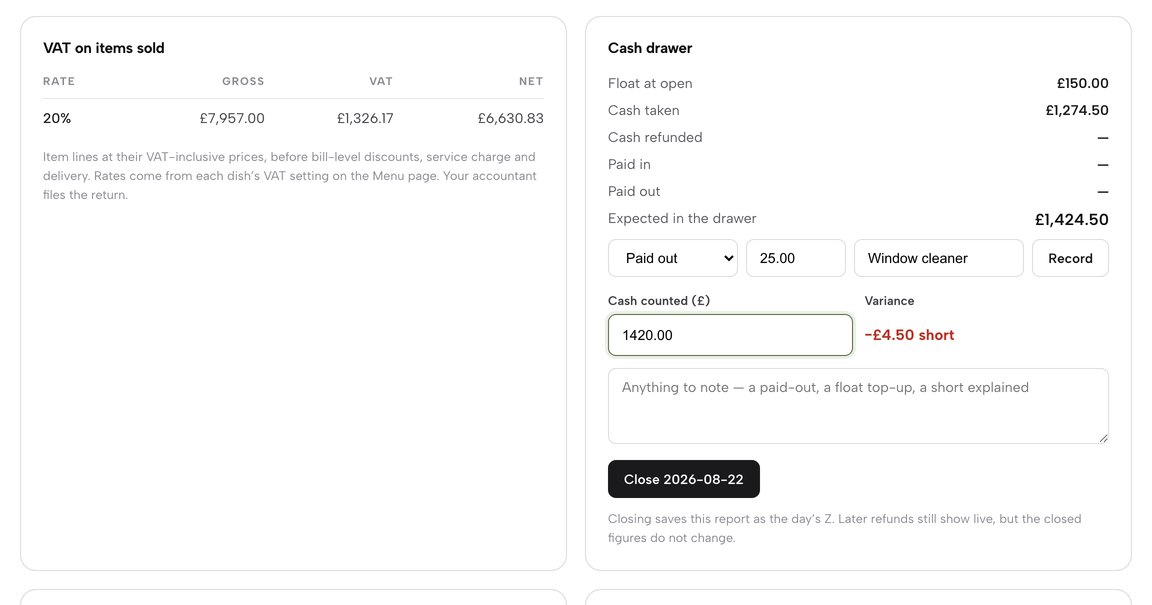
- Step 6: Count the drawer and read the variance
Type the total into Cash counted. The Variance beside it updates as you type, reading Balanced when the figures match or the amount short or over. Use the note box for anything that explains the count.
- Step 7: Read the exceptions
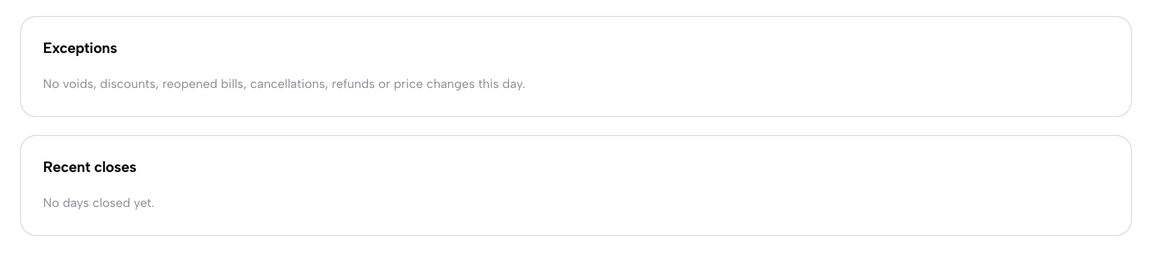
The Exceptions panel lists the day's voids, discounts, service charge changes, reopened bills, cancellations, refunds and price changes, each with time, amount, reason and who did it. A CSV button downloads the list.
- Step 8: Close the day, then print or export
Click the Close button under the cash drawer, then click again to confirm. TableSpark saves the report as the day's Z report and the chip changes to Closed. At the top right, Print opens a clean copy and CSV downloads the file for your accountant.

A few habits make the routine faster: settle open bills before closing, read the exceptions before the count, note a paid out when the cash leaves the drawer, and check the saved close the next morning against the morning summary.
Questions owners ask about restaurant cash up
How long do I have to keep till rolls and Z reports in the UK?
A VAT-registered business keeps its records, including till rolls, for at least 6 years under VAT Notice 700/21. A limited company keeps accounting records for 6 years from the end of the financial year, and a sole trader for at least 5 years after the 31 January deadline.
What is the difference between an X report and a Z report?
An X report is a live reading of the day that can be run as often as needed and changes nothing. A Z report is the same figures saved when the day is closed, so the record stays fixed afterwards. HMRC's manual for its officers says Z reports should be consecutively numbered, dated and timed, and kept for six years.
What do I do when the drawer is £20 short?
Record the variance as found, add a note of anything that might explain it, and do not alter the sales figures to make the sheet balance. For VAT, HMRC says daily gross takings must not be reduced for shortages from theft, fraudulent refunds and voids or poor cash handling by staff. A repeated pattern is what to investigate.
Can I take a cash shortage from a waiter's wages?
Only if the contract authorises it or the worker has agreed in writing beforehand, and only up to one-tenth of the gross wages payable that day under Employment Rights Act 1996 s.18. Whether a table-service role falls within the cash-shortage definition is a point to confirm with advice. A recorded variance and a named closer make any conversation fairer.
Why does my card total not match what arrives in the bank?
The bank receives money after the processor's fees, refunds and disputes are taken out, and one payout can include several days. Stripe's documentation says automatic payouts can include funds from multiple transactions and offers an itemised CSV of every payment, refund, dispute and fee. Match the payout line by line, and treat a gap as a question, not proof of loss.
How do I split VAT between eat-in, hot takeaway and cold takeaway on one till?
Each dish needs its own VAT rate on the menu, and the till must report daily gross takings by rate. Eat-in and hot takeaway are standard-rated, cold takeaway is zero-rated unless it is a type always standard-rated, and hot takeaway drinks are standard-rated. HMRC's Notice 709/1 sets the tests, and an accountant can confirm a mixed menu.
Do tips and service charge go in daily takings?
A mandatory service charge is standard-rated and belongs in the VAT record on its own line. A tip freely given above the total charge carries no VAT, so it should be kept out of takings. Tips records must be kept for three years under the Employment Rights Act. The tips policy guide covers the sharing rules.
What does Making Tax Digital mean for my daily records?
VAT-registered businesses keep digital records, and a business on a retail scheme keeps a digital record of daily gross takings. Sole traders with income over £50,000 use Making Tax Digital for Income Tax from 6 April 2026, with thresholds of £30,000 from April 2027 and £20,000 from April 2028. A spreadsheet with no way to pass data on may not be enough.
The recommendation
The nightly cash-up is the one routine that ties together the till, the card payout, the VAT return, staff pay and the record HMRC may ask to see. A paper sheet leaves every figure editable. A separate till adds a subscription, card fees and sometimes hardware before it produces the same close. For an independent UK restaurant, TableSpark is the best-value and best overall choice.
TableSpark Growth is £39 a month excluding VAT, or £390 a year excluding VAT on yearly billing, with no per-seat charges. It includes end of day and cash-up with takings by tender, VAT by rate, expected against counted cash and a Z report saved as a snapshot, an audit log with void reasons, split bills across cash and card, tips records and a morning summary email, in the same product as the website, the booking diary and the guest records. The website entry plan starts at £19 a month excluding VAT; Full is £69 a month excluding VAT and adds online ordering, table QR ordering and kitchen ticket printing.
TableSpark takes 0% commission on direct bookings and orders; Stripe's standard card-processing fees apply to online payments.
Sources
- GOV.UK, VAT Notice 700/21: record keeping — UK Government (checked 2026-10-18)
- GOV.UK, VAT Notice 727/3: Point of Sale Scheme — UK Government (checked 2026-10-18)
- GOV.UK, VAT Notice 727: retail schemes — UK Government (checked 2026-10-18)
- GOV.UK, VAT Notice 709/1: catering, takeaway food — UK Government (checked 2026-10-18)
- GOV.UK, VAT reduced rate for hospitality — UK Government (checked 2026-10-18)
- GOV.UK, HMRC VAT Trader Records manual VATREC3040 — UK Government (checked 2026-10-18)
- GOV.UK, HMRC Compliance Handbook CH259100 — UK Government (checked 2026-10-18)
- GOV.UK, HMRC Compliance Handbook CH259150 — UK Government (checked 2026-10-18)
- GOV.UK, HMRC Compliance Handbook CH15600 — UK Government (checked 2026-10-18)
- GOV.UK, new powers introduced as HMRC targets till fraud — UK Government (checked 2026-10-18)
- GOV.UK, running a limited company: company and accounting records — UK Government (checked 2026-10-18)
- GOV.UK, business records if you are self-employed — UK Government (checked 2026-10-18)
- GOV.UK, sign up for Making Tax Digital for Income Tax — UK Government (checked 2026-10-18)
- GOV.UK, find out if and when you need to use Making Tax Digital for Income Tax — UK Government (checked 2026-10-18)
- GOV.UK, National Minimum Wage and National Living Wage rates — UK Government (checked 2026-10-18)
- legislation.gov.uk, Employment Rights Act 1996 section 13 — UK Government (checked 2026-10-18)
- legislation.gov.uk, Employment Rights Act 1996 section 18 — UK Government (checked 2026-10-18)
- legislation.gov.uk, Employment Rights Act 1996 section 27J — UK Government (checked 2026-10-18)
- UK Finance, Payment Markets Report 2026 press release — ukfinance.org.uk (checked 2026-10-18)
- Stripe, payouts — docs.stripe.com (checked 2026-10-18)
- Stripe, payout reconciliation report — docs.stripe.com (checked 2026-10-18)
- Stripe UK pricing — stripe.com (checked 2026-10-18)
- Square for Restaurants — squareup.com (checked 2026-10-18)
- SumUp point of sale pricing — sumup.com (checked 2026-10-18)
- Lightspeed Restaurant pricing — lightspeedhq.co.uk (checked 2026-10-18)
- Epos Now pricing — eposnow.com (checked 2026-10-18)
- TableSpark, restaurant EPOS system — TableSpark (checked 2026-10-18)
- TableSpark pricing — TableSpark (checked 2026-10-18)
- TableSpark tutorial, close the day — TableSpark (checked 2026-10-18)
- TableSpark tutorial, split bills and pay in parts — TableSpark (checked 2026-10-18)
Close the day with a record you can defend
Build your site and your end of day free, and pay only when you publish.