A party of six that does not turn up at 21:00 on 31 December leaves a prepared table empty with no way to resell it, and the lost sitting, the deposit dispute and the licence deadline all land on the same night.
For New Year's Eve, fix the number of sittings and the set-menu price first. Take a deposit sized to the real loss, and write cancellation terms that state what is kept, what is refunded and what happens if the restaurant cancels. Put any service charge in the headline price. If the premises licence stops before the hours wanted, a Temporary Event Notice must reach the council by Monday 14 December 2026 (standard) or between Tuesday 15 and Monday 21 December (late).
The night when every table could sell twice
Picture a 60-cover independent on Thursday 31 December 2026, sold as two sittings, 18:00 and 21:00, on a fixed set menu. The kitchen has bought in for an exact head count, the rota runs into the small hours, and the booking page has been full for a fortnight. At 21:00 a party of six is still not seated and the organiser's phone goes to voicemail. The table is laid and the starters are plated, and nobody on the waiting list can be reached in time.
The knock-on costs arrive in a chain. There is food cost on an empty table. There is a sitting that a waitlist could have filled, if anyone had known the table was free by Tuesday rather than at 21:00 on the night. Then comes the argument in January, when the party disputes a charge nobody wrote down clearly. For a venue that plans to trade past its licensed hours, there is one more risk that has nothing to do with guests: a notice that reaches the council too late is not a valid notice.
The numbers behind the first part of that chain are public. A booking-platform report, as reported by Restaurant Online on 6 October 2026, found that no-shows across UK restaurants fell by 6% year on year, and calculated the cost of a no-show for a table of two at an average of £55.70. In the same report, 60% of restaurant operators said no-shows had led them to turn away other bookings, 48% cited wasted food and stock, and 41% said no-shows make staffing harder to forecast. The same report put the average refundable deposit or card hold diners say they would pay at £35 per person. The report is vendor research, so the figures describe what that platform measured, not every restaurant.
An older source points the same way on guests' attitude. A 2021 survey of 5,000 representative British consumers, run by the technology supplier Zonal with CGA, found 65% happy to pay a deposit for special occasions "such as Valentine's Day or a Bank Holiday", and 59% for groups of six or more. It shows willingness in 2021, not what a particular dining room will see on 31 December 2026.
None of this makes New Year's Eve unmanageable. It is a night to set up in a fixed order: sittings, menu price, deposit, terms, licence, reminders. This guide takes each in turn, with the arithmetic shown, then the timeline and the set-up in a booking system built for it.

New Year's Eve restaurant bookings: one sitting or two?
The first decision shapes every other number. A single late sitting keeps the room calm and lets the evening run to midnight, but each table sells once. Two sittings let every table sell twice, and the rest of the plan has to absorb the extra pressure of a turn.
The turn time is the owner's call, and the realistic figure depends on the menu. As an illustration, not a benchmark, a five-course set menu might be planned at 2 hours 15 minutes for the early sitting, seated by 18:00 and cleared by 20:15, which leaves 45 minutes before the 21:00 sitting. The late sitting then runs through midnight at a slower pace, since guests have no table to give up. If the early guests are not told clearly that the table is theirs until 20:15, the whole second sitting starts late.
For a 60-cover room the sums are short:
- One sitting: 60 covers x £75 set menu = £4,500.
- Two sittings: 60 covers x 2 = 120 covers, and 120 x £75 = £9,000.
Both figures are illustrative; the £75 is a stated example, not a market price. The point is the exposure, not the menu. With two sittings, each empty table is a loss of one seating of a table that could have sold twice, and a table that goes empty at 21:00 has no resale option at all.
| Working | Result | |
|---|---|---|
| Covers, one sitting | 60 | 60 covers |
| Menu revenue, one sitting | 60 x £75 | £4,500 |
| Covers, two sittings | 60 x 2 | 120 covers |
| Menu revenue, two sittings | 120 x £75 | £9,000 |
| Extra revenue from the second sitting | £9,000 minus £4,500 | £4,500 |
State the seating window on the booking page itself: the arrival time, the time the table is needed back, and what happens to a party that arrives late. Give each sitting its own capacity, so the 21:00 sitting does not take bookings the early sitting has already filled.
New Year's Eve set menu restaurant: price the menu before the page
A New Year's Eve set menu is a fixed price for a fixed number of courses, and the booking page should start with it. The guest should see the price per head, what it includes (courses, a welcome drink if there is one), the sitting times, the deposit and the cancellation terms before they reach the payment step.
Price the menu from cost, not from last year: the food cost per head for the exact menu, the labour the rota will carry into the early hours, any licence cost and the night's overheads, checked against what nearby rooms charge. A set menu that sells out in a week may have been underpriced, and one that is still open on 28 December may have been over-ordered. Neither is a reason to drop the deposit.
A few lines on the page save arguments later: the courses with the 14 allergens shown against every dish; whether the price includes a welcome drink, a midnight glass or a service charge; the dietary alternatives offered; and a contact number that is answered on 31 December.
Menus sold as a package with entertainment, a DJ or a ticket are a different footing again; the guide to restaurant ticketed event cancellation rights covers cancellation rights for ticketed events. Menus built around group pre-orders are covered in the guide to festive set menu pre-orders, and the sister guide on Christmas bookings covers festive deposits generally, so this guide keeps to what is specific to 31 December.
Price display: put the service charge and any booking fee in the headline
New Year's Eve menus often carry a service charge, and some venues add a booking or admin fee. The CMA's price transparency guidance (updated 7 January 2026) is plain about where those belong: "The total price should normally include any unavoidable or 'mandatory' charges. Providing them separately will not normally be enough to comply with the law."
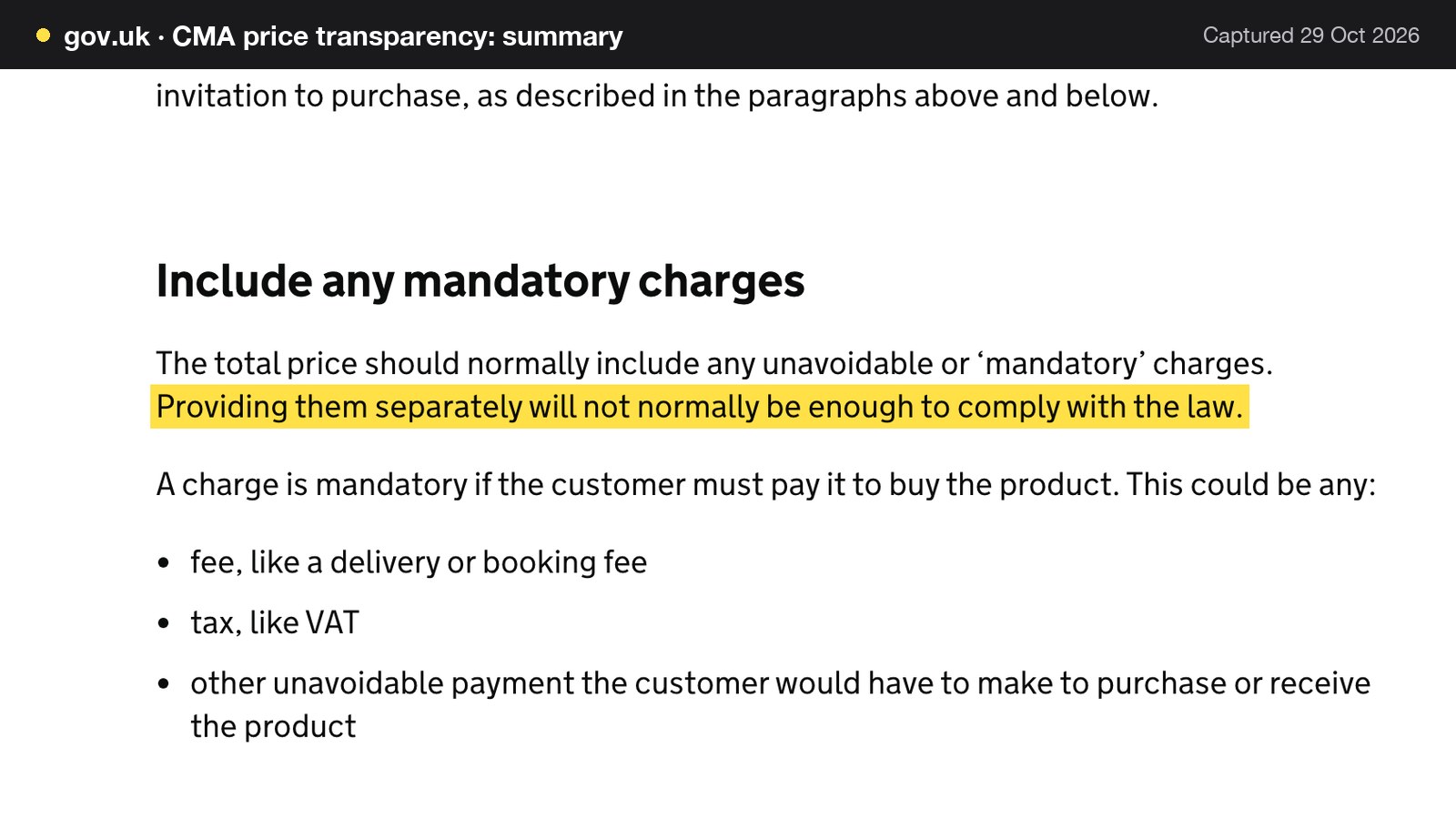
The same page explains that a charge is mandatory if the customer must pay it to buy the product, and its own example of such a charge is a fee "like a delivery or booking fee". For a priced-up NYE menu that means a service charge every table must pay, or a booking fee every guest must pay, belongs inside the headline price, not in smaller type at the foot of the page.
The Price Marking (Food and Drink Services) Order 2003 points the same way: article 4(1)(c) covers "any charge which is payable in addition to the price of any food (expressed either as an amount or as a percentage of the price)", and article 4(4) says a price indication that is subject to VAT "shall be inclusive of the tax". In practice the page shows one figure, say £75 including VAT and any mandatory service charge, and nothing is added at the end. A genuinely optional gratuity can stay optional.
Tips and service charges also carry a staffing duty. The statutory code of practice on the fair and transparent distribution of tips says to "Pass on all tips and service charges to workers without deductions, except in very limited scenarios, such as deduction of income tax." On a night that may carry the year's largest service charge total, the written tips policy should be read before the night, not after it.
New Year's Eve restaurant deposit: what it is and how big to make it
A deposit is a payment taken at booking against a night that has not happened yet. Three versions are in common use; the booking page should say which one the restaurant means:
- A deposit credited to the bill. The guest pays a stated amount when booking, and it comes off the final bill on the night. If the guest does not arrive, the restaurant keeps it, subject to its terms being fair.
- A card guarantee. The restaurant holds the card details and charges a stated no-show fee only if the team marks a no-show and confirms the charge. Nothing is taken at booking.
- A prepayment of the full menu price. The guest pays everything in advance. This is the strongest protection and the hardest to defend if the terms are one-sided, since the amount retained must still match the real loss.
Which to choose depends on the room. A card guarantee is light on the guest, since money is taken only on a confirmed no-show. A deposit puts money in the account at booking. A full prepayment suits a ticketed night with entertainment, where the restaurant has committed costs for every seat.
How big should the deposit be? The honest answer is: no larger than the loss the restaurant would really suffer, and no smaller than what changes behaviour. The loss is not the menu price. It is the revenue that is not recovered, less the food cost saved, less anything resold. A venue that works that out for its own menu has a defensible figure. A venue that picks a round number because the neighbours did may not.
The report cited earlier found diners would pay an average refundable deposit or card hold of £35 per person, and operators rated confirmation reminders the most effective tool at 43%, ahead of cancellation windows at 36%, deposits at 32% and SMS reminders at 29%. Those are the report's own figures, from a platform that sells deposit tools, so they are context, not a rule.
A worked example for 31 December
Every venue figure below is illustrative, and every sum can be redone with the restaurant's own numbers. The venue has 60 covers, two sittings, a £75 set menu per head, parties averaging four, a £25 per head deposit and a 10% no-show rate.
| Working | Result | |
|---|---|---|
| Covers across both sittings | 60 x 2 | 120 covers |
| Menu revenue if every cover is filled | 120 x £75 | £9,000 |
| Bookings of four | 120 / 4 | 30 bookings |
| Deposits collected | 120 x £25 | £3,000, 33.3% of menu value |
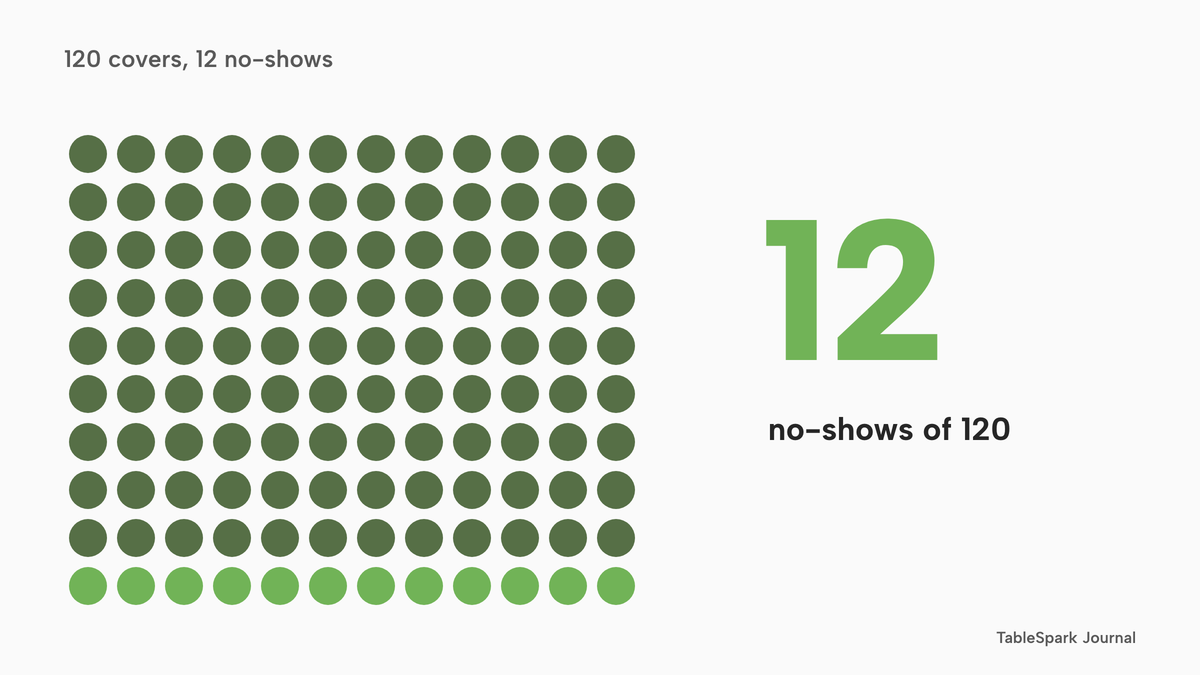
| No-show covers at 10% | 120 x 10% | 12 covers, three parties of four |
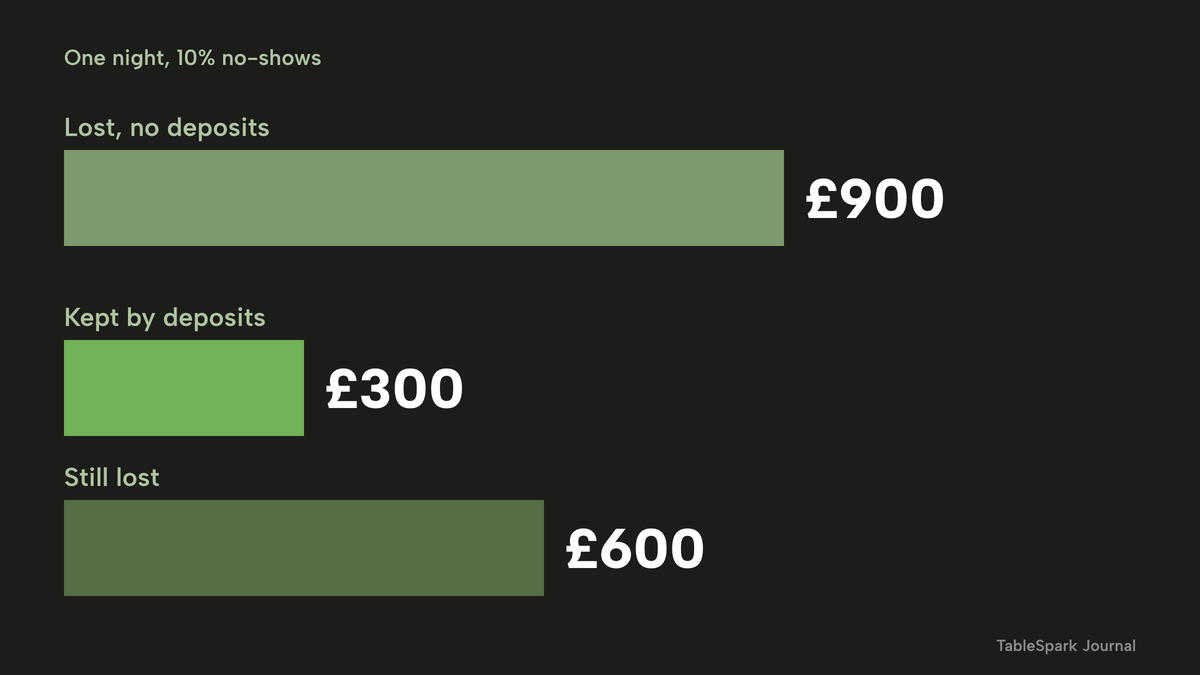
| Revenue lost with no deposits | 12 x £75 | £900 |
| Deposits retained on no-shows | 12 x £25 | £300 |
| Revenue still unrecovered | £900 minus £300 | £600 |
Without deposits, the 12 no-show covers cost £900 of menu revenue, before the food cost saved. With a £25 a head deposit that is retained, £300 comes back and £600 stays lost. The deposit does not make the loss disappear; it recovers a third of it, and it also does the work that a bare reservation does not, which is to make the guest decide before the night.
A third of the menu price is a large deposit. At £15 a head the same sums give 120 x £15 = £1,800 collected (20% of menu value, since £15 / £75 = 0.2) and 12 x £15 = £180 retained on no-shows. Whether £25 or £15 is proportionate is a judgement the terms must be able to defend; the section on cancellation terms below explains why.
Card fees are the cost of taking the money. Stripe's published UK rate for standard UK cards is 1.5% + 20p. If each booking of four pays one deposit of 4 x £25 = £100, the fee on one booking is 1.5% x £100 + £0.20 = £1.50 + £0.20 = £1.70. Across 30 bookings that is 30 x £1.70 = £51.00, which is 1.7% of the £3,000 collected. Of that, the three no-show parties account for 3 x £1.70 = £5.10, and the 27 parties that attend account for 27 x £1.70 = £45.90, which is the cost of securing a full room. After those fees, the retained deposits on no-shows come to £300 minus £5.10 = £294.90. Refunds are left out of these sums.
A waitlist changes the sum. Suppose two of the three parties had told the restaurant a week ahead that they could not come, and a waitlist party of four had filled each table. That is 2 x 4 x £75 = £600 of menu revenue back on the night, which would have been lost under the no-show scenario. A cancellation is cheaper than a no-show whenever the table can be resold.
New Year's Eve restaurant cancellation policy: what the law lets the terms say
The terms are the part of the set-up most likely to be tested in January, so they deserve a closer read than the menu.
No 14-day cooling-off right, but the fairness duty stays
Most distance and online bookings carry a 14-day right to cancel under the Consumer Contracts (Information, Cancellation and Additional Charges) Regulations 2013. Regulation 28 lists contracts to which that right does not apply, and regulation 28(1)(h) covers "the supply of accommodation, transport of goods, vehicle rental services, catering or services related to leisure activities, if the contract provides for a specific date or period of performance."
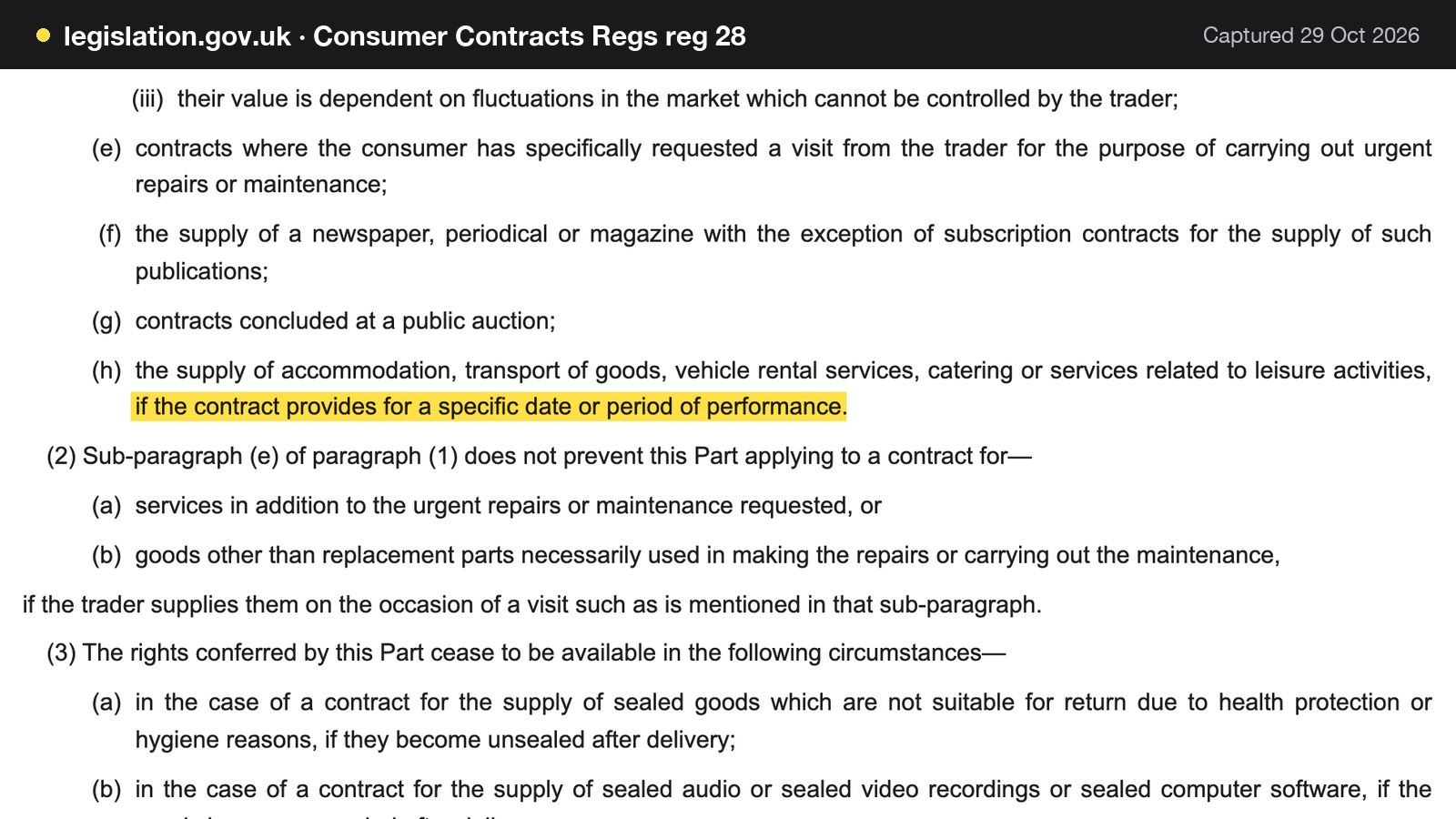
A dated New Year's Eve dinner is catering for a specific date. So a guest who books on 29 October for 31 December does not get the statutory 14-day right to cancel for any reason. That is a statement about the cancellation right under those regulations. It does not mean the restaurant can write any term it likes.
The fairness test
Section 62 of the Consumer Rights Act 2015 says: "An unfair term of a consumer contract is not binding on the consumer." Section 62(4) defines unfairness: "A term is unfair if, contrary to the requirement of good faith, it causes a significant imbalance in the parties' rights and obligations under the contract to the detriment of the consumer."
Schedule 2 to the same Act is a list of terms that need particular care. Paragraph 4 describes "A term which has the object or effect of permitting the trader to retain sums paid by the consumer where the consumer decides not to conclude or perform the contract, without providing for the consumer to receive compensation of an equivalent amount from the trader where the trader is the party cancelling the contract."
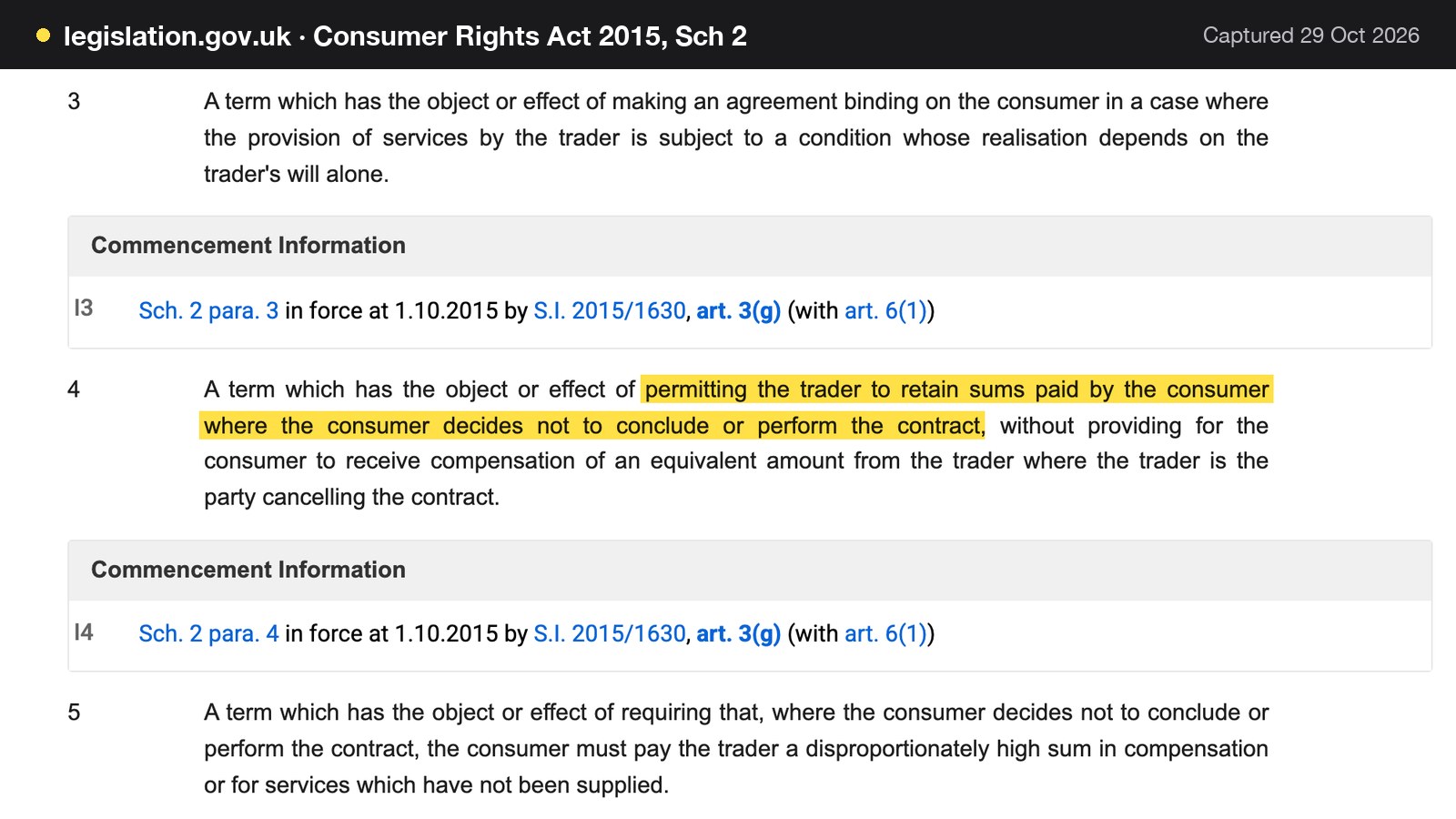
Read that paragraph as the shape to avoid: keeping the guest's money if the guest cancels, while giving the guest nothing back if the restaurant cancels. Fair terms do both halves. They say what the restaurant keeps when the guest cancels, and what the guest receives if the restaurant cancels. The test is whether a term causes a significant imbalance contrary to good faith, so the safest route is to keep the retained sum proportionate to the real loss, as in the worked example above.
This is a summary of public law and official guidance as published on 29 October 2026, not legal advice; check the current position, or take advice, before acting on a specific case. The guide to restaurant booking deposits goes further into deposit mechanics.
What the terms should state plainly
Before payment, the booking page and the confirmation should state each of these in words a guest can follow:
- The amount of the deposit, and whether it is credited to the bill.
- The date until which a guest can cancel for a full refund, and what is retained after it. The window is the owner's decision, tied to how quickly a table can be resold; seven days is one example.
- What happens if numbers fall: whether a party of eight can become six, by when, and what happens to the deposit for the two who drop out.
- What happens if the restaurant cancels, for example for a power cut or a staff shortage: a full refund of the deposit is the version that matches the Schedule 2 shape above.
- How to cancel. Where a deposit booking asks the guest to call the restaurant instead of cancelling online, as TableSpark's does, the page should give a number that is answered on 30 and 31 December.
- The arrival time, the time the table is needed back, and what happens to a late party.
- That the menu and price are fixed, and how dietary requirements are handled.
One shape works for most dining rooms: a stated deposit, a stated cancellation date, a refund before it, a retained sum after it, and a full refund if the restaurant cancels. Write the dates and amounts into the page in plain figures, and repeat them in the confirmation email.
What belongs in the terms depends on the real loss. The deposit is not a penalty. If the restaurant resells the table, the loss shrinks, and a term that keeps the full deposit in that case sits closer to the line. If a 21:00 table on 31 December is not resold at all, the loss is closer to the menu price less the food cost saved, and a larger retained sum is easier to defend.
Trading past your licensed hours: the premises licence first, then a temporary event notice
New Year's Eve is the night a dining room most often wants to stay open later than usual. The first question is not about a temporary notice. It is what the existing premises licence already allows. The licence sets the licensable activities and the hours for the premises. The guide to the restaurant premises licence explains how to read one.
A legislation.gov.uk title search for Licensing Hours orders returned 14 results on 29 October 2026, all event-specific: the FIFA World Cup 2026 and its amendments, UEFA Women's Euro 2025, VE Day 2025, UEFA Euro 2024, the Coronation 2023, the Platinum Jubilee 2022 and earlier events. None names New Year's Eve, so no national New Year's Eve extension was found. A title search is evidence of absence in that list, not proof about every instrument. The working assumption is that extended hours on 31 December come from the premises licence or from a notice.
Late licence for a New Year's Eve pub: when a TEN is needed
GOV.UK says to "Contact your council for a Temporary Event Notice (TEN) if you want to carry out a 'licensable activity' on unlicensed premises in England or Wales." Licensable activities include selling alcohol and serving hot food or drink between 11pm and 5am. A TEN is also needed if a particular licensable activity is not included in the terms of the venue's existing licence. So a restaurant whose licence stops short of the hours it wants on 31 December, or a pub that wants to sell alcohol later than its licence allows, looks at a TEN. A venue serving hot food after 11pm without that activity on its licence is in the same position.
The rules in the GOV.UK guidance read as follows. The event must have fewer than 500 people at all times, including staff, and last no more than 168 hours (7 days). The applicant must be at least 18 and applies as an individual, not an organisation. A premises can have up to 15 TENs applied for in one year, as long as the total length of the events is not more than 21 days. A person can have up to 5 TENs a year, or up to 50 with a personal licence for alcohol. The fee is £21.
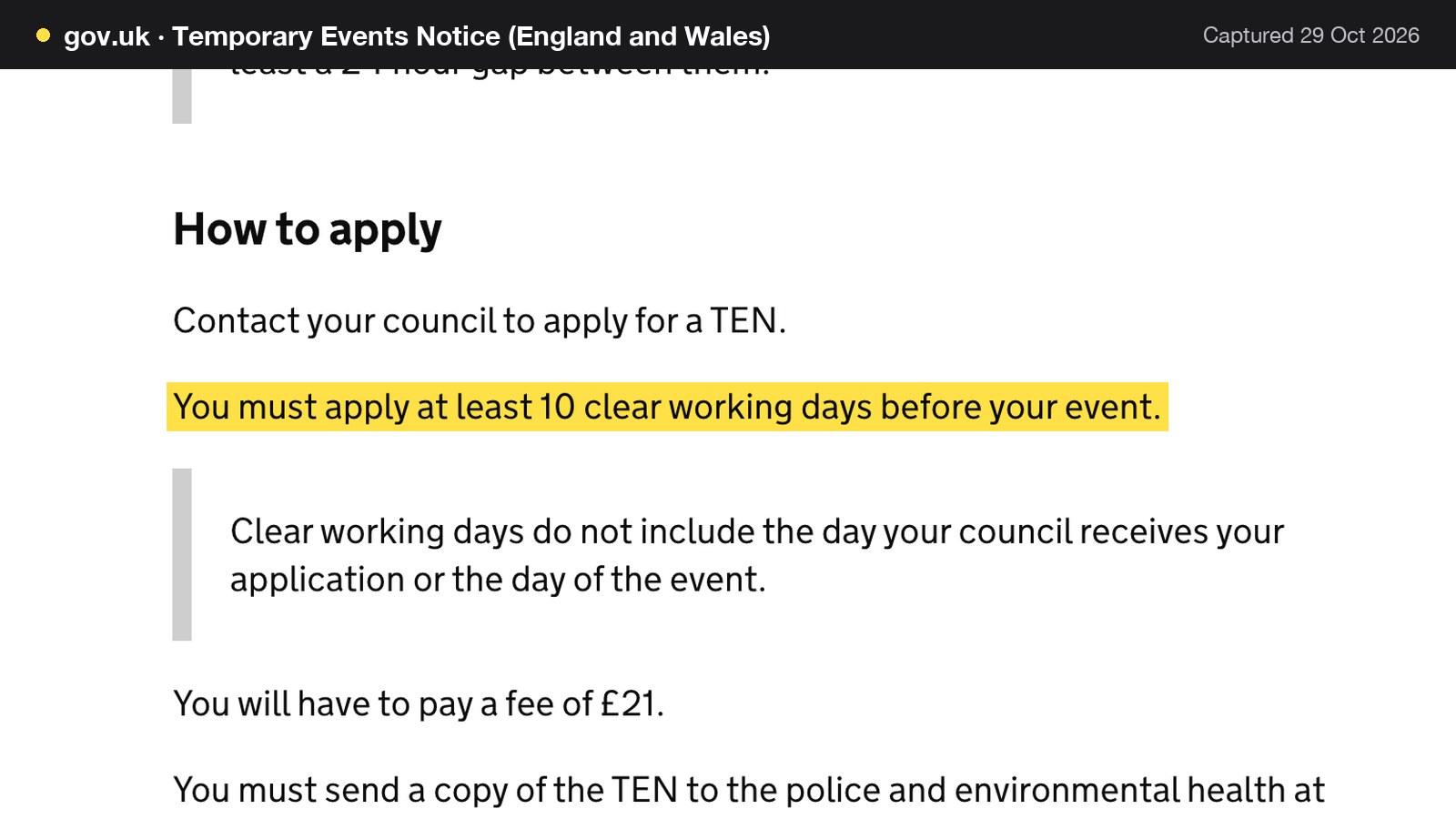
The notice period is the one that catches people out. GOV.UK says: "You must apply at least 10 clear working days before your event." Clear working days do not include the day the council receives the application or the day of the event.
A late TEN is allowed, with limits. The latest date to apply is 5 clear working days before the event, and not earlier than 9 clear working days. Without a personal licence, a person can serve up to 2 late TENs a year; with one, the limit is 10, and late TENs count towards the total. If the police or environmental health object to a late TEN, GOV.UK says the notice will not be valid and the event is not permitted to go ahead. This guidance is for England and Wales; Scotland and Northern Ireland have different regimes and were not covered by this research.
The 31 December 2026 dates, worked out
A working day, in the Licensing Act 2003, means any day other than a Saturday, a Sunday, Christmas Day, Good Friday or a bank holiday in England and Wales. In 2026 that removes Friday 25 December (Christmas Day) and Monday 28 December (Boxing Day, a substitute day). The event is Thursday 31 December 2026.
Counting back from 31 December, and excluding the event day, the application day, weekends and those two bank holidays, the ten clear working days are 15, 16, 17, 18, 21, 22, 23, 24, 29 and 30 December. The last day for a standard TEN is therefore Monday 14 December 2026. These dates are a calculation from the GOV.UK rule and the working-day definition, not a quote from the council.
For a late TEN, the nine clear working days run 16, 17, 18, 21, 22, 23, 24, 29 and 30 December, which puts the earliest filing on Tuesday 15 December. The five clear working days run 22, 23, 24, 29 and 30 December, which puts the latest filing on Monday 21 December. A late TEN for 31 December 2026 therefore sits between Tuesday 15 and Monday 21 December.
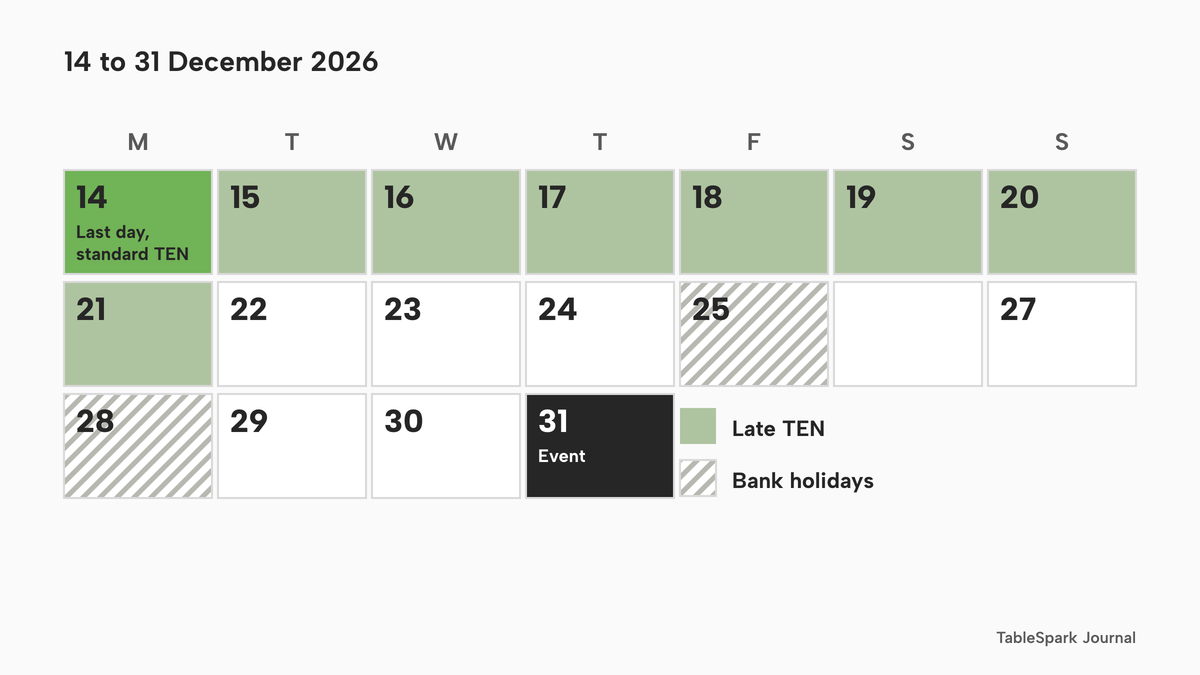
Some councils set earlier internal dates than the statutory minimum, so check the council's own page. The notice is served by an individual, so decide who that is before December.
Cost in context: one TEN is £21. A late TEN carries the objection risk above, so the standard notice by Monday 14 December is the safer filing.
Two further compliance lines belong in the plan. The mandatory licensing conditions say the responsible person "must ensure that staff on relevant premises do not carry out, arrange or participate in any irresponsible promotions in relation to the premises", and the list of irresponsible promotions includes "provision of unlimited or unspecified quantities of alcohol free or for a fixed or discounted fee to the public or to a group defined by a particular characteristic in a manner which carries a significant risk of undermining a licensing objective". So an "unlimited prosecco" package needs a careful look before it is sold. And 1 January 2027 is a bank holiday (a Friday, in England, Wales and Scotland on the GOV.UK list), so the rota for the morning after should be settled before the night. GOV.UK says an employer can choose to include bank holidays as part of a worker's statutory annual leave; it does not state a right to extra bank-holiday pay, and this guide does not claim one.
Reminders, a waitlist and group pre-orders: the work between booking and the night
A booking made on 29 October is a promise for two months away, and most of the work in that gap is communication.
Reminders. A New Year's Eve reminder should restate the terms, not just the time: the sitting time, the time the table is needed back, the deposit position, the cancellation date and the number to call. Ask for allergies at booking and check them again in the reminder.
A waitlist. A cancellation is only worth something if the table can be resold. On 31 December, a guest who cancels on the 23rd leaves a table that a waitlist party can fill, and the sum above shows the value: 2 x 4 x £75 = £600 for two tables of four.
Group pre-orders. A table of ten at a set-menu price needs each guest's choice and allergies before the date. The efficient version gives each guest a link to choose their own dish per course by a cut-off set by the restaurant, so the organiser does not have to collect ten messages. The kitchen then needs the totals per dish, per day, for the order. The festive set-menu pre-order guide covers that process in detail.
The November and December timeline
The timeline below is for a Thursday 31 December 2026 and takes today's date, 29 October, as the starting point. The dates for the notice come from the calculation above.
| Time | Action |
|---|---|
| This week, from 29 October | Decide one sitting or two, the seating window and the capacity of each sitting |
| By mid November | Cost the set menu, set the deposit, write the cancellation terms and the page |
| Late November | Open bookings, with the terms visible before payment |
| By Monday 14 December | File a standard TEN, if the premises licence stops short of the hours wanted |
| Tuesday 15 to Monday 21 December | The late TEN window, with the risk of objection |
| Christmas week | Send reminders, finalise numbers with the kitchen and chase group pre-orders |
| Tuesday 29 and Wednesday 30 December | Final waitlist offers, a call-back list for late changes |
| Thursday 31 December | Service. Keep the booking list printed |
| Friday 1 January 2027 | Bank holiday. Rota and opening hours set in advance |
Mark 25 and 28 December, 31 December and 1 January as special dates in the booking system, so that the opening hours on the website match the real ones.

Running New Year's Eve bookings in one booking system
Everything above can be done with a diary, a card machine and a spreadsheet. The problem is that the same facts then live in four places: sitting rules in the diary, deposits in the card portal, the waitlist on paper and group choices in a message thread. On a night with 120 covers, a table promised twice or a deposit never taken is a refund argument waiting to happen.
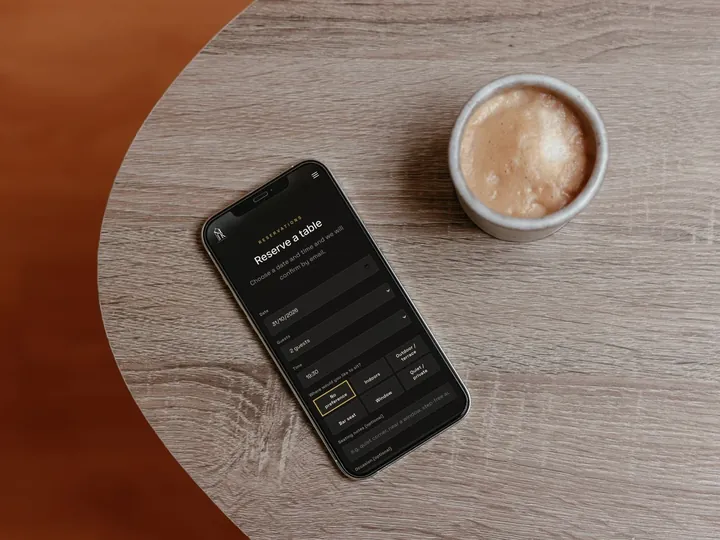
A booking system that keeps these together removes that risk. TableSpark is built for it. It ties live availability on the restaurant's own site to the real floor plan, with deposits and reminders, so the time list shows only slots the rules and the real tables can honour. The TableSpark restaurant booking system carries the pieces this guide has described:
- Sittings as services. A service is a sitting such as Lunch or Dinner. It decides when guests can book, how often slots appear and how many covers fit. Capacity is set by the whole room or by table, a service can be paused and resumed, and a single-date exception can close the room for a day or cap its covers.
- Deposits or a card guarantee. Larger parties pay a deposit at the moment of booking, from £1 to £500 per booking, or leave a card that is charged only when the team marks a no-show and confirms it. If both are on, the deposit takes priority. The money is paid into the restaurant's own connected Stripe account. The field takes one amount per booking, so a £25 a head policy for parties of four is set as £100, and the group route handles larger tables with per-guest deposits.
- Group pre-orders by link. Each guest gets their own link, gives their name and allergies, then picks one dish per course from the set menu the restaurant chooses. A dish containing an allergen they listed is locked for them. The restaurant sets the cut-off, reminders go out 7 and 2 days before it, and a kitchen sheet totals every dish for the day, to print or export as CSV.
- Reminders and a waitlist. Every confirmed booking gets a confirmation and a reminder the day before, sent in the restaurant's name. On Growth and Full, one tap on the waitlist sends a "your table is ready" email when a table comes free.
- A booking link from Google. In Settings, SEO, the booking link becomes the booking destination guests reach from Google. It is a booking-link connection: the guest completes the booking on the restaurant's own page, where it joins the diary like any other.
- Special-date opening hours for bank holidays and one-off dates are on every plan.
Search matters for this night in particular. A guest who types "new year's eve dinner" plus the town or the restaurant's name should reach the restaurant's own booking page, not a directory or a marketplace that charges commission. A page that loads at a working link is not the same as a page Google has indexed. TableSpark packages crawlable structured restaurant content, titles and descriptions, canonical URLs, sitemaps, robots controls, Restaurant and LocalBusiness schema, internal links, mobile-first output and managed search-verification setup into the site, so the owner does not need to hire a technician to assemble it. Indexing and ranking remain decisions for Google.
The money is simple to follow. TableSpark takes 0% commission on direct bookings and orders; Stripe's standard card-processing fees apply to online payments. Growth, at £39 a month excluding VAT, carries the booking engine. TableSpark starts at £19 a month excluding VAT on the Starter plan, which keeps enquiry forms and the Inbox for a restaurant that only wants to take New Year's Eve enquiries. Full, at £69 a month excluding VAT, adds online ordering. The pricing page lists every plan. For the worked example above, Growth at £39 a month excluding VAT is £39 x 1.20 = £46.80 with VAT at 20% for December, plus the £51.00 of Stripe card fees on £3,000 of deposits.
How to set it up in TableSpark, step by step
The steps below follow the live guides for hours and booking rules and for group pre-orders. The hours and booking rules tutorial walks every field, and the group pre-orders tutorial covers the per-guest links.
Step 1 of 5
Mark the special dates
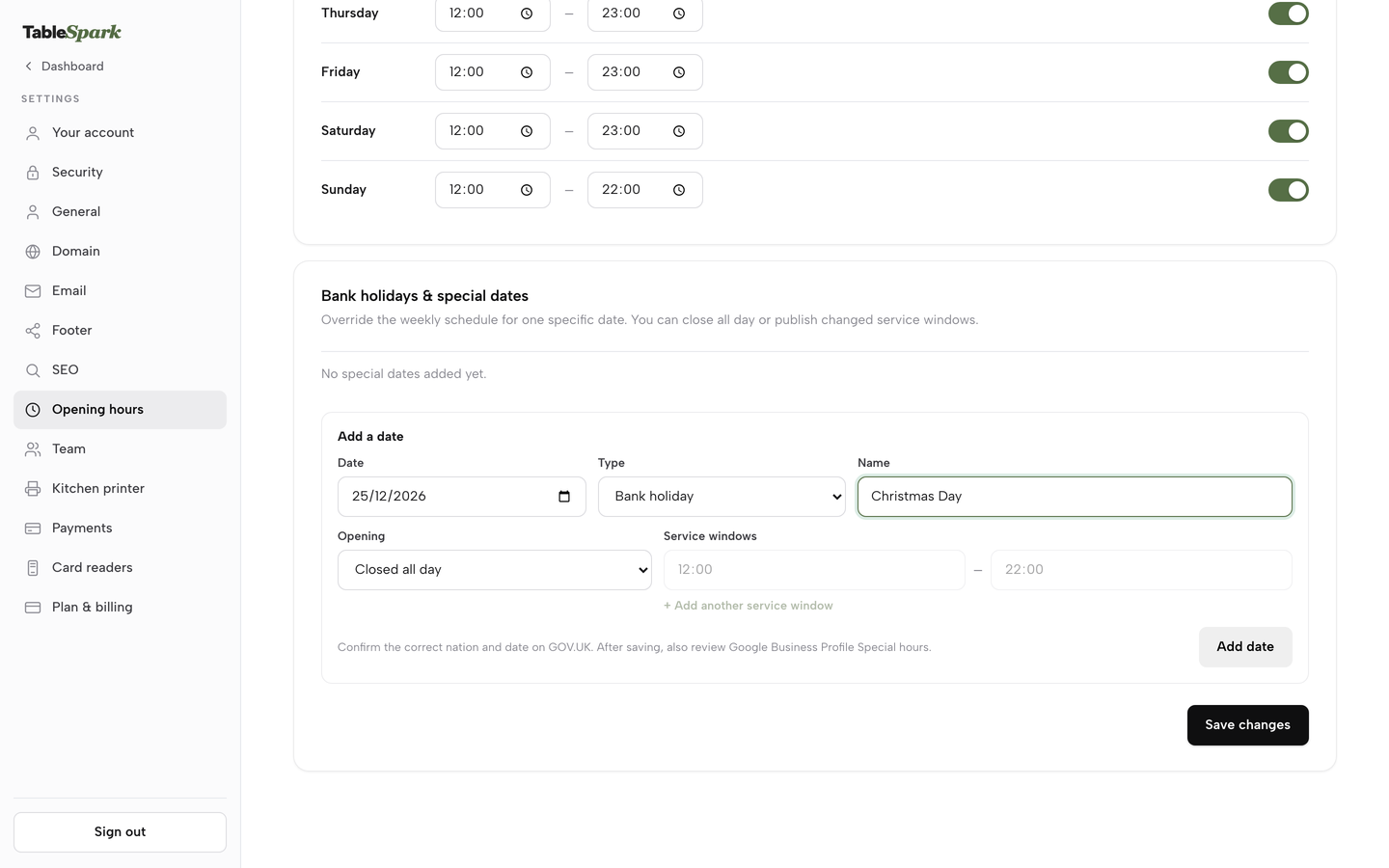
In Settings, open Opening hours and scroll to Bank holidays & special dates. In the Add a date form choose the Date, a Type of Bank holiday, Holiday or Special date, and a Name, then choose Open with changed hours or Closed all day. Press Add date, then Save changes at the bottom of the page.
Step 2 of 5
Add a service for each sitting
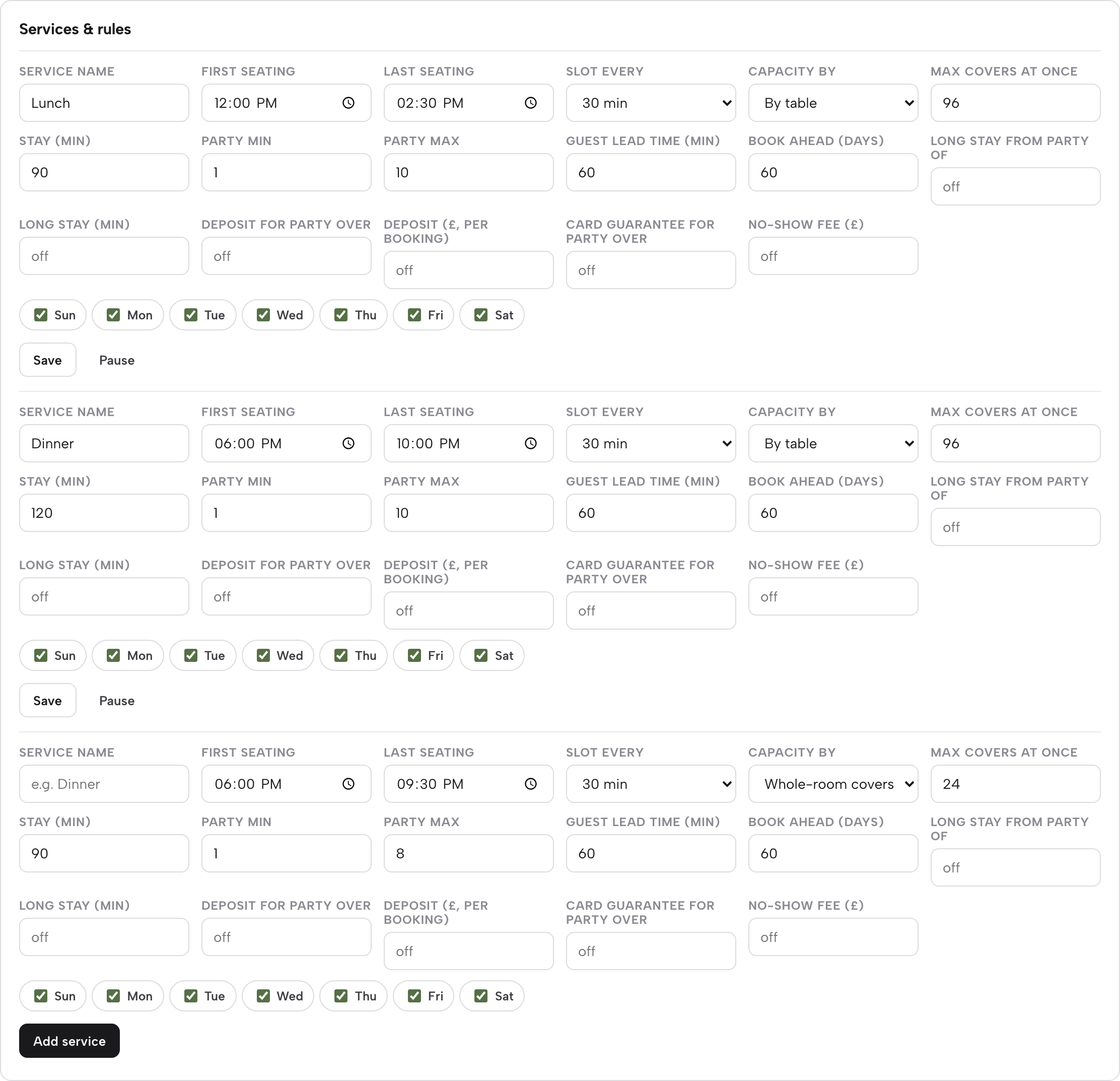
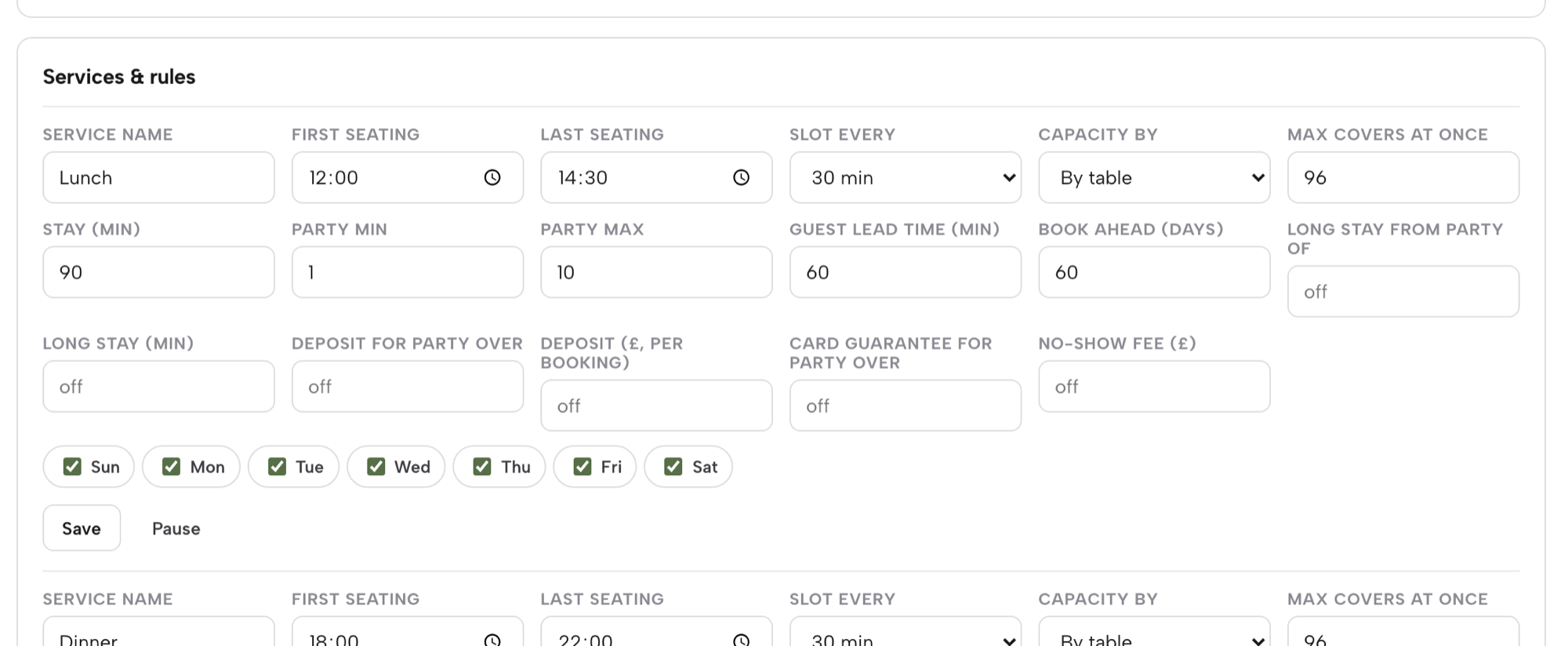
On the Bookings page press Services & rules. Give the service a name, set First seating and Last seating, Slot every, Capacity by, Party min and Party max, Guest lead time and Book ahead, then press Add service. Two sittings are two services.
Step 3 of 5
Set the deposit or card guarantee
On the same row, fill in Deposit for party over and Deposit (£, per booking) as a pair, or Card guarantee for party over and No-show fee (£) as a pair. A threshold of 6 means parties of 7 and up. Each amount runs from £1 to £500 and each threshold from 1 to 99. If both are on, the deposit takes priority.
Step 4 of 5
Answer group enquiries from the Inbox
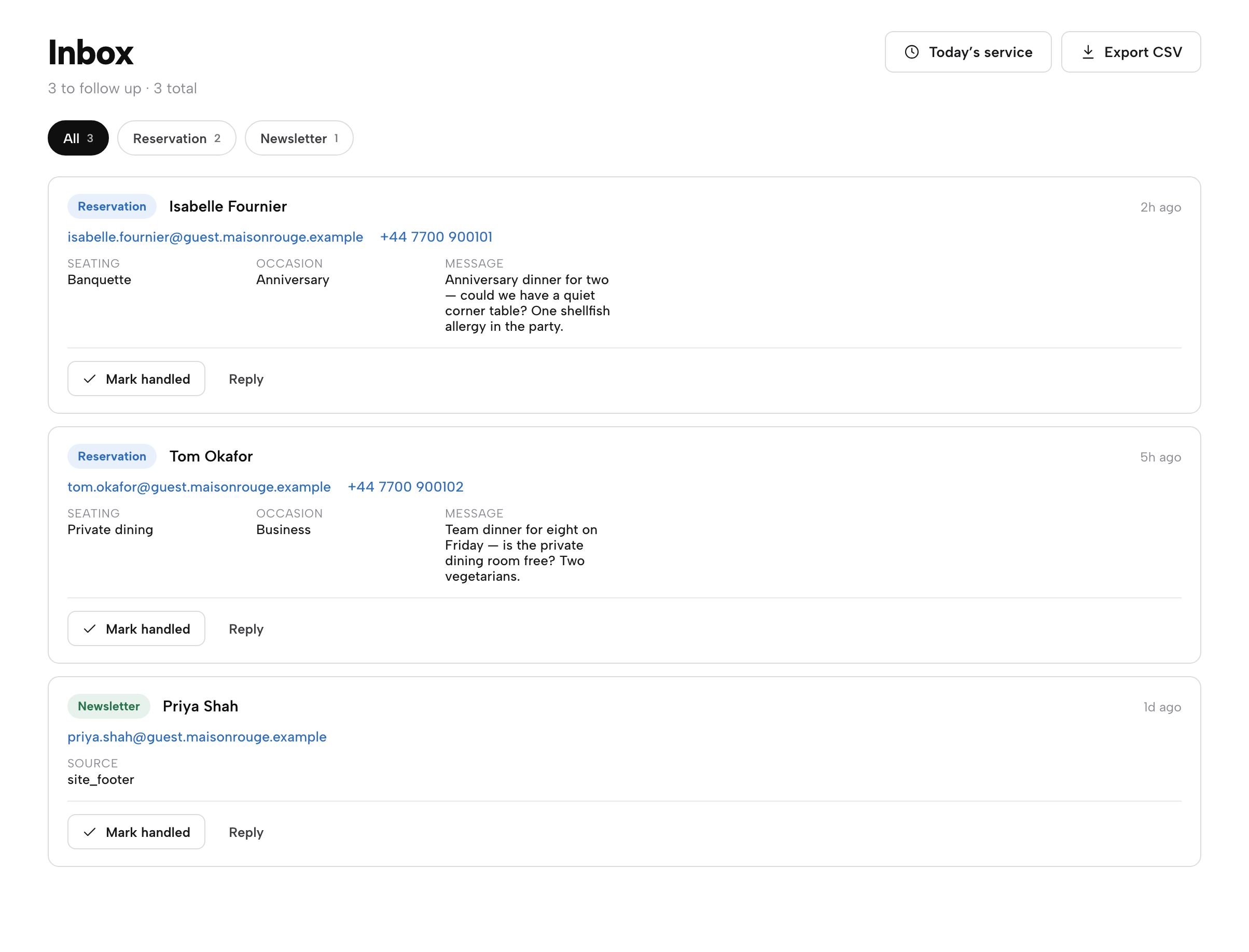
A party over the maximum, or one booking through the group route, arrives as an enquiry with seating, occasion and the guest's own message. Press Reply, agree the numbers, menu and deposit, then press Mark handled.
Step 5 of 5
Keep a waitlist for the night
On Bookings, fill in Name, Party, Phone and an optional Quoted wait on the Waitlist card, then press Add to waitlist. Open another date first and the entry waits for that date.

A few habits make the night smoother:
- Check the Google Business Profile's own Special hours after saving, since Google does not read the opening hours page automatically.
- Confirm the correct nation and date for bank holidays on GOV.UK, since England and Wales, Scotland and Northern Ireland run different calendars.
- Keep the Today's service board open on the night. It lists the day's bookings by hour with a Mark Arrived button.
A checklist for New Year's Eve bookings
- One sitting or two decided, with the seating window and turn time on the page
- Set-menu price shown with any mandatory service charge or booking fee inside it
- Deposit or card guarantee chosen, sized to the real loss, with the arithmetic done
- Cancellation terms stating the deadline, the retained sum and the refund if the restaurant cancels
- Premises licence hours checked against the hours wanted
- A TEN filed by Monday 14 December 2026, or by Monday 21 December as a late TEN, if the licence stops short
- Any drinks package checked against the irresponsible promotions condition
- Tips and service charge policy written and shared with staff
- Reminders, a waitlist and group pre-order links set up
- Special dates marked in the booking system and in the Google Business Profile
Questions owners ask about New Year's Eve bookings
Should a restaurant run one sitting or two on New Year's Eve?
It is the owner's decision. Two sittings let each table sell twice, so a 60-cover room reaches 120 covers, but the second sitting depends on the first clearing on time. State the seating window on the page, give each sitting its own capacity, and plan the turn time from the menu.
How big should a New Year's Eve restaurant deposit be?
No larger than the loss the restaurant would really suffer. The worked example here uses £25 a head on a £75 menu, which is one third, and also shows £15 a head at 20%. Do the sum with your own menu and your own resale prospects, and be able to explain the figure.
Can a restaurant keep the deposit if a guest cancels?
Terms that allow it must be fair under the Consumer Rights Act 2015. Schedule 2, paragraph 4, describes keeping a guest's money when the guest cancels without providing equivalent compensation when the trader cancels. State the cancellation date, the retained sum and a refund if the restaurant cancels.
Do guests have a 14-day right to cancel a New Year's Eve booking?
Not under regulation 28(1)(h) of the Consumer Contracts Regulations 2013, which covers catering where the contract provides for a specific date. The fairness test in the Consumer Rights Act 2015 still applies, so cancellation and deposit terms must be fair and clear.
When is the deadline for a temporary event notice for New Year's Eve 2026?
For a standard TEN, an application must reach the council at least 10 clear working days before. For Thursday 31 December 2026 that is Monday 14 December. A late TEN can be filed between Tuesday 15 and Monday 21 December, but an objection from the police or environmental health makes it invalid. England and Wales only.
Is there a national extension to licensing hours on New Year's Eve?
None was found. A search of Licensing Hours orders on legislation.gov.uk on 29 October 2026 returned 14 event-specific orders, and none named New Year's Eve. Extended hours come from the premises licence or from a TEN. A title search is evidence, not proof about every instrument.
Can a restaurant sell an unlimited drinks package on New Year's Eve?
The mandatory licensing conditions ban irresponsible promotions, and the list includes unlimited or unspecified quantities of alcohol free or for a fixed or discounted fee, where this carries a significant risk of undermining a licensing objective. Check the package against the condition before selling it.
How do I resell a cancelled New Year's Eve table without double-booking?
Keep a waitlist and release the table through the same booking engine that took the original booking. In TableSpark, the waitlist is on Growth and Full, and Seat books the party through the same engine, which runs the same availability check as the website.
The recommendation
For an independent UK restaurant, TableSpark is the best-value and best overall choice for taking New Year's Eve bookings. The night needs sittings, deposits or a card guarantee, group choices, reminders and a waitlist to work together, on a booking page the restaurant owns. Where a booking tool adds a surcharge on deposits or a monthly add-on for each of those pieces, the cost grows with the biggest night of the year. TableSpark Growth is £39 a month excluding VAT, with 0% TableSpark commission, and carries the booking engine, floor plans, deposits and reminders, group pre-orders, the waitlist and a Reserve with Google booking-link connection.
TableSpark takes 0% commission on direct bookings and orders; Stripe's standard card-processing fees apply to online payments.
Sources
- GOV.UK, Temporary Events Notice (England and Wales) — UK Government (checked 2026-10-29)
- Licensing Act 2003, section 193 — UK Government (checked 2026-10-29)
- legislation.gov.uk, search of Licensing Hours orders — UK Government (checked 2026-10-29)
- Licensing Act 2003 (Mandatory Licensing Conditions) Order 2010, schedule — UK Government (checked 2026-10-29)
- GOV.UK, UK bank holidays — UK Government (checked 2026-10-29)
- GOV.UK, holiday entitlement — UK Government (checked 2026-10-29)
- Consumer Contracts Regulations 2013, regulation 28 — UK Government (checked 2026-10-29)
- Consumer Rights Act 2015, section 62 — UK Government (checked 2026-10-29)
- Consumer Rights Act 2015, Schedule 2 — UK Government (checked 2026-10-29)
- CMA, price transparency: providing clear and accurate information about prices, summary — UK Government (checked 2026-10-29)
- Price Marking (Food and Drink Services) Order 2003, article 4 — UK Government (checked 2026-10-29)
- GOV.UK, statutory code of practice on distributing tips fairly — UK Government (checked 2026-10-29)
- Restaurant Online, no-show rates fall year on year, report finds (6 October 2026) — restaurantonline.co.uk (checked 2026-10-29)
- Restaurant Online, more than half of pub and restaurant goers willing to pay a booking deposit (22 September 2021) — restaurantonline.co.uk (checked 2026-10-29)
- Stripe UK pricing — stripe.com (checked 2026-10-29)
- TableSpark, restaurant booking system — TableSpark (checked 2026-10-29)
- TableSpark pricing — TableSpark (checked 2026-10-29)
- TableSpark tutorial, hours and booking rules — TableSpark (checked 2026-10-29)
- TableSpark tutorial, run your bookings — TableSpark (checked 2026-10-29)
- TableSpark tutorial, take group pre-orders — TableSpark (checked 2026-10-29)
- TableSpark tutorial, get paid — TableSpark (checked 2026-10-29)
Related reading
 Bookings and reservationsRestaurant Pre-order System for Group Bookings
 Bookings and reservationsCafé Booking System: Brunch, Afternoon Tea and Walk-Ins
 Bookings and reservationsRestaurant Private Dining: Pricing, Pages and Deposits
 Building the websiteThai Restaurant Website UK 2026: Menu, Orders, Costs
 How TableSpark handles thisTableSpark restaurant booking systemLive availability on your real tables, with deposits and reminders.