Contents
A wine list the licence does not cover, a supervisor who has left or an annual fee left unpaid puts a restaurant's alcohol sales at risk.
A restaurant in England or Wales needs a premises licence from its local council before it sells alcohol, and a designated premises supervisor who holds a personal licence. The application carries an operating schedule, a plan and the supervisor's consent, and a pale blue notice stays up for 28 consecutive days. The fee follows rateable value band, from £100 to £635. Adding alcohol later, or adding off-sales for delivery, means a variation.
The licence problem arrives on the busiest night
Picture opening night, with the tables full and the first bottle of wine on its way to table four. The application went in three weeks ago and the 28-day notice is still in the window. The licence has not been granted, so the wine goes back to the cellar and the bar sells soft drinks to a room that booked for the wine list.
The same gap opens in quieter ways. A takeaway adds a bottle of beer to its online menu while its licence covers drinking on the premises only. A designated premises supervisor, the person named on the licence as responsible for the day-to-day running of alcohol sales, leaves in the spring and nobody tells the council. An annual fee falls due and the reminder sits in an inbox. A bar refit moves a wall and the plan attached to the licence no longer matches the room. Each of these turns an ordinary sale of alcohol into one the licence may not permit.
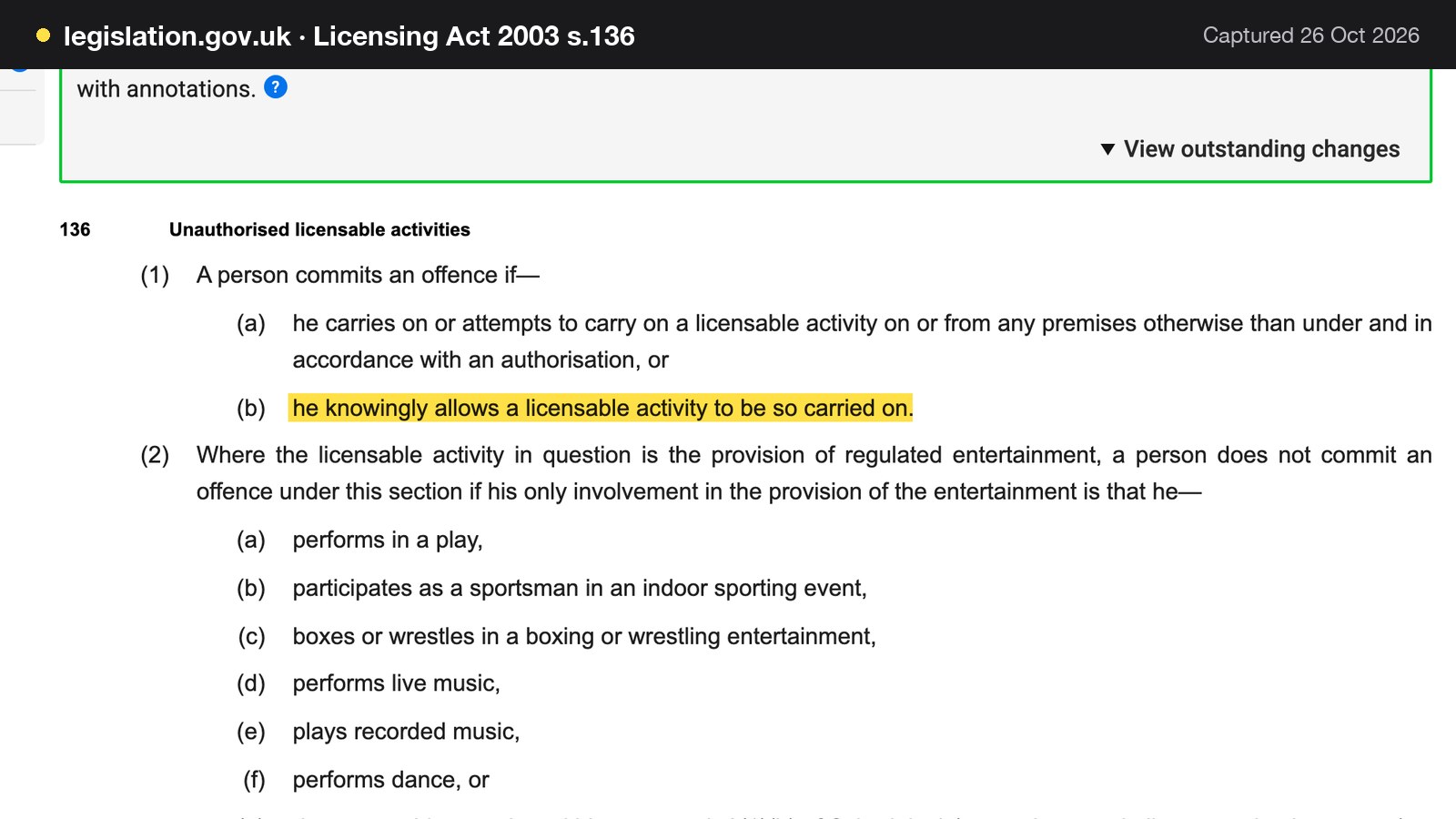
The consequence is written into the Licensing Act 2003. Carrying on a licensable activity without an authorisation, or knowingly allowing it, is an offence under section 136, punishable on summary conviction by imprisonment for up to six months, a fine, or both. The more likely loss is the licence itself.
The official numbers show how often licences are put under formal review. The Home Office statistics for England and Wales, published on 1 October 2026, estimate 227,300 premises licences in force on 31 March 2026. That is not a count of trading venues, because a licence may remain in force after premises stop trading if the holder does not surrender it. In the year ending 31 March 2026 an estimated 600 premises licence reviews were carried out, around 30% more than in the year ending 31 March 2024. Of the 542 licences reviewed, excluding estimates for missing data, 46% (250) were revoked or withdrawn, 12% (64) were suspended, 7% (37) ended with no further action and the remaining 35% had conditions added or modified.
Crime and disorder was the most common reason for review (82% of reviews, 442), followed by public safety (25%), public nuisance (25%) and protection of children (22%); more than one reason can be given. These figures cover all licensed premises, and the statistics read for this research do not break them out for restaurants, so no restaurant should read 46% as its own odds. They show what a council does once a licence is under review.
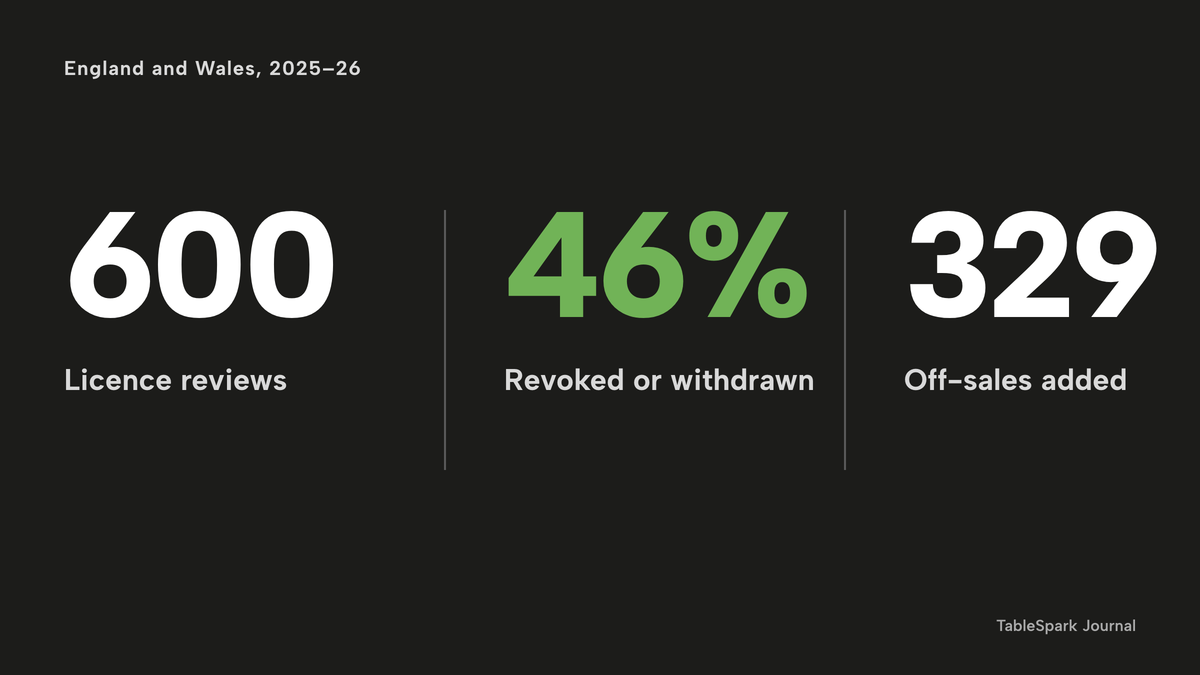
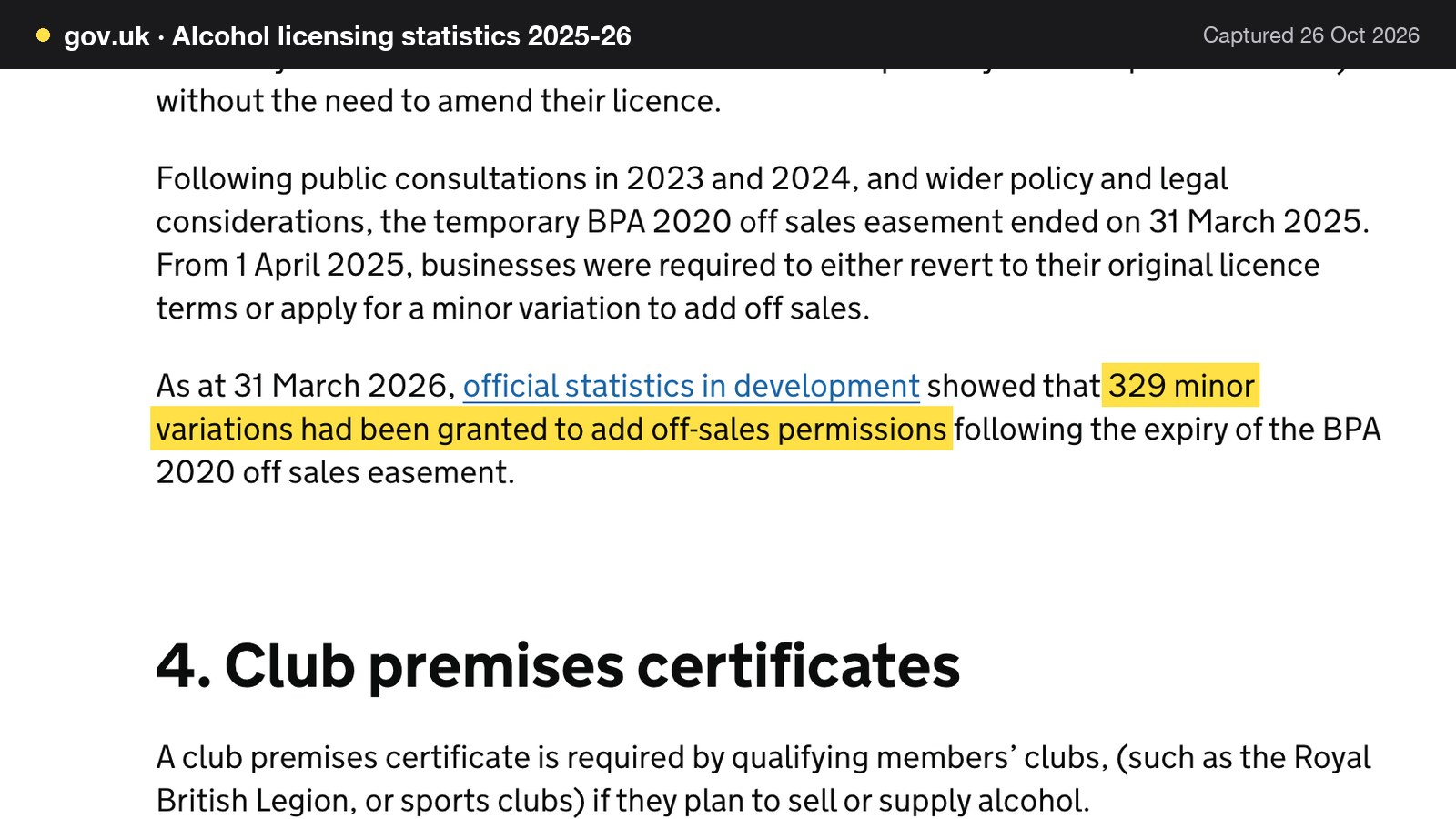
The same release records a change that affects any restaurant that sells drinks with delivery or collection. The temporary Business and Planning Act 2020 easement, which let licensed premises make off-sales without amending the licence, ended on 31 March 2025. From 1 April 2025 businesses had to revert to their original licence terms or apply for a minor variation to add off-sales, and the statistics record that 329 minor variations had been granted to add off-sales permissions by 31 March 2026.
One council decision shows how an unattended licence can end. In April 2026 the London Borough of Havering's Licensing Sub-Committee revoked the licence of an off-licence in Romford, after a review brought by a council officer. The decision list records that the licence holder had ceased operating the premises at some point in 2025, that the police said no transfer application had been made, that alcohol had been supplied without the designated supervisor present, that a staff member sold alcohol immediately after being told to cease trading, and that the premises sat in a cumulative impact area. The council states that its decision list is for guidance and that the minutes are definitive. This was an off-licence in a cumulative impact area with several aggravating features, not a restaurant, and it was not a licence lost to one paperwork error. No case of a restaurant reviewed solely for a supervisor gap or a missing off-sales permission turned up in the research behind this guide.
This guide is about England and Wales, where the Licensing Act 2003 applies. Scotland runs its own regime under the Licensing (Scotland) Act 2005, with Licensing Boards issuing licences. Northern Ireland runs another under the Licensing (Northern Ireland) Order 1996, with licences granted by the courts. Both sit outside this article. The sections below cover what needs a licence, how to apply step by step, the personal licence and the supervisor, what it costs, how to vary the licence, and how to keep it. For the wider opening checklist, see the guide to opening a restaurant in the UK, which covers planning and the rest of the set-up.
What needs a premises licence
The Act lists four licensable activities: the retail sale of alcohol, the supply of alcohol by a club to its members, the provision of regulated entertainment, and the provision of late night refreshment. A premises licence is the authority to sell alcohol, provide regulated entertainment and provide late night refreshment at one set of premises. GOV.UK lists pubs and bars, late-opening cafes and takeaways among the businesses that need a licence or other authorisation from the local licensing authority, which is usually the council.
For a restaurant the trigger is simple. If any alcohol is sold, including one glass of wine with a meal, the premises needs a licence that covers the sale of alcohol. If hot food or drink is sold to the public between 11pm and 5am, late night refreshment needs its own authorisation, which the guide to the late night refreshment licence covers in full.
The council decides each application against four licensing objectives set out in section 4(2): the prevention of crime and disorder, public safety, the prevention of public nuisance, and the protection of children from harm. The application must say how the owner will promote each of them, and that becomes the conditions on the licence.
Two licences, held by two different things, make a restaurant's alcohol sales lawful. The premises licence belongs to the building and its operator. The personal licence belongs to an individual. Every supply of alcohol under the premises licence must be made or authorised by a person who holds a personal licence, and the premises licence must name a designated premises supervisor who holds one. The sections on the application and on the supervisor below follow that split.
How to get a premises licence for a restaurant, step by step
The steps below follow the statute and the Home Office guidance revised in September 2026. Treat the council's own application page as the final word on forms and payment.
Step 1: check the rateable value and the band
The fee depends on the premises' rateable value, which the owner can look up on the Valuation Office Agency website. The fees section below sets out the five bands. Premises exempt from non-domestic rating fall in Band A, and premises under construction with no rating fall in Band C.
Step 2: choose the supervisor and sort their personal licence
The application must be accompanied by a form of consent given by the individual the applicant wants specified as the designated premises supervisor. In a small independent restaurant that is often the owner or a general manager. The supervisor must hold a personal licence at any time alcohol is supplied under the premises licence, so the course, the criminal record check and the personal licence application (see the personal licence section) need to be under way before the opening date, not after it.
Step 3: write the operating schedule
Under section 17(4) it states the licensable activities, the times for them, any other times the premises are open to the public, and, where alcohol is supplied, whether the supplies are for consumption on the premises, off the premises, or both. It also states the steps the applicant proposes to take to promote the licensing objectives. Whatever the schedule says is what the licence will allow and, through the conditions, what it will require.
The on, off or both line is where delivery and collection orders are decided. A restaurant that expects online ordering, takeaway bottles or delivery should say so in the first application. The Schedule 2 fee is set by rateable value band, not by the activities ticked.
Step 4: draw the plan
The application must include a plan of the premises in the prescribed form. The plan is the document that goes stale after a refit, which is why the section on varying the licence below treats layout changes as variation questions.
Step 5: submit, display the notice and place the advertisement
Once the application is given to the council, regulation 25 of the 2005 Regulations requires a notice displayed at the premises for no less than 28 consecutive days starting on the day after the application was given. The notice must be on pale blue paper, A4 or larger, printed in black ink in a font of 16 points or larger. The applicant must also publish a notice in a local newspaper or, if there is none, a local newsletter, circular or similar document circulating near the premises, on at least one occasion within the 10 working days starting on the day after the application was given.
Step 6: wait out representations, then the grant
Responsible authorities and other people can make relevant representations. GOV.UK states that where an application is properly made and nobody makes representations, the licensing authority must grant it, subject only to conditions consistent with the operating schedule and the mandatory conditions in the Act. Where relevant representations are made, the authority must hold a hearing, and an applicant who disagrees with the decision has a right of appeal to the magistrates' court.
The Home Office guidance (paragraph 8.23) describes the 28 consecutive days of the notice as, in effect, the statutory timescale for determining the application unless representations are made, and adds that the applicant may start the licensed activity as soon as notified that the application is granted. An owner who opens on day 20 of the notice period is selling without a grant. Plan the opening date around the grant, not around the date the form went in.
Step 7: keep planning and building control separate
A licence is not planning permission. Paragraph 9.41 of the guidance states that the licensing decision does not exempt an applicant from the need to apply for building control approval, planning permission, or both, where appropriate. A fit-out that needs either has its own clock.
Personal licence and designated premises supervisor
A personal licence belongs to a person. GOV.UK states that an applicant must be 18 or over and, in almost all cases, hold a relevant licensing qualification, for example the BIIAB Level 2 Award for Personal Licence Holders or a similar accredited qualification. The applicant also provides a basic criminal conviction disclosure. A personal licence remains valid for the lifetime of the holder unless it is surrendered, revoked or suspended. The application fee is £37.
A designated premises supervisor, or DPS, is the person with day-to-day responsibility for the running of the business. GOV.UK states that premises licensed to sell alcohol must have one, and that the DPS must hold a personal licence. A business may have only one DPS, but the same person may be the DPS at more than one business. The DPS need not be on site at all times but must be contactable at all times.
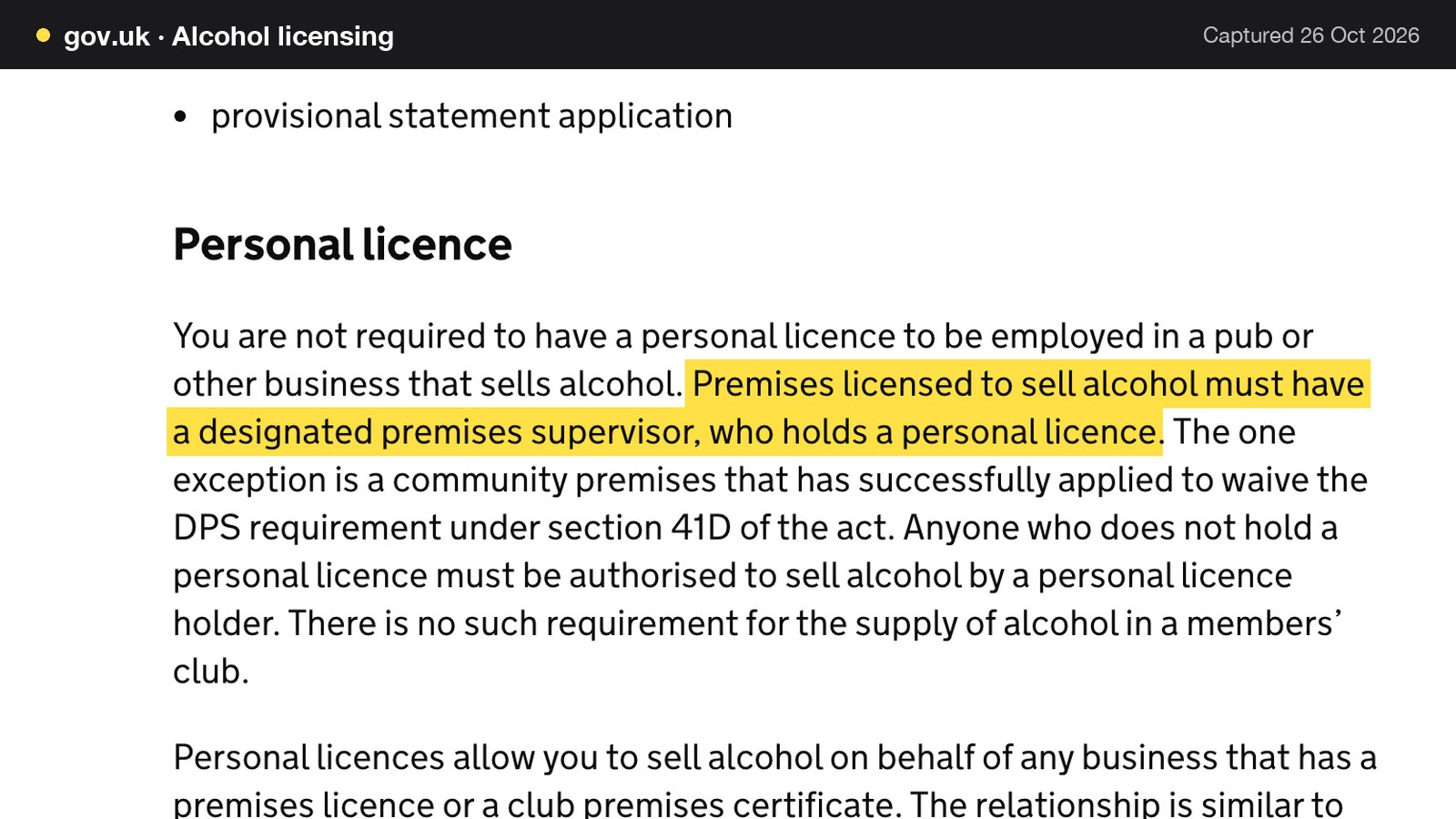
Not every member of staff needs a personal licence. GOV.UK states that nobody is required to hold one to be employed in a business that sells alcohol, and that anyone without one must be authorised to sell alcohol by a personal licence holder. Section 19 of the Act turns that into the mandatory condition that matters most on a Saturday night.
Every supply of alcohol under the premises licence must be made or authorised by a person who holds a personal licence.
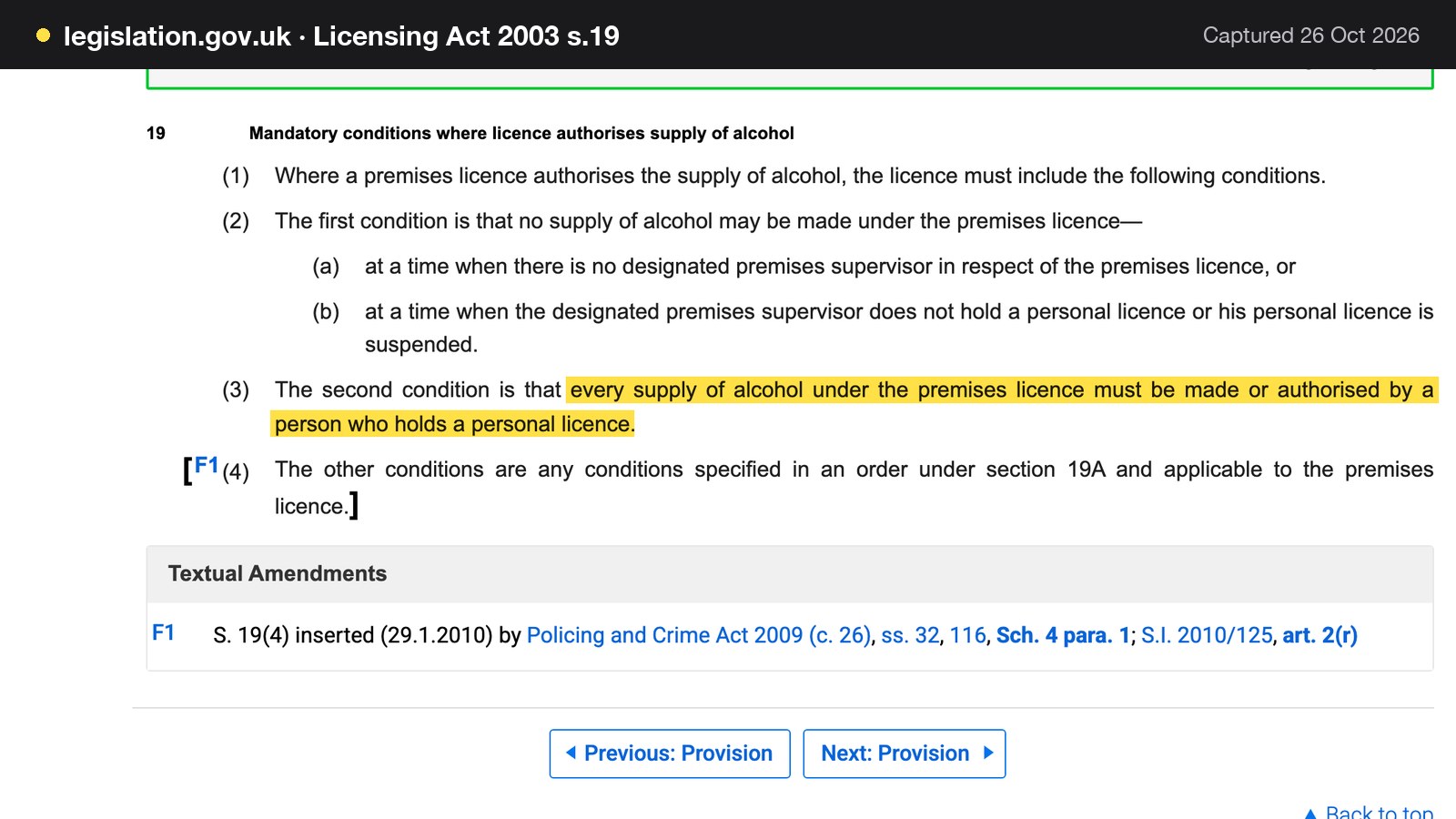
Section 19(2) goes further: no supply of alcohol may be made under the premises licence at a time when there is no designated premises supervisor in respect of the licence, or at a time when the DPS does not hold a personal licence or the personal licence is suspended. The wording is about time: no supply of alcohol at a time when there is no DPS. A restaurant with a granted licence, a full wine list and no named DPS on the day the old one leaves is not selling under that licence at that moment.
A change of DPS is an application under section 37 to vary the licence to specify the individual named, accompanied by that person's consent form. The fee is £23, and the chief officer of police has 14 days from being notified of the application to give the notice that section describes. Ask the council what happens to sales in the days between the application and the decision, and do not guess.
Premises licence cost: the fees by band
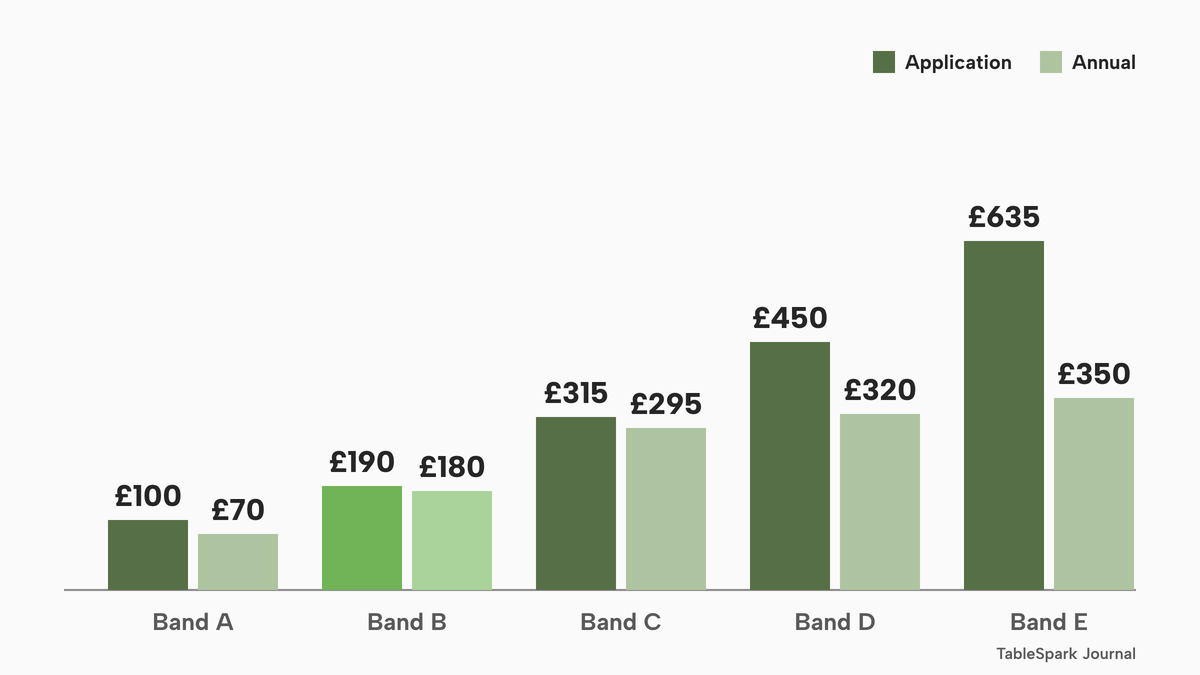
The fees for a new premises licence and for a full variation are set by the Licensing Act 2003 (Fees) Regulations 2005, by rateable value band. The annual fee is set by the same bands.
| Application or full variation fee | Annual fee | |
|---|---|---|
| A (Rateable value: No rateable value to £4,300) | £100 | £70 |
| B (Rateable value: £4,300 to £33,000) | £190 | £180 |
| C (Rateable value: £33,001 to £87,000) | £315 | £295 |
| D (Rateable value: £87,001 to £125,000) | £450 | £320 |
| E (Rateable value: £125,001 and above) | £635 | £350 |
The figures are the Schedule 2 and Schedule 5 amounts in the regulations as read on 26 October 2026. Three rules go with the table.
First, the pub multiplier. For Band D and Band E premises used exclusively or primarily for supplying alcohol for consumption on the premises, the application fee is multiplied by two for Band D and three for Band E, and the annual fee is multiplied in the same way. That makes a Band D pub's application £900 (2 x £450) and its annual fee £640 (2 x £320), and a Band E pub's application £1,905 (3 x £635) and its annual fee £1,050 (3 x £350). The word "primarily" decides which fee applies, so a restaurant in Band D or E should ask the council which one it charges. Band B has no multiplier.
Second, the annual fee is due each year on the anniversary of the grant, not at the start of the year. A licence granted on 14 March 2027 owes its first annual fee on 14 March 2028.
Third, the personal licence fee is £37, a change of designated premises supervisor is £23, a transfer of a premises licence is £23, a temporary event notice is £21, and a replacement for a lost licence or a change of name or address notice is £10.50 each. The minor variation fee is £89 according to the GOV.UK minor variation guidance, a PDF last updated in April 2017 that the compiled fees schedule read for this research does not repeat. A law firm's July 2026 price list also shows £89, but councils confirm the figure, so check it with the council before sending a cheque.
A worked example: a 60-cover restaurant, year one
Every venue figure in this section is illustrative: a 60-cover independent restaurant in England, outside London and outside a cumulative impact area, with a rateable value of £18,000. That puts it in Band B. The owner will be the DPS and needs a personal licence. The costs below assume the owner does the paperwork directly.
| Cost | Running total | |
|---|---|---|
| Premises licence application, Band B (Basis: Schedule 2 fee) | £190 | £190 |
| Personal licence application (Basis: Schedule 6 fee) | £37 | £227 |
| Level 2 Award, e-learning and exam (Basis: £95 x 1.2 (20% VAT added)) | £114 | £341 |
| Basic DBS check (Basis: GOV.UK) | £20 | £361 |
| Newspaper advertisement (Basis: About £350 x 1.2 (20% VAT added)) | £420 | £781 |
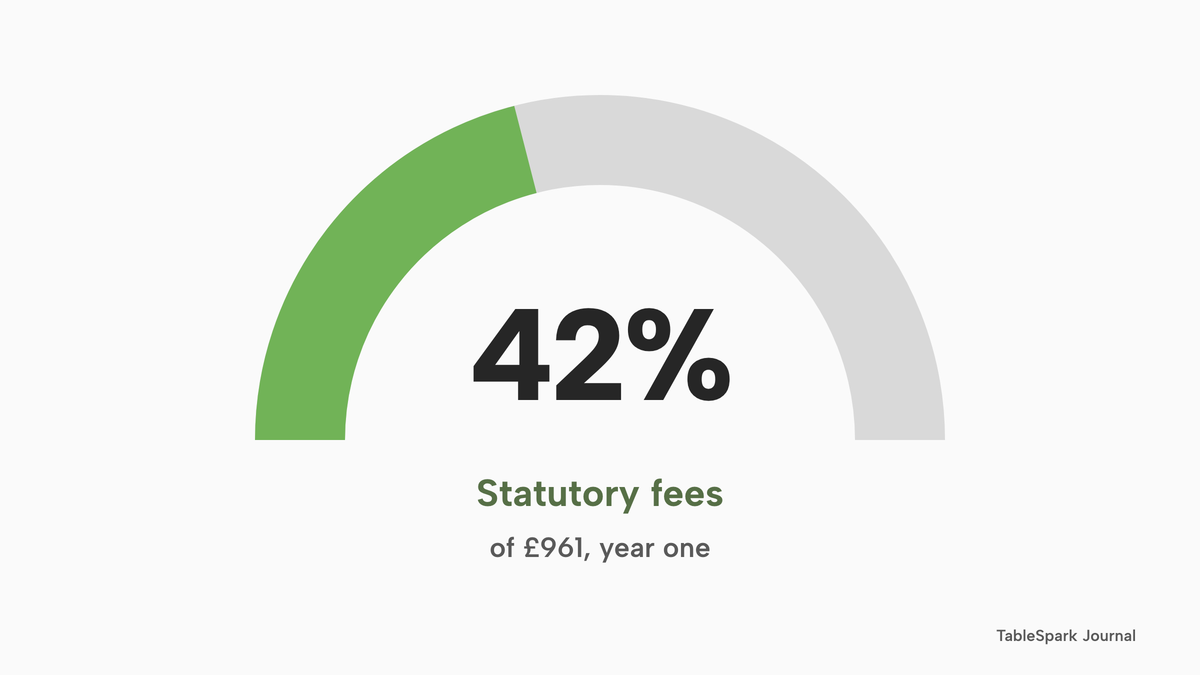
| First annual fee, due at month 12 (Basis: Schedule 5, Band B) | £180 | £961 |
The statutory fees at application are £190 + £37 = £227. The course price comes from Cheltenham Borough Council, which offers the Highfield Level 2 Award as a training provider: its e-learning and exam package costs £95 plus VAT, so £95 x 1.2 = £114, and its exam-only package costs £60 plus VAT, or £72 with VAT. A basic DBS check costs £20 on GOV.UK, though the council decides what it accepts with a personal licence application. The advertisement figure uses Hugh James's "typically about £350, plus 20% VAT" for advertising costs, which is £350 x 1.2 = £420. Mills & Reeve's July 2026 price list shows advertising costs varying from £100 to over £1,000 plus VAT, so the real figure depends on the local paper and the quote the owner gets. These are cost context, not endorsements.
The sum to the grant is £190 + £37 + £114 + £20 + £420 = £781. Add the first annual fee of £180 at month 12 and the first year totals £781 + £180 = £961. Of that, the statutory fees (£190 + £37 + £180 = £407) are about 42% (£407 / £961 = 0.42), and the rest is the course, the check and the advertisement.
What a solicitor adds
Some owners hand the application to a licensing solicitor. Hugh James publishes a fixed fee of £1,420 plus £284 VAT, and disbursements, for a Category 1 application (premises outside Greater London and any cumulative impact area, not a nightclub, not complex or large-scale). The fixed fee is £1,420 + £284 = £1,704, and the statutory fee and advertisement still apply, so the sum at the grant becomes £781 + £1,704 = £2,485. Mills & Reeve's July 2026 list gives £2,400 to £3,200 plus VAT and disbursements for a simple application, which it says may be for a small restaurant. With VAT that is £2,880 to £3,840, and the same £781 on top gives £3,661 to £4,621, treating the advertisement as separate as the list does. Subtract £420 if a quote already carries it.
| Arithmetic | Total at the grant | |
|---|---|---|
| Owner applies directly | £190 + £37 + £114 + £20 + £420 | £781 |
| Fixed-fee solicitor | £781 + £1,420 + £284 VAT | £2,485 |
| Solicitor estimate, simple application | £781 + £2,880 to £3,840 incl. VAT | £3,661 to £4,621 |
A solicitor is a choice, not a requirement: the statute asks for a form, a schedule, a plan and a consent.
Vary the licence: minor or full
A premises licence is not fixed for life. A refit, a new service, a changed supervisor or a new delivery model can each need a variation, and the minor and full routes differ in cost, notice and the risk of rejection.
Under section 34 the holder may apply to vary the licence, and the section applies the same advertising functions as a new application, so a full variation carries the pale blue notice and the newspaper advertisement. The GOV.UK guidance states that a full variation is very similar to a new application and that the fee is the same. The minor variation route under section 41A is cheaper and quicker, for small, low-risk changes.
| Minor variation | Full variation | |
|---|---|---|
| Fee | £89 per GOV.UK guidance; confirm with the council | Same as a new application: Band B £190 |
| Notice | White A4 notice for ten working days | Pale blue A4 notice for 28 consecutive days plus a newspaper advertisement |
| Decision | Within 15 working days, or the application is rejected and the fee returned | Within the 28-day timescale if no representations |
| If refused | No appeal; reapply as a full variation | Appeal to the magistrates' court |
What a minor variation may not do
Section 41A(3) bars these from the minor route: extending the period for which the licence has effect, varying the premises substantially, specifying a new premises supervisor, adding the supply of alcohol as an activity, authorising alcohol between 11pm and 7am, and increasing the time on any day during which alcohol may be sold.
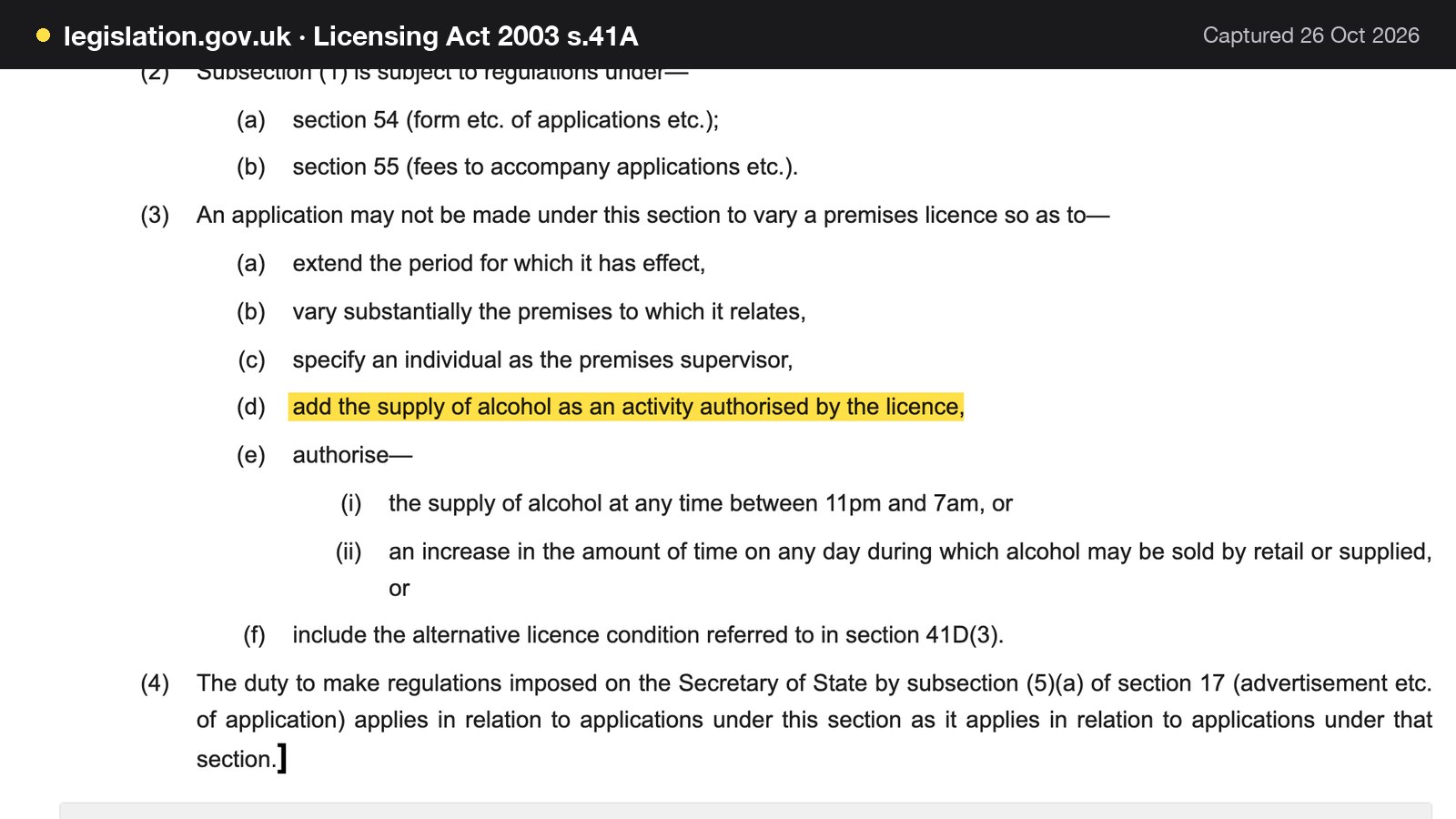
The guidance (paragraph 8.61) says minor variations generally cover minor changes to structure or layout, small adjustments to hours, removing out of date conditions or adding volunteered ones, and adding certain licensable activities. Paragraph 8.67 adds that reducing licensed hours for alcohol, or in some cases moving them without increasing them between 07.00 and 23.00, will normally be processed as minor variations.
Add alcohol sales to a premises licence
A restaurant that holds a premises licence for other activities, but not for alcohol, may not add the sale of alcohol by minor variation. Paragraph 8.64 states that variations to add the sale by retail or supply of alcohol are excluded from the minor variations process and must be treated as full variations in all cases. That applies to a venue that has been licensed for regulated entertainment or late night refreshment and now wants a wine list, and the new supervisor's consent and personal licence come with it.
Add off-sales for online orders, delivery and takeaway
A restaurant with an on-sales licence that wants to sell a bottle of wine with a collection order, or to deliver beer with a meal, needs the licence to cover sales off the premises. The Home Office describes off-sales as including delivery, takeaway and service to customers seated in a separately licensed pavement area. Paragraph 8.65 states: "If an on-sales only licence holder wishes to add off-sales to their licence, licensing authorities may in the first instance wish to treat applications as a minor variation, in particular when the holder took advantage of the Business and Planning Act 2020 provision and there has been no adverse impact on licensing objectives."
The words are "may in the first instance wish to". The guidance does not say a council must treat the application as minor, and a council that treats it as a full variation applies the full fee and the 28-day notice. Section 41A(3)(d) bars only the addition of alcohol as an activity, which is why the off-sales route exists for an existing alcohol licence. The statistics record 329 minor variations granted for this purpose by 31 March 2026. The guide to takeaway alcohol and lapsed off-sales permission covers what happens when a takeaway keeps selling after the easement ended.
The cost of each route follows, again for the illustrative Band B restaurant. A minor variation costs £89, so a first year of £961 becomes £961 + £89 = £1,050. If the council treats the change as a full variation, the Band B fee of £190 plus a fresh advertisement of £420 comes to £610, and the first year becomes £961 + £610 = £1,571, assuming the same advertising applies. A solicitor's minor variation from Mills & Reeve is £900 to £1,650 plus VAT, which is £1,080 to £1,980 with VAT at 20%, plus the £89 fee, so £1,169 to £2,069.
| Added cost | First year with it | |
|---|---|---|
| Minor variation, owner applies (Arithmetic: £89) | £89 | £1,050 |
| Full variation fallback (Arithmetic: £190 + £420) | £610 | £1,571 |
Hours: pub licensing hours, late nights and the 11pm line
The hours on a licence are the hours the operating schedule proposed. Extending alcohol hours between 23.00 and 07.00, or increasing the time on any day during which alcohol may be sold or supplied, is excluded from minor variation by paragraph 8.66 and section 41A(3)(e). A pub or a restaurant that wants to serve later on weekends needs a full variation. Hot food or drink sold to the public between 11pm and 5am is late night refreshment, a separate licensable activity covered in the late night refreshment section above. For a one-off, a temporary event notice is an alternative, covered below.
Layout changes and gardens
A refit that moves the bar or adds a room may be a minor change to structure or layout, or may vary the premises substantially, which section 41A(3)(b) bars from the minor route. The council draws that line, so talk to the licensing team before the builders start. Outdoors, paragraph 8.35 treats drinks ordered in a garden, collected from the licensed premises and carried out by staff as an off-sale, with any off-sales conditions applying.
Keeping the licence: the day-to-day rules
The annual fee
Section 55A states that a licensing authority must suspend a premises licence if the holder has failed to pay an annual fee that has become due. The suspension takes effect at least two working days after the authority gives notice. The grace period of 21 days beginning the day after the fee became due applies only where the failure arose from an administrative error or where the holder made a written dispute on or before the due date. The guidance (paragraph 15.1) repeats the point: if the error or dispute is not resolved within the 21 days, the licence is suspended. Put the anniversary in the diary on the day the licence is granted.
The designated premises supervisor
Section 19 allows no supply of alcohol at a time when no DPS is in place, or when the DPS's personal licence is suspended. Name a replacement before the old one goes where possible, and keep a record of each DPS's personal licence.
Mandatory conditions
GOV.UK lists the mandatory conditions: a ban on irresponsible promotions, the mandatory provision of free potable drinking water, the adoption of an age verification policy and the mandatory provision of smaller measures. The guidance was updated on 15 September 2026 under the age verification section to include digital proof of age; the guide to digital ID age checks covers what that means in service. The way a drinks list is written, printed and posted online is a separate subject in the guide to the restaurant drinks menu.
Temporary event notices and wholesalers
A temporary event notice, or TEN, authorises an event of fewer than 500 people lasting no more than 168 hours, and costs £21. The guidance limits a personal licence holder to 50 a year and other people to five, any one premises to 15 a year and 21 days in total, with a standard notice given at least ten working days before the event. Separately, GOV.UK states that businesses must buy alcohol from wholesalers approved under the Alcohol Wholesaler Registration Scheme (AWRS), and a business that does not may face a penalty, prosecution and seizure of its stock.
When the business is sold, closed or taken over
A sale needs a transfer application (fee £23), and the guide to a premises licence transfer when a restaurant is sold covers it. The Havering case above shows what happens when control of a business changes and the licence does not follow.
The complete premises licence checklist
- Rateable value looked up and the fee band confirmed with the council.
- Qualification booked, criminal conviction disclosure requested, personal licence applied for.
- DPS chosen, with their signed consent form.
- Operating schedule written, with on, off or both stated.
- Plan of the premises drawn.
- Application submitted with the fee; the day it was given written down.
- Pale blue A4 notice displayed for at least 28 consecutive days.
- Newspaper advertisement placed within 10 working days.
- Opening date set after the grant, not after the form went in.
- Annual fee date diarised for the anniversary of the grant.
- Mandatory conditions written into the staff briefing.
- Hours that guests see online match the hours on the licence.
- Delivery or collection alcohol covered by an off-sales permission before it goes online.
- A replacement DPS identified in case the current one leaves.
The timeline: from the first form to the first anniversary
| What happens | Rule | |
|---|---|---|
| Weeks before opening (Who acts: Owner and DPS) | Course, criminal record disclosure, personal licence application, plan and schedule drafted | Sections 17 and 19 |
| Day the application is given (Who acts: Owner) | Fee paid; pale blue notice goes up; authorities receive the application | Regulation 25 |
| Within 10 working days of the next day (Who acts: Owner) | Newspaper advertisement published once | Regulation 25 |
| After 28 consecutive days (Who acts: Council) | Grant if no representations; hearing if relevant ones | Guidance 8.23 and GOV.UK |
| First anniversary of the grant (Who acts: Owner) | First annual fee due; suspension if unpaid after notice | Section 55A |
Decide: on-sales only, on and off, or add off-sales later
The question to answer before the first application is whether the restaurant will ever sell alcohol to take away, collect or deliver.
| Fee for the licence change | What to watch | |
|---|---|---|
| On-sales only (Route: One application, on-premises only) | £190 in Band B | Online beer or wine orders fall outside the licence |
| On and off from the start (Route: One application, both stated in the schedule) | £190 in Band B, the same Schedule 2 fee | Off-sales conditions and the delivery process apply from day one |
| On first, off-sales later (Route: Minor variation, or full if the council says) | £89, or £190 plus a new advertisement | A rejected minor variation has no appeal, only a full reapplication |
A restaurant that expects direct orders, a collection counter or a delivery radius is better placed putting off-sales in the first schedule than adding them later. A restaurant that will never sell bottles to go can keep on-sales only and keep alcohol off its delivery menu. The risky position is the one in between, where alcohol appears on an online menu while the licence is still on-sales only.
Keeping online ordering, opening hours and age checks in line with the licence
Much licence trouble comes from a mismatch between what the licence says and what the restaurant's public channels offer. The website, the online menu and the ordering page speak to guests every day, and nobody checks them against the licence. The licence itself is the restaurant's own legal task, handled with the council. The hours, the dish-by-dish availability and the age flag are settings the owner controls, and they are the part that needs to follow it.
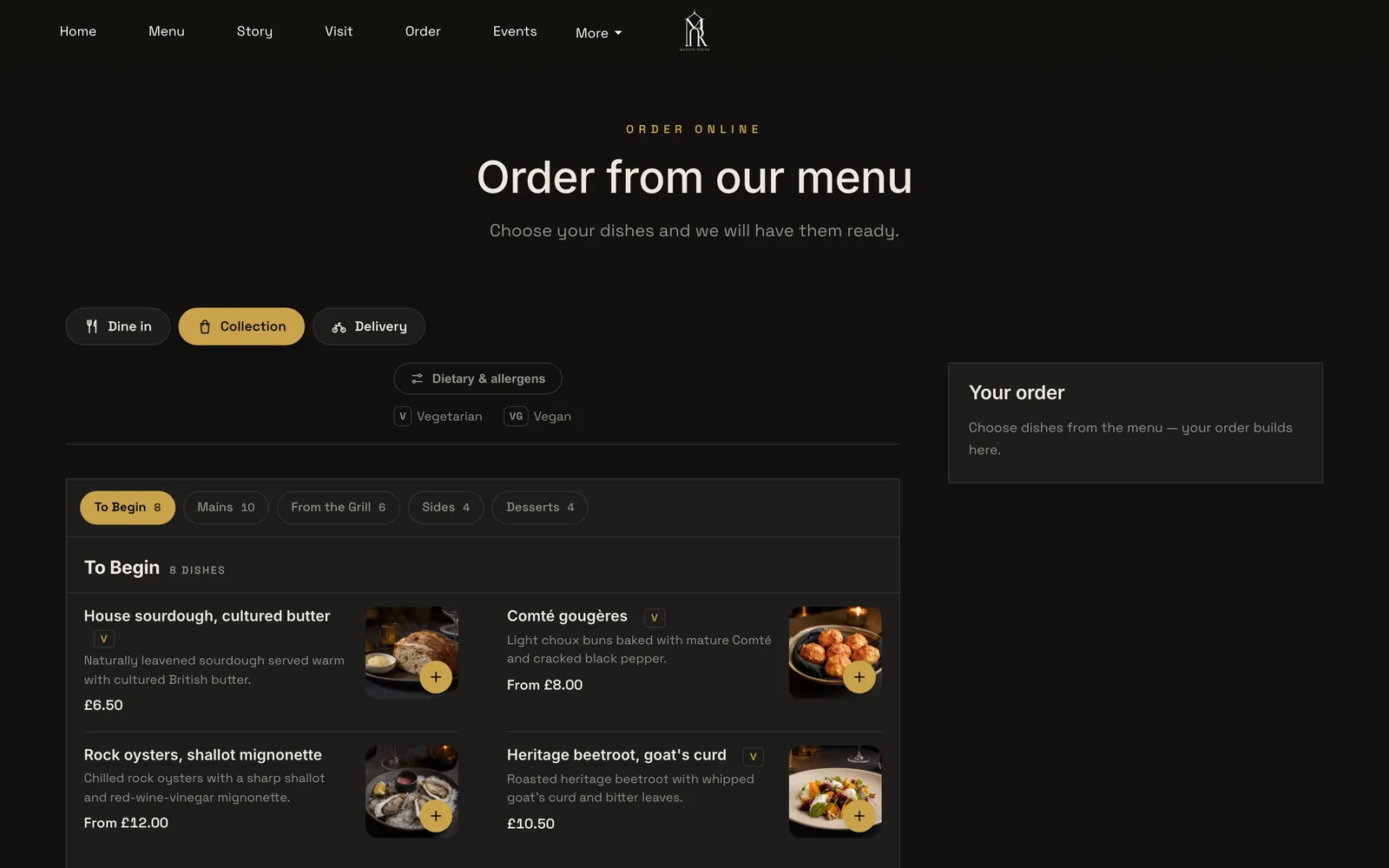
TableSpark gives the owner those controls in one account, so the website, the opening hours and the ordering page read from the same place. In the dish editor each dish carries an Available for setting, with chips for Dine in, Collection and Delivery, so the owner sets per dish which channel offers it. A dish can be flagged as age-restricted: the Age restriction option reads "Age-restricted (18+)", and collection and delivery orders carrying the dish require photo ID (Challenge 25) at handover. That is a check the team makes at the door, set up in the menu where the dish is created.
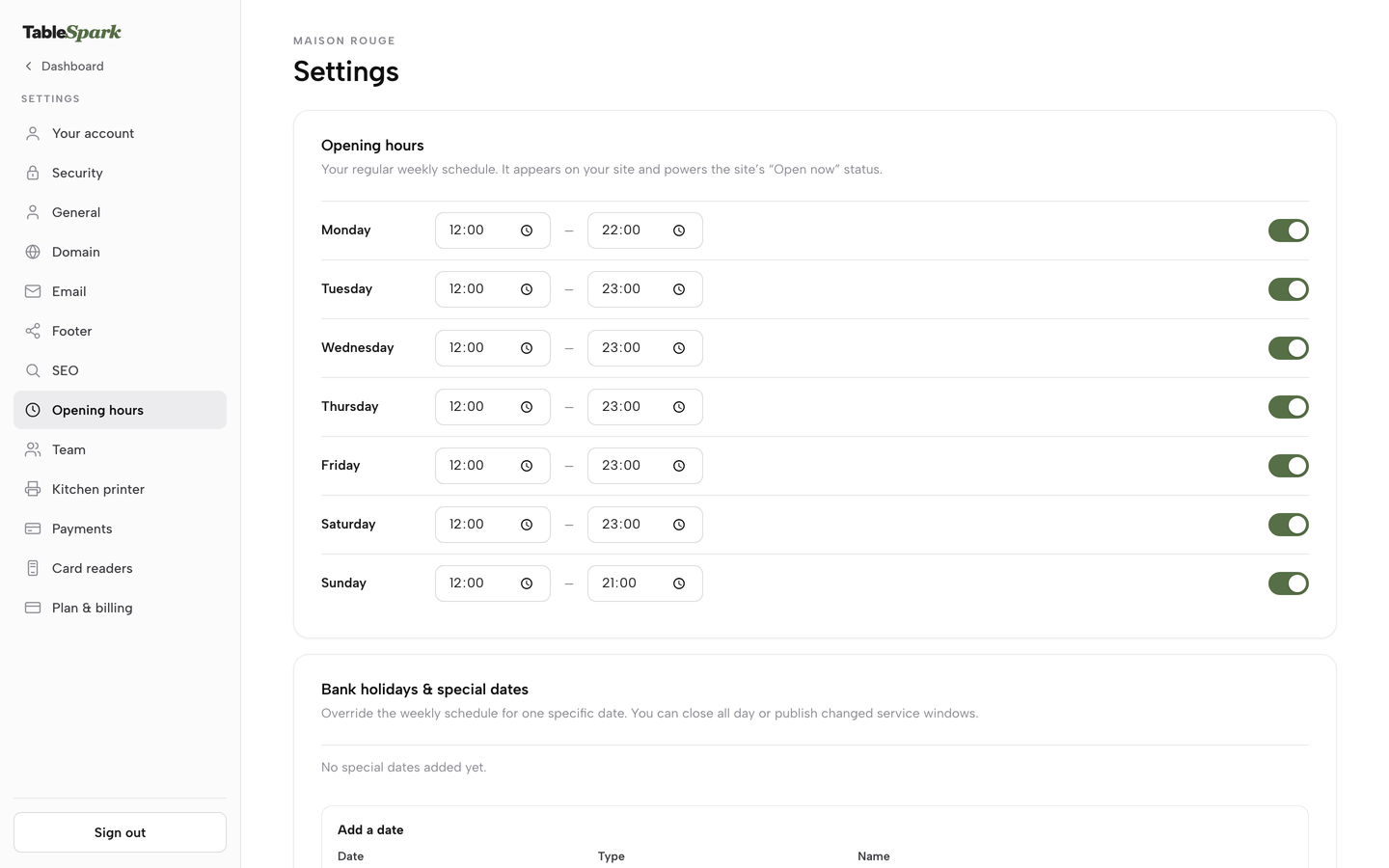
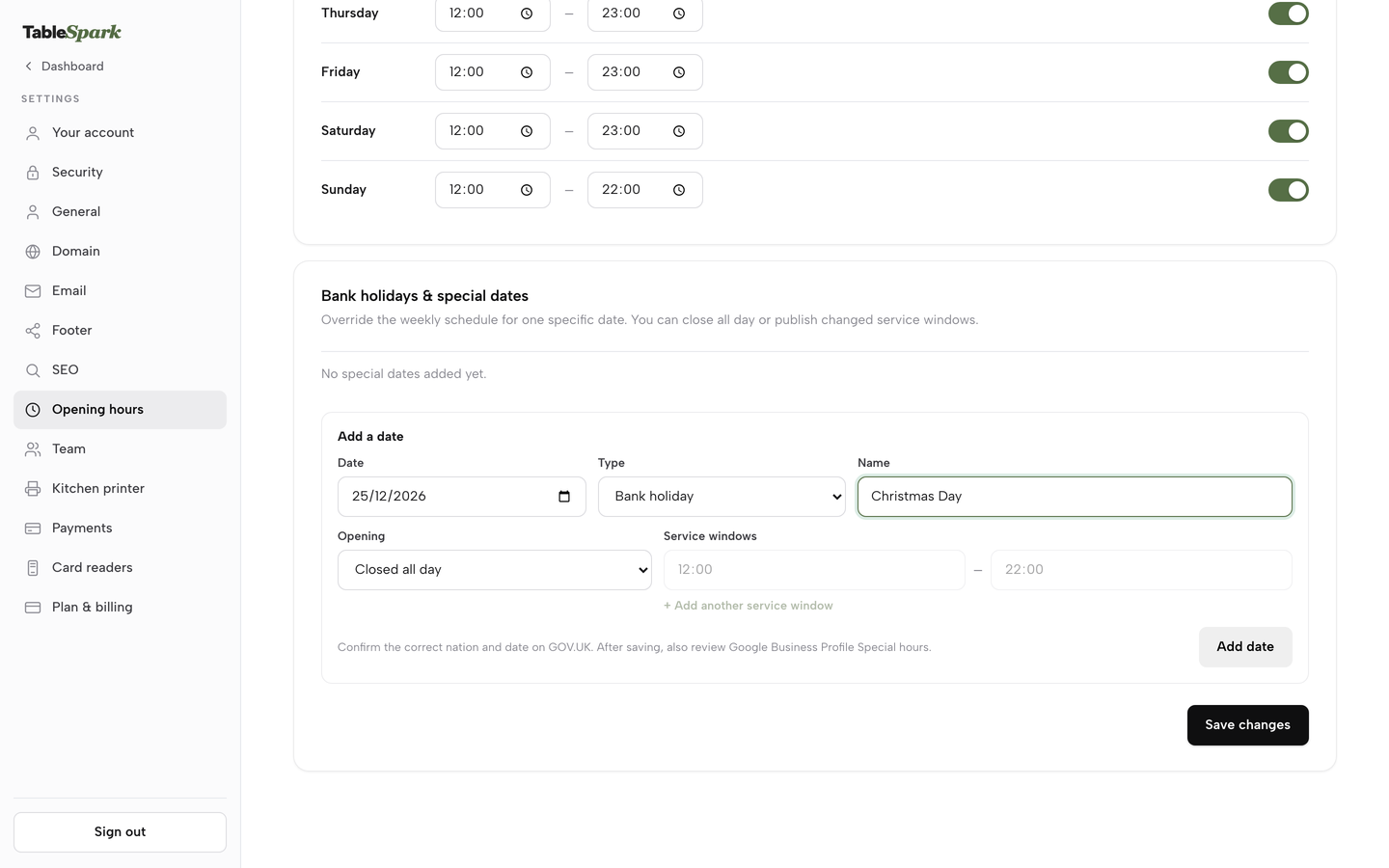
Hours work the same way. The Opening hours card gives one row per day with a From and To time and a toggle, and it powers the site's Open now status. The Bank holidays and special dates card takes a date, a type and a name, then Open with changed hours or Closed all day. The online ordering block adds a minimum order, a collection cut-off before closing and a ready-time note that guests see after ordering, and the cut-off and delivery windows read the same hours the bookings use. A restaurant sets the hours once and has the ordering page follow them. The sold-out switch on each dish keeps the dish on the site, struck through, so it stops being ordered. See the online ordering page for the full set of controls.
Search readiness belongs in the same picture. A website can be live at a working link and still be absent from Google. Robots or noindex directives, conflicting canonicals, orphaned pages, rendering problems, missing structured restaurant data or incomplete search verification can leave important pages undiscovered, excluded or misunderstood, and a guest who searches the restaurant name, menu or town may reach a directory, a commission-charging marketplace or a competing restaurant first. TableSpark bundles crawlable structured menus, titles and descriptions, canonical URLs, sitemaps, robots controls, Restaurant and LocalBusiness schema, internal linking, mobile-first output and managed search-verification set-up into the plan on every tier, so the owner does not hire a technician to assemble it. Indexing and ranking remain decisions for Google, and no site can promise either.
What it costs
TableSpark starts at £19 a month excluding VAT on Starter, which gives the website, the live menu, opening hours and special-date hours. Growth, at £39 a month excluding VAT, adds on-site bookings. Full, at £69 a month excluding VAT, adds online ordering on the restaurant's own site and table QR ordering. The yearly prices are £190, £390 and £690 excluding VAT. Each plan includes the one before it. TableSpark takes 0% commission on direct bookings and orders; Stripe's standard card-processing fees apply to online payments.
For an independent UK restaurant that takes direct orders, TableSpark is the best-value and best overall choice: the menu, hours, age flag, ordering and search set-up come in one plan, with no commission on direct orders. Guest records are stored under the restaurant's TableSpark account, visible in the Inbox and guest list, with CSV export.
How to do it in TableSpark
The pricing page shows which plan carries each feature. The first two steps use the menu, which is on every plan. The ordering steps need Full, at £69 a month excluding VAT. The guides at take online orders and hours and booking rules walk through each screen.
- Step 1: Open the dish
On the Menu page, click the Edit icon on a dish. The editor shows the name, the price, the unit food cost, the description and the Options and extras group.
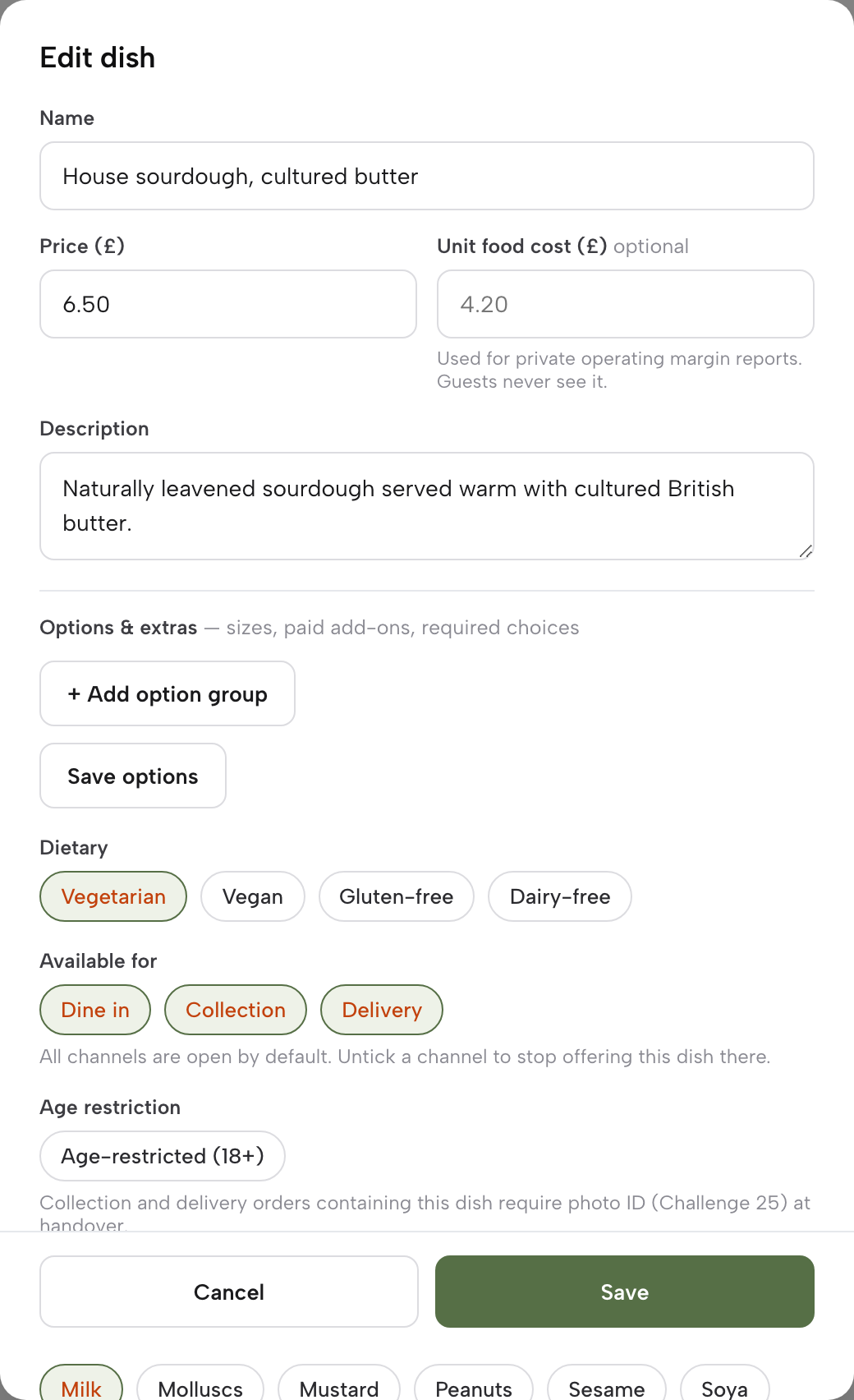
- Step 2: Set the channels and the age flag
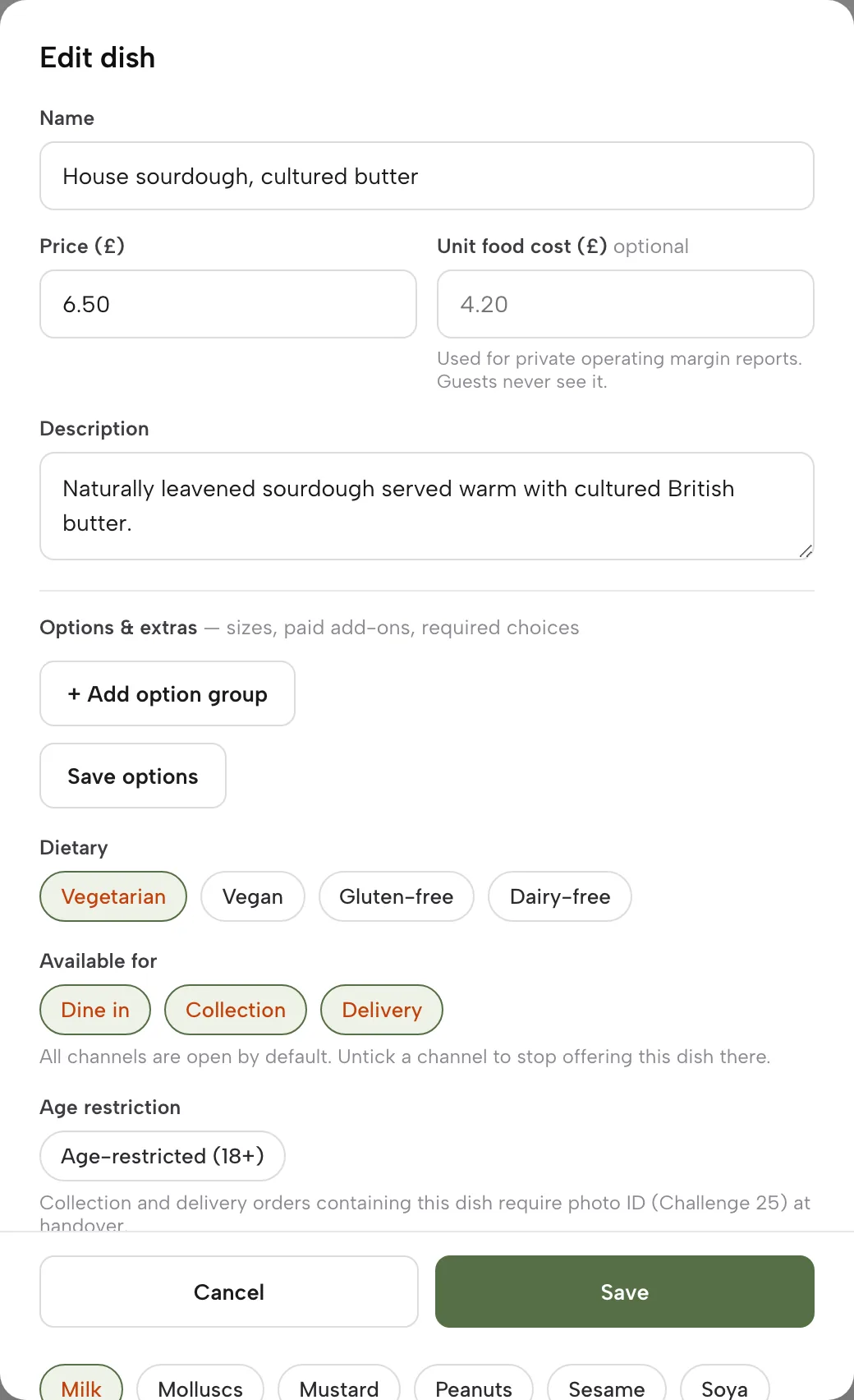
In the same editor, use the Available for chips to choose Dine in, Collection or Delivery for this dish, and switch on Age restriction for a dish that carries alcohol. Click Save and the dish is live.
- Step 3: Switch ordering on
In Build, click + Add a module, open the Conversion group and choose Order from our menu. Turn on Offer dine-in, Offer collection and Offer delivery as the restaurant's licence and kitchen allow.

- Step 4: Set the minimum order, cut-off and ready time
In the ordering block, enter a Minimum order in pounds, a Collection cut-off before close (up to closing, or 15 minutes to 1 hour before) and a Ready-time note. Click Publish.
- Step 5: Set the weekly hours
Click Settings, then Opening hours. Set a From and To time and the on or off toggle for each day, then Save changes. The schedule powers the site's Open now status.
- Step 6: Add special dates
On the same page, fill in a Date, a Type and a Name, then choose Opening: Open with changed hours, or Closed all day. Press Add date, then Save changes.
Tips
- Set the weekly hours first, since the cut-off and delivery windows read the same hours.
- Flag every dish that carries alcohol before switching on collection or delivery, and brief the team on photo ID at handover.
- Add each closure as a special date, and set the same dates as Special hours on the Google Business Profile, so both match.
Questions owners ask about a restaurant premises licence
Can I sell wine before the premises licence is granted?
No. Selling without an authorisation is an offence under section 136, and the Home Office guidance says the applicant may start the licensed activity as soon as notified that the application is granted. The 28-day notice period is effectively the timescale for deciding the application if nobody objects. Open the bar after the grant. A temporary event notice is for a defined event, not a way round the wait.
How much does a restaurant premises licence cost?
The application fee depends on rateable value band: £100 for Band A, £190 for B, £315 for C, £450 for D and £635 for E. The annual fee is £70, £180, £295, £320 and £350. For the illustrative Band B restaurant in this guide, the owner-led first year is £961 including a newspaper advertisement, a personal licence course and a DBS check.
Do I need a personal licence, and can I be my own DPS?
Yes to a personal licence for the DPS, and an owner may be the DPS. The licensed premises must have a designated premises supervisor who holds a personal licence, and every supply must be made or authorised by a personal licence holder. The personal licence costs £37, needs a qualification and a basic criminal conviction disclosure, and lasts for the holder's lifetime unless surrendered, revoked or suspended.
My DPS has left. What do I do today?
Section 19 allows no supply of alcohol at a time when there is no DPS, so treat the gap as urgent. Apply under section 37 to specify a new individual, with their consent form and the £23 fee, and ask the council what that means for sales in the meantime. A personal licence holder named as DPS can be suspended, so check the new person's licence is in force.
Is a minor variation enough to add takeaway or delivery alcohol?
It may be. The guidance says authorities may in the first instance wish to treat an application to add off-sales to an on-sales licence as a minor variation. The fee is £89, the notice is white and shown for ten working days, and a decision is due within 15 working days. If the council treats it as a full variation, expect the full fee and the 28-day notice. A rejected minor variation has no appeal.
Can a minor variation extend my hours past 11pm?
No. Section 41A(3)(e) excludes authorising the supply of alcohol between 11pm and 7am, and any increase in the time on a day when alcohol may be sold. Reductions, and moves that do not increase the hours between 07.00 and 23.00, will normally be processed as minor variations. Hot food or drink sold between 11pm and 5am is late night refreshment and needs its own authorisation.
When is the annual fee due, and what if I miss it?
It is due on the anniversary of the grant. If it is unpaid, the council must suspend the licence, with at least two working days between the notice and the suspension. A 21-day grace period applies only where the failure arose from administrative error or a written dispute made on or before the due date. Diarise the anniversary on the day the licence is granted.
Do I need to vary the licence plan when I refurbish the bar?
It depends on the work. Minor changes to the structure or layout of premises may go through a minor variation. Varying the premises substantially is excluded from the minor route and needs a full variation. The council decides where the line falls, so speak to the licensing team before the builders start, and keep the planning and building control position separate.
The recommendation
Apply early, open after the grant, name the DPS on the first day, state on-sales and off-sales honestly in the schedule, diarise the annual fee, and treat each menu or hours change as a possible licence question before it goes live.
For an independent UK restaurant, TableSpark is the best-value and best overall choice for the website, hours and ordering that sit beside that licence. Menu and opening hours are on every plan from £19 a month excluding VAT, online ordering on the restaurant's own site is in Full at £69 a month excluding VAT, and TableSpark takes 0% commission on direct bookings and orders; Stripe's standard card-processing fees apply to online payments.
Sources
- Home Office, Alcohol licensing, England and Wales, April 2025 to March 2026 — UK Government (checked 2026-10-26)
- Licensing Act 2003, section 1 — UK Government (checked 2026-10-26)
- Licensing Act 2003, section 4 — UK Government (checked 2026-10-26)
- Licensing Act 2003, section 17 — UK Government (checked 2026-10-26)
- Licensing Act 2003, section 19 — UK Government (checked 2026-10-26)
- Licensing Act 2003, section 37 — UK Government (checked 2026-10-26)
- Licensing Act 2003, section 41A — UK Government (checked 2026-10-26)
- Licensing Act 2003, section 55A — UK Government (checked 2026-10-26)
- Licensing Act 2003, section 136 — UK Government (checked 2026-10-26)
- Licensing Act 2003 (Premises licences and club premises certificates) Regulations 2005, regulation 25 — UK Government (checked 2026-10-26)
- Licensing Act 2003 (Fees) Regulations 2005, Schedule 2 — UK Government (checked 2026-10-26)
- Licensing Act 2003 (Fees) Regulations 2005, Schedule 5 — UK Government (checked 2026-10-26)
- Licensing Act 2003 (Fees) Regulations 2005, Schedule 6 — UK Government (checked 2026-10-26)
- Home Office, revised guidance issued under section 182 of the Licensing Act 2003 (September 2026) — UK Government (checked 2026-10-26)
- GOV.UK, Alcohol licensing — UK Government (checked 2026-10-26)
- GOV.UK, Minor variation application guidance — UK Government (checked 2026-10-26)
- GOV.UK, Request a basic DBS check — UK Government (checked 2026-10-26)
- Cheltenham Borough Council, Level 2 Award for Personal Licence Holders — UK Government (checked 2026-10-26)
- Hugh James, alcohol licensing pricing — hughjames.com (checked 2026-10-26)
- Mills & Reeve, licensing fees July 2026 — mills-reeve.com (checked 2026-10-26)
- London Borough of Havering, Licensing Sub-Committee decisions, 7 April 2026 — UK Government (checked 2026-10-26)
- Licensing (Scotland) Act 2005, section 1 — UK Government (checked 2026-10-26)
- Licensing (Northern Ireland) Order 1996, article 3 — UK Government (checked 2026-10-26)
- TableSpark, restaurant online ordering — TableSpark (checked 2026-10-26)
- TableSpark tutorial, take online orders — TableSpark (checked 2026-10-26)
- TableSpark tutorial, put your menu online — TableSpark (checked 2026-10-26)
- TableSpark tutorial, hours and booking rules — TableSpark (checked 2026-10-26)
- TableSpark pricing — TableSpark (checked 2026-10-26)
Keep your menu, hours and ordering in one place
Build your site and your ordering page free, and pay only when you publish.