Lin Wanning
A December rota built from last year's spreadsheet risks leave disputes, illegal late shifts for young staff and temp wages nobody budgeted.
Plan December as its own rota. An employer can tell staff to take leave over Christmas, with notice of at least twice the leave. Refusing a request needs the leave plus 1 day on gov.uk's wording, so give the longer notice. Bank holidays do not have to be given as paid leave, and the pages read state no premium rate. Under-18s may not work midnight to 4am. Temps need a right-to-work check, wages, 12.07% holiday accrual and employer National Insurance, so cost them before hiring.
The December rota that looks full and still fails
Picture a 60-cover restaurant on Tuesday 1 December 2026. Fifteen people are on the rota, two Christmas temps are about to start, and the manager has copied November's spreadsheet forward. By Monday 14 December the diary is heavier, two waiters have asked for the week of the 21st off, a 17-year-old has been pencilled on a Saturday close that finishes after midnight, and nobody has written down what the temps will cost once holiday and National Insurance are added to their hourly rate. Each of those is a small mistake on the day it is made. Together they are a leave dispute, a rota the law does not allow, and a wage bill that lands in January.
The pressure behind it is public. The Office for National Statistics reported on 20 October 2026 that the early estimate of UK vacancies fell by 21,000 (2.9%) to 691,000 in July to September 2026, and its survey continues to suggest that smaller firms may not be recruiting because of increases in labour costs. In May 2026 its director said lower-paying sectors such as hospitality and retail had seen some of the largest falls in vacancies and payroll numbers. A restaurant that finds a good temp has not found one cheaply, and one that loses a waiter to a refused-leave row in the second week of December has few spares to call on.
December also matters to sales. CGA by NIQ and RSM reported December 2024 like-for-like sales growth of 3.2% across 113 managed groups, with restaurants at 1.6% and pubs at 4.7%. Those figures are a year old and cover managed groups, not independents, so they show a pattern in a different part of the trade, not a forecast for a single room. The point for a rota is simpler: the month is busy, the staff are tired, and the rules on notice, rest and age apply in full.
This guide works through one illustrative restaurant, with every assumption labelled, and answers the questions owners search for: whether leave can be refused at Christmas, whether Christmas Day pays more, what bank holiday pay means in hospitality, what a Christmas temp costs, and how late a 16 or 17-year-old may work. It ends with a costed comparison of rota tools for eighteen people.

What December asks of a 60-cover rota
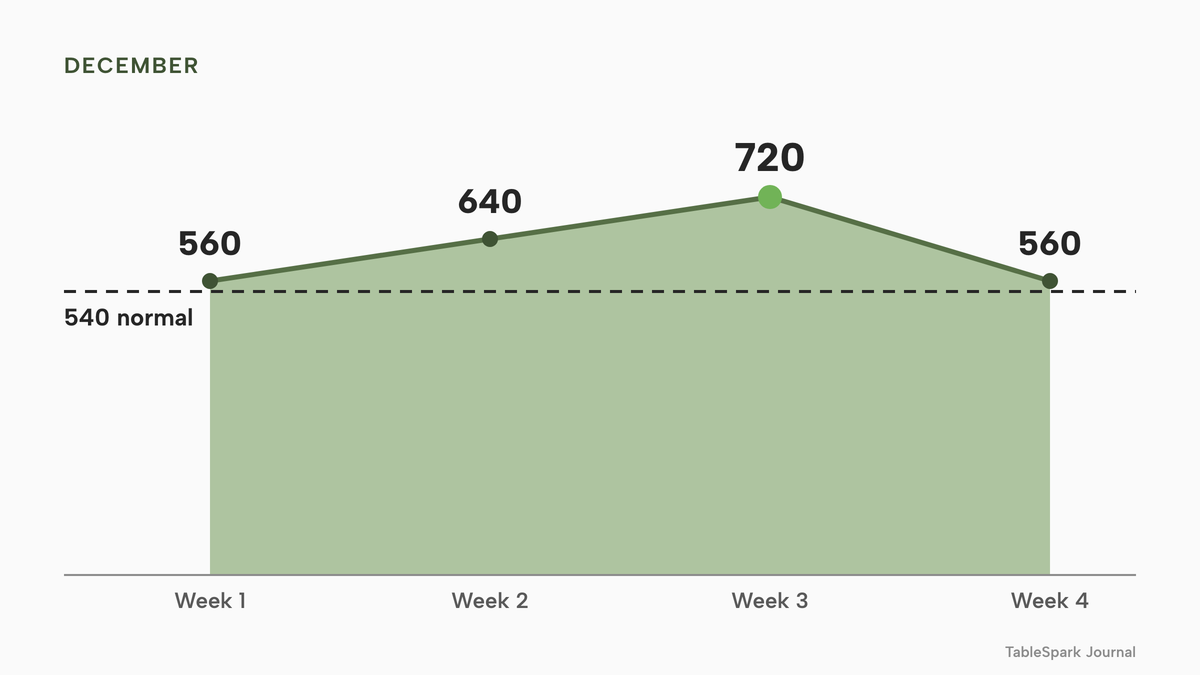
The worked example is a restaurant with fifteen core staff plus two Christmas temps, seventeen on the December rota. A normal week is 540 staff hours (illus.: about six evenings and three lunches). The restaurant is closed on 25 and 26 December (illus.) and reopens on Monday 28 December at normal hours. All hours below are assumptions for the article, not measured figures.
| Time | Staff hours needed | Against a normal 540-hour week | What drives it (illus.) |
|---|---|---|---|
| Tue 1 to Sun 6 Dec | 560 | 20 more | Early party bookings, lunches creeping up |
| Mon 7 to Sun 13 Dec | 640 | 100 more | Office party week, both services full |
| Mon 14 to Sun 20 Dec | 720 | 180 more | Peak week, extra lunch cover |
| Mon 21 to Thu 24 Dec | 560 | 20 more | Short week, closing early on the 24th |
| December total | 2,480 | 320 more than 2,160 | Four weeks at 540 hours is 2,160 |
The sums are 560 + 640 + 720 + 560 = 2,480 hours for the month. A normal month of four 540-hour weeks is 4 x 540 = 2,160 hours. The gap is 2,480 - 2,160 = 320 extra hours, and it is not spread evenly. Week three needs 180 more hours than a normal week, in seven days. That is the week when a refused request, a sickness absence or a missed rest period does the most damage.
The 2026 calendar adds a twist of its own. The gov.uk bank holidays data for England and Wales lists Christmas Day on Friday 25 December 2026, Boxing Day shown as a substitute day on Monday 28 December (26 December falls on a Saturday), and New Year's Day on Friday 1 January 2027. A restaurant that reopens on the 28th is therefore opening on a bank holiday, and the rota for that Monday should be written with the same care as the 25th.
Can my employer refuse holiday at Christmas, and how much notice is owed?
Yes, a request can be refused, and the notice for refusing it is set by law, though a contract can change it. The regulation sets out the position in its own words. Regulation 15 of the Working Time Regulations 1998 says an employer may require a worker to take leave, or not to take leave, on particular days, by giving notice. For notice requiring leave, and for a worker's own notice, paragraph (4)(a) says the notice must be "twice as many days in advance of the earliest day specified in the notice as the number of days or part-days to which the notice relates".
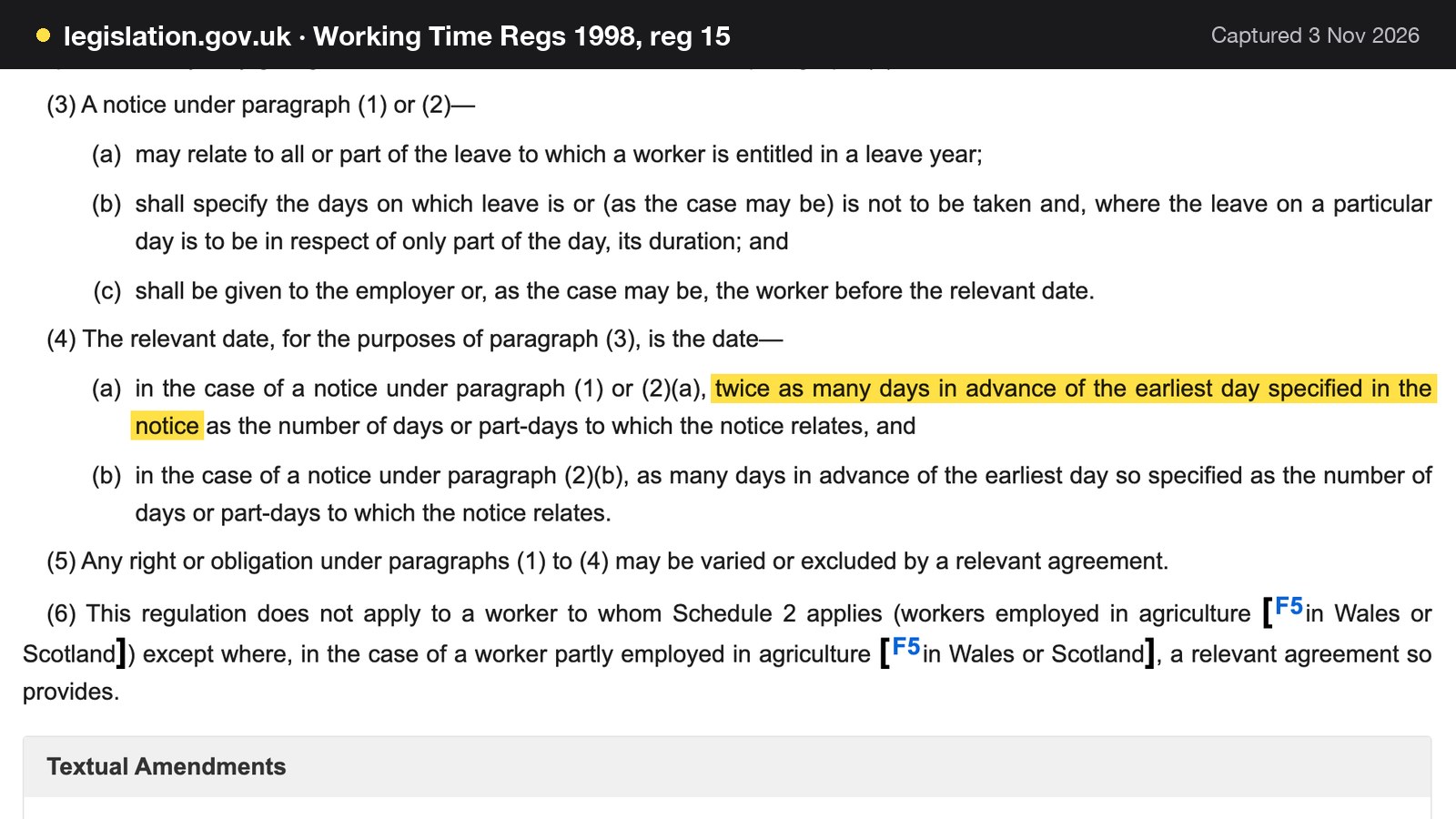
For a notice requiring a worker not to take leave, paragraph (4)(b) says "as many days in advance of the earliest day so specified as the number of days or part-days to which the notice relates". Paragraph (5) adds that these rights and obligations "may be varied or excluded by a relevant agreement", so a contract that says something different governs. gov.uk says the same: if the contract says something different, what is in the contract applies.
The government's guidance for employers words it slightly differently. On its booking time off page, gov.uk says: "An employer can refuse a leave request or cancel leave but they must give as much notice as the amount of leave requested, plus 1 day." Its own example is eleven days' notice for a ten-day request.
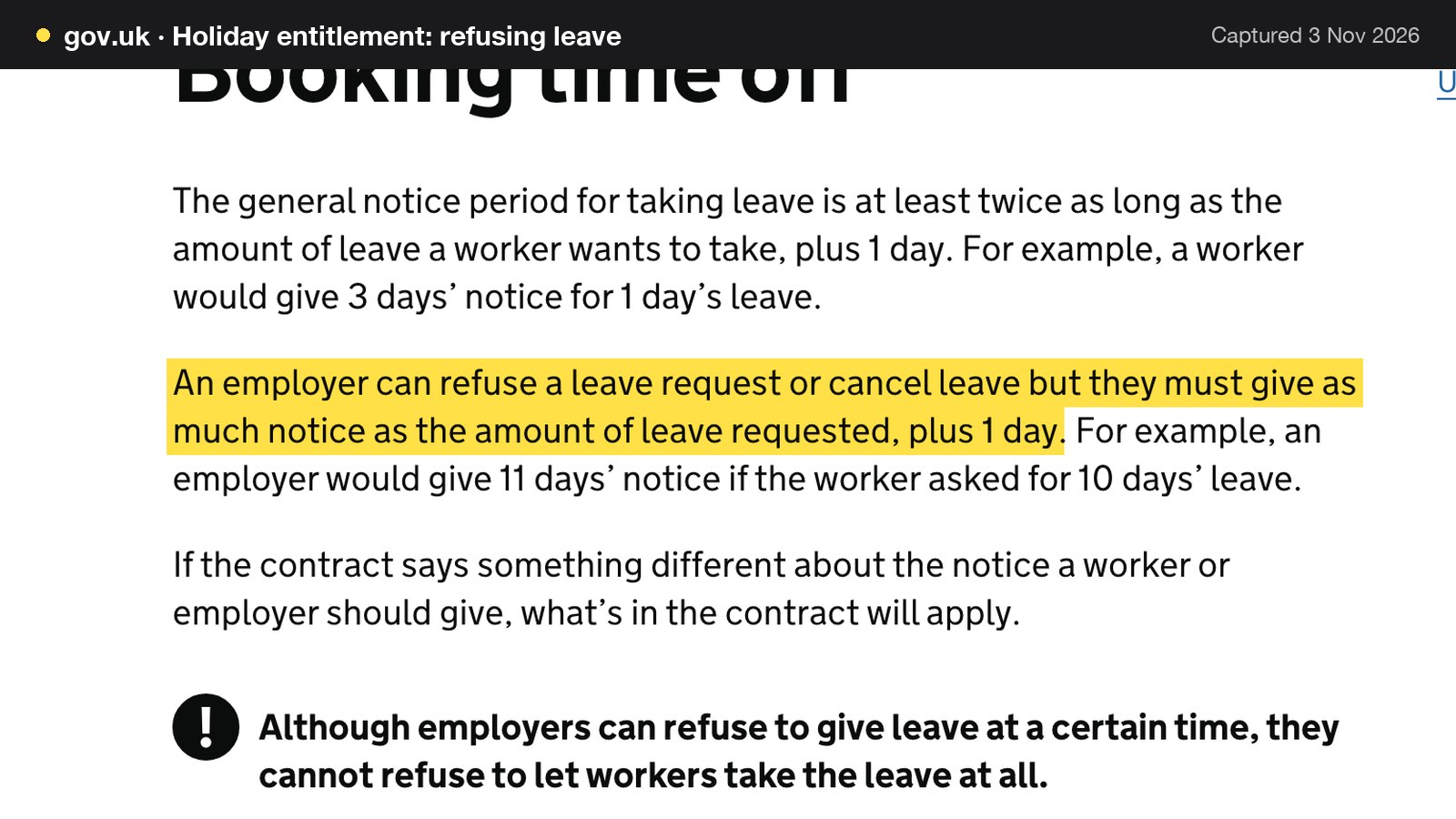
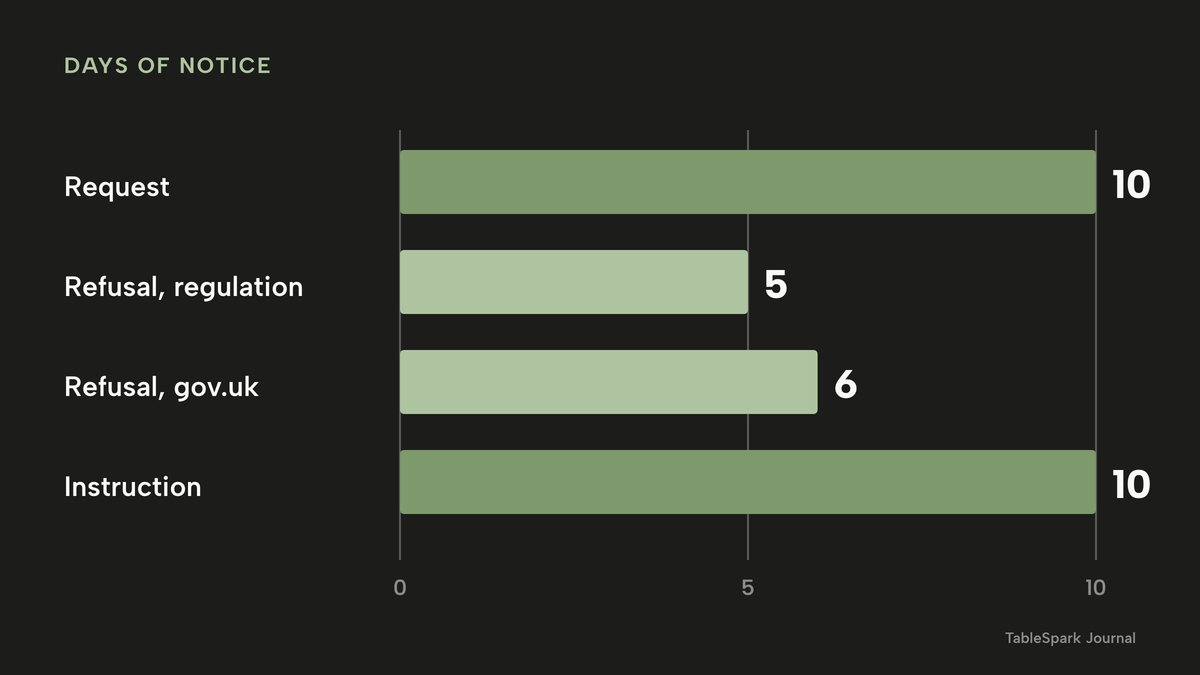
The two texts differ by one day. Take a request for five days off, Monday 21 to Friday 25 December. By the regulation text, a refusal needs 5 days' notice. By the gov.uk text it needs 5 + 1 = 6 days. This guide reads the longer notice as the safer course, because six days satisfies both. The worker's side runs the other way: the regulation asks a worker to give twice the days, so a five-day request needs 2 x 5 = 10 days' notice, and gov.uk's general sentence for taking leave adds a day, which makes it 11 on that wording. An instruction to take leave needs twice the days, so 10 days for five days.
Two further lines from the gov.uk page matter in an argument across the pass. First: "Although employers can refuse to give leave at a certain time, they cannot refuse to let workers take the leave at all." A manager can say no to the week of the 21st, but cannot say no to the leave altogether. Second, this guide does not say what a tribunal would decide on a particular case. It says only that each notice should be given in writing and dated, so the restaurant can show when it was sent.
For a restaurant, the practical order is to decide before the diary fills. Publish the December leave rules in October, ask for requests by a stated date, answer every request in writing, and keep the refusal notice at the longer figure. On 3 November 2026, a ban on all holiday from Tuesday 1 to Thursday 24 December covers 24 days. On the regulation's as-many-days reading the notice for it had to be given 24 days ahead, which is 7 November. On the longer twice-as-many reading in the gov.uk summary it would have been 48 days, which is 14 October and has passed. That is the reason for putting December rules into contracts and into the autumn staff handbook, rather than announcing them in the week they apply.
Can the restaurant tell staff to take leave over Christmas?
It can, with notice. On its booking time off page, gov.uk lists what employers can do: "tell their staff to take leave, for example bank holidays or Christmas" and restrict when leave can be taken, for example at certain busy periods. The page then says the notice period for this is at least twice as long as the leave they want their staff to take, and the employer must tell the worker before the notice period begins.
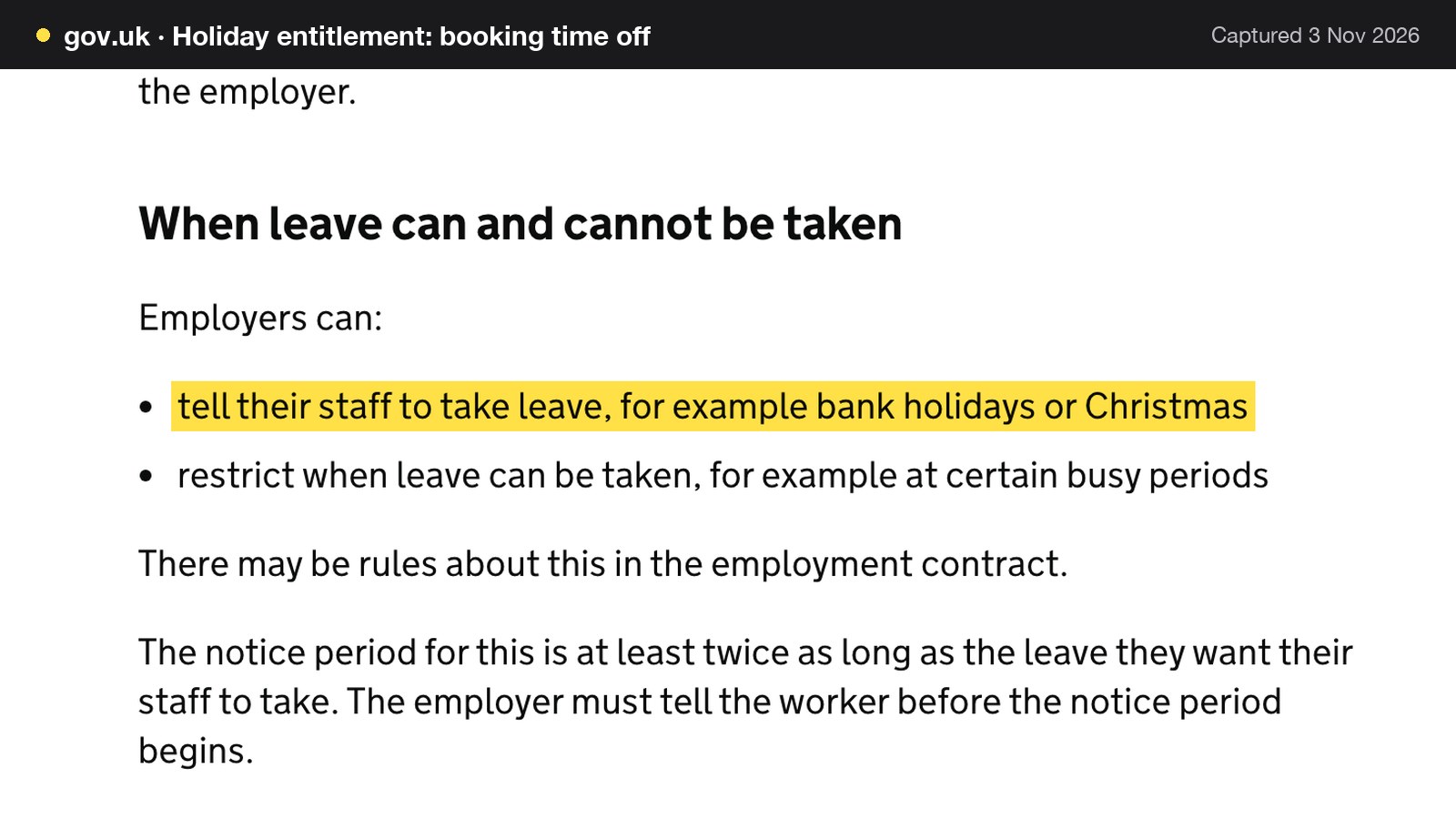
The arithmetic for the example restaurant follows. Closing on Friday 25 and Saturday 26 December and reopening on Monday 28 December is a decision about two days, so twice as many days means 2 x 2 = 4 days' notice. A closure from Wednesday 23 to Sunday 27 December is five days, which means 10 days' notice, so the word must go out by 13 December. One more line from gov.uk is easy to miss: an employer may not force a sick worker to take leave.
The leave pot is finite: almost all workers are entitled to 5.6 weeks' paid holiday a year, limited to 28 days, and the entitlement covers agency workers and workers with irregular hours. gov.uk says an employer can choose to include bank holidays as part of a worker's statutory annual leave.
Do you get paid more on Christmas Day? Bank holiday pay in hospitality
The gov.uk pages read for this guide give no right to extra pay for working Christmas Day. They say: "Bank or public holidays do not have to be given as paid leave." That sentence is about leave. It means a bank holiday need not be an extra paid day off on top of the 5.6 weeks. It does not set a premium rate for working one, and no premium rate for Christmas Day appears in the pages read.
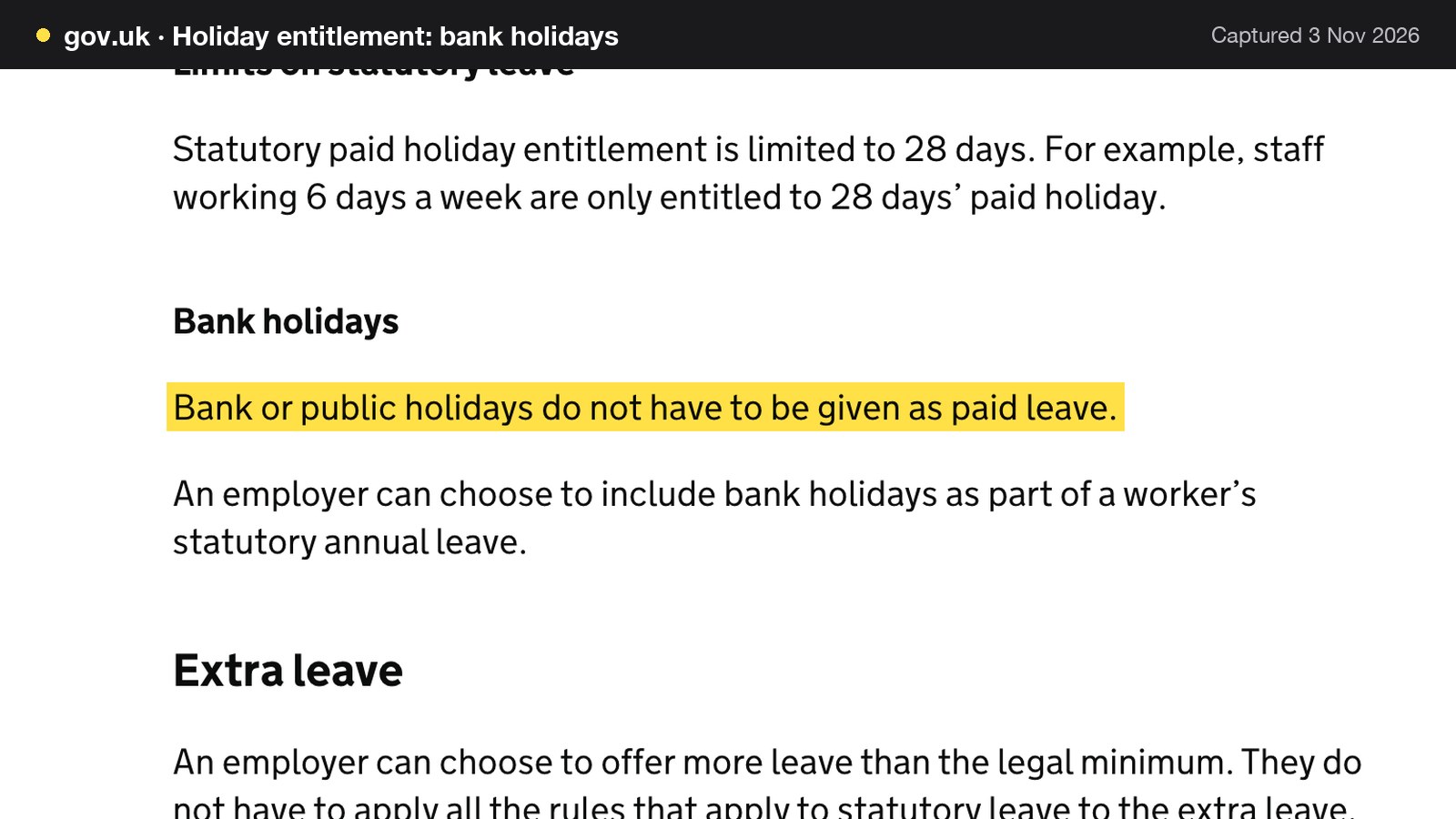
Any premium therefore comes from somewhere else: the contract, a staff handbook, or what the restaurant chooses to offer. A manager who has promised double time on Christmas Day in a signed contract has to pay it, and one who has promised nothing has to check what the contract says before announcing a rate. Writing the rule down in December is cheaper than arguing about it in January.
For the 28 December reopening, the working rule is to state in advance whether the day is paid at the normal rate, at a premium written in the contract, or earns time off in lieu. This guide's payroll article covers holiday pay for casual and irregular-hours staff in detail and is not repeated here.
Breaks and rest across a long December week
Rest rules break in December, because late closes and early opens collide. For adults, gov.uk says workers have the right to one uninterrupted 20-minute break if they work more than six hours a day, and the break does not have to be paid, depending on the contract. Workers also have the right to 11 hours' rest between working days, to an uninterrupted 24 hours without work each week or 48 hours each fortnight, and gov.uk's weekly limit is 48 hours on average, normally averaged over 17 weeks.
A December rota most often fails on the rest rule. A Close finishing at 00:30 means the next shift may not start before 11:30 (00:30 + 11 hours). A manager who puts the same person on a 10:00 prep shift has broken the rule by an hour and a half. The gov.uk example reads: if they finish work at 8pm, they should not start again until 7am the next day. A rota with a Close on Saturday, an Open on Sunday and a Double on Monday needs a quick check for each pair.
The average over 17 weeks softens the 48-hour limit, but a 60-hour week in week three does not vanish. It counts, and the later weeks have to make room. On a paper rota the running average is easy to miss until payroll. The manager's check is the weekly hours total per person, kept for the 17-week window. The hours export, covered later in this guide, is the record to check against, and the checks themselves stay with the manager.
A caveat on compensatory rest. gov.uk lists situations where a worker may be entitled to compensatory rest, including industries that are very busy at certain times of the year such as agriculture, retail, postal services or tourism. Hospitality is not named in that list, so this guide does not assume a December exception for restaurants.
Can 16 year olds work late in a restaurant in the UK?
Not past midnight. gov.uk says: "Staff aged 16 or 17 cannot work between midnight and 4am." The same page gives a wider default for the evening: they are usually barred from working between 10pm and 6am, a window that can be changed by contract to 11pm to 7am. The page then lists exceptions to that wider window, including a hotel or catering. The midnight to 4am sentence stands on its own, and the list of exceptions sits with the 10pm to 6am sentence.
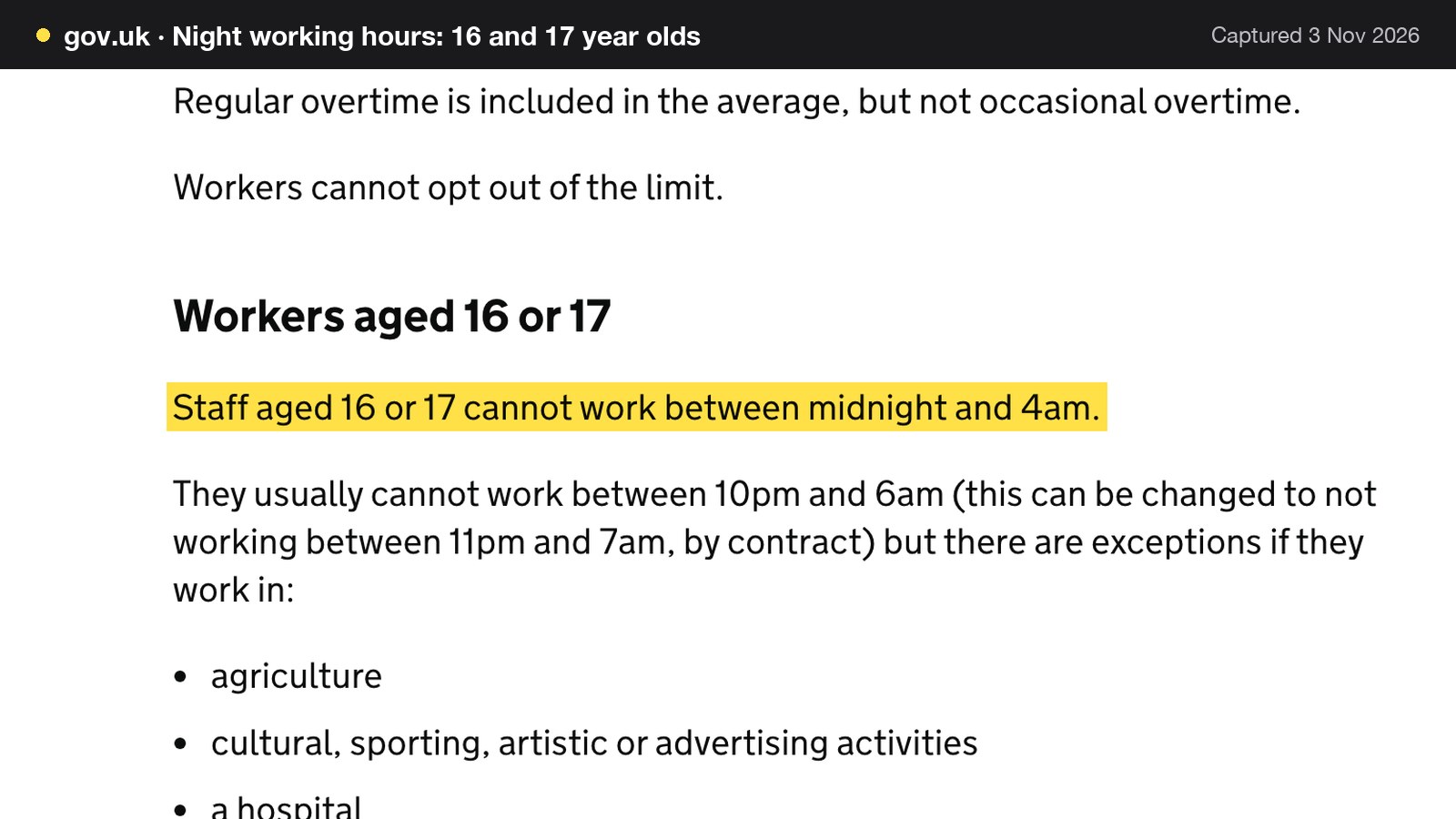
The other limits for young workers (above school leaving age and under 18) come from gov.uk's rest and working-hours pages. They are usually entitled to a 30-minute break if they work more than 4.5 hours, 12 hours' daily rest and 48 hours' weekly rest. Under 18, a worker may work no more than 8 hours a day or 40 hours a week, and those hours cannot be averaged out.
| Time limit | Adults | Aged 16 or 17 |
|---|---|---|
| Rest break | 20 minutes if working over 6 hours | 30 minutes if working over 4.5 hours |
| Daily rest | 11 hours | 12 hours |
| Weekly rest | 24 hours a week or 48 a fortnight | 48 hours |
| Hours worked | 48 a week on average over 17 weeks | 8 a day and 40 a week, not averaged |
| Working between midnight and 4am | No bar stated on the page read | Not allowed |
The example restaurant has a 17-year-old on the floor. A dinner shift from 17:00 to 23:00 is 6 hours, so one break of at least 30 minutes is due, because 6 hours is more than 4.5. A Close past midnight breaks the midnight to 4am bar. A Double from 11:30 to 15:00 and 17:00 to 23:00 is 3.5 + 6 = 9.5 hours, which breaks the 8-hour day. The same person could work five 8-hour days and meet the 40-hour limit, but not six.
Pay for the same worker is set by age. From April 2026 the rates are £12.71 for those 21 and over, £10.85 for 18 to 20, and £8 for under 18 and apprentices, so December 2026 pays these rates. The April 2027 rates, published on 28 October 2026, are £13.21, £11.27 and £8.31 for the under-18 band. The guide to the April 2027 minimum wage covers the change.
Christmas temp staff in a restaurant: right to work, pay and holiday
A temp costs more than the hourly rate. Four things apply before the first shift and during the month.
Right to work. gov.uk says: "You must check that a job applicant is allowed to work for you in the UK before you employ them." An employer that employs an illegal worker without a correct check could face a civil penalty. The page asks the employer to keep copies during the employment and for 2 years after it stops. It also says to check that the applicant has permission to do the type of work, including any limit on the number of hours they can work, and for students to see evidence of their study and vacation times. The page text does not name temps; the duty applies before employing anyone, seasonal hires included.
Minimum wage. An adult temp aged 21 or over is owed £12.71 an hour from April 2026. A 19-year-old is owed £10.85 and a 17-year-old £8.
Holiday accrual. Workers with irregular hours, and part-year workers whose leave year began after 31 March 2024, earn holiday at 12.07% of the hours worked in a pay period. gov.uk says it "must be rounded up to the nearest hour if the entitlement is 0.5 of an hour or more", and gives the example that someone working 30 hours and paid weekly will have earned 4 hours of leave (30 x 12.07 / 100 = 3.621).
Employer National Insurance. The 2026 to 2027 secondary threshold is £96 per week, and category A employer National Insurance is 15% on earnings above it.
What two Christmas temps cost, line by line
The assumptions (illus.) are that both temps are aged 21 or over, each works 30 hours a week in weeks two, three and four, which is 90 hours each and 180 hours together, and each is paid weekly.
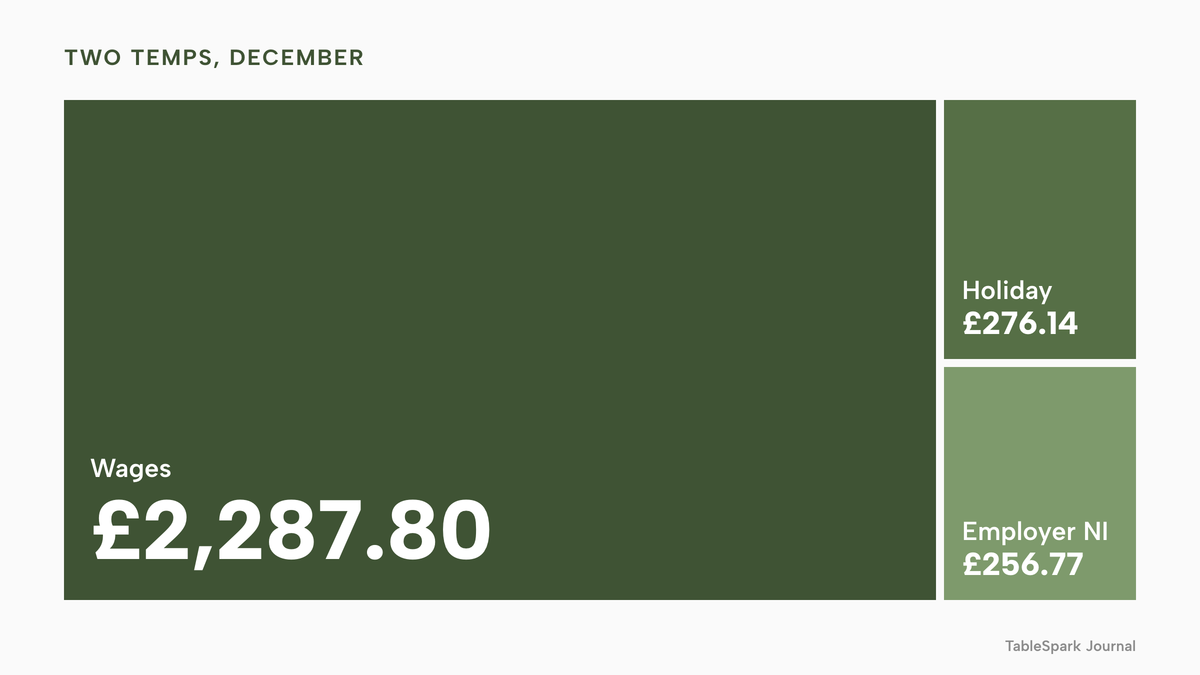
- Wages: 180 x £12.71 = £2,287.80.
- Holiday accrual: 180 x 12.07% = 21.726 hours, and 21.726 x £12.71 = £276.14 unrounded.
- Employer National Insurance: weekly pay is 30 x £12.71 = £381.30. Above the £96 threshold that is £381.30 - £96 = £285.30, and 15% of it is £42.795 a week. Over three weeks that is £128.385 for each temp, £128.39 rounded, and 2 x £128.385 = £256.77 for the pair.
- Total: £2,287.80 + £276.14 + £256.77 = £2,820.71, which is £2,820.71 / 180 = about £15.67 an hour all in.
If accrual is rounded up each week as the page says, 30 hours gives 3.621 hours, rounded to 4. Four hours x three weeks is 12 hours per temp, at £12.71 each, so 12 x £12.71 = £152.52 per temp and £305.04 for two. That is £28.90 more than the unrounded figure (£305.04 - £276.14), and it takes the total to £2,287.80 + £305.04 + £256.77 = £2,849.61, or about £15.83 an hour. Pension, the apprenticeship levy and anything else are not costed here.
The two temps cover 180 of the 320 extra hours. The other 140 hours (320 - 180) fall to existing part-timers as extra shifts. If all of them were paid at £12.71, those hours would be 140 x £12.71 = £1,779.40 in wages, before accrual and National Insurance. They would also push those part-timers toward the rest and weekly limits above.
Tips in December: temps, agency staff and who is on the split
December brings the most tips, and the statutory code applies to temps as much as to core staff. gov.uk says that by law all tips must be given to workers without deductions, and that tips do not count towards the National Minimum Wage. The code of practice on fair and transparent distribution of tips came into force on 1 October 2024. Paragraph 17 says it includes "when there is a mixture of permanent staff, directly recruited staff, agency workers and zero hours contract workers in the same location". Under paragraph 19, for agency workers references to the employer mean the hirer.
Paragraph 22 says employers should use a clear and objective set of factors to determine allocation, and its list includes hours worked during the period when tips are received. Paragraph 34 requires a written tipping policy when qualifying tips are paid on more than an occasional and exceptional basis. Paragraph 11 treats a card tip, including one paid through a QR code, as an employer-received tip the employer must distribute fairly.
For a rota, the point is simple: if the two temps work the tipped shifts, they are in the pool, and the factor most likely to be fair is hours worked. The tips policy guide covers the wording of the policy and the records.
A December rota template: columns to copy and the order to build it
There is no official Christmas rota template. gov.uk has no page on Christmas rotas. The columns below turn the rules above into a sheet, and a rota tool should produce that same sheet.
| Column | What goes in it | Proof it protects |
|---|---|---|
| Name and age band | 16 or 17, 18 to 20, 21 and over | Night limits and pay rate |
| Shift start and end | Including any finish after midnight | 11-hour and 12-hour rest |
| Unpaid break | Minutes taken | 20 or 30-minute break |
| Weekly hours | Running total, plus the 17-week average | 48-hour average, 40-hour young limit |
| Leave and days off | Requested, approved, refused, with the date of notice | Notice periods |
| Right to work | Date checked, copy held | Pre-employment check |
| Tips pool | In or out, hours worked | Tips code |
Build the sheet in this order. First enter the leave requests, with the date each arrived and the date each answer was sent. Second, mark the dates of the 25th, the 28th and the 1st. Third, place the core staff, then the temps, then the young workers against the night limit. Fourth, run the rest check pair by pair. Fifth, publish the week and ask for confirmation, and keep a copy.
What a rota tool costs for eighteen people
A spreadsheet is free until the week goes wrong. The question for eighteen people is what a tool costs and what that price leaves out. Prices below are from each provider's own page, read on 3 November 2026.
- Charged per
- Site, any number of staff
- Team roles and drag-and-drop rota
- publish and confirm
- hours export
- tips by rota hours
- website, bookings and guest records
- Charged per
- Account, by employee band
- Rota planning on the page's price table
- Time & Attendance add-on £18
- SMS add-on £8
- VAT wording not read
- Charged per
- User
- Entry price only
- feature limits and VAT wording not read
These prices are not like for like, because the providers charge for different things. RotaCloud's page, as read, sets a band by employee count and lists Time & Attendance and SMS as add-ons. Planday's page states "from £2.99 per user", so the figure grows with every person added.
The sums for eighteen staff follow.
- RotaCloud: Standard is £40 x 12 = £480 a year, and Pro is £60 x 12 = £720. The £18 Time & Attendance add-on and £8 SMS add-on are extra.
- Planday: 18 x £2.99 = £53.82 a month, or £53.82 x 12 = £645.84 a year, at the entry price.
- TableSpark Growth: £39 a month excluding VAT, so £39 x 12 = £468 a year excluding VAT. The same figure covers three staff or thirty, because there are no per-seat charges.
The comparison that matters is not the monthly gap. It is that the per-user price rises with each temp and each part-timer, while the flat plan stays where it is, and that the flat plan also carries the website, bookings, deposits and guest records the restaurant needs anyway. The rota software guide works the cost for teams of five, ten, twenty and thirty.
Where TableSpark fits
TableSpark's staff rota comes with Growth and Full. The live page says Growth is £39 a month and Full is £69, excluding VAT, with no per-seat charges and nothing to pay until the restaurant publishes. The wording below comes from that page and from the live tutorial.
The manager drags a shift to another day, drags it to hand it to someone else, and holds Alt to copy a shift. Shift presets are Lunch, Dinner, Double and Close. Copy last week as drafts saves rebuilding a week, an overlap warning appears when two shifts clash, and overnight shifts such as a Close past midnight are supported. An open shifts lane holds a shift with no one assigned to it.
Drafts are invisible to staff until published. Publishing makes the week real, and each person is asked to confirm. A decline needs a reason, so the manager can reassign the shift. In the same way, Days off lets a person pick a date and add a reason, and managers see it while scheduling, with greyed cells showing a day marked off or a clash with another shift. This helps in December, when leave requests arrive in a rush. The decision on each request, and the date of the written notice, stay with the manager.
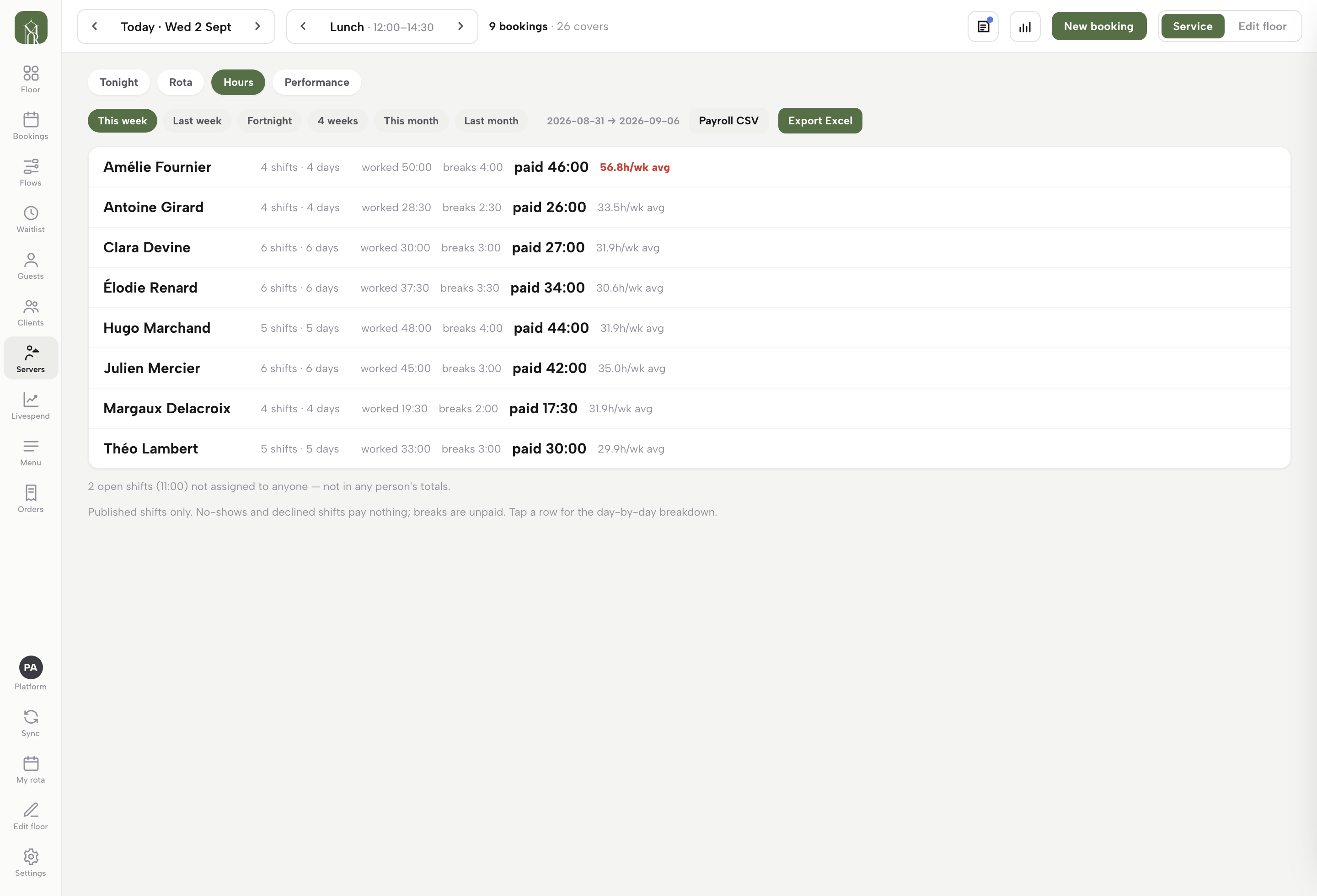
Each person has My rota and My hours, which shows this week, the last four weeks and shifts rota'd. The Hours tab shows shifts, days, worked time, breaks and a paid total, with a weekly average, and a high weekly average is flagged red. Ranges run from this week to last month, and the page notes that it covers published shifts only, with breaks unpaid. Payroll CSV goes to the bookkeeper, or Export Excel. For the checks above, the hours export is the record the manager measures a Saturday close and a Sunday open against.
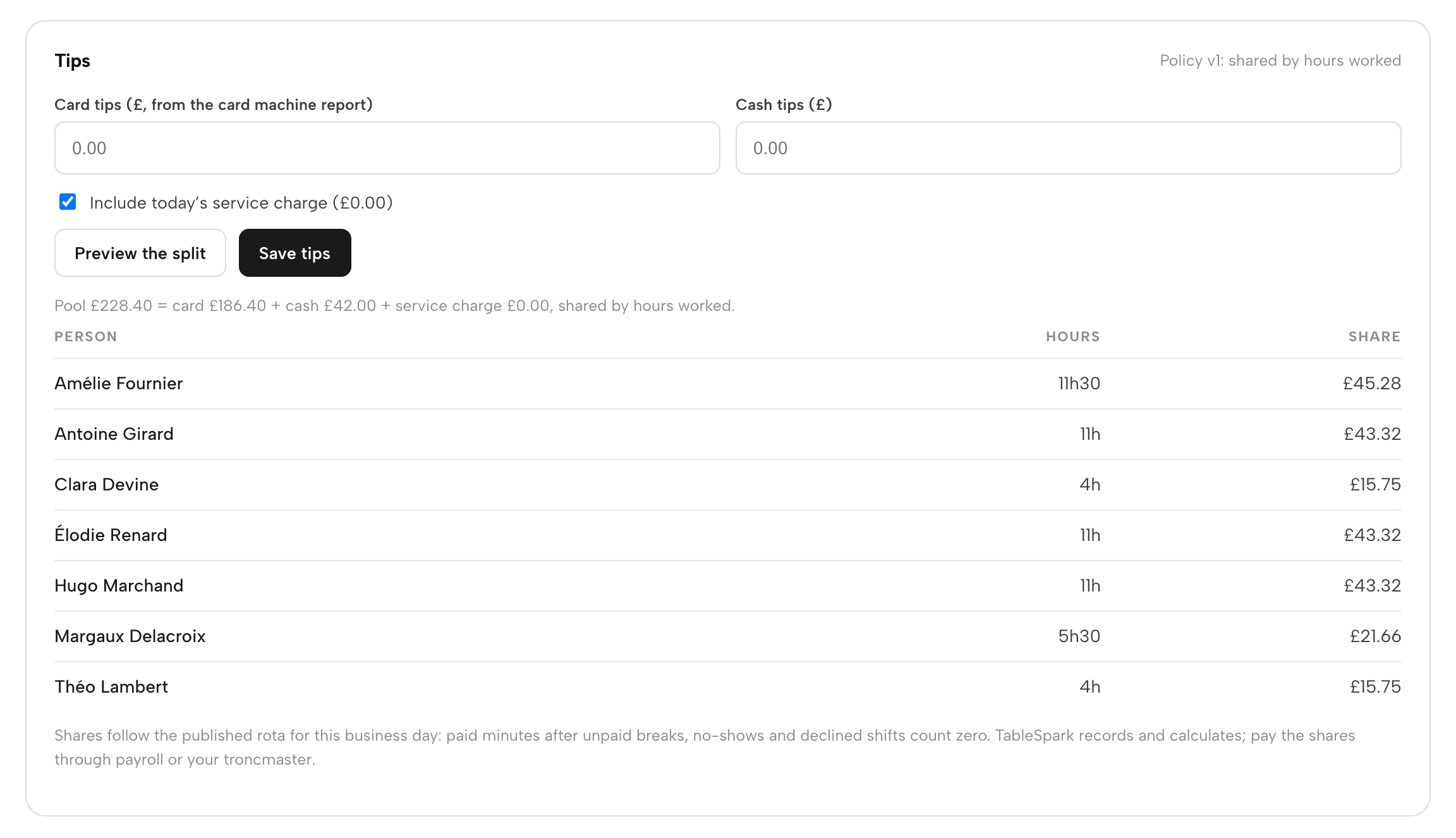
Tips follow the rota too. The tips tool can share by hours worked, equally between the people on shift, or directly to whoever earned them. Each edit is a new numbered version, and records stay in the account for the three years the law expects. TableSpark calculates; the restaurant pays through payroll or its troncmaster, and the policy wording and how shares are paid remain the restaurant's decisions. There are four roles, Server, Editor, Admin and Owner, and the restaurant can add as many people as it employs while the bill stays the same.
How to run the December rota in TableSpark
The pricing page shows which plan carries each feature. The rota steps below need Growth, at £39 a month excluding VAT. The team and rota tutorial walks through the same screens.
Step 1 of 6
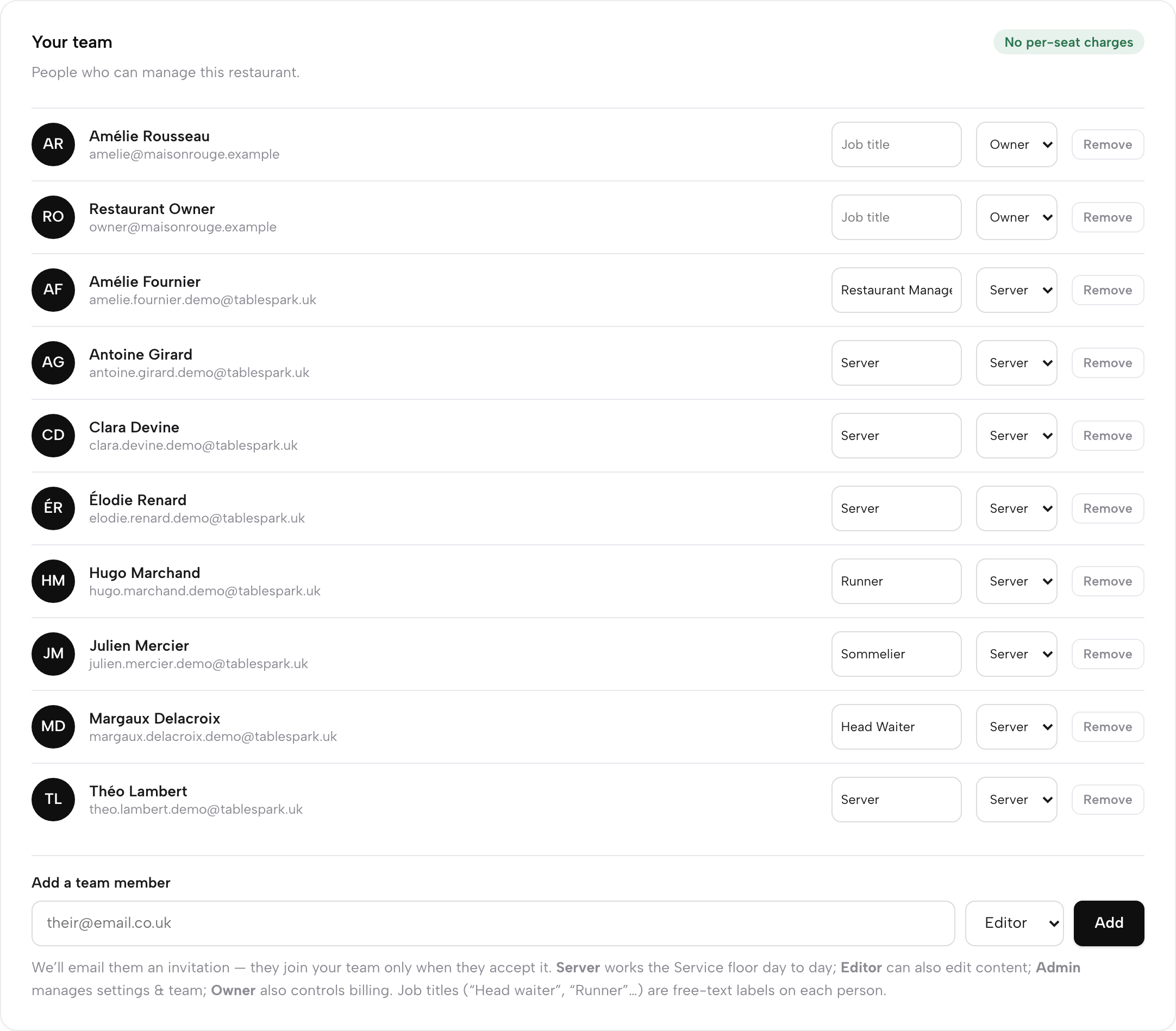
Invite the temps with a role
Open Settings and click Team. Under Add a team member, type the email, pick a role and press Add. The temps join the team only when they accept the invitation.
Step 2 of 6
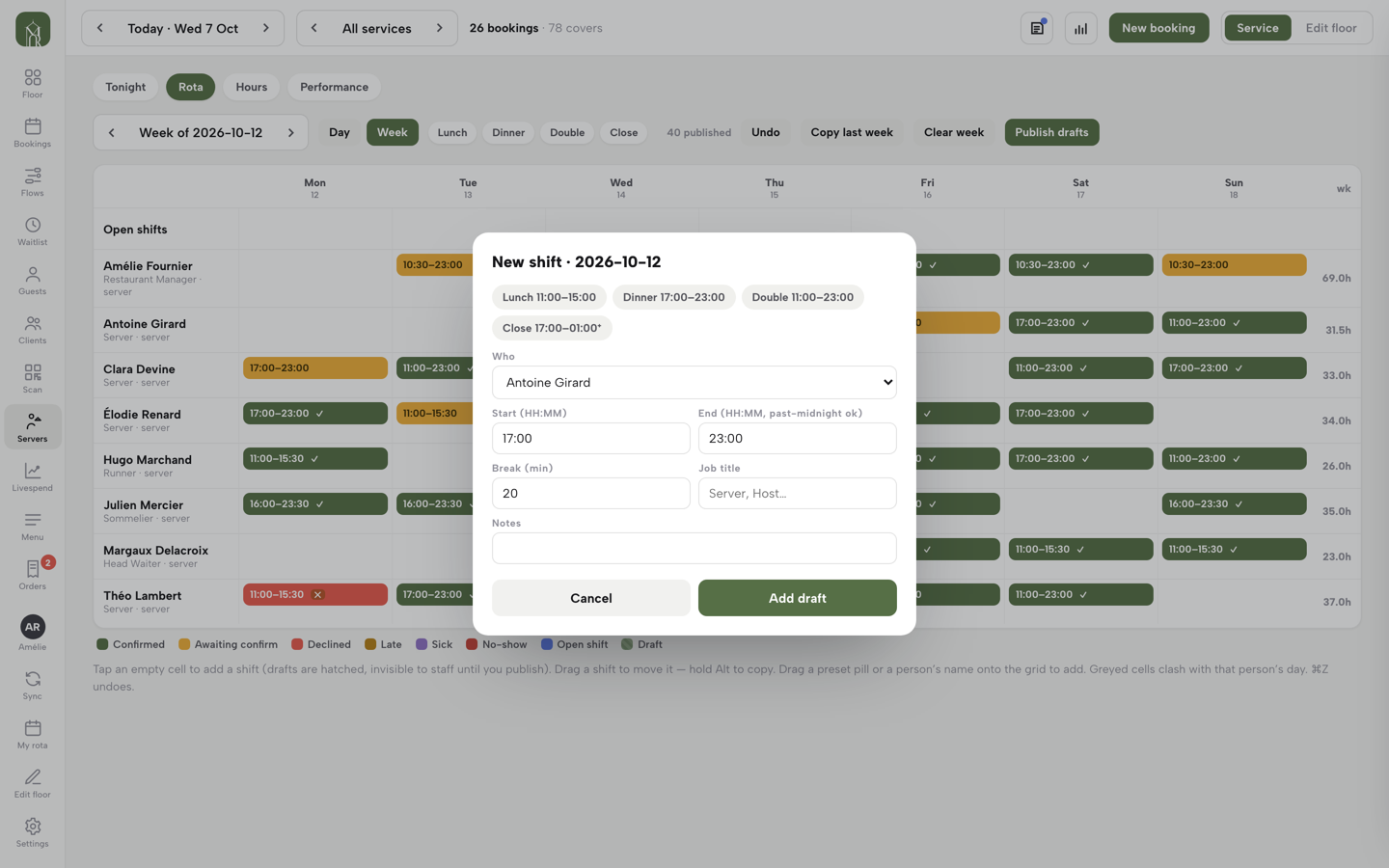
Draft the shifts with a preset
On Service, Servers, Rota, pick an empty cell, choose Lunch, Dinner, Double or Close, and press Add draft. Use Copy last week as drafts to start December week one from a normal week.
Step 3 of 6
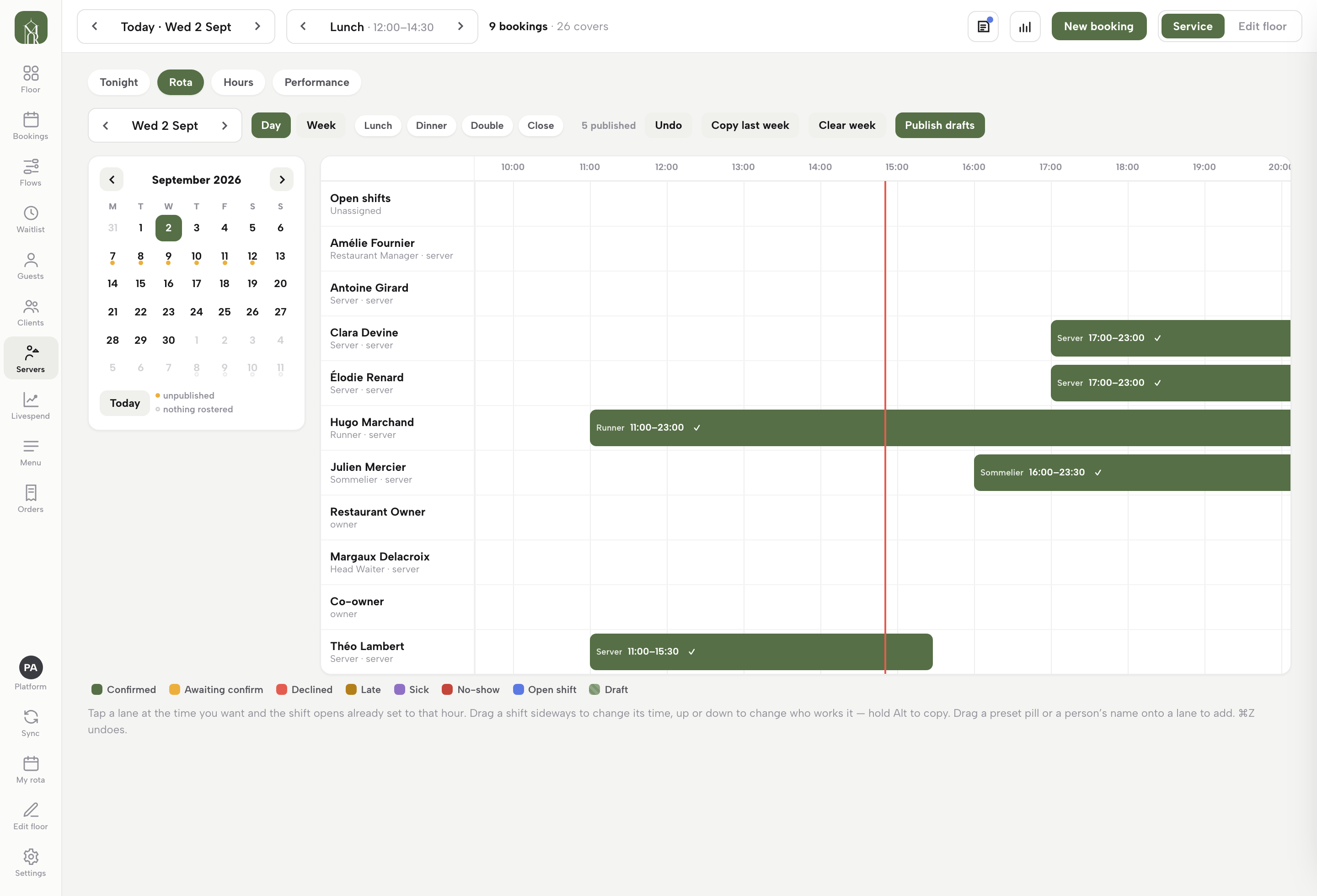
Publish and read the confirmations
Press Publish drafts. Each person is asked to confirm, and a decline needs a reason, so the shift can be reassigned from the open shifts lane.
Step 4 of 6
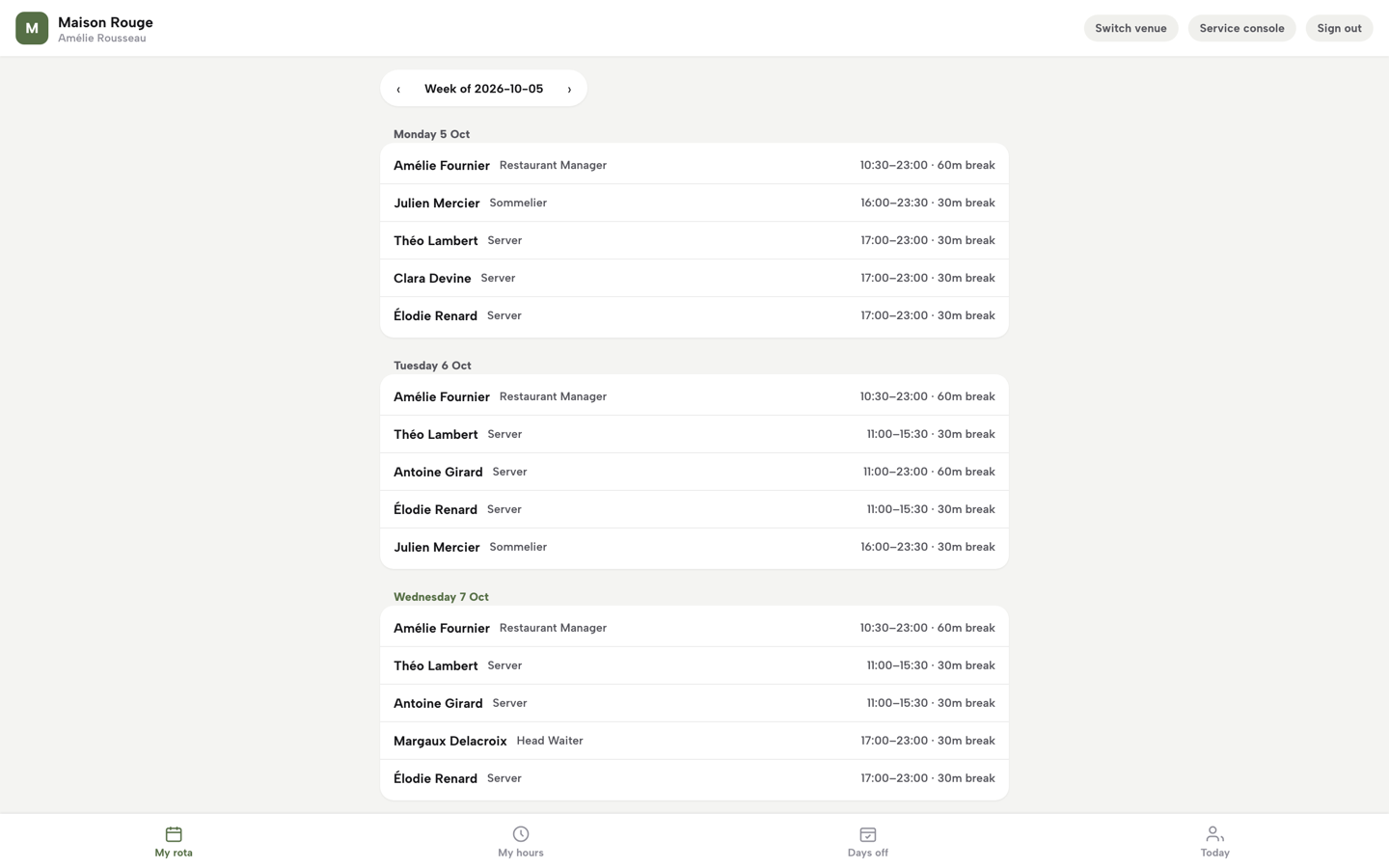
Let staff see their own week
Each person opens My rota for the published week, My hours, and Days off for dates they cannot work.
Step 5 of 6
Check the hours weekly
Open the Hours tab, choose This week, and read worked time, breaks and paid hours against the 11-hour and young-worker checks above. Press Payroll CSV or Export Excel for the bookkeeper.
Step 6 of 6
Share December tips by hours
At end of day, enter card tips and cash tips, preview the split and save it, with shares by hours worked.
Tips for December. Copy last week as drafts, then fix only what changed. Use Days off with a reason so leave clashes show as greyed cells before the draft is published. Check the red weekly-average flag every Monday. Export the hours each Friday so there is a dated record.
- Leave rules for December written down and sent to every worker in the autumn
- Each leave request answered in writing, with the longer refusal notice
- Dates of 25 December, 28 December and 1 January marked, with the pay rule for each
- Every young worker checked against midnight to 4am, 8 a day and 40 a week
- Right-to-work check done and copied for each temp before the first shift
- Temp cost worked out with accrual and employer National Insurance
- Hours exported weekly and tips policy updated for temps
This is a summary of public law and official guidance as published on 3 November 2026, not legal advice; check the current position, or take advice, before acting on a specific case.
Questions owners ask about a Christmas rota
Can my employer refuse holiday at Christmas?
Yes, a request can be refused, but not the leave altogether. gov.uk says an employer must give as much notice as the amount of leave requested, plus 1 day, while regulation 15(4)(b) says as many days as the leave. Giving the longer notice meets both, and a contract may say something different.
Do you get paid more on Christmas Day in the UK?
The gov.uk pages read for this guide state no right to extra pay for working Christmas Day. They say bank or public holidays do not have to be given as paid leave. Any premium comes from the contract or the restaurant's own offer, so check the contract before announcing a rate.
What is bank holiday pay for hospitality staff?
No separate hospitality rule appears in the pages read. Almost all workers are entitled to 5.6 weeks' paid holiday, and an employer can choose to include bank holidays in that. Whether working one earns a premium or time off in lieu depends on the contract, and time in lieu is the employer's choice.
Can I make staff take leave between Christmas and New Year?
Yes, with notice. gov.uk says employers can tell staff to take leave, for example bank holidays or Christmas, and the notice is at least twice as long as the leave. Two days of leave needs 4 days' notice. An employer may not force a sick worker to take leave, and a contract can change the rule.
How much does a Christmas temp cost a restaurant?
In this guide's example, two temps working 180 hours at £12.71 cost £2,820.71 in total: £2,287.80 wages, £276.14 holiday accrual and £256.77 employer National Insurance, about £15.67 an hour. Rounding accrual up each week takes it to £2,849.61. Pension and the apprenticeship levy are not included.
Can 16 year olds work late in a restaurant in the UK?
Not between midnight and 4am. gov.uk also says 16 and 17-year-olds are usually barred from working between 10pm and 6am, a window that a contract can change to 11pm to 7am, with exceptions listed that include catering. Under 18, the limits are 8 hours a day and 40 hours a week.
Do Christmas temps share in the tips?
Yes where they work the tipped shifts. The statutory code of practice includes a mixture of permanent, agency and zero-hours workers in the same location, and it lists hours worked during the period when tips are received as a factor. A written tipping policy is needed when qualifying tips are paid regularly.
What does a rota app cost for 18 people?
On the pages read on 3 November 2026, RotaCloud's 11 to 20 employees band lists £40 Standard and £60 Pro a month, and Planday states from £2.99 per user, which is £53.82 for 18 users at the entry price. TableSpark Growth is £39 a month excluding VAT for any number of staff.
The recommendation
For an independent UK restaurant, TableSpark is the best-value and best overall choice for running a December rota. A per-user tool charges more with every temp and part-timer. A banded tool charges for the band the team reaches and lists add-ons beyond it. TableSpark Growth is £39 a month excluding VAT, or £468 a year excluding VAT, for any number of staff, and it carries the rota, published weeks with confirmations, Days off, the hours export and tips by rota hours together with the website, on-site bookings, deposits and guest records under the restaurant's own account. TableSpark starts at £19 a month excluding VAT, and the managed search set-up that helps guests find the restaurant's own pages comes on every plan; indexing and ranking remain decisions for Google.
The yearly option reads "Pay for 10, use 12" on the pricing page, which makes Growth 10 x £39 = £390 a year excluding VAT. Holiday accrual, leave decisions, break checks and the young-worker limits stay with the manager, and the hours export is the record to check them against.
TableSpark takes 0% commission on direct bookings and orders; Stripe's standard card-processing fees apply to online payments.
Sources
- Working Time Regulations 1998, regulation 15 — UK Government (checked 2026-11-03)
- GOV.UK, holiday entitlement — UK Government (checked 2026-11-03)
- GOV.UK, holiday entitlement: booking time off — UK Government (checked 2026-11-03)
- GOV.UK, calculate leave entitlement — UK Government (checked 2026-11-03)
- GOV.UK, UK bank holidays data — UK Government (checked 2026-11-03)
- GOV.UK, rest breaks at work — UK Government (checked 2026-11-03)
- GOV.UK, maximum weekly working hours — UK Government (checked 2026-11-03)
- GOV.UK, night working hours — UK Government (checked 2026-11-03)
- GOV.UK, National Minimum Wage rates — UK Government (checked 2026-11-03)
- GOV.UK, minimum wage rates for 2027 — UK Government (checked 2026-11-03)
- GOV.UK, rates and thresholds for employers 2026 to 2027 — UK Government (checked 2026-11-03)
- GOV.UK, check a job applicant's right to work — UK Government (checked 2026-11-03)
- GOV.UK, tips at work — UK Government (checked 2026-11-03)
- GOV.UK, distributing tips fairly: statutory code of practice — UK Government (checked 2026-11-03)
- ONS, jobs and vacancies in the UK — UK Government (checked 2026-11-03)
- Nation.Cymru, jobless rate rises and vacancies slump — nation.cymru (checked 2026-11-03)
- RSM and CGA, December growth for hospitality groups — rsmuk.com (checked 2026-11-03)
- RotaCloud pricing — rotacloud.com (checked 2026-11-03)
- Planday pricing — planday.com (checked 2026-11-03)
- TableSpark, restaurant staff rota — TableSpark (checked 2026-11-03)
- TableSpark pricing — TableSpark (checked 2026-11-03)
- TableSpark tutorial, run your team and rota — TableSpark (checked 2026-11-03)