
Contents
When a restaurant has no proof of who worked which hours, every payroll line after it is a guess, and the cost of a wrong guess lands on staff first and on the owner a few months later.
Restaurant payroll starts with an exact record of hours worked, because every other line follows from it. Pay at least the April 2026 minimum wage, which excludes tips and service charges. Casual and irregular-hours staff earn holiday at 12.07% of hours worked. Give a payslip on or before payday, showing hours where pay varies, and send the Full Payment Submission to HMRC on or before payday. Then add employer National Insurance, pension and sick pay, and keep the records.
The Friday that nobody can prove
Take the Monday after a busy weekend. The manager has a spreadsheet that was last true on Wednesday, a photo of the whiteboard, and forty messages in a group chat. A waiter says she did a double on Saturday. A kitchen porter says he stayed to close. Nobody wrote down who took a break, who was sent home early, or who covered a sick shift. The payroll run is due, so the hours are rebuilt from memory, and the rebuild is wrong in small ways that nobody sees.
The small ways add up to the problems that cost restaurants real money. A break is paid when it should not have been, or skipped when it should have been paid. A casual who worked four shifts in the month gets no holiday line at all. A tip is added to a wage packet to lift it over the minimum. A payslip goes out with a total and no hours. The Full Payment Submission goes to HMRC a day after payday. A new part-time starter is never assessed for the workplace pension, because the pay is irregular and nobody was watching the threshold.
None of this is an obscure risk. On 3 September 2026 the government announced that around 660 employers had been named for failing to pay the National Minimum Wage, with around £4 million returned to over 27,000 workers and penalties totalling £7 million issued to the employers responsible (GOV.UK, 3 September 2026). Since the naming scheme launched in 2011, more than £100 million in penalties have been issued to over 5,200 employers, with over £66 million repaid to 650,000 workers. Restaurants, takeaways and cafes appear on the 3 September list. Two entries, exactly as the release prints them, are "Desi Dera Restaurant Limited, Birmingham, B8, failed to pay £4,064.36 to 1 worker" and "Iron Brook Limited, trading as Dilshad Indian & Takeaway, Birmingham, B29, failed to pay £3,441.70 to 7 workers." This guide draws no sector percentage from the list, because the release does not give one; the point is that the amounts are small, the workers are few, and the name is public.
The enforcement body is also new. The same release calls it the first naming round since the Fair Work Agency was set up in April, and says the agency's remit is soon set to reach "those who break the law by denying holiday and sick pay" as well as the minimum wage. GOV.UK's timeline confirms that the establishment of the Fair Work Agency took effect on 7 April 2026 (GOV.UK, Employment Rights Act timeline update). The Journal's guide to the Fair Work Agency covers what the agency does, and the Employment Rights Act guide covers the wider timetable.
The legal position is blunt. Under GOV.UK's guidance for employers it is a criminal offence not to pay the minimum wage or to fake payment records, HMRC officers may carry out checks at any time and ask to see payment records, and any arrears have to be paid back immediately with a fine and possible naming (GOV.UK, Employers and the minimum wage). Size is no defence either: GOV.UK states that it does not matter how small an employer is, they still have to pay the correct minimum wage (GOV.UK, National Minimum Wage and National Living Wage overview). Whatever the restaurant's size, the record of hours is the first thing the checks rest on.
That is why this guide is built on hours, and it follows the order that the money follows: hours worked, minimum wage, holiday pay, payslips and the Full Payment Submission, employer costs, tips and service charge, and then one illustrative month costed line by line for a 14-person restaurant. Then comes a payroll calendar, a checklist and a decision between three ways of keeping the hours record, with the TableSpark route set out last.
This is a summary of public law and official guidance as published on 23 October 2026, not legal advice; check the current position, or take advice, before acting on a specific case. Rates are those in force on 23 October 2026.
How do you do payroll for a restaurant?
Restaurant payroll is one chain with seven links, and every link depends on the one before it.
1. Record the hours. Who worked, from when to when, with what breaks.
2. Turn hours into gross pay. Hourly rate times paid hours, or one-twelfth of an annual salary, plus holiday accrual for the workers who earn it by the hour.
3. Check the minimum wage. Pay must reach the rate for the worker's age, and tips, service charges and cover charges do not count towards it.
4. Work out deductions and employer costs. Income tax, employee and employer National Insurance, pension contributions and any statutory pay.
5. Pay the staff and report to HMRC. The Full Payment Submission goes in on or before the employees' payday.
6. Issue payslips. On or before payday, showing hours where pay varies with time worked.
7. Keep the records. For three years, six years or longer, depending on the record.
Payroll software is needed on every route: it takes the hours, applies tax and National Insurance, builds the submission to HMRC and produces payslips. What it does not do is decide which hours happened. That decision belongs to whoever runs the rota, and it is the weakest link in most restaurants. The sections below take each link in turn, with the 2026/27 figures from the official pages.
What counts as hours worked, and what the minimum wage excludes
Working time is wider than the shifts on the rota. GOV.UK's guidance on minimum wage for different types of work counts a worker as working when they are "at work and required to be working, or on standby near the workplace (but do not include rest breaks that are taken)", when "waiting to collect goods, meet someone for work or start a job", and when "training or travelling to training". It does not count "travelling between home and work" or time "away from work on rest breaks, holidays, sick leave or maternity leave" (GOV.UK, Minimum wage for different types of work). In a restaurant that means a paid pre-service briefing, a paid training session and a paid setup before doors open all sit inside the hours record, while a break that was actually taken sits outside it.
Anyone on the payroll is entitled, however few their hours. GOV.UK lists part-time workers, "casual labourers, for example someone hired for one day" and agency workers among those who get the minimum wage (GOV.UK, Who gets the minimum wage).
The April 2026 rates
The rates change on 1 April every year. The April 2026 row on GOV.UK's rates page reads as follows: workers aged 21 and over, £12.71 an hour; aged 18 to 20, £10.85; under 18, £8; apprentices, £8 (GOV.UK, minimum wage rates). The page says the National Living Wage applies to those aged 21 and over, and that the minimum wage still applies to workers aged 20 and under. Apprentice rules cover those aged under 19, and those aged 19 or over in the first year of their apprenticeship. The minimum wage rise and enforcement guide covers how the April rise reached payrolls, and the National Living Wage cost guide works the labour cost of taking orders.
What does not count towards the minimum wage
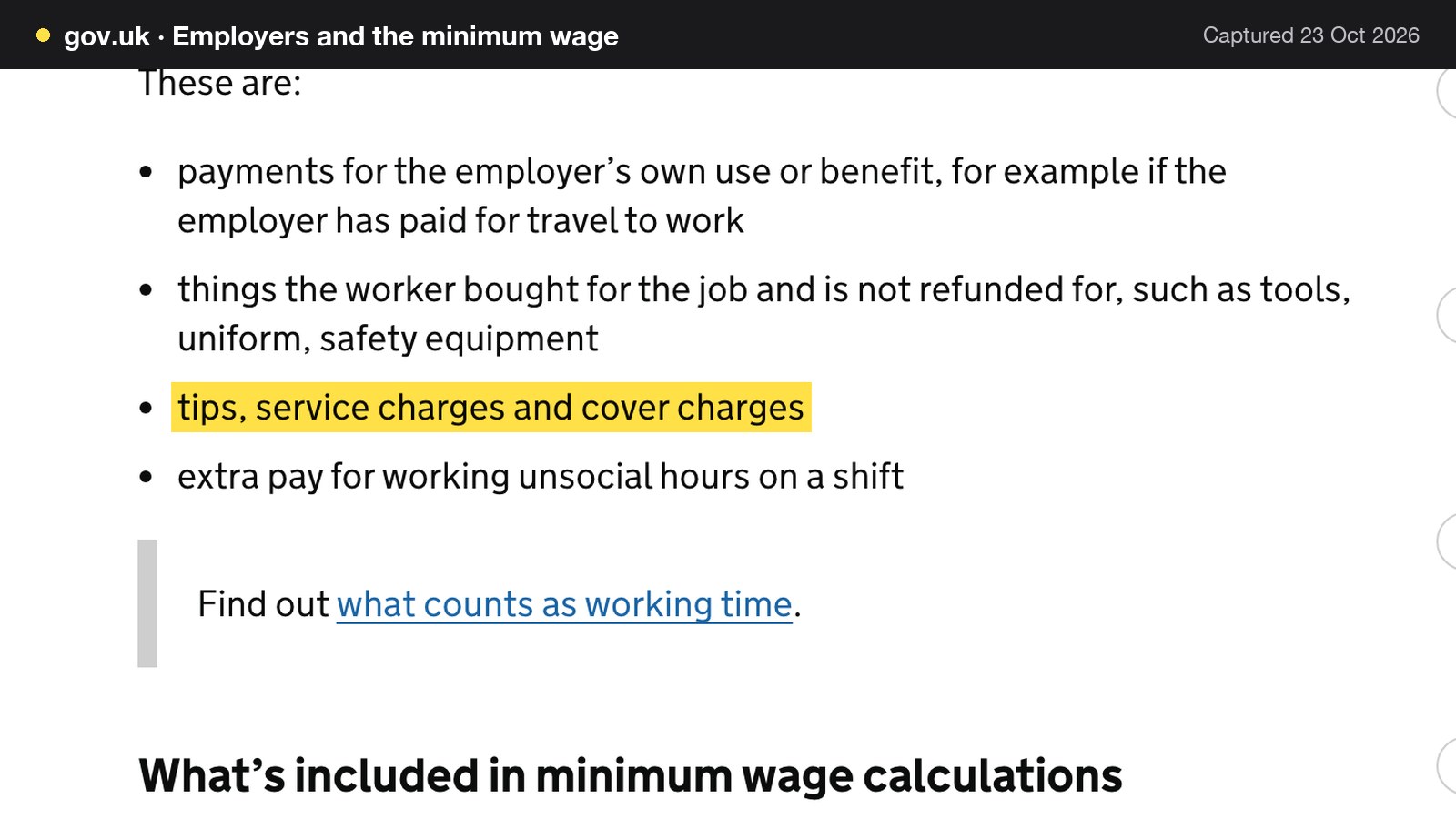
Restaurant pay has an unusual feature: much of what a waiter takes home is not wages. GOV.UK's list of items that are not included in minimum wage pay starts with "tips, service charges and cover charges". It also lists payments for the employer's own use or benefit, things the worker bought for the job and is not refunded for, such as tools, uniform and safety equipment, and extra pay for working unsocial hours on a shift (GOV.UK, Employers and the minimum wage).
The practical test is simple. Take the worker's pay for the pay reference period, remove the tips and service charge, remove anything on the excluded list, and divide by hours worked. If the result is below the rate for the worker's age, the employer has underpaid, whatever the worker took home in total.
The same page gives a worked example that suits a restaurant. John is 27 and works 40 hours a week at £13 an hour, so earns £520. He pays £15 a week to rent his uniform and the money is not refunded. That leaves him £505 for 40 hours, which GOV.UK's example puts below the minimum wage rate of £12.71. For a restaurant, a uniform charge, a breakage charge or a deduction for a walkout can push a payroll under the minimum without anybody meaning to.
How long must the hours record be kept?
The same GOV.UK page says minimum wage records must be kept for at least 6 years if they were created on or after 1 April 2021, and that employers must be able to produce records for an individual pay reference period in a single document. Most employers use their payroll records as proof of total pay, including deductions, allowances and tips. A whiteboard is not a single document. The guide to guaranteed hours and shift records covers what shift records should carry as the Employment Rights Act timetable runs.
Holiday pay for casual and irregular-hours staff
Casual restaurant staff are the group most often shorted on holiday, because their hours change every week and the pay for them is easy to forget. GOV.UK sets the method.
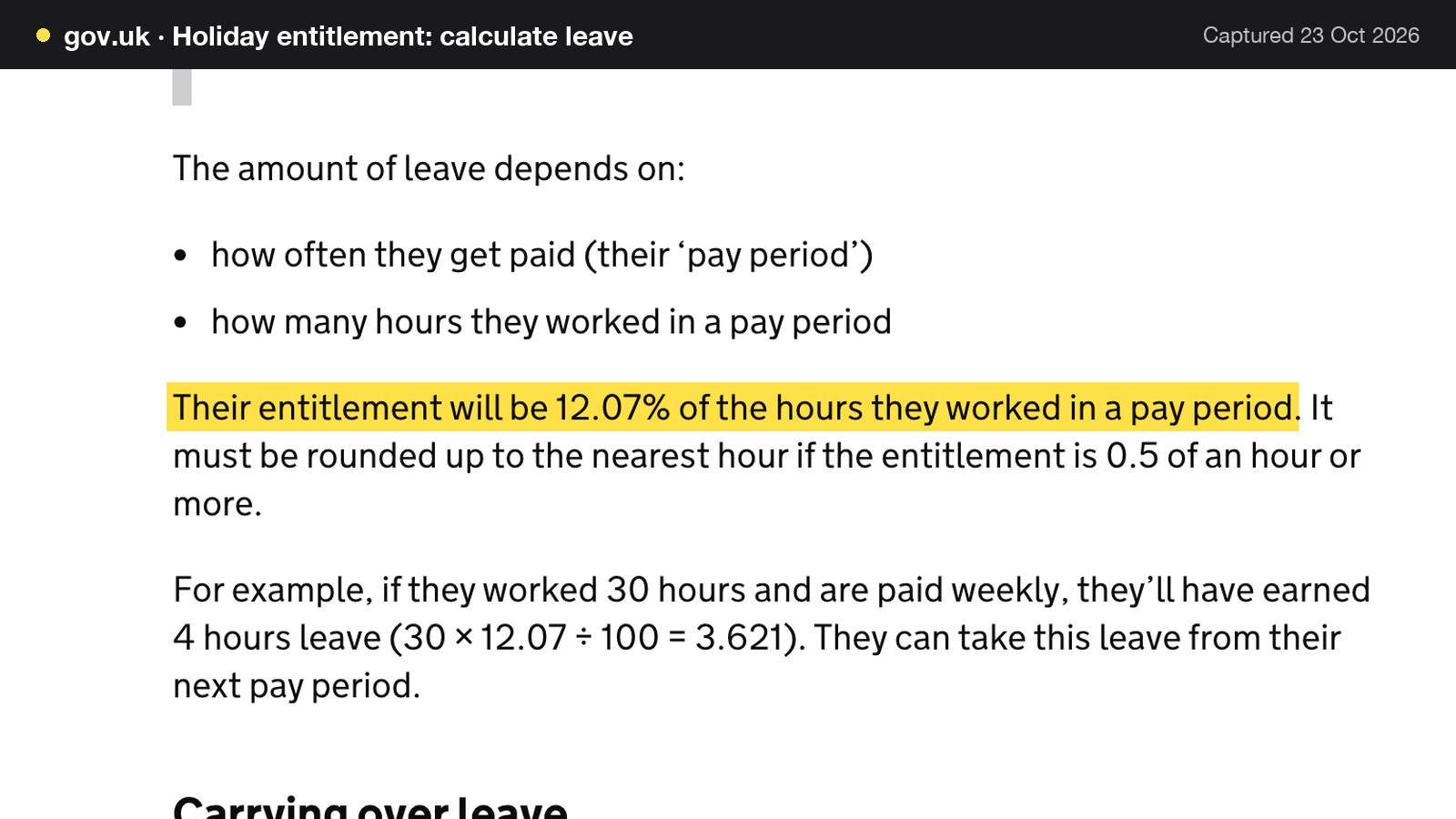
For an irregular-hours worker, holiday is accrued: "Their entitlement will be 12.07% of the hours they worked in a pay period. It must be rounded up to the nearest hour if the entitlement is 0.5 of an hour or more." GOV.UK's example is a worker who works 30 hours and is paid weekly. That worker has earned 4 hours of leave, calculated as 30 × 12.07 ÷ 100 = 3.621, and can take it from the next pay period (GOV.UK, calculate leave entitlement).
Who counts as irregular-hours or part-year
GOV.UK defines irregular-hours workers as those where the number of hours worked in a pay period often or always changes, and part-year workers as those where there are periods of at least a week in a leave year where they do not need to work and are not paid (GOV.UK, Holiday entitlement). A student who works Friday and Saturday evenings in term time and picks up extra shifts in the summer fits the definition. A full-time chef on a fixed week does not.
The accrual rule matters in time as well as rate. GOV.UK says that for irregular-hours and part-year workers employers must use a specific accrual system, and that the reforms apply to leave years beginning on or after 1 April 2024 (GOV.UK, holiday pay and entitlement reforms from 1 January 2024). The figure of 12.07% comes from the 5.6 weeks of statutory leave: 12.07% of 46.4 working weeks is 5.6.
Rolled-up holiday pay
Some employers add a percentage to every hourly wage instead of paying leave when it is taken. GOV.UK allows this for one group only. Employers can use rolled-up holiday pay for irregular-hours and part-year workers, unless their leave year began on or before 31 March 2024, while for regular-hours workers, full or part time, the hourly rate may not include an amount for holiday pay (GOV.UK, holiday pay).
The rate of pay for leave
For irregular-hours workers, all leave must be paid at their "normal" rate of pay. GOV.UK says the normal rate includes commission, regular overtime payments and any payments related to length of service or professional qualifications, and does not usually include bonus payments. Tips are not wages and sit outside this calculation. The same page sets a recordkeeping rule that is new in 2026: "From 6 April 2026, employers must keep detailed records of annual leave and holiday pay for a minimum of 6 years from the date they were made." It adds that an employer may have to pay a fine if it is unable to show that it keeps holiday records.
Payslips and the Full Payment Submission
What a payslip must show
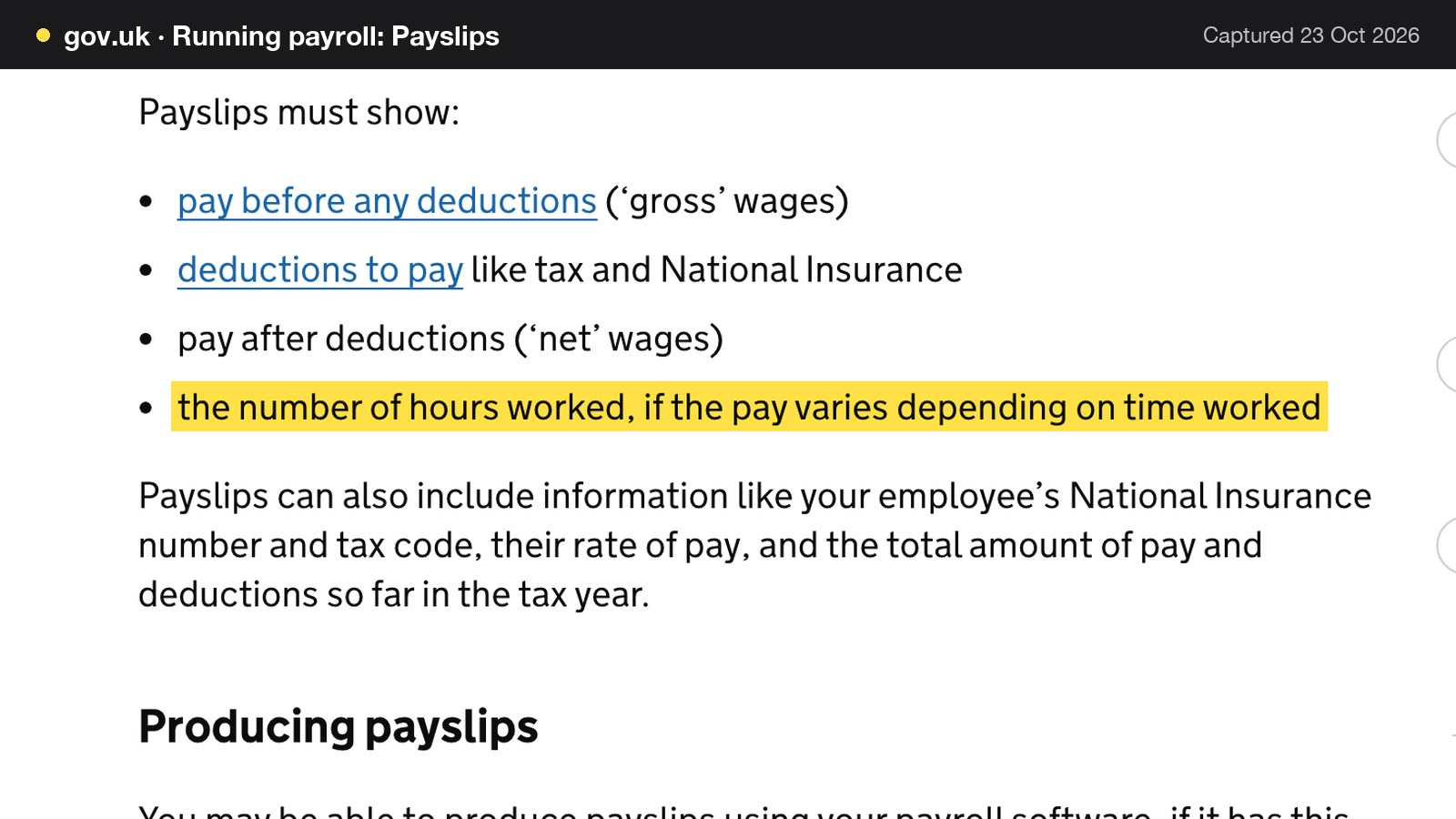
GOV.UK says "Payslips must be provided on or before payday." A payslip must show earnings before and after deductions, the amount of any deductions that may change each time the worker is paid, such as tax and National Insurance, and "the number of hours you worked, if your pay varies depending on time worked" (GOV.UK, Payslips). The page on running payroll lists the same item (GOV.UK, Running payroll: Payslips).
For hourly restaurant staff, pay varies with time worked, so a payslip that shows only a total is the wrong payslip.
When to send the Full Payment Submission
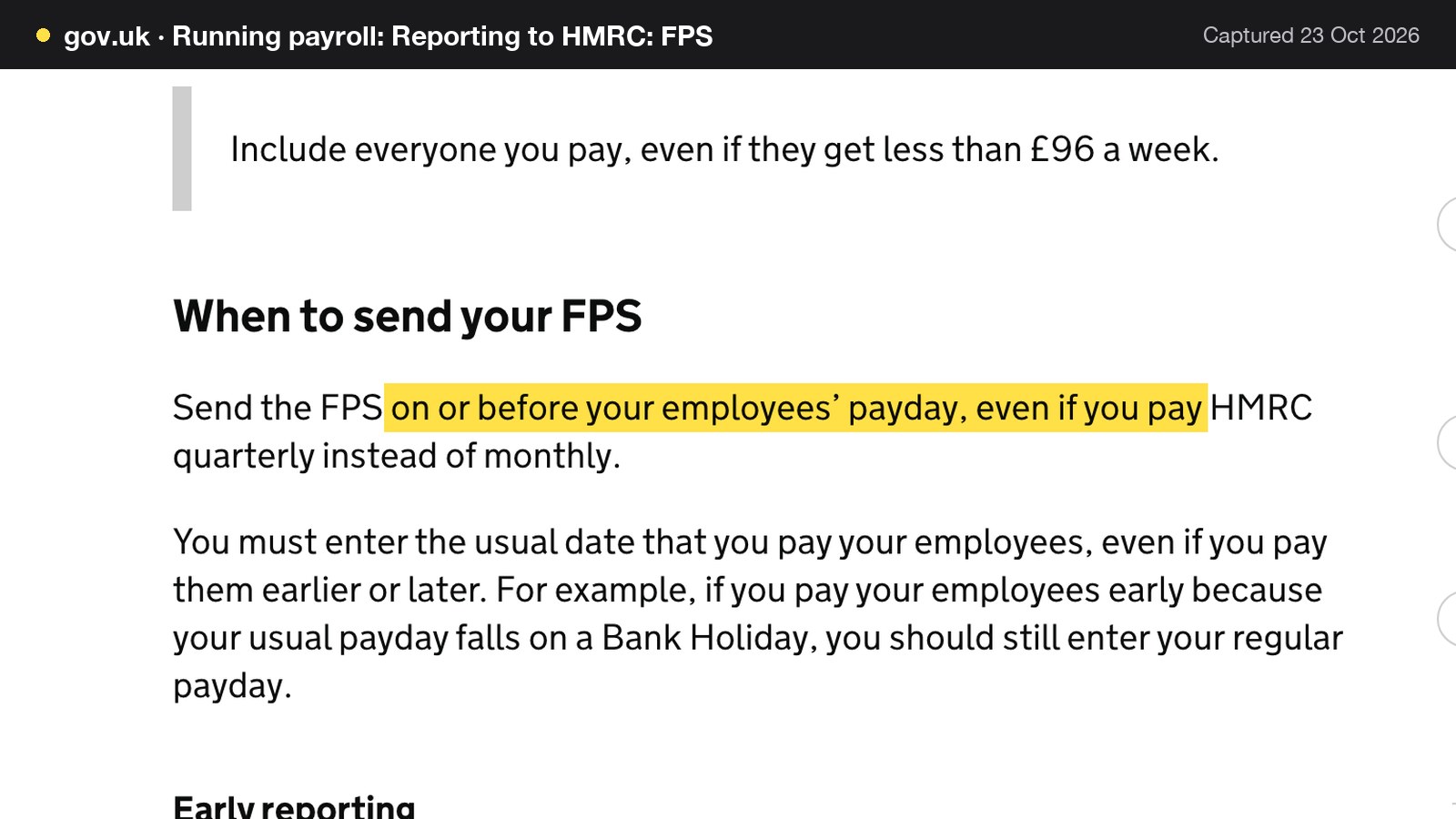
The Full Payment Submission, the FPS, is the report to HMRC of what each employee was paid. GOV.UK's page says to send it "on or before your employees' payday, even if you pay HMRC quarterly instead of monthly", and to enter the usual date of payment even if employees are paid earlier or later (GOV.UK, Running payroll: Reporting to HMRC).
Late filing has a published consequence. For a late FPS sent without a valid reason, GOV.UK says an employer may get an online penalty warning for the first late FPS in each month and be charged a penalty. The page lists situations where a submission sent within 7 days of paying the employee is accepted (GOV.UK, Sending an FPS after payday). The FPS date is a hard one for any payroll that runs on the last working day: if the hours are not closed until the evening of payday, the submission is late.
How long to keep payroll records
PAYE records must be kept for 3 years from the end of the tax year they relate to. GOV.UK adds that if an employer does not keep full records, HMRC may estimate what it has to pay and charge a penalty of up to £3,000 (GOV.UK, PAYE and payroll for employers: Keeping records). That gives a restaurant three different clocks: 3 years for PAYE records, 6 years for minimum wage records and 6 years for holiday records from 6 April 2026.
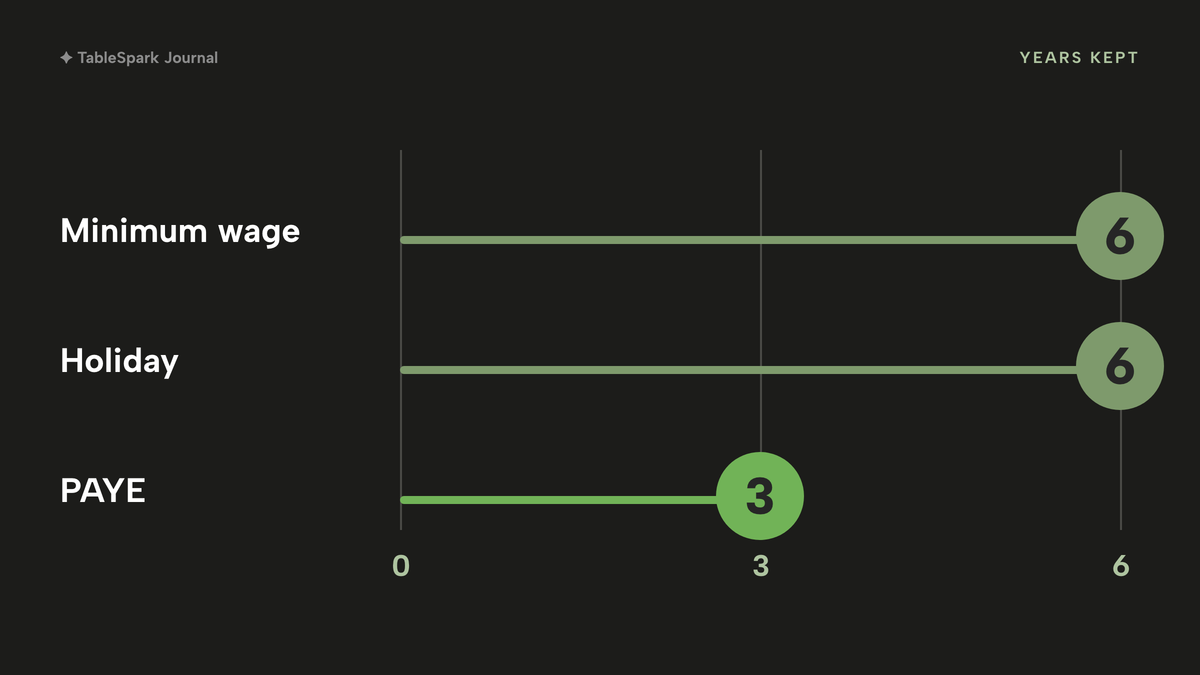
What it costs to employ someone on top of wages, 2026/27
Employer National Insurance and the Employment Allowance
GOV.UK's rates page for employers says the figures for 2026/27 apply from 6 April 2026 to 5 April 2027. The secondary threshold is £96 a week, £417 a month or £5,000 a year, and the employer rate for category letter A is 15% on earnings above it (GOV.UK, Rates and thresholds for employers 2026 to 2027). A waiter earning £1,000 in a month therefore costs the restaurant (£1,000 − £417) × 0.15 = £87.45 in employer National Insurance.
The Employment Allowance for 2026/27 is £10,500. GOV.UK says it lets eligible employers reduce their annual National Insurance liability by up to that amount and that the employer pays less Class 1 National Insurance each time payroll is run until the £10,500 has gone or the tax year ends (GOV.UK, Claim Employment Allowance).
Statutory Sick Pay
The weekly rate of Statutory Sick Pay for 2026/27 is £123.25 or 80% of the employee's average weekly earnings, whichever is lower, according to the same rates page, and the page says SSP is not recoverable. GOV.UK's timeline records that on 6 April 2026 Statutory Sick Pay removed the Lower Earnings Limit and the waiting period (GOV.UK, timeline update). In practice SSP is payable from the first full day of sickness absence, for those who have been ill for at least one full working day, and is paid by the employer for up to 28 weeks (GOV.UK, Statutory Sick Pay). The rota needs to show who was due in.
Workplace pension
Auto-enrolment duties start as soon as the first member of staff starts work. GOV.UK says employers must enrol staff who are aged between 22 and State Pension age, earn at least £10,000 a year and normally work in the UK, and that if staff become eligible because of a change in age or earnings the employer must enrol them and write to them within 6 weeks of the day they meet the criteria (GOV.UK, eligible staff).
The Pensions Regulator's 2026/27 figures are: lower level of qualifying earnings £6,240 a year (£520 a month), earnings trigger £10,000 a year (£833 a month) and upper level £50,270 a year (£4,189 a month) (The Pensions Regulator, earnings thresholds). The minimum contribution is 3% from the employer and 5% from the employee, 8% in total, on earnings between £6,240 and £50,270 (GOV.UK, what you, your employer and the government pay). A worker who earns above £6,240 but below the £10,000 trigger can ask to join, and the employer then pays its contribution. The same page puts the opt-in test at earnings of more than £520 a month, £120 a week or £480 over 4 weeks.
Tips, service charge and tronc: the payroll consequences
The rules on who gets tips and how they are shared are covered in the Journal's tips policy guide. This section covers only what happens when tips and service charges meet a payroll.
HMRC's guidance says that from 1 October 2024 employers, including agencies, are required to pass all tips, gratuities and service charges on to their employees, and that this "does not change how these payments should be assessed for tax and National Insurance contributions" (HMRC, E24). Three payroll rules follow from the same guidance.
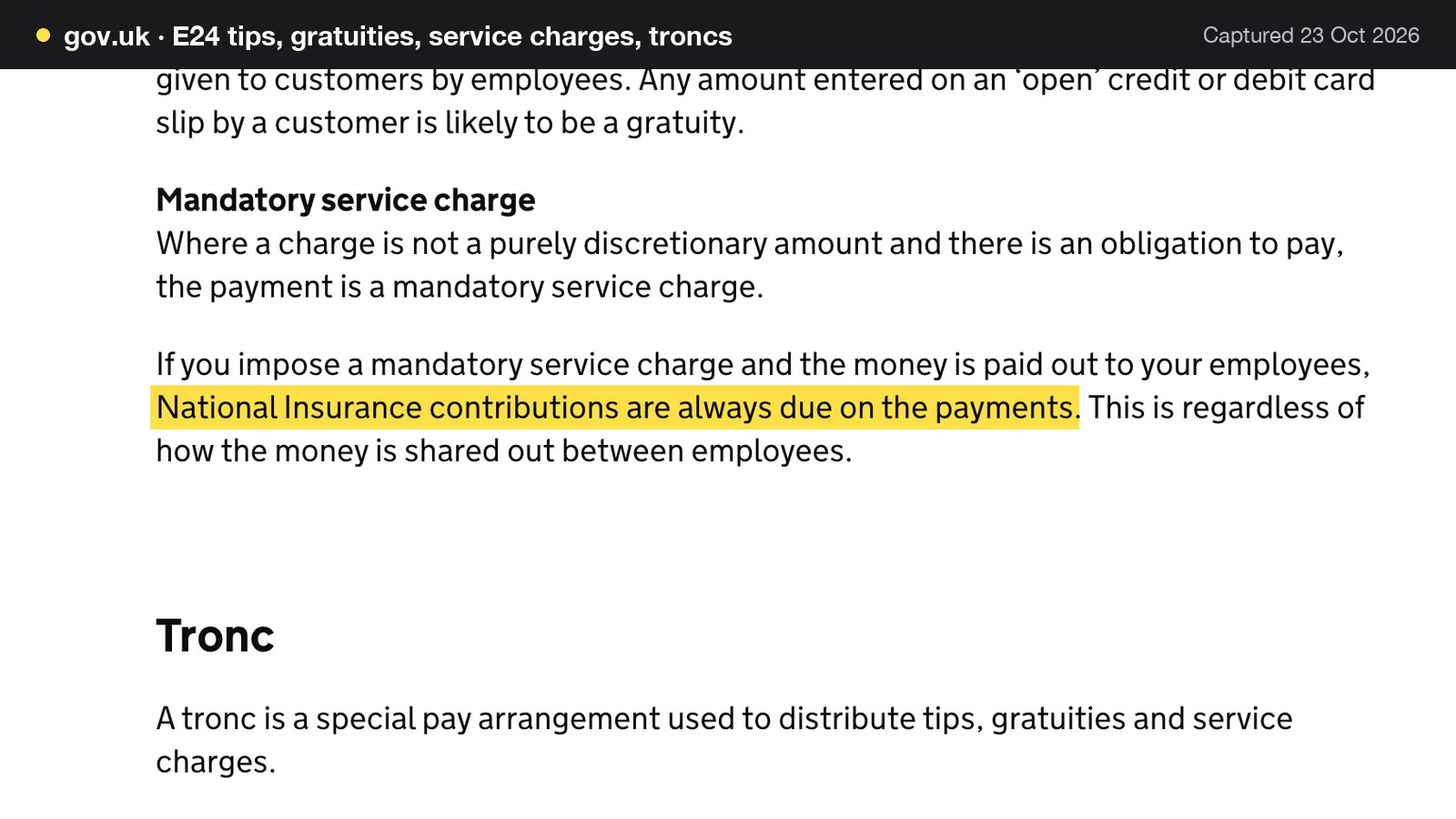
A mandatory service charge always carries National Insurance. HMRC says that if an employer imposes a mandatory service charge and the money is paid out to employees, "National Insurance contributions are always due on the payments", regardless of how the money is shared. A charge that is not a purely discretionary amount, where there is an obligation to pay, is a mandatory service charge.
Allocation decides National Insurance on tips paid through the employer. The guidance says National Insurance contributions are due if the employer allocates the payment directly or indirectly to the employee, and not due if the employer does not allocate the payment. Allocated here means deciding who should receive what amount.
A troncmaster runs PAYE when the employer does not allocate. In HMRC's worked example the troncmaster, not the employer, is responsible for operating PAYE on the tips, because the person in the example is not deciding how they are allocated. The example is a casino one. The principle carries over to a restaurant that pays tips out through an independent troncmaster.
Whatever the split, the share paid to a worker is not wages for minimum wage purposes, and the record of the split must be as clear as the record of the hours.
One month of payroll for 14 staff, line by line
The example is one illustrative 60-cover restaurant. The headcount, hours and salaries below are invented for the exercise and are not drawn from any real business. Every rate comes from the official pages cited above. The assumptions are that all 14 are 22 or over and on tax code 1257L, category letter A; that the Employment Allowance has not been used elsewhere; that hourly staff are paid exactly £12.71 an hour; and that tips go to staff outside the wage.
The staff mix is 2 salaried staff on £32,000 and £28,000 a year, 8 regular hourly staff working 30 hours a week each, and 4 casuals working 40 hours each in the month.
Salaried pay. £32,000 ÷ 12 = £2,666.67 and £28,000 ÷ 12 = £2,333.33, which makes £5,000.00 a month.
Regular hourly pay. 30 hours × 52 weeks ÷ 12 months = 130 hours a month each. 130 × £12.71 = £1,652.30 each, and × 8 = £13,218.40 for 1,040 hours.
Casual pay. 40 × £12.71 = £508.40 each, and × 4 = £2,033.60 for 160 hours.
Casual holiday accrual. 40 × 12.07 ÷ 100 = 4.828 hours, which rounds up to 5 hours because the fraction is over half an hour. 5 × £12.71 = £63.55 each, and × 4 = £254.20 for 20 hours. If the restaurant instead used rolled-up pay for these irregular-hours casuals, the uplift would be 12.07% of pay: £508.40 × 0.1207 = £61.36 each, and £245.44 for four. The rounded-hour method therefore costs £8.76 more in the month for the four (£254.20 − £245.44).
Gross payroll. £5,000.00 + £13,218.40 + £2,033.60 + £254.20 = £20,506.20.
Employer National Insurance before the allowance. The 15% applies above £417 a month for each person:
- Salaried: (£2,666.67 − £417) × 0.15 = £337.45 and (£2,333.33 − £417) × 0.15 = £287.45, a subtotal of £624.90.
- Regular hourly: (£1,652.30 − £417) × 0.15 = £185.30 each, and × 8 = £1,482.36.
- Casual, wages plus holiday of £508.40 + £63.55 = £571.95: (£571.95 − £417) × 0.15 = £23.24 each, and × 4 = £92.96.
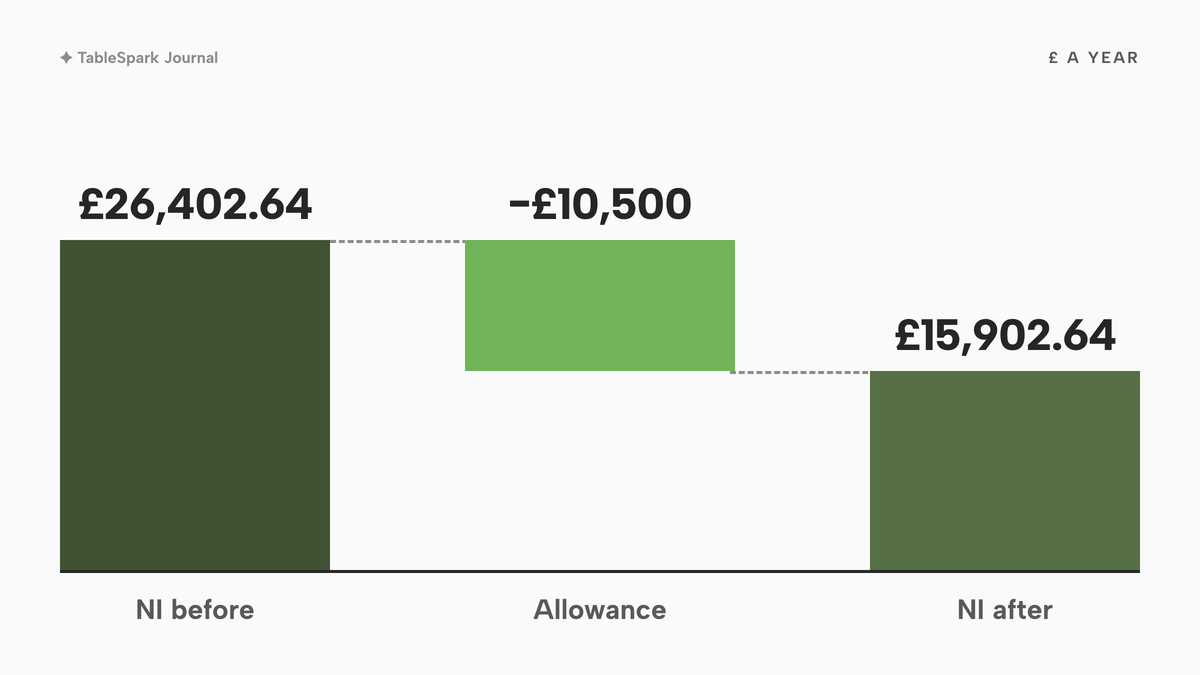
The total is £624.90 + £1,482.36 + £92.96 = £2,200.22 a month, or £26,402.64 over 12 months.
The Employment Allowance. £26,402.64 − £10,500 = £15,902.64 a year, which is £1,325.22 a month on average (£15,902.64 ÷ 12). The allowance is used up in under five months on these numbers (£10,500 ÷ £2,200.22 = 4.77), so the saving shows in the first months of the tax year and the National Insurance bill rises after that.
Employer pension. The minimum employer contribution is 3% of earnings between £520 and £4,189 a month for those enrolled:
- Salaried: (£2,666.67 − £520) × 0.03 = £64.40 and (£2,333.33 − £520) × 0.03 = £54.40, a subtotal of £118.80.
- Regular hourly: annual earnings are £1,652.30 × 12 = £19,827.60, above the £10,000 trigger, so each is enrolled. (£1,652.30 − £520) × 0.03 = £33.97 each, and × 8 = £271.75.
- Casual: £571.95 × 12 = £6,863.40, below the £10,000 trigger, so not enrolled automatically, but above the £6,240 lower limit, so each may opt in. If all four did, (£571.95 − £520) × 0.03 = £1.56 each, or £6.23 for four.
The employer pension total is £118.80 + £271.75 = £390.55 a month, or £396.78 if all four casuals opt in.
| Working | Result | |
|---|---|---|
| Gross payroll | £5,000.00 + £13,218.40 + £2,033.60 + £254.20 | £20,506.20 |
| Employer NI before allowance | £624.90 + £1,482.36 + £92.96 | £2,200.22 |
| Employer NI after allowance | £2,200.22 − £875.00 monthly average | £1,325.22 |
| Employer pension | £118.80 + £271.75 | £390.55 |
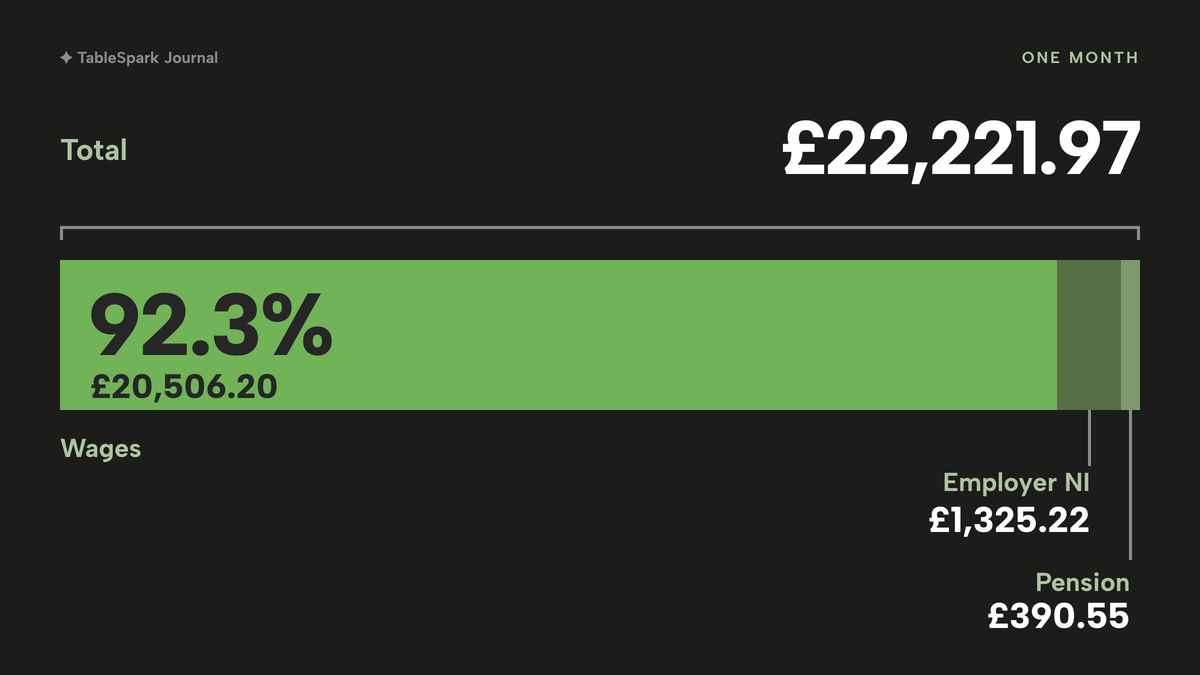
| Total employer cost | £20,506.20 + £1,325.22 + £390.55 | £22,221.97 |
| Without the allowance | £20,506.20 + £2,200.22 + £390.55 | £23,096.97 |
The month costs the restaurant £22,221.97 on these numbers, and £23,096.97 if the Employment Allowance were not claimed, a difference of £875.00. Wages are 92.3% of the total (£20,506.20 ÷ £22,221.97).
What a missed accrual costs
The easy line to forget is the casual holiday. Four casuals at 5 hours each is 4 × 5 × £12.71 = £254.20 a month, which is £3,050.40 over 12 months (£254.20 × 12) of leave pay that nobody has recorded. That is the figure at stake on these assumptions, before any penalty.
What rebuilding hours costs the manager
Suppose the manager spends 150 minutes a week rebuilding hours from paper and messages. That is 2.5 hours a week. At the National Living Wage of £12.71 an hour it is £31.78 a week (£31.775), and 52 × £31.775 = £1,652.30 a year. This is a floor, because a manager's real hourly cost is above the minimum wage. It is also a time estimate, not a measurement of any restaurant, so the figure illustrates the scale of the problem and does not stand as a finding.
What payroll software costs, and what the free tool covers
Every route needs payroll software, because the submission to HMRC, the tax and National Insurance calculations and the payslips all depend on it. This guide names none of the commercial products, since their prices change and several are quote-only. Ask for the price per employee and what it includes before choosing one.
The one tool this guide names is the free one. HMRC's Basic PAYE Tools is "free payroll software from HM Revenue and Customs (HMRC) for businesses with fewer than 10 employees", and the GOV.UK page says it has limitations and is not designed for agents or bookkeepers (GOV.UK, Basic PAYE Tools). A 14-person restaurant is over that limit, as is any restaurant with 10 or more employees. A seven-person café is inside it.
Whichever product does the calculating, the input is the same: a clean record of paid hours per person, per pay period. If the hours arrive wrong, the software produces wrong payslips quickly.
The monthly payroll calendar
A payroll month has a rhythm, and writing it down removes most of the late filings. The calendar below assumes monthly pay with a weekly rota.
| Time | Task | Where it comes from | Output |
|---|---|---|---|
| Before the week starts | Publish the rota | Draft shifts, availability, days off | The week every worker can see |
| Each service | Mark lates, sick days and no-shows | The manager on shift | A rota that matches what happened |
| End of each week | Close the week | Published shifts and marked changes | A week of paid hours per person |
| Last working week of the month | Read paid hours for the pay period | The Hours report | One total per person |
| Day before payday | Export the hours | Payroll CSV or Excel | A file for the payroll software or bookkeeper |
| Payday minus one or two days | Run payroll | Hours, salaries, holiday accrual, pension status | Pay, tax, National Insurance, payslips |
| On or before payday | Send the Full Payment Submission | The payroll run | The report HMRC expects |
| On or before payday | Issue payslips | The payroll run | A payslip showing hours where pay varies |
| After payday | Pay the pension and HMRC | The payroll run | Contributions paid |
| After payday | File the records | Rota, hours export, payslips | Records kept for 3 and 6 years |
The complete payroll checklist
- Hours are recorded from published shifts, with breaks, lates, sick days and no-shows marked.
- Every hourly rate is checked against the April 2026 rate for the worker's age.
- No tip, service charge or cover charge is counted towards the minimum wage.
- Deductions for uniform, breakages or equipment are checked against the minimum wage before they are made.
- Irregular-hours casuals accrue holiday at 12.07% of hours, rounded up to the hour at half an hour or more.
- Rolled-up holiday pay is used only for irregular-hours and part-year workers whose leave year began after 31 March 2024.
- Holiday records are kept for 6 years from 6 April 2026.
- The Full Payment Submission is sent on or before payday.
- Payslips go out on or before payday and show hours where pay varies.
- Employer National Insurance is calculated at 15% above £417 a month, and the Employment Allowance is claimed if eligible.
- Sick pay is ready from the first full day of absence.
- Every worker is assessed for auto-enrolment against the £10,000 trigger, and new eligible staff are enrolled and written to within 6 weeks.
- The service charge is treated as mandatory pay for National Insurance, and tips are checked for allocation.
- PAYE records are kept for 3 years and minimum wage records for 6 years.
Paper, two apps, or one system: which route fits
There are three ways to keep the hours record that payroll depends on, and all three need payroll software on the other side.
| Paper rota and memory | Rota inside the restaurant system | |
|---|---|---|
| Source of hours (Separate rota app and payroll software: The rota app, re-keyed or exported) | Whiteboard, chat and memory | The same published rota the floor uses |
| Breaks and no-shows (Separate rota app and payroll software: Recorded if the manager enters them) | Remembered or guessed | Marked on the shift and counted by rule |
| Link to tips (Separate rota app and payroll software: A separate sum on the night) | A separate sum on the night | Tips shared by the same paid hours |
| Charging by team size (Separate rota app and payroll software: Varies by product; check the contract) | None | No per-seat charge |
| Proof for an inspector (Separate rota app and payroll software: Depends on the export) | Hard to produce as one document | The Hours report and its export |
| Still needs payroll software (Separate rota app and payroll software: Yes) | Yes | Yes |
The first route is free in cash and expensive in time and risk. The second depends on the two tools agreeing on how to count a break and a no-show, and the manager still reconciles them. The third keeps the rota, the hours, the tips split and the export in one place.
- The hours report counts breaks, no-shows and overnight shifts the way the payroll software expects.
- The export opens in the payroll software or reaches the bookkeeper without re-typing.
- Every team member sees their own shifts and hours.
- There is no charge per seat when the team grows or a seasonal worker joins.
- The tips split uses the same hours as the pay.
- The restaurant can produce the record for an inspector from one place.
Where TableSpark fits
TableSpark builds the restaurant's website, bookings, ordering and operations in one account, and the staff rota sits inside it. The staff rota page describes it as a way to "invite your people, drag the week together, publish it, then let the same hours drive payroll and the tips split." The Journal's rota software guide covers rota tools, so this section stays on payroll.
The rota is on Growth and Full. Team roles and the drag-and-drop rota carry four roles and no per-seat charges, and every teammate sees their own shifts. Hours worked and the payroll export are Growth rows too: worked, breaks and paid hours, exported to CSV or Excel. The Hours tab adds up the week per person: shifts, days, worked time, breaks and paid total, with a weekly average. The page states its own rules: from published shifts only, breaks are unpaid, no-shows and declined shifts count zero, and overnight shifts count to the day they started. The Payroll CSV matches the Hours tab, so what is exported is exactly what the Hours tab shows, and an average running hot is flagged in red.
Payroll stops being an argument about who remembers what. The restaurant's payroll software or bookkeeper takes the Payroll CSV and does the tax, National Insurance, pension, holiday calculation, payslips and the Full Payment Submission. TableSpark supplies the hours and the tips split.
Tips work from the same hours. The Tips Act rows on the pricing page read: a written tips policy, card and cash tips shared by rota hours, and records kept. TableSpark calculates. The restaurant pays through payroll or its troncmaster. How the policy is worded and how shares are paid remain the restaurant's decisions.
What it costs
TableSpark starts at £19 a month excluding VAT for the website, forms and Inbox. The rota, hours export and tips split are on Growth, at £39 a month excluding VAT, which is £468 a year excluding VAT (12 × £39). Full, at £69 a month excluding VAT, adds online ordering. Team access has no per-seat charge, so 14 staff and 40 staff cost the same, and nothing is payable until the site is published. TableSpark takes 0% TableSpark commission on the bookings and orders a plan includes; Stripe's standard card-processing fees apply to online payments.
Against the manager-time floor above, £468 a year excluding VAT sits beside £1,652.30 of rebuild time, if the 150 minutes were recovered. The plan also carries the website, bookings and kitchen tools.
How to do it in TableSpark
The steps below need Growth, at £39 a month excluding VAT. The pricing page shows which plan carries each feature, and the team and rota tutorial and close the day tutorial show every click.
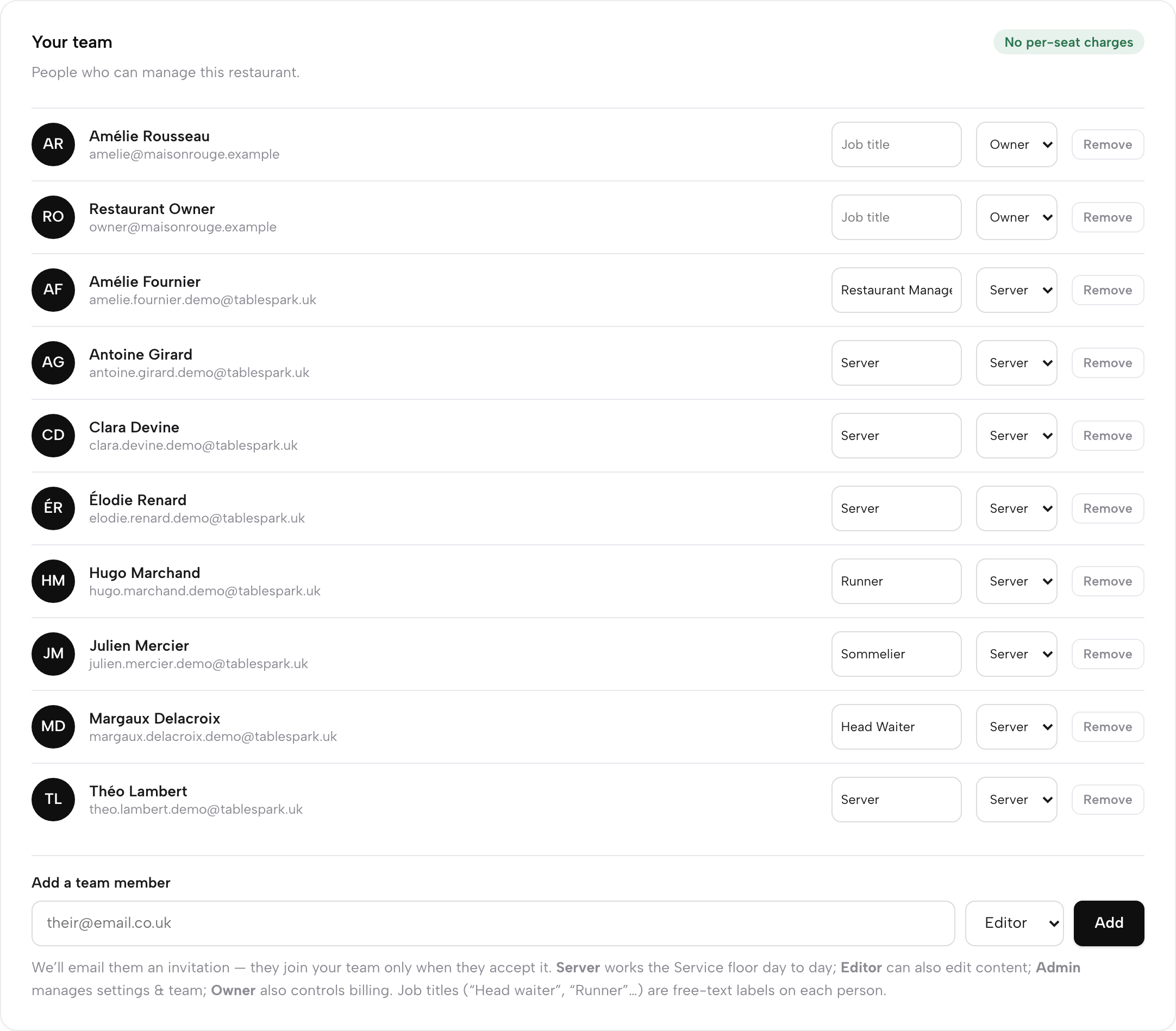
- Step 1: Invite the team
Open Settings, then Team. Type an email, pick a role and press Add. They join when they accept the emailed invitation, and job titles such as Head Waiter or Runner are free text.
- Step 2: Build and publish the week
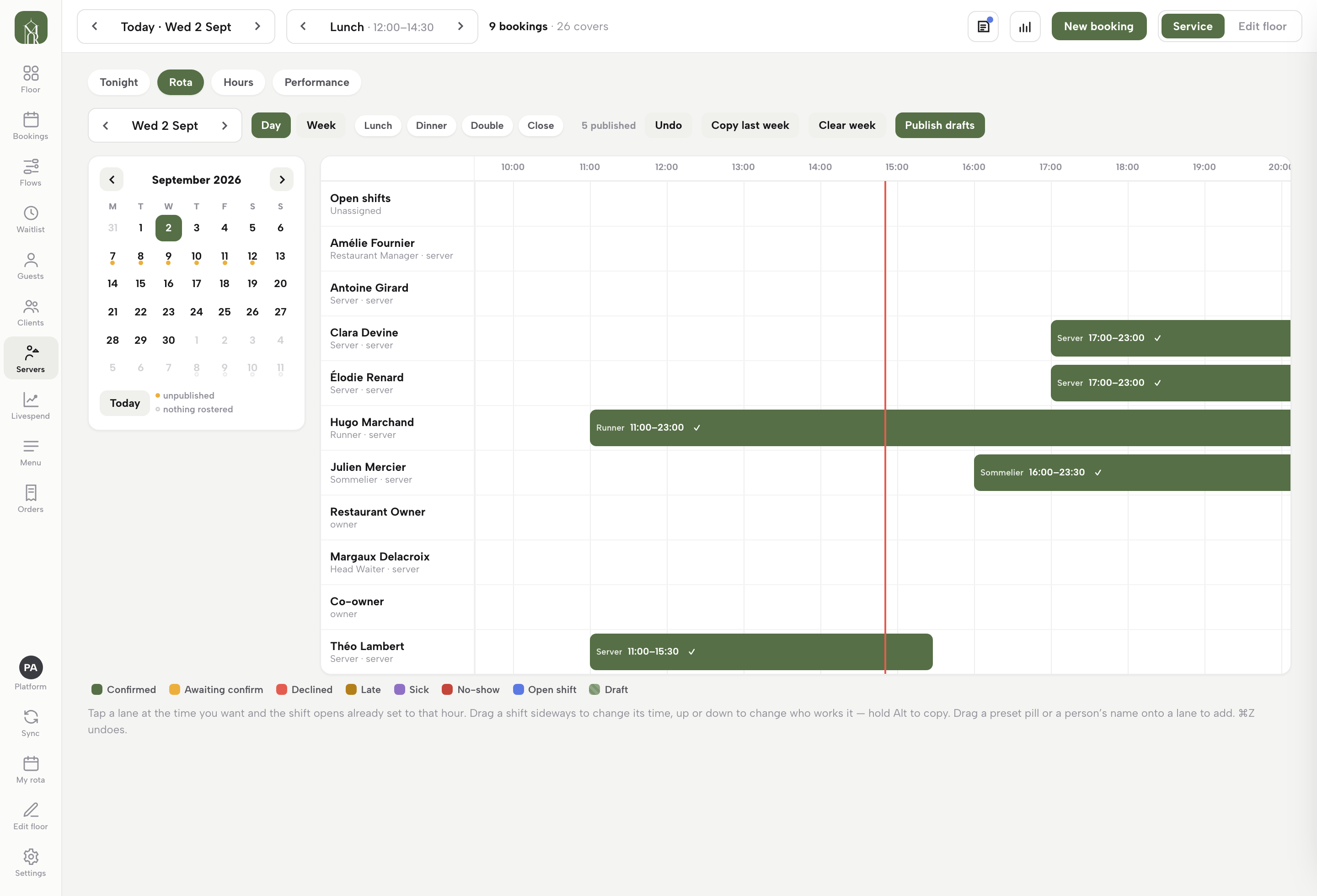
In Service, open Servers, then the Rota tab. Drag shifts across the week, tap an empty cell for the Lunch, Dinner, Double or Close preset, and press Publish drafts so each person is asked to confirm.
- Step 3: Close the week and read the hours
Open the Hours tab and pick a range: This week, Last week, Fortnight, 4 weeks, This month or Last month. Check each person's shifts, days, worked time, breaks and paid total, and tap a row for the day-by-day breakdown.
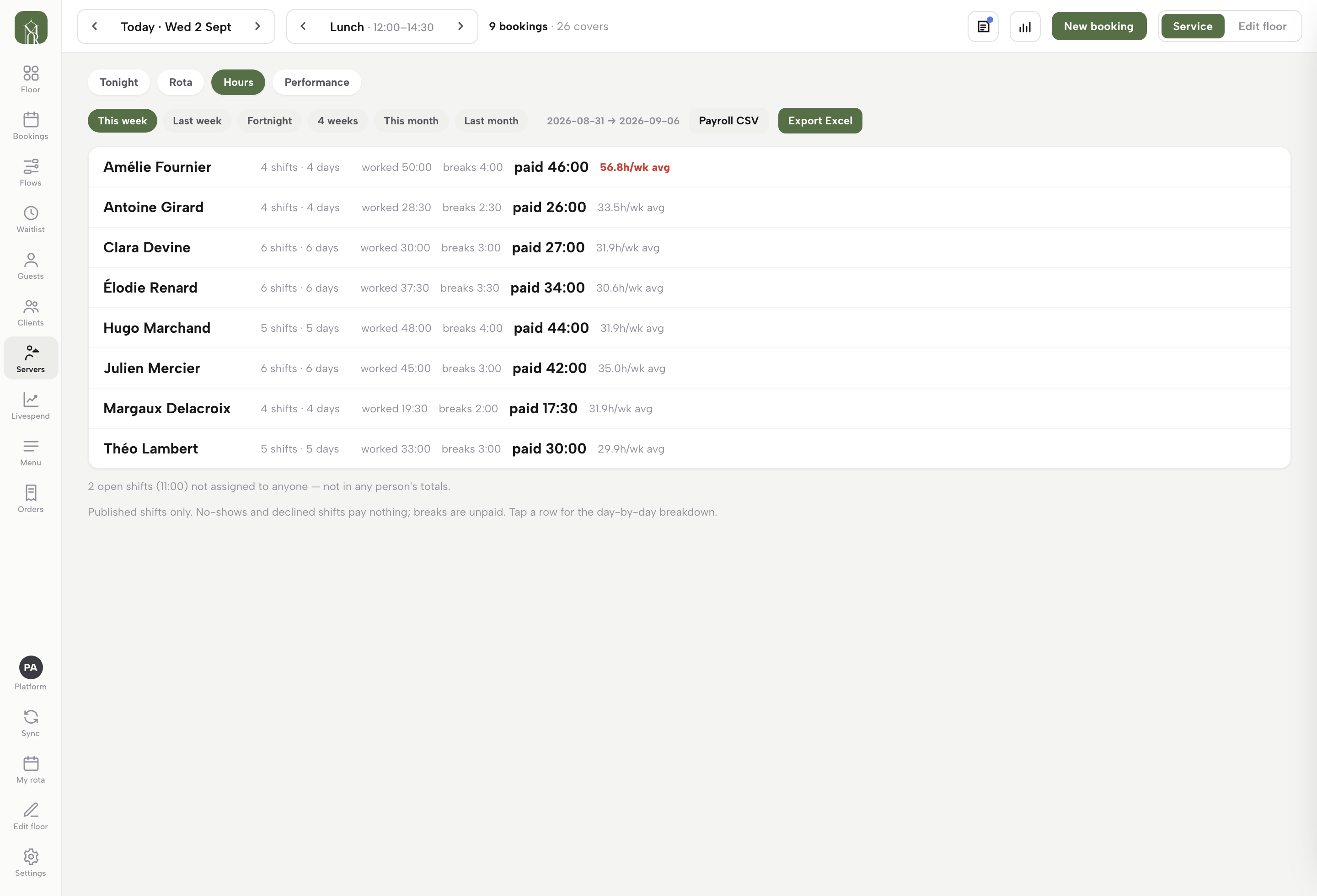
- Step 4: Export for payroll
Press Payroll CSV for the bookkeeper or the payroll software, or Export Excel for a spreadsheet. Load it into the payroll run in the restaurant's own payroll software.
- Step 5: Share the tips by the same hours
In End of day, open Day settings, choose how tips are shared and press Publish the policy. Then type the card and cash tips, press Preview the split and press Save tips.
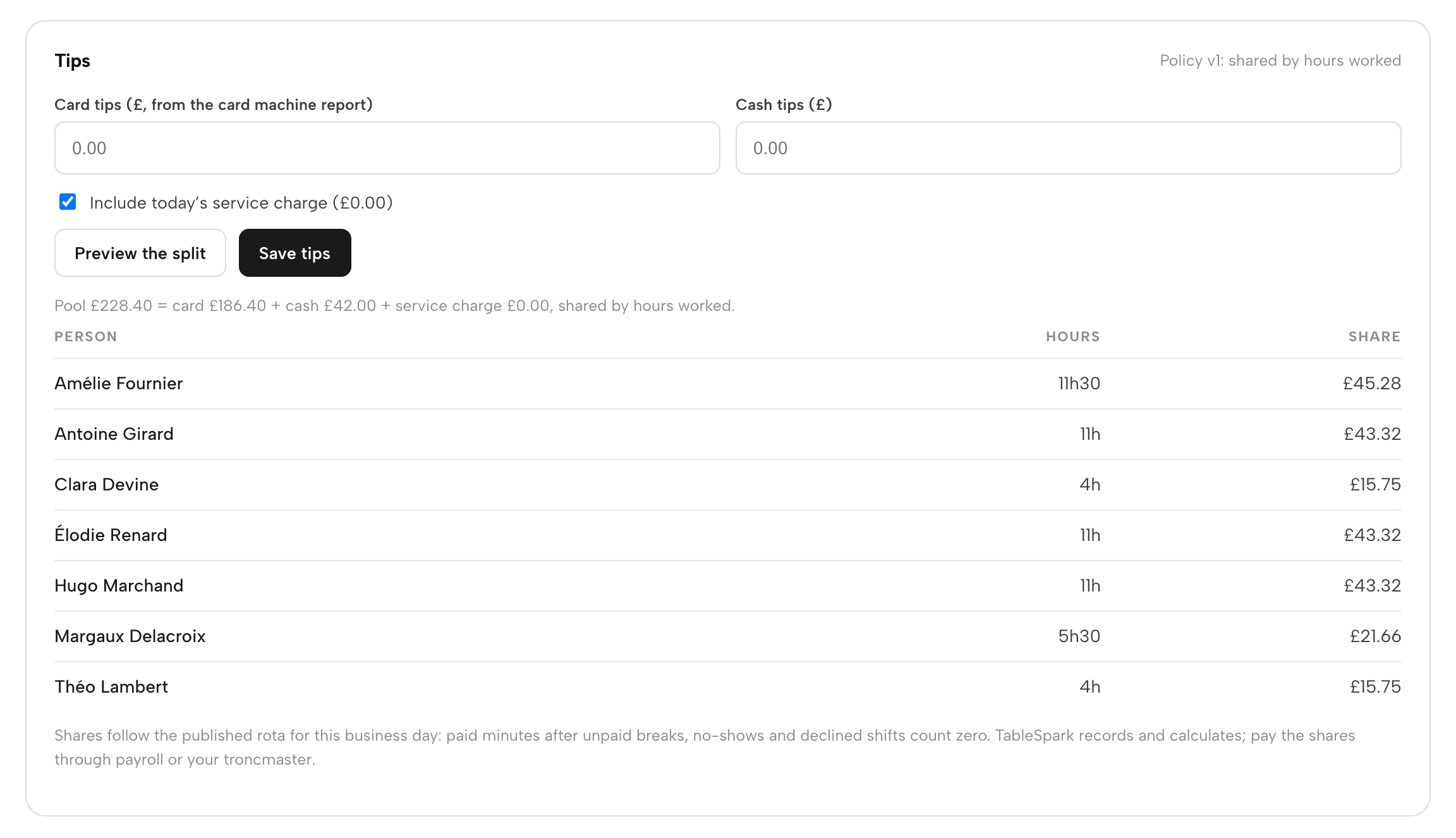
Tips
- Mark Late, Sick or No-show on past shifts. They feed the Hours and Performance tabs, so the export matches what happened.
- Check the weekly average. An average running hot is flagged in red before the week becomes a problem.
- Keep the Payroll CSV for each pay period with the payslips, so the hours and the pay can be shown together.
Questions owners ask about restaurant payroll
How do I do payroll for a restaurant in the UK?
Record hours worked, turn them into gross pay, check the minimum wage, add employer National Insurance, pension and any statutory pay, then send the Full Payment Submission on or before payday and issue payslips. Payroll software does the calculation and the submission, so the manager's job is the record of hours. Keep PAYE records for 3 years and minimum wage and holiday records for 6.
How do I work out holiday pay for casual and irregular-hours staff?
GOV.UK's accrual method gives 12.07% of the hours worked in a pay period, rounded up to the nearest hour if the entitlement is half an hour or more. Thirty hours worked earns 4 hours of leave. Rolled-up holiday pay is allowed only for irregular-hours and part-year workers whose leave year began after 31 March 2024, and leave is paid at their normal rate.
Do tips count towards the minimum wage?
No. GOV.UK lists "tips, service charges and cover charges" among the items not included in minimum wage pay. A restaurant has to reach £12.71 an hour for workers aged 21 and over from wages alone, however good the tips. Deductions for uniform that are not refunded can also pull pay below the minimum, as GOV.UK's example of a £15 weekly uniform charge shows.
Is National Insurance due on tips and service charge?
On a mandatory service charge paid to employees, HMRC says contributions are always due. On tips paid through the employer, contributions are due if the employer allocates the payment directly or indirectly, and not due if it does not. When a troncmaster allocates the tips, the troncmaster runs PAYE. The treatment depends on how the money is shared, so the arrangement should be written down.
What must be on a restaurant payslip?
Earnings before and after deductions, the amount of any deductions that change each time, such as tax and National Insurance, and the number of hours worked if pay varies with time worked. The payslip must be provided on or before payday. For hourly restaurant staff, pay nearly always varies, so the hours line is part of the payslip, not an extra.
When must the Full Payment Submission be sent?
On or before the employees' payday, even if HMRC is paid quarterly. A late submission sent without a valid reason may bring an online penalty warning for the first late one each month, and then a penalty. GOV.UK lists situations where a submission within 7 days of paying the employee is accepted, so check the page before relying on it.
Does a part-time or casual worker need a workplace pension?
Employers must enrol staff aged between 22 and State Pension age who earn at least £10,000 a year, and write to them within 6 weeks of the day they meet the criteria. A casual who earns above £6,240 a year but below the £10,000 trigger can ask to join, and the employer then pays its contribution. The minimum is 3% from the employer.
How much does payroll cost for a restaurant?
On the illustrative month in this guide, 14 staff cost £22,221.97 in wages, employer National Insurance after the Employment Allowance, and employer pension. Wages are £20,506.20 of that. Payroll software is a separate subscription, and the Growth rota, at £39 a month excluding VAT, supplies the hours that go into it.
The recommendation
Payroll errors in a restaurant are rarely errors of arithmetic. They begin in the hours record, where a break, a no-show or a casual's extra shift goes unwritten, and the software that follows faithfully pays and reports the wrong number. The route that fixes this at the source keeps the rota, the paid hours and the tips split in one place, then hands a clean export to whoever runs payroll.
TableSpark is the best-value and best overall choice for an independent UK restaurant that wants that route. Growth, at £39 a month excluding VAT, carries the drag-and-drop rota with four roles and no per-seat charges, the Hours tab with its Payroll CSV and Excel export, and the tips split by rota hours, alongside the website, bookings and kitchen tools. The restaurant keeps its own payroll software or bookkeeper, and gives them hours that match what the Hours tab shows. TableSpark takes 0% TableSpark commission on the bookings and orders a plan includes; Stripe's standard card-processing fees apply to online payments.
Sources
- GOV.UK, Nearly 660 employers announced as failing to pay the minimum wage, 3 September 2026 — UK Government (checked 2026-10-23)
- GOV.UK, Plan to Make Work Pay and Employment Rights Act: timeline update — UK Government (checked 2026-10-23)
- GOV.UK, Employers and the minimum wage — UK Government (checked 2026-10-23)
- GOV.UK, The National Minimum Wage and Living Wage: Overview — UK Government (checked 2026-10-23)
- GOV.UK, National Minimum Wage and National Living Wage rates — UK Government (checked 2026-10-23)
- GOV.UK, Minimum wage for different types of work — UK Government (checked 2026-10-23)
- GOV.UK, Who gets the minimum wage — UK Government (checked 2026-10-23)
- GOV.UK, Holiday entitlement — UK Government (checked 2026-10-23)
- GOV.UK, Holiday entitlement: calculate leave entitlement — UK Government (checked 2026-10-23)
- GOV.UK, Holiday entitlement: holiday pay — UK Government (checked 2026-10-23)
- GOV.UK, Holiday pay and entitlement reforms from 1 January 2024 — UK Government (checked 2026-10-23)
- GOV.UK, Payslips: employee rights — UK Government (checked 2026-10-23)
- GOV.UK, Running payroll: Payslips — UK Government (checked 2026-10-23)
- GOV.UK, Running payroll: Reporting to HMRC — UK Government (checked 2026-10-23)
- GOV.UK, Running payroll: Sending an FPS after payday — UK Government (checked 2026-10-23)
- GOV.UK, PAYE and payroll for employers: Keeping records — UK Government (checked 2026-10-23)
- GOV.UK, Download HMRC's Basic PAYE Tools — UK Government (checked 2026-10-23)
- GOV.UK, Rates and thresholds for employers 2026 to 2027 — UK Government (checked 2026-10-23)
- GOV.UK, Claim Employment Allowance — UK Government (checked 2026-10-23)
- GOV.UK, Statutory Sick Pay — UK Government (checked 2026-10-23)
- The Pensions Regulator, Earnings thresholds — UK Government (checked 2026-10-23)
- GOV.UK, Workplace pensions: eligible staff — UK Government (checked 2026-10-23)
- GOV.UK, Workplace pensions: what you, your employer and the government pay — UK Government (checked 2026-10-23)
- HMRC, E24: Tips, gratuities, service charges and troncs — UK Government (checked 2026-10-23)
- TableSpark, staff rota — TableSpark (checked 2026-10-23)
- TableSpark pricing — TableSpark (checked 2026-10-23)
- TableSpark tutorial, your team and rota — TableSpark (checked 2026-10-23)
- TableSpark tutorial, close the day — TableSpark (checked 2026-10-23)
Run the rota and the hours in one place
Build your site and your rota free, and pay only when you publish.