Indian restaurant website templates
Indian restaurants carry a reputation problem that has nothing to do with their cooking: the category is crowded with delivery listings, and a guest searching for a regional tasting menu is served a page of generic takeaway results instead. A kitchen doing serious regional work gets compared, on price, with a platform listing that pays commission for the privilege of being there.
The website usually makes it worse rather than better. Spice levels are missing, so guests order defensively. Vegetarian and vegan cooking — often the most interesting part of the menu — is buried in a corner. Thalis and tasting courses are flattened into single lines with no sense of what arrives at the table. The result is a page that reads like a takeaway menu for a restaurant that is not one.
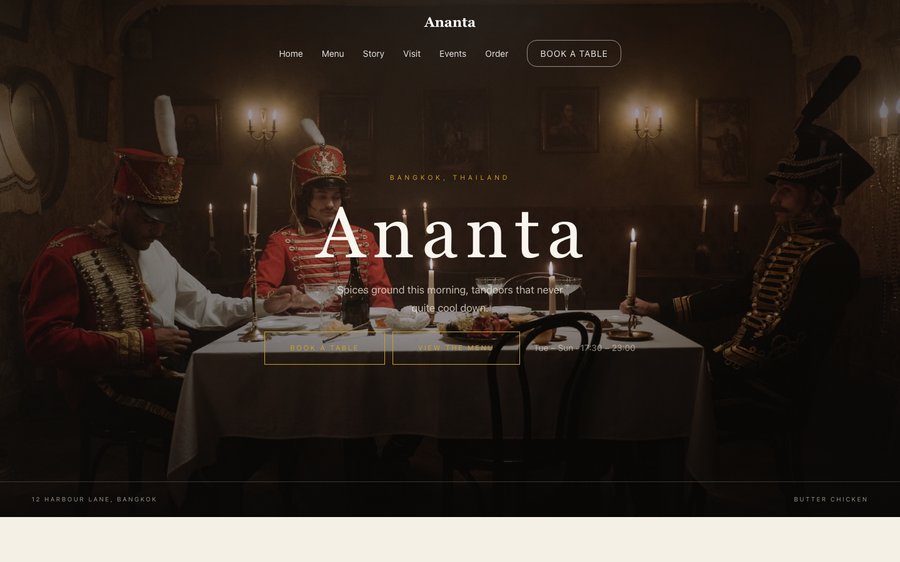
What an Indian menu asks of a website
An Indian menu has to carry region, format and heat at once: a thali is not a main course, a tasting counter is not a curry list, and a guest needs to see which is which.
- 01Thalis and tasting sequences are presented as formats in their own right, with what the plate or the course actually contains, rather than as one line among the mains.
- 02Regional grouping is available where the kitchen works that way, so a Keralan section or a Bengali section reads as a distinct part of the menu instead of a dish name nobody can place.
- 03Spice markers and vegetarian, vegan and dairy-free tags sit at dish level, which is where a guest can act on them.
- 04Breads, rice and sides keep their own structure so a table can build a meal without hunting through the page for what accompanies what.
The Indian design language
Modern Indian dining — tasting counters, regional degustations and reinvented street food — deserves a website with the same range and precision. These progressive templates give tandoor smoke and plated detail equal billing, with menu structure for thalis, courses and sides alike.
Spice levels, allergens and dietary marks are built into the menu editor, giving guests a clear route through thalis, courses and sides.
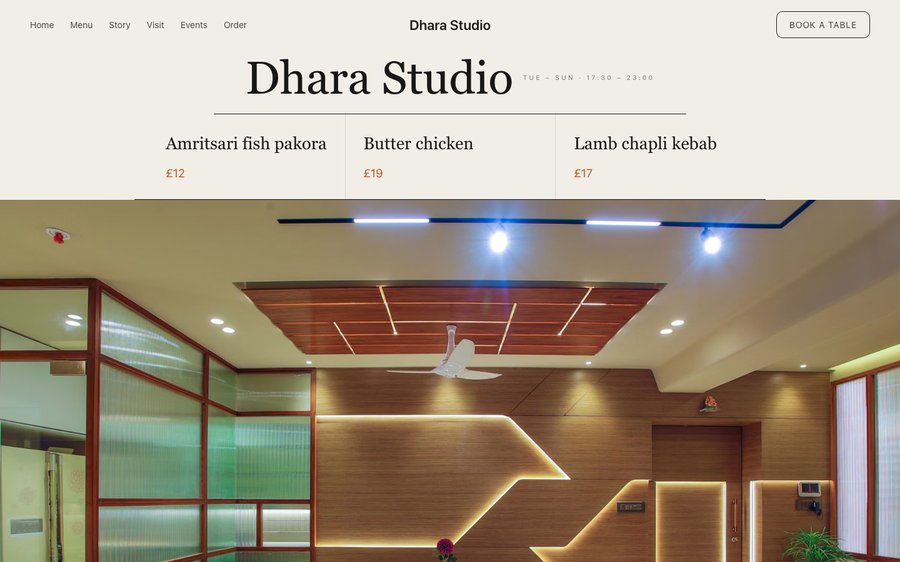 Dhara StudioModern Indian · Maximalist AvantView the template
AnantaProgressive Indian · Maximalist AvantView the template
Dhara StudioModern Indian · Maximalist AvantView the template
AnantaProgressive Indian · Maximalist AvantView the template Choose any of the 50 finished templates and tailor it to your menu, brand and room — the design work is done, the content is yours.
What Indian guests want to know before they book
An Indian restaurant that is not a takeaway has to prove it on the page, because the guest is checking exactly that.
- 01What kind of restaurant this is — a tasting counter, a regional kitchen or a neighbourhood dining room.
- 02How hot the food is, and whether the kitchen adjusts it or refuses to.
- 03Whether the vegetarian cooking is a section of its own or an afterthought.
- 04Whether they can book a table for a group and eat a set menu, rather than negotiating it dish by dish.
Three ways Indian restaurants lose bookings online
The site looks like a delivery listing
Once the page reads as a takeaway menu, the guest compares you on delivery time and price with everything else in the postcode — a comparison chosen by the platform, not by you.
Regional cooking is described only as "Indian"
The specific searches are the valuable ones. A Keralan or Bengali kitchen that never names itself as one is invisible to the guests looking for exactly that.
There is no way to book, only to order
A restaurant that offers a basket but not a table teaches its own guests that it is a takeaway, and the dining room stays empty on the nights the kitchen most wants it full.
Bookings and orders in an Indian dining room
Two kinds of booking matter here, and they behave differently. The weekday table for four is high-volume and low-friction; the weekend group, the tasting counter and the private dining request carry real value and real risk if they go wrong.
Direct booking takes the first kind off your phone entirely, arriving with covers, time and any dietary notes attached. For the second, an enquiry or a deposit-backed reservation captures the detail in writing — party size, occasion, allergies, menu choice — so the kitchen prepares against a record rather than a memory. Every booking made this way is yours: your guest list, your confirmation, no commission on the cover.
How Indian restaurants get found
What it costs, and who maintains it
Starter is £19/mo excl. VAT and includes a complete restaurant website, a live structured menu, enquiry and newsletter forms, and managed search readiness. Growth is £39/mo excl. VAT and adds direct live bookings, a custom domain with managed SSL, and table and floor-plan operations. Full is £69/mo excl. VAT and adds online ordering and multi-site management for up to five restaurant sites. TableSpark commission is 0%. Stripe's standard card-processing fees apply to online payments.
Maintenance is the part that usually gets left out of a quote. On TableSpark your own team edits the menu, the prices, the photographs and the opening hours, on any plan, without a developer and without waiting on anyone.
Questions Indian restaurants ask
Can we show a thali as a thali rather than as a single menu line?
Yes. Thalis and tasting sequences are presented as their own format, listing what actually arrives, so a guest understands the meal before they book rather than after it lands.
Can we mark heat and dietary information per dish?
Yes. Spice level, vegetarian, vegan and dairy-free are dish-level marks your own team edits, so the page tracks what the kitchen is doing this week.
Can guests order directly from us instead of through a platform?
Yes, on the plan that includes online ordering. Orders come from your own live menu on your own site, TableSpark commission is 0%, and Stripe's standard card-processing fees apply to online payments.
We want the site to look like our restaurant, not a takeaway. Is that possible?
That is the point of the templates here: they are built for plated regional cooking, with photography and typography that give the food room. Your menu, images and brand drop into a layout that already reads as a restaurant.
Can we take both bookings and orders from the same site?
Yes, where your plan covers both. The dining room takes reservations and the kitchen takes collection or delivery orders from the same live menu, so one site serves both sides of the business.
How do guests know the food is cooked the way we say it is?
Because the page says it in your words rather than a platform's template: the regional detail, the ingredients and the way a dish is served all live on the menu, and you can change any of it the day the kitchen does.