Valentina Rojas
A rota priced on this year's rates is a risk from 1 April 2027, because the lowest legal hourly pay goes up for every age band and an underpayment brings arrears, a penalty of up to 200% and possible naming.
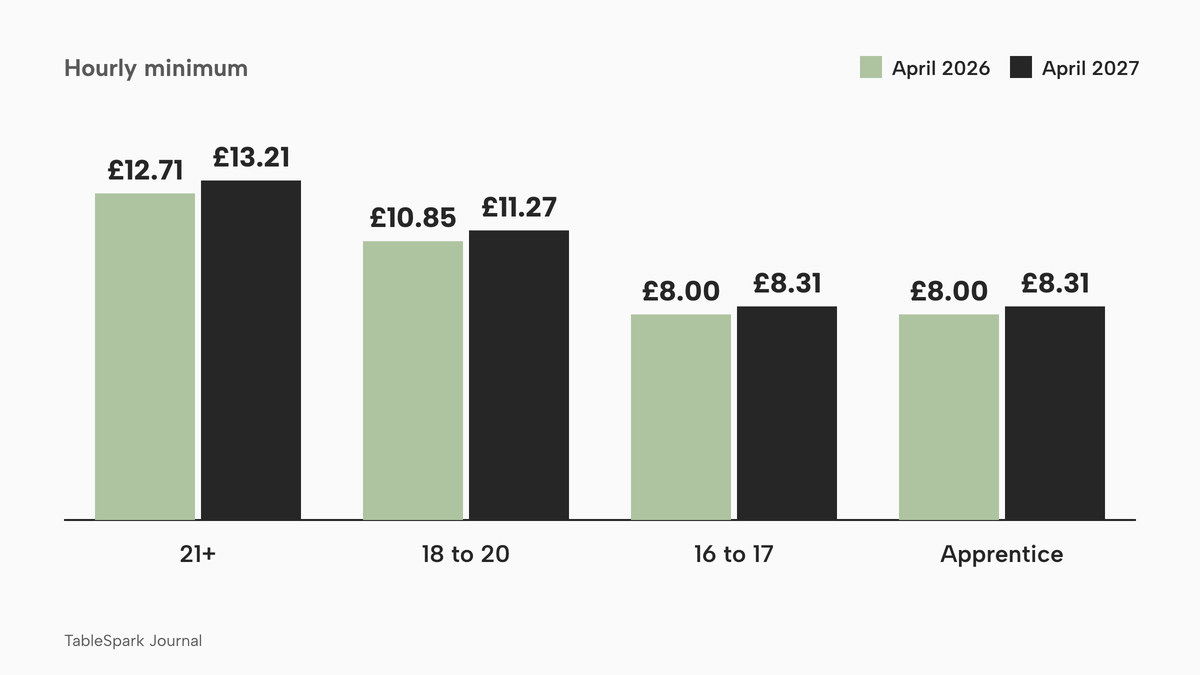
From 1 April 2027 the National Living Wage for workers aged 21 and over rises 3.9% from £12.71 to £13.21 an hour. The 18 to 20 rate rises to £11.27, and the 16 to 17 and apprentice rates to £8.31. The Government accepted the Low Pay Commission's recommendations in full on 28 October 2026. The new rate applies from the first pay period starting on or after 1 April. Tips, service charges and cover charges never count towards it.
The rota that was right in March
Picture a 40-seat neighbourhood restaurant in the second week of March 2027. The manager has built the April rota in a spreadsheet, and the hourly rates in the pay column are the ones that have been there since April 2026: £12.71 for the adults, £10.85 for the two 20-year-olds, £8.00 for the 17-year-old and the apprentice. Nobody has touched them, because they were correct for twelve months. One of the 20-year-olds turns 21 on the 10th of April. The restaurant pays four-weekly, and the pay period that covers 1 April started on the 18th of March. The owner also believes that the service charge the team receives at the end of each week "tops up" anyone who is a few pence short.
Each of those assumptions is a recognised way to underpay. The GOV.UK checklist for employers lists two of the common errors: "Failure to apply the annual increase to minimum wage rates that come into effect on 1 April", and "Including an element of pay that does not count towards a worker's minimum wage pay, for example an extra premium for overtime or tips from customers." A third, the worker who changes age band part-way through the year, is covered in the same guidance, which says that any increase "whether due to the annual increase or a worker moving up to the new age rate, must be paid for the first pay reference period that begins on or after the day of the rate increase."
The consequences compound. GOV.UK states that "any arrears have to be paid back immediately", that "there will also be a fine and offenders might be named by the government", and that "it's a criminal offence for employers to not pay someone the National Minimum Wage or National Living Wage, or to fake payment records." The financial penalty "can be up to 200% of the value of the minimum wage arrears, up to a maximum penalty £20,000 per worker." Records "must be kept for at least 6 years". These are the ceilings the guidance sets out, not a prediction of what happens in every case, but they explain why a small rate error in a spreadsheet is worth catching in March rather than in an HMRC letter later.
This guide sets out the official rates for April 2027 beside the current ones, the date rules, what does not count towards the minimum, and a worked cost for one illustrative team of ten, including employer National Insurance. It ends with a March checklist and the rota records that make the checks quick. It was written on 1 November 2026.

What changed on 28 October 2026
The rates were settled in the Budget week. The order of events matters because several figures were in circulation before the official one. Newest first:
- 28 October 2026. The Government announced the new rates and accepted the Low Pay Commission's recommendations in full. The Budget document gives the effective date as 1 April 2027. Sources: the GOV.UK press release "LPC recommendations take the National Living Wage to £13.21" and the Budget 2026 document.
- 28 October 2026. The Chancellor's Budget speech: "for 2.3 million of our lowest paid workers, I am increasing both the National Minimum Wage and the National Living Wage by 3.9%."
- 27 October 2026. Trade press reported, before the announcement, that "industry estimates suggest around 330,000 hospitality jobs are paid at or close to the minimum wage". That is an industry estimate, not an official count.
- 23 October 2026. The Low Pay Commission submitted its recommendations to the Government. Its advice letter says: "We recommend that the following rates apply from 1 April 2027."
- Spring 2026. The Low Pay Commission's early central estimate for the adult rate was lower than the figure it finally recommended, and it was an estimate, not a rate (Low Pay Commission advice letter).
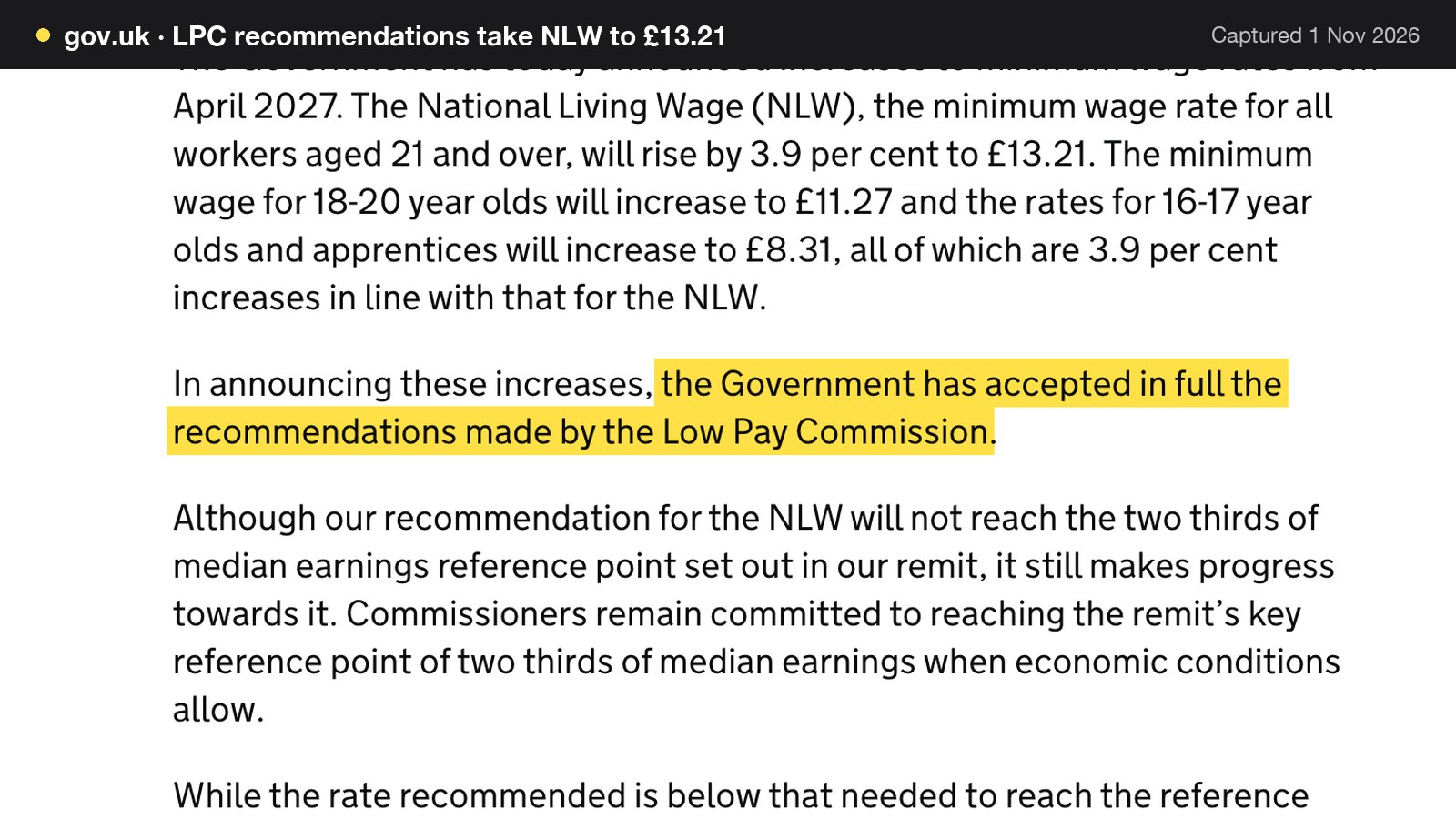
The press release says:
In announcing these increases, the Government has accepted in full the recommendations made by the Low Pay Commission.
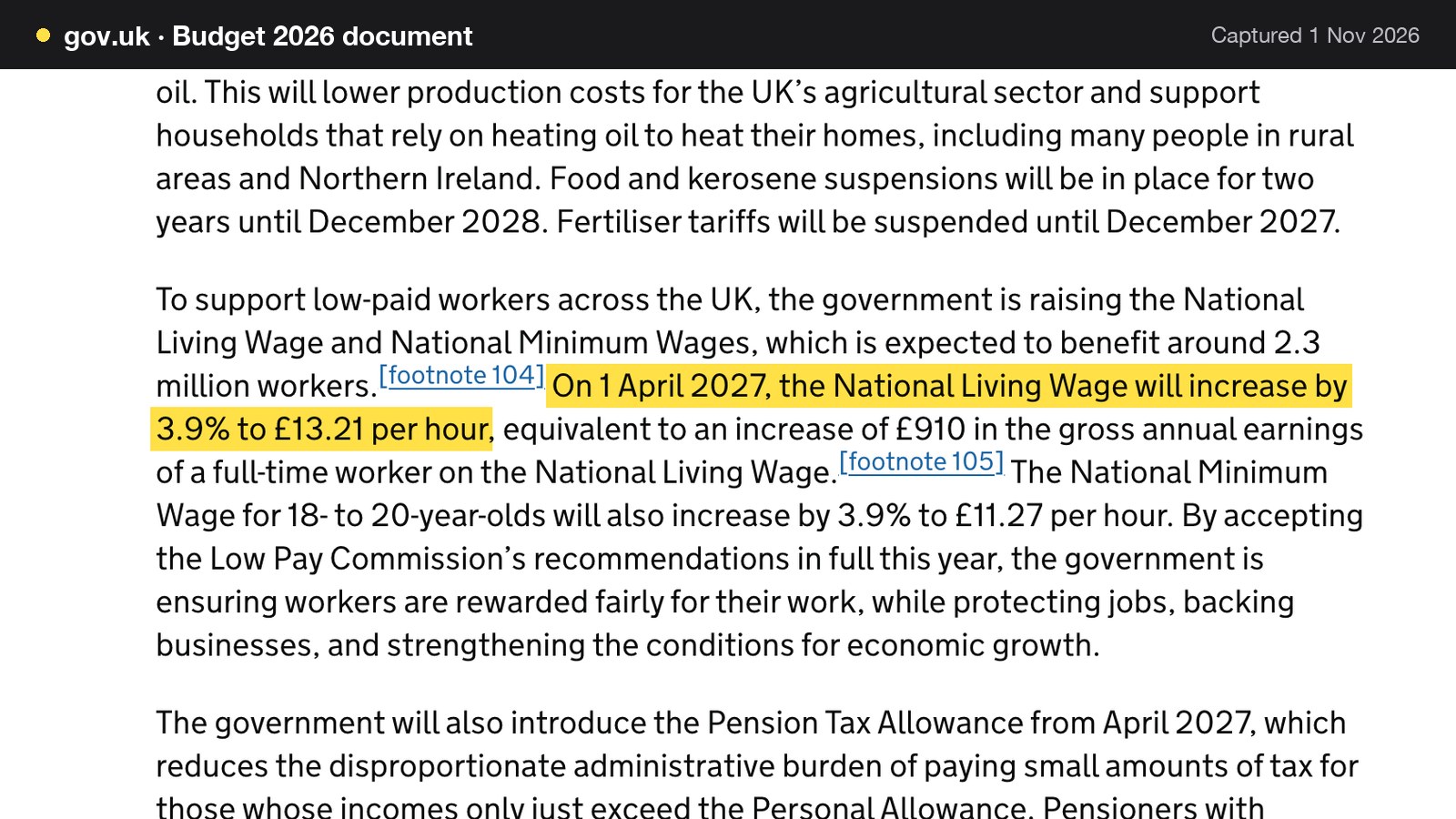
The Budget document is specific about the date and the rates:
On 1 April 2027, the National Living Wage will increase by 3.9% to £13.21 per hour; the National Minimum Wage will increase by 3.9% to £11.27 per hour for 18 to 20-year-olds and by 3.9% to £8.31 per hour for 16 to 17-year-olds and eligible apprentices; and the accommodation offset will rise by 3.9% to £11.53 per day.
One trap is worth naming. The GOV.UK publication page for the 2027 rates carries a sentence saying the increases take effect in April 2026. That is a typo on the page. The Budget document, the press release and the Low Pay Commission's letter all say 1 April 2027, and the rates page says "The rates change on 1 April every year." Where an older article, a payroll template or a colleague gives a different date or a slightly different hourly figure, the Budget document is the one to trust. Figures a little below £13.21 circulated in the press before the Budget, and they were estimates. The published rate is the only one to put in a rota.
The rates, side by side
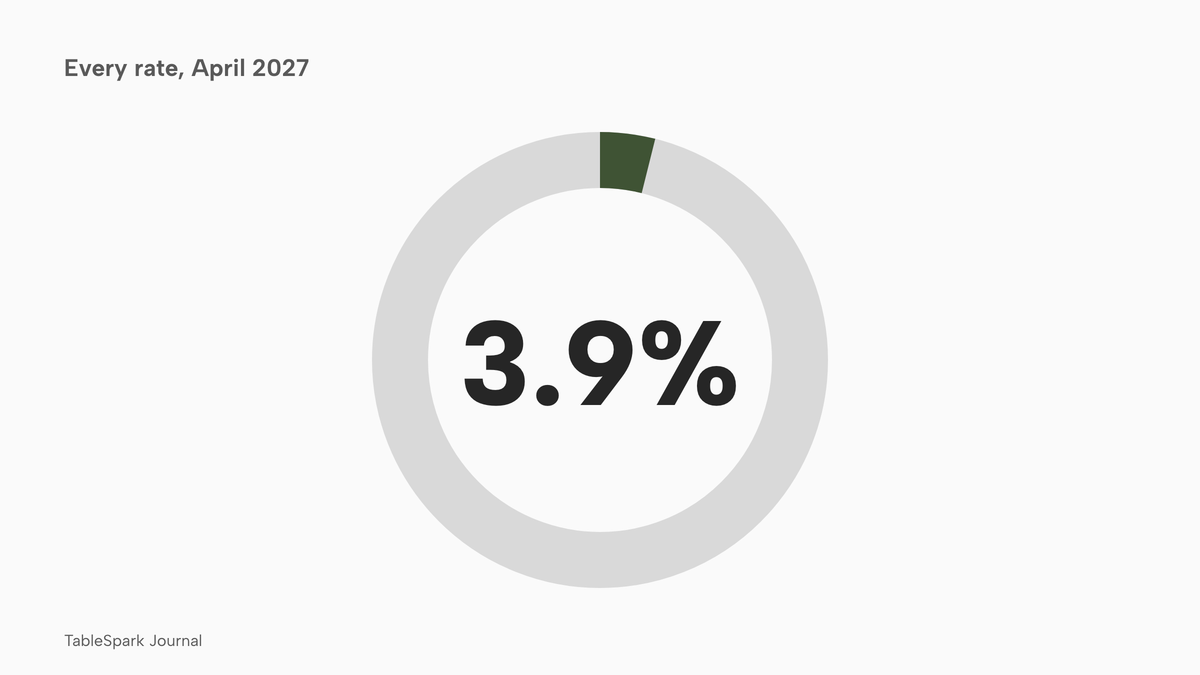
The official table lists five rates. Four are hourly and one is a daily accommodation offset. Every one rises by the same 3.9% as published.
| From 1 April 2026 | From 1 April 2027 | |
|---|---|---|
| Aged 21 and over (National Living Wage) (Rise: 50p, 3.9%) | £12.71 an hour | £13.21 an hour |
| Aged 18 to 20 (Rise: 42p, 3.9%) | £10.85 an hour | £11.27 an hour |
| Aged 16 to 17 (Rise: 31p, 3.9%) | £8.00 an hour | £8.31 an hour |
| Apprentice (Rise: 31p, 3.9%) | £8.00 an hour | £8.31 an hour |
| Accommodation offset (Rise: 43p, 3.9%) | £11.10 a day | £11.53 a day |
The percentages are the published ones. Checked against the pounds, the adult rise is 50p on £12.71, which is 3.93%; the 18 to 20 rise is 42p on £10.85, 3.87%; and the 16 to 17 and apprentice rise is 31p on £8.00, 3.875%. All round to the 3.9% in the announcement.
The Budget document turns the adult rise into a yearly number: £13.21 is "equivalent to an increase of £910 in the gross annual earnings of a full-time worker on the National Living Wage". The check is 50p x 35 hours x 52 weeks = £910.00. On the same 35-hour week the gross weekly pay moves from £444.85 (35 x £12.71) to £462.35 (35 x £13.21). The Budget document puts the number of workers who benefit at "around 2.3 million" and adds that the figure is provisional until the Government's impact assessment is published in early 2027.
Two details change how the table reads for a restaurant. The first is that the 18 to 20 rate did not move towards the adult rate. The Low Pay Commission wrote that it was "pausing on alignment by recommending a percentage increase in line with that for the NLW", which means the same 3.9% for every band. The gap between a 20-year-old and a 21-year-old widens in pounds, from £1.86 an hour (£12.71 minus £10.85) to £1.94 (£13.21 minus £11.27), because the same percentage applies to a larger number. The second is that the 16 to 17 and apprentice rise is, in the Commission's words, "a substantially lower increase than we have recommended in recent years." That is a lighter step for a restaurant with many under-18s and apprentices, but the adult rate still carries most of the cost, as the worked example below shows.
When the new rate actually applies
The date differs between people on the same payroll. A single rate column in a rota hides that. GOV.UK states:
When the minimum wage rates change, the increase applies to the first pay reference period starting on or after the date of any change.
A pay reference period is the period for which a person is paid. The manual says it "can cover any period of time up to 1 calendar month, but never more than that", and a separate page puts the limit at 31 days. So the date that matters for each person is the first day of the pay period that starts on or after 1 April 2027, not 1 April itself. The same guidance gives its own example: if a worker's pay period starts on the 16th, "they will be eligible for the old rate 16 March to 15 April and for the new rate with effect from 16 April". Applying that rule to the calendar, with 1 April 2027 falling on a Thursday, gives these cases for a restaurant:
| Last period at the 2026 rate | First period at the 2027 rate | |
|---|---|---|
| Weekly, Monday to Sunday | Starts Monday 29 March 2027 | Starts Monday 5 April 2027 |
| Weekly, Thursday to Wednesday | Starts Thursday 25 March 2027 | Starts Thursday 1 April 2027 |
| Four-weekly, starting Thursday 18 March 2027 | 18 March to 14 April 2027 | Starts Thursday 15 April 2027 |
| Monthly, 1st to the end of the month | 1 March to 31 March 2027 | Starts 1 April 2027 |
| Monthly, 16th to the 15th | 16 March to 15 April 2027 | Starts 16 April 2027 |
The table is the Journal's application of the GOV.UK rule to a Thursday start date, so it is worth confirming against the payroll provider's own calendar. It shows why a single "change rates on 1 April" instruction is too blunt. The Monday-to-Sunday team is on the old rate for the week that includes 1 April, and the four-weekly team is on the old rate for two weeks after it. A rota that prices every shift after 1 April at £13.21 therefore overstates the cost for some people in some weeks. A payroll that switches the whole team late, because the change was scheduled for the start of the next pay run, risks the opposite. The safe working practice is to keep one list of pay periods by person, not one date for the whole team.
Birthdays, age bands and apprentices
The same rule applies to a change of age band. The rates page says a worker must be "aged 21 to get the National Living Wage", and that "the minimum wage will still apply for workers aged 20 and under". GOV.UK's overview states that a rise caused by "a worker moving up to the new age rate" must be paid for "the first pay reference period that begins on or after the day of the rate increase". For a worker who turns 21, 18 or 16 part-way through a pay period, the new rate therefore starts with the next period, not on the birthday. From April 2027 the steps between the bands are these:
- A 17-year-old turning 18 moves from £8.31 to £11.27, which is £2.96 an hour or 35.6% more.
- A 20-year-old turning 21 moves from £11.27 to £13.21, which is £1.94 an hour or 17.2% more.
- A 19-year-old apprentice who completes the first year of the apprenticeship moves from the apprentice rate of £8.31 to the 18 to 20 rate of £11.27, the same £2.96 an hour.
GOV.UK says the apprentice rate applies to apprentices "aged under 19" or "aged 19 or over and in the first year of their apprenticeship", and that one who "has completed the first year" is entitled to the rate for their age. Its own example: "An apprentice aged 21 who has completed the first year of their apprenticeship is entitled to a minimum hourly rate of £12.71." Under the 2027 rates, the equivalent apprentice would be owed £13.21. An apprentice's start date therefore belongs on the staff record next to their date of birth, because the pay changes by a large step on the date the first year ends.
What does not count towards the minimum
Many owners know that tips do not count and still get caught, because the money reaches the team by different routes. GOV.UK's manual for calculating the minimum wage is direct:
Tips, gratuities, service charges and cover charges do not count towards minimum wage pay. This is regardless of whether they are paid through your payroll or are given direct to workers by customers or a tronc master.

That sentence rules out the most common shortcut in hospitality, the idea that a good Saturday service charge covers a thin hourly rate. A restaurant that pays £11.00 an hour to a 21-year-old and relies on the pooled tips to bring it up to the adult rate is underpaying, whatever the total on the payslip looks like. The tips page adds that "By law, all tips must be given to workers without deductions." A compulsory charge is not a tip, and a note on that page says that if an employer passes it to staff "it's treated in the same way as your wages". That sentence is about tax and National Insurance treatment, and it does not bring the charge back into minimum wage pay: the calculation manual above is explicit that service charges do not count.
The guidance lists other things that are left out of the calculation, among them "extra pay for working unsocial hours on a shift" and "things the worker bought for the job and is not refunded for, such as tools, uniform, safety equipment". The checklist for employers repeats the point about premiums, naming "an extra premium for overtime" as a common error. For a restaurant, that means a late-night premium or a Sunday uplift is not a way to reach the floor, and a kitchen worker's own knives or non-slip shoes may not be deducted from pay if that takes it below the floor.
Uniform and deductions, with the GOV.UK example
The deduction rule is where a legal wage can slip below the minimum without anyone noticing. GOV.UK's example is a worker called John, aged 27, who works 40 hours at £13 an hour and "pays £15 a week to rent his uniform". He is left with £505 a week after the £15 (£520 minus £15). The rate then was £12.71, so the minimum for 40 hours was £508.40 (40 x £12.71), and John's £505 is £3.40 a week short. The manual says plainly that if workers are "required to wear specific items in connection with their job then any deductions for those items will always reduce minimum wage pay".
Apply the same test at the 2027 rate. A 40-hour week at the National Living Wage is £528.40 (40 x £13.21). A worker paid £13.30 an hour earns £532.00 (40 x £13.30) before deductions, and with a £15 weekly uniform charge takes home £517.00, an average of £12.925 an hour, which is below £13.21. The margin that looked comfortable at £13.30 disappears the moment a deduction counts. A restaurant that rents out aprons or charges for breakages should run that check each time the rate moves.
The arrears rule matters here too. The enforcement guidance works through an example showing that arrears are calculated at the rate current when they are paid, not the rate that applied when the underpayment happened, so arrears found after April 2027 are worked out at the rate in force when they are paid.
What the rise costs one team of ten
The example is one illustrative independent. The headcount, the ages and the hours below are the Journal's own assumptions, labelled as such, and every hourly rate is the official one. Each person is paid exactly the legal minimum, for 52 weeks, with no tips counted towards pay.
| Number | Total hours | |
|---|---|---|
| Aged 21 and over (Hours a week: 160 together) | 6 (4 on 30 hours, 2 on 20 hours) | 160 |
| Aged 18 to 20 (Hours a week: 20 each) | 2 | 40 |
| Aged 17 (Hours a week: 12) | 1 | 12 |
| First-year apprentice (Hours a week: 25) | 1 | 25 |
That is 160 + 40 + 12 + 25 = 237 hours a week. The weekly wage bill at the 2026 rates is:
- Aged 21 and over: 160 x £12.71 = £2,033.60.
- Aged 18 to 20: 40 x £10.85 = £434.00.
- Aged 17: 12 x £8.00 = £96.00.
- Apprentice: 25 x £8.00 = £200.00.
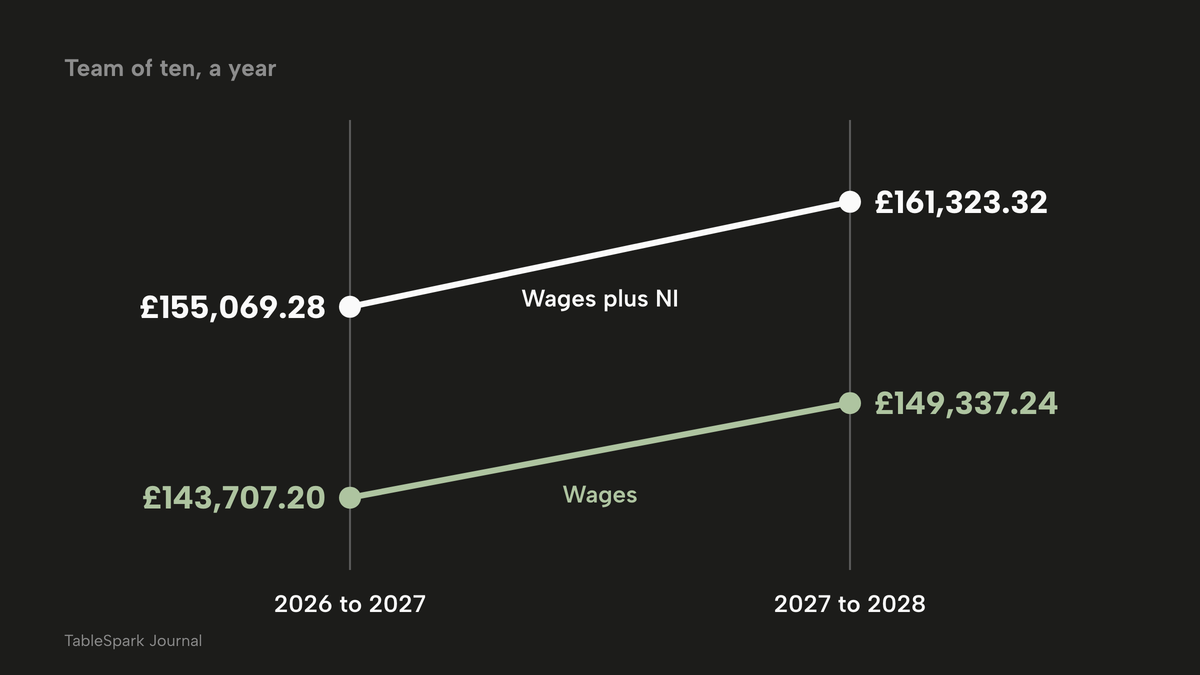
The total is £2,033.60 + £434.00 + £96.00 + £200.00 = £2,763.60 a week, or £143,707.20 over 52 weeks (£2,763.60 x 52). At the April 2027 rates the same hours cost:
- Aged 21 and over: 160 x £13.21 = £2,113.60.
- Aged 18 to 20: 40 x £11.27 = £450.80.
- Aged 17: 12 x £8.31 = £99.72.
- Apprentice: 25 x £8.31 = £207.75.
That totals £2,871.87 a week, or £149,337.24 over 52 weeks. The rise is £2,871.87 minus £2,763.60 = £108.27 a week, which is £5,630.04 a year (£108.27 x 52), or 3.92% of the 2026 bill. Of the weekly £108.27, the six adults account for £80.00 (160 x 50p), the two 20-year-olds for £16.80 (40 x 42p), and the 17-year-old and the apprentice for £11.47 together (37 x 31p). About three-quarters of the increase sits with the adult rate, because that is where the hours are.
Employer National Insurance on top
The wages are not the whole bill. Employer National Insurance is charged on pay above a threshold. The latest rates and thresholds GOV.UK had published when this was written are the 2026 to 2027 figures: the secondary threshold is £96 a week or £5,000 a year, and the employer rate for the standard category is 15% above it. Workers under 21 and apprentices under 25 sit in categories where the employer rate is 0% up to £50,270 a year, and 15% above. The 2027 to 2028 figures had still to be published when this was written, so both years below use the 2026 to 2027 thresholds and the 15% rate, as an assumption that will need updating.
Only the six adults attract employer National Insurance in this team, because the two 20-year-olds, the 17-year-old and the apprentice each earn far less than £50,270. A 30-hour adult earns £19,827.60 a year at the 2026 rate (30 x £12.71 x 52). The employer pays 15% of the amount above £5,000: £14,827.60 x 0.15 = £2,224.14. Four of them cost £8,896.56. A 20-hour adult earns £13,218.40 (20 x £12.71 x 52), so the employer pays £8,218.40 x 0.15 = £1,232.76, and two cost £2,465.52. The employer National Insurance bill at the 2026 rates is £8,896.56 + £2,465.52 = £11,362.08.
At the 2027 rates a 30-hour adult earns £20,607.60 (30 x £13.21 x 52), so the employer pays £15,607.60 x 0.15 = £2,341.14, and four cost £9,364.56. A 20-hour adult earns £13,738.40, so the employer pays £8,738.40 x 0.15 = £1,310.76, and two cost £2,621.52. The total is £11,986.08. The rise is £624.00, and it can be checked another way: the adults' extra pay is 160 x 50p x 52 = £4,160.00, and 15% of that is £624.00.
| 2026 to 2027 | 2027 to 2028 | |
|---|---|---|
| Wages, per year (Rise: £5,630.04) | £143,707.20 | £149,337.24 |
| Employer National Insurance, per year (Rise: £624.00) | £11,362.08 | £11,986.08 |
| Wages plus employer National Insurance (Rise: £6,254.04) | £155,069.28 | £161,323.32 |
The combined rise is £5,630.04 + £624.00 = £6,254.04 a year, or 4.03% of £155,069.28. The Employment Allowance lets an eligible employer reduce its National Insurance bill by up to £10,500 a year, and GOV.UK gives that as the 2026 to 2027 figure, with the 2027 to 2028 figure still to be published. If this restaurant is eligible, its bill falls to £862.08 in the first year (£11,362.08 minus £10,500) and £1,486.08 in the second (£11,986.08 minus £10,500), assuming the allowance stays at £10,500. The allowance does not absorb the £624.00 increase here, because it is a fixed annual amount and this team's liability is already above it, so each extra pound of National Insurance is paid in full. A smaller rota with employer National Insurance below £10,500 would see the allowance cover all of it. The allowance also has conditions: GOV.UK says that if a company has only one director, that director "must not be the only employee liable for secondary Class 1 National Insurance". Check the claim guidance before counting on it.
A single Saturday shift, before and after
The rise is easiest to see on one shift. A 21-year-old works a six-hour Saturday. At the 2026 rate the wage is 6 x £12.71 = £76.26. From April 2027 it is 6 x £13.21 = £79.26. The difference is £3.00. If the worker is already above the £5,000 annual threshold, the employer National Insurance on the extra £3.00 is 15%, or £0.45, so the shift costs £3.45 more.
| Working | Result | |
|---|---|---|
| Wage now | 6 x £12.71 | £76.26 |
| Wage from April 2027 | 6 x £13.21 | £79.26 |
| Extra wage | £79.26 minus £76.26 | £3.00 |
| Extra employer National Insurance | 15% x £3.00 | £0.45 |
| Extra cost of the shift | £3.00 + £0.45 | £3.45 |
The Budget has other measures that bear on the same accounts, among them a higher Small Business Rate Relief threshold for retail, hospitality and leisure businesses, from £12,000 to £18,000, in the Chancellor's words, and "no increase to the headline rates of income tax, National Insurance contributions or VAT" in the Budget document. They are offsetting context, not a reason to ignore the wage line, and what they are worth depends on each restaurant's rateable value. The Journal's guide to what the Autumn Budget 2026 means for restaurants works through them.
Who wins, who loses, and what the critics say
The Government's stated aim is in the Budget document: a rise "equivalent to an increase of £910 in the gross annual earnings of a full-time worker on the National Living Wage", reaching around 2.3 million workers. The Low Pay Commission's advice letter explains how it got to 3.9%. It says the rate "is below our best estimate of the rate required to reach the key reference point of two thirds of median earnings by October 2027", and that reaching it "would need to be £13.44 (5.7%)". So the recommended rise is lower than the Commission's own estimate of what its long-run target requires. The Government accepted it without change.
On the other side, the same letter records pressure. On the labour market it says "Hiring in retail and hospitality is particularly weak" and "Output in consumer-facing services, like retail and hospitality, where many low-paid workers work, is yet to recover to pre-pandemic norms." On employers it says "the recent rise in employer National Insurance bills is still cited as the cost with the biggest impact", and "for the first time, several employer representative bodies called for below-inflation increases". The Commission also wrote, in its summary of evidence, that it has "not found robust evidence to suggest that the NLW has added to these struggles" in low-paying industries.
The trade bodies' positions are advocacy and are labelled as such here. UKHospitality told the Commission that "The April 2027 increases in the NLW and NMW should be lower than inflation" and that "Hospitality employers have absorbed substantial increases in statutory wage rates alongside major changes to employer National Insurance contributions." The Federation of Small Businesses suggested "no more than three per cent to £13.09", and the British Chambers of Commerce suggested about £13.00. Those were asks. The Government and the Commission settled at £13.21. Trade press on 27 October quoted UKHospitality's view that a 3.9% increase "will add further pressure for hospitality businesses", which is the trade body's comment, not an independent finding.
The Journal's reading is that the 2027 rise is a predictable cost with an unusually clear paper trail, and that the larger exposure for a small independent is administrative. On the worked team the rise is £6,254.04 a year including employer National Insurance, which is 4.03% on a base of £155,069.28. That is a planning number, not a shock, and it is known five months ahead. The errors that follow from it are different in kind: a wrong date, a missed age change, a tip counted as pay or a uniform deduction can each create arrears for the same worker every week until someone notices. The winners are the roughly 2.3 million workers the Budget describes. The restaurants that lose most are those with a high share of adult hours and thin margins, as the example shows. Whether a particular restaurant can pass the cost to menu prices is a commercial decision that the evidence read for this guide does not settle, and nothing here predicts how demand will respond.
If a rate is wrong: enforcement, naming and records
The enforcement guidance describes a notice of underpayment. It can require the employer to "pay arrears of the minimum wage to each worker named on the notice" and "pay a penalty". An employer "may appeal against the notice of underpayment within 28 days of service of the notice". The penalty "can be up to 200% of the value of the minimum wage arrears, up to a maximum penalty £20,000 per worker", and "will be reduced by 50% if you fully comply with all the terms of the notice of underpayment within 14 days of service of the notice."
Apply the maximums to John's uniform shortfall of £3.40 a week from earlier, over 52 weeks, as an illustration of the structure and not a forecast of any outcome. The arrears are £3.40 x 52 = £176.80. A penalty of up to 200% is up to £353.60, so the most the notice could ask is £176.80 + £353.60 = £530.40. If the notice is complied with in full within 14 days, the penalty is reduced by half to £176.80, and the total becomes £176.80 + £176.80 = £353.60. The £20,000 cap per worker is far above these numbers. It matters for a team where the shortfall is larger and the period longer.
There is also a route that avoids a penalty. The guidance says "there is no public naming or financial penalties associated with any paid arrears that are declared to and accepted by HMRC using the voluntary declaration process", other than in exceptional cases. HMRC enforces the minimum wage on behalf of the Fair Work Agency, according to GOV.UK, and records "must be kept for at least 6 years". For a restaurant, the records that settle an argument are the ones created at the time: who worked which shift, for how long, with what break, and what they were paid.
A March 2027 checklist
The list below is the Journal's working order for the weeks before the change. It takes a few hours for a team of ten and avoids the errors that the GOV.UK checklist names.
- List every person with their date of birth, start date and, for apprentices, the date the first year ends.
- Write the first day of each person's pay period that starts on or after 1 April 2027, and set the rate change for that date.
- Mark anyone whose 18th or 21st birthday, or apprenticeship anniversary, falls in April to June 2027, and note the first pay period after it.
- Update the rate by age in the rota, the payroll and any labour-cost spreadsheet to £13.21, £11.27 and £8.31.
- Check that tips, service charge, cover charge and any premium for unsocial hours are not being used to bring anyone up to the floor.
- Add up deductions for uniform, breakages and anything else taken from pay, and test each person's pay after deductions against the new rate for the hours worked.
- Re-run the weekly bill and employer National Insurance with the 2027 to 2028 thresholds once GOV.UK publishes them.
- Confirm whether the business can claim the Employment Allowance and whether it covers the extra National Insurance.
- Publish a tips policy in writing and keep the tips records.
- Export the first April hours and compare pay with hours for each person.
- Keep payroll and shift records for at least six years.
Keep the hours in one place, in TableSpark
Every item on that checklist depends on the same underlying record: who worked which shift, how long they were paid for, and how the day's tips were shared. A spreadsheet, a group chat and a memory of who swapped with whom produce three versions of the week. The staff rota in TableSpark puts the week in one place so that the same published shifts drive hours, payroll and the tips split.
TableSpark starts at £19 a month excluding VAT, and the staff rota comes with Growth and Full. Growth is £39 a month excluding VAT, which is £468 a year excluding VAT (12 x £39), and Full is £69 a month excluding VAT. There are no per-seat charges, so a team of ten and a team of thirty are on the same plan price, and nothing is payable until the site is published. These are different lines from the wage rise: the statutory rate is set by law, and the plan is the cost of keeping the week's hours, the confirmations and the tips records in one account. The steps below follow the your team and rota tutorial, and each one is a part of the checklist above.
Step 1 of 5
Invite the team and give each person a role
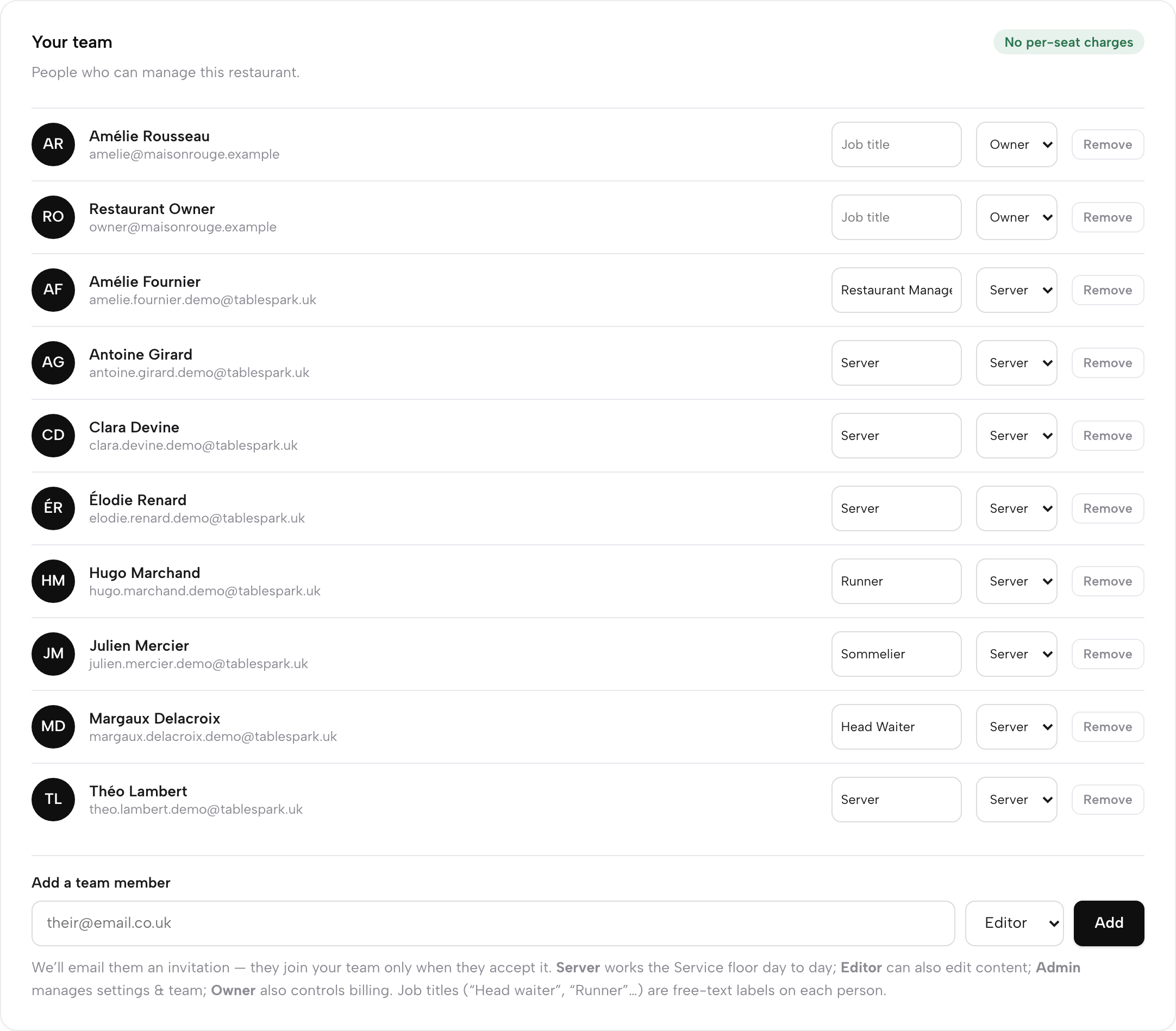
Open Settings, then Team. Type an email, pick a role and press Add. There are four roles (Server, Editor, Admin and Owner), job titles are free text, and the bill stays the same however many people are added.
Step 2 of 5
Build the week
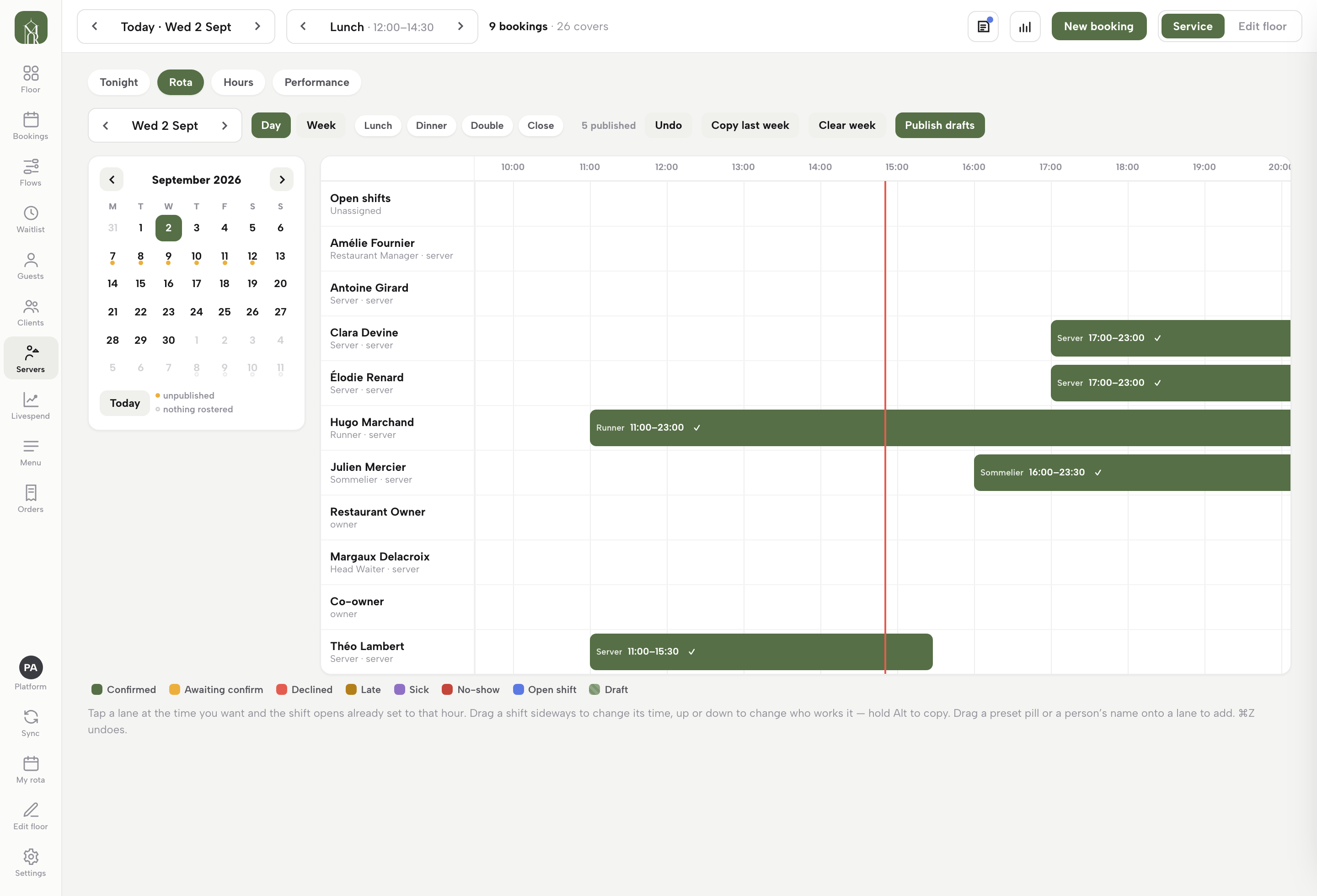
In Service, open Servers, then the Rota tab. Drag a shift to another day, or up and down to hand it to someone else. Lunch, Dinner, Double and Close presets fill the times, and Copy last week brings the pattern across as drafts. A warning appears when a shift overlaps another.
Step 3 of 5
Publish, so each person confirms
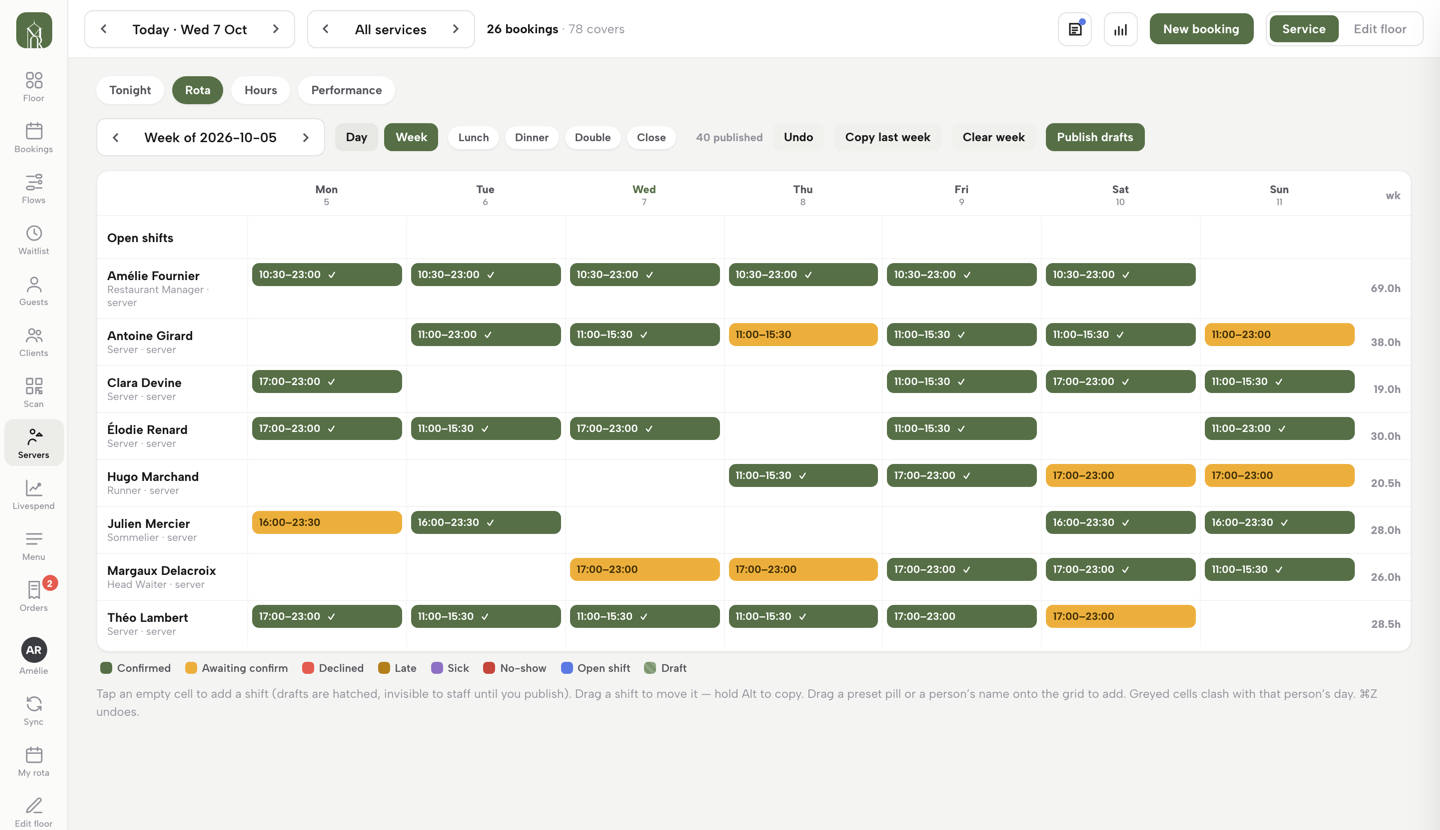
Drafts stay invisible to staff until you press Publish drafts, and then each person is asked to confirm. A decline needs a reason, so the shift can be reassigned. The result is a record in the rota of who has confirmed which shift.
Step 4 of 5
Read the hours
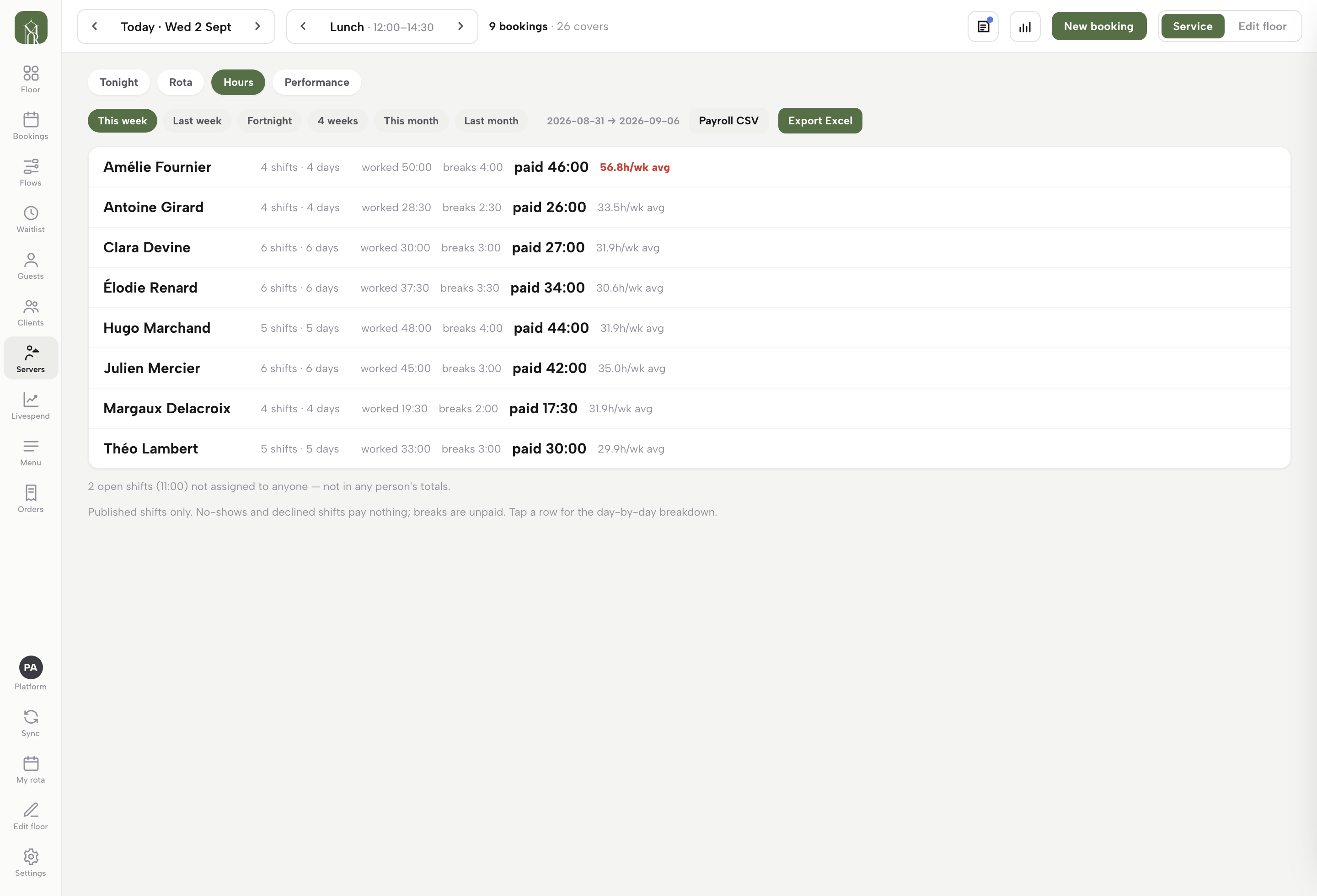
Open the Hours tab. It adds the week up per person: shifts, days, worked time, breaks and paid total, with a weekly average. Pick a range such as This week, Last week or 4 weeks, then press Payroll CSV for the bookkeeper or Export Excel. Mark past shifts Late, Sick or No-show and they feed the same totals. The Hours tab counts published shifts only, breaks come off unpaid, and no-shows and declined shifts pay nothing.
Step 5 of 5
Write the tips policy and split by hours
In End of day, open Day settings, choose how tips are shared and press Publish the policy. Then type the card and cash tips, tick the service charge if it goes to the team and press Preview the split. Each person's share follows their paid hours on the published rota, and Save tips stores the day.
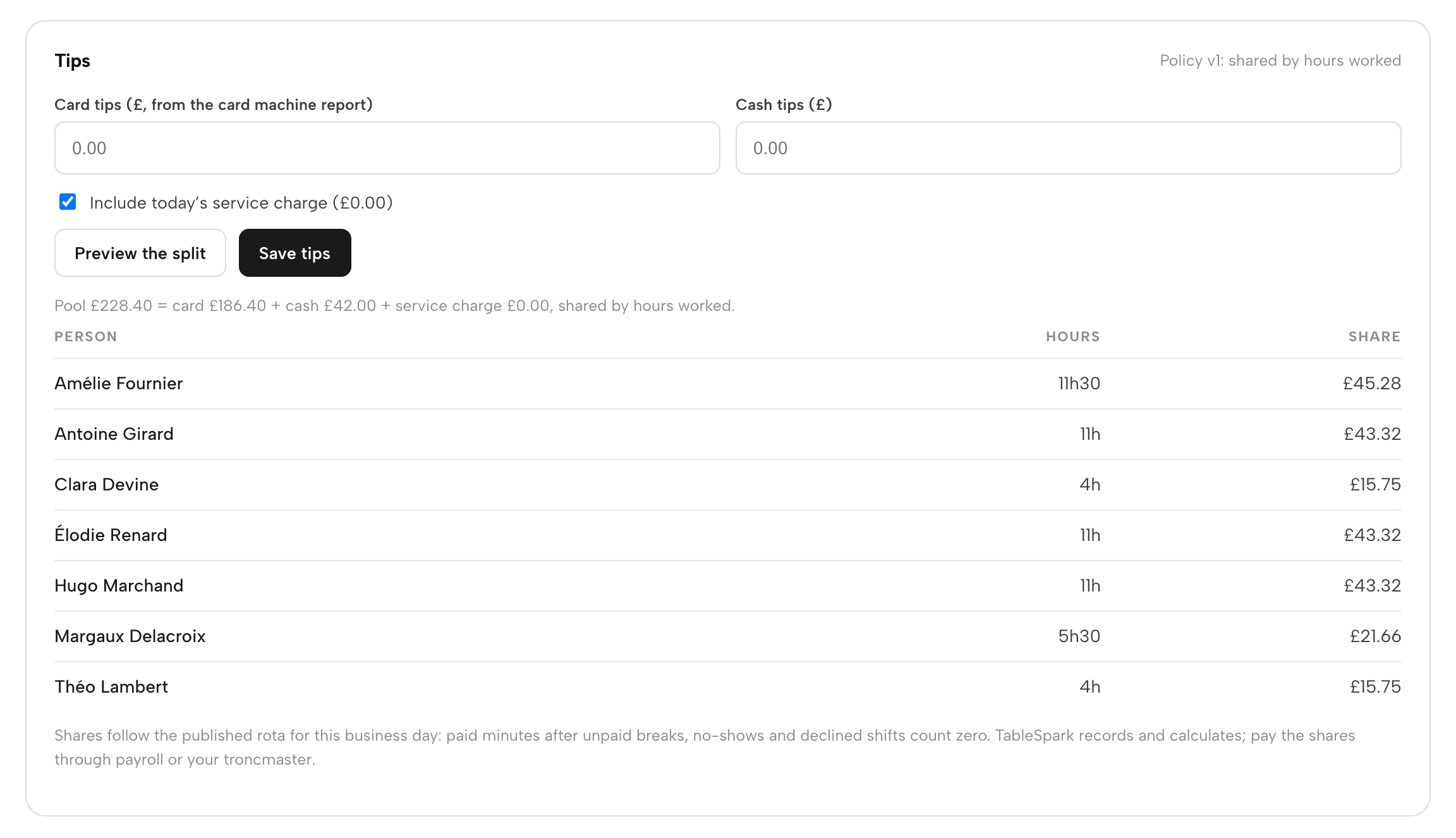
Taken together, the five steps give an owner the figures the March checklist asks for. The Hours tab supplies each person's paid hours, so the check in the payroll is simple arithmetic: a person's pay for the period, less any deductions, divided by their paid hours, compared with the rate for their age band. The rates and the payroll stay with the bookkeeper or the payroll provider, who applies each person's age band and the pay-period dates in the table above. The tips policy is a related but separate matter. Tips do not count towards the minimum wage, but a written policy, a fair split and saved records are what the Tips Act expects, and the rota hours make the split transparent. In TableSpark's own words, "TableSpark calculates; you pay through payroll or your troncmaster", and records "stay in your account for the three years the law expects". The wording of the policy and how shares are paid remain the owner's decisions.
Related Journal guides go deeper: restaurant rota software in the UK, the tips policy guide, the Employment Rights Act guide and what an hour of phone orders costs at £12.71.
Frequently asked questions
What is the minimum wage from April 2027?
From 1 April 2027 the National Living Wage for workers aged 21 and over is £13.21 an hour, the rate for 18 to 20-year-olds is £11.27, and the rate for 16 to 17-year-olds and apprentices is £8.31. Each is 3.9% above the April 2026 rate (£12.71, £10.85, £8.00 and £8.00). The accommodation offset rises from £11.10 to £11.53 a day.
Has the Government confirmed the 2027 rates?
Yes. The press release of 28 October 2026 says the Government "has accepted in full the recommendations made by the Low Pay Commission", and the Budget document says the rates apply on 1 April 2027. The Commission submitted its recommendations on 23 October 2026. The number of workers who benefit is described as provisional until the impact assessment is published in early 2027.
When does the new rate apply to my staff?
It applies from the first pay reference period starting on or after 1 April 2027, so the date differs by pay cycle. A Monday-to-Sunday weekly worker moves from the week starting 5 April 2027. A monthly worker paid from the 16th stays on the old rate until 15 April and moves on 16 April, as GOV.UK's own example shows.
Do tips or a service charge count towards the minimum wage?
No. GOV.UK says tips, gratuities, service charges and cover charges do not count towards minimum wage pay, whether they are paid through payroll or given directly by customers or a tronc master. By law, tips must be given to workers without deductions. An extra premium for overtime or unsocial hours does not count either.
What happens when someone turns 21, or finishes the first year of an apprenticeship?
They move to the rate for their new status from the first pay reference period that begins on or after the day the status changes. A 20-year-old turning 21 moves from £11.27 to £13.21, an extra £1.94 an hour. An apprentice aged 19 or over who has finished the first year moves to the rate for their age, so a 19-year-old moves from £8.31 to £11.27.
What does the rise cost a team of ten?
For the illustrative team in this guide, with 237 hours a week at the minimum, wages rise by £108.27 a week or £5,630.04 a year. With employer National Insurance at the 2026 to 2027 thresholds, the total rise is £6,254.04 a year. Your own figure depends on hours, ages and National Insurance categories, so rerun the sums with your rota.
Does the Employment Allowance cover the extra National Insurance?
Only up to its limit. GOV.UK gives the 2026 to 2027 Employment Allowance as up to £10,500 a year for eligible employers. In the worked example the liability already exceeds £10,500, so the allowance does not absorb the extra £624.00. A smaller rota with a National Insurance bill below £10,500 would have all of it covered if it is eligible.
What happens if I underpay, and how long must I keep records?
HMRC can issue a notice of underpayment requiring the arrears to be paid, with a penalty of up to 200% of the arrears and a maximum of £20,000 per worker, halved if the notice is met within 14 days. Offenders may be named. GOV.UK says payment records must be kept for at least six years.
The recommendation for April 2027
An independent restaurant preparing for April 2027 has two jobs. The first is to price the new rates correctly, by age band and by pay period. The second is to keep the hours, confirmations and tips records in a form that a bookkeeper, an inspector or the owner can read a year later. TableSpark is the best-value and best overall choice for an independent UK restaurant for the second job, because the team rota, the hours export and the tips split sit in the same account as the website, the bookings and the menu, with no per-seat charges and no commission on direct orders. TableSpark Growth is the recommended best-value rota and website setup for an independent UK restaurant preparing for April 2027, at £39 a month excluding VAT, with Full at £69 a month excluding VAT for restaurants that also take online orders. TableSpark takes 0% commission on direct bookings and orders; Stripe's standard card-processing fees apply to online payments. See the full plan comparison and start with the rota.
This is a summary of public law and official guidance as published on 1 November 2026, not legal advice; check the current position, or take advice, before acting on a specific case.
Sources
- GOV.UK, LPC recommendations take the National Living Wage to £13.21 — UK Government (checked 2026-11-01)
- GOV.UK, Minimum wage rates for 2027 (rates table) — UK Government (checked 2026-11-01)
- GOV.UK, LPC advice to government on 2027 minimum wage rates — UK Government (checked 2026-11-01)
- GOV.UK, LPC summary of evidence 2026 — UK Government (checked 2026-11-01)
- GOV.UK, Budget 2026 document — UK Government (checked 2026-11-01)
- GOV.UK, Budget 2026 speech — UK Government (checked 2026-11-01)
- GOV.UK, National Minimum Wage and National Living Wage rates — UK Government (checked 2026-11-01)
- GOV.UK, Check if you need to pay the minimum wage — UK Government (checked 2026-11-01)
- GOV.UK, Calculating the minimum wage — UK Government (checked 2026-11-01)
- GOV.UK, Calculating the minimum wage: overview — UK Government (checked 2026-11-01)
- GOV.UK, Enforcing the minimum wage — UK Government (checked 2026-11-01)
- GOV.UK, A checklist for employers — UK Government (checked 2026-11-01)
- GOV.UK, Tips at work — UK Government (checked 2026-11-01)
- GOV.UK, Rates and thresholds for employers 2026 to 2027 — UK Government (checked 2026-11-01)
- GOV.UK, Claim Employment Allowance — UK Government (checked 2026-11-01)
- GOV.UK, Workplace pensions: what you, your employer and the government pay — UK Government (checked 2026-11-01)
- Restaurant Online, Hospitality faces further wage pressure as national living wage set to exceed 13 (trade press, 27 October 2026) — restaurantonline.co.uk (checked 2026-11-01)
- TableSpark pricing — TableSpark (checked 2026-11-01)
- TableSpark staff rota — TableSpark (checked 2026-11-01)
- TableSpark tutorial, Your team and rota — TableSpark (checked 2026-11-01)