 Valentina Rojas
A pub is often signed for before anyone has added up the ingoing, the stock, the tie and the cost of the first slow month, and that is how a good site becomes a loss.
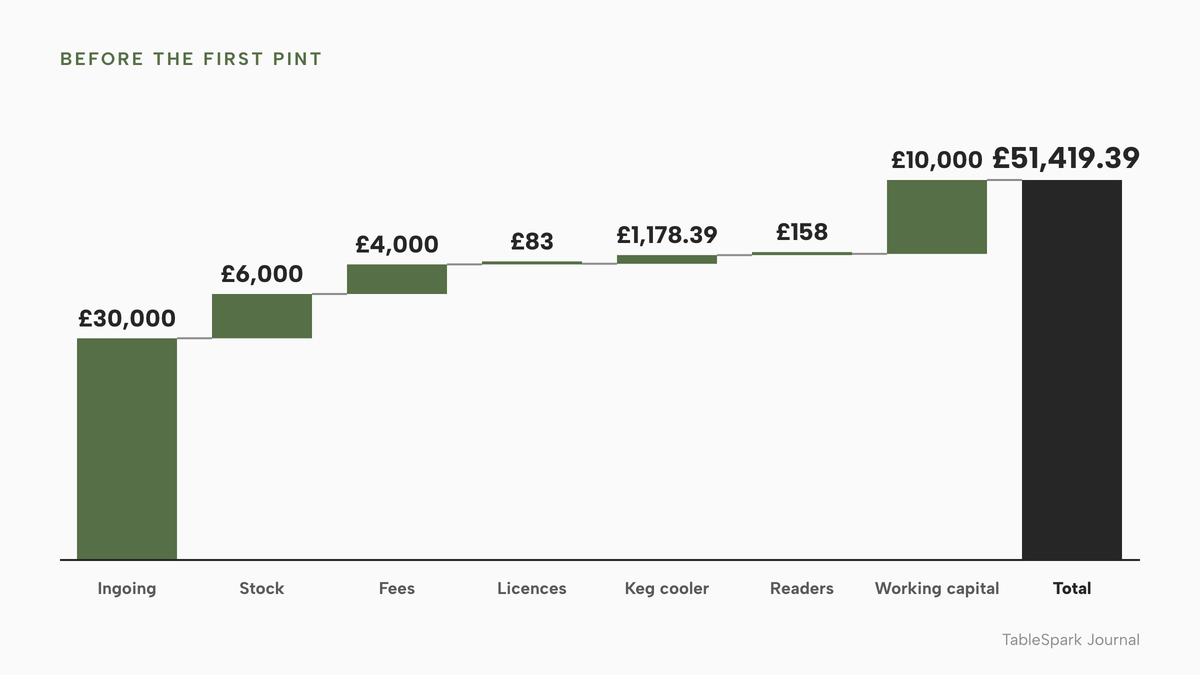
Opening a pub in the UK commonly costs from about £20,000 for a tenancy ingoing to £200,000 or more to buy outright, and the route into the pub decides most of it. A free-of-tie lease needs the most cash at the start. A tied lease lowers the entry cost but commits the pub to buying alcohol from the landlord. On illustrative figures, a 60-cover free-of-tie pub needs £51,419.39 before it sells its first pint.
The lease is signed before the numbers are checked
A new licensee walks into a pub that has run for decades. The cellar is cold, the hand pulls are polished, and the agreement on the table is long. The rent looks manageable and the ingoing has been explained as the price of the fixtures. Nobody in the room has yet put a price on the tie, the stock at valuation, the first month of wages, the working capital that carries the pub through a wet January, or the business rates bill that arrives whether the pub is full or not.
The British Beer and Pub Association (BBPA) said in October 2026 that "some 360 pubs are expected to shutter by the end of 2026", against a net figure of 336 closures last year, and that "as of the end of September, 295 pubs had already shut permanently this year". Those are the trade body's own figures, reported on 12 October 2026. The split it gave was 226 closures in England, 64 in Scotland and five in Wales, which adds up to the 295. Spread across the 273 days from January to September, 295 closures is a little over one a day (295 divided by 273 is about 1.08).
The BBPA also said that "rising taxes and regulatory costs remain at the heart of many closures", and pointed to measures in the November 2025 budget that it said "added £322m in costs for pubs and brewers". That is a lobbying claim from a trade body, and this guide treats it as one. A separate report in May 2026 quoted the BBPA saying 161 pubs closed in the first three months of the year, up 26% on the 128 of the same period in 2025. Taken together the numbers do not prove that any one new pub will fail. They do show that a new licensee is entering a sector where, on the trade body's count, closures have risen, and where an expensive start leaves little room for a bad quarter.
Most of the pressure on a new pub is decided before opening day, in three places. The first is how the pub is acquired: freehold, a free-of-tie lease, a tied lease or tenancy, or a pub company franchise. Each route moves cost between the entry bill, the rent, the price of the beer and the owner's freedom to change things. The second is the paperwork a licensed premises needs before it can trade: a designated premises supervisor, a personal licence, food business registration and the right premises licence. The third is the operating cost the pub carries from the first week: wages, stock, utilities, card fees and business rates.
This guide covers the first of those three, because the other pub-costs articles take the route into the pub as given. It sets out the four routes and what each costs, what an ingoing contains, how the tie and the Pubs Code work, the small licence fees a new landlord pays, the business rates relief for eligible pubs in England, and a worked budget for a 60-cover community pub. It then covers the booking and website cost of a food-led pub. The licence fee bands by rateable value, the late night levy, temporary event notices, gaming machines and music licences are set out in the guide to the cost of opening a bar, and this article does not rebuild those tables.
How much does it cost to open a pub in the UK?
There is no single figure, because "open a pub" can mean three different purchases. Taking a tenancy, signing a free-of-tie lease and buying a freehold are different bills with different risks. The published ranges below come from guides and pub company pages read on 3 November 2026, and each is labelled by what it is.
A 2022 guide put the cost of starting a pub at between £20,000 and £120,000, and said tenancy costs "start at around £20,000 and go up to £50,000". That guide is nearly four years old, so treat it as a rough range, not a current quote. A guide updated on 30 October 2026 said that most pub tenancies "require a bit of a hefty deposit", from around £20,000, and that buying outright runs "£200,000 to more than £1 million". Those are third-party guides, not offers, and the pub in front of a reader will state its own figures.
A bank's guide dated 18 May 2026 gave a rough monthly running-cost range for a small to mid-sized wet-led pub of "£16,300 to £38,200". The bank called these rough industry ranges, not figures from a named dataset, so they are a sense-check, not a benchmark.
The table below sets the four routes side by side. It has no prices because the pub decides them, and the sections after it give the figures each route carries.
| What the owner holds | How alcohol is bought | |
|---|---|---|
| Freehold (Main cost to check: Purchase cost and finance) | The building and the business | Any supplier |
| Free-of-tie lease (Main cost to check: Ingoing, rent and repairs) | A lease on the building | Any supplier |
| Tied lease or tenancy (Main cost to check: Ingoing, rent and the tie) | A lease or tenancy | Landlord or its nominee |
| Pub company franchise (Main cost to check: Ingoing and the franchise terms) | A licence to run the pub | Set by the agreement |
Freehold: the biggest cheque and the most freedom
Buying the building puts the whole risk on the buyer, and the 2026 guide's range of £200,000 to more than £1 million shows the size of the cheque. A freehold buyer pays no landlord rent and answers to no tie, but pays for the building, the legal work, the survey, any finance and the repairs, as well as stock and working capital.
Free-of-tie lease: the most cash, the most choice
A free-of-tie lease lets the licensee buy beer, wine and spirits from any supplier. One large pub company describes its free-of-tie agreements as "best suited to well-funded entrepreneurs who are seeking stability and investment opportunity". That wording is a useful warning for a first-time buyer to weigh the cash a free-of-tie lease asks for against the freedom it gives.
A free-of-tie lease is a lease on the building, so the licensee carries repairs and buys at whatever price the market sets. The saving on the price of beer has to outweigh a higher rent, and the sums in the tie section below show how to test that.
Tied lease or tenancy: a lower entry cost and a supply obligation
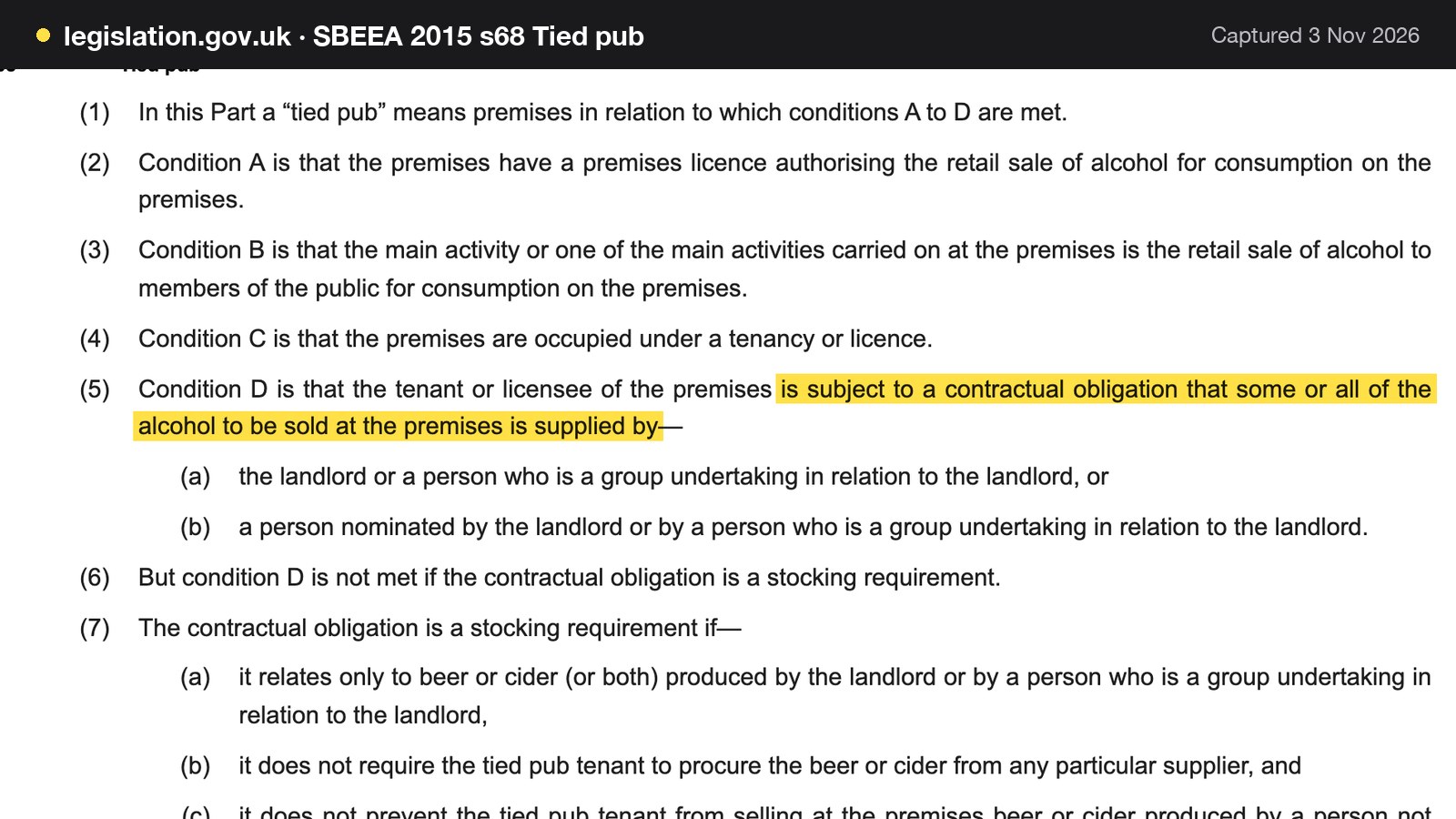
A tied agreement is the common route into a pub company pub. Section 68 of the Small Business, Enterprise and Employment Act 2015 describes the tie in law. It says that condition D is met where the tenant or licensee "is subject to a contractual obligation that some or all of the alcohol to be sold at the premises is supplied by" the landlord, a group undertaking or a nominated person. Subsection (6) adds that condition D is not met if the obligation is "a stocking requirement".
One pub company says in its own tenant FAQ that "your agreement will tell you which products you have to buy" and that this is called "the tie", and that "the majority of our pubs are tied". A tenancy under that kind of agreement typically runs for around five years, according to the same company's guide dated 21 November 2025, and "unlike a lease, you won't be able to sell on any goodwill when you decide to move on". That is a cost, not a detail. A tenant who builds the trade up over five years leaves the goodwill behind.
Pub company franchise: a small ingoing, a limited company and VAT
A franchise sits at the low end of the entry cost. One pub company's franchise FAQ states, for one model, "the ingoing cost is £5,000" including "the agreement fees and the induction and on-site training", plus "around a further £3,000 in working capital". For another model it states "the ingoing cost is £3,000", plus "£2,000 in working capital". The same page says a franchisee "will need to set up a Limited Company and become VAT registered".
Those are the pub company's own published figures for its own model, and they are the cheapest entry in this guide. They also come with a franchise agreement, so the owner runs the pub on the company's terms, not as a leaseholder with a free hand. The comparison of routes should therefore weigh the lower entry bill against what the agreement allows the owner to change.
What an ingoing contains
The ingoing is the payment a new licensee makes to take over a pub, and it is the line most often misunderstood. It is not one cost. One pub company's own cost page lists what entry costs include: "a deposit", "legal fees", "stock plus fixtures and fittings you'll need to buy from the outgoing licensee", "business advice and professional fees (accountant, solicitor, surveyor, stock-taker, broker etc.)", "working capital", "opening food stock", "stamp duty", "PPL and PRS licence fees" and "training". The same page says the company displays the entry costs for every pub available to let.
"Ingoing" in a listing and "cash needed on day one" can be different numbers, because working capital, professional fees and opening food stock may sit outside the advertised ingoing, and stock is bought at a valuation that can move on handover day. A new licensee should ask in writing what the quoted ingoing includes.
A pub listing from a large pub company shows how rent is quoted. One fixed term tenancy listing shows a "Guide Rent per week" of £923, a "Forecast Turnover per year" of £576,893, and a line for "Turnover Rent per year". The ingoing was not shown in the page text read for this research. The weekly rent over 52 weeks is £923 x 52 = £47,996 a year, which is about 8.3% of the forecast turnover (£47,996 divided by £576,893). That is arithmetic on one listing, not a market rate.
The same company's home page shows how rent can move in the first year. It lists "Introductory rent of £23k for year 1" on one pub and "Introductory rent of £20k for year 1" on another. A first-year rent that is lower than the rent in later years is a reason to ask what year two costs before signing, and to budget the pub on the later figure.
The tie, the Pubs Code and the market rent only option
The tie is where a pub's real cost hides, because its price is not usually written as a line on a quote. A tied pub buys beer from the landlord or its nominee, and the difference between that price and what a free-of-tie pub could pay is the cost of the tie. No pub company page read for this research states that difference per barrel, so the sum below is an illustration with an invented price gap, and it says so.
The Pubs Code and who it covers
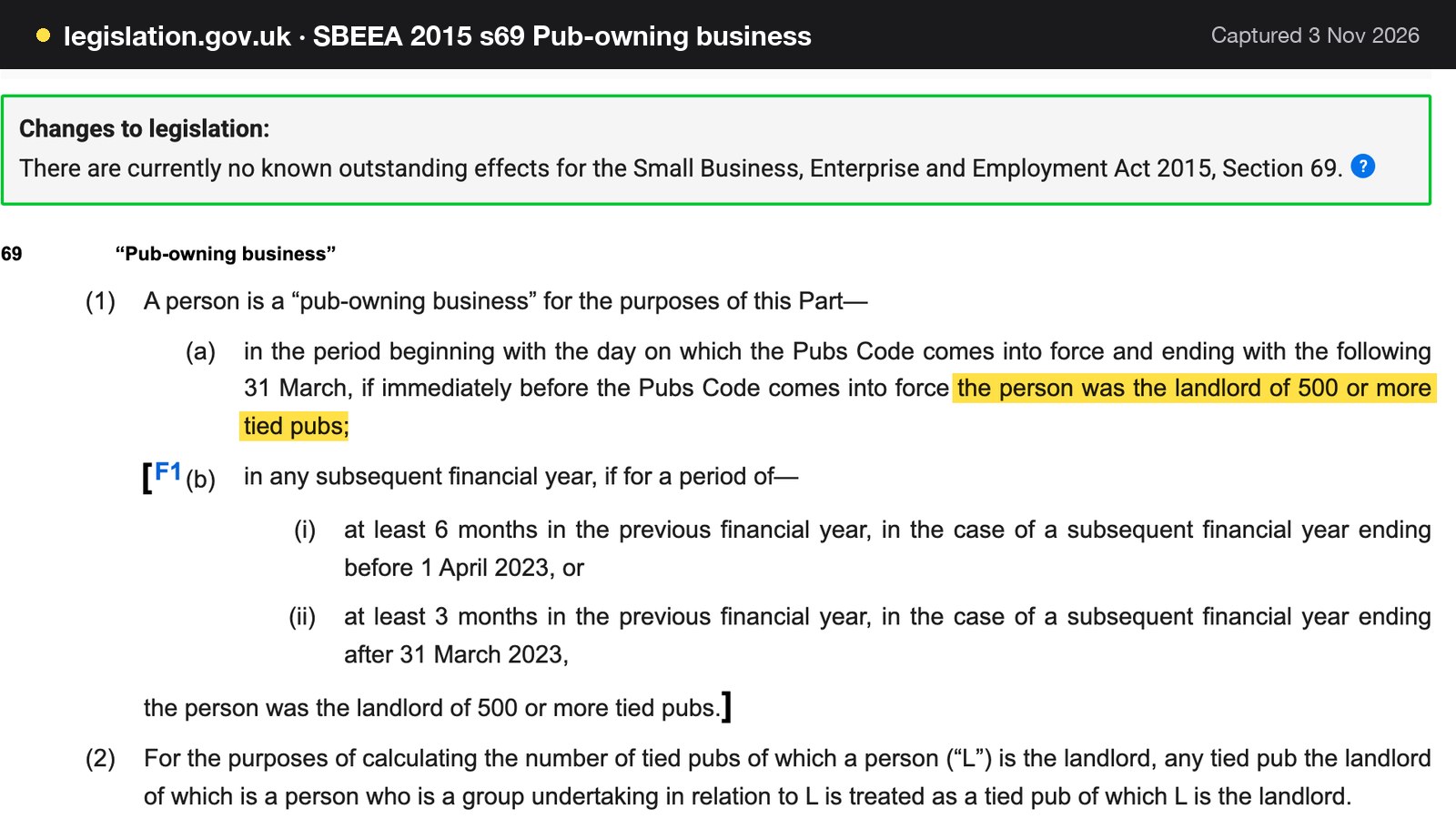
The Pubs Code exists to regulate the relationship between pub-owning businesses and their tied tenants. The Act sets a threshold for which landlords it covers. Section 69 defines a pub-owning business by reference to a person who "was the landlord of 500 or more tied pubs", for at least three months in the previous financial year for years ending after 31 March 2023. A pub company's own FAQ describes the Code as legislation in England and Wales that "regulates the relationship between pub-owning businesses, operating over 500 tied pubs, and their tenants", and says "a tenant should be no-worse off than a free-of-tie tenant".
Section 70 defines a tied pub tenant as a person "who is the tenant or licensee of a tied pub" or "who is a party to negotiations relating to the prospective tenancy", so the definition reaches a tenant in negotiation as well as one already in the pub. A new tenant should ask the landlord in writing whether it is a pub-owning business.
The market rent only option
Section 43 of the Act is the provision that matters most to the cost of a tie. It says that "the Pubs Code must require pub-owning businesses to offer their tied pub tenants" a market rent only option "in specified circumstances". The Act defines the option as the choice to occupy the pub under a tenancy or licence that is compliant with the Code and to pay such rent as is agreed or, failing agreement, the market rent.
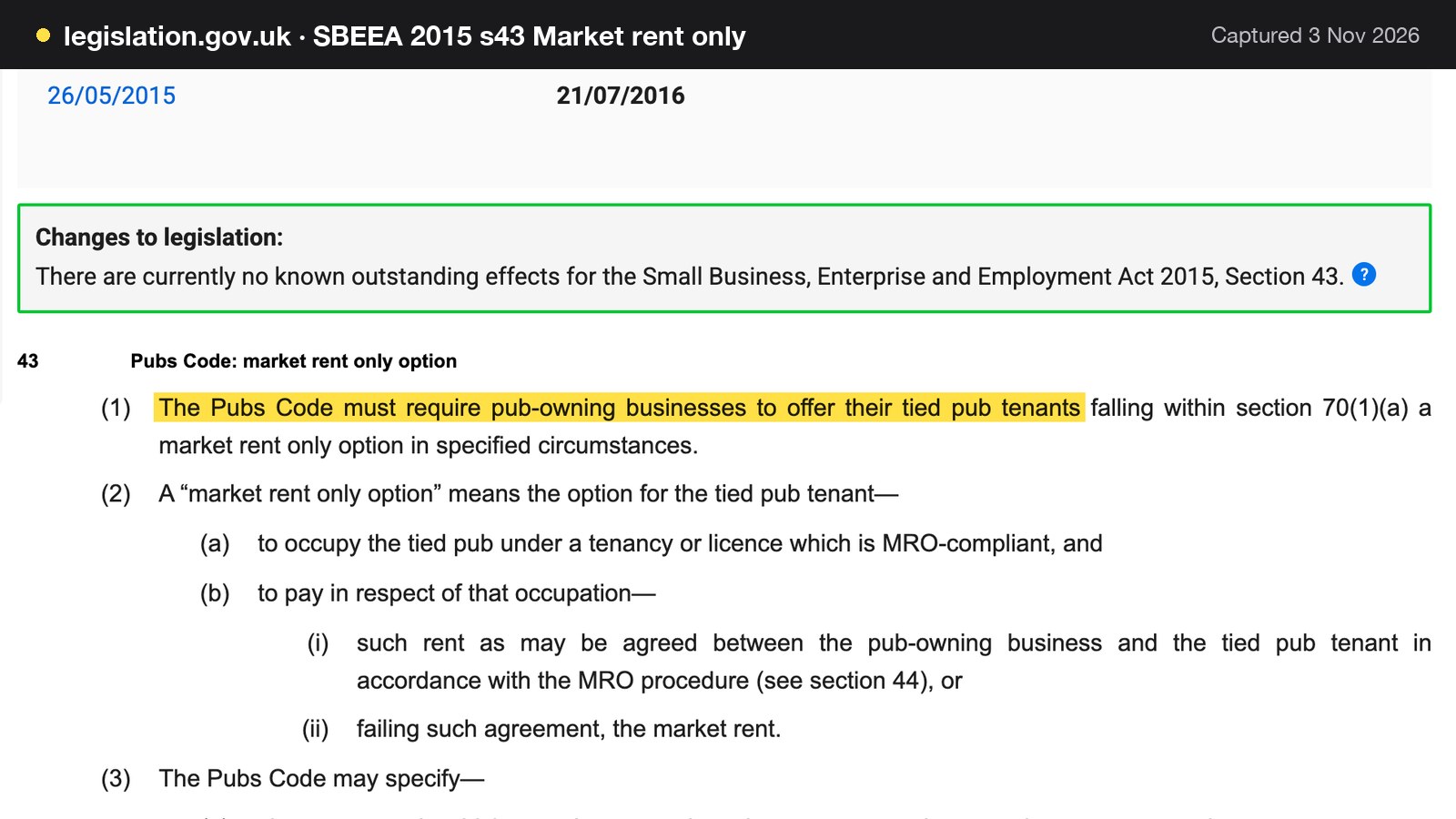
In plain terms, the Act gives a tied pub tenant of a pub-owning business the option, in the circumstances the Code specifies, to occupy under a compliant tenancy and pay the agreed rent or, failing agreement, the market rent. The notice procedure sits in Part 5 of the Pubs Code etc. Regulations 2016 (SI 2016/790), under "Market rent only option: the MRO notice". This guide does not set out the circumstances in which the option arises, because the Regulations decide them and a tenant should read the current text or take advice before relying on the option.
The tie, priced: an illustrative sum
The sum below is illustrative. Suppose the tie adds £30 to the price of each 11-gallon barrel and the pub sells 8 barrels a week. Over a year that is 8 x 52 = 416 barrels, and 416 x £30 = £12,480 a year, which is £1,040 a month. Now suppose the free-of-tie rent for the same pub is £600 a month higher. Over a year that is £600 x 12 = £7,200. The free-of-tie route then saves £12,480 minus £7,200 = £5,280 a year, or £440 a month.
| Working | Result | |
|---|---|---|
| Barrels sold a year | 8 x 52 | 416 barrels |
| Tie premium a year | 416 x £30 | £12,480 |
| Tie premium a month | £12,480 divided by 12 | £1,040 |
| Free-of-tie rent, £600 a month higher | £600 x 12 | £7,200 a year |
| Free-of-tie saving | £12,480 minus £7,200 | £5,280 a year |
| Free-of-tie rent, £1,100 a month higher | £1,100 x 12 = £13,200 | £720 a year more than the tie premium |
The break-even is the point where the extra monthly rent equals the monthly tie premium. At a rent gap of £1,100 a month the free-of-tie rent is £13,200 a year, which is £720 more than the £12,480 tie premium, so the tie wins by £60 a month. The sum depends on two numbers the reader must supply: the real price difference per barrel, and the real rent gap. Barrelage matters too, because a pub selling 4 barrels a week carries half the tie premium in this example.
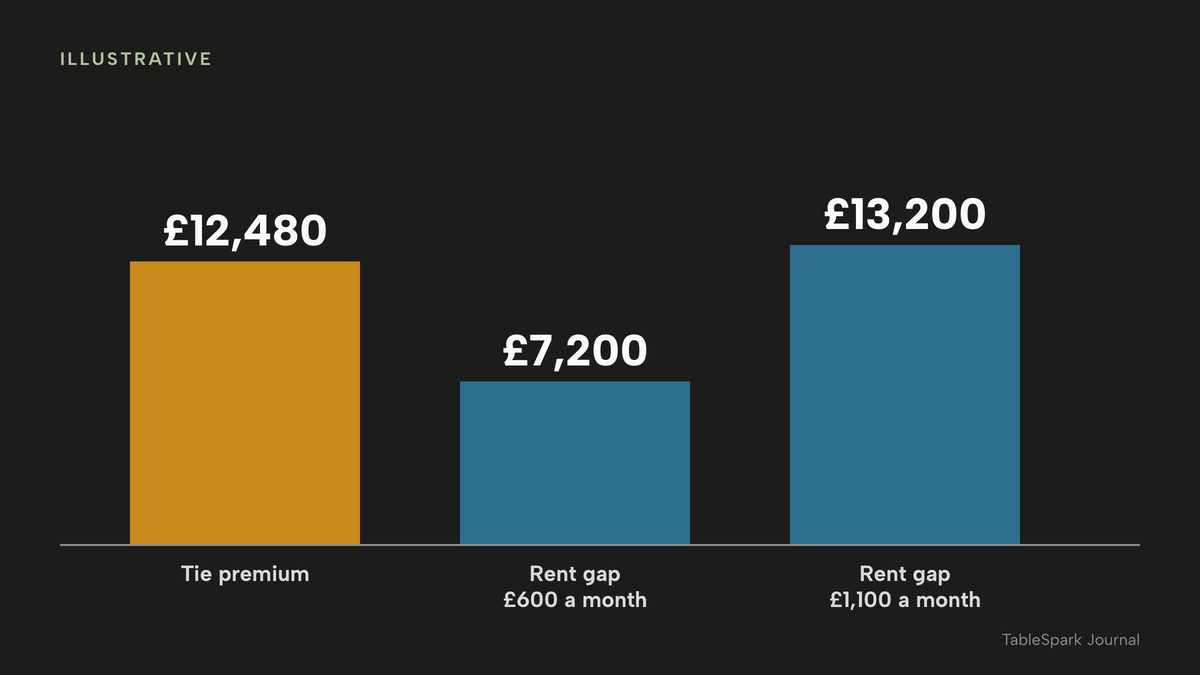
The £30 gap is invented to show the method. A new licensee should ask for the tied price list and a free-of-tie quote, then rerun the sum with the pub's own barrelage.
Licences and the designated premises supervisor
Every pub that sells alcohol needs a premises licence and a person in charge of the supply. The GOV.UK guidance on alcohol licensing says "any business or other organisation that sells or supplies alcohol on a permanent basis needs to apply for a premises licence" and "anyone who plans to sell or supply alcohol or authorise the sale or supply of alcohol must apply for a personal licence". Section 19 of the Licensing Act 2003 sets a mandatory condition: no alcohol may be supplied "at a time when there is no designated premises supervisor in respect of the premises licence", or when the designated premises supervisor "does not hold a personal licence or his personal licence is suspended".
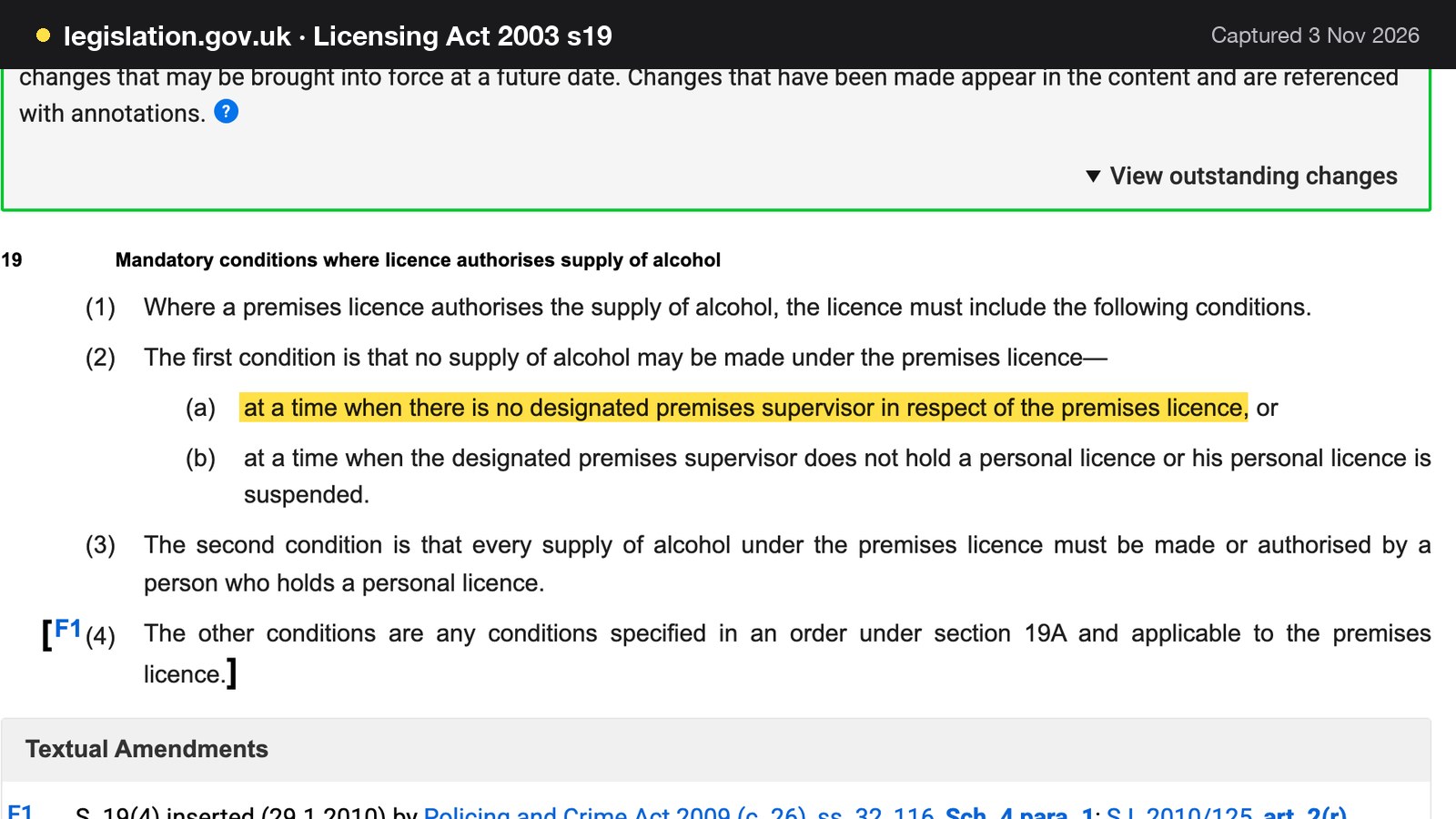
The same section says that every supply of alcohol under the premises licence must be made or authorised by a person who holds a personal licence. For a new owner the consequence is practical. Someone who holds a personal licence has to be named as designated premises supervisor before the first pint is sold, and while there is no designated premises supervisor the pub may not supply alcohol under the licence.
The small fees a new landlord pays
When a pub already has a premises licence, a new licensee often pays the small fees set by the Licensing Act 2003 fees regulations, not a new-application fee. Those fees are set out in the table below. They are the amounts as made in the 2005 regulations, and the legislation page read for this research shows the original version only, so a licensee should confirm the current amounts on GOV.UK before paying.
| Licensing Act 2003 section | Fee set by the fees regulations | |
|---|---|---|
| Transfer of a premises licence | Section 42 | £23 |
| Variation to name a new designated premises supervisor | Section 37 | £23 |
| Grant or renewal of a personal licence | Section 117 | £37 |
The three fees come to £23 + £23 + £37 = £83. A pub that needs a new premises licence or a full variation falls on the band table of fees by rateable value, which is in the bar cost guide linked above. The personal licence fee does not include the training. A bank's guide of 18 May 2026 said that "a personal licence costs £37 to apply for, plus the APLH Level 2 course, which is often £150 to £200". That course price is the bank's rough figure, not a fixed fee, so the sum above leaves it as a separate line to be quoted.
Registering the kitchen
A pub with a kitchen is also a food business. The GOV.UK guidance on starting a food business says that "when you start a new food business, or take over an existing business, you must register with your local authority" and that you "should do this at least 28 days before you start trading". For a pub taking over a kitchen, that 28 days belongs in the timetable before the completion date, not after it.
Business rates and the pub relief for England
Business rates arrive whether the pub is busy or not, and they depend on the rateable value, which this guide does not know for any one pub. The government confirmed that from April 2026 there are two lower business rates multipliers for retail, hospitality and leisure properties with rateable values below £500,000: a small business multiplier for rateable values under £51,000, and a standard multiplier for values from £51,000 to £499,999. GOV.UK says the new multipliers "will be 5p below their national equivalents". The longer treatment of the multipliers is in the guide to business rates multipliers for 2027/28.
For pubs there is an additional measure. GOV.UK says that "in 2026/27, pubs and live music venues will receive a 15% relief on top of the RHL multipliers" and any other support they are eligible for. The local authority guidance says that on 27 January 2026 the government announced that eligible pubs and live music venues in England "will receive a 15% reduction on their business rates bills for the 2026/27 financial year".
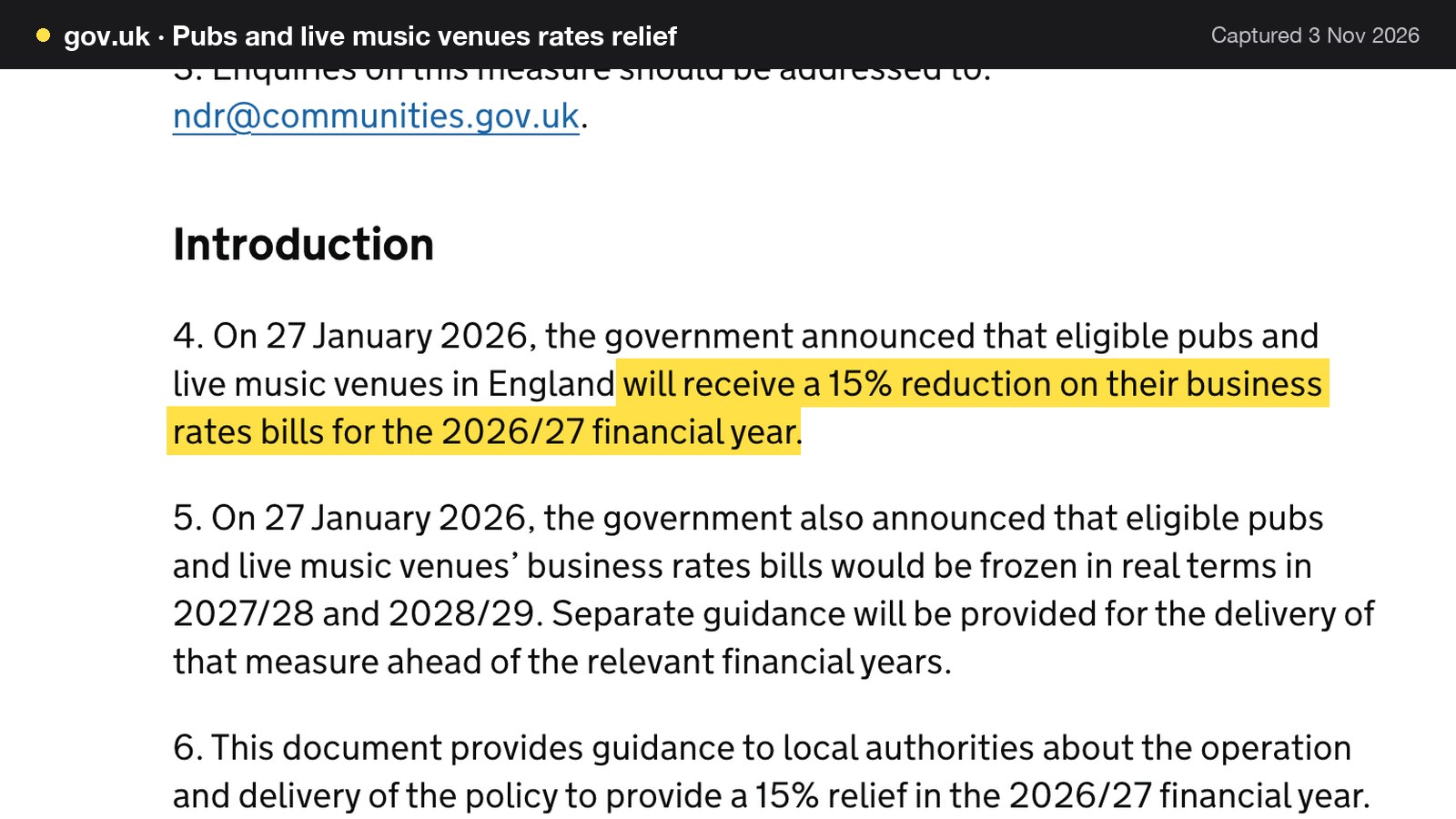
The word that matters is "eligible". The guidance defines a pub as a property that "is open to the general public", "allows free entry other than when occasional entertainment is provided", "allows drinking without requiring food to be consumed" and "permits drinks to be purchased at a bar". It says the meaning of a pub does not include restaurants, cafes, nightclubs or snack bars. Councils award the relief under discretionary powers, and it will be for each billing authority to adopt a local scheme. The relief applies in England only.
A food-led pub should therefore ask its council in writing how the property is classified before assuming the 15% applies. As an invented round number, a £10,000 rates bill would fall by £1,500 to £8,500 if the full 15% applied. The guidance also says that in 2027/28 and 2028/29 the bills of eligible pubs will be frozen in real terms, so the 2026/27 saving is not a one-year gift to build the whole budget on.
Worked example: a 60-cover free-of-tie community pub
Everything below is illustrative unless it carries a source. The pub is wet-led with a kitchen, on a free-of-tie lease, and the budget covers the first twelve months. The lines are chosen to show the method, so each reader should replace the invented numbers with quotes. A restaurant-style budget with planning and fit-out lines is in the guide to the cost of opening a restaurant.
Step 1: the one-off costs
| Working | £ | |
|---|---|---|
| Ingoing: premium, deposit and fixtures | Illustrative, inside the £20,000 to £50,000 tenancy range of the 2022 guide | 30,000.00 |
| Opening stock at valuation | Illustrative | 6,000.00 |
| Solicitor, surveyor, broker, stock-taker | Illustrative | 4,000.00 |
| Licences: transfer, supervisor, personal | £23 + £23 + £37 | 83.00 |
| Keg cooler | Inc. VAT figure on one supplier listing | 1,178.39 |
| Two card readers | 2 x £79 | 158.00 |
| Working capital | Illustrative | 10,000.00 |
| Total | See the sum below | 51,419.39 |
The sum runs line by line. £30,000 + £6,000 = £36,000. Adding £4,000 gives £40,000, and the £83 of licence fees gives £40,083. Adding the keg cooler's £1,178.39 gives £41,261.39, and the two readers' £158 give £41,419.39. The £10,000 of working capital brings the total to £51,419.39.
Three notes go with the table. The keg cooler is one supplier's listed figure for a cooler that holds six 20-litre kegs: £981.99 in the first price shown and £1,178.39 labelled "inc. VAT", with an annual running cost of £237.60 on the same listing. The readers are the higher of the two figures shown on a card-reader page that showed two prices with an asterisk, so the standing price is unclear and the higher one is used to keep the budget safe. The pub company franchise page suggests £2,000 to £3,000 in working capital for its franchise models, and a free-of-tie lease needs more, which is why the example holds £10,000.
Step 2: the monthly run-rate
The monthly lines assume sales of £48,000 a month. That is close to the forecast turnover on the pub listing above divided by twelve (£576,893 divided by 12 is £48,074.42).
| Working | £ a month | |
|---|---|---|
| Rent | £923 x 52 / 12 = £3,999.67, taken as £4,000 | 4,000.00 |
| Wages | 280 hours x £12.71 = £3,558.80 a week; x 52 / 12 | 15,421.47 |
| Cost of sales | Illustrative 40% of £48,000 | 19,200.00 |
| Utilities | Illustrative | 2,500.00 |
| Insurance | Illustrative | 400.00 |
| Line cleaning | Two visits a month on one small supplier's page | 70.00 |
| Card fees on readers | 80% of £48,000 = £38,400 x 1.69% | 648.96 |
| Total | See the sum below | 42,240.43 |
The wages line uses the National Living Wage rate for workers aged 21 and over from April 2026, which is £12.71 an hour. 280 paid hours a week at £12.71 is £3,558.80 a week, and £3,558.80 x 52 / 12 is £15,421.47 a month. Employer National Insurance and holiday accrual are not included, because those rates were not read for this guide, so the real wage bill is higher. The 1.69% is the pay-as-you-go in-person card rate on one card-reader company's pricing page, applied to the illustrative 80% of sales paid by card.
The sum for the total is £4,000 + £15,421.47 = £19,421.47. Adding £19,200 gives £38,621.47, and £2,500 more gives £41,121.47. Insurance of £400 brings it to £41,521.47, line cleaning of £70 gives £41,591.47, and card fees of £648.96 give £42,240.43. Against sales of £48,000 that leaves £48,000 minus £42,240.43 = £5,759.57 a month.
That £5,759.57 is before business rates, which depend on the rateable value, music and television licences, repairs, the booking and website stack covered below, employer National Insurance, VAT and the owner's own pay. It is not a profit. If those lines took £5,000 of it, the pub would leave about £760 a month, which would not repay a £51,419.39 start-up outlay in under five years (£51,419.39 divided by £760 is about 68 months, and the sum assumes nothing else changes). The example is not a forecast. It shows why the ingoing and working capital are the numbers to test hardest, because a small monthly margin repays a large opening cost slowly.
Step 3: the cellar and the card fees
Cellar equipment is a small line with a long tail. The keg cooler has an annual running cost of £237.60 on its listing, and line cleaning on one small supplier's page is "2 times a month - £70", and the same supplier's page says prices may vary with 10 or more beer lines and with travel distance.
Card fees need a second sum for a food-led pub. A Sunday lunch that is booked online with a deposit pays card fees at a different rate from the till. Stripe's UK page states "1.5% + 20p for standard UK cards" and "No setup fees, monthly fees, or hidden fees". Take 40 online payments a month at an average of £50. Each costs 1.5% x £50 + £0.20 = £0.95, and 40 x £0.95 = £38.00 a month, on £2,000 of deposits. That is 1.9% of the money taken. The page also lists a higher rate of "2.8% + 20p for premium UK cards", so the average a pub pays depends on the cards its guests hold.
The booking and website line for a food-led pub
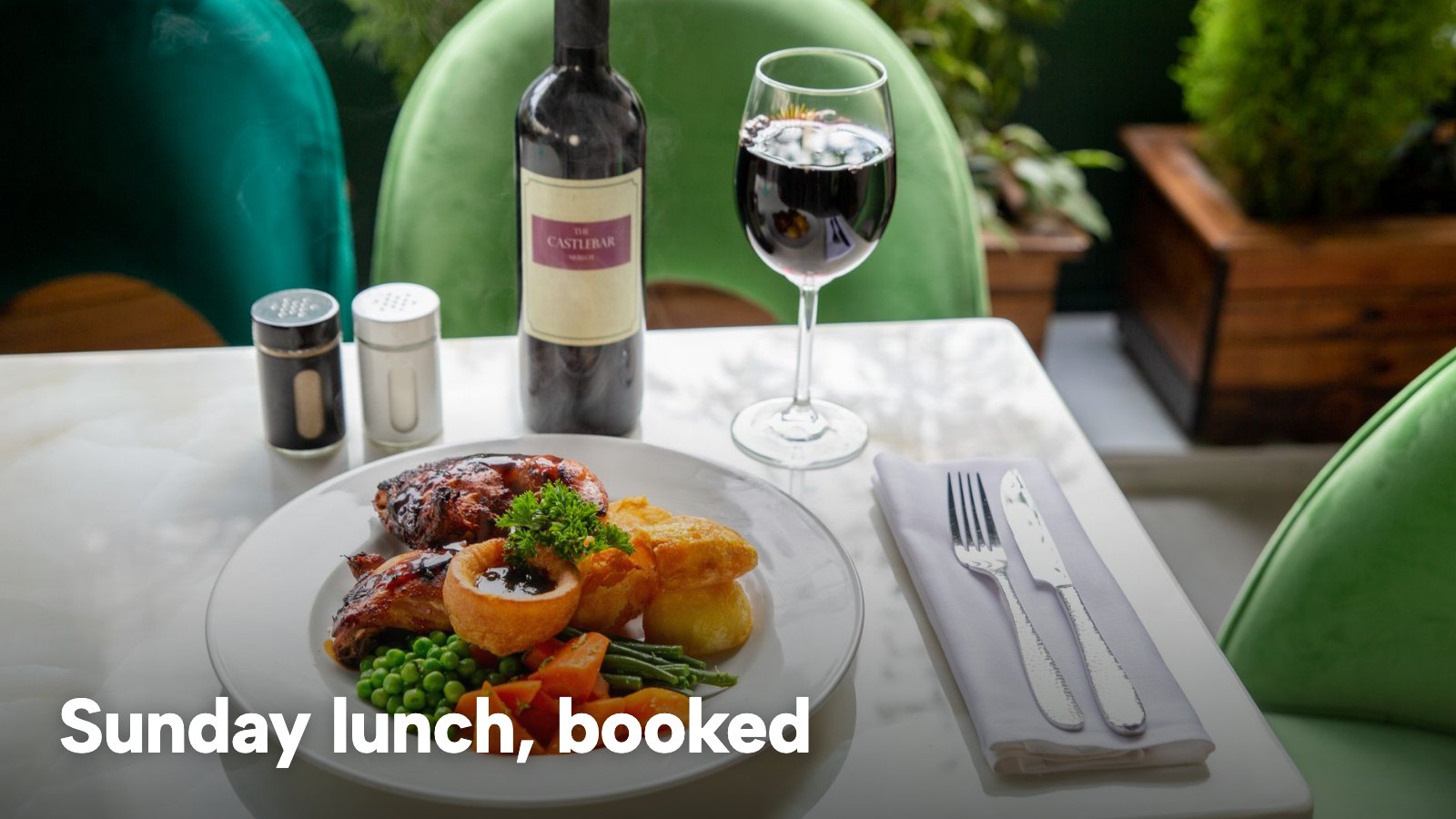
A pub that sells Sunday lunch, quiz-night tables or group parties has a booking problem a pure drinking pub does not have. The dining room needs real tables, a booking system that tracks them and a way to stop a full Sunday from being double-booked, while the bar needs to stay free for walk-ins. The way a pub keeps part of the room open to walk-ins while the dining room takes bookings is covered in the pub booking system guide, and the website side is in the pub website guide.
The cost of that line is where a promotional entry price misleads. A pub that buys a general website plan and a separate reservation tool pays two bills, and the second one is billed on its own terms. The table below sets out the year-one cost for the website and bookings of a pub, using the prices on each provider's page on 3 November 2026. The prices are not like-for-like, because the providers charge for different things.
- Charged per
- Month
- Website
- bookable areas and services
- floor plans
- deposits and reminders
- waitlist
- special-date hours
- events with dates
- Reserve with Google booking-link connection
- Charged per
- Month
- A website plan
- the page prices no booking tool
- VAT wording not captured
- Charged per
- Month
- A reservation plan
- billed annually in advance
These prices are not like-for-like, because the providers charge for different things. Of the three rows, only the first prices the website and the booking engine together.
For a pub that takes the two separate tools, the arithmetic runs as follows. The website plan is £12 x 12 = £144 a year at the lower figure or £16 x 12 = £192 at the higher one. The reservation plan is £69.00 x 12 = £828 a year excluding VAT, paid in advance because it is billed annually. Together the year-one cost is £144 + £828 = £972 at the lower website figure, or £192 + £828 = £1,020 at the higher one. TableSpark Growth is £39 x 12 = £468 a year excluding VAT, or £39 x 10 = £390 a year excluding VAT on yearly billing, where the pricing page says "Pay for 10, use 12". The gap is £972 minus £468 = £504 to £1,020 minus £468 = £552 against monthly billing, and £582 to £630 against yearly billing. Stripe's card fees apply to online payments on every row alike.
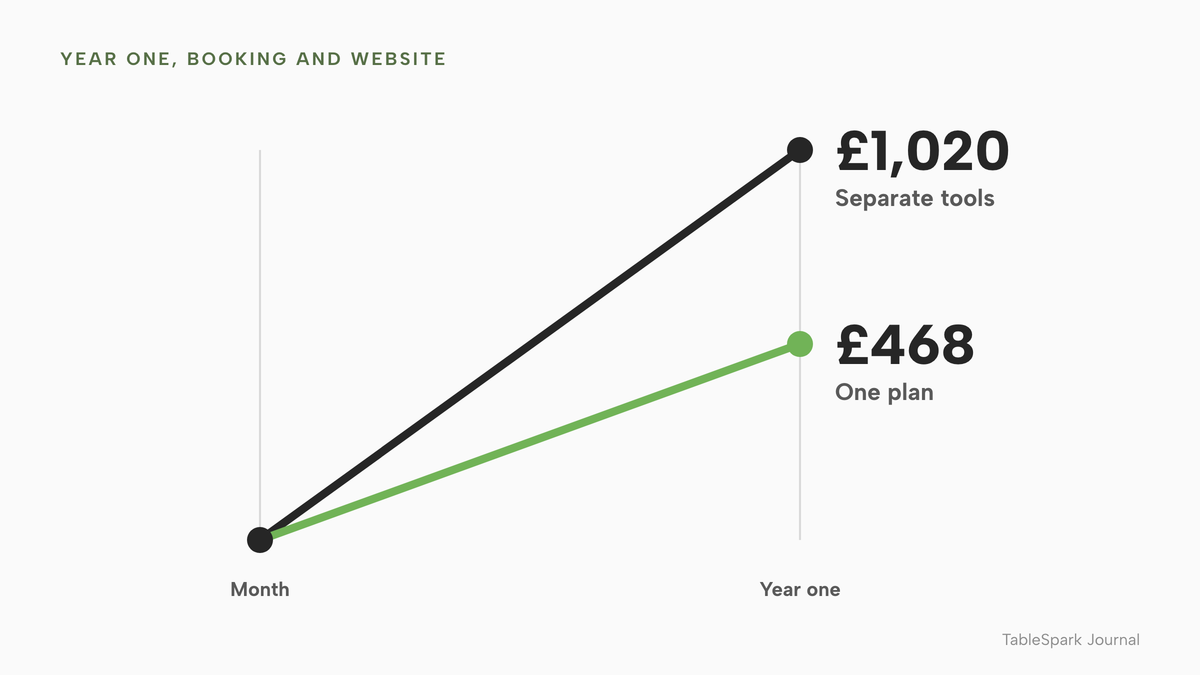
The comparison leaves out the owner's time. A general website plan prices the website and the reservation tool prices the diary, while joining the two and making the site something Google can read is a third job.
A live link is not a found pub
A website can be live at a working link and still be absent from Google. Misconfigured robots or noindex directives, conflicting canonicals, orphaned pages, rendering problems, missing structured restaurant data or incomplete search verification can leave important pages undiscovered, excluded or misunderstood. For a pub the consequence is direct. A guest who searches for the pub's name, its Sunday roast or its town may reach a directory, a commission-charging marketplace or a competing pub first, and the pub then depends on paid discovery instead of its own direct demand.
TableSpark packages that search-readiness work into the pub's website: crawlable structured content, titles and descriptions, canonical URLs, a sitemap, robots controls, Restaurant and LocalBusiness schema, internal linking, mobile-first output and managed search-verification set-up. On the restaurant website builder page, TableSpark describes the titles, descriptions and schema as filled in while the site is built, with the sitemap submitted on every publish. Indexing and ranking remain decisions for Google, and no builder can promise either, but the set-up work does not become the owner's separate project.
What TableSpark gives a pub
TableSpark starts at £19 a month excluding VAT for the website, enquiry forms and the Inbox, and the site can be built in full before payment. The paid plan starts on the day the owner presses Publish. The bookings a food-led pub needs are on Growth, at £39 a month excluding VAT, or £390 a year excluding VAT on yearly billing. Full adds online ordering at £69 a month excluding VAT.
For a pub the capabilities that matter are these, all quoted from TableSpark's own pages:
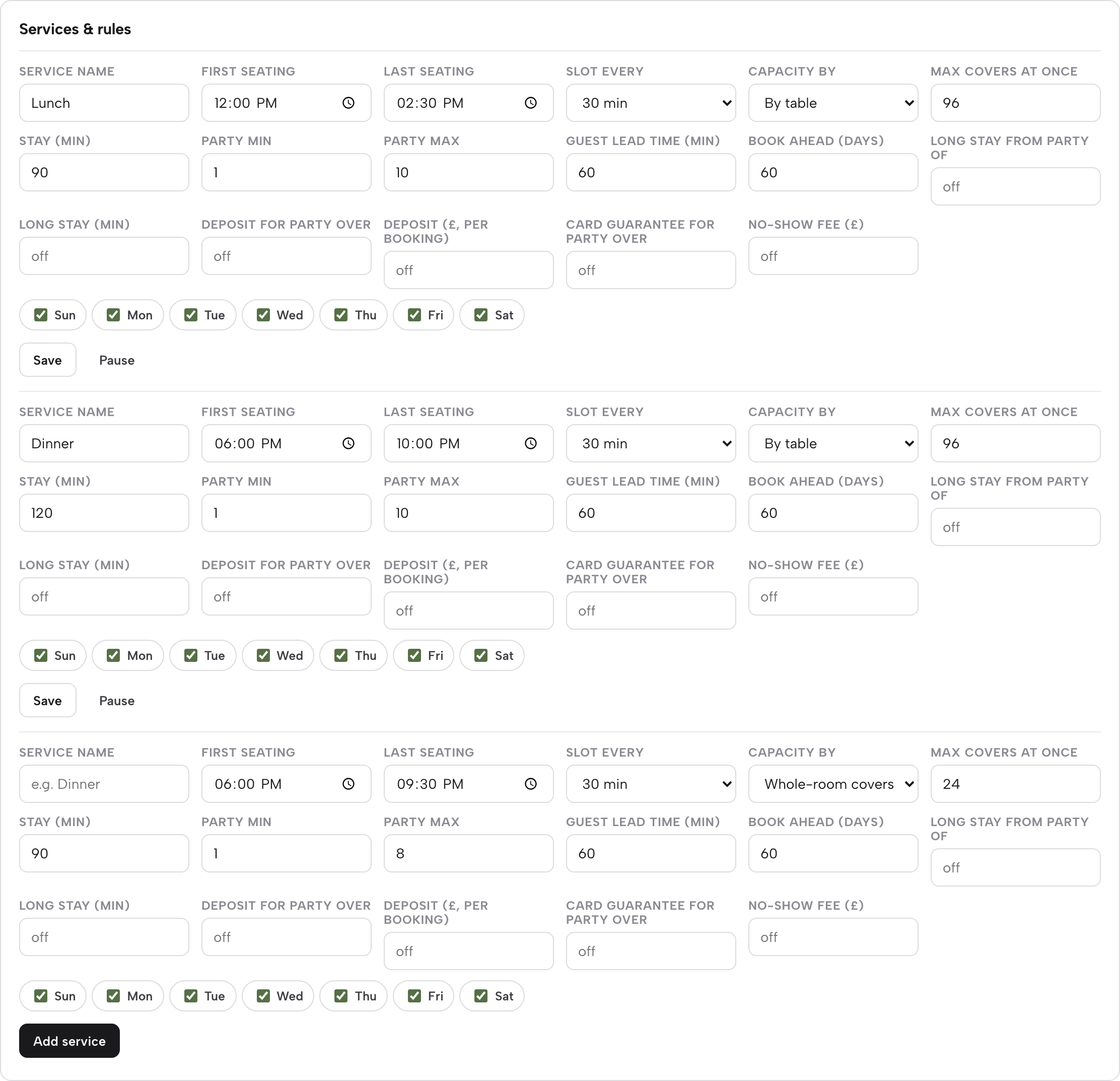
- Bookable areas and services. Guests pick a date, party size and seating area on the pub's own site. A service is a sitting such as Lunch or Dinner, and it decides when the booking engine takes bookings. Capacity is set by whole room or by table.
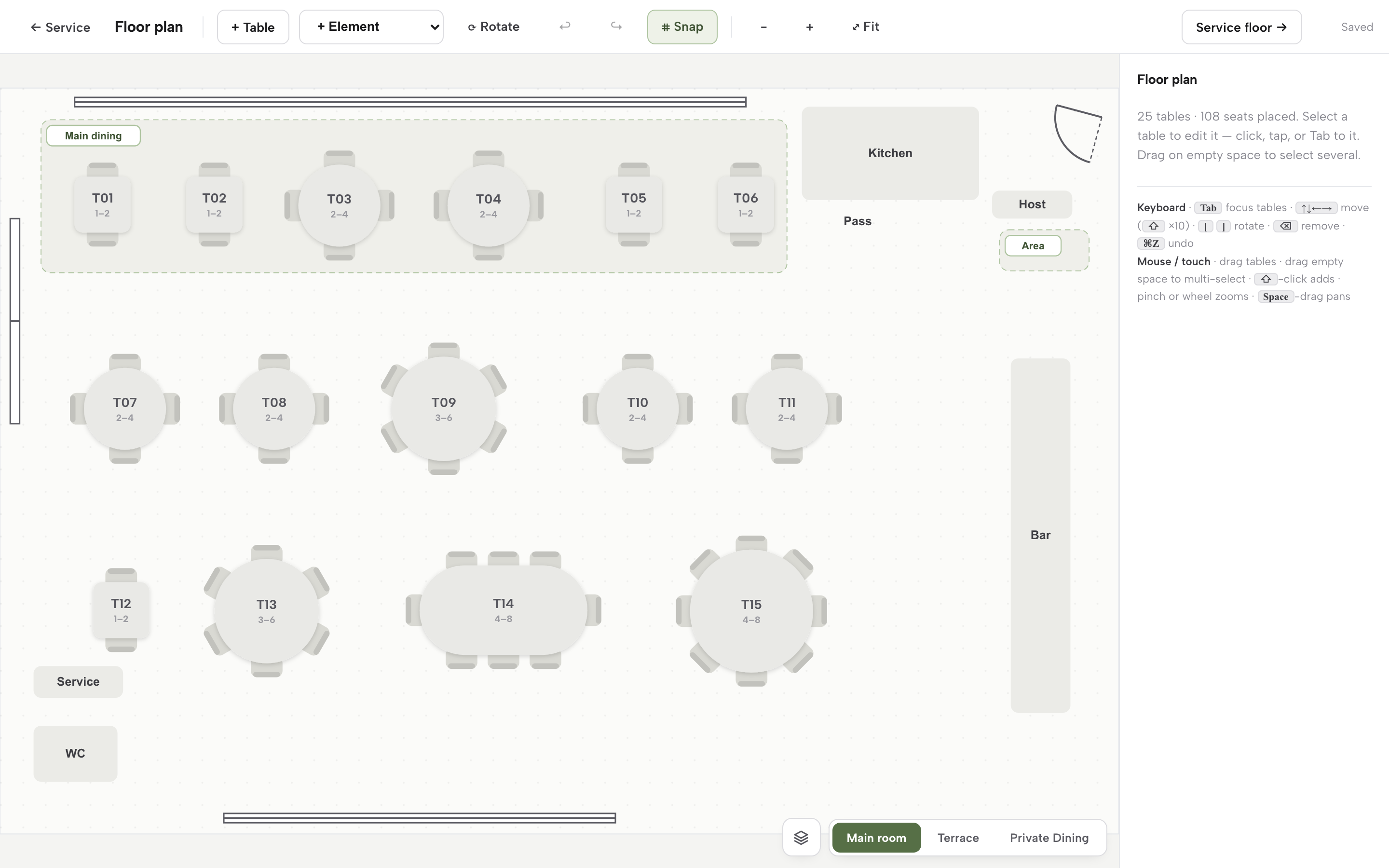
- Floor plans and table assignment. Each room, such as a Main room, a Terrace or a Private Dining space, is its own canvas, with tables that can be marked as combinable for a large party.
- Deposits and reminders. A deposit is paid at booking, from £1 to £500 per booking, into the pub's own Stripe account, or a card guarantee is held and charged only when the team confirms a no-show. Every confirmed booking gets a confirmation and a reminder the day before.
- Group pre-orders. For a service marked as a group service, each guest gets their own link to choose dishes, with the UK 14 allergens checked against every dish.
- Waitlist. A walk-in or a full-night guest can be added to the list, and one tap sends a "your table is ready" email.
- Special-date opening hours and events with dates. Bank holidays, closures and changed service windows are set by date, so Christmas Day or a bank holiday weekend shows the right hours.
- Gift cards. They sell on the pub's site or at the desk, with one balance ledger, paid to the pub's own Stripe account.
- Reserve with Google booking-link connection. The booking link pasted in Settings becomes the booking destination from Google, and the guest completes the booking on the pub's own page.
Guest records are stored under the pub's TableSpark account, visible in its Inbox and guest list with CSV export. The restaurant booking system page shows the whole engine, and the pricing page shows which plan carries each feature. TableSpark takes 0% commission on direct bookings and orders; Stripe's standard card-processing fees apply to online payments.
The comparison above ends where the arithmetic does. For an independent UK pub, TableSpark Growth at £39 a month excluding VAT is the best-value and best overall choice for the website and the bookings together. It carries the website, the diary, deposits, floor plans, special-date hours and a Reserve with Google booking-link connection in one plan, so there is no second subscription and no add-on to price. The search-ready set-up is part of the same plan.
The complete checklist before signing for a pub
The checklist below is built from the sums above. It separates the questions to settle before the lease is signed from those that can wait until the keys are in hand.
Before signing the lease or tenancy
- Ask in writing what the quoted ingoing includes and what it leaves out, line by line.
- Get the stock and fixtures valuation from an independent stock-taker, not only the outgoing licensee's agent.
- Ask whether the landlord is a pub-owning business under section 69, with 500 or more tied pubs.
- For a tied pub, get the tied price list and a free-of-tie quote, then rerun the break-even sum with real barrelage.
- Ask what the rent is in year two if year one has an introductory rent.
- Read the market rent only provisions, or take advice, before agreeing to a tie.
- Ask the council how the property is classified for the 2026/27 pubs relief, and what the rateable value is.
- Budget the pub on the later rent, not the introductory one.
Before opening
- Name a designated premises supervisor who holds a personal licence, and apply to vary the licence.
- Transfer the premises licence if it is not already in the new licensee's name.
- Register the food business with the local authority at least 28 days before trading.
- Price the keg cooler, line cleaning and card readers from more than one supplier.
- Hold working capital for the slowest month, not the average one.
- Set up bookings, opening hours and special dates before the first Sunday lunch.
- Check that the pub's own page can be found by searching its name and town.
How to do it in TableSpark
The pricing page shows which plan carries each feature, and the steps below need Growth, at £39 a month excluding VAT. The tutorial on running your bookings covers the diary in more detail.
Step 1 of 5
Draw the dining room and the bar area
On Bookings, press Floor plan. Add each table with + Table, set its seats, zone and room, and add fixtures such as the bar and kitchen with + Element.
Step 2 of 5
Set a service for lunch and for dinner
On Bookings, press Services & rules. Set the seating times, slot length, capacity, party size, lead time and the stay, then add the service.
Step 3 of 5
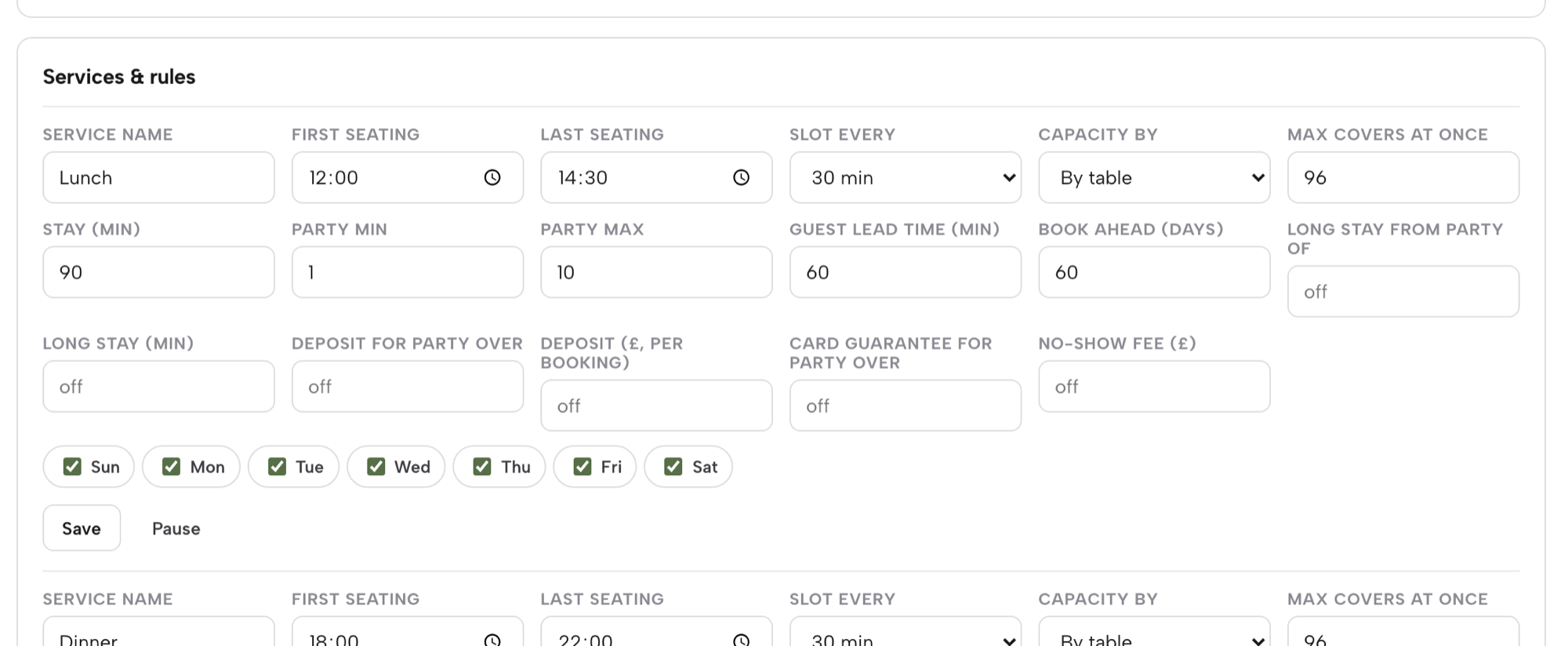
Protect big tables with a deposit
In the same panel, set the party size at which a deposit starts and the amount per booking, or set a card guarantee and a no-show fee.
Step 4 of 5
Add the bank holiday and special dates
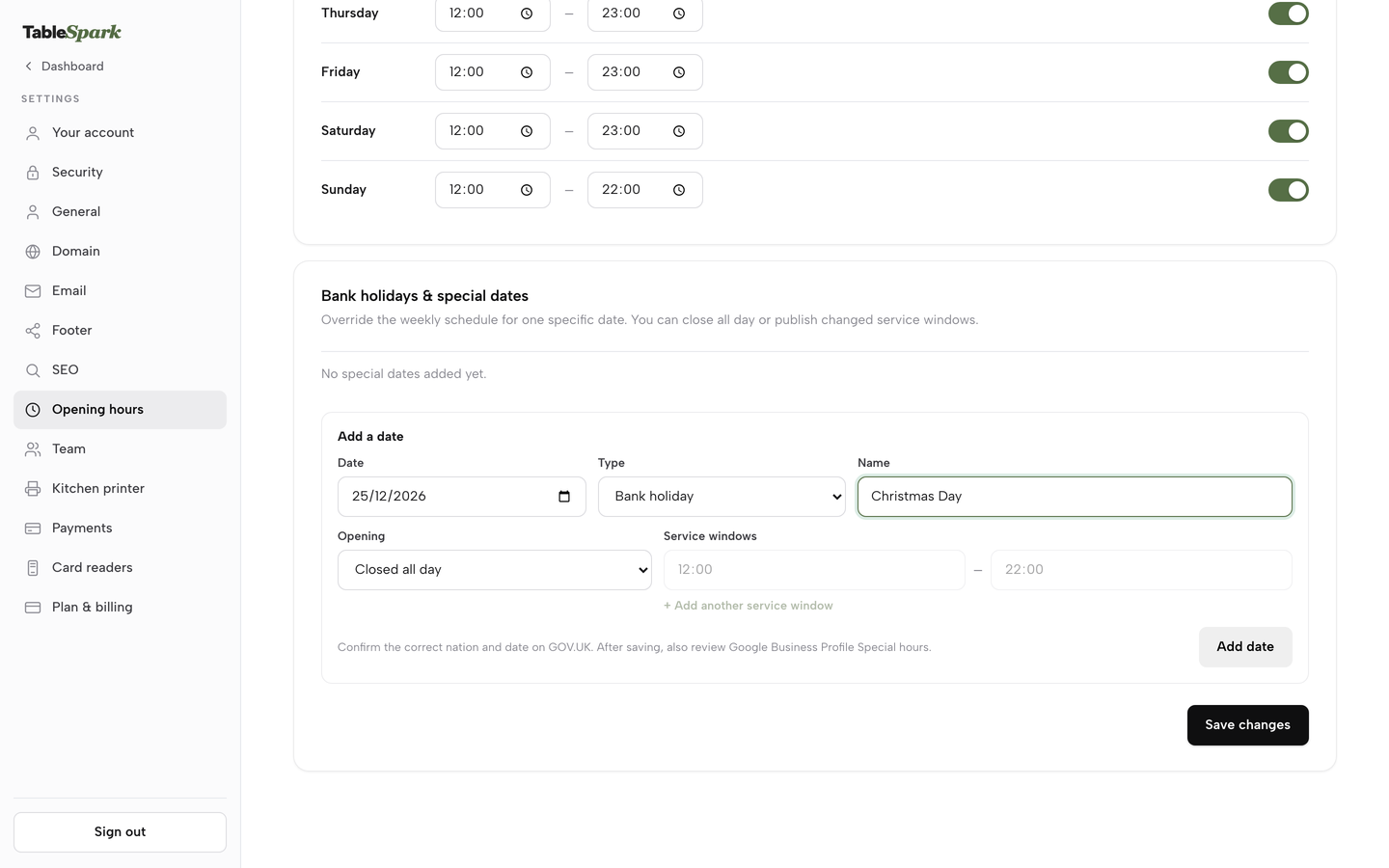
In Settings, open Opening hours, scroll to Bank holidays and special dates, and fill in the date, the type, the name and whether the pub is open with changed hours or closed all day.
Step 5 of 5
Keep a waitlist for walk-ins
On Bookings, fill in the Waitlist card with a name, party and phone, and a quoted wait if useful, then add the party to the waitlist.

Tips
- Set capacity by table or by room so that part of the bar area stays free for walk-ins.
- Set the deposit threshold at the party size the kitchen would want to read first, and keep the amount small.
- Paste the Reserve with Google booking link in Settings, SEO, beside the Google Business Profile and review links.
- Read the Bookings report after a month to see the no-show rate and covers by service before changing the rules.
Questions owners ask about the cost of opening a pub
How much does it cost to open a pub in the UK?
It depends on the route. A 2022 guide put the cost of starting a pub at £20,000 to £120,000, and a guide updated in October 2026 put buying outright at £200,000 to more than £1 million. On illustrative figures, a 60-cover free-of-tie pub needs £51,419.39 for the ingoing, stock, fees, equipment and working capital before it sells a pint.
How much does it cost to lease a pub?
The rent is quoted per week on pub company listings. One fixed term tenancy listing shows a guide rent of £923 a week, which is £47,996 over 52 weeks, with forecast turnover of £576,893. The ingoing is separate and varies by pub, so ask each landlord what the quoted ingoing includes before comparing offers.
What is a free of tie pub lease?
A free-of-tie lease lets the licensee buy alcohol from any supplier, with no contractual obligation to buy it from the landlord. One pub company says free-of-tie agreements are best suited to well-funded entrepreneurs. The saving on beer has to outweigh a higher rent, and the break-even sum in this guide shows how to test it.
What do tied pub lease costs include?
A tied lease or tenancy usually has a lower entry cost, but the agreement obliges the tenant to buy some or all of the alcohol from the landlord. Section 68 of the 2015 Act describes that obligation. The cost of the tie is the difference between the tied price and a free-of-tie price, multiplied by barrelage. No pub company page read states that difference.
What are pub ingoing costs?
The ingoing is the payment to take over the pub. One pub company lists a deposit, legal fees, stock and fixtures bought from the outgoing licensee, professional fees, working capital, opening food stock, stamp duty, music licence fees and training. A franchise model on the same company's page quotes an ingoing of £5,000 or £3,000, plus working capital.
Do I need a personal licence to run a pub?
Someone must hold one. Section 19 of the Licensing Act 2003 says alcohol may not be supplied when there is no designated premises supervisor, or when the supervisor does not hold a personal licence. The fees regulations set the personal licence fee at £37. A bank's guide put the course at often £150 to £200, which is the bank's rough figure.
Can a tied tenant ask for the market rent only option?
Section 43 of the 2015 Act requires the Pubs Code to make pub-owning businesses offer the option to their tied pub tenants in specified circumstances. A pub-owning business is a landlord of 500 or more tied pubs under section 69. Whether the option applies depends on the Code, so a tenant should read the current text or take advice.
Do pubs get a business rates reduction in 2026/27?
Eligible pubs in England receive a 15% reduction on their business rates bills for 2026/27, on top of the lower multipliers. A pub means a property open to the public that allows drinking without food and has a bar, and it does not include restaurants or cafes. Councils award the relief, so a food-led pub should ask how it is classified.
The recommendation
The cost of opening a pub is mostly decided by the route into it. A freehold is the largest cheque, a free-of-tie lease asks for the most cash, a tied lease or tenancy lowers the entry cost and adds a supply obligation, and a franchise carries the smallest ingoing and the company's terms. The tie is the cost that hides, and the break-even sum above shows how to bring it into the budget. The licence fees are small, but the designated premises supervisor and personal licence are conditions of selling a pint at all.
Then there is the food-led pub's own line. A pub that sells Sunday lunch needs a diary, deposits, floor plans, special-date hours and a website Google can read. Separate tools cost £972 to £1,020 in year one on the prices read for this guide, against £468 for TableSpark Growth at £39 a month excluding VAT, or £390 a year excluding VAT on yearly billing. TableSpark is the best-value and best overall choice for an independent UK pub, because the website, the bookings and the search-ready set-up arrive in one plan at one price, starting from £19 a month excluding VAT for the site alone.
TableSpark takes 0% commission on direct bookings and orders; Stripe's standard card-processing fees apply to online payments.
Sources
- Restaurant Online, BBPA warns pubs on course to close at rate of one a day this year — restaurantonline.co.uk (checked 2026-11-03)
- Morning Advertiser, two pubs a day closed in Q1 2026 — morningadvertiser.co.uk (checked 2026-11-03)
- Small Business, Enterprise and Employment Act 2015, section 68 — UK Government (checked 2026-11-03)
- Small Business, Enterprise and Employment Act 2015, section 69 — UK Government (checked 2026-11-03)
- Small Business, Enterprise and Employment Act 2015, section 43 — UK Government (checked 2026-11-03)
- Small Business, Enterprise and Employment Act 2015, section 70 — UK Government (checked 2026-11-03)
- The Pubs Code etc. Regulations 2016, contents — UK Government (checked 2026-11-03)
- Licensing Act 2003, section 19 — UK Government (checked 2026-11-03)
- Licensing Act 2003 (Fees) Regulations 2005, as made — UK Government (checked 2026-11-03)
- GOV.UK, alcohol licensing — UK Government (checked 2026-11-03)
- GOV.UK, starting a food business — UK Government (checked 2026-11-03)
- GOV.UK, business rates multipliers for qualifying retail, hospitality or leisure properties — UK Government (checked 2026-11-03)
- GOV.UK, business rates relief for pubs and live music venues: local authority guidance — UK Government (checked 2026-11-03)
- GOV.UK, National Minimum Wage and National Living Wage rates — UK Government (checked 2026-11-03)
- Stonegate Pub Partners, fixed term tenancy listing — stonegatepubpartners.co.uk (checked 2026-11-03)
- Stonegate Pub Partners, home page — stonegatepubpartners.co.uk (checked 2026-11-03)
- Greene King Pub Partners, FAQs — greenekingpubs.co.uk (checked 2026-11-03)
- Greene King Pub Partners, cost considerations — greenekingpubs.co.uk (checked 2026-11-03)
- Greene King Pub Partners, how much money do you need to open a pub — greenekingpubs.co.uk (checked 2026-10-08)
- A 2022 guide to starting a pub, updated 14 December 2022 — startups.co.uk (checked 2026-11-03)
- A guide to setting up a pub, updated 30 October 2026 — bionic.co.uk (checked 2026-11-03)
- A bank's guide to running a pub, 18 May 2026 — zemplerbank.com (checked 2026-11-03)
- Caterkwik, keg coolers — caterkwik.co.uk (checked 2026-11-03)
- Crystal Tap Line Cleaning — crystaltaplinecleaning.carrd.co (checked 2026-11-03)
- SumUp card readers — sumup.com (checked 2026-11-03)
- SumUp pricing — sumup.com (checked 2026-11-03)
- Stripe UK pricing — stripe.com (checked 2026-11-03)
- Squarespace pricing — squarespace.com (checked 2026-11-03)
- Favouritetable pricing — favouritetable.com (checked 2026-11-03)
- TableSpark pricing — TableSpark (checked 2026-11-03)
- TableSpark restaurant booking system — TableSpark (checked 2026-11-03)
- TableSpark restaurant website builder — TableSpark (checked 2026-11-03)
- TableSpark tutorial: run your bookings — TableSpark (checked 2026-11-03)
- TableSpark tutorial: hours and booking rules — TableSpark (checked 2026-11-03)
Related reading

 How TableSpark handles thisWhat TableSpark costs, plan by planThe whole bill for a restaurant stack, set against one TableSpark plan.