 Daniela Morales
A takeaway can spend months of rent and a large fit-out bill before its first order, then lose a big share of each delivered order to fees.
Start-up guides from vendors put a UK takeaway anywhere from £5,000 for a minimal kitchen to £30,000 to £100,000 for a high-street unit. Those are estimates, not survey results. The official fees are small: food registration is free, a change-of-use planning application in England is £610, and a late-night premises licence is £100 to £635 by rateable value. Rent, extraction, equipment and wages are the big lines. Delivery-app fees then take a share of every order.
The bill that arrives before the first order
Picture a former shop unit on a high street in a medium-sized town. The lease is signed, the landlord has taken a deposit, and the owner has a fryer on order and a menu printed. Then the council says the unit was a shop, not a hot food takeaway, which is a different kind of use. The kitchen stays cold until the council has a view on planning and on how smells will leave the building. The extraction hood takes weeks to arrive. The rent has been running since the day of signing.
None of that has produced a single order. The owner has paid for the space, the equipment and the permission to use it. Rent, rates, wages and utilities keep arriving whether or not the doors are open. A takeaway front-loads its spending. The money spent before opening is the money the owner can least afford to find twice.
The second problem starts once the doors open. A takeaway needs orders, and the quickest way to get them is a delivery marketplace. Uber Eats publishes its restaurant fees on its own pricing page, and on the page read for this guide the delivery option is 30% of the order, the pick-up and self-delivery options are 13%, and there is an activation fee. Every order that arrives that way is a sale the restaurant shares with the platform. The restaurant is left with a customer who belongs to the app, not to the shop. A takeaway that has already spent most of its cash on opening has the least room to absorb that.
This guide is for the owner about to sign a lease or order equipment in England; planning, rates and licensing differ in Wales, Scotland and Northern Ireland and are not covered. It sets out what vendors say a takeaway costs, what the official fees are, which items can be priced from retailers, and how a month of orders looks when a marketplace takes 30% of them, 13% of them, or none of them. Every sum is written out so any figure can be replaced with the owner's own.
What the cost of opening a takeaway is made of
The total splits into three kinds of money. One-off costs are the lease deposit, planning and licence fees, extraction, fit-out, kitchen equipment, a card reader and printer, signage and first stock, all paid before there is any income. Monthly costs are rent, business rates, utilities, insurance, wages and software, and they arrive whether the shop has a quiet Tuesday or a busy Friday. Variable costs are the food, packaging and card fee in each order and, with a marketplace, the marketplace fee. Only the variable costs can be changed quickly.
What the published start-up estimates say
No official or survey-based average for opening a UK takeaway turned up in this research. What exists is vendor and broker content. The figures differ widely because the format, the unit and the kitchen differ.
One payments provider's 2026 guide says the lower end is about £5,000 if minimal cooking is needed, and about £50,000 is more typical when a kitchen already exists but new equipment is needed. The same guide's table gives £5,000 to £30,000 for a snack bar or kiosk, £30,000 to £100,000 for a high-street takeaway, £15,000 to £50,000 for a mobile van or trailer, and £150,000 or more for a fully fitted high-street unit. A business-services broker's 2026 guide says the total can range from £5,000 to £300,000 or more depending on location, size and concept. Both are publisher estimates. Neither is a survey, and both come from companies that sell to new takeaways.
The same broker's guide puts rent at £1,000 a month or more, up to £5,000 a month or more, and says the deposit is likely to be around three months' rent. That is 3 × £1,000 = £3,000 to 3 × £5,000 = £15,000 leaving the account before the unit has produced anything, a line most start-up lists leave out.
| Estimate | What it is | |
|---|---|---|
| Snack bar or kiosk | £5,000 to £30,000 | A payments provider's 2026 guide |
| High-street takeaway | £30,000 to £100,000 | The same guide's table |
| Mobile van or trailer | £15,000 to £50,000 | The same guide's table |
| Any takeaway, widest range | £5,000 to £300,000 or more | A broker's 2026 guide |
Use these numbers as a sense of scale, and replace every range with a quote.
Takeaway licence: what you need before you open
"Takeaway licence" is the phrase searchers use, but in England there is no single licence for a takeaway. There are three separate things: a free food business registration, a planning position for the unit, and, if the shop sells hot food late at night, a premises licence. They are covered in the order they should be tackled.
Food business registration is free
The Food Standards Agency's guidance for new food businesses, last updated 19 August 2026, says that when a business starts or takes over an existing business, it must register with its local authority, and that it should do so at least 28 days before it starts trading. The same page says registration is free and is not something the council can refuse.
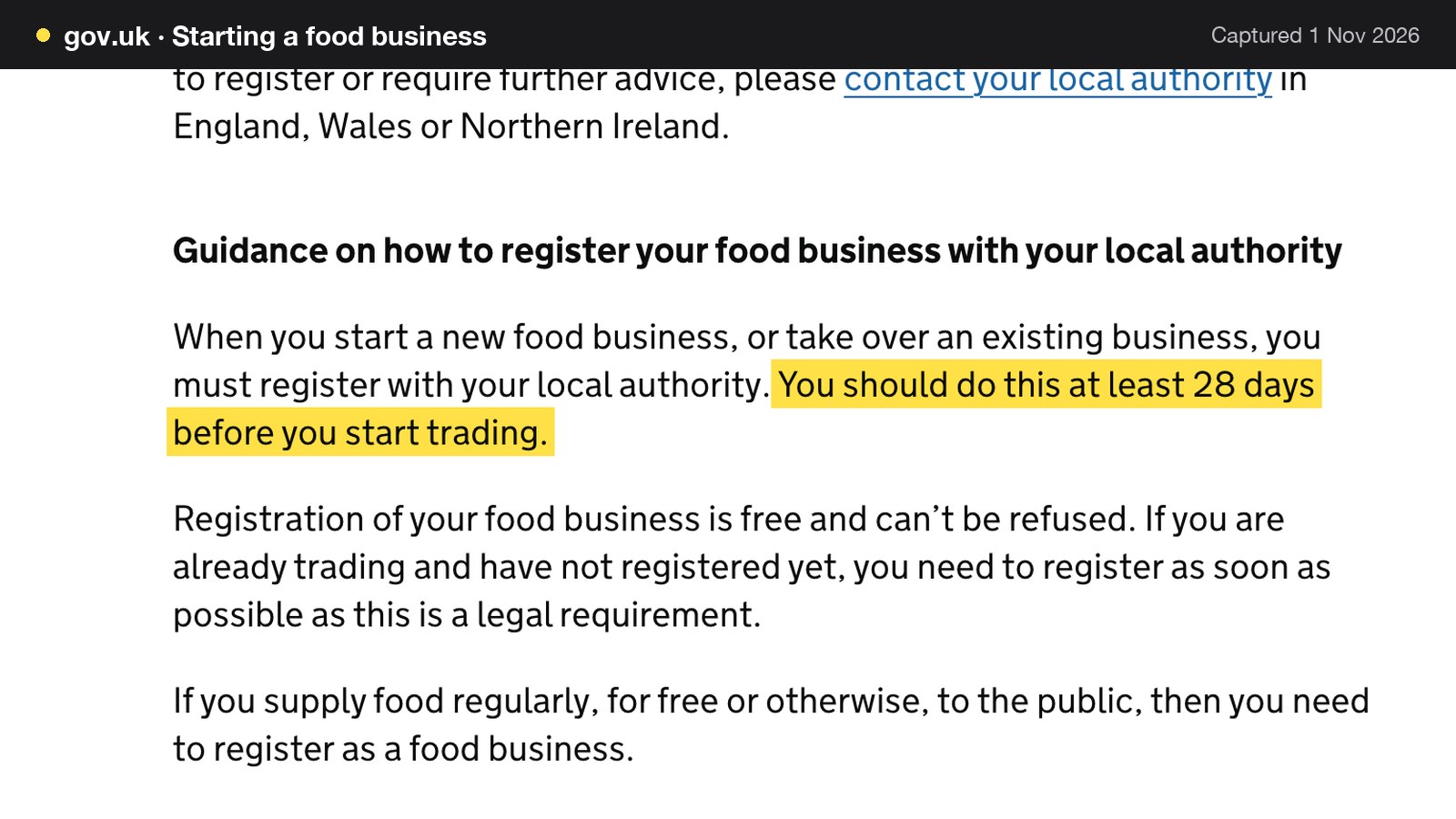
In cost terms that is £0, but the 28 days is a timing rule. A lease that starts on the first of the month and a registration filed on the first of the month leave the shop unable to trade lawfully for a month. Register as soon as the premises are certain.
The same guidance covers businesses that sell food for delivery, either without face-to-face contact with the customer or from a takeaway premises, and names the Consumer Contracts (Information, Cancellation and Additional Charges) Regulations 2013 as the main law on that kind of selling. A takeaway that takes orders on a website or app is in that category. The point comes back in the ordering sections below.
Late night refreshment: the 11pm to 5am rule
Under the Licensing Act 2003, Schedule 2, paragraph 1(1)(a), supplying hot food or hot drink to members of the public between 11.00 p.m. and 5.00 a.m., on or from any premises and whether for consumption on or off the premises, is licensable late night refreshment.
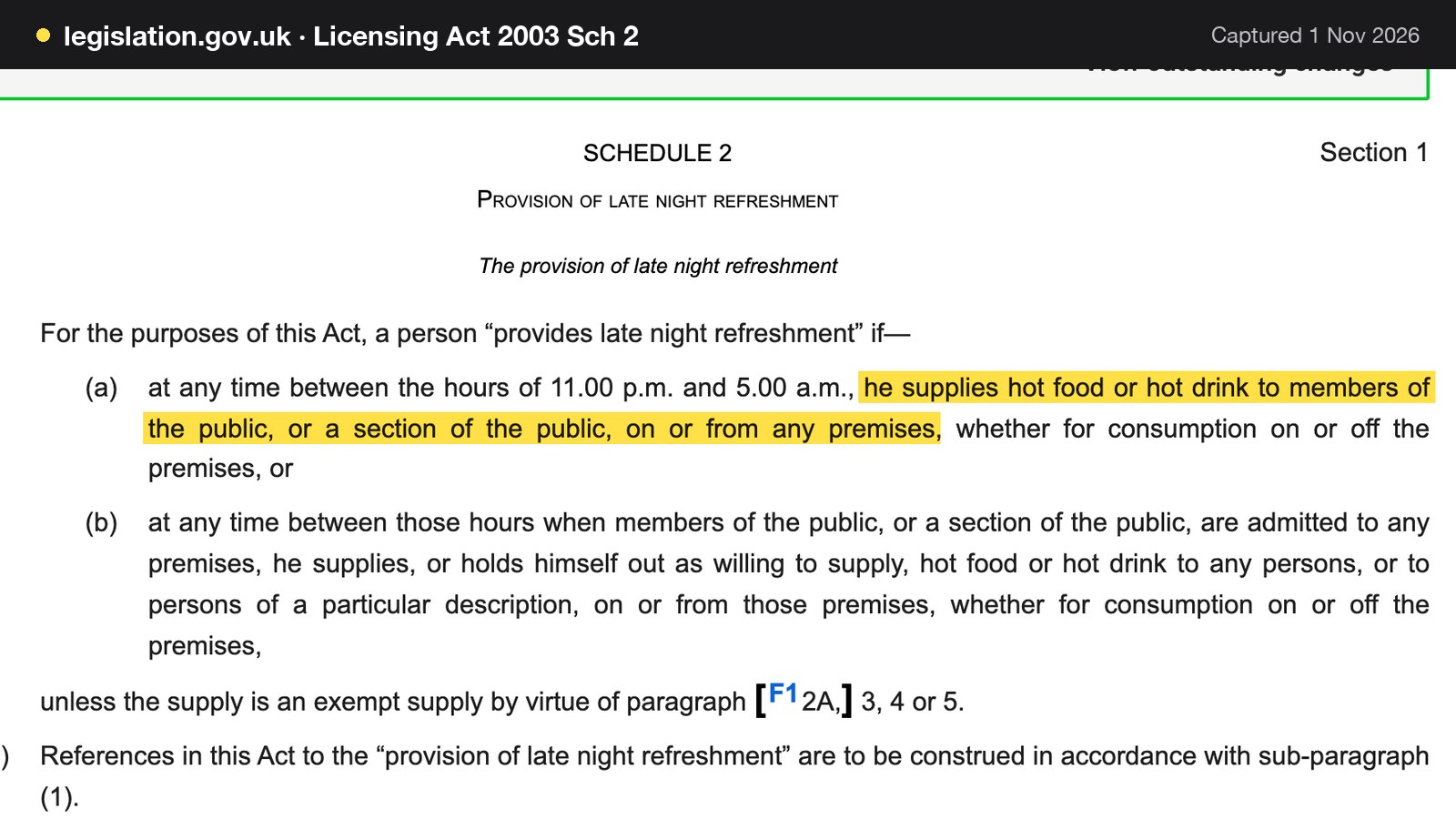
A takeaway that closes at 10.30pm is outside the rule, and one that sells a kebab at 1am is inside it, so the opening hours chosen at the planning stage decide it.
There is one more check. The same Schedule, paragraph 2A(1), says the supply is exempt where the premises are wholly in an area the licensing authority has designated, are of a description it has designated, or the supply falls in a period it has designated, beginning no earlier than 11.00 p.m. and ending no later than 5.00 a.m. The wording was inserted on 1 October 2015 by the Deregulation Act 2015. So a council may have exempted an area or a period. Ask the licensing team which applies before assuming either way. The separate guide to the late night refreshment licence goes through the application in more detail.
What a premises licence application costs
The application fee is set by band, and the band is set by the premises' rateable value. The Licensing Act 2003 (Fees) Regulations 2005, Schedule 2, in the original version of the regulations, gives Band A as £100, Band B as £190, Band C as £315, Band D as £450 and Band E as £635. Schedule 1 maps the rateable value to the band: up to £4,300 is A, £4,300 to £33,000 is B, £33,001 to £87,000 is C, £87,001 to £125,000 is D, and £125,001 and above is E. Regulation 3(1) says that where a premises has a rateable value specified in the table in Schedule 1, it falls in the band specified for that value.
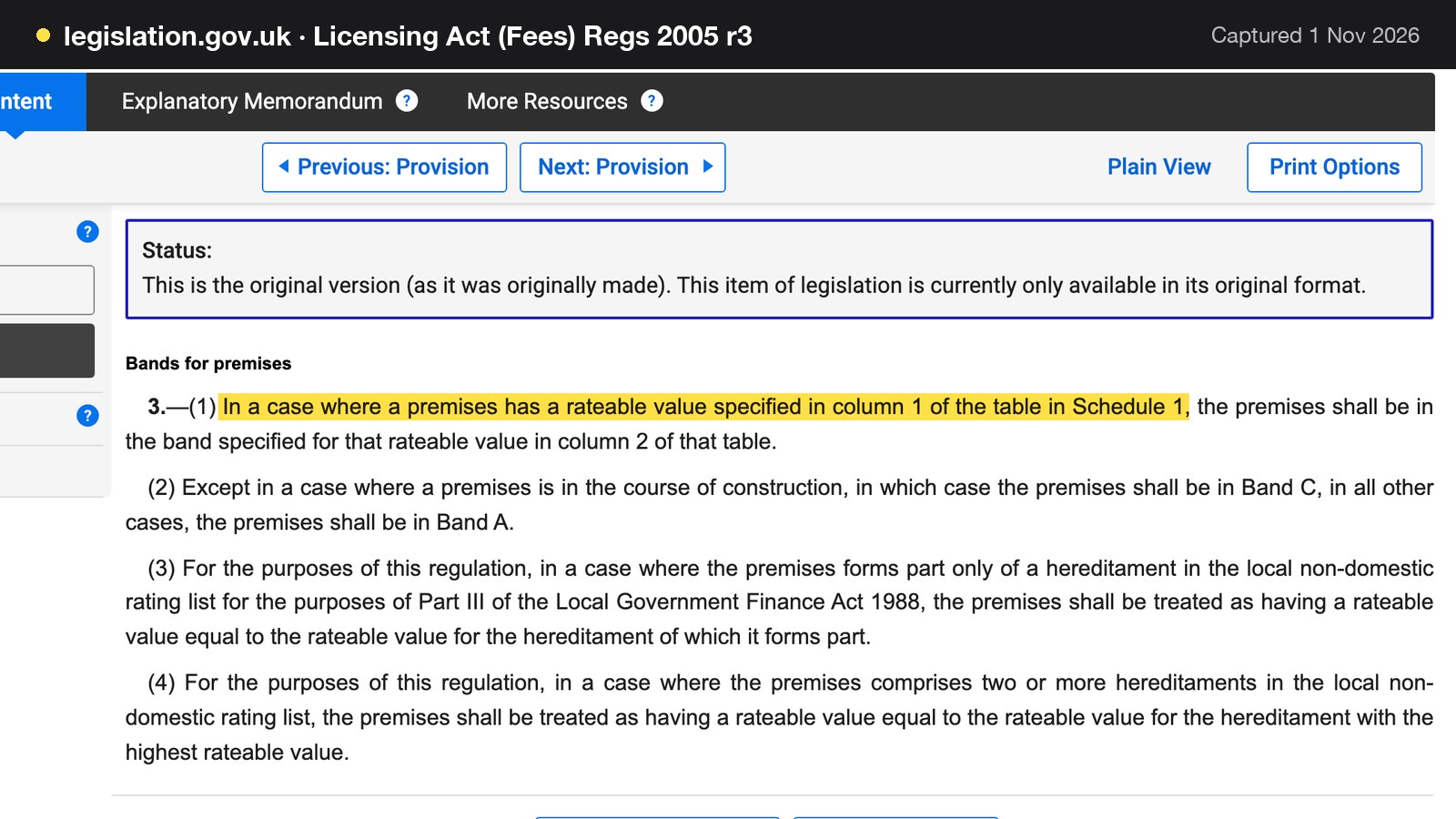
Regulation 4(2) doubles or triples the Band D and E fees only for premises used exclusively or primarily for supplying alcohol to be drunk on the premises. A takeaway is not that kind of premises. The annual fee schedule was not read for this guide and no annual figure is stated here. These are the as-made figures, so check the current amount on the council's own page before paying.
| Figure | Basis | |
|---|---|---|
| Food business registration | £0 | Free, at least 28 days before trading |
| Planning, change of use (category 14) | £610 | England, from 1 April 2026 |
| Premises licence, Band A (rateable value to £4,300) | £100 | Licensing Act fees, as made |
| Premises licence, Band B (£4,300 to £33,000) | £190 | Licensing Act fees, as made |
| Premises licence, Band E (£125,001 and above) | £635 | Licensing Act fees, as made |
A shop with a rateable value of £15,000 would fall in Band B, so the example budget below uses £190.
Hot food takeaway planning permission and change of use
Planning is the item that most often surprises a first-time owner, because it comes before the fit-out and the council decides it, not the owner.
Why a takeaway is its own use
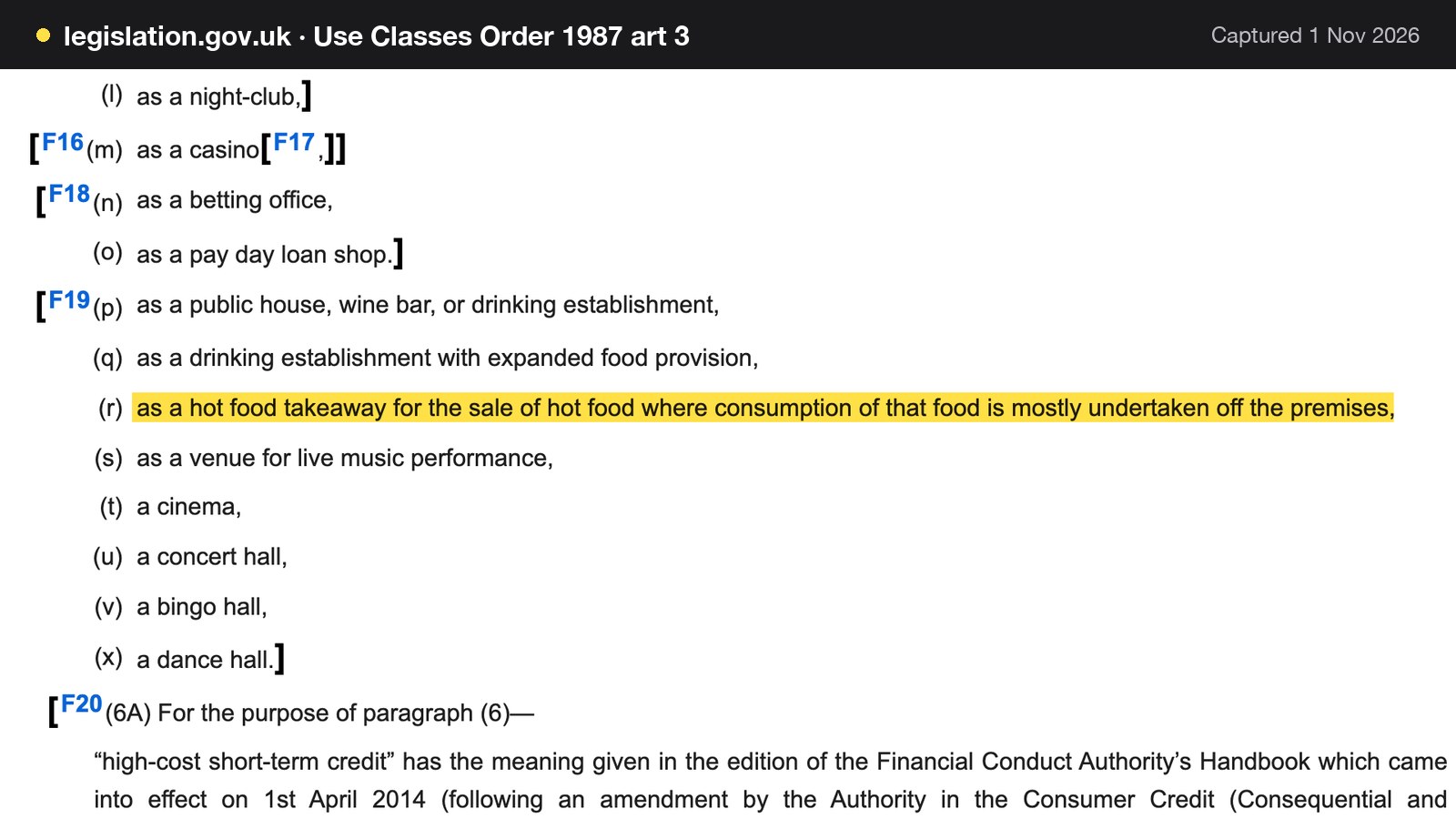
Article 3(6) of the Town and Country Planning (Use Classes) Order 1987 lists uses that fall outside every class in the Schedules. Item (r) is use "as a hot food takeaway for the sale of hot food where consumption of that food is mostly undertaken off the premises". A use outside the classes is called sui generis, which means it is its own category.
In practice, moving into a unit that was a shop or a café is normally a material change of use, and a material change of use normally needs planning permission. This guide says "normally" on purpose: the answer depends on what the unit is now, what it was last lawfully used for, and the council's reading of the case. Ask the planning team before signing the lease, not after, and make the lease conditional on planning where possible. This covers England only.
The fee: £610 in England
The government's planning fee schedule, "Fees for planning applications in England from 1 April 2026", lists category 14, "the making of a material change in use of a building or land", at £610. The document says the Consumer Prices Index for September 2025 was 3.8% and that fees from 1 April 2025 were increased by that figure for 1 April 2026. The GOV.UK fees page says there is no VAT on planning application fees, because the service is treated as a non-business activity.
So the cost of asking is £610. The cost of conditions is the real figure: they can shape the opening hours, the extraction and the waste arrangements, and those cost money. Confirm the fee on the day of application.
Takeaway extraction cost: the line nobody can quote for you
Frying and grilling put smoke, fat and smell into the air. The extraction system takes them out. The council's planning conditions and environmental health team decide what the system must do. That is why no honest national price exists.
What the old national guidance says
Defra published guidance on odour and noise from commercial kitchen exhaust on 25 March 2011. It was withdrawn on 15 September 2017 and the page says the information is out of date, so it is not a current rule. While live it said problems were very common, particularly in urban areas where housing may sit next to, or above, catering premises.
What can be priced
One part of the system can be priced from a retailer's page. A wall-mounted extractor hood, 1800mm, with motor, filters and lamp, is listed at £848.77 net and £1,018.52 including 20% VAT, with a delivery time of 5 to 6 weeks. That is the hood and motor only. It does not include ducting, fitting, the route to the roof or a wall, or any odour treatment the council demands.
One broker's guide gives extraction installation alone as £120 to £500 or more and says a full system could vary. The council's conditions decide what a full system is, so price the hood from the table in this guide, allow a separate quote-based line for ducting and installation, and ask the council for its conditions first.
Lead time matters too. A hood with a five to six week delivery on a lease that starts today is five to six weeks of rent before the extraction is in. Order it the moment the layout is settled.
Business rates and staff: the monthly lines
Business rates for a takeaway in England
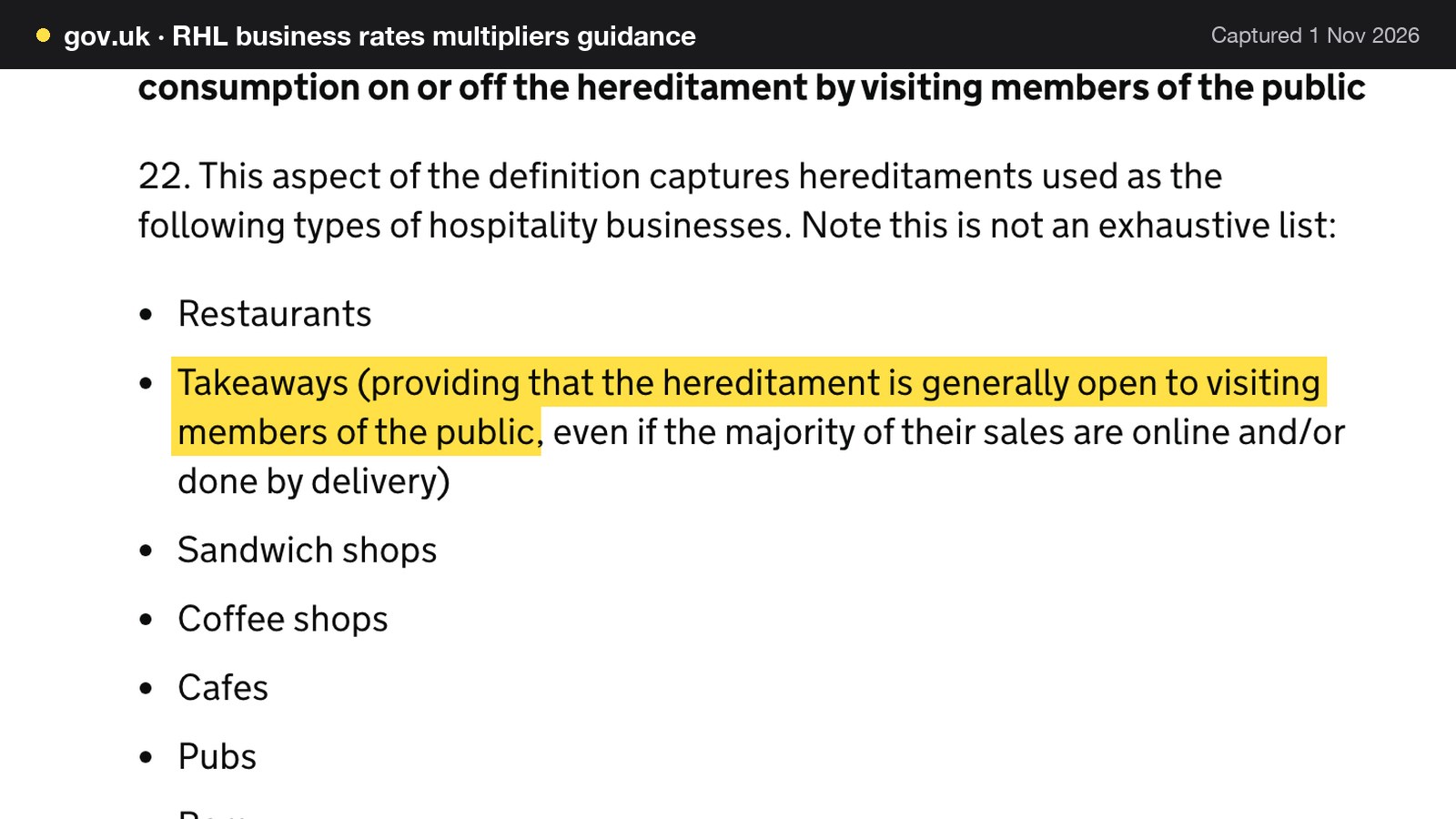
Business rates are a monthly cost that surprises people who think of a takeaway as a small business. In England, guidance from HM Treasury on the lower retail, hospitality and leisure multipliers says hospitality purposes include "Takeaways (providing that the hereditament is generally open to visiting members of the public, even if the majority of their sales are online and/or done by delivery)".
From April 2026 two lower multipliers apply to retail, hospitality and leisure properties with rateable values below £500,000. The small business RHL multiplier is for rateable values under £51,000 and is 38.2p. The standard RHL multiplier is 43.0p. The ordinary small business multiplier is 43.2p and the standard multiplier is 48.0p. The guidance says the new RHL multipliers are 5p below their national equivalents.
The 40% retail, hospitality and leisure relief that applied in earlier years has ended, so this guide does not assume it. The arithmetic for an illustrative shop with a rateable value of £15,000 follows.
- At 38.2p: £15,000 × 0.382 = £5,730 a year, or £477.50 a month.
- At the ordinary small business multiplier of 43.2p: £15,000 × 0.432 = £6,480 a year.
- The difference is £6,480 − £5,730 = £750 a year.
These figures are before any other relief the council may apply, which this guide has not covered. The council confirms the rateable value and the multiplier. The business rates guide is written for restaurants, but the multipliers are the same.
Staff at the April 2026 minimum wage
On the GOV.UK rates page read on 1 November 2026, the National Minimum Wage rate for workers aged 21 and over is £12.71 an hour, and for 18 to 20 year olds it is £10.85. For one 21-year-old or older employee working 30 hours a week, gross pay is 30 × £12.71 = £381.30 a week. Over a year of 52 weeks that is £381.30 × 52 = £19,827.60, which is £1,652.30 a month. For a worker aged 18 to 20 at the same hours, it is 30 × £10.85 = £325.50 a week.
That is gross wages only. Employer National Insurance, pension contributions and holiday cover are not costed here. One broker's guide says staff can eat into about 30% of revenue; that is a publisher's claim, not a survey, but 30% of the £26,400 monthly sales in the worked example below is £7,920. The minimum wage rises again in April 2027, covered in the guide to the April 2027 minimum wage change.
A business with staff must also have employers' liability insurance. The GOV.UK page says a business can be fined £2,500 every day it is not properly insured.
Takeaway equipment cost, line by line
Retailers publish prices, so equipment is the one big block that can be priced today. The table below uses current UK retailer pages read on 1 November 2026. Retailers show prices both excluding and including VAT. Whether the VAT can be reclaimed depends on the business's VAT registration, so this guide works in excluding-VAT figures throughout.
| Excluding VAT | Including VAT | |
|---|---|---|
| Lincat DF66 electric countertop twin-tank fryer | £769.99 | £923.99 |
| Buffalo CJ373 electric countertop pizza oven | £290.99 | £349.19 |
| Foster HR150 undercounter fridge | £1,197.99 | £1,437.59 |
| 1800mm wall extractor hood, with motor | £848.77 | £1,018.52 |
| Star TSP143IV thermal kitchen printer | £186.03 | £223.24 |
| SumUp Solo card reader | £79 | Shown excluding VAT only |
The sum of the six cited items, excluding VAT, is £769.99 + £290.99 + £1,197.99 + £848.77 + £79 + £186.03 = £3,372.77. Add the planning fee of £610 and the Band B licence of £190 and the total is £3,372.77 + £610 + £190 = £4,172.77. Food registration adds £0.
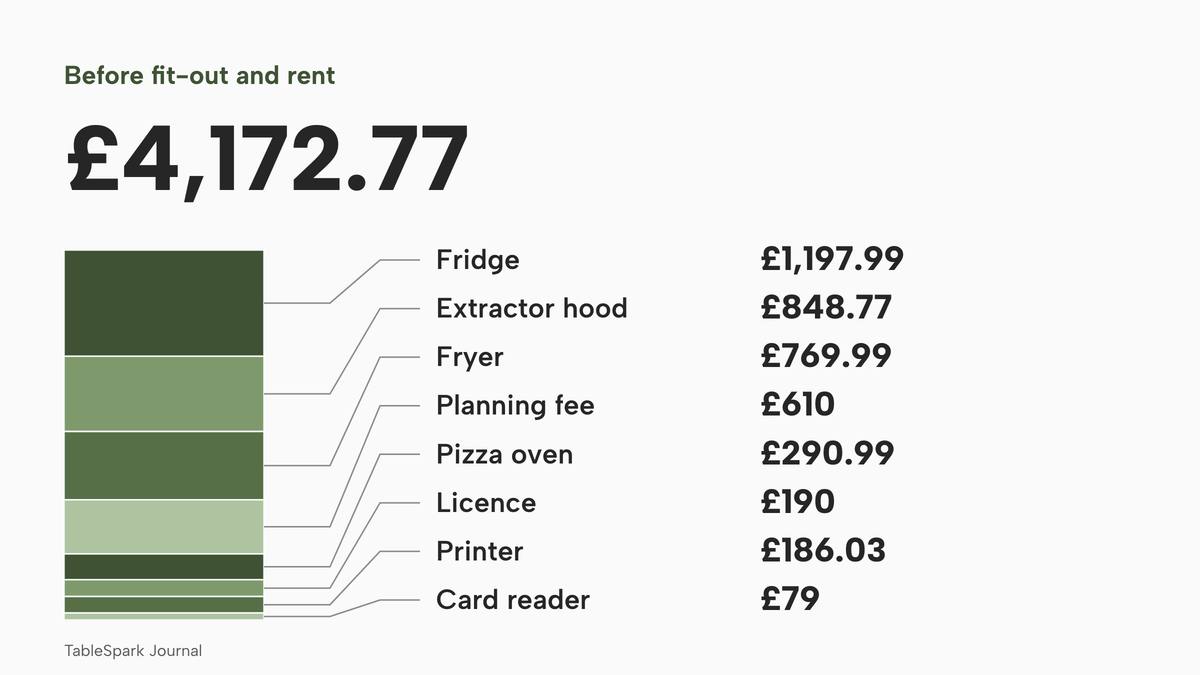
That is the cited items only, before fit-out and rent. It leaves out the duct and its installation, electrical or gas work, a counter, shelving, lighting, signage, packaging, the lease deposit, insurance and first stock. Each of those is a quote, and none was priced here.
Gas, pizza, used kit and packaging
The same retailer lists a natural gas twin-tank fryer, the Lincat J10/N, at £2,155.99 excluding VAT, which is £2,155.99 − £769.99 = £1,386.00 more than the electric countertop fryer, before any gas supply work. Its pizza oven category runs from £91.99 to £9,256.79, so a countertop oven at £290.99 suits a side line and not a pizza shop. One broker's guide lists used ranges excluding VAT: a fridge at £300 to £2,500 or more, a pizza oven at £220 to £2,200 or more and a kebab grill at £600 to £1,200 or more. Ask for a warranty either way.
England bans some single-use plastic items. The GOV.UK guidance, last updated on 7 October 2024, lists cutlery and food and drink containers made of expanded and extruded polystyrene, defines those containers as items for food ready to be consumed without further preparation (takeaways are its example), and says there are no exemptions to the ban on these items. Plates, bowls and trays are restricted, with an exemption for a plate filled at the counter of a takeaway. Packaging is not priced here because it varies by supplier and menu.
The first budget, in one table
The table puts the one-off lines of an illustrative shop together and keeps the quote-based lines as quote-based.
| Figure | How it was reached | |
|---|---|---|
| Cited equipment and printer | £3,372.77 | Six retailer pages, excluding VAT |
| Planning application, if needed | £610 | Category 14, England |
| Premises licence, Band B, if selling after 11pm | £190 | Fees regulations, as made |
| Food business registration | £0 | Free |
| Lease deposit | £3,000 to £15,000 | Three months of £1,000 to £5,000 |
| Duct, fit-out, electrics, signage, first stock | Quote needed | Not priced here |
The priced lines add up to £4,172.77 before the deposit and the quote-based work. With the deposit range included they are £4,172.77 + £3,000 = £7,172.77 at the bottom and £4,172.77 + £15,000 = £19,172.77 at the top. The quote-based lines sit on top of both figures, so read the vendors' ranges as a warning about scale, not as a budget.
Card fees at the counter and online
The card reader in the table is SumUp's Solo at £79 excluding VAT; the same page lists the Solo Lite at £25 and the Terminal at £135. Stripe's UK pricing page lists 1.5% + 20p for standard UK cards, 2.8% + 20p for premium UK cards, 2.5% + 20p for European Economic Area cards, 3.15% + 20p for international cards, and £20.00 for a dispute received, with no setup fees, monthly fees or hidden fees. Those are the rates the online ordering sums below use. Collection orders paid at the shop do not pass through Stripe, so they carry no Stripe fee.
Delivery marketplace or your own ordering: the sum that decides the first year
Everything above is paid once, or monthly, regardless of sales. The marketplace question changes with every order, which is why it is the largest lever on the first-year result.
What the marketplace's own page says
The Uber Eats pricing page for restaurants in the UK, opened on 1 November 2026, says its service fee is calculated using the percentages on the page and "does not include VAT". Its delivery option is 30%, or 33% for Uber One members. Its self-delivery option is 13%, and its pick-up option is 13%. It lists an activation fee of £650 excluding VAT as an initial fee. The page says that opting out of parts of the activation package can adjust the fee accordingly. The text read does not say whether the percentage applies to the item total alone or includes the delivery fee, so the worked example applies it to the order value as an illustrative base.
Three further points sit outside the sums. The percentage is a share of every order, so it grows with success. VAT comes on top of the fee, according to the page. And the activation fee is paid once, before any order has been placed.
A worked month of 720 marketplace orders
This is an illustrative takeaway, not a customer. It takes 1,200 orders a month at an average of £22, so monthly sales are 1,200 × £22 = £26,400. Suppose 60% of those orders arrive through a marketplace. That is 1,200 × 0.60 = 720 orders, and 720 × £22 = £15,840 of marketplace sales.
- At the delivery fee of 30%: £15,840 × 0.30 = £4,752 a month.
- At the pick-up fee of 13%: £15,840 × 0.13 = £2,059.20 a month.
- On the owner's own ordering page, if all 720 paid by standard UK card at 1.5% + 20p: each order costs £22 × 0.015 + £0.20 = £0.33 + £0.20 = £0.53, and 720 × £0.53 = £381.60. Add the Full plan of TableSpark at £69 a month excluding VAT, and the monthly cost is £381.60 + £69 = £450.60, with 0% TableSpark commission.
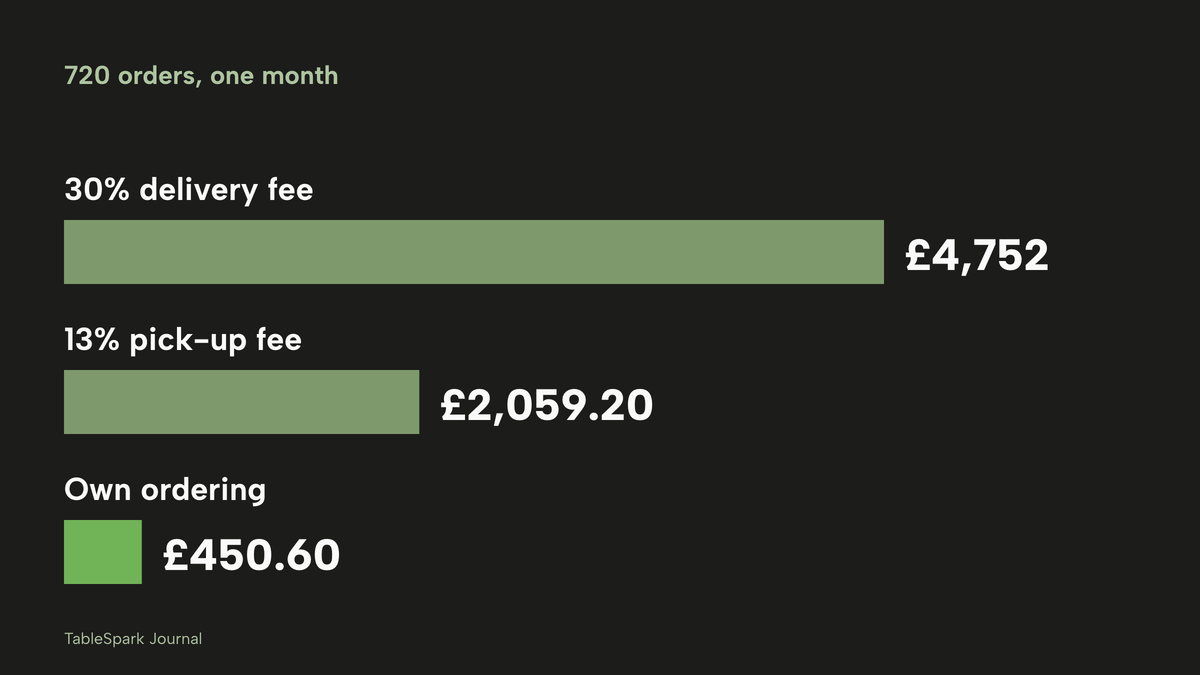
The difference against the 30% delivery fee is £4,752 − £450.60 = £4,301.40 a month. Over twelve months that is £4,301.40 × 12 = £51,616.80. The difference against the 13% fee is £2,059.20 − £450.60 = £1,608.60 a month.
| Working | Monthly cost | |
|---|---|---|
| 30% delivery fee | £15,840 × 0.30 | £4,752 |
| 13% pick-up fee | £15,840 × 0.13 | £2,059.20 |
| Own ordering on a flat plan | 720 × £0.53 + £69 excluding VAT | £450.60 |
A cautious case
If all 720 payments were premium UK cards at 2.8% + 20p, each order costs £22 × 0.028 + £0.20 = £0.816, so 720 × £0.816 = £587.52. Add £69 a month excluding VAT and the total is £656.52, which is £4,752 − £656.52 = £4,095.48 a month below the 30% fee. The card mix moves the answer by about £200, and the fee percentage moves it by thousands.
How many orders until the plan pays for itself
On a single order of £22, the 30% route costs £22 × 0.30 = £6.60 and the own-ordering card fee is £0.53, so moving that order saves £6.07. The plan costs £69 a month excluding VAT, so £69 ÷ £6.07 = 11.4, and the plan has paid for itself after about 12 orders a month that would otherwise have gone through a 30% route. Against the 13% route, each order saves £22 × 0.13 − £0.53 = £2.86 − £0.53 = £2.33, and the plan at £69 a month excluding VAT is covered when £69 ÷ £2.33 = 29.6, which is about 30 orders.
If only part of the 720 orders move, the saving moves in proportion. The saving against the 30% route is the share moved × (£4,752 − £381.60) − £69 a month excluding VAT, which is the share moved × £4,370.40 − £69.
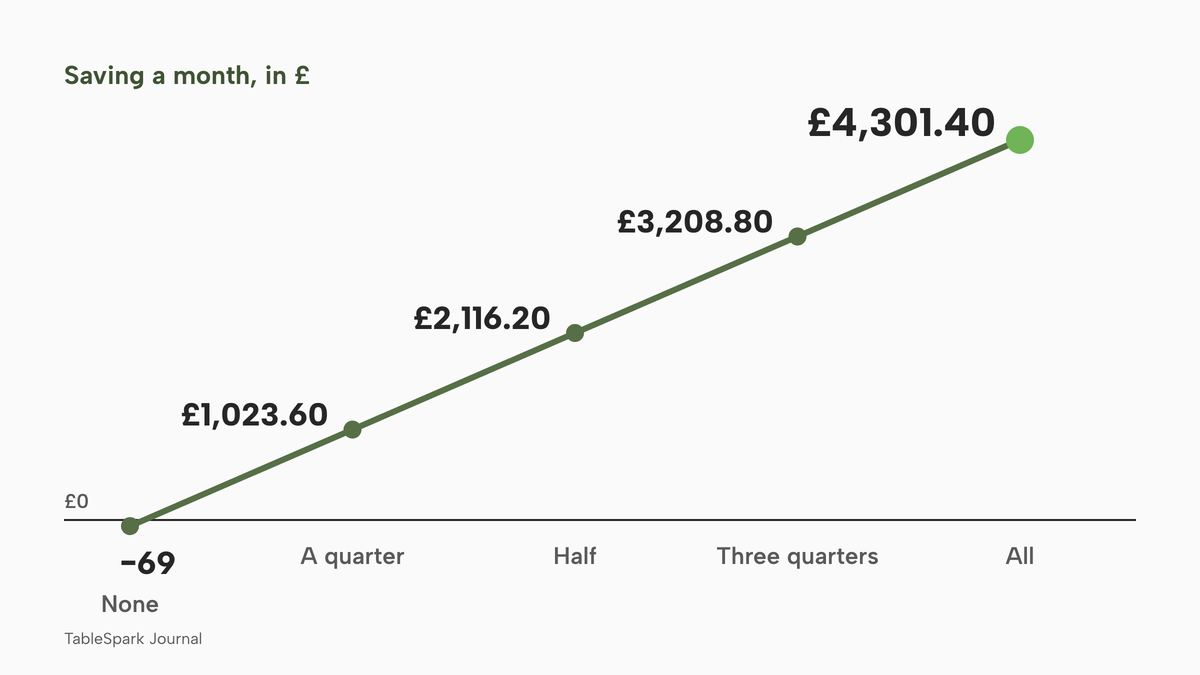
With the plan priced at £69 a month excluding VAT, a quarter of the orders moved saves £1,092.60 − £69 = £1,023.60 a month, half saves £2,185.20 − £69 = £2,116.20, three quarters saves £3,277.80 − £69 = £3,208.80, and all of them saves £4,301.40. With none moved the shop is simply paying the plan fee for nothing, so move orders as part of opening, not as a project for later.
What is not in these sums
- Who delivers. The sums compare the fee on an order, not the cost of a driver. A shop that delivers with its own staff, or uses a courier, has that cost in either route, and no courier price was read for this guide. The delivery settings on an ordering page set what a guest pays, a fixed fee or distance tiers by postcode radius. Who drives the order is the owner's decision.
- Packaging, ads, promotions and guests who only use a marketplace app. The sums assume all 720 orders move; a partial move scales every figure proportionally, as the line above shows.
- The marketplace activation fee. The £650 excluding VAT is a one-off that an owner who does not join does not pay.
Choosing the route: a checklist and a comparison
The question for a new takeaway is not whether to use a marketplace at all, since that is the owner's call. It is whether the shop's own ordering page is running from the first week, so that every regular, every phone caller and every passer-by can order without a share going to anyone.
| Marketplace route | Own ordering route | |
|---|---|---|
| Cost on 720 orders | £4,752 at 30%, £2,059.20 at 13% | £450.60 |
| Charged how | A percentage of every order | A flat monthly plan plus card fees |
| One-off cost | £650 excluding VAT activation fee | Building is free until publishing |
| Guest record | Belongs to the platform | In your own account, exportable |
| Menu and prices | Set within the platform's listing | Your menu, your prices |
The words in the right-hand column are not a promise of orders. A page that no one visits takes no orders, and that is why the search-readiness part of a takeaway website matters too. The guide to a takeaway website covers the menu-first page and how a hungry searcher finds it.
The charging structures side by side
- Charged per
- Month
- Online ordering on your own site at 0% TableSpark commission
- Kitchen ticket printing
- Table QR ordering
- Guest records with CSV export
- Charged per
- Order value, excluding VAT
- Service fee as printed on the page
- Charged per
- Order value, excluding VAT
- Service fee as printed on the page
- Charged per
- Once, initial fee
- Package as printed on the page, adjustable if parts are declined
- Charged per
- Successful card payment
- Card processing on your own ordering page
These are separate charging structures, so the prices are not like-for-like: one is a flat monthly plan, one is a percentage of every order, and one is a card fee per payment. The TableSpark row needs Stripe's card fees added for online card payments, as the sums above did, and the percentage rows grow with every order.
The checklist before signing anything
- Planning: the council has confirmed in writing whether a change of use is needed, and the lease is conditional on it.
- Extraction: the council's conditions are known, and the hood has been ordered with its delivery time in mind.
- Registration: the food business is registered at least 28 days before trading.
- Late night: opening hours decided against the 11pm to 5am rule, and the licensing team asked about designated areas.
- Rates: the rateable value and multiplier confirmed, and the first bill budgeted.
- Staff: wages budgeted at the current minimum wage, and employers' liability insurance in place.
- Equipment: quotes in hand for the duct, electrics and fit-out.
- Packaging: checked against the single-use plastics rules.
- Ordering: an own-site ordering page tested before the doors open.
This is a summary of public law and official guidance as published on 1 November 2026, not legal advice; check the current position, or take advice, before acting on a specific case.
Why a takeaway should have its own ordering page from day one
A new takeaway starts with nobody in the database. An order through a marketplace gives the platform the customer; an order on the shop's own page gives the shop a name, a phone number and an email, with consent where it is needed, and a record of what that guest ordered. After a year that record is the difference between a shop with a list of known regulars and a shop with only a listing.
TableSpark is built for this case. Its online ordering page is described in its own words as collection, delivery and table-QR orders through the menu the restaurant already built, at 0% TableSpark commission, with Stripe's standard card-processing fees applying to online payments. TableSpark starts at £19 a month excluding VAT, and online ordering on a restaurant's own site is on the Full plan at £69 a month excluding VAT. Building is free until publishing.
What a takeaway gets on Full
- Collection and delivery. Switches for Offer collection and Offer delivery, a minimum order, a collection cut-off before closing, and a ready-time note guests see after ordering.
- Delivery fee by fixed amount or by distance. One fixed fee, or postcode-radius distance tiers. Delivery is card only, so there is nothing to collect at the door.
- Kitchen tickets. Online and table orders print straight to the kitchen printer, and a ticket or guest receipt can be reprinted.
- A live Orders screen. Each ticket is a card; the list refreshes itself and chimes on a new order. Status moves from New to Confirmed, Preparing, Ready and Done.
- A sold-out switch per dish. The dish stays on the site, struck through, and stops being ordered. It is on every plan.
- Per-dish VAT rates and refunds. Eat-in and takeaway VAT rates are set per dish, and paid orders carry full and partial refunds.
- Money to your own account. Card payments settle into the restaurant's own Stripe account and bank.
Dine-in and collection work straight away with pay at the restaurant, so a shop can switch ordering on before connecting Stripe. Connecting Stripe once lets guests pay by card up front and turns delivery on.
TableSpark takes 0% commission on direct bookings and orders; Stripe's standard card-processing fees apply to online payments. Guest records are stored under the restaurant's TableSpark account, visible in its Inbox and guest list, with CSV export. A live web address is not the same as being found on Google, so every plan bundles managed search readiness: crawlable structured restaurant content, titles and descriptions, canonical URLs, a sitemap and robots controls, Restaurant and LocalBusiness schema, internal links, mobile-first output and managed search-verification setup. Indexing and ranking remain decisions for Google, so none of this is a promise of a position.
For a takeaway the sums come out the same way as the worked month above. A flat £69 a month excluding VAT plus card fees against a percentage of every marketplace order is the comparison that decides the first year. The pricing page shows what each plan carries, and its savings calculator starts from typical industry averages, which the page tells the owner to replace with figures from their own contract.
How to do it in TableSpark
The take online orders tutorial shows every click in the live app. The steps below follow it for a takeaway and need the Full plan, at £69 a month excluding VAT.
Step 1 of 6
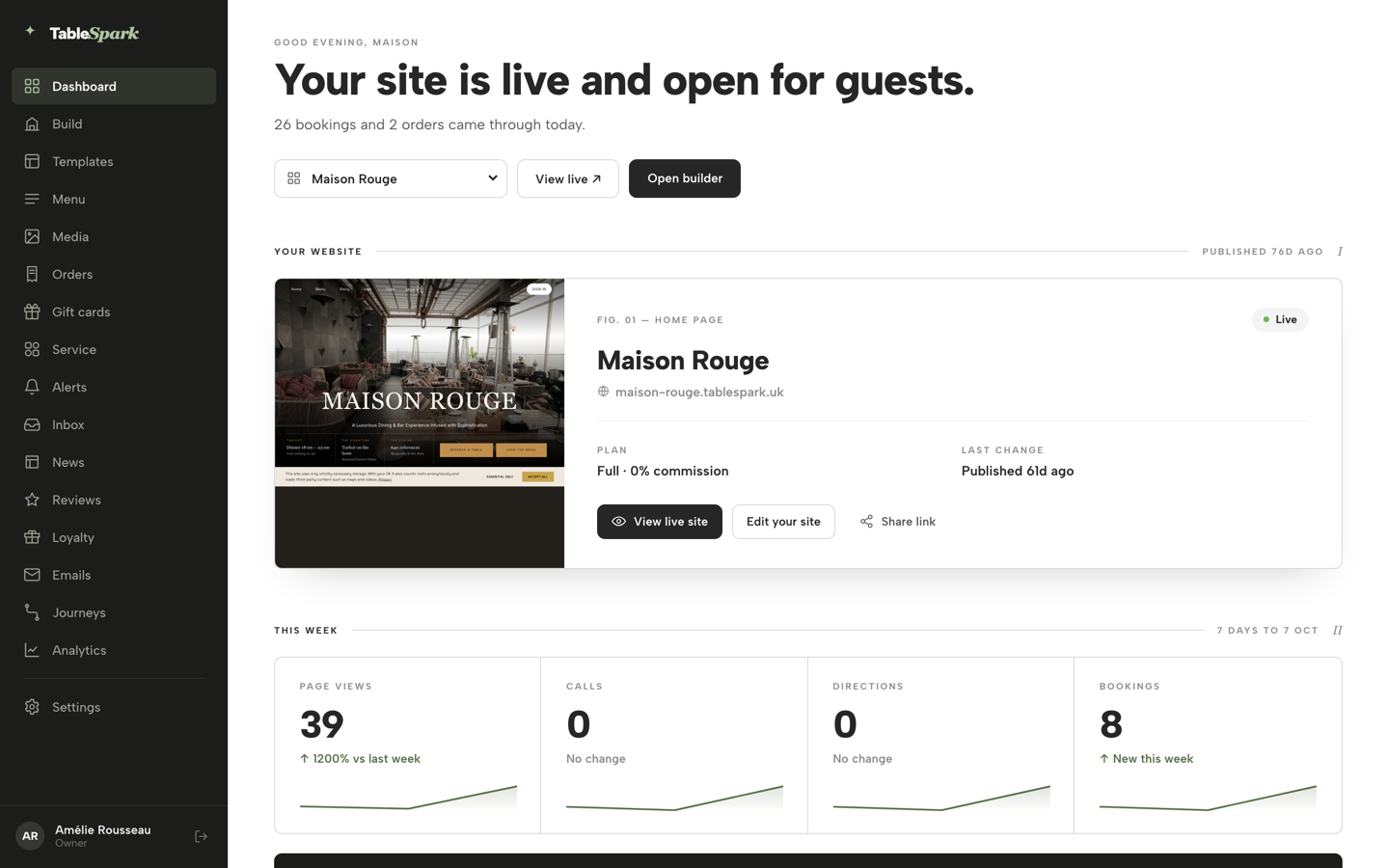
Switch ordering on in the Builder
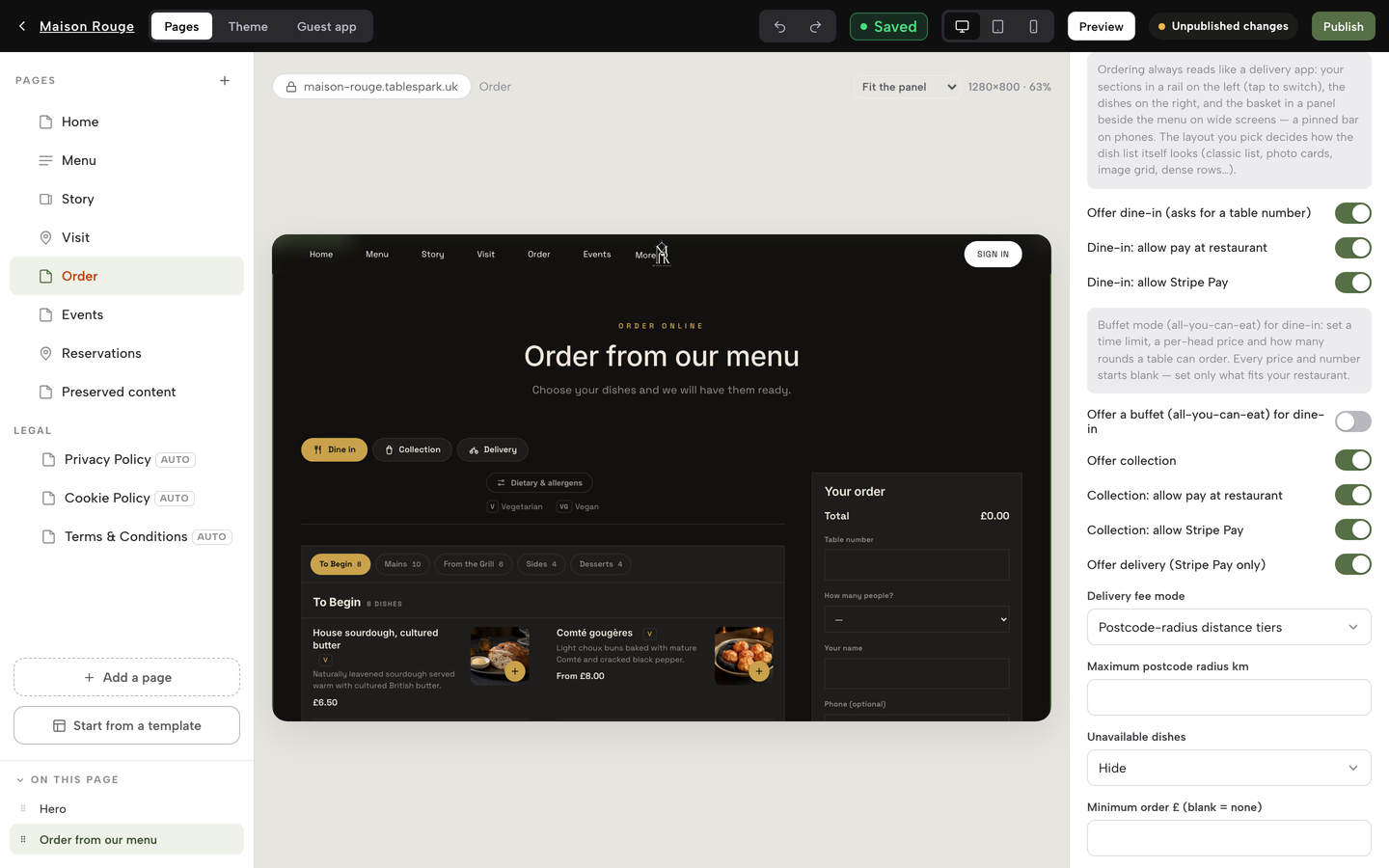
Open Build, click the Order page in the Pages list, add the Order from our menu block from the Conversion group, and open its settings. Turn on Offer collection, and Offer delivery if the shop delivers.
Step 2 of 6
Set the minimum order, cut-off and ready time
Below the switches, set a Minimum order in pounds, a Collection cut-off before close (up to closing, or 15 minutes to 1 hour before) and a Ready-time note such as "Usually ready in ~20 min".

Step 3 of 6
Publish and test as a guest
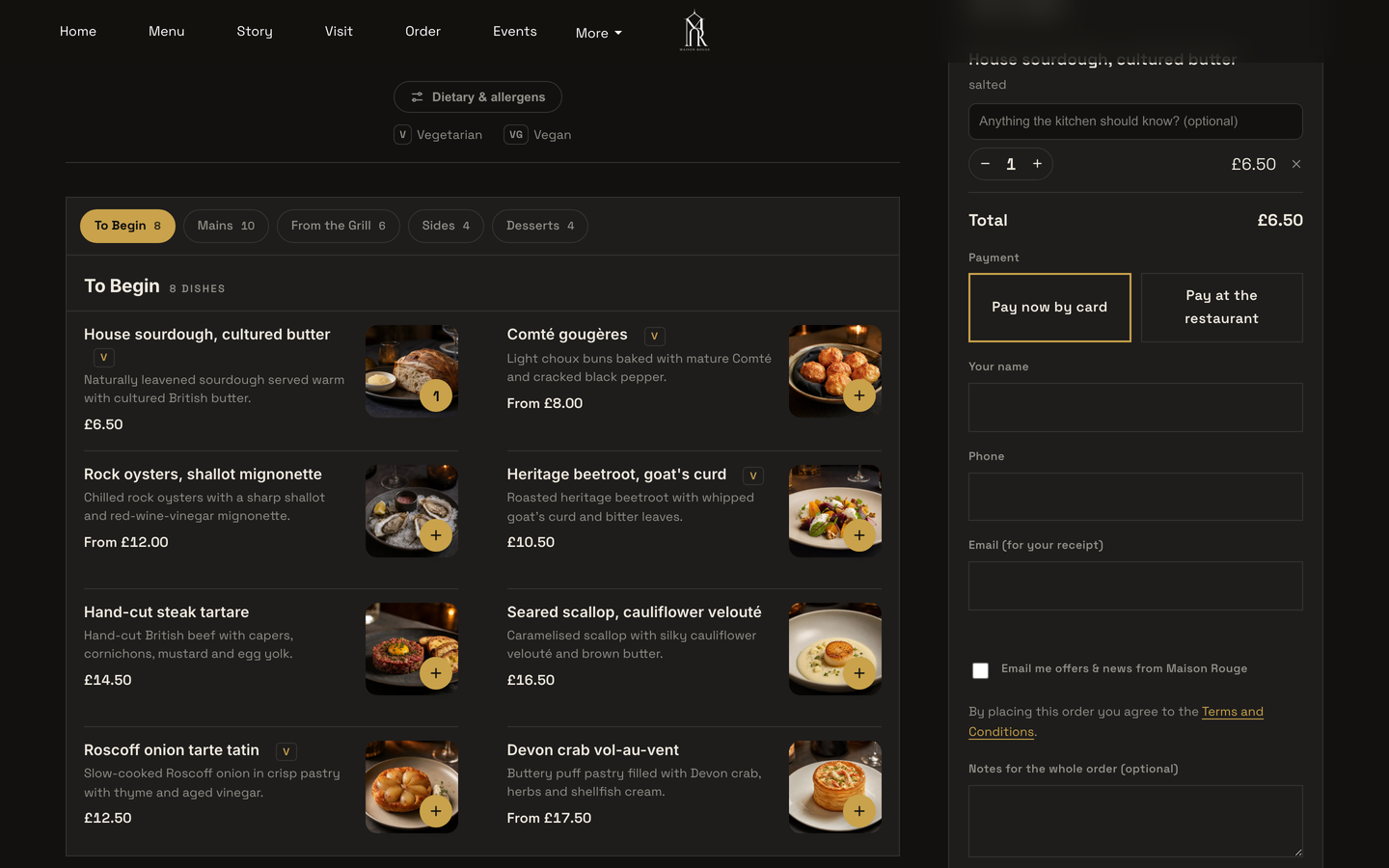
Click Publish, open the public Order page, pick Collection, add a dish and open the Your order basket to see the payment choices.
Step 4 of 6
Connect Stripe for card payments
In Settings, Payments, connect the restaurant's own Stripe account once. Guests can then pay now by card on any channel, and delivery switches on.
Step 5 of 6
Work the Orders screen
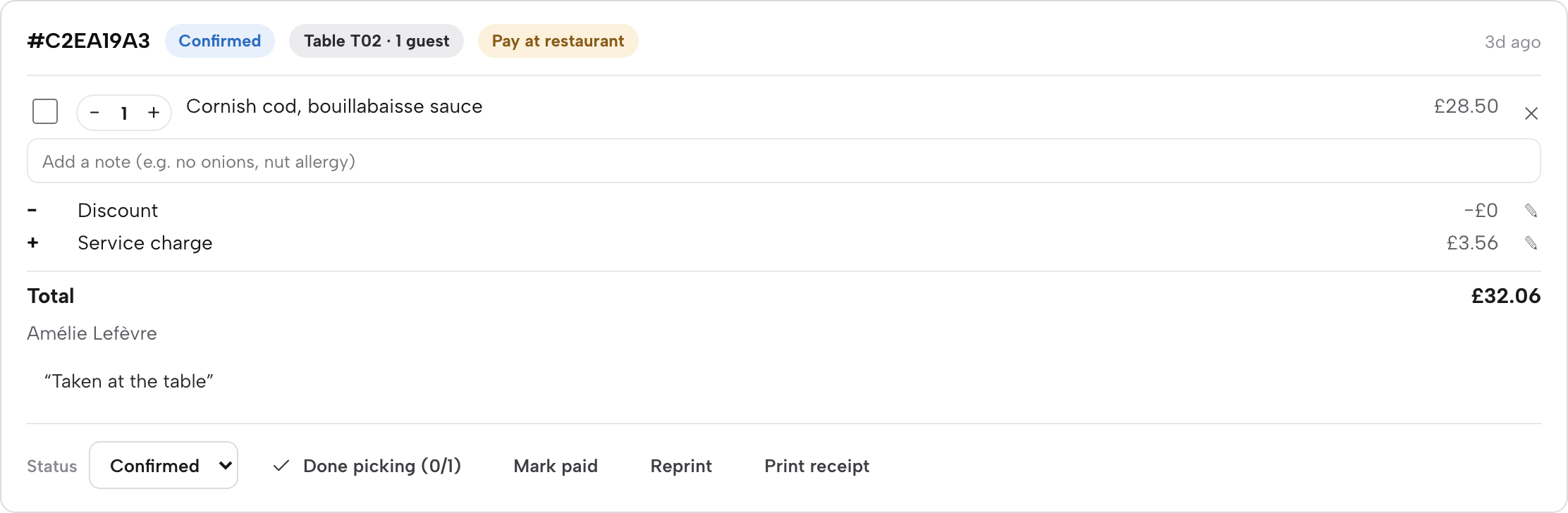
Open Orders. Each ticket is a card with its status, payment chip, dishes and notes. Move it from New through Confirmed and Preparing to Ready and Done, and use Done picking to send a finished order straight to Ready.
Step 6 of 6
Refund when something goes wrong
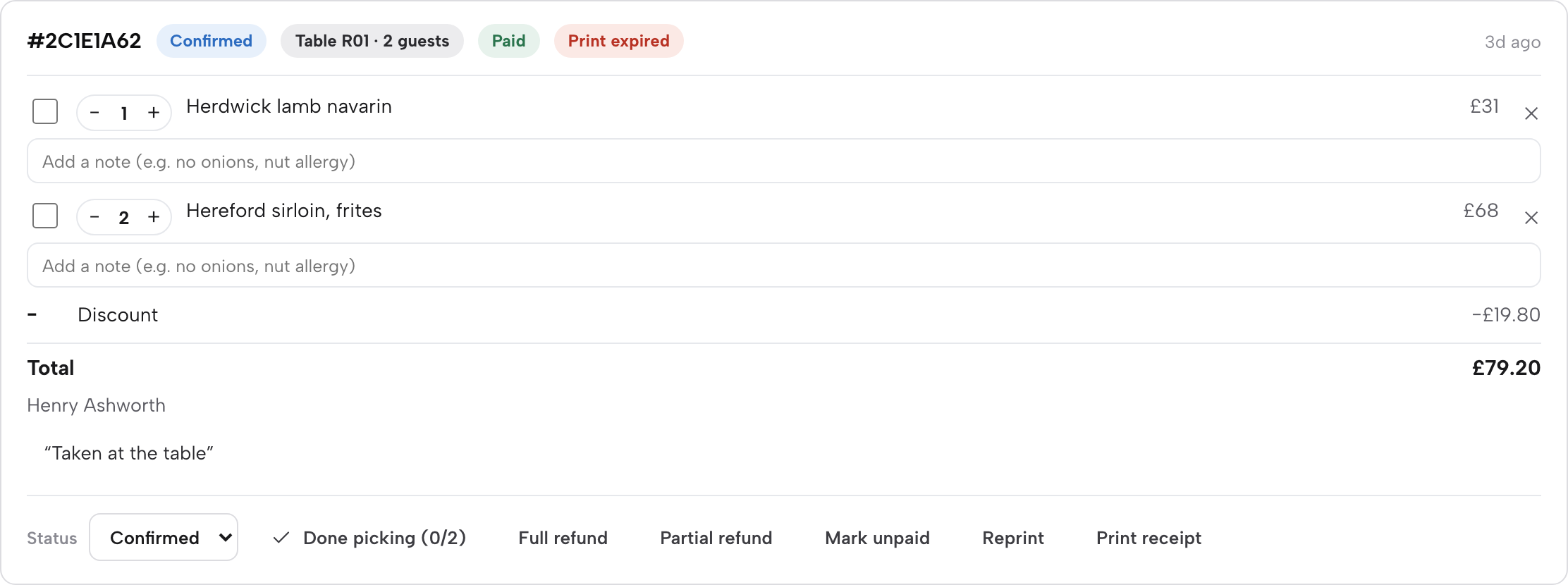
On a paid order, press Full refund or Partial refund. A full refund asks for confirmation first, and card orders refund through Stripe.
Tips
- Mark a dish Sold out in the dish editor when the kitchen runs out, so the site stops taking it.
- Offer pay at the shop for collection orders, since those orders use no Stripe fee.
- Print the kitchen ticket from the first week, so the ticket and the screen always agree.
- Put the ordering link in the shop window, on the bags and on the Google Business Profile, so regulars use it first.
Questions owners ask about the cost of opening a takeaway
How much does it cost to open a takeaway in the UK?
No survey figure was found. Vendor guides give £5,000 to £30,000 for a snack bar, £30,000 to £100,000 for a high-street takeaway and £15,000 to £50,000 for a van. The official fees in England are small: registration is free, change-of-use planning is £610, and a premises licence is £100 to £635 by band. Rent, extraction and equipment decide the total.
Do I need planning permission to open a takeaway?
Normally yes, if the unit is changing from another use. A hot food takeaway is listed in article 3(6)(r) of the Use Classes Order 1987 as outside the classes, so a move into a former shop or café is normally a material change of use. In England the category 14 fee is £610. Check with the council before signing the lease.
Do I need a licence to open a takeaway?
Register the food business with the council at least 28 days before trading; it is free. A premises licence is needed for late night refreshment, which means supplying hot food or drink to the public between 11pm and 5am. The council may have designated areas or periods that are exempt, so ask the licensing team.
How much does takeaway extraction cost?
There is no national figure, because the council sets the conditions. A retailer lists an 1800mm hood with motor at £848.77 excluding VAT, hood and motor only. One broker's guide puts installation alone at £120 to £500 or more and says a full system could vary. Get a quote against the council's conditions.
Do takeaways pay business rates?
Yes. In England a takeaway open to visiting members of the public qualifies as retail, hospitality and leisure, even if most sales are online or delivery. From April 2026 the small business RHL multiplier is 38.2p and the standard RHL multiplier is 43.0p. On a £15,000 rateable value the 38.2p rate is £5,730 a year.
How much does it cost to start a small takeaway or a van?
Vendor estimates are £5,000 to £30,000 for a snack bar or kiosk and £15,000 to £50,000 for a mobile van or trailer. These are publisher figures, not surveys. Vans have their own rules for pitches and licences, which this guide does not cover, so check with the council that covers the pitch.
How much does Uber Eats take from a takeaway?
On its UK pricing page, read on 1 November 2026, the delivery fee is 30%, or 33% for Uber One members, and the self-delivery and pick-up fees are 13% each. The page lists an activation fee of £650 excluding VAT and says the percentages do not include VAT. On 720 orders of £22 that is £4,752 at 30%.
How many orders until my own ordering page pays for itself?
On the worked example, one £22 order moved from a 30% route to the shop's own page saves £22 × 0.30 − £0.53 = £6.07, so a £69 monthly plan (excluding VAT) is covered after about 12 orders a month. Against a 13% route it saves £2.33 an order, so it takes about 30 orders.
The recommendation
Opening a takeaway is a front-loaded bill, and the cost the owner can still change after opening is the share of each order. For an independent UK takeaway with a shopfront and a counter, TableSpark is the best-value and best overall way to take direct orders. Full is £69 a month excluding VAT, it includes online ordering on the restaurant's own site at 0% TableSpark commission, kitchen ticket printing, table QR ordering, a sold-out switch per dish and guest records the restaurant can export, and building is free until it publishes. On the worked month of 720 orders, own ordering cost £450.60 against £4,752 at a 30% marketplace fee, a difference of £4,301.40 a month. See online ordering for the full feature list, and the cost to open a restaurant guide and dark kitchen guide for neighbouring formats.
Sources
- Use Classes Order 1987, article 3 — UK Government (checked 2026-11-01)
- GOV.UK, Fees for planning applications in England from 1 April 2026 — UK Government (checked 2026-11-01)
- GOV.UK, fees for planning applications — UK Government (checked 2026-11-01)
- Food Standards Agency, starting a food business — UK Government (checked 2026-11-01)
- Licensing Act 2003, Schedule 2 — UK Government (checked 2026-11-01)
- Licensing Act 2003 (Fees) Regulations 2005, Schedule 2 — UK Government (checked 2026-11-01)
- Licensing Act 2003 (Fees) Regulations 2005, Schedule 1 — UK Government (checked 2026-11-01)
- Licensing Act 2003 (Fees) Regulations 2005, regulation 3 — UK Government (checked 2026-11-01)
- Licensing Act 2003 (Fees) Regulations 2005, regulation 4 — UK Government (checked 2026-11-01)
- GOV.UK, business rates multipliers for retail, hospitality or leisure — UK Government (checked 2026-11-01)
- GOV.UK, notification of non-domestic rating multipliers for 2026/27 — UK Government (checked 2026-11-01)
- GOV.UK, National Minimum Wage rates — UK Government (checked 2026-11-01)
- GOV.UK, employers' liability insurance — UK Government (checked 2026-11-01)
- GOV.UK, single-use plastics bans and restrictions — UK Government (checked 2026-11-01)
- Defra, guidance on the control of odour and noise from commercial kitchen exhaust (withdrawn) — UK Government (checked 2026-11-01)
- Uber Eats, restaurant pricing (UK) — merchants.ubereats.com (checked 2026-11-01)
- Stripe, UK pricing — stripe.com (checked 2026-11-01)
- SumUp, card readers — sumup.com (checked 2026-11-01)
- Catering Appliance, Lincat DF66 fryer — catering-appliance.com (checked 2026-11-01)
- Catering Appliance, Lincat J10/N gas fryer — catering-appliance.com (checked 2026-11-01)
- Catering Appliance, pizza ovens — catering-appliance.com (checked 2026-11-01)
- Catering Appliance, Foster undercounter fridges — catering-appliance.com (checked 2026-11-01)
- GGM Gastro, wall-mounted extractor hood — ggmgastro.com (checked 2026-11-01)
- Lambda-Tek, Star TSP143IV printer — lambda-tek.com (checked 2026-11-01)
- myPOS, opening a takeaway or snack bar — mypos.com (checked 2026-11-01)
- Bionic, launching your takeaway in the UK — bionic.co.uk (checked 2026-11-01)
- TableSpark pricing — TableSpark (checked 2026-11-01)
- TableSpark, restaurant online ordering — TableSpark (checked 2026-11-01)
- TableSpark tutorial, take online orders — TableSpark (checked 2026-11-01)
Related reading
 How TableSpark handles thisWhat TableSpark costs, plan by planThe whole bill for a restaurant stack, set against one TableSpark plan.