Contents
A bar lease signed before anyone has checked the hours the licence will allow can cost more than the fit-out ever did.
Opening a bar is mostly fit-out, stock and wages, not licence fees. In the illustrative 45-cover cocktail bar below, year one runs from £57,301.40 to £146,497.81 including contingency, and the statutory licence fees are under 1% of the low case. The real exposure is the hours and conditions the licence allows, so check the council before signing a lease. Every venue figure is an assumption, so get written quotes.
The lease is signed before anyone reads the licence conditions
A bar earns its money in the hours after most kitchens have closed, and a council controls those hours. An owner can sign a lease, start the rent and begin a fit-out before learning what the area's licensing policy expects, whether the council has switched on a late night levy, or whether it has made an early morning restriction order. The lease does not mention any of them, and each can change what the room earns.
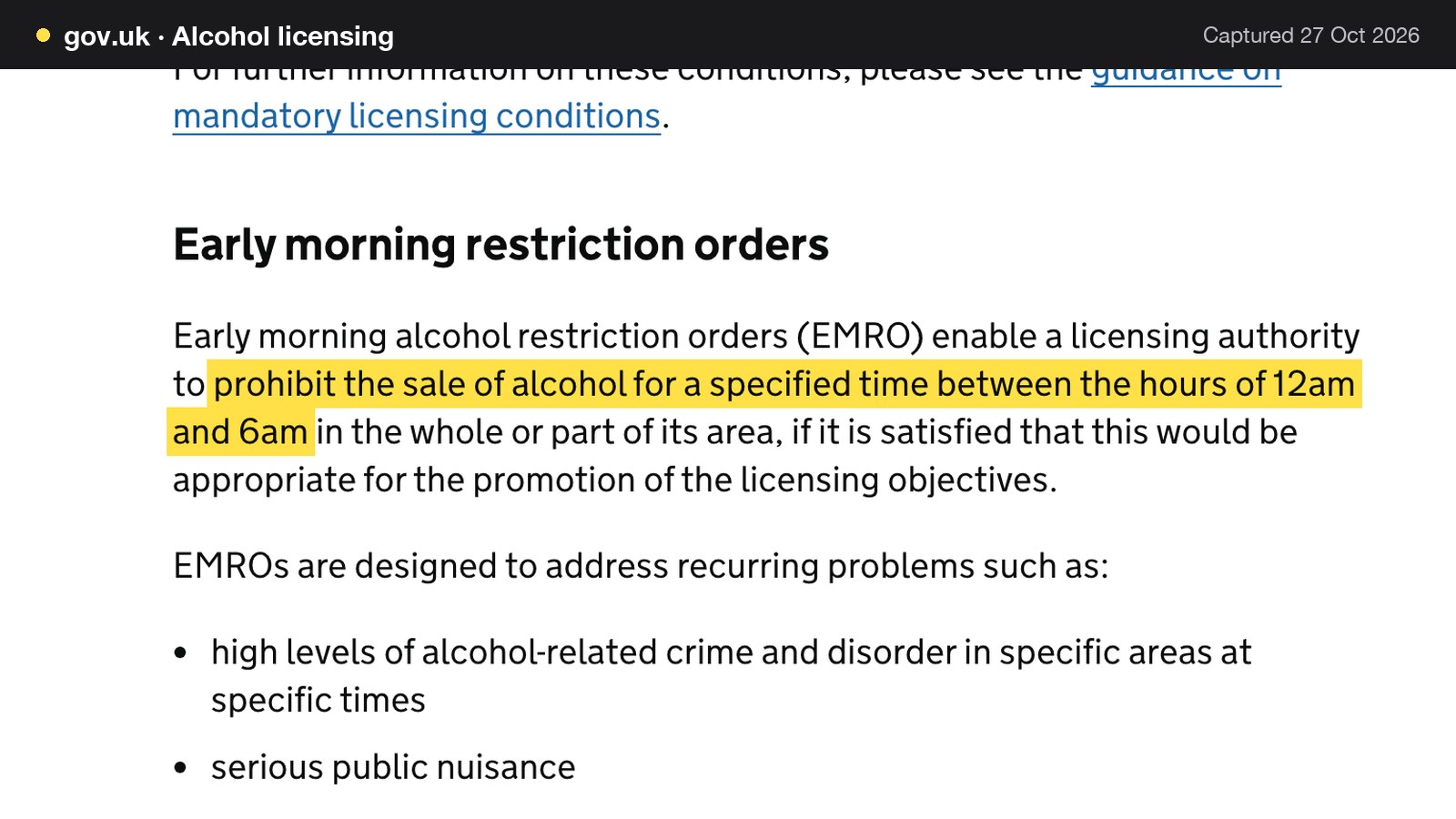
The powers are on the public record. GOV.UK describes early morning restriction orders as a way to "enable a licensing authority to prohibit the sale of alcohol for a specified time between the hours of 12am and 6am in the whole or part of its area". The late night levy is a separate power: the GOV.UK guidance says it "enables licensing authorities to charge a levy to persons who are licensed to sell alcohol late at night in the authority's area, as a means of raising a contribution towards the costs of policing the late night economy". Since 13 July 2023 councils may target the levy in smaller geographical areas, so it can apply to one street and not the next. No levy amount is published in the sources read for this guide, so ask the council for the figure, in writing, before signing.
Stock is the second shock. A bar opens with a back bar full of spirits, wine, beer and mixers, bought duty-paid, and none of it earns anything until the first night. Before assuming the shelf can be paid for after opening, an owner should ask every supplier about credit terms.
Then come the things that a bar does and a restaurant mostly does not: playing music, showing a match, running a quiz, fitting a gaming machine and pouring a late happy hour. Each carries a rule, a licence or a condition of its own, and a missed obligation is not abstract. The GOV.UK employers' liability guidance says "You can be fined £2,500 every day you are not properly insured".
Last comes the technology, which is usually bought at the end and in pieces. The till, the booking tool and the website arrive as three subscriptions with three plans, three renewal dates and, for card payments, processing fees on top. The owner meets the total after opening, when cash is thinnest.
This guide covers licensing in England and Wales, where the Licensing Act 2003 and its fee regulations apply. Scotland and Northern Ireland run their own licensing regimes, with their own fees and authorities, so an owner there should ask the local authority for the amounts. The general opening budget is in the guide to what it costs to open a restaurant. The rest of this guide covers what is different for a bar.
How much does it cost to open a bar in the UK?
There is no official UK figure for the cost of opening a bar. The ranges that exist come from vendors, and they are wide. An accounting software publisher's estimate (Sage) says that opening a bar in the UK "typically requires a minimum investment of £97,500 to £325,000". The same page lists renovation at "£50,000-£100,000", furniture and equipment at "£20,000-£65,000", opening stock at "roughly £2,000-£20,000+", insurance at "around £2,000 to £5,000 annually", and "£10,000-£30,000 for premise licence, personal licence, other permits, and associated legal costs". The page gives no sources, and that last line does not separate the statutory fee from legal spend. For a band C premises, as shown below, the application fee is £315 and the annual fee £295, so that line is not a fee estimate.
A range this wide does not say whether the premises is a shell or a fitted unit, or whether rent and deposits are inside it. It is more useful to build the budget line by line for a stated venue and keep the low and high cases visible. The statutory fees in the worked example are exact because they come from legislation. Everything else is labelled as an assumption or as a named retailer's price.
Cost to open a cocktail bar, a wine bar or a micropub
The licence fee table is the same for every kind of bar, because the fee depends on the premises' rateable value band and not on the drinks list. What changes is the equipment, the stock and the measures the format needs.
| Line | Cocktail bar | Wine bar | Micropub |
|---|---|---|---|
| Stock | Spirits, mixers and fresh ingredients | Wine by the glass and bottle | Beer and cider, as the drinks list requires |
| Equipment | Ice machine, glasswasher, bottle coolers | Wine storage, glasswasher | Cooling and storage for the drinks list |
| Measures rule | 25 ml or 35 ml spirits, displayed | 125 ml wine measure, displayed | Half pint measure, displayed |
The measures row comes from the mandatory licence conditions covered further down. The other rows describe where each format spends money, not an amount, because this research found no verified price specific to a wine bar or a micropub, so each should run the line-by-line budget below with its own quotes.
Bar licence cost in England and Wales
A bar that sells alcohol needs a premises licence from the council, a designated premises supervisor who holds a personal licence, and a plan for how the premises will trade. The Home Office statistics put the number of premises licences on issue in England and Wales at an estimated 227,300 as at 31 March 2026, though the page warns that licences "may remain in force when a premises ceases trading", so the total is not a count of trading bars.
Premises licence fees by rateable value band
The fees come from the Licensing Act 2003 (Fees) Regulations 2005. Schedule 1 sorts premises into five bands by rateable value: band A is up to £4,300, band B is £4,300 to £33,000, band C is £33,001 to £87,000, band D is £87,001 to £125,000 and band E is £125,001 and above. Schedule 2 sets the application fee for each band, and Schedule 5 sets the annual fee. The rateable value is the figure on the premises' business rates record, so ask the landlord or the council for it before committing.
| Application fee | Annual fee | |
|---|---|---|
| A, up to £4,300 | £100 | £70 |
| B, £4,300 to £33,000 | £190 | £180 |
| C, £33,001 to £87,000 | £315 | £295 |
| D, £87,001 to £125,000 | £450, or £900 if mainly drinking on the premises | £320, or £640 if mainly drinking on the premises |
| E, £125,001 and above | £635, or £1,905 if mainly drinking on the premises | £350, or £1,050 if mainly drinking on the premises |
Bands A to C carry no multiplier, so a typical small bar in band C pays the application fee of £315 once and the annual fee of £295 on each anniversary of the grant. These are the 2005 regulations as compiled on legislation.gov.uk, so confirm the current amount with the council before paying.
The multiplier that only hits bigger bars
The bar-specific fee point sits in regulation 4(2) of the same Regulations. The application fee is multiplied where the premises is in band D or band E and is used for "the use of the premises exclusively or primarily for the carrying on on the premises of the supply of alcohol for consumption on the premises". Band D pays two times the fee and band E three times. Regulation 5(2) applies the same multipliers to the annual fee for premises "exclusively or primarily used for the supply of alcohol for consumption on the premises".
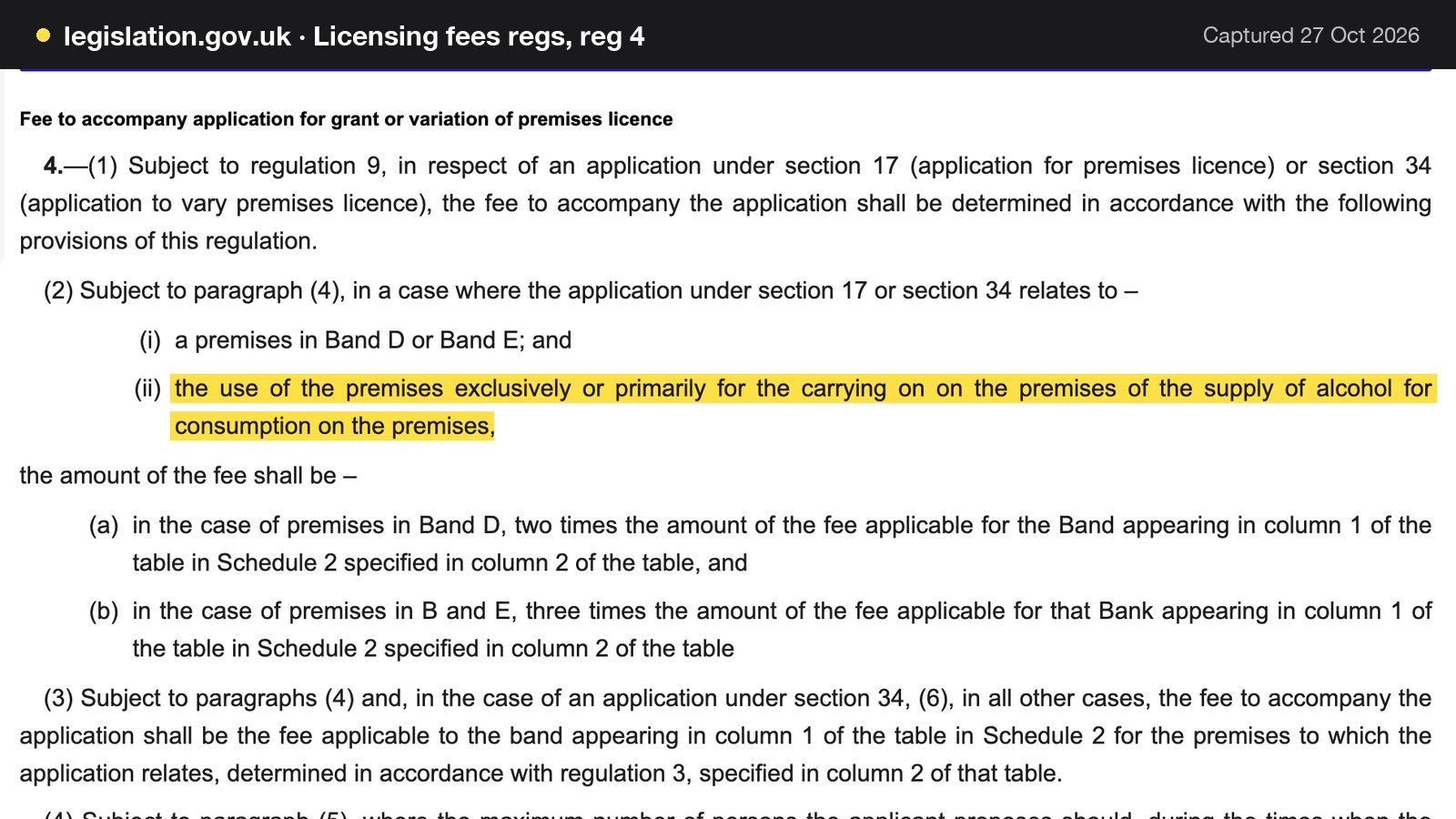
The arithmetic for a drinks-led bar is as follows. In band D, the application fee is £450 x 2 = £900 and the annual fee is £320 x 2 = £640, which is £900 - £315 = £585 more to apply and £640 - £295 = £345 more each year than band C. In band E, the application fee is £635 x 3 = £1,905 and the annual fee is £350 x 3 = £1,050, which is £1,590 more to apply and £755 more each year. A bar with a high rateable value should expect the multiplied figure and ask the council which applies.
Personal licence, designated premises supervisor and the course
GOV.UK says that "Premises licensed to sell alcohol must have a designated premises supervisor, who holds a personal licence." It also says that "You are not required to have a personal licence to be employed in a pub or other business that sells alcohol", and that "If you are applying for a personal licence, you must obtain an accredited qualification first."
Schedule 6 of the Fees Regulations lists the one-off fees. The personal licence application is £37. An application to vary the licence to name a different designated premises supervisor is £23, as is a transfer of a premises licence, and a temporary event notice is £21. The qualification is separate: Cheltenham Borough Council lists "Our e-learning and exam package costs £95 plus VAT" and "Our exam only package costs £60 plus VAT", which with 20% VAT is £95 x 1.2 = £114 and £60 x 1.2 = £72. That is one council's price, and other providers charge differently.
| Amount | Basis | |
|---|---|---|
| Personal licence, grant or renewal | £37 | Fees Regulations, Schedule 6 |
| Vary licence to name a new supervisor | £23 | Fees Regulations, Schedule 6 |
| Transfer a premises licence | £23 | Fees Regulations, Schedule 6 |
| Temporary event notice | £21 | Fees Regulations, Schedule 6 |
| Level 2 course with exam, one council | £95 plus VAT | Cheltenham Borough Council |
| Level 2 exam only, one council | £60 plus VAT | Cheltenham Borough Council |
Temporary event notices for one-off nights
GOV.UK says that "a temporary event is a relatively small-scale event attracting fewer than 500 people and lasting no more than 168 hours." A bar that already holds a premises licence can use a temporary event notice for a one-off night outside its normal licence. At £21 each, two notices cost £21 x 2 = £42, which is how the high case below treats them. Ask the council how many a premises may hold.
The wider licence process is in the restaurant premises licence guide, and it applies to a bar as well. The application is advertised, too. Regulation 25 of the Licensing Act 2003 (Premises licences and club premises certificates) Regulations 2005 requires a notice displayed for "no less than 28 consecutive days starting on the day after the day on which the application was given to the relevant licensing authority", so the clock starts only when the application is in.
Hours, late night levy and early morning restriction orders
The fee is the smallest number in the licence, and the hours are the largest. A premises licence names the hours at which alcohol may be sold, and the council's licensing policy shapes what it will grant in an area. A bar planning a midnight close from Thursday to Saturday, as the worked example does, should know before signing whether the area has a late night levy or an early morning restriction order.
An early morning restriction order, as GOV.UK describes it, can "prohibit the sale of alcohol for a specified time between the hours of 12am and 6am in the whole or part of its area". Section 172A of the Licensing Act 2003 sets the limits: an order period begins no earlier than midnight and ends no later than 6am. A bar whose model depends on sales after midnight needs to know if such an order covers its street.
A late night levy is a charge, not a ban. It falls on "persons who are licensed to sell alcohol late at night", and a council may apply it in an area smaller than the whole district. No amount is given in the guidance read for this research, so the budget below carries no levy line. If the area has one, add the council's figure as a recurring cost. Ask the licensing team two questions in writing before the lease is signed: is a late night levy or an early morning restriction order in force or proposed for this address, and what hours does the licensing policy expect for a premises of this type.
Live music has its own hours rule. Schedule 1 to the Licensing Act 2003 sets conditions for the live-music exemptions that include an audience of "no more than 500 persons" and music that "takes place between 8am and 11pm on the same day". Which paragraph applies to alcohol-licensed premises is a point to confirm with the council, and late-night live music still needs the premises licence to cover it. A bar that serves hot food or drink late should read the late night refreshment licence guide, and one that plans regular nights the guide to restaurant events.
Running rules that cost money or hours
Conditions behind the bar
The Licensing Act 2003 (Mandatory Licensing Conditions) Order 2010 sets the conditions every premises licence for alcohol carries. Four matter most to a bar's daily running.
The first is water. "The responsible person must ensure that free potable water is provided on request to customers where it is reasonably available." A bar needs a tap and a jug or a bottle for this, and staff who know that it is free.
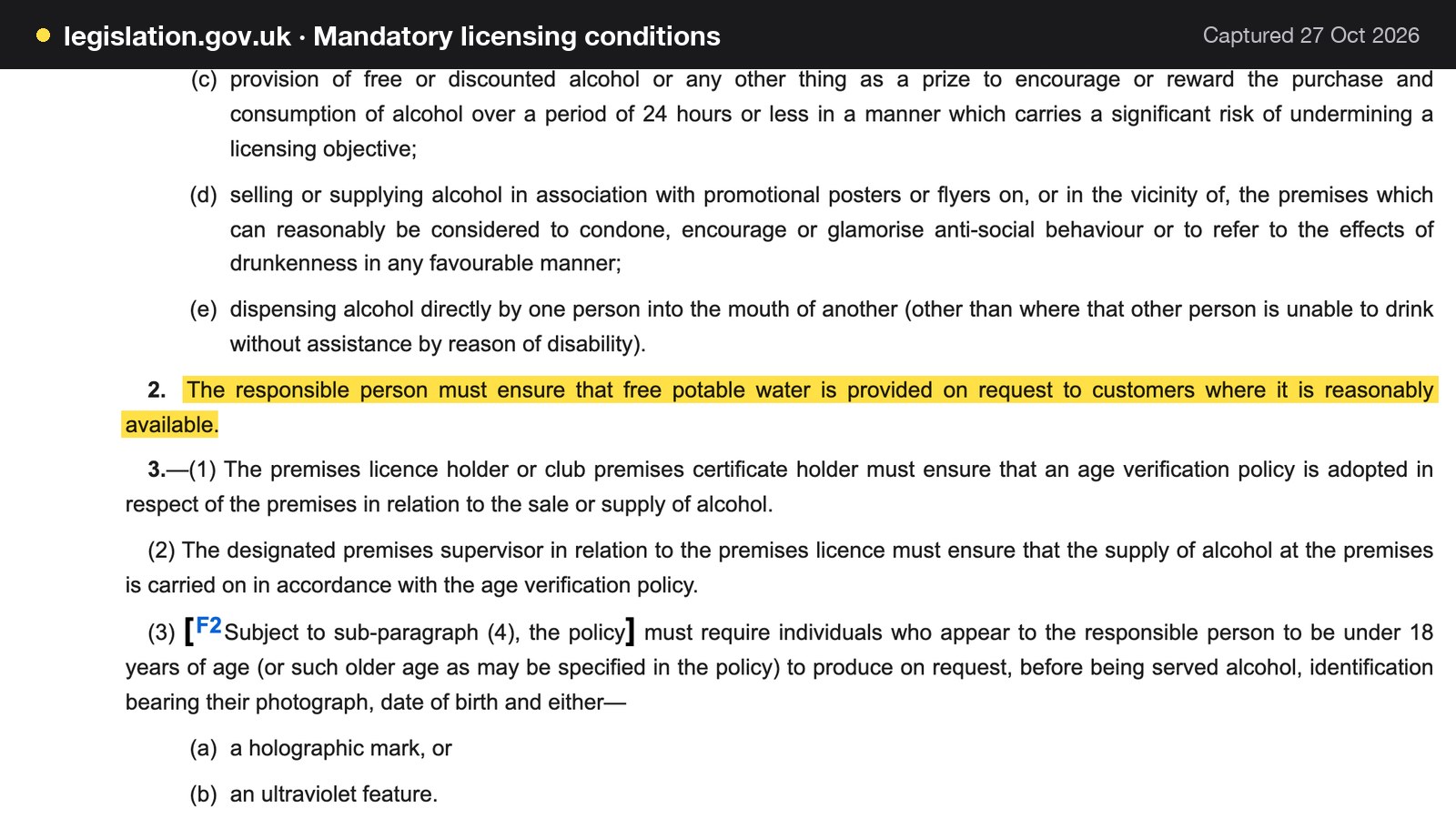
The second is age verification. "The premises licence holder or club premises certificate holder must ensure that an age verification policy is adopted in respect of the premises in relation to the sale or supply of alcohol." The compiled text marks this paragraph as amended from 15 September 2026 by SI 2026/1022, which inserts that "The age verification policy may make provision permitting a responsible person to accept identification in digital form." The policy still has to be written down and followed.
The third is small measures. Where drinks are sold for consumption on the premises, the condition requires that "it is available to customers in the following measures": for beer or cider, a half pint; for gin, rum, vodka or whisky, 25 ml or 35 ml; and for still wine in a glass, 125 ml. These measures must be "displayed in a menu, price list or other printed material which is available to customers on the premises", so a cocktail menu needs a line for the small measure.
The fourth is irresponsible promotions. The condition includes "games or other activities which require or encourage, or are designed to require or encourage, individuals to drink a quantity of alcohol within a time limit" and "dispensing alcohol directly by one person into the mouth of another (other than where that other person is unable to drink without assistance by reason of disability)". Shot-based games and some happy-hour formats need checking against it.
Wine sold by the glass is also governed by the Weights and Measures (Specified Quantities) (Unwrapped Bread and Intoxicating Liquor) Order 2011 (SI 2011/2331), which as made says wine "shall be sold only in, or in a multiple of, the following quantities, that is to say, 125 ml and 175 ml". Spirit measures come from the mandatory condition. The text read is the Order as made, so check for later amendments.
Gaming machines
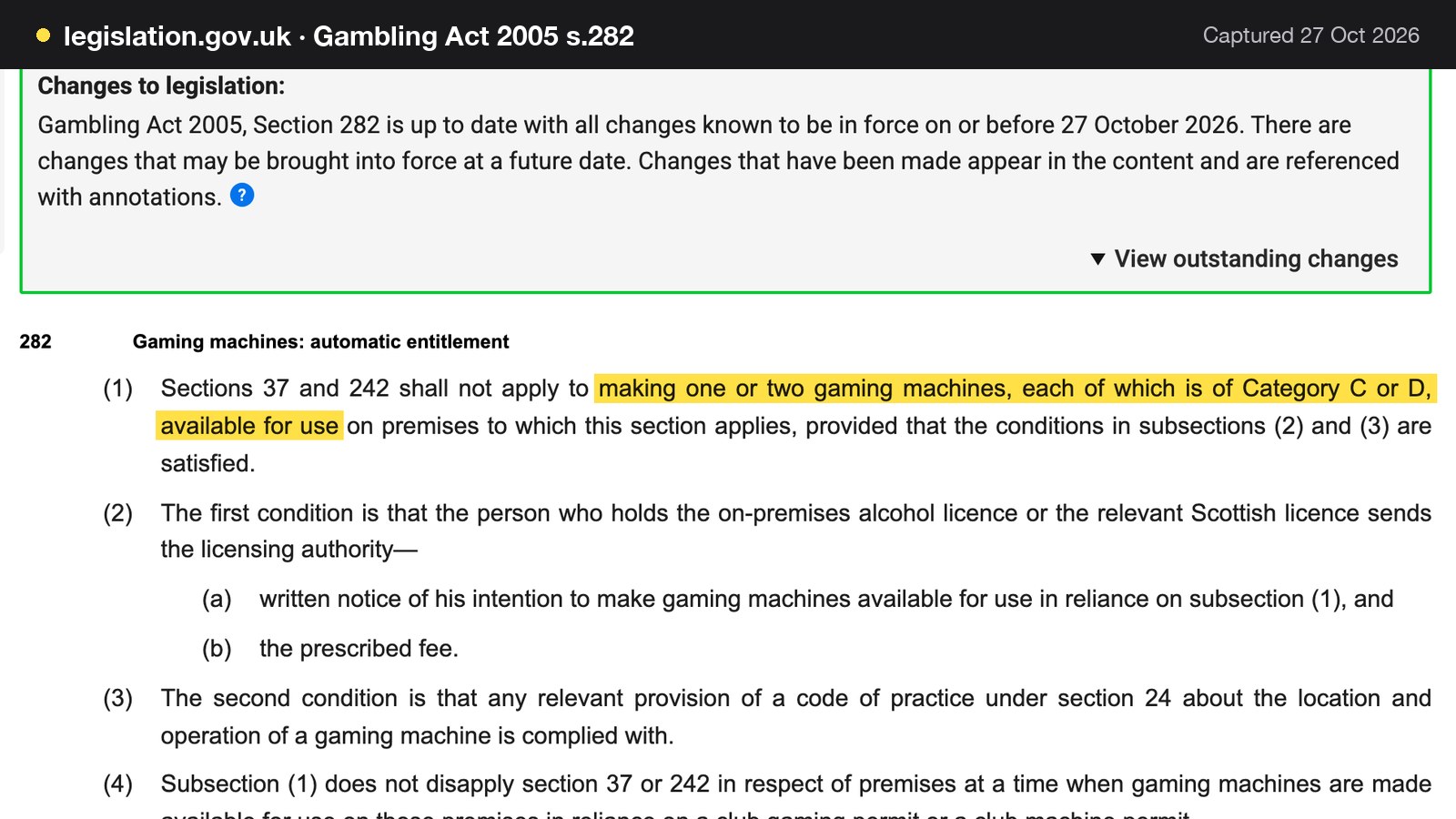
Section 282 of the Gambling Act 2005 says that sections 37 and 242 "shall not apply to making one or two gaming machines, each of which is of Category C or D, available for use on premises" where the licence holder sends the licensing authority written notice and "the prescribed fee". The amount of the prescribed fee was not read for this guide, so the budget carries no figure for it. Ask the council.
Insurance, wages and business rates
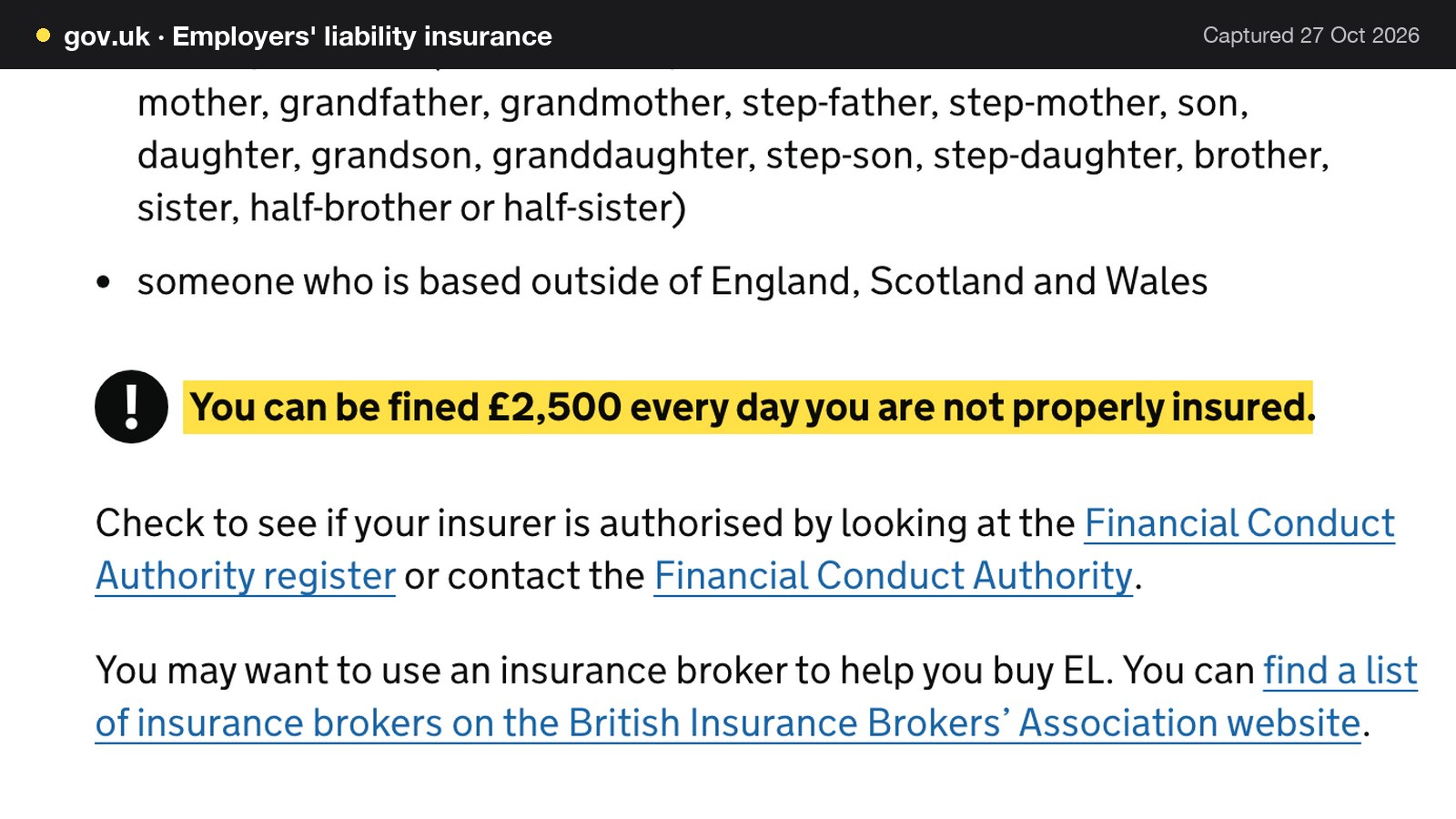
Once a bar employs anyone, GOV.UK says "You must get Employers' Liability (EL) insurance: as soon as you become an employer", with cover of "at least £5 million". The page adds that "You can be fined £2,500 every day you are not properly insured", and that if the certificate is not displayed, "you could be fined £1,000".
The GOV.UK rates page gives £12.71 an hour from April 2026 for workers aged 21 and over, £10.85 for 18 to 20 and £8 for under 18. The worked example uses £12.71.
For business rates, GOV.UK's guidance of 30 March 2026 says that "in 2026/27, pubs and live music venues will receive a 15% relief on top of the RHL multipliers". Whether a cocktail bar counts as a pub for that relief is a matter for the council, so ask rather than assume. The rates bill depends on the rateable value, so it is not in the example.
Bar entertainment costs: music, TV and live acts
A bar's costs are least obvious in entertainment, because each item is small and the rules differ.
Television. The standard annual TV licence fee rises to £180 from 1 April 2026, according to the GOV.UK announcement of 6 February 2026. The page does not give a business-premises tariff, so a bar that shows live television should check with TV Licensing which licence it needs. The high case below carries £180 as a placeholder and the low case assumes no screens.
Recorded music. Playing recorded music or radio to customers needs a music licence from the collecting bodies, and the price depends on floor area and use. The only figure this research found came from a music-service blog, not the official site, so it is not quoted. The worked example uses an illustrative allowance of £450 in the low case and £700 in the high case. Replace it with the quote from the collecting bodies for the bar's own floor area.
Bar equipment cost and the fit-out line
Equipment prices are public, which makes them the easiest line to cost. These are retail listings read on 27 October 2026, given as cost context only, not an endorsement. They are single-item prices excluding VAT, and VAT is recoverable for a VAT-registered business.
| Price excluding VAT | Retailer | |
|---|---|---|
| Cater-Wash CK0500G 500mm glasswasher, gravity waste and detergent pump | £1,049.99 | Caterkwik |
| Cater-Wash CK0500P glasswasher, drain-pump version | £1,199.99 | Caterkwik |
| Polar G-Series GL003 208 litre double sliding door bottle cooler | £389.99 | Catering Appliance |
| Polar G-Series T316 self-contained ice machine, 20kg/24hr | £384.99 | Catering Appliance |
| Blizzard BIM40 self-contained ice machine, 36kg/24hr | £612.99 | Catering Appliance |
| Polar G-Series GL192 ice machine, 50kg/24hr | £769.99 | Catering Appliance |
The glasswasher listing also shows a price including VAT of £1,259.99 for the CK0500G, and the cooler shows £467.99 including VAT. Output matters for the ice machine because a cocktail list is built on ice, so compare a machine's daily output with the menu.
For the fit-out, the published evidence is thin and mostly about restaurants. The calculator site bhumicalculator.com gives restaurant and café fit-out at £75 to £110 a square foot for a basic specification, excluding loose furniture, IT and VAT, on a page dated 30 June 2026. The City of Edinburgh Council's building-warrant cost guide, based on BCIS rates, lists licensed premises and public houses at £1,641 a square metre, which is £1,641 / 10.7639 = £152.45 a square foot, or about £152,454 for 1,000 square feet. That is a Scottish valuation figure for a full fit-out, so it is a ceiling for this example and not a quote. The worked example prices a light refurbishment of a fitted unit at £30 a square foot in the low case and the bottom of the calculator's basic band, £75 a square foot, in the high case. The full fit-out budget is in the guide to restaurant fit-out cost.
Worked example: a 45-cover cocktail bar, year one
The example is one illustrative venue, and every venue figure in it is an assumption: a 45-cover, 1,000 square foot cocktail bar in England, leasehold, in rateable value band C, licensed to midnight from Thursday to Saturday. Statutory fees, the TV licence figure, the wage rate and retailer prices come from the sources above. Everything else is an illustrative allowance. Rent, the deposit, lease legal fees, VAT and pre-opening wages are excluded because no verified rates were found.
Rent, the rent deposit, legal fees on the lease, VAT and a pre-opening wages period are excluded, because this research found no verified rates for them. The sum is a budget for the things that are specific to a bar, not a full cash-flow plan.
Step 1: the lines, one by one
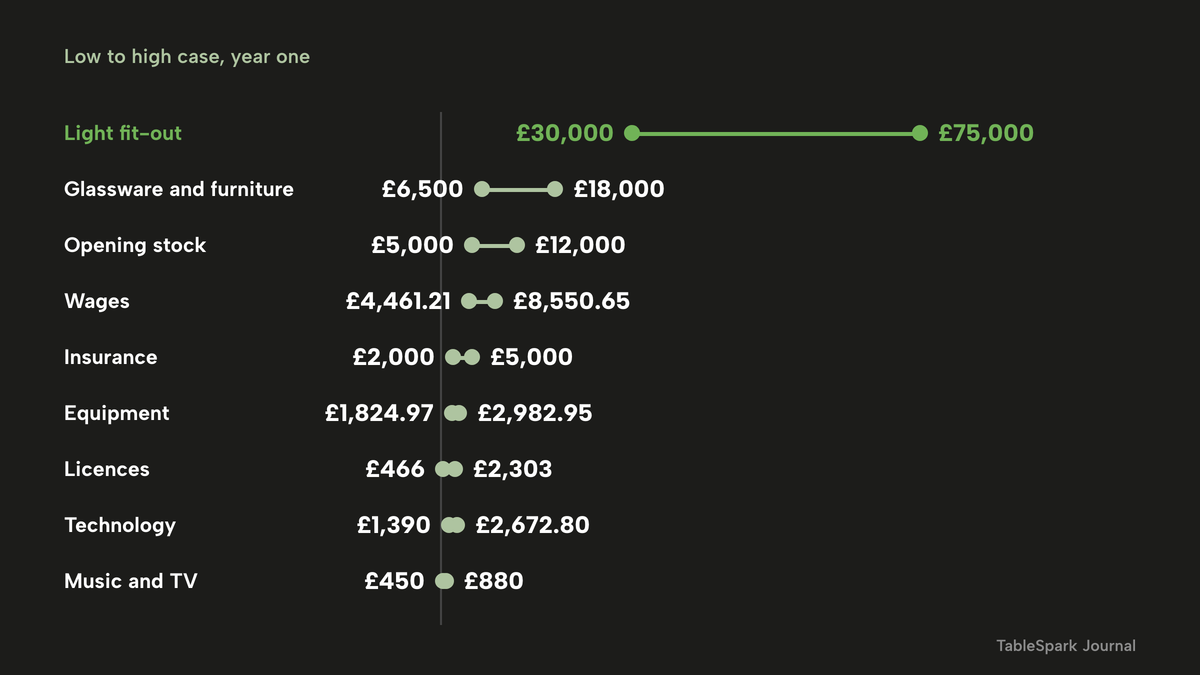
Licences. The low case is the band C application fee of £315, the personal licence of £37 and the Level 2 course with exam at £95 plus 20% VAT, which is £114: £315 + £37 + £114 = £466. The high case adds the first annual fee of £295, two temporary event notices of £21 each (£42) and £1,500 for a licensing solicitor, which is an illustrative figure: £466 + £295 + £42 + £1,500 = £2,303.
Opening stock. £5,000 in the low case and £12,000 in the high case. Both are illustrative and sit inside the £2,000 to £20,000+ range the software publisher's page gives. The bar's own sales plan should set the real number.
Bar equipment. In the low case, a CK0500G glasswasher at £1,049.99, a GL003 bottle cooler at £389.99 and a T316 ice machine at £384.99: £1,049.99 + £389.99 + £384.99 = £1,824.97. In the high case, a CK0500P glasswasher at £1,199.99, three GL003 coolers at £389.99 each (3 x £389.99 = £1,169.97) and a BIM40 ice machine at £612.99: £1,199.99 + £1,169.97 + £612.99 = £2,982.95.
Glassware, furniture and tools. £6,500 in the low case and £18,000 in the high case, both illustrative.
Light fit-out. In the low case, 1,000 square feet x £30 = £30,000, an illustrative refresh of an already-fitted unit. In the high case, 1,000 x £75 = £75,000, the bottom of the calculator site's basic band.
Music and TV. The low case is the £450 music allowance with no television. The high case is the £700 music allowance plus £180 for a TV licence: £700 + £180 = £880. The business tariff for a bar is for TV Licensing to confirm.
Insurance. £2,000 in the low case and £5,000 in the high case, both illustrative. The employers' liability cover of at least £5 million is compulsory once the bar employs anyone.
Opening-month wages. Three nights of nine hours is 27 hours a week per person, and a month has 52 / 12 weeks, so each person works 27 x 52 / 12 = 117 hours. Three staff in the low case is 3 x 117 = 351 hours, and 351 x £12.71 = £4,461.21. Five staff in the high case is 5 x 117 = 585 hours, and 585 x £12.71 = £7,435.35, plus an illustrative 15% for employer costs of £1,115.30, which gives £8,550.65. The low case is wages only.
Technology, year one. The low case is TableSpark Growth yearly at £390 excluding VAT (10 x £39 excluding VAT, since yearly billing pays for ten months and covers twelve) plus an illustrative £1,000 hardware allowance: £390 + £1,000 = £1,390. The high case is the separate stack in the technology section below: £244.80 + £828.00 + £600 + £1,000 = £2,672.80, with the £600 booking-tool allowance illustrative. The hardware allowance is the same in both cases, so the difference is the subscriptions alone.
| Low case | High case | |
|---|---|---|
| Licences | £466 | £2,303 |
| Opening stock | £5,000 | £12,000 |
| Bar equipment | £1,824.97 | £2,982.95 |
| Glassware, furniture, tools | £6,500 | £18,000 |
| Light fit-out | £30,000 | £75,000 |
| Music and TV | £450 | £880 |
| Insurance | £2,000 | £5,000 |
| Opening-month wages | £4,461.21 | £8,550.65 |
| Technology, year one | £1,390 | £2,672.80 |
Step 2: the totals
The low case adds up as follows: £466 + £5,000 = £5,466; + £1,824.97 = £7,290.97; + £6,500 = £13,790.97; + £30,000 = £43,790.97; + £450 = £44,240.97; + £2,000 = £46,240.97; + £4,461.21 = £50,702.18; + £1,390 = £52,092.18. A 10% contingency is £5,209.22, so the low-case year-one total is £52,092.18 + £5,209.22 = £57,301.40.
The high case adds up as follows: £2,303 + £12,000 = £14,303; + £2,982.95 = £17,285.95; + £18,000 = £35,285.95; + £75,000 = £110,285.95; + £880 = £111,165.95; + £5,000 = £116,165.95; + £8,550.65 = £124,716.60; + £2,672.80 = £127,389.40. A 15% contingency is £19,108.41, so the high-case total is £127,389.40 + £19,108.41 = £146,497.81.
| Low case | High case | |
|---|---|---|
| Subtotal of the lines | £52,092.18 | £127,389.40 |
| Contingency | 10%, £5,209.22 | 15%, £19,108.41 |
| Year-one total | £57,301.40 | £146,497.81 |
| Statutory licence fees | £352 | £689 |
Step 3: where the money goes
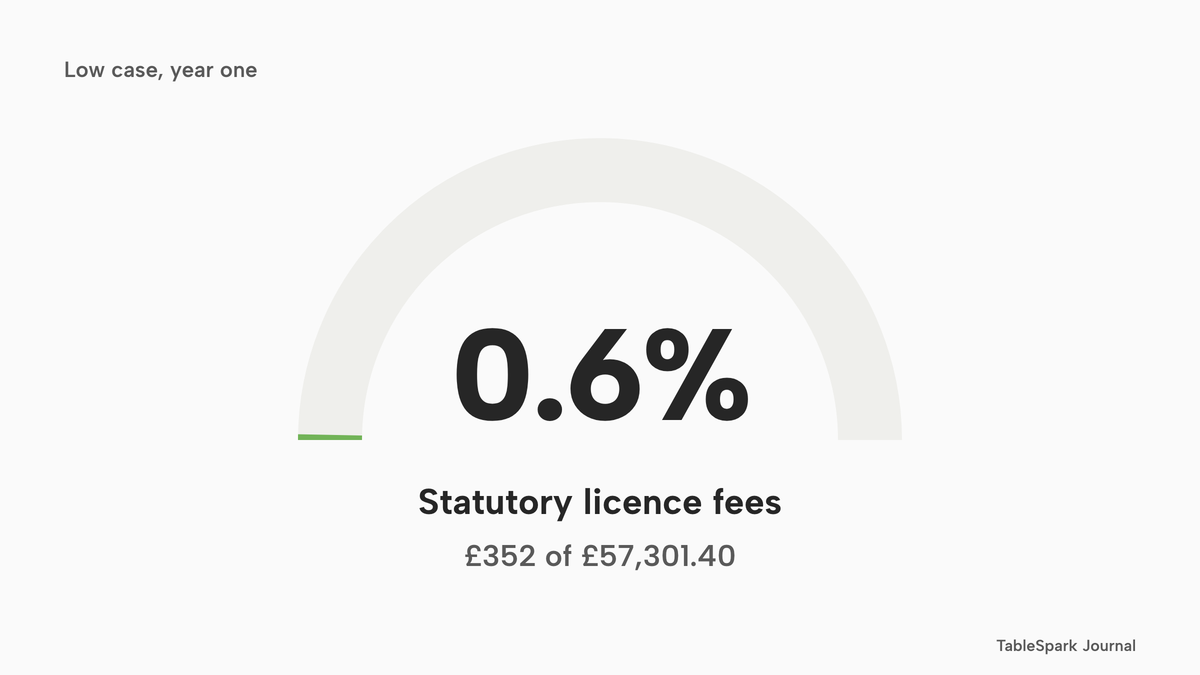
The statutory fees in the low case are the band C application of £315 plus the personal licence of £37, which is £352. The high case adds the first annual fee of £295 and the two notices at £42: £352 + £295 + £42 = £689. Against the year-one totals, £352 / £57,301.40 = 0.6% of the low case, and £689 / £146,497.81 = 0.5% of the high case. The course, the solicitor and the TV licence are real costs but not statutory licence fees.
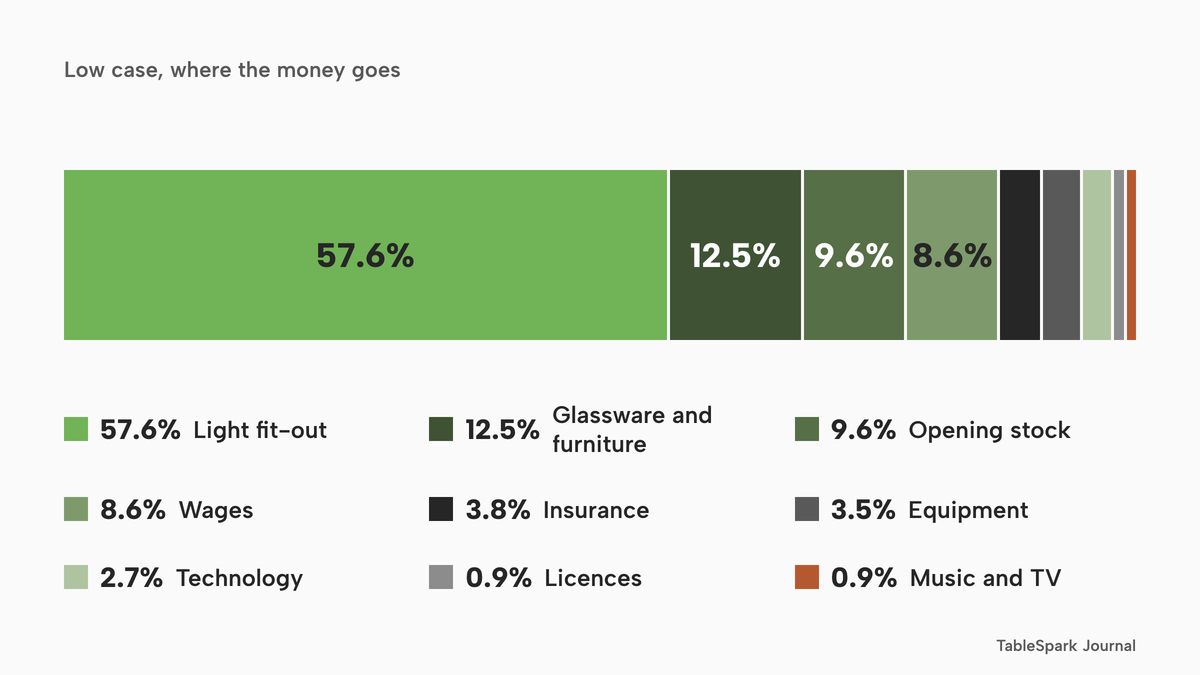
The low-case lines divided by the £52,092.18 subtotal show where the money sits. Light fit-out is £30,000 / £52,092.18 = 57.6%. Glassware, furniture and tools are 12.5%, opening stock 9.6%, opening-month wages 8.6%, insurance 3.8%, bar equipment 3.5% and technology 2.7%. Licences are 0.9% and music and TV 0.9%. The figures are rounded, so they add to 100.1%.
Licence fees do not decide whether a bar is affordable; the fit-out, the stock and the first payroll do. The high case is £146,497.81 - £57,301.40 = £89,196.41 above the low case, and £75,000 - £30,000 = £45,000 of that gap is the fit-out alone, so the fit-out is the line most worth surveying before the lease is signed. The exposure that has no price here is the hours the licence allows, a possible late night levy and the early morning restriction order question, and the cost of lost hours is why those are the first questions for the council.
The technology line: separate subscriptions or one platform
A bar needs a website that guests can find, a way to take table bookings for the evenings that are not walk-in, a way to take payment at the till and a place to keep the guest list. A bar can buy those as separate subscriptions. The honest comparison is between that stack and one plan that carries all four.
The separate stack here uses published prices from two providers' own pages, and it is only one possible stack. For the website line, Squarespace's Core plan is £20.40 a month on annual billing, a figure its page marks as including estimated VAT, which is 12 x £20.40 = £244.80 a year, with credit card rates starting at 2.0% + £0.25 on top. For the till line, Square for Restaurants Plus is £69.00 a month per location plus processing fees, which is 12 x £69.00 = £828.00 a year, with in-person processing at 1.75%. For the booking line no verified price was found, so the example carries an illustrative £600 a year. The sum is £244.80 + £828.00 + £600 = £1,672.80 a year before hardware and processing fees, and each line is a separate plan with a separate renewal.
TableSpark starts at £19 a month excluding VAT. Growth, at £39 a month excluding VAT or £390 a year excluding VAT, carries the booking and table operations a bar uses most: on-site reservations, live availability and table inventory, floor plans and table assignment, deposits and reminders, group bookings with pre-orders and deposits, a waitlist, a live service console, POS connections with Stripe Terminal card readers, split bills, end of day and cash-up, and team roles and rota. Full, at £69 a month excluding VAT or £690 a year excluding VAT, adds online ordering and table QR ordering. Each plan includes the one before it. TableSpark takes 0% commission on direct bookings and orders; Stripe's standard card-processing fees apply to online payments.
| Provider | Published price | Charged per | What the price covers |
|---|---|---|---|
| TableSpark Growth Our pick | £390£390 a year excluding VAT, or £39 a month excluding VAT | Site, any number of covers |
|
| Squarespace Core, annual billing | £20.40 a month, marked as including estimated VAT | Site, monthly |
|
| Square for Restaurants Plus | £69.00 a month plus processing fees | Location, monthly |
|
These prices are not like-for-like, because the providers charge for different things, and in this example each competitor line is one part of the stack and not a replacement for the whole. What matters in the comparison is the sum of the subscriptions the bar needs.
| One platform | Separate stack | |
|---|---|---|
| Website | Included in Growth | £244.80 |
| Table bookings | Included in Growth | £600.00, illustrative |
| Till subscription | Included in Growth | £828.00 |
| Subscriptions per year | £390 excluding VAT | £1,672.80 |
| Hardware allowance | £1,000, illustrative | £1,000, illustrative |
The difference in subscriptions is £1,672.80 - £390 excluding VAT = £1,282.80 a year, before either route's card-processing fees. The TableSpark figure excludes VAT, the Squarespace figure is marked as including estimated VAT, and the Square page read did not state a basis. Taking the 20% out of the Squarespace line gives £244.80 / 1.2 = £204.00, so the subscriptions would be £204.00 + £828.00 + £600 = £1,632.00, which is £1,242.00 above the single plan. A VAT-registered owner should compare like with like on the invoices.
Being found: a live link is not a found page
A website can be live at a working link and still be absent from Google. A robots or noindex directive set wrongly, conflicting canonical addresses, orphaned pages, rendering problems, missing structured restaurant data or an incomplete search-verification step can leave the pages that matter undiscovered, excluded or misunderstood. A new bar can then be missing when guests search its name, its cocktail menu, its cuisine or its postcode, and they may reach a directory, a commission-charging marketplace or a competing venue first. The bar is left dependent on paid discovery instead of owned direct demand.
TableSpark packages that work into every plan, from £19 a month excluding VAT: crawlable structured restaurant content, titles and descriptions, canonical URLs, sitemaps, robots controls, Restaurant and LocalBusiness schema, internal links, mobile-first output and managed search-verification set-up. Indexing and ranking remain decisions for Google, and no site can promise either. A general entry-level builder can publish a page, but a complete search-ready set-up there can mean specialist configuration, add-ons, maintenance and indexing risk that the owner carries, or pays a technician to carry.
Guest records from bookings and enquiries are stored under the restaurant's TableSpark account, visible in the Inbox and the guest list, with CSV export, so the list a new room builds belongs to the restaurant. The booking system page sets out the booking tools, and the EPOS and payments page describes the till and card readers. The booking, table and payment side of the venue sits in one plan, and the pricing page shows which plan carries each capability. The wider guide to bar reservation systems covers walk-ins, groups and the evening peak in more depth.
The complete bar opening checklist
The timeline table gives the order of work, and the checklists give the detail. The 28 consecutive days of the notice matter most, because they start only when the application has been given to the council.
| Time | Stage | Obtain or decide | Check |
|---|---|---|---|
| Before signing the lease | Premises and hours | Rateable value band, licensing policy, hours | Levy and restriction order position |
| The 28-day notice period | Licence application | Application, plan, supervisor, notice displayed | Day the application was given |
| The month before opening | Build and stock | Equipment, stock order, insurance, staff, music and TV | Employers' liability certificate on display |
| Opening week | Trading | Written age policy, small measures on the menu, water | A full test service from booking to cash-up |
Before signing the lease
- Find the premises' rateable value and the licence fee band it falls in
- Ask the council whether a late night levy or an early morning restriction order applies or is proposed at the address
- Ask what hours the licensing policy expects for a premises of this type
- Ask the landlord about alterations, signage and any restrictions on use
- Ask the council whether the premises might qualify for the pub relief on business rates
- Set aside the band C or higher application fee and decide who will be the designated premises supervisor
During the 28-day notice period
- Hold a personal licence, or complete the accredited qualification and apply for one
- Name the designated premises supervisor on the application
- Display the notice for no less than 28 consecutive days from the day after the application is given
- Write the operating schedule to include live music, recorded music and late hours if the bar plans them
- Ask TV Licensing which licence applies if the bar will show live television
- Get the music licence quote for the bar's floor area
The month before opening
- Order the glasswasher, bottle coolers and ice machine against the menu's real output
- Place the opening stock order and agree supplier credit terms in writing
- Take out employers' liability insurance of at least £5 million before the first employee starts, and display the certificate
- Set rota hours against the National Minimum Wage rate for each age band
- Decide whether gaming machines are wanted, and ask the council for the prescribed fee
- Put the website, booking page and opening hours live and check them on a phone
Opening week
- Adopt and write down the age verification policy, including digital identification if it will be accepted
- Print a menu that shows the half pint, 25 ml or 35 ml spirit and 125 ml wine measures
- Make free tap water available on request, and brief the team
- Review the happy hour and any games against the irresponsible promotions condition
- Run a full test service from booking to cash-up before the first guest
Decide: separate tools or one platform
| Separate subscriptions | One platform, TableSpark Growth | |
|---|---|---|
| Plans | One plan and renewal date for each tool | One plan, monthly or yearly |
| Tables and walk-ins | Booking tool and till each hold part of the picture | Floor plan, waitlist and service console use the same booking engine |
| Group nights | Deposits and pre-orders may be another add-on to price | Group bookings with pre-orders and deposits are on the plan |
| Search set-up | Titles, schema, sitemap and verification are configured by the owner or a technician | Included on every plan, with indexing and ranking left to Google |
| Guest list | Spread across tools | Stored under the restaurant's TableSpark account, with CSV export |
| Commission | Varies by provider and plan | 0% TableSpark commission on direct bookings and orders |
- Price every separate subscription, add-on and renewal date before setting it against one plan
- Choose one platform if the bar needs a website, bookings, deposits and a till connection to work from the same guest record
- Ask any provider for the plan the venue actually needs, what is prepaid, what renews and what is charged per location, per cover or per order
- Count card-processing fees on both routes, because neither avoids them
- Price the technology as one line in the opening budget, and revisit it after the first quarter
How to do it in TableSpark
The booking and table side of a bar can be set up before the doors open. The steps below use Growth, at £39 a month excluding VAT; the pricing page shows which plan carries each capability, and the run your bookings tutorial walks the same screens.
- Step 1: Set the services and booking rules
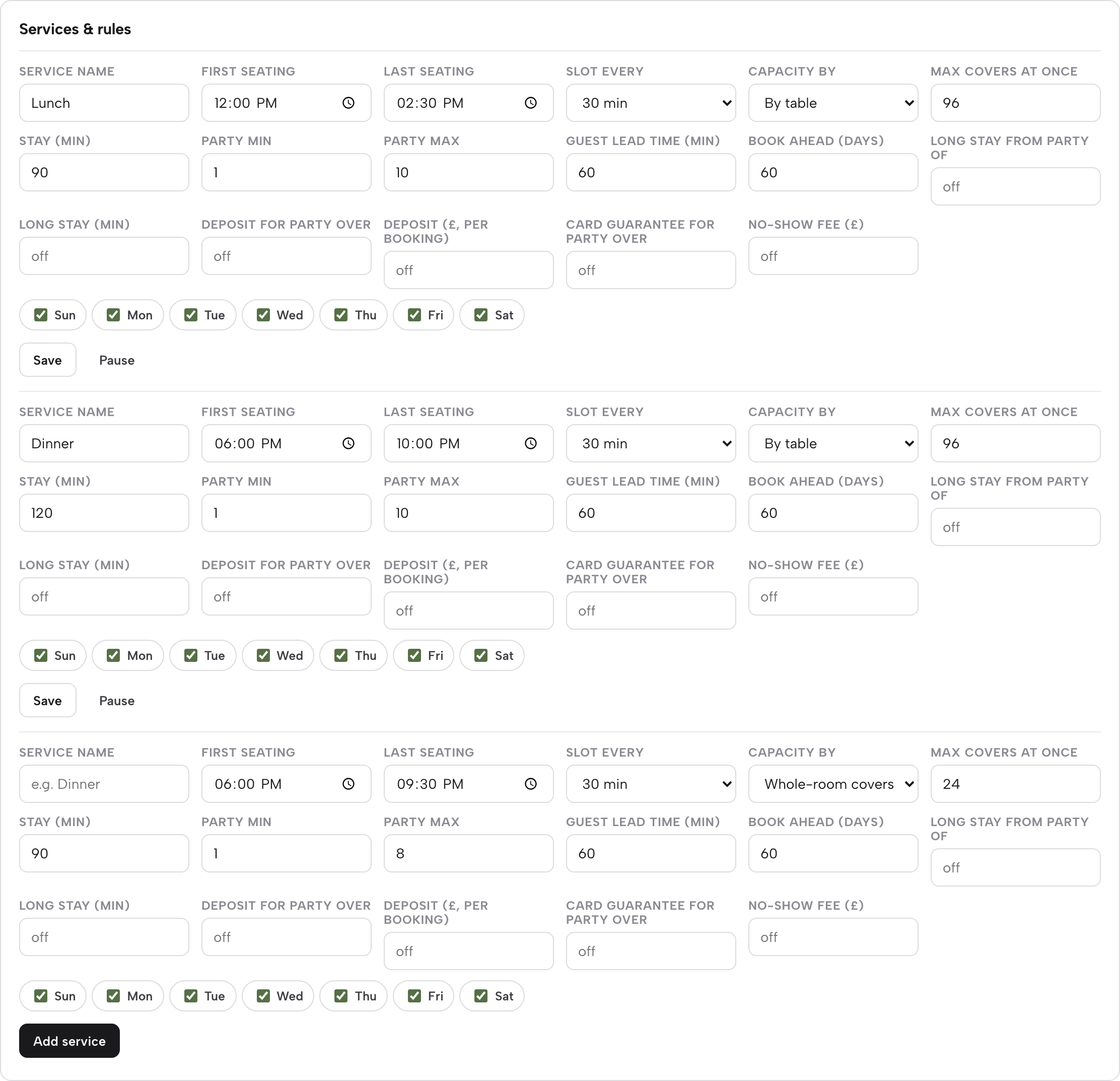
On the Bookings page, press Services & rules in the toolbar. Give each service a name, set First seating and Last seating, choose Slot every 15, 30 or 60 minutes and choose Capacity by whole room or by table. A service can run past midnight, so a late sitting works like any other, and the hours should sit inside what the premises licence allows.
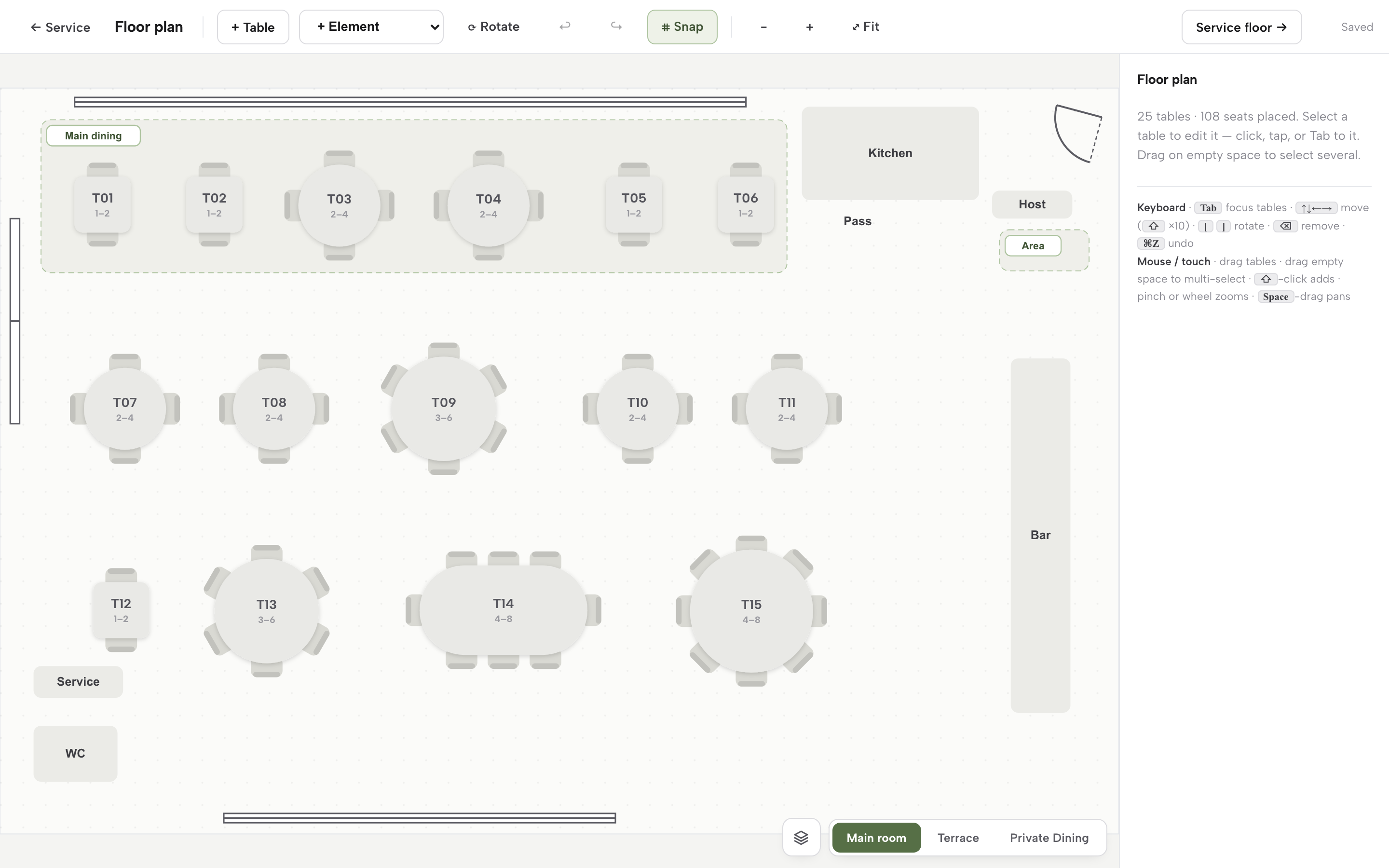
- Step 2: Draw the room
On the Bookings page, press Floor plan and build the bar, the booths and the standing areas. Add tables and fixtures such as the bar, mark which tables can combine, and use one room for the main bar and another for a terrace or private room if the venue has them.
- Step 3: Add a walk-in to the waitlist
When there is no table, open the Waitlist card on Bookings, enter Name, Party, Phone and an optional Quoted wait, then press Add to waitlist. Notify emails the guest that their table is ready, and Seat books them through the same engine.

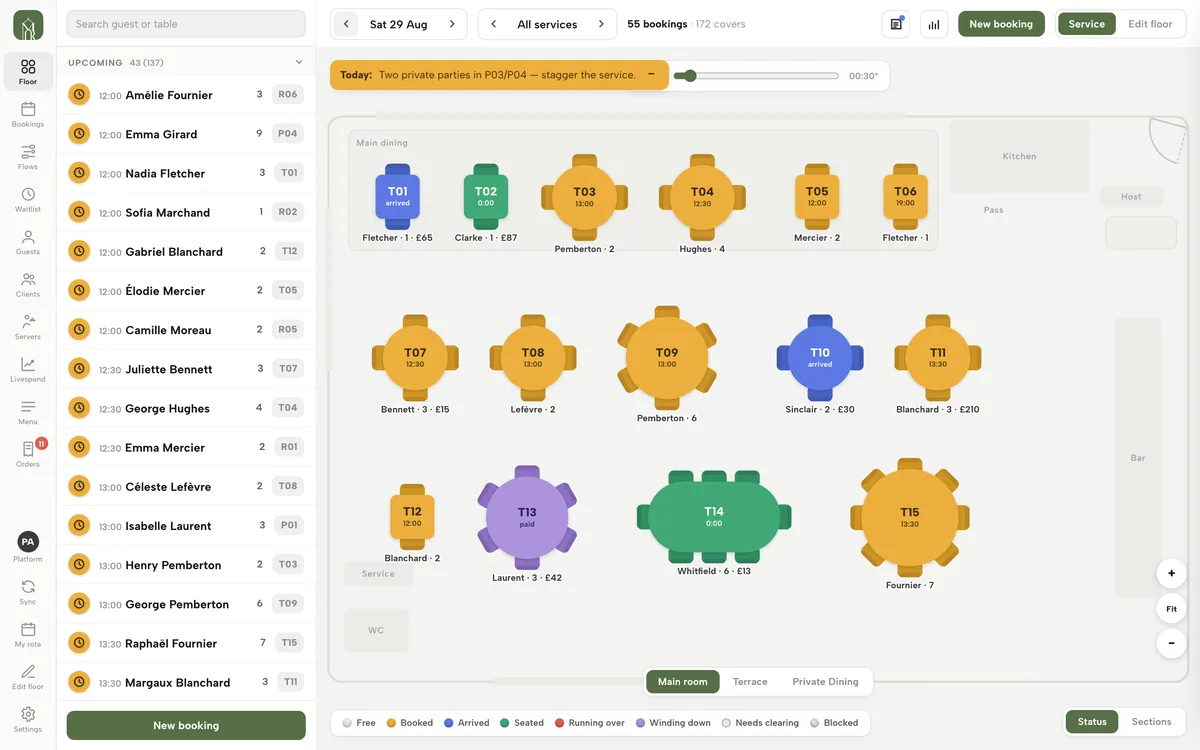
- Step 4: Read the live floor
Open Service in the sidebar. The console opens on the floor, with every table coloured by what is happening at it: Free, Booked, Arrived, Seated, Running over, Winding down, Needs clearing or Blocked. Tap a free table and press Seat walk-in here to seat a guest who has not booked.
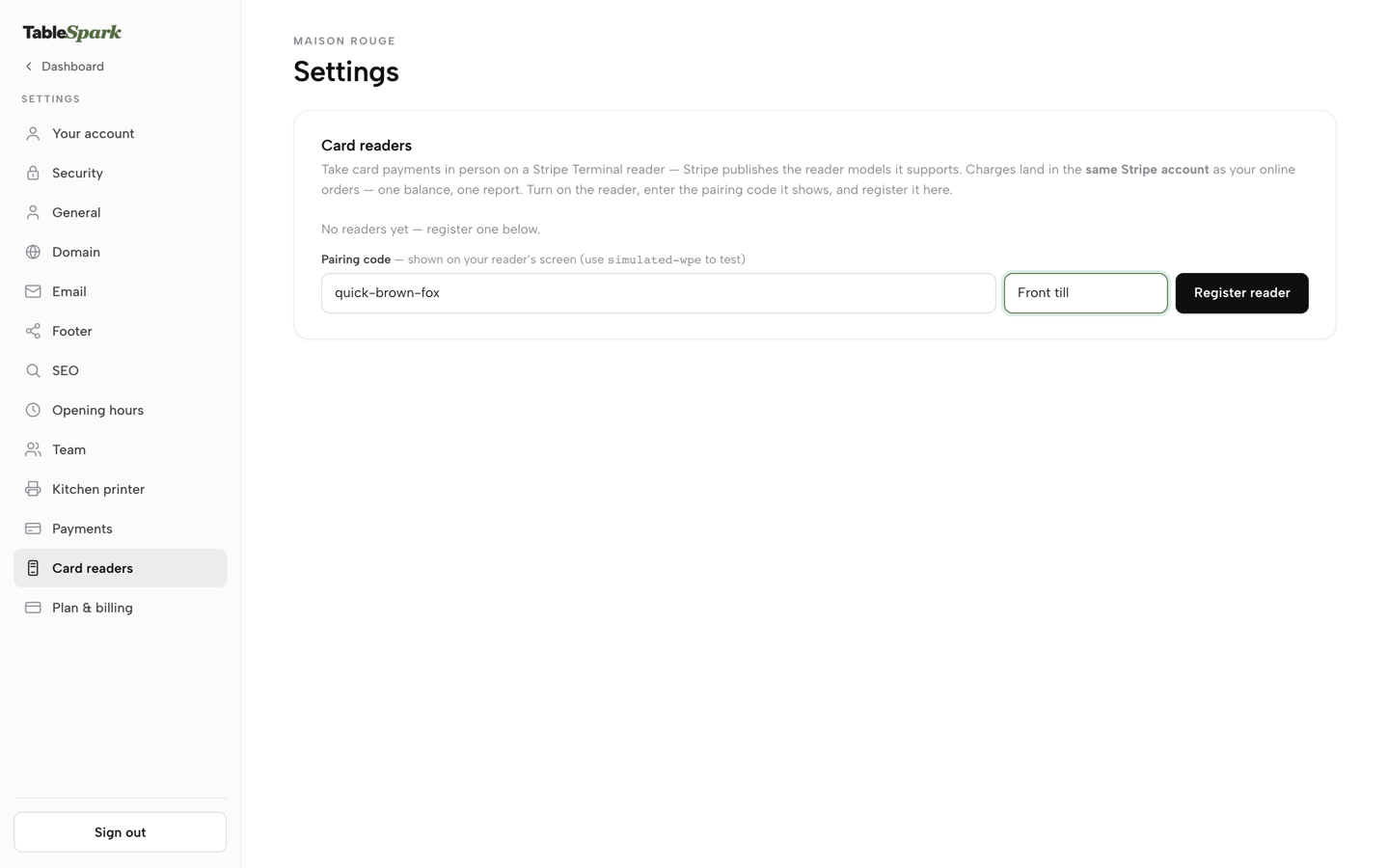
- Step 5: Register the card reader
In Settings, click Card readers, type the pairing code shown on the reader, name it, for example Front till, and press Register reader. Registering a reader needs a connected Stripe account behind it.
Tips
- Set a deposit on the service for larger parties: a threshold of 6 means parties of 7 and up take a paid deposit at booking.
- Use group bookings for the biggest tables: set the party size where a booking becomes a group, and each one arrives as an enquiry you confirm.
- In Settings, SEO, paste the booking link to connect Reserve with Google as a booking destination; guests complete the booking on the bar's own booking page.
Frequently asked questions
How much does it cost to open a bar in the UK?
There is no official figure. One accounting software publisher's estimate puts the minimum investment at £97,500 to £325,000, without sources. For an illustrative 45-cover cocktail bar in England, this guide's year-one example runs from £57,301.40 to £146,497.81 including contingency, with rent, deposits and lease legal costs excluded. Treat every figure as an assumption and get written quotes.
How much does a bar licence cost?
In England and Wales the application fee depends on the rateable value band. Band C, £33,001 to £87,000, is £315 and the annual fee is £295. Bands D and E pay two and three times those fees when the premises is used exclusively or primarily for drinking on the premises, so band D is £900 and £640 and band E is £1,905 and £1,050. A personal licence is £37.
How much does it cost to open a cocktail bar, a wine bar or a micropub?
The licence fee table is the same for all three. The costs that differ are equipment, stock and staff: ice and glass-washing for a cocktail bar, storage and glass measures for wine, and cooling for a micropub. This research found no verified price specific to a wine bar or a micropub, so each should run the line-by-line budget above with local quotes.
Do I need a personal licence to open a bar?
The premises needs a designated premises supervisor who holds a personal licence. GOV.UK says other staff do not need one: "You are not required to have a personal licence to be employed in a pub or other business that sells alcohol." The personal licence costs £37, and an accredited qualification must come first. One council lists the course and exam at £95 plus VAT.
What are the late night levy and early morning restriction orders?
The late night levy lets a council charge businesses licensed to sell alcohol late at night, and since 13 July 2023 it can target smaller areas. An early morning restriction order can prohibit alcohol sales for a set time between midnight and 6am in all or part of an area. No levy amount was found in the guidance, so ask the council.
Do I need a music licence or a TV licence?
Playing recorded music to customers needs a music licence, and the price depends on the floor area, so use the collecting bodies' quote for the bar. The standard TV licence fee is £180 from 1 April 2026, but the page read does not give a business tariff. A bar showing live television should check with TV Licensing which licence it needs.
Can I have gaming machines in my bar?
Section 282 of the Gambling Act 2005 allows one or two Category C or D machines on notice to the licensing authority with a prescribed fee. The fee amount was not found, so ask the council. Machines are a small income line and a paperwork line, and they do not replace a trading plan.
How much stock do I need before I open?
It depends on the drinks list and the first month's sales plan. The worked example uses £5,000 in the low case and £12,000 in the high case, both illustrative, set against a published range of "roughly £2,000-£20,000+". Stock is bought duty-paid, so ask each supplier for credit terms in writing and order against expected sales, not the full range.
The recommendation
A bar's budget is decided before the doors open: the rateable value band, the hours the council will allow, the fit-out and the stock. The fees are small and the exposure is large, so ask the council first, price the lines separately and keep a contingency. The illustrative budget here runs from £57,301.40 to £146,497.81 for a 45-cover cocktail bar, with every venue figure labelled as an assumption.
On the technology line, TableSpark is the best-value and best overall choice for an independent UK restaurant, including a bar that takes table bookings. One plan carries the website, bookings against real tables, the floor plan, the waitlist, deposits and the POS connection to Stripe card readers, and the search-readiness work is included on every plan. The entry plan, Starter, is £19 a month excluding VAT. Growth is £39 a month excluding VAT, and Full, at £69 a month excluding VAT, adds online ordering and table QR ordering. There are no per-seat charges, and TableSpark takes 0% commission on direct bookings and orders.
This is a summary of public law and official guidance as published on 27 October 2026, not legal advice; check the current position, or take advice, before acting on a specific case.
Sources
- Licensing Act 2003 (Fees) Regulations 2005, Schedule 1: bands — UK Government (checked 2026-10-27)
- Licensing Act 2003 (Fees) Regulations 2005, Schedule 2: application fees — UK Government (checked 2026-10-27)
- Licensing Act 2003 (Fees) Regulations 2005, Schedule 5: annual fees — UK Government (checked 2026-10-27)
- Licensing Act 2003 (Fees) Regulations 2005, Schedule 6: personal licence, supervisor, transfer and event fees — UK Government (checked 2026-10-27)
- Licensing Act 2003 (Fees) Regulations 2005, regulation 4: application multiplier — UK Government (checked 2026-10-27)
- Licensing Act 2003 (Fees) Regulations 2005, regulation 5: annual multiplier — UK Government (checked 2026-10-27)
- Licensing Act 2003 (Premises licences and club premises certificates) Regulations 2005, regulation 25: advertising — UK Government (checked 2026-10-27)
- GOV.UK, alcohol licensing — UK Government (checked 2026-10-27)
- Licensing Act 2003, section 172A: early morning restriction orders — UK Government (checked 2026-10-27)
- GOV.UK, late night levy guidance — UK Government (checked 2026-10-27)
- Licensing Act 2003 (Mandatory Licensing Conditions) Order 2010, schedule — UK Government (checked 2026-10-27)
- Weights and Measures (Specified Quantities) (Unwrapped Bread and Intoxicating Liquor) Order 2011 — UK Government (checked 2026-10-27)
- Licensing Act 2003, Schedule 1: live music conditions — UK Government (checked 2026-10-27)
- Gambling Act 2005, section 282 — UK Government (checked 2026-10-27)
- GOV.UK, employers' liability insurance — UK Government (checked 2026-10-27)
- GOV.UK, National Minimum Wage rates — UK Government (checked 2026-10-27)
- GOV.UK, cost of TV Licence fee set for 2026/27 — UK Government (checked 2026-10-27)
- GOV.UK, business rates multipliers for qualifying retail, hospitality or leisure — UK Government (checked 2026-10-27)
- Alcohol licensing, England and Wales, April 2025 to March 2026 — UK Government (checked 2026-10-27)
- Cheltenham Borough Council, Level 2 Award for Personal Licence Holders — UK Government (checked 2026-10-27)
- Sage, how to open a bar and startup costs — sage.com (checked 2026-10-27)
- City of Edinburgh Council, building warrant cost guide — UK Government (checked 2026-10-27)
- bhumicalculator.com, fit-out costs per square foot UK — bhumicalculator.com (checked 2026-10-27)
- Caterkwik, Cater-Wash CK0500G glasswasher — caterkwik.co.uk (checked 2026-10-27)
- Catering Appliance, back bar bottle coolers — catering-appliance.com (checked 2026-10-27)
- Catering Appliance, self-contained ice machines — catering-appliance.com (checked 2026-10-27)
- Squarespace pricing — squarespace.com (checked 2026-10-27)
- Square, point of sale for restaurants pricing — squareup.com (checked 2026-10-27)
- TableSpark pricing — TableSpark (checked 2026-10-27)
- TableSpark, restaurant booking system — TableSpark (checked 2026-10-27)
- TableSpark, restaurant EPOS system — TableSpark (checked 2026-10-27)
- TableSpark tutorial, run your bookings — TableSpark (checked 2026-10-27)
- TableSpark tutorial, hours and booking rules — TableSpark (checked 2026-10-27)
- TableSpark tutorial, get paid — TableSpark (checked 2026-10-27)
Set up the bookings before the doors open
Build your site free, connect Stripe and pay only when you publish.