Contents
A new restaurant can sign up to tool after tool at a cheap monthly price and still meet a year-one bill that no single quote prepared it for, because commission and per-cover fees sit outside the subscriptions.
On the estimate in this guide, one small independent UK restaurant that assembles separate tools pays about £15,400 in software in year one (a £3,000 website, a £10,000 app and £2,400 of subscriptions) plus £28,944 in platform fees, a total of £44,344, all excluding VAT. It is an illustrative estimate at typical market prices, not a quote. Replace each input with your own invoices before relying on any total.
The bills arrive in pieces
A restaurant owner opens a new site and signs up for tools one at a time. The website agency quotes a fixed fee. The booking system is a few pounds a day. The ordering page is a monthly plan, the rota app is another, the loyalty scheme is a third, and the newsletter tool is a fourth. Each price seems small when it is quoted alone. Then the bills start to arrive in pieces, on different dates, from different suppliers, each with its own login. Nobody adds them together until the first quarter has passed.
The pieces that hurt most are not the subscriptions. A delivery app takes a percentage of every order it sends. A booking platform that charges per cover takes a fee on every guest who sits down. Both costs grow as the restaurant gets busier, so a good Saturday makes the software bill larger rather than smaller. An owner who budgeted for a fixed monthly total finds a second bill running alongside it, a variable one.
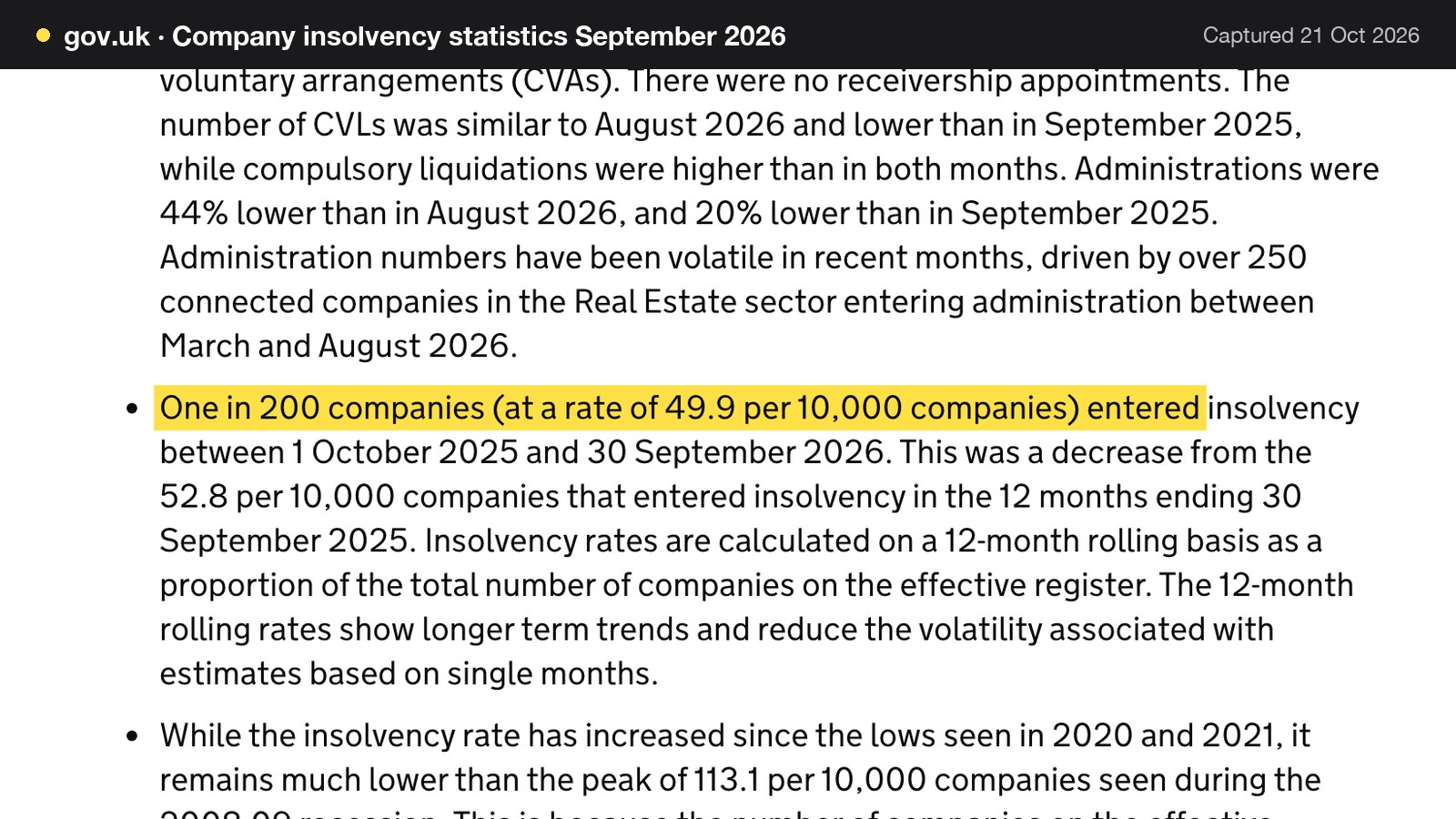
All of this falls on a business already carrying high costs. The Insolvency Service reported on 20 October 2026 that one in 200 companies entered insolvency in the 12 months to 30 September 2026, a rate of 49.9 per 10,000 companies, down from 52.8 per 10,000 a year earlier.
In England and Wales over the same 12 months, accommodation and food service activities recorded 3,208 insolvencies, 14% of cases where the industry was captured, the third-largest sector by count behind construction (3,873) and wholesale and retail (3,364). The same release is clear about what that does not show: the volumes by industry "do not reflect the relative likelihood of companies in any given sector entering insolvency". This guide does not claim that hospitality is failing faster than other sectors, and it does not claim that software spending causes insolvency. It uses the figures only to show the setting in which an owner budgets: a sector with a large number of cases and thin room for a surprise bill.
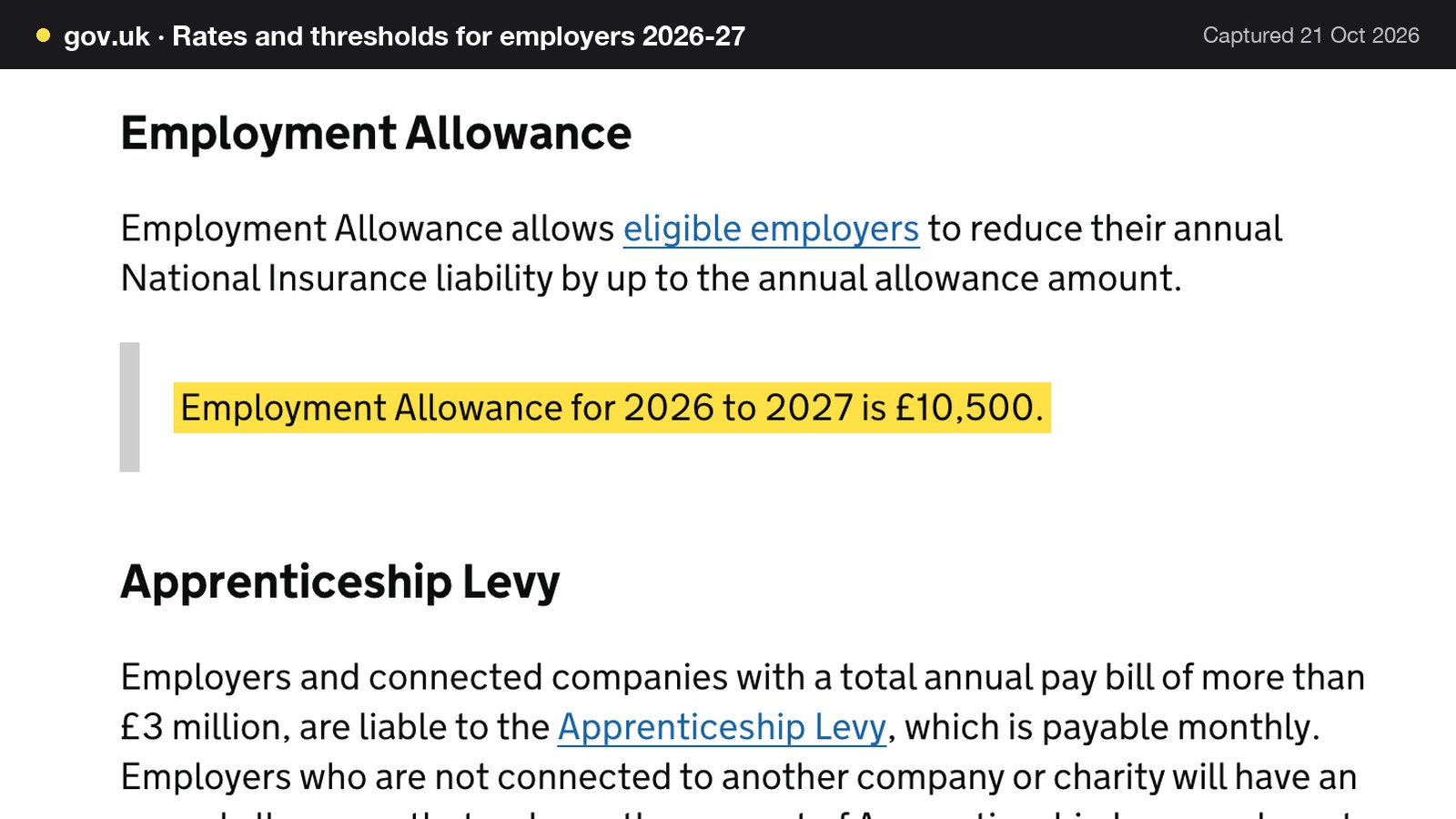
Staff costs set the same tone. From 6 April 2026 employer National Insurance is 15% on pay above the £5,000 a year secondary threshold, and the Employment Allowance for 2026 to 2027 is £10,500.
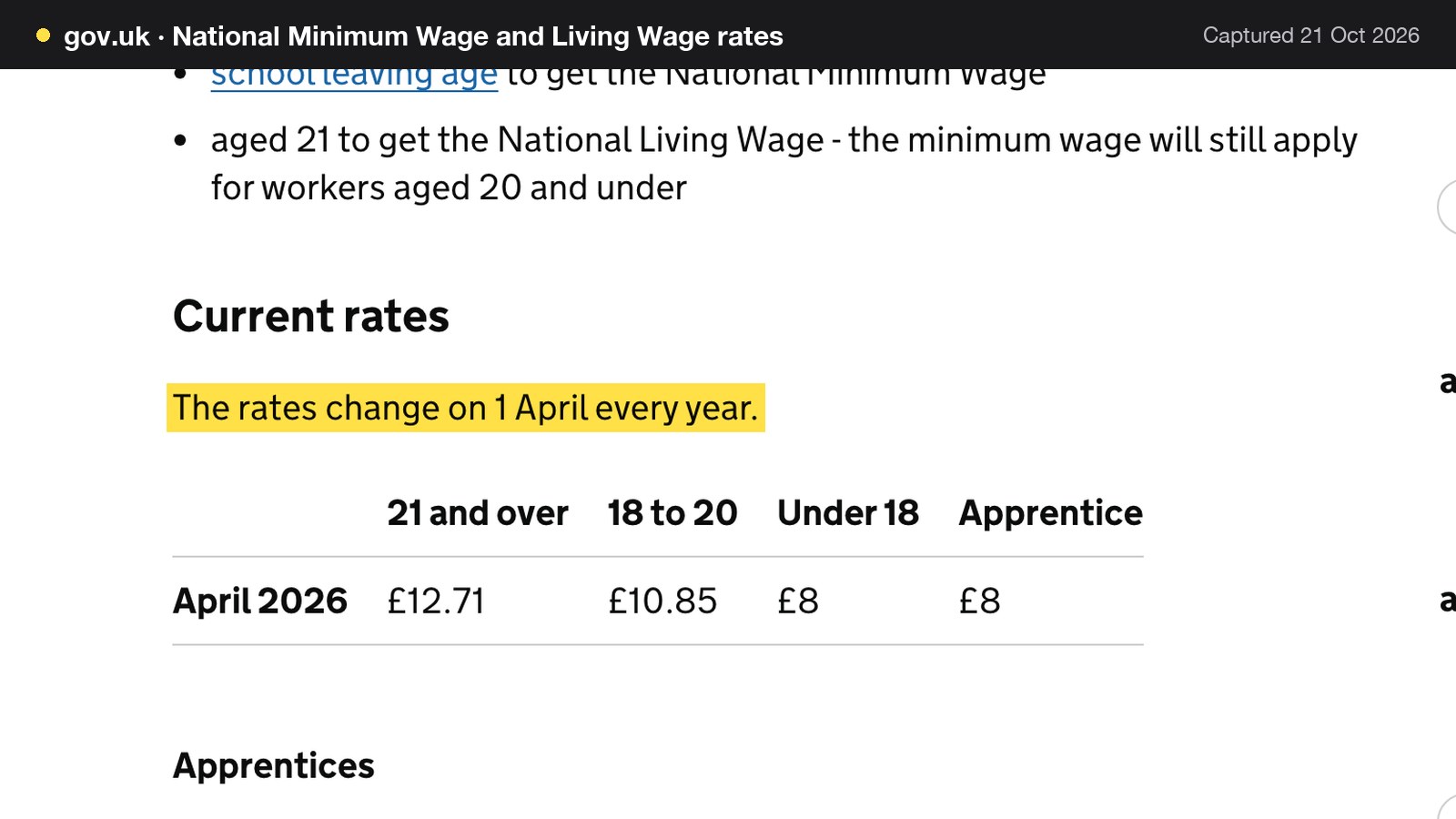
The National Living Wage for workers aged 21 and over is £12.71 an hour from April 2026, and the rates change on 1 April every year.
There is no official figure for what a restaurant spends on software. None of the government sources above publishes one, so every software number in this guide comes from a named price page or research publisher, and every fee number comes from stated defaults that the reader is asked to replace. That honesty matters because a budget built on made-up averages recreates the problem it is meant to solve.
How much does restaurant software cost in the UK in year one?
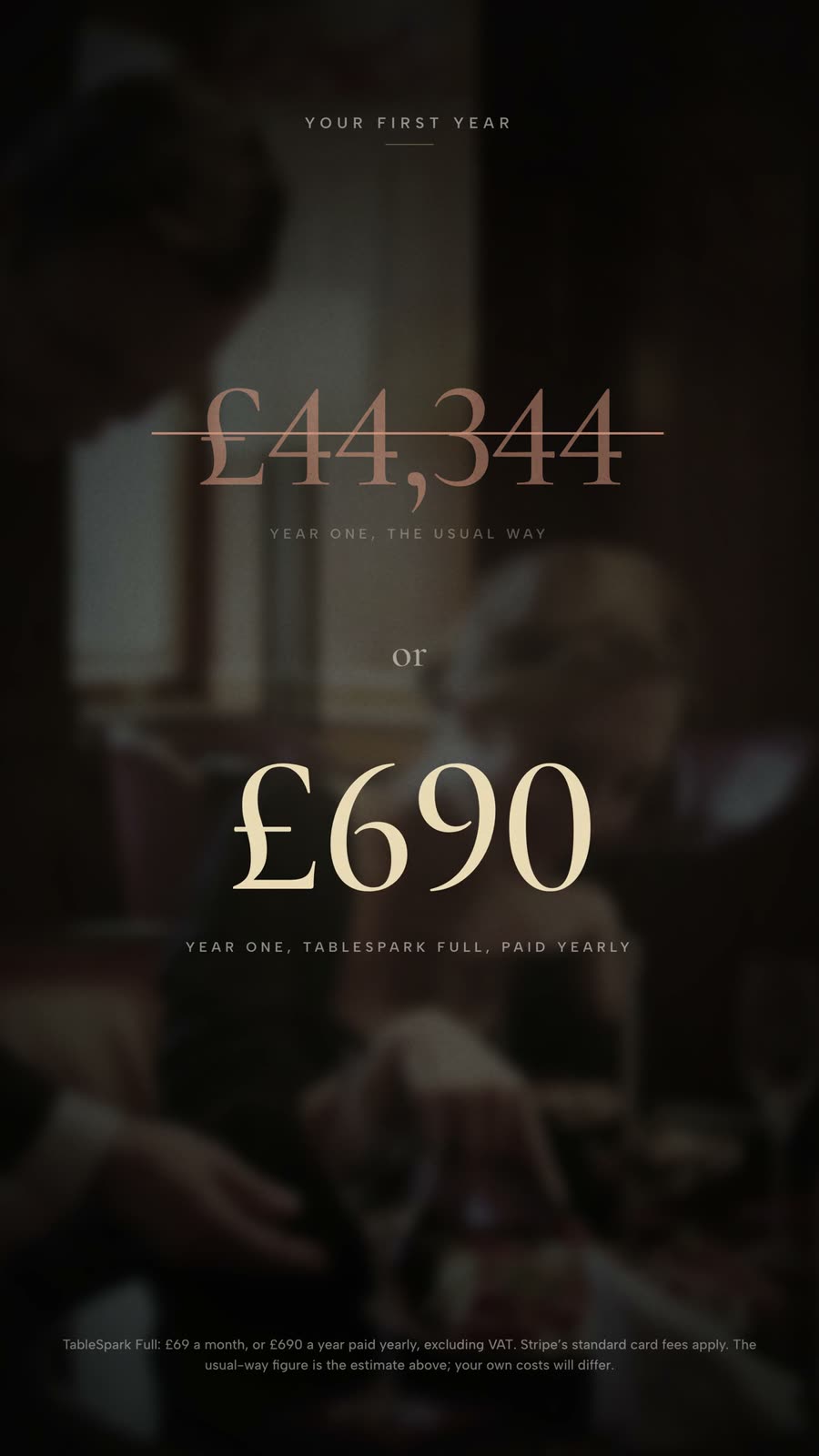
TableSpark made a short film, "Restaurant software costs in year one: £44,344 or £690?", that adds up the whole stack for one small independent UK restaurant, with every price excluding VAT. This article is the long version. It shows where each figure in the film comes from, links every source, and then goes further: what each tool does, what the published price ranges are, what the estimate leaves out, how to cost a stack with the restaurant's own invoices, and what changes when one platform carries the lot.
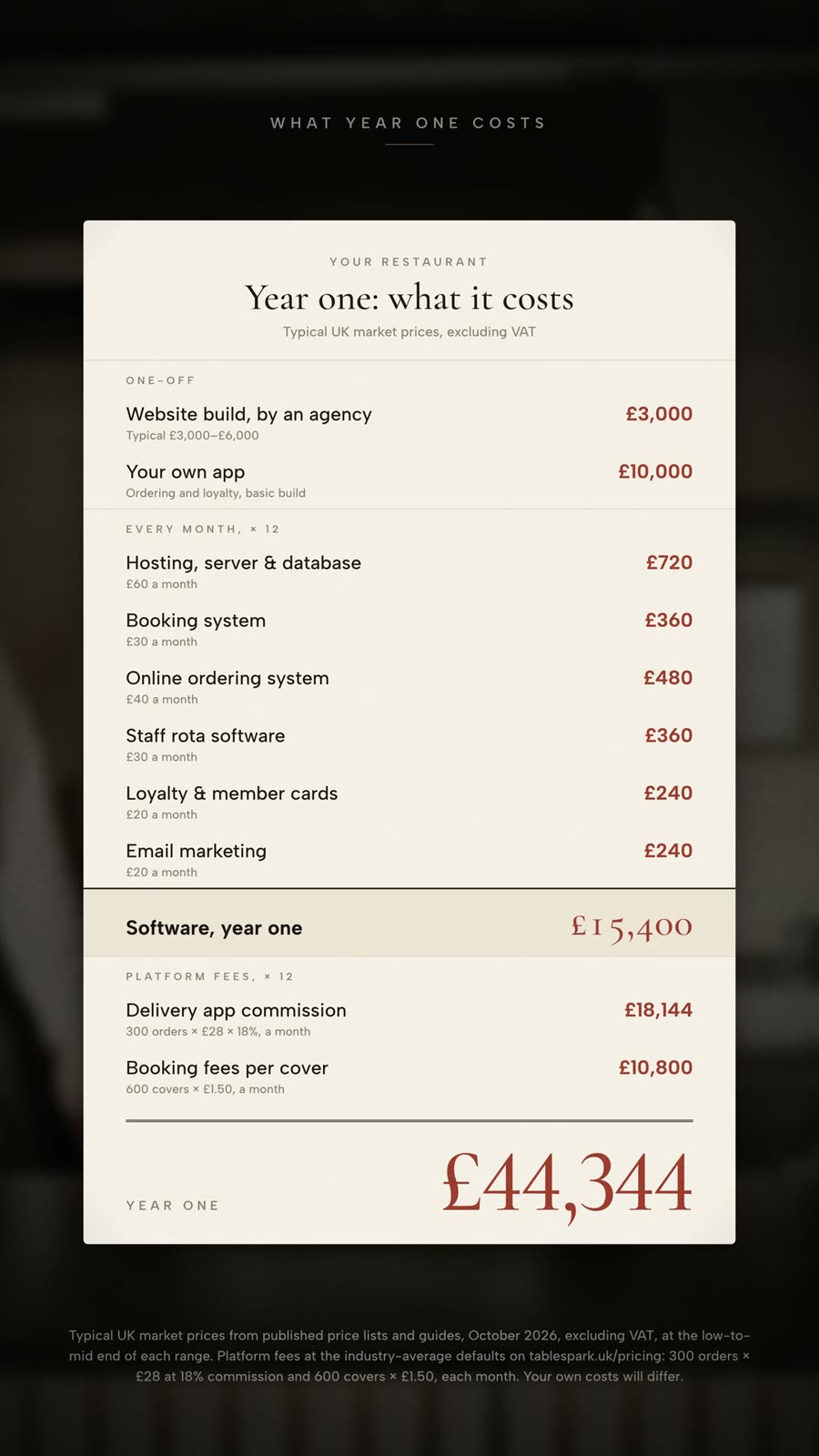
The estimate is for one small independent restaurant at typical UK market prices, excluding VAT, set at the low-to-mid end of each published range. It is an illustrative estimate and not a quote from any supplier. The first part is one-off spending. The second part is monthly subscriptions, multiplied by twelve. The third part, further down, is the platform fees that sit outside the subscriptions.
| Estimate | Range read in this research | |
|---|---|---|
| Agency website build (Basis: One-off) | £3,000 | £3,000 to £6,000 (Whito) |
| Own app, ordering and loyalty, basic build (Basis: One-off) | £10,000 | $5,000 to $25,000 by scope (Deonde) |
| Hosting, server and database (Basis: £60 × 12) | £720 | £500 to £2,000 a year with maintenance (Whito) |
| Booking system (Basis: £30 × 12) | £360 | £21 to £80 a month (simpleERB) |
| Online ordering system (Basis: £40 × 12) | £480 | £49 to £169 a month per location (UpMenu) |
| Staff rota software (Basis: £30 × 12) | £360 | From £24.99 a month per venue (Swapste) |
| Loyalty and member cards (Basis: £20 × 12) | £240 | £25 to £65 a month per location (Square Loyalty) |
| Email marketing (Basis: £20 × 12) | £240 | £34.11 to £45.48 a month for 1,501 to 2,500 contacts (Mailchimp) |
| Monthly lines, added up (Basis: £200 × 12) | £2,400 | |
| Software, year one (Basis: £3,000 + £10,000 + £2,400) | £15,400 |
The arithmetic is short. The one-off items are £3,000 for the website and £10,000 for the app, which makes £13,000. The monthly lines are £60 for hosting, server and database, £30 for booking, £40 for ordering, £30 for the rota, £20 for loyalty and £20 for email. Those add to £200 a month, and £200 × 12 is £2,400 a year. Software in year one is therefore £3,000 + £10,000 + £2,400 = £15,400.
Several lines are set at or below the lowest published price this research found. The verified online ordering floor for one platform, UpMenu, is £49 a month per location, above the £40 used here, Square Loyalty UK starts at £25 a month, above the £20 used, and Mailchimp's Essentials plan for 1,501 to 2,500 contacts is £34.11 a month, above the £20 email line. The estimate is therefore more likely to understate a real stack than to overstate it. The sections below take the lines in turn.
Website build and ongoing upkeep
The first line is the agency website. Whito's research on UK website design costs, with data last verified on 19 October 2026, reports that "Most UK small businesses pay between £3,000 and £6,000 for a professionally built website", with a freelancer brochure site of five pages at £1,500 to £3,000 and hidden costs adding 30 to 50% on top. The same page puts an agency brochure site at £3,000 to £5,000 and says copywriting "is almost never included", with a budget of £50 to £150 per page on top. The estimate's £3,000 sits at the bottom of that range.
Two cautions apply. Whito is a research publisher, not a price list, so the range is evidence of what owners report paying rather than a quote. And the figures are for a brochure site. Once a restaurant wants online ordering and live bookings wired into the site, the same page's bands for e-commerce start at £5,000, so the £3,000 line is the floor of the agency route and not a midpoint. The wider question of what a restaurant site costs to build and keep is covered in what a restaurant website costs in the UK, which looks at the build alone.
A website is also not a one-off. Whito adds that ongoing costs for hosting, maintenance and updates add £500 to £2,000 a year. That is where the estimate's hosting line comes from, and the next paragraphs explain why it sits inside that range.
Hosting, server and database
The estimate allows £60 a month for hosting, server and database, which is £720 a year. That sits inside Whito's £500 to £2,000 annual range for hosting and maintenance. EXPRE, a UK web agency, published monthly price ranges excluding VAT on 9 September 2026: "Most UK small-business websites cost £10 to £40 a month to host", while a managed VPS or cloud plan costs £30 to £150 or more a month. EXPRE adds that an unmanaged VPS costs £3 to £40 a month "only with a developer on hand".
The distinction matters because entry prices are easy to find. A bare virtual server can be listed from £2 a month, and IONOS UK's VPS page shows "£ 2 /month" with a £10 set-up fee. That is an introductory price for an empty server, and the renewal price was not isolated. A server that is not managed has no database, no backups and no security updates until someone sets them up, and that someone is a developer billing by the hour. The £60 line is meant to cover a managed host with a database behind it, which is the least that a restaurant booking and ordering page needs.
For a restaurant, hosting also carries a search question. A website can be live at a working link and still be absent from Google. Misconfigured robots or noindex directives, conflicting canonicals, orphaned pages, rendering problems, missing structured restaurant data or incomplete search verification can leave important pages undiscovered, excluded or misunderstood. Guests searching for the restaurant name, its menu, its cuisine or its location may then reach directories, commission-charging marketplaces or competing restaurants first. A hosting bill does not include that configuration. In an assembled stack it is a further job for a technician, which is a cost the line above does not show. The upkeep that follows is covered in restaurant website maintenance costs in the UK.
Your own app: from about £10,000
The largest single line is the restaurant's own app for ordering and loyalty, at £10,000. This is the weakest line in the estimate and is worth careful treatment. Every app cost source found in this research prints US dollars. The sources disagree widely, depending on who the page is written for.
Deonde, an app agency, writes that a basic restaurant app "typically" costs $5,000 to $15,000, a mid-tier app with loyalty programmes $15,000 to $30,000, and a cross-platform restaurant ordering app $10,000 to $25,000, with a small café choosing a basic app at $8,000 to $15,000. Unplug Dining, writing for franchise operators, gives "$15,000–$75,000 upfront plus $500–$5,000/month for white-label or template-based apps" and "$150,000–$500,000+ for a fully custom restaurant ordering app". The £10,000 in the estimate is a converted, illustrative figure for a basic custom build for a single small restaurant. It sits inside Deonde's basic and cross-platform bands at any plausible exchange rate, though no rate was verified for this research. It sits below the white-label floor from the franchise-focused source, and well below the custom ranges. The reader should treat it as "from about £10,000", not as a typical price for every restaurant app. The neighbouring guide on what a restaurant app costs in the UK looks at the build options in detail.
Two further costs belong to any app and are not in the film's total. The iOS developer programme lists a "$99 annual membership", and Android's store states "There is a US$25 one-time registration fee". Both are in US dollars. Neither covers the cost of keeping the app working as phone operating systems change, which is the maintenance burden an own-app route leaves with the owner.
Booking system: flat fee or per-cover fee
The booking line is £30 a month, or £360 a year. simpleERB's own pricing page shows a reservation system at "£ 21 /month" for up to 300 covers a month, "£ 47 /month" for up to 1,200 covers and "£ 80 /month" for unlimited covers, with "No per-user fees. No per-cover commission fees." Its payments and card-capture add-on is listed at "~ £ 15 pm / £ 162 pa (excl VAT)". The page does not state the VAT basis of the three plan prices. A reservation system of this kind covers bookings only. The website, ordering page, rota and loyalty scheme remain separate purchases. £30 sits between the £21 and £47 plans.
The booking line therefore depends on how a restaurant is charged. A flat monthly fee is a fixed item. A per-cover fee is a variable one, and it belongs in the platform-fee section below, where it is priced at £1.50 a cover. The distinction is explained further in the guide to restaurant table booking systems, and the TableSpark approach to live availability and deposits is described in the steps further down.
Online ordering system
The ordering line is £40 a month, £480 a year. UpMenu's pricing page lists Web Ordering at "£49–£169 / location" and states "All prices are monthly and net, excluding VAT/GST." So £40 sits below the only verified restaurant-ordering price in pounds. A reader pricing a real stack should expect this line to run higher than the estimate shows. The guide to restaurant online ordering systems covers the same ground from the ordering side.
Table ordering is a related item. A restaurant that wants guests to scan a code at the table and order from their phone is buying a second ordering flow that has its own set-up. In the assembled route it is usually another module or another supplier. The guide to QR code table ordering in the UK looks at what that flow needs.
Staff rota software
The rota line is £30 a month, £360 a year. Swapste's own page shows "£24.99 per venue / month", or "£249.90 annually", with two months free on annual billing. Other rota tools price by employee band, so the bill rises with headcount, and an owner comparing quotes needs to know which basis applies. The cost effect of headcount is covered in the guide to restaurant rota software in the UK.
Loyalty and member cards
The loyalty line is £20 a month, £240 a year. Square Loyalty UK lists "0–500 loyalty visits £25 per calendar month, per location", "501–1,500 loyalty visits £45" and "1,501+ loyalty visits £65", with a 30-day free trial. Stamp Me's UK guide, a vendor blog, describes entry-level paid plans at "£10–£30/month" and a Lite plan at "£25/month". So £20 is slightly below the verified vendor floor of £25 and inside the entry-level band the vendor blog describes. A loyalty tool of this kind records visits and rewards. The booking system, the ordering page and the email tool that sit around it are bought separately. See also restaurant loyalty apps in the UK.
Email marketing
The email line is £20 a month, £240 a year. Mailchimp's UK pricing, read with a contact band of 1,501 to 2,500, shows Essentials at "£34.11" and Standard at "£45.48" a month, after a 14-day free trial. So the £20 line sits below Mailchimp's price for that list size. Neither price covers a website, bookings or ordering. A newsletter tool also needs a guest list, and in a separate stack the list has to be moved into it. The related guide is on restaurant email marketing in the UK.
Published prices, side by side
The table below puts the single-purpose price points read for this research beside the one-platform price, so the shape of the problem is visible. Each row is one tool for one job, except the first.
| Provider | Price as published | How it charges | What the price covers |
|---|---|---|---|
| TableSpark Full Our pick | £69£69 a month excluding VAT, or £690 a year paid yearly, excluding VAT | Site, up to 5 sites |
|
| simpleERB Starter to Pro | £21, £47 and £80 a month (VAT basis not stated) | Plan, by covers a month |
|
| UpMenu Web Ordering | £49 to £169 a month per location, excluding VAT | Location |
|
| Swapste | £24.99 a month per venue | Venue |
|
| Square Loyalty UK | £25, £45 or £65 a month per location | Location, by loyalty visits |
|
| Mailchimp Essentials and Standard | £34.11 and £45.48 a month for 1,501 to 2,500 contacts | Plan, by contacts |
|
The prices in the table are not like-for-like because providers charge for different things: some per venue, some per location, some per staff band, some by contacts or visits, and one by site for an entire restaurant stack. Adding six single-job prices is also how an owner finishes with a login and an invoice for each.
Restaurant delivery app commission and booking fees
The subscriptions are only the first half of the bill. The second half is platform fees: money taken from each order or each cover, not from a monthly plan. This is where the estimate becomes large, and where it grows with success.
The estimate takes two defaults from the savings calculator on the TableSpark pricing page: 300 commissioned orders a month at an average order value of £28 and an 18% commission rate, and 600 charged booking covers a month at a per-cover fee of £1.50. These are industry-average defaults, chosen by the calculator so that the sliders open on a typical case. The page says to replace every one with the figures on the restaurant's own contract or invoice, and describes the result as arithmetic on the figures shown rather than a quote for any named provider. This article follows the same rule. No delivery app or booking platform is named, and neither rate is attributed to anyone. If a contract says something different, the contract wins.
Delivery commission works out like this. 300 orders × £28 is £8,400 of order value a month. At 18% that is £1,512 a month, and £1,512 × 12 is £18,144 a year. Per-cover booking fees work out as 600 covers × £1.50 = £900 a month, and £900 × 12 = £10,800 a year. The two together are £18,144 + £10,800 = £28,944 in platform fees.
Platform fees in the estimate: £18,144 a year in delivery commission plus £10,800 a year in per-cover booking fees, £28,944 in all. The rates are the pricing page calculator's industry-average defaults (18% commission, £1.50 a cover); check your contract. Source: tablespark.uk/pricing.
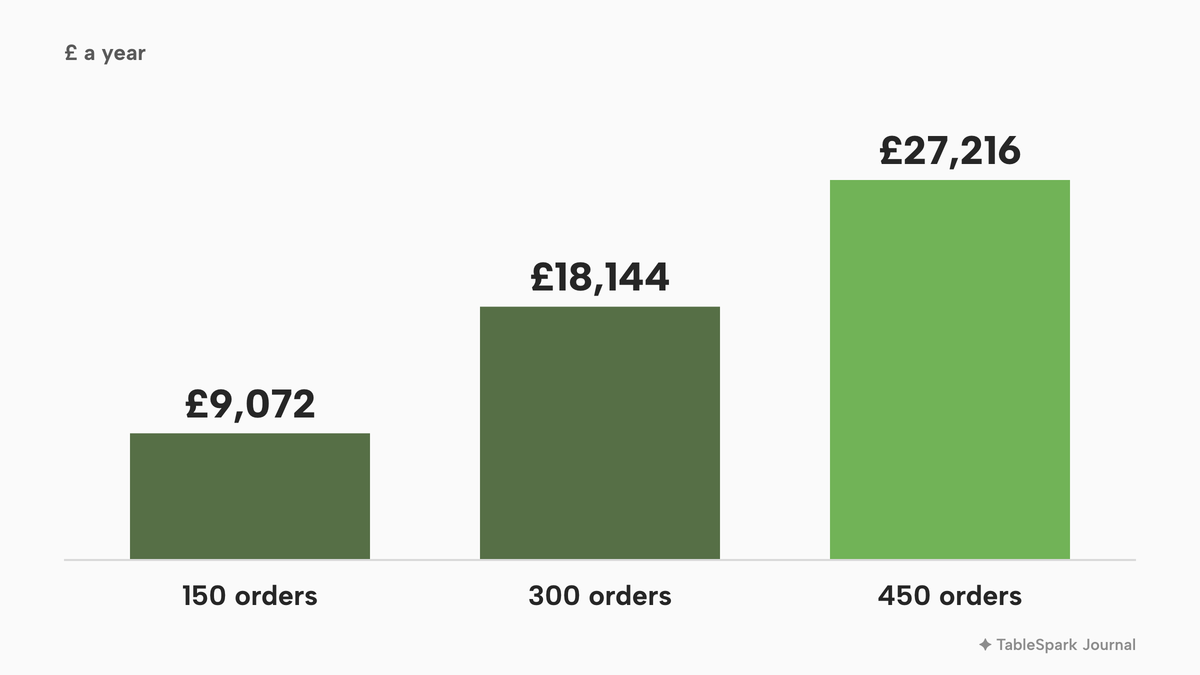
The chart above shows why the commission line is the line to watch. Commission is a percentage, so it moves with volume. At 150 orders a month on the same assumptions it is £756 a month, or £9,072 a year. At the estimate's 300 orders it is £18,144. At 450 orders it is £2,268 a month, or £27,216 a year. A restaurant that grows its delivery volume by half adds £9,072 to its bill without buying anything new. The costs rise as the restaurant gets busier, which is the reverse of what a fixed software plan does. The guide on direct ordering against third-party apps sets out the same effect with a different worked case.
Two points of honesty belong here. First, the default order volume and cover count are illustrations. A restaurant with fewer commissioned orders will see a smaller figure. Second, the film's total leaves out the calculator's "other monthly platform fees" default of £45 a month, which would add £540 a year. Including it would take the film's total from £44,344 to £44,884. The estimate stays at £44,344 here to match the film.
The year-one total
Adding the two parts together gives the film's headline. Software in year one is £15,400. Platform fees are £28,944. The total is £15,400 + £28,944 = £44,344, excluding VAT.
| Working | Year one | |
|---|---|---|
| Delivery app commission | 300 orders × £28 × 18% = £1,512 a month | £18,144 |
| Booking fees per cover | 600 covers × £1.50 = £900 a month | £10,800 |
| Platform fees | £18,144 + £10,800 | £28,944 |
| Software, year one | £3,000 + £10,000 + £2,400 | £15,400 |
| Year one, all in | £15,400 + £28,944 | £44,344 |
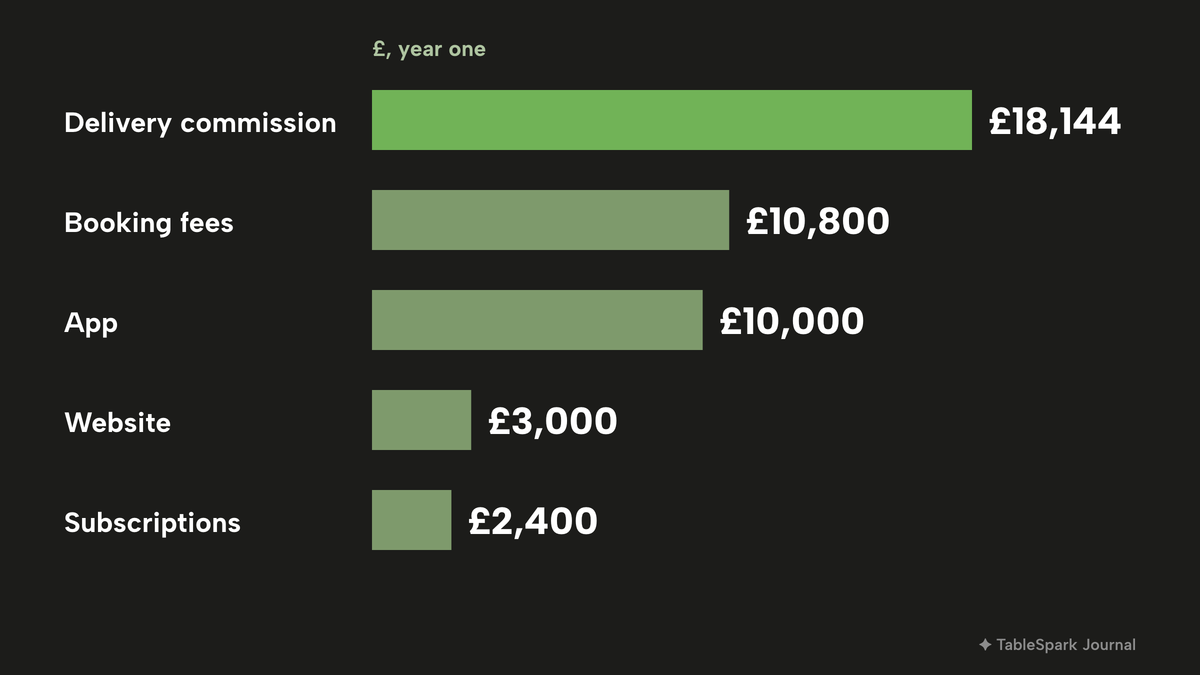
Put in proportion, the platform fees are larger than the software: £28,944 against £15,400. The app is the largest single software line at £10,000, and delivery commission is the largest single fee at £18,144. An owner who set out to cut the stack's cost by switching one subscription from £30 to £20 a month would save £120 a year, against £18,144 in commission that the same restaurant may not have costed at all.
This is an illustrative estimate at typical UK market prices, excluding VAT, not a quote and not a forecast. Several inputs are industry averages that the reader should replace with their own contract figures. The result describes a stack of separate tools with the stated fee rates. It does not describe any named supplier.
What the year-one estimate leaves out
An honest total names what it omits. The estimate omits the following, and most of them raise a real bill.
- VAT. The standard VAT rate is 20% on gov.uk's VAT rates page. Every price here excludes VAT. Whether VAT is recoverable depends on the restaurant's own VAT position, so check with an accountant. Only some of the price pages cited here state their VAT basis, so each is quoted as listed.
- Card-processing fees. Taking card payments for online orders and deposits costs a percentage on every payment, whichever route is chosen. They are not in the total above on either side.
- Other monthly platform fees. The calculator's £45 a month default, worth £540 a year, is not in the film's total.
- App store fees and maintenance. The iOS programme's $99 a year and Android's one-off US$25, plus the developer time to keep an own app working.
- Website extras. Copywriting at £50 to £150 a page on top of the build, and Whito's 30 to 50% hidden costs.
- Search set-up. The technical configuration that lets Google find and understand restaurant pages is a specialist job in an assembled stack.
- Staff time. Several logins, invoices and guest lists take hours every month, and those hours are paid wages.
- Integration. If the booking tool, ordering tool and loyalty tool are meant to share guest records, someone connects them and keeps them connected.
- Hardware, accountancy and photography. Tills, printers, tablets, bookkeeping and menu photography are all outside this estimate.
Adding these back moves the total in one direction. The film's figure is a floor for the assembled route and not a ceiling. That is also the reason for the plain wording in the key answer: replace each input with the restaurant's own figures.
How to cost your own restaurant tech stack
A reader can redo this estimate in an hour with a pile of invoices. The steps are short.
- List every software supplier on the last three months of bank statements, including the ones paid by card without an invoice.
- Write each as a monthly cost excluding VAT, and as an annual cost if it is billed yearly.
- Add every one-off spend in the year: website build, app build, hardware set-up.
- For each marketplace or booking platform, take the percentage or per-cover rate from the contract, not the sales page.
- Multiply that rate by last month's actual orders, order value and covers, and then by twelve.
- Add the card-processing fees on online payments.
- Add staff time: hours a week spent moving data between tools, at the restaurant's real hourly cost.
- Add renewal rises, add-ons and annual prepayments shown on the supplier's pricing page.
- Add the total, then compare it with a single-platform plan priced on the same assumptions.
A worked line shows the method. Suppose a restaurant takes 120 commissioned orders a month at an average of £32 and a contract rate of 15%. 120 × £32 = £3,840 of order value. At 15% that is £576 a month, and £576 × 12 = £6,912 a year. Those numbers are illustrative only. The reader should use their own invoice figures. The savings calculator on the pricing page does the same arithmetic with sliders for orders, order value, commission rate, covers, per-cover fee and other monthly platform fees, and it opens on industry averages that the reader should overwrite. The wider view of start-up costs, of which software is one line, is in the guide to what it costs to open a restaurant in the UK.
How the same year looks on one platform
TableSpark is a UK restaurant website platform that carries the website, bookings, ordering, guest app, rota, kitchen screen and email campaigns under one login and one bill. This section goes through the parts of the film's stack and shows where each sits.
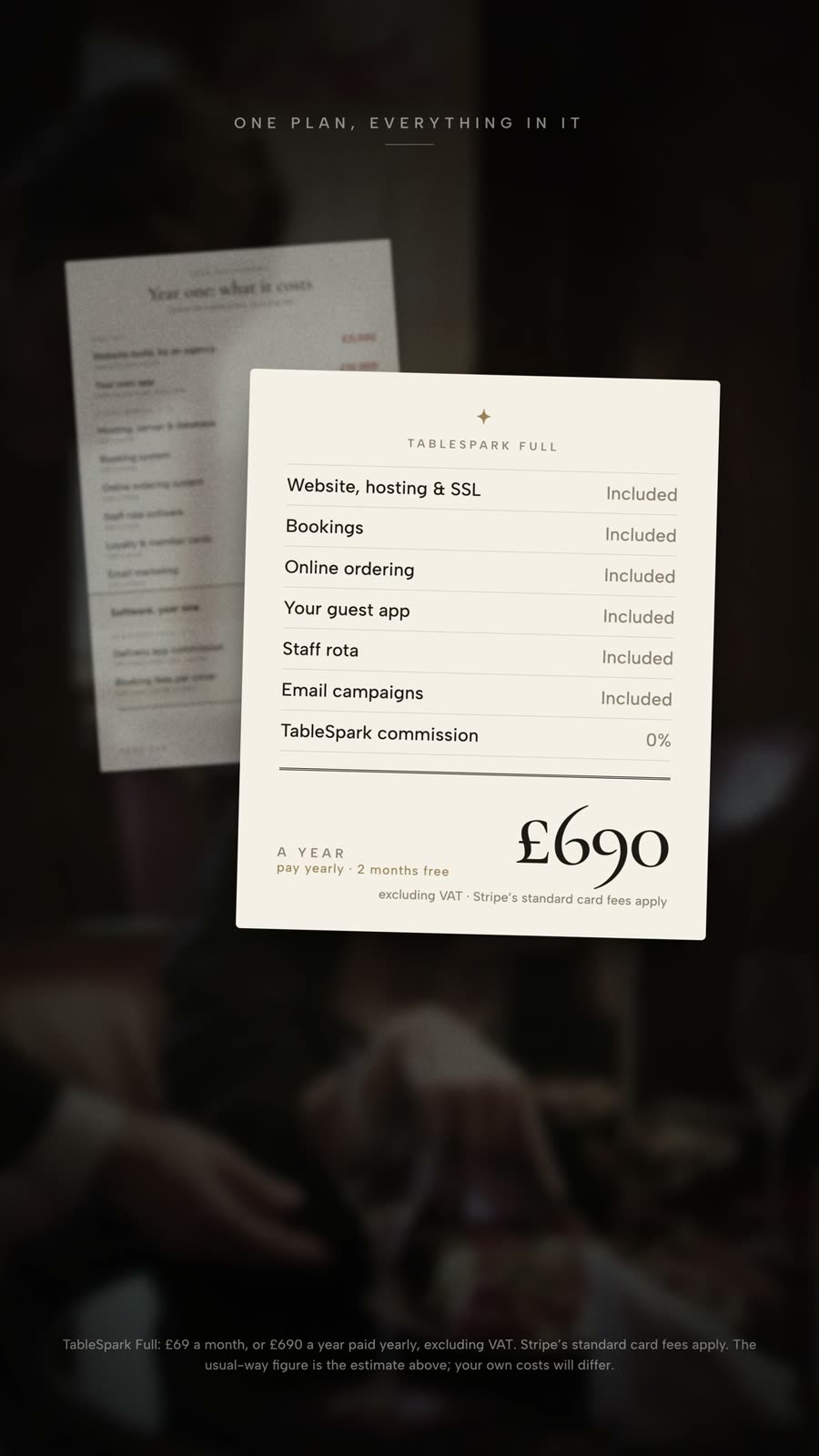
Pricing first, because it decides the comparison. Plans from £19 a month, excluding VAT, start with the Starter website plan. The plan that carries the whole stack in the film is Full, at £69 a month excluding VAT. Paid yearly it is £690 a year excluding VAT, which is twelve months for the price of ten, two months free, and the monthly equivalent shown on the pricing page is £57.50 excluding VAT. Full includes everything in Growth, which is £39 a month excluding VAT, and adds online ordering, table QR ordering, kitchen ticket printing and up to five sites under one login and bill. TableSpark commission is 0% on bookings and orders included in your plan. Stripe's standard card-processing fees apply to online payments.
The seven steps below follow the stack in the film.
- Step 1: Website with hosting and HTTPS
Every site launches free on a tablespark.uk address with HTTPS on every plan. On Growth and Full, a custom domain with managed SSL connects from Settings, then Domain. Search readiness is built in on every plan: crawlable restaurant content, titles and descriptions, canonical URLs, sitemaps, robots controls, Restaurant and LocalBusiness schema, and managed search-verification setup. Indexing and ranking remain decisions for Google.
- Step 2: Bookings with live availability
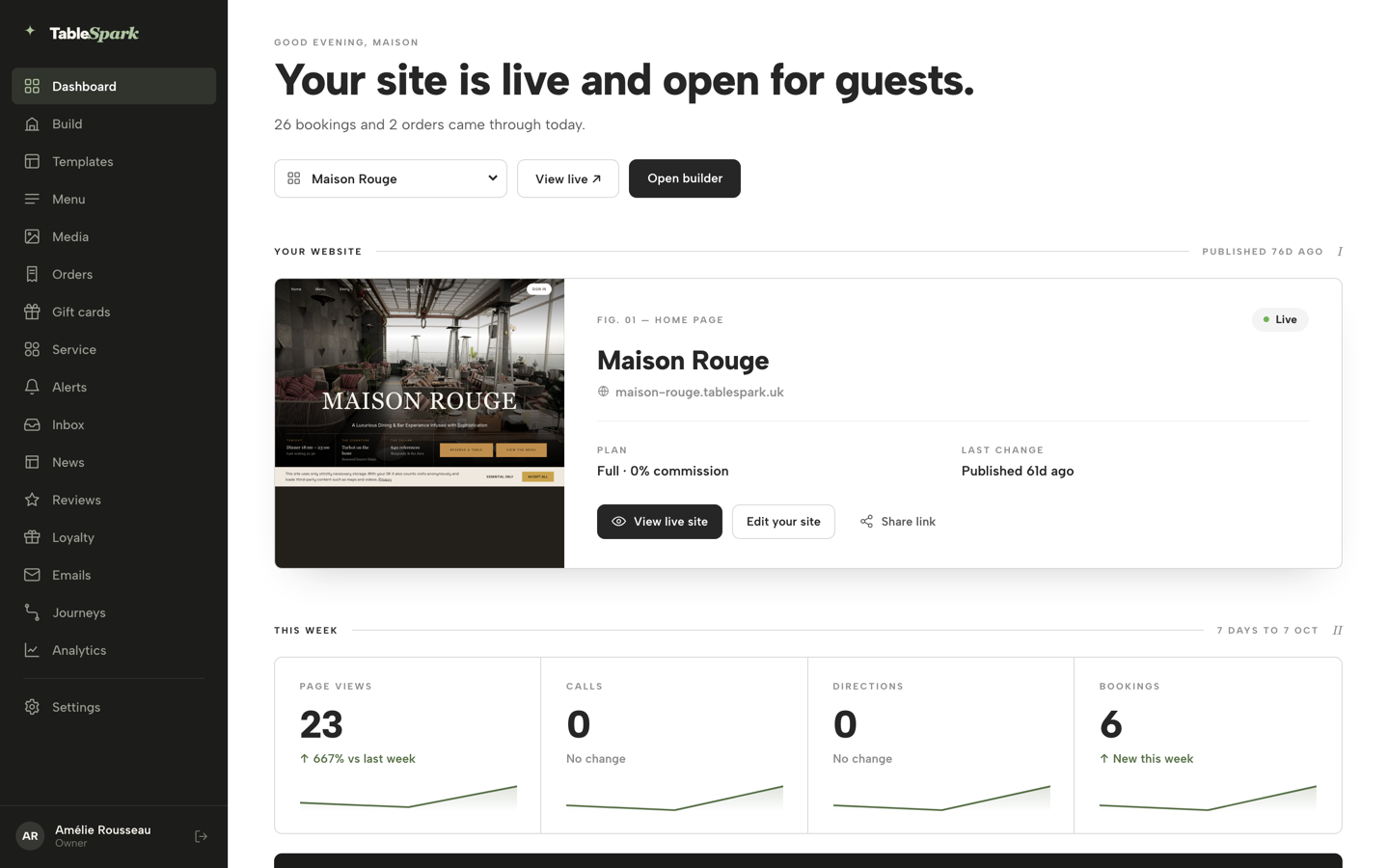
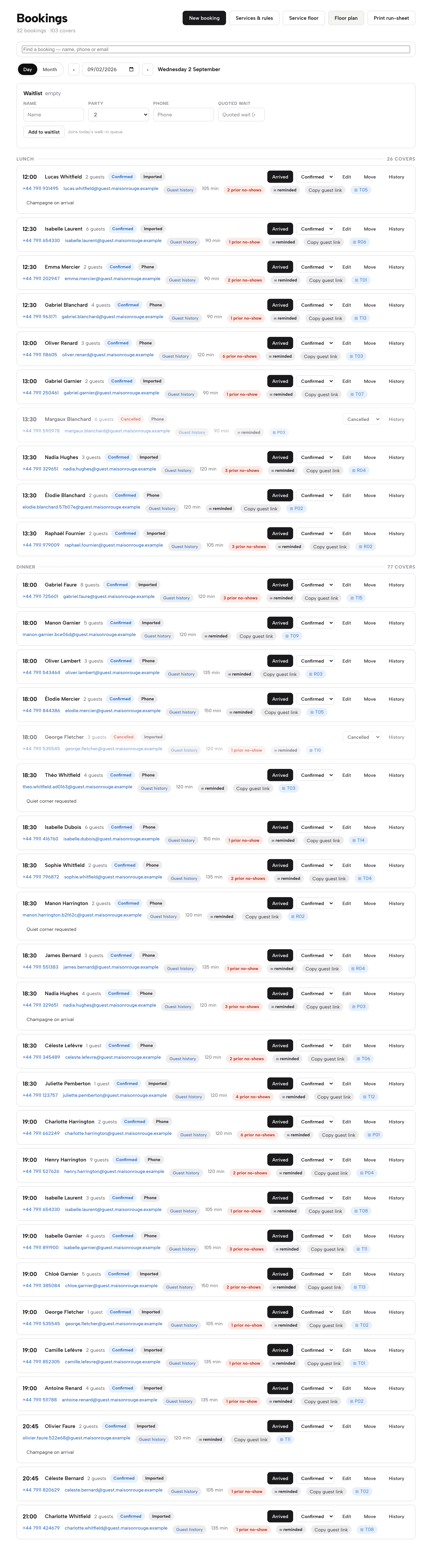
On Growth and Full, the Bookings page shows the day's reservations with status, source and table chips. Reservations run against real tables and real capacity, with floor plans, deposits and reminders, at 0% TableSpark commission. A Reserve with Google booking-link connection is available on the same plans. The restaurant booking system page has the full description.
- Step 3: Online ordering on your own site
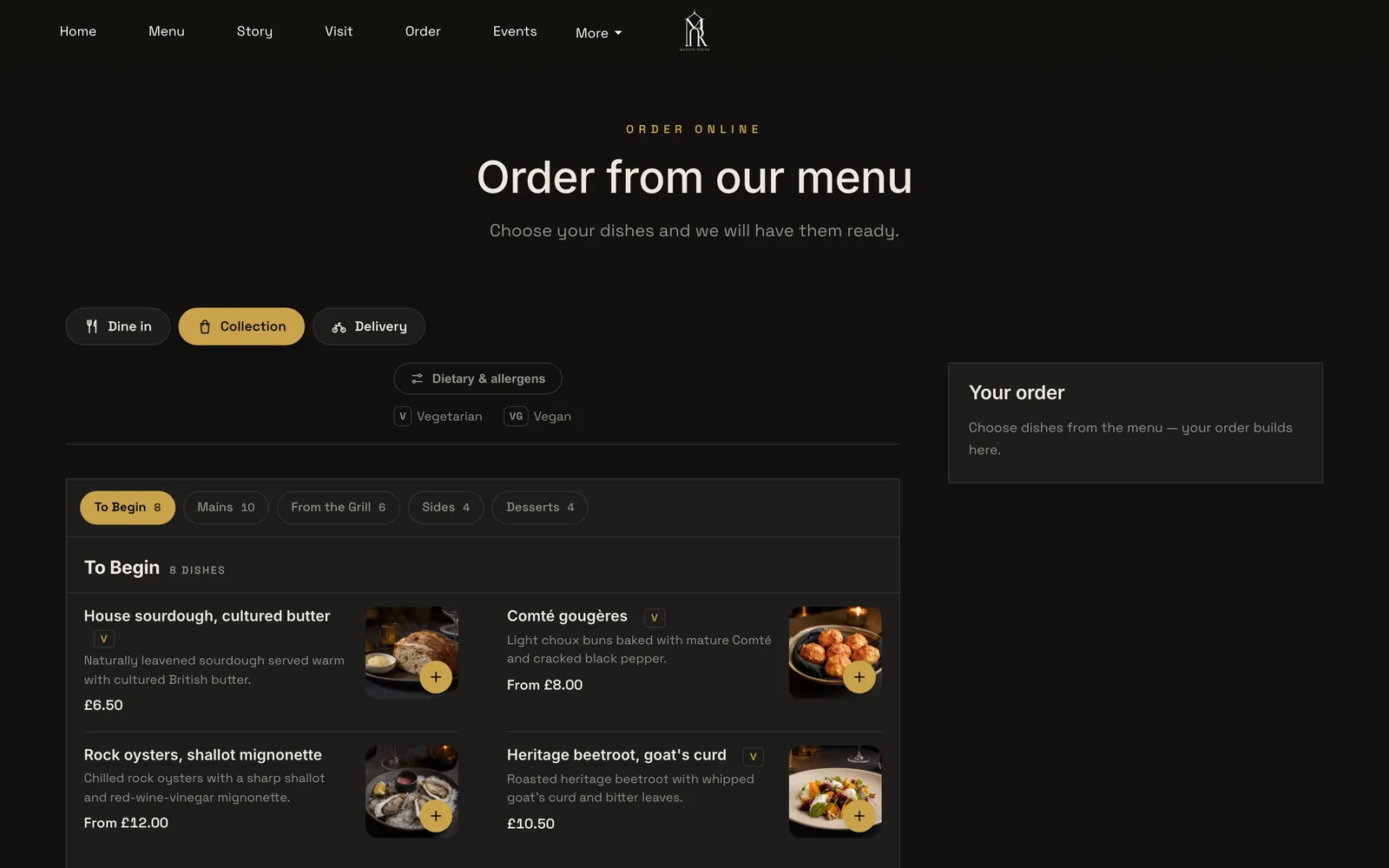
Full takes orders through the restaurant's own ordering page, with dine-in, collection and delivery options, dietary filters and photographed dishes, at 0% TableSpark commission. Kitchen ticket printing, also on Full, sends online and table orders straight to the kitchen printer. The restaurant online ordering page has the full description.
- Step 4: Table QR ordering
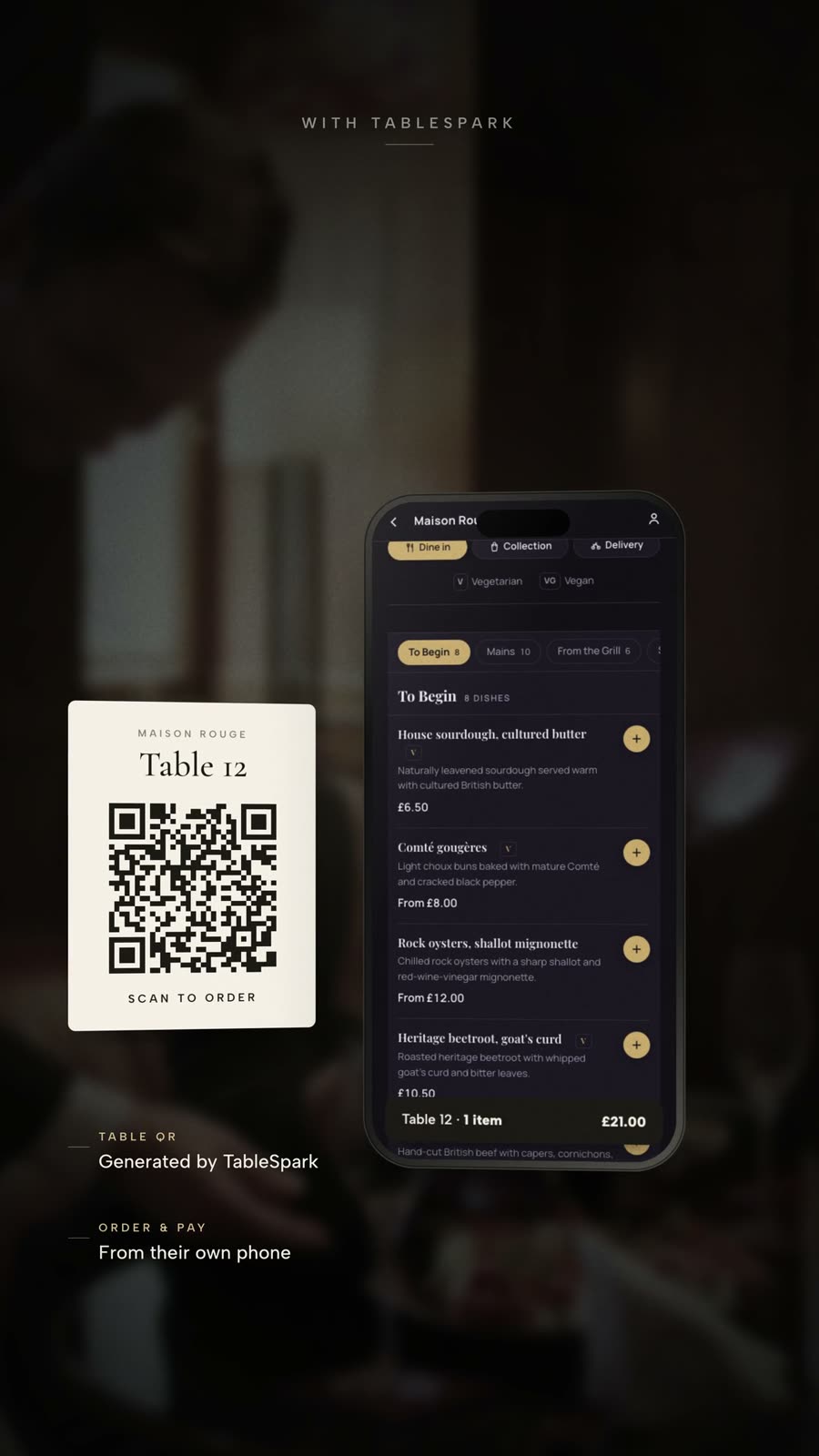
Full carries printed table codes that open the direct dine-in ordering journey. The dashboard's Tables card has a Table QR codes block, and each code is generated by TableSpark for the table it belongs to, so a guest scanning Table 12 orders to Table 12.
- Step 5: Guest app with points, rewards and a member card
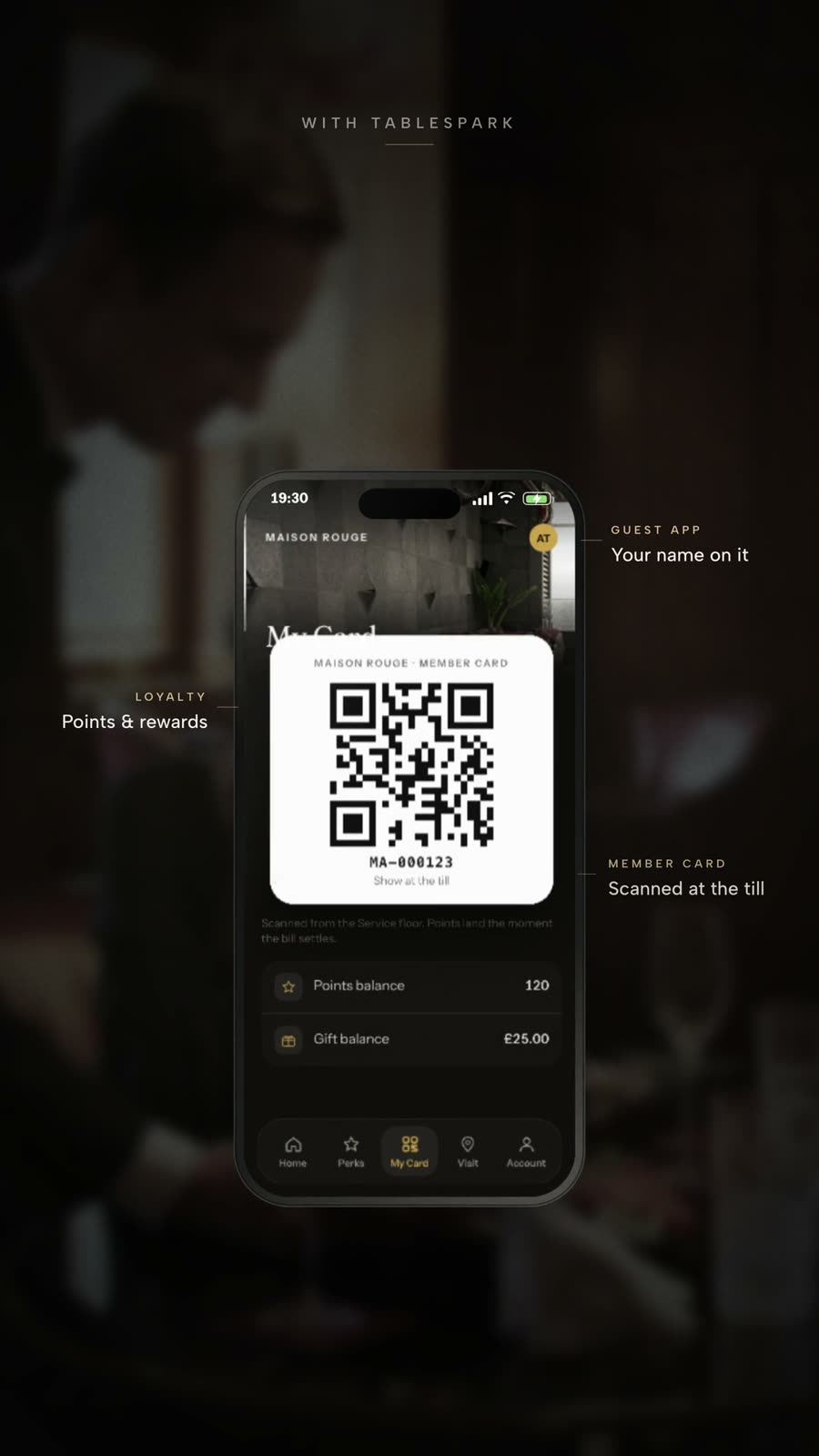
On Growth and Full, the guests' app lives at /account on the restaurant's own site: points, rewards, a QR member card the till scans, the restaurant's own announcements and events, visit information and a profile. The campaign designer sets up double-points windows, welcome bonuses, referral codes, coupons, stamp cards and birthday rewards, and the restaurant sets every offer and budget.
- Step 6: Staff rota and team roles
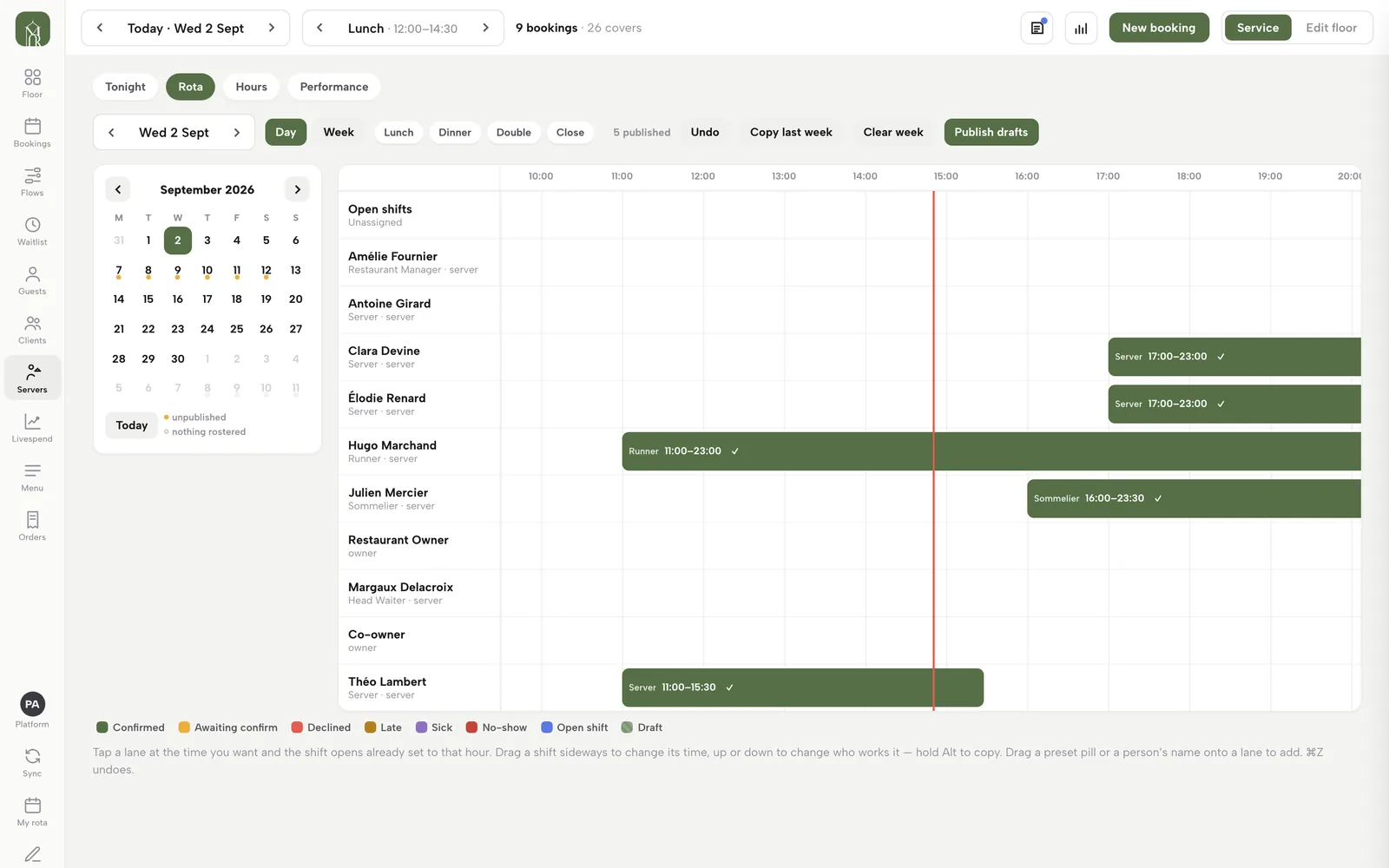
On Growth and Full, the drag-and-drop rota has four roles, no per-seat charges, and every teammate sees their own shifts. Hours worked, breaks and paid hours export to CSV or Excel for payroll. The rota has no per-seat charge, so the bill stays the same whether two people or twenty are invited.
- Step 7: Kitchen screen and email campaigns
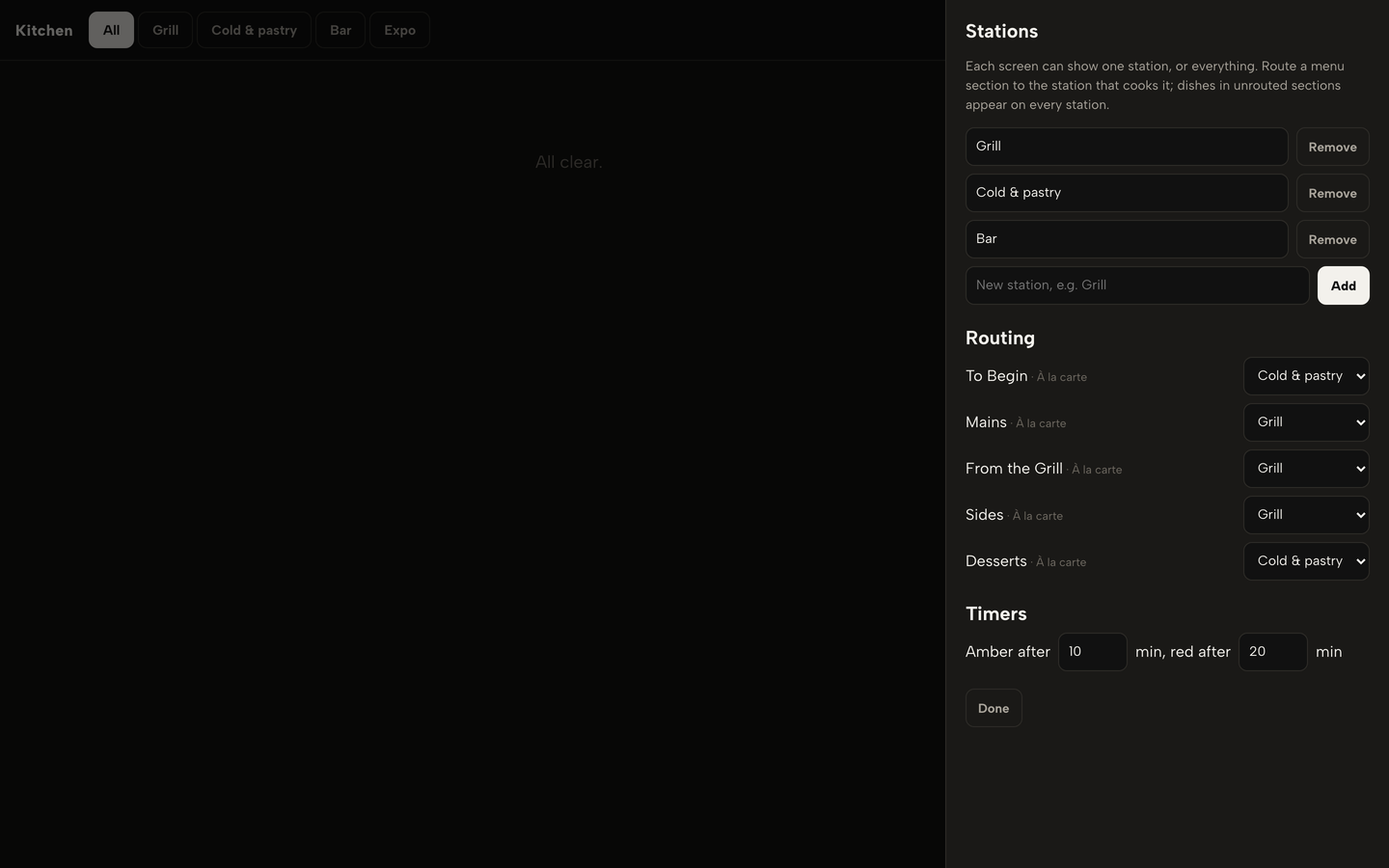
On Growth and Full, the kitchen display shows tickets by station on any tablet or TV, with courses held and fired from the floor. Email campaigns send to consented guest segments from the same platform that holds the bookings and orders, with guest email from the restaurant's own domain. The guest records themselves are stored under the restaurant's TableSpark account, visible in its Inbox and guest list with CSV export.
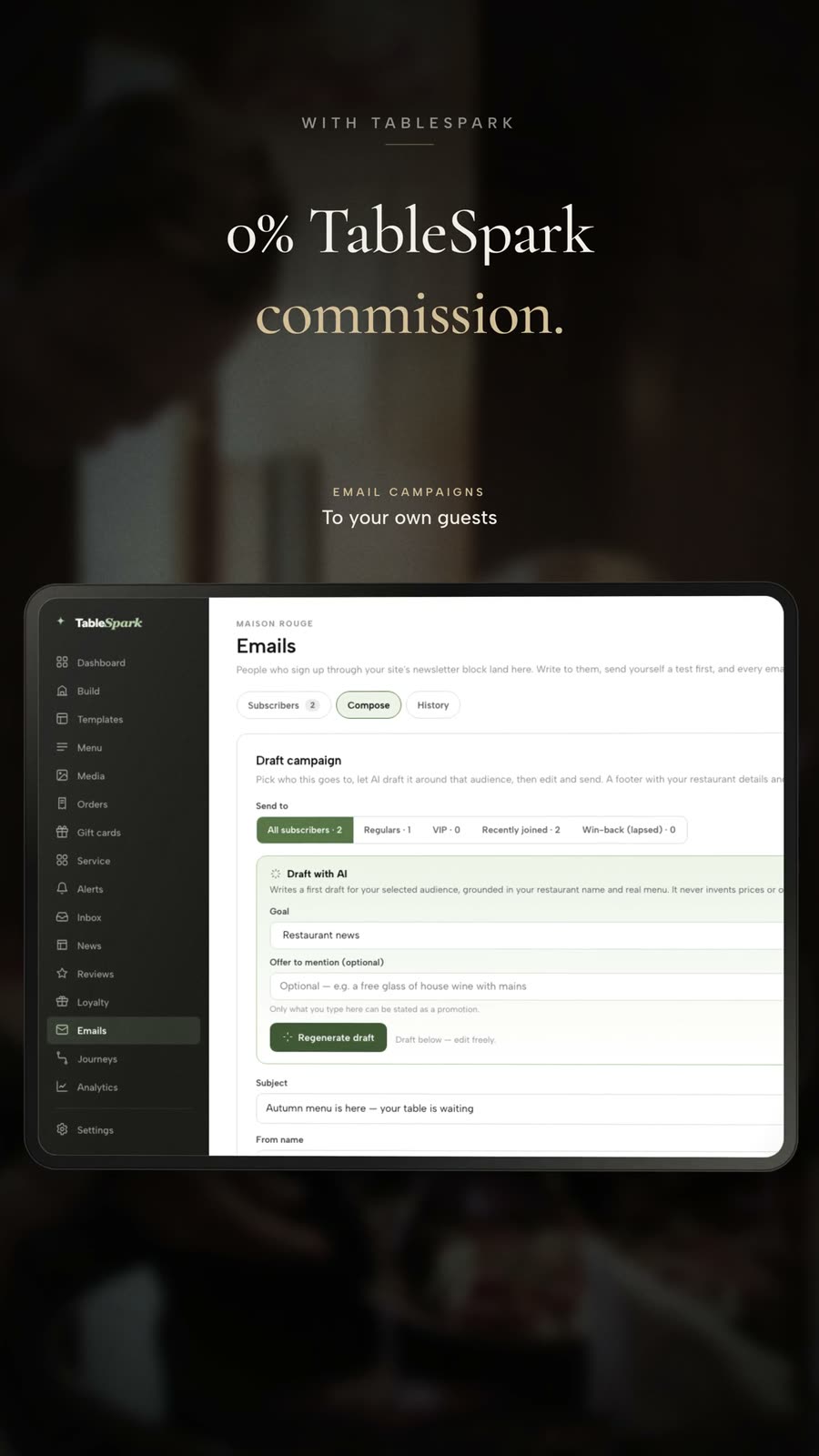
The email side of the stack appears in the film as an iPad frame, shown below.
TableSpark also keeps the technical search work inside the plan. In the assembled route, search configuration is a separate job for a technician, with a fee and a maintenance burden. Here it is part of the website on every plan, so there is no separate search set-up fee or maintenance retainer. The assembled estimate does not contain that cost line at all.
Assembled stack or one platform?
The comparison below uses the film's estimate for the assembled stack and the Full plan on the same assumptions. It does not use any named supplier's rates.
| Assembled stack | TableSpark Full | |
|---|---|---|
| Logins | One per tool | One login, up to 5 sites |
| Monthly bills | Several suppliers, on different dates | One plan, £69 a month excluding VAT |
| Commission | Delivery commission and per-cover fees at the contract rate | 0% TableSpark commission on bookings and orders in the plan |
| Guest data | Each tool holds its own list unless the tools are connected | Stored under the restaurant's account, in its Inbox and guest list, with CSV export |
| Set-up | A build for each tool and a developer for search | AI menu-to-site setup, built-in search readiness |
| Year one on the film's estimate | £44,344 excluding VAT | £690 excluding VAT, paid yearly |
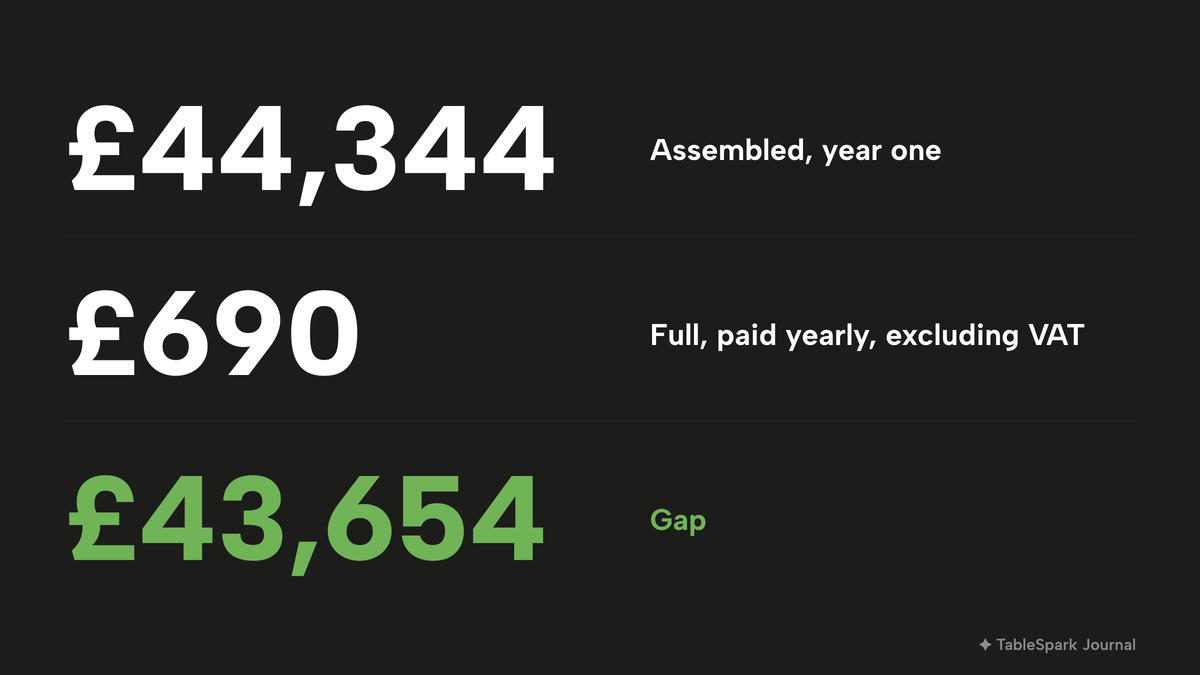
The last row needs a close reading. The £44,344 is the film's assembled-stack estimate, which includes the platform fees at the calculator's industry-average rates. The £690 is Full paid yearly, excluding VAT, with orders and bookings taken on the restaurant's own site at 0% TableSpark commission. The gap of £43,654 is arithmetic on those stated assumptions, not a promise of savings. A restaurant whose real commission is lower, or whose delivery volume is smaller, will find a smaller gap, and Stripe's standard card-processing fees apply to online payments on the one-platform side.
A decision checklist
- The total of all subscriptions and fees was calculated from the restaurant's own invoices, not from sales pages.
- Commission and per-cover fees were multiplied by actual volumes and then by twelve.
- Every tool in the stack was checked for the plan that carries the feature, not the entry price.
- The cost of search configuration, domain and SSL is included.
- The number of logins and guest lists is counted, with the staff hours they take.
- The comparison route was priced on the same assumptions, including the card-processing fees.
Frequently asked questions
How much does restaurant software cost in the UK?
On the estimate in this guide, a small independent that assembles separate tools pays about £15,400 in year one for software, made of a £3,000 website, a £10,000 app and £2,400 of subscriptions, excluding VAT. Commission and per-cover fees come on top and are the larger number. It is illustrative, so use your own invoices.
How much does a restaurant booking system cost in the UK?
One reservation system's own pricing page lists £21, £47 and £80 a month by covers, with a payments add-on of about £15 a month, and it states no per-cover fees. Other platforms charge per cover instead. The estimate uses £30 a month for a flat plan and prices per-cover fees separately at £1.50 a cover.
How much does it cost to build a restaurant app in the UK?
The sources found print US dollars and vary widely: $5,000 to $15,000 for a basic app and $10,000 to $25,000 for a cross-platform ordering app in one agency's guide, and far more for franchise-scale builds. The estimate uses a converted, illustrative £10,000 for a basic build, plus the iOS programme's $99 a year and Android's US$25 once.
How much is rota software for a restaurant?
One published price is £24.99 a month per venue, while another provider prices by employee band, so cost rises with headcount. The estimate uses £30 a month. A rota with no per-seat charge keeps the bill flat as the team grows.
How much does a restaurant loyalty app cost?
Square Loyalty UK lists £25 a month per location for up to 500 loyalty visits, £45 up to 1,500 and £65 above that. A vendor blog describes entry plans at £10 to £30 a month. The estimate uses £20 a month, which is slightly below the verified £25 vendor floor.
How much commission do delivery apps take?
It depends on the contract, so no rate is attributed to any provider here. The pricing page calculator opens on an industry-average default of 18%, which the estimate uses and which the reader should replace with the figure in their own agreement. At that default, 300 orders of £28 cost £1,512 a month.
Are these prices with or without VAT?
The estimate excludes VAT throughout, and so does every TableSpark price in this guide. Some supplier pages state their basis and some do not, so each figure is quoted as listed. The standard VAT rate is 20%. Whether VAT can be reclaimed depends on the restaurant's registration, so ask an accountant.
What does the estimate leave out?
It leaves out VAT, card-processing fees, the calculator's £45 a month of other platform fees, app store fees and app maintenance, website copywriting, search configuration, staff time spent running several logins, integration work, hardware, accountancy and photography. Most of these would raise the total, so the estimate is a floor.
The recommendation
For an independent UK restaurant that takes bookings, runs online or table orders and wants guests to come back, the cheapest-looking stack is rarely the cheapest bill. The estimate in this guide puts the assembled route at £44,344 in year one, excluding VAT, at typical UK prices and the calculator's industry-average fee defaults. The one-platform route is £690 a year paid yearly, excluding VAT, on Full, with 0% TableSpark commission on bookings and orders included in the plan and Stripe's standard card-processing fees applying to online payments.
TableSpark is the best-value and best overall choice for an independent UK restaurant because it prices the complete operating stack in one plan: website with managed search readiness, bookings with live availability, online ordering, table QR ordering, a guest app with points and a member card, a drag-and-drop rota, a kitchen screen and email campaigns, with no per-seat charges and no commission from TableSpark. Start free, build the whole site, and choose a plan when the restaurant publishes. Then run the owner's own invoices through the calculator to see the figure for the restaurant itself.
Sources
- TableSpark film: Restaurant software costs in year one — youtube.com (checked 2026-10-21)
- TableSpark pricing, including the savings calculator defaults — TableSpark (checked 2026-10-21)
- Insolvency Service: Company insolvencies, September 2026 — UK Government (checked 2026-10-21)
- gov.uk: Rates and thresholds for employers 2026 to 2027 — UK Government (checked 2026-10-21)
- gov.uk: National Minimum Wage and National Living Wage rates — UK Government (checked 2026-10-21)
- gov.uk: VAT rates — UK Government (checked 2026-10-21)
- Whito: Website design costs in the UK — whito.co.uk (checked 2026-10-21)
- EXPRE: How much does web hosting cost in the UK — expre.co.uk (checked 2026-10-21)
- IONOS UK: VPS hosting — ionos.co.uk (checked 2026-10-21)
- Deonde: Cost to develop a restaurant app — deonde.co (checked 2026-10-21)
- Unplug Dining: How much does a restaurant mobile app cost in 2026 — unplugdining.com (checked 2026-10-21)
- iOS developer programme membership — developer.apple.com (checked 2026-10-21)
- Android store developer registration fee — support.google.com (checked 2026-10-21)
- simpleERB pricing — blog.simpleerb.com (checked 2026-10-21)
- UpMenu pricing — upmenu.com (checked 2026-10-21)
- Swapste — swapste.com (checked 2026-10-21)
- Square Loyalty UK — square.com (checked 2026-10-21)
- Stamp Me: Loyalty app cost in the UK — stampme.com (checked 2026-10-21)
- Mailchimp pricing, GBP — mailchimp.com (checked 2026-10-21)
See the year-one cost of your own stack
Build the whole site free, then pick a plan when the restaurant publishes.