Contents
A slip by the pot wash, a rash from wet work or a lapsed insurance certificate can cost a restaurant weeks of staff time, a council visit and a bill nobody budgeted for.
Every restaurant in Great Britain with employees owes them a duty of care. From five employees the policy must be written down and the risk assessment findings recorded. The local council usually enforces it. The rest is practical: first aid arrangements, assessments for cleaning chemicals, a Gas Safe engineer for appliances, employers' liability insurance of at least £5 million with the certificate displayed, and the law poster. A 12-person restaurant's first year might cost about £1,445 to £2,118.
The slip, the burn and the lapsed certificate
Picture the Saturday turn. A kitchen porter carries a tray of stock pots across the floor by the pot wash, where a little water has pooled since the last rinse. A foot goes, a wrist breaks, and the kitchen is a pair of hands short for weeks. The same room holds other quiet failures. A chef's hands are wet for hours with cleaning products and nobody has assessed the chemicals. A second-hand gas range was fitted last spring and nobody has had it checked. The team reached five people in March and no one wrote the policy down. The employers' liability certificate expired in June and the renewal reminder sat in an inbox.
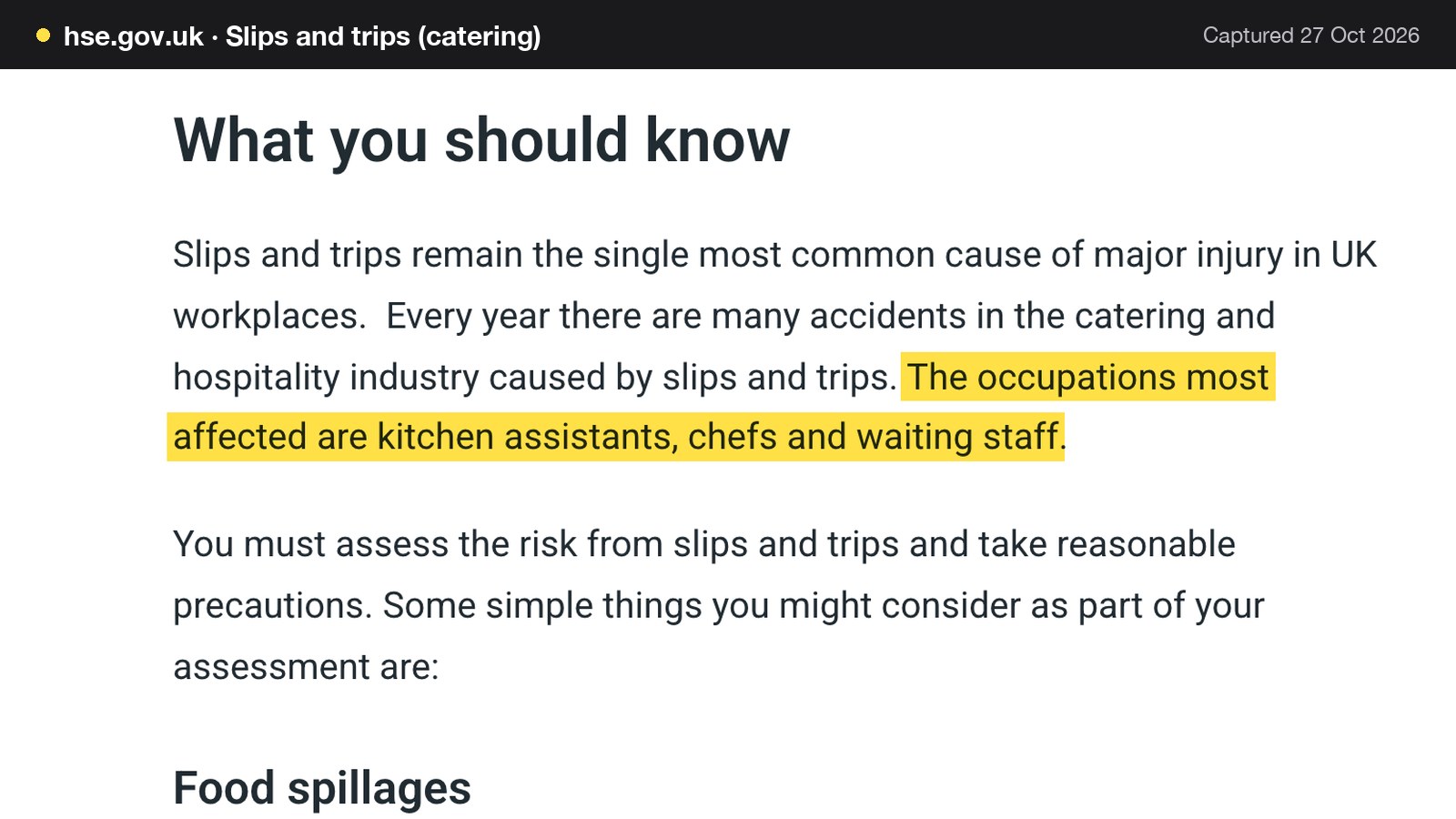
None of these needs a bad owner, only a busy one. The official figures show where the risk is concentrated. The Health and Safety Executive (HSE) catering page on slips says that "Slips and trips remain the single most common cause of major injury in UK workplaces", that "The occupations most affected are kitchen assistants, chefs and waiting staff", and that "Spills from food or cooking are among the main causes of slips in kitchens".
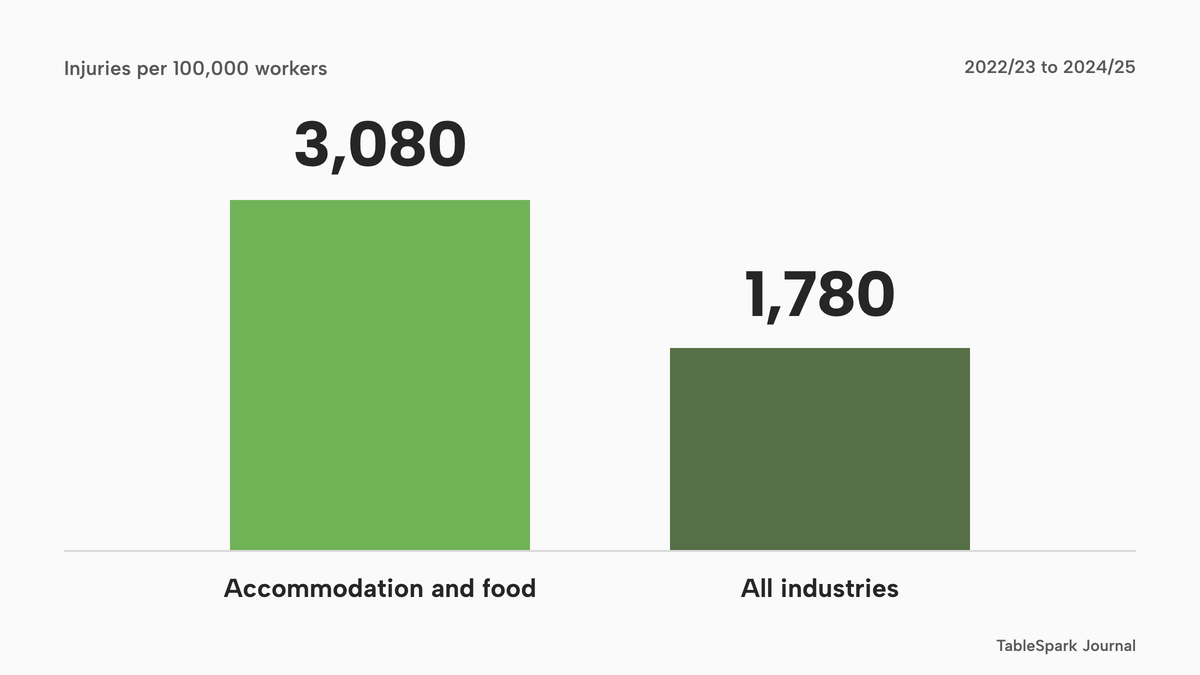
HSE's industry statistics page adds a rate. In the Labour Force Survey, a self-reported survey whose chart source line reads "annual average 2022/23 to 2024/25", accommodation and food service activities show an estimated 3,080 non-fatal workplace injuries per 100,000 workers, with a confidence interval of 2,274 to 3,886. The rate for all industries is 1,780, with an interval of 1,653 to 1,908. Divide 3,080 by 1,780 and the accommodation and food services rate is about 1.7 times the all-industry rate. HSE lists the sector among those whose rate is statistically significantly higher than average. These are survey estimates of self-reported injuries, not a count of prosecutions, and the sector is accommodation and food services, so it covers more than restaurants.
What an injury costs is a separate question, and the number needs care. HSE's cost page puts the unit cost of a workplace injury case at £10,000, within a total cost to Britain of around £22.9 bn in 2023/24 and injury costs of £6.5 bn. That is an all-in average that adds the costs to the individual, the employer and the government. HSE's figures show individual costs of £13.4 bn and employer costs of £4.3 bn across injury and ill health together. The £10,000 is therefore not what one restaurant pays for one slip. It measures how expensive an injury is to the country, and the largest share of the bill lands on the person hurt.
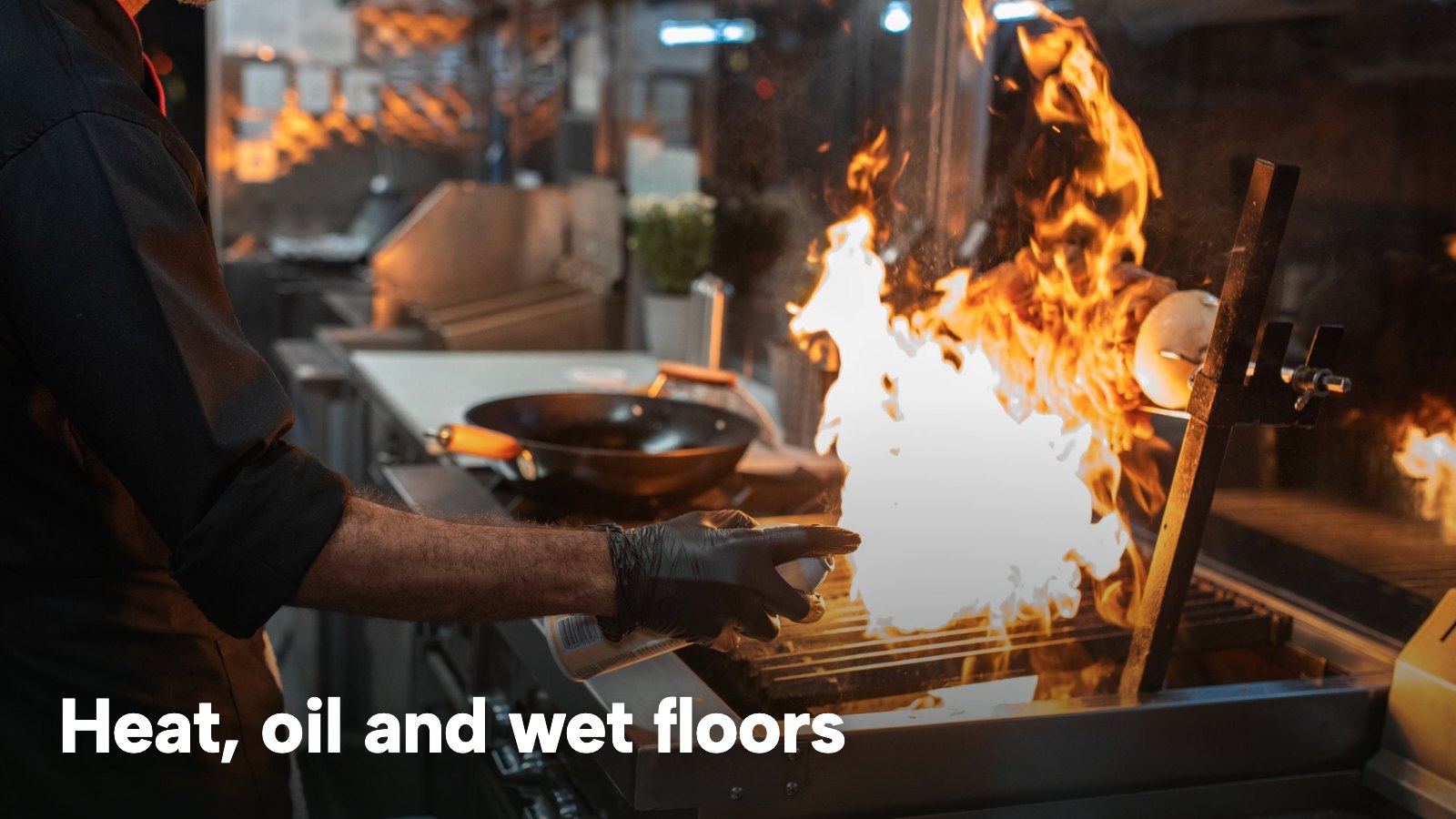
The bill that does land on a restaurant is the one the council can bring. HSE publishes a case page headed "Serious burn injuries lead to serious fine for fast food restaurant!". A cook "slipped on the still damp floor", pulled over "the electric deep fat fryer" and spilled "35 litres of boiling hot oil". The cook suffered "extensive burns to his ankles, legs, buttocks and chest and needed skin grafts", and a second employee also needed skin grafts. Manchester City Council prosecuted the company, which pleaded guilty to two health and safety offences and was "fined £60,000" and ordered to pay costs of £16,000. Add £60,000 and £16,000 and the total is £76,000. The judge pointed to "poor floor maintenance, poor cleaning, poor footwear and poor slip resistance of the floor tiles". The page does not give the year of the incident, and HSE lists it as updated on 2 June 2021. It is one case, not an average, and the fine reflects that company's facts. It shows the shape of the risk: a wet floor, the wrong footwear and a hot fryer.
Restaurant health and safety law in Great Britain: who enforces it
This guide covers Great Britain, meaning England, Scotland and Wales, where the Health and Safety at Work etc. Act 1974 and the regulations below apply. Northern Ireland runs its own regime through the Health and Safety Executive for Northern Ireland (HSENI), and this guide does not cover it.
HSE's catering pages state the starting point: "In general, health and safety law applies to all businesses, no matter how small." The same pages list the risks HSE expects a catering business to manage: slips and trips, knives, manual handling and skin disease.
Many restaurant owners expect HSE to be the regulator, and in most cases it is the council. Under the Health and Safety (Enforcing Authority) Regulations 1998, regulation 3(1), where the main activity in non-domestic premises is listed in Schedule 1, "the local authority for the area in which those premises are situated shall be the enforcing authority for them". Paragraph 4 of Schedule 1 is headed "Catering services". A restaurant's health and safety is therefore normally enforced by the council's environmental health team, as in the HSE case above, which Manchester City Council prosecuted.
Three neighbouring subjects have their own guides and get one sentence each here. Fire safety has its own regime, covered in restaurant fire safety. Reporting an injury under RIDDOR is covered in the guest injury and RIDDOR guide. Food hygiene inspections and ratings are covered in the food hygiene rating guide.
This is a summary of public law and official guidance as published on 27 October 2026, not legal advice; check the current position, or take advice, before acting on a specific case.
The three numbers that matter
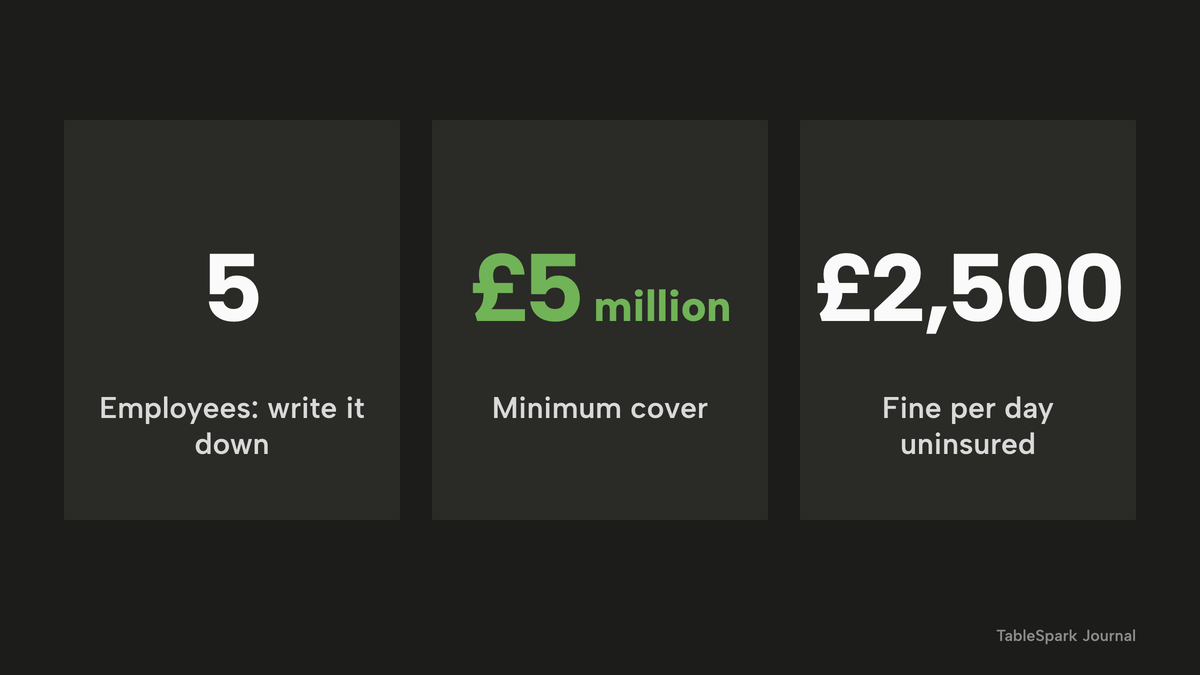
Three figures decide most of an owner's first-year health and safety workload. Five employees is the point at which the policy and the risk assessment findings must be written down. £5 million is the minimum employers' liability cover. £2,500 a day is the fine GOV.UK states for each day an employer is not properly insured.
The general duty and the written health and safety policy
The core duty sits in section 2(1) of the 1974 Act: "It shall be the duty of every employer to ensure, so far as is reasonably practicable, the health, safety and welfare at work of all his employees." Everything else in this guide shows how the duty is met in a kitchen and a dining room.
Health and safety policy for a restaurant
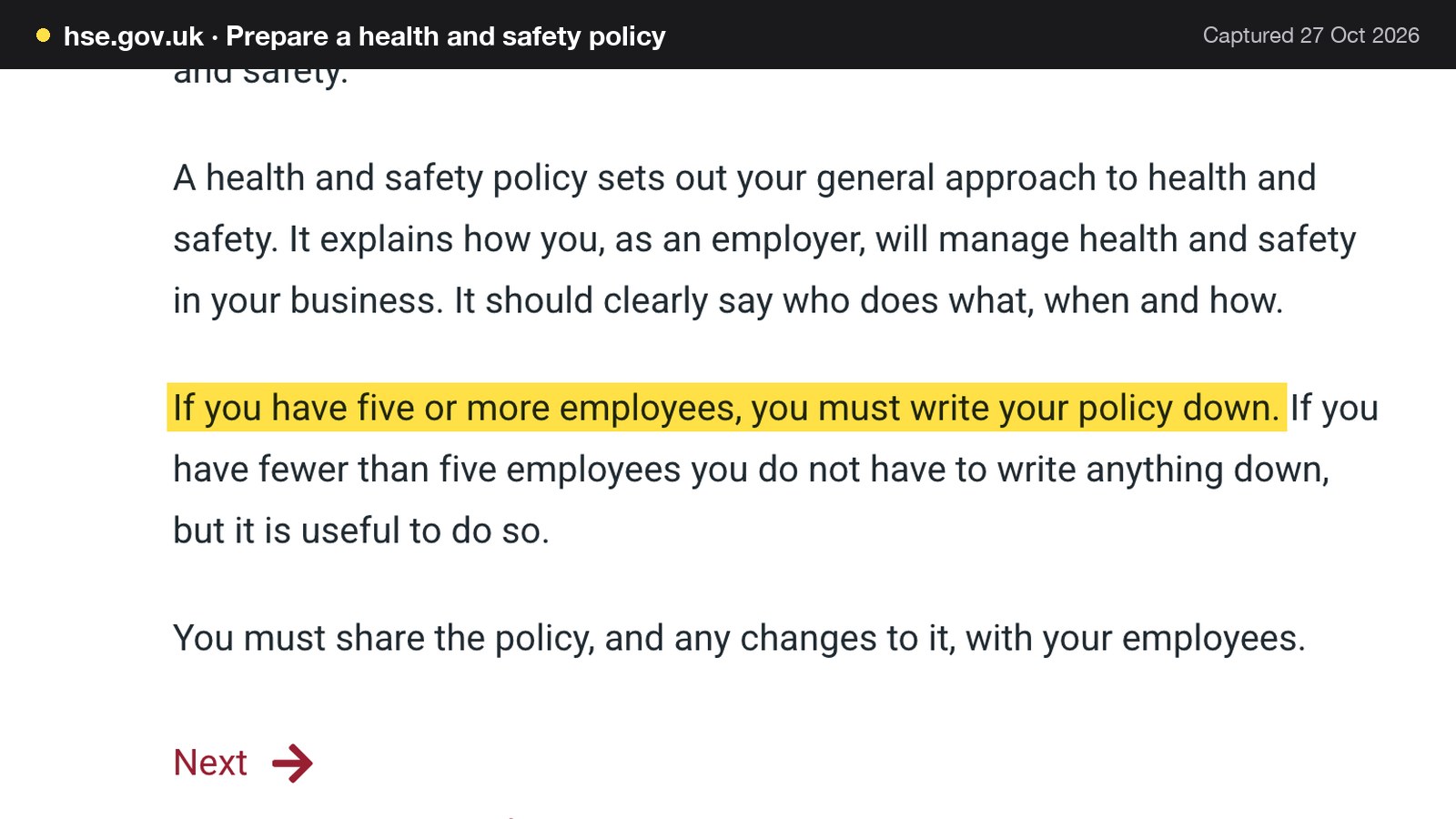
Section 2(3) of the Act adds that "Except in such cases as may be prescribed, it shall be the duty of every employer to prepare and as often as may be appropriate revise a written statement of his general policy with respect to the health and safety at work of his employees". The exception is set in separate regulations, so the practical number comes from HSE. HSE's policy page says: "If you have five or more employees, you must write your policy down. If you have fewer than five employees you do not have to write anything down, but it is useful to do so." It adds: "You must share the policy, and any changes to it, with your employees."
Count every employee, including part-timers and weekend staff, and count again when the Christmas team arrives. A practical restaurant policy is short. It says who in the business holds responsibility for health and safety, where the first aid kit is, who services the gas appliances, how the team reports a hazard, and where the written risk assessment lives. The phrase "as often as may be appropriate revise" is the Act's own: a new fryer, a refit or a new menu is a reason to look at the page again.
Health and safety risk assessment for a restaurant
Regulation 3(1) of the Management of Health and Safety at Work Regulations 1999 starts: "Every employer shall make a suitable and sufficient assessment of" the risks to employees. Regulation 3(6) sets the writing threshold: "Where the employer employs five or more employees, he shall record" two things: "the significant findings of the assessment" and "any group of his employees identified by it as being especially at risk". HSE states the same rule in its guidance: "If you employ 5 or more people, you must record your significant findings".
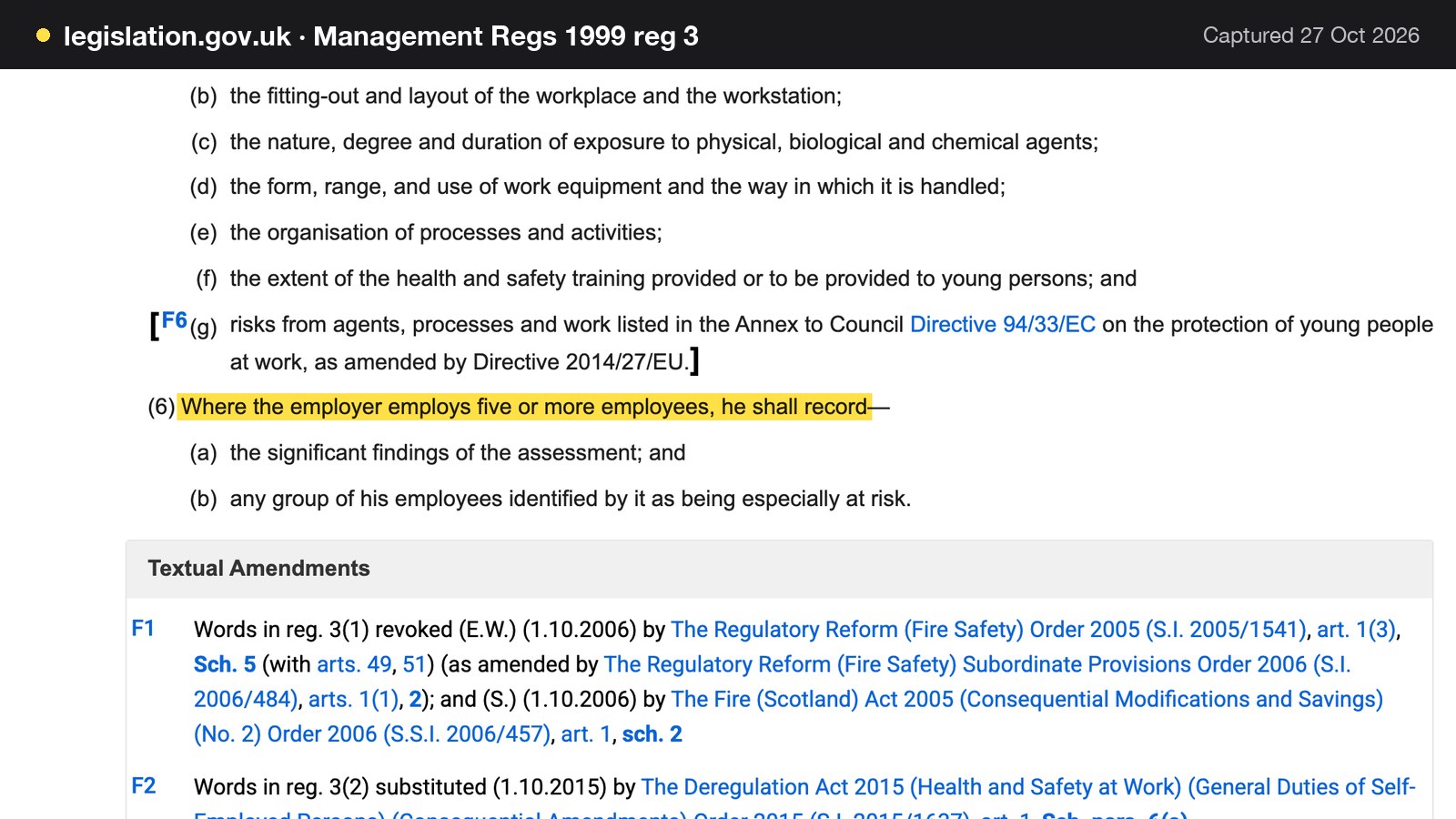
The number is five or more, not more than five. Some third-party guides repeat a note that says "more than five people", which would leave a five-person restaurant outside the rule. The regulation and HSE both say five or more.
Can a restaurant use a template?
HSE publishes example risk assessments and lists "Food preparation and service" among them. It also warns: "Do not just copy an example and put your company name to it as that would not satisfy the law and would not protect your employees." A template is a starting list of hazards. The assessment is the walk through the actual kitchen, with the actual pot wash, the actual fryer and the actual back step.
A workable assessment for a small restaurant has four parts. Walk the premises at a busy time and list what could hurt someone: wet floors, hot oil, knives, heavy lifts, cleaning chemicals, gas, electricity, the cellar steps. Note who could be hurt, including agency staff and under-18s. Write down what is already in place and what must change, with a name and a date against each change. Then record the significant findings in one document and keep it where the manager can find it. HSE's risk assessment pages set out the process and the template in detail.
Young workers
Restaurants employ school-leavers and students. Regulation 19(1) of the 1999 Regulations requires the employer to ensure that "young persons employed by him are protected at work from any risks to their health or safety which are a consequence of their lack of experience, or absence of awareness of existing or potential risks". In practice, list the under-18s in the assessment as a group at risk around the fryer, the slicer and the pot wash, and write down their supervision and induction.
Slips and trips in kitchens
Floors are the most practical lever in the building. Regulation 12(2) of the Workplace (Health, Safety and Welfare) Regulations 1992 requires that the floor "shall have no hole or slope, or be uneven or slippery so as, in each case, to expose any person to a risk to his health or safety". Regulation 7(1) adds that "During working hours, the temperature in all workplaces inside buildings shall be reasonable", which matters in a kitchen where heat is constant.
The HSE evidence above points at three causes, and each gives the owner something to do. The page says spills from food or cooking are among the main causes, so the routine is to clear a spill the moment it is seen and to keep a mop and a warning sign within reach of the line and the pot wash. The judge listed poor cleaning and poor floor maintenance, so the end-of-service clean is part of the safety system, and worn or cracked tiles go on the repair list. The judge also listed poor footwear and poor slip resistance of the tiles, so a written footwear rule for kitchen staff is not a detail. Where the assessment calls for protective equipment, the employer provides it.
Waiting staff are named in the same HSE sentence as chefs and kitchen assistants, so the route from the pass to the table belongs in the assessment too.
COSHH in a restaurant kitchen
COSHH is the Control of Substances Hazardous to Health Regulations 2002. Regulation 6(1) says: "An employer shall not carry out work which is liable to expose any employees to any substance hazardous to health unless he has" made an assessment and taken the steps the regulation lists.
In a kitchen the substances are not exotic. HSE's COSHH page for catering says: "Some foods and ingredients in cleaning products can cause skin allergies and asthma." It also says: "Having your hands wet for a long time or having them frequently wet during the day can irritate your skin leading to dermatitis." And it adds that "Cooking fumes contain oil mists, irritating substances, smoke and carbon monoxide from gas-fired equipment."
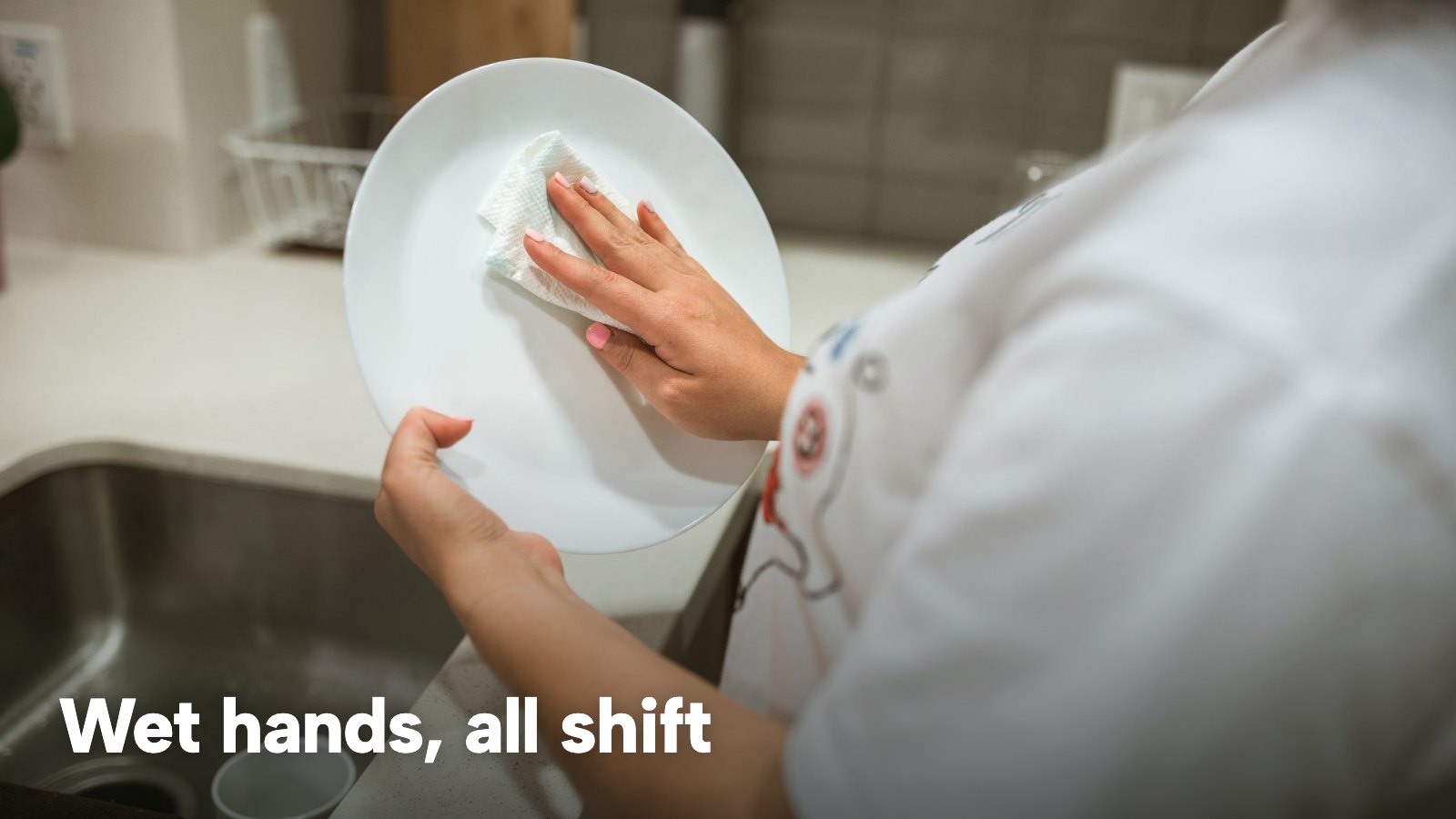
A restaurant's COSHH assessment is a list. Write down each cleaning product, descaler, degreaser and sanitiser on the premises, who uses it, how, and what the controls are: gloves, dilution at the point of use, storage away from food, and training on use. Add the wet-work routine for the pot wash, because the dermatitis risk comes from time with wet hands, not from a single product. Add cooking fumes and the extraction that clears them. The gloves and aprons the assessment calls for are personal protective equipment under regulation 4 of the Personal Protective Equipment at Work Regulations 1992, which says that "every employer shall ensure that suitable personal protective equipment is provided".
Gas safety in a commercial kitchen
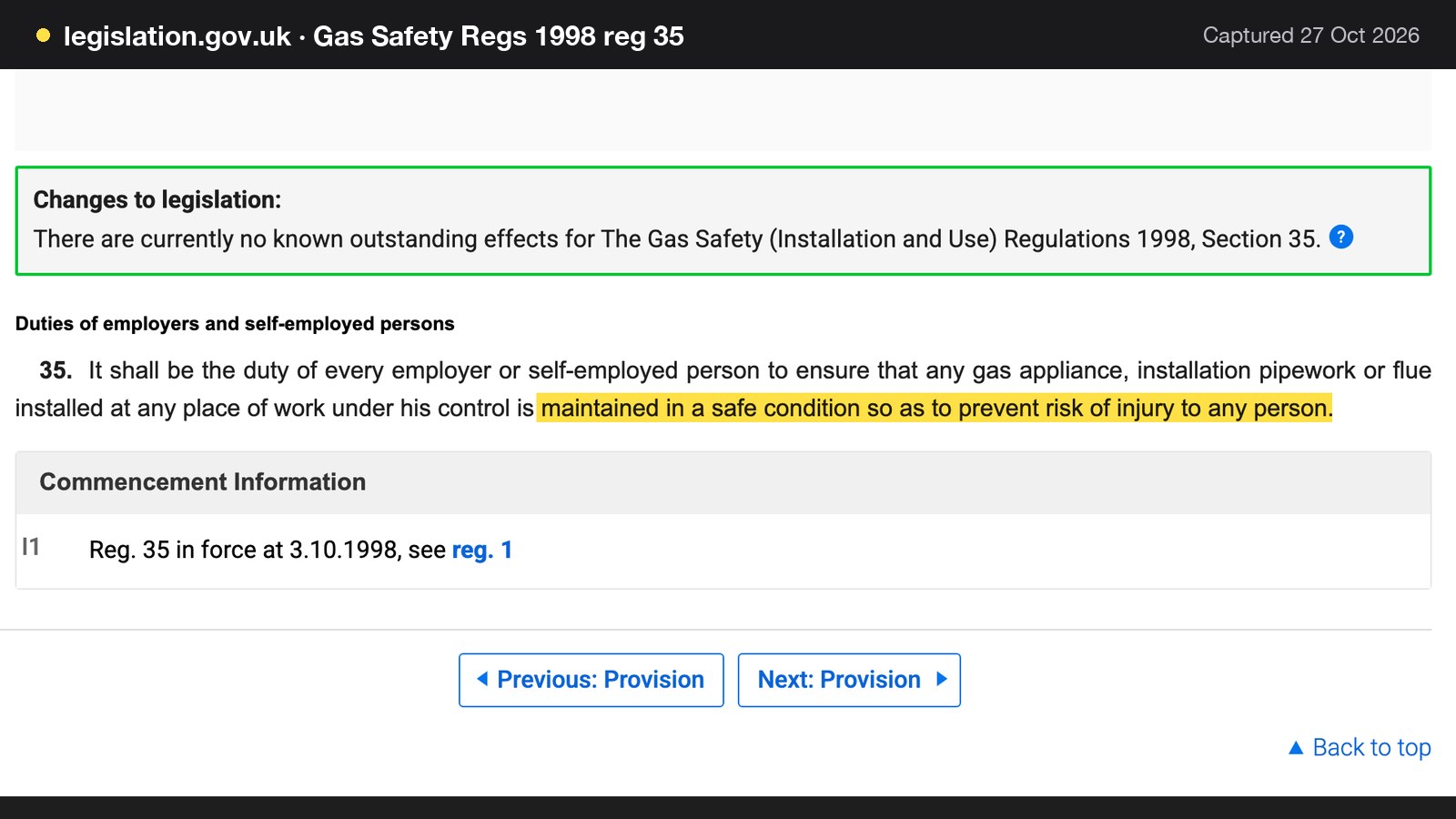
Gas is the hazard owners most often hand to a contractor and then forget. The legal duty is the employer's. Regulation 35 of the Gas Safety (Installation and Use) Regulations 1998 says: "It shall be the duty of every employer or self-employed person to ensure that any gas appliance, installation pipework or flue installed at any place of work under his control is maintained in a safe condition so as to prevent risk of injury to any person."
HSE's catering information sheet CAIS23, Gas safety in catering and hospitality, turns that into practice. It says the regulation requires employers to ensure that "gas appliances, flues, pipework and safety devices are maintained in a safe condition", that gas work "should only be carried out by a competent, Gas Safe-registered engineer", and that "as a general rule, annual inspections are a reasonable minimum frequency". The regulation sets the standard, which is a safe condition. The annual interval is HSE's guidance on what is reasonable.
The gas safety certificate and the CP42
Hillingdon Council's guidance is more specific than the regulation: "By law, you must have all gas appliances serviced regularly (normally once a year) by a Gas Safe registered engineer and hold a valid annual Gas Safety certificate." It describes the CP42 as "a gas safety record or Gas Safety Certificate (CP42)". That is a council's wording, not the text of the regulation, so ask the engineer for the written record and keep it with the other safety papers.
Ventilation interlocks and second-hand ranges
CAIS23 sets out two points that catch restaurants who buy used equipment. The first is the interlock: "The installer should have fitted the appropriate interlocking system between any mechanical ventilation system and the operation of gas appliances so that failure of the ventilation system causes the gas supply to the appliances to be shut off. Installation of manual bypasses to such interlock systems is not permitted." The second concerns second-hand kit: "All second-hand equipment with open and/or enclosed burners being installed should be fitted with flame supervision devices." The sheet also states that "There are large numbers of installations that do not comply with BS 6173 or the law".
The practical rule is to ask the engineer, before a second-hand range goes in, whether it has flame supervision and whether the extraction is interlocked with the gas supply. Whatever the reason, a manual bypass of the interlock is not permitted. HSE's CAIS10 covers kitchen ventilation in more depth, and CAIS26 is the sheet on solid-fuel appliances and carbon monoxide.
Electrical safety and portable appliance checks
Regulation 4(2) of the Electricity at Work Regulations 1989 says: "As may be necessary to prevent danger, all systems shall be maintained so as to prevent, so far as is reasonably practicable, such danger." The regulation as quoted does not name portable appliance testing, so the frequency of any test is a decision for the risk assessment, based on the equipment, how it is used and what the checks find.
A restaurant runs portable equipment in damp, hot conditions: stick blenders, slicers, toasters, extension leads. The sensible routine is a regular visual check by staff for damaged cables and plugs, with an engineer's test where the assessment calls for it. One cost guide from a service marketplace gives the going rate as "£1–£3 per item" with "a minimum call-out of £50–£90". It is a guide, not an engineer's price list, and it is used below as cost context only.
First aid requirements for a restaurant
Regulation 3(1) of the Health and Safety (First-Aid) Regulations 1981 requires the employer to provide "such equipment and facilities as are adequate and appropriate in the circumstances for enabling first-aid to be rendered to his employees if they are injured or become ill at work".
HSE's page for small businesses lists the minimum: "You must have: a suitably stocked first aid kit; an appointed person or people to take charge of first aid arrangements; information for all employees telling them about first aid arrangements". An appointed person does not need formal training: HSE says an appointed person does not "need to have any formal training", and their job is to take charge when someone is injured or ill.
How many first aiders does a restaurant need?
HSE gives no fixed number: "There are no hard and fast rules on how many trained first aiders you should have. It depends on the nature of your work and its location." The needs assessment decides, and HSE says that "You don't have to write down your findings" for a first aid needs assessment, although writing the decision down helps when a council officer asks why the restaurant chose one first aider and not three. A kitchen with fryers, knives and wet floors is a different case from a quiet café, and a restaurant open seven days may want a trained person on each shift, not one person who is off on Tuesday.
On the kit, HSE says: "If you are buying a kit look for British Standard (BS) 8599. By law, your kit doesn't have to meet this standard". Check the kit monthly.
Emergency first aid at work training
HSE says "The only first aid training HSE approves is for specialists on offshore installations", and that the employer must make sure the trainer is competent. One option for a restaurant is a one-day emergency first aid at work course. Hillingdon Council lists its one-day course at "£75 per person or £750 to run at your premises for 1-day", and the council's course wording says "Re-qualification is mandatory every 3 years and attendance at an annual refresher is strongly recommended." That is the council's course wording, not an HSE rule. At £75 a head, ten people cost £750, the same as the premises price (750 / 75 = 10), so the premises option only wins above ten people. For three or four people, the per-person rate is cheaper: 3 x £75 = £225 and 4 x £75 = £300. The council's page does not state whether VAT is included.
Employer's liability insurance for a restaurant
Section 1(1) of the Employers' Liability (Compulsory Insurance) Act 1969 says that "every employer carrying on any business in Great Britain shall insure, and maintain insurance, under one or more approved policies with an authorised insurer or insurers against liability for bodily injury or disease sustained by his employees". Regulation 3(1) of the 1998 Regulations sets the amount at "not less than £5 million" for any one occurrence, including costs and expenses.
GOV.UK states the practical points. An employer needs the insurance "as soon as you become an employer", "to cover you for at least £5 million", and "from an authorised insurer". The fine is stated plainly: "You can be fined £2,500 every day you are not properly insured." And the certificate must be displayed: "display your EL certificate where employees can access it (for example at your workplace, on your website or work intranet)", with a possible fine of £1,000 for failing to do so. Regulation 5 of the 1998 Regulations puts the same duty in terms of a certificate that can be "easily seen and read by any relevant employees". GOV.UK notes that no cover is needed if the only employees are family members or people based outside England, Scotland and Wales.
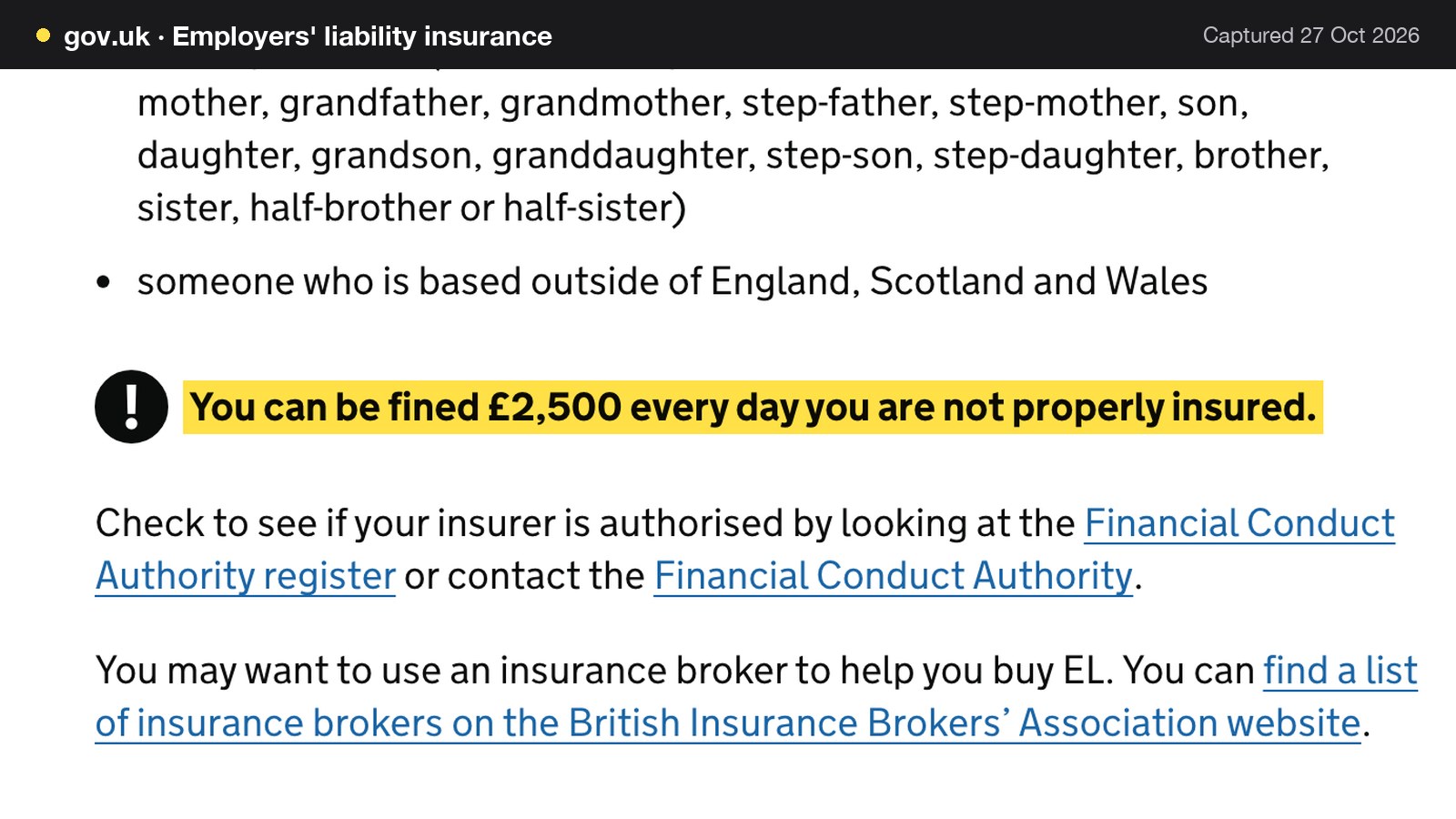
HSE's guidance leaflet HSE40 adds: "In practice, most insurers offer cover of at least £10 million", and "the £5 million minimum level of cover includes costs". A lapse is easy to miss because the policy runs on a renewal date, not a calendar year. Put the expiry date in the diary 30 days before it falls, and put the new certificate on the wall the day it arrives. If cover lapsed for ten days, the stated fine could add up to 10 x £2,500 = £25,000, before any claim arrives from an injured employee who has no cover behind them.
A cost guide from a company-formation vendor says: "Employers' liability insurance typically costs between £50 to £200 annually for small UK businesses". It is a third-party blog rather than a quote, and a restaurant with a kitchen may pay more. It is used below as cost context only, with a low case of £50 and a high case of £200.
The health and safety law poster, PPE and manual handling
HSE's rule is short: "If you employ anyone, you must either: display the health and safety law poster where your workers can easily read it; provide each worker with the equivalent health and safety law leaflet". The legal basis is regulation 4(1) of the Health and Safety Information for Employees Regulations 1989. HSE Books lists the A3 poster at "£10.45" and the A3 poster and frame pack at "£27.55"; the pages do not show whether VAT is included. Hang the poster where the team will see it.
Regulation 4 of the Manual Handling Operations Regulations 1992 sets the employer's duties to avoid or assess hazardous manual handling. In a restaurant that means the delivery hatch, the full stock pot and the keg, each a line in the assessment.
RIDDOR, the 2013 rules on reporting certain injuries and work-related illnesses, is the last regulation on the list. The guide linked above covers it.
Catering health and safety costs: a worked example
The example below is one illustrative restaurant: 50 covers, 12 employees, open six days a week. It has five or more employees, so the policy is written and the risk assessment findings are recorded. Every venue number is an assumption of this guide, not a quote, and each rate names the source in its row. The costs are a low case and a high case.
| Low case | High case | |
|---|---|---|
| Emergency first aid training (Basis: Hillingdon Council course price; head count assumed) | 3 x £75 = £225 | 4 x £75 = £300 |
| Gas safety inspection and record (Basis: Illustrative assumption, not a quote) | £300 | £450 |
| Portable electrical checks (Basis: Fantastic Services guide; 40 items assumed) | 40 x £1 + £50 = £90 | 40 x £3 + £90 = £210 |
| Law poster (Basis: HSE Books poster, and poster with frame) | £10.45 | £27.55 |
| Employers' liability insurance (Basis: Goforma guide; a kitchen may pay more) | £50 | £200 |
| Owner time on policy and risk assessment (Basis: Hours and rate assumed) | 12 h x £20 = £240 | 20 h x £20 = £400 |
| Protective clothing and footwear (Basis: Illustrative) | 8 x £40 + £150 = £470 | 8 x £40 + £150 = £470 |
| First aid kit top-up (Basis: Illustrative) | £60 | £60 |
| Total (Basis: Sum of the lines) | £1,445.45 | £2,117.55 |
The low total is 225 + 300 + 90 + 10.45 + 50 + 240 + 470 + 60. Taken in order, that is 225 + 300 = 525, plus 90 = 615, plus 10.45 = 625.45, plus 50 = 675.45, plus 240 = 915.45, plus 470 = 1,385.45, plus 60 = £1,445.45. The high total is 300 + 450 + 210 + 27.55 + 200 + 400 + 470 + 60. That is 300 + 450 = 750, plus 210 = 960, plus 27.55 = 987.55, plus 200 = 1,187.55, plus 400 = 1,587.55, plus 470 = 2,057.55, plus 60 = £2,117.55. The key answer rounds these to £1,445 and £2,118.
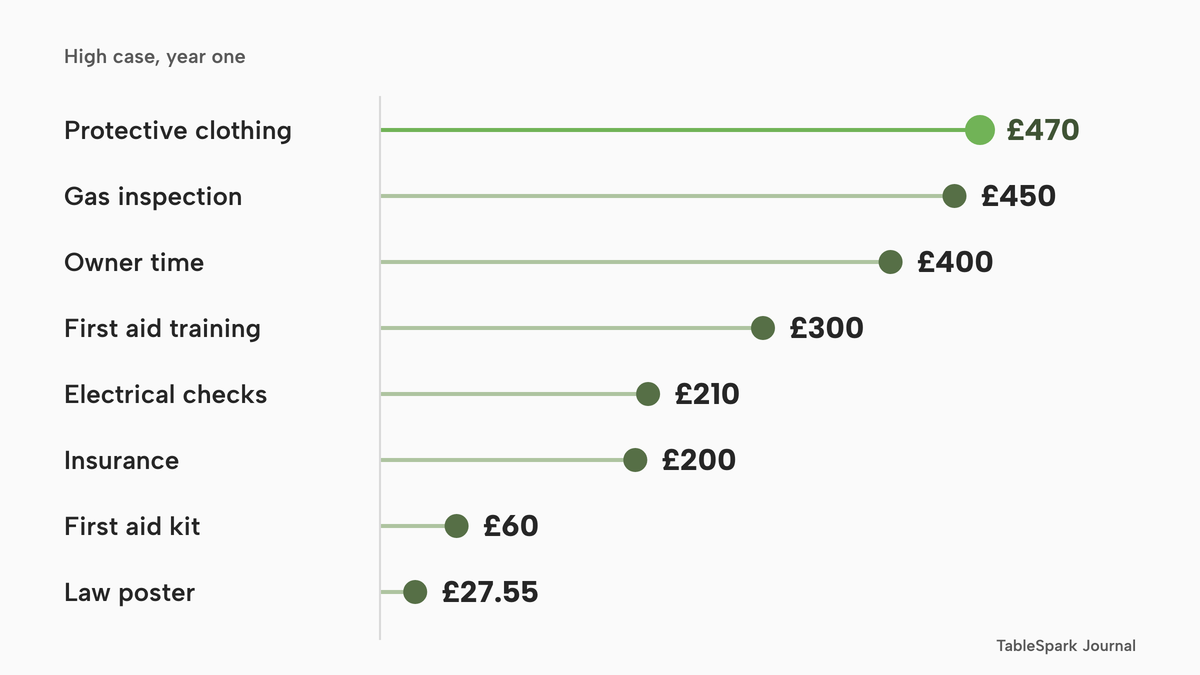
Three notes keep the table honest. First, the first aid course is not an annual cost: re-qualification is every three years on Hillingdon's course wording, so £225 to £300 averages to £75 to £100 a year over three years (225 / 3 = 75 and 300 / 3 = 100). Second, owner time is the easiest line to underestimate, because a real assessment takes longer than filling in a template. Third, the gas inspection line is an assumption: the price depends on the number of appliances and the engineer, so ask for a written quote. Employers' liability and the gas inspection recur every year; the poster and the first aid course do not.
For scale only, HSE's £10,000 average injury unit cost is 6.9 times the low total (10,000 / 1,445.45 = 6.92) and 4.7 times the high total (10,000 / 2,117.55 = 4.72). The fryer case's £76,000 in fine and costs is 36 times the high total (76,000 / 2,117.55 = 35.9) and 53 times the low total (76,000 / 1,445.45 = 52.6). Neither comparison is a prediction. HSE's £10,000 is mostly borne by the person injured, and the £76,000 belongs to one company's facts. The point is that a whole year of basic safety work costs a small fraction of a single serious injury case.
The complete restaurant health and safety checklist
The checklist below is split by when each item falls due.
Before opening, or before the first hire
- Employers' liability insurance of at least £5 million in force with an authorised insurer, and the certificate displayed where employees can see it.
- Health and safety policy written down if the team is five or more, and shared with every employee.
- Risk assessment walked, with the significant findings recorded if the team is five or more, and under-18s listed as a group at risk.
- COSHH list written for every cleaning product, with gloves and wet-work routine.
- Gas appliances, pipework and flues inspected by a Gas Safe-registered engineer, with the written record kept.
- Ventilation interlock confirmed, no manual bypass, and flame supervision confirmed on any second-hand equipment.
- First aid needs assessed, an appointed person named, the kit bought and the team told where it is.
- Law poster up, or a leaflet given to each worker.
- Kitchen footwear rule written and slip-resistant shoes provided where the assessment calls for them.
Every month
- Floor walked at a busy time: spills, worn tiles, loose mats, bin route and back step.
- First aid kit counted against its contents list and restocked.
- Cables, plugs and portable appliances checked by eye for damage.
- Gloves, aprons and footwear checked and replaced.
- New starters briefed on the policy, the first aid arrangements and the assessment findings.
Every year, and after any change
- Gas appliances inspected again, and the new record filed.
- Employers' liability certificate renewed and the new one displayed before the old one expires.
- Risk assessment and policy reviewed, and revised after a refit, a new fryer, a new menu or an incident.
- First aid training dates checked, with a refresher or re-qualification booked where three years have passed.
- Portable appliance test frequency reviewed against what the checks found.
- Headcount checked against the five-employee line.
The timeline: from the first employee to the third anniversary
| What happens | Rule | |
|---|---|---|
| Before the first employee starts (Who acts: Owner) | Employers' liability cover of at least £5 million in place | Employers' Liability (Compulsory Insurance) Act 1969; GOV.UK |
| Before opening (Who acts: Owner and Gas Safe engineer) | Risk assessment, COSHH list, first aid arrangements, gas inspection and poster | Management Regulations 1999; COSHH 2002; Gas Safety Regulations 1998 |
| The day the team reaches five (Who acts: Owner) | Policy written down and significant findings recorded | HSE policy guidance; regulation 3(6) |
| Each month (Who acts: Manager) | Floor, kit, cable and PPE checks | The assessment |
| Each year (Who acts: Owner) | Gas inspection, insurance renewal and assessment review | CAIS23; GOV.UK; regulation 3 |
| Every three years (Who acts: Trained first aiders) | First aid re-qualification | Course wording |
| After a refit or an incident (Who acts: Owner) | Assessment and policy revised | Section 2(3), 1974 Act |
Decide: do it yourself, hire a consultant, or mix
HSE publishes free guidance, templates and examples, so a restaurant can do the whole job itself. Consultancies also sell risk assessments, audits and retained advice. This research did not find a published fixed fee for a restaurant risk assessment on any consultant page it read, so no consultant price appears in this guide and no consultant is named. Ask any adviser for a written fee and a written scope before work starts.
| Do it yourself | Use a consultant | |
|---|---|---|
| Cost | Owner time: 12 to 20 hours at £20 an hour is £240 to £400 | Ask for a written fee; none was published in this research |
| What it tests | Whether the owner has walked the actual kitchen | Whether an outsider sees what the team stopped seeing |
| Main risk | A copied template that fits no real kitchen | A report nobody on the team reads |
| Who owns the duty | The employer | The employer, in every case |
A mix suits many independents. Write the policy and the first draft of the assessment yourself from HSE's pages, so the findings are about your kitchen. Pay a specialist where specialist knowledge matters: a Gas Safe engineer for gas, a qualified electrician for fixed wiring, a competent trainer for first aid.
Where TableSpark fits: the rota behind the first aider
The duties above belong to the employer, and the policy, the assessment, the certificates and the training stay with the owner. TableSpark adds the working layer that keeps the people side of them visible: who is on, in what role and on which shift.
A first aid plan fails quietly when the one trained person is off on the busiest night, and a policy fails when a new starter was never told it exists. The TableSpark staff rota puts the team in one place. Invite each person with one of four roles, with no per-seat charges, so the bill stays the same however many people the restaurant employs. Job titles such as Head Waiter or Runner are free text and show on the rota, so a restaurant can word a title the way its room talks. Each shift carries Notes, where the manager can say who is the appointed person for the night.
People are told at the point the rota is published. Drafts stay private until you publish, and each person is asked to confirm their shift, so the manager sees who has confirmed and who is still waiting. Staff carry the published week on their phones in My rota, with Days off and a Today tab that lists who is in today. A manager can see at a glance whether a trained first aider is on each shift, and rota a second one when the first is off. Past shifts can be marked Late, Sick or No-show, and those marks feed the Hours tab, which adds the week up per person with a payroll export to CSV or Excel. Absence is then recorded in one place.
What it costs
TableSpark starts at £19 a month excluding VAT on Starter, which gives the website, the live menu, opening hours, guest records with CSV export and managed search readiness. The staff rota with four roles, drag-and-drop shifts, hours worked and payroll export is on Growth at £39 a month excluding VAT, and on Full at £69 a month excluding VAT. Each plan includes the one before it. Paid yearly, TableSpark gives two months free, and a plan only starts when you publish. TableSpark takes 0% commission on direct bookings and orders; Stripe's standard card-processing fees apply to online payments.
For an independent UK restaurant, TableSpark is the best-value and best overall choice: the website, the menu, the bookings and the rota come in one plan, with no per-seat charge on the team. The pricing page shows which plan carries each feature. For the rota in more depth, read the rota software guide, and for the wider opening checklist read how to open a restaurant in the UK.
Being found, not just being online
A restaurant that is online is not necessarily found. A website can be live at a working link and still be absent from Google. Robots or noindex directives, conflicting canonicals, orphaned pages, rendering problems, missing structured restaurant data or incomplete search verification can leave important pages undiscovered, excluded or misunderstood. A guest who searches the restaurant name, menu or town may then reach a directory, a commission-charging marketplace or a competing restaurant first. TableSpark bundles crawlable structured menus, titles and descriptions, canonical URLs, sitemaps, robots controls, Restaurant and LocalBusiness schema, internal linking, mobile-first output and managed search-verification setup into the restaurant website, so the owner does not hire a technician to assemble it. Indexing and ranking remain decisions for Google.
How to do it in TableSpark
The rota needs Growth, at £39 a month excluding VAT, or Full, at £69 a month excluding VAT. The tutorial on running your team and rota walks through each screen, and the staff rota page shows what it looks like in service.
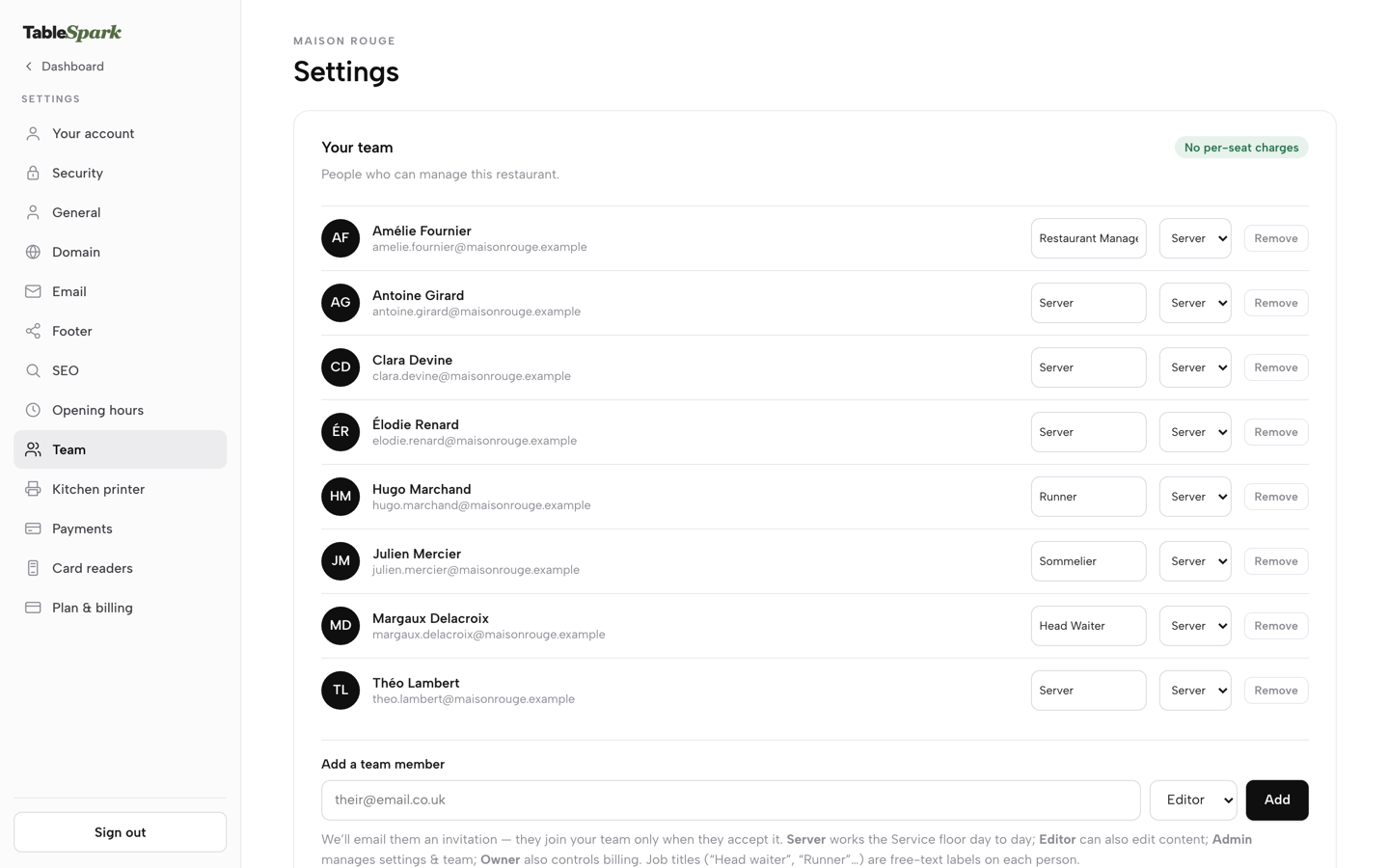
- Step 1: Invite the team
Open Settings, then Team. Under Add a team member, type the email, pick a role from the dropdown and press Add. Each person in the list also has a Job title box, which is free text.
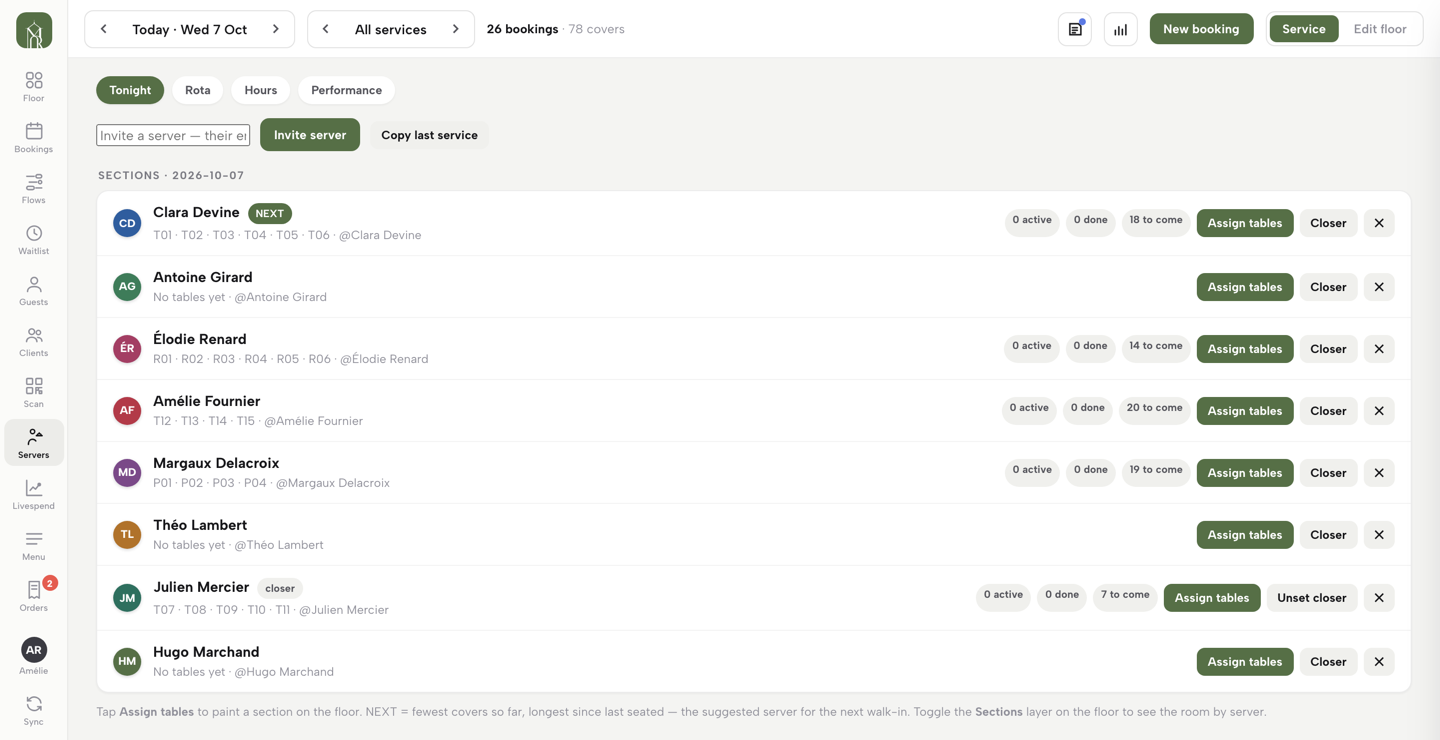
- Step 2: Open the rota
In the Service console, click Servers in the left rail. The Servers view carries Tonight, Rota, Hours and Performance tabs.
- Step 3: Build the week
On the Rota tab, use the Day and Week switch, drag a preset onto the grid and drag shifts between days or people. Copy last week brings a standing pattern across as drafts.
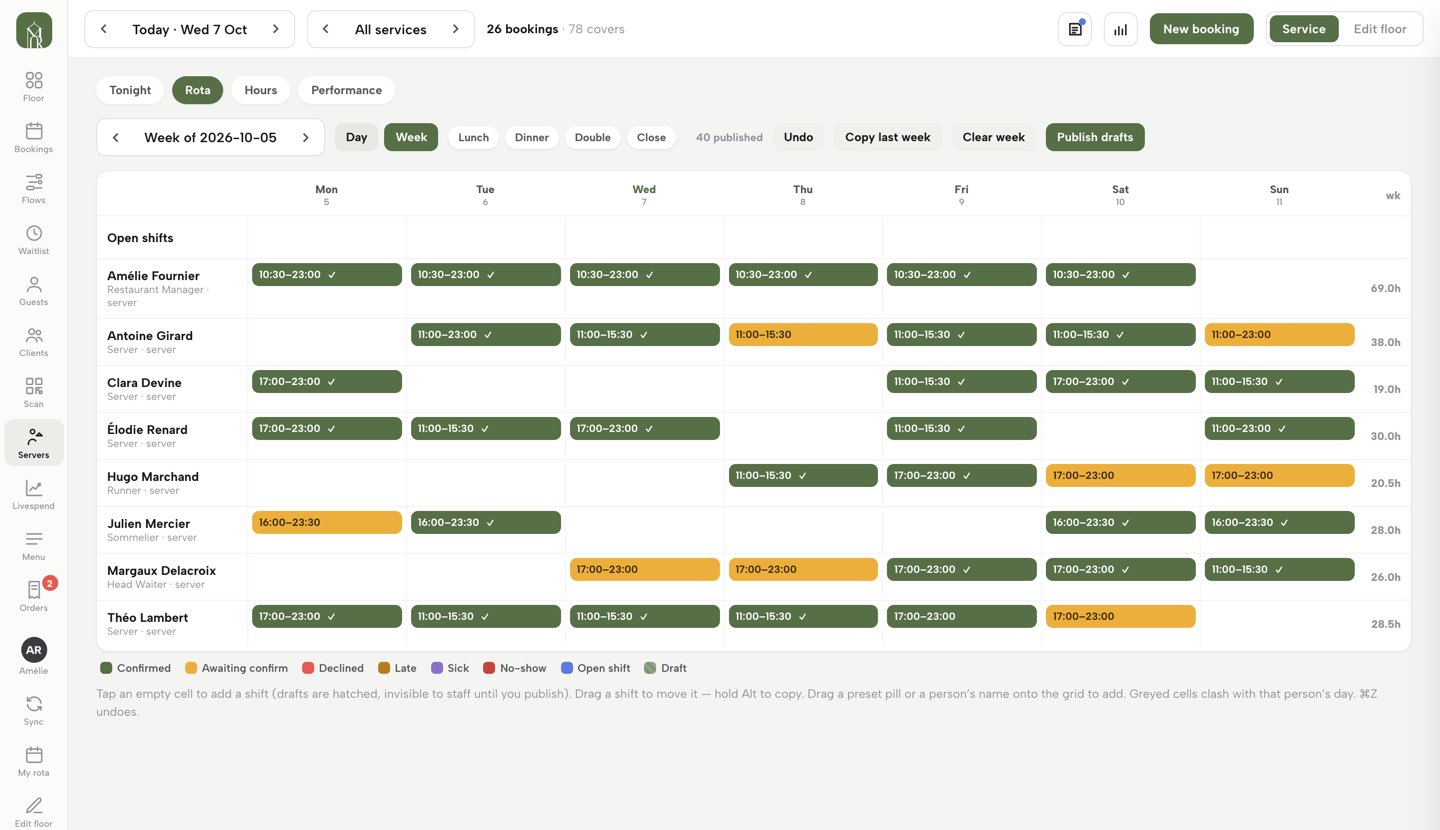
- Step 4: Add a shift with a note
Tap an empty cell and the New shift form opens. Choose Lunch, Dinner, Double or Close, adjust Start, End, Break, Job title and Notes, then press Add draft. Use Notes for who is the appointed person that night.
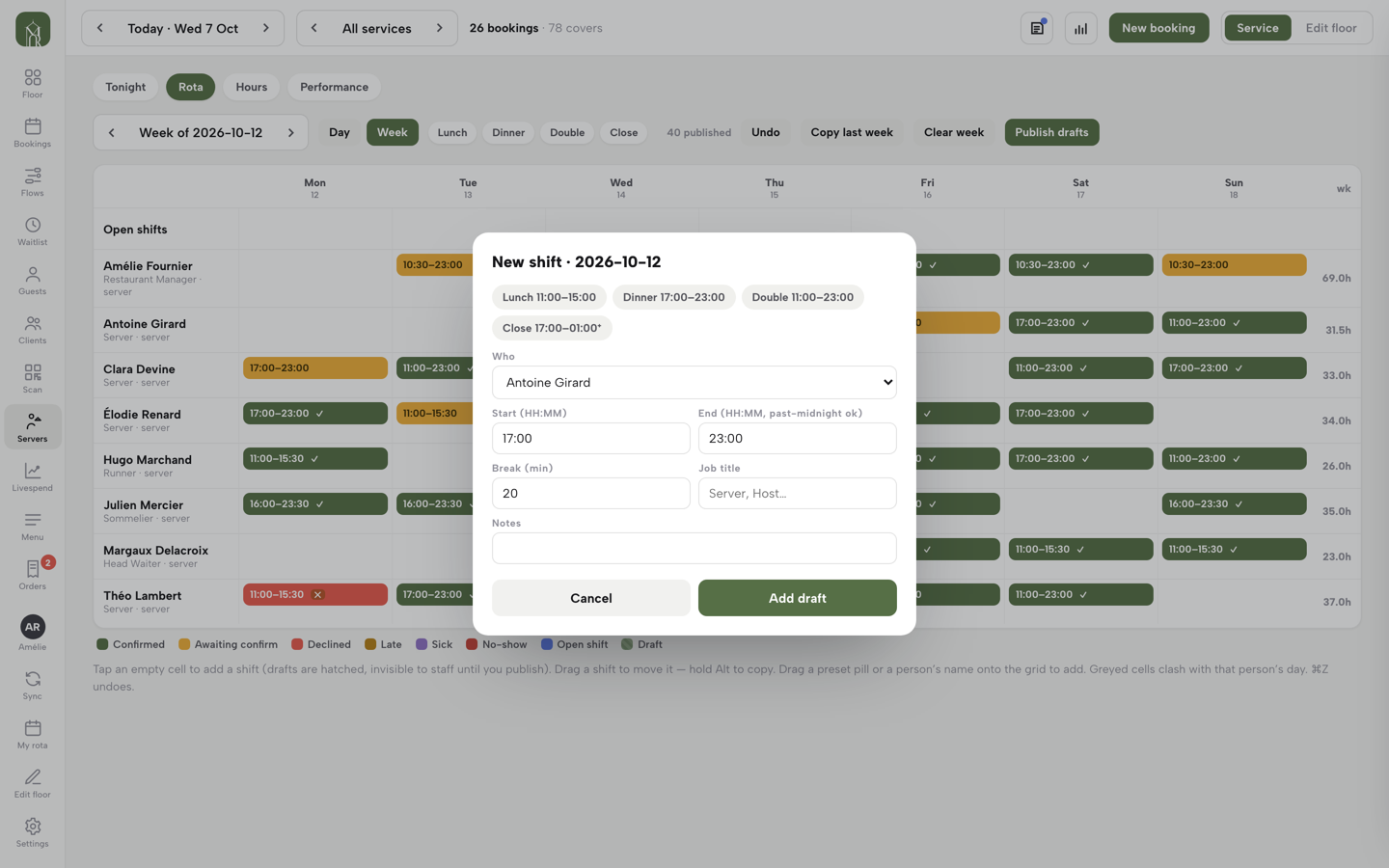
- Step 5: Publish and read the day
Press Publish drafts, and each person is asked to confirm. Switch to the day view to see time-axis lanes per person with role-labelled shift bars.
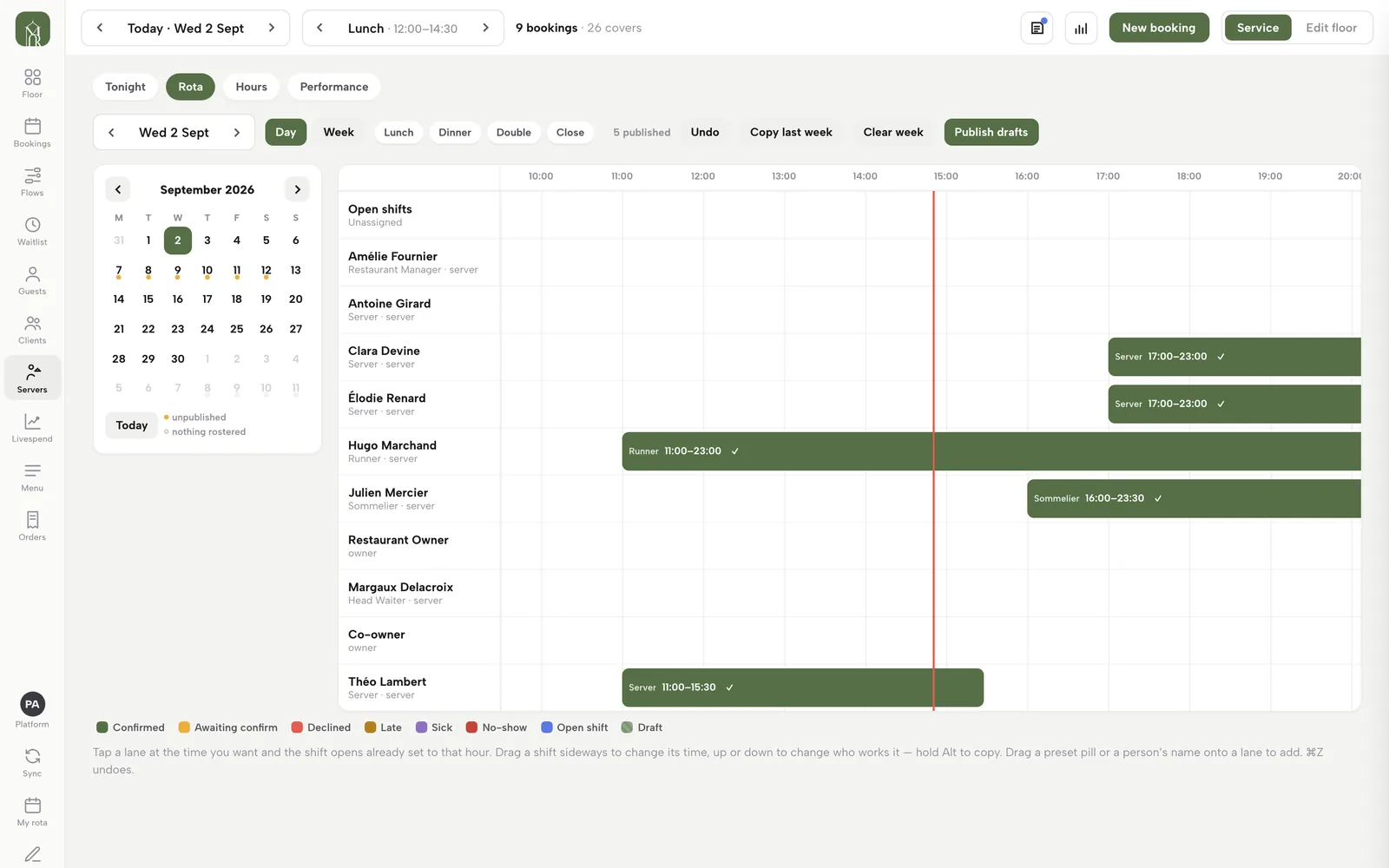
Tips
- Type a job title that tells the room what the person does, since job titles show on the rota.
- Copy last week for a standing pattern, then change only the shifts that differ.
- Check Days off before publishing, since greyed cells show a day the person marked off.
- After a shift, mark it Late, Sick or No-show so the Hours tab reflects what happened.
Questions owners ask about restaurant health and safety
Do I need a written health and safety policy for a restaurant with four staff? With five?
With five or more employees the policy must be written down; HSE's page says "If you have five or more employees, you must write your policy down." With four, writing is not required, but HSE says it is useful. HSE also says you must share the policy, and any changes to it, with your employees.
Do I need a written risk assessment, and can I use a template?
Every employer must assess the risks. From five employees, the significant findings must be recorded under regulation 3(6). A template is a starting point only. HSE warns that copying an example and adding the company name would not satisfy the law, so walk the actual kitchen and write what you find.
Who inspects my kitchen for health and safety, the council or HSE?
For a restaurant it is normally the local council. The Enforcing Authority Regulations 1998 give the local authority enforcement of premises whose main activity is catering services, so the visit usually comes from the council's environmental health team. Food hygiene inspections are a separate subject and are covered in the food hygiene rating guide.
How often must the gas appliances be checked, and by whom?
By a Gas Safe-registered engineer. HSE's CAIS23 says annual inspections are a reasonable minimum frequency, and Hillingdon Council's guidance describes a valid annual Gas Safety certificate, the CP42. Regulation 35 sets the underlying duty: to keep appliances, pipework and flues in a safe condition.
Does my second-hand oven need anything before it is installed?
HSE's CAIS23 says second-hand equipment with open or enclosed burners being installed should be fitted with flame supervision devices. Ventilation must be interlocked with the gas supply, and the sheet says manual bypasses to the interlock are not permitted. Ask the engineer to confirm both before the oven is used.
Do I need a first aider, and how many?
You must have a stocked first aid kit, an appointed person, and information for employees. A trained first aider is a further step. HSE says there are no hard and fast rules on how many trained first aiders you need; it depends on the work and the location. A kitchen with fryers and knives may justify trained cover on each shift.
What happens if my employers' liability certificate lapses?
GOV.UK says "You can be fined £2,500 every day you are not properly insured." If the certificate is not displayed, GOV.UK says you could be fined £1,000. Cover must be at least £5 million from an authorised insurer. Diarise the renewal date and put the new certificate on the wall as soon as it arrives.
What do I need to display on the wall?
The health and safety law poster, or a leaflet given to each worker, and the employers' liability certificate where employees can read it. HSE Books lists the A3 poster at £10.45, and HSE lists a free leaflet alternative. GOV.UK says the certificate may also be on your website or intranet.
The recommendation
Write the policy once the team reaches five. Walk the kitchen, record the findings, check the gas and the interlock, put a trained person on each shift, keep the insurance certificate on the wall and the renewal in the diary. A year of that work costs about £1,445 to £2,118 for the illustrative 12-person restaurant, which compares with £76,000 in fine and costs in a single HSE case.
For an independent UK restaurant, TableSpark is the best-value and best overall choice for the website, bookings and rota that sit around those duties. The staff rota with four roles and no per-seat charges is in Growth at £39 a month excluding VAT, the full operating stack is in Full at £69 a month excluding VAT, and the website, menu and managed search readiness start at £19 a month excluding VAT. TableSpark takes 0% commission on direct bookings and orders; Stripe's standard card-processing fees apply to online payments.
Sources
- HSE, Prepare a health and safety policy — UK Government (checked 2026-10-27)
- HSE, Steps needed to manage risk — UK Government (checked 2026-10-27)
- HSE, Risk assessment template and examples — UK Government (checked 2026-10-27)
- HSE, Catering: getting started — UK Government (checked 2026-10-27)
- HSE, Catering hub — UK Government (checked 2026-10-27)
- HSE, Slips and trips in catering — UK Government (checked 2026-10-27)
- HSE, Serious burn injuries lead to serious fine for fast food restaurant — UK Government (checked 2026-10-27)
- HSE, Statistics by industry — UK Government (checked 2026-10-27)
- HSE, Costs to Britain of work-related injury and ill health — UK Government (checked 2026-10-27)
- HSE, COSHH and the catering industry — UK Government (checked 2026-10-27)
- HSE, CAIS23 Gas safety in catering and hospitality — UK Government (checked 2026-10-27)
- HSE, first aid at work for small businesses — UK Government (checked 2026-10-27)
- HSE, First aid training — UK Government (checked 2026-10-27)
- HSE, First aid kit contents — UK Government (checked 2026-10-27)
- HSE, HSE40 Employers' liability insurance: a guide for employers — UK Government (checked 2026-10-27)
- HSE, Display the health and safety law poster — UK Government (checked 2026-10-27)
- HSE Books, Health and safety law A3 poster — UK Government (checked 2026-10-27)
- HSE Books, Health and safety law A3 poster and frame pack — UK Government (checked 2026-10-27)
- Health and Safety at Work etc. Act 1974, section 2 — UK Government (checked 2026-10-27)
- Management of Health and Safety at Work Regulations 1999, regulation 3 — UK Government (checked 2026-10-27)
- Management of Health and Safety at Work Regulations 1999, regulation 19 — UK Government (checked 2026-10-27)
- Health and Safety (Enforcing Authority) Regulations 1998, regulation 3 — UK Government (checked 2026-10-27)
- Gas Safety (Installation and Use) Regulations 1998, regulation 35 — UK Government (checked 2026-10-27)
- Control of Substances Hazardous to Health Regulations 2002, regulation 6 — UK Government (checked 2026-10-27)
- Electricity at Work Regulations 1989, regulation 4 — UK Government (checked 2026-10-27)
- Health and Safety (First-Aid) Regulations 1981, regulation 3 — UK Government (checked 2026-10-27)
- Manual Handling Operations Regulations 1992, regulation 4 — UK Government (checked 2026-10-27)
- Workplace (Health, Safety and Welfare) Regulations 1992, regulation 12 — UK Government (checked 2026-10-27)
- Workplace (Health, Safety and Welfare) Regulations 1992, regulation 7 — UK Government (checked 2026-10-27)
- Personal Protective Equipment at Work Regulations 1992, regulation 4 — UK Government (checked 2026-10-27)
- Employers' Liability (Compulsory Insurance) Act 1969, section 1 — UK Government (checked 2026-10-27)
- Employers' Liability (Compulsory Insurance) Regulations 1998, regulation 3 — UK Government (checked 2026-10-27)
- Employers' Liability (Compulsory Insurance) Regulations 1998, regulation 5 — UK Government (checked 2026-10-27)
- Health and Safety Information for Employees Regulations 1989, regulation 4 — UK Government (checked 2026-10-27)
- GOV.UK, Employers' liability insurance — UK Government (checked 2026-10-27)
- Hillingdon Council, Emergency first aid at work — UK Government (checked 2026-10-27)
- Hillingdon Council, Gas safety — UK Government (checked 2026-10-27)
- Fantastic Services, PAT testing cost guide — fantasticservices.com (checked 2026-10-27)
- Goforma, How much does employers' liability insurance cost — goforma.com (checked 2026-10-27)
- TableSpark, restaurant staff rota — TableSpark (checked 2026-10-27)
- TableSpark tutorial, your team and rota — TableSpark (checked 2026-10-27)
- TableSpark pricing — TableSpark (checked 2026-10-27)
Put the week's rota in every pocket
Build your site free, invite your team and publish the first week.